1
Deris Stiawan
PhD Candidate
Faculty of Computer Science & Information System
Universiti Teknologi Malaysia
Faculty of Computer Science
University of Sriwijaya, Indonesia
@2011
ICT for fighting Corruption
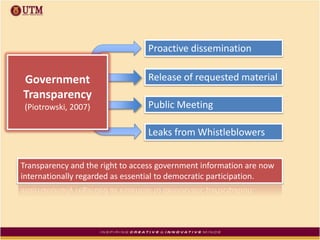
Proactive dissemination
Release of requested material
Public Meeting
Leaks from Whistleblowers
Government
Transparency
(Piotrowski, 2007)
Transparency and the right to access government information are now
internationally regarded as essential to democratic participation.
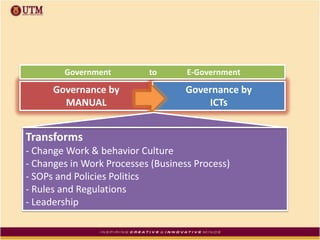
Governance by
MANUAL
Governance by
ICTs
Government to E-Government
Transforms
- Change Work & behavior Culture
- Changes in Work Processes (Business Process)
- SOPs and Policies Politics
- Rules and Regulations
- Leadership
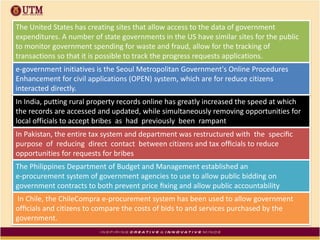
In India, putting rural property records online has greatly increased the speed at which
the records are accessed and updated, while simultaneously removing opportunities for
local officials to accept bribes as had previously been rampant
In Pakistan, the entire tax system and department was restructured with the specific
purpose of reducing direct contact between citizens and tax officials to reduce
opportunities for requests for bribes
The Philippines Department of Budget and Management established an
e-procurement system of government agencies to use to allow public bidding on
government contracts to both prevent price fixing and allow public accountability
In Chile, the ChileCompra e-procurement system has been used to allow government
officials and citizens to compare the costs of bids to and services purchased by the
government.
The United States has creating sites that allow access to the data of government
expenditures. A number of state governments in the US have similar sites for the public
to monitor government spending for waste and fraud, allow for the tracking of
transactions so that it is possible to track the progress requests applications.
e-government initiatives is the Seoul Metropolitan Government's Online Procedures
Enhancement for civil applications (OPEN) system, which are for reduce citizens
interacted directly.
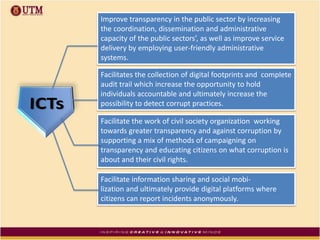
Improve transparency in the public sector by increasing
the coordination, dissemination and administrative
capacity of the public sectors’, as well as improve service
delivery by employing user-friendly administrative
systems.
Facilitates the collection of digital footprints and complete
audit trail which increase the opportunity to hold
individuals accountable and ultimately increase the
possibility to detect corrupt practices.
Facilitate the work of civil society organization working
towards greater transparency and against corruption by
supporting a mix of methods of campaigning on
transparency and educating citizens on what corruption is
about and their civil rights.
Facilitate information sharing and social mobi-
lization and ultimately provide digital platforms where
citizens can report incidents anonymously.
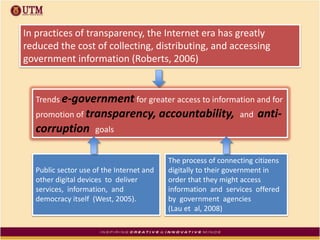
In practices of transparency, the Internet era has greatly
reduced the cost of collecting, distributing, and accessing
government information (Roberts, 2006)
Trends e-government for greater access to information and for
promotion of transparency, accountability, and anti-
corruption goals
Public sector use of the Internet and
other digital devices to deliver
services, information, and
democracy itself (West, 2005).
The process of connecting citizens
digitally to their government in
order that they might access
information and services offered
by government agencies
(Lau et al, 2008)
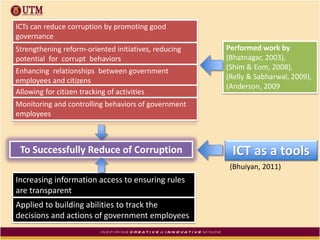
Performed work by
(Bhatnagar, 2003),
(Shim & Eom, 2008),
(Relly & Sabharwal, 2009),
(Anderson, 2009
ICTs can reduce corruption by promoting good
governance
Strengthening reform-oriented initiatives, reducing
potential for corrupt behaviors
Enhancing relationships between government
employees and citizens
Allowing for citizen tracking of activities
Monitoring and controlling behaviors of government
employees
To Successfully Reduce of Corruption
Increasing information access to ensuring rules
are transparent
Applied to building abilities to track the
decisions and actions of government employees
ICT as a tools
(Bhuiyan, 2011)
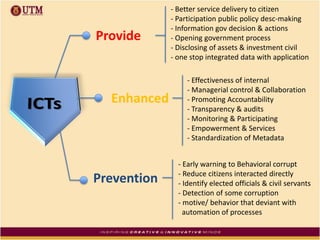
Enhanced
Prevention
Provide
- Better service delivery to citizen
- Participation public policy desc-making
- Information gov decision & actions
- Opening government process
- Disclosing of assets & investment civil
- one stop integrated data with application
- Effectiveness of internal
- Managerial control & Collaboration
- Promoting Accountability
- Transparency & audits
- Monitoring & Participating
- Empowerment & Services
- Standardization of Metadata
- Early warning to Behavioral corrupt
- Reduce citizens interacted directly
- Identify elected officials & civil servants
- Detection of some corruption
- motive/ behavior that deviant with
automation of processes
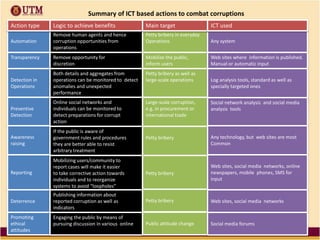
Remove human agents and hence
corruption opportunities from
operations
Remove opportunity for
discretion
Automation
Transparency
Detection in
Operations
Preventive
Detection
Awareness
raising
Reporting
Deterrence
Promoting
ethical
attitudes
Both details and aggregates from
operations can be monitored to detect
anomalies and unexpected
performance
Online social networks and
individuals can be monitored to
detect preparations for corrupt
action
If the public is aware of
government rules and procedures
they are better able to resist
arbitrary treatment
Mobilizing users/community to
report cases will make it easier
to take corrective action towards
individuals and to reorganize
systems to avoid “loopholes”
Petty bribery in everyday
Operations
Mobilize the public,
inform users
Petty bribery as well as
large-scale operations
Any system
Web sites where information is published.
Manual or automatic input
Log analysis tools, standard as well as
specially targeted ones
Large-scale corruption,
e.g. in procurement or
international trade
Petty bribery
Petty bribery
Publishing information about
reported corruption as well as
indicators
Engaging the public by means of
pursuing discussion in various online
Action type Logic to achieve benefits Main target ICT used
Petty bribery
Public attitude change
Social network analysis and social media
analysis tools
Any technology, but web sites are most
Common
Web sites, social media networks, online
newspapers, mobile phones, SMS for
input
Web sites, social media networks
Social media forums
Summary of ICT based actions to combat corruptions
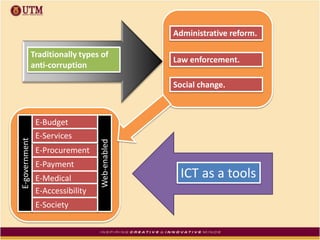
Traditionally types of
anti-corruption
Administrative reform.
Law enforcement.
Social change.
ICT as a tools
E-government
Web-enabled
E-Budget
E-Procurement
E-Payment
E-Medical
E-Accessibility
E-Services
E-Society
E-Procurement
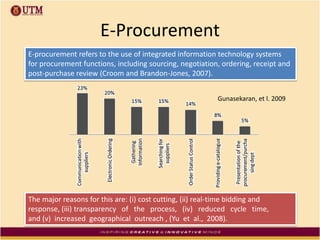
E-procurement refers to the use of integrated information technology systems
for procurement functions, including sourcing, negotiation, ordering, receipt and
post-purchase review (Croom and Brandon-Jones, 2007).
The major reasons for this are: (i) cost cutting, (ii) real-time bidding and
response, (iii) transparency of the process, (iv) reduced cycle time,
and (v) increased geographical outreach , (Yu et al., 2008).
Gunasekaran, et l. 2009
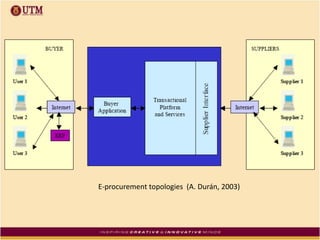
E-procurement topologies (A. Durán, 2003)
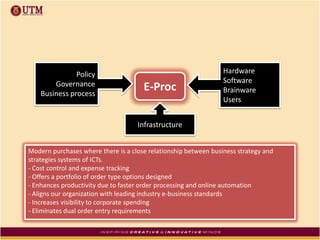
E-Proc
Hardware
Software
Brainware
Users
Policy
Governance
Business process
Infrastructure
Modern purchases where there is a close relationship between business strategy and
strategies systems of ICTs.
- Cost control and expense tracking
- Offers a portfolio of order type options designed
- Enhances productivity due to faster order processing and online automation
- Aligns our organization with leading industry e-business standards
- Increases visibility to corporate spending
- Eliminates dual order entry requirements
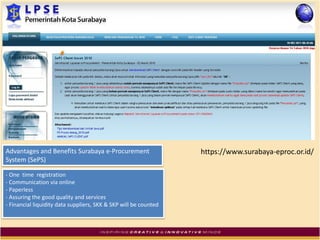
Advantages and Benefits Surabaya e-Procurement
System (SePS)
- One time registration
- Communication via online
- Paperless
- Assuring the good quality and services
- Financial liquidity data suppliers, SKK & SKP will be counted
https://www.surabaya-eproc.or.id/
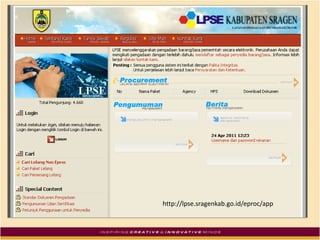
http://lpse.sragenkab.go.id/eproc/app
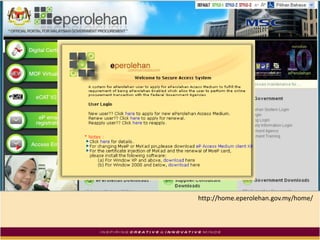
http://home.eperolehan.gov.my/home/
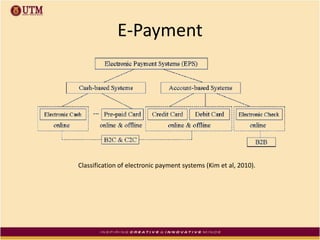
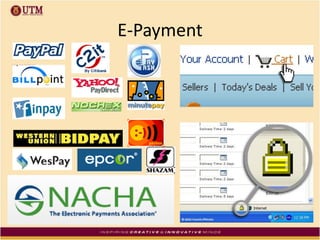
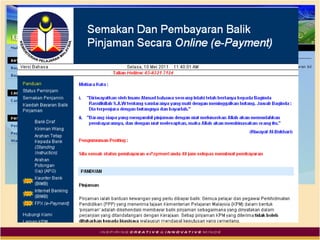
E-Payment
Classification of electronic payment systems (Kim et al, 2010).
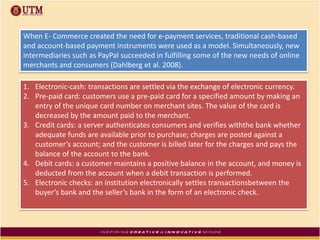
1. Electronic-cash: transactions are settled via the exchange of electronic currency.
2. Pre-paid card: customers use a pre-paid card for a specified amount by making an
entry of the unique card number on merchant sites. The value of the card is
decreased by the amount paid to the merchant.
3. Credit cards: a server authenticates consumers and verifies withthe bank whether
adequate funds are available prior to purchase; charges are posted against a
customer’s account; and the customer is billed later for the charges and pays the
balance of the account to the bank.
4. Debit cards: a customer maintains a positive balance in the account, and money is
deducted from the account when a debit transaction is performed.
5. Electronic checks: an institution electronically settles transactionsbetween the
buyer’s bank and the seller’s bank in the form of an electronic check.
When E- Commerce created the need for e-payment services, traditional cash-based
and account-based payment instruments were used as a model. Simultaneously, new
intermediaries such as PayPal succeeded in fulfilling some of the new needs of online
merchants and consumers (Dahlberg et al. 2008).
E-Payment
SCM - CRM
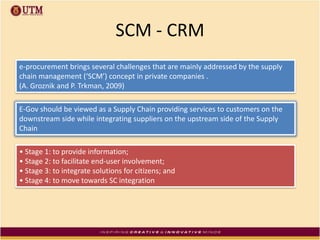
• Stage 1: to provide information;
• Stage 2: to facilitate end-user involvement;
• Stage 3: to integrate solutions for citizens; and
• Stage 4: to move towards SC integration
e-procurement brings several challenges that are mainly addressed by the supply
chain management (‘SCM’) concept in private companies .
(A. Groznik and P. Trkman, 2009)
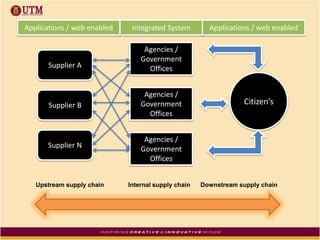
E-Gov should be viewed as a Supply Chain providing services to customers on the
downstream side while integrating suppliers on the upstream side of the Supply
Chain
Agencies /
Government
Offices
Agencies /
Government
Offices
Agencies /
Government
Offices
Citizen’s
Supplier A
Supplier B
Supplier N
Upstream supply chain Internal supply chain Downstream supply chain
Applications / web enabledIntegrated SystemApplications / web enabled
Problem & Challenges
Performed work by (Bhuiyan, 2011), there are problem & challenges:
- Social and cultural constraints
- Political consensus constraints
- Human resources constraints
- Digital divide constraints
- Infrastructural development constraints
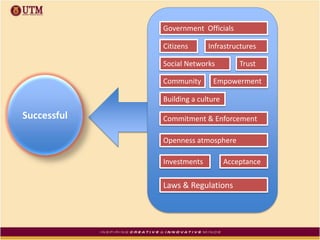
Successful
Government Officials
Citizens
Social Networks
Community
Infrastructures
Commitment & Enforcement
Building a culture
Trust
Empowerment
Openness atmosphere
Investments Acceptance
Laws & Regulations
References
S.E. Alptekin and E.E. Karsak, “An integrated decision framework for evaluating and selecting e-learning products,”
Applied Soft Computing, vol. 11, Apr. 2011, pp. 2990-2998.
S.H. Bhuiyan, “Modernizing Bangladesh public administration through e-governance: Benefits and challenges,”
Government Information Quarterly, vol. 28, Jan. 2011, pp. 54-65.
A. Gunasekaran, R.E. McGaughey, E.W.T. Ngai, and B.K. Rai, “E-Procurement adoption in the Southcoast SMEs,”
International Journal of Production Economics, vol. 122, Nov. 2009, pp. 161-175.
U. Nations, “Anti-Corruption Symposium 2001 : The Role of On-line Procedures in Promoting Good Governance,”
Symposium A Quarterly Journal In Modern Foreign Literatures, 2003.
R.W. Nichols, “Innovation, change, and order: Reflections on science and technology in India, China, and the United
States,” Technology in Society, vol. 30, Aug. 2008, pp. 437-450.
D. Soper and D.S. Soper, “ICT Investment Impacts on Future Levels of Democracy , Corruption , and E-Government
Acceptance in Emerging Countries,” Information Systems, 2007.
P. Sturges, “Corruption, Transparency and a Role for ICT?,” Journal of Information Ethics, vol. 2, 2004, pp. 1-9.
E. Ponce and A. Durán, “Characterization of the Security Implications of Alternative E-procurement Topologies
Alternative E-procurement Topologies,” Security, 2003, pp. 114-122.
T.B. Andersen, “E-Government as an anti-corruption strategy,” Information Economics and Policy, vol. 21, Aug. 2009,
pp. 201-210.
A. Groznik and P. Trkman, “Upstream supply chain management in e-government: The case of Slovenia,” Government
Information Quarterly, vol. 26, Jul. 2009, pp. 459-467.
Presented by :
Prof. Abdul Hanan Abdullah. M.Sc., Ph.D,
Receive the B.Sc. and M.Sc from San Francisco, California, and Ph.D degree from
Aston University, Birmingham, UK, in 1995. He is a Professor at Faculty of Computer
Science & Information System, Universiti Teknologi Malaysia (UTM).
His reseach interest is in Information/ Network Security & ICT Infrastructure.
He is also a head of Pervasive Computing Research Group (PCRG) UTM and member
of IEEE & ACM.
Contact : hanan@utm.my & blog : http://csc.fsksm.utm.my/hanan/
Provide by :
Deris Stiawan. Holds an M.Eng from University of Gadjah Mada, Indonesia,
since 2006, he is Computer Science faculty member at University of Sriwijaya,
Indonesia. He is member of IEEE and currently pursuing his Ph.D degree at
Faculty of Computer Science & Information System, Universiti Teknologi
Malaysia (UTM) working in intrusion prevention system. He joined research
group Information Assurance and Security Research Group (IASRG) in the
area of Intrusion Prevention and Detection (ITD) at UTM. His professional
profile has derived to the field of computer network and network security,
specially focused on intrusion prevention and network infrastructure.
http://webs.fsksm.utm.my/blog/pcrg/derissetiawan/

ICT for fighting Corruption

  • 1.
    1 Deris Stiawan PhD Candidate Facultyof Computer Science & Information System Universiti Teknologi Malaysia Faculty of Computer Science University of Sriwijaya, Indonesia @2011 ICT for fighting Corruption
  • 3.
    Proactive dissemination Release ofrequested material Public Meeting Leaks from Whistleblowers Government Transparency (Piotrowski, 2007) Transparency and the right to access government information are now internationally regarded as essential to democratic participation.
  • 4.
    Governance by MANUAL Governance by ICTs Governmentto E-Government Transforms - Change Work & behavior Culture - Changes in Work Processes (Business Process) - SOPs and Policies Politics - Rules and Regulations - Leadership
  • 5.
    In India, puttingrural property records online has greatly increased the speed at which the records are accessed and updated, while simultaneously removing opportunities for local officials to accept bribes as had previously been rampant In Pakistan, the entire tax system and department was restructured with the specific purpose of reducing direct contact between citizens and tax officials to reduce opportunities for requests for bribes The Philippines Department of Budget and Management established an e-procurement system of government agencies to use to allow public bidding on government contracts to both prevent price fixing and allow public accountability In Chile, the ChileCompra e-procurement system has been used to allow government officials and citizens to compare the costs of bids to and services purchased by the government. The United States has creating sites that allow access to the data of government expenditures. A number of state governments in the US have similar sites for the public to monitor government spending for waste and fraud, allow for the tracking of transactions so that it is possible to track the progress requests applications. e-government initiatives is the Seoul Metropolitan Government's Online Procedures Enhancement for civil applications (OPEN) system, which are for reduce citizens interacted directly.
  • 7.
    Improve transparency inthe public sector by increasing the coordination, dissemination and administrative capacity of the public sectors’, as well as improve service delivery by employing user-friendly administrative systems. Facilitates the collection of digital footprints and complete audit trail which increase the opportunity to hold individuals accountable and ultimately increase the possibility to detect corrupt practices. Facilitate the work of civil society organization working towards greater transparency and against corruption by supporting a mix of methods of campaigning on transparency and educating citizens on what corruption is about and their civil rights. Facilitate information sharing and social mobi- lization and ultimately provide digital platforms where citizens can report incidents anonymously.
  • 8.
    In practices oftransparency, the Internet era has greatly reduced the cost of collecting, distributing, and accessing government information (Roberts, 2006) Trends e-government for greater access to information and for promotion of transparency, accountability, and anti- corruption goals Public sector use of the Internet and other digital devices to deliver services, information, and democracy itself (West, 2005). The process of connecting citizens digitally to their government in order that they might access information and services offered by government agencies (Lau et al, 2008)
  • 9.
    Performed work by (Bhatnagar,2003), (Shim & Eom, 2008), (Relly & Sabharwal, 2009), (Anderson, 2009 ICTs can reduce corruption by promoting good governance Strengthening reform-oriented initiatives, reducing potential for corrupt behaviors Enhancing relationships between government employees and citizens Allowing for citizen tracking of activities Monitoring and controlling behaviors of government employees To Successfully Reduce of Corruption Increasing information access to ensuring rules are transparent Applied to building abilities to track the decisions and actions of government employees ICT as a tools (Bhuiyan, 2011)
  • 10.
    Enhanced Prevention Provide - Better servicedelivery to citizen - Participation public policy desc-making - Information gov decision & actions - Opening government process - Disclosing of assets & investment civil - one stop integrated data with application - Effectiveness of internal - Managerial control & Collaboration - Promoting Accountability - Transparency & audits - Monitoring & Participating - Empowerment & Services - Standardization of Metadata - Early warning to Behavioral corrupt - Reduce citizens interacted directly - Identify elected officials & civil servants - Detection of some corruption - motive/ behavior that deviant with automation of processes
  • 11.
    Remove human agentsand hence corruption opportunities from operations Remove opportunity for discretion Automation Transparency Detection in Operations Preventive Detection Awareness raising Reporting Deterrence Promoting ethical attitudes Both details and aggregates from operations can be monitored to detect anomalies and unexpected performance Online social networks and individuals can be monitored to detect preparations for corrupt action If the public is aware of government rules and procedures they are better able to resist arbitrary treatment Mobilizing users/community to report cases will make it easier to take corrective action towards individuals and to reorganize systems to avoid “loopholes” Petty bribery in everyday Operations Mobilize the public, inform users Petty bribery as well as large-scale operations Any system Web sites where information is published. Manual or automatic input Log analysis tools, standard as well as specially targeted ones Large-scale corruption, e.g. in procurement or international trade Petty bribery Petty bribery Publishing information about reported corruption as well as indicators Engaging the public by means of pursuing discussion in various online Action type Logic to achieve benefits Main target ICT used Petty bribery Public attitude change Social network analysis and social media analysis tools Any technology, but web sites are most Common Web sites, social media networks, online newspapers, mobile phones, SMS for input Web sites, social media networks Social media forums Summary of ICT based actions to combat corruptions
  • 12.
    Traditionally types of anti-corruption Administrativereform. Law enforcement. Social change. ICT as a tools E-government Web-enabled E-Budget E-Procurement E-Payment E-Medical E-Accessibility E-Services E-Society
  • 13.
    E-Procurement E-procurement refers tothe use of integrated information technology systems for procurement functions, including sourcing, negotiation, ordering, receipt and post-purchase review (Croom and Brandon-Jones, 2007). The major reasons for this are: (i) cost cutting, (ii) real-time bidding and response, (iii) transparency of the process, (iv) reduced cycle time, and (v) increased geographical outreach , (Yu et al., 2008). Gunasekaran, et l. 2009
  • 14.
  • 15.
    E-Proc Hardware Software Brainware Users Policy Governance Business process Infrastructure Modern purchaseswhere there is a close relationship between business strategy and strategies systems of ICTs. - Cost control and expense tracking - Offers a portfolio of order type options designed - Enhances productivity due to faster order processing and online automation - Aligns our organization with leading industry e-business standards - Increases visibility to corporate spending - Eliminates dual order entry requirements
  • 16.
    Advantages and BenefitsSurabaya e-Procurement System (SePS) - One time registration - Communication via online - Paperless - Assuring the good quality and services - Financial liquidity data suppliers, SKK & SKP will be counted https://www.surabaya-eproc.or.id/
  • 17.
  • 18.
  • 19.
    E-Payment Classification of electronicpayment systems (Kim et al, 2010).
  • 20.
    1. Electronic-cash: transactionsare settled via the exchange of electronic currency. 2. Pre-paid card: customers use a pre-paid card for a specified amount by making an entry of the unique card number on merchant sites. The value of the card is decreased by the amount paid to the merchant. 3. Credit cards: a server authenticates consumers and verifies withthe bank whether adequate funds are available prior to purchase; charges are posted against a customer’s account; and the customer is billed later for the charges and pays the balance of the account to the bank. 4. Debit cards: a customer maintains a positive balance in the account, and money is deducted from the account when a debit transaction is performed. 5. Electronic checks: an institution electronically settles transactionsbetween the buyer’s bank and the seller’s bank in the form of an electronic check. When E- Commerce created the need for e-payment services, traditional cash-based and account-based payment instruments were used as a model. Simultaneously, new intermediaries such as PayPal succeeded in fulfilling some of the new needs of online merchants and consumers (Dahlberg et al. 2008).
  • 21.
  • 23.
    SCM - CRM •Stage 1: to provide information; • Stage 2: to facilitate end-user involvement; • Stage 3: to integrate solutions for citizens; and • Stage 4: to move towards SC integration e-procurement brings several challenges that are mainly addressed by the supply chain management (‘SCM’) concept in private companies . (A. Groznik and P. Trkman, 2009) E-Gov should be viewed as a Supply Chain providing services to customers on the downstream side while integrating suppliers on the upstream side of the Supply Chain
  • 24.
    Agencies / Government Offices Agencies / Government Offices Agencies/ Government Offices Citizen’s Supplier A Supplier B Supplier N Upstream supply chain Internal supply chain Downstream supply chain Applications / web enabledIntegrated SystemApplications / web enabled
  • 25.
    Problem & Challenges Performedwork by (Bhuiyan, 2011), there are problem & challenges: - Social and cultural constraints - Political consensus constraints - Human resources constraints - Digital divide constraints - Infrastructural development constraints
  • 26.
    Successful Government Officials Citizens Social Networks Community Infrastructures Commitment& Enforcement Building a culture Trust Empowerment Openness atmosphere Investments Acceptance Laws & Regulations
  • 27.
    References S.E. Alptekin andE.E. Karsak, “An integrated decision framework for evaluating and selecting e-learning products,” Applied Soft Computing, vol. 11, Apr. 2011, pp. 2990-2998. S.H. Bhuiyan, “Modernizing Bangladesh public administration through e-governance: Benefits and challenges,” Government Information Quarterly, vol. 28, Jan. 2011, pp. 54-65. A. Gunasekaran, R.E. McGaughey, E.W.T. Ngai, and B.K. Rai, “E-Procurement adoption in the Southcoast SMEs,” International Journal of Production Economics, vol. 122, Nov. 2009, pp. 161-175. U. Nations, “Anti-Corruption Symposium 2001 : The Role of On-line Procedures in Promoting Good Governance,” Symposium A Quarterly Journal In Modern Foreign Literatures, 2003. R.W. Nichols, “Innovation, change, and order: Reflections on science and technology in India, China, and the United States,” Technology in Society, vol. 30, Aug. 2008, pp. 437-450. D. Soper and D.S. Soper, “ICT Investment Impacts on Future Levels of Democracy , Corruption , and E-Government Acceptance in Emerging Countries,” Information Systems, 2007. P. Sturges, “Corruption, Transparency and a Role for ICT?,” Journal of Information Ethics, vol. 2, 2004, pp. 1-9. E. Ponce and A. Durán, “Characterization of the Security Implications of Alternative E-procurement Topologies Alternative E-procurement Topologies,” Security, 2003, pp. 114-122. T.B. Andersen, “E-Government as an anti-corruption strategy,” Information Economics and Policy, vol. 21, Aug. 2009, pp. 201-210. A. Groznik and P. Trkman, “Upstream supply chain management in e-government: The case of Slovenia,” Government Information Quarterly, vol. 26, Jul. 2009, pp. 459-467.
  • 28.
    Presented by : Prof.Abdul Hanan Abdullah. M.Sc., Ph.D, Receive the B.Sc. and M.Sc from San Francisco, California, and Ph.D degree from Aston University, Birmingham, UK, in 1995. He is a Professor at Faculty of Computer Science & Information System, Universiti Teknologi Malaysia (UTM). His reseach interest is in Information/ Network Security & ICT Infrastructure. He is also a head of Pervasive Computing Research Group (PCRG) UTM and member of IEEE & ACM. Contact : hanan@utm.my & blog : http://csc.fsksm.utm.my/hanan/ Provide by : Deris Stiawan. Holds an M.Eng from University of Gadjah Mada, Indonesia, since 2006, he is Computer Science faculty member at University of Sriwijaya, Indonesia. He is member of IEEE and currently pursuing his Ph.D degree at Faculty of Computer Science & Information System, Universiti Teknologi Malaysia (UTM) working in intrusion prevention system. He joined research group Information Assurance and Security Research Group (IASRG) in the area of Intrusion Prevention and Detection (ITD) at UTM. His professional profile has derived to the field of computer network and network security, specially focused on intrusion prevention and network infrastructure. http://webs.fsksm.utm.my/blog/pcrg/derissetiawan/