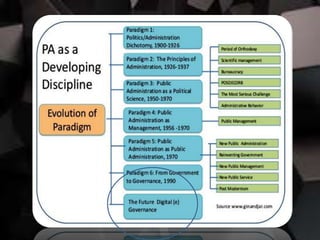
The Future
of Digital
GovernanceJosefina B. Bitonio, DPA
Professor
o Global Network Civilization of the 21st
Century
o Greater force sweeping the planet, global
connectivity on its form shaping the world
o Global system is evolving
Parag Khana (2016)
Connectivity the most important
asset class in the 21st Century
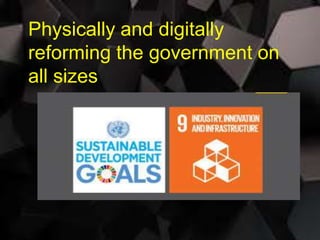
Physically and digitally
reforming the government on
all sizes
Parag Khana (2016)
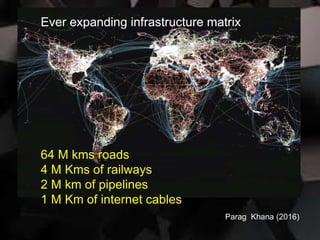
Ever expanding infrastructure matrix
64 M kms roads
4 M Kms of railways
2 M km of pipelines
1 M Km of internet cables
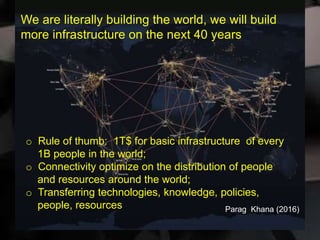
We are literally building the world, we will build
more infrastructure on the next 40 years
o Rule of thumb: 1T$ for basic infrastructure of every
1B people in the world;
o Connectivity optimize on the distribution of people
and resources around the world;
o Transferring technologies, knowledge, policies,
people, resources Parag Khana (2016)
ASEAN’s e-
Readiness Are
We Ready for the
Networked
World?
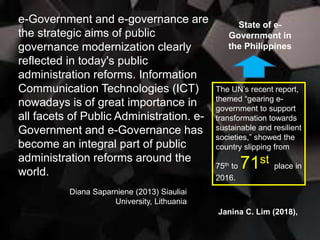
e-Government and e-governance are
the strategic aims of public
governance modernization clearly
reflected in today's public
administration reforms. Information
Communication Technologies (ICT)
nowadays is of great importance in
all facets of Public Administration. e-
Government and e-Governance has
become an integral part of public
administration reforms around the
world.
Diana Saparniene (2013) Siauliai
University, Lithuania
State of e-
Government in
the Philippines
The UN’s recent report,
themed “gearing e-
government to support
transformation towards
sustainable and resilient
societies,” showed the
country slipping from
75th to 71st place in
2016.
Janina C. Lim (2018),
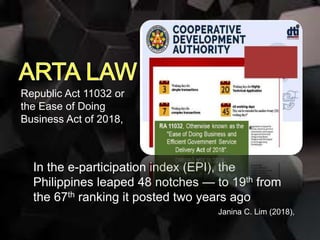
Republic Act 11032 or
the Ease of Doing
Business Act of 2018,
In the e-participation index (EPI), the
Philippines leaped 48 notches — to 19th from
the 67th ranking it posted two years ago
Janina C. Lim (2018),
changing Jobs and
Enterprises?
How Technology is
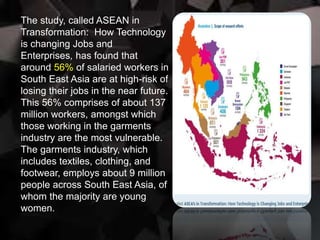
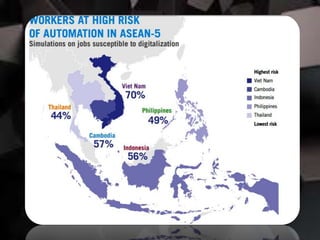
The study, called ASEAN in
Transformation: How Technology
is changing Jobs and
Enterprises, has found that
around 56% of salaried workers in
South East Asia are at high-risk of
losing their jobs in the near future.
This 56% comprises of about 137
million workers, amongst which
those working in the garments
industry are the most vulnerable.
The garments industry, which
includes textiles, clothing, and
footwear, employs about 9 million
people across South East Asia, of
whom the majority are young
women.
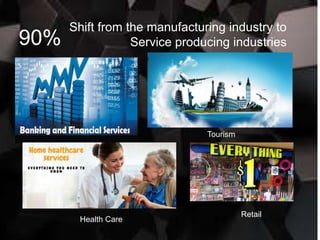
Shift from the manufacturing industry to
Service producing industries
Tourism
Health Care
Retail
90%
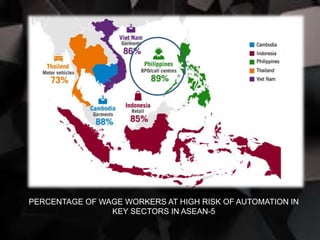
PERCENTAGE OF WAGE WORKERS AT HIGH RISK OF AUTOMATION IN
KEY SECTORS IN ASEAN-5
[WEF (Sep. 2018)
Shaping ASEAN’s
Future Readiness]
Global value chains are continuing to
shift, especially from East Asia, but also
increasing reshoring. New technologies
are disrupting and fostering a technology-
based model of production, challenging
especially the region’s SMEs.”
“Can ASEAN Turn
Geostrategic
and Technological Disruption
into Opportunity?”
[Project Syndicate, Sep. 4, 2018]
“Trade war and costs speeding shifts
of production to ASEAN and USA”
[Next Big Future, Sep. 21, 2018]
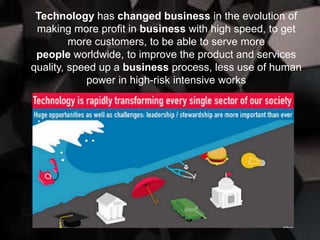
Technology has changed business in the evolution of
making more profit in business with high speed, to get
more customers, to be able to serve more
people worldwide, to improve the product and services
quality, speed up a business process, less use of human
power in high-risk intensive works
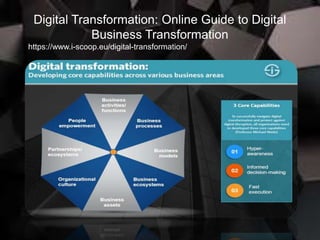
Digital Transformation: Online Guide to Digital
Business Transformation
https://www.i-scoop.eu/digital-transformation/
Digital Business Transformation Areas
Digital transformation in the integrated and connected sense
which it requires can, among, others, touch upon the
transformation of:
• Business activities/functions: marketing, operations, human
resources, administration, customer service, etc.
• Business processes: one or more connected operations,
activities and sets to achieve a specific business goal, whereby
business process management, business process optimization
and business process automation come into the picture (with
new technologies such as RPA). Business process
optimization is essential in digital transformation strategies and
in most industries and cases is a mix of customer-facing goals
and internal goals today.
• Business ecosystems: the networks of partners and
stakeholders, as well as contextual factors affecting the
business such as regulatory or economic priorities and
evolutions. New ecosystems are built between companies
with various background upon the fabric of digital
transformation, information, whereby data and actionable
intelligence become innovation assets.
• Business asset management: whereby the focus lies on
traditional assets but, increasingly, on less ‘tangible’
assets such as information and customers (enhancing
customer experience is a leading goal of many digital
transformation “projects” and information is the lifeblood
of business, technological evolutions and of any human
relationship). Both customers and information need to be
treated as real assets in all perspectives.
• Organizational culture, whereby there must be a clear
customer-centric, agile and hyper-aware goal which is
achieved by acquiring core competencies across the board
in areas such as digital maturity, leadership, knowledge
worker silos and so forth. Culture also overlaps with
processes, business activities, collaboration and the IT-
side of digital transformation. In order to bring applications
faster to market changes are required. That’s the essence
of DevOps: development and operations. In order to make
IT and OC work together in businesses /processes
/activities, change is required too (it’s not just the
information and operational technologies, it’s the
processes, culture, collaboration). Etc.
Ecosystem and partnership models, with
among others a rise of co-operative,
collaborative, co-creating and, last but not
lost, entirely new business ecosystem
approaches, leading to new business
models and revenue sources. Ecosystems
will be key in the as-a-service-economy and
in achieving digital transformation success.
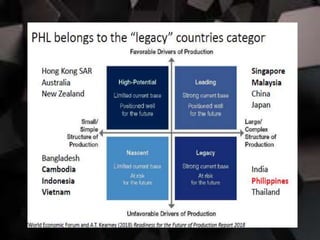
[ASEC Aldaba, DTI, quoted by the Philippine
Information Agency on May 17, 2018]
“The recent assessment
report of WEF
showed that Philippines has
a low level of
readiness for future
production ”
Global Leadership Forecast 2018
• 50% of the 2006 Fortune companies will no
longer exist
• Many companies are unable to keep up with
the pace
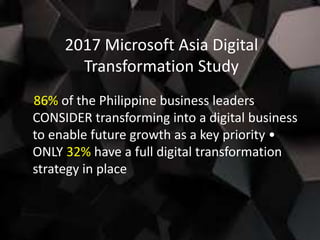
2017 Microsoft Asia Digital
Transformation Study
86% of the Philippine business leaders
CONSIDER transforming into a digital business
to enable future growth as a key priority •
ONLY 32% have a full digital transformation
strategy in place
Are we ready?
World of constant disruption and innovation”
URGENT NEED to groom digital leaders
for Philippine businesses to grow and
remain relevant in the future
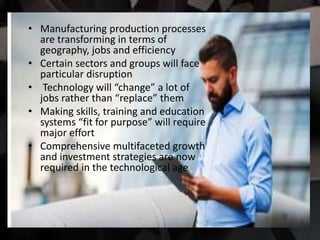
• Manufacturing production processes
are transforming in terms of
geography, jobs and efficiency
• Certain sectors and groups will face
particular disruption
• Technology will “change” a lot of
jobs rather than “replace” them
• Making skills, training and education
systems “fit for purpose” will require
major effort
• Comprehensive multifaceted growth
and investment strategies are now
required in the technological age
Technology recruitment will be robust in
2018, with digital transformation driving much
of the demand. Many businesses in the future
looked to integrate a digital strategy into their
overall business approach. This has led to
huge demand for digitally astute candidates in
all areas of technology.
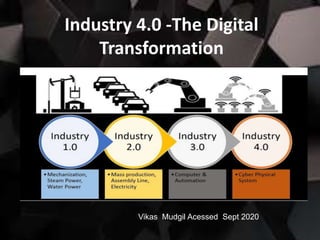
Industry 4.0 -The Digital
Transformation
Vikas Mudgil Acessed Sept 2020
Industry Revolution 4.0
Know anything,
anytime, anywhere
Global community will
connect everything,
everywhere always -
the INTERNET of
Everything
• Autonomous Ubers Hit the
Streets
• FORD will produce ride-sharing
driverless cars in 2021
• Keyless cars
Electric Autonomous Cars
• 10 x Cheaper than car ownership
• Experts predict car ownership
“dead” by 2025 (carless)
• Autonomous aerial taxi services
TOP Careers in IR 4.0 (World
Economic Forum Report)
• Controls Systems Engineer
• Automation Engineer
• Validation Engineer
• Equipment Systems Engineer
• Data Scientist
• Robotics Engineer
• IT Solution Architect
• UI ( User Interface ) and UX
(User Experience) Designer
• Project Manager
• AI
• Robotics
• 3D printing
• Nanotechnology
• Quantum computing
• Biotechnology
• The Internet of Things
• Autonomous transport
• Aerospace
• Genomics (mapping and
editing of genomes)
New Areas of Work in IR 4.0
• Creation and Designing of
Automated and Online
Processes
New Titles for IR 4.0.
• Professor of E-Learning
Technologies
• Digital Learning Professor
• Digital Director
• Vice Chancellor for Innovative
Learning
Other Areas Seen to Be
Stable in IR 4.0
• Consumer Products (73% stable),
• Healthcare (71% stable),
• Energy (70% stable),
• Professional Services (67%
stable),
Other Areas Seen to Be
Stable in IR 4.0
• Media & Entertainment (65% stable)
• ICT (65% stable)
• Infrastructure (58%) and
• Financial/Investor services (57%
stable)
Source: weforum.org .
IR 4.0 - Multi-skilled workers
• In many cases, occupational
categories will overlap with one
another to form new roles.
• Not generalist
• Not specialist
• But MULTI-SPECIALIST
10 Skills for the Fourth
Industrial Revolution
• Complex Problem Solving
• Critical Thinking
• Creativity
• People Management
• Coordinating with Others
Source: World Economic Forum Report
• Emotional Intelligence
• Judgment and Decision- making
• Service Orientation
• Negotiation
• Cognitive Flexibility
(Source : World Economic Forum Report)
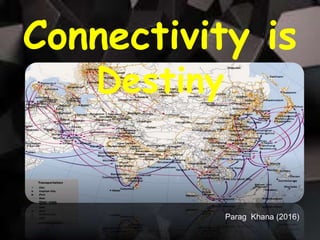
Connectivity is
Destiny
Parag Khana (2016)
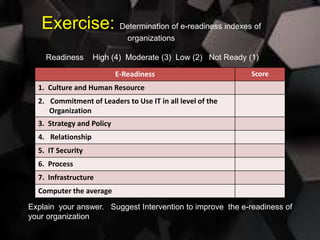
Exercise: Determination of e-readiness indexes of
organizations
Readiness High (4) Moderate (3) Low (2) Not Ready (1)
E-Readiness Score
1. Culture and Human Resource
2. Commitment of Leaders to Use IT in all level of the
Organization
3. Strategy and Policy
4. Relationship
5. IT Security
6. Process
7. Infrastructure
Computer the average
Explain your answer. Suggest Intervention to improve the e-readiness of
your organization
What is your
learning in PL
Reference
• ILO (2017) ASEAN IN TRANSFORMATION HOW
TECHNOLOGY IS CHANGING JOBS AND ENTERPRISES
• Hideki Kagohashi (2018) Disruptive Technologies, Future of
Work and Cooperative Future. 3rd International
Conference on Cooperatives “Cooperative Transformation
in the Changing Global Economy” at Development Academy
of the Philippines Conference Center, Tagaytay City,
Philippines
• How megacities are changing the map of the world | Parag
Khanna
https://www.youtube.com/watch?v=U7y4GlmwPLQ
https://unctad.org/meetings/en/Presentation/cstd2016_p24_Jae-
HeeChang_ILO_en.pdf

Digital Governance PL #1

  • 1.
  • 2.
    o Global NetworkCivilization of the 21st Century o Greater force sweeping the planet, global connectivity on its form shaping the world o Global system is evolving Parag Khana (2016) Connectivity the most important asset class in the 21st Century
  • 3.
    Physically and digitally reformingthe government on all sizes
  • 4.
    Parag Khana (2016) Everexpanding infrastructure matrix 64 M kms roads 4 M Kms of railways 2 M km of pipelines 1 M Km of internet cables
  • 5.
    We are literallybuilding the world, we will build more infrastructure on the next 40 years o Rule of thumb: 1T$ for basic infrastructure of every 1B people in the world; o Connectivity optimize on the distribution of people and resources around the world; o Transferring technologies, knowledge, policies, people, resources Parag Khana (2016)
  • 12.
    ASEAN’s e- Readiness Are WeReady for the Networked World?
  • 13.
    e-Government and e-governanceare the strategic aims of public governance modernization clearly reflected in today's public administration reforms. Information Communication Technologies (ICT) nowadays is of great importance in all facets of Public Administration. e- Government and e-Governance has become an integral part of public administration reforms around the world. Diana Saparniene (2013) Siauliai University, Lithuania State of e- Government in the Philippines The UN’s recent report, themed “gearing e- government to support transformation towards sustainable and resilient societies,” showed the country slipping from 75th to 71st place in 2016. Janina C. Lim (2018),
  • 16.
    Republic Act 11032or the Ease of Doing Business Act of 2018, In the e-participation index (EPI), the Philippines leaped 48 notches — to 19th from the 67th ranking it posted two years ago Janina C. Lim (2018),
  • 17.
  • 18.
    The study, calledASEAN in Transformation: How Technology is changing Jobs and Enterprises, has found that around 56% of salaried workers in South East Asia are at high-risk of losing their jobs in the near future. This 56% comprises of about 137 million workers, amongst which those working in the garments industry are the most vulnerable. The garments industry, which includes textiles, clothing, and footwear, employs about 9 million people across South East Asia, of whom the majority are young women.
  • 19.
    Shift from themanufacturing industry to Service producing industries Tourism Health Care Retail 90%
  • 22.
    PERCENTAGE OF WAGEWORKERS AT HIGH RISK OF AUTOMATION IN KEY SECTORS IN ASEAN-5
  • 23.
    [WEF (Sep. 2018) ShapingASEAN’s Future Readiness] Global value chains are continuing to shift, especially from East Asia, but also increasing reshoring. New technologies are disrupting and fostering a technology- based model of production, challenging especially the region’s SMEs.”
  • 24.
    “Can ASEAN Turn Geostrategic andTechnological Disruption into Opportunity?” [Project Syndicate, Sep. 4, 2018]
  • 25.
    “Trade war andcosts speeding shifts of production to ASEAN and USA” [Next Big Future, Sep. 21, 2018]
  • 26.
    Technology has changedbusiness in the evolution of making more profit in business with high speed, to get more customers, to be able to serve more people worldwide, to improve the product and services quality, speed up a business process, less use of human power in high-risk intensive works
  • 27.
    Digital Transformation: OnlineGuide to Digital Business Transformation https://www.i-scoop.eu/digital-transformation/
  • 28.
    Digital Business TransformationAreas Digital transformation in the integrated and connected sense which it requires can, among, others, touch upon the transformation of: • Business activities/functions: marketing, operations, human resources, administration, customer service, etc. • Business processes: one or more connected operations, activities and sets to achieve a specific business goal, whereby business process management, business process optimization and business process automation come into the picture (with new technologies such as RPA). Business process optimization is essential in digital transformation strategies and in most industries and cases is a mix of customer-facing goals and internal goals today.
  • 29.
    • Business ecosystems:the networks of partners and stakeholders, as well as contextual factors affecting the business such as regulatory or economic priorities and evolutions. New ecosystems are built between companies with various background upon the fabric of digital transformation, information, whereby data and actionable intelligence become innovation assets. • Business asset management: whereby the focus lies on traditional assets but, increasingly, on less ‘tangible’ assets such as information and customers (enhancing customer experience is a leading goal of many digital transformation “projects” and information is the lifeblood of business, technological evolutions and of any human relationship). Both customers and information need to be treated as real assets in all perspectives.
  • 30.
    • Organizational culture,whereby there must be a clear customer-centric, agile and hyper-aware goal which is achieved by acquiring core competencies across the board in areas such as digital maturity, leadership, knowledge worker silos and so forth. Culture also overlaps with processes, business activities, collaboration and the IT- side of digital transformation. In order to bring applications faster to market changes are required. That’s the essence of DevOps: development and operations. In order to make IT and OC work together in businesses /processes /activities, change is required too (it’s not just the information and operational technologies, it’s the processes, culture, collaboration). Etc.
  • 31.
    Ecosystem and partnershipmodels, with among others a rise of co-operative, collaborative, co-creating and, last but not lost, entirely new business ecosystem approaches, leading to new business models and revenue sources. Ecosystems will be key in the as-a-service-economy and in achieving digital transformation success.
  • 32.
    [ASEC Aldaba, DTI,quoted by the Philippine Information Agency on May 17, 2018] “The recent assessment report of WEF showed that Philippines has a low level of readiness for future production ”
  • 34.
    Global Leadership Forecast2018 • 50% of the 2006 Fortune companies will no longer exist • Many companies are unable to keep up with the pace
  • 35.
    2017 Microsoft AsiaDigital Transformation Study 86% of the Philippine business leaders CONSIDER transforming into a digital business to enable future growth as a key priority • ONLY 32% have a full digital transformation strategy in place
  • 36.
    Are we ready? Worldof constant disruption and innovation” URGENT NEED to groom digital leaders for Philippine businesses to grow and remain relevant in the future
  • 37.
    • Manufacturing productionprocesses are transforming in terms of geography, jobs and efficiency • Certain sectors and groups will face particular disruption • Technology will “change” a lot of jobs rather than “replace” them • Making skills, training and education systems “fit for purpose” will require major effort • Comprehensive multifaceted growth and investment strategies are now required in the technological age
  • 38.
    Technology recruitment willbe robust in 2018, with digital transformation driving much of the demand. Many businesses in the future looked to integrate a digital strategy into their overall business approach. This has led to huge demand for digitally astute candidates in all areas of technology.
  • 39.
    Industry 4.0 -TheDigital Transformation Vikas Mudgil Acessed Sept 2020
  • 40.
    Industry Revolution 4.0 Knowanything, anytime, anywhere
  • 41.
    Global community will connecteverything, everywhere always - the INTERNET of Everything
  • 42.
    • Autonomous UbersHit the Streets • FORD will produce ride-sharing driverless cars in 2021 • Keyless cars
  • 43.
    Electric Autonomous Cars •10 x Cheaper than car ownership • Experts predict car ownership “dead” by 2025 (carless) • Autonomous aerial taxi services
  • 44.
    TOP Careers inIR 4.0 (World Economic Forum Report) • Controls Systems Engineer • Automation Engineer • Validation Engineer • Equipment Systems Engineer • Data Scientist
  • 45.
    • Robotics Engineer •IT Solution Architect • UI ( User Interface ) and UX (User Experience) Designer • Project Manager
  • 46.
    • AI • Robotics •3D printing • Nanotechnology • Quantum computing
  • 47.
    • Biotechnology • TheInternet of Things • Autonomous transport • Aerospace • Genomics (mapping and editing of genomes)
  • 48.
    New Areas ofWork in IR 4.0 • Creation and Designing of Automated and Online Processes
  • 49.
    New Titles forIR 4.0. • Professor of E-Learning Technologies • Digital Learning Professor • Digital Director • Vice Chancellor for Innovative Learning
  • 50.
    Other Areas Seento Be Stable in IR 4.0 • Consumer Products (73% stable), • Healthcare (71% stable), • Energy (70% stable), • Professional Services (67% stable),
  • 51.
    Other Areas Seento Be Stable in IR 4.0 • Media & Entertainment (65% stable) • ICT (65% stable) • Infrastructure (58%) and • Financial/Investor services (57% stable) Source: weforum.org .
  • 52.
    IR 4.0 -Multi-skilled workers • In many cases, occupational categories will overlap with one another to form new roles. • Not generalist • Not specialist • But MULTI-SPECIALIST
  • 53.
    10 Skills forthe Fourth Industrial Revolution • Complex Problem Solving • Critical Thinking • Creativity • People Management • Coordinating with Others Source: World Economic Forum Report
  • 54.
    • Emotional Intelligence •Judgment and Decision- making • Service Orientation • Negotiation • Cognitive Flexibility (Source : World Economic Forum Report)
  • 55.
  • 56.
    Exercise: Determination ofe-readiness indexes of organizations Readiness High (4) Moderate (3) Low (2) Not Ready (1) E-Readiness Score 1. Culture and Human Resource 2. Commitment of Leaders to Use IT in all level of the Organization 3. Strategy and Policy 4. Relationship 5. IT Security 6. Process 7. Infrastructure Computer the average Explain your answer. Suggest Intervention to improve the e-readiness of your organization
  • 57.
  • 58.
    Reference • ILO (2017)ASEAN IN TRANSFORMATION HOW TECHNOLOGY IS CHANGING JOBS AND ENTERPRISES • Hideki Kagohashi (2018) Disruptive Technologies, Future of Work and Cooperative Future. 3rd International Conference on Cooperatives “Cooperative Transformation in the Changing Global Economy” at Development Academy of the Philippines Conference Center, Tagaytay City, Philippines • How megacities are changing the map of the world | Parag Khanna https://www.youtube.com/watch?v=U7y4GlmwPLQ https://unctad.org/meetings/en/Presentation/cstd2016_p24_Jae- HeeChang_ILO_en.pdf

Editor's Notes

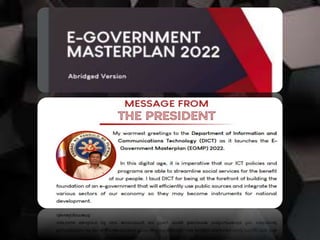
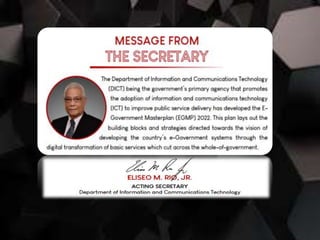
  • #8 Ict policies and programs are able to strealine social services for the benefit of the filipino people
  • #9 Embodied in Masterplan 2022 od the DICT to improve public service deliver thyu e-govt peogram
  • #11 Singapore 20 years aheas of most countries – planning 50 years aheas of sustainable urbanization
  • #17 3 days simple transaction 7 days complex transaction 20 days tech application 45 highly technical can be extended
  • #21 Gone are the days of USB and external disk