Open City Portal Delta Nigeria, November 2008 General Background: E-Government
Contents 1. What’s the  e-government 3. How to develop the e-Government 3.1. S trategy  1.1. The goals of the  e-government  1.2. The scope of the e-government 2. Current state of e-Government 4. E-Government around the World 4.1. Best examples 2.1. E-Government levels 2.3. Challenges 2.4. Obstacles 2.2. Cutting edges features 2.6. Benefits 4.2. Nigeria case
There are  three imperatives for Governments to succeed  in the currently world where every person and institution is connected to the rest: 1. Use the  network as a platform for collaboration and creativity 2. “Empowering the edge” to make  the   best use all available expertise and experience 3. Harness the potential of  the society as a whole to create and share knowledge These principles  transform the relationship between citizens and the state , breaking down the divide that often exists among them.  1. What’s the e-Government E-Government (electronic government) refers to the use of an  internet technology platform  for  exchanging information, providing services and interacting  among citizens, businesses, and government institutions and for  making government more accountable, transparent and effective .  In this way, the platform serves as a  “ single window ” for all the services.
1. What’s the e-Government It is not a matter of creating a new service but of  reinventing the old : perform the same functions all governments do but in a better way using the electronic resources. It puts the  public at the center  of the service delivery task. This means  delivery excellence and customer satisfaction  become the key objective.  The  Internet portal  architecture acts as the  catalyst for cost savings and service improvements  but it cannot achieve these benefits simply by itself.  The starting point is located in  correspondingly reforming the front- and backoffice Government processes .  Therefore,  the portal is the driver for transformation, but transformation itself comes from integrating services and manage information across all the units through Government .
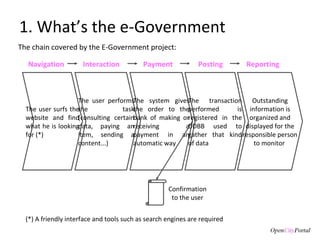
1. What’s the e-Government The chain covered by the E-Government project:  The user performs the task (consulting certain data, paying an item, sending a content...)  The user surfs the website and find what he is looking for (*)  The system gives the order to the bank of making or receiving a payment in an automatic way The transaction performed is registered in the DDBB used to gather that kind of data (*) A friendly interface and tools such as search engines are required Navigation Interaction Payment Posting Reporting Outstanding information is organized and displayed for the responsible person to monitor  Confirmation to the user
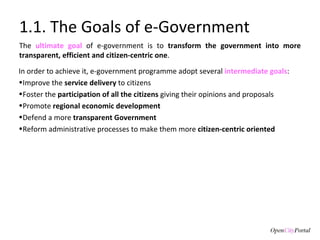
1.1. The Goals of e-Government The  ultimate goal  of e-government is to  transform the government into more transparent, efficient and citizen-centric one .  In order to achieve it, e-government programme adopt several  intermediate goals : Improve the  service delivery  to citizens Foster the  participation of all the citizens  giving their opinions and proposals Promote  regional economic development Defend a more  transparent Government Reform administrative processes to make them more  citizen-centric oriented
1.2. The Scope of e-Government In order to achieve its goals, an e-Government programme should cover all the major target groups within its citizen population:  households, businesses and NGOs . Therefore, it is necessary to allow the interaction:  Government with Citizens:  G2C Government with Businesses:  G2B Government with Other Governments or Public Administrations:  G2G Citizens with Citizens:  C2C
1. Benefits of the e-Government A good e-Government level assures the following benefits: Better and more flexible access  (24x7 electronically) to government services: Information  is  clearly organized according  to the prospective user ( ‘citizen’, ‘business’ and ‘government’) Users kept informed about  last news and events  since they are  shown at a glance . ‘ Help’  and ‘feedback’ options are  accessible  to solve any doubt  There is only  one single counter  or online “one-stop shopping”  for public services More  agile service delivery More  transparency of the policies and legislation Reference site  for people  living abroad  of the community For citizens
1. Benefits of the e-Government Promotion of the  government  making known the  National Governance Plan. More accurate information for better decision making Cost savings:  r euse and share  of the  existing IT assets  for new offerings Redeploy services among different agencies thanks to the faster service delivery Definition and control  of the  service level agreements    Automation  of the  processes  and  improvement  of the  services  by integrating the channels, processes and services and making a better use of the resources For the Government Efficiency gains:  r eduction  of  the bureaucracy, paperwork and processing time  by shifting from paper-based to Web-based approval processes.  This means:  free time  to do other things and the  feeling of the work well done .  Aggregation of the information  held in multiple locations by creating a  unique record  used by all the systems (regardless of the programming language). For the Government employees
1. Benefits of the e-Government Knowledge sharing  about data and  decisions made by other countries Better use of the information  provided by the  E-participation  Interaction among  the  citizens  which  increase the overall economic activity  of the country. Increase  of the  tourism  thanks to the  knowledge about the country by other OCP Network members Maintenance and continuous update of the platform  that guarantee the technology and functionalities are always upgraded.  Together with the general benefits  offered by e-government,  OCP  offers certain  benefits  derived from the  OCP Network  and the  Knowledge Sharing  capability :
Contents 1. What’s the  e-government 3. How to develop the e-Government 3.1. S trategy  1.1. The goals of the  e-government  1.2. The scope of the e-government 2. Current state of e-Government 4. E-Government around the World 4.1. Best examples 2.1. E-Government levels 2.3. Challenges 2.4. Obstacles 2.2. Cutting edges features 2.5. Benefits 4.2. Nigeria case
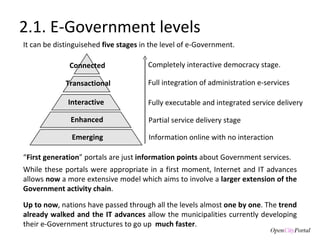
Completely interactive democracy stage.  2.1. E-Government levels Emerging Enhanced Interactive Transactional Connected It can be distinguisehed  five stages  in the level of e-Government. Partial service delivery stage Fully executable and integrated service delivery Full integration of administration e-services  Information online with no interaction Up to now , nations have passed through all the levels almost  one by one . The  trend already walked and the IT advances  allow the municipalities currently developing their e-Government structures to go up  much faster .  “ First generation ” portals are just  information points  about Government services.  While these portals were appropriate in a first moment, Internet and IT advances allows  now  a more extensive model which aims to involve a  larger extension of the Government activity chain .
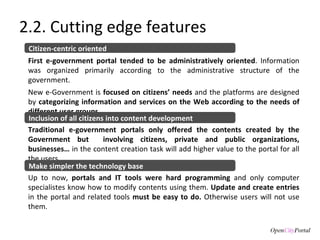
2.2. Cutting edge features First e-government portal tended to be administratively oriented . Information was organized primarily according to the administrative structure of the government. New e-Government is  focused on citizens’ needs  and the platforms are designed by  categorizing information and services on the Web according to the needs of different user groups. Citizen-centric oriented Traditional e-government portals only offered the contents created by the Government but  involving citizens, private and public organizations, businesses…  in the content creation task will add higher value to the portal for all the users.  Inclusion of all citizens into content development Up to now,  portals and IT tools were hard programming  and only computer specialistes know how to modify contents using them.  Update and create entries  in the portal and related tools  must be easy to do.  Otherwise users will not use them.  Make simpler the technology base
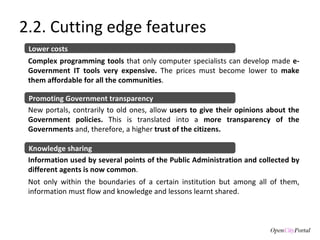
2.2. Cutting edge features Complex programming tools  that only computer specialists can develop made  e-Government IT tools very expensive.  The prices must become lower to  make them affordable for all the communities .  Lower costs Information used by several points of the Public Administration and collected by different agents is now common .  Not only within the boundaries of a certain institution but among all of them, information must flow and knowledge and lessons learnt shared.  Knowledge sharing New portals, contrarily to old ones, allow  users to give their opinions about the Government policies.  This is translated into a  more transparency of the Governments  and, therefore, a higher  trust of the citizens.  Promoting Government transparency
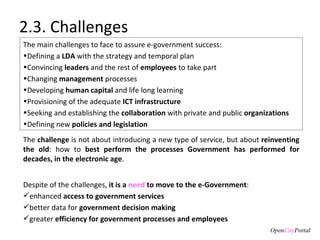
2.3. Challenges The main challenges to face to assure e-government success: Defining a  LDA  with the strategy and temporal plan  Convincing  leaders  and the rest of  employees  to take part Ch anging  management  processes Developing  human capital  and life long learning Provisioning of the adequate  ICT infrastructure Seeking and establishing the  collaboration  with private and public  organizations  Defining new  policies and legislation Despite of the challenges,  it is a  need  to move to the e-Government : enhanced  access to government services better data for  government decision making  greater  efficiency for government processes and employees The  challenge  is not about introducing a new type of service, but about  reinventing the old : how to  best perform the processes Government has performed for decades, in the electronic age .
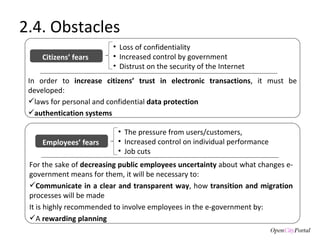
For the sake of  decreasing public employees uncertainty  about what changes e-government means for them, it will be necessary to: Communicate in a clear and transparent way , how  transition and migration  processes will be made It is highly recommended to involve employees in the e-government by:  A  rewarding planning 2.4. Obstacles Loss of confidentiality  Increased control by government  Distrust on the security of the Internet Citizens’ fears  In order to  increase citizens’ trust in electronic transactions , it must be developed: laws for personal and confidential  data protection  authentication systems The pressure from users/customers,  Increased control on individual performance  Job cuts Employees’ fears
Contents 1. What’s the  e-government 3. How to develop the e-Government 3.1. S trategy  1.1. The goals of the  e-government  1.2. The scope of the e-government 2. Current state of e-Government 4. E-Government around the World 4.1. Best examples 2.1. E-Government levels 2.3. Challenges 2.4. Obstacles 2.2. Cutting edges features 2.6. Benefits 4.2. Nigeria case
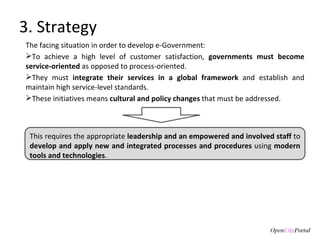
3. Strategy The facing situation in order to develop e-Government:  To achieve a high level of customer satisfaction,  governments must become service-oriented  as opposed to process-oriented.  They must  integrate their services in a global framework  and establish and maintain high service-level standards.  These initiatives means  cultural and policy changes  that must be addressed.  This requires the appropriate  leadership and an empowered and involved staff  to  develop and apply new and integrated processes and procedures  using  modern tools and technologies .
3. Strategy The taskforce will formulate a 'government information system strategy' for the municipality, which will elaborate the  priority objectives  of an information system to support the e-government programme.  The system should be developed to  achieve goals stated in the vision  set out by the top management. The strategy should also contain a  rationale  and a  sequencing and implementation plan .  Define the objectives The ultimate goal of the e-government initiative is the  transformation of the government into more a efficient, transparent and citizen-centered one . In order to achieve this goal, the strategy should include  not only technical solutions but also policy and organizational reforms .  Objectives should include the formulation of  policies for: information management; communication; citizen's right to access information .  They will also set out a clear definition of the  functions of the CIO and taskforce  and identify the  responsibility of government offices  in terms of content creation and updating, etc.
3. Strategy Define priorities and sequencing plans The strategy should not simply be the shopping list of all projects possible under the e-government initiative. The strategic planning process should be based on reasonable assumptions about the budget and human resources that are available. It should take into account the outcomes of an  e-readiness assessment  in terms of the status of  existing physical ICT infrastructure  and the relevance of the current  regulatory framework . The strategy should establish  priorities within and between projects  based on this analysis.  Sequencing  of various components should be established and a  time-bound implementation plan  should be agreed based upon technological considerations and the priorities.  OCP as the entry point The IT infrastructure required to e-Government is the point where difficulties arise due to budget constraints in most national and municipal governments in developing countries.  The Open City Portal is a cost-effective tool that offers a city portal that is locally relevant without spending too much on government IT systems.
3. Strategy Government Information System developed in the right sequence Unless it already exists, the  government information system  should be  developed in parallel  with  portal  development.  Any computerized system is not only very  expensive  but requires  detailed  knowledge about the various user groups and their inter-relationships. Carefully  phased programmes  are therefore needed when such systems are being introduced. It is recommended that:  A  citizens' registration and authentication system  should be developed first as it provides the basis for all government information systems.  The second priority should be those  e-government components which can produce additional revenue or significant cost savings , for example: tax online, a customs clearance system or an e-procurement system.  Another priority should be  projects which increase the level of service and productivity of the government significantly . These may include systems for: information management; data/content management; knowledge management; and the linking of government databases through a web-service.
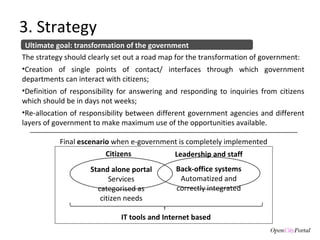
3. Strategy Ultimate goal: transformation of the government The strategy should clearly set out a road map for the transformation of government:  Creation of single points of contact/ interfaces through which government departments can interact with citizens;  Definition of responsibility for answering and responding to inquiries from citizens which should be in days not weeks;  Re-allocation of responsibility between different government agencies and different layers of government to make maximum use of the opportunities available. Stand alone portal Services categorised as citizen needs Back-office systems Automatized and correctly integrated Leadership and staff Citizens IT tools and Internet based Final  escenario  when e-government is completely implemented
Contents 1. What’s the  e-government 3. How to develop the e-Government 3.1. S trategy  1.1. The goals of the  e-government  1.2. The scope of the e-government 2. Current state of e-Government 4. E-Government around the World 4.1. Best examples 2.1. E-Government levels 2.3. Challenges 2.4. Obstacles 2.2. Cutting edges features 2.6. Benefits 4.2. Nigeria case
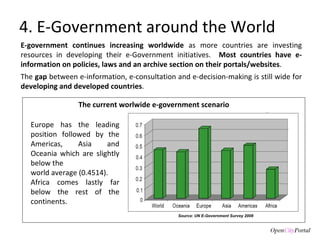
4. E-Government around the World Europe has  the leading position followed by the Americas, Asia and Oceania which are slightly below the world average (0.4514).  Africa comes lastly far below the rest of the continents. Source: UN E-Government Survey 2008 E-government continues increasing worldwide  as more countries are investing resources in developing their e-Government initiatives.  Most countries have e-information on policies, laws and an archive section on their portals/websites .  The  gap  between e-information, e-consultation and e-decision-making is still wide for  developing and developed countries . The current worlwide e-government scenario
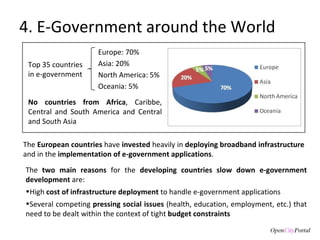
4. E-Government around the World Europe: 70% Asia: 20% North America: 5% Oceania: 5%  The  European countries  have  invested  heavily in  deploying broadband infrastructure  and in the  implementation of e-government applications .  The  two main reasons  for the  developing countries slow down e-government development  are:  High  cost of infrastructure deployment  to handle e-government applications Several competing  pressing social issues  (health, education, employment, etc.) that need to be dealt within the context of tight  budget constraints Top 35 countries  in e-government No countries from Africa , Caribbe, Central and South America and Central and South Asia
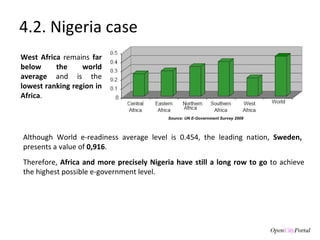
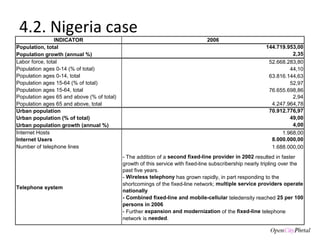
4.2. Nigeria case West Africa  remains  far below the world average  and is the  lowest ranking region in Africa .  Therefore,  Africa and more precisely Nigeria have still a long row to go  to achieve the highest possible e-government level.  Source: UN E-Government Survey 2008 Although World e-readiness average level is 0.454, the leading nation,  Sweden,  presents a value of  0,916 .
4.2. Nigeria case
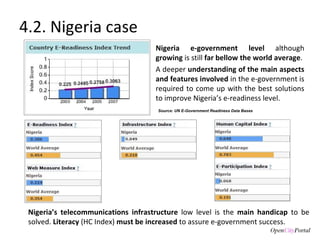
4.2. Nigeria case Nigeria e-government level  although  growing  is still  far bellow the world average . A deeper  understanding of the main aspects and features involved  in the e-government is required to come up with the best solutions to improve Nigeria’s e-readiness level.  Nigeria’s telecommunications infrastructure  low level is the  main handicap  to be solved.  Literacy  (HC Index)  must be increased  to assure e-government success.  Source: UN E-Government Readiness Data Bases
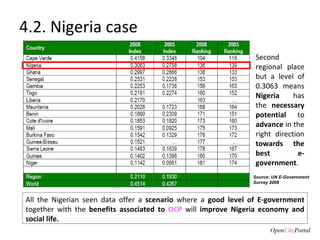
4.2. Nigeria case Source: UN E-Government Survey 2008 Second regional place but a level of 0.3063 means  Nigeria  has the  necessary potential  to  advance  in the right direction  towards the best e-government .  All the Nigerian seen data offer a  scenario  where a  good level of E-government  together with the  benefits associated to  OCP   will  improve Nigeria economy and social life.
References Dpt of Accounting and Finance of the  University of Zaragoza (Spain) “ E-government and the transformation of public administrations in EU countries: Beyond NPM or just a second wave of reforms?” study Authors: Lourdes Torres, Vicente Pina and Sonia Royo CGI “ Single-Window Government: Using the new generation of e-government to transform government operations  “ study World Bank online DDBB The CIA World Factbook

General Background And E Gov

  • 1.
    Open City PortalDelta Nigeria, November 2008 General Background: E-Government
  • 2.
    Contents 1. What’sthe e-government 3. How to develop the e-Government 3.1. S trategy 1.1. The goals of the e-government 1.2. The scope of the e-government 2. Current state of e-Government 4. E-Government around the World 4.1. Best examples 2.1. E-Government levels 2.3. Challenges 2.4. Obstacles 2.2. Cutting edges features 2.6. Benefits 4.2. Nigeria case
  • 3.
    Contents 1. What’sthe e-government 3. How to develop the e-Government 3.1. S trategy 1.1. The goals of the e-government 1.2. The scope of the e-government 2. Current state of e-Government 4. E-Government around the World 4.1. Best examples 2.1. E-Government levels 2.3. Challenges 2.4. Obstacles 2.2. Cutting edges features 2.6. Benefits 4.2. Nigeria case
  • 4.
    There are three imperatives for Governments to succeed in the currently world where every person and institution is connected to the rest: 1. Use the network as a platform for collaboration and creativity 2. “Empowering the edge” to make the best use all available expertise and experience 3. Harness the potential of the society as a whole to create and share knowledge These principles transform the relationship between citizens and the state , breaking down the divide that often exists among them. 1. What’s the e-Government E-Government (electronic government) refers to the use of an internet technology platform for exchanging information, providing services and interacting among citizens, businesses, and government institutions and for making government more accountable, transparent and effective . In this way, the platform serves as a “ single window ” for all the services.
  • 5.
    1. What’s thee-Government It is not a matter of creating a new service but of reinventing the old : perform the same functions all governments do but in a better way using the electronic resources. It puts the public at the center of the service delivery task. This means delivery excellence and customer satisfaction become the key objective. The Internet portal architecture acts as the catalyst for cost savings and service improvements but it cannot achieve these benefits simply by itself. The starting point is located in correspondingly reforming the front- and backoffice Government processes . Therefore, the portal is the driver for transformation, but transformation itself comes from integrating services and manage information across all the units through Government .
  • 6.
    1. What’s thee-Government The chain covered by the E-Government project: The user performs the task (consulting certain data, paying an item, sending a content...) The user surfs the website and find what he is looking for (*) The system gives the order to the bank of making or receiving a payment in an automatic way The transaction performed is registered in the DDBB used to gather that kind of data (*) A friendly interface and tools such as search engines are required Navigation Interaction Payment Posting Reporting Outstanding information is organized and displayed for the responsible person to monitor Confirmation to the user
  • 7.
    1.1. The Goalsof e-Government The ultimate goal of e-government is to transform the government into more transparent, efficient and citizen-centric one . In order to achieve it, e-government programme adopt several intermediate goals : Improve the service delivery to citizens Foster the participation of all the citizens giving their opinions and proposals Promote regional economic development Defend a more transparent Government Reform administrative processes to make them more citizen-centric oriented
  • 8.
    1.2. The Scopeof e-Government In order to achieve its goals, an e-Government programme should cover all the major target groups within its citizen population: households, businesses and NGOs . Therefore, it is necessary to allow the interaction: Government with Citizens: G2C Government with Businesses: G2B Government with Other Governments or Public Administrations: G2G Citizens with Citizens: C2C
  • 9.
    1. Benefits ofthe e-Government A good e-Government level assures the following benefits: Better and more flexible access (24x7 electronically) to government services: Information is clearly organized according to the prospective user ( ‘citizen’, ‘business’ and ‘government’) Users kept informed about last news and events since they are shown at a glance . ‘ Help’ and ‘feedback’ options are accessible to solve any doubt There is only one single counter or online “one-stop shopping” for public services More agile service delivery More transparency of the policies and legislation Reference site for people living abroad of the community For citizens
  • 10.
    1. Benefits ofthe e-Government Promotion of the government making known the National Governance Plan. More accurate information for better decision making Cost savings: r euse and share of the existing IT assets for new offerings Redeploy services among different agencies thanks to the faster service delivery Definition and control of the service level agreements    Automation of the processes and improvement of the services by integrating the channels, processes and services and making a better use of the resources For the Government Efficiency gains: r eduction of the bureaucracy, paperwork and processing time by shifting from paper-based to Web-based approval processes. This means: free time to do other things and the feeling of the work well done . Aggregation of the information held in multiple locations by creating a unique record used by all the systems (regardless of the programming language). For the Government employees
  • 11.
    1. Benefits ofthe e-Government Knowledge sharing about data and decisions made by other countries Better use of the information provided by the E-participation Interaction among the citizens which increase the overall economic activity of the country. Increase of the tourism thanks to the knowledge about the country by other OCP Network members Maintenance and continuous update of the platform that guarantee the technology and functionalities are always upgraded. Together with the general benefits offered by e-government, OCP offers certain benefits derived from the OCP Network and the Knowledge Sharing capability :
  • 12.
    Contents 1. What’sthe e-government 3. How to develop the e-Government 3.1. S trategy 1.1. The goals of the e-government 1.2. The scope of the e-government 2. Current state of e-Government 4. E-Government around the World 4.1. Best examples 2.1. E-Government levels 2.3. Challenges 2.4. Obstacles 2.2. Cutting edges features 2.5. Benefits 4.2. Nigeria case
  • 13.
    Completely interactive democracystage. 2.1. E-Government levels Emerging Enhanced Interactive Transactional Connected It can be distinguisehed five stages in the level of e-Government. Partial service delivery stage Fully executable and integrated service delivery Full integration of administration e-services Information online with no interaction Up to now , nations have passed through all the levels almost one by one . The trend already walked and the IT advances allow the municipalities currently developing their e-Government structures to go up much faster . “ First generation ” portals are just information points about Government services. While these portals were appropriate in a first moment, Internet and IT advances allows now a more extensive model which aims to involve a larger extension of the Government activity chain .
  • 14.
    2.2. Cutting edgefeatures First e-government portal tended to be administratively oriented . Information was organized primarily according to the administrative structure of the government. New e-Government is focused on citizens’ needs and the platforms are designed by categorizing information and services on the Web according to the needs of different user groups. Citizen-centric oriented Traditional e-government portals only offered the contents created by the Government but involving citizens, private and public organizations, businesses… in the content creation task will add higher value to the portal for all the users. Inclusion of all citizens into content development Up to now, portals and IT tools were hard programming and only computer specialistes know how to modify contents using them. Update and create entries in the portal and related tools must be easy to do. Otherwise users will not use them. Make simpler the technology base
  • 15.
    2.2. Cutting edgefeatures Complex programming tools that only computer specialists can develop made e-Government IT tools very expensive. The prices must become lower to make them affordable for all the communities . Lower costs Information used by several points of the Public Administration and collected by different agents is now common . Not only within the boundaries of a certain institution but among all of them, information must flow and knowledge and lessons learnt shared. Knowledge sharing New portals, contrarily to old ones, allow users to give their opinions about the Government policies. This is translated into a more transparency of the Governments and, therefore, a higher trust of the citizens. Promoting Government transparency
  • 16.
    2.3. Challenges Themain challenges to face to assure e-government success: Defining a LDA with the strategy and temporal plan Convincing leaders and the rest of employees to take part Ch anging management processes Developing human capital and life long learning Provisioning of the adequate ICT infrastructure Seeking and establishing the collaboration with private and public organizations Defining new policies and legislation Despite of the challenges, it is a need to move to the e-Government : enhanced access to government services better data for government decision making greater efficiency for government processes and employees The challenge is not about introducing a new type of service, but about reinventing the old : how to best perform the processes Government has performed for decades, in the electronic age .
  • 17.
    For the sakeof decreasing public employees uncertainty about what changes e-government means for them, it will be necessary to: Communicate in a clear and transparent way , how transition and migration processes will be made It is highly recommended to involve employees in the e-government by: A rewarding planning 2.4. Obstacles Loss of confidentiality Increased control by government Distrust on the security of the Internet Citizens’ fears In order to increase citizens’ trust in electronic transactions , it must be developed: laws for personal and confidential data protection authentication systems The pressure from users/customers, Increased control on individual performance Job cuts Employees’ fears
  • 18.
    Contents 1. What’sthe e-government 3. How to develop the e-Government 3.1. S trategy 1.1. The goals of the e-government 1.2. The scope of the e-government 2. Current state of e-Government 4. E-Government around the World 4.1. Best examples 2.1. E-Government levels 2.3. Challenges 2.4. Obstacles 2.2. Cutting edges features 2.6. Benefits 4.2. Nigeria case
  • 19.
    3. Strategy Thefacing situation in order to develop e-Government: To achieve a high level of customer satisfaction, governments must become service-oriented as opposed to process-oriented. They must integrate their services in a global framework and establish and maintain high service-level standards. These initiatives means cultural and policy changes that must be addressed. This requires the appropriate leadership and an empowered and involved staff to develop and apply new and integrated processes and procedures using modern tools and technologies .
  • 20.
    3. Strategy Thetaskforce will formulate a 'government information system strategy' for the municipality, which will elaborate the priority objectives of an information system to support the e-government programme. The system should be developed to achieve goals stated in the vision set out by the top management. The strategy should also contain a rationale and a sequencing and implementation plan . Define the objectives The ultimate goal of the e-government initiative is the transformation of the government into more a efficient, transparent and citizen-centered one . In order to achieve this goal, the strategy should include not only technical solutions but also policy and organizational reforms . Objectives should include the formulation of policies for: information management; communication; citizen's right to access information . They will also set out a clear definition of the functions of the CIO and taskforce and identify the responsibility of government offices in terms of content creation and updating, etc.
  • 21.
    3. Strategy Definepriorities and sequencing plans The strategy should not simply be the shopping list of all projects possible under the e-government initiative. The strategic planning process should be based on reasonable assumptions about the budget and human resources that are available. It should take into account the outcomes of an e-readiness assessment in terms of the status of existing physical ICT infrastructure and the relevance of the current regulatory framework . The strategy should establish priorities within and between projects based on this analysis. Sequencing of various components should be established and a time-bound implementation plan should be agreed based upon technological considerations and the priorities. OCP as the entry point The IT infrastructure required to e-Government is the point where difficulties arise due to budget constraints in most national and municipal governments in developing countries. The Open City Portal is a cost-effective tool that offers a city portal that is locally relevant without spending too much on government IT systems.
  • 22.
    3. Strategy GovernmentInformation System developed in the right sequence Unless it already exists, the government information system should be developed in parallel with portal development. Any computerized system is not only very expensive but requires detailed knowledge about the various user groups and their inter-relationships. Carefully phased programmes are therefore needed when such systems are being introduced. It is recommended that: A citizens' registration and authentication system should be developed first as it provides the basis for all government information systems. The second priority should be those e-government components which can produce additional revenue or significant cost savings , for example: tax online, a customs clearance system or an e-procurement system. Another priority should be projects which increase the level of service and productivity of the government significantly . These may include systems for: information management; data/content management; knowledge management; and the linking of government databases through a web-service.
  • 23.
    3. Strategy Ultimategoal: transformation of the government The strategy should clearly set out a road map for the transformation of government: Creation of single points of contact/ interfaces through which government departments can interact with citizens; Definition of responsibility for answering and responding to inquiries from citizens which should be in days not weeks; Re-allocation of responsibility between different government agencies and different layers of government to make maximum use of the opportunities available. Stand alone portal Services categorised as citizen needs Back-office systems Automatized and correctly integrated Leadership and staff Citizens IT tools and Internet based Final escenario when e-government is completely implemented
  • 24.
    Contents 1. What’sthe e-government 3. How to develop the e-Government 3.1. S trategy 1.1. The goals of the e-government 1.2. The scope of the e-government 2. Current state of e-Government 4. E-Government around the World 4.1. Best examples 2.1. E-Government levels 2.3. Challenges 2.4. Obstacles 2.2. Cutting edges features 2.6. Benefits 4.2. Nigeria case
  • 25.
    4. E-Government aroundthe World Europe has the leading position followed by the Americas, Asia and Oceania which are slightly below the world average (0.4514). Africa comes lastly far below the rest of the continents. Source: UN E-Government Survey 2008 E-government continues increasing worldwide as more countries are investing resources in developing their e-Government initiatives. Most countries have e-information on policies, laws and an archive section on their portals/websites . The gap between e-information, e-consultation and e-decision-making is still wide for developing and developed countries . The current worlwide e-government scenario
  • 26.
    4. E-Government aroundthe World Europe: 70% Asia: 20% North America: 5% Oceania: 5% The European countries have invested heavily in deploying broadband infrastructure and in the implementation of e-government applications . The two main reasons for the developing countries slow down e-government development are: High cost of infrastructure deployment to handle e-government applications Several competing pressing social issues (health, education, employment, etc.) that need to be dealt within the context of tight budget constraints Top 35 countries in e-government No countries from Africa , Caribbe, Central and South America and Central and South Asia
  • 27.
    4.2. Nigeria caseWest Africa remains far below the world average and is the lowest ranking region in Africa . Therefore, Africa and more precisely Nigeria have still a long row to go to achieve the highest possible e-government level. Source: UN E-Government Survey 2008 Although World e-readiness average level is 0.454, the leading nation, Sweden, presents a value of 0,916 .
  • 28.
  • 29.
    4.2. Nigeria caseNigeria e-government level although growing is still far bellow the world average . A deeper understanding of the main aspects and features involved in the e-government is required to come up with the best solutions to improve Nigeria’s e-readiness level. Nigeria’s telecommunications infrastructure low level is the main handicap to be solved. Literacy (HC Index) must be increased to assure e-government success. Source: UN E-Government Readiness Data Bases
  • 30.
    4.2. Nigeria caseSource: UN E-Government Survey 2008 Second regional place but a level of 0.3063 means Nigeria has the necessary potential to advance in the right direction towards the best e-government . All the Nigerian seen data offer a scenario where a good level of E-government together with the benefits associated to OCP will improve Nigeria economy and social life.
  • 31.
    References Dpt ofAccounting and Finance of the University of Zaragoza (Spain) “ E-government and the transformation of public administrations in EU countries: Beyond NPM or just a second wave of reforms?” study Authors: Lourdes Torres, Vicente Pina and Sonia Royo CGI “ Single-Window Government: Using the new generation of e-government to transform government operations “ study World Bank online DDBB The CIA World Factbook