Unit – III
INTERNATIONAL STRATEGIC
MANAGEMENT
International Strategic management
 Strategy is derived from the Greek word ‘Strategos’
 It means ‘Generalship – the actual direction of
military force’
 Strategy Mgt involves the analysis of internal
capabilities and external environment of a firm in
order to efficiently and effectively uses the
resources to meet organizational objectives.
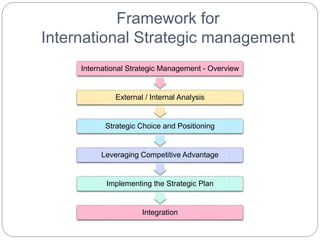
Framework for
International Strategic management
International Strategic Management - Overview
External / Internal Analysis
Strategic Choice and Positioning
Leveraging Competitive Advantage
Implementing the Strategic Plan
Integration
Strategic Compulsions
 Strategic management includes strategic
planning, implementation, and review/control of
the strategy of an organization.
 The companies want survive in the today’s
business competition, they must sell their
products in the global market and enlarge their
market.
 The companies face the compulsion to be global if
they want to gain the global market and more
values.
 Ex: Sony, Pepsi, Microsoft…
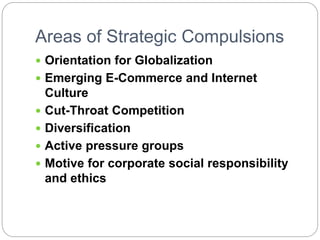
Areas of Strategic Compulsions
 Orientation for Globalization
 Emerging E-Commerce and Internet
Culture
 Cut-Throat Competition
 Diversification
 Active pressure groups
 Motive for corporate social responsibility
and ethics
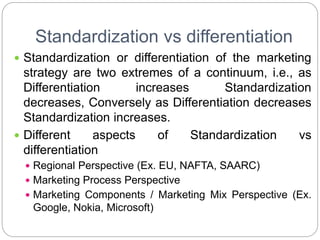
Standardization vs differentiation
 Standardization or differentiation of the marketing
strategy are two extremes of a continuum, i.e., as
Differentiation increases Standardization
decreases, Conversely as Differentiation decreases
Standardization increases.
 Different aspects of Standardization vs
differentiation
 Regional Perspective (Ex. EU, NAFTA, SAARC)
 Marketing Process Perspective
 Marketing Components / Marketing Mix Perspective (Ex.
Google, Nokia, Microsoft)
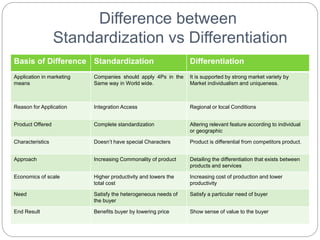
Difference between
Standardization vs Differentiation
Basis of Difference Standardization Differentiation
Application in marketing
means
Companies should apply 4Ps in the
Same way in World wide.
It is supported by strong market variety by
Market individualism and uniqueness.
Reason for Application Integration Access Regional or local Conditions
Product Offered Complete standardization Altering relevant feature according to individual
or geographic
Characteristics Doesn’t have special Characters Product is differential from competitors product.
Approach Increasing Commonality of product Detailing the differentiation that exists between
products and services
Economics of scale Higher productivity and lowers the
total cost
Increasing cost of production and lower
productivity
Need Satisfy the heterogeneous needs of
the buyer
Satisfy a particular need of buyer
End Result Benefits buyer by lowering price Show sense of value to the buyer
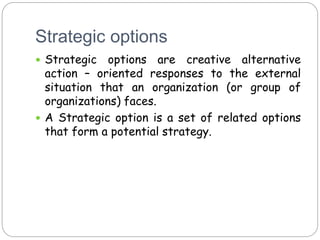
Strategic options
 Strategic options are creative alternative
action – oriented responses to the external
situation that an organization (or group of
organizations) faces.
 A Strategic option is a set of related options
that form a potential strategy.
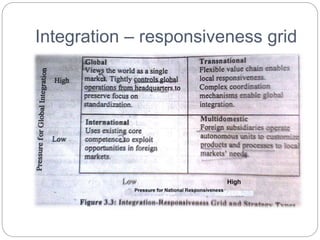
Integration – responsiveness grid
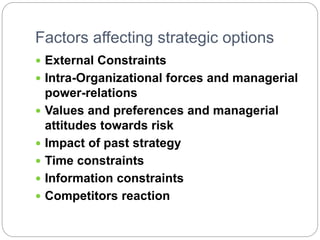
Factors affecting strategic options
 External Constraints
 Intra-Organizational forces and managerial
power-relations
 Values and preferences and managerial
attitudes towards risk
 Impact of past strategy
 Time constraints
 Information constraints
 Competitors reaction
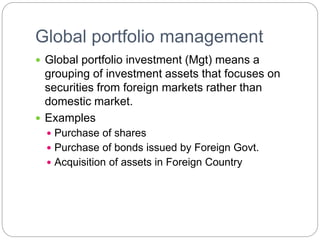
Global portfolio management
 Global portfolio investment (Mgt) means a
grouping of investment assets that focuses on
securities from foreign markets rather than
domestic market.
 Examples
 Purchase of shares
 Purchase of bonds issued by Foreign Govt.
 Acquisition of assets in Foreign Country
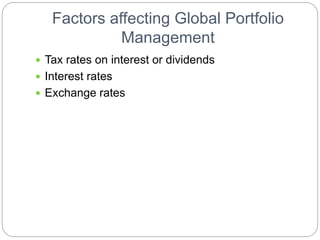
Factors affecting Global Portfolio
Management
 Tax rates on interest or dividends
 Interest rates
 Exchange rates
Global entry strategies
Forms of international business
1.Trade related forms of international
business
 Exports – direct and indirect
 Indirect Exports
 Domestic Purchase
 Export Houses
 Piggybacking
 Trading companies
Forms of international business
2. Manufacturing Strategies without FDI
 International licensing
 International franchising
 International Contract manufacturing
 Turnkey Projects
 Management contracts
Forms of international business
3. Manufacturing Strategies with FDI
 Joint Ventures
 International strategic Alliance
 Merger & Acquisition
 Wholly owned subsidiaries
Organizational issues of I.B
There are 3 issues
 First, the different elements of a firm’s
organizational architecture must be internally
consistent.
 Second, the organizational architecture must
match or fit the strategy of the firm strategy
and architecture must be, consistent.
 Third, the strategy and architecture must be
consistent with competitive conditions prevailing
in the firm’s market strategy , architecture and
environment must be, consistent
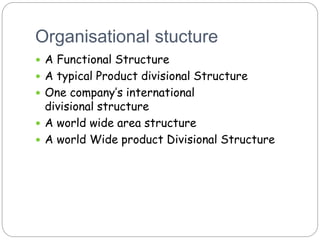
Organisational stucture
 A Functional Structure
 A typical Product divisional Structure
 One company’s international
divisional structure
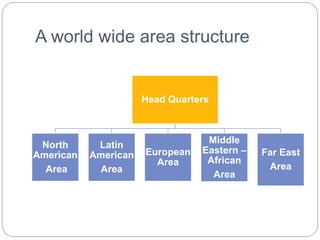
 A world wide area structure
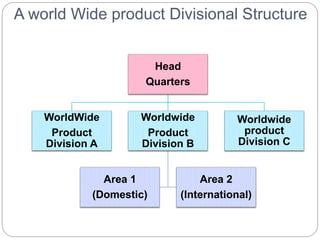
 A world Wide product Divisional Structure
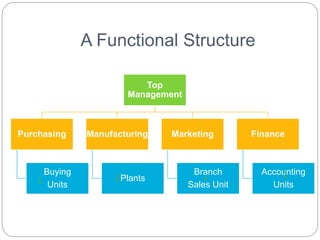
A Functional Structure
Top
Management
Purchasing
Buying
Units
Manufacturing
Plants
Marketing
Branch
Sales Unit
Finance
Accounting
Units
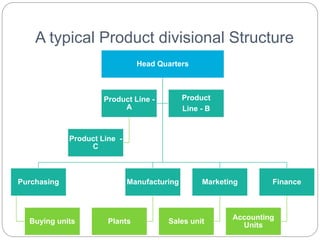
A typical Product divisional Structure
Head Quarters
Purchasing
Buying units
Manufacturing
Plants
Marketing
Sales unit
Finance
Accounting
Units
Product Line -
A
Product Line -
C
Product
Line - B
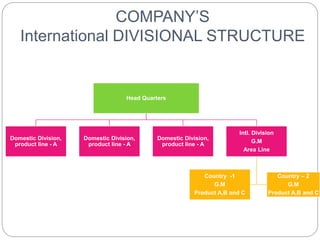
COMPANY’S
International DIVISIONAL STRUCTURE
Head Quarters
Domestic Division,
product line - A
Domestic Division,
product line - A
Domestic Division,
product line - A
Intl. Division
G.M
Area Line
Country -1
G.M
Product A,B and C
Country – 2
G.M
Product A,B and C
A world wide area structure
Head Quarters
North
American
Area
Latin
American
Area
European
Area
Middle
Eastern –
African
Area
Far East
Area
A world Wide product Divisional Structure
Head
Quarters
WorldWide
Product
Division A
Worldwide
Product
Division B
Area 1
(Domestic)
Area 2
(International)
Worldwide
product
Division C
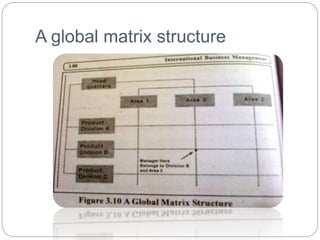
A global matrix structure
Controlling of intrenational business
 Personal Controls
 Bureaucratic Controls
 Output Controls
 Cultural Controls
Approaches to control
 Market approach
 Rules approach
 Corporate culture approach
Performance evaluation system
 First, Incentive used often varies depending on the
employees and their tasks
 Second, the successful execution of strategy in the
multinational firm often requires significant
cooperation between managers in different sub units
Contd…
 Third, the incentive system used within a
multinational enterprise often have to be
adjusted to account for national differences in
institutions and culture
 Finally, it is important for managers to
recognize that incentive systems can have
unintented consequences.
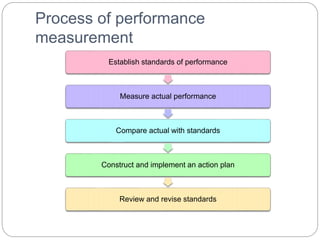
Process of performance
measurement
Establish standards of performance
Measure actual performance
Compare actual with standards
Construct and implement an action plan
Review and revise standards
Objectives of performance evaluation
 To evaluate the economic performance of
its international performance, this is
frequently referred to as an evaluation of
the unit’s management performance.
 To evaluate the unit’s management
performance.
 To monitor progress towards corporate
objectives including strategic goals.
 To assist efficient allocation of resources.
Thank u

Ibm unit – iii

  • 1.
    Unit – III INTERNATIONALSTRATEGIC MANAGEMENT
  • 2.
    International Strategic management Strategy is derived from the Greek word ‘Strategos’  It means ‘Generalship – the actual direction of military force’  Strategy Mgt involves the analysis of internal capabilities and external environment of a firm in order to efficiently and effectively uses the resources to meet organizational objectives.
  • 3.
    Framework for International Strategicmanagement International Strategic Management - Overview External / Internal Analysis Strategic Choice and Positioning Leveraging Competitive Advantage Implementing the Strategic Plan Integration
  • 4.
    Strategic Compulsions  Strategicmanagement includes strategic planning, implementation, and review/control of the strategy of an organization.  The companies want survive in the today’s business competition, they must sell their products in the global market and enlarge their market.  The companies face the compulsion to be global if they want to gain the global market and more values.  Ex: Sony, Pepsi, Microsoft…
  • 5.
    Areas of StrategicCompulsions  Orientation for Globalization  Emerging E-Commerce and Internet Culture  Cut-Throat Competition  Diversification  Active pressure groups  Motive for corporate social responsibility and ethics
  • 6.
    Standardization vs differentiation Standardization or differentiation of the marketing strategy are two extremes of a continuum, i.e., as Differentiation increases Standardization decreases, Conversely as Differentiation decreases Standardization increases.  Different aspects of Standardization vs differentiation  Regional Perspective (Ex. EU, NAFTA, SAARC)  Marketing Process Perspective  Marketing Components / Marketing Mix Perspective (Ex. Google, Nokia, Microsoft)
  • 7.
    Difference between Standardization vsDifferentiation Basis of Difference Standardization Differentiation Application in marketing means Companies should apply 4Ps in the Same way in World wide. It is supported by strong market variety by Market individualism and uniqueness. Reason for Application Integration Access Regional or local Conditions Product Offered Complete standardization Altering relevant feature according to individual or geographic Characteristics Doesn’t have special Characters Product is differential from competitors product. Approach Increasing Commonality of product Detailing the differentiation that exists between products and services Economics of scale Higher productivity and lowers the total cost Increasing cost of production and lower productivity Need Satisfy the heterogeneous needs of the buyer Satisfy a particular need of buyer End Result Benefits buyer by lowering price Show sense of value to the buyer
  • 8.
    Strategic options  Strategicoptions are creative alternative action – oriented responses to the external situation that an organization (or group of organizations) faces.  A Strategic option is a set of related options that form a potential strategy.
  • 9.
  • 10.
    Factors affecting strategicoptions  External Constraints  Intra-Organizational forces and managerial power-relations  Values and preferences and managerial attitudes towards risk  Impact of past strategy  Time constraints  Information constraints  Competitors reaction
  • 11.
    Global portfolio management Global portfolio investment (Mgt) means a grouping of investment assets that focuses on securities from foreign markets rather than domestic market.  Examples  Purchase of shares  Purchase of bonds issued by Foreign Govt.  Acquisition of assets in Foreign Country
  • 12.
    Factors affecting GlobalPortfolio Management  Tax rates on interest or dividends  Interest rates  Exchange rates
  • 13.
    Global entry strategies Formsof international business 1.Trade related forms of international business  Exports – direct and indirect  Indirect Exports  Domestic Purchase  Export Houses  Piggybacking  Trading companies
  • 14.
    Forms of internationalbusiness 2. Manufacturing Strategies without FDI  International licensing  International franchising  International Contract manufacturing  Turnkey Projects  Management contracts
  • 15.
    Forms of internationalbusiness 3. Manufacturing Strategies with FDI  Joint Ventures  International strategic Alliance  Merger & Acquisition  Wholly owned subsidiaries
  • 16.
    Organizational issues ofI.B There are 3 issues  First, the different elements of a firm’s organizational architecture must be internally consistent.  Second, the organizational architecture must match or fit the strategy of the firm strategy and architecture must be, consistent.  Third, the strategy and architecture must be consistent with competitive conditions prevailing in the firm’s market strategy , architecture and environment must be, consistent
  • 17.
    Organisational stucture  AFunctional Structure  A typical Product divisional Structure  One company’s international divisional structure  A world wide area structure  A world Wide product Divisional Structure
  • 18.
  • 19.
    A typical Productdivisional Structure Head Quarters Purchasing Buying units Manufacturing Plants Marketing Sales unit Finance Accounting Units Product Line - A Product Line - C Product Line - B
  • 20.
    COMPANY’S International DIVISIONAL STRUCTURE HeadQuarters Domestic Division, product line - A Domestic Division, product line - A Domestic Division, product line - A Intl. Division G.M Area Line Country -1 G.M Product A,B and C Country – 2 G.M Product A,B and C
  • 21.
    A world widearea structure Head Quarters North American Area Latin American Area European Area Middle Eastern – African Area Far East Area
  • 22.
    A world Wideproduct Divisional Structure Head Quarters WorldWide Product Division A Worldwide Product Division B Area 1 (Domestic) Area 2 (International) Worldwide product Division C
  • 23.
    A global matrixstructure
  • 24.
    Controlling of intrenationalbusiness  Personal Controls  Bureaucratic Controls  Output Controls  Cultural Controls
  • 25.
    Approaches to control Market approach  Rules approach  Corporate culture approach
  • 26.
    Performance evaluation system First, Incentive used often varies depending on the employees and their tasks  Second, the successful execution of strategy in the multinational firm often requires significant cooperation between managers in different sub units
  • 27.
    Contd…  Third, theincentive system used within a multinational enterprise often have to be adjusted to account for national differences in institutions and culture  Finally, it is important for managers to recognize that incentive systems can have unintented consequences.
  • 28.
    Process of performance measurement Establishstandards of performance Measure actual performance Compare actual with standards Construct and implement an action plan Review and revise standards
  • 29.
    Objectives of performanceevaluation  To evaluate the economic performance of its international performance, this is frequently referred to as an evaluation of the unit’s management performance.  To evaluate the unit’s management performance.  To monitor progress towards corporate objectives including strategic goals.  To assist efficient allocation of resources.
  • 30.