



Abortive Initiation
Outline
Introduction
Why abortive transcripts are formed
Steps Involved
Fate of product formed
Conclusion
Introduction
•Repetitive synthesis and release of short nascent RNAs by
RNA polymerase.
•accompanies steady-state transcription
•~95% of the total RNA contains
ribo-oligonucleotide products usually ranging between 2-
15 nts in length.
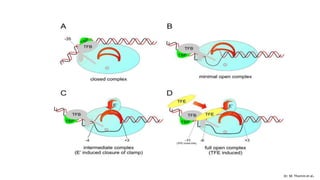
Transcriptional initiation involves three steps-
1.Formation of closed ‘preinitiation’ complex,
2.formation the open complex
3. transitions from initiation to elongation - promoter escape.
.
Dr. M. Thomm et al.
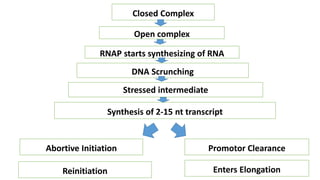
Closed Complex
Open complex
RNAP starts synthesizing of RNA
Abortive Initiation
Synthesis of 2-15 nt transcript
Stressed intermediate
DNA Scrunching
Promotor Clearance
Reinitiation Enters Elongation
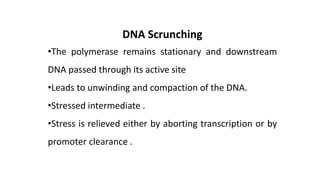
DNA Scrunching
•The polymerase remains stationary and downstream
DNA passed through its active site
•Leads to unwinding and compaction of the DNA.
•Stressed intermediate .
•Stress is relieved either by aborting transcription or by
promoter clearance .
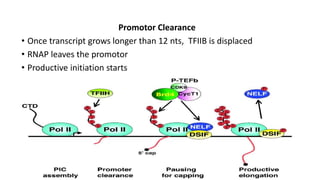
Promotor Clearance
• Once transcript grows longer than 12 nts, TFIIB is displaced
• RNAP leaves the promotor
• Productive initiation starts
• RNAP bound with TFIIB provides checkpoint for transition
• Structural transition of RNAP on escape
• Re-closure of upstream transcription bubble
• TFIIE and TFIIH mediates escape and then elongation
Importance of the process
•Dissociation of sigma factors and transcription factors
•Promoter clearance
•Proper orientation of DNA and RNA Polymerase complex for
entering the elongation stage.
Abortive vs Productive Initiation depends on
• Initially transcribed sequence
• Tight binding of sigma factor to core enzyme.
• The affinity of bacterial RNA polymerase for the promoter
(Promotor strength)
• Presence of GreA/B factors
Fate of Abortive Transcripts
•Very short lived, usually degraded quickly
•Functions not known
•Abortive transcription events stall polymerases
•Might be involved in antisense mediated regulation
Conclusion
• Conserved phenomenon
• Promotor escaping based on DNA Scrunching mechanism
• Transition from initiation to elongation phase
• Short lived transcripts
• Unknown biological functions
References
1. . Achillefs N. Kapanidis, Emmanuel Margeat, Sam On Ho, Ekaterine
Kortkhonjia, Shimon Weiss, and Richard H. Ebright ; Initial Transcription
By Rna Polymerase Proceeds Through A Dna-scrunching Mechanism;
Science. 2006 ; 314(5802): 1139–1143.
2. Goldman, SR, Ebright RH, Nickels BE. 2009. Direct detection of abortive
RNA transcripts in vivo. Science. 324:927-8.
3. Joseph T Wade1 and Kevin Struhl; The transition from transcriptional
initiation to elongation; Current Opinion in Genetics & Development
2008, 18:130–136.
4. Lilian M. Hsu; Monitoring abortive initiation; Methods, 2008; 1046-2023.
6. Sooncheol Lee, Huong Minh Nguyen and Changwon Kang; Tiny abortive
initiation transcripts exert antitermination activity on an RNA hairpin-
dependent intrinsic terminator; Nucleic Acids Research, 2010, Vol. 38, No.
18.
7. Sabyasachi Baboo and Peter R Cook,; Dark matter” worlds of unstable
RNA and protein; Nucleus 5:4, 281–286; July/August 2014
8. Taft RJ et al (2009) Tiny RNAs associated with transcription start sites in
animals. Nat Genet 41: 572–578.
Thank you !
Abortive initiation
Abortive initiation
Abortive initiation

Abortive initiation

  • 1.
  • 2.
    Outline Introduction Why abortive transcriptsare formed Steps Involved Fate of product formed Conclusion
  • 3.
    Introduction •Repetitive synthesis andrelease of short nascent RNAs by RNA polymerase. •accompanies steady-state transcription •~95% of the total RNA contains ribo-oligonucleotide products usually ranging between 2- 15 nts in length.
  • 4.
    Transcriptional initiation involvesthree steps- 1.Formation of closed ‘preinitiation’ complex, 2.formation the open complex 3. transitions from initiation to elongation - promoter escape. .
  • 5.
  • 6.
    Closed Complex Open complex RNAPstarts synthesizing of RNA Abortive Initiation Synthesis of 2-15 nt transcript Stressed intermediate DNA Scrunching Promotor Clearance Reinitiation Enters Elongation
  • 7.
    DNA Scrunching •The polymeraseremains stationary and downstream DNA passed through its active site •Leads to unwinding and compaction of the DNA. •Stressed intermediate . •Stress is relieved either by aborting transcription or by promoter clearance .
  • 8.
    Promotor Clearance • Oncetranscript grows longer than 12 nts, TFIIB is displaced • RNAP leaves the promotor • Productive initiation starts
  • 9.
    • RNAP boundwith TFIIB provides checkpoint for transition • Structural transition of RNAP on escape • Re-closure of upstream transcription bubble • TFIIE and TFIIH mediates escape and then elongation
  • 10.
    Importance of theprocess •Dissociation of sigma factors and transcription factors •Promoter clearance •Proper orientation of DNA and RNA Polymerase complex for entering the elongation stage.
  • 11.
    Abortive vs ProductiveInitiation depends on • Initially transcribed sequence • Tight binding of sigma factor to core enzyme. • The affinity of bacterial RNA polymerase for the promoter (Promotor strength) • Presence of GreA/B factors
  • 12.
    Fate of AbortiveTranscripts •Very short lived, usually degraded quickly •Functions not known •Abortive transcription events stall polymerases •Might be involved in antisense mediated regulation
  • 13.
    Conclusion • Conserved phenomenon •Promotor escaping based on DNA Scrunching mechanism • Transition from initiation to elongation phase • Short lived transcripts • Unknown biological functions
  • 14.
    References 1. . AchillefsN. Kapanidis, Emmanuel Margeat, Sam On Ho, Ekaterine Kortkhonjia, Shimon Weiss, and Richard H. Ebright ; Initial Transcription By Rna Polymerase Proceeds Through A Dna-scrunching Mechanism; Science. 2006 ; 314(5802): 1139–1143. 2. Goldman, SR, Ebright RH, Nickels BE. 2009. Direct detection of abortive RNA transcripts in vivo. Science. 324:927-8. 3. Joseph T Wade1 and Kevin Struhl; The transition from transcriptional initiation to elongation; Current Opinion in Genetics & Development 2008, 18:130–136. 4. Lilian M. Hsu; Monitoring abortive initiation; Methods, 2008; 1046-2023.
  • 15.
    6. Sooncheol Lee,Huong Minh Nguyen and Changwon Kang; Tiny abortive initiation transcripts exert antitermination activity on an RNA hairpin- dependent intrinsic terminator; Nucleic Acids Research, 2010, Vol. 38, No. 18. 7. Sabyasachi Baboo and Peter R Cook,; Dark matter” worlds of unstable RNA and protein; Nucleus 5:4, 281–286; July/August 2014 8. Taft RJ et al (2009) Tiny RNAs associated with transcription start sites in animals. Nat Genet 41: 572–578.
  • 16.

Editor's Notes

  • #7 RNA polymerase (RNAP) binds to promoter DNA, to yield an RNAP-promoter closed complex. RNAP unwinds ~14 base pairs of promoter DNA surrounding the transcription start site, rendering accessible the genetic information in the template strand of DNA, and yielding an RNAP-promoter open complex. RNAP begins synthesis of RNA as an RNAP-promoter initial transcribing complex. During initial transcription, RNAP uses a "scrunching" mechanism, in which RNAP remains stationary on promoter DNA and unwinds and pulls downstream DNA into itself and past its active center in each nucleotide-addition cycle, resulting in generation of a stressed intermediate. After RNAP synthesizes an RNA product ~10-15 nucleotides in length, RNAP breaks its interactions with promoter DNA, breaks at least some of its interactions with sigma, escapes the promoter, and begins transcription elongation as a transcription elongation complex. Energy stored in the stressed intermediate generated by scrunching during initial transcription is used to drive breakage of interactions with promoter DNA and interactions with sigma during promoter escape. During transcription elongation, RNAP uses a "stepping" mechanism, in which RNAP translocates relative to DNA in each nucleotide-addition step. Each nucleotide-addition cycle during initial transcription and transcription elongation can be subdivided into four sub-steps: (1) translocation of the RNAP active center relative to DNA (by scrunching in initial transcription; by stepping in transcription elongation); (2) binding of the incoming nucleotide; (3) formation of the phosphodiester bond; and (4) release of pyrophosphate.
  • #8 At a typical promoter, RNAP synthesizes ∼9−11 nt, corresponding to ∼7−9 bp of scrunched DNA, before it can proceed to elongation. It is possible that part of the ∼14−18 kcal/mol stored in this process is used to overcome the RNAP−promoter interactions, estimated to be ∼7−9 kcal/mol at 37 °C.20
  • #9 Once promotor is cleared the process is irreversible because it involves dissociation of sigma or transcription factors Rate limiting step in transcription