E-business  MANAGEMENT AND STRATEGY
Contents Introductions E-business technology E-business markets and models E-business economics E-marketing Management of e-business
Contents (cont.) E-business strategy : Formulation E-business strategy : Implementation E-business strategy : Evaluation The internet : law, privacy and security E-business in the future
Introduction Defining e-business The development of the new economy Types of e-business and related industries The growth of e-business Use of the internet Key people
Defining e-business E-business can be defined as the use of the internet to network and empower business processes, electronic commerce, organizational communication and collaboration within a compay and with its customers, suppliers, and other stakeholders E-business utilise the internet, intranets, extranets and other networks to support their commercial processes
E-commerce is the buying and selling, marketing and servicing of products and services via computer networks E-business and e-commerce are often used synonymously Chaffey (2004)    e-commerce can best be conceived as a subser of e-business
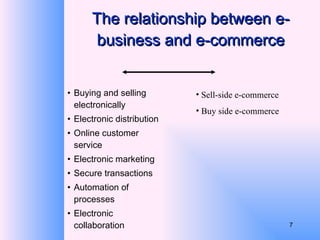
The relationship between e-business and e-commerce Buying and selling electronically Electronic distribution Online customer service Electronic marketing Secure transactions Automation of processes Electronic collaboration Sell-side e-commerce Buy side e-commerce
The development of the new economy Don Tapscott (1997) : “ Digital Economy :  Promise And Peril In The Age Of Networked Intellegency “, memaparkan bagaimana perekonomian bergeser menuju pada perekonomian baru yang disebut sebagai  digital economy  Perekonomian baru ( digital economy )  adalah perekonomian yang didasarkan pada ilmu pengetahuan, sehingga disebut juga dengan  knowledge economy
This terms are used to define the distinct contributions to the economy through use of the internet, digital technology, or information and communications technology (ITC). Called “ new economy ”    based on entrepreneurship in knowledge creation and sharing, innovation and creativity, and utilising information technology for developing and selling new products and services.
The new economy has been boosted by the development of the infrastructure that supports the internet, ICT and digital technology The internet has opened up the possibility of exchanging information, products and services around the globe without any restrains of time or distance. This has given rise to the concept of the ‘boundaryless’ organization
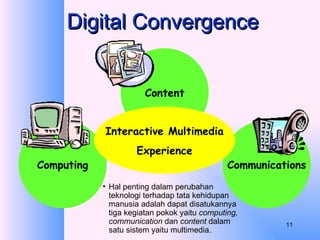
Digital Convergence Hal penting dalam perubahan teknologi terhadap tata kehidupan manusia adalah dapat disatukannya tiga kegiatan pokok yaitu  computing, communication  dan  content  dalam satu sistem yaitu multimedia. Computing Content Communications Interactive Multimedia Experience
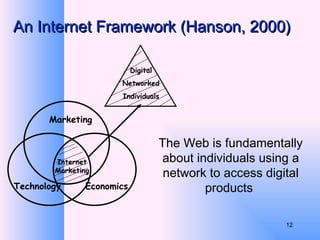
An Internet Framework (Hanson, 2000) The Web is fundamentally about individuals using a network to access digital products  Marketing Technology Economics Internet Marketing Digital Networked Individuals
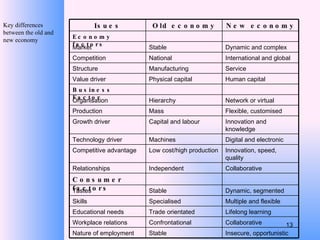
Key differences between the old and new economy Insecure, opportunistic Stable Nature of employment Collaborative Confrontational Workplace relations Lifelong learning Trade orientated Educational needs Multiple and flexible Specialised Skills Dynamic, segmented Stable Tastes Consumer factors Collaborative Independent Relationships Innovation, speed, quality Low cost/high production Competitive advantage Digital and electronic Machines Technology driver Innovation and knowledge Capital and labour Growth driver Flexible, customised Mass Production Network or virtual Hierarchy Organisation Business Factor Human capital Physical capital Value driver Service Manufacturing Structure International and global National Competition Dynamic and complex Stable Market Economy factors New economy Old economy Isues
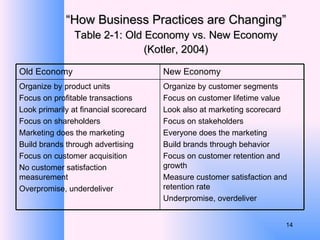
“ How Business Practices are Changing” Table 2-1: Old Economy vs. New Economy (Kotler, 2004) Organize by customer segments Focus on customer lifetime value Look also at marketing scorecard Focus on stakeholders Everyone does the marketing Build brands through behavior Focus on customer retention and growth Measure customer satisfaction and retention rate Underpromise, overdeliver Organize by product units Focus on profitable transactions Look primarily at financial scorecard Focus on shareholders Marketing does the marketing Build brands through advertising Focus on customer acquisition No customer satisfaction measurement Overpromise, underdeliver New Economy Old Economy
Procter & Gamble’s Reflect.com site allows customers to design their own beauty products
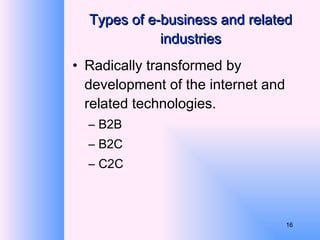
Types of e-business and related industries Radically transformed by development of the internet and related technologies. B2B B2C C2C
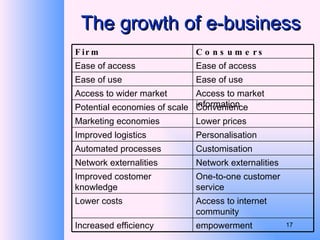
The growth of e-business empowerment Increased efficiency Access to internet community Lower costs One-to-one customer service Improved costomer knowledge Network externalities Network externalities Customisation Automated processes Personalisation Improved logistics Lower prices Marketing economies Convenience Potential economies of scale Access to market information Access to wider market Ease of use Ease of use Ease of access Ease of access Consumers Firm
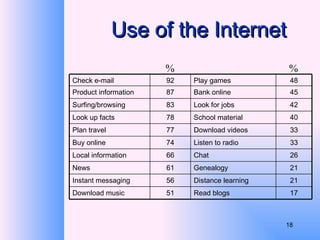
Use of the Internet % % 17 Read blogs 51 Download music 21 Distance learning 56 Instant messaging 21 Genealogy 61 News 26 Chat 66 Local information 33 Listen to radio 74 Buy online 33 Download videos 77 Plan travel 40 School material 78 Look up facts 42 Look for jobs 83 Surfing/browsing 45 Bank online 87 Product information 48 Play games 92 Check e-mail
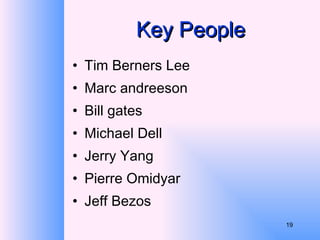
Key People Tim Berners Lee Marc andreeson Bill gates Michael Dell Jerry Yang Pierre Omidyar Jeff Bezos
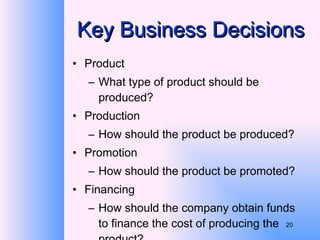
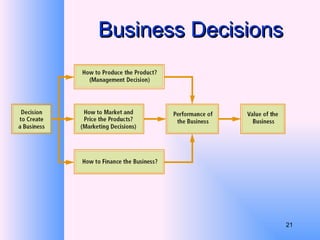
Key Business Decisions Product  What type of product should be produced? Production  How should the product be produced? Promotion How should the product be promoted? Financing How should the company obtain funds to finance the cost of producing the product?
Business Decisions
Key Stakeholders Owners Entrepreneurs Co-owners Stockholders Creditors Employees Managers Suppliers Customers
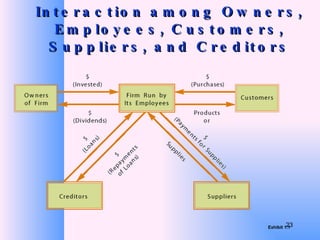
Interaction among Owners, Employees, Customers, Suppliers, and Creditors Exhibit 1.1
Creating a Business Idea Identify a competitive advantage. Differentiate the product or service from competitors. Determine necessary resources. Assess feasibility of the idea.
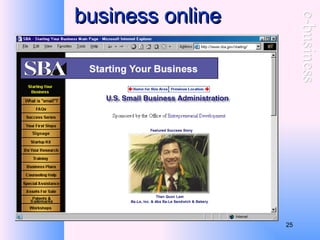
business online
Success Stories Domino’s Pizza Managhans bought bankrupt pizza parlor Started with little funding Now generates sales of $1 billion per year Jeremy’s Micro Batch Ice Cream Applied microbrewery concept to ice cream Makes ice cream in small batches, sold in limited editions Glow Dog, Inc. Sells light-reflective clothing for pets After two years, average annual sales of $1 million
Lessons to Remember Successful businesses do not require a great invention.  Many focus on making life more convenient for customers. Some business ideas will fail—but entrepreneurs can learn from failures and make revisions.
Impact of Technology Technology defined Knowledge or tools used to produce products and services Information technology Represents over 1/3 of the growth in U.S. output Reduces cost of producing products Workers in technology industries earn more than workers in other industries.
Impact of Technology E-business or e-commerce Use electronic communications to produce or sell products and services Sales to individual customers  B2B e-business: transactions between a business and its suppliers Generates $301 billion in revenue and creates 1.2 million jobs each year
Successful E-Businesses Started out small Created to sell a product or service that was not offered by competitors Transformed how traditional firms conducted business Improved communication with customers Improved information flow Improved efficiency Complemented traditional business operations
E-Business Examples Amazon Online seller of books, music and other products Low overhead costs allow price discounting Yahoo! Internet search engine and the most visited site on the Web Offers variety of services - free email, web page hosting, custom-designed start-up pages Generates revenue by selling advertising eBay Online auction service
Key Functions of Business Management Means by which employees and other resources are used by the firm Marketing Means by which products and services are developed, priced, distributed, and promoted to customers Finance Means by which firms obtain and use funds for their business operations
Key Functions of Business Accounting Summary and analysis of the firm’s financial condition Used to make various business decisions Information systems Information technology, people, and procedures that provide appropriate information to make effective decisions
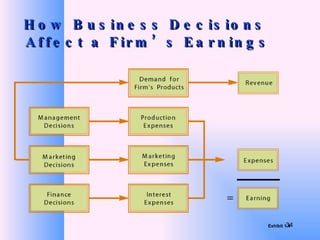
How Business Decisions  Affect a Firm’s Earnings Exhibit 1.4
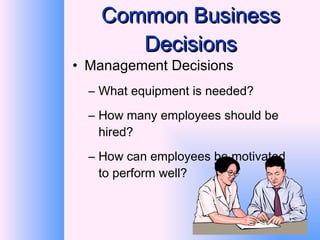
Common Business Decisions Management Decisions What equipment is needed? How many employees should be hired? How can employees be motivated to perform well?
Common Business Decisions Marketing Decisions What price should be charged? Should the product be changed to be more appealing to customers? Should the firm use advertising or some other strategy to promote its product?
Common Business Decisions Finance Decisions Should financial support come from the sale of stock or from borrowing money or some combination? Should the firm attempt to obtain borrowed funds for a short-term or long-term period? Should the firm invest funds in a new business project?
Which is more important for developing an e-presence: the agility of a pure click company, or the well defined and readily identifiable resources of a traditional  brick and mortar  company? Discussion Question
A Business Plan Detailed description of the proposed business Description of the product or service Types of customers the business would attract Competition Facilities needed for production
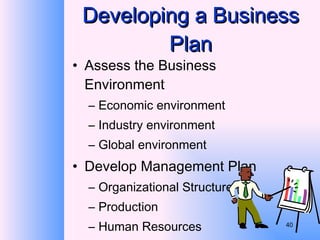
Developing a Business Plan Assess the Business Environment Economic environment Industry environment Global environment Develop Management Plan Organizational Structure Production Human Resources
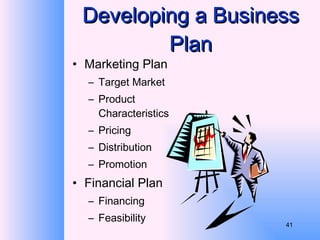
Developing a Business Plan Marketing Plan Target Market Product Characteristics Pricing Distribution Promotion Financial Plan Financing Feasibility
Online Resources Advice and basic information Yahoo’s Small Business site American Express Small Business Administration Financing Options Quicken Small Business Garage.com The Elevator Business Planning Software
Assessing a Business Plan Potential revenue Potential demand for product or service Potential expenses Profit potential
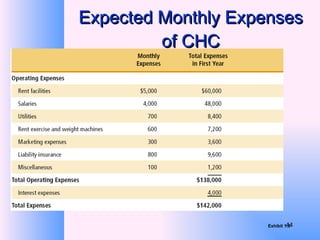
Expected Monthly Expenses of CHC Exhibit 1.6
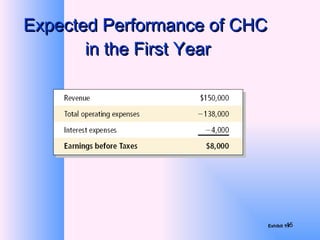
Expected Performance of CHC  in the First Year Exhibit 1.7

E Business Introduction

  • 1.
  • 2.
    Contents Introductions E-businesstechnology E-business markets and models E-business economics E-marketing Management of e-business
  • 3.
    Contents (cont.) E-businessstrategy : Formulation E-business strategy : Implementation E-business strategy : Evaluation The internet : law, privacy and security E-business in the future
  • 4.
    Introduction Defining e-businessThe development of the new economy Types of e-business and related industries The growth of e-business Use of the internet Key people
  • 5.
    Defining e-business E-businesscan be defined as the use of the internet to network and empower business processes, electronic commerce, organizational communication and collaboration within a compay and with its customers, suppliers, and other stakeholders E-business utilise the internet, intranets, extranets and other networks to support their commercial processes
  • 6.
    E-commerce is thebuying and selling, marketing and servicing of products and services via computer networks E-business and e-commerce are often used synonymously Chaffey (2004)  e-commerce can best be conceived as a subser of e-business
  • 7.
    The relationship betweene-business and e-commerce Buying and selling electronically Electronic distribution Online customer service Electronic marketing Secure transactions Automation of processes Electronic collaboration Sell-side e-commerce Buy side e-commerce
  • 8.
    The development ofthe new economy Don Tapscott (1997) : “ Digital Economy : Promise And Peril In The Age Of Networked Intellegency “, memaparkan bagaimana perekonomian bergeser menuju pada perekonomian baru yang disebut sebagai digital economy Perekonomian baru ( digital economy ) adalah perekonomian yang didasarkan pada ilmu pengetahuan, sehingga disebut juga dengan knowledge economy
  • 9.
    This terms areused to define the distinct contributions to the economy through use of the internet, digital technology, or information and communications technology (ITC). Called “ new economy ”  based on entrepreneurship in knowledge creation and sharing, innovation and creativity, and utilising information technology for developing and selling new products and services.
  • 10.
    The new economyhas been boosted by the development of the infrastructure that supports the internet, ICT and digital technology The internet has opened up the possibility of exchanging information, products and services around the globe without any restrains of time or distance. This has given rise to the concept of the ‘boundaryless’ organization
  • 11.
    Digital Convergence Halpenting dalam perubahan teknologi terhadap tata kehidupan manusia adalah dapat disatukannya tiga kegiatan pokok yaitu computing, communication dan content dalam satu sistem yaitu multimedia. Computing Content Communications Interactive Multimedia Experience
  • 12.
    An Internet Framework(Hanson, 2000) The Web is fundamentally about individuals using a network to access digital products Marketing Technology Economics Internet Marketing Digital Networked Individuals
  • 13.
    Key differences betweenthe old and new economy Insecure, opportunistic Stable Nature of employment Collaborative Confrontational Workplace relations Lifelong learning Trade orientated Educational needs Multiple and flexible Specialised Skills Dynamic, segmented Stable Tastes Consumer factors Collaborative Independent Relationships Innovation, speed, quality Low cost/high production Competitive advantage Digital and electronic Machines Technology driver Innovation and knowledge Capital and labour Growth driver Flexible, customised Mass Production Network or virtual Hierarchy Organisation Business Factor Human capital Physical capital Value driver Service Manufacturing Structure International and global National Competition Dynamic and complex Stable Market Economy factors New economy Old economy Isues
  • 14.
    “ How BusinessPractices are Changing” Table 2-1: Old Economy vs. New Economy (Kotler, 2004) Organize by customer segments Focus on customer lifetime value Look also at marketing scorecard Focus on stakeholders Everyone does the marketing Build brands through behavior Focus on customer retention and growth Measure customer satisfaction and retention rate Underpromise, overdeliver Organize by product units Focus on profitable transactions Look primarily at financial scorecard Focus on shareholders Marketing does the marketing Build brands through advertising Focus on customer acquisition No customer satisfaction measurement Overpromise, underdeliver New Economy Old Economy
  • 15.
    Procter & Gamble’sReflect.com site allows customers to design their own beauty products
  • 16.
    Types of e-businessand related industries Radically transformed by development of the internet and related technologies. B2B B2C C2C
  • 17.
    The growth ofe-business empowerment Increased efficiency Access to internet community Lower costs One-to-one customer service Improved costomer knowledge Network externalities Network externalities Customisation Automated processes Personalisation Improved logistics Lower prices Marketing economies Convenience Potential economies of scale Access to market information Access to wider market Ease of use Ease of use Ease of access Ease of access Consumers Firm
  • 18.
    Use of theInternet % % 17 Read blogs 51 Download music 21 Distance learning 56 Instant messaging 21 Genealogy 61 News 26 Chat 66 Local information 33 Listen to radio 74 Buy online 33 Download videos 77 Plan travel 40 School material 78 Look up facts 42 Look for jobs 83 Surfing/browsing 45 Bank online 87 Product information 48 Play games 92 Check e-mail
  • 19.
    Key People TimBerners Lee Marc andreeson Bill gates Michael Dell Jerry Yang Pierre Omidyar Jeff Bezos
  • 20.
    Key Business DecisionsProduct What type of product should be produced? Production How should the product be produced? Promotion How should the product be promoted? Financing How should the company obtain funds to finance the cost of producing the product?
  • 21.
  • 22.
    Key Stakeholders OwnersEntrepreneurs Co-owners Stockholders Creditors Employees Managers Suppliers Customers
  • 23.
    Interaction among Owners,Employees, Customers, Suppliers, and Creditors Exhibit 1.1
  • 24.
    Creating a BusinessIdea Identify a competitive advantage. Differentiate the product or service from competitors. Determine necessary resources. Assess feasibility of the idea.
  • 25.
  • 26.
    Success Stories Domino’sPizza Managhans bought bankrupt pizza parlor Started with little funding Now generates sales of $1 billion per year Jeremy’s Micro Batch Ice Cream Applied microbrewery concept to ice cream Makes ice cream in small batches, sold in limited editions Glow Dog, Inc. Sells light-reflective clothing for pets After two years, average annual sales of $1 million
  • 27.
    Lessons to RememberSuccessful businesses do not require a great invention. Many focus on making life more convenient for customers. Some business ideas will fail—but entrepreneurs can learn from failures and make revisions.
  • 28.
    Impact of TechnologyTechnology defined Knowledge or tools used to produce products and services Information technology Represents over 1/3 of the growth in U.S. output Reduces cost of producing products Workers in technology industries earn more than workers in other industries.
  • 29.
    Impact of TechnologyE-business or e-commerce Use electronic communications to produce or sell products and services Sales to individual customers B2B e-business: transactions between a business and its suppliers Generates $301 billion in revenue and creates 1.2 million jobs each year
  • 30.
    Successful E-Businesses Startedout small Created to sell a product or service that was not offered by competitors Transformed how traditional firms conducted business Improved communication with customers Improved information flow Improved efficiency Complemented traditional business operations
  • 31.
    E-Business Examples AmazonOnline seller of books, music and other products Low overhead costs allow price discounting Yahoo! Internet search engine and the most visited site on the Web Offers variety of services - free email, web page hosting, custom-designed start-up pages Generates revenue by selling advertising eBay Online auction service
  • 32.
    Key Functions ofBusiness Management Means by which employees and other resources are used by the firm Marketing Means by which products and services are developed, priced, distributed, and promoted to customers Finance Means by which firms obtain and use funds for their business operations
  • 33.
    Key Functions ofBusiness Accounting Summary and analysis of the firm’s financial condition Used to make various business decisions Information systems Information technology, people, and procedures that provide appropriate information to make effective decisions
  • 34.
    How Business Decisions Affect a Firm’s Earnings Exhibit 1.4
  • 35.
    Common Business DecisionsManagement Decisions What equipment is needed? How many employees should be hired? How can employees be motivated to perform well?
  • 36.
    Common Business DecisionsMarketing Decisions What price should be charged? Should the product be changed to be more appealing to customers? Should the firm use advertising or some other strategy to promote its product?
  • 37.
    Common Business DecisionsFinance Decisions Should financial support come from the sale of stock or from borrowing money or some combination? Should the firm attempt to obtain borrowed funds for a short-term or long-term period? Should the firm invest funds in a new business project?
  • 38.
    Which is moreimportant for developing an e-presence: the agility of a pure click company, or the well defined and readily identifiable resources of a traditional brick and mortar company? Discussion Question
  • 39.
    A Business PlanDetailed description of the proposed business Description of the product or service Types of customers the business would attract Competition Facilities needed for production
  • 40.
    Developing a BusinessPlan Assess the Business Environment Economic environment Industry environment Global environment Develop Management Plan Organizational Structure Production Human Resources
  • 41.
    Developing a BusinessPlan Marketing Plan Target Market Product Characteristics Pricing Distribution Promotion Financial Plan Financing Feasibility
  • 42.
    Online Resources Adviceand basic information Yahoo’s Small Business site American Express Small Business Administration Financing Options Quicken Small Business Garage.com The Elevator Business Planning Software
  • 43.
    Assessing a BusinessPlan Potential revenue Potential demand for product or service Potential expenses Profit potential
  • 44.
    Expected Monthly Expensesof CHC Exhibit 1.6
  • 45.
    Expected Performance ofCHC in the First Year Exhibit 1.7

Editor's Notes

  • #23 Entrepreneurs Organize, manage and assume the risk of starting a business Owners Share ownership by issuing stock to investors Creditors Provide loans and charge interest Employees Suppliers Provide materials used to produce products and services Customers Buy products that meet their needs and are priced fairly
  • #25 Identify a competitive advantage Recognize entrepreneur’s skills and experience Differentiate the product or service from competitors Find ways to distinguish offering from others Determine necessary resources Employees, workspace, machinery Assess feasibility of the idea Consider possible revenues, expenses, and profitability
  • #31 KPMG study found that 87 percent of firms are using e-business to improve their efficiency
  • #43 Business Planning Software Outlines Text generation Forecasting Graphics Supplementary resources