Dysautonomia By Dani Fisher and Emily Block
Activity Daily Activities Eat Breakfast  (1) Get ready for school  (2) Go to school  (1 per hour: 4 hours is 4 sticks) Eat Lunch  (1) Exercise  (4) Go to work  (1 per hour: 3 hours is 3 sticks) Hang out with friends  (2) Dinner  (2) Grocery shopping  (2) Household chores  (2) Get Ready for Bed  (1)
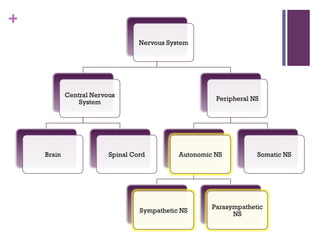
What does dysautonomia mean? Break it down Dys : referring to dysfunction Autonomia : referring to the autonomic nervous system The autonomic nervous system controls all processes in your body that you don’t have to think about (like digestion, blood pressure, heart rate and wake/sleep cycle) With DYSautonomia the autonomic nervous system does not work correctly
 
Sub Types There are many kinds of dysautonomia, but the information in this presentation is based on the most common type: Postural Orthostatic Tachycardia Syndrome (POTS) Also called orthostatic hypotension
What does it feel like (Symptoms) Nausea/Vomiting Joint pain Flu like symptoms (including fever, chills, and body aches) Sleep disorders Anxiety Heat/cold intolerance Easily over stimulated Lightheadedness Fainting or almost fainting (black outs) Exercise intolerance Abnormal heart rate Abnormal blood pressure Weakness Slow or dysfunctional digestive system
What does it feel like? (Symptoms) Sometimes when you get up too fast, you may feel light headed or even have you vision dim.  This is what low blood pressure feels like. The high heart rate would feel like you are jogging or sprinting when you are just sitting or walking. The other symptoms come together to feel like a mild to moderate case of the flu.  Everyone has felt what it feels like to have dysautonomia, but only for brief periods of time.
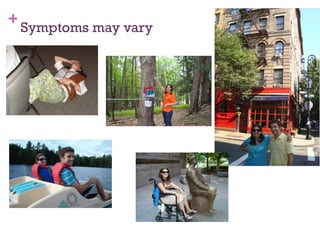
Symptoms may vary
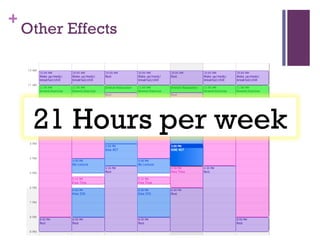
Other Effects 21 Hours per week
Other Effects 21 hours a week to Cook Clean Office hours, meet with faculty, meet with advisor Homework that can’t be done laying in bed Contact doctors Grocery shop Club meetings Hygiene (shower, laundry, picking out clothes, styling hair) Foster relationships Exercise Have fun
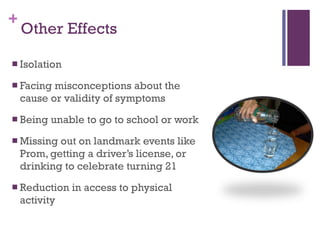
Other Effects Isolation Facing misconceptions about the cause or validity of symptoms Being unable to go to school or work Missing out on landmark events like Prom, getting a driver’s license, or drinking to celebrate turning 21 Reduction in access to physical activity
What causes dysautonomia? Can have multiple and/or unknown causes Onset of dysautonomia may follow a Bacterial or viral infection Serious injury Period of extreme physical or emotional stress Surgery (particularly with stronger anesthesia) Beginning of puberty or a growth spurt Pregnancy And may be related to other conditions such as Lime Disease Ehlers-Danlos Syndrome (hyper-mobility) Diabetes  May be autoimmune, genetic, and/or developmental (Grubb)
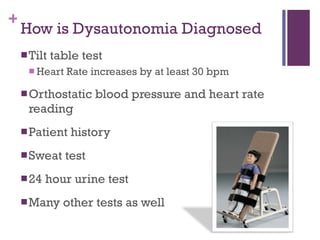
How is Dysautonomia Diagnosed Tilt table test Heart Rate increases by at least 30 bpm Orthostatic blood pressure and heart rate reading Patient history Sweat test 24 hour urine test Many other tests as well
What is the prognosis? POTS is usually not fatal but there isn’t a cure Post viral usually resolves in 2-5 years Developmental usually resolves by around ages 21-24 Some will have symptoms for life Most will experience at least some improvement in symptoms from treatment
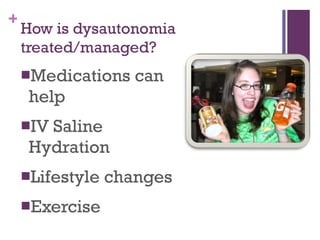
How is dysautonomia treated/managed? Medications can help IV Saline Hydration Lifestyle changes Exercise
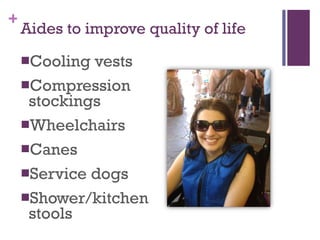
Aides to improve quality of life Cooling vests Compression stockings Wheelchairs Canes Service dogs Shower/kitchen stools
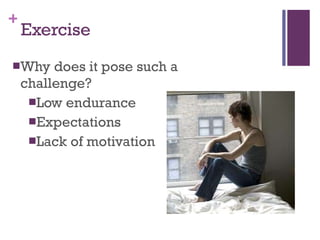
Exercise Why does it pose such a challenge? Low endurance Expectations Lack of motivation
Tips for Physical Activity Control environmental temperature Make sure environment is not stuffy or humid Concentrate on strengthening legs and abdominal muscles Tone in these muscles improves blood circulation Carefully monitor heart rate and blood pressure Frequent breaks Avoid long periods of standing Hydration is important before, during, and after exercise Should expect frequent steps backwards in progress and may need to give extra encouragement
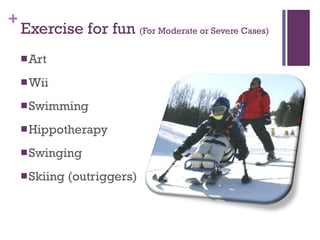
Exercise for fun  (For Moderate or Severe Cases) Art Wii Swimming Hippotherapy Swinging Skiing (outriggers)
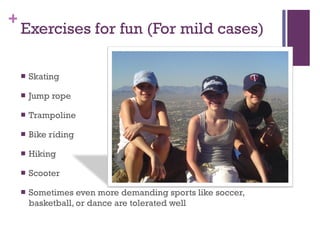
Exercises for fun (For mild cases) Skating Jump rope Trampoline Bike riding Hiking Scooter Sometimes even more demanding sports like soccer, basketball, or dance are tolerated well
Sources Grubb, Blair P., DANIEL J. KOSINSKI, and YOUSUF KANJWAL. "The Postural Tachycardia Syndrome: A Concise Guide to Diagnosis and Management."  TECHNIQUES AND TECHNOLOGY . The Medical University of Ohio, Toledo. Web. 22 Feb. 2010.  http://www.iranep.org/Articles/POTS%20%20JCE%202006.pdf . Blair. Postural Tachycardia Syndrome:POTS [Internet]. Version 18. Knol. 2008 Oct 26. Available from:  http://knol.google.com/k/blair/postural-tachycardia-syndrome/z0Lsji-N/oPFBfQ . Edwards, Laurie.  Life Disrupted: Getting Real about Chronic Illness in Your Twenties and Thirties. New York: Walker & Company, 2008. Print. Low, Phillip, Paola Sandroni, Michael Joyner, and Win-Kuang Shen. "Postural Tachycardia Syndrome (POTS): Management." (2009).  MedScape: Medical Students . Web. 22 Feb. 2010.  http://www.medscape.com/viewarticle/705183_9 . Miserandino, Christine. "The Spoon Theory." Weblog post.  But You Don't Look SIck. 2003. Web. 20 Feb. 2010.  http://www.butyoudontlooksick.com/navigation/BYDLS-TheSpoonTheory.pdf  . Raj, Satish. "The Postural Tachycardia Syndrome (POTS): Pathophysiology, Diagnosis & Management."  Indian Pacing and Electrophysiology Journal  (2006).  Pub Med . National Institute of Health, 1 Apr. 2006. Web. 22 Feb. 2010.  http://www.ncbi.nlm.nih.gov/pmc/articles/PMC1501099/?tool=pmcentrez  .

Dysautonomia

  • 1.
    Dysautonomia By DaniFisher and Emily Block
  • 2.
    Activity Daily ActivitiesEat Breakfast (1) Get ready for school (2) Go to school (1 per hour: 4 hours is 4 sticks) Eat Lunch (1) Exercise (4) Go to work (1 per hour: 3 hours is 3 sticks) Hang out with friends (2) Dinner (2) Grocery shopping (2) Household chores (2) Get Ready for Bed (1)
  • 3.
    What does dysautonomiamean? Break it down Dys : referring to dysfunction Autonomia : referring to the autonomic nervous system The autonomic nervous system controls all processes in your body that you don’t have to think about (like digestion, blood pressure, heart rate and wake/sleep cycle) With DYSautonomia the autonomic nervous system does not work correctly
  • 4.
  • 5.
    Sub Types Thereare many kinds of dysautonomia, but the information in this presentation is based on the most common type: Postural Orthostatic Tachycardia Syndrome (POTS) Also called orthostatic hypotension
  • 6.
    What does itfeel like (Symptoms) Nausea/Vomiting Joint pain Flu like symptoms (including fever, chills, and body aches) Sleep disorders Anxiety Heat/cold intolerance Easily over stimulated Lightheadedness Fainting or almost fainting (black outs) Exercise intolerance Abnormal heart rate Abnormal blood pressure Weakness Slow or dysfunctional digestive system
  • 7.
    What does itfeel like? (Symptoms) Sometimes when you get up too fast, you may feel light headed or even have you vision dim. This is what low blood pressure feels like. The high heart rate would feel like you are jogging or sprinting when you are just sitting or walking. The other symptoms come together to feel like a mild to moderate case of the flu. Everyone has felt what it feels like to have dysautonomia, but only for brief periods of time.
  • 8.
  • 9.
    Other Effects 21Hours per week
  • 10.
    Other Effects 21hours a week to Cook Clean Office hours, meet with faculty, meet with advisor Homework that can’t be done laying in bed Contact doctors Grocery shop Club meetings Hygiene (shower, laundry, picking out clothes, styling hair) Foster relationships Exercise Have fun
  • 11.
    Other Effects IsolationFacing misconceptions about the cause or validity of symptoms Being unable to go to school or work Missing out on landmark events like Prom, getting a driver’s license, or drinking to celebrate turning 21 Reduction in access to physical activity
  • 12.
    What causes dysautonomia?Can have multiple and/or unknown causes Onset of dysautonomia may follow a Bacterial or viral infection Serious injury Period of extreme physical or emotional stress Surgery (particularly with stronger anesthesia) Beginning of puberty or a growth spurt Pregnancy And may be related to other conditions such as Lime Disease Ehlers-Danlos Syndrome (hyper-mobility) Diabetes May be autoimmune, genetic, and/or developmental (Grubb)
  • 13.
    How is DysautonomiaDiagnosed Tilt table test Heart Rate increases by at least 30 bpm Orthostatic blood pressure and heart rate reading Patient history Sweat test 24 hour urine test Many other tests as well
  • 14.
    What is theprognosis? POTS is usually not fatal but there isn’t a cure Post viral usually resolves in 2-5 years Developmental usually resolves by around ages 21-24 Some will have symptoms for life Most will experience at least some improvement in symptoms from treatment
  • 15.
    How is dysautonomiatreated/managed? Medications can help IV Saline Hydration Lifestyle changes Exercise
  • 16.
    Aides to improvequality of life Cooling vests Compression stockings Wheelchairs Canes Service dogs Shower/kitchen stools
  • 17.
    Exercise Why doesit pose such a challenge? Low endurance Expectations Lack of motivation
  • 18.
    Tips for PhysicalActivity Control environmental temperature Make sure environment is not stuffy or humid Concentrate on strengthening legs and abdominal muscles Tone in these muscles improves blood circulation Carefully monitor heart rate and blood pressure Frequent breaks Avoid long periods of standing Hydration is important before, during, and after exercise Should expect frequent steps backwards in progress and may need to give extra encouragement
  • 19.
    Exercise for fun (For Moderate or Severe Cases) Art Wii Swimming Hippotherapy Swinging Skiing (outriggers)
  • 20.
    Exercises for fun(For mild cases) Skating Jump rope Trampoline Bike riding Hiking Scooter Sometimes even more demanding sports like soccer, basketball, or dance are tolerated well
  • 21.
    Sources Grubb, BlairP., DANIEL J. KOSINSKI, and YOUSUF KANJWAL. "The Postural Tachycardia Syndrome: A Concise Guide to Diagnosis and Management." TECHNIQUES AND TECHNOLOGY . The Medical University of Ohio, Toledo. Web. 22 Feb. 2010. http://www.iranep.org/Articles/POTS%20%20JCE%202006.pdf . Blair. Postural Tachycardia Syndrome:POTS [Internet]. Version 18. Knol. 2008 Oct 26. Available from: http://knol.google.com/k/blair/postural-tachycardia-syndrome/z0Lsji-N/oPFBfQ . Edwards, Laurie. Life Disrupted: Getting Real about Chronic Illness in Your Twenties and Thirties. New York: Walker & Company, 2008. Print. Low, Phillip, Paola Sandroni, Michael Joyner, and Win-Kuang Shen. "Postural Tachycardia Syndrome (POTS): Management." (2009). MedScape: Medical Students . Web. 22 Feb. 2010. http://www.medscape.com/viewarticle/705183_9 . Miserandino, Christine. "The Spoon Theory." Weblog post. But You Don't Look SIck. 2003. Web. 20 Feb. 2010. http://www.butyoudontlooksick.com/navigation/BYDLS-TheSpoonTheory.pdf . Raj, Satish. "The Postural Tachycardia Syndrome (POTS): Pathophysiology, Diagnosis & Management." Indian Pacing and Electrophysiology Journal (2006). Pub Med . National Institute of Health, 1 Apr. 2006. Web. 22 Feb. 2010. http://www.ncbi.nlm.nih.gov/pmc/articles/PMC1501099/?tool=pmcentrez .