The Invisible Woman By Cecilia Paredes
 AKA POTS
 A condition resulting in the dysfunction of the

autonomic system (ANS)
 Two subsets:
 Primary – idiopathic (ex. Developmental,

Hyperadrenergic)
 Secondary – in conjunction with disease or disorder
(typically seen in diabetes and Ehlers-Danlos Syndrome)
 Primary POTS affects mainly young, healthy, active

women.
 Other populations include teenagers and pregnant

women.
(Busmer, 2011)
 Exact etiology unknown and remains speculative.
 Statistically significant correlational evidence (Kanjwal, Kosinski, &
Grubb, 2003)

indicates relationships between POTS and:

Growth spurts
Surgery
Post-viral infection
Post-pregnancy
Immunization
Genetic components
Trauma
Peripheral nerve deinnervation of the extremities and/or
heart
 Baroreceptor abnormalities (Abed, Ball, & Wang, 2012)








 Increase in sympathetic activity due to one of the

following:
 Autonomic neuropathy as a result of viral illness (Kanjwal et al.,
2003)

 A hyperadrenergic state (Thieben, Sandroni, Sletten, et al., 2007) due to the

following :
 Increased levels of norepinephrine
 A genetic inability of the system to modulate NE
concentrations (Shannon et al. as cited by Kanjwal et al., 2003)¹

 Blood pooling in the extremities due to either
 Peripheral deinnervation
 Abnormal activity of the reninangiotensin system


(Thieben et al., 2007)
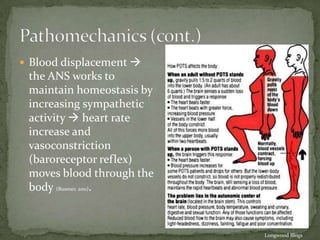
 Blood displacement 

the ANS works to
maintain homeostasis by
increasing sympathetic
activity  heart rate
increase and
vasoconstriction
(baroreceptor reflex)
moves blood through the
body (Busmer, 2011).

Longwood Blogs
 Cardiovascular –

 Sudomotor –

 Tachycardia

 Palpitations

 Loss of or excessive sweating

 Muscular skeletal

 Syncope or presyncope

 RLS, muscle pain, (low back, neck

shoulders) neuropathic pain, chronic
recurring headaches

 Dizziness or lightheadedness
 Angina

 Neurological –

 General –
 Polyuria, nocturia

 Tremulousness

 Chronic fatigue, tiredness, and weakness

 Chronic recurring headaches

 Exercise intolerance

 Problems with balance (equilibrium) 
 Sleep disturbance

Other –
 Cognitive impairment – “difficulty

 Gastrointestinal –
 Abdominal cramps, constipation,



nausea, diarrhea, constipation,
delayed gastric emptying (DINET)





with concentration, brain fog,
memory and/or word recall” (DINET)
Anxiety
Numbness or tingling in extremities
Intolerance to heat
Feeling cold & cold hands and feet

Information compiled from (Busmer, 2011) & (DINET, n.d.)
(Disability Horizons)

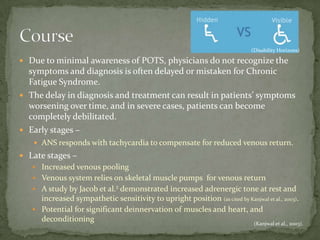
 Due to minimal awareness of POTS, physicians do not recognize the

symptoms and diagnosis is often delayed or mistaken for Chronic
Fatigue Syndrome.
 The delay in diagnosis and treatment can result in patients’ symptoms
worsening over time, and in severe cases, patients can become
completely debilitated.
 Early stages –
 ANS responds with tachycardia to compensate for reduced venous return.

 Late stages –
 Increased venous pooling
 Venous system relies on skeletal muscle pumps for venous return

 A study by Jacob et al.² demonstrated increased adrenergic tone at rest and

increased sympathetic sensitivity to upright position (as cited by Kanjwal et al., 2003).
 Potential for significant deinnervation of muscles and heart, and
deconditioning
(Kanjwal et al., 2003).
 At this time, there is insufficient data concerning the

prognosis of POTS (primary subtype)
 Mainly due to variability of the disorder between patients.
 Usually, with proper medical and therapeutic treatment, the

symptoms of POTS can be alleviated.
 A study by Low et al.³ found typical prognosis for ½ of post-

viral onset POTS patients to make good recovery over 2-5
years (as cited by Kanjwal et al., 2003).
 Secondary POTS prognosis is reliant on underlying disorder.
Kanjwal et al., 2003)
 Symptoms must be present for at least six months (Abed et
al., 2012)

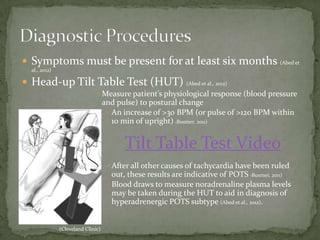
 Head-up Tilt Table Test (HUT) (Abed et al., 2012)
Measure patient’s physiological response (blood pressure

and pulse) to postural change
An increase of >30 BPM (or pulse of >120 BPM within
10 min of upright) Busmer, 2011)
(

Tilt Table Test Video
After all other causes of tachycardia have been ruled

out, these results are indicative of POTS Busmer, 2011)
Blood draws to measure noradrenaline plasma levels
may be taken during the HUT to aid in diagnosis of
hyperadrenergic POTS subtype (Abed et al., 2012).
(

(Cleveland Clinic)
 Diet & Exercise (Abed et al., 2012)
 Increase salt and water intake to increase blood volume
 Smaller, more frequent meals, and increase electrolytes
 20 minutes aerobic low impact exercise – walking, stretching,

swimming, recumbent cycling (Busmer, 2011).

 Pharmacalogical
 Fludocortisone
 Miodrine
 Beta blockers
 Ivabadrine
 SSRI’s (Busmer, 2011)
 IV saline
 Vasoconstrictors
 Pyridostigmine bromide
 NSAIDs (Abed et al., 2012)
 Vasopressin (Kanjwal et al., 2003)
 Equipment and environmental modifications –
 30mmHg compression hosiery to reduce venous pooling (Kanjwal
et al., 2003)

 Modify bed: place bricks under head end of bed to create a

downward slope
 Purpose: condition heart to develop tolerance to orthostatic stress

during sleep (Abed et al., 2012)
 Shower bench

 Behavioral changes (Busmer, 2011)





Moving slowly from supine to upright position
Avoid standing for long periods of time
Stay in motion
Avoid activities that require raising arms overhead for
extended period of time (induces tachycardia)
 Fatigue , dizziness, syncope, exercise

intolerance significantly interfere
with a patient’s personal and social
life
 Reduced ability/inability to

participate in all areas of occupation,
i.e. performing ADL’s/IADL’s,
participating in leisure, sleep/rest,
etc.
 Depression due to sudden loss of
functional ability can greatly reduce
willingness to engage with others.
Patient may feel like a burden, or that
it takes too much out of them both
physically and emotionally.
(Rosemary Lee)
(Busmer, 2011)
 http://oddstuffmagazine.com/unique-photo-series-the-








invisible-woman-by-cecilia-paredes.html/unique-photoseries-the-invisible-woman-by-cecilia-paredes
https://blogs.longwood.edu/joshlynharris/2012/10/06/hell
o-world/
http://my.clevelandclinic.org/heart/disorders/electric/sync
ope.aspx
http://disabilityhorizons.com/tag/invisible-disability/
http://rosemaryl.blogspot.com/2010/09/invisiblewoman.html
Video URL: http://heart.emedtv.com/common-heartconditions,-tests,-and-procedures-video/tilt-table-testvideo.html
 Abed, H., Ball, P., Wang, L. (2012). Diagnosis and management of postural








orthostatic tachycardia syndrome: A brief review. Geriatric Cardiology, 9(1), 6167. Retrieved from http://www.ncbi.nlm.nih.gov/pmc/articles/PMC3390096/
Busmer, L. (2011). Postural orthostatic tachycardia syndrome. Primary Health
Care, 21(9), 16-20. Retrieved from
http://search.proquest.com/docview/906851154?accountid=15099
Dysautonomia Information Network. (n.d.) Symptoms. Retrieved from
http://www.dinet.org/symptoms.htm
Kanjwal, Y., Kosinski, D., & Grubb, B. P. (2003). The postural orthostatic
tachycardia syndrome: Defnitions, diagnosis, and management. Pacing and
Clinical Electrophysiology, 26, 1747-1757. Retrieved from
http://onlinelibrary.wiley.com.libproxy.library.wmich.edu/doi/10.1046/j.14609592.2003.t01-1-00262.x/full
Thieben, M. J., Sandroni, P., Sletten, David, M., Benrud-Larson, L., & et al.
(2007). Postural orthostatic tachycardia syndrome: The mayo clinic experience.
Mayo Clinic Proceedings, 82(3), 308-13. Retrieved from
http://search.proquest.com/docview/216875137?accountid=15099
 ¹Shannon, J., Flatten, N., Jordan J., et al. (2000).

Orthostatic intolerance and tachycardia associated
with norepinephrine-transporter deficiency. N Engl J
Med, 342, 541–549.
 ²Jacob ,G., Ertl, A., Costa, F., et al. (2000).The
neuropathic postural tachycardia syndrome. N Engl J
Med, 343, 1008–1014.
 ³Low, P., Schondorf, R., Novak, V., et al. (1997).
Postural tachycardia syndrome. In P. Low (eds.),
Clinical Autonomic Disorders. (2nd ed.) (pp. 681–697).
Philadelphia, PA, Lippincott Raven Publishers.

Pots Awareness

  • 1.
    The Invisible WomanBy Cecilia Paredes
  • 2.
     AKA POTS A condition resulting in the dysfunction of the autonomic system (ANS)  Two subsets:  Primary – idiopathic (ex. Developmental, Hyperadrenergic)  Secondary – in conjunction with disease or disorder (typically seen in diabetes and Ehlers-Danlos Syndrome)  Primary POTS affects mainly young, healthy, active women.  Other populations include teenagers and pregnant women. (Busmer, 2011)
  • 3.
     Exact etiologyunknown and remains speculative.  Statistically significant correlational evidence (Kanjwal, Kosinski, & Grubb, 2003) indicates relationships between POTS and: Growth spurts Surgery Post-viral infection Post-pregnancy Immunization Genetic components Trauma Peripheral nerve deinnervation of the extremities and/or heart  Baroreceptor abnormalities (Abed, Ball, & Wang, 2012)        
  • 4.
     Increase insympathetic activity due to one of the following:  Autonomic neuropathy as a result of viral illness (Kanjwal et al., 2003)  A hyperadrenergic state (Thieben, Sandroni, Sletten, et al., 2007) due to the following :  Increased levels of norepinephrine  A genetic inability of the system to modulate NE concentrations (Shannon et al. as cited by Kanjwal et al., 2003)¹  Blood pooling in the extremities due to either  Peripheral deinnervation  Abnormal activity of the reninangiotensin system  (Thieben et al., 2007)
  • 5.
     Blood displacement the ANS works to maintain homeostasis by increasing sympathetic activity  heart rate increase and vasoconstriction (baroreceptor reflex) moves blood through the body (Busmer, 2011). Longwood Blogs
  • 6.
     Cardiovascular – Sudomotor –  Tachycardia  Palpitations  Loss of or excessive sweating  Muscular skeletal  Syncope or presyncope  RLS, muscle pain, (low back, neck shoulders) neuropathic pain, chronic recurring headaches  Dizziness or lightheadedness  Angina  Neurological –  General –  Polyuria, nocturia  Tremulousness  Chronic fatigue, tiredness, and weakness  Chronic recurring headaches  Exercise intolerance  Problems with balance (equilibrium)   Sleep disturbance Other –  Cognitive impairment – “difficulty  Gastrointestinal –  Abdominal cramps, constipation,  nausea, diarrhea, constipation, delayed gastric emptying (DINET)    with concentration, brain fog, memory and/or word recall” (DINET) Anxiety Numbness or tingling in extremities Intolerance to heat Feeling cold & cold hands and feet Information compiled from (Busmer, 2011) & (DINET, n.d.)
  • 7.
    (Disability Horizons)  Dueto minimal awareness of POTS, physicians do not recognize the symptoms and diagnosis is often delayed or mistaken for Chronic Fatigue Syndrome.  The delay in diagnosis and treatment can result in patients’ symptoms worsening over time, and in severe cases, patients can become completely debilitated.  Early stages –  ANS responds with tachycardia to compensate for reduced venous return.  Late stages –  Increased venous pooling  Venous system relies on skeletal muscle pumps for venous return  A study by Jacob et al.² demonstrated increased adrenergic tone at rest and increased sympathetic sensitivity to upright position (as cited by Kanjwal et al., 2003).  Potential for significant deinnervation of muscles and heart, and deconditioning (Kanjwal et al., 2003).
  • 8.
     At thistime, there is insufficient data concerning the prognosis of POTS (primary subtype)  Mainly due to variability of the disorder between patients.  Usually, with proper medical and therapeutic treatment, the symptoms of POTS can be alleviated.  A study by Low et al.³ found typical prognosis for ½ of post- viral onset POTS patients to make good recovery over 2-5 years (as cited by Kanjwal et al., 2003).  Secondary POTS prognosis is reliant on underlying disorder. Kanjwal et al., 2003)
  • 9.
     Symptoms mustbe present for at least six months (Abed et al., 2012)  Head-up Tilt Table Test (HUT) (Abed et al., 2012) Measure patient’s physiological response (blood pressure and pulse) to postural change An increase of >30 BPM (or pulse of >120 BPM within 10 min of upright) Busmer, 2011) ( Tilt Table Test Video After all other causes of tachycardia have been ruled out, these results are indicative of POTS Busmer, 2011) Blood draws to measure noradrenaline plasma levels may be taken during the HUT to aid in diagnosis of hyperadrenergic POTS subtype (Abed et al., 2012). ( (Cleveland Clinic)
  • 10.
     Diet &Exercise (Abed et al., 2012)  Increase salt and water intake to increase blood volume  Smaller, more frequent meals, and increase electrolytes  20 minutes aerobic low impact exercise – walking, stretching, swimming, recumbent cycling (Busmer, 2011).  Pharmacalogical  Fludocortisone  Miodrine  Beta blockers  Ivabadrine  SSRI’s (Busmer, 2011)  IV saline  Vasoconstrictors  Pyridostigmine bromide  NSAIDs (Abed et al., 2012)  Vasopressin (Kanjwal et al., 2003)
  • 11.
     Equipment andenvironmental modifications –  30mmHg compression hosiery to reduce venous pooling (Kanjwal et al., 2003)  Modify bed: place bricks under head end of bed to create a downward slope  Purpose: condition heart to develop tolerance to orthostatic stress during sleep (Abed et al., 2012)  Shower bench  Behavioral changes (Busmer, 2011)     Moving slowly from supine to upright position Avoid standing for long periods of time Stay in motion Avoid activities that require raising arms overhead for extended period of time (induces tachycardia)
  • 12.
     Fatigue ,dizziness, syncope, exercise intolerance significantly interfere with a patient’s personal and social life  Reduced ability/inability to participate in all areas of occupation, i.e. performing ADL’s/IADL’s, participating in leisure, sleep/rest, etc.  Depression due to sudden loss of functional ability can greatly reduce willingness to engage with others. Patient may feel like a burden, or that it takes too much out of them both physically and emotionally. (Rosemary Lee) (Busmer, 2011)
  • 13.
  • 14.
     Abed, H.,Ball, P., Wang, L. (2012). Diagnosis and management of postural     orthostatic tachycardia syndrome: A brief review. Geriatric Cardiology, 9(1), 6167. Retrieved from http://www.ncbi.nlm.nih.gov/pmc/articles/PMC3390096/ Busmer, L. (2011). Postural orthostatic tachycardia syndrome. Primary Health Care, 21(9), 16-20. Retrieved from http://search.proquest.com/docview/906851154?accountid=15099 Dysautonomia Information Network. (n.d.) Symptoms. Retrieved from http://www.dinet.org/symptoms.htm Kanjwal, Y., Kosinski, D., & Grubb, B. P. (2003). The postural orthostatic tachycardia syndrome: Defnitions, diagnosis, and management. Pacing and Clinical Electrophysiology, 26, 1747-1757. Retrieved from http://onlinelibrary.wiley.com.libproxy.library.wmich.edu/doi/10.1046/j.14609592.2003.t01-1-00262.x/full Thieben, M. J., Sandroni, P., Sletten, David, M., Benrud-Larson, L., & et al. (2007). Postural orthostatic tachycardia syndrome: The mayo clinic experience. Mayo Clinic Proceedings, 82(3), 308-13. Retrieved from http://search.proquest.com/docview/216875137?accountid=15099
  • 15.
     ¹Shannon, J.,Flatten, N., Jordan J., et al. (2000). Orthostatic intolerance and tachycardia associated with norepinephrine-transporter deficiency. N Engl J Med, 342, 541–549.  ²Jacob ,G., Ertl, A., Costa, F., et al. (2000).The neuropathic postural tachycardia syndrome. N Engl J Med, 343, 1008–1014.  ³Low, P., Schondorf, R., Novak, V., et al. (1997). Postural tachycardia syndrome. In P. Low (eds.), Clinical Autonomic Disorders. (2nd ed.) (pp. 681–697). Philadelphia, PA, Lippincott Raven Publishers.