CSC354-Design and Analysis of
Algorithms
Week-9 Lecture-15
Semester#4 Spring 2022
Prepared by:
Adeel Munawar
1
Instructor Contact Details
 Name: Adeel Munawar
 Course Instructor: Design and Analysis of Algorithms
 Credit Hours: 3
 Office Location: CS-Faculty Office, 2nd Floor New Building
 Email: Adeel.munawar@lgu.edu.pk
 Visiting Hours: Friday 8am-10:30am. Also after class. Students can also walk in if
I am free
Friday, June
24, 2022
Lahore Garrison University
Analysis of Algorithm
2
Previous Lecture Summary
 Sorting in Linear Time
 Counting Sort
 Counting Sort Algorithm
 Radix Sort
Friday, June
24, 2022
Lahore Garrison University
Analysis of Algorithm
3
Today’s Lecture Summary
 Dynamic Programming
 Fibonacci numbers
 Chain Matrix Multiplication
 Algorithm
 Example
Friday, June
24, 2022
Lahore Garrison University
Analysis of Algorithm
4
Dynamic Programming
LOGICAL RE-USE OF COMPUTATIONS
5
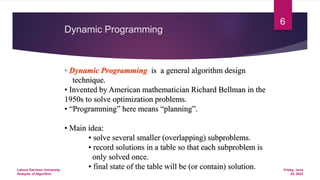
Dynamic Programming
• Dynamic Programming is a general algorithm design
technique.
• Invented by American mathematician Richard Bellman in the
1950s to solve optimization problems.
• “Programming” here means “planning”.
• Main idea:
• solve several smaller (overlapping) subproblems.
• record solutions in a table so that each subproblem is
only solved once.
• final state of the table will be (or contain) solution. Friday, June
24, 2022
Lahore Garrison University
Analysis of Algorithm
6
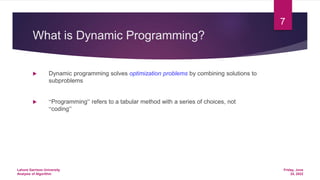
What is Dynamic Programming?
 Dynamic programming solves optimization problems by combining solutions to
subproblems
 “Programming” refers to a tabular method with a series of choices, not
“coding”
Friday, June
24, 2022
Lahore Garrison University
Analysis of Algorithm
7
What is Dynamic Programming?
…contd
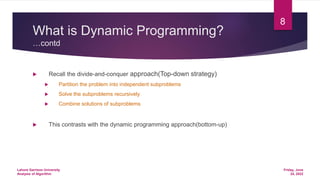
 Recall the divide-and-conquer approach(Top-down strategy)
 Partition the problem into independent subproblems
 Solve the subproblems recursively
 Combine solutions of subproblems
 This contrasts with the dynamic programming approach(bottom-up)
Friday, June
24, 2022
Lahore Garrison University
Analysis of Algorithm
8
Friday, June
24, 2022
Lahore Garrison University
Analysis of Algorithm
9
Top down Bottom Up
Follows the memorization technique Follows the tabulation method
Top Down Approach:
Memorization is equal to the sum of the recursion and caching whereas the
recursion is calling the function itself and caching is storing the intermediate
results.
Top Down Approach
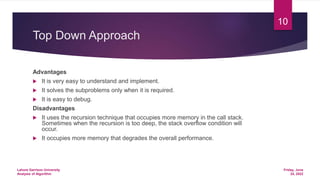
Advantages
 It is very easy to understand and implement.
 It solves the subproblems only when it is required.
 It is easy to debug.
Disadvantages
 It uses the recursion technique that occupies more memory in the call stack.
Sometimes when the recursion is too deep, the stack overflow condition will
occur.
 It occupies more memory that degrades the overall performance.
Friday, June
24, 2022
Lahore Garrison University
Analysis of Algorithm
10
Example
int fib(int n)
{
if(n<0)
error;
if(n==0)
return 0;
if(n==1)
return 1;
sum = fib(n-1) + fib(n-2);
}
Friday, June
24, 2022
Lahore Garrison University
Analysis of Algorithm
11
Cont..
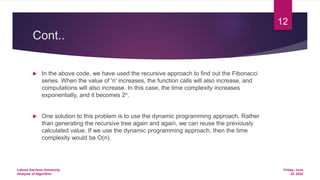
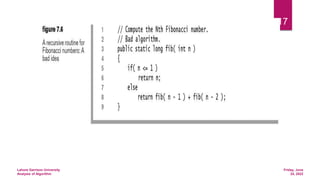
 In the above code, we have used the recursive approach to find out the Fibonacci
series. When the value of 'n' increases, the function calls will also increase, and
computations will also increase. In this case, the time complexity increases
exponentially, and it becomes 2n.
 One solution to this problem is to use the dynamic programming approach. Rather
than generating the recursive tree again and again, we can reuse the previously
calculated value. If we use the dynamic programming approach, then the time
complexity would be O(n).
Friday, June
24, 2022
Lahore Garrison University
Analysis of Algorithm
12
What is Dynamic Programming?
…contd
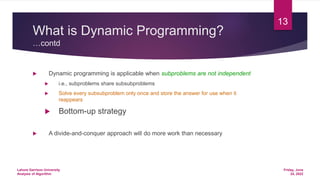
 Dynamic programming is applicable when subproblems are not independent
 i.e., subproblems share subsubproblems
 Solve every subsubproblem only once and store the answer for use when it
reappears
 Bottom-up strategy
 A divide-and-conquer approach will do more work than necessary
Friday, June
24, 2022
Lahore Garrison University
Analysis of Algorithm
13
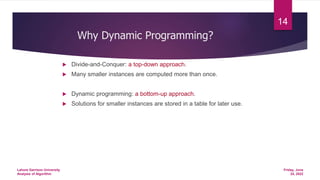
 Divide-and-Conquer: a top-down approach.
 Many smaller instances are computed more than once.
 Dynamic programming: a bottom-up approach.
 Solutions for smaller instances are stored in a table for later use.
Why Dynamic Programming?
Friday, June
24, 2022
Lahore Garrison University
Analysis of Algorithm
14
Why Dynamic Programming? …
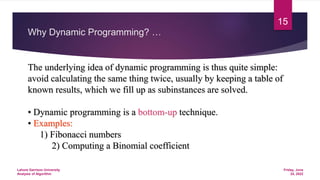
The underlying idea of dynamic programming is thus quite simple:
avoid calculating the same thing twice, usually by keeping a table of
known results, which we fill up as subinstances are solved.
• Dynamic programming is a bottom-up technique.
• Examples:
1) Fibonacci numbers
2) Computing a Binomial coefficient
Friday, June
24, 2022
Lahore Garrison University
Analysis of Algorithm
15
Dynamic Programming
 Fibonacci numbers:
0, 1, 1, 2, 3, 5, 8, 13, 21, 34
 Recurrence Relation of Fibonacci numbers
?
Friday, June
24, 2022
Lahore Garrison University
Analysis of Algorithm
16
Friday, June
24, 2022
Lahore Garrison University
Analysis of Algorithm
17
Example: Fibonacci numbers
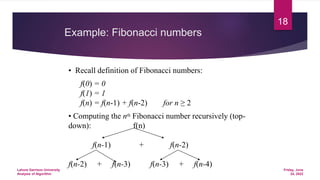
• Recall definition of Fibonacci numbers:
f(0) = 0
f(1) = 1
f(n) = f(n-1) + f(n-2) for n ≥ 2
• Computing the nth Fibonacci number recursively (top-
down): f(n)
f(n-1) + f(n-2)
f(n-2) + f(n-3) f(n-3) + f(n-4)
Friday, June
24, 2022
Lahore Garrison University
Analysis of Algorithm
18
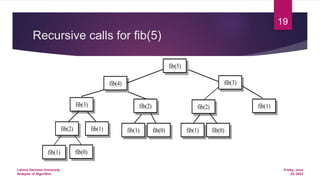
Recursive calls for fib(5)
fib(5)
fib(4) fib(3)
fib(3) fib(2) fib(2) fib(1)
fib(2) fib(1) fib(1) fib(0) fib(1) fib(0)
fib(1) fib(0)
Friday, June
24, 2022
Lahore Garrison University
Analysis of Algorithm
19
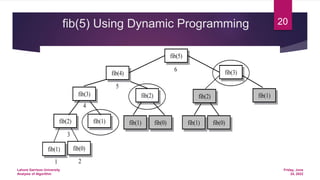
fib(5) Using Dynamic Programming
fib(5)
fib(4) fib(3)
fib(3) fib(2) fib(2) fib(1)
fib(2) fib(1) fib(1) fib(0) fib(1) fib(0)
fib(1) fib(0)
6
5
2
1
3
4
Friday, June
24, 2022
Lahore Garrison University
Analysis of Algorithm
20
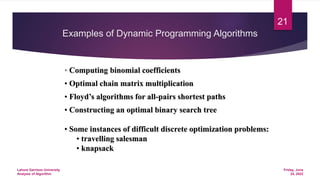
Examples of Dynamic Programming Algorithms
• Computing binomial coefficients
• Optimal chain matrix multiplication
• Floyd’s algorithms for all-pairs shortest paths
• Constructing an optimal binary search tree
• Some instances of difficult discrete optimization problems:
• travelling salesman
• knapsack
Friday, June
24, 2022
Lahore Garrison University
Analysis of Algorithm
21
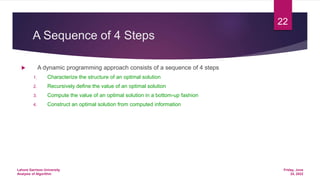
A Sequence of 4 Steps
 A dynamic programming approach consists of a sequence of 4 steps
1. Characterize the structure of an optimal solution
2. Recursively define the value of an optimal solution
3. Compute the value of an optimal solution in a bottom-up fashion
4. Construct an optimal solution from computed information
Friday, June
24, 2022
Lahore Garrison University
Analysis of Algorithm
22
MATRIX MULTIPLICATION
MATRIX MULTIPLY(A, B)
1. if columns[A]rows[B]
2. then error “incompatible dimension”
3. else
4. for i1 to rows[A]
5. do for j1 to columns[B]
6. do C[i,j] 0
7. for k1 to columns[A]
8. do C[i,j] C[i,j]+A[i,k]. B[k,j]
9. return C
Friday, June
24, 2022
Lahore Garrison University
Analysis of Algorithm
MATRIX MULTIPLICATION
• Two matrices can only be multiplied if
columns[A] = rows [B]
• If order of A is p x q & order of B is q x r
then order of C will be p x r
• Time required to computer the product of two
matrices is p x q x r
Friday, June
24, 2022
Lahore Garrison University
Analysis of Algorithm
MATRIX CHAIN MULTIPLICATION
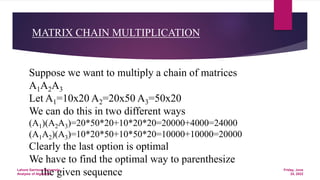
Suppose we want to multiply a chain of matrices
A1A2A3
Let A1=10x20 A2=20x50 A3=50x20
We can do this in two different ways
(A1)(A2A3)=20*50*20+10*20*20=20000+4000=24000
(A1A2)(A3)=10*20*50+10*50*20=10000+10000=20000
Clearly the last option is optimal
We have to find the optimal way to parenthesize
the given sequence Friday, June
24, 2022
Lahore Garrison University
Analysis of Algorithm
Friday, June
24, 2022
Lahore Garrison University
Analysis of Algorithm
Matrix-Chain multiplication
Dynamic Programming – Bottom Up Approach
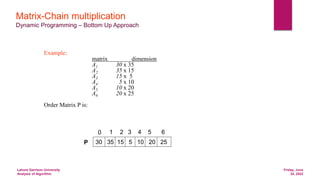
Example:
matrix dimension
A1 30 x 35
A2 35 x 15
A3 15 x 5
A4 5 x 10
A5 10 x 20
A6 20 x 25
Order Matrix P is:
30 35 15 5 10 20 25
0 1 2 3 4 5 6
P
Friday, June
24, 2022
Lahore Garrison University
Analysis of Algorithm
Matrix-Chain multiplication
Dynamic Programming – Bottom Up Approach
30 35 15 5 10 20 25
0 1 2 3 4 5 6
P
August
2014
Amjad Ali
28
Matrix-Chain multiplication
Dynamic Programming – Bottom Up Approach
30 35 15 5 10 20 25
0 1 2 3 4 5 6
P
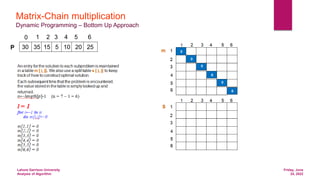
for l←2 to n
do for i←1 to n-l+1
do j←i+l-1
m[1,2]
m[2,3]
m[3,4]
m[4,5]
m[5,6]
1
2
3
4
6
5
1 2 3 4 5 6
1
2
3
4
6
5
1 2 3 4 5 6
m
S
0
0
0
0
0
0
l = 2
Matrix-Chain multiplication
Dynamic Programming
29
Matrix-Chain multiplication
Dynamic Programming – Bottom Up Approach
30 35 15 5 10 20 25
0 1 2 3 4 5 6
P
for l←2 to n
do for i←1 to n-l+1
do j←i+l-1
m[i, j] = min { m[i, k] +m[k+1, j] + pi-1 pk pj}
i ≤ k < j
m[1, 2] = min { m[1, 1] +m[2, 2] + p0 p1 p2}
1 ≤ k < 2
m[1, 2] = min { 0 + 0 + 30x35x15}
= min ( 15750 ) = 15750
m[2, 3] = min { m[2, 2] + m[3, 3] + p1 p2 p3}
2 ≤ k < 3
m[2, 3] = min { 0 + 0 + 35x15x5}
= min ( 2625 ) = 2625
1
2
3
4
6
5
1 2 3 4 5 6
1
2
3
4
6
5
1 2 3 4 5 6
m
S
0
0
0
0
0
0
15750
2625
1
2
l = 2
Matrix-Chain multiplication
Dynamic Programming
30
Matrix-Chain multiplication
Dynamic Programming – Bottom Up Approach
30 35 15 5 10 20 25
0 1 2 3 4 5 6
P
for l←2 to n
do for i←1 to n-l+1
do j←i+l-1
m[3, 4] = min { m[3, 3] +m[4, 4] + p2 p3 p4}
3 ≤ k < 4
m[3, 4] = min { 0 + 0 + 15x5x10}
= min ( 750 ) = 750
m[4, 5] = min { m[4, 4] + m[5, 5] + p3 p4 p5}
4 ≤ k < 5
m[4, 5] = min { 0 + 0 + 5x10x20}
= min ( 1000 ) = 1000
m[5, 6] = min { m[5, 5] + m[6, 6] + p4 p5 p6}
5 ≤ k < 6
m[5, 6] = min { 0 + 0 + 10x20x25}
= min ( 5000 ) = 5000
1
2
3
4
6
5
1 2 3 4 5 6
1
2
3
4
6
5
1 2 3 4 5 6
m
S
0
0
0
0
0
0
15750
2625
1
2
750
3
1000
4
5000
5
l = 2
Matrix-Chain multiplication
Dynamic Programming
August
2014
Amjad Ali
31
Matrix-Chain multiplication
Dynamic Programming – Bottom Up Approach
30 35 15 5 10 20 25
0 1 2 3 4 5 6
P
for l←2 to n
do for i←1 to n-l+1
do j←i+l-1
m[1, 3]
m[2, 4]
m[3, 5]
m[4, 6]
1
2
3
4
6
5
1 2 3 4 5 6
1
2
3
4
6
5
1 2 3 4 5 6
m
S
0
0
0
0
0
0
15750
2625
1
2
750
3
1000
4
5000
5
l = 3
Matrix-Chain multiplication
Dynamic Programming
August
2014
Amjad Ali
32
Matrix-Chain multiplication
Dynamic Programming – Bottom Up Approach
30 35 15 5 10 20 25
0 1 2 3 4 5 6
P
for l←2 to n
do for i←1 to n-l+1
do j←i+l-1
m[1, 3]=min { m[1, 1] +m[2, 3] + p0 p1 p3 ,
1 ≤ k < 3 m[1, 2] +m[3, 3] + p0 p2 p3 }
m[1, 3] = min { 0 + 2625 + 30x35x5 ,
15750 + 0 +30x15x5 }
= min ( 7875 , 18000 ) = 7875
m[2, 4] = min { m[2, 2] + m[3, 4] + p1 p2 p4 ,
2 ≤ k < 4 m [2, 3]+m[4, 4] + p1 p3 p4 }
m[2, 4] = min { 0 + 750 + 35x15x10 ,
2625 + 0 + 35x5x10}
= min ( 6000, 4375) = 4375
1
2
3
4
6
5
1 2 3 4 5 6
1
2
3
4
6
5
1 2 3 4 5 6
m
S
0
0
0
0
0
0
15750
2625
1
2
750
3
1000
4
5000
5
7875
1
4375
3
l = 3
Matrix-Chain multiplication
Dynamic Programming
August
2014
Amjad Ali
33
Matrix-Chain multiplication
Dynamic Programming – Bottom Up Approach
30 35 15 5 10 20 25
0 1 2 3 4 5 6
P
for l←2 to n
do for i←1 to n-l+1
do j←i+l-1
m[3, 5]=min { m[3, 3] +m[4, 5] + p2 p3 p5 ,
3 ≤ k < 5 m[3, 4] +m[5, 5] + p2 p4 p5 }
m[3, 5] = min { 0 + 1000 + 15x5x20 ,
750 + 0 +15x10x20 }
= min ( 2500 , 3750 ) = 2500
m[4, 6] = min { m[4, 4] + m[5, 6] + p3 p4 p6 ,
4 ≤ k < 6 m [4, 5]+m[6, 6] + p3 p5 p6 }
m[4, 6] = min { 0 + 5000 + 5x10x25 ,
1000 + 0 + 5x20x25}
= min ( 6250, 3500) = 3500
1
2
3
4
6
5
1 2 3 4 5 6
1
2
3
4
6
5
1 2 3 4 5 6
m
S
0
0
0
0
0
0
15750
2625
1
2
750
3
1000
4
5000
5
7875
1
4375
3
2500
3
3500
5
l = 3
Matrix-Chain multiplication
Dynamic Programming
August
2014
Amjad Ali
34
Matrix-Chain multiplication
Dynamic Programming – Bottom Up Approach
30 35 15 5 10 20 25
0 1 2 3 4 5 6
P
m[1, 4]
m[2, 5]
m[3, 6]
1
2
3
4
6
5
1 2 3 4 5 6
1
2
3
4
6
5
1 2 3 4 5 6
m
S
0
0
0
0
0
0
15750
2625
1
2
750
3
1000
4
5000
5
7875
1
4375
3
2500
3
3500
5
l = 4
Matrix-Chain multiplication
Dynamic Programming
August
2014
Amjad Ali
35
Matrix-Chain multiplication
Dynamic Programming – Bottom Up Approach
30 35 15 5 10 20 25
0 1 2 3 4 5 6
P
m[1, 4]=min { m[1, 1] + m[2, 4] + p0 p1 p4 ,
1 ≤ k < 4 m[1, 2] + m[3, 4] + p0 p2 p4 ,
m[1,3] + m[4,4] + p0 p3 p4 }
m[1, 4]=min { 0 + 4375 + 30x35x10 ,
15750 + 750 + 30x15x10
7875 + 0 + 30x5x10 }
m[1, 4]=min { 14875 , 21000 , 9375} = 9375
1
2
3
4
6
5
1 2 3 4 5 6
1
2
3
4
6
5
1 2 3 4 5 6
m
S
0
0
0
0
0
0
15750
2625
1
2
750
3
1000
4
5000
5
7875
1
4375
3
2500
3
3500
5
9375
3
l = 4
Matrix-Chain multiplication
Dynamic Programming
August
2014
Amjad Ali
36
Matrix-Chain multiplication
Dynamic Programming – Bottom Up Approach
30 35 15 5 10 20 25
0 1 2 3 4 5 6
P
m[2, 5]=min { m[2, 2] + m[3, 5] + p1 p2 p5 ,
2 ≤ k < 5 m[2, 3] + m[4, 5] + p1 p3 p5 ,
m[2,4] + m[5,5] + p1 p4 p5 }
m[2, 5]=min { 0 + 2500 + 35x15x20 ,
2625+ 1000 + 35x5x20 ,
4375 + 0 + 35x10x20}
m[2, 5]=min { 13000 , 7125 , 11375} = 7125
1
2
3
4
6
5
1 2 3 4 5 6
1
2
3
4
6
5
1 2 3 4 5 6
m
S
0
0
0
0
0
0
15750
2625
1
2
750
3
1000
4
5000
5
7875
1
4375
3
2500
3
3500
5
9375
7125
3
3
l = 4
Matrix-Chain multiplication
Dynamic Programming
August
2014
Amjad Ali
37
Matrix-Chain multiplication
Dynamic Programming – Bottom Up Approach
30 35 15 5 10 20 25
0 1 2 3 4 5 6
P
m[3, 6]=min { m[3, 3] + m[4, 6] + p2 p3 p6 ,
3 ≤ k < 6 m[3, 4] + m[5, 6] + p2 p4 p6 ,
m[3,5] + m[6,6] + p2 p5 p6 }
m[3, 6]=min { 0 + 3500 + 15x5x25 ,
750+ 5000 + 15x10x25 ,
2500 + 0 + 15x20x25}
m[3, 6]=min { 5375 , 9500 , 10000} = 5375
1
2
3
4
6
5
1 2 3 4 5 6
1
2
3
4
6
5
1 2 3 4 5 6
m
S
0
0
0
0
0
0
15750
2625
1
2
750
3
1000
4
5000
5
7875
1
4375
3
2500
3
3500
5
9375
5375
7125
3
3
3
l = 4
Matrix-Chain multiplication
Dynamic Programming
August
2014
Amjad Ali
38
Matrix-Chain multiplication
Dynamic Programming – Bottom Up Approach
30 35 15 5 10 20 25
0 1 2 3 4 5 6
P
m[1, 5]
m[2, 6]
1
2
3
4
6
5
1 2 3 4 5 6
1
2
3
4
6
5
1 2 3 4 5 6
m
S
0
0
0
0
0
0
15750
2625
1
2
750
3
1000
4
5000
5
7875
1
4375
3
2500
3
3500
5
9375
5375
7175
3
3
3
l = 5
Matrix-Chain multiplication
Dynamic Programming
August
2014
Amjad Ali
39
Matrix-Chain multiplication
Dynamic Programming – Bottom Up Approach
30 35 15 5 10 20 25
0 1 2 3 4 5 6
P
m[1, 5]=min { m[1, 1] + m[2, 5] + p0 p1 p5 ,
1 ≤ k < 5 m[1, 2] + m[3, 5] + p0 p2 p5 ,
m[1,3] + m[4,5] + p0 p3 p5 ,
m[1, 4] + m[5, 5] + p0 p4 p5 }
m[1, 5]=min { 0 + 7175 + 30x35x20 ,
15750 + 2500 + 30x15x20 ,
7875 + 1000 + 30x5x20 ,
9375 + 0 + 30x10x20}
m[1, 5]=min { 28175 , 27250 , 11875 , 15375}
= 11875
1
2
3
4
6
5
1 2 3 4 5 6
1
2
3
4
6
5
1 2 3 4 5 6
m
S
0
0
0
0
0
0
15750
2625
1
2
750
3
1000
4
5000
5
7875
1
4375
3
2500
3
3500
5
9375
5375
7175
3
3
3
l = 5
11875
3
Matrix-Chain multiplication
Dynamic Programming
August
2014
Amjad Ali
40
Matrix-Chain multiplication
Dynamic Programming – Bottom Up Approach
30 35 15 5 10 20 25
0 1 2 3 4 5 6
P
m[2, 6]=min { m[2, 2] + m[3, 6] + p1 p2 p6 ,
2 ≤ k < 6 m[2, 3] + m[4, 6] + p1 p3 p6 ,
m[2,4] + m[5,6] + p1 p4 p6 ,
m[2, 5] + m[6, 6] + p1 p5 p6 }
m[2, 6]=min { 0 + 5375 + 35x15x25 ,
2625+ 3500 + 35x5x25 ,
4375 + 5000 + 35x10x25 ,
5725 + 0 + 35x20x25}
m[2, 6]=min { 18500 , 10500 , 18125 , 23225}
= 10500
1
2
3
4
6
5
1 2 3 4 5 6
1
2
3
4
6
5
1 2 3 4 5 6
m
S
0
0
0
0
0
0
15750
2625
1
2
750
3
1000
4
5000
5
7875
1
4375
3
2500
3
3500
5
9375
5375
5725
3
3
3
l = 5
3
10500
3
11875
Matrix-Chain multiplication
Dynamic Programming
August
2014
Amjad Ali
41
Matrix-Chain multiplication
Dynamic Programming – Bottom Up Approach
30 35 15 5 10 20 25
0 1 2 3 4 5 6
P
m[1, 6]
1
2
3
4
6
5
1 2 3 4 5 6
1
2
3
4
6
5
1 2 3 4 5 6
m
S
0
0
0
0
0
0
15750
2625
1
2
750
3
1000
4
5000
5
7875
1
4375
3
2500
3
3500
5
9375
5375
5725
3
3
3
l = 6
3
10500
3
11875
Matrix-Chain multiplication
Dynamic Programming
August
2014
Amjad Ali
42
Matrix-Chain multiplication
Dynamic Programming – Bottom Up Approach
30 35 15 5 10 20 25
0 1 2 3 4 5 6
P
m[1, 6]=min { m[1, 1] + m[2, 6] + p0 p1 p6 ,
1 ≤ k < 6 m[1, 2] + m[3, 6] + p0 p2 p6 ,
m[1,3] + m[4,6] + p0 p3 p6 ,
m[1, 4] + m[5, 6] + p0 p4 p6 ,
m[1, 5] + m[6, 6] + p0 p5 p6 }
m[1, 6]=min { 0 + 10500 + 30x35x25,
15750+ 5375 + 30x15x25 ,
7875 + 3500 + 30x5x25 ,
9375+ 5000 + 30x10x25 ,
11875+ 0 + 30x20x25}
m[1, 6]=min { 36750 , 32375 , 15125 , 26875}
= 15125
1
2
3
4
6
5
1 2 3 4 5 6
1
2
3
4
6
5
1 2 3 4 5 6
m
S
0
0
0
0
0
0
15750
2625
1
2
750
3
1000
4
5000
5
7875
1
4375
3
2500
3
3500
5
9375
5375
5725
3
3
3
l = 6
3
10500
3
11875
3
15125
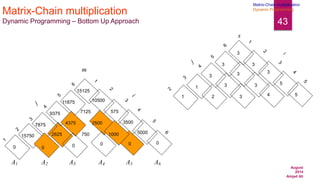
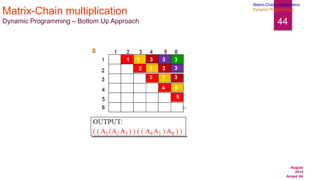
Matrix-Chain multiplication
Dynamic Programming
3
3
3
3 3
3 3
3
1
5
2
1 3 4 5
s
15750
0
9375
7875
15125
11875
4375
2625
10500
7125
0
0
0
575
0
5000
3500
0
750
A1 A2 A3 A4 A5 A6
m
1000
2500
August
2014
Amjad Ali
43
Matrix-Chain multiplication
Dynamic Programming – Bottom Up Approach
Matrix-Chain multiplication
Dynamic Programming
August
2014
Amjad Ali
44
Matrix-Chain multiplication
Dynamic Programming – Bottom Up Approach
Matrix-Chain multiplication
Dynamic Programming
Summary
 Dynamic Programming
 Fibonacci numbers
 Chain Matrix Multiplication
 Algorithm
 Example
Friday, June
24, 2022
Lahore Garrison University
Analysis of Algorithm
45
Q & A
Friday, June
24, 2022
Lahore Garrison University
Analysis of Algorithm
46
References
 These lecture notes were taken from following source:
 Introduction to Algorithms 2nd ,Cormen, Leiserson, Rivest and
Stein, The MIT Press, 2001.
Friday, June
24, 2022
Lahore Garrison University
Analysis of Algorithm
47

week 9 lec 15.pptx

  • 1.
    CSC354-Design and Analysisof Algorithms Week-9 Lecture-15 Semester#4 Spring 2022 Prepared by: Adeel Munawar 1
  • 2.
    Instructor Contact Details Name: Adeel Munawar  Course Instructor: Design and Analysis of Algorithms  Credit Hours: 3  Office Location: CS-Faculty Office, 2nd Floor New Building  Email: Adeel.munawar@lgu.edu.pk  Visiting Hours: Friday 8am-10:30am. Also after class. Students can also walk in if I am free Friday, June 24, 2022 Lahore Garrison University Analysis of Algorithm 2
  • 3.
    Previous Lecture Summary Sorting in Linear Time  Counting Sort  Counting Sort Algorithm  Radix Sort Friday, June 24, 2022 Lahore Garrison University Analysis of Algorithm 3
  • 4.
    Today’s Lecture Summary Dynamic Programming  Fibonacci numbers  Chain Matrix Multiplication  Algorithm  Example Friday, June 24, 2022 Lahore Garrison University Analysis of Algorithm 4
  • 5.
  • 6.
    Dynamic Programming • DynamicProgramming is a general algorithm design technique. • Invented by American mathematician Richard Bellman in the 1950s to solve optimization problems. • “Programming” here means “planning”. • Main idea: • solve several smaller (overlapping) subproblems. • record solutions in a table so that each subproblem is only solved once. • final state of the table will be (or contain) solution. Friday, June 24, 2022 Lahore Garrison University Analysis of Algorithm 6
  • 7.
    What is DynamicProgramming?  Dynamic programming solves optimization problems by combining solutions to subproblems  “Programming” refers to a tabular method with a series of choices, not “coding” Friday, June 24, 2022 Lahore Garrison University Analysis of Algorithm 7
  • 8.
    What is DynamicProgramming? …contd  Recall the divide-and-conquer approach(Top-down strategy)  Partition the problem into independent subproblems  Solve the subproblems recursively  Combine solutions of subproblems  This contrasts with the dynamic programming approach(bottom-up) Friday, June 24, 2022 Lahore Garrison University Analysis of Algorithm 8
  • 9.
    Friday, June 24, 2022 LahoreGarrison University Analysis of Algorithm 9 Top down Bottom Up Follows the memorization technique Follows the tabulation method Top Down Approach: Memorization is equal to the sum of the recursion and caching whereas the recursion is calling the function itself and caching is storing the intermediate results.
  • 10.
    Top Down Approach Advantages It is very easy to understand and implement.  It solves the subproblems only when it is required.  It is easy to debug. Disadvantages  It uses the recursion technique that occupies more memory in the call stack. Sometimes when the recursion is too deep, the stack overflow condition will occur.  It occupies more memory that degrades the overall performance. Friday, June 24, 2022 Lahore Garrison University Analysis of Algorithm 10
  • 11.
    Example int fib(int n) { if(n<0) error; if(n==0) return0; if(n==1) return 1; sum = fib(n-1) + fib(n-2); } Friday, June 24, 2022 Lahore Garrison University Analysis of Algorithm 11
  • 12.
    Cont..  In theabove code, we have used the recursive approach to find out the Fibonacci series. When the value of 'n' increases, the function calls will also increase, and computations will also increase. In this case, the time complexity increases exponentially, and it becomes 2n.  One solution to this problem is to use the dynamic programming approach. Rather than generating the recursive tree again and again, we can reuse the previously calculated value. If we use the dynamic programming approach, then the time complexity would be O(n). Friday, June 24, 2022 Lahore Garrison University Analysis of Algorithm 12
  • 13.
    What is DynamicProgramming? …contd  Dynamic programming is applicable when subproblems are not independent  i.e., subproblems share subsubproblems  Solve every subsubproblem only once and store the answer for use when it reappears  Bottom-up strategy  A divide-and-conquer approach will do more work than necessary Friday, June 24, 2022 Lahore Garrison University Analysis of Algorithm 13
  • 14.
     Divide-and-Conquer: atop-down approach.  Many smaller instances are computed more than once.  Dynamic programming: a bottom-up approach.  Solutions for smaller instances are stored in a table for later use. Why Dynamic Programming? Friday, June 24, 2022 Lahore Garrison University Analysis of Algorithm 14
  • 15.
    Why Dynamic Programming?… The underlying idea of dynamic programming is thus quite simple: avoid calculating the same thing twice, usually by keeping a table of known results, which we fill up as subinstances are solved. • Dynamic programming is a bottom-up technique. • Examples: 1) Fibonacci numbers 2) Computing a Binomial coefficient Friday, June 24, 2022 Lahore Garrison University Analysis of Algorithm 15
  • 16.
    Dynamic Programming  Fibonaccinumbers: 0, 1, 1, 2, 3, 5, 8, 13, 21, 34  Recurrence Relation of Fibonacci numbers ? Friday, June 24, 2022 Lahore Garrison University Analysis of Algorithm 16
  • 17.
    Friday, June 24, 2022 LahoreGarrison University Analysis of Algorithm 17
  • 18.
    Example: Fibonacci numbers •Recall definition of Fibonacci numbers: f(0) = 0 f(1) = 1 f(n) = f(n-1) + f(n-2) for n ≥ 2 • Computing the nth Fibonacci number recursively (top- down): f(n) f(n-1) + f(n-2) f(n-2) + f(n-3) f(n-3) + f(n-4) Friday, June 24, 2022 Lahore Garrison University Analysis of Algorithm 18
  • 19.
    Recursive calls forfib(5) fib(5) fib(4) fib(3) fib(3) fib(2) fib(2) fib(1) fib(2) fib(1) fib(1) fib(0) fib(1) fib(0) fib(1) fib(0) Friday, June 24, 2022 Lahore Garrison University Analysis of Algorithm 19
  • 20.
    fib(5) Using DynamicProgramming fib(5) fib(4) fib(3) fib(3) fib(2) fib(2) fib(1) fib(2) fib(1) fib(1) fib(0) fib(1) fib(0) fib(1) fib(0) 6 5 2 1 3 4 Friday, June 24, 2022 Lahore Garrison University Analysis of Algorithm 20
  • 21.
    Examples of DynamicProgramming Algorithms • Computing binomial coefficients • Optimal chain matrix multiplication • Floyd’s algorithms for all-pairs shortest paths • Constructing an optimal binary search tree • Some instances of difficult discrete optimization problems: • travelling salesman • knapsack Friday, June 24, 2022 Lahore Garrison University Analysis of Algorithm 21
  • 22.
    A Sequence of4 Steps  A dynamic programming approach consists of a sequence of 4 steps 1. Characterize the structure of an optimal solution 2. Recursively define the value of an optimal solution 3. Compute the value of an optimal solution in a bottom-up fashion 4. Construct an optimal solution from computed information Friday, June 24, 2022 Lahore Garrison University Analysis of Algorithm 22
  • 23.
    MATRIX MULTIPLICATION MATRIX MULTIPLY(A,B) 1. if columns[A]rows[B] 2. then error “incompatible dimension” 3. else 4. for i1 to rows[A] 5. do for j1 to columns[B] 6. do C[i,j] 0 7. for k1 to columns[A] 8. do C[i,j] C[i,j]+A[i,k]. B[k,j] 9. return C Friday, June 24, 2022 Lahore Garrison University Analysis of Algorithm
  • 24.
    MATRIX MULTIPLICATION • Twomatrices can only be multiplied if columns[A] = rows [B] • If order of A is p x q & order of B is q x r then order of C will be p x r • Time required to computer the product of two matrices is p x q x r Friday, June 24, 2022 Lahore Garrison University Analysis of Algorithm
  • 25.
    MATRIX CHAIN MULTIPLICATION Supposewe want to multiply a chain of matrices A1A2A3 Let A1=10x20 A2=20x50 A3=50x20 We can do this in two different ways (A1)(A2A3)=20*50*20+10*20*20=20000+4000=24000 (A1A2)(A3)=10*20*50+10*50*20=10000+10000=20000 Clearly the last option is optimal We have to find the optimal way to parenthesize the given sequence Friday, June 24, 2022 Lahore Garrison University Analysis of Algorithm
  • 26.
    Friday, June 24, 2022 LahoreGarrison University Analysis of Algorithm Matrix-Chain multiplication Dynamic Programming – Bottom Up Approach Example: matrix dimension A1 30 x 35 A2 35 x 15 A3 15 x 5 A4 5 x 10 A5 10 x 20 A6 20 x 25 Order Matrix P is: 30 35 15 5 10 20 25 0 1 2 3 4 5 6 P
  • 27.
    Friday, June 24, 2022 LahoreGarrison University Analysis of Algorithm Matrix-Chain multiplication Dynamic Programming – Bottom Up Approach 30 35 15 5 10 20 25 0 1 2 3 4 5 6 P
  • 28.
    August 2014 Amjad Ali 28 Matrix-Chain multiplication DynamicProgramming – Bottom Up Approach 30 35 15 5 10 20 25 0 1 2 3 4 5 6 P for l←2 to n do for i←1 to n-l+1 do j←i+l-1 m[1,2] m[2,3] m[3,4] m[4,5] m[5,6] 1 2 3 4 6 5 1 2 3 4 5 6 1 2 3 4 6 5 1 2 3 4 5 6 m S 0 0 0 0 0 0 l = 2 Matrix-Chain multiplication Dynamic Programming
  • 29.
    29 Matrix-Chain multiplication Dynamic Programming– Bottom Up Approach 30 35 15 5 10 20 25 0 1 2 3 4 5 6 P for l←2 to n do for i←1 to n-l+1 do j←i+l-1 m[i, j] = min { m[i, k] +m[k+1, j] + pi-1 pk pj} i ≤ k < j m[1, 2] = min { m[1, 1] +m[2, 2] + p0 p1 p2} 1 ≤ k < 2 m[1, 2] = min { 0 + 0 + 30x35x15} = min ( 15750 ) = 15750 m[2, 3] = min { m[2, 2] + m[3, 3] + p1 p2 p3} 2 ≤ k < 3 m[2, 3] = min { 0 + 0 + 35x15x5} = min ( 2625 ) = 2625 1 2 3 4 6 5 1 2 3 4 5 6 1 2 3 4 6 5 1 2 3 4 5 6 m S 0 0 0 0 0 0 15750 2625 1 2 l = 2 Matrix-Chain multiplication Dynamic Programming
  • 30.
    30 Matrix-Chain multiplication Dynamic Programming– Bottom Up Approach 30 35 15 5 10 20 25 0 1 2 3 4 5 6 P for l←2 to n do for i←1 to n-l+1 do j←i+l-1 m[3, 4] = min { m[3, 3] +m[4, 4] + p2 p3 p4} 3 ≤ k < 4 m[3, 4] = min { 0 + 0 + 15x5x10} = min ( 750 ) = 750 m[4, 5] = min { m[4, 4] + m[5, 5] + p3 p4 p5} 4 ≤ k < 5 m[4, 5] = min { 0 + 0 + 5x10x20} = min ( 1000 ) = 1000 m[5, 6] = min { m[5, 5] + m[6, 6] + p4 p5 p6} 5 ≤ k < 6 m[5, 6] = min { 0 + 0 + 10x20x25} = min ( 5000 ) = 5000 1 2 3 4 6 5 1 2 3 4 5 6 1 2 3 4 6 5 1 2 3 4 5 6 m S 0 0 0 0 0 0 15750 2625 1 2 750 3 1000 4 5000 5 l = 2 Matrix-Chain multiplication Dynamic Programming
  • 31.
    August 2014 Amjad Ali 31 Matrix-Chain multiplication DynamicProgramming – Bottom Up Approach 30 35 15 5 10 20 25 0 1 2 3 4 5 6 P for l←2 to n do for i←1 to n-l+1 do j←i+l-1 m[1, 3] m[2, 4] m[3, 5] m[4, 6] 1 2 3 4 6 5 1 2 3 4 5 6 1 2 3 4 6 5 1 2 3 4 5 6 m S 0 0 0 0 0 0 15750 2625 1 2 750 3 1000 4 5000 5 l = 3 Matrix-Chain multiplication Dynamic Programming
  • 32.
    August 2014 Amjad Ali 32 Matrix-Chain multiplication DynamicProgramming – Bottom Up Approach 30 35 15 5 10 20 25 0 1 2 3 4 5 6 P for l←2 to n do for i←1 to n-l+1 do j←i+l-1 m[1, 3]=min { m[1, 1] +m[2, 3] + p0 p1 p3 , 1 ≤ k < 3 m[1, 2] +m[3, 3] + p0 p2 p3 } m[1, 3] = min { 0 + 2625 + 30x35x5 , 15750 + 0 +30x15x5 } = min ( 7875 , 18000 ) = 7875 m[2, 4] = min { m[2, 2] + m[3, 4] + p1 p2 p4 , 2 ≤ k < 4 m [2, 3]+m[4, 4] + p1 p3 p4 } m[2, 4] = min { 0 + 750 + 35x15x10 , 2625 + 0 + 35x5x10} = min ( 6000, 4375) = 4375 1 2 3 4 6 5 1 2 3 4 5 6 1 2 3 4 6 5 1 2 3 4 5 6 m S 0 0 0 0 0 0 15750 2625 1 2 750 3 1000 4 5000 5 7875 1 4375 3 l = 3 Matrix-Chain multiplication Dynamic Programming
  • 33.
    August 2014 Amjad Ali 33 Matrix-Chain multiplication DynamicProgramming – Bottom Up Approach 30 35 15 5 10 20 25 0 1 2 3 4 5 6 P for l←2 to n do for i←1 to n-l+1 do j←i+l-1 m[3, 5]=min { m[3, 3] +m[4, 5] + p2 p3 p5 , 3 ≤ k < 5 m[3, 4] +m[5, 5] + p2 p4 p5 } m[3, 5] = min { 0 + 1000 + 15x5x20 , 750 + 0 +15x10x20 } = min ( 2500 , 3750 ) = 2500 m[4, 6] = min { m[4, 4] + m[5, 6] + p3 p4 p6 , 4 ≤ k < 6 m [4, 5]+m[6, 6] + p3 p5 p6 } m[4, 6] = min { 0 + 5000 + 5x10x25 , 1000 + 0 + 5x20x25} = min ( 6250, 3500) = 3500 1 2 3 4 6 5 1 2 3 4 5 6 1 2 3 4 6 5 1 2 3 4 5 6 m S 0 0 0 0 0 0 15750 2625 1 2 750 3 1000 4 5000 5 7875 1 4375 3 2500 3 3500 5 l = 3 Matrix-Chain multiplication Dynamic Programming
  • 34.
    August 2014 Amjad Ali 34 Matrix-Chain multiplication DynamicProgramming – Bottom Up Approach 30 35 15 5 10 20 25 0 1 2 3 4 5 6 P m[1, 4] m[2, 5] m[3, 6] 1 2 3 4 6 5 1 2 3 4 5 6 1 2 3 4 6 5 1 2 3 4 5 6 m S 0 0 0 0 0 0 15750 2625 1 2 750 3 1000 4 5000 5 7875 1 4375 3 2500 3 3500 5 l = 4 Matrix-Chain multiplication Dynamic Programming
  • 35.
    August 2014 Amjad Ali 35 Matrix-Chain multiplication DynamicProgramming – Bottom Up Approach 30 35 15 5 10 20 25 0 1 2 3 4 5 6 P m[1, 4]=min { m[1, 1] + m[2, 4] + p0 p1 p4 , 1 ≤ k < 4 m[1, 2] + m[3, 4] + p0 p2 p4 , m[1,3] + m[4,4] + p0 p3 p4 } m[1, 4]=min { 0 + 4375 + 30x35x10 , 15750 + 750 + 30x15x10 7875 + 0 + 30x5x10 } m[1, 4]=min { 14875 , 21000 , 9375} = 9375 1 2 3 4 6 5 1 2 3 4 5 6 1 2 3 4 6 5 1 2 3 4 5 6 m S 0 0 0 0 0 0 15750 2625 1 2 750 3 1000 4 5000 5 7875 1 4375 3 2500 3 3500 5 9375 3 l = 4 Matrix-Chain multiplication Dynamic Programming
  • 36.
    August 2014 Amjad Ali 36 Matrix-Chain multiplication DynamicProgramming – Bottom Up Approach 30 35 15 5 10 20 25 0 1 2 3 4 5 6 P m[2, 5]=min { m[2, 2] + m[3, 5] + p1 p2 p5 , 2 ≤ k < 5 m[2, 3] + m[4, 5] + p1 p3 p5 , m[2,4] + m[5,5] + p1 p4 p5 } m[2, 5]=min { 0 + 2500 + 35x15x20 , 2625+ 1000 + 35x5x20 , 4375 + 0 + 35x10x20} m[2, 5]=min { 13000 , 7125 , 11375} = 7125 1 2 3 4 6 5 1 2 3 4 5 6 1 2 3 4 6 5 1 2 3 4 5 6 m S 0 0 0 0 0 0 15750 2625 1 2 750 3 1000 4 5000 5 7875 1 4375 3 2500 3 3500 5 9375 7125 3 3 l = 4 Matrix-Chain multiplication Dynamic Programming
  • 37.
    August 2014 Amjad Ali 37 Matrix-Chain multiplication DynamicProgramming – Bottom Up Approach 30 35 15 5 10 20 25 0 1 2 3 4 5 6 P m[3, 6]=min { m[3, 3] + m[4, 6] + p2 p3 p6 , 3 ≤ k < 6 m[3, 4] + m[5, 6] + p2 p4 p6 , m[3,5] + m[6,6] + p2 p5 p6 } m[3, 6]=min { 0 + 3500 + 15x5x25 , 750+ 5000 + 15x10x25 , 2500 + 0 + 15x20x25} m[3, 6]=min { 5375 , 9500 , 10000} = 5375 1 2 3 4 6 5 1 2 3 4 5 6 1 2 3 4 6 5 1 2 3 4 5 6 m S 0 0 0 0 0 0 15750 2625 1 2 750 3 1000 4 5000 5 7875 1 4375 3 2500 3 3500 5 9375 5375 7125 3 3 3 l = 4 Matrix-Chain multiplication Dynamic Programming
  • 38.
    August 2014 Amjad Ali 38 Matrix-Chain multiplication DynamicProgramming – Bottom Up Approach 30 35 15 5 10 20 25 0 1 2 3 4 5 6 P m[1, 5] m[2, 6] 1 2 3 4 6 5 1 2 3 4 5 6 1 2 3 4 6 5 1 2 3 4 5 6 m S 0 0 0 0 0 0 15750 2625 1 2 750 3 1000 4 5000 5 7875 1 4375 3 2500 3 3500 5 9375 5375 7175 3 3 3 l = 5 Matrix-Chain multiplication Dynamic Programming
  • 39.
    August 2014 Amjad Ali 39 Matrix-Chain multiplication DynamicProgramming – Bottom Up Approach 30 35 15 5 10 20 25 0 1 2 3 4 5 6 P m[1, 5]=min { m[1, 1] + m[2, 5] + p0 p1 p5 , 1 ≤ k < 5 m[1, 2] + m[3, 5] + p0 p2 p5 , m[1,3] + m[4,5] + p0 p3 p5 , m[1, 4] + m[5, 5] + p0 p4 p5 } m[1, 5]=min { 0 + 7175 + 30x35x20 , 15750 + 2500 + 30x15x20 , 7875 + 1000 + 30x5x20 , 9375 + 0 + 30x10x20} m[1, 5]=min { 28175 , 27250 , 11875 , 15375} = 11875 1 2 3 4 6 5 1 2 3 4 5 6 1 2 3 4 6 5 1 2 3 4 5 6 m S 0 0 0 0 0 0 15750 2625 1 2 750 3 1000 4 5000 5 7875 1 4375 3 2500 3 3500 5 9375 5375 7175 3 3 3 l = 5 11875 3 Matrix-Chain multiplication Dynamic Programming
  • 40.
    August 2014 Amjad Ali 40 Matrix-Chain multiplication DynamicProgramming – Bottom Up Approach 30 35 15 5 10 20 25 0 1 2 3 4 5 6 P m[2, 6]=min { m[2, 2] + m[3, 6] + p1 p2 p6 , 2 ≤ k < 6 m[2, 3] + m[4, 6] + p1 p3 p6 , m[2,4] + m[5,6] + p1 p4 p6 , m[2, 5] + m[6, 6] + p1 p5 p6 } m[2, 6]=min { 0 + 5375 + 35x15x25 , 2625+ 3500 + 35x5x25 , 4375 + 5000 + 35x10x25 , 5725 + 0 + 35x20x25} m[2, 6]=min { 18500 , 10500 , 18125 , 23225} = 10500 1 2 3 4 6 5 1 2 3 4 5 6 1 2 3 4 6 5 1 2 3 4 5 6 m S 0 0 0 0 0 0 15750 2625 1 2 750 3 1000 4 5000 5 7875 1 4375 3 2500 3 3500 5 9375 5375 5725 3 3 3 l = 5 3 10500 3 11875 Matrix-Chain multiplication Dynamic Programming
  • 41.
    August 2014 Amjad Ali 41 Matrix-Chain multiplication DynamicProgramming – Bottom Up Approach 30 35 15 5 10 20 25 0 1 2 3 4 5 6 P m[1, 6] 1 2 3 4 6 5 1 2 3 4 5 6 1 2 3 4 6 5 1 2 3 4 5 6 m S 0 0 0 0 0 0 15750 2625 1 2 750 3 1000 4 5000 5 7875 1 4375 3 2500 3 3500 5 9375 5375 5725 3 3 3 l = 6 3 10500 3 11875 Matrix-Chain multiplication Dynamic Programming
  • 42.
    August 2014 Amjad Ali 42 Matrix-Chain multiplication DynamicProgramming – Bottom Up Approach 30 35 15 5 10 20 25 0 1 2 3 4 5 6 P m[1, 6]=min { m[1, 1] + m[2, 6] + p0 p1 p6 , 1 ≤ k < 6 m[1, 2] + m[3, 6] + p0 p2 p6 , m[1,3] + m[4,6] + p0 p3 p6 , m[1, 4] + m[5, 6] + p0 p4 p6 , m[1, 5] + m[6, 6] + p0 p5 p6 } m[1, 6]=min { 0 + 10500 + 30x35x25, 15750+ 5375 + 30x15x25 , 7875 + 3500 + 30x5x25 , 9375+ 5000 + 30x10x25 , 11875+ 0 + 30x20x25} m[1, 6]=min { 36750 , 32375 , 15125 , 26875} = 15125 1 2 3 4 6 5 1 2 3 4 5 6 1 2 3 4 6 5 1 2 3 4 5 6 m S 0 0 0 0 0 0 15750 2625 1 2 750 3 1000 4 5000 5 7875 1 4375 3 2500 3 3500 5 9375 5375 5725 3 3 3 l = 6 3 10500 3 11875 3 15125 Matrix-Chain multiplication Dynamic Programming
  • 43.
    3 3 3 3 3 3 3 3 1 5 2 13 4 5 s 15750 0 9375 7875 15125 11875 4375 2625 10500 7125 0 0 0 575 0 5000 3500 0 750 A1 A2 A3 A4 A5 A6 m 1000 2500 August 2014 Amjad Ali 43 Matrix-Chain multiplication Dynamic Programming – Bottom Up Approach Matrix-Chain multiplication Dynamic Programming
  • 44.
    August 2014 Amjad Ali 44 Matrix-Chain multiplication DynamicProgramming – Bottom Up Approach Matrix-Chain multiplication Dynamic Programming
  • 45.
    Summary  Dynamic Programming Fibonacci numbers  Chain Matrix Multiplication  Algorithm  Example Friday, June 24, 2022 Lahore Garrison University Analysis of Algorithm 45
  • 46.
    Q & A Friday,June 24, 2022 Lahore Garrison University Analysis of Algorithm 46
  • 47.
    References  These lecturenotes were taken from following source:  Introduction to Algorithms 2nd ,Cormen, Leiserson, Rivest and Stein, The MIT Press, 2001. Friday, June 24, 2022 Lahore Garrison University Analysis of Algorithm 47