Dynamic Memory Allocation
Introduction
calloc()
malloc()
realloc()
free()
Introduction
• The process of allocating and freeing memory at run
time (or execution time) is called dynamic memory
allocation.
• Problem with Arrays:
– C requires the no. of elements in an array to be specified
at compile time.
– It is difficult to know the exact size of the array in advance
(prior to execution).
– If the size needed at run time is small than the specified
size, then we have wastage of memory space.
– If the size needed at run time is greater than the specified
size, we will have shortage of memory space.
– Solution: DMA
• In C we have the following four functions for
memory management process:
– malloc()
– calloc()
– realloc()
– free()
• These are defined in header file stdlib.h
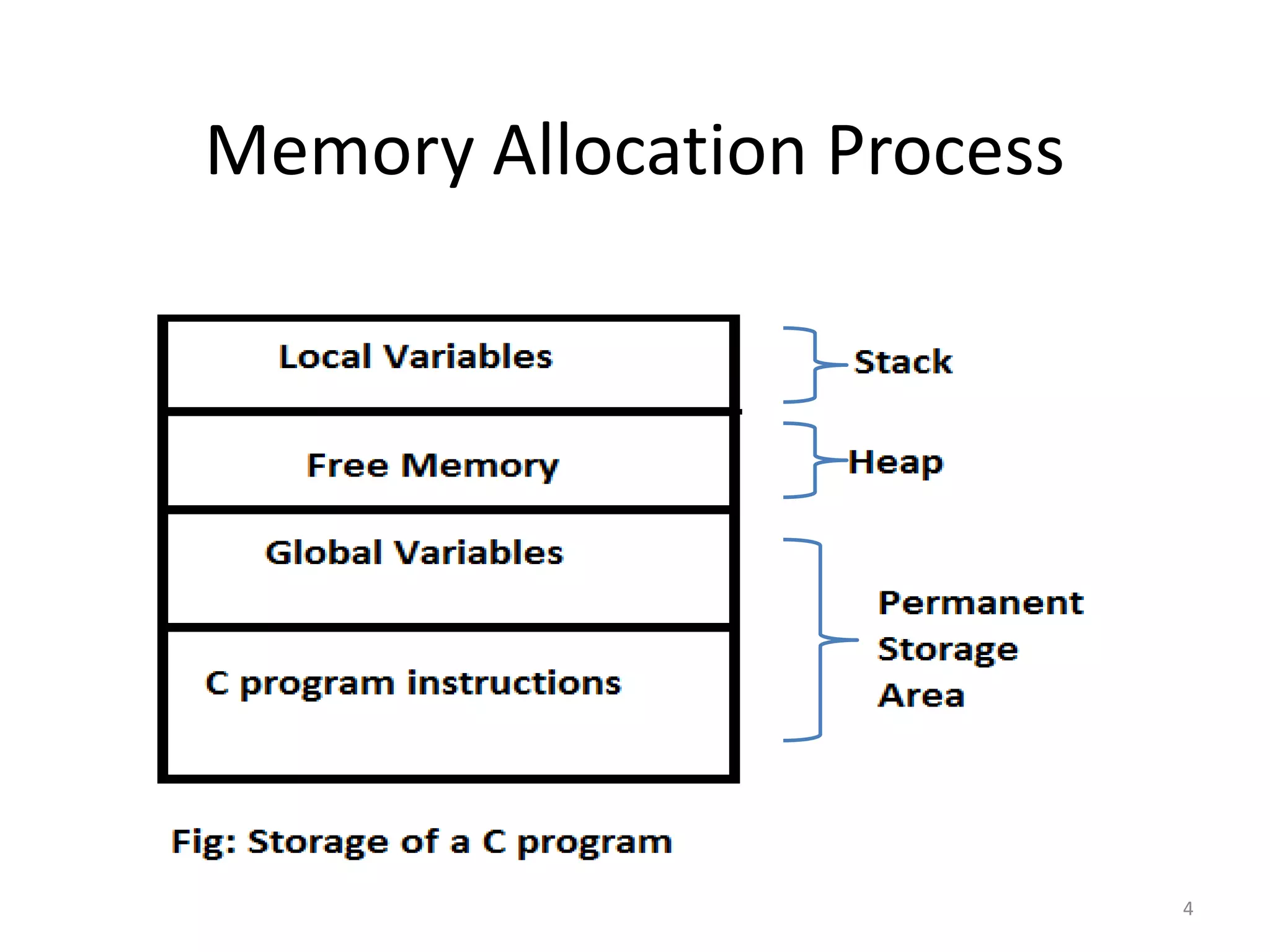
Memory Allocation Process
4
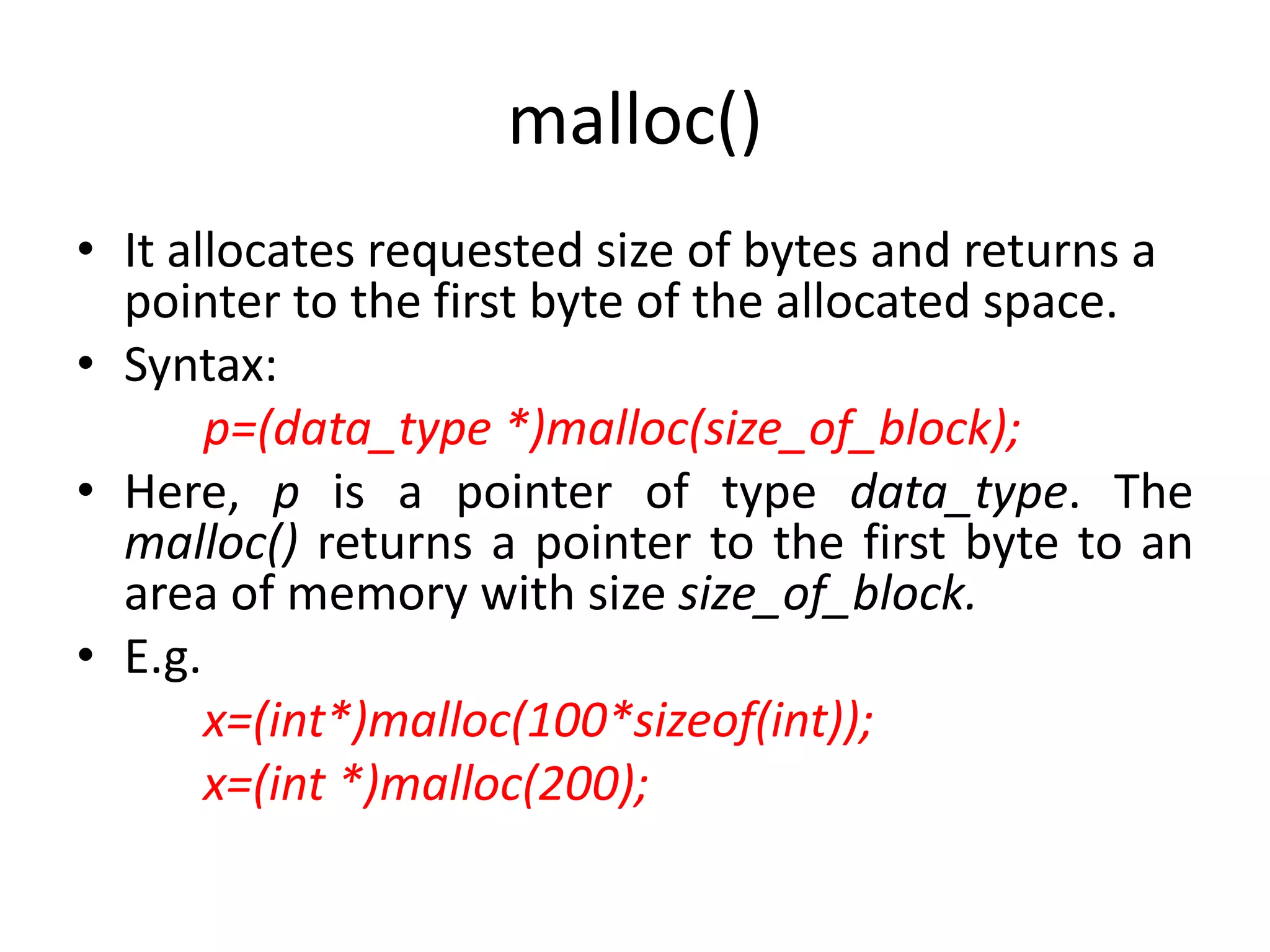
malloc()
• It allocates requested size of bytes and returns a
pointer to the first byte of the allocated space.
• Syntax:
p=(data_type *)malloc(size_of_block);
• Here, p is a pointer of type data_type. The
malloc() returns a pointer to the first byte to an
area of memory with size size_of_block.
• E.g.
x=(int*)malloc(100*sizeof(int));
x=(int *)malloc(200);
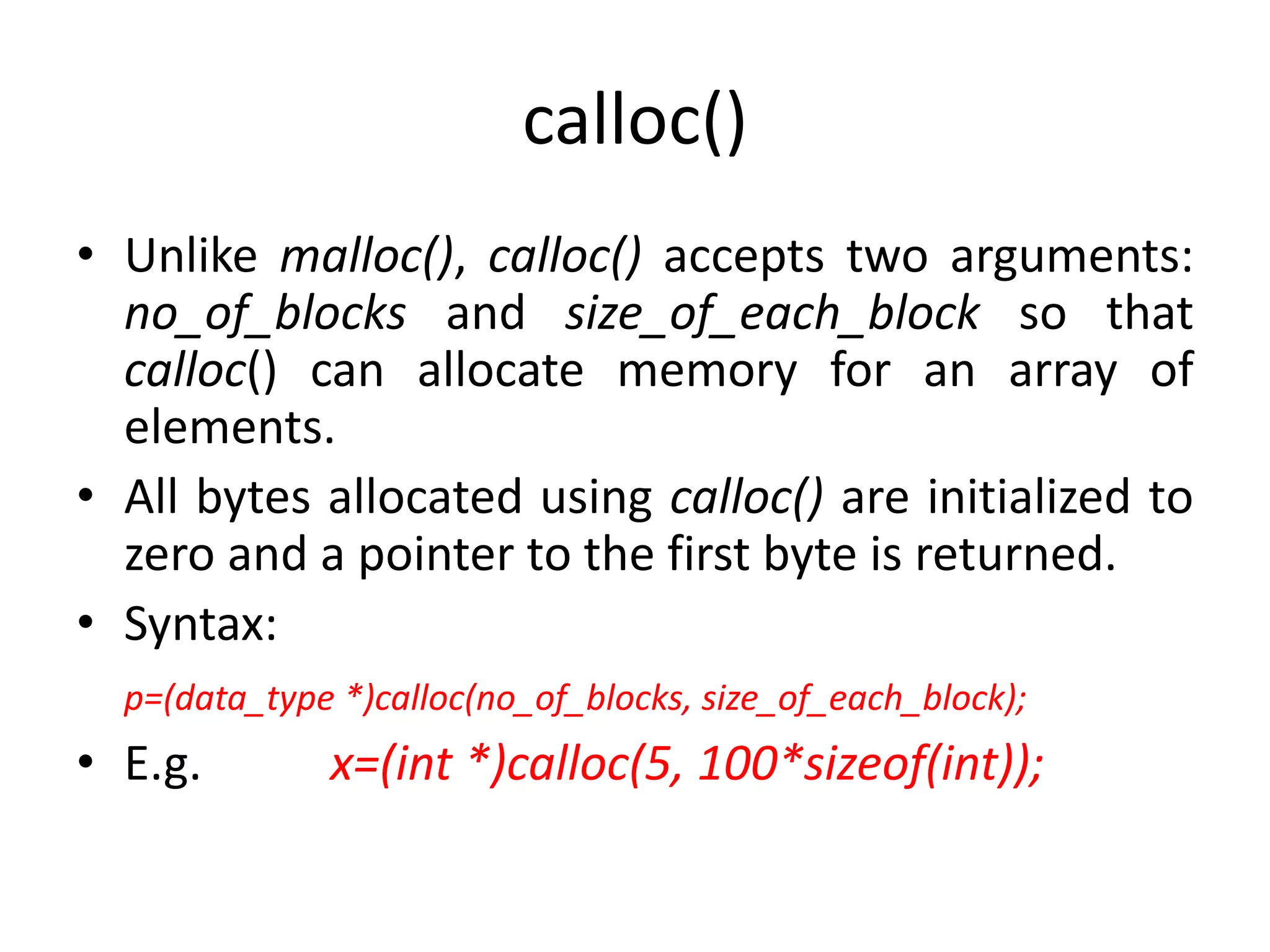
calloc()
• Unlike malloc(), calloc() accepts two arguments:
no_of_blocks and size_of_each_block so that
calloc() can allocate memory for an array of
elements.
• All bytes allocated using calloc() are initialized to
zero and a pointer to the first byte is returned.
• Syntax:
p=(data_type *)calloc(no_of_blocks, size_of_each_block);
• E.g. x=(int *)calloc(5, 100*sizeof(int));
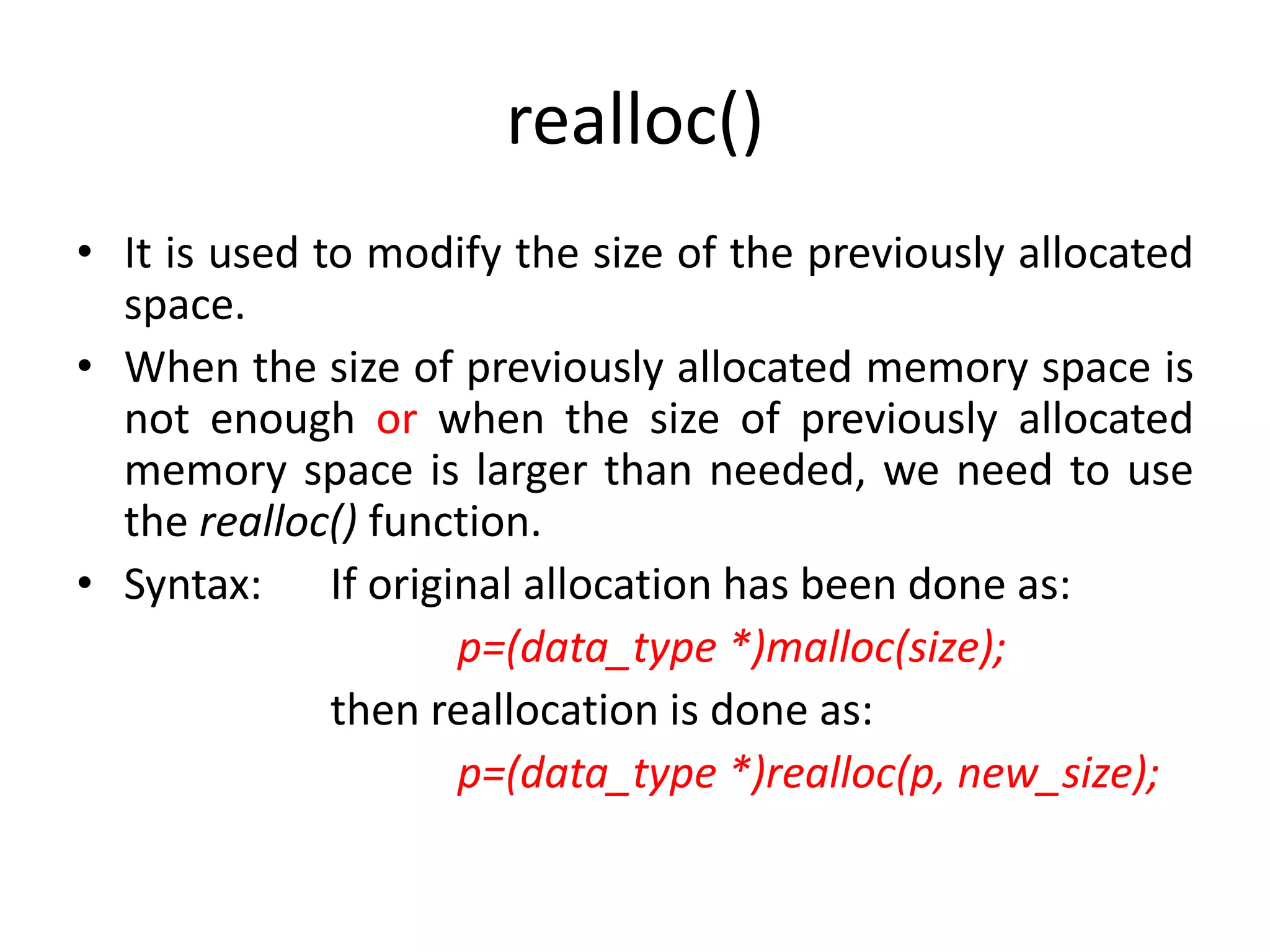
realloc()
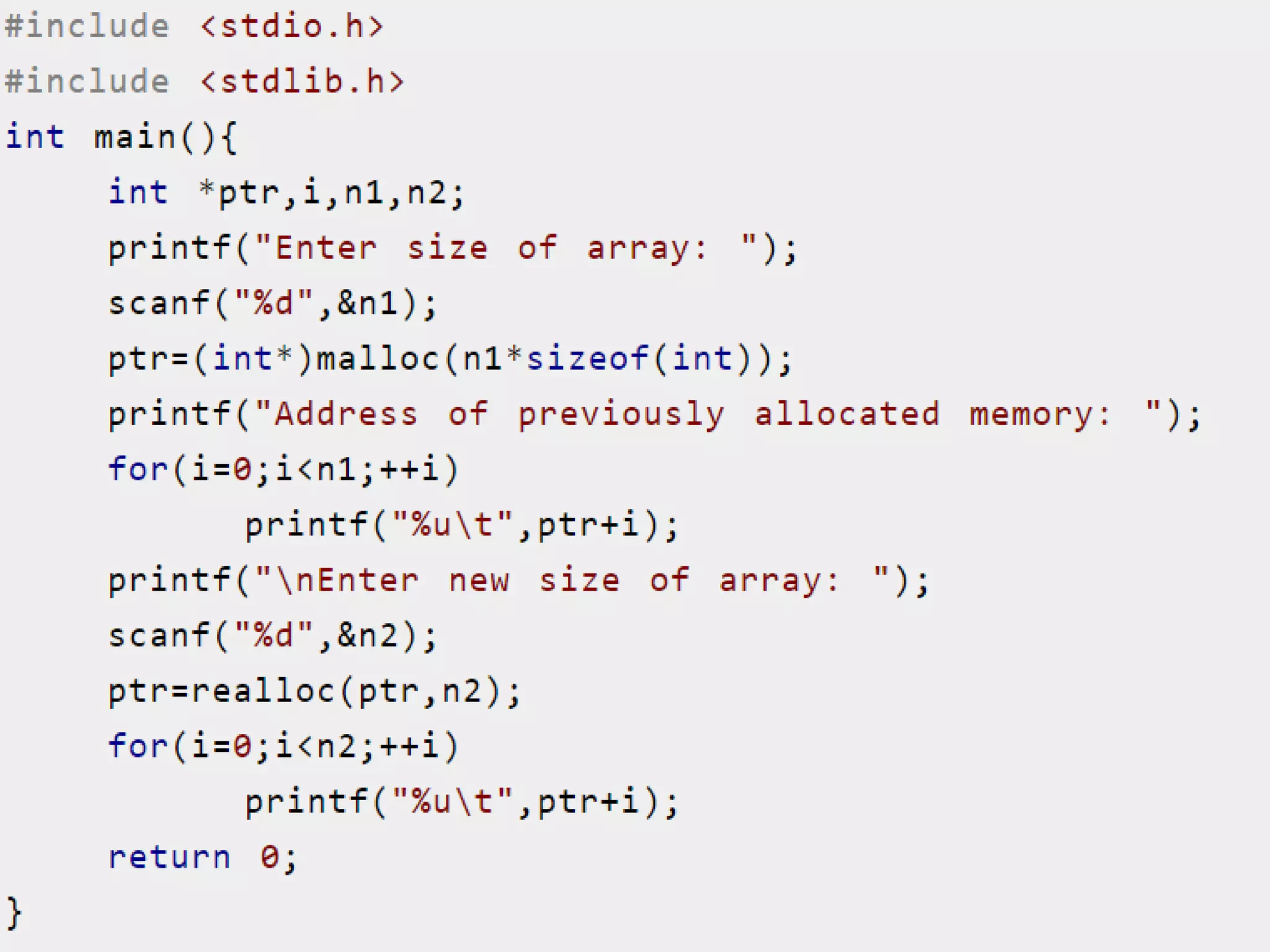
• It is used to modify the size of the previously allocated
space.
• When the size of previously allocated memory space is
not enough or when the size of previously allocated
memory space is larger than needed, we need to use
the realloc() function.
• Syntax: If original allocation has been done as:
p=(data_type *)malloc(size);
then reallocation is done as:
p=(data_type *)realloc(p, new_size);
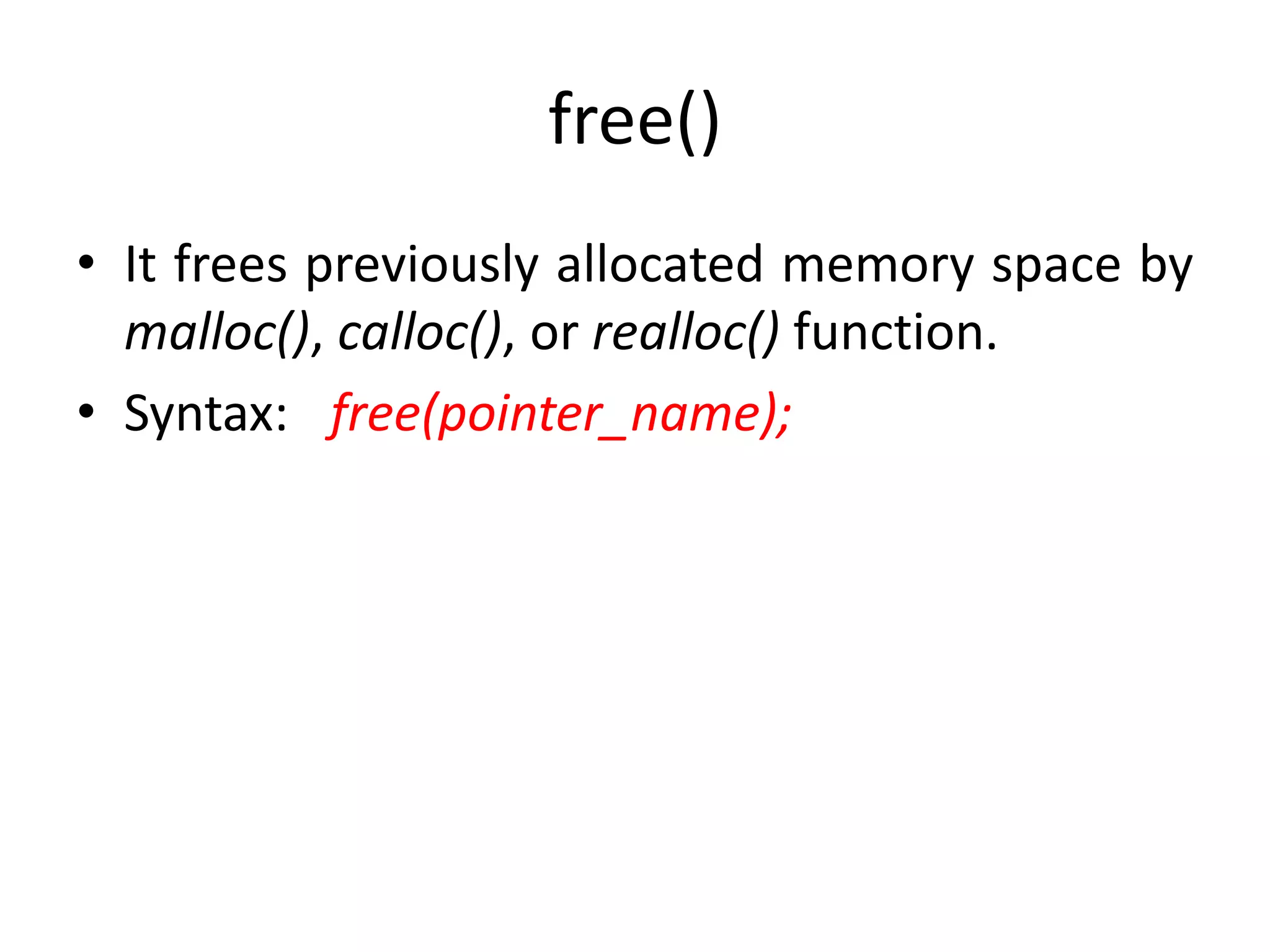
free()
• It frees previously allocated memory space by
malloc(), calloc(), or realloc() function.
• Syntax: free(pointer_name);
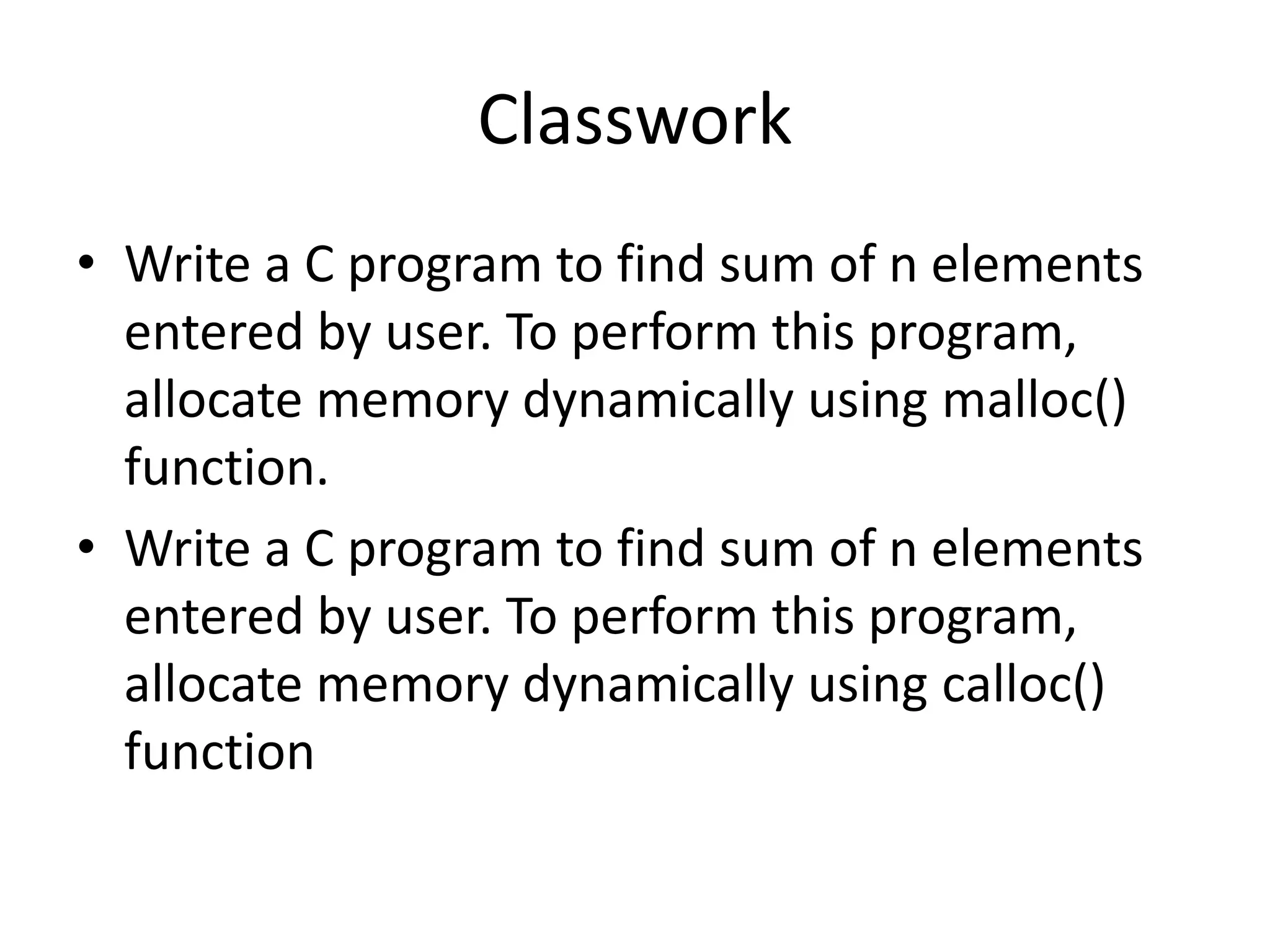
Classwork
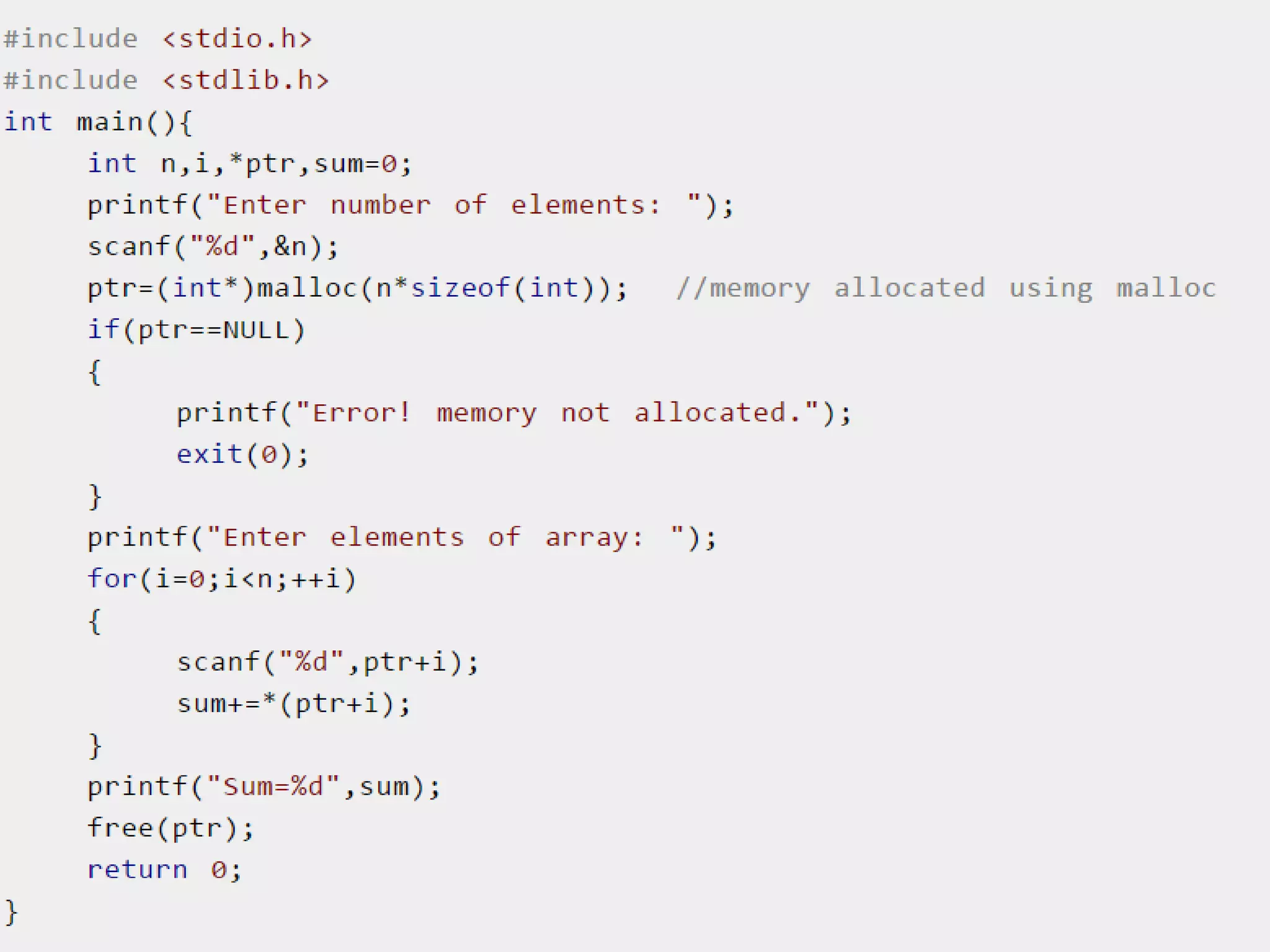
• Write a C program to find sum of n elements
entered by user. To perform this program,
allocate memory dynamically using malloc()
function.
• Write a C program to find sum of n elements
entered by user. To perform this program,
allocate memory dynamically using calloc()
function
Dynamic Memory Allocation(DMA)

Dynamic Memory Allocation(DMA)

  • 1.
  • 2.
    Introduction • The processof allocating and freeing memory at run time (or execution time) is called dynamic memory allocation. • Problem with Arrays: – C requires the no. of elements in an array to be specified at compile time. – It is difficult to know the exact size of the array in advance (prior to execution). – If the size needed at run time is small than the specified size, then we have wastage of memory space. – If the size needed at run time is greater than the specified size, we will have shortage of memory space. – Solution: DMA
  • 3.
    • In Cwe have the following four functions for memory management process: – malloc() – calloc() – realloc() – free() • These are defined in header file stdlib.h
  • 4.
  • 5.
    malloc() • It allocatesrequested size of bytes and returns a pointer to the first byte of the allocated space. • Syntax: p=(data_type *)malloc(size_of_block); • Here, p is a pointer of type data_type. The malloc() returns a pointer to the first byte to an area of memory with size size_of_block. • E.g. x=(int*)malloc(100*sizeof(int)); x=(int *)malloc(200);
  • 6.
    calloc() • Unlike malloc(),calloc() accepts two arguments: no_of_blocks and size_of_each_block so that calloc() can allocate memory for an array of elements. • All bytes allocated using calloc() are initialized to zero and a pointer to the first byte is returned. • Syntax: p=(data_type *)calloc(no_of_blocks, size_of_each_block); • E.g. x=(int *)calloc(5, 100*sizeof(int));
  • 7.
    realloc() • It isused to modify the size of the previously allocated space. • When the size of previously allocated memory space is not enough or when the size of previously allocated memory space is larger than needed, we need to use the realloc() function. • Syntax: If original allocation has been done as: p=(data_type *)malloc(size); then reallocation is done as: p=(data_type *)realloc(p, new_size);
  • 8.
    free() • It freespreviously allocated memory space by malloc(), calloc(), or realloc() function. • Syntax: free(pointer_name);
  • 9.
    Classwork • Write aC program to find sum of n elements entered by user. To perform this program, allocate memory dynamically using malloc() function. • Write a C program to find sum of n elements entered by user. To perform this program, allocate memory dynamically using calloc() function