Active Learning Assignment
Semester : 3rd
Branch : CE Engineering
Subject : Data Structures(2130702)
Topic : “Dynamic Memory Allocation”
Prepared by : Vaani Pathak
Enrollement No. :170120107131
Guided by : Prof. Ketan Pandya
1Gandhinagar Institute of Technology
Introduction to Dynamic Memory
Allocation
• Dynamic Allocation is by which a program can
obtain memory while it is running.
• Pointers provide necessary support for C’s
powerful dynamic memory allocation.
• In general global variables are allocated
storage at compile time. Local variables can
use the program stack.
Dynamic Allocation Functions
• 1) malloc()
• 2)free()
• 3)calloc()
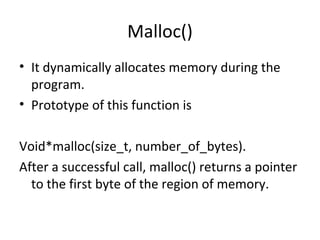
Malloc()
• It dynamically allocates memory during the
program.
• Prototype of this function is
Void*malloc(size_t, number_of_bytes).
After a successful call, malloc() returns a pointer
to the first byte of the region of memory.
Example of Malloc()
• Example:-
Code fragments below allocate 1000 bytes of
contiguous memory.
char*p;
p=(char*)malloc(1000);
Here,(char*)forces void pointer to become a
character
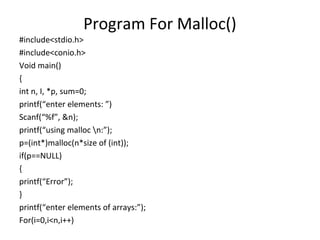
Program For Malloc()
#include<stdio.h>
#include<conio.h>
Void main()
{
int n, I, *p, sum=0;
printf(“enter elements: ”)
Scanf(“%f”, &n);
printf(“using malloc n:”);
p=(int*)malloc(n*size of (int));
if(p==NULL)
{
printf(“Error”);
}
printf(“enter elements of arrays:”);
For(i=0,i<n,i++)
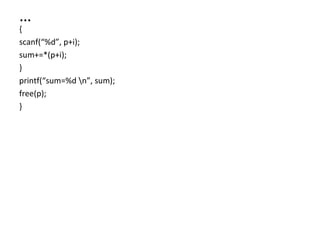
…
{
scanf(“%d”, p+i);
sum+=*(p+i);
}
printf(“sum=%d n”, sum);
free(p);
}
Free() Function
• It is the opposite of malloc().
• It returns previously allocated memory to the
system.
• Prototype: void free(void*p);
• It is critical that you never call free() with an
invalid argument. That will delete the free list.
Calloc() function
• Calloc() function allocates an amount of
memory equal to num*size.
• It allocates enough memory for an array of
num objects and size bytes long.
• Memory allocated by calloc() is released by
free() function.
• Prototype:
• void*calloc(size_t,n,size_t,number_of_bytes);
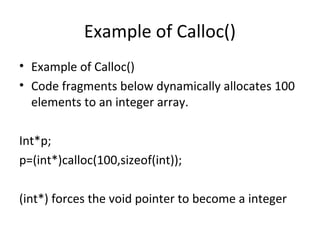
Example of Calloc()
• Example of Calloc()
• Code fragments below dynamically allocates 100
elements to an integer array.
Int*p;
p=(int*)calloc(100,sizeof(int));
(int*) forces the void pointer to become a integer
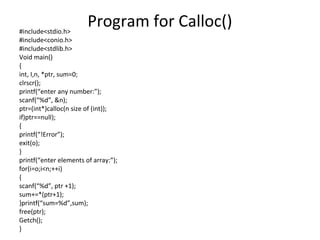
Program for Calloc()#include<stdio.h>
#include<conio.h>
#include<stdlib.h>
Void main()
{
int, I,n, *ptr, sum=0;
clrscr();
printf(“enter any number:”);
scanf(“%d”, &n);
ptr=(int*)calloc(n size of (int));
if)ptr==null);
{
printf(“!Error”);
exit(o);
}
printf(“enter elements of array:”);
for(i=o;i<n;++i)
{
scanf(“%d”, ptr +1);
sum+=*(ptr+1);
}printf(“sum=%d”,sum);
free(ptr);
Getch();
}
Difference between Malloc() and
Calloc()
Malloc()
• In Malloc, how much memory we want we can
pass it as one slot.
• Malloc is faster than calloc.
• Malloc dosnt initializes the allocated
memory.It contains garbage values.
…
Calloc()
• We need to split ad pass the memory as we
want.
• Calloc is slower than malloc.
• Calloc initialize the allocated memory to zero.
• Number of arguments is 2.
THANK YOU

Dynamic Memory Allocation

  • 1.
    Active Learning Assignment Semester: 3rd Branch : CE Engineering Subject : Data Structures(2130702) Topic : “Dynamic Memory Allocation” Prepared by : Vaani Pathak Enrollement No. :170120107131 Guided by : Prof. Ketan Pandya 1Gandhinagar Institute of Technology
  • 2.
    Introduction to DynamicMemory Allocation • Dynamic Allocation is by which a program can obtain memory while it is running. • Pointers provide necessary support for C’s powerful dynamic memory allocation. • In general global variables are allocated storage at compile time. Local variables can use the program stack.
  • 3.
    Dynamic Allocation Functions •1) malloc() • 2)free() • 3)calloc()
  • 4.
    Malloc() • It dynamicallyallocates memory during the program. • Prototype of this function is Void*malloc(size_t, number_of_bytes). After a successful call, malloc() returns a pointer to the first byte of the region of memory.
  • 5.
    Example of Malloc() •Example:- Code fragments below allocate 1000 bytes of contiguous memory. char*p; p=(char*)malloc(1000); Here,(char*)forces void pointer to become a character
  • 6.
    Program For Malloc() #include<stdio.h> #include<conio.h> Voidmain() { int n, I, *p, sum=0; printf(“enter elements: ”) Scanf(“%f”, &n); printf(“using malloc n:”); p=(int*)malloc(n*size of (int)); if(p==NULL) { printf(“Error”); } printf(“enter elements of arrays:”); For(i=0,i<n,i++)
  • 7.
  • 8.
    Free() Function • Itis the opposite of malloc(). • It returns previously allocated memory to the system. • Prototype: void free(void*p); • It is critical that you never call free() with an invalid argument. That will delete the free list.
  • 9.
    Calloc() function • Calloc()function allocates an amount of memory equal to num*size. • It allocates enough memory for an array of num objects and size bytes long. • Memory allocated by calloc() is released by free() function. • Prototype: • void*calloc(size_t,n,size_t,number_of_bytes);
  • 10.
    Example of Calloc() •Example of Calloc() • Code fragments below dynamically allocates 100 elements to an integer array. Int*p; p=(int*)calloc(100,sizeof(int)); (int*) forces the void pointer to become a integer
  • 11.
    Program for Calloc()#include<stdio.h> #include<conio.h> #include<stdlib.h> Voidmain() { int, I,n, *ptr, sum=0; clrscr(); printf(“enter any number:”); scanf(“%d”, &n); ptr=(int*)calloc(n size of (int)); if)ptr==null); { printf(“!Error”); exit(o); } printf(“enter elements of array:”); for(i=o;i<n;++i) { scanf(“%d”, ptr +1); sum+=*(ptr+1); }printf(“sum=%d”,sum); free(ptr); Getch(); }
  • 12.
    Difference between Malloc()and Calloc() Malloc() • In Malloc, how much memory we want we can pass it as one slot. • Malloc is faster than calloc. • Malloc dosnt initializes the allocated memory.It contains garbage values.
  • 13.
    … Calloc() • We needto split ad pass the memory as we want. • Calloc is slower than malloc. • Calloc initialize the allocated memory to zero. • Number of arguments is 2.
  • 14.