
ShajahanTS
shajahan007ts@gmail.com
www.facebook.com/username
twitter.com/username
in.linkedin.com/in/profilename
9544040194
Typing Speed:
Disclaimer: This presentation is prepared by
trainees of baabtra as a part of mentoring
program. This is not official document of baabtra
–Mentoring Partner
Baabtra-Mentoring Partner is the mentoring division of baabte System
Technologies Pvt . Ltd
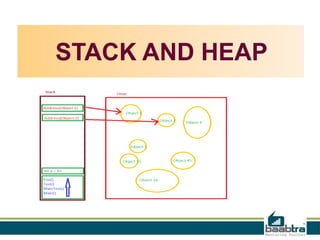
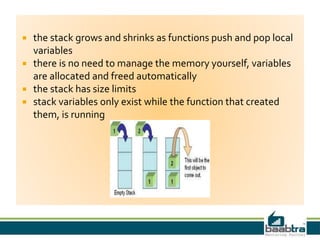
 Stack is a special region of computer's memory that stores temporary
variables created by each function (including the main() function).The stack is a
"FILO" (first in, last out) data structure, that is managed and optimized by the
CPU quite closely. Every time a function declares a new variable, it is "pushed"
onto the stack.Then every time a function exits, all of the variables pushed
onto the stack by that function, are freed (that is to say, they are deleted).
Once a stack variable is freed, that region of memory becomes available for
other stack variables.
 the stack grows and shrinks as functions push and pop local
variables
 there is no need to manage the memory yourself, variables
are allocated and freed automatically
 the stack has size limits
 stack variables only exist while the function that created
them, is running
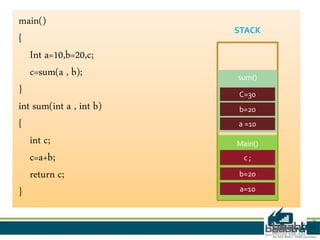
main()
{
Int a=10,b=20,c;
c=sum(a , b);
}
int sum(int a , int b)
{
int c;
c=a+b;
return c;
}
STACK
Main()
a=10
b=20
c ;
sum()
a =10
b=20
C=30
 The heap is a region of computer's memory that is not
managed automatically , and is not as tightly managed by
the CPU. It is a more region of memory .
 To allocate memory on the heap, you must
use malloc() or calloc(), which are built-in C functions.
Once you have allocated memory on the heap, you are
responsible for using free() to deallocate that memory
once you don't need it any more. If you fail to do this, your
program will have what is known as a memory leak.That
is, memory on the heap will still be set aside (and won't be
available to other processes).
 malloc() Allocates requested size of bytes and
returns a pointer first byte of allocated space
 calloc() Allocates space for an array
elements, initializes to zero and then returns a
pointer to memory
 free() deallocate the previously allocated
space
 realloc() Change the size of previously
allocated space
malloc()
 Syntax
malloc(size in bytes);
 This function allocates ‘size’ byte of memory and returns a pointer to
the first byte or NULL if there is some kind of error
 But we need a pointer to point to the allocated space in heap
 int *p; p=malloc(2);
int *p;
p=malloc(2); //allocates 2 bytes of memory
p=malloc(sizeof(int)); //sizeof() returns size of any data type
so here it will be malloc(2)
p=(int *)malloc(2); //malloc always return void * pointer .
So you may type cast it into
any data type.
but it is unnecessary as the compiler
does it
for us
p=(int *)malloc (sizeof(int)); //allocates 2 bytes of memory
 Calloc() stands for "contiguous allocation”
 Allocates multiple blocks of memory each of same size and sets all
bytes to zero
 Syntax
calloc(number of elements , size in bytes);
we need a pointer to point to the allocated space in heap
int *p;
p=calloc(2,2); //allocates 2 block of 2 bytes memory
p=calloc(3,sizeof(int)); //sizeof() returns size of any data type
so here it will be calloc(3,2)
p=(int *)calloc(2,10); //calloc always return void * pointer .
So you may type cast it into any data type.
but it is unnecessary as the compiler does it
for us
p=(int *)calloc (3,sizeof(int)); //allocates 3 block of 2 bytes
memmory
MALLOC()
• Allocates "size" bytes of memory.
• The contents of
allocated memory are not
changed. i.e., the memory may
contains garbage values.
• returns void pointer (void *). If
the allocation succeeds, a pointer
to the block of memory is returned
CALLOC()
• Allocates
a region of memory large
enough to hold "n elements" of
"size" bytes each.
• The allocated region is
initialized to zero.
• returns void pointer (void *). If
the allocation succeeds, a
pointer to the block of
memory is returned.
realloc( pointer name , new size );
It will realloc the size of memory
free( pointer name );
De allocate the memory
#include <stdio.h>
#include <stdlib.h>
double* multiplyByTwo (double *input)
{
double *twice = malloc(sizeof(double));
*twice = *input * 2.0;
return twice;
}
int main ()
{
int *age = malloc(sizeof(int));
*age = 30;
double *salary = malloc(sizeof(double));
*salary = 12345.67;
double *myList = calloc(3 , sizeof(double));
myList[0] = 1.2;
myList[1] = 2.3;
myList[2] = 3.4;
double *twiceSalary = multiplyByTwo(salary);
printf("double your salary is %.3fn", *twiceSalary);
free(age);
free(salary);
free(myList);
free(twiceSalary);
return 0;
}
If this presentation helped you, please visit our
page facebook.com/baabtra and like it.
Thanks in advance.
www.baabtra.com | www.massbaab.com |www.baabte.com
Contact Us
Emarald Mall (Big Bazar Building)
Mavoor Road, Kozhikode,
Kerala, India.
Ph: + 91 – 495 40 25 550
NC Complex, Near Bus Stand
Mukkam, Kozhikode,
Kerala, India.
Ph: + 91 – 495 40 25 550
Start upVillage
Eranakulam,
Kerala, India.
Email: info@baabtra.com

Stack & heap

  • 2.
  • 3.
    Disclaimer: This presentationis prepared by trainees of baabtra as a part of mentoring program. This is not official document of baabtra –Mentoring Partner Baabtra-Mentoring Partner is the mentoring division of baabte System Technologies Pvt . Ltd
  • 6.
     Stack isa special region of computer's memory that stores temporary variables created by each function (including the main() function).The stack is a "FILO" (first in, last out) data structure, that is managed and optimized by the CPU quite closely. Every time a function declares a new variable, it is "pushed" onto the stack.Then every time a function exits, all of the variables pushed onto the stack by that function, are freed (that is to say, they are deleted). Once a stack variable is freed, that region of memory becomes available for other stack variables.
  • 7.
     the stackgrows and shrinks as functions push and pop local variables  there is no need to manage the memory yourself, variables are allocated and freed automatically  the stack has size limits  stack variables only exist while the function that created them, is running
  • 8.
    main() { Int a=10,b=20,c; c=sum(a ,b); } int sum(int a , int b) { int c; c=a+b; return c; } STACK Main() a=10 b=20 c ; sum() a =10 b=20 C=30
  • 9.
     The heapis a region of computer's memory that is not managed automatically , and is not as tightly managed by the CPU. It is a more region of memory .  To allocate memory on the heap, you must use malloc() or calloc(), which are built-in C functions. Once you have allocated memory on the heap, you are responsible for using free() to deallocate that memory once you don't need it any more. If you fail to do this, your program will have what is known as a memory leak.That is, memory on the heap will still be set aside (and won't be available to other processes).
  • 10.
     malloc() Allocatesrequested size of bytes and returns a pointer first byte of allocated space  calloc() Allocates space for an array elements, initializes to zero and then returns a pointer to memory  free() deallocate the previously allocated space  realloc() Change the size of previously allocated space
  • 11.
    malloc()  Syntax malloc(size inbytes);  This function allocates ‘size’ byte of memory and returns a pointer to the first byte or NULL if there is some kind of error  But we need a pointer to point to the allocated space in heap  int *p; p=malloc(2);
  • 12.
    int *p; p=malloc(2); //allocates2 bytes of memory p=malloc(sizeof(int)); //sizeof() returns size of any data type so here it will be malloc(2) p=(int *)malloc(2); //malloc always return void * pointer . So you may type cast it into any data type. but it is unnecessary as the compiler does it for us p=(int *)malloc (sizeof(int)); //allocates 2 bytes of memory
  • 13.
     Calloc() standsfor "contiguous allocation”  Allocates multiple blocks of memory each of same size and sets all bytes to zero  Syntax calloc(number of elements , size in bytes); we need a pointer to point to the allocated space in heap
  • 14.
    int *p; p=calloc(2,2); //allocates2 block of 2 bytes memory p=calloc(3,sizeof(int)); //sizeof() returns size of any data type so here it will be calloc(3,2) p=(int *)calloc(2,10); //calloc always return void * pointer . So you may type cast it into any data type. but it is unnecessary as the compiler does it for us p=(int *)calloc (3,sizeof(int)); //allocates 3 block of 2 bytes memmory
  • 15.
    MALLOC() • Allocates "size"bytes of memory. • The contents of allocated memory are not changed. i.e., the memory may contains garbage values. • returns void pointer (void *). If the allocation succeeds, a pointer to the block of memory is returned CALLOC() • Allocates a region of memory large enough to hold "n elements" of "size" bytes each. • The allocated region is initialized to zero. • returns void pointer (void *). If the allocation succeeds, a pointer to the block of memory is returned.
  • 16.
    realloc( pointer name, new size ); It will realloc the size of memory free( pointer name ); De allocate the memory
  • 17.
    #include <stdio.h> #include <stdlib.h> double*multiplyByTwo (double *input) { double *twice = malloc(sizeof(double)); *twice = *input * 2.0; return twice; } int main () { int *age = malloc(sizeof(int)); *age = 30; double *salary = malloc(sizeof(double)); *salary = 12345.67; double *myList = calloc(3 , sizeof(double)); myList[0] = 1.2; myList[1] = 2.3; myList[2] = 3.4; double *twiceSalary = multiplyByTwo(salary); printf("double your salary is %.3fn", *twiceSalary); free(age); free(salary); free(myList); free(twiceSalary); return 0; }
  • 18.
    If this presentationhelped you, please visit our page facebook.com/baabtra and like it. Thanks in advance. www.baabtra.com | www.massbaab.com |www.baabte.com
  • 19.
    Contact Us Emarald Mall(Big Bazar Building) Mavoor Road, Kozhikode, Kerala, India. Ph: + 91 – 495 40 25 550 NC Complex, Near Bus Stand Mukkam, Kozhikode, Kerala, India. Ph: + 91 – 495 40 25 550 Start upVillage Eranakulam, Kerala, India. Email: info@baabtra.com