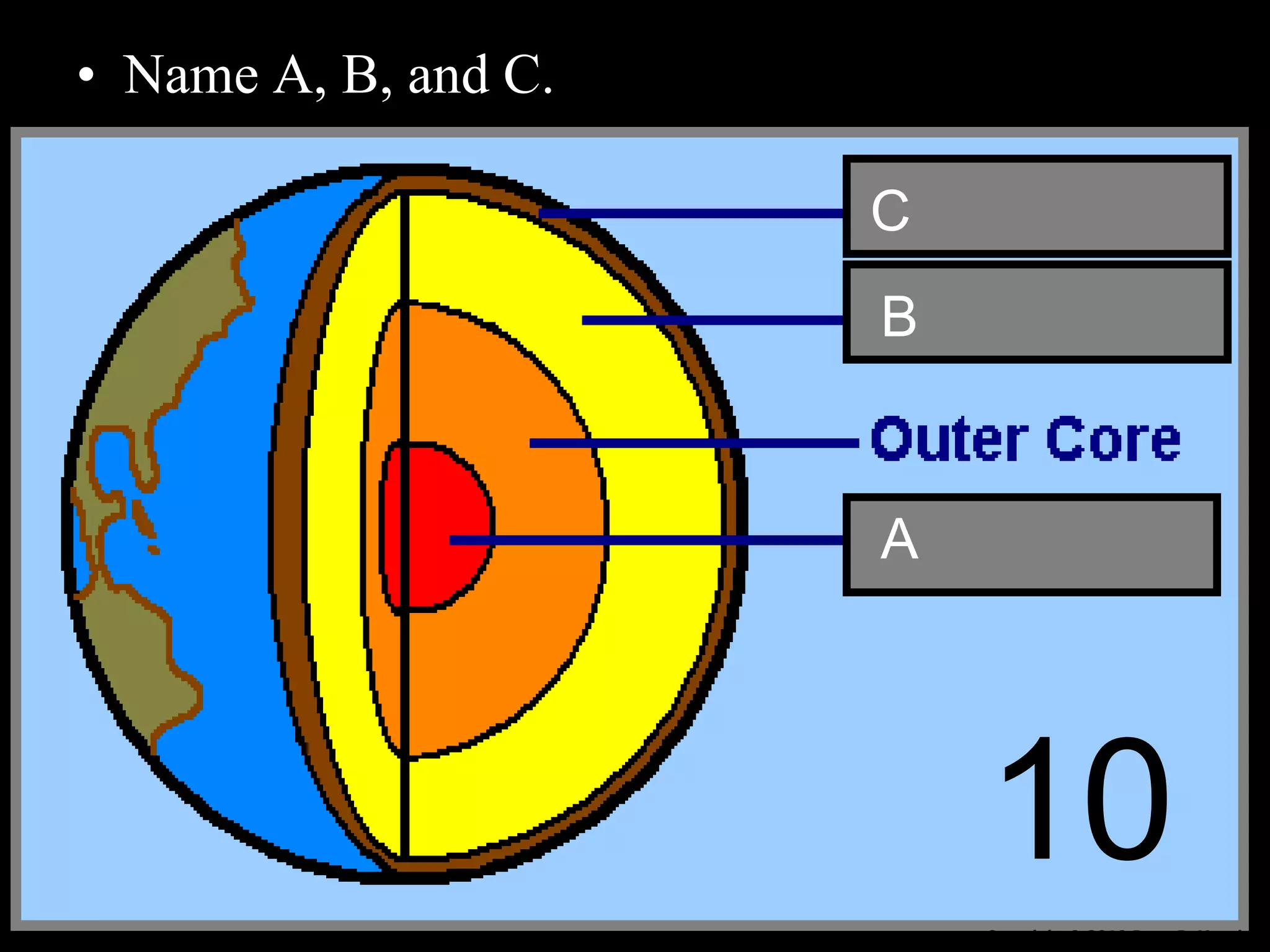



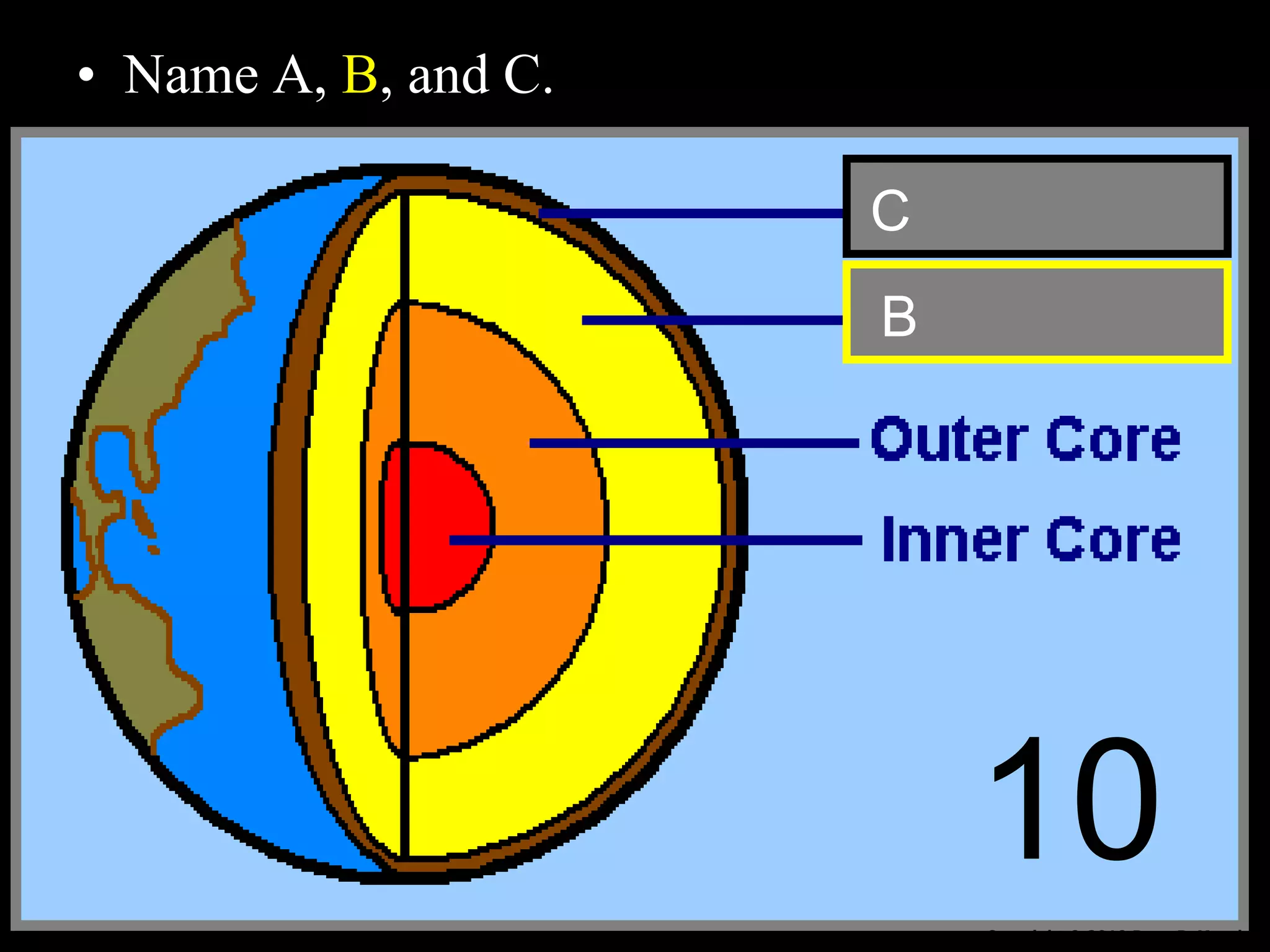
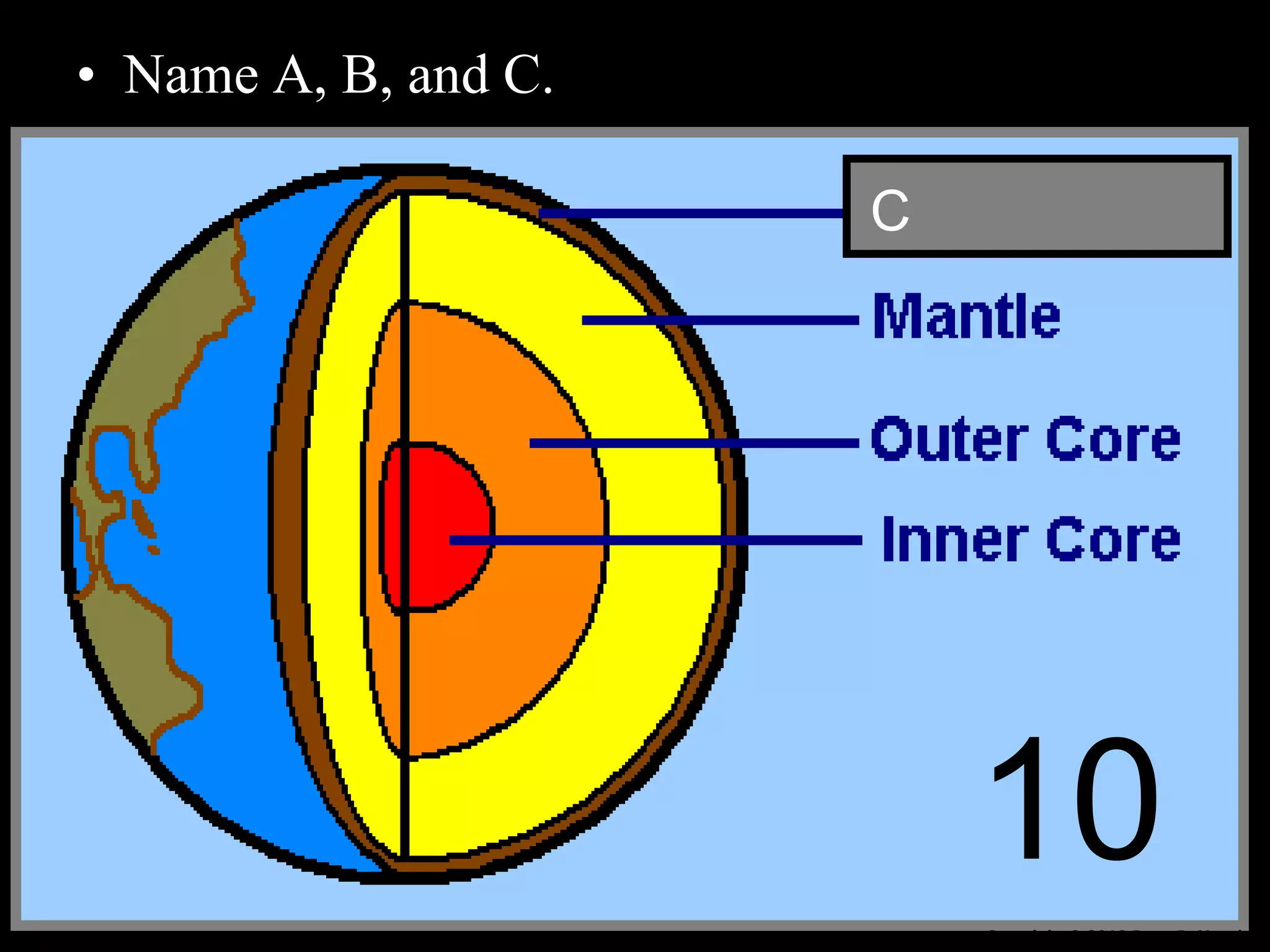
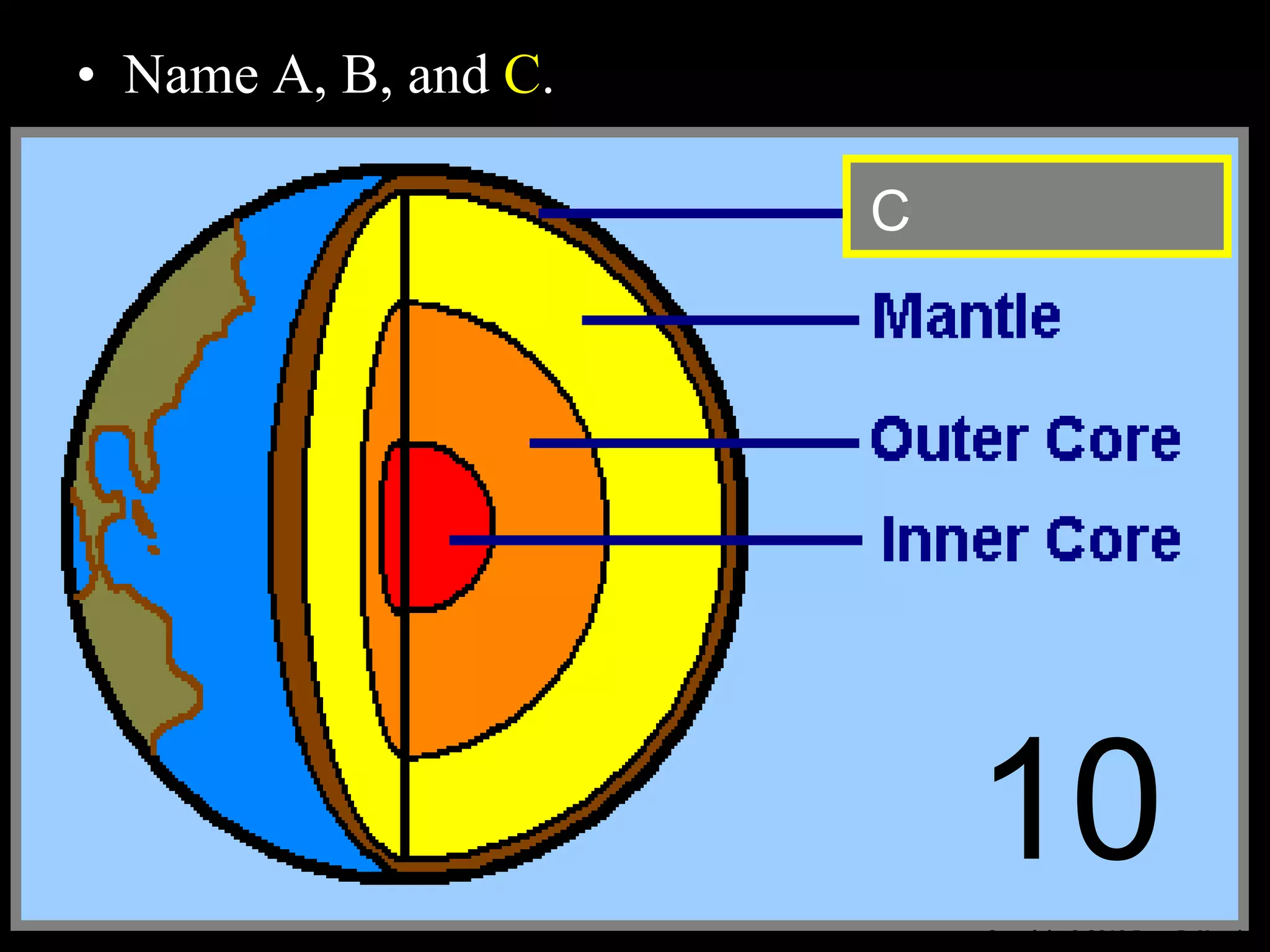
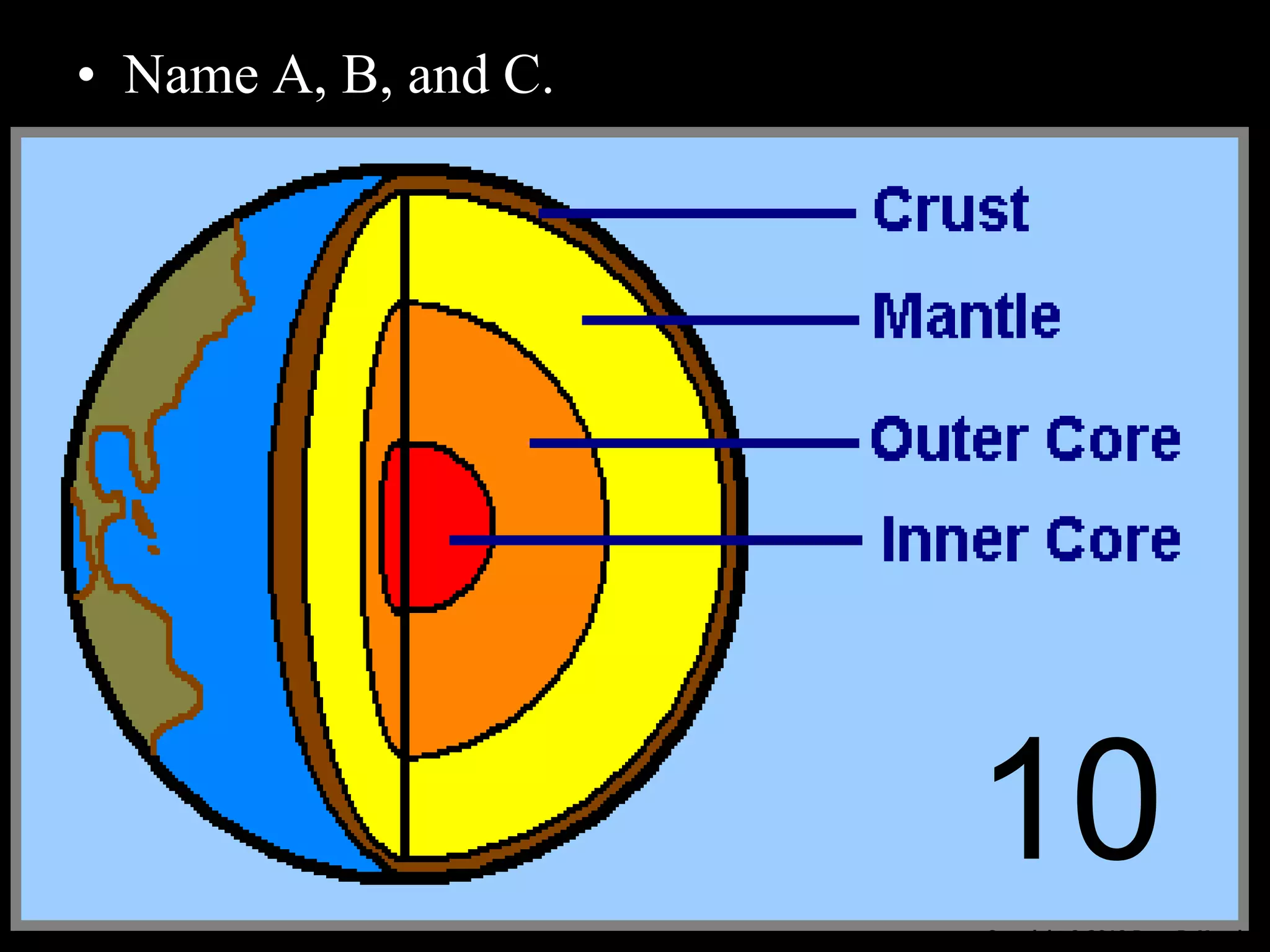
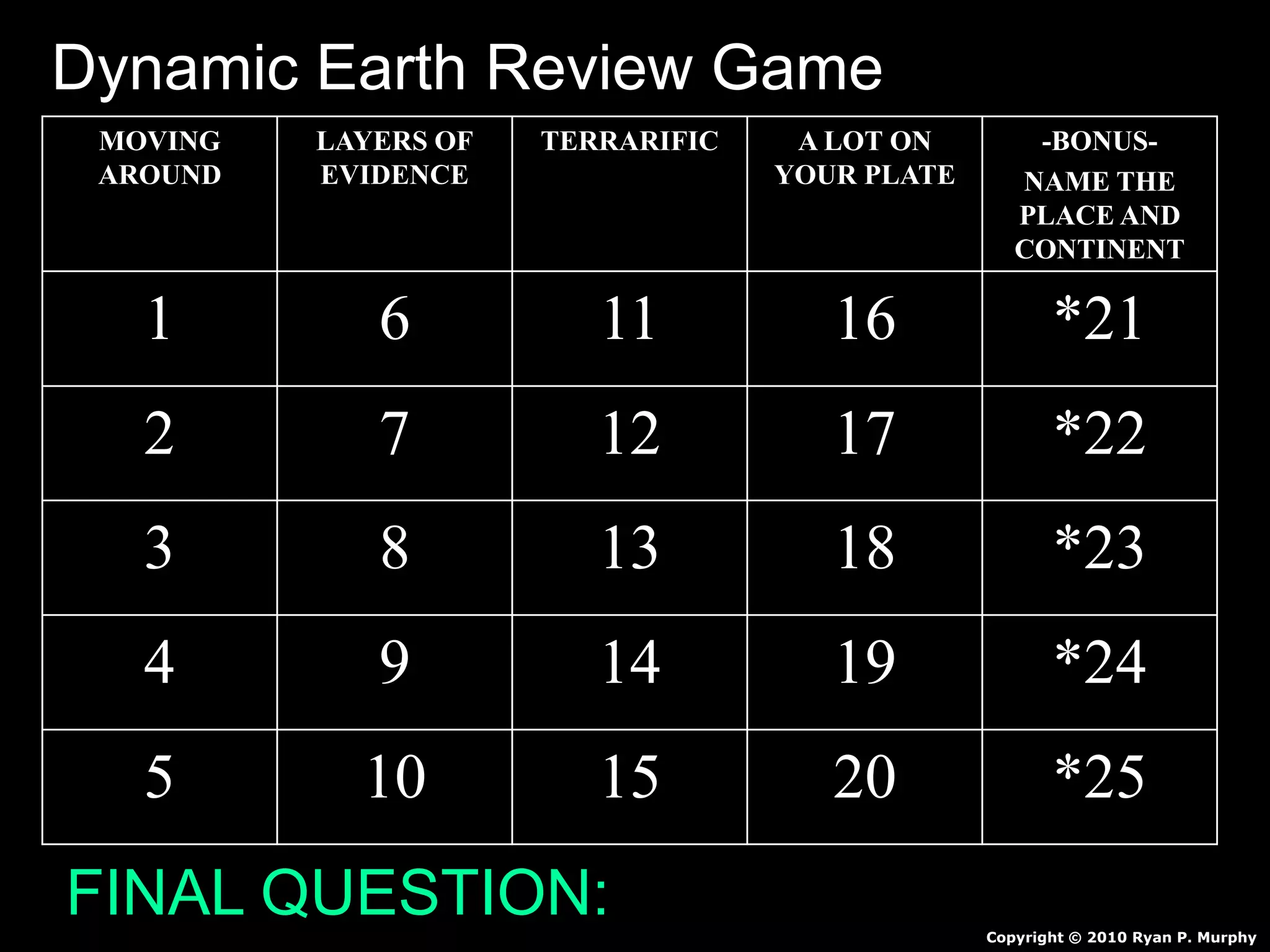



• Name A, B, and C.
Copyright © 2010 Ryan P. Murphy
A
B
C
10
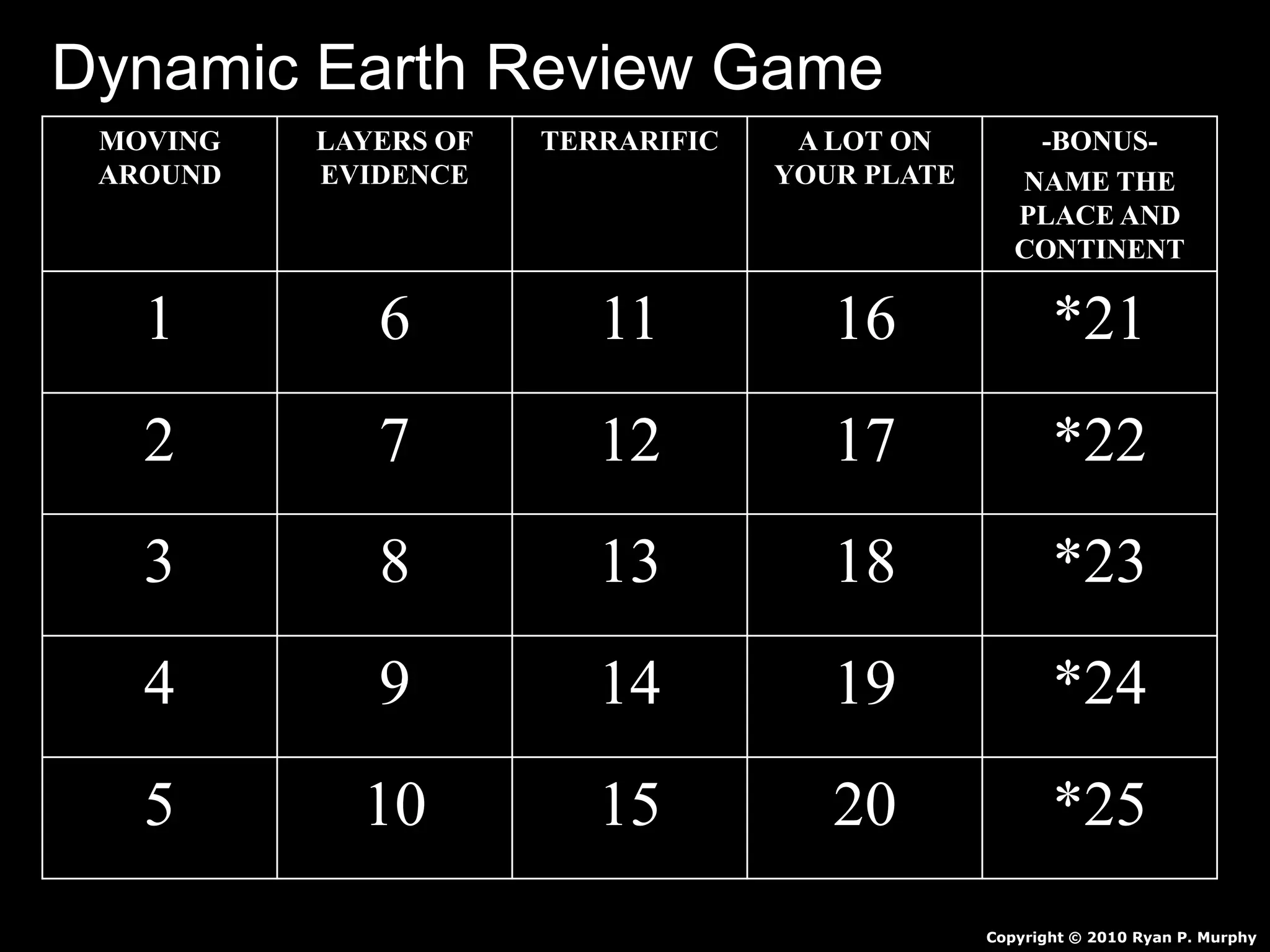
MOVING
AROUND
LAYERS OF
EVIDENCE
TERRARIFIC A LOT ON
YOUR PLATE
-BONUS-
NAME THE
PLACE AND
CONTINENT
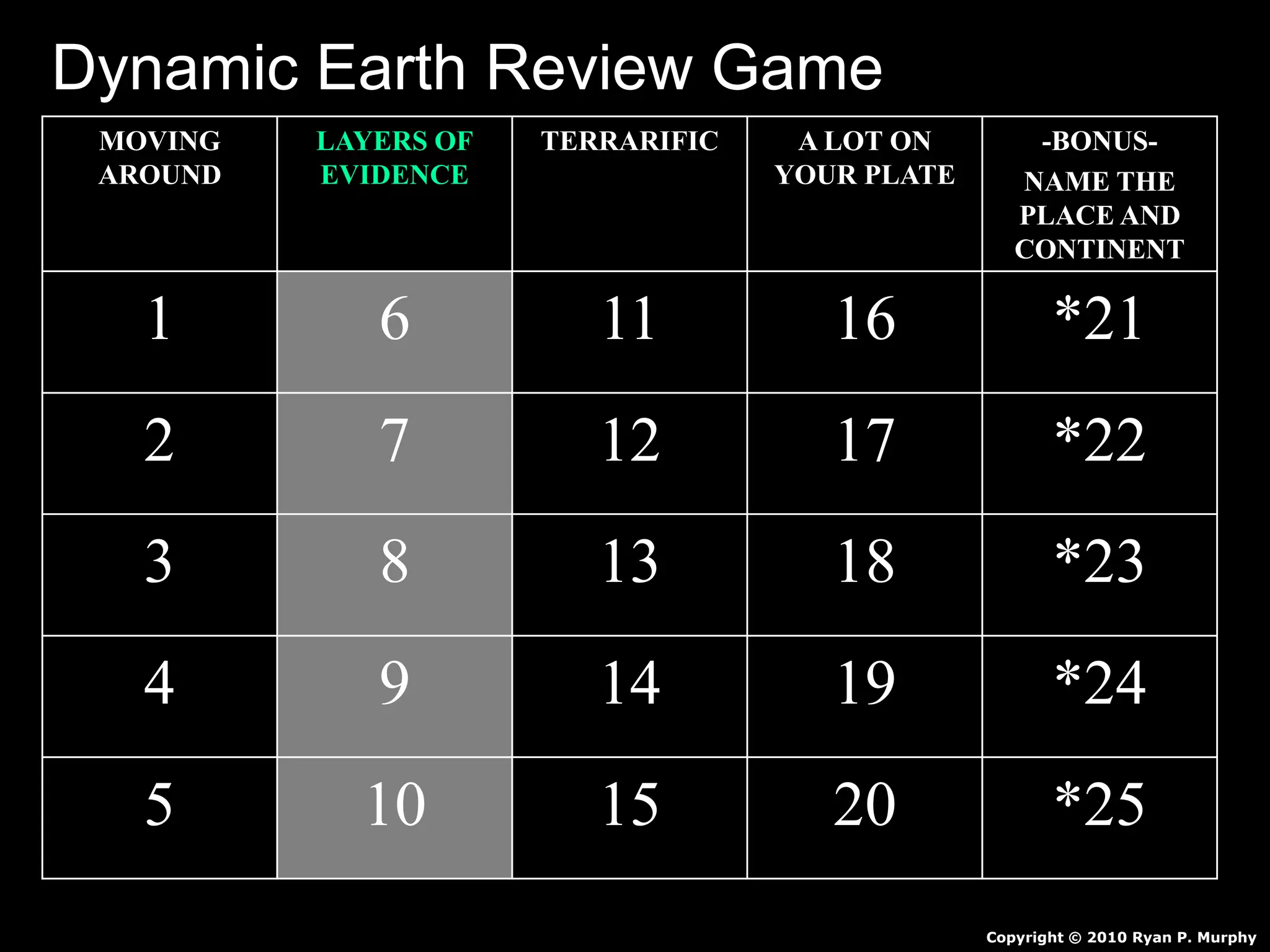
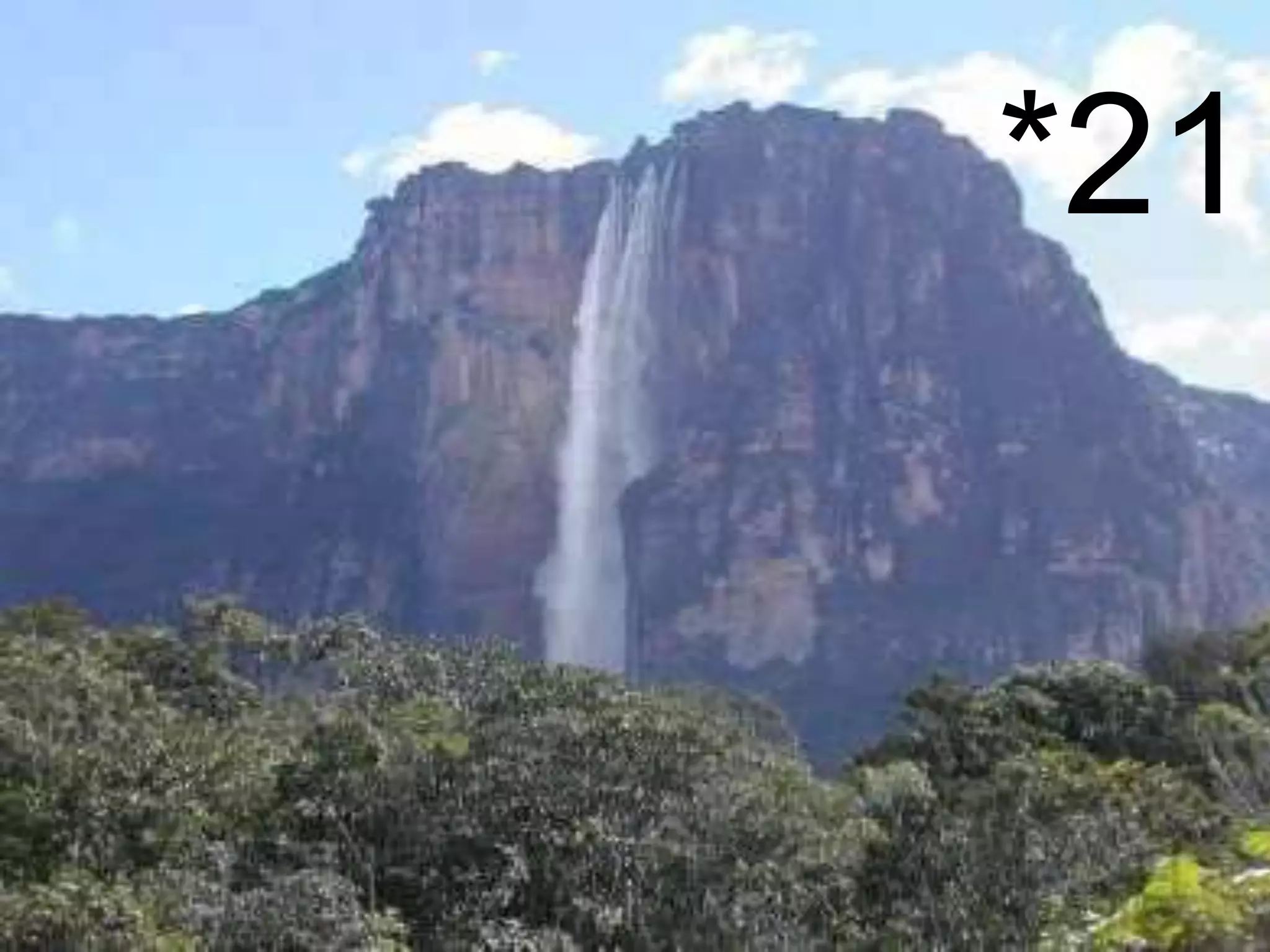
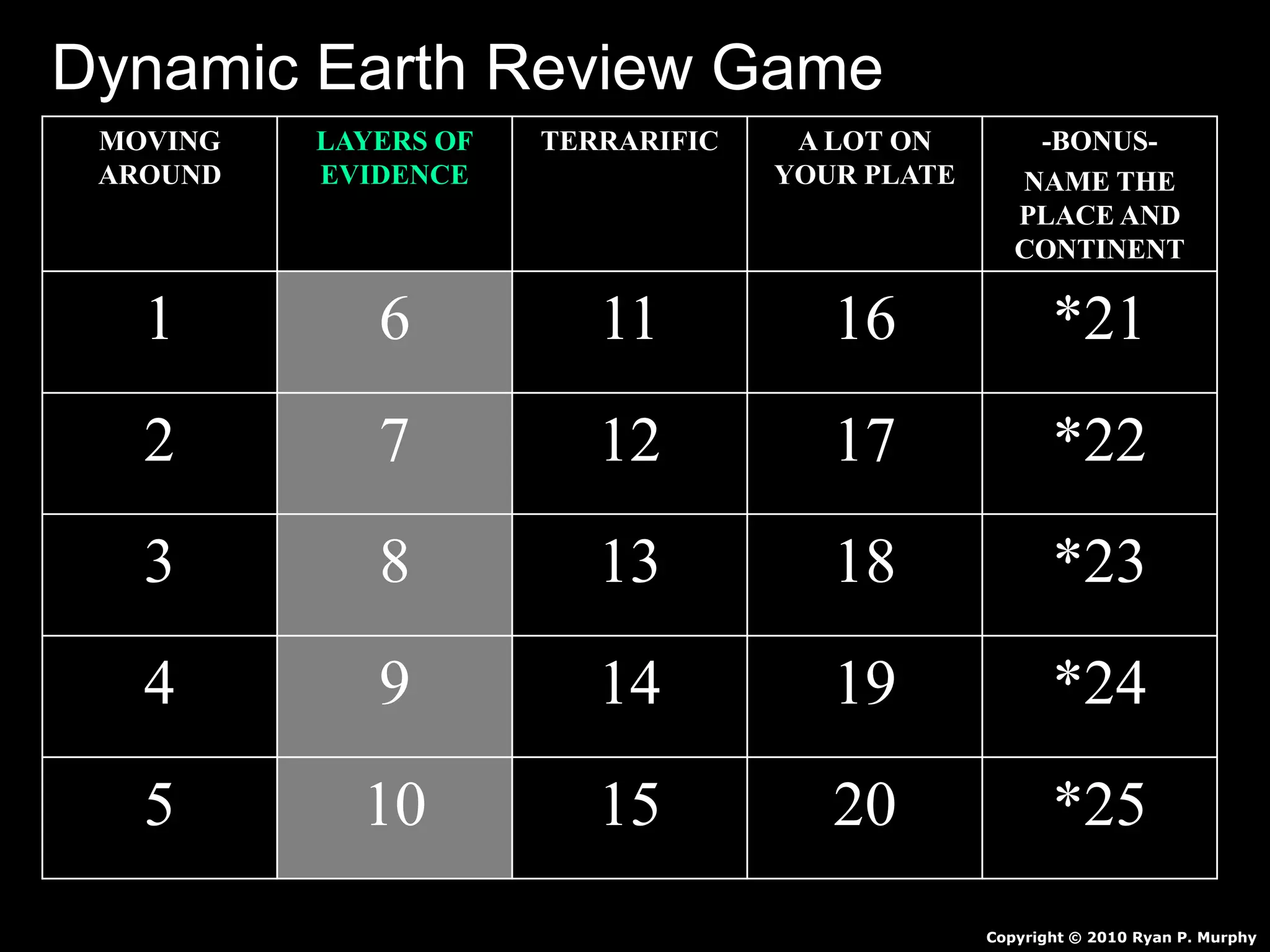
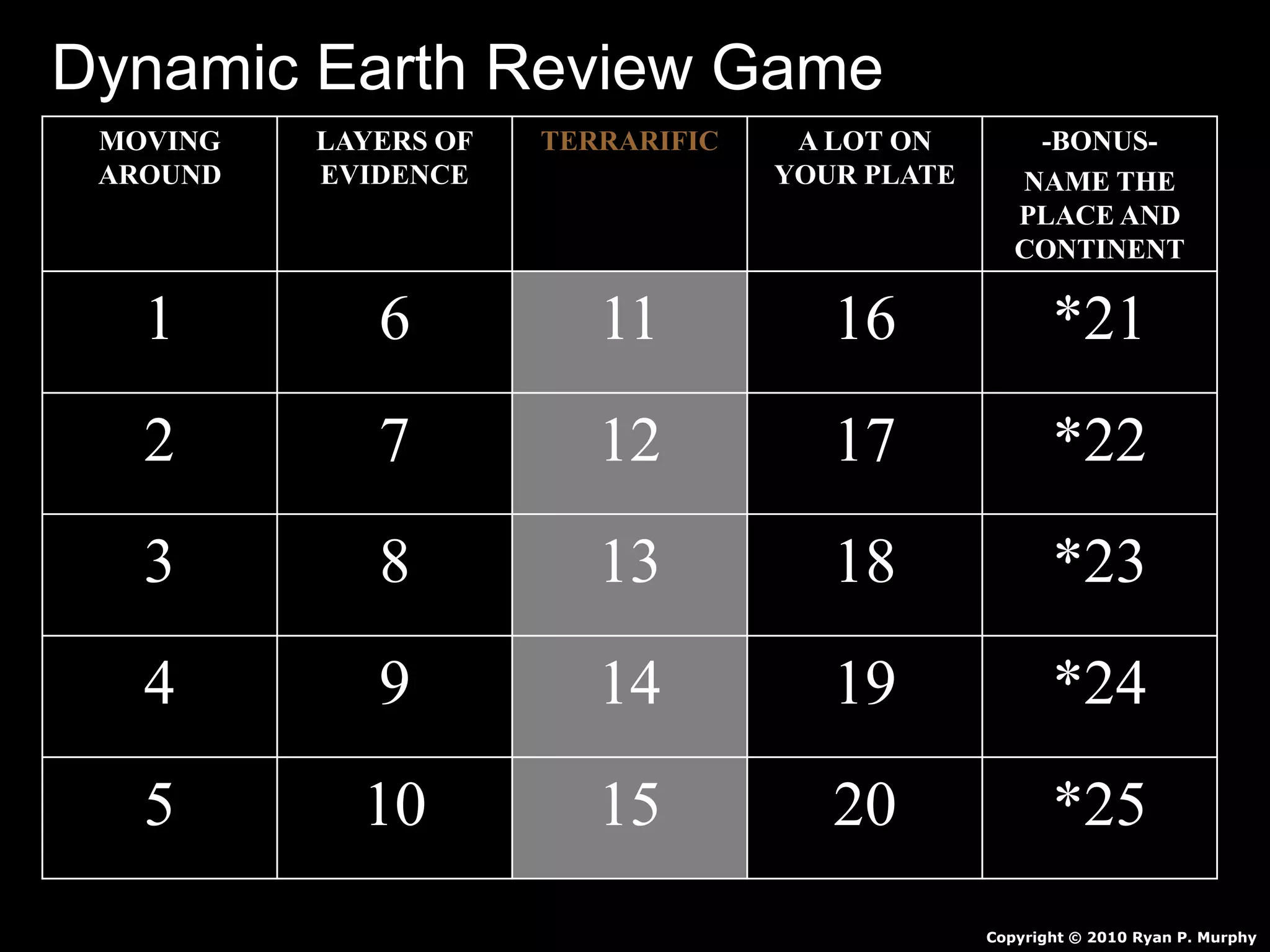
1 6 11 16 *21
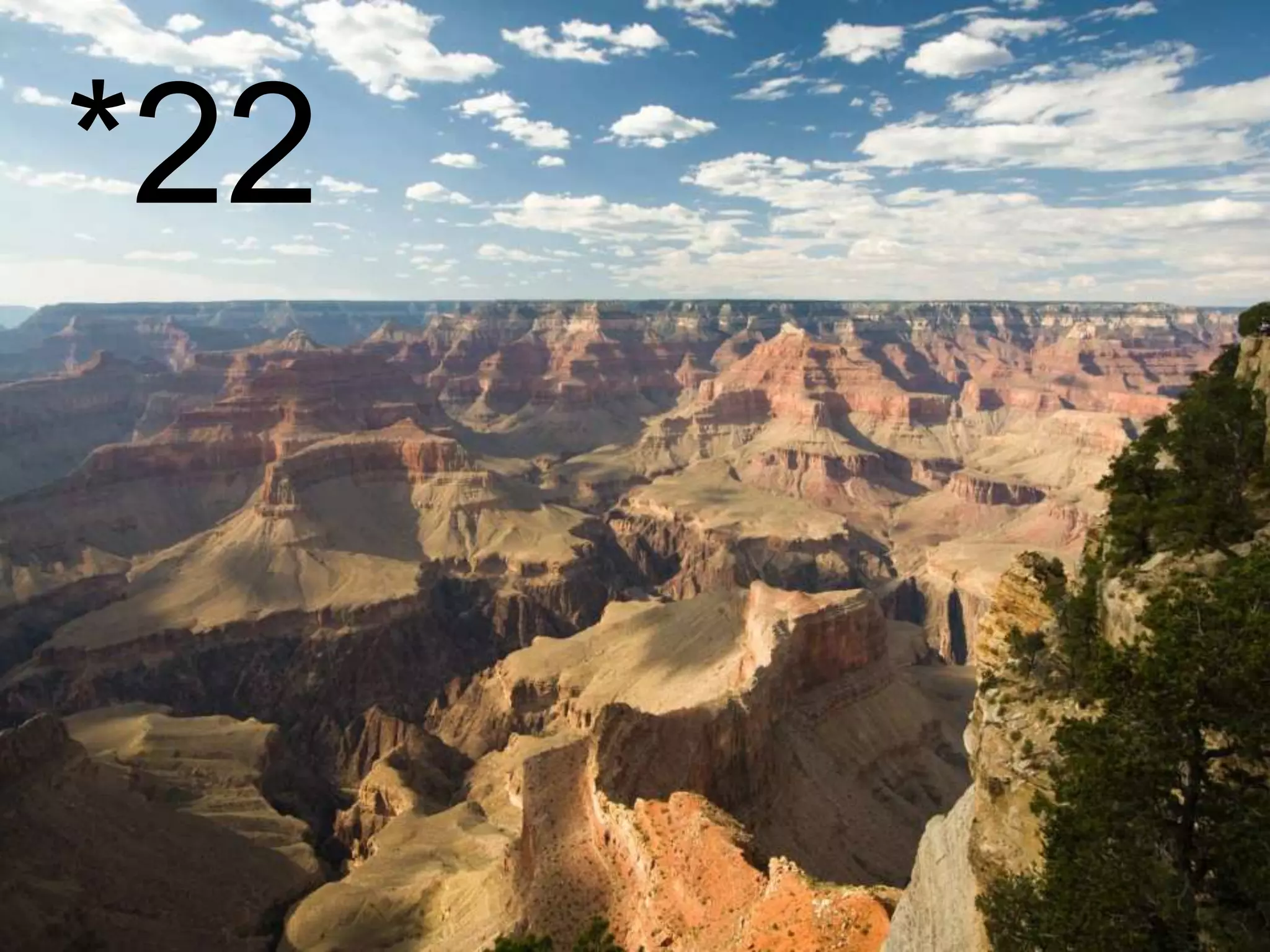
2 7 12 17 *22
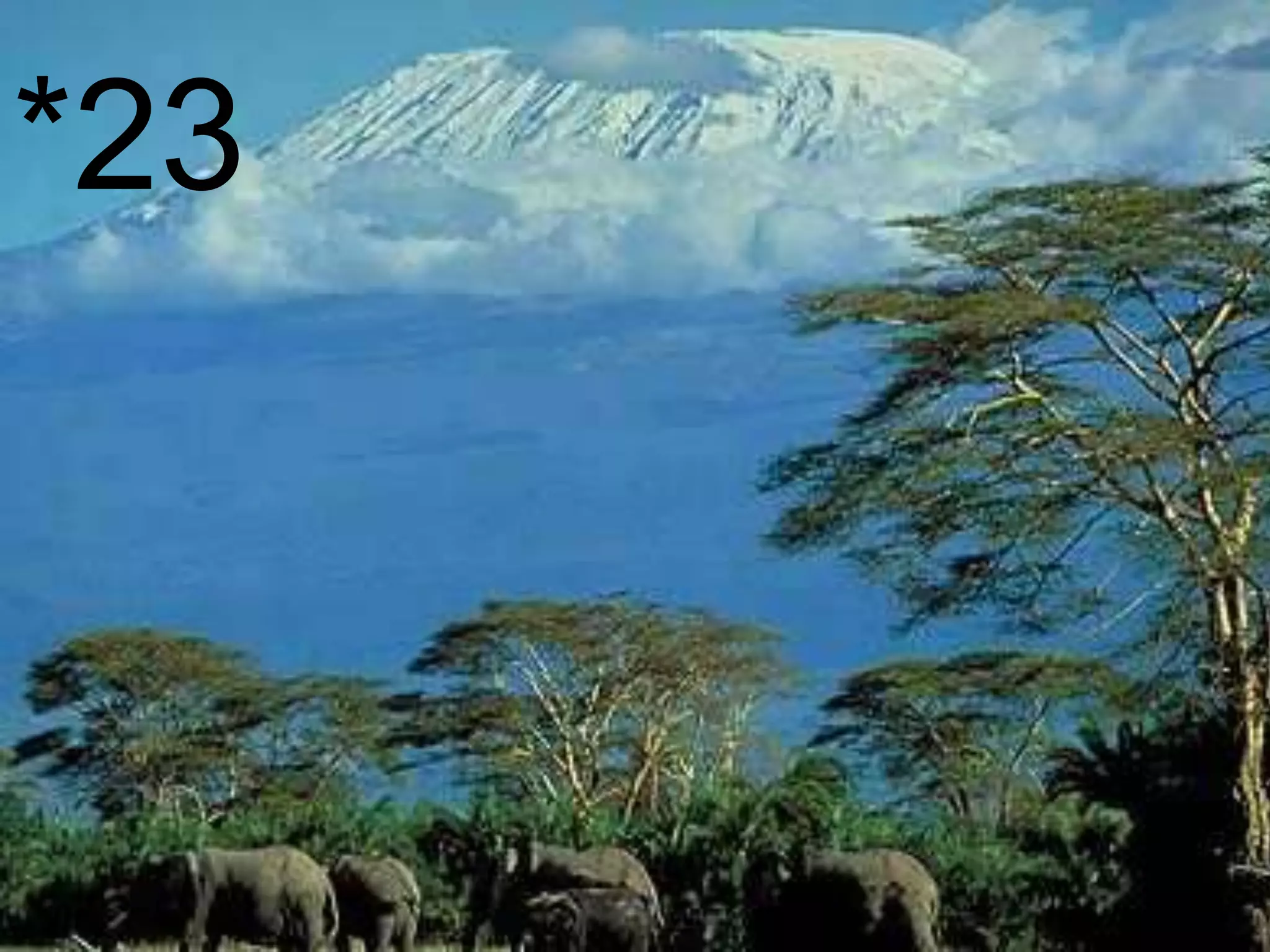
3 8 13 18 *23
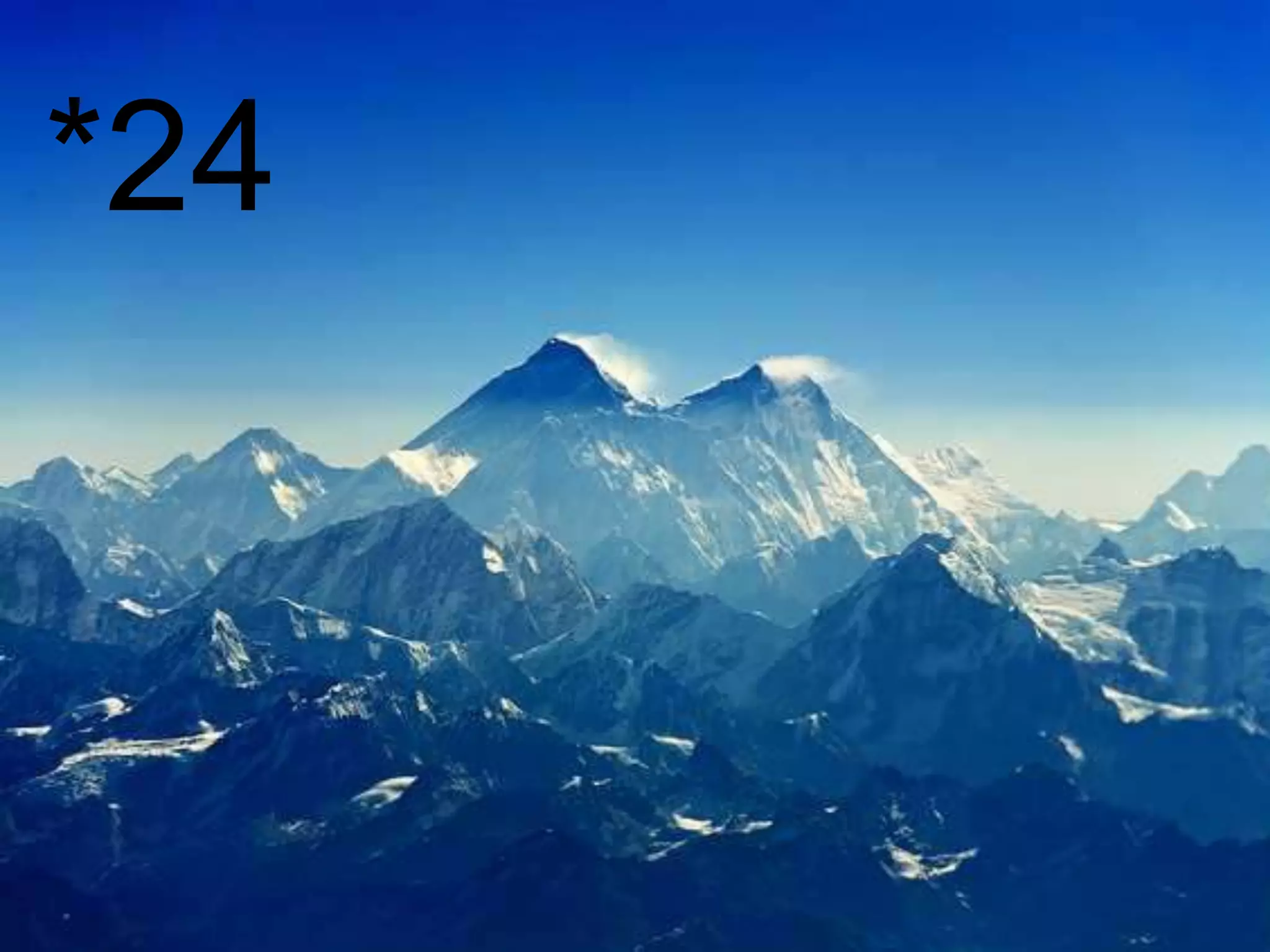
4 9 14 19 *24
5 10 15 20 *25
Copyright © 2010 Ryan P. Murphy
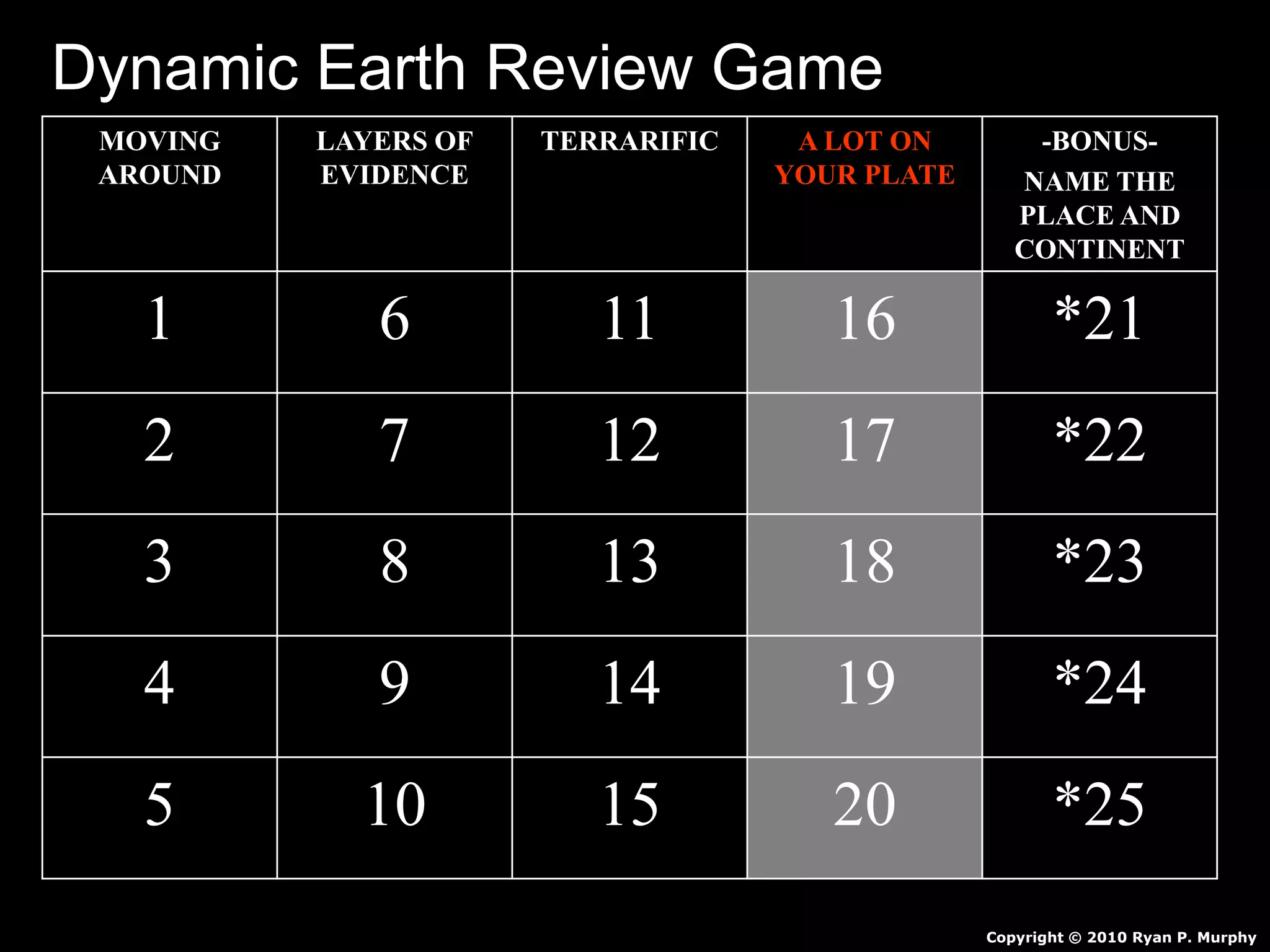
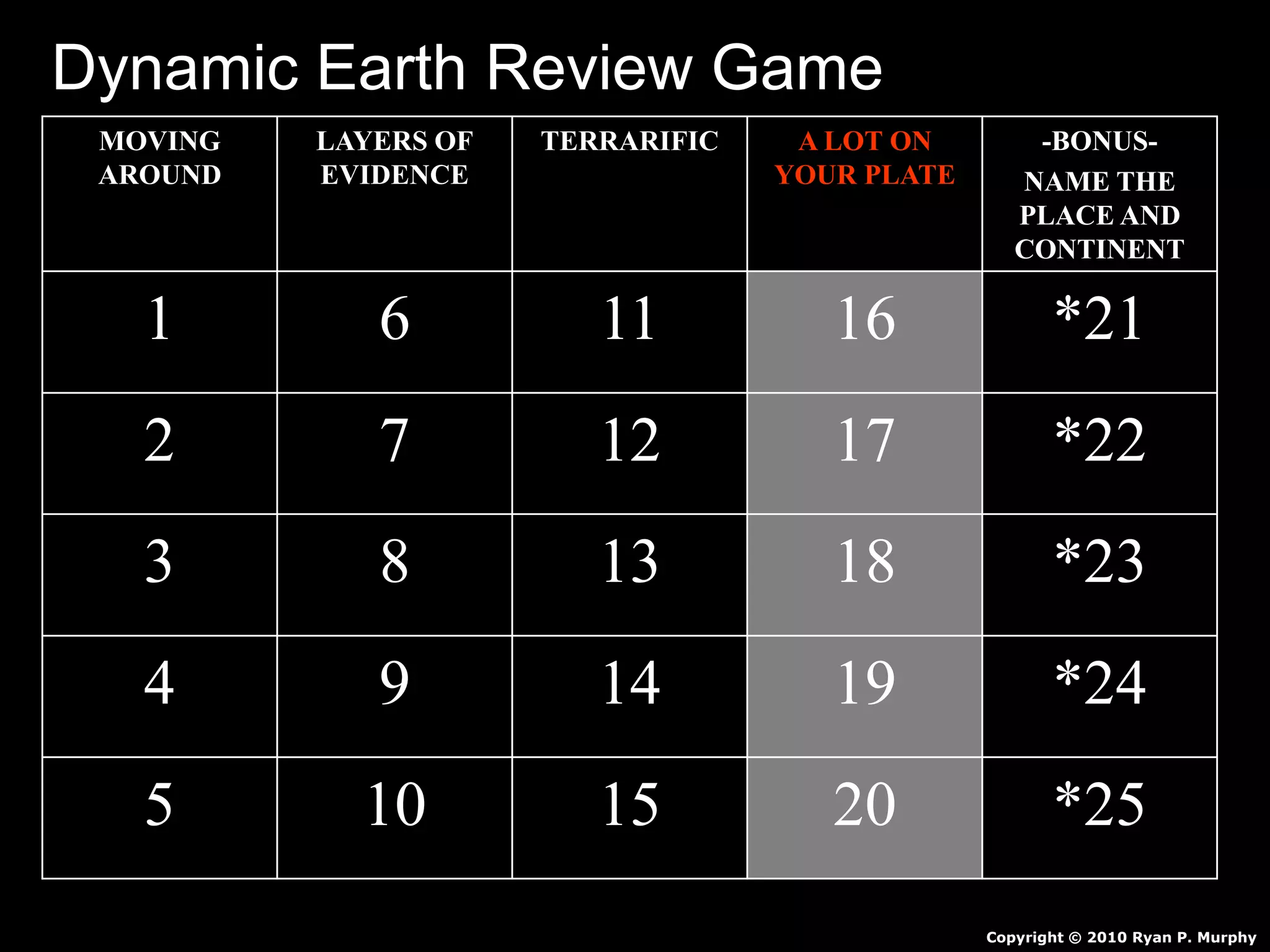
Dynamic Earth Review Game
• How to play…
– Don’t play like Jeo_ _ _ _ y.
– Class should be divided into several small groups.
– Groups should use science journal (red slide
notes), homework, and other available materials to
assist you.
– Groups can communicate quietly with each other
but no sharing answers between groups.
• Practice quietly communicating right now?
• Practice Communication Question:
• Your group gets to order one pizza and you can have
two toppings. What does your group want?
Questions 1-20 = 5pts Each
Final Category (Bonus) = 1pt Each
Final Questions = 5 pt wager
If you wager 5 on the last question and get it wrong you lose
5 pts. Wager 5 and get it right you get 5 pts.
Find the Owl =
Secretly write “Owl” in the correct box
worth 1pt.
“I’ll be about
this big.”
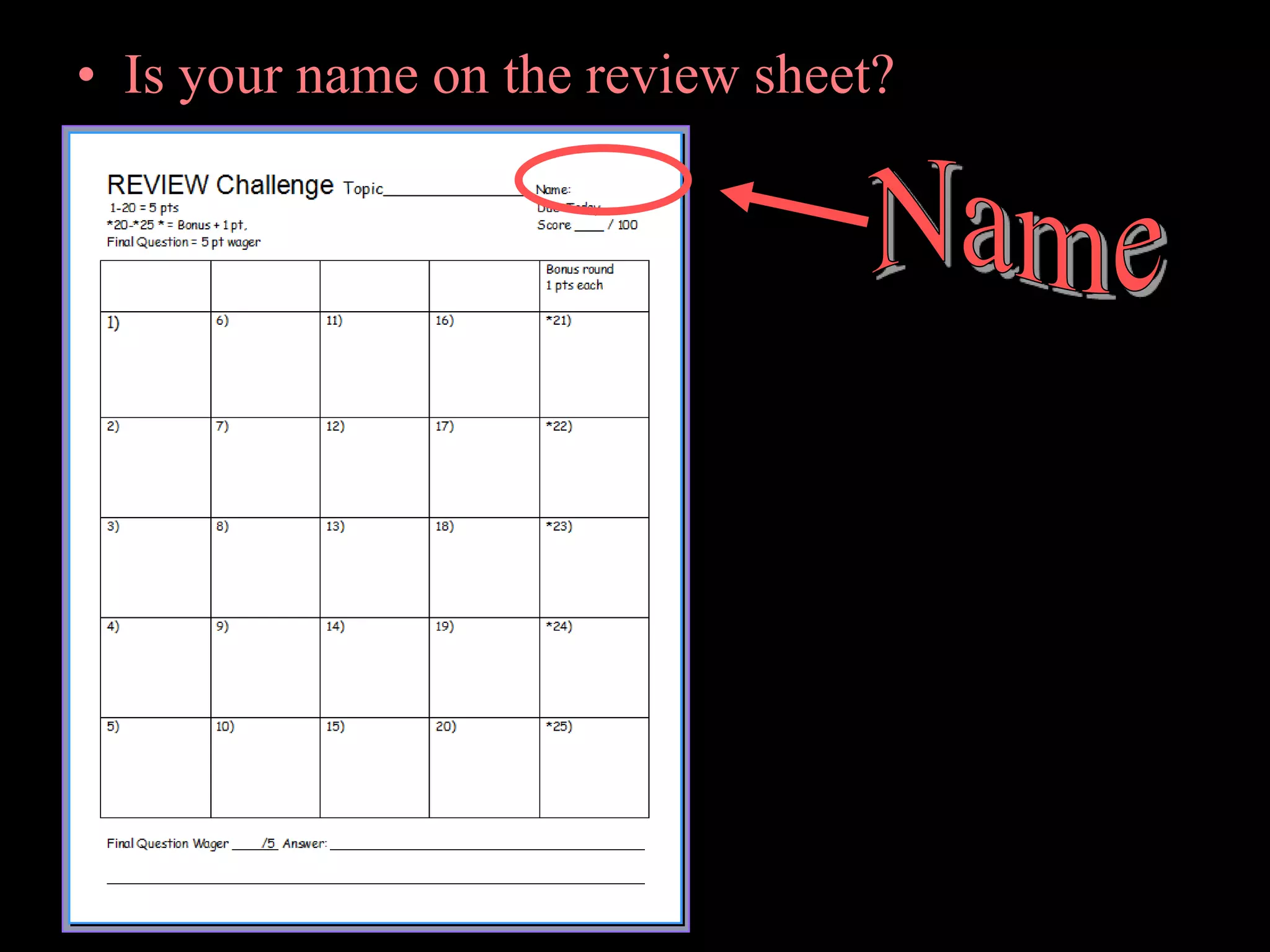
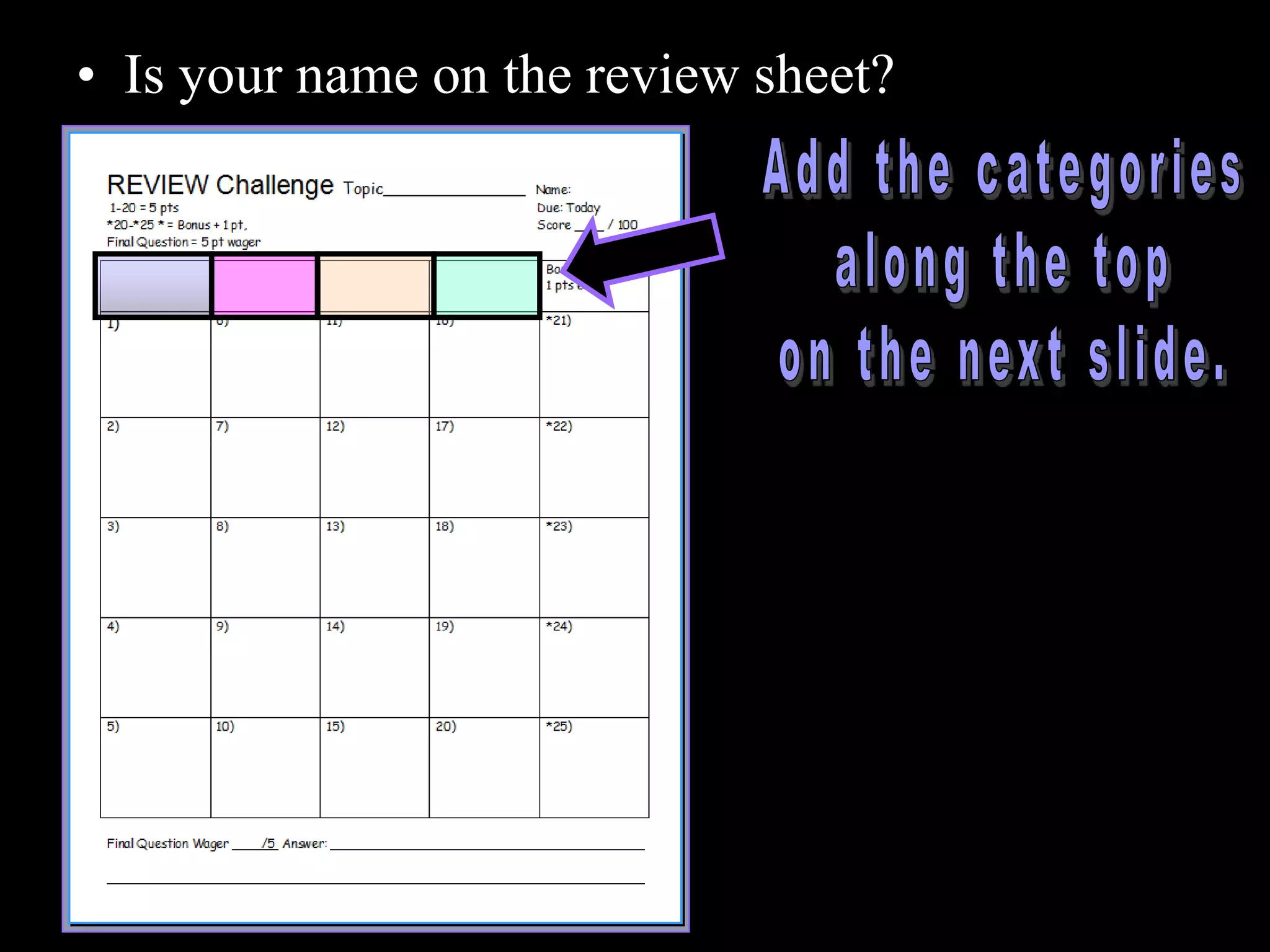
• Is your name on the review sheet?
http://sciencepowerpoint.com/Website Link:
MOVING
AROUND
LAYERS OF
EVIDENCE
TERRARIFIC A LOT ON
YOUR PLATE
-BONUS-
NAME THE
PLACE AND
CONTINENT
1 6 11 16 *21
2 7 12 17 *22
3 8 13 18 *23
4 9 14 19 *24
5 10 15 20 *25
Copyright © 2010 Ryan P. Murphy
Dynamic Earth Review Game
MOVING
AROUND
LAYERS OF
EVIDENCE
TERRARIFIC A LOT ON
YOUR PLATE
-BONUS-
NAME THE
PLACE AND
CONTINENT
1 6 11 16 *21
2 7 12 17 *22
3 8 13 18 *23
4 9 14 19 *24
5 10 15 20 *25
Copyright © 2010 Ryan P. Murphy
Dynamic Earth Review Game
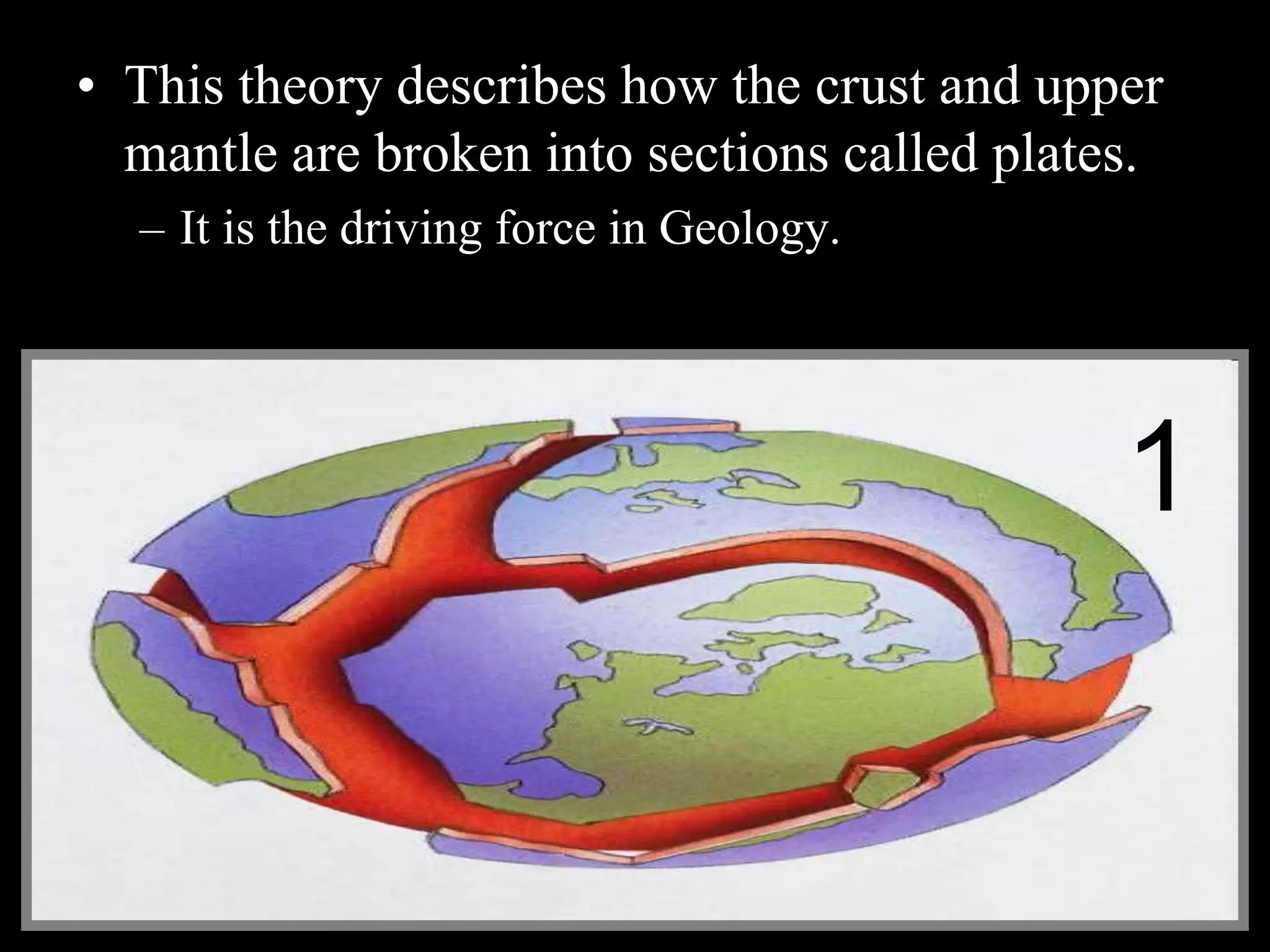
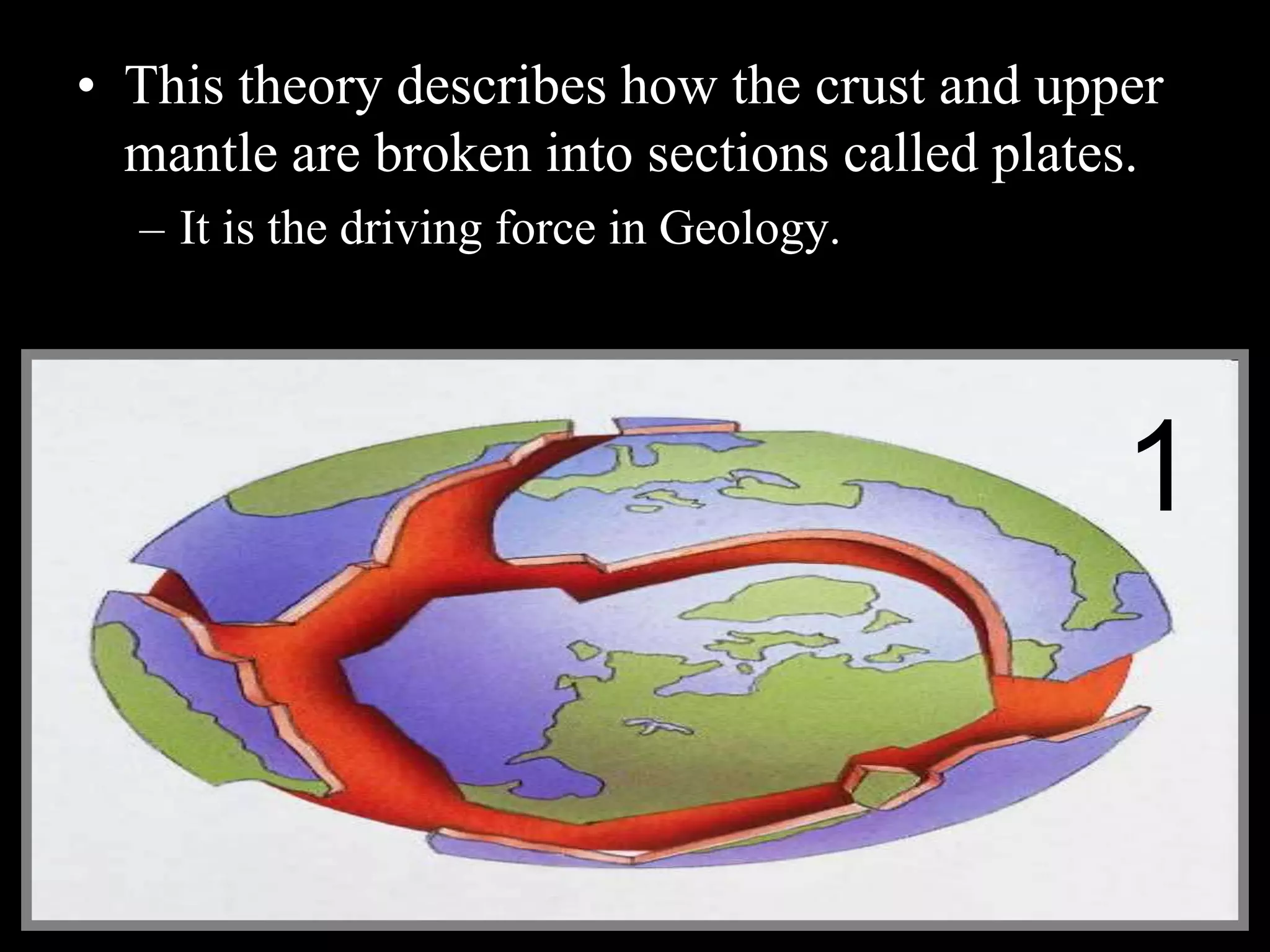
• This theory describes how the crust and upper
mantle are broken into sections called plates.
– It is the driving force in Geology.
1
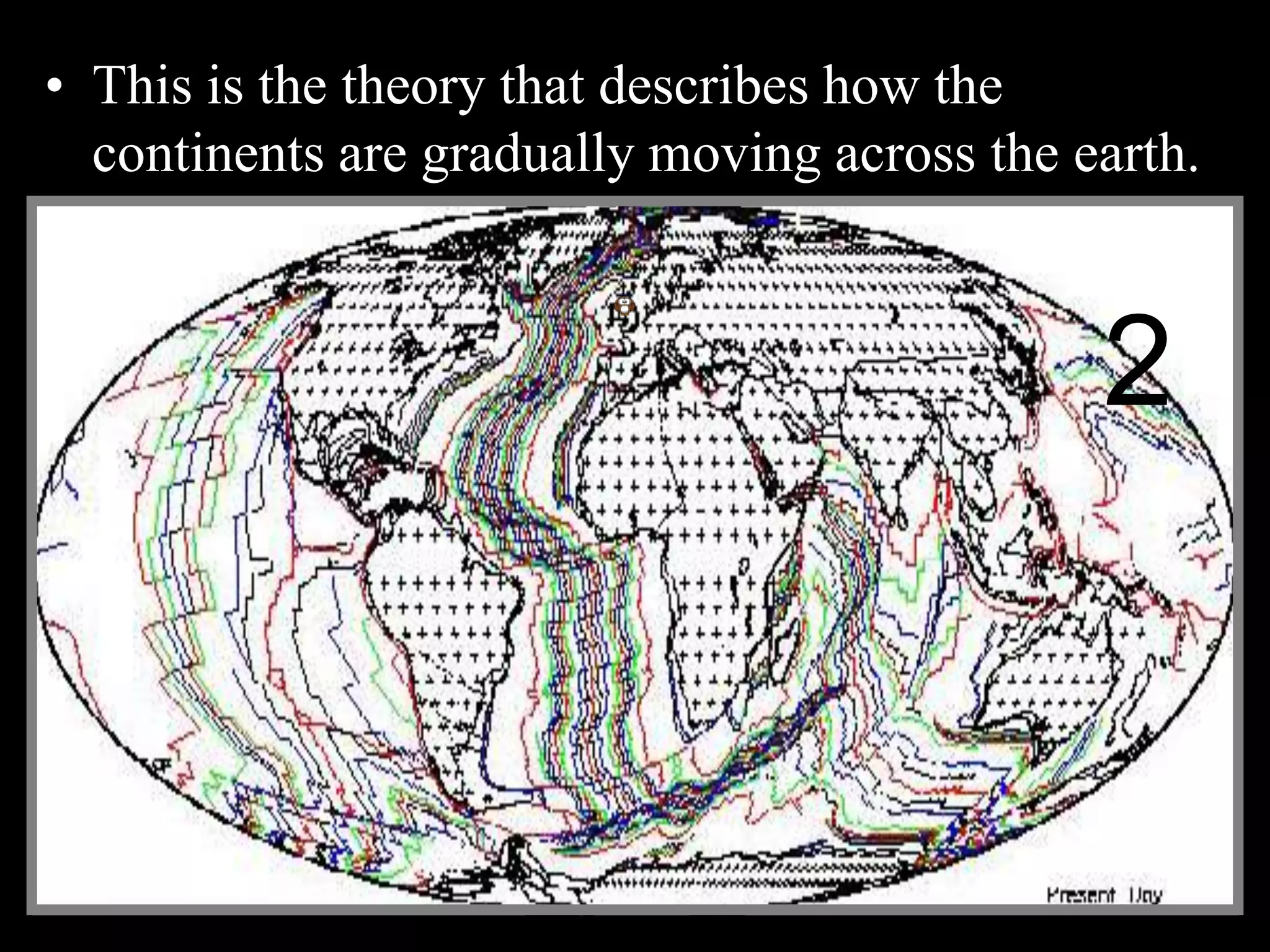
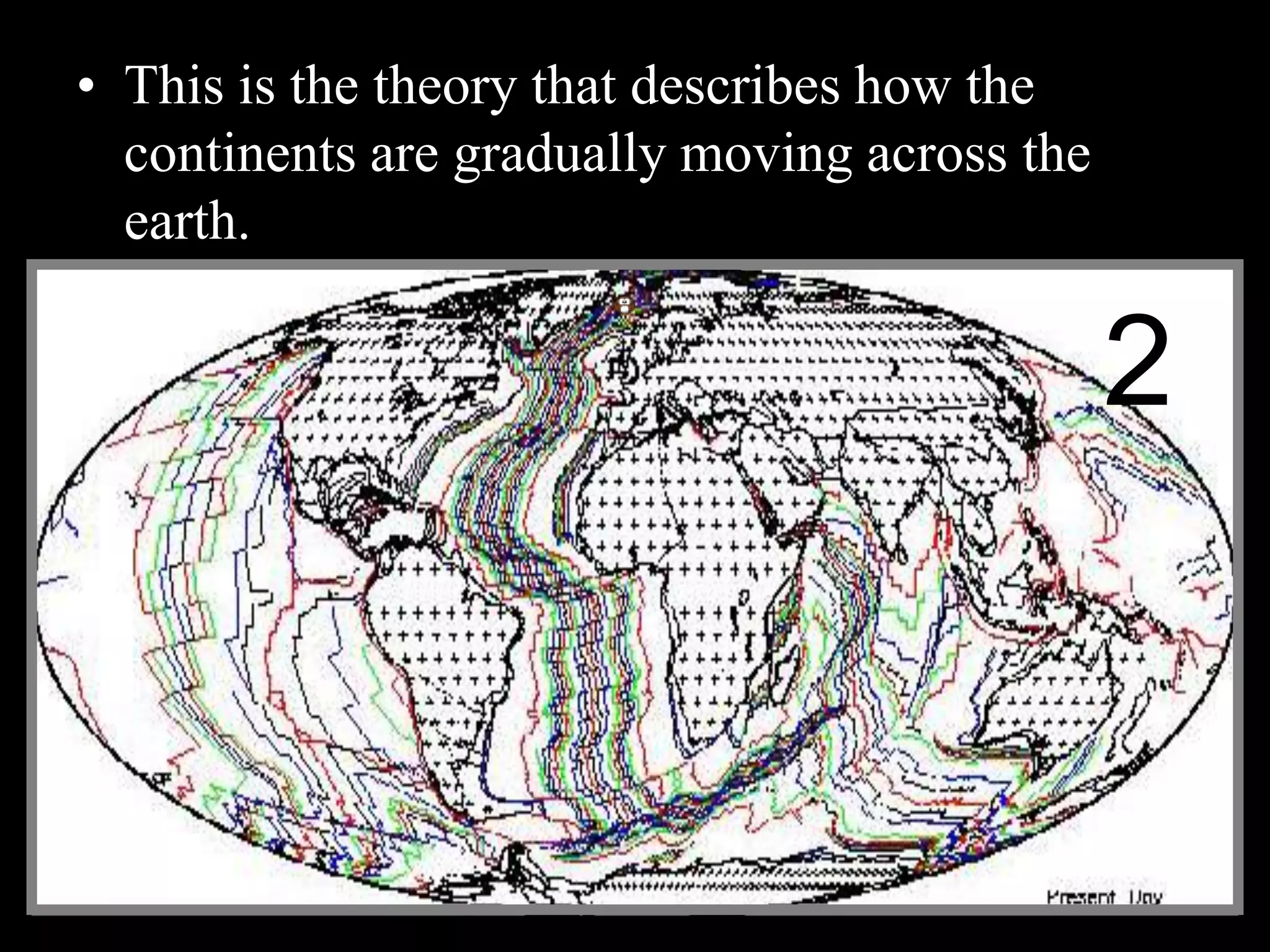
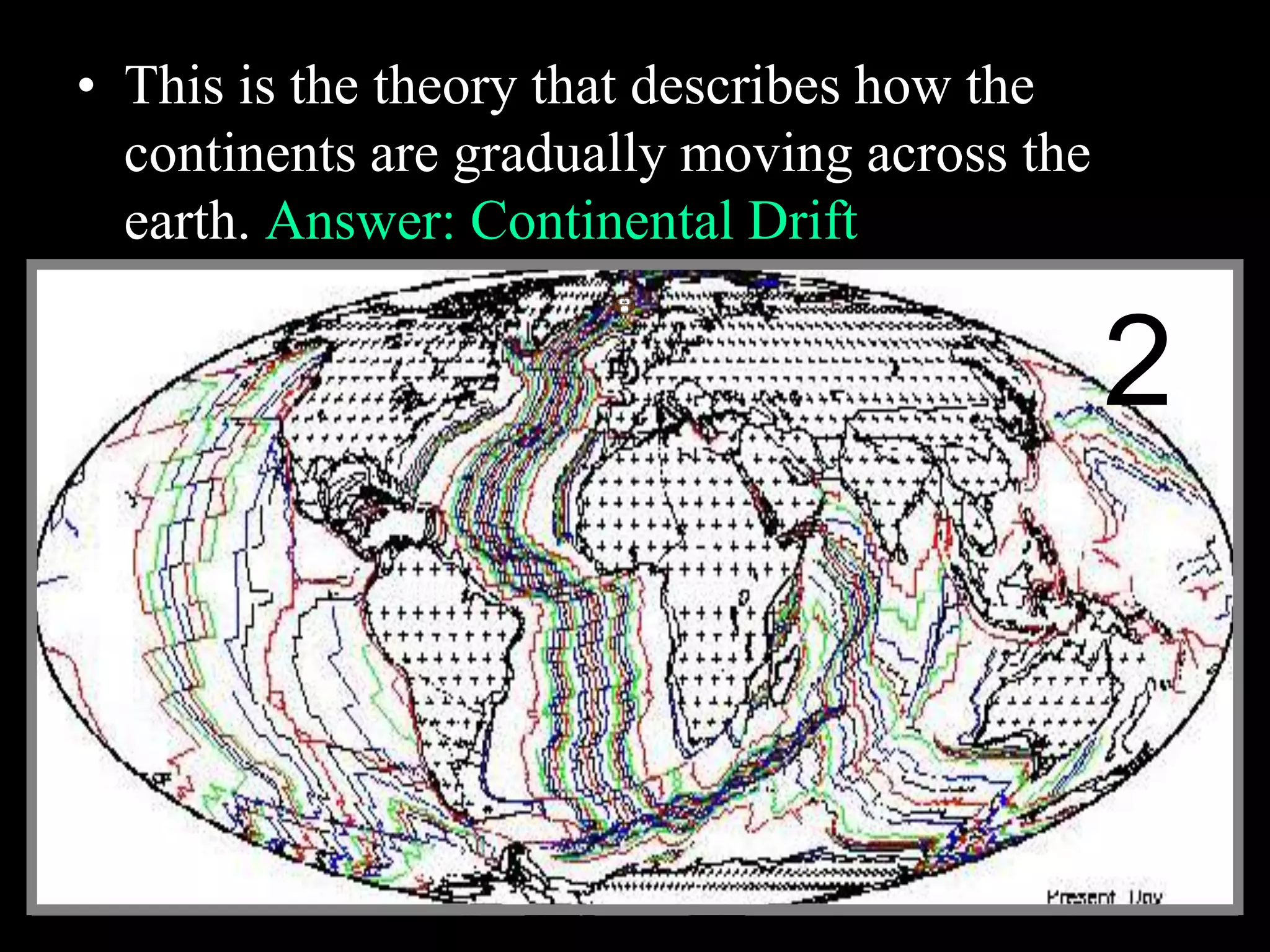
• This is the theory that describes how the
continents are gradually moving across the earth.
2
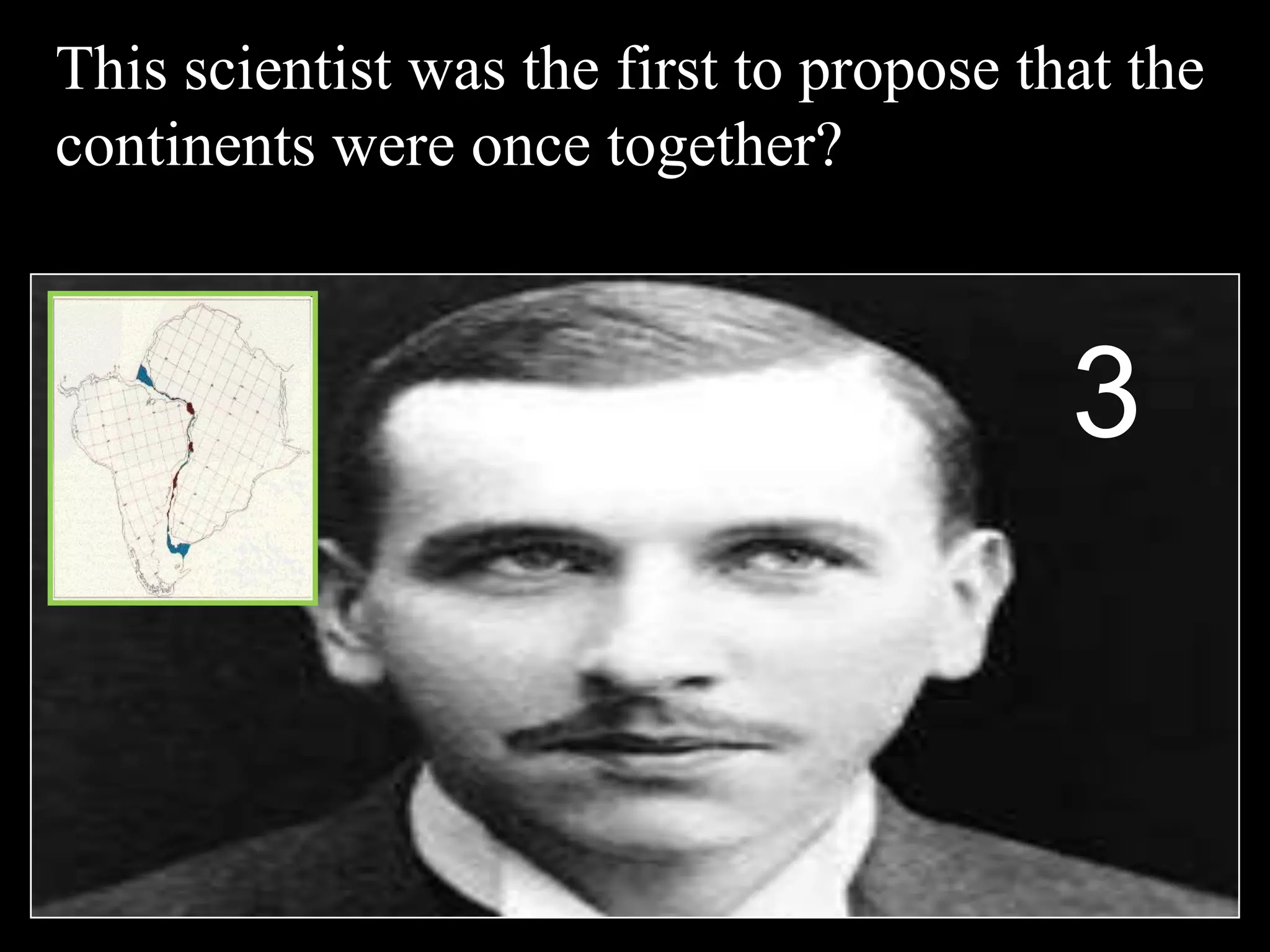
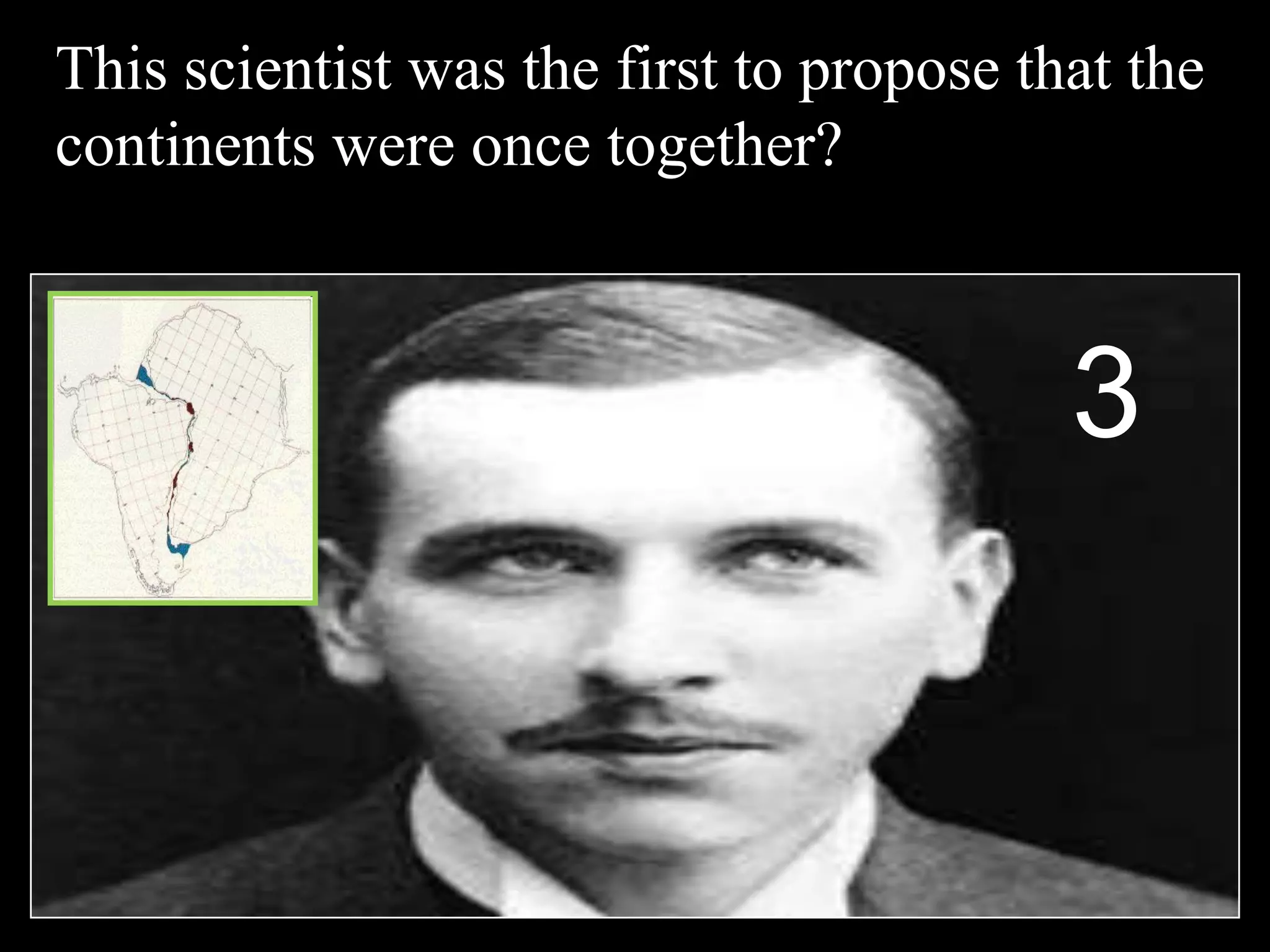
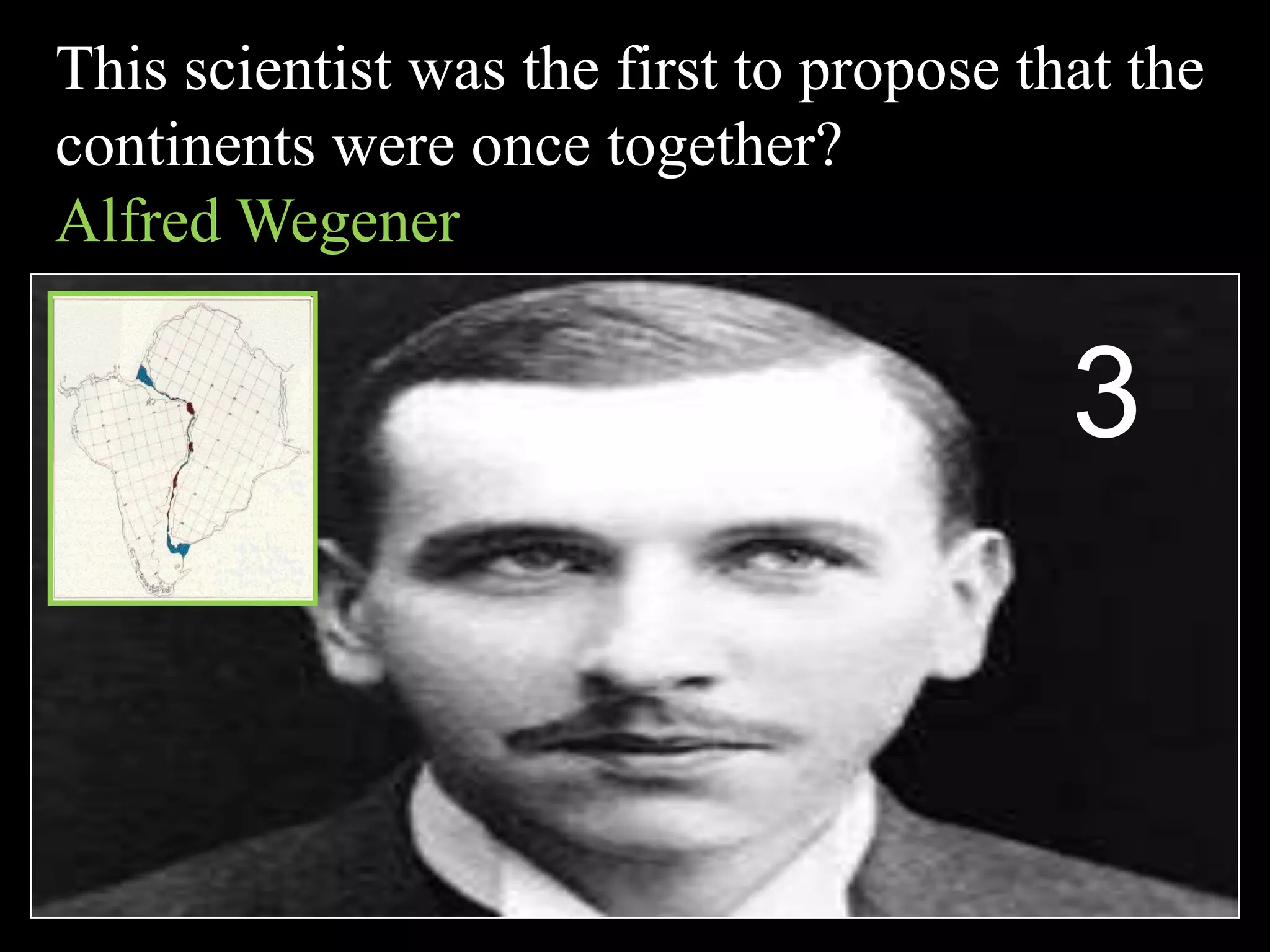
This scientist was the first to propose that the
continents were once together?
3
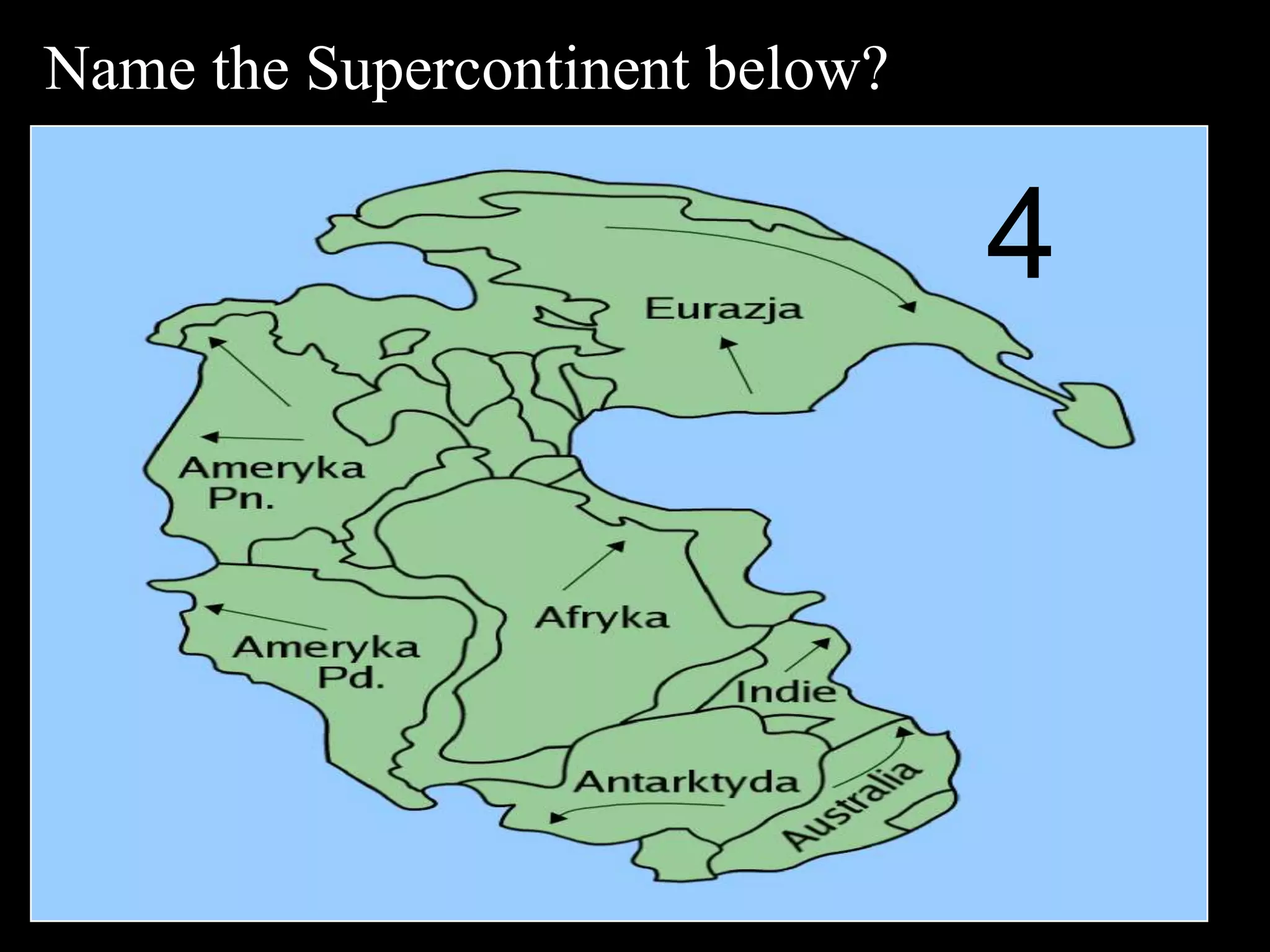
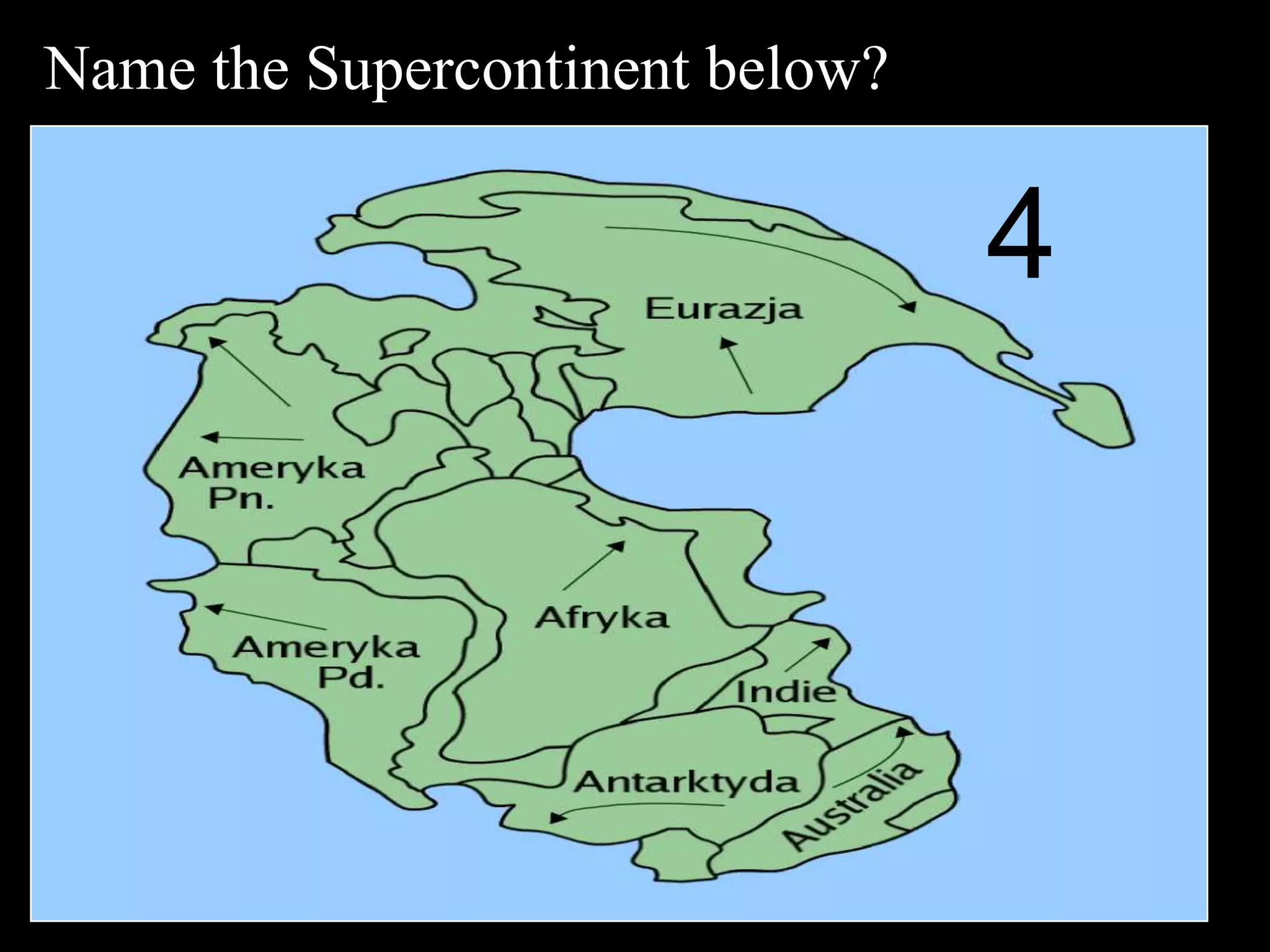
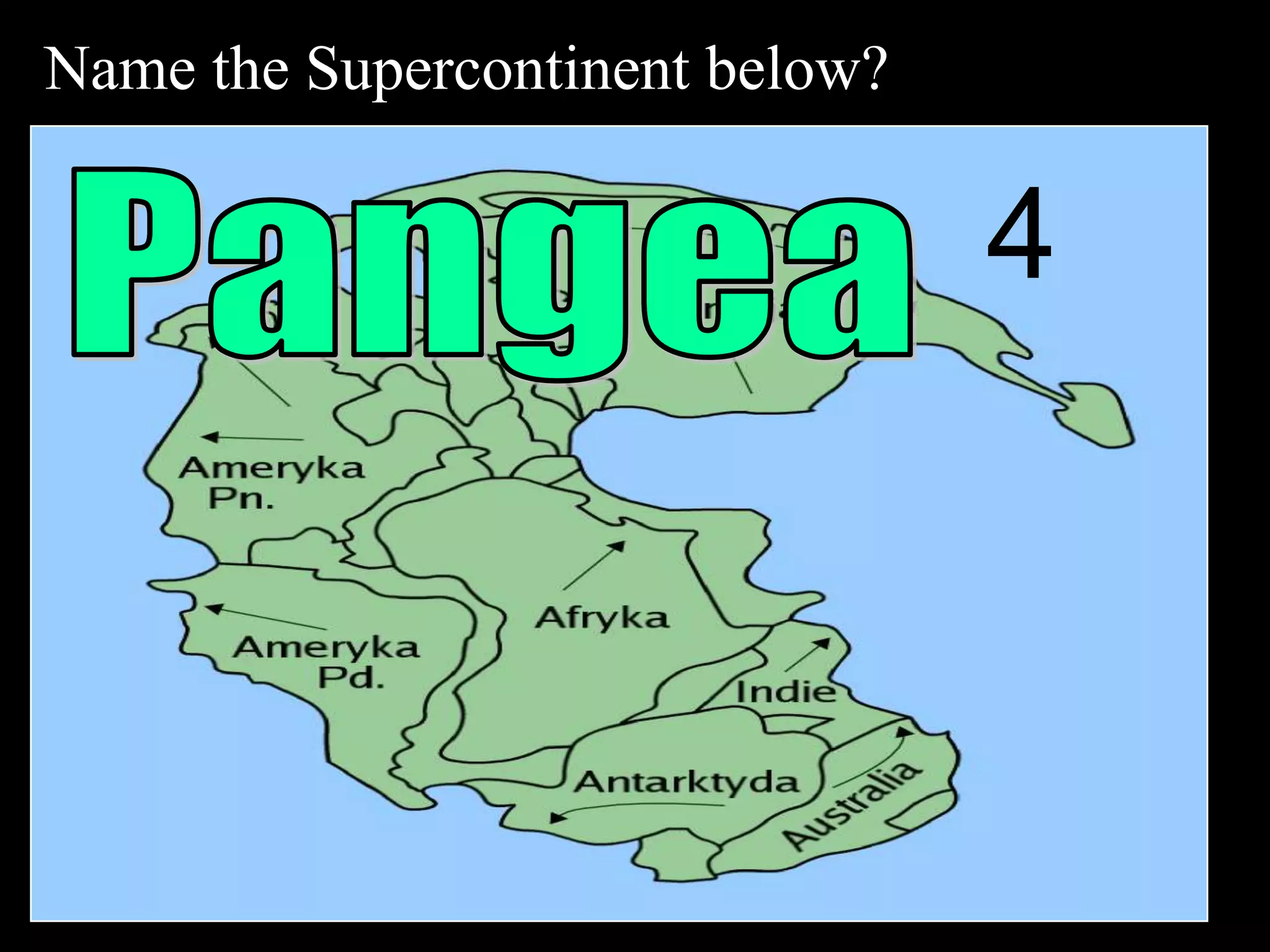
Name the Supercontinent below?
4
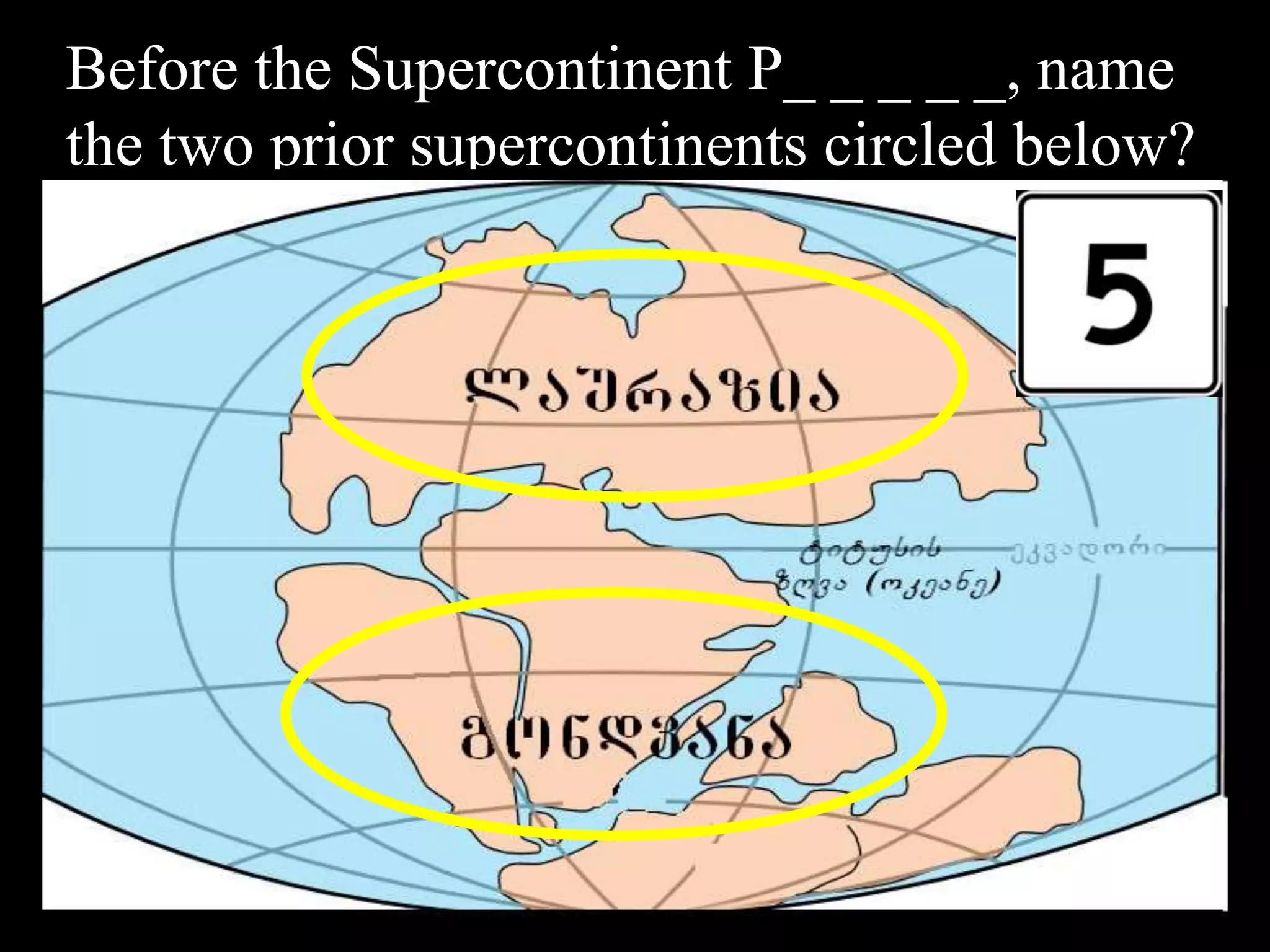
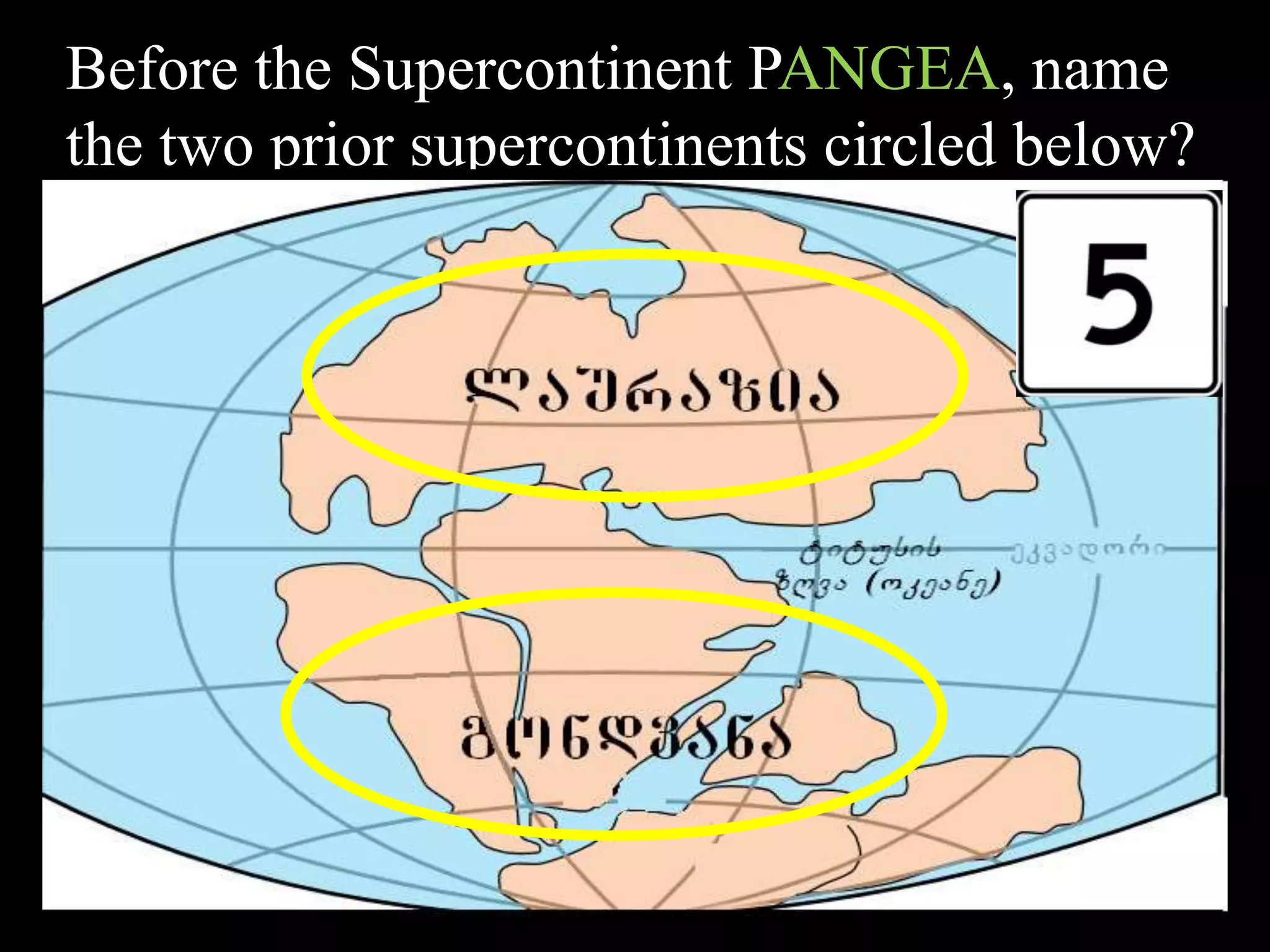
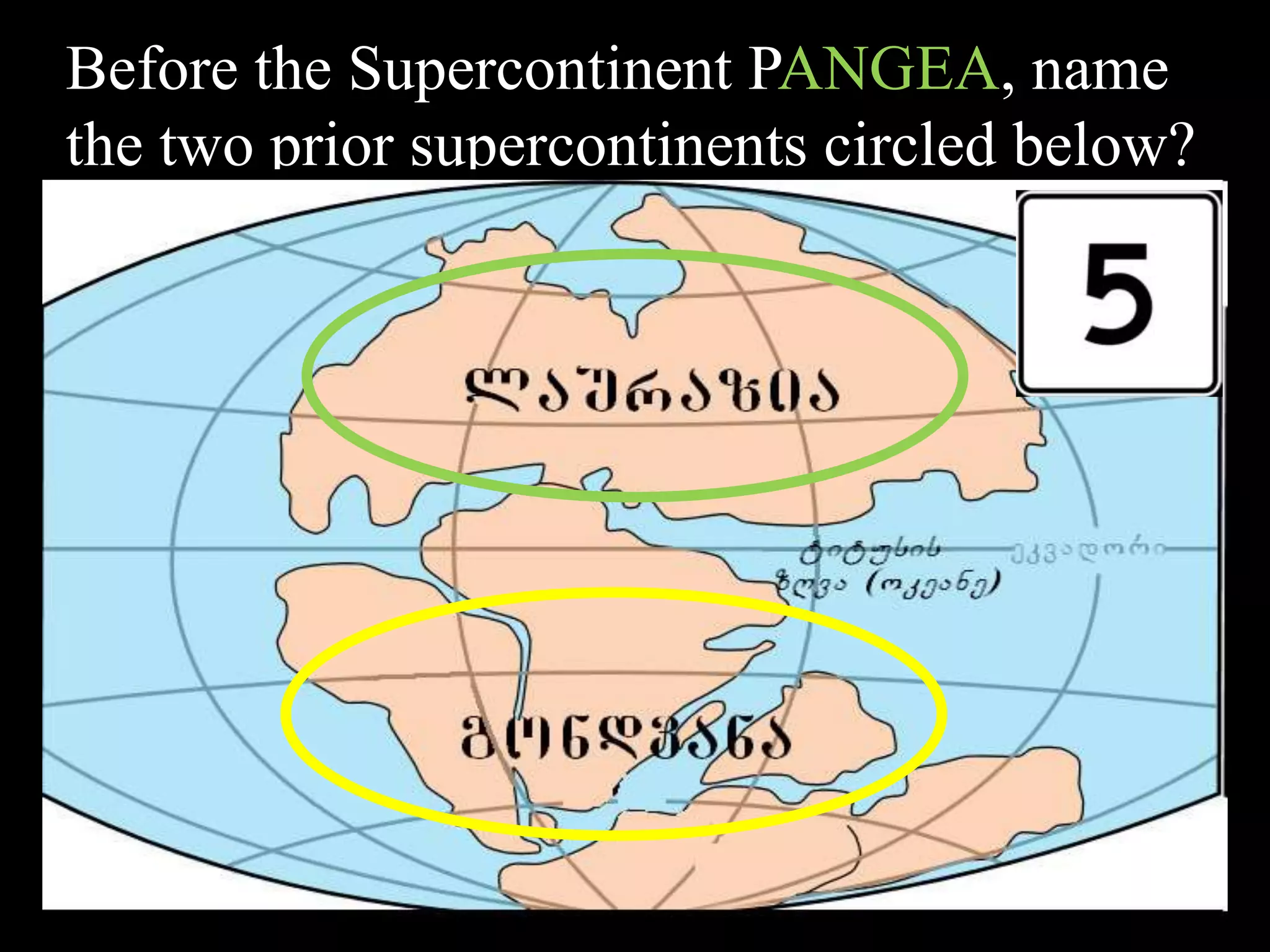
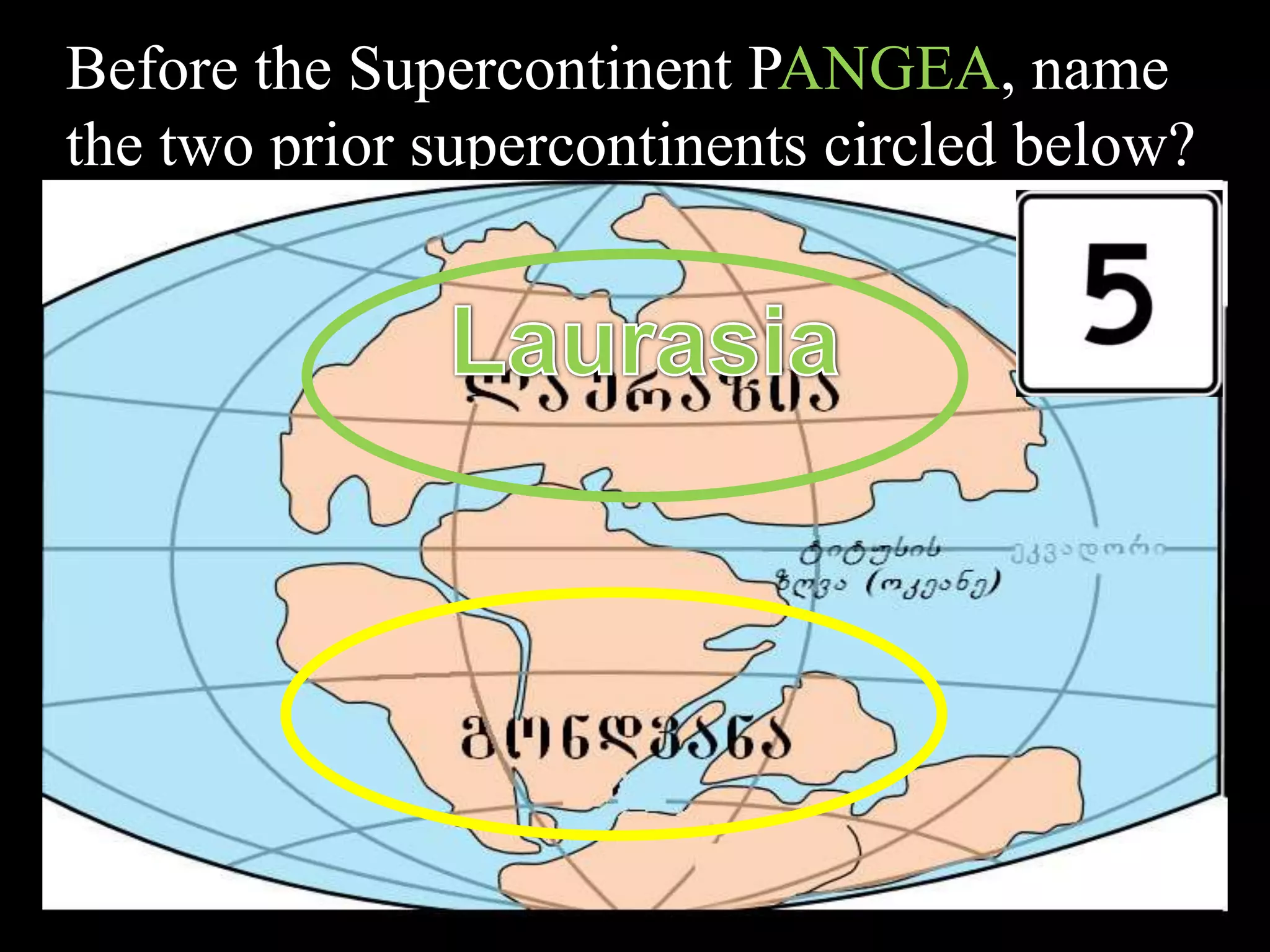
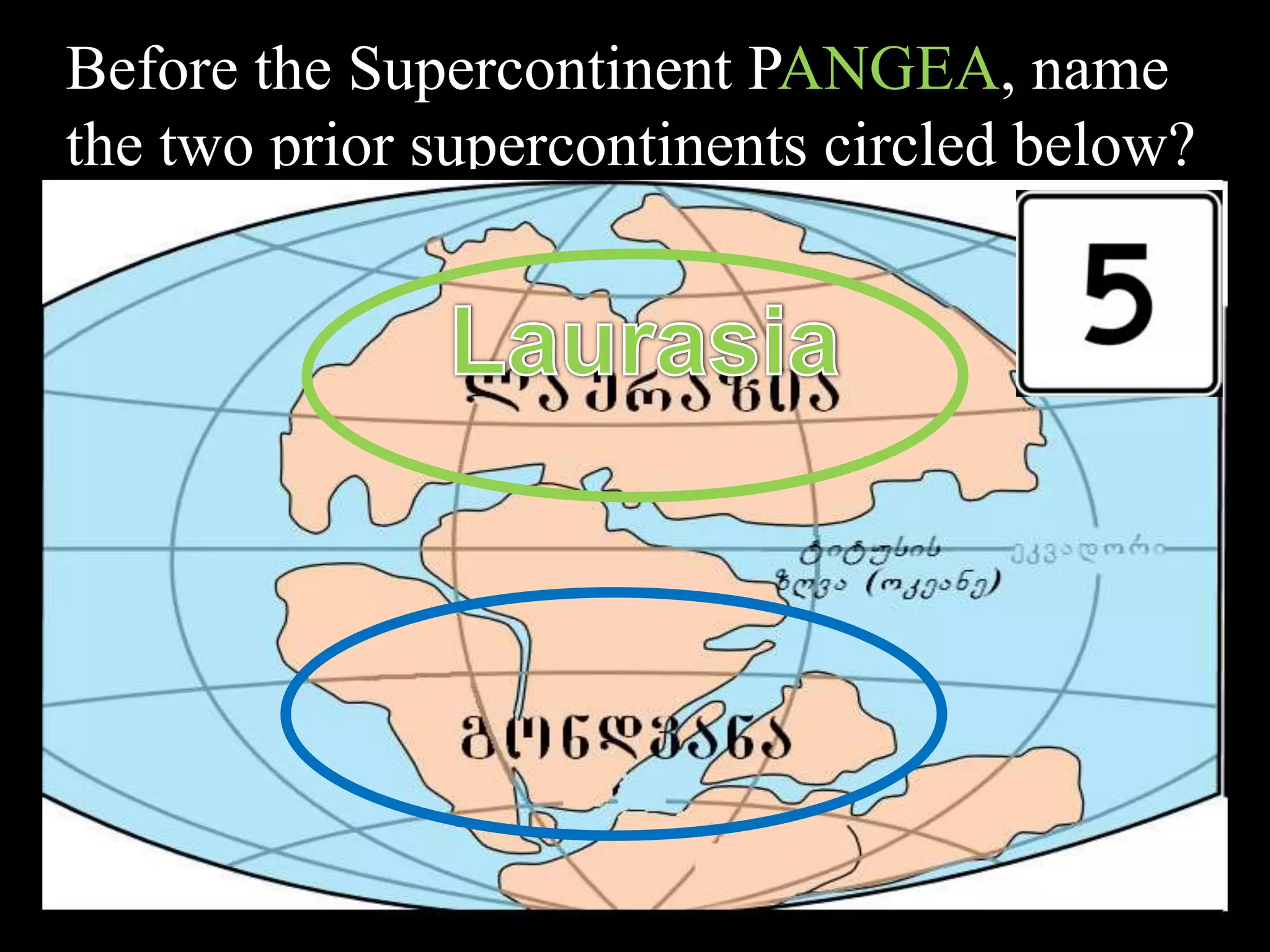
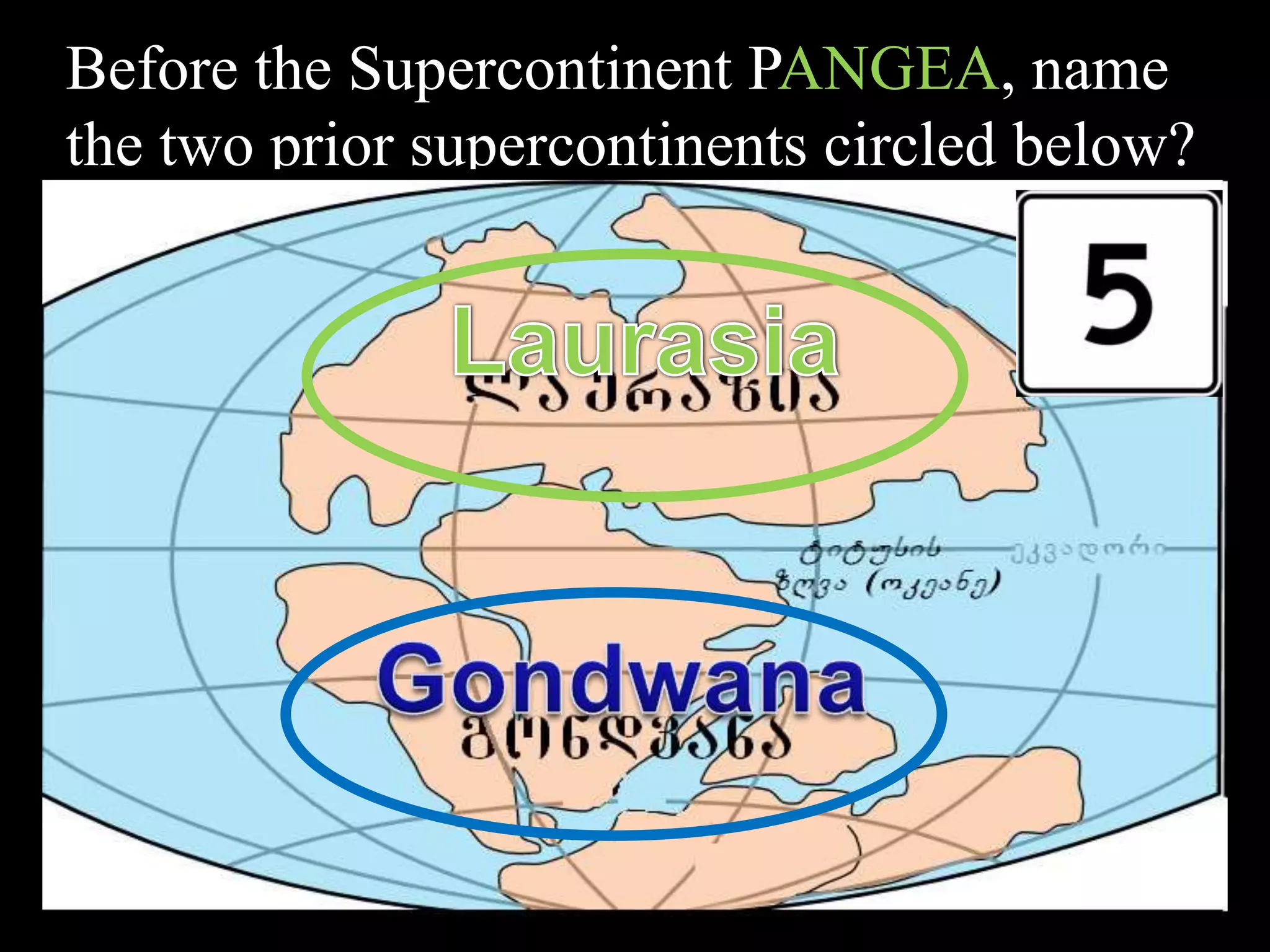
Before the Supercontinent P_ _ _ _ _, name
the two prior supercontinents circled below?
MOVING
AROUND
LAYERS OF
EVIDENCE
TERRARIFIC A LOT ON
YOUR PLATE
-BONUS-
NAME THE
PLACE AND
CONTINENT
1 6 11 16 *21
2 7 12 17 *22
3 8 13 18 *23
4 9 14 19 *24
5 10 15 20 *25
Copyright © 2010 Ryan P. Murphy
Dynamic Earth Review Game
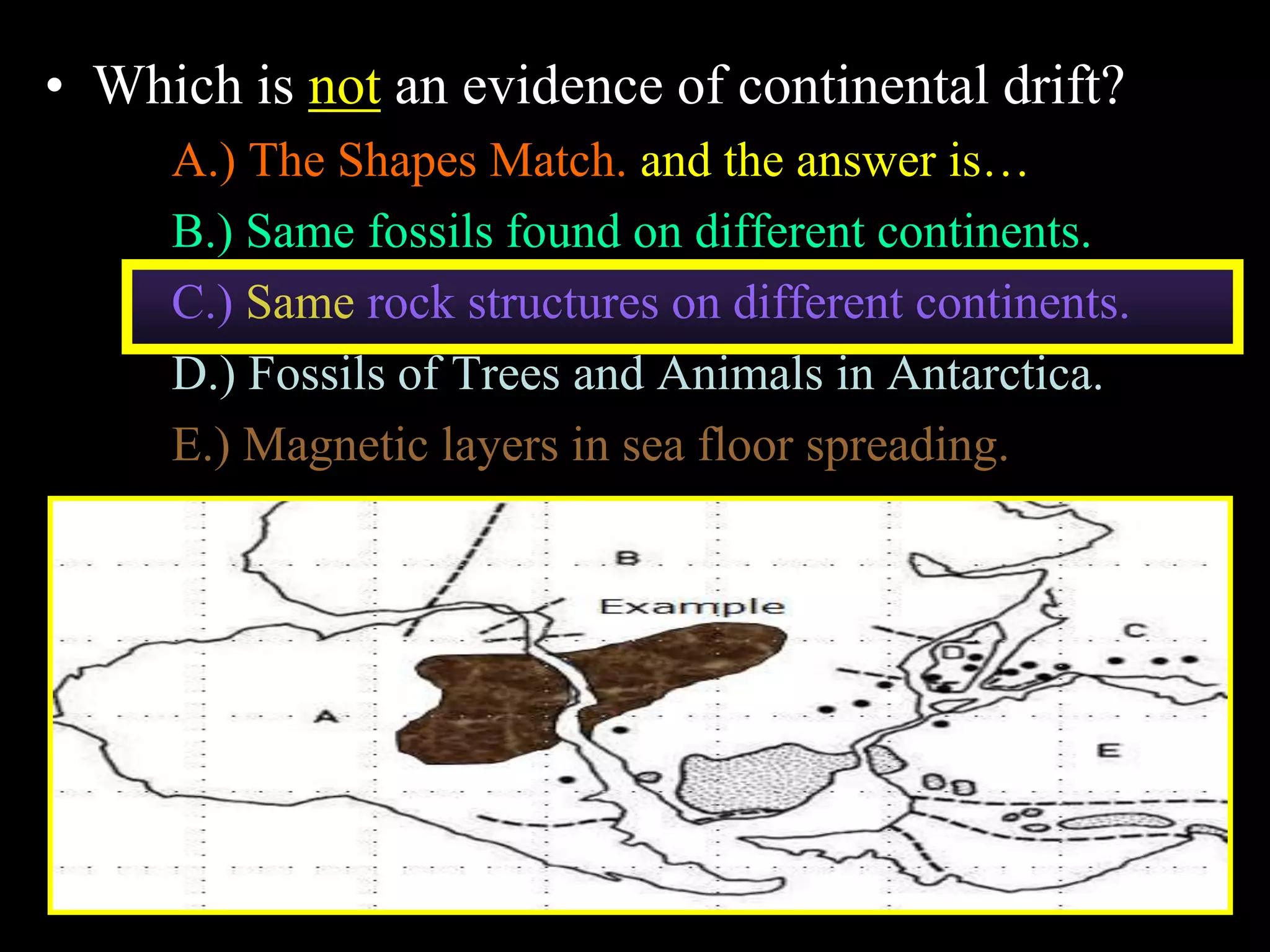
• Which is not an evidence of continental drift?
A.) The Shapes Match.
B.) Same fossils found on different continents.
C.) Different rock structures on different continents.
D.) Fossils of Trees and Animals in Antarctica.
E.) Magnetic layers in sea floor spreading.
6
• Which is not an evidence of continental drift?
A.) The Shapes Match.
B.) Same fossils found on different continents.
C.) Different rock structures on different continents.
D.) Fossils of Trees and Animals in Antarctica.
E.) Magnetic layers in sea floor spreading.
6
• Which is not an evidence of continental drift?
A.) The Shapes Match.
B.) Same fossils found on different continents.
C.) Different rock structures on different continents.
D.) Fossils of Trees and Animals in Antarctica.
E.) Magnetic layers in sea floor spreading.
6
• Which is not an evidence of continental drift?
A.) The Shapes Match.
B.) Same fossils found on different continents.
C.) Different rock structures on different continents.
D.) Fossils of Trees and Animals in Antarctica.
E.) Magnetic layers in sea floor spreading.
6
• Which is not an evidence of continental drift?
A.) The Shapes Match.
B.) Same fossils found on different continents.
C.) Different rock structures on different continents.
D.) Fossils of Trees and Animals in Antarctica.
E.) Magnetic layers in sea floor spreading.
6
• Which is not an evidence of continental drift?
A.) The Shapes Match.
B.) Same fossils found on different continents.
C.) Different rock structures on different continents.
D.) Fossils of Trees and Animals in Antarctica.
E.) Magnetic layers in sea floor spreading.
6
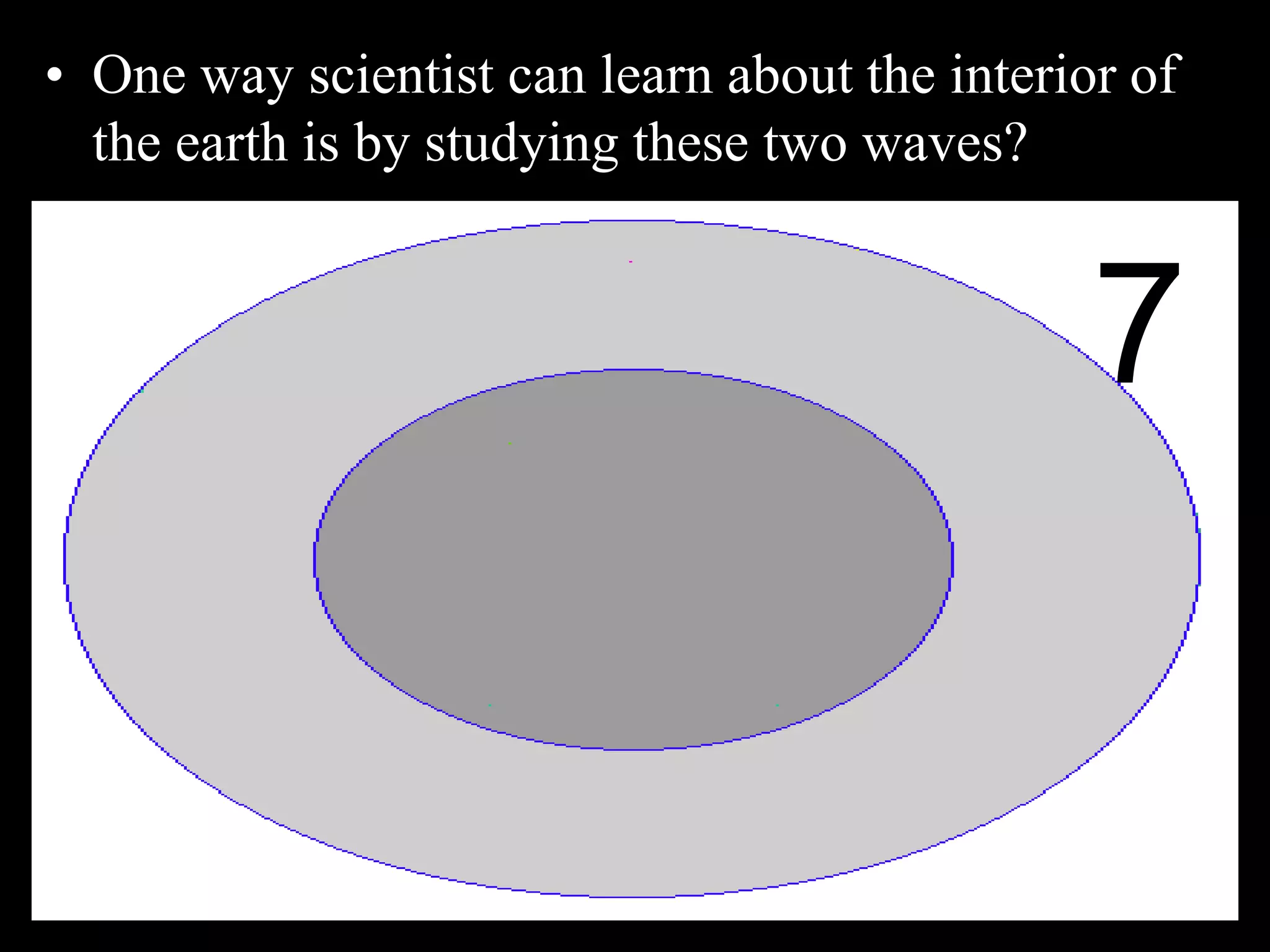
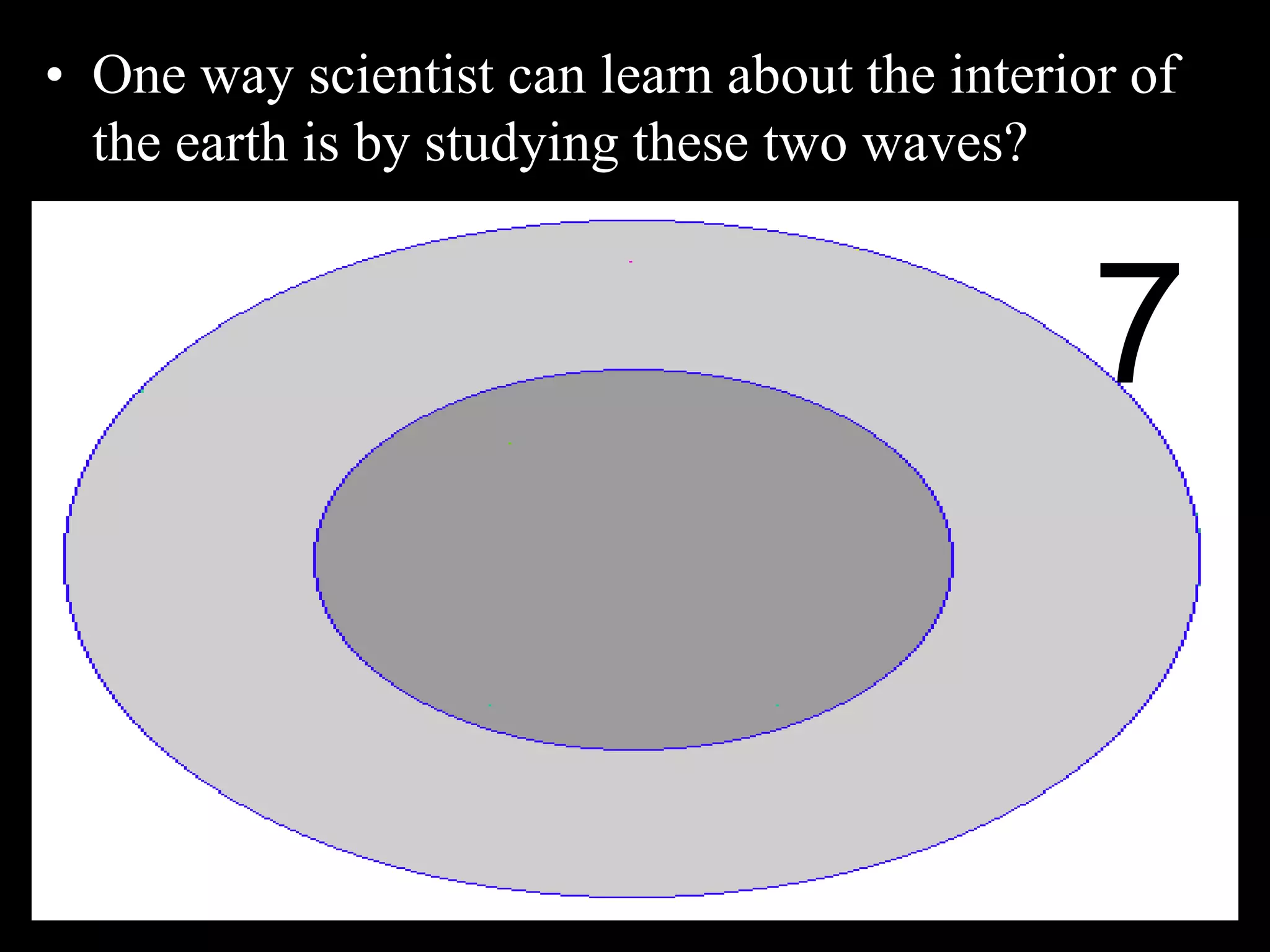
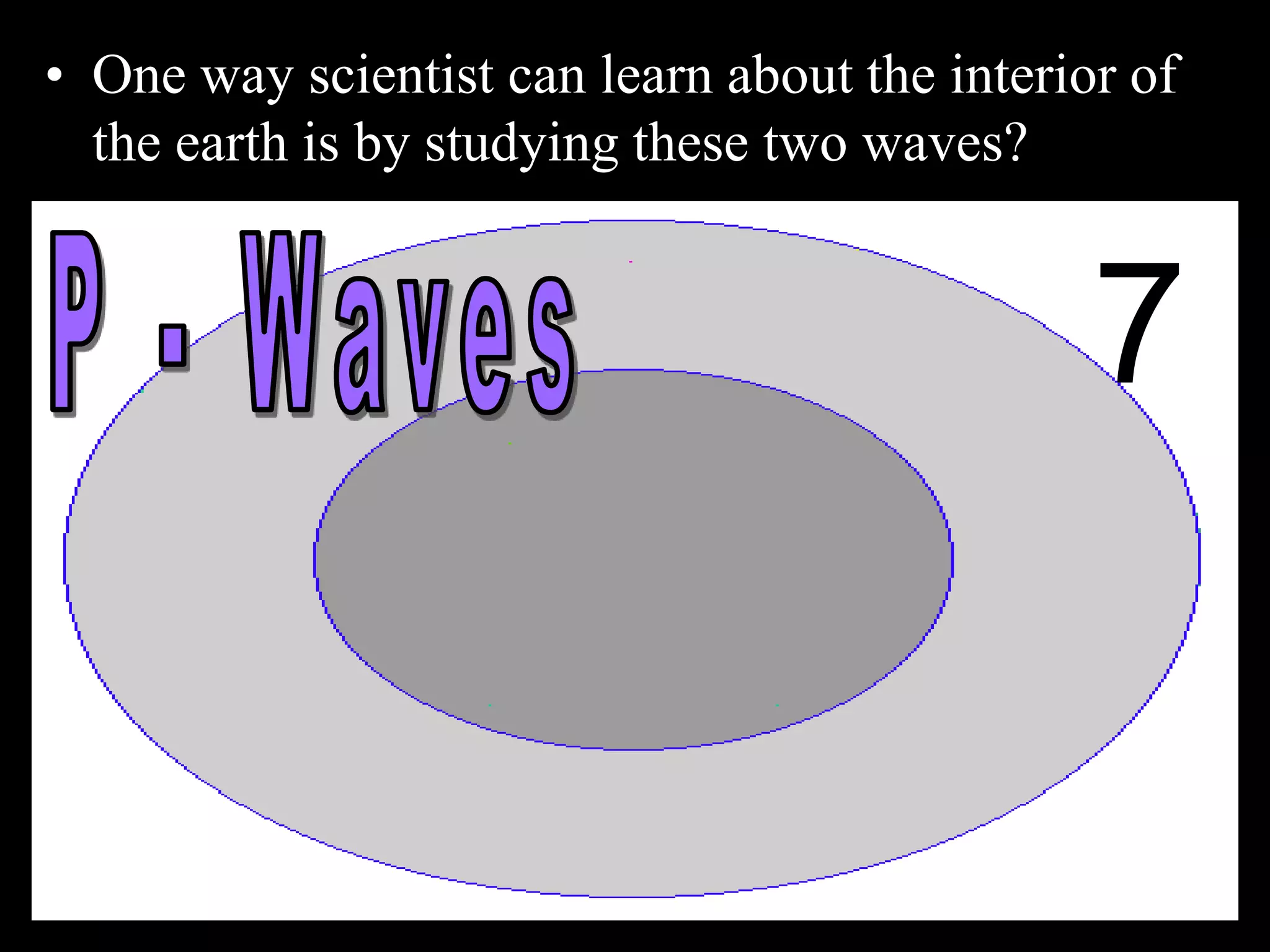
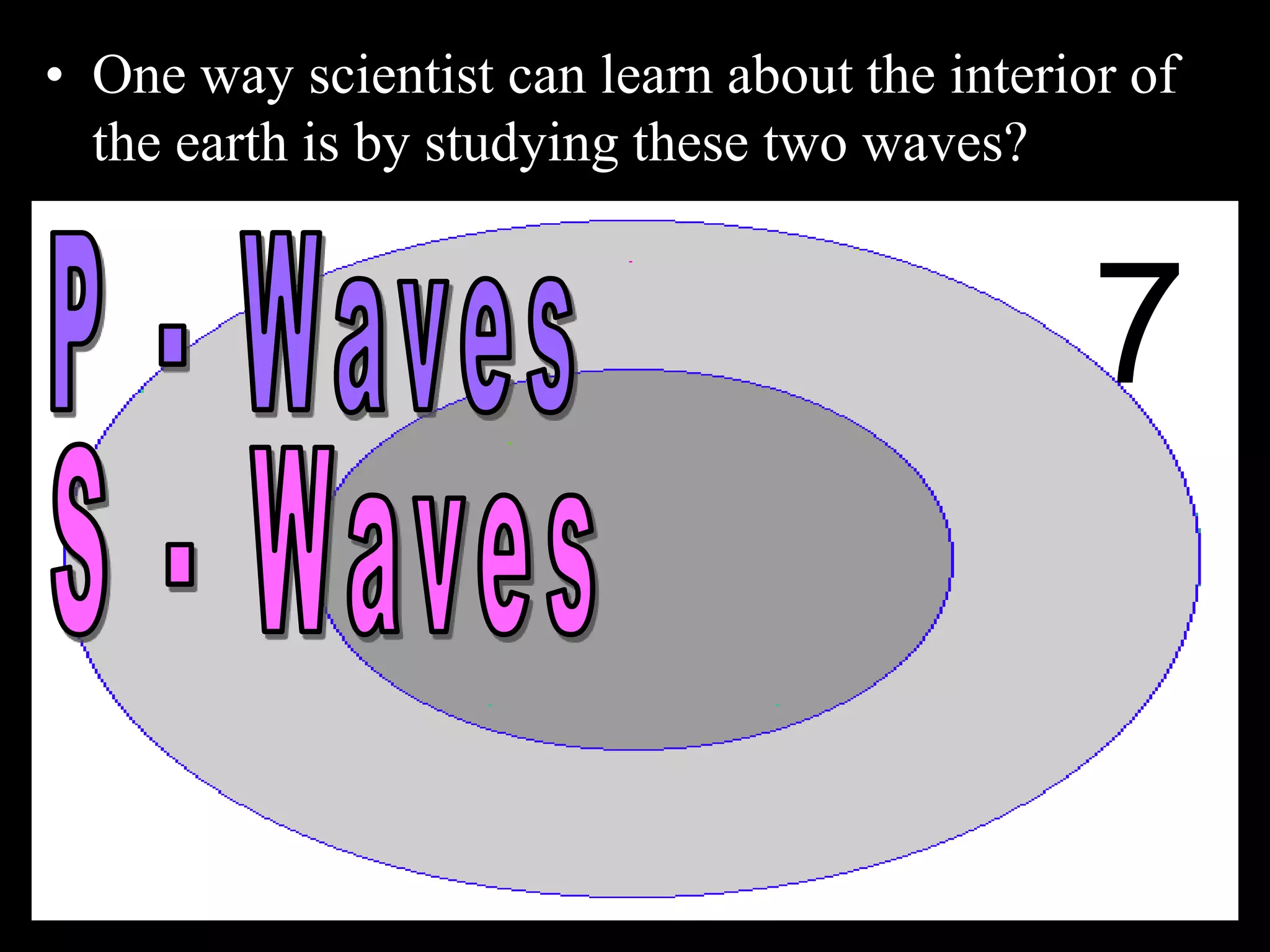
• One way scientist can learn about the interior of
the earth is by studying these two waves?
7
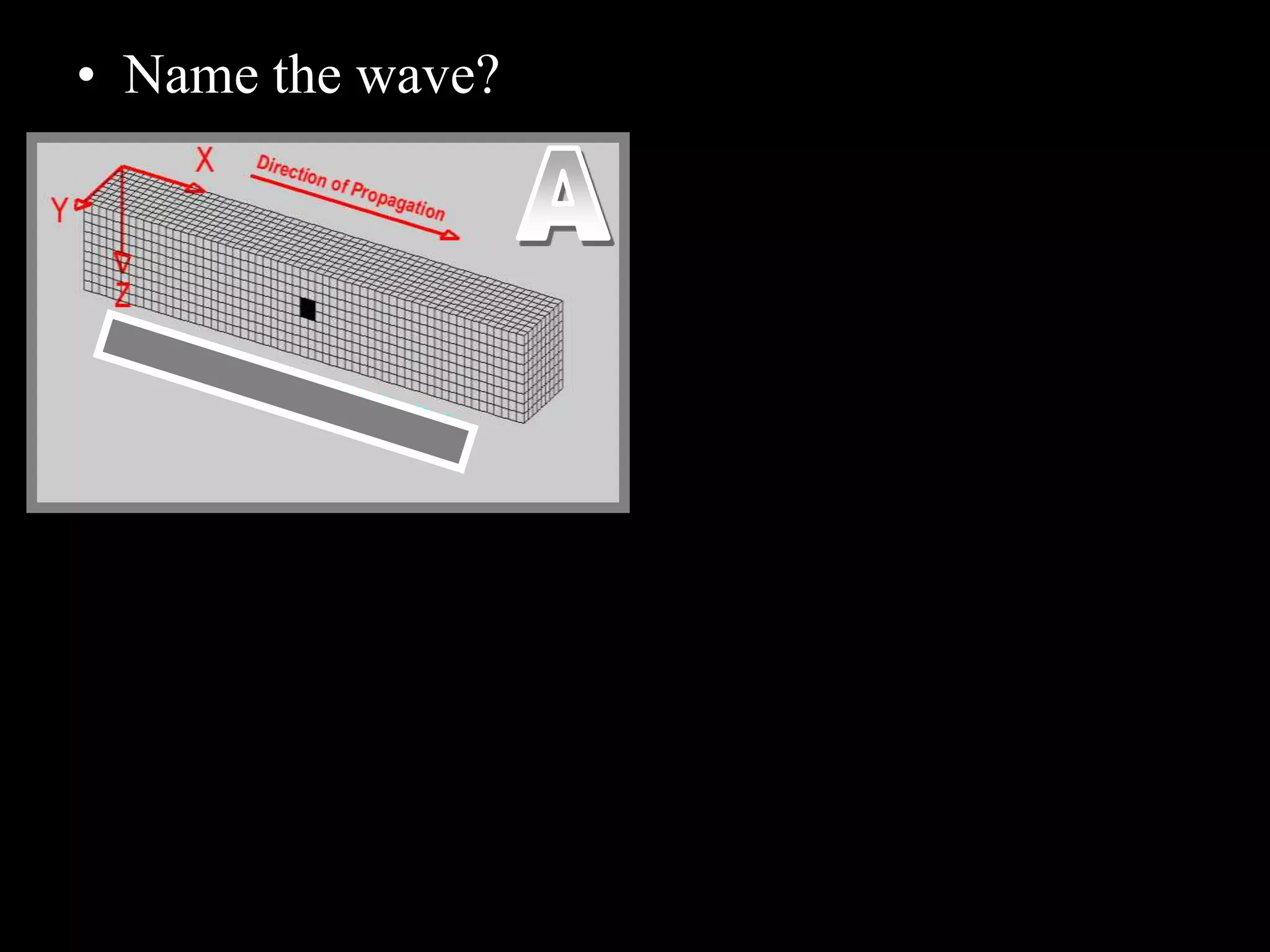
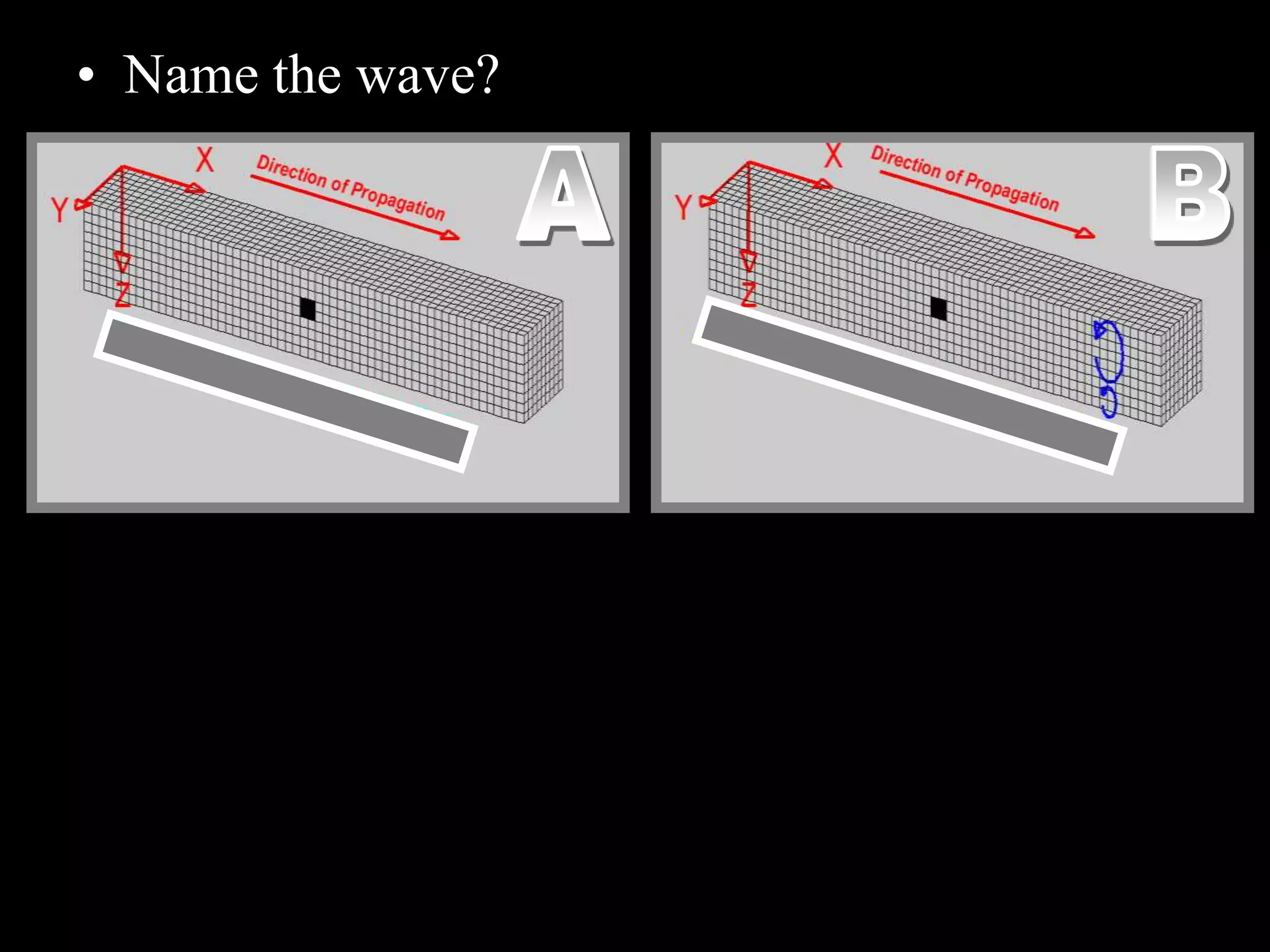
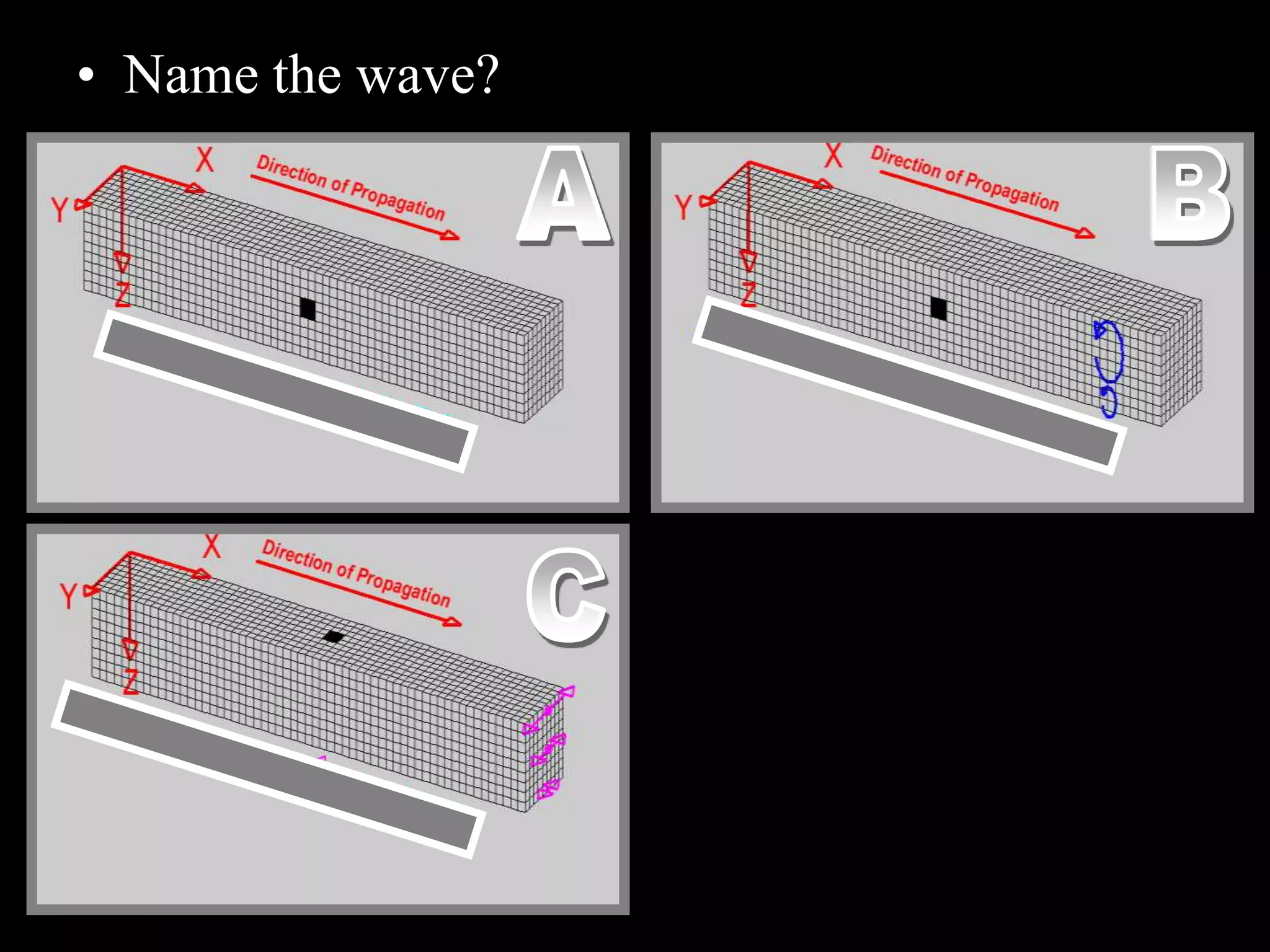
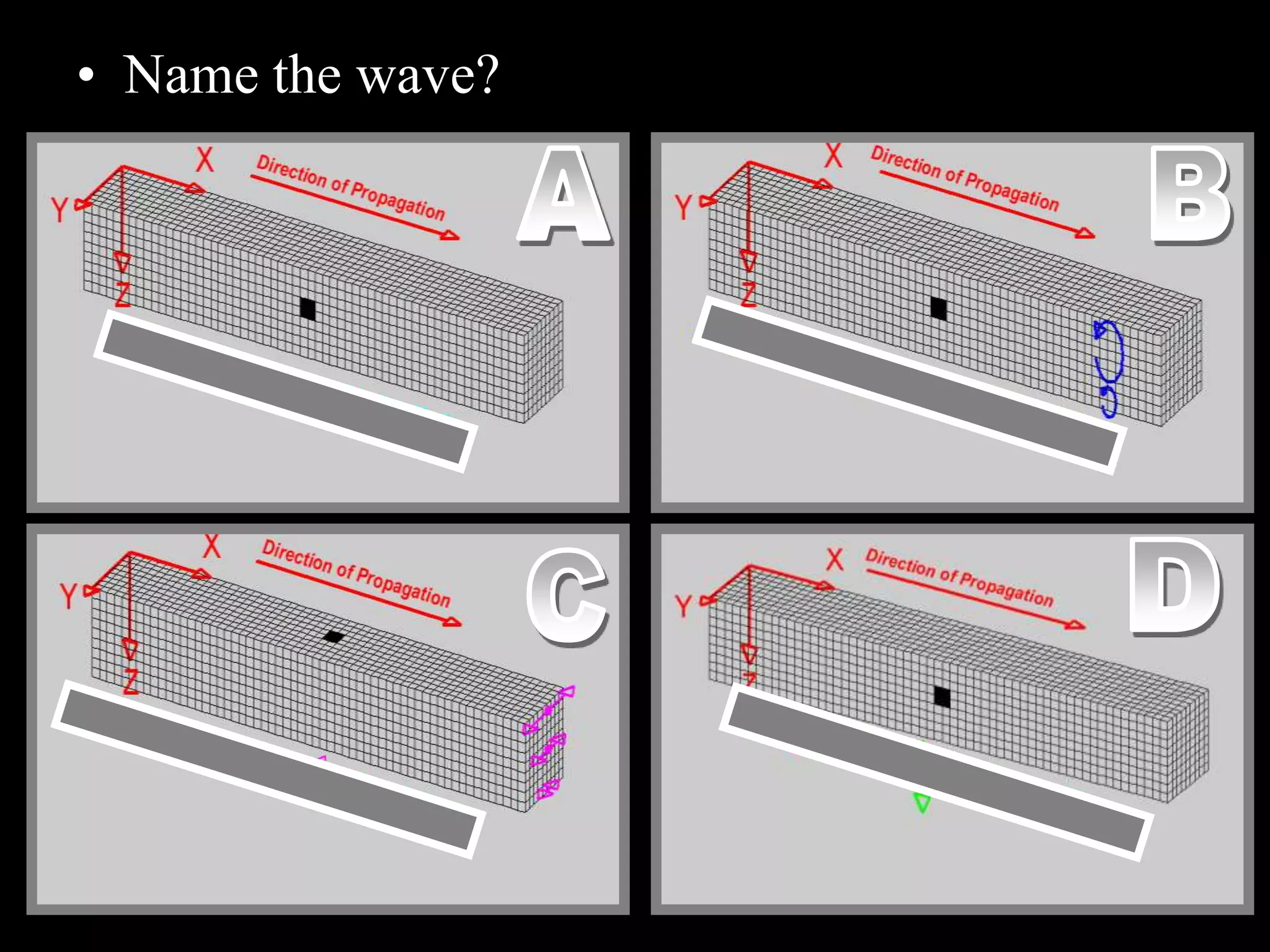
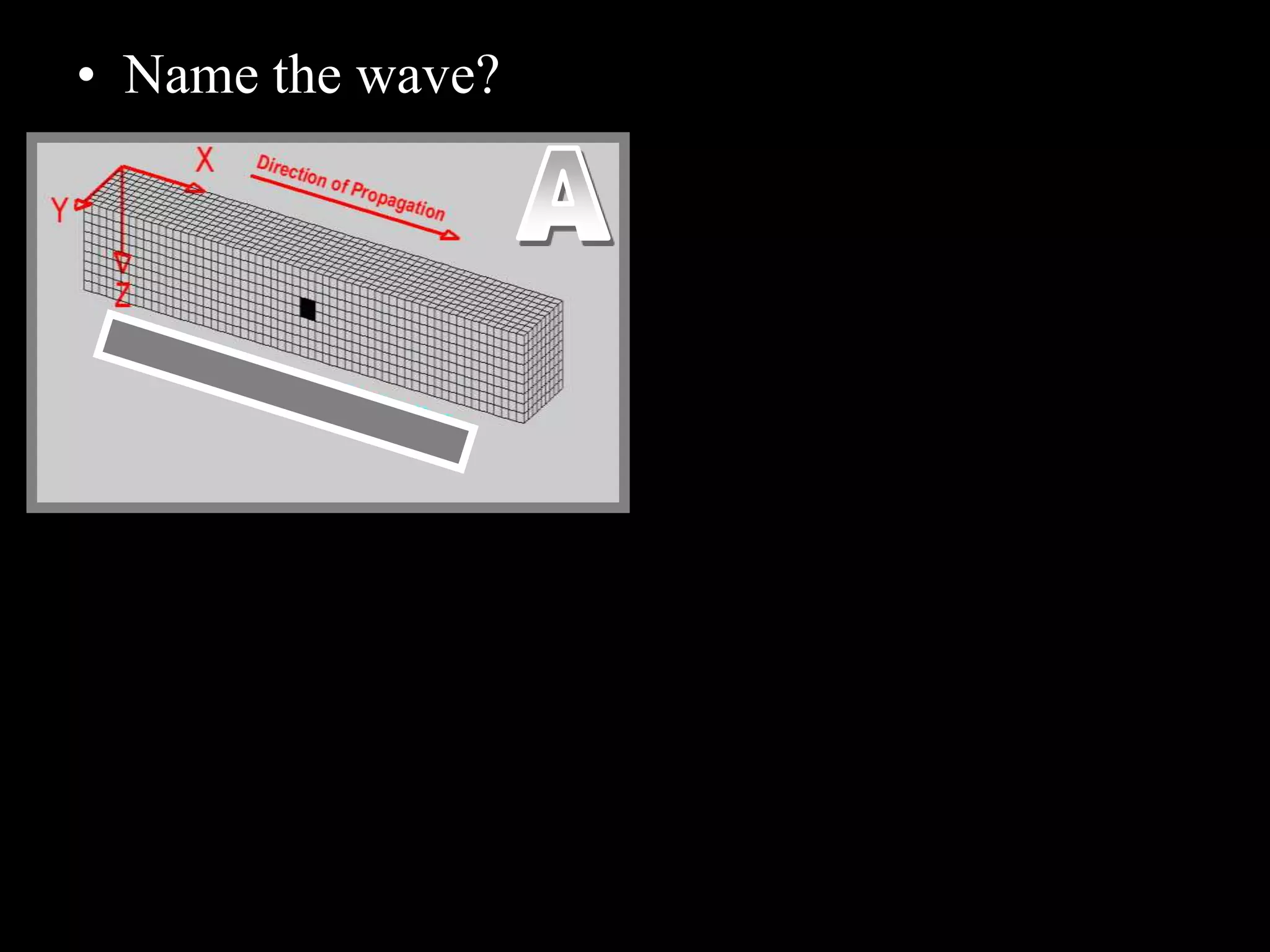
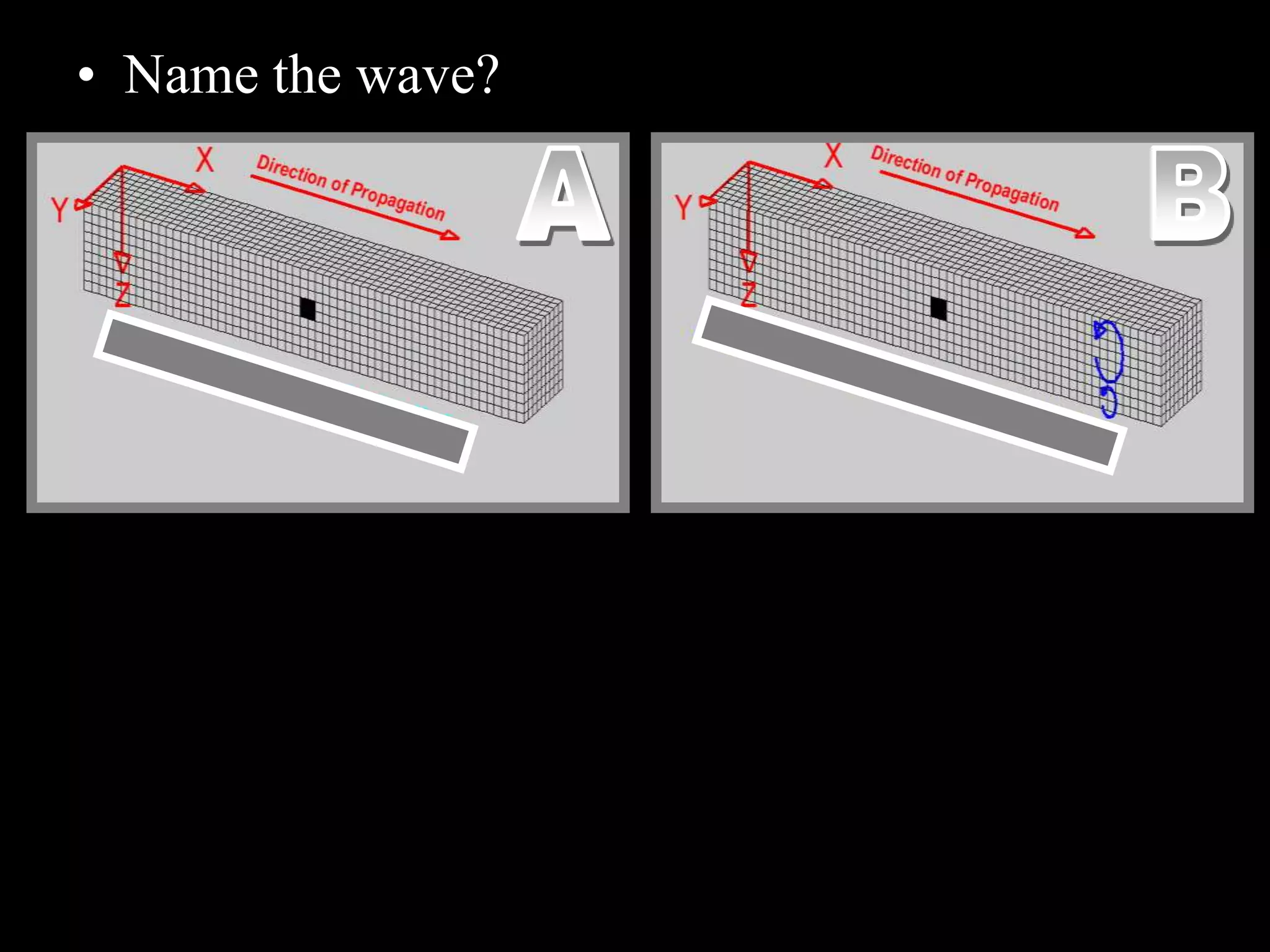
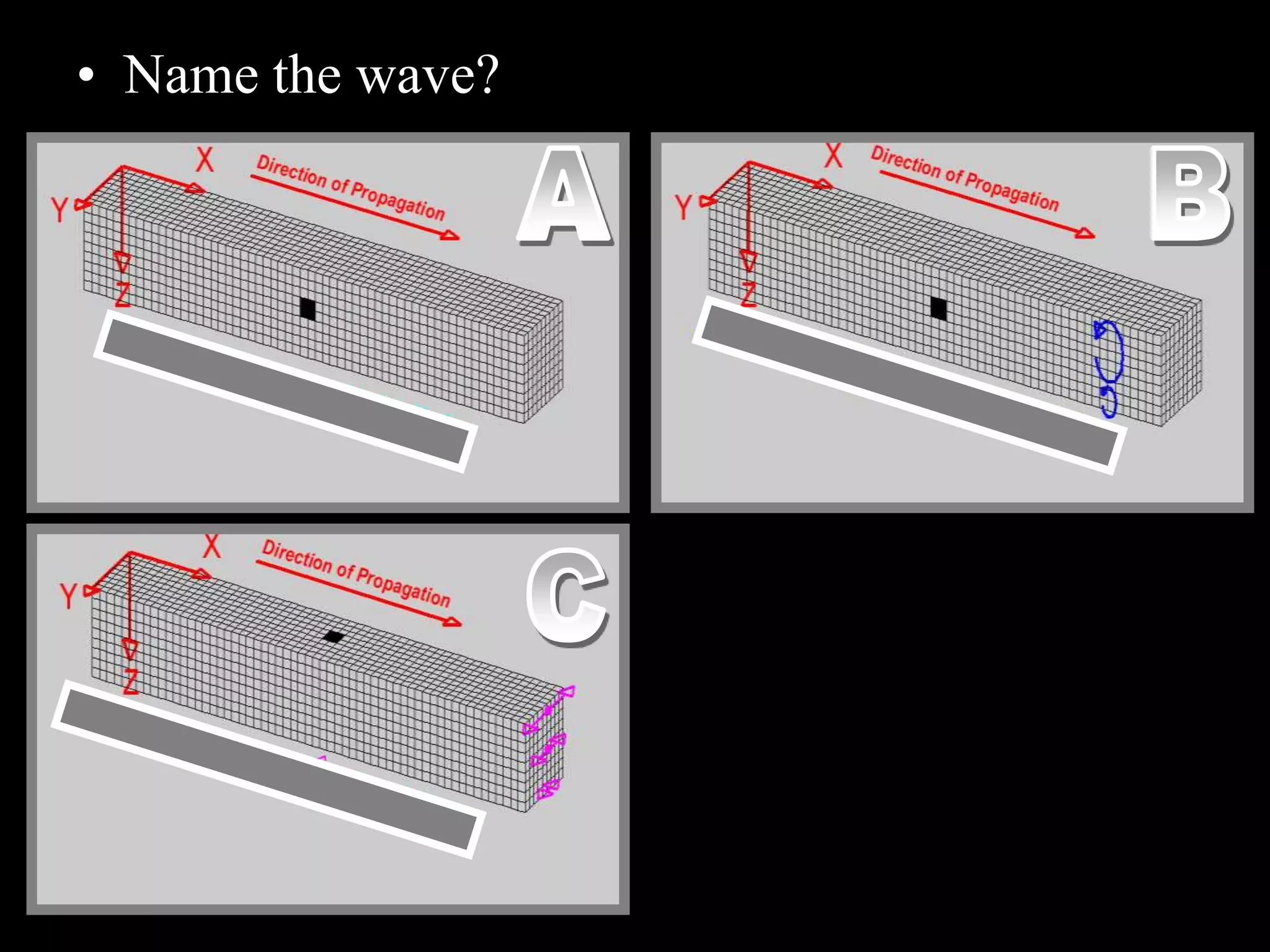
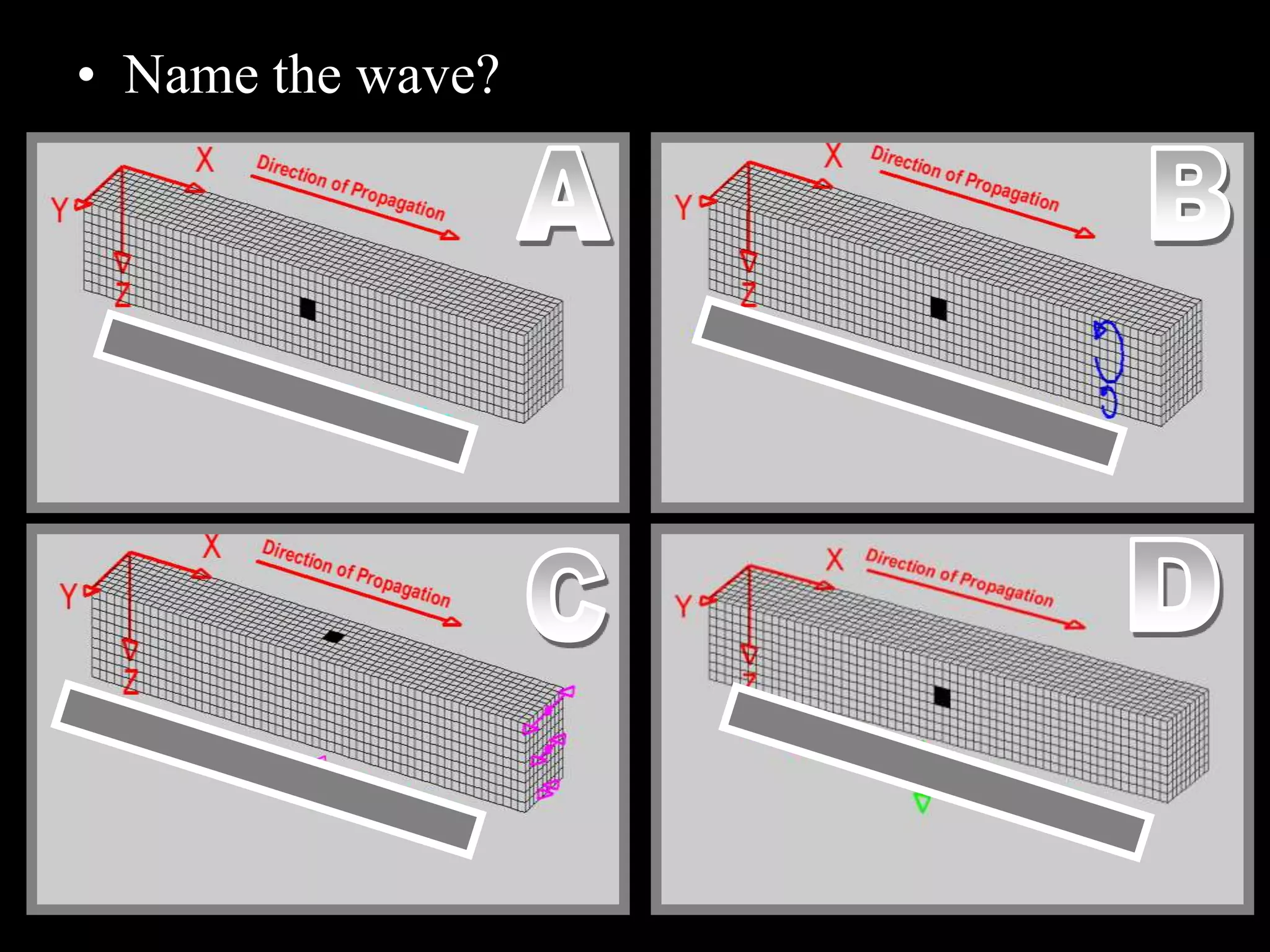
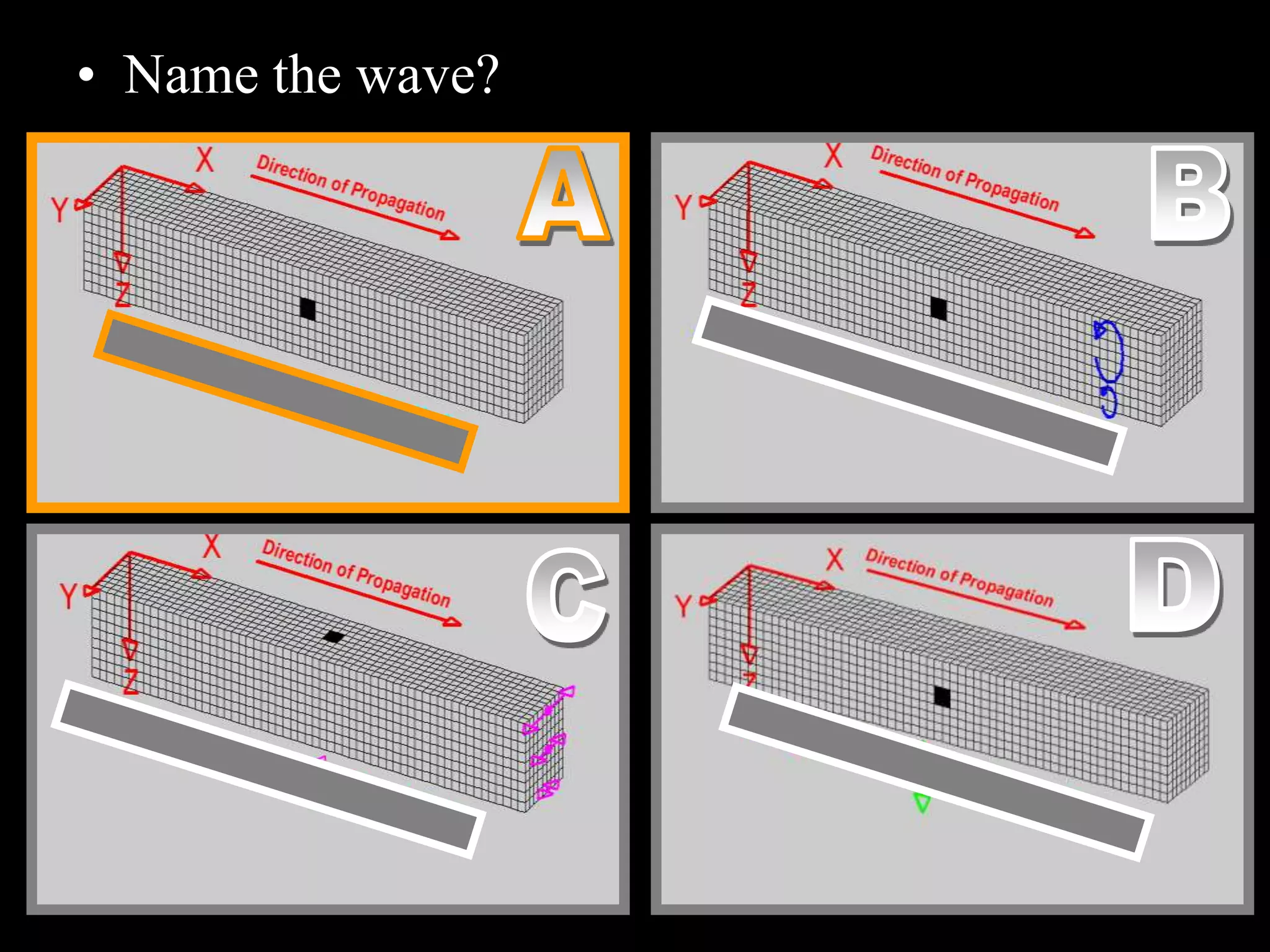
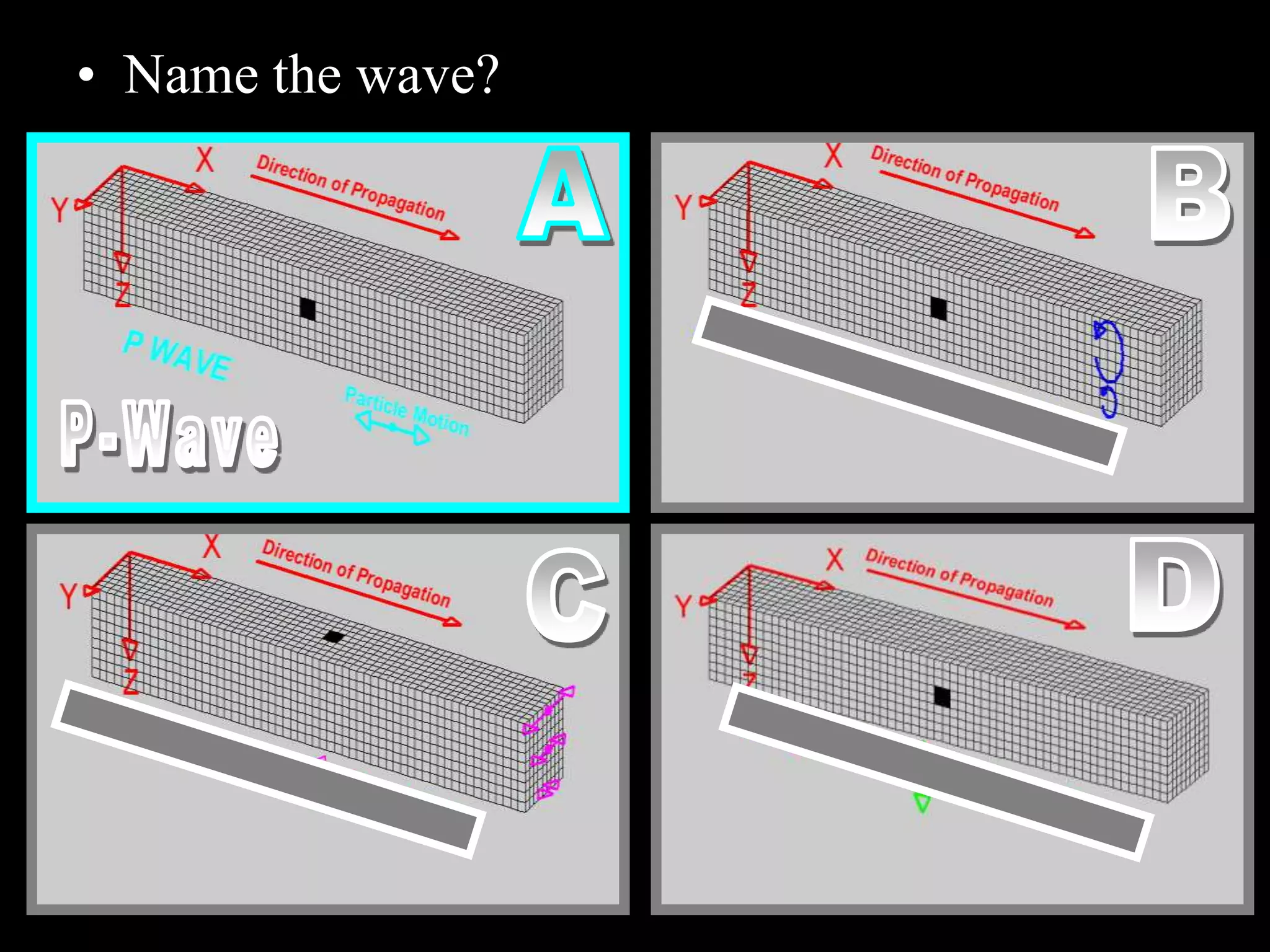
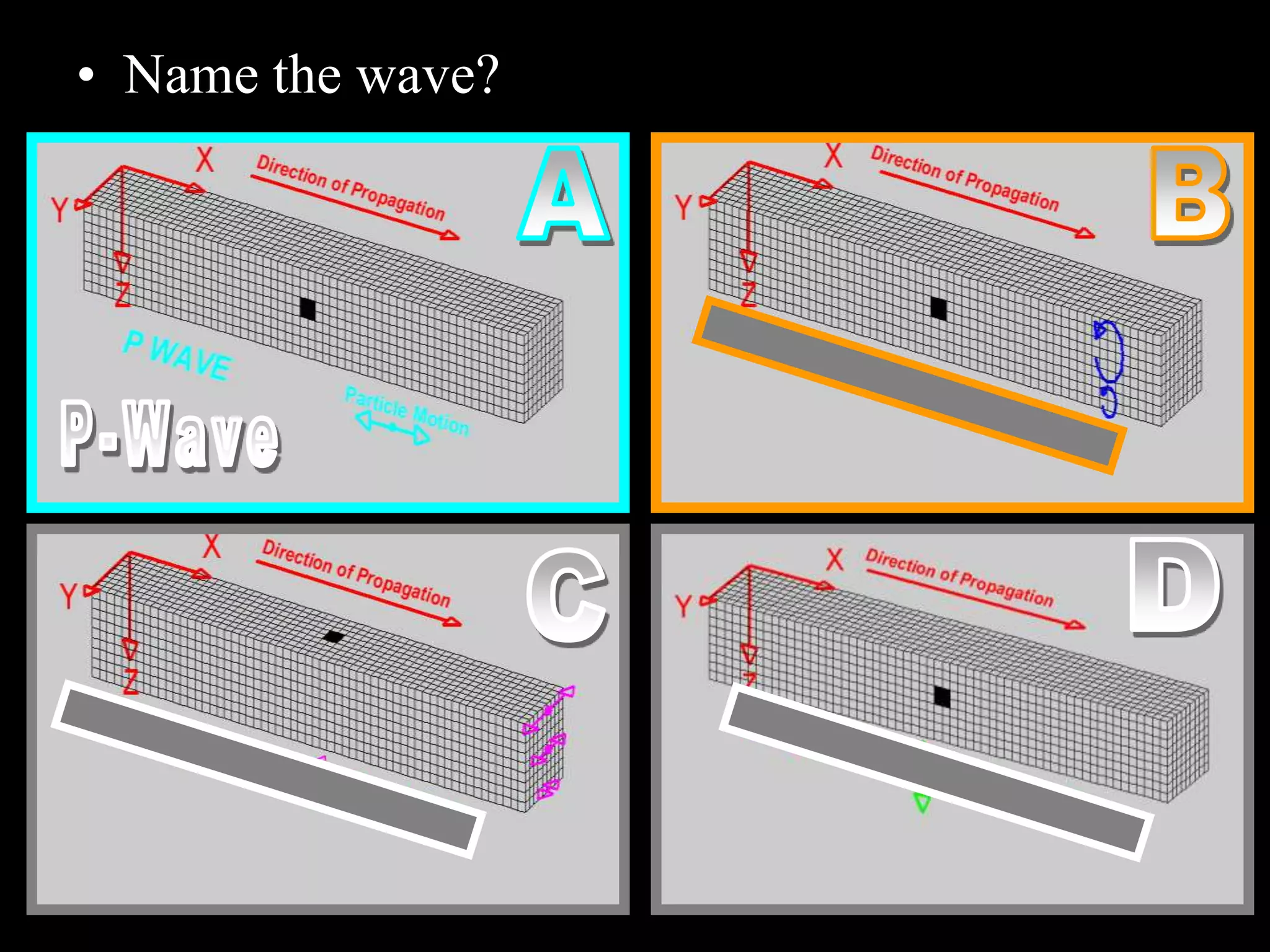
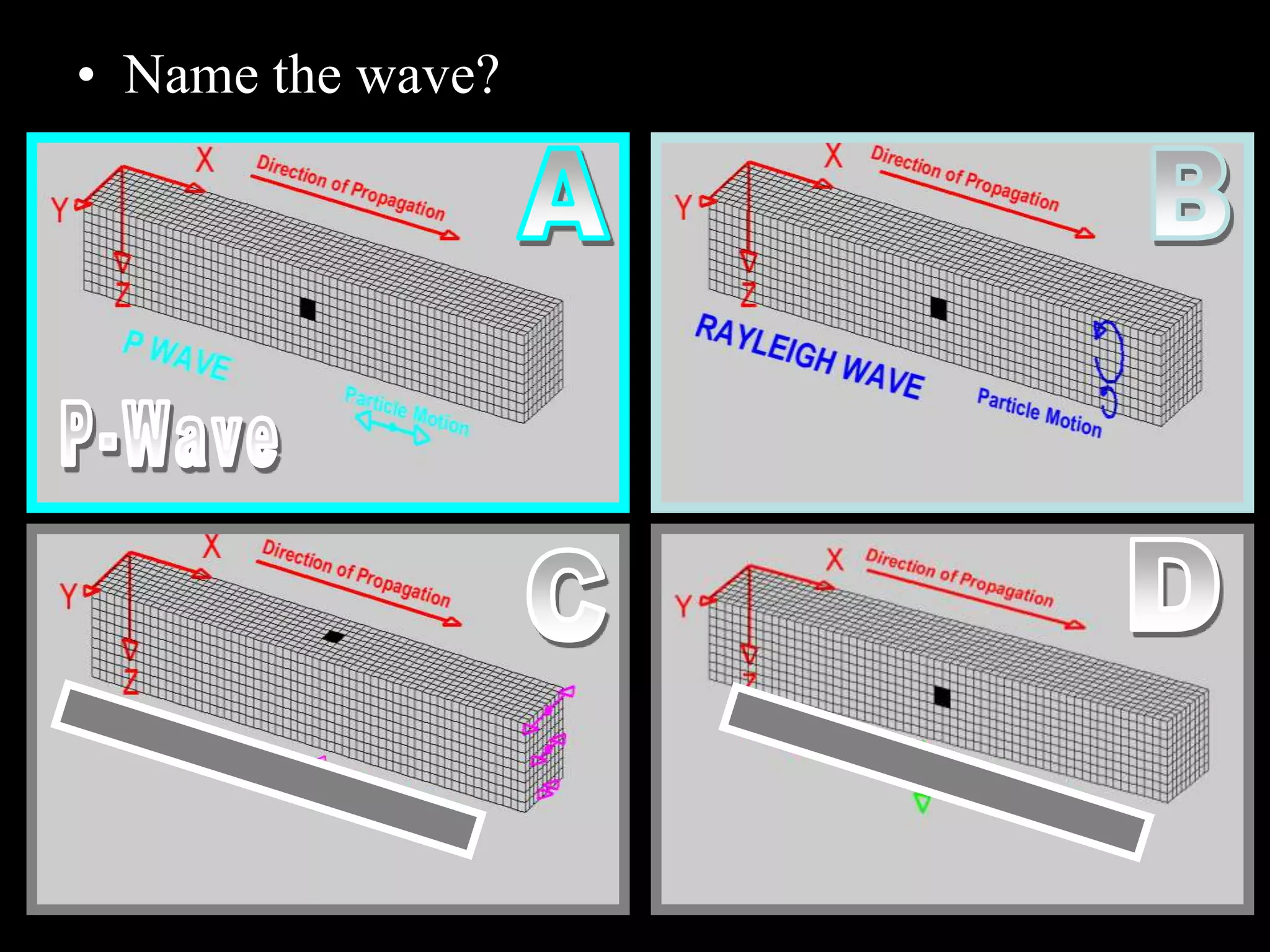
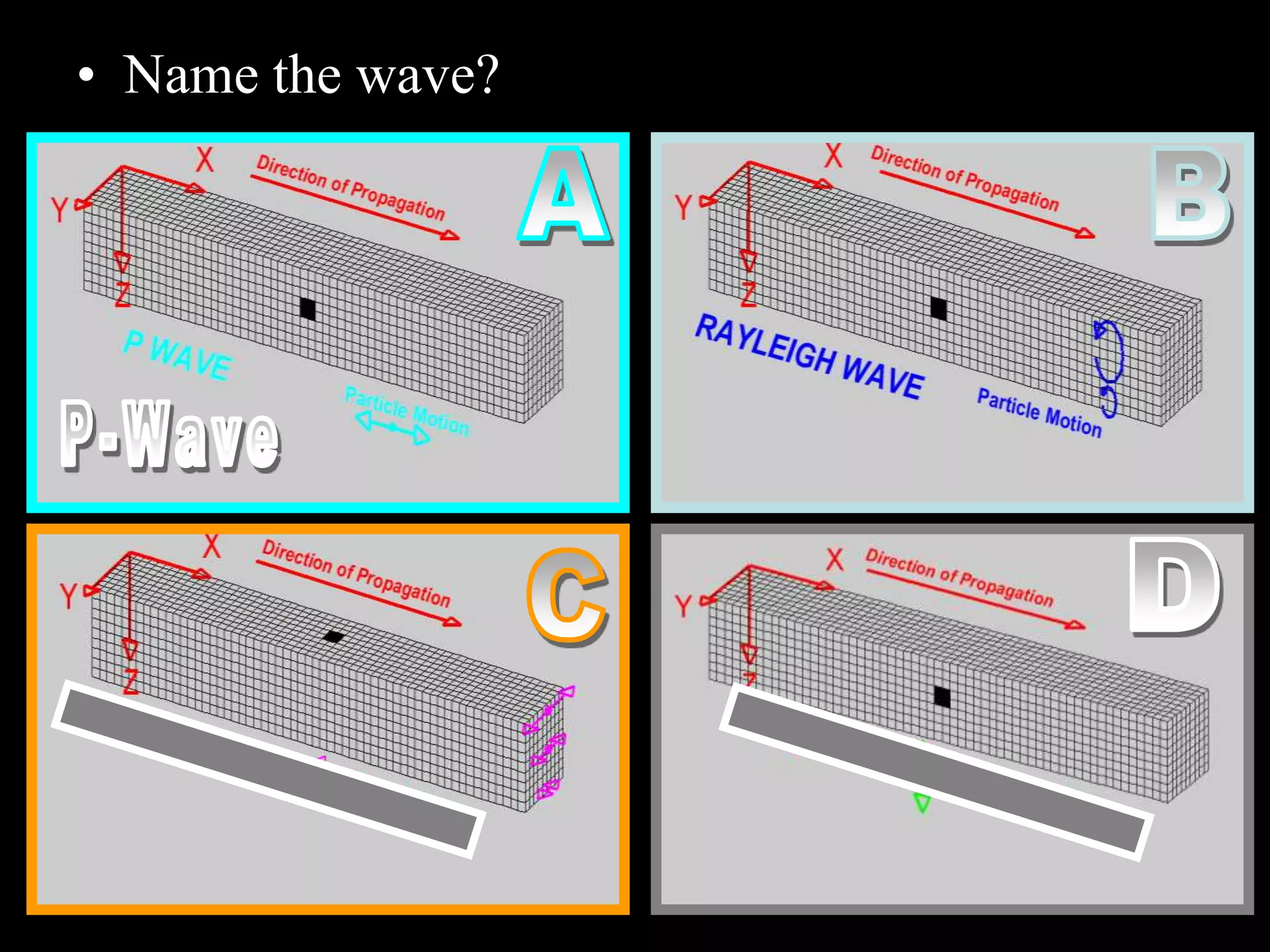
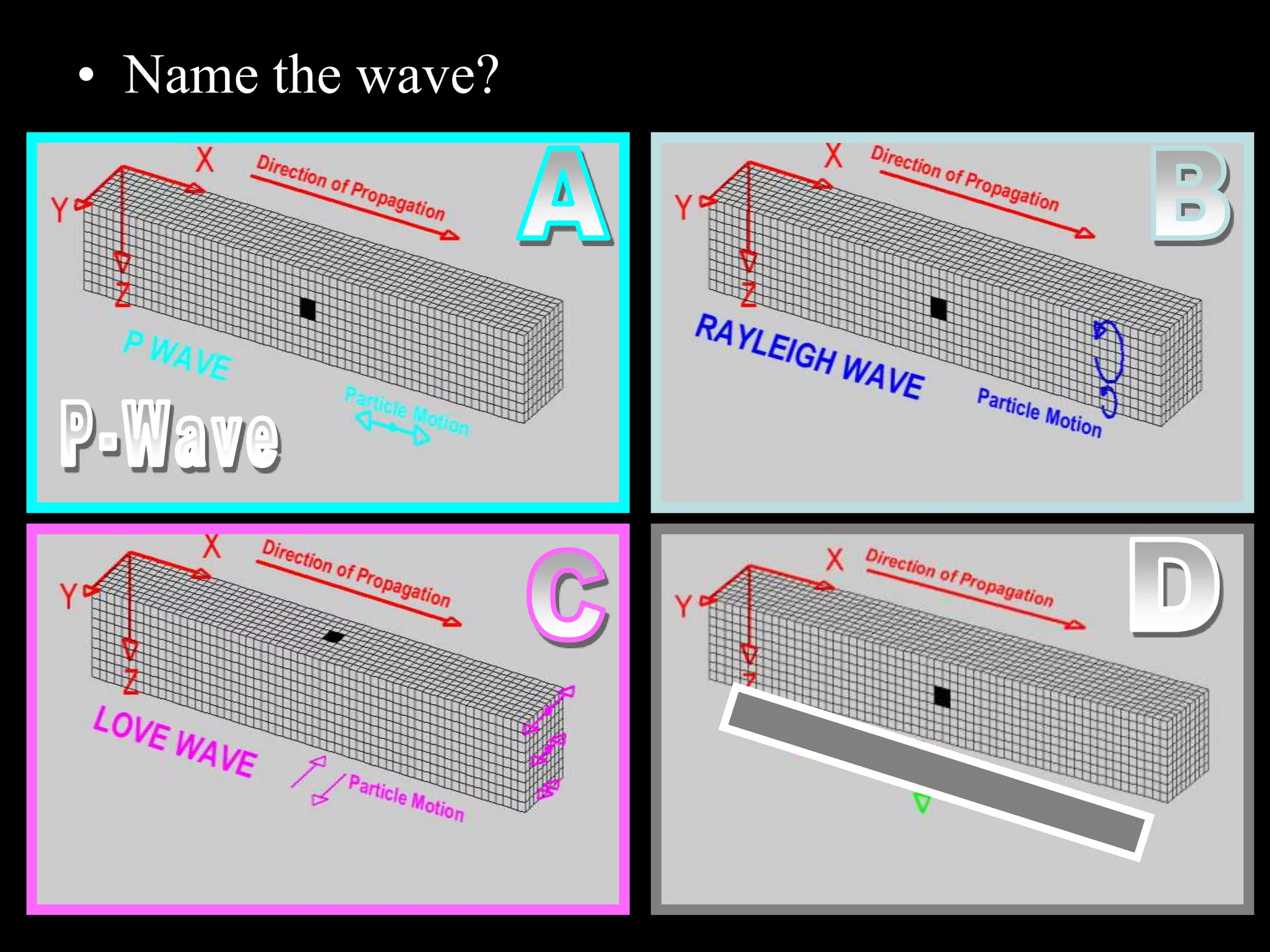
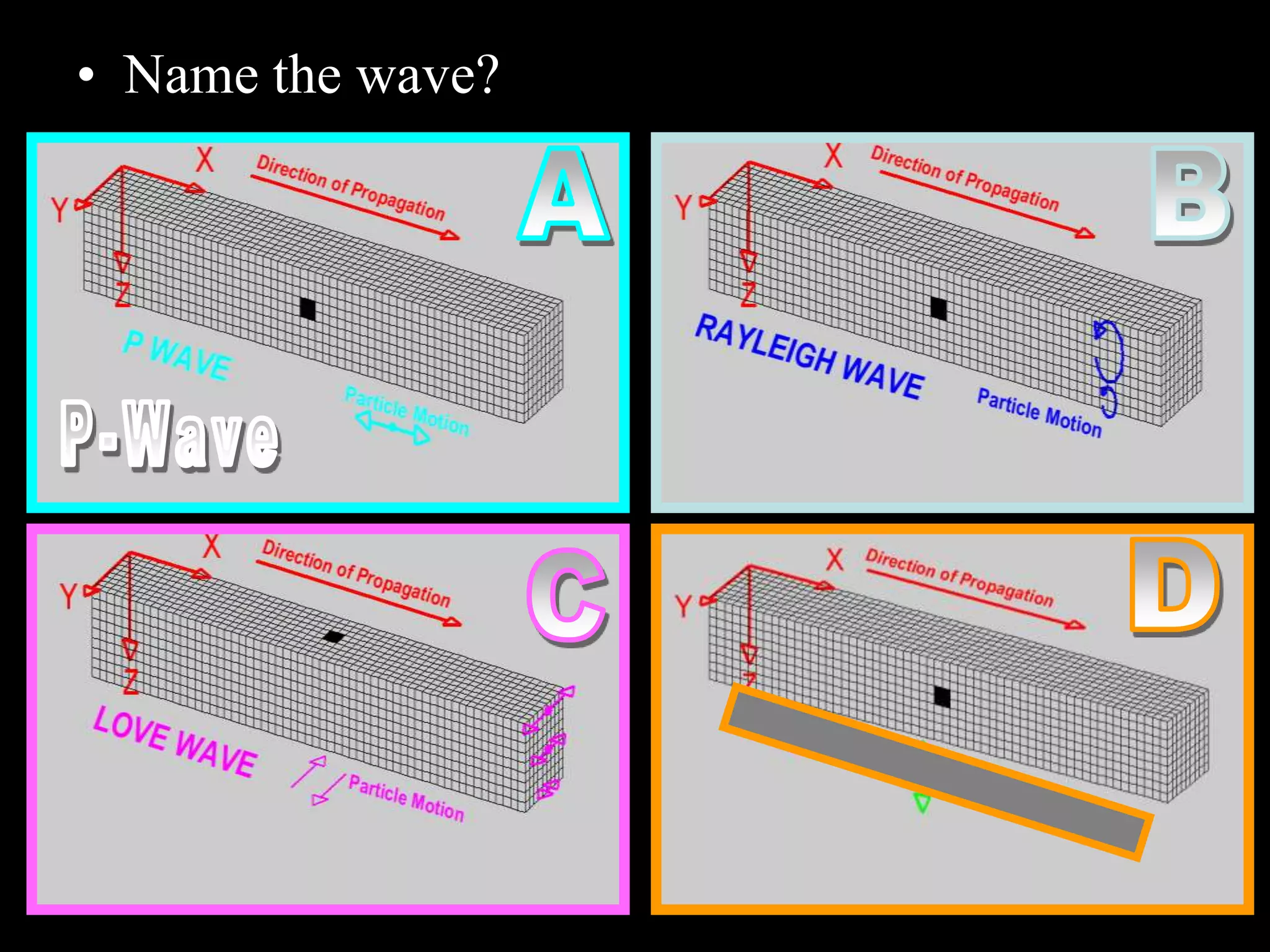
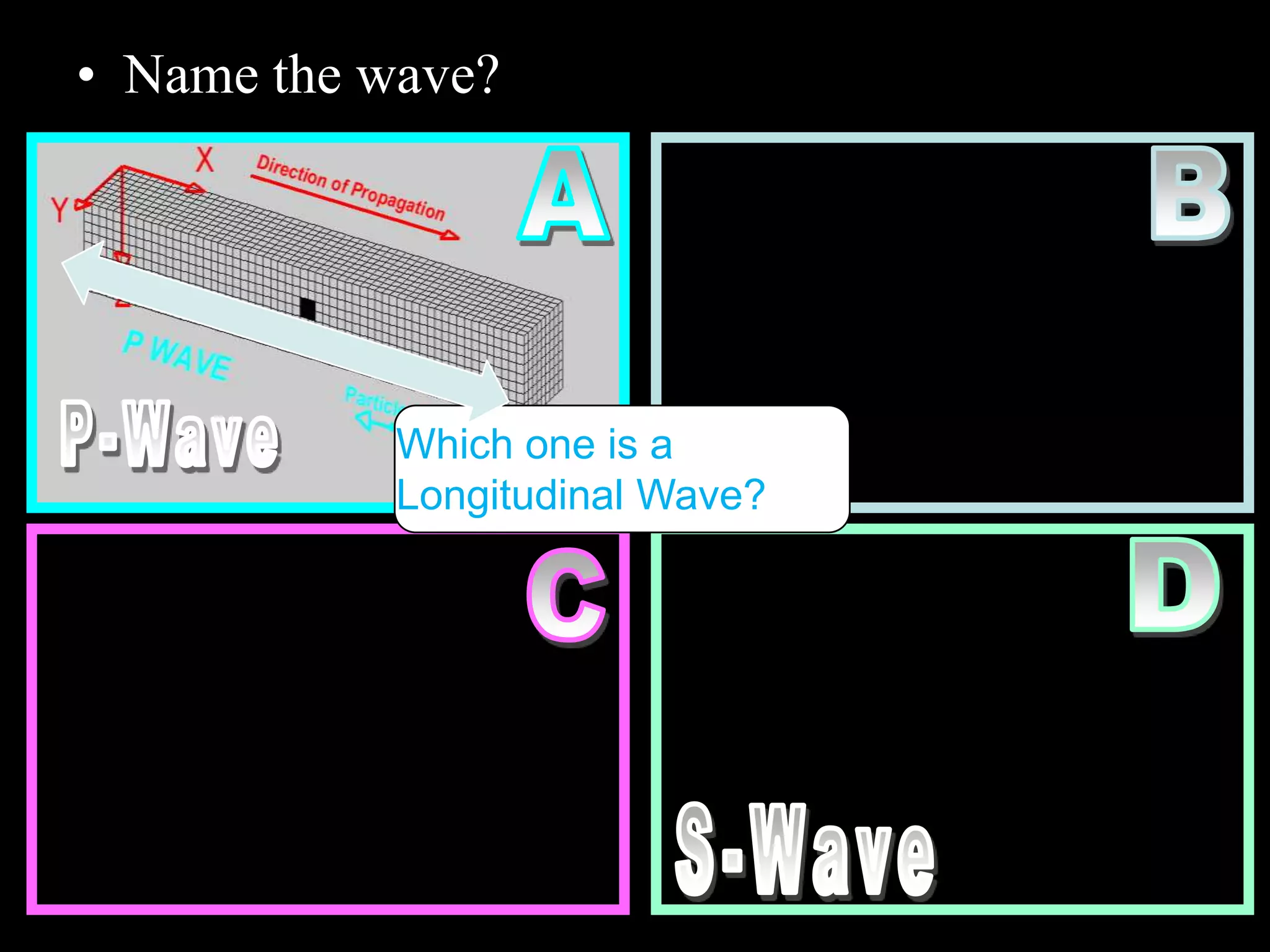
• Name the wave?
• Name the wave?
• Name the wave?
• Name the wave?
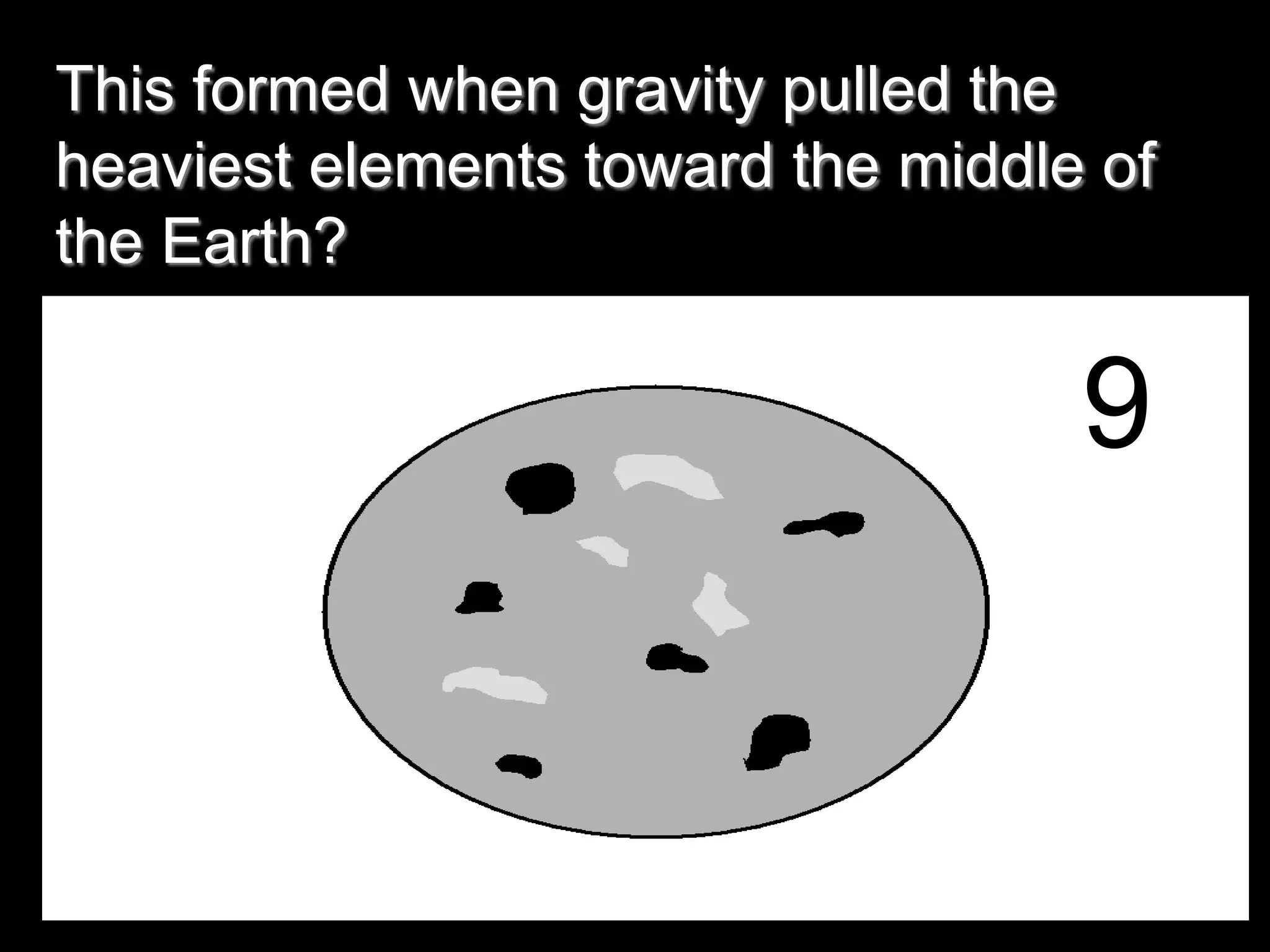
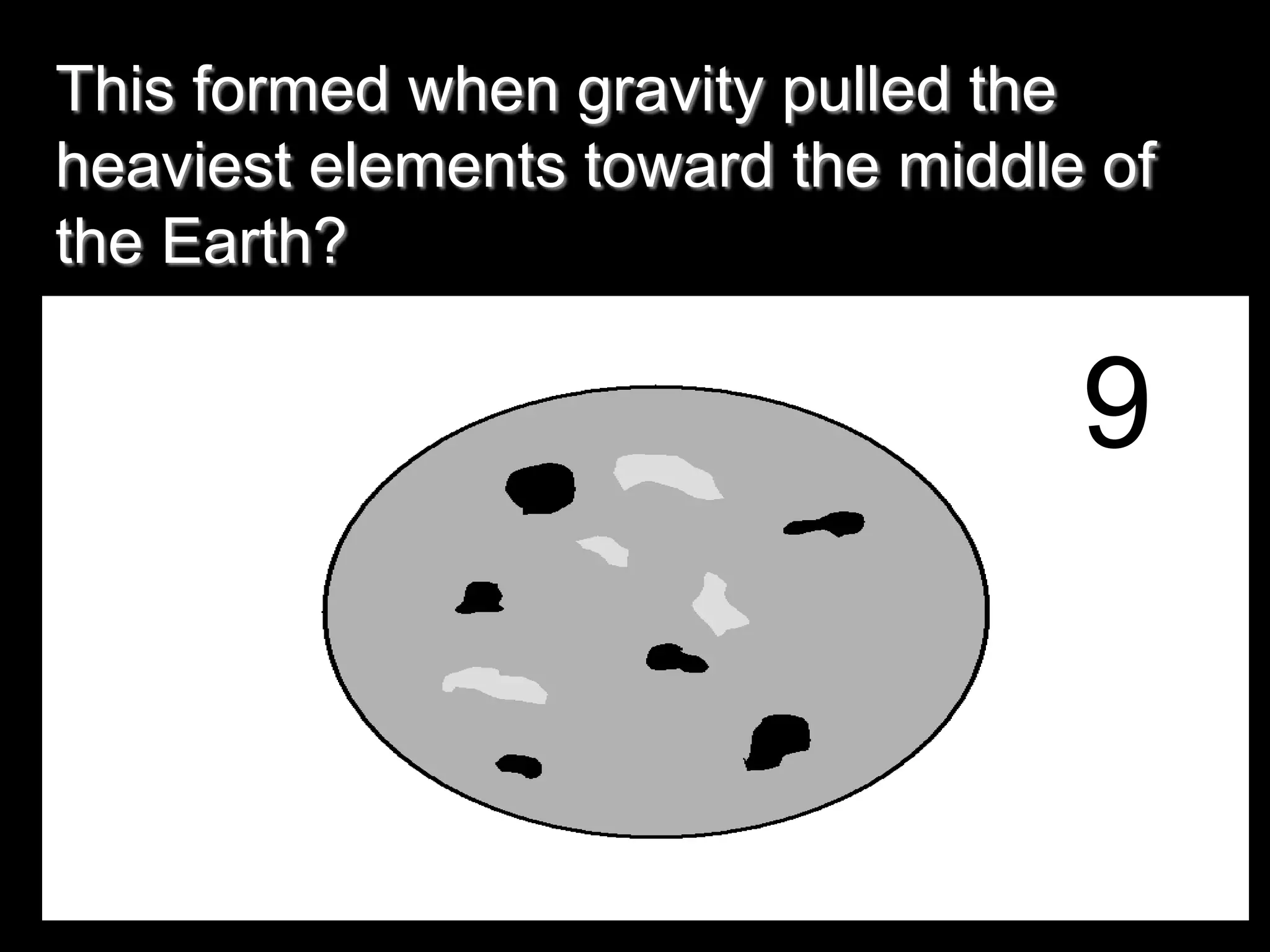
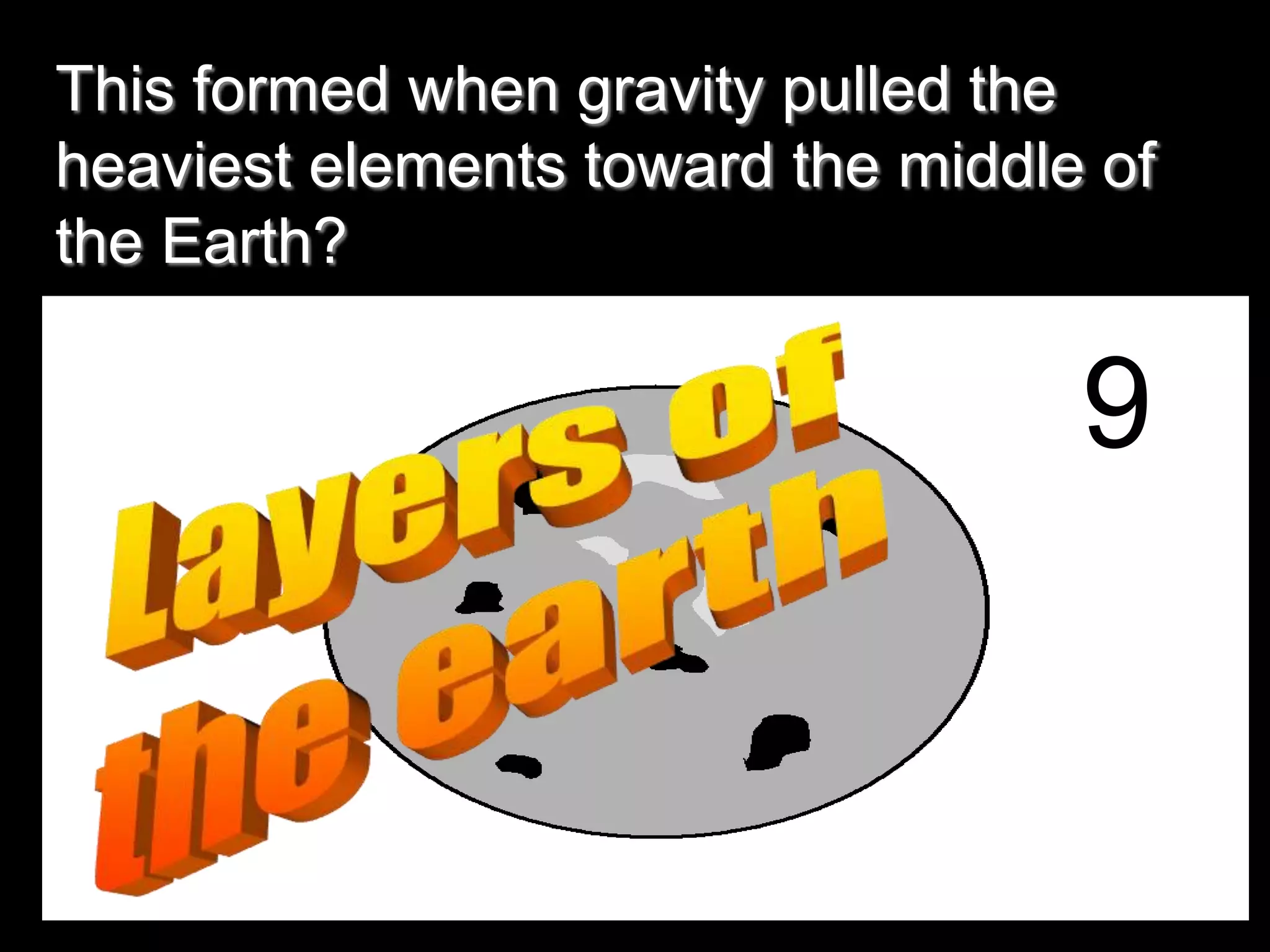
This formed when gravity pulled the
heaviest elements toward the middle of
the Earth?
9
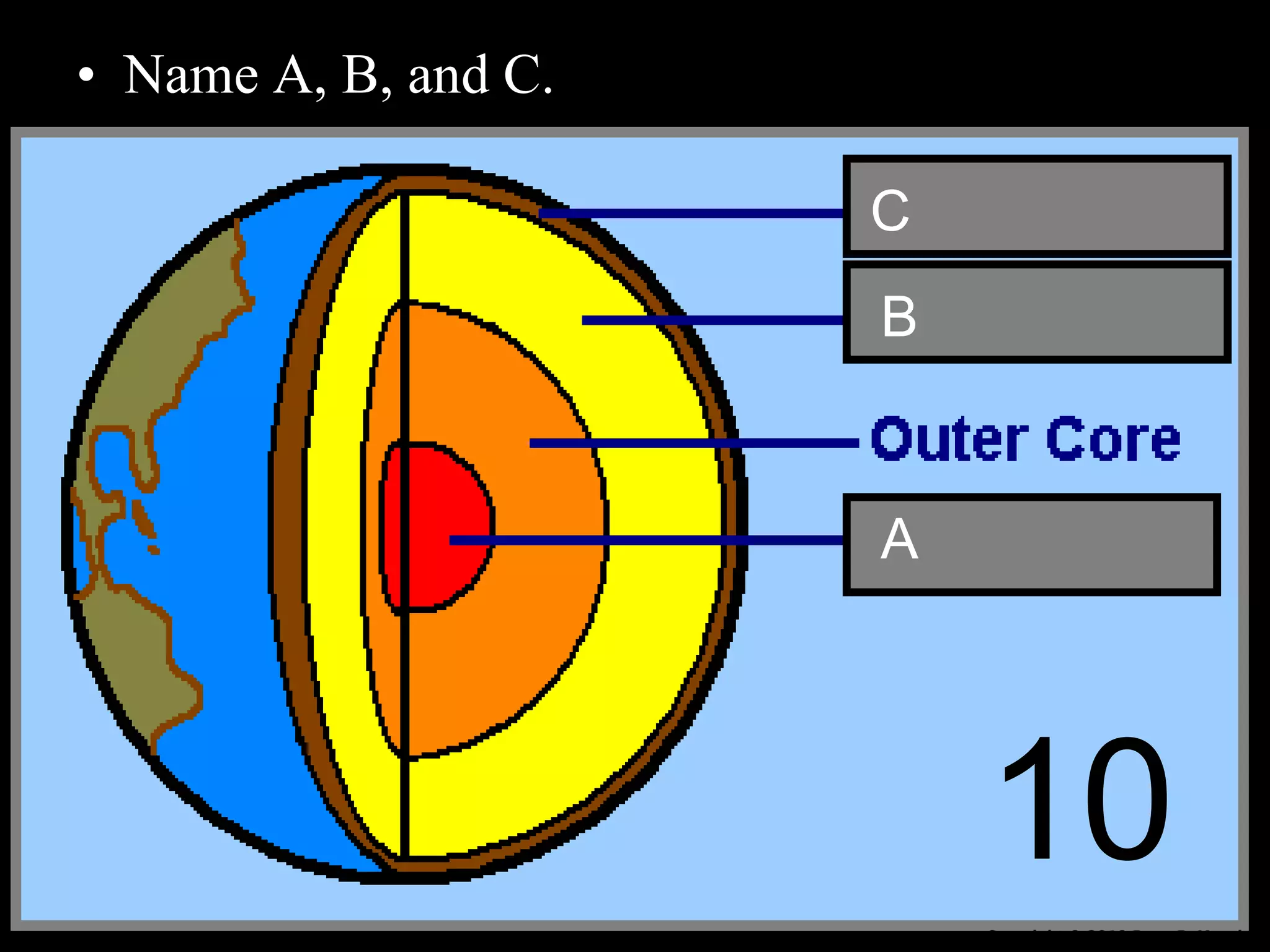
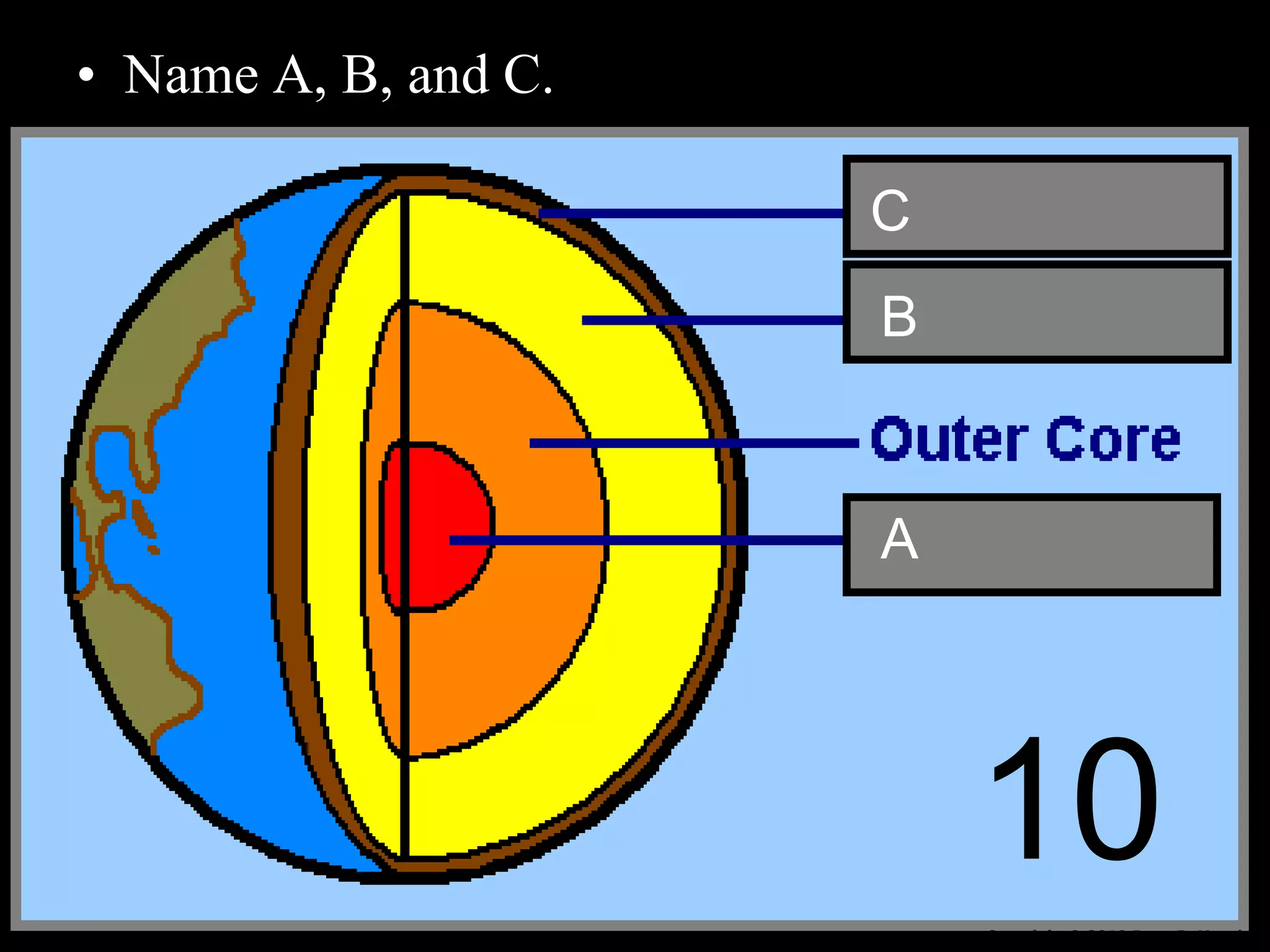
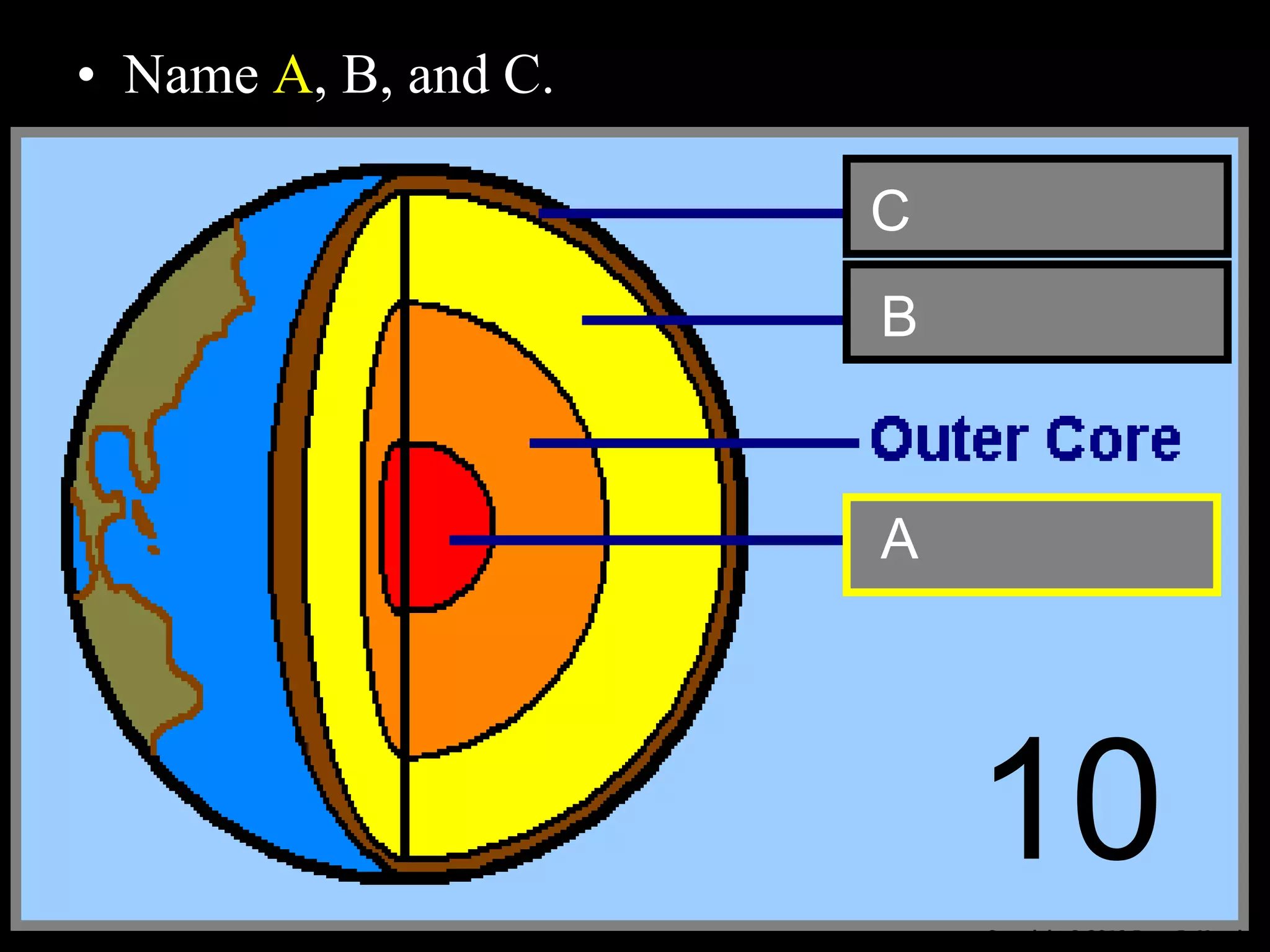
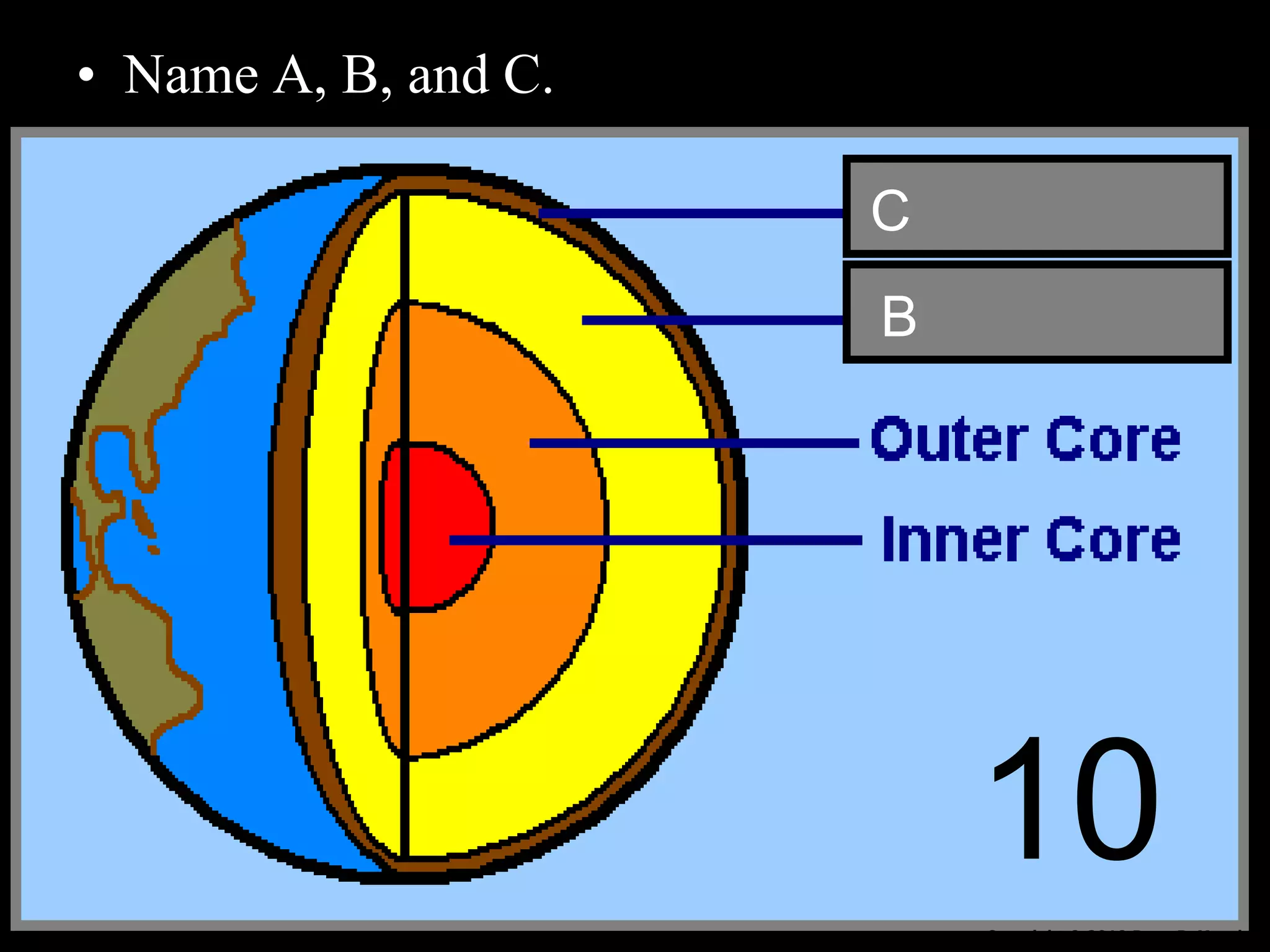
• Name A, B, and C.
Copyright © 2010 Ryan P. Murphy
A
B
C
10
MOVING
AROUND
LAYERS OF
EVIDENCE
TERRARIFIC A LOT ON
YOUR PLATE
-BONUS-
NAME THE
PLACE AND
CONTINENT
1 6 11 16 *21
2 7 12 17 *22
3 8 13 18 *23
4 9 14 19 *24
5 10 15 20 *25
Copyright © 2010 Ryan P. Murphy
Dynamic Earth Review Game
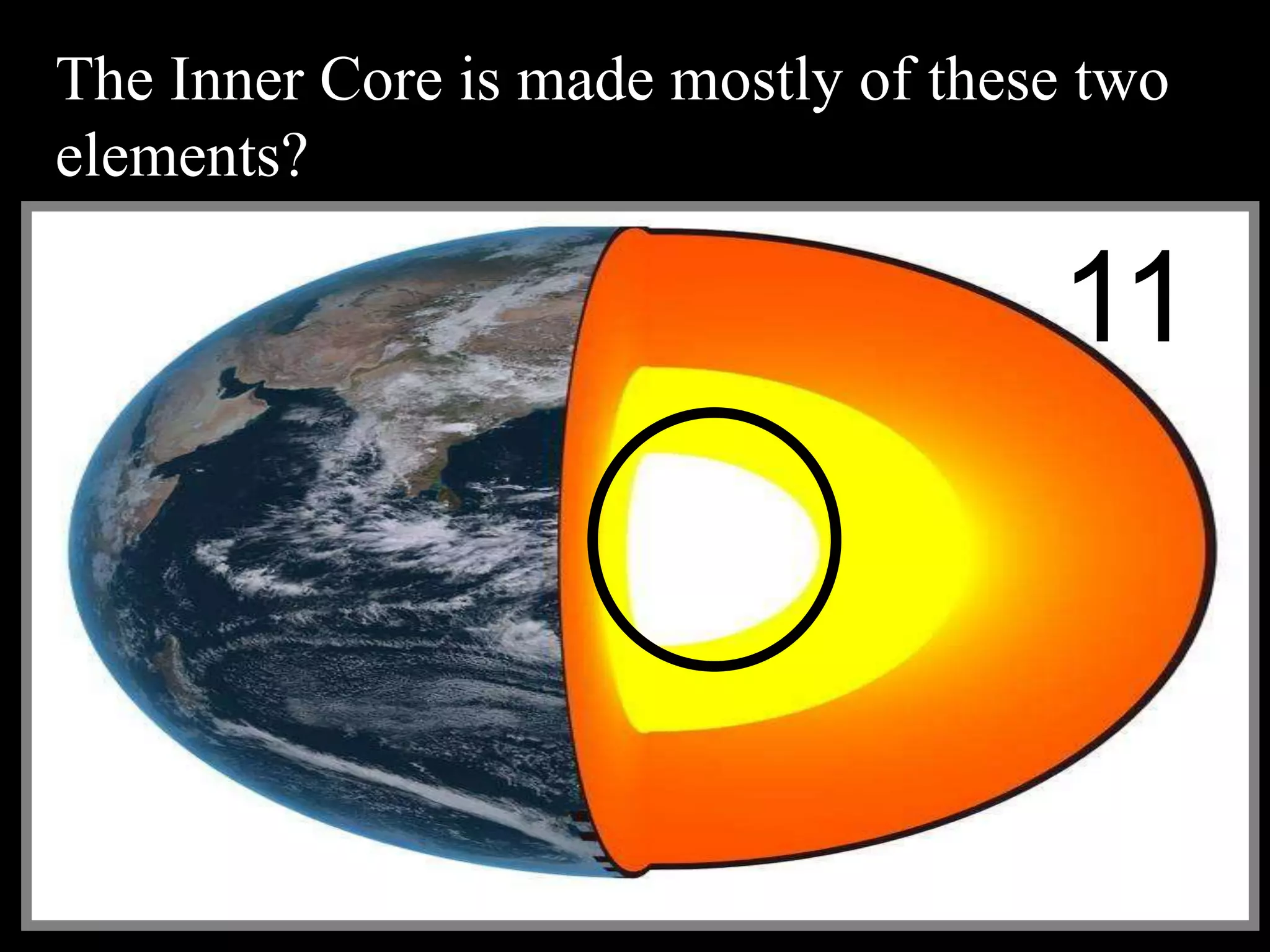
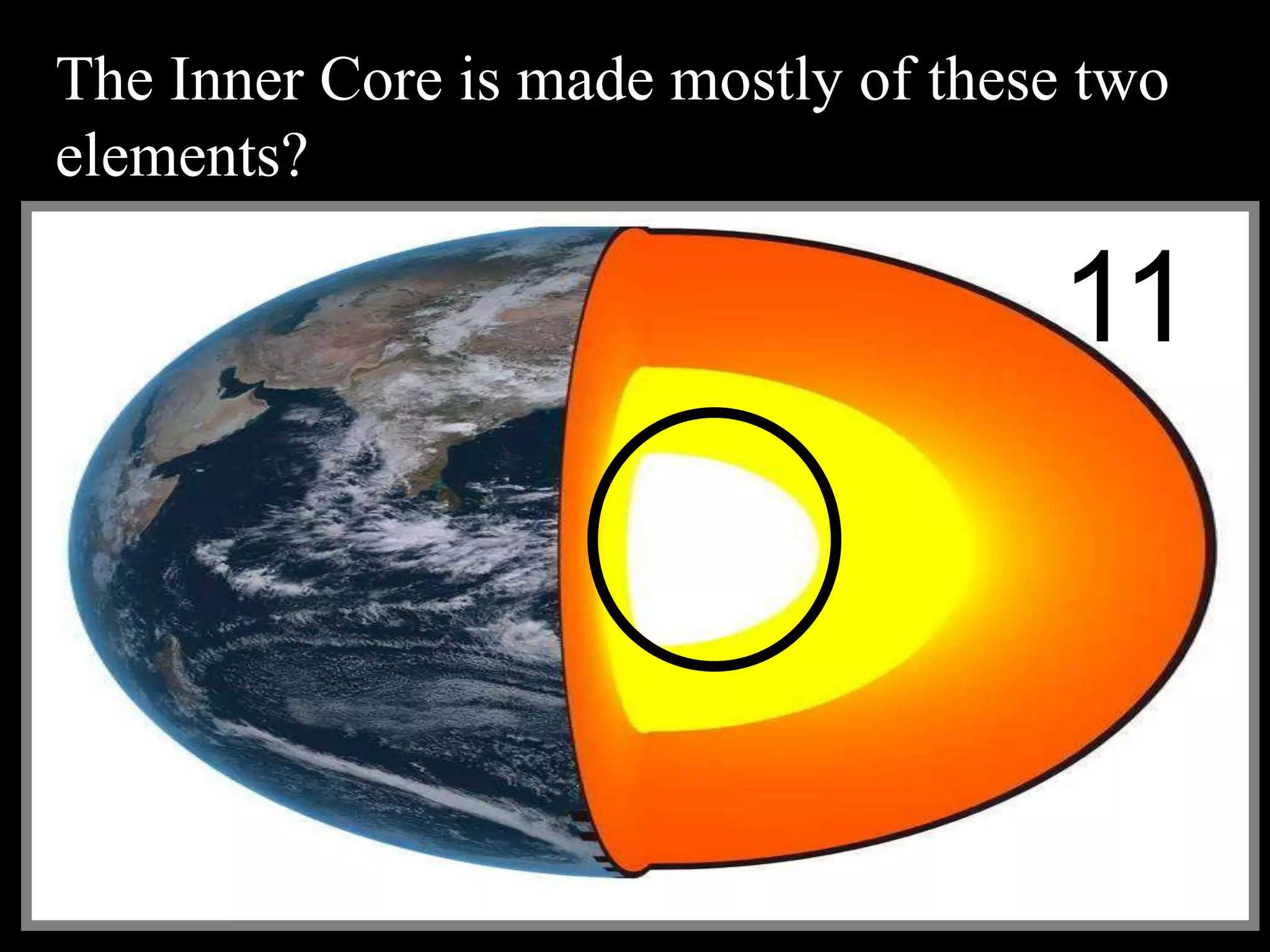
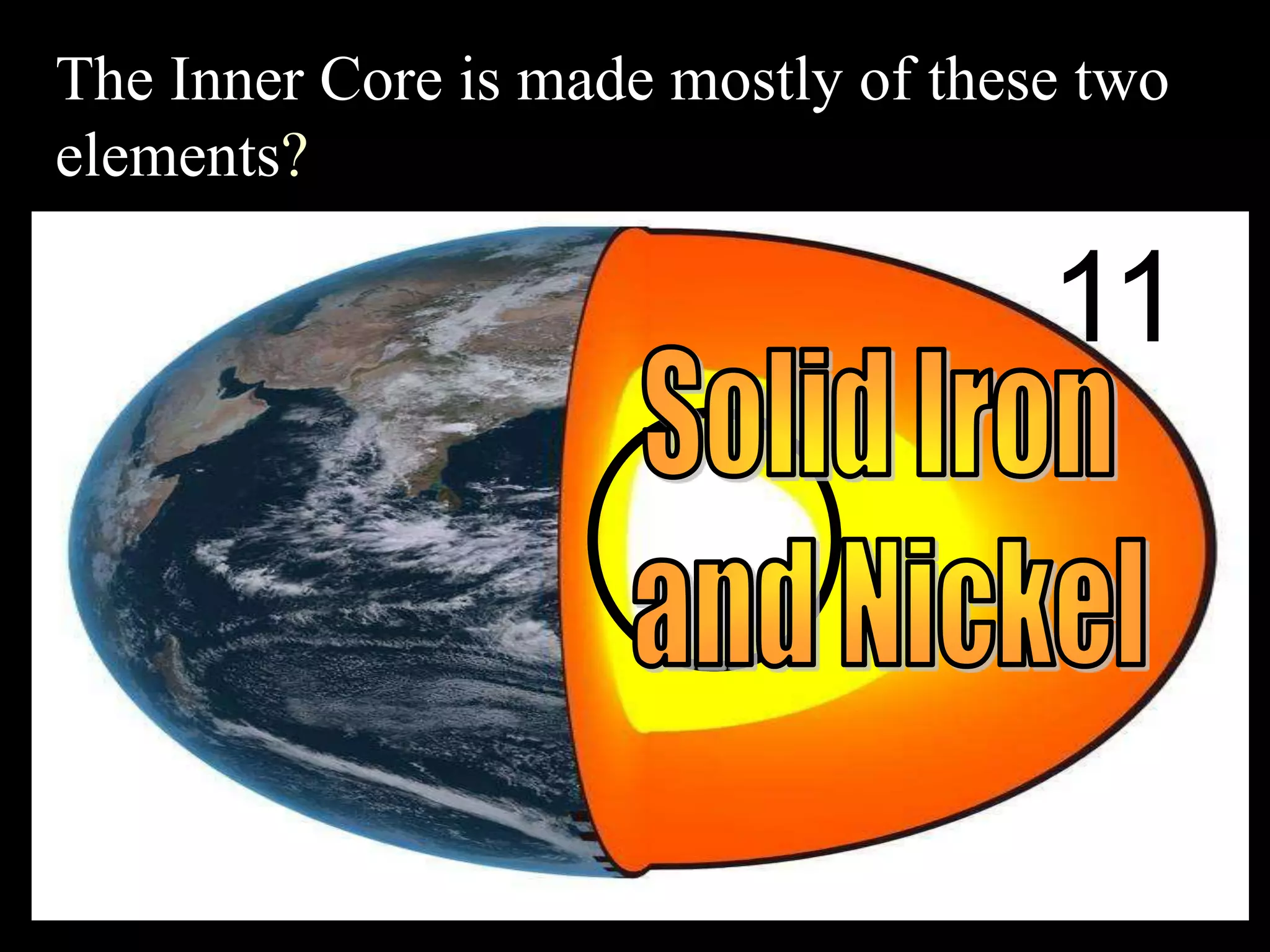
The Inner Core is made mostly of these two
elements?
11
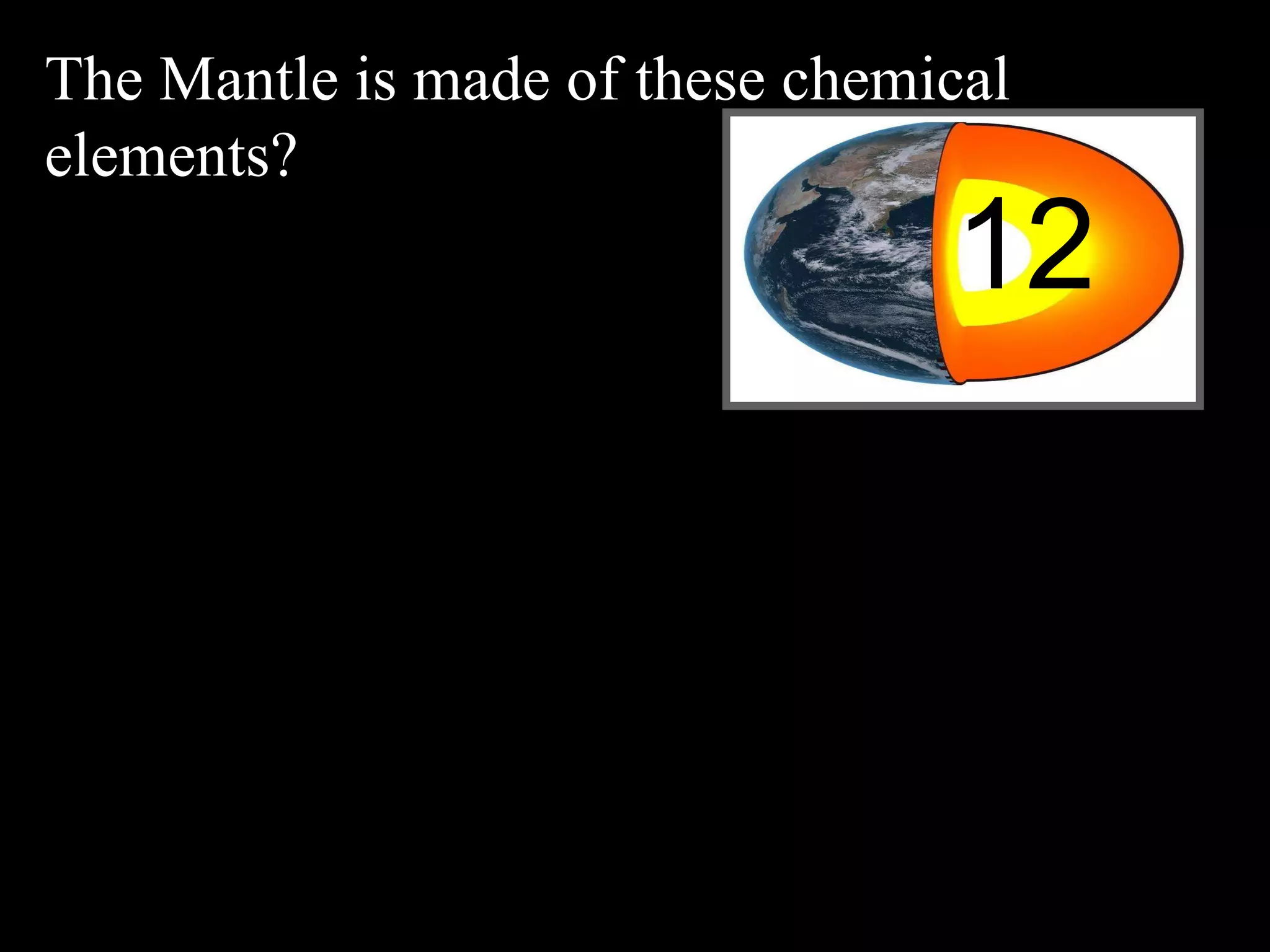
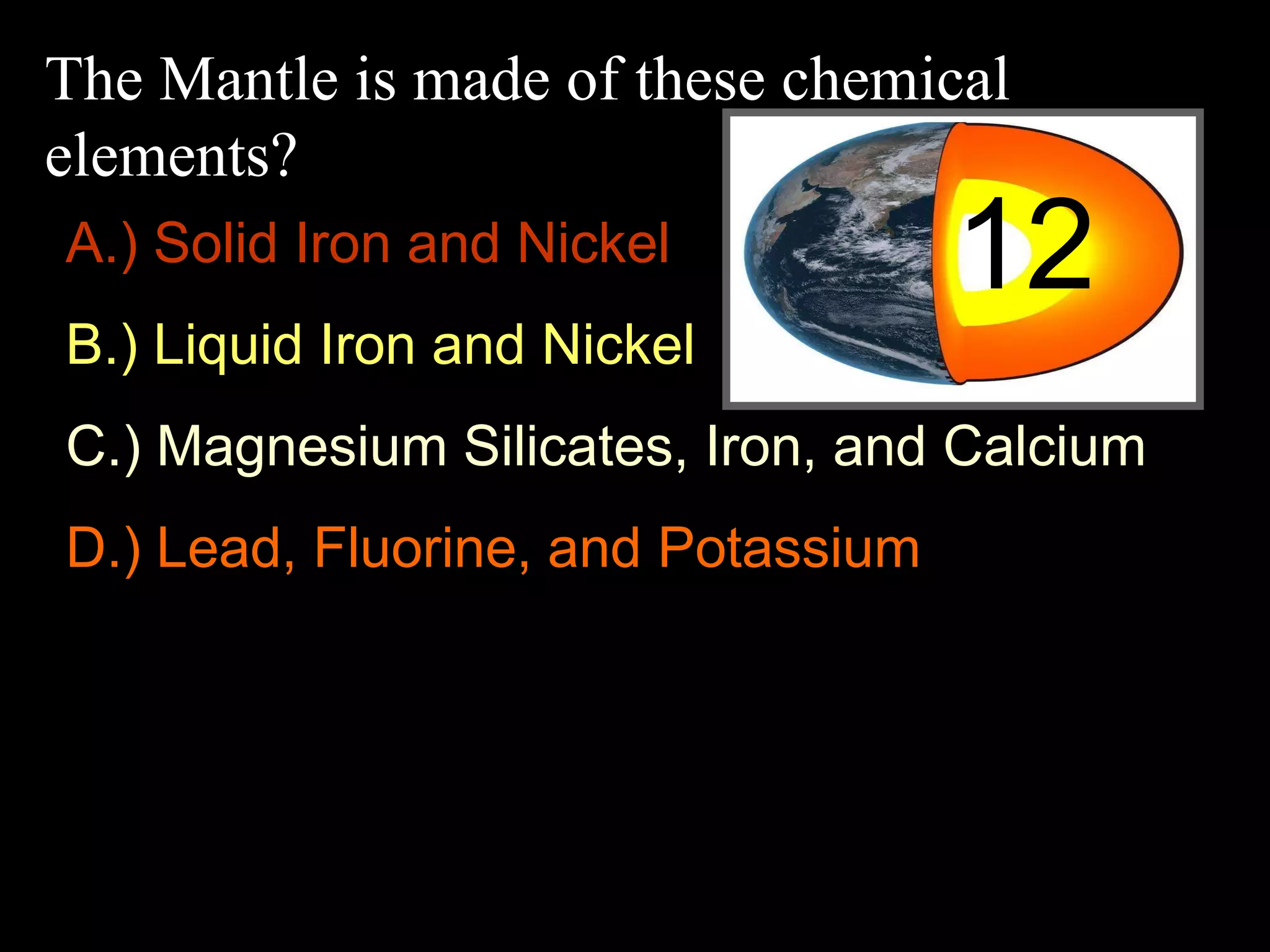
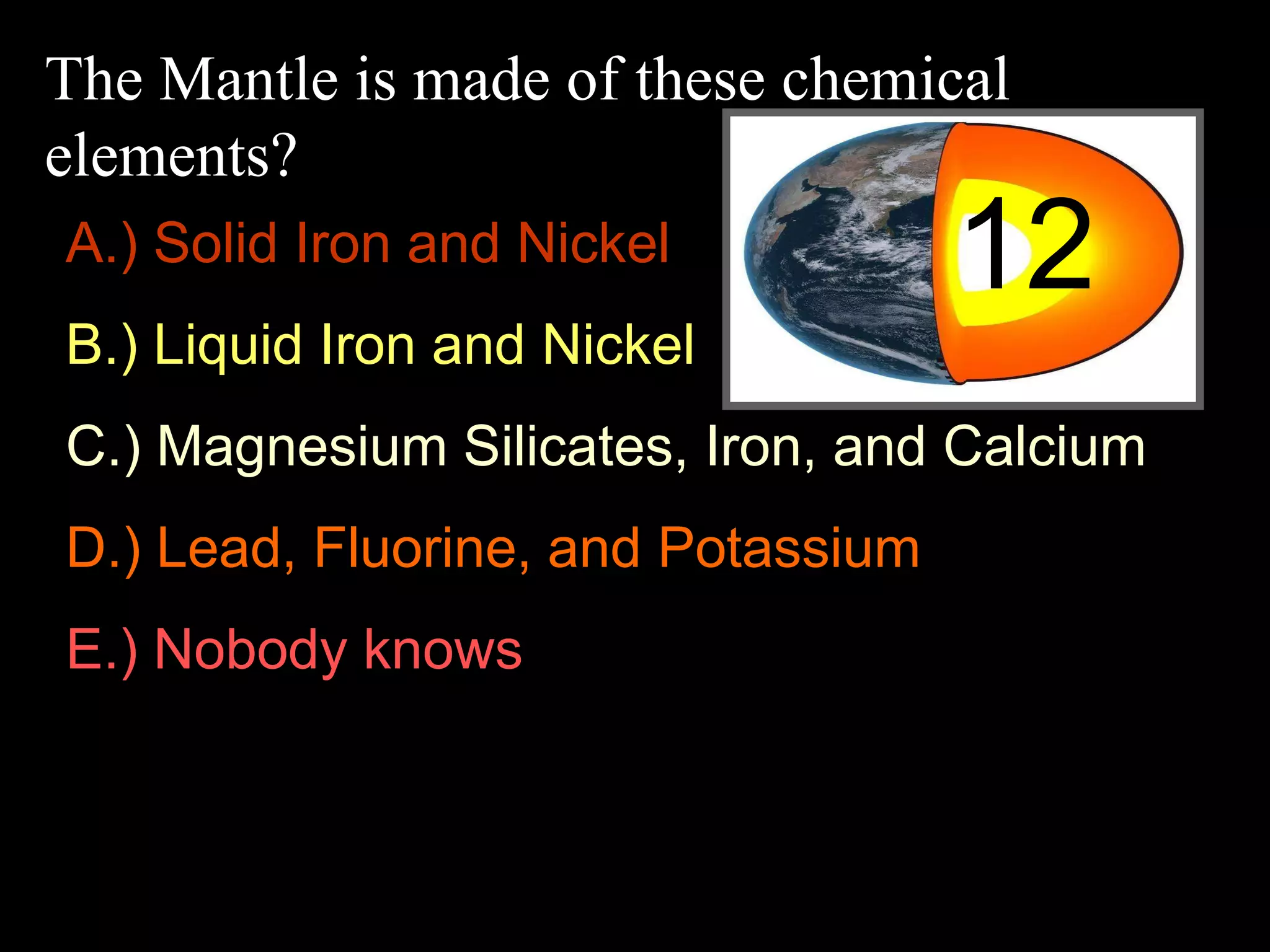
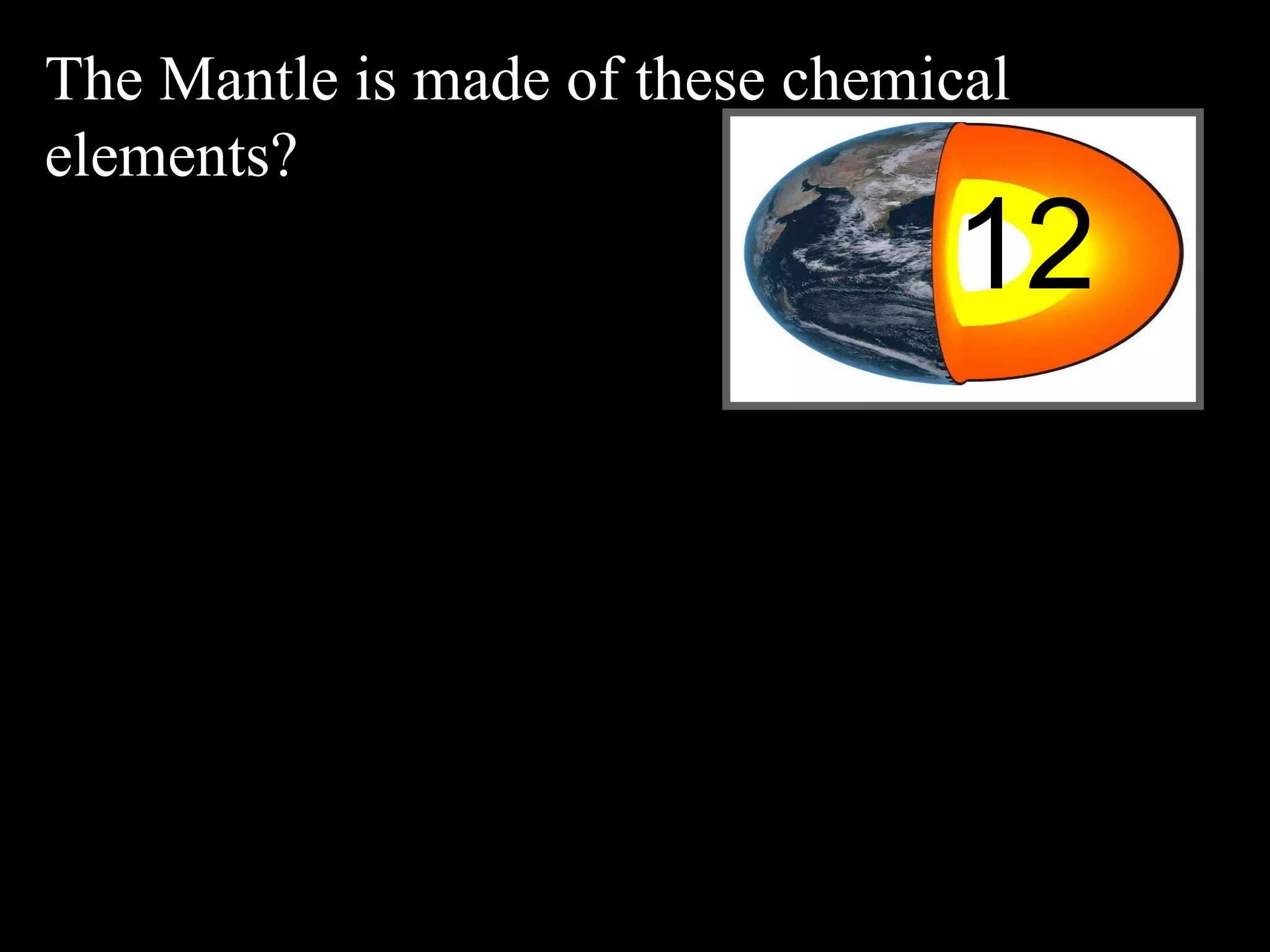
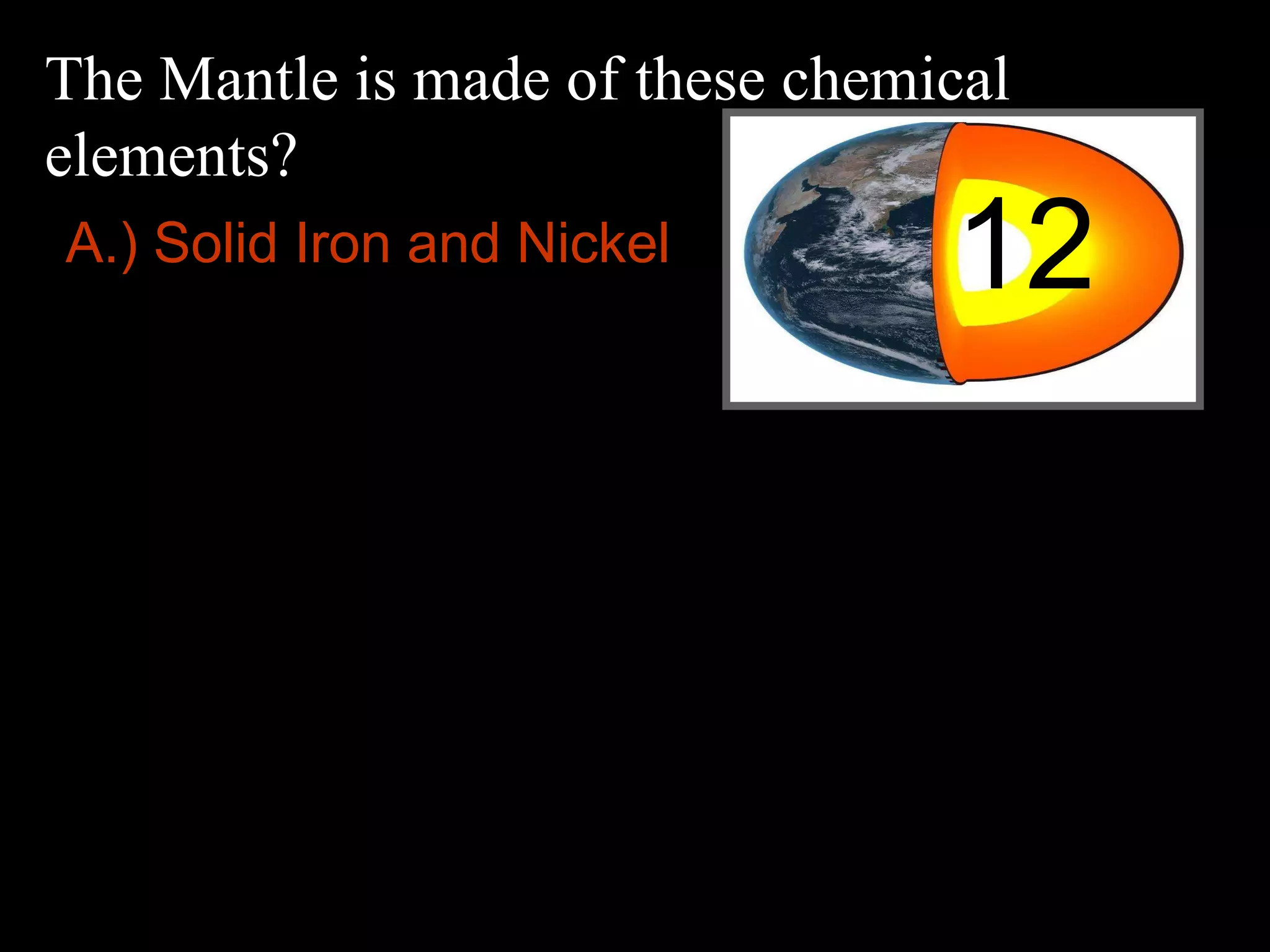
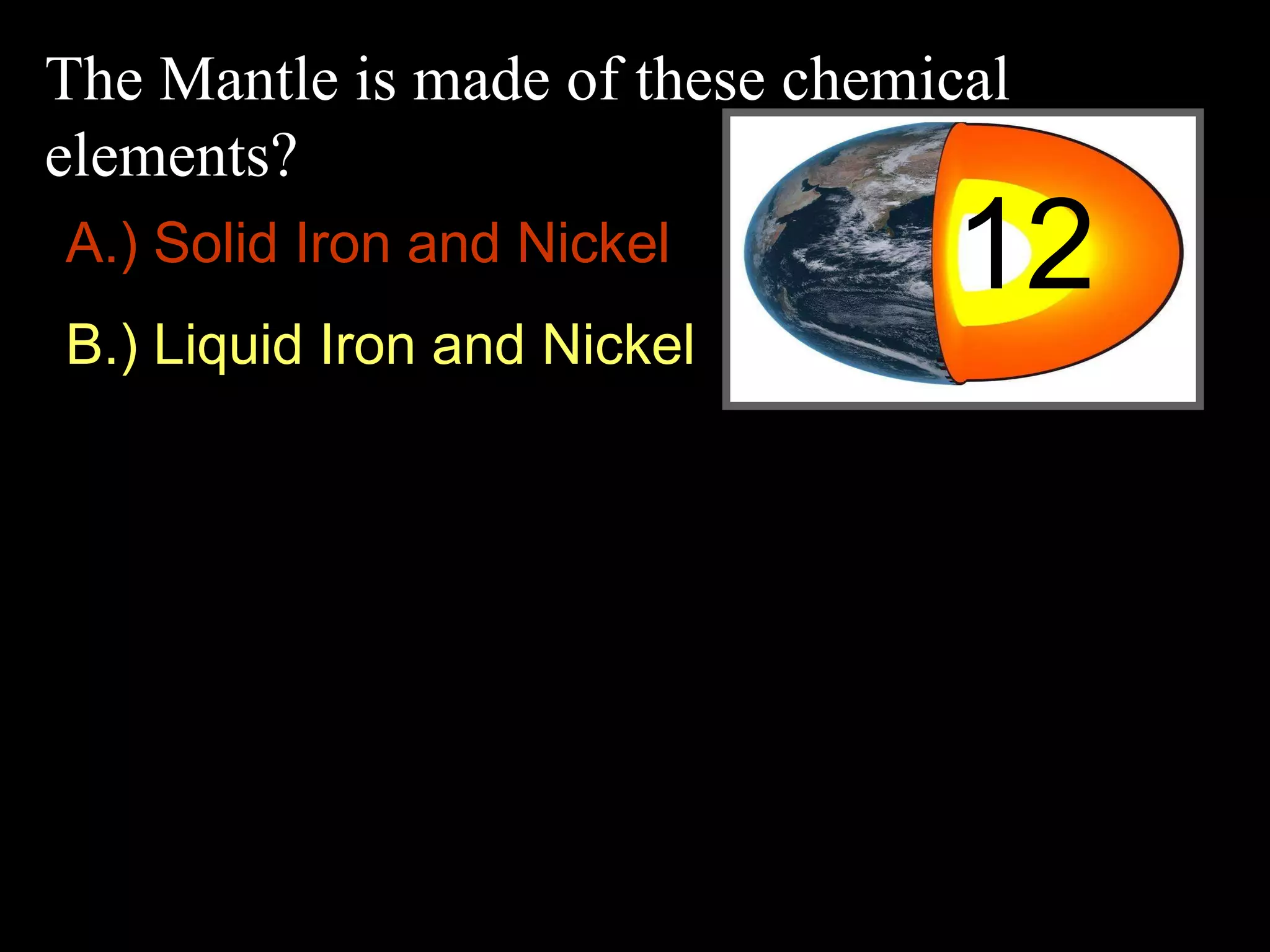
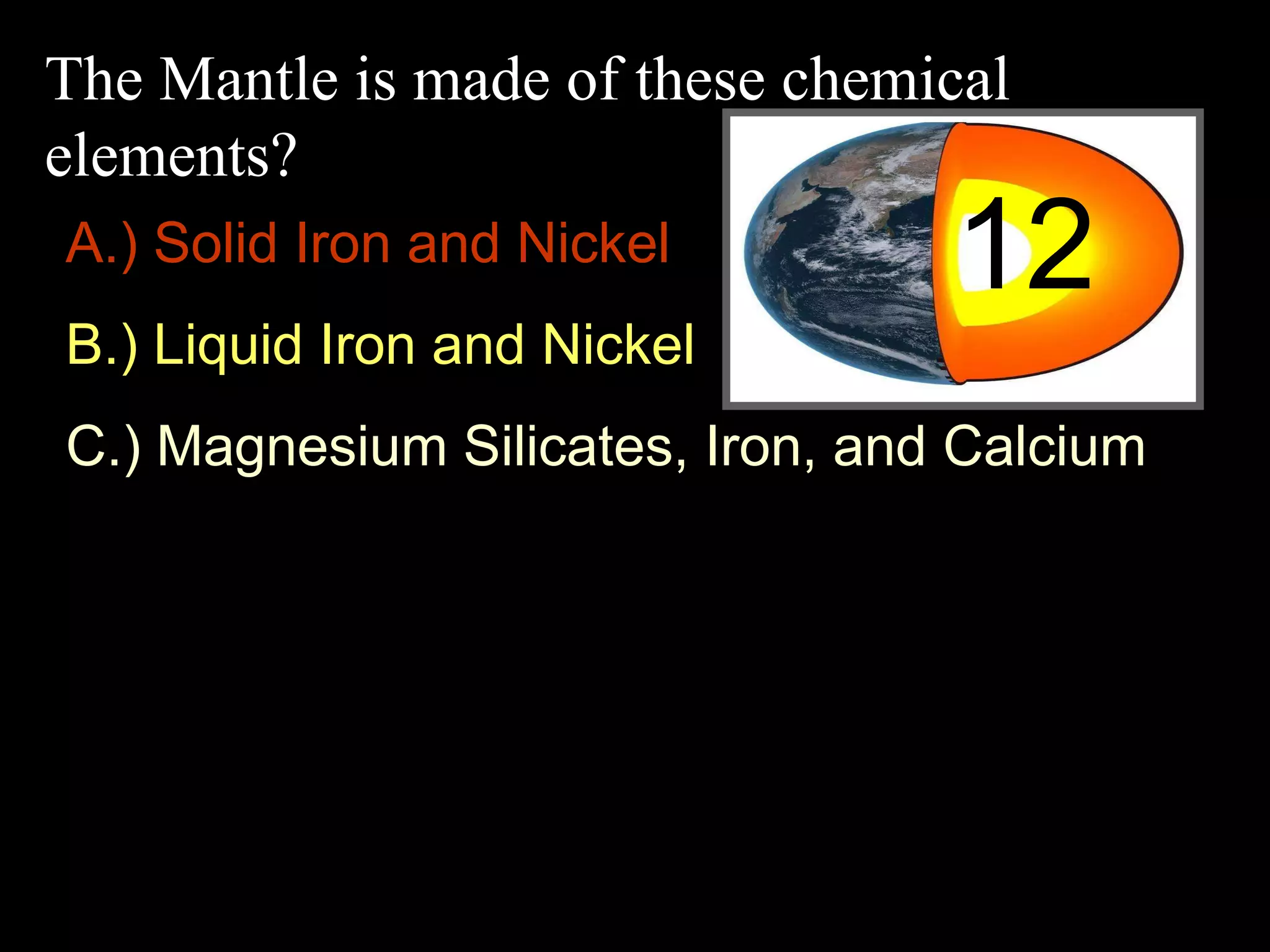
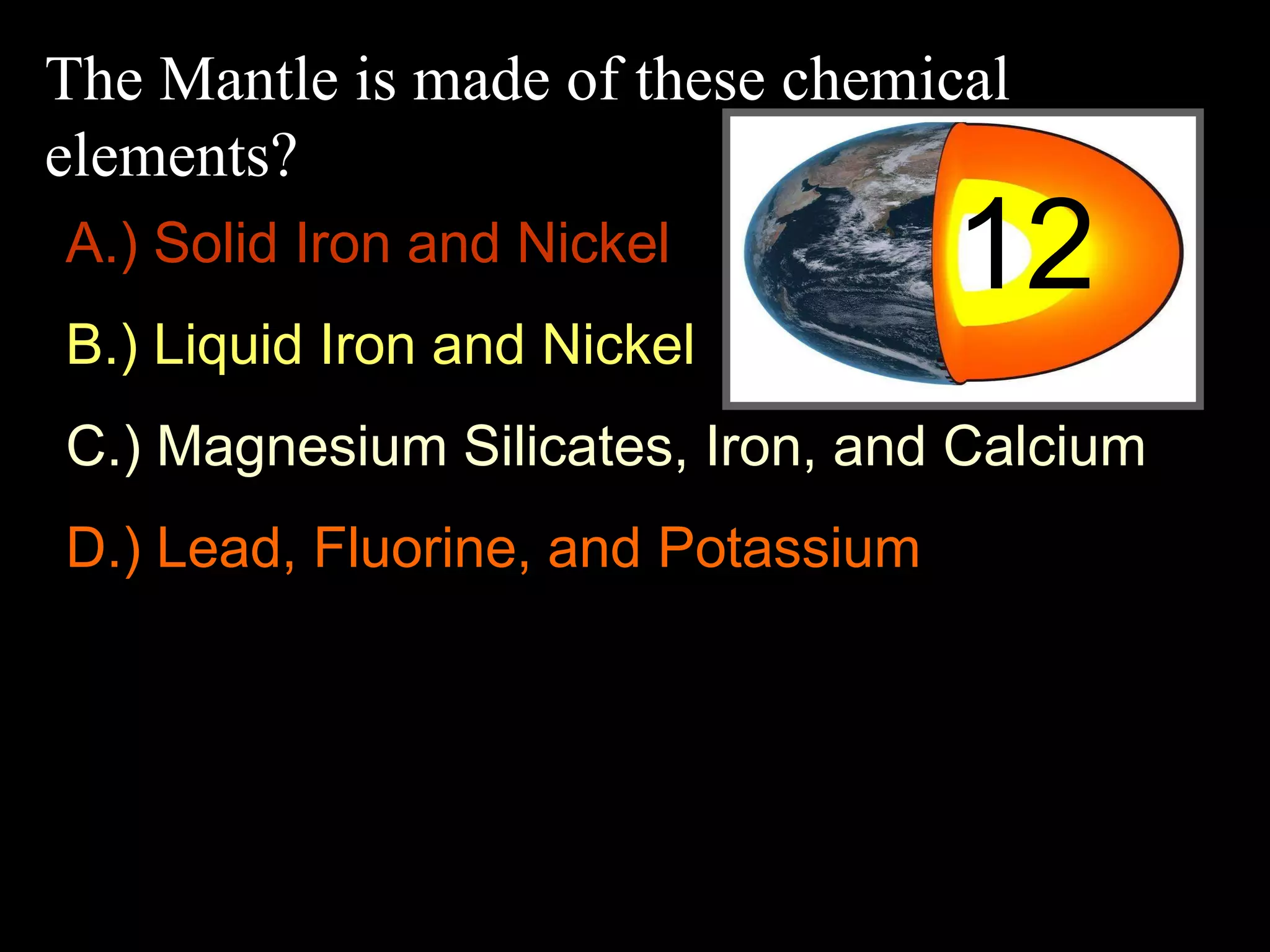
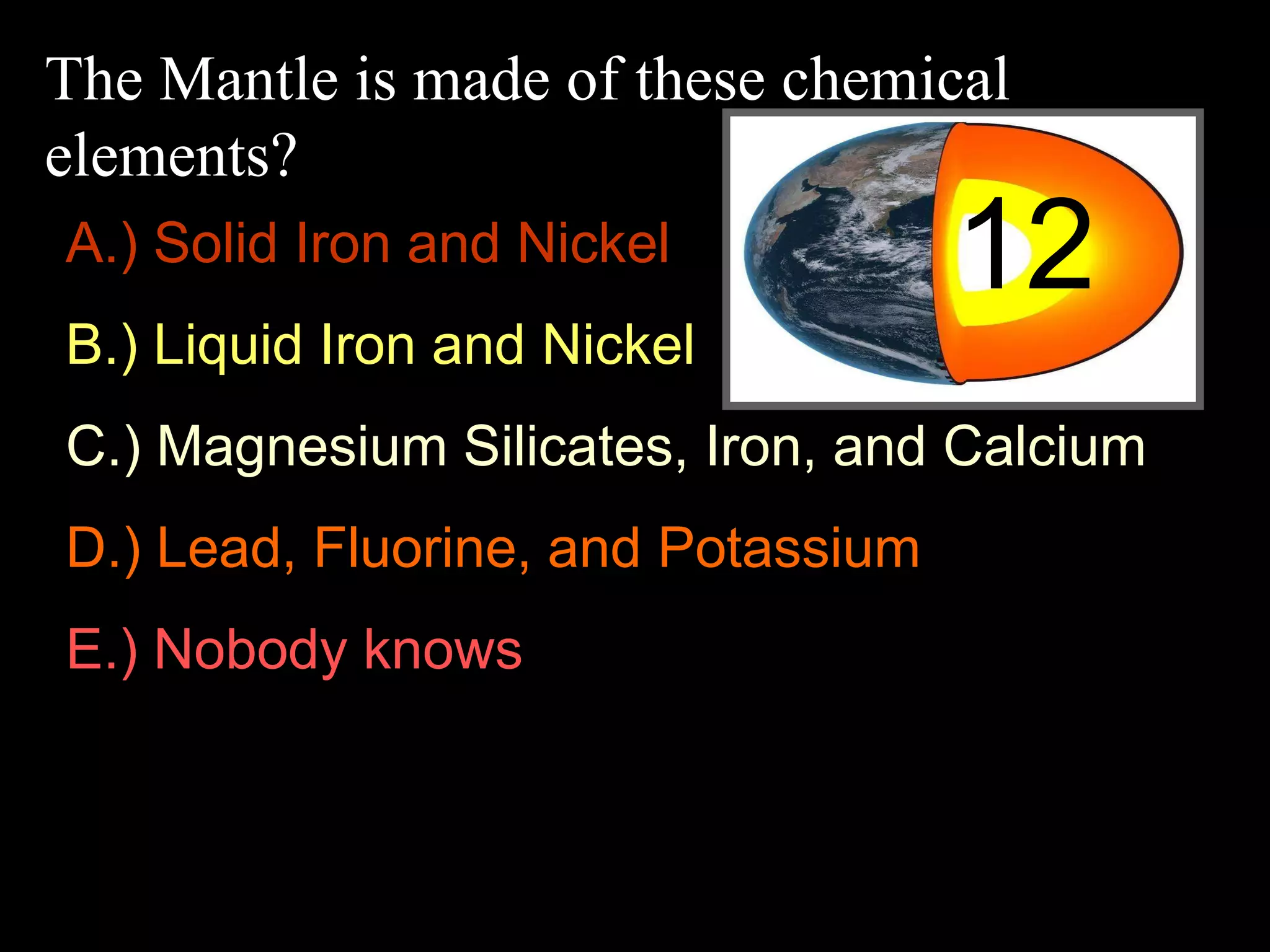
The Mantle is made of these chemical
elements?
12
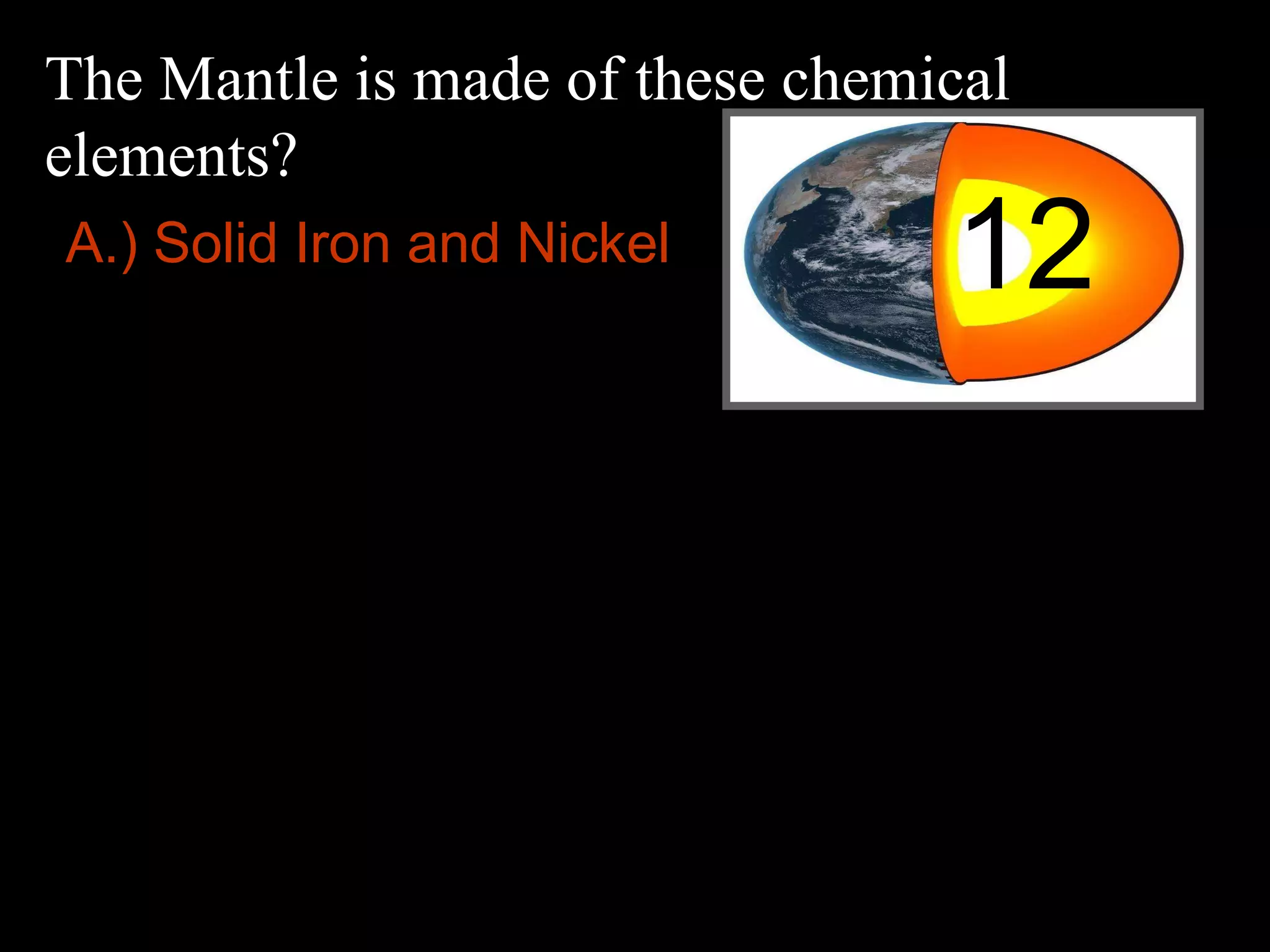
The Mantle is made of these chemical
elements?
12A.) Solid Iron and Nickel
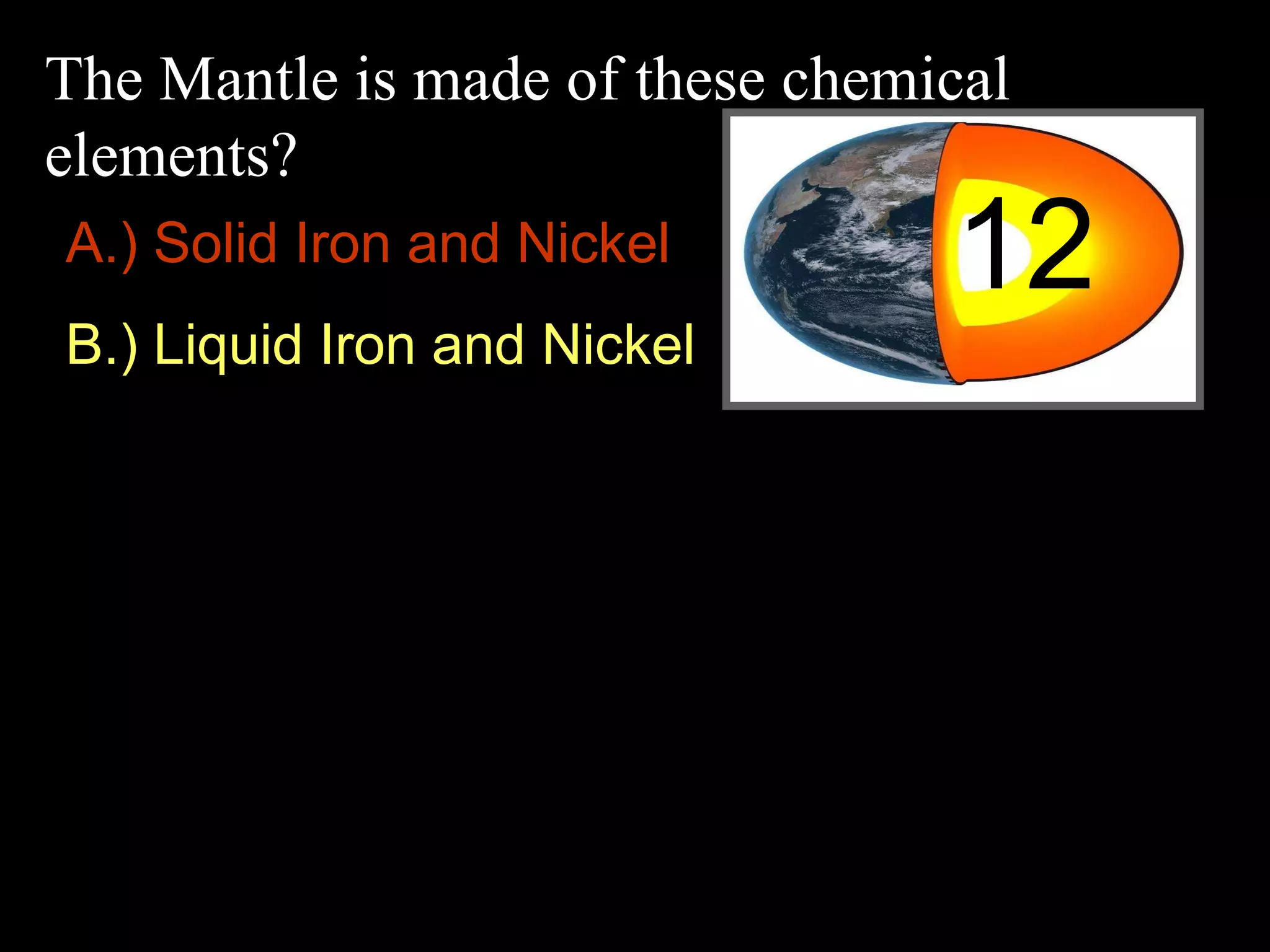
The Mantle is made of these chemical
elements?
12A.) Solid Iron and Nickel
B.) Liquid Iron and Nickel
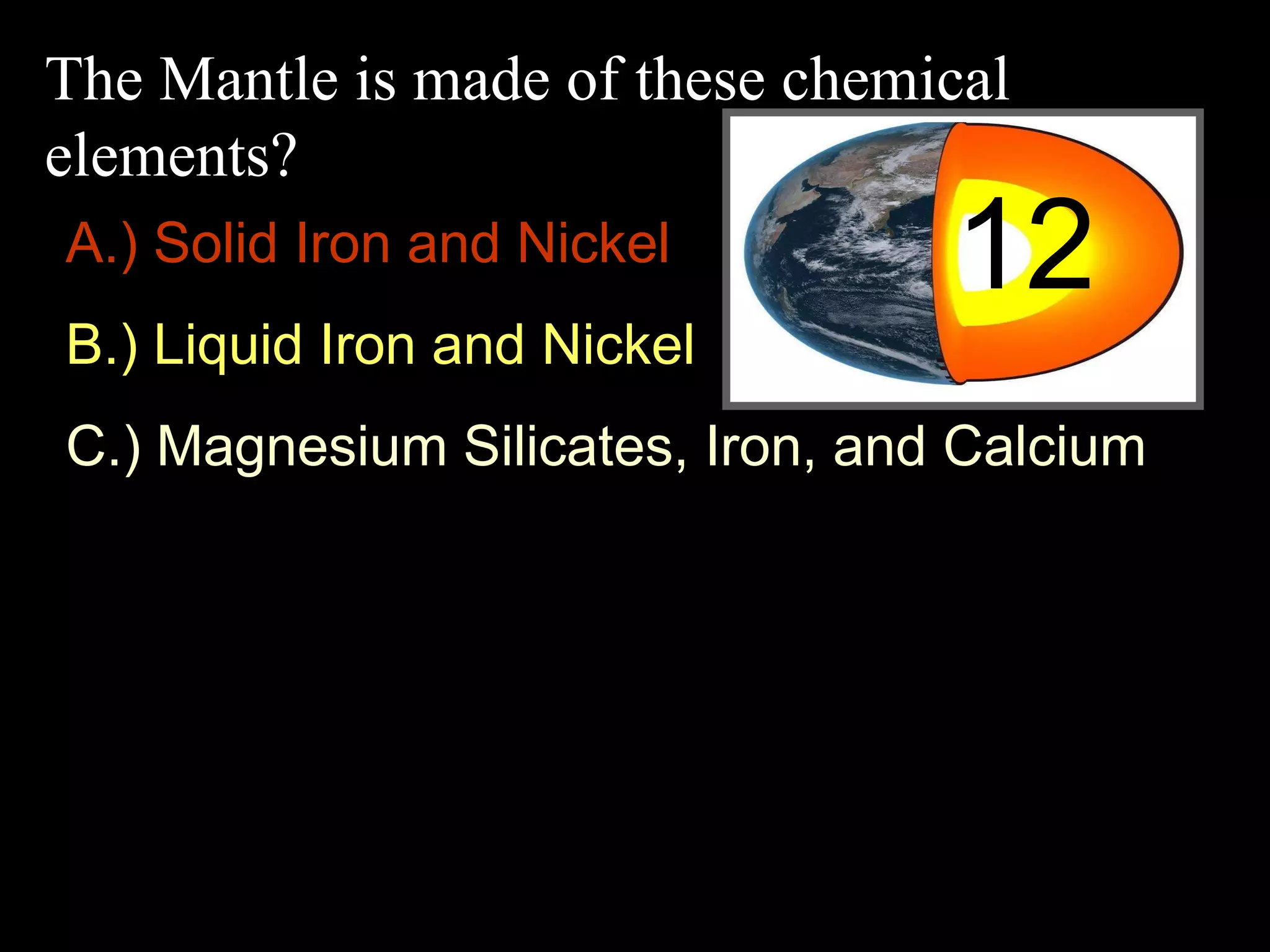
The Mantle is made of these chemical
elements?
12A.) Solid Iron and Nickel
B.) Liquid Iron and Nickel
C.) Magnesium Silicates, Iron, and Calcium
The Mantle is made of these chemical
elements?
12A.) Solid Iron and Nickel
B.) Liquid Iron and Nickel
C.) Magnesium Silicates, Iron, and Calcium
D.) Lead, Fluorine, and Potassium
The Mantle is made of these chemical
elements?
12A.) Solid Iron and Nickel
B.) Liquid Iron and Nickel
C.) Magnesium Silicates, Iron, and Calcium
D.) Lead, Fluorine, and Potassium
E.) Nobody knows
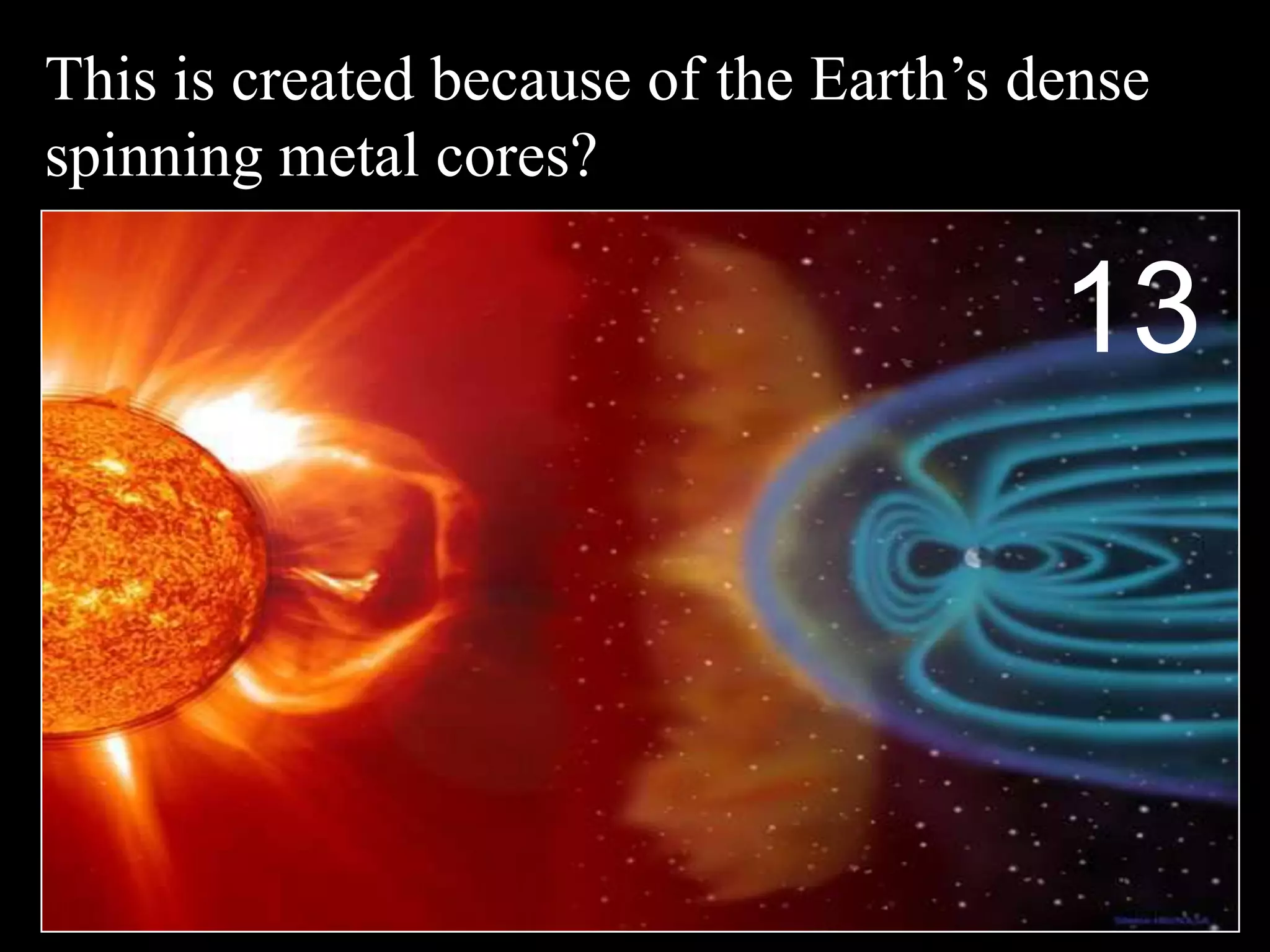
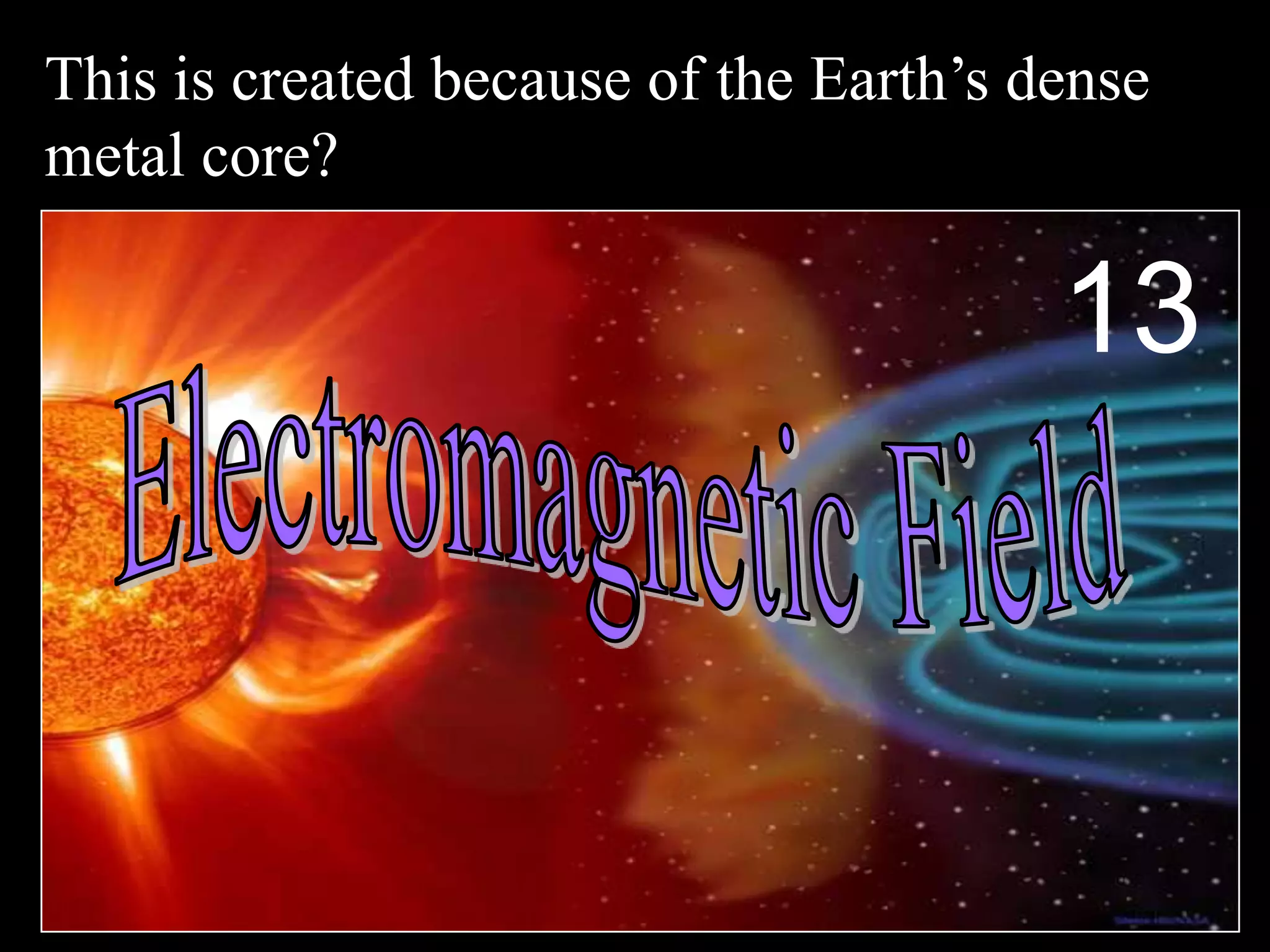
This is created because of the Earth’s dense
spinning metal cores?
13
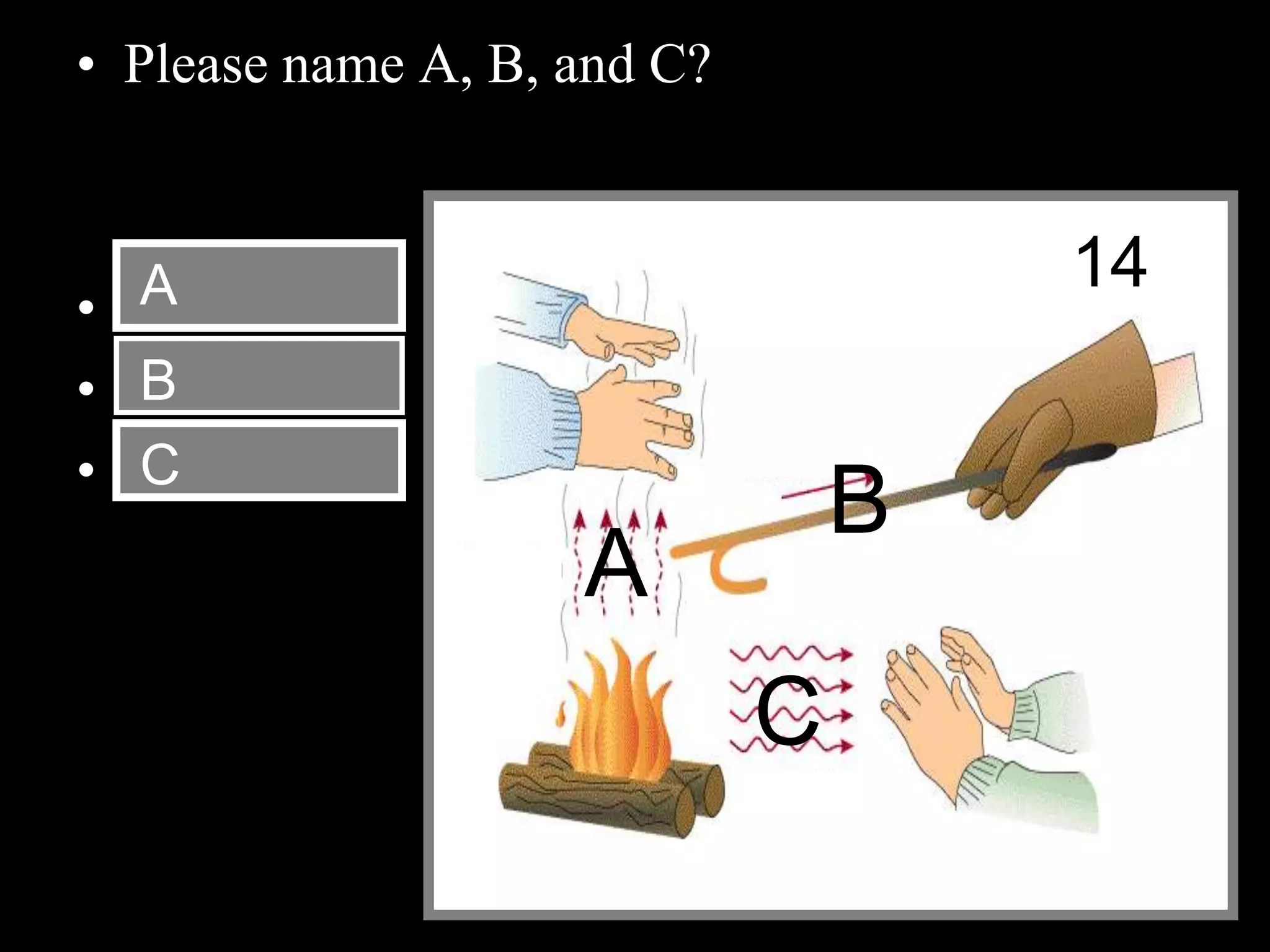
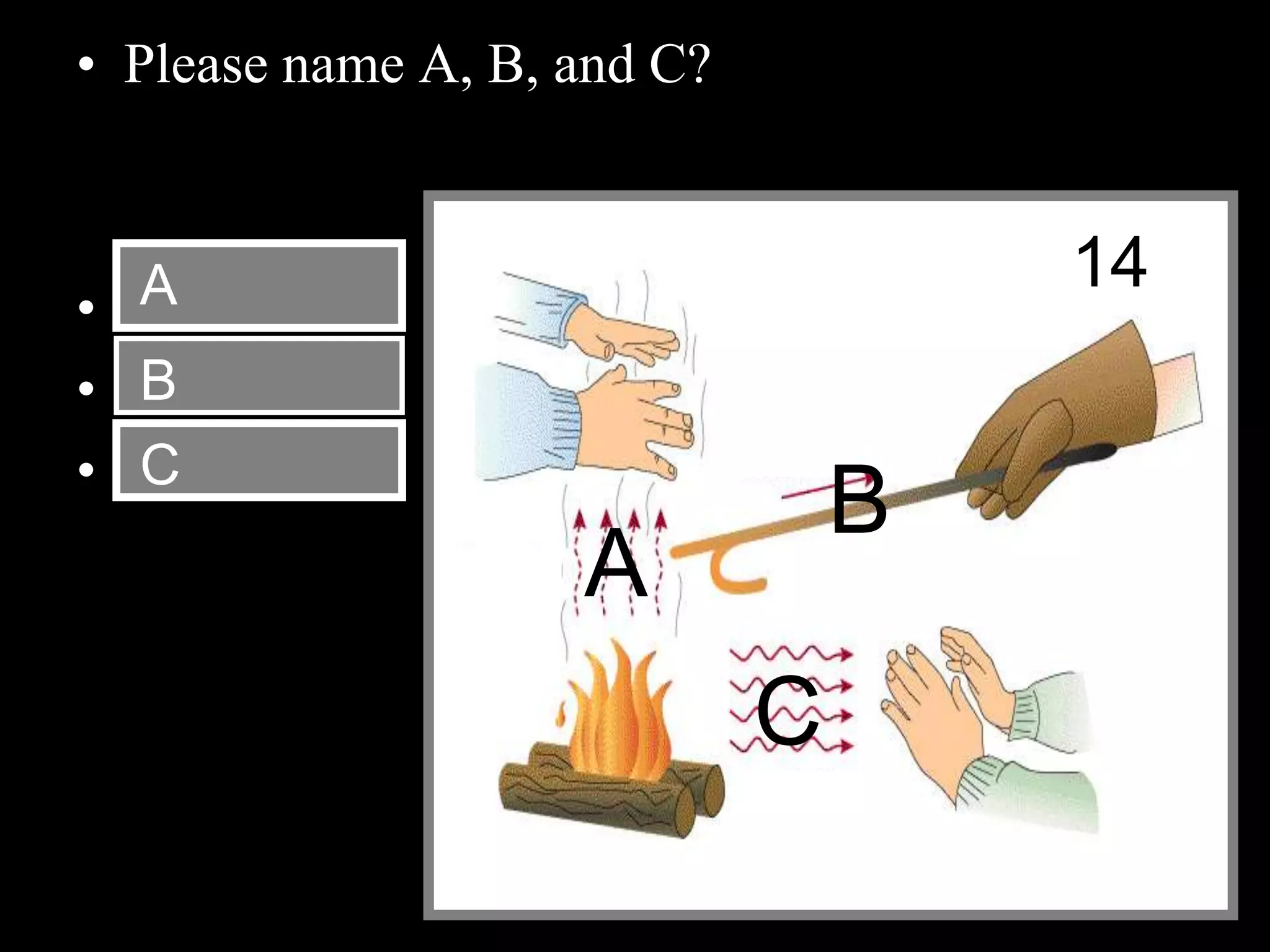
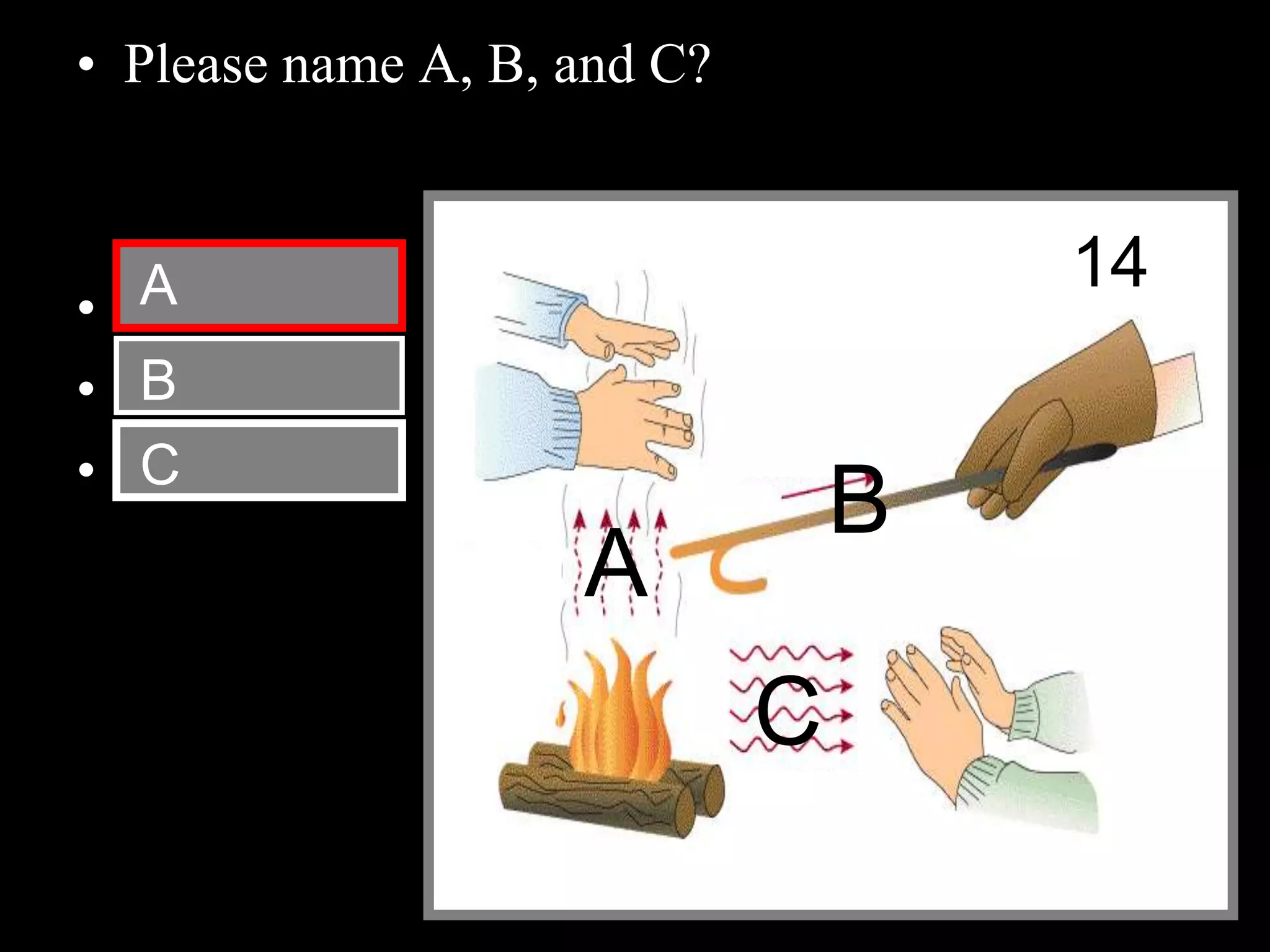
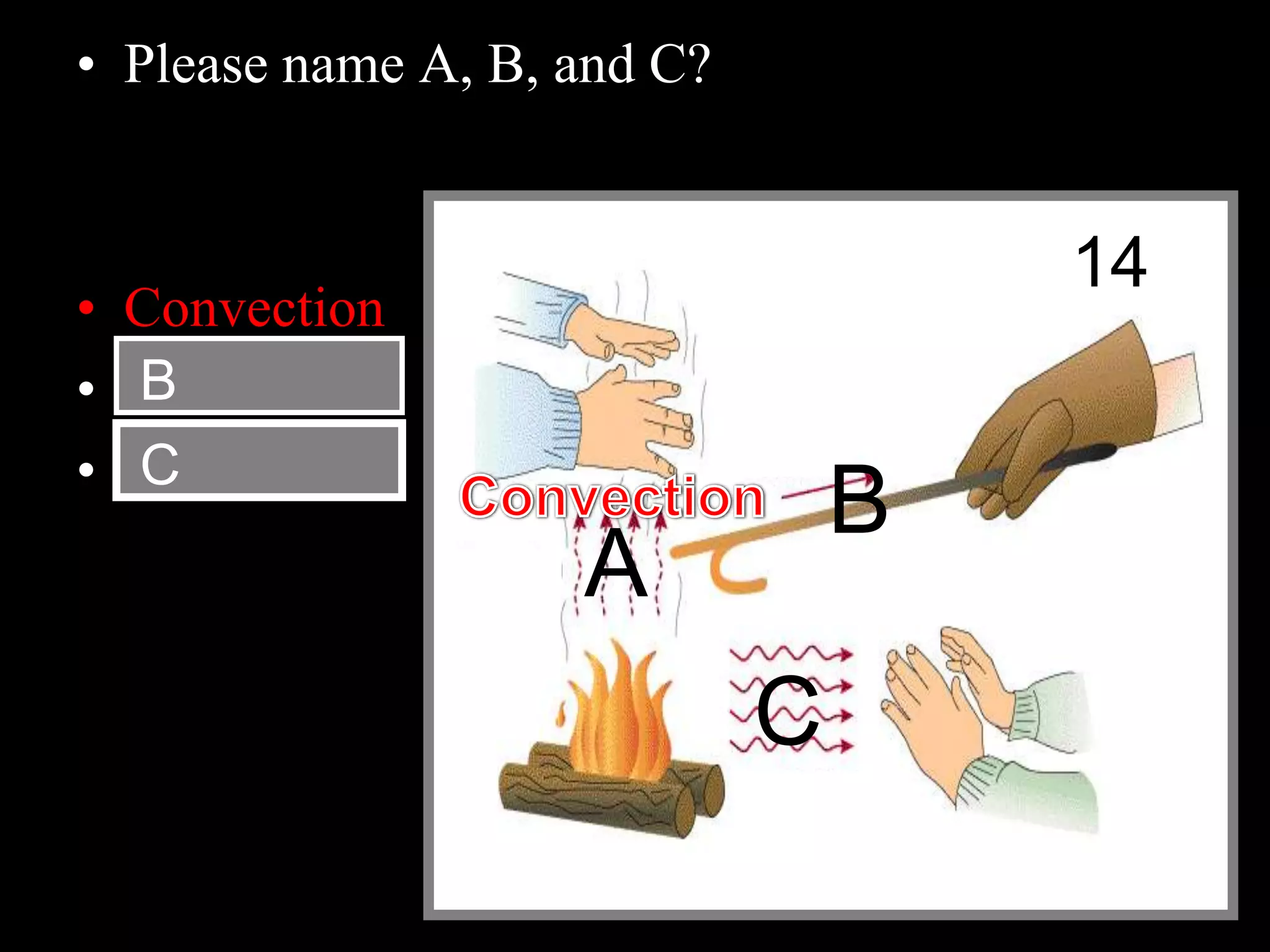
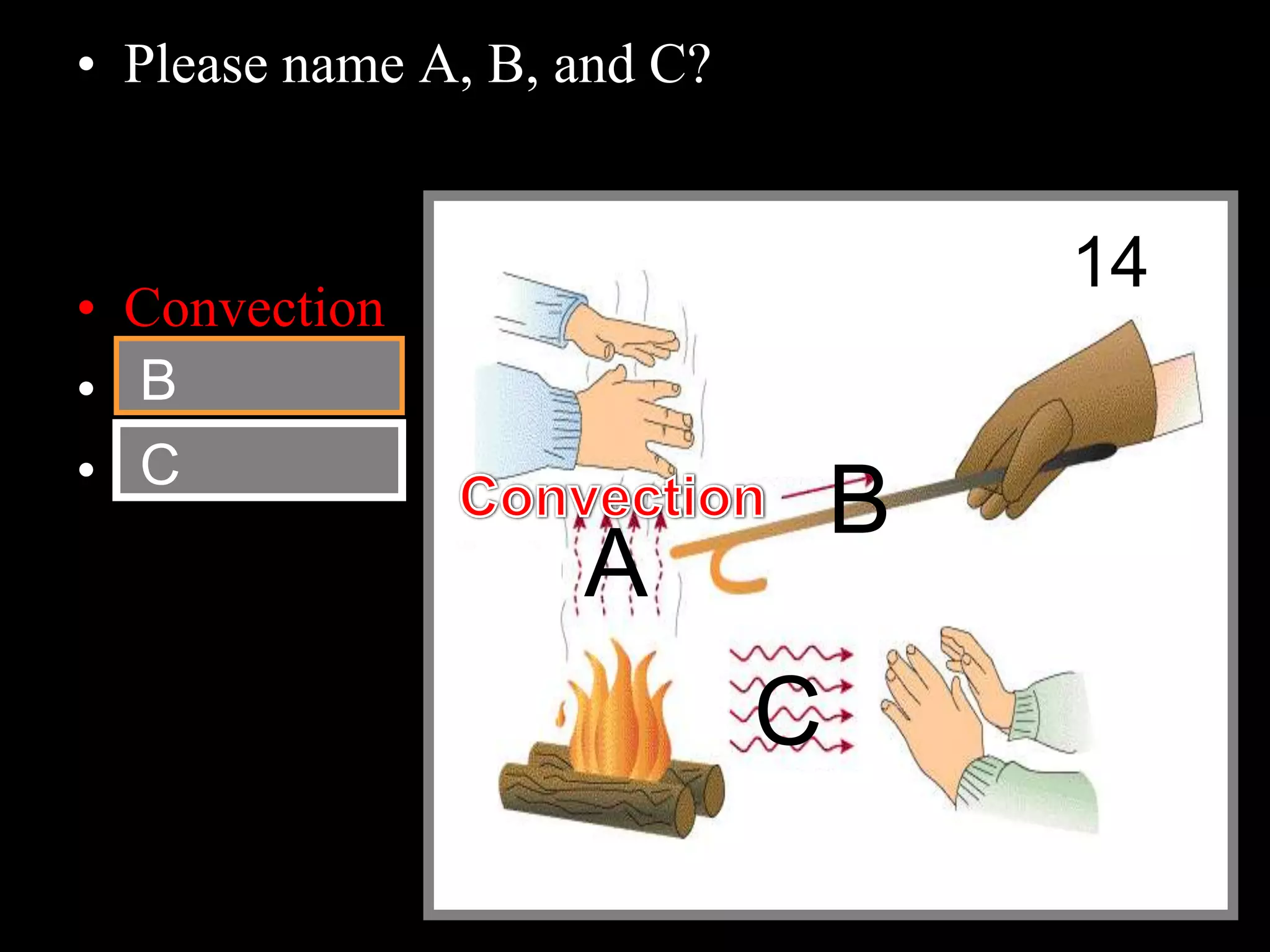
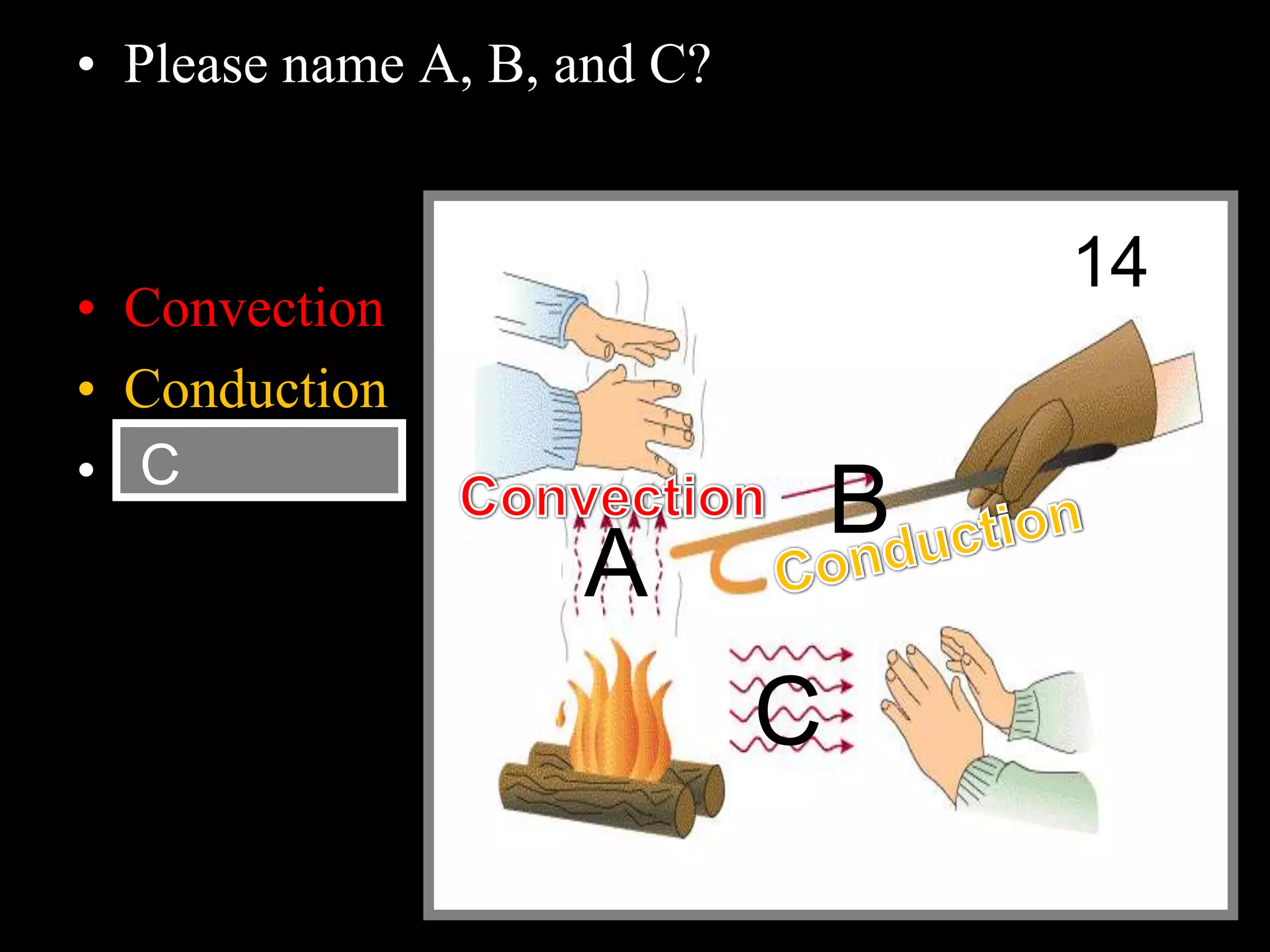
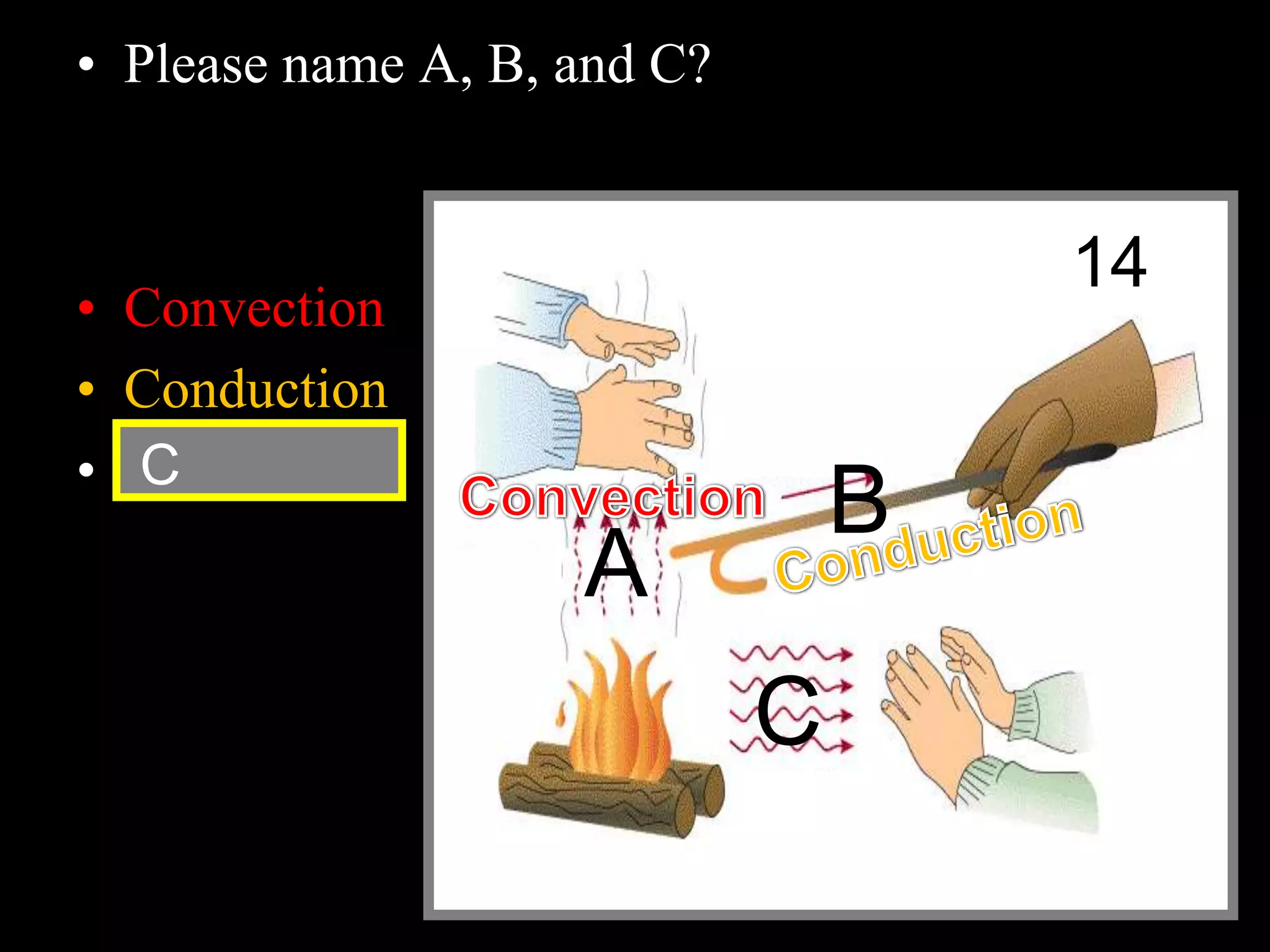
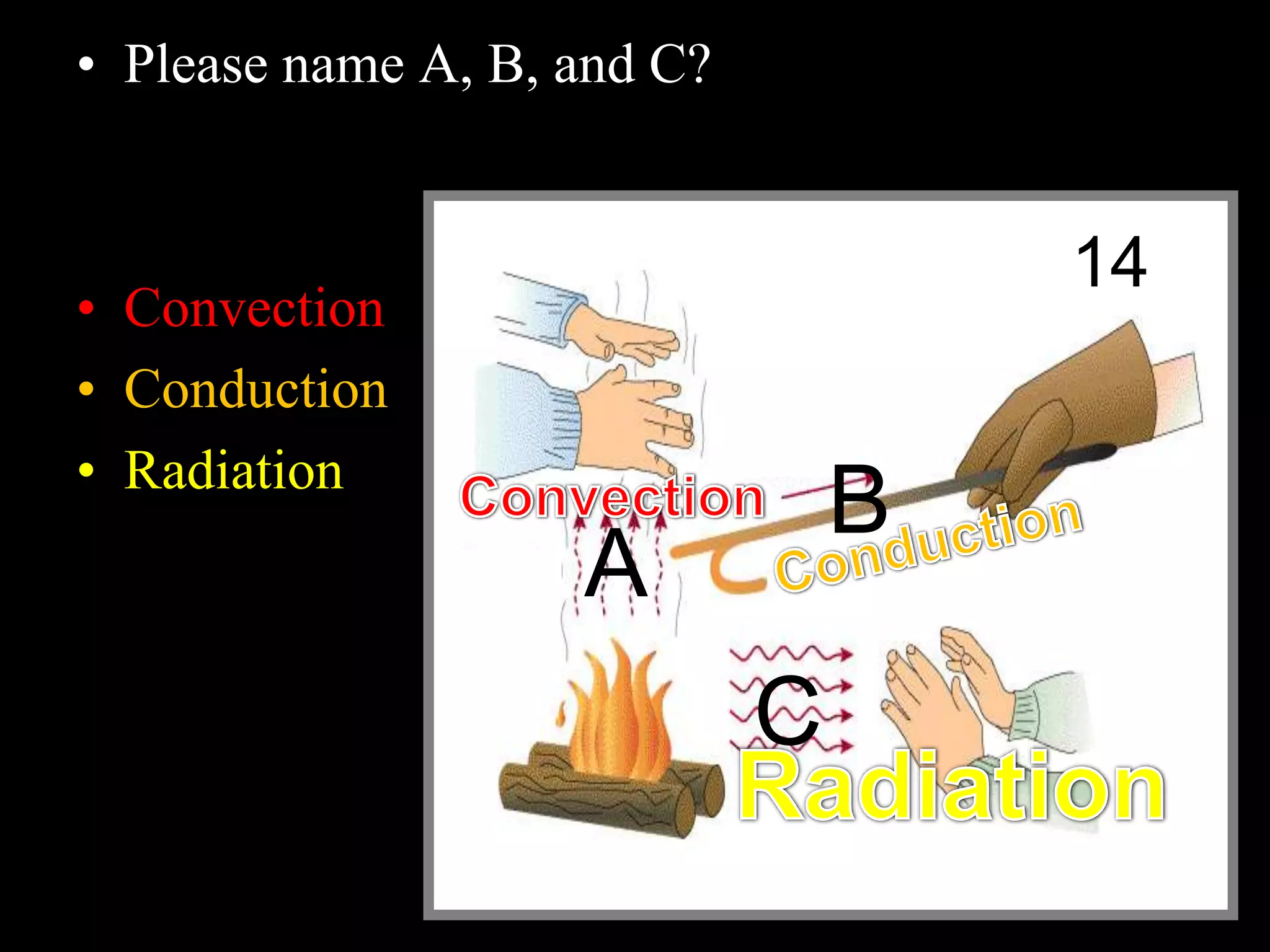
• Please name A, B, and C?
• Convection
• Conduction
• Radiation
Copyright © 2010 Ryan P. Murphy
A
B
C
A
B
C
14
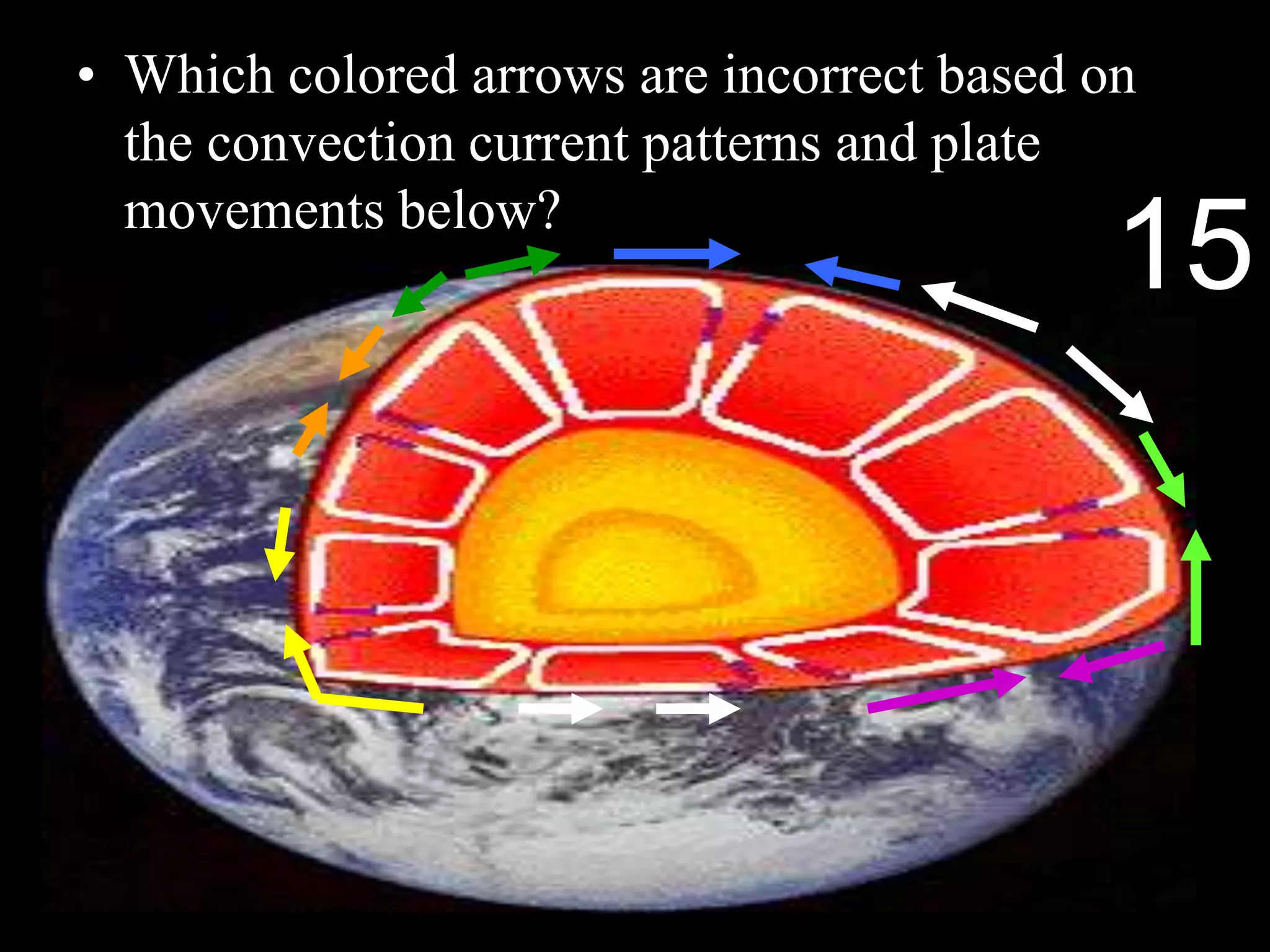
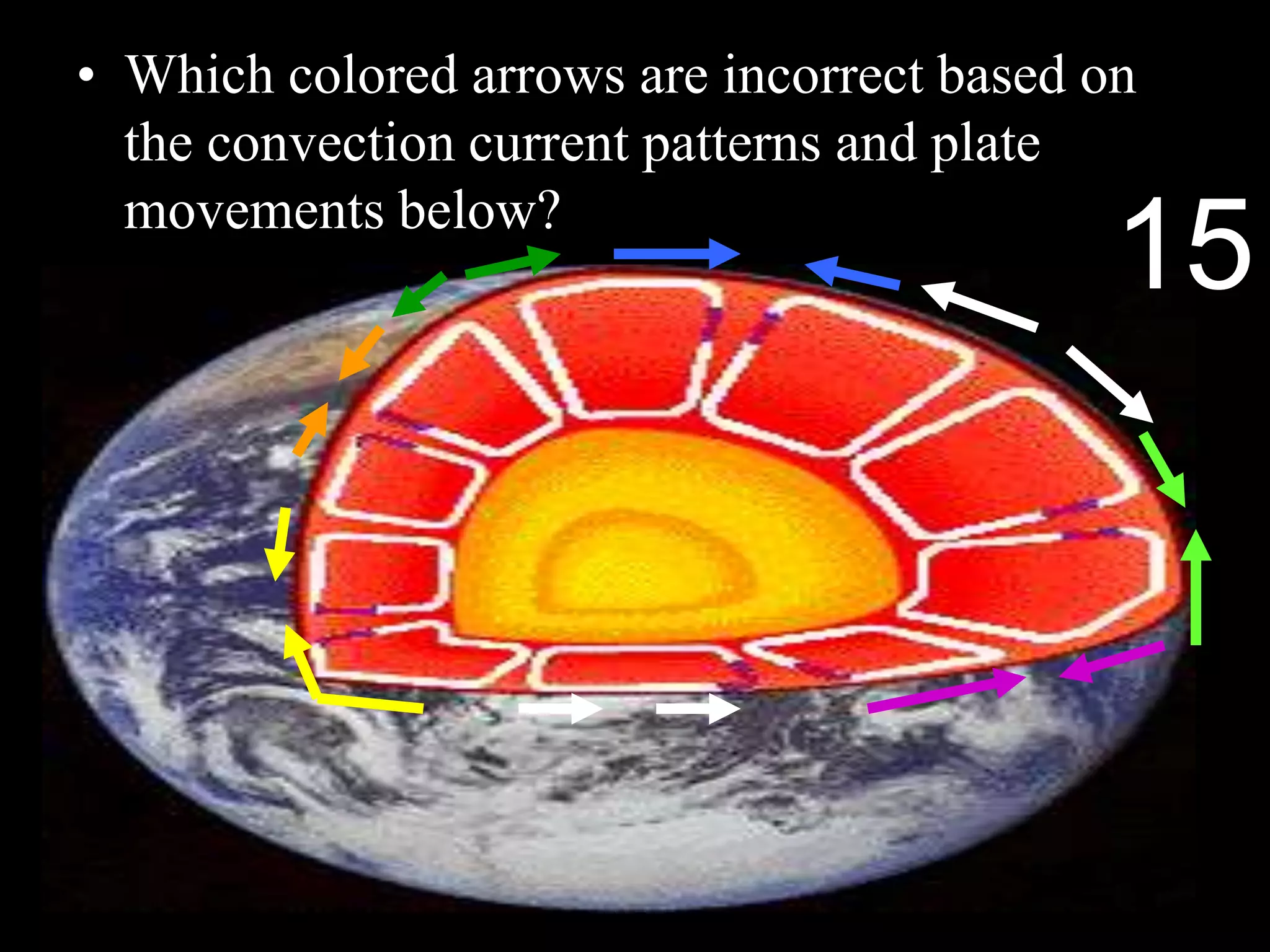
• Which colored arrows are incorrect based on
the convection current patterns and plate
movements below?
Copyright © 2010 Ryan P. Murphy
15
MOVING
AROUND
LAYERS OF
EVIDENCE
TERRARIFIC A LOT ON
YOUR PLATE
-BONUS-
NAME THE
PLACE AND
CONTINENT
1 6 11 16 *21
2 7 12 17 *22
3 8 13 18 *23
4 9 14 19 *24
5 10 15 20 *25
Copyright © 2010 Ryan P. Murphy
Dynamic Earth Review Game
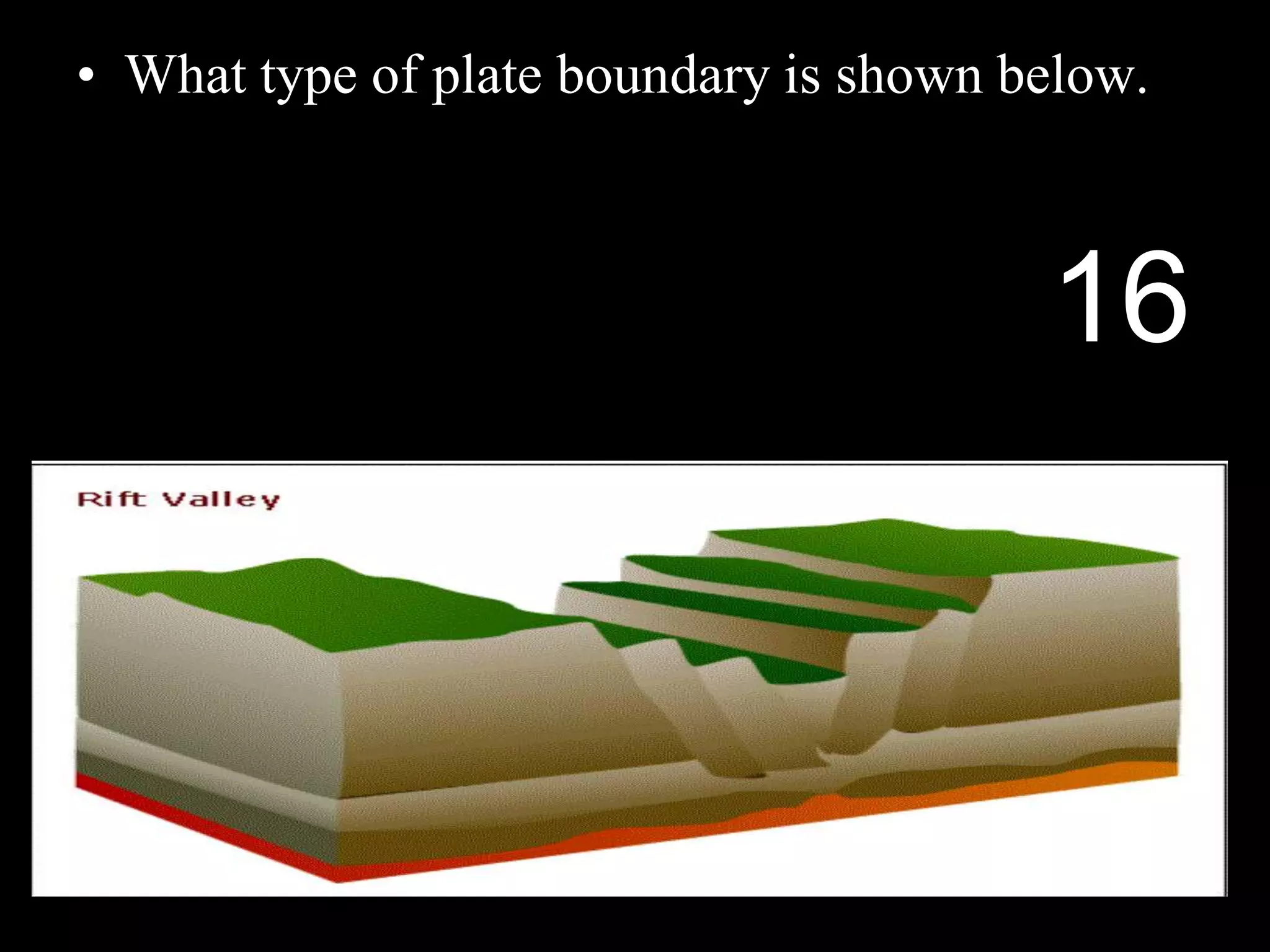
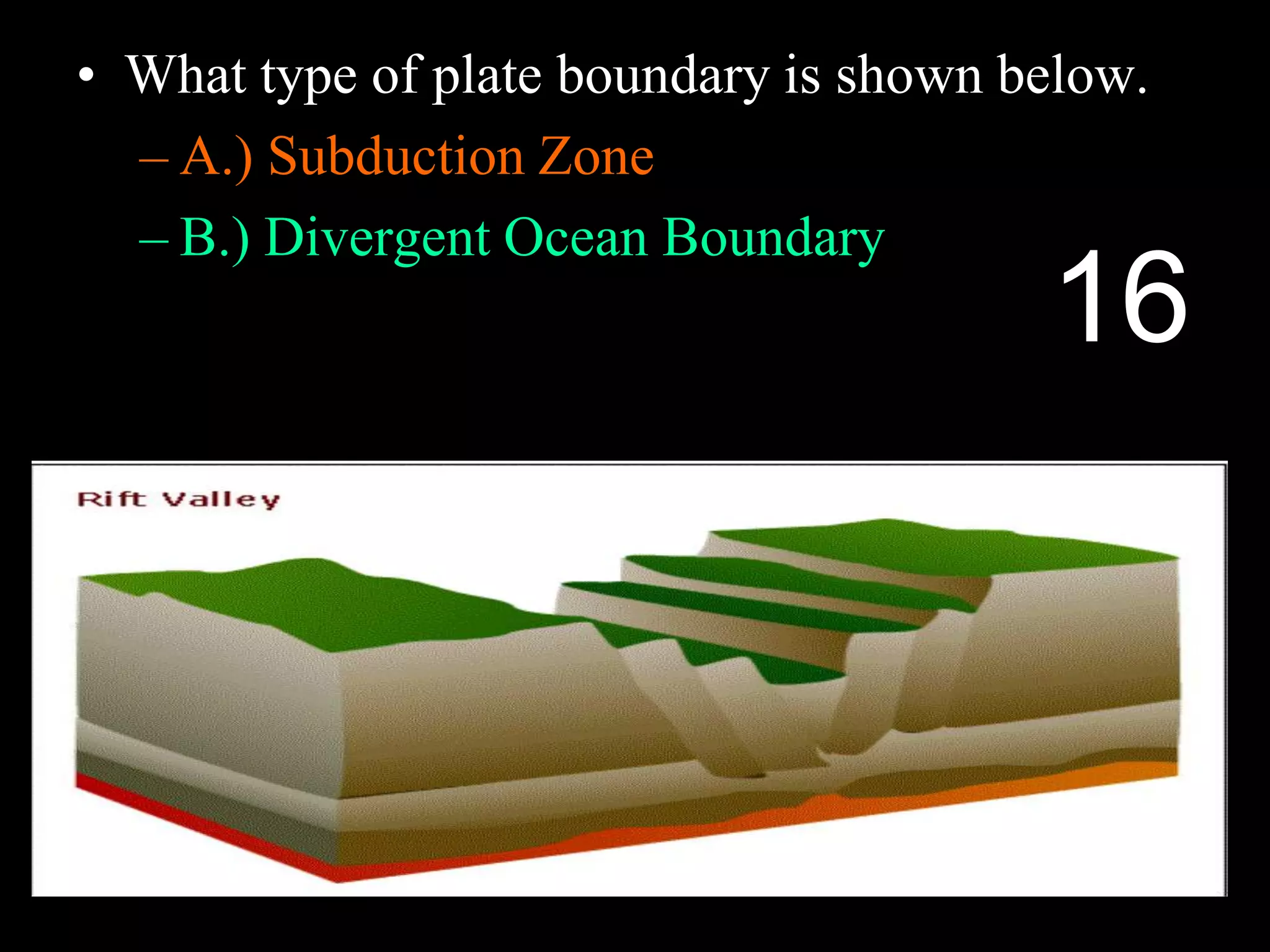
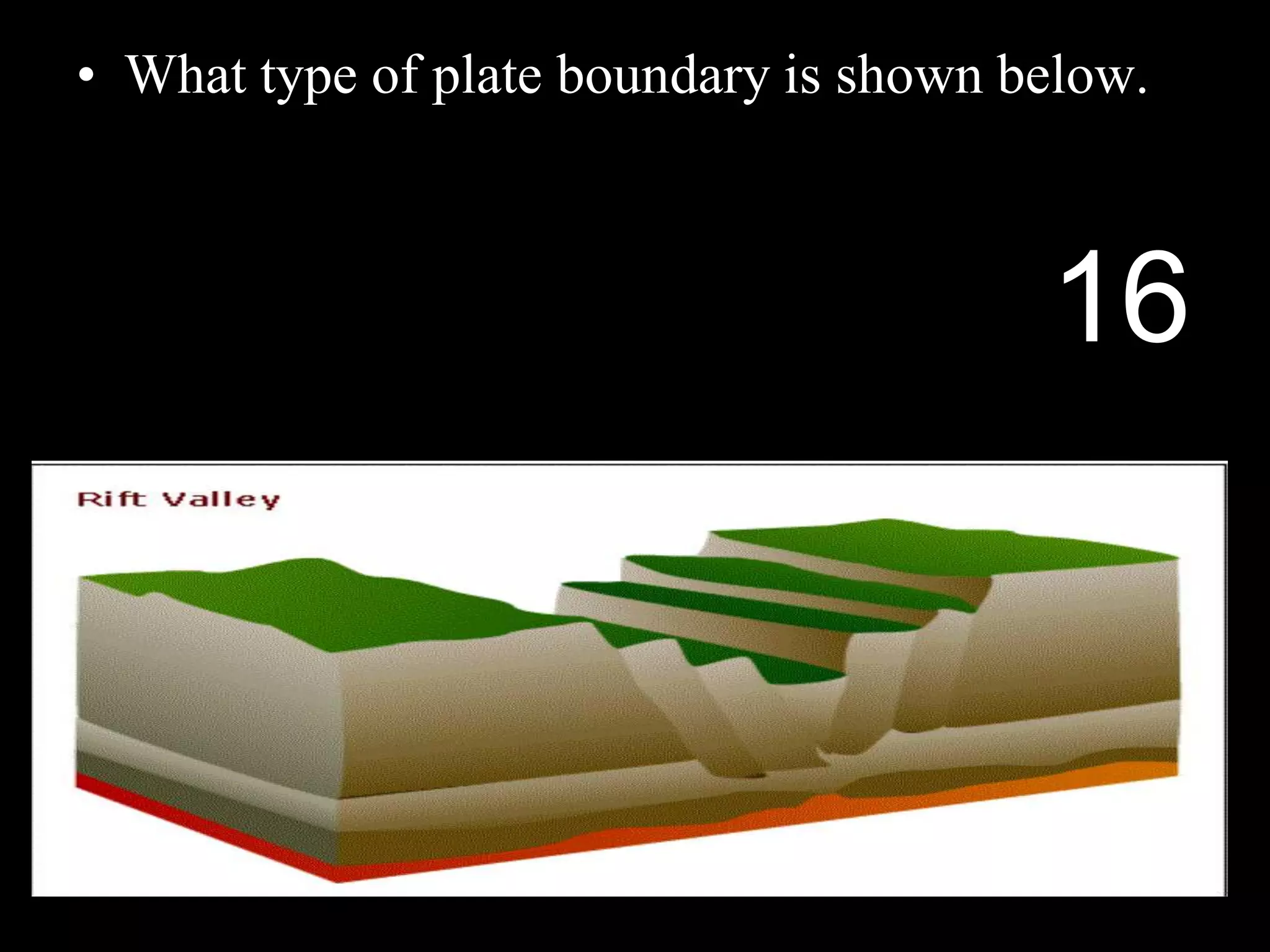
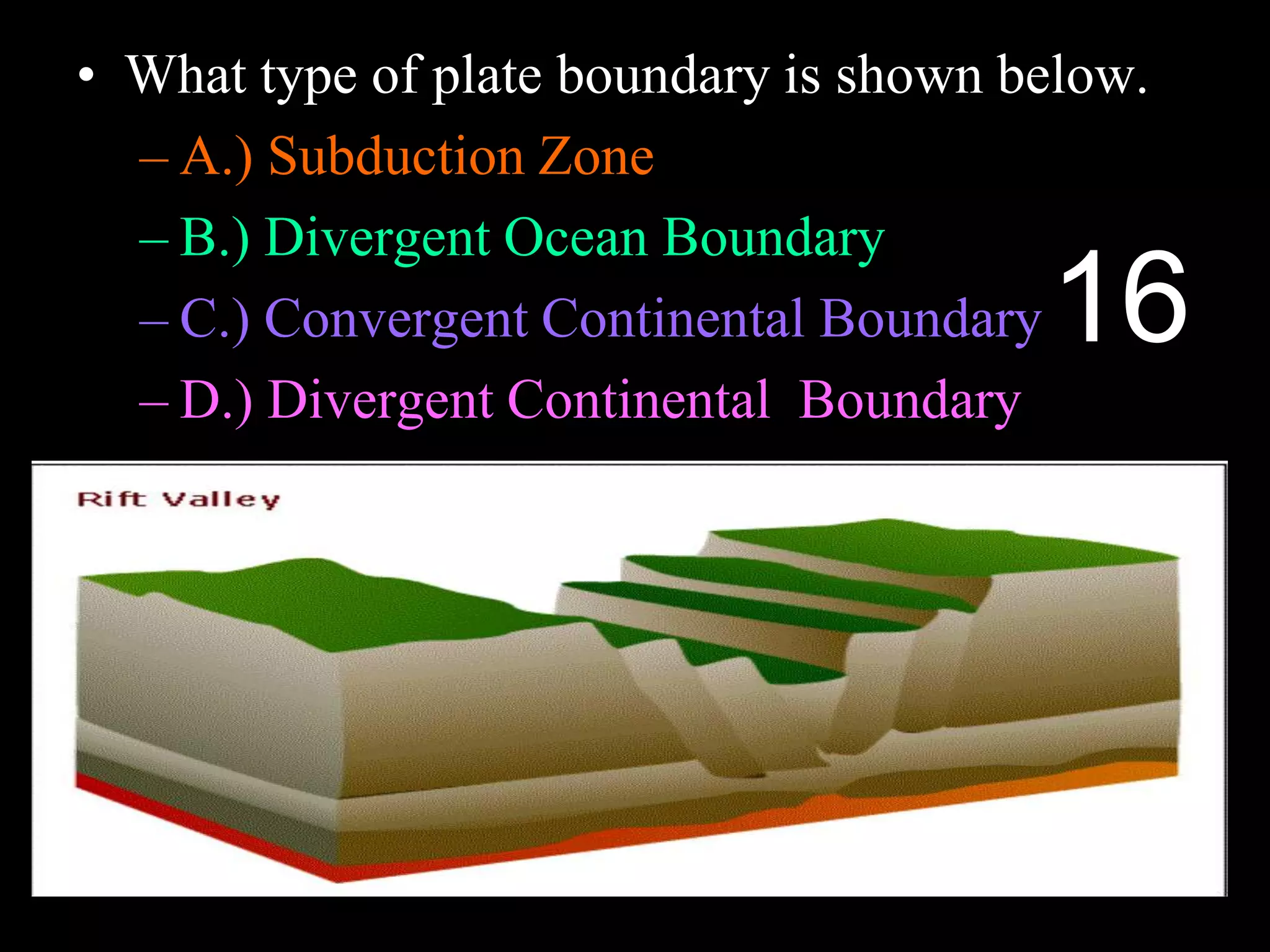
• What type of plate boundary is shown below.
16
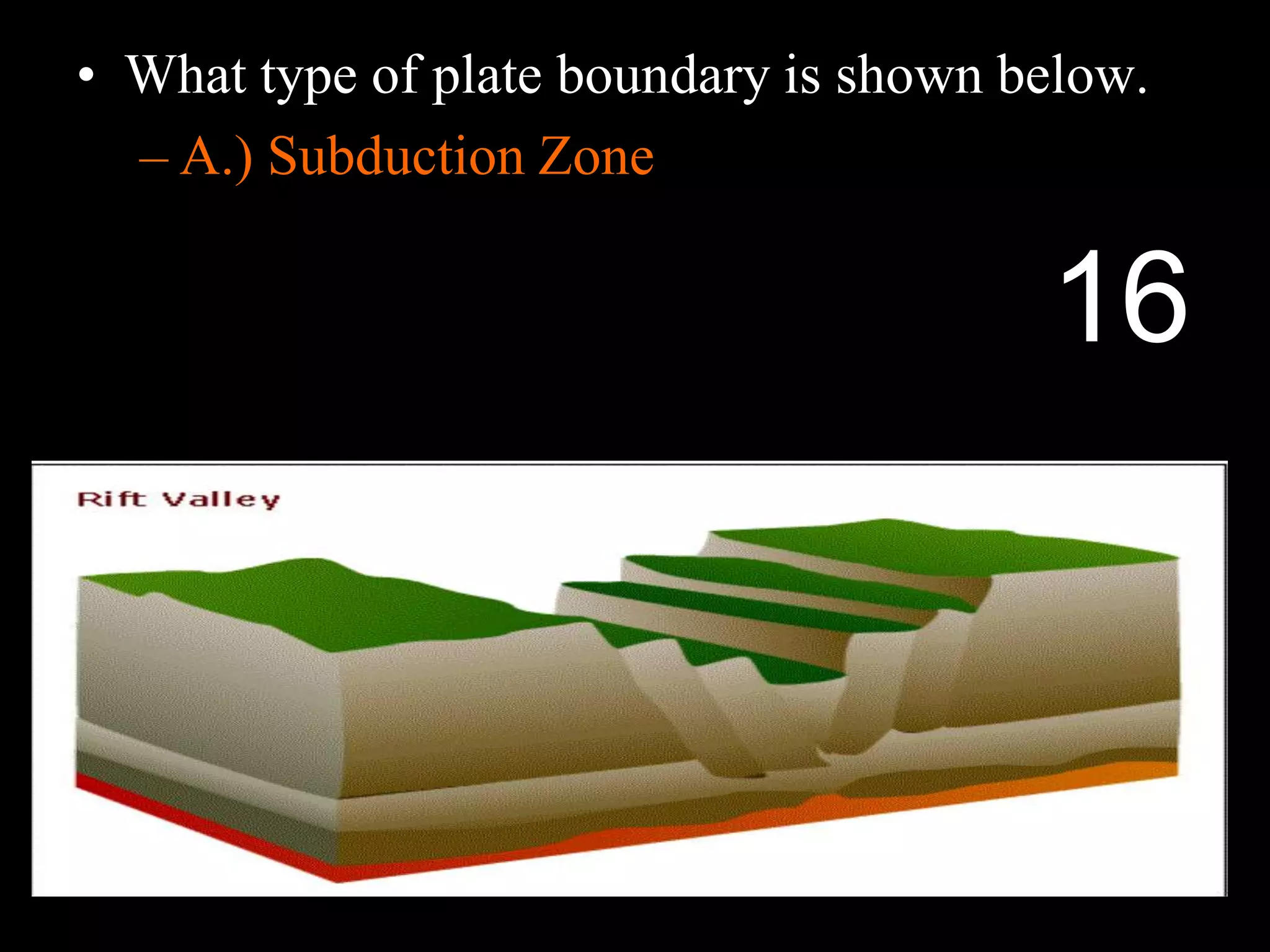
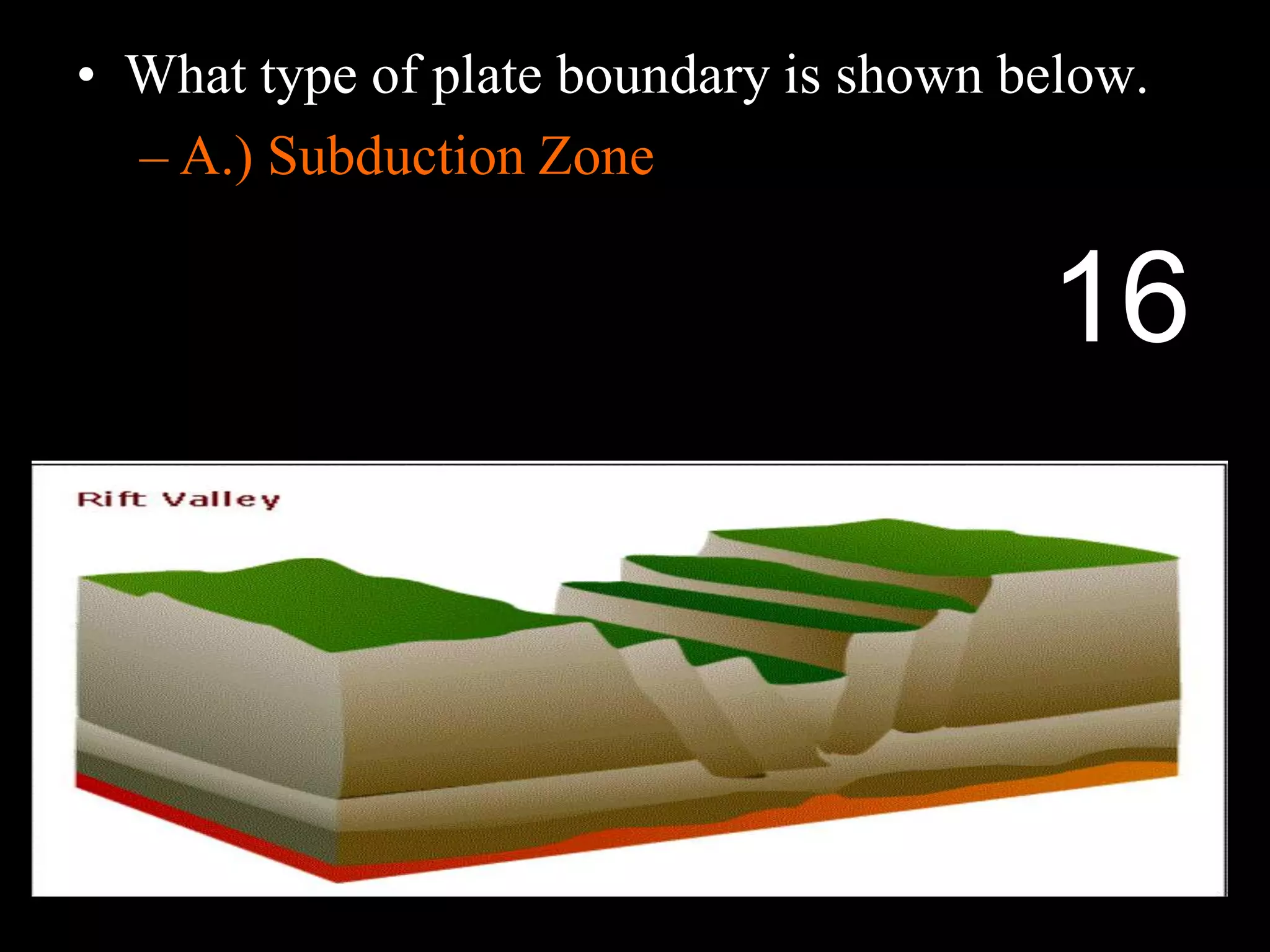
• What type of plate boundary is shown below.
– A.) Subduction Zone
16
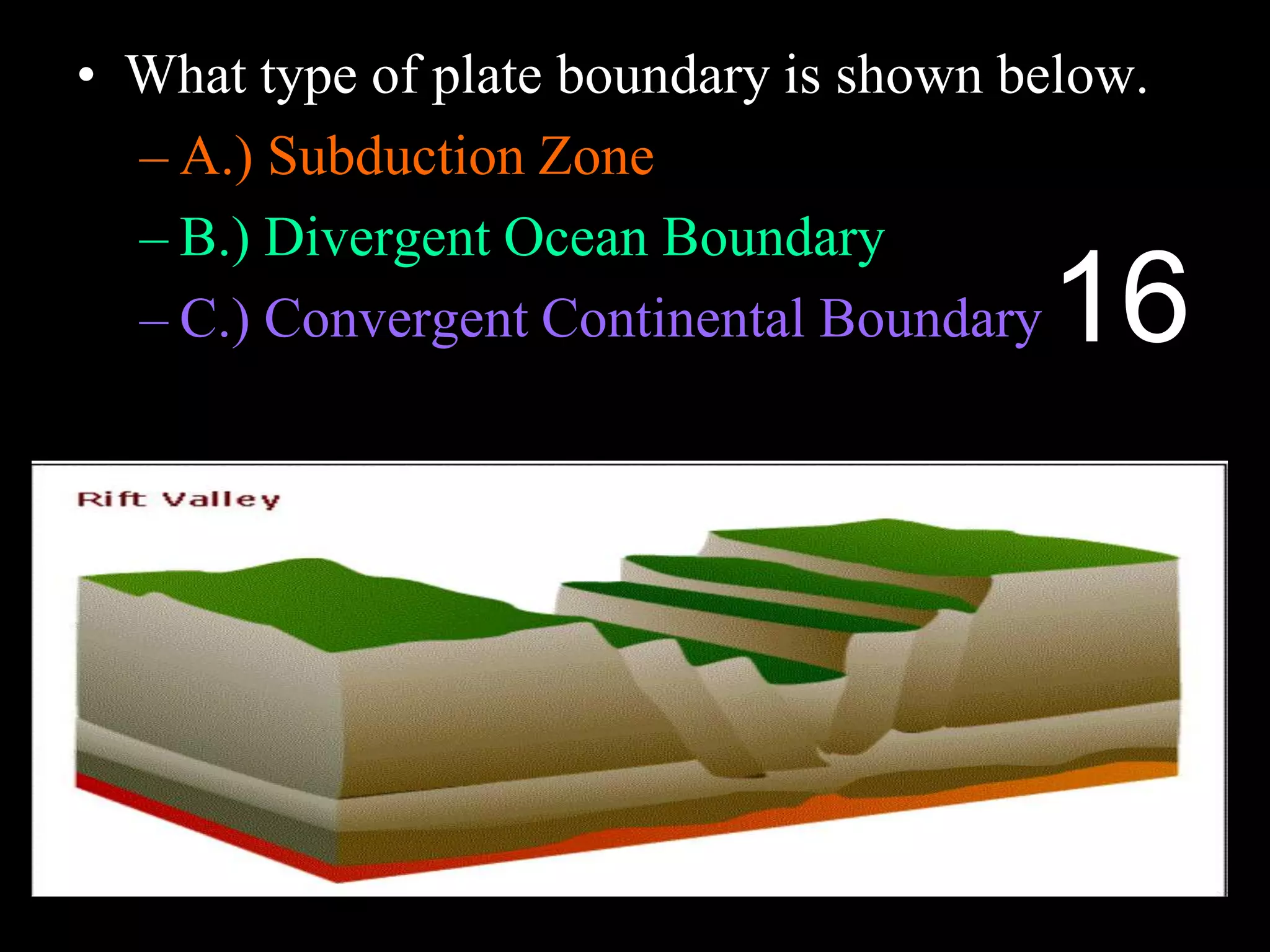
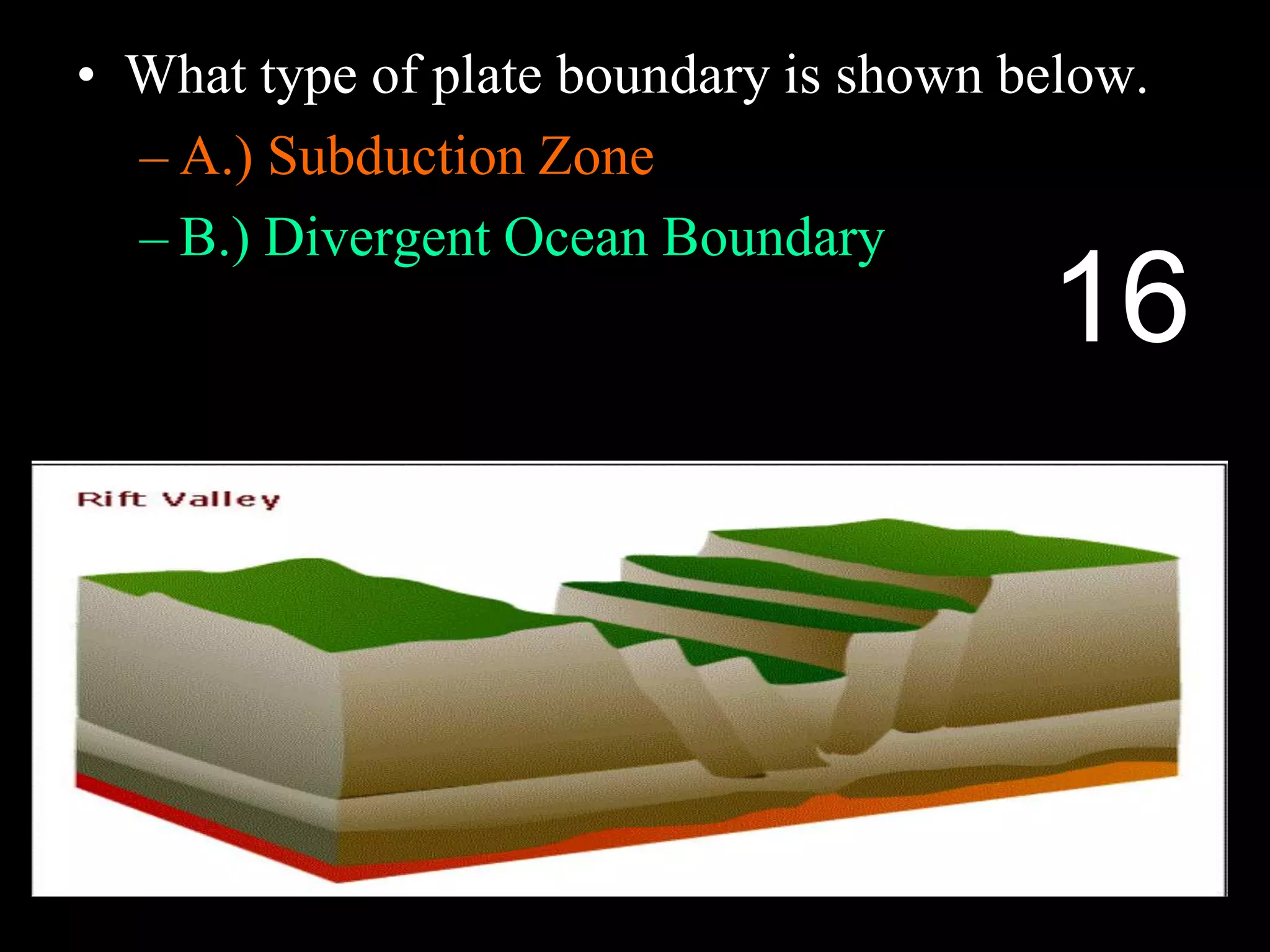
• What type of plate boundary is shown below.
– A.) Subduction Zone
– B.) Divergent Ocean Boundary
16
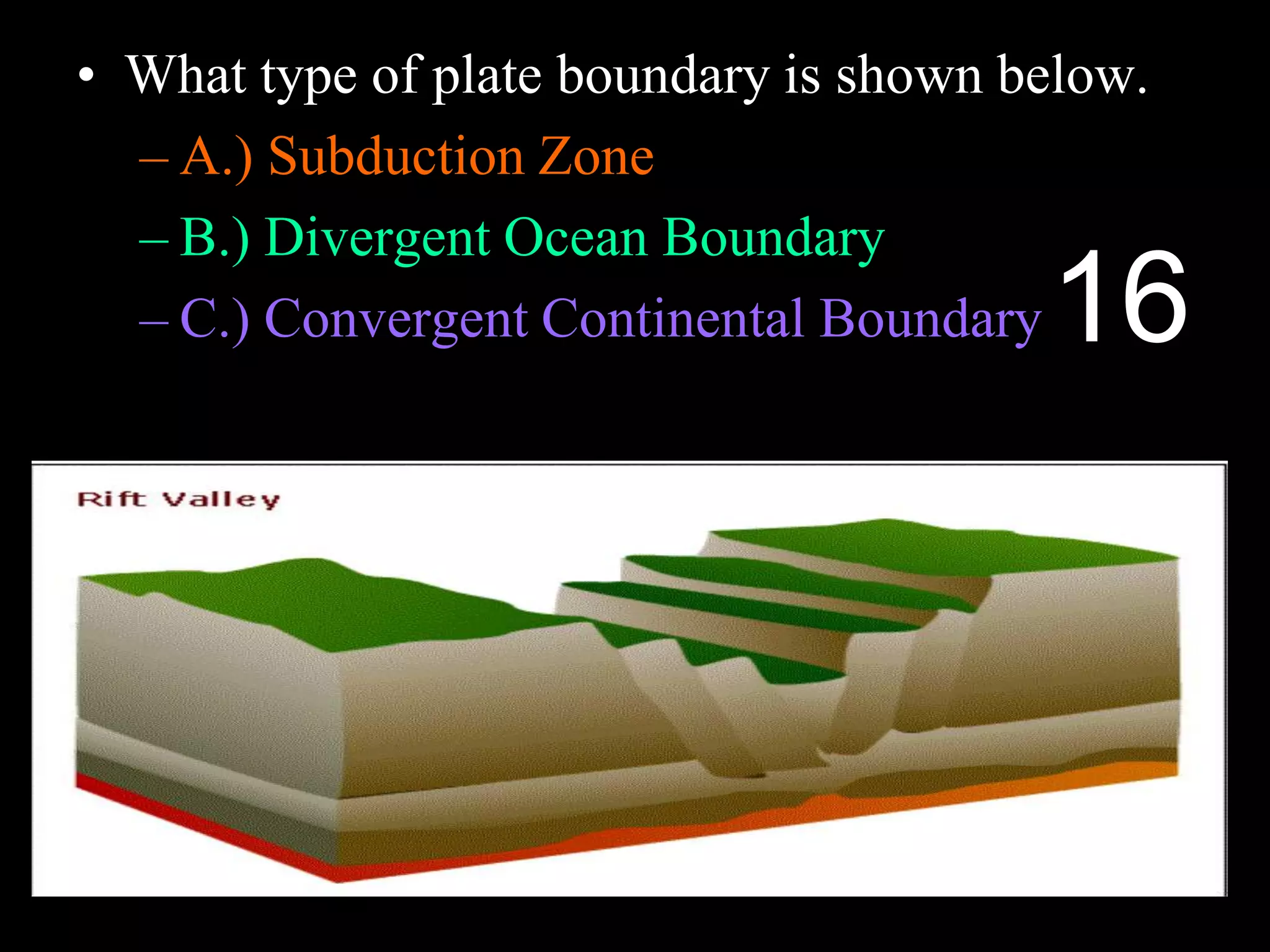
• What type of plate boundary is shown below.
– A.) Subduction Zone
– B.) Divergent Ocean Boundary
– C.) Convergent Continental Boundary16
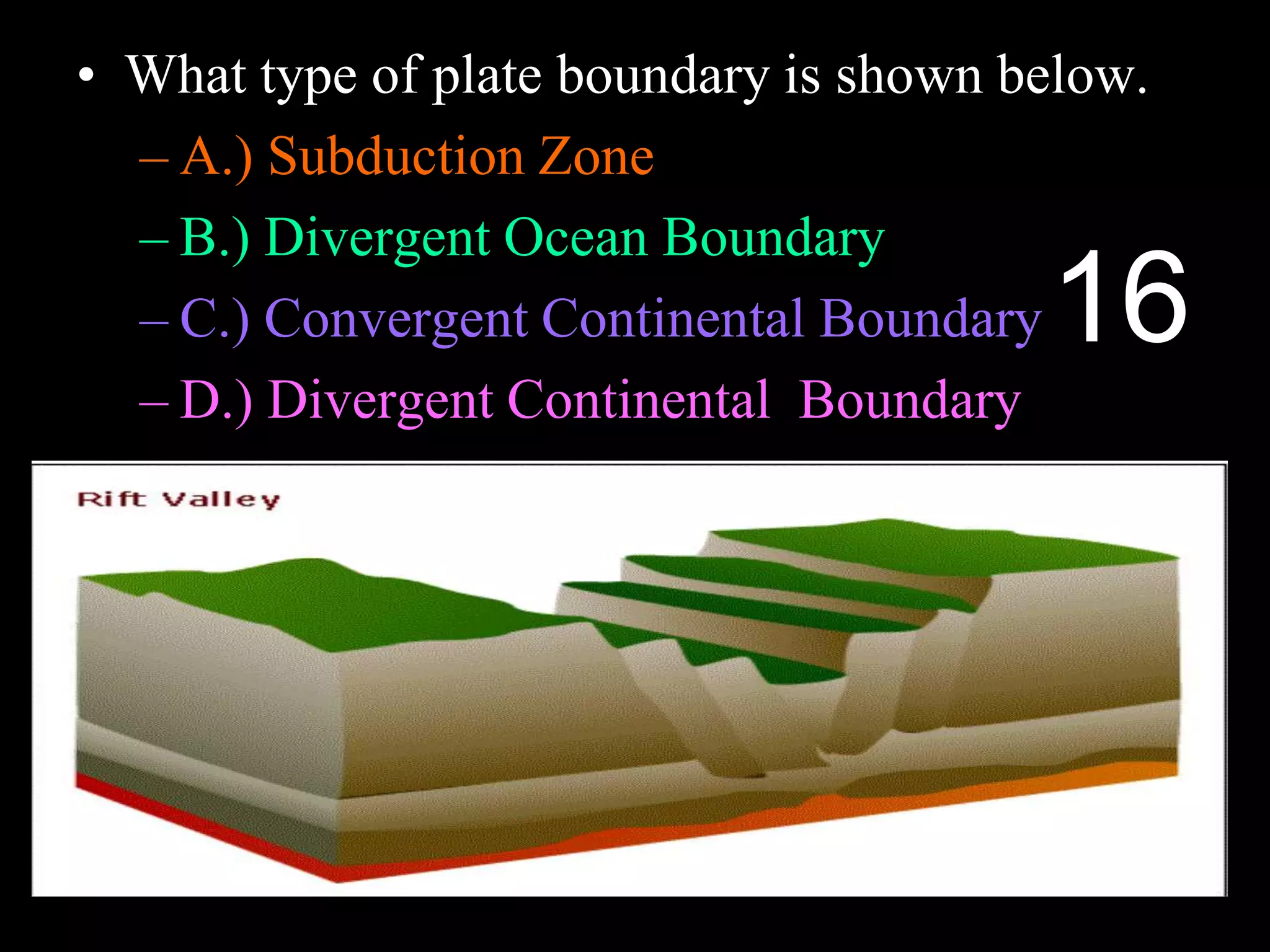
• What type of plate boundary is shown below.
– A.) Subduction Zone
– B.) Divergent Ocean Boundary
– C.) Convergent Continental Boundary
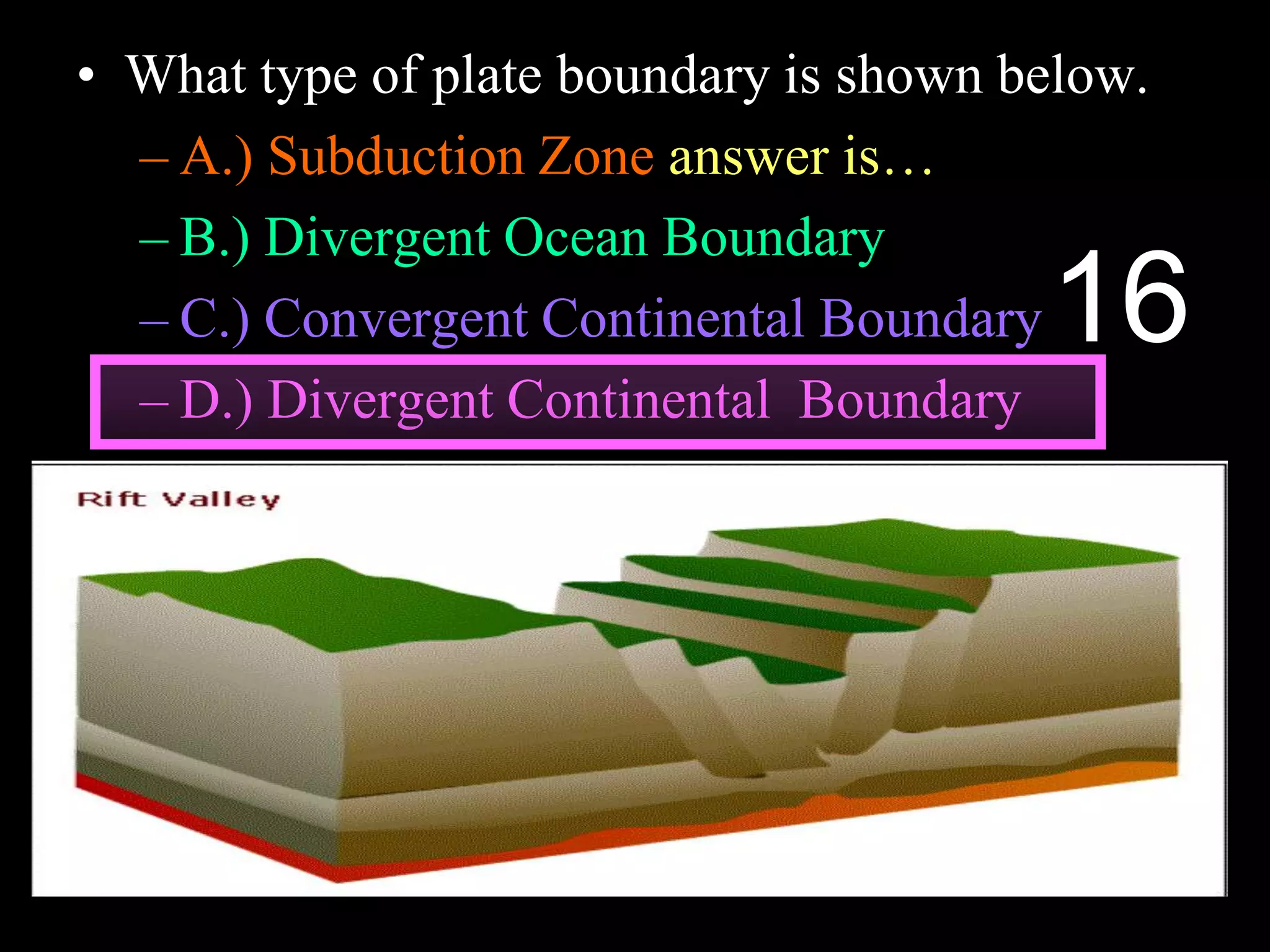
– D.) Divergent Continental Boundary
16
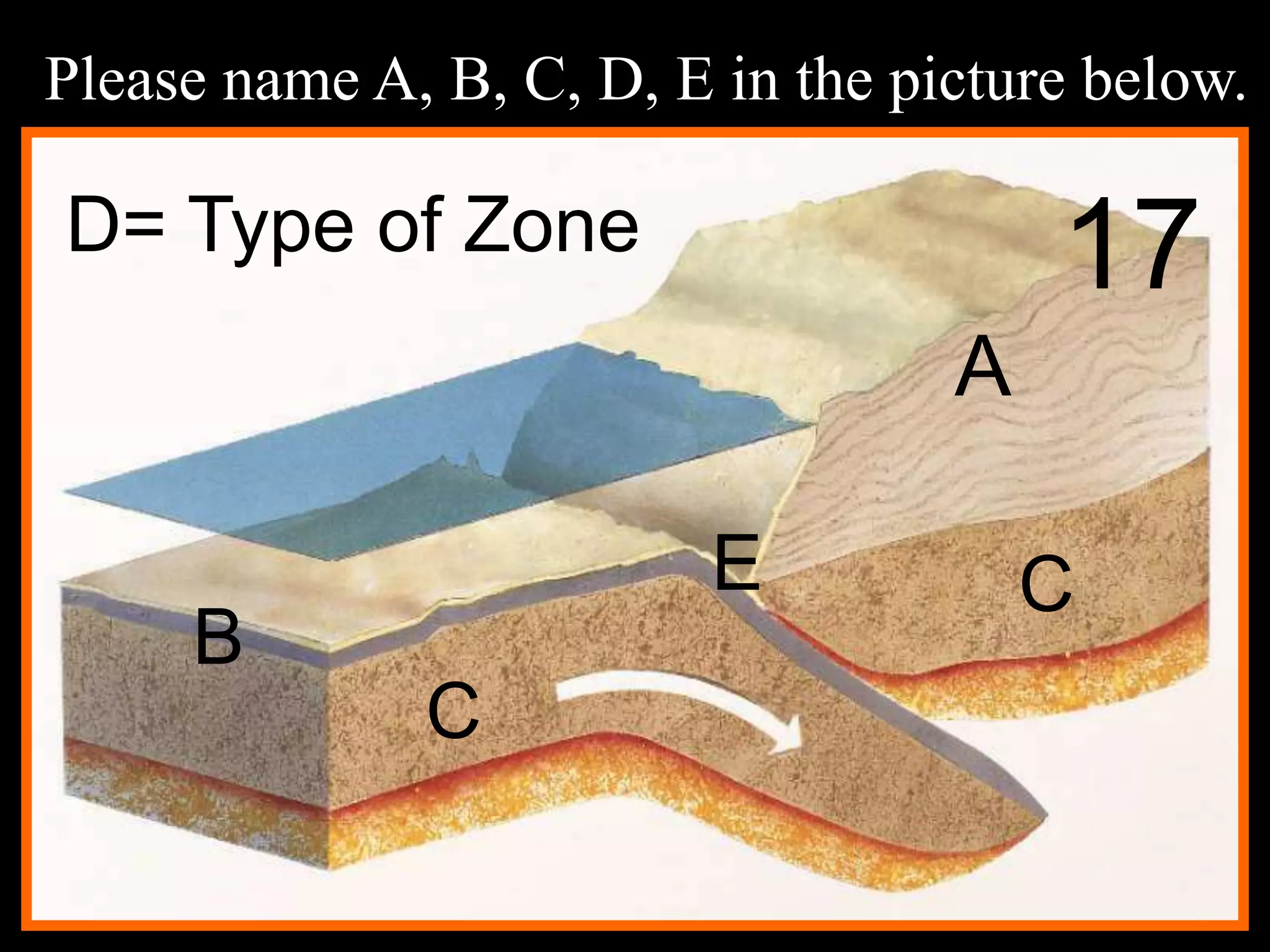
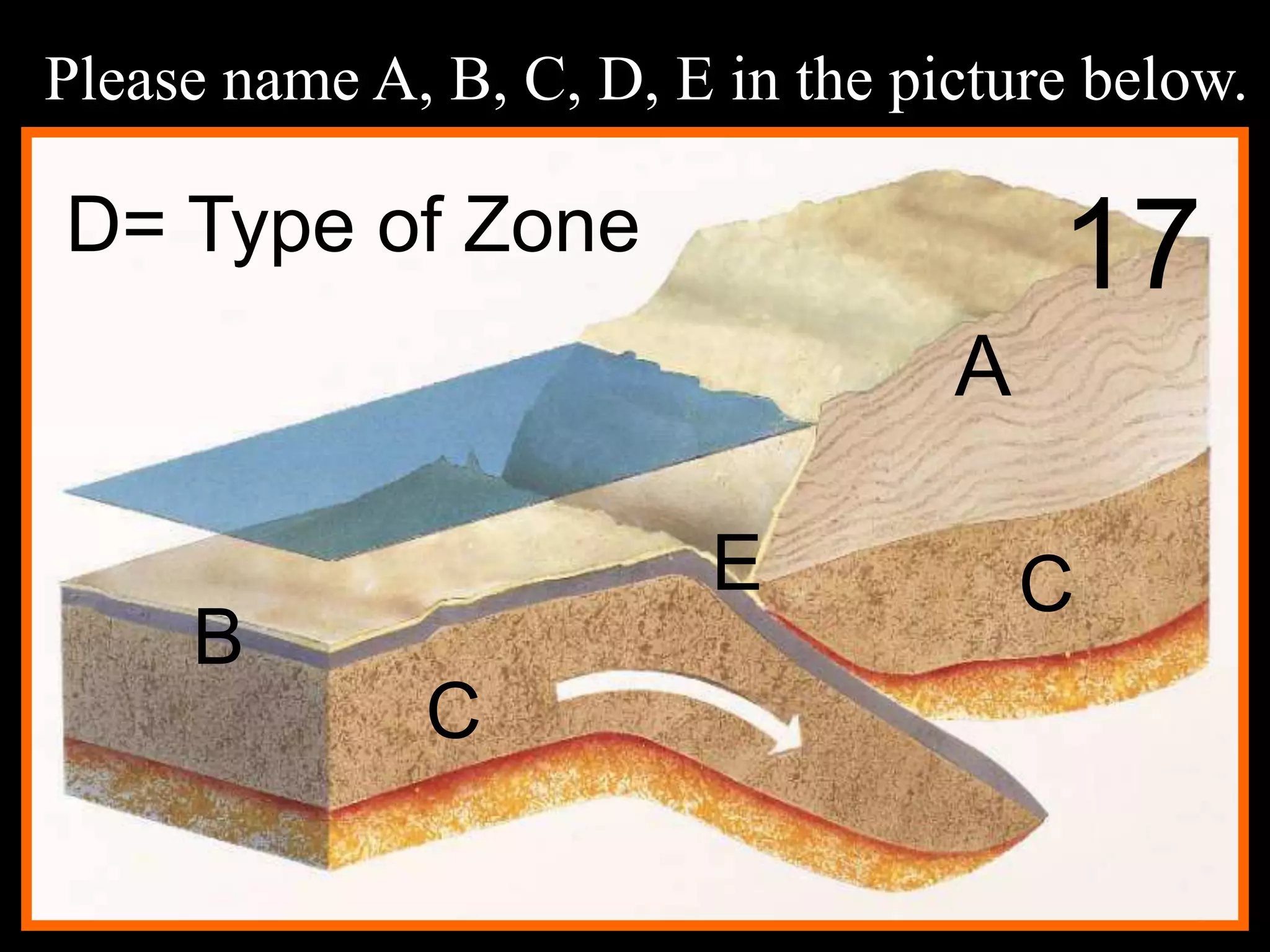
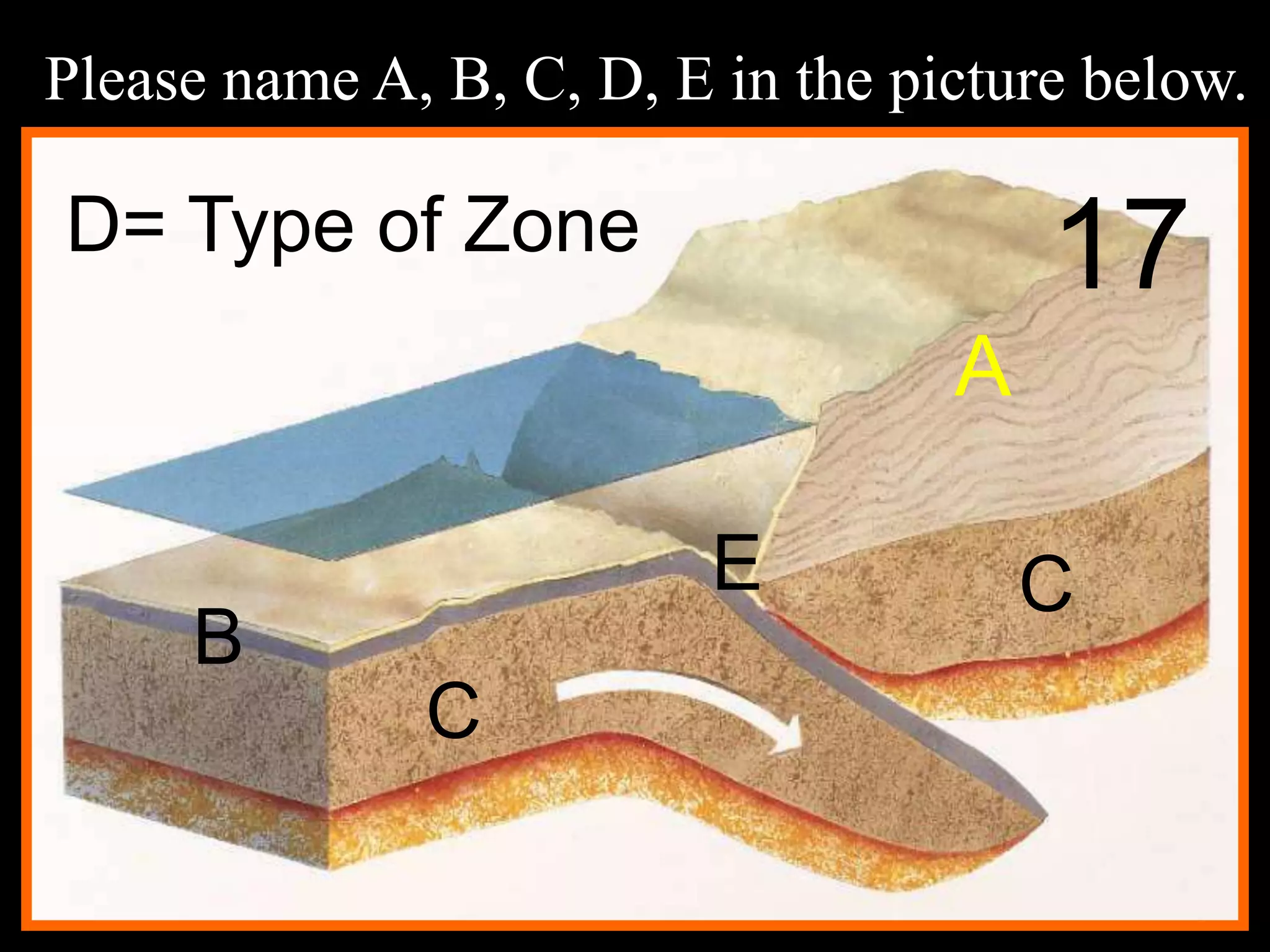
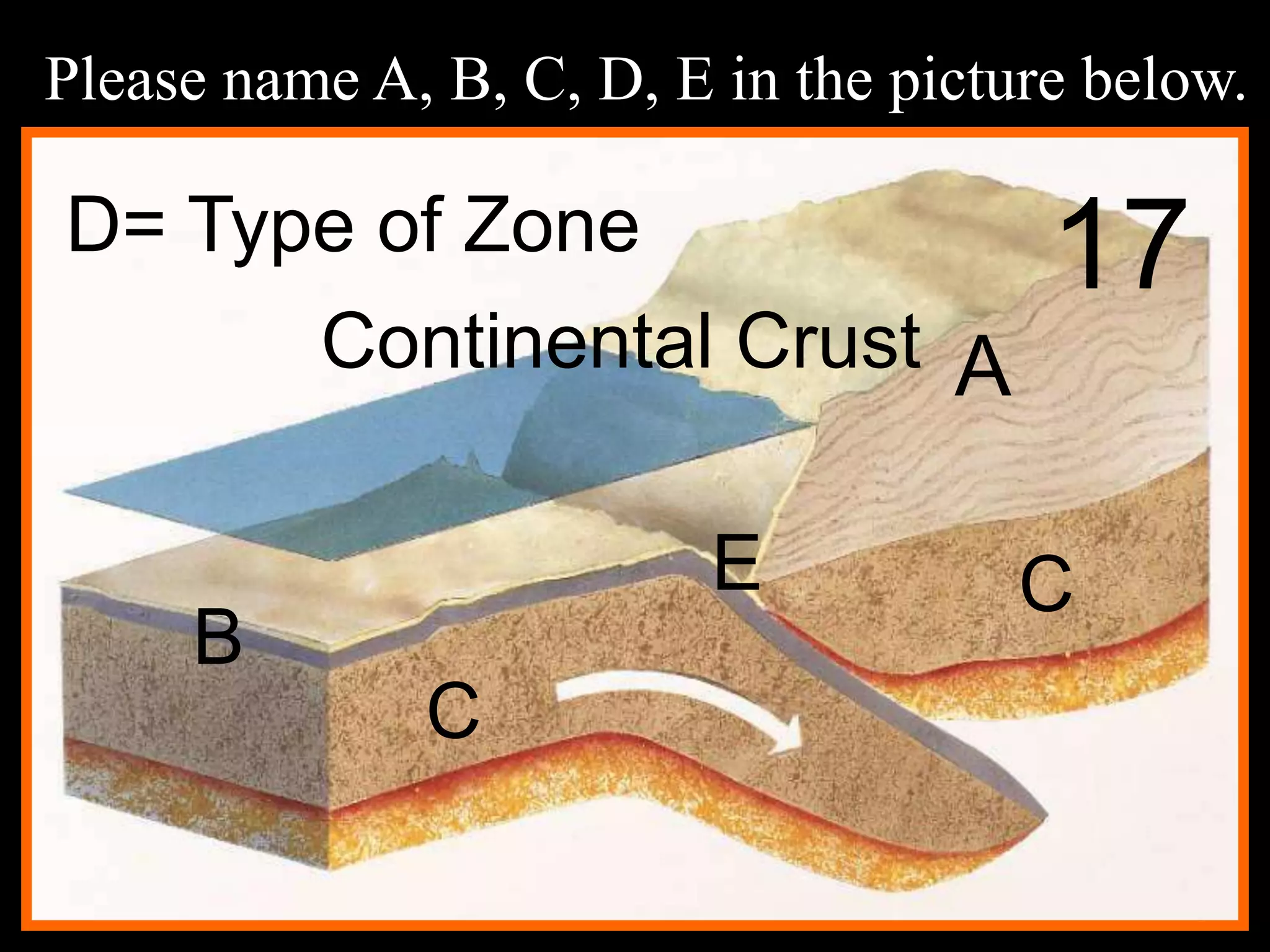
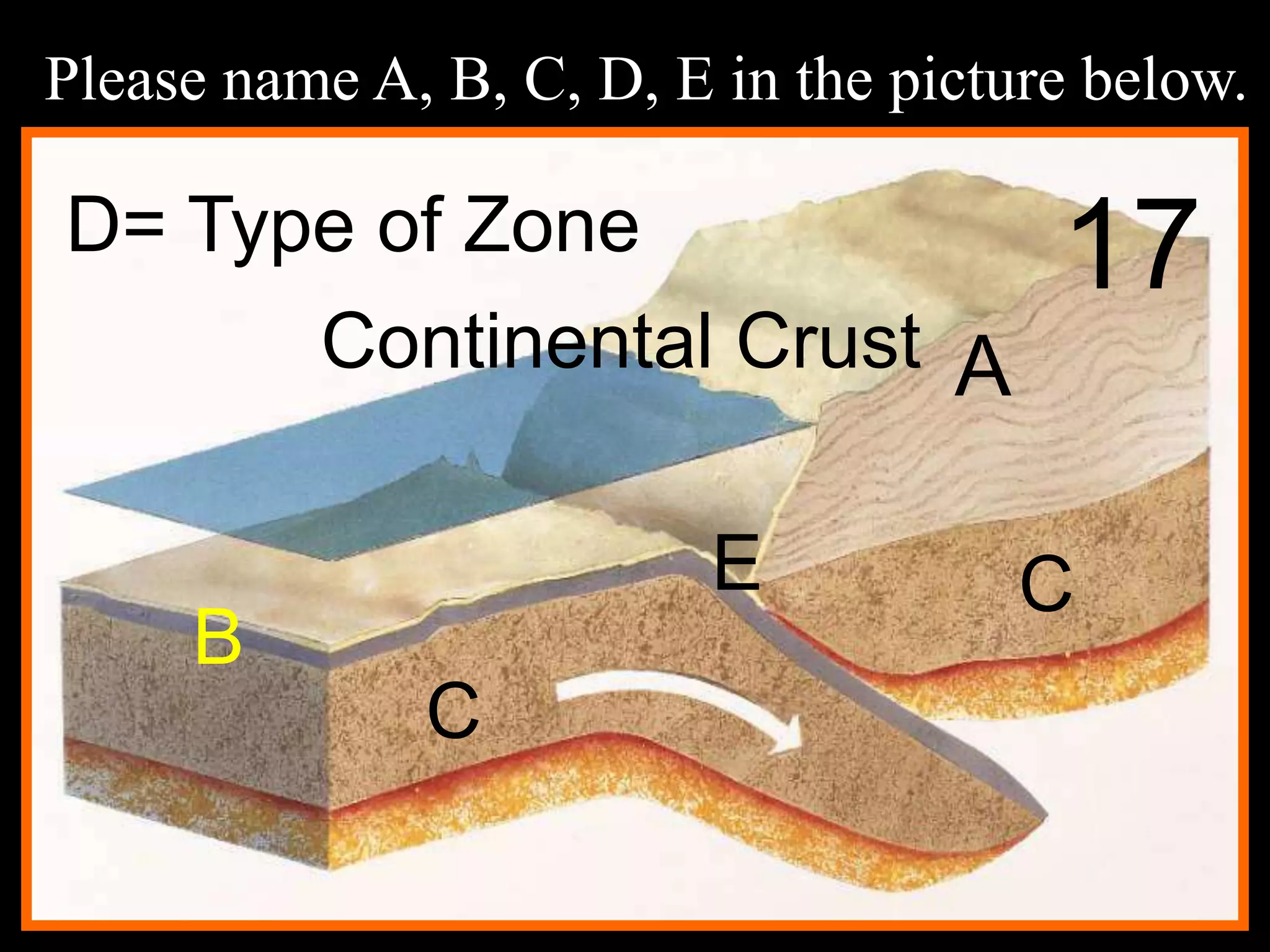
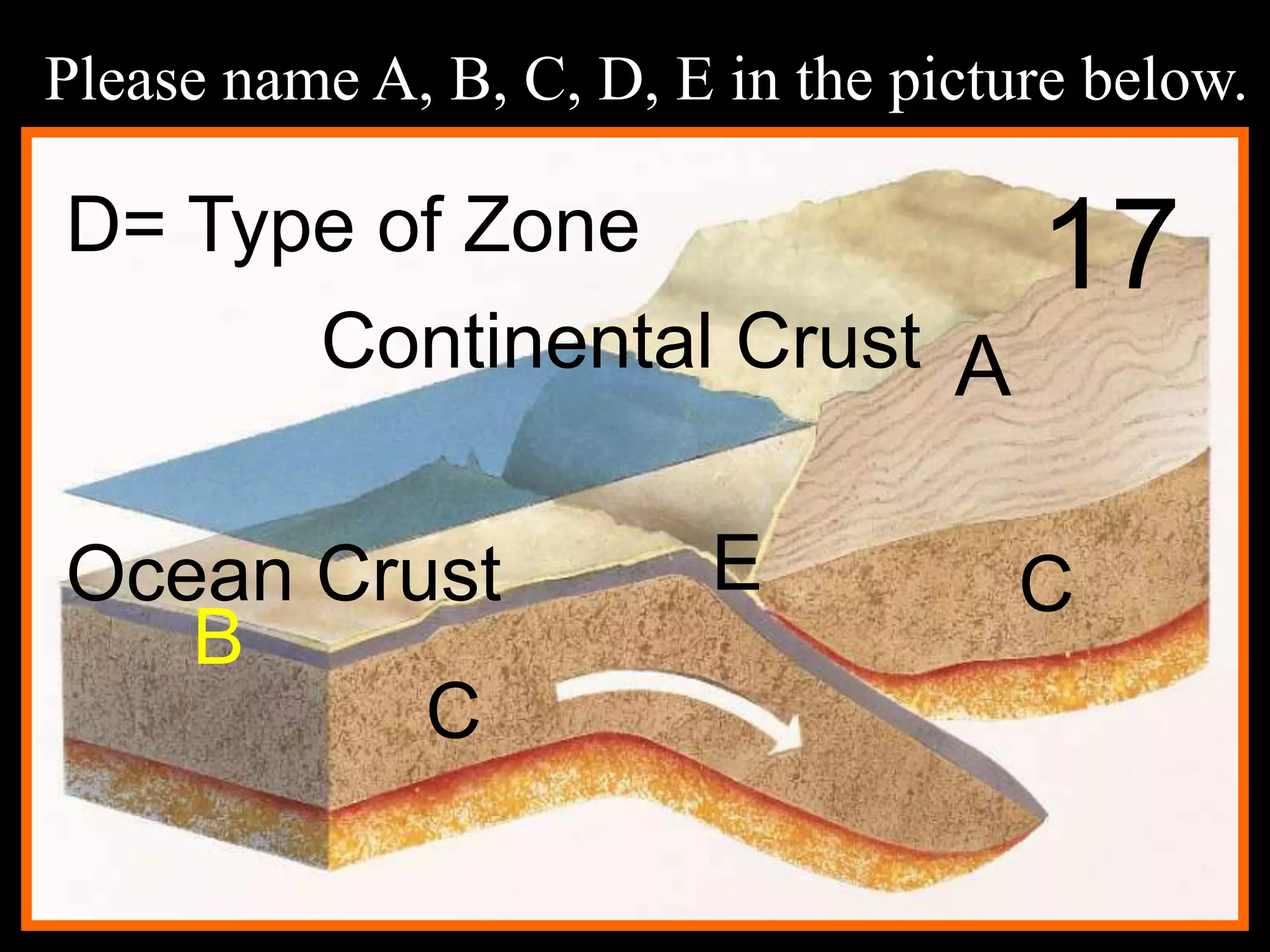
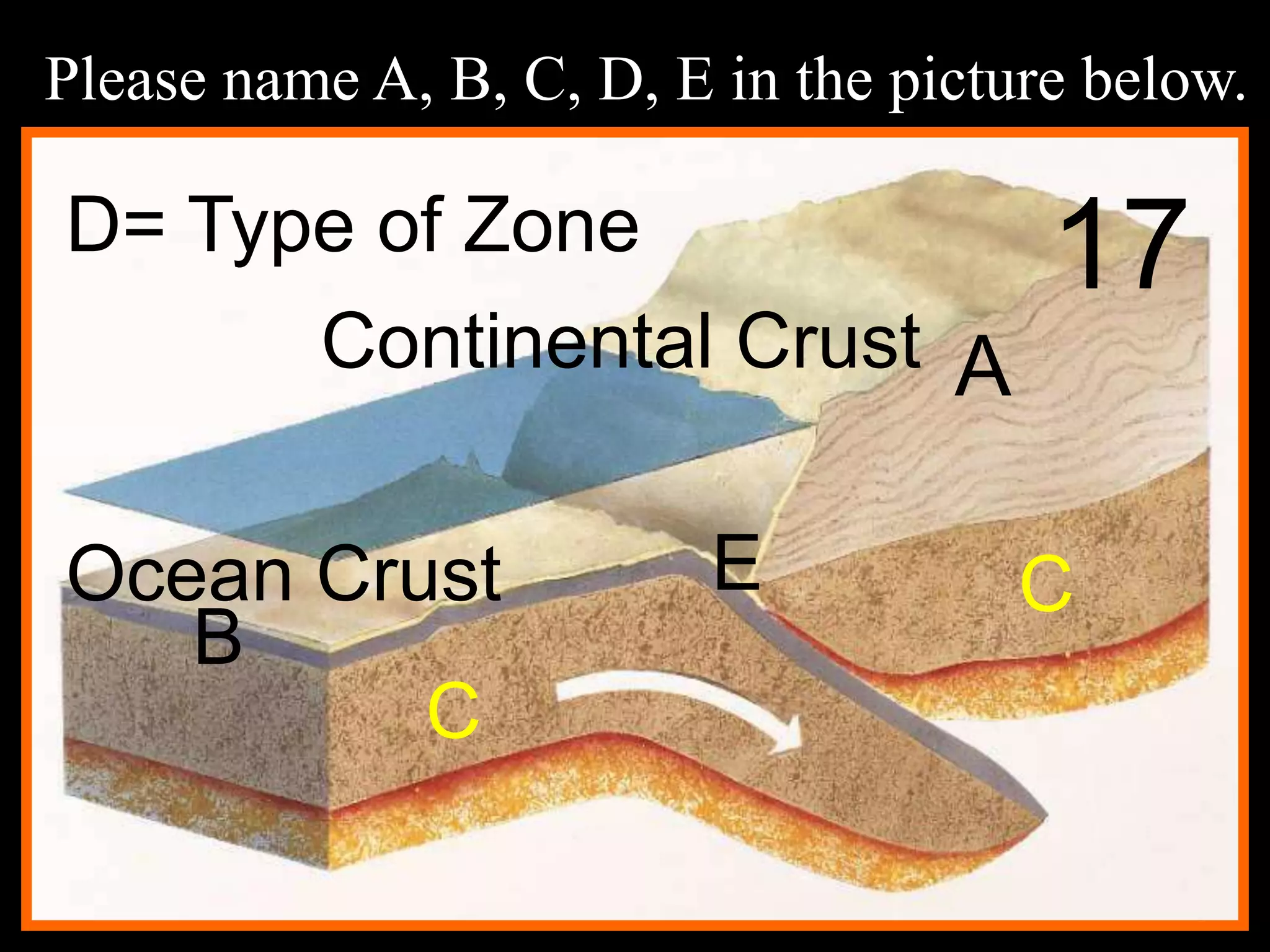
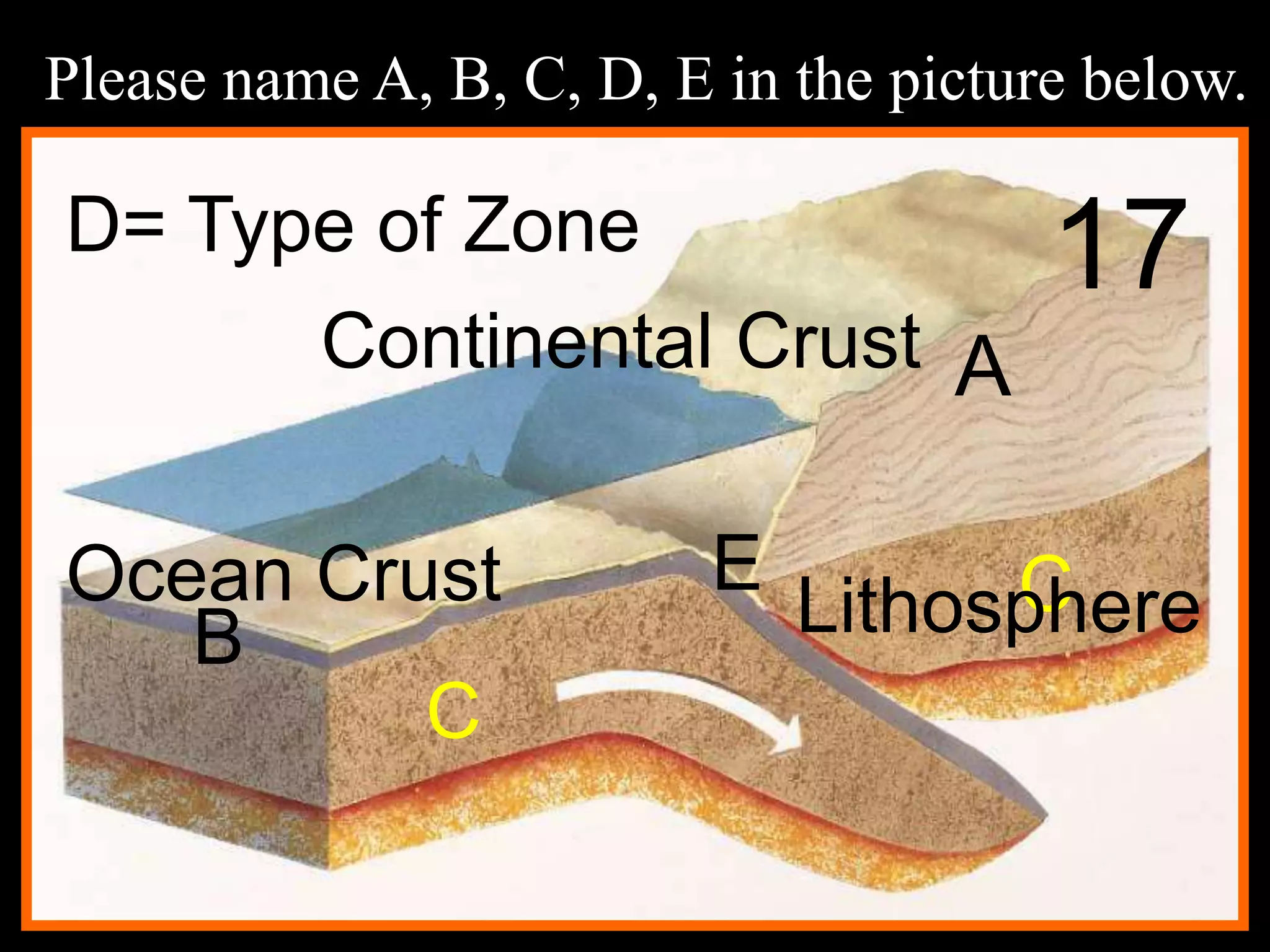
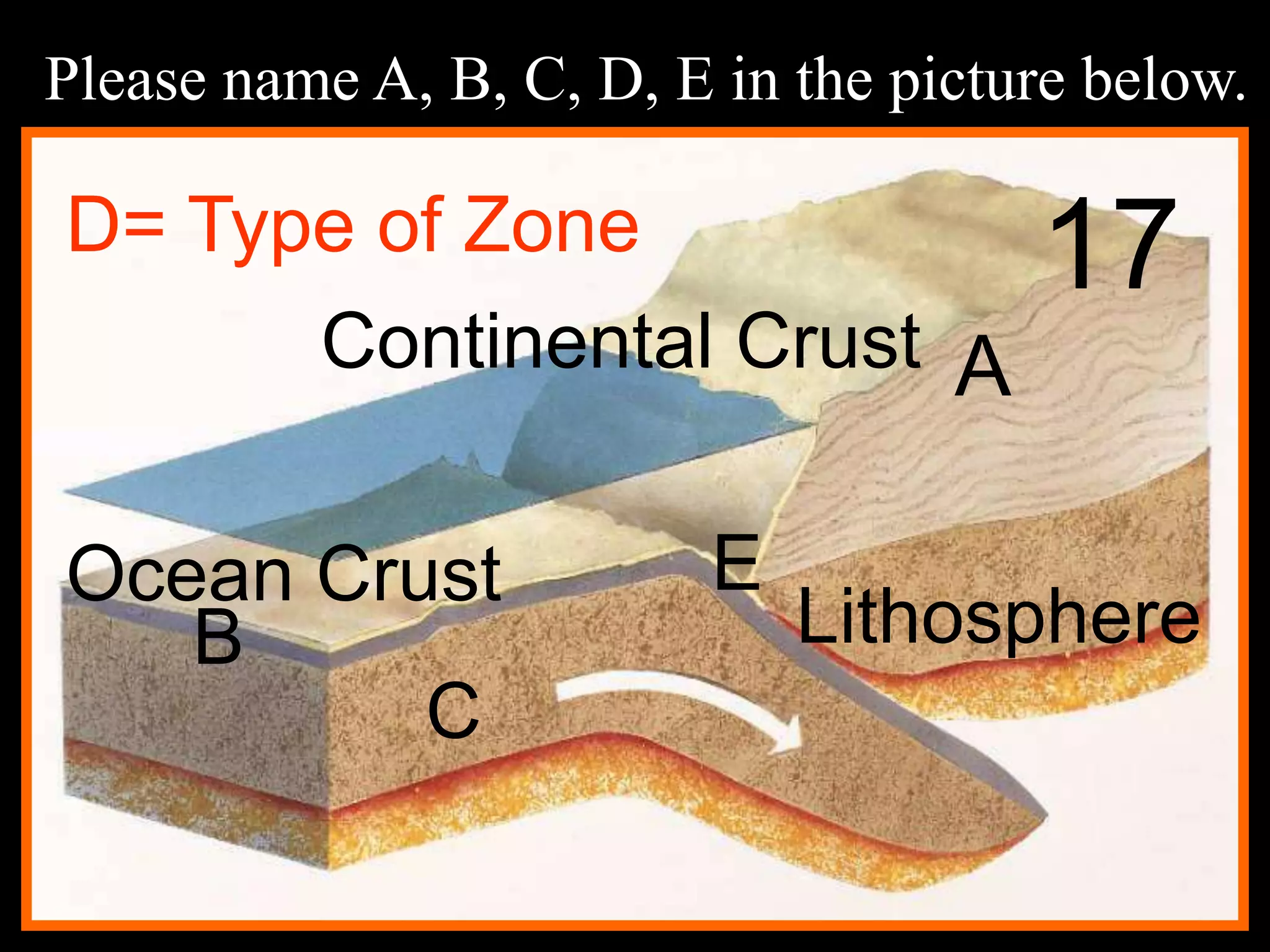
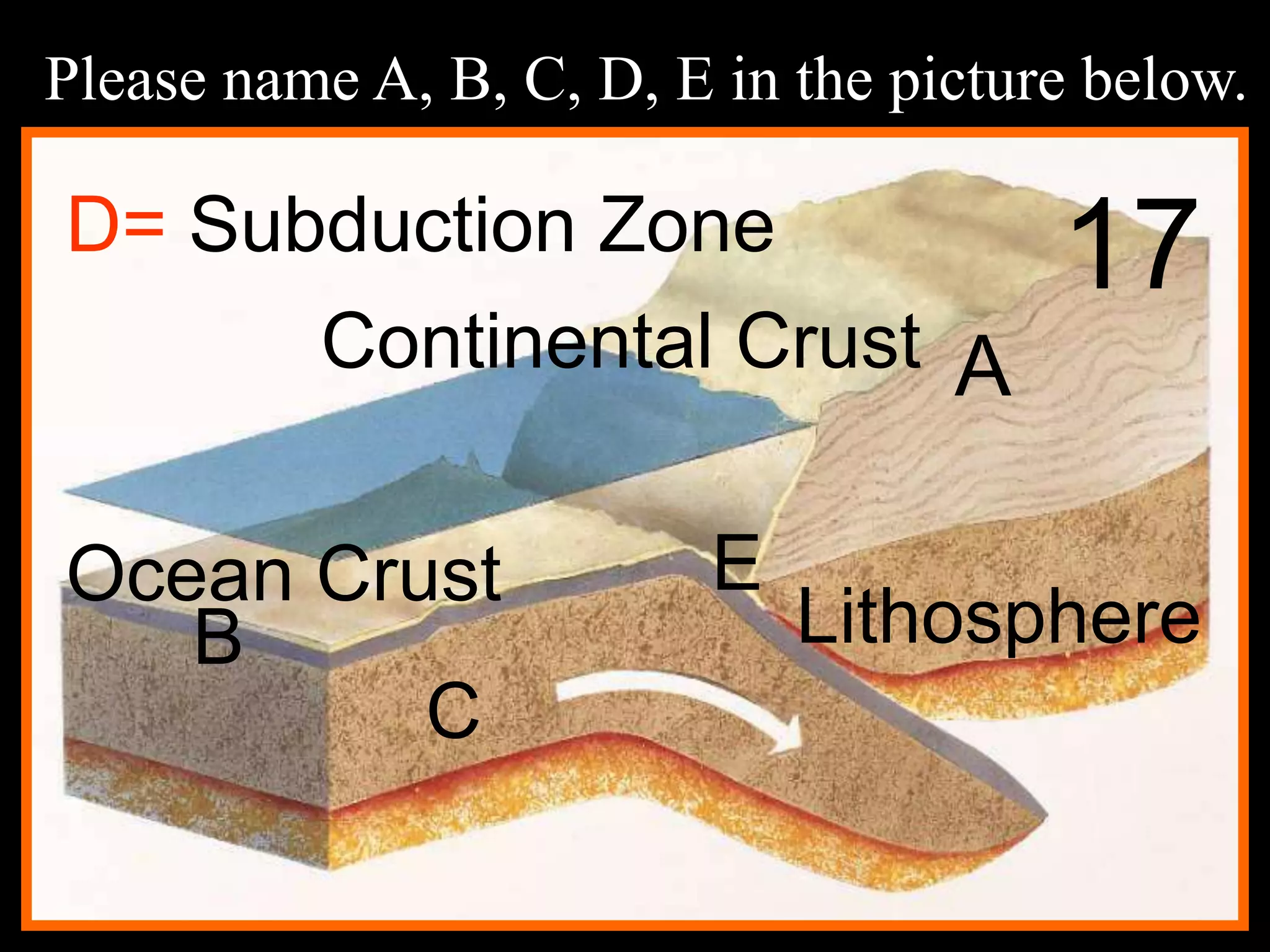
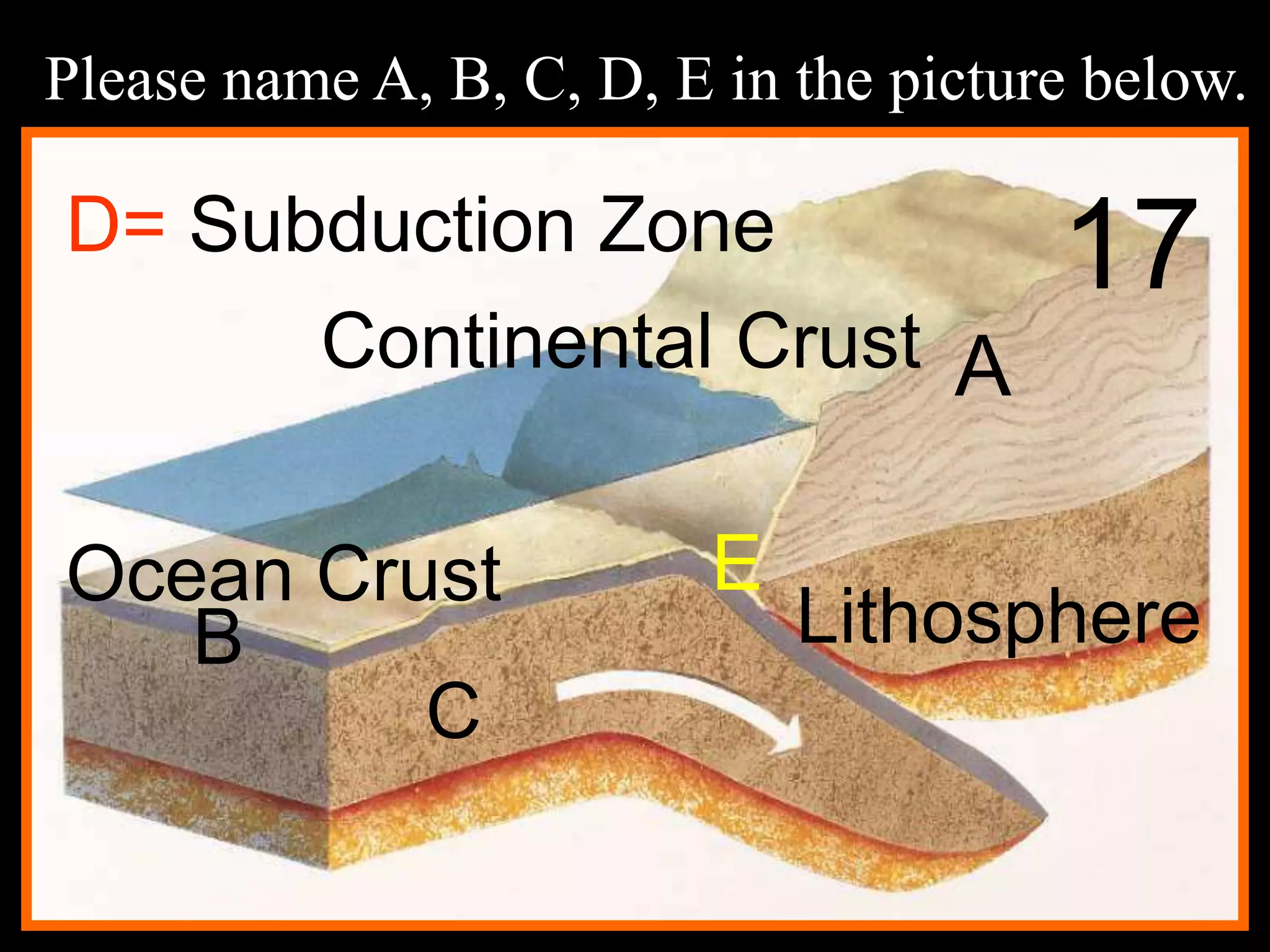
Please name A, B, C, D, E in the picture below.
17
A
B
C
CE
D= Type of Zone
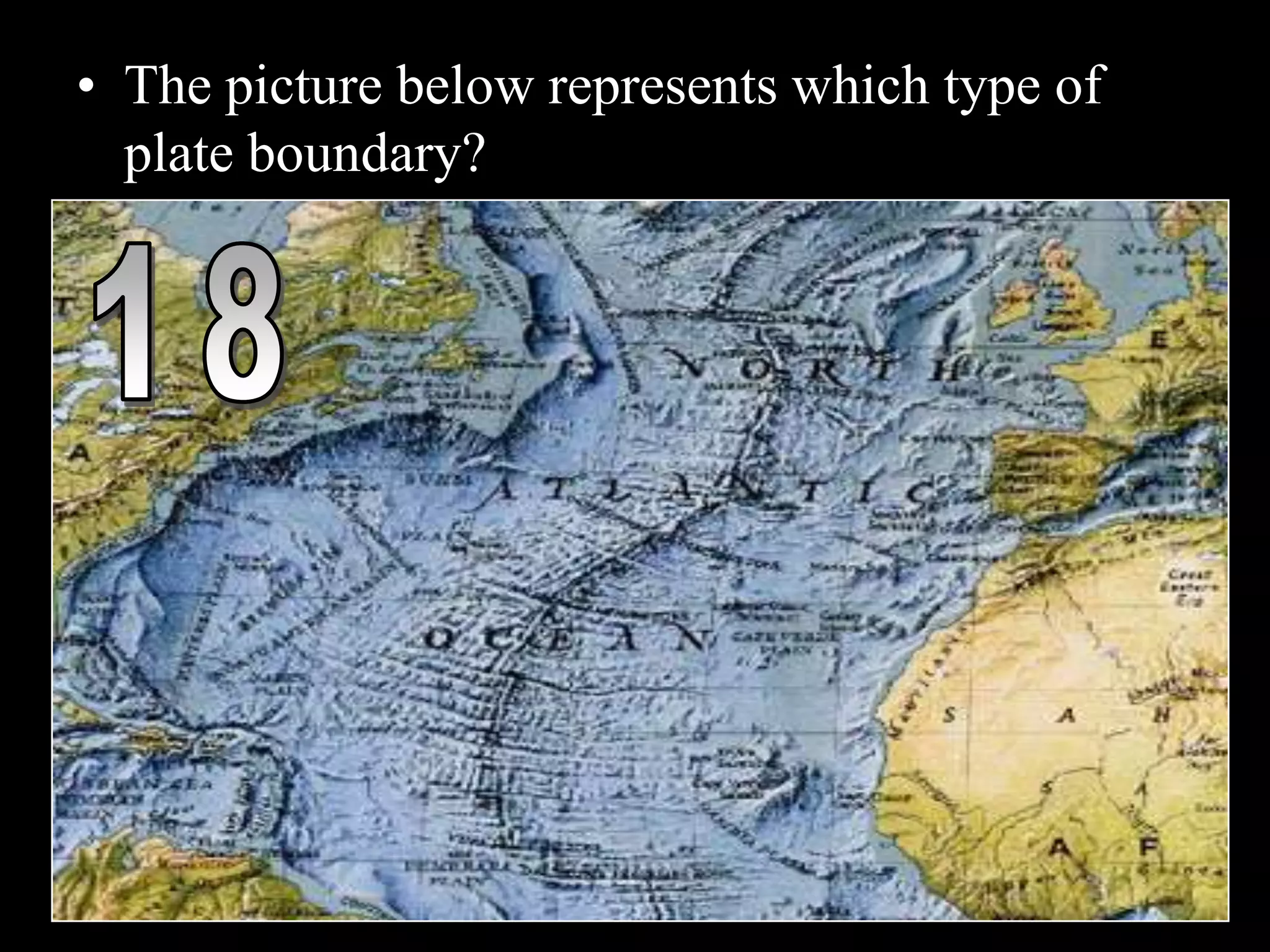
• The picture below represents which type of
plate boundary?
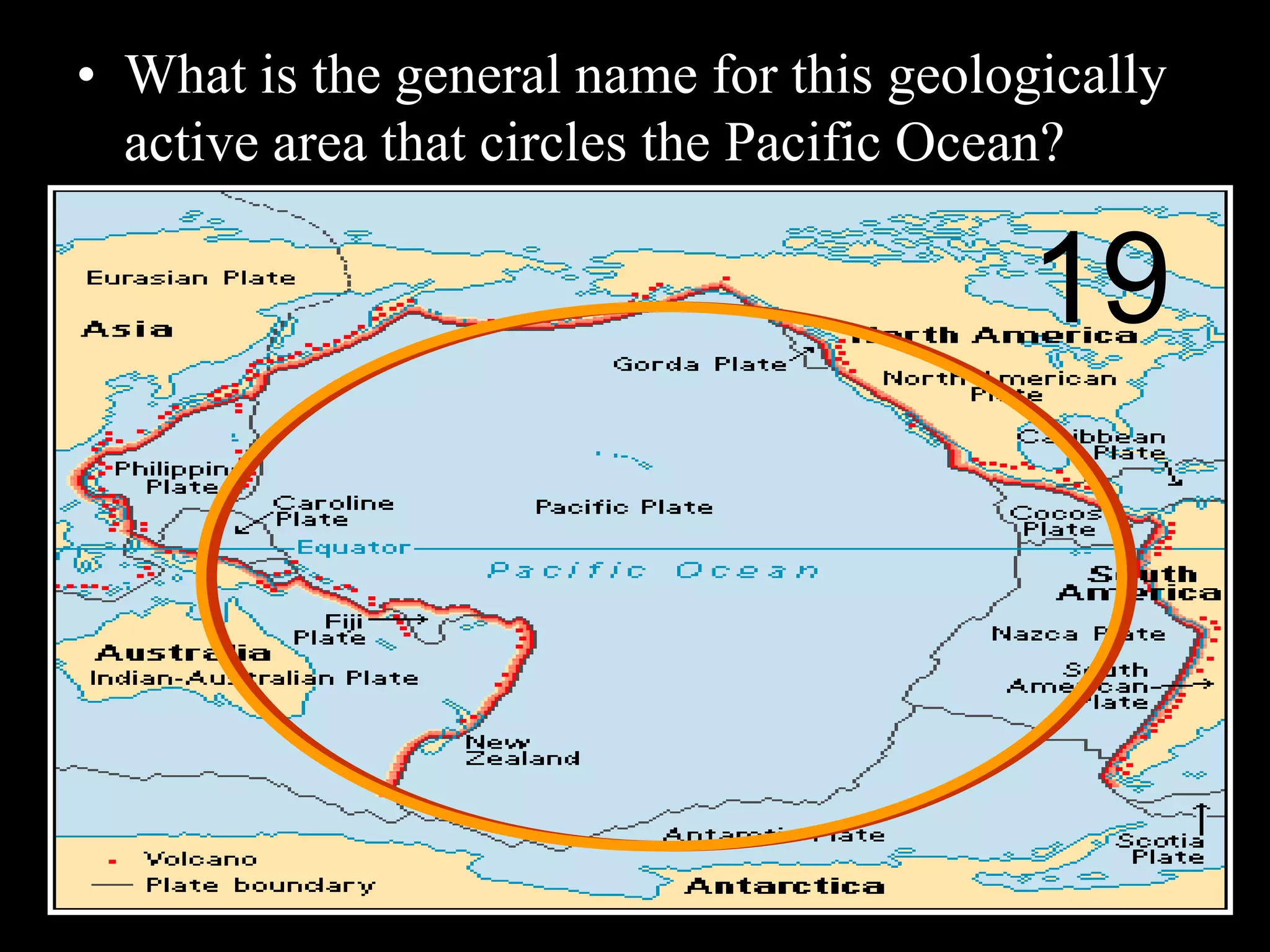
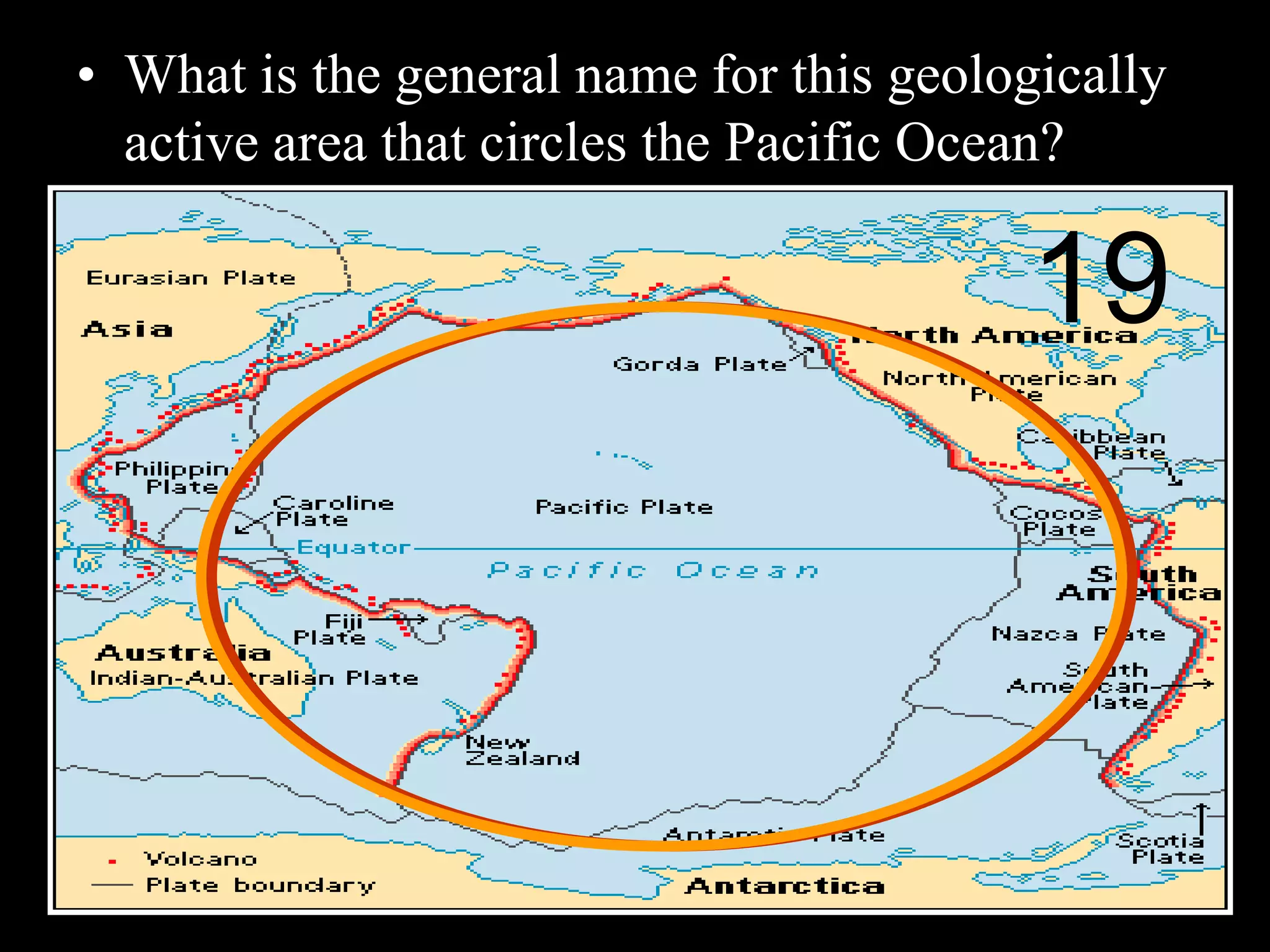
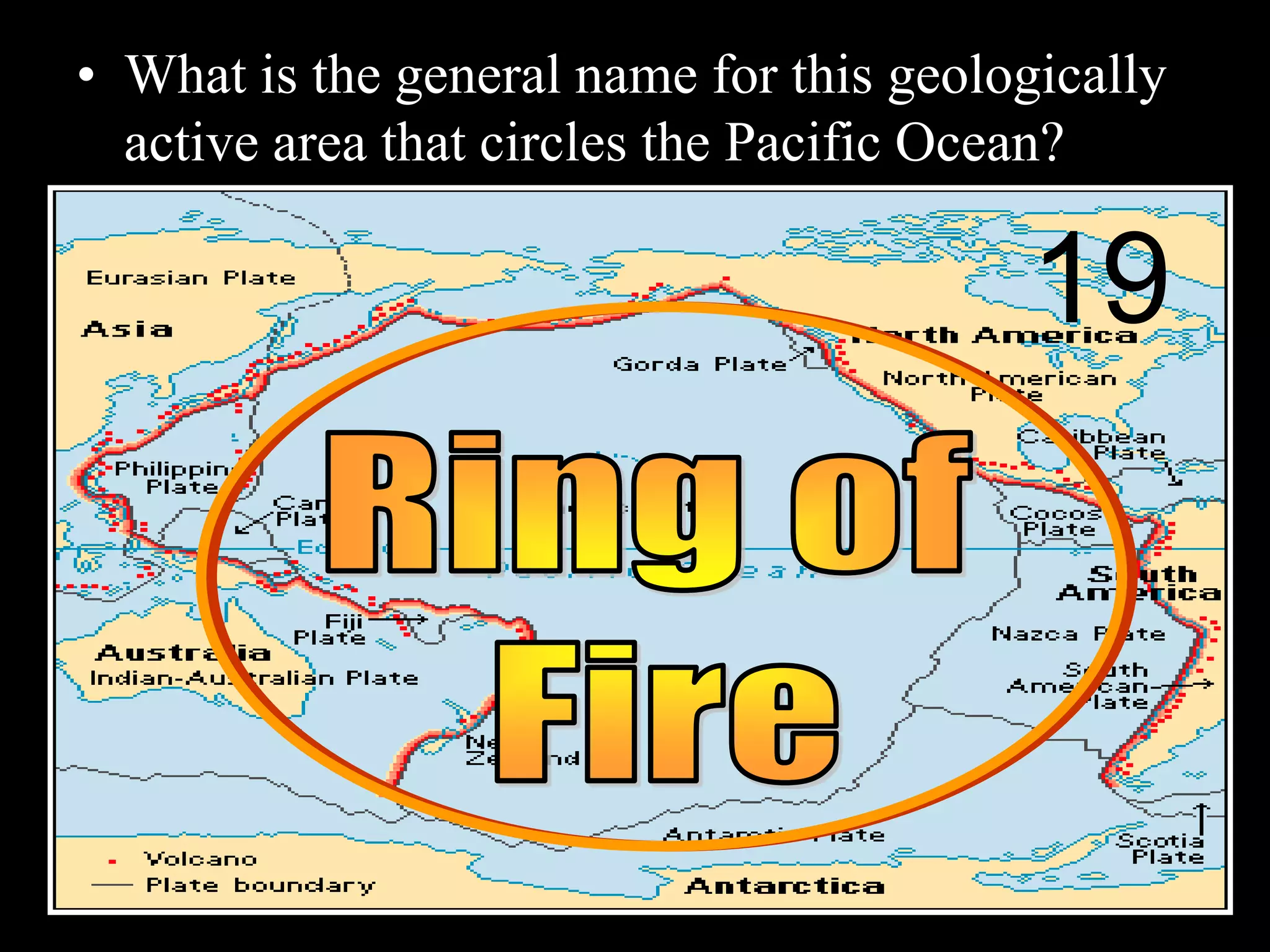
• What is the general name for this geologically
active area that circles the Pacific Ocean?
19
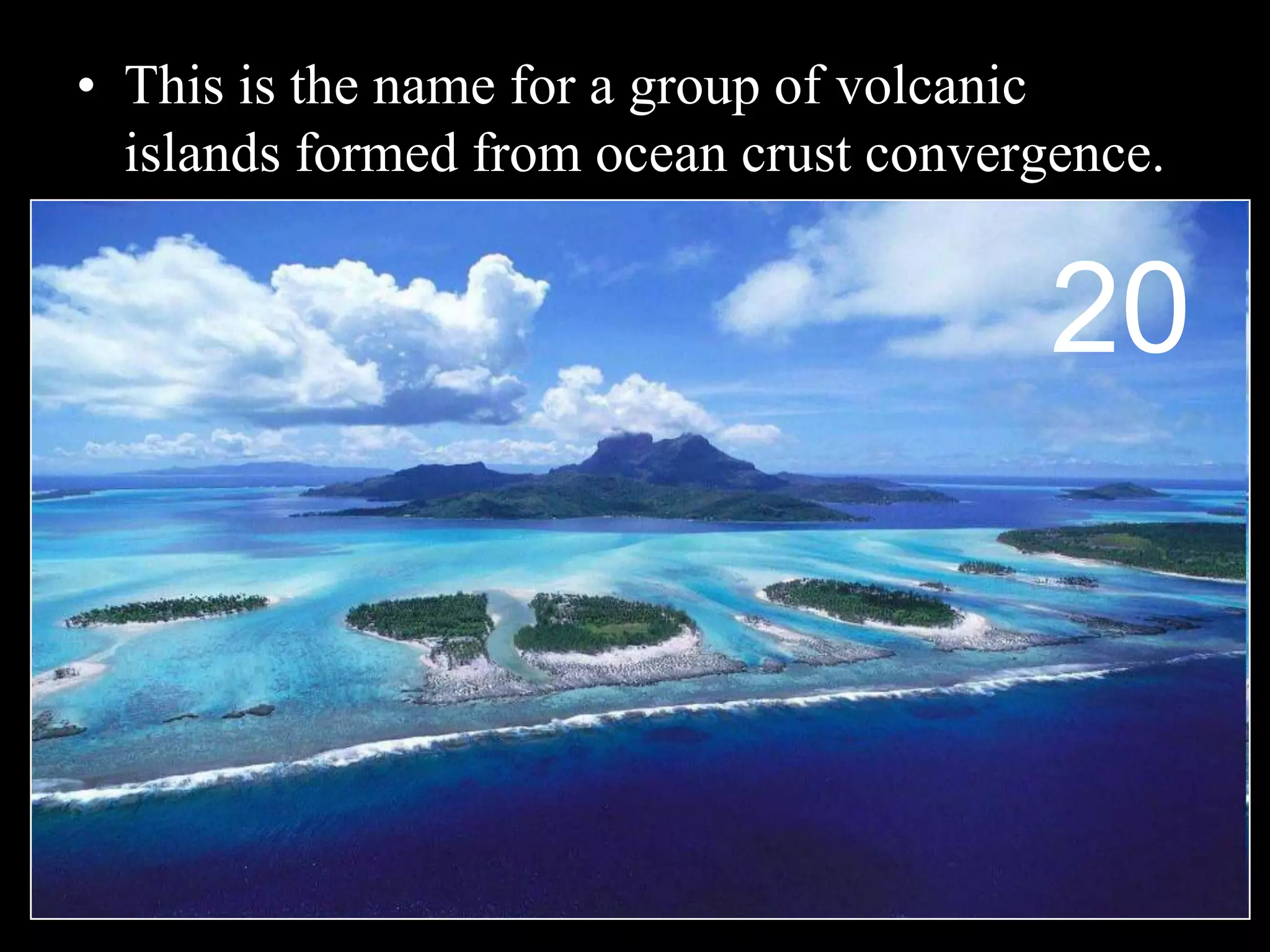
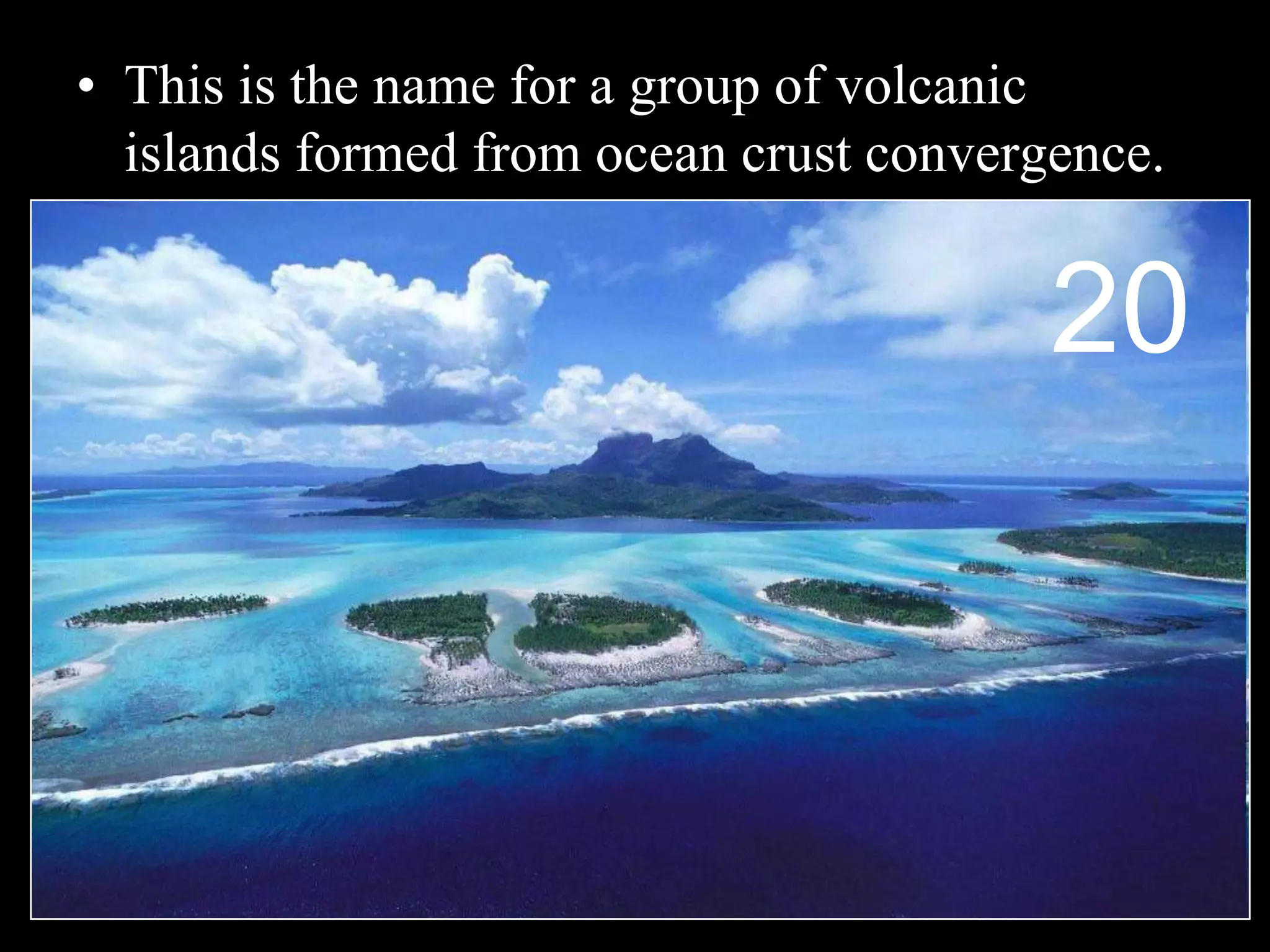
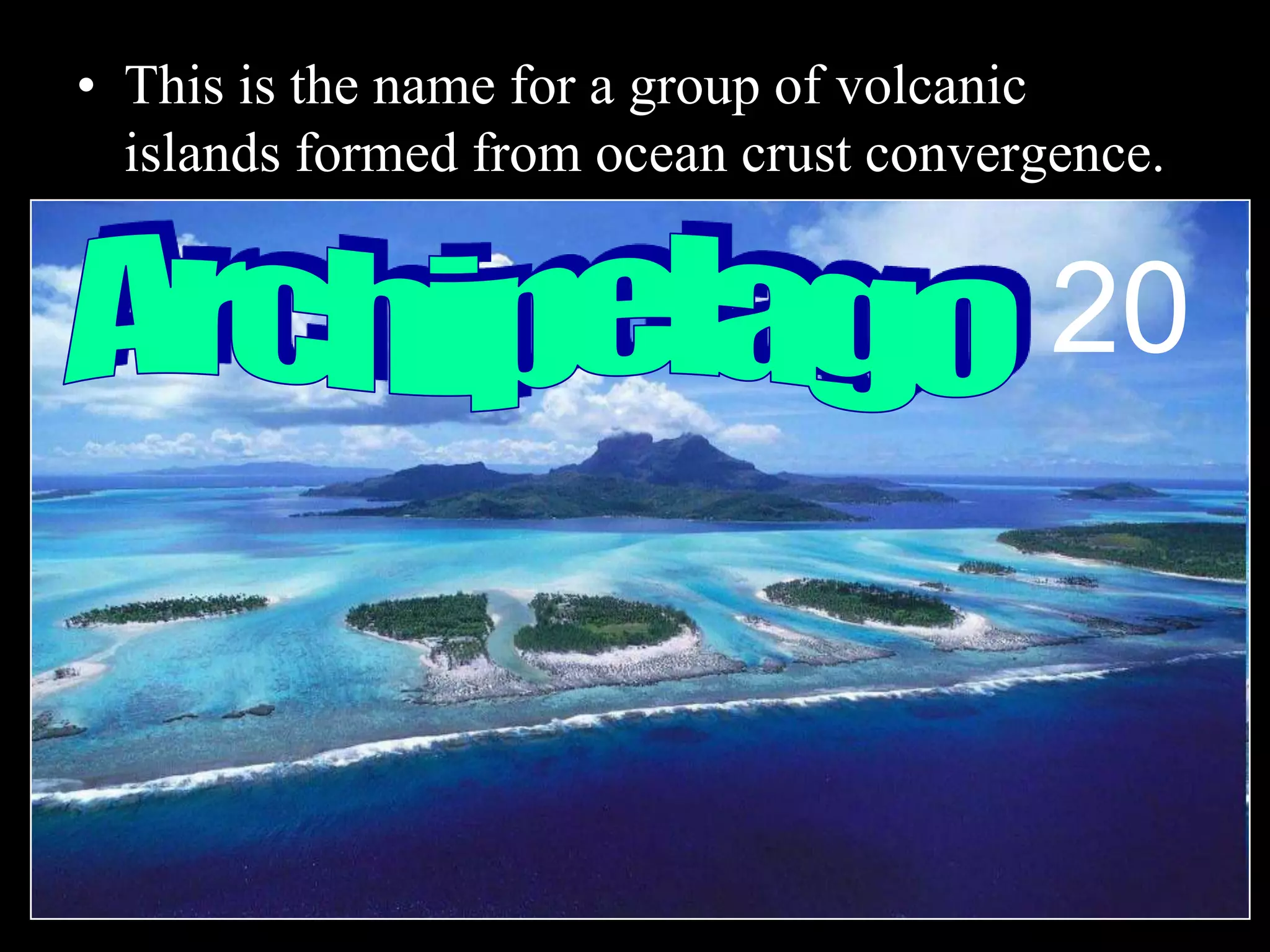
• This is the name for a group of volcanic
islands formed from ocean crust convergence.
20
MOVING
AROUND
LAYERS OF
EVIDENCE
TERRARIFIC A LOT ON
YOUR PLATE
-BONUS-
NAME THE
PLACE AND
CONTINENT
1 6 11 16 *21
2 7 12 17 *22
3 8 13 18 *23
4 9 14 19 *24
5 10 15 20 *25
Copyright © 2010 Ryan P. Murphy
Dynamic Earth Review Game
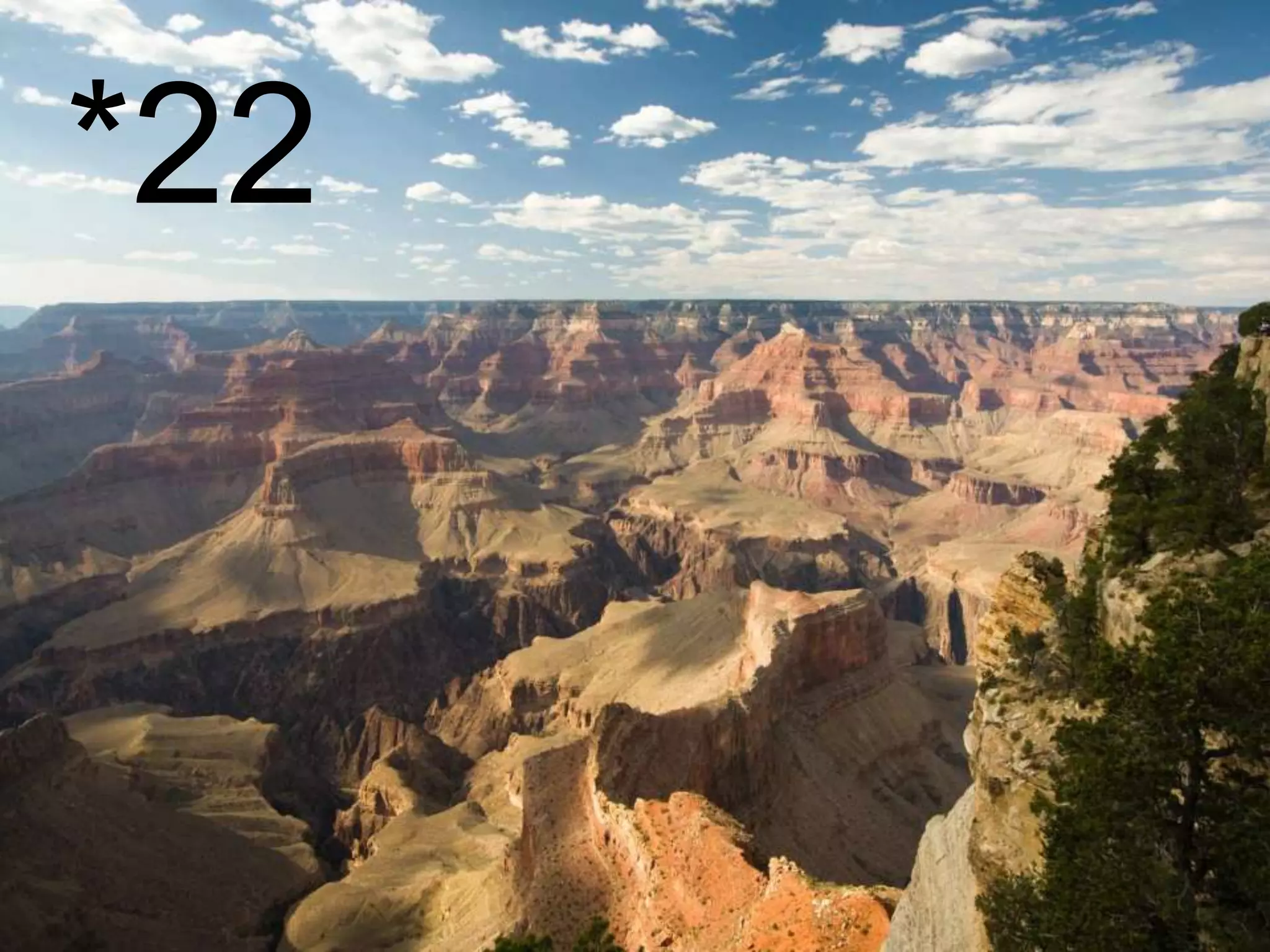
*21
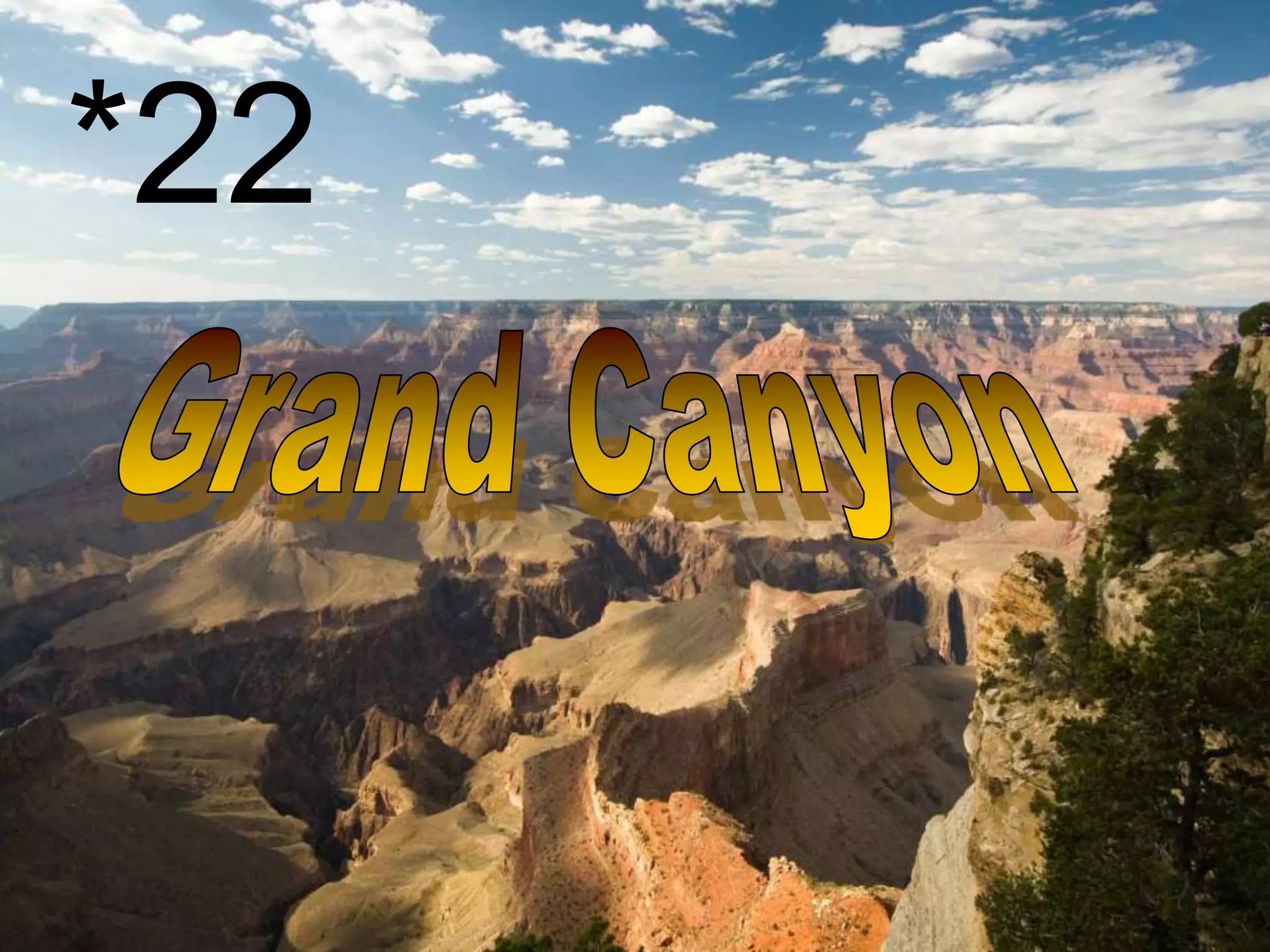
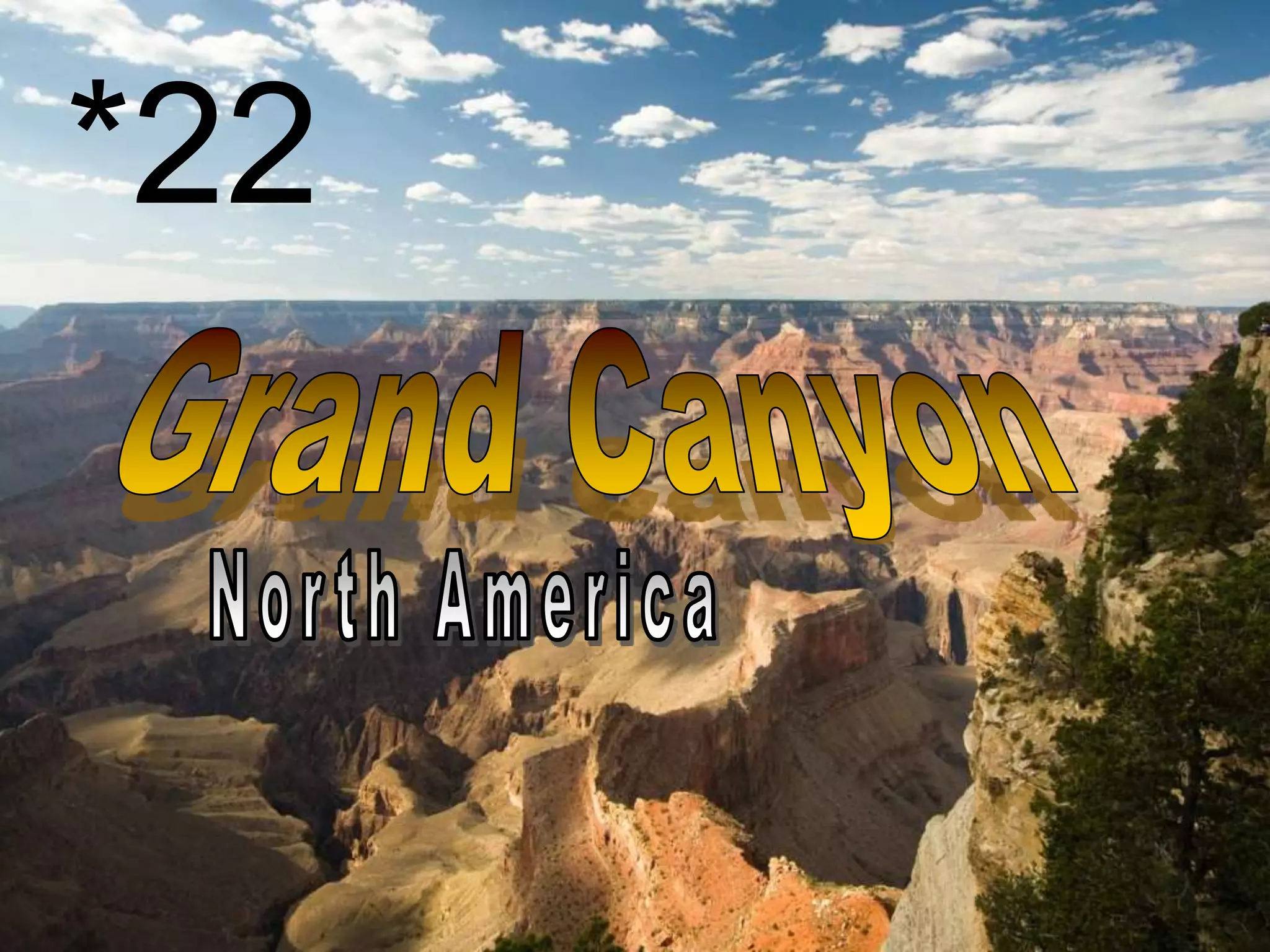
*22
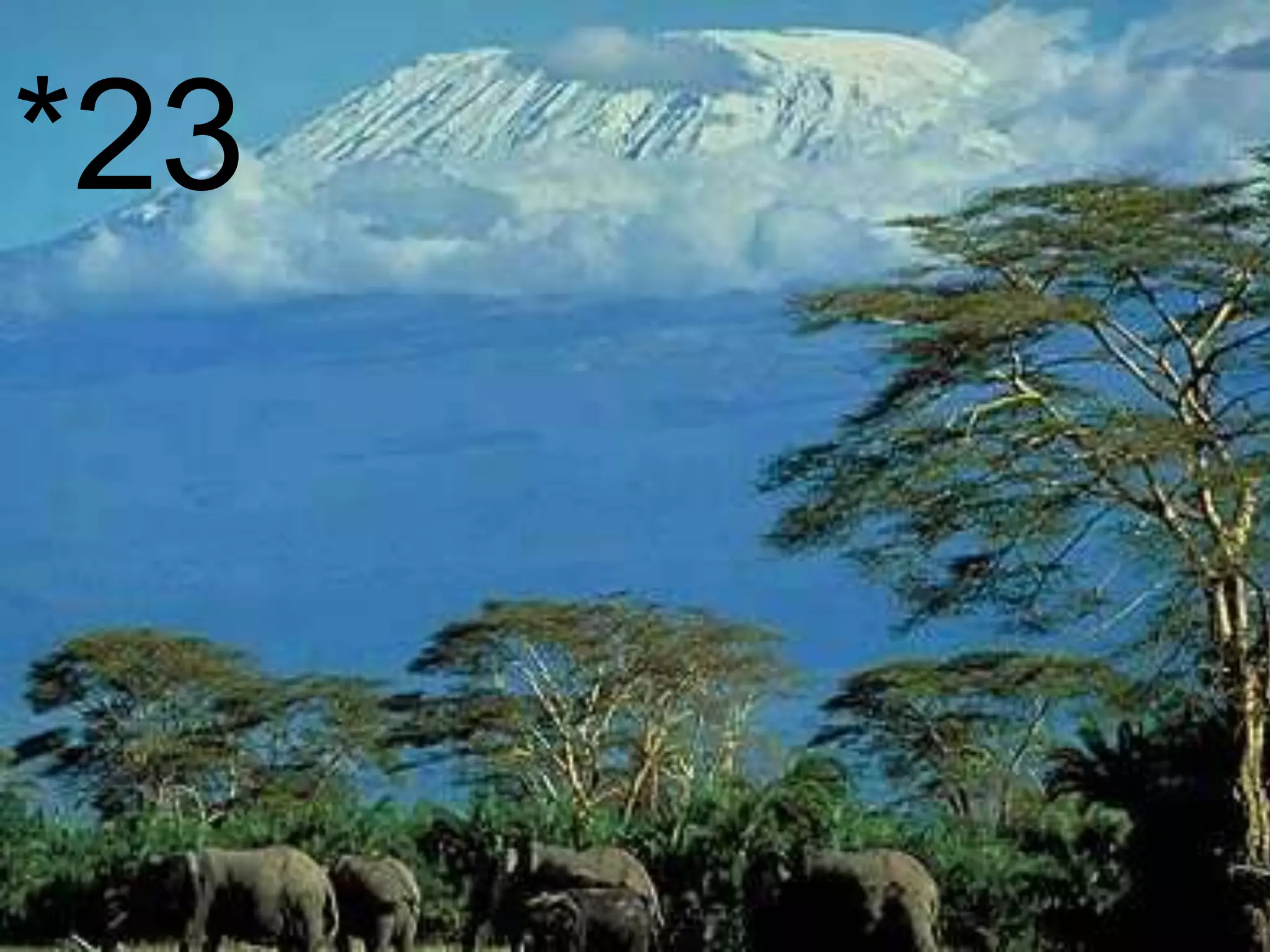
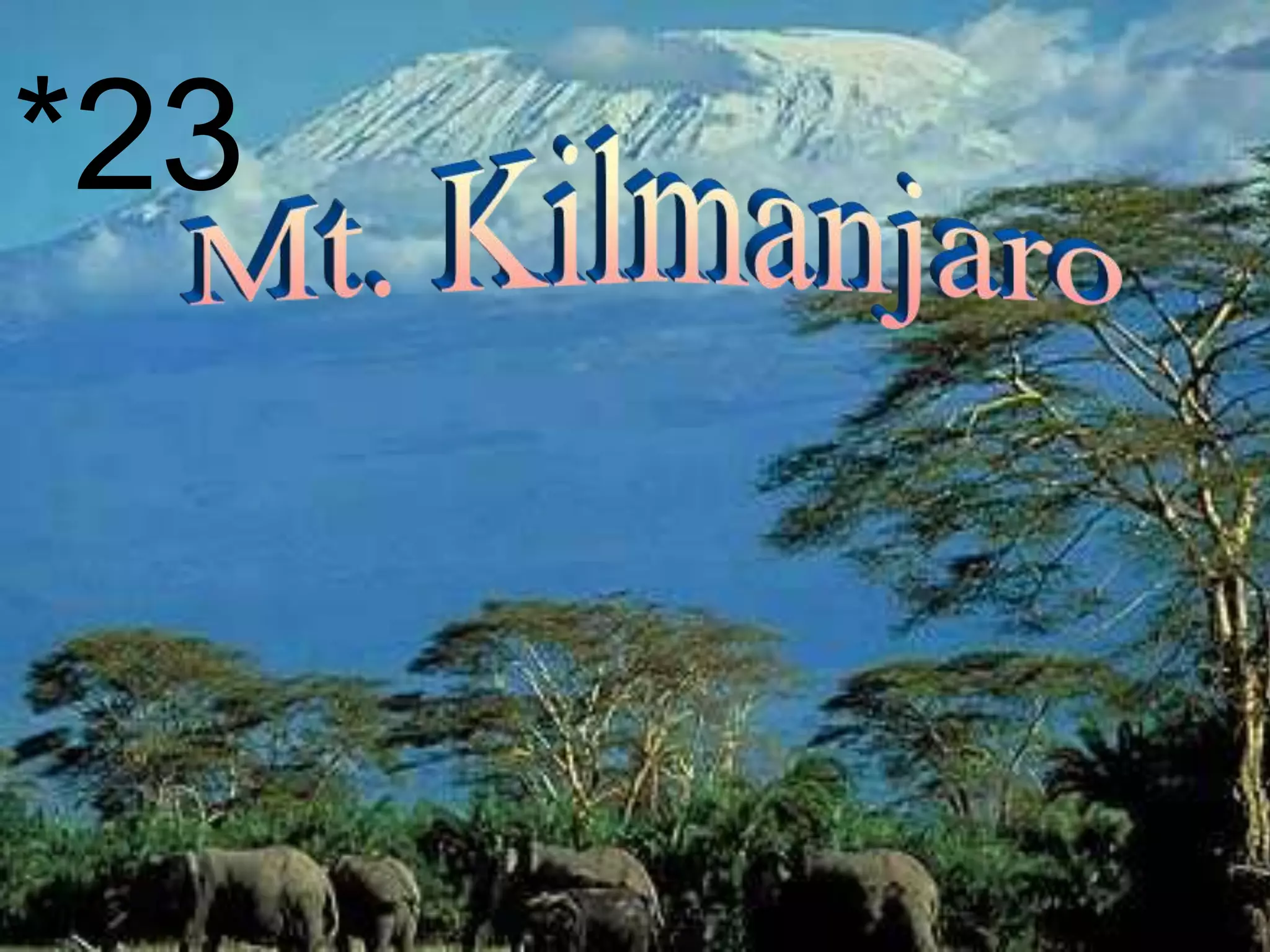
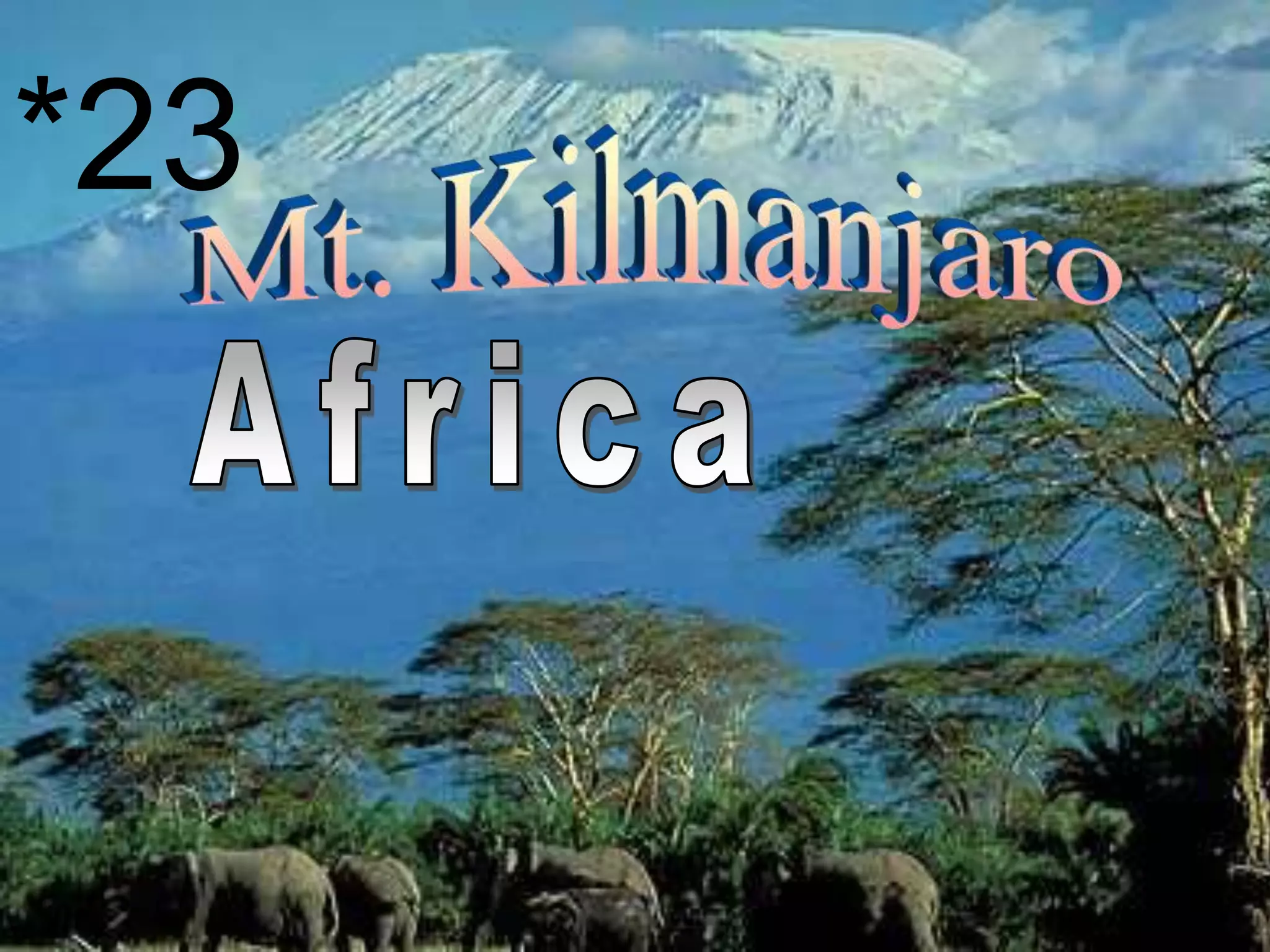
*23
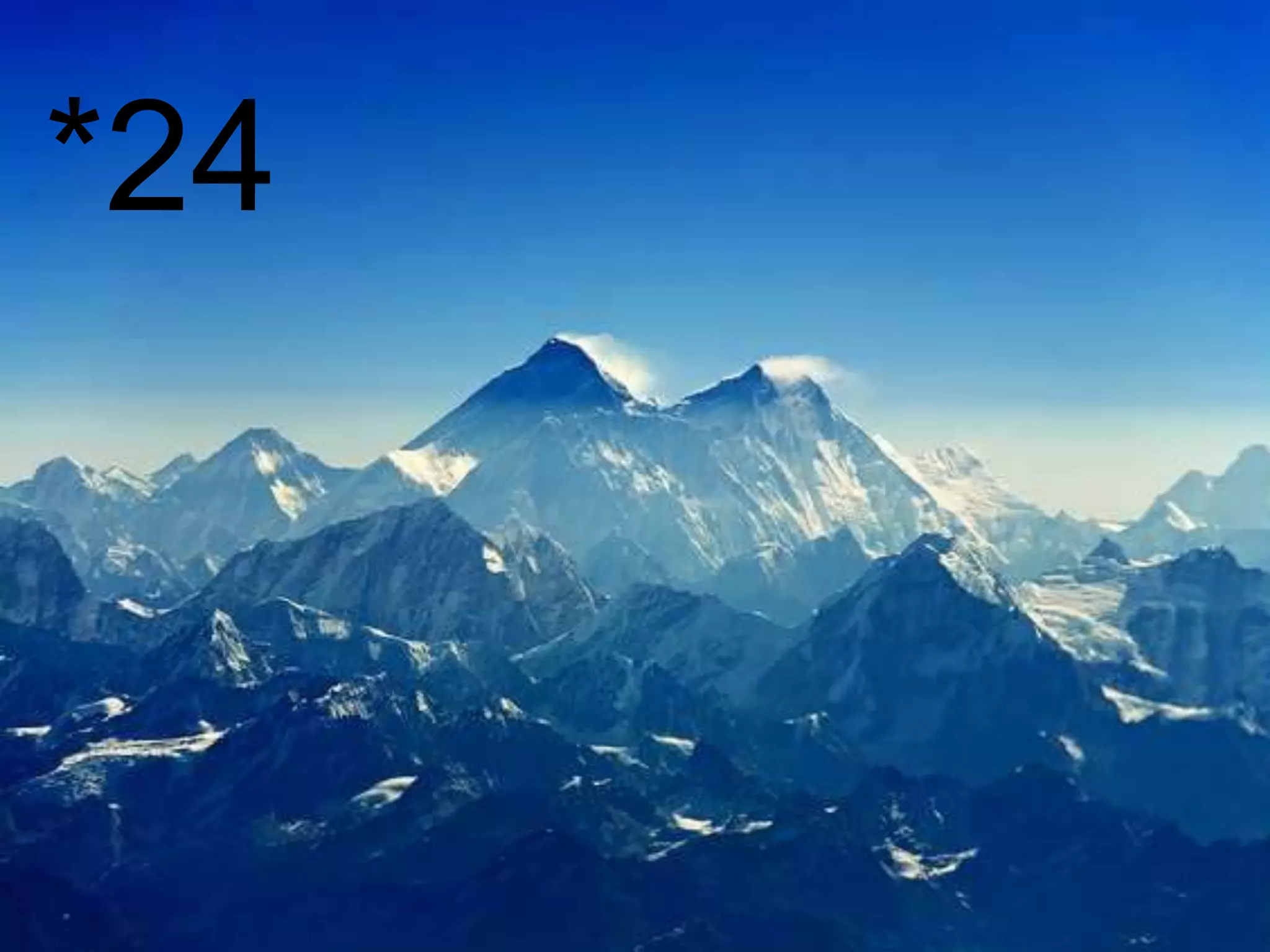
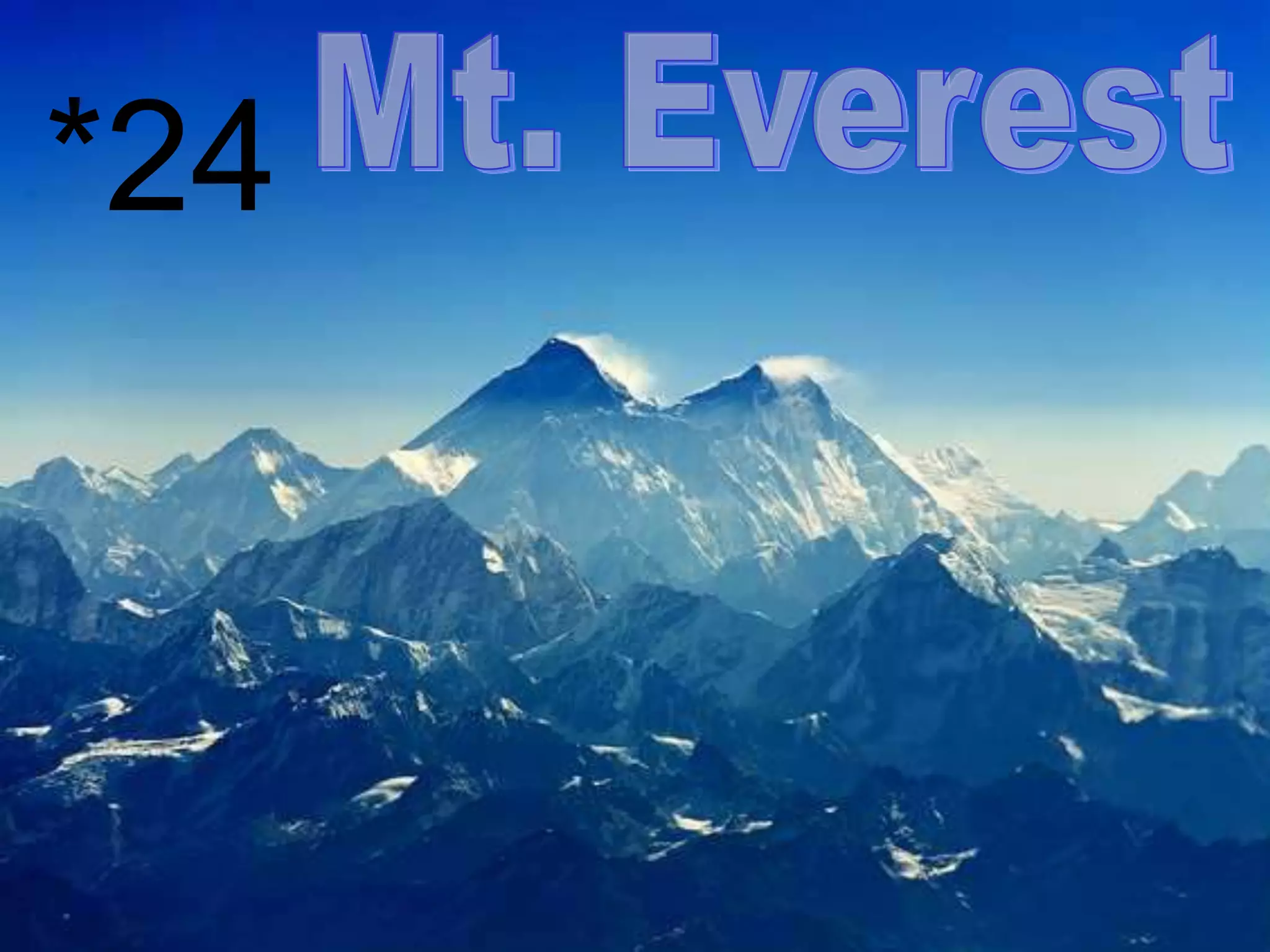
*24
*25
MOVING
AROUND
LAYERS OF
EVIDENCE
TERRARIFIC A LOT ON
YOUR PLATE
-BONUS-
NAME THE
PLACE AND
CONTINENT
1 6 11 16 *21
2 7 12 17 *22
3 8 13 18 *23
4 9 14 19 *24
5 10 15 20 *25
Copyright © 2010 Ryan P. Murphy
Dynamic Earth Review Game
FINAL QUESTION:
“You may wager up
to 5pts for this final
question.”
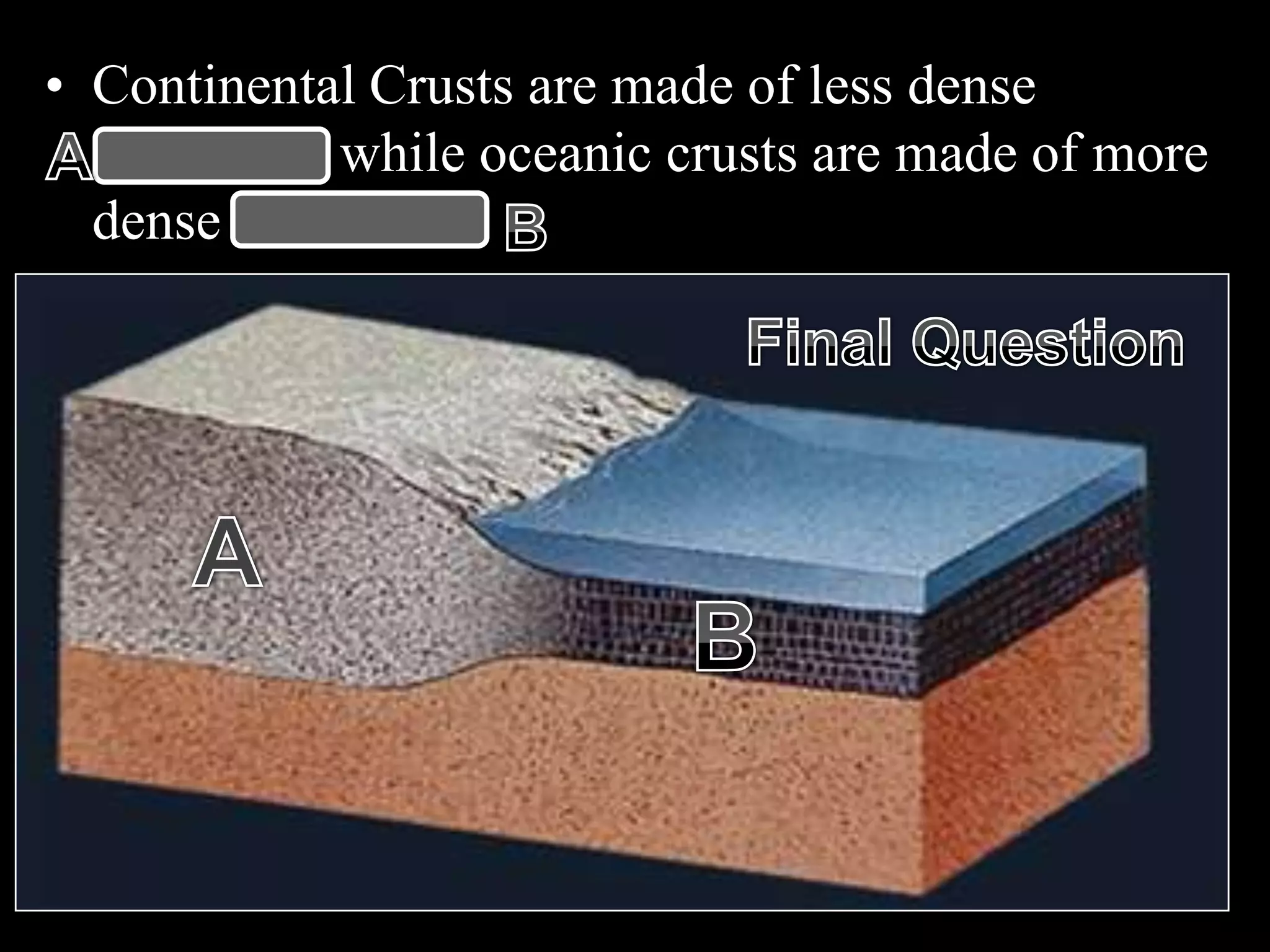
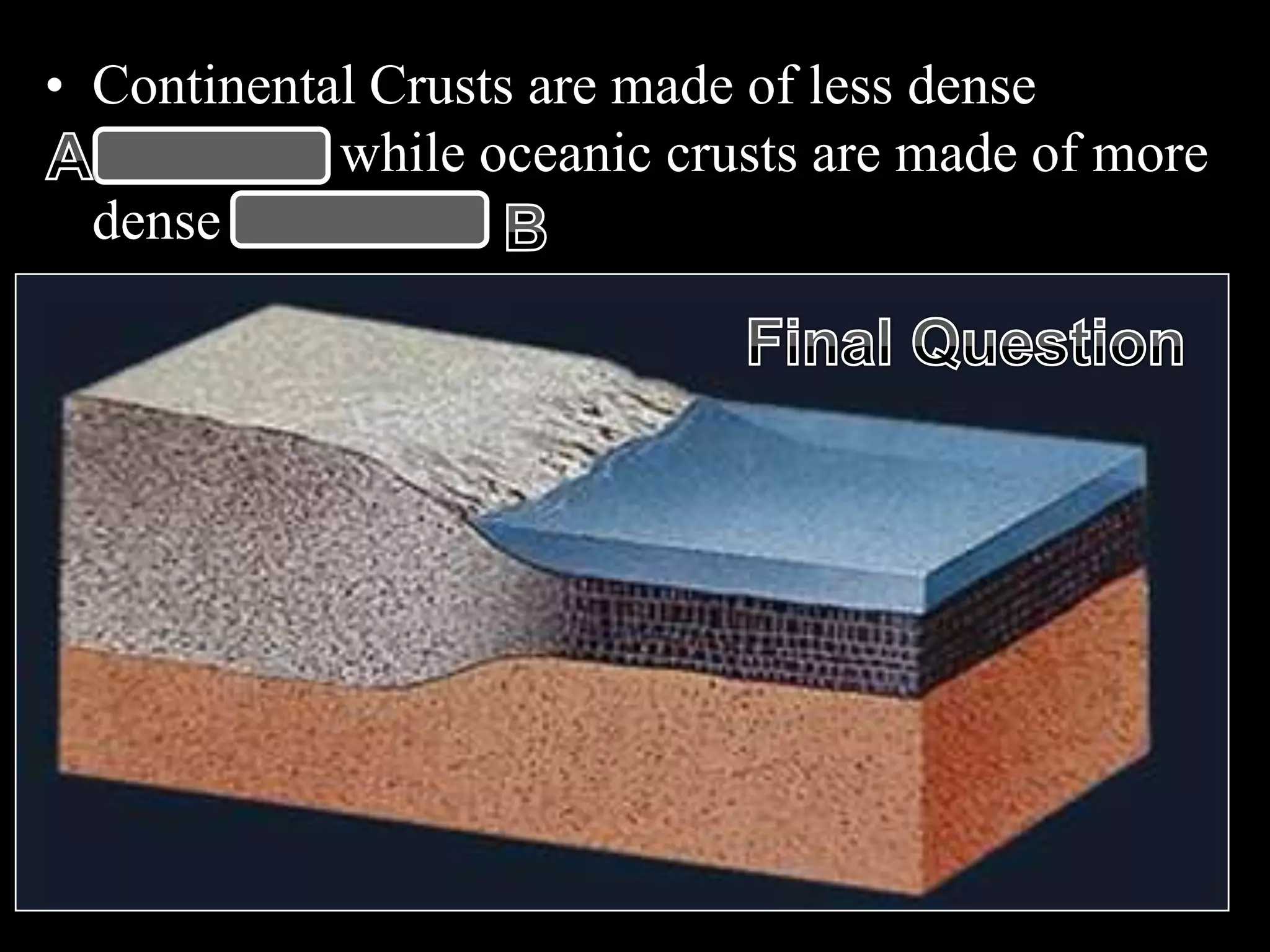
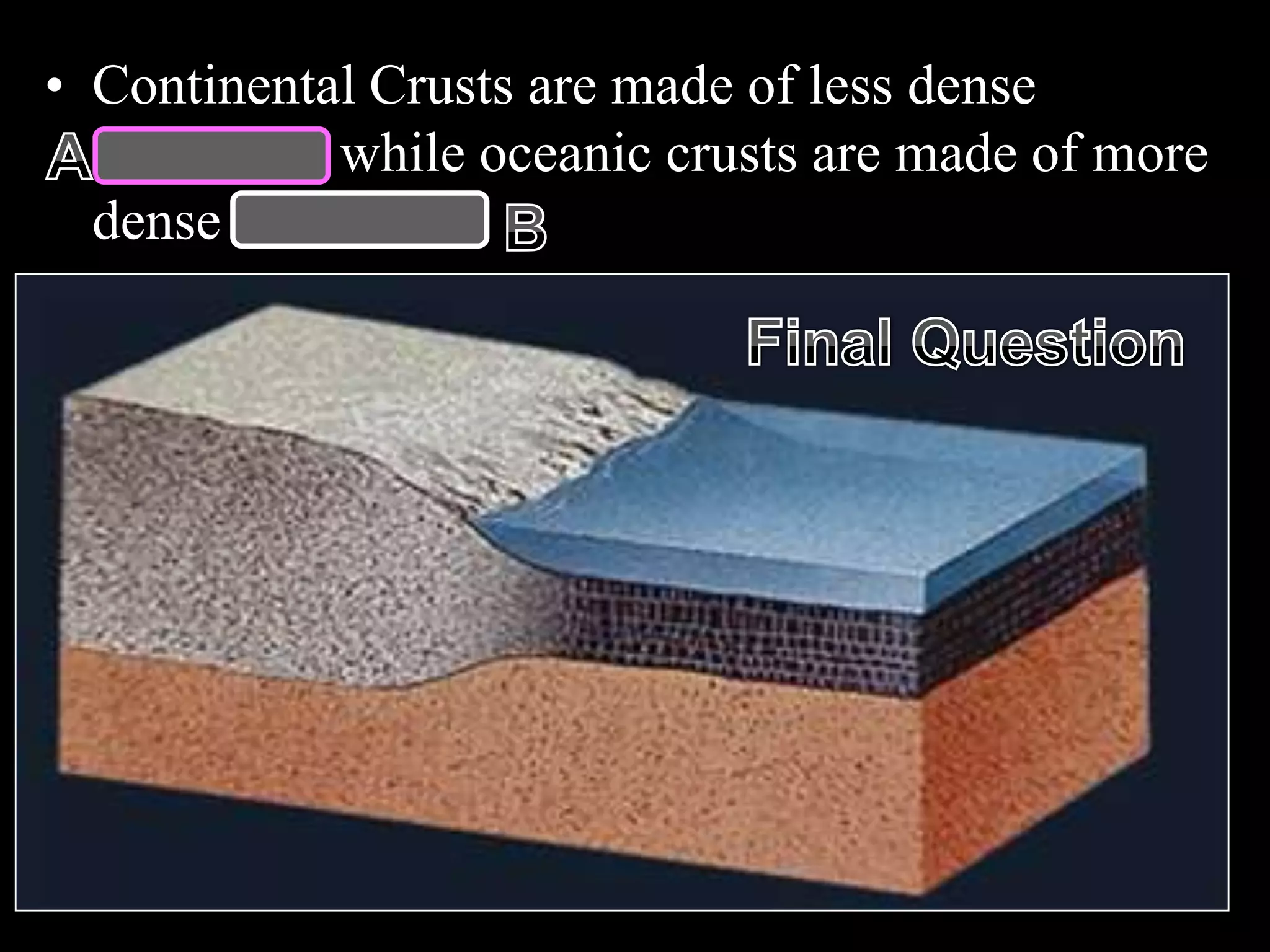
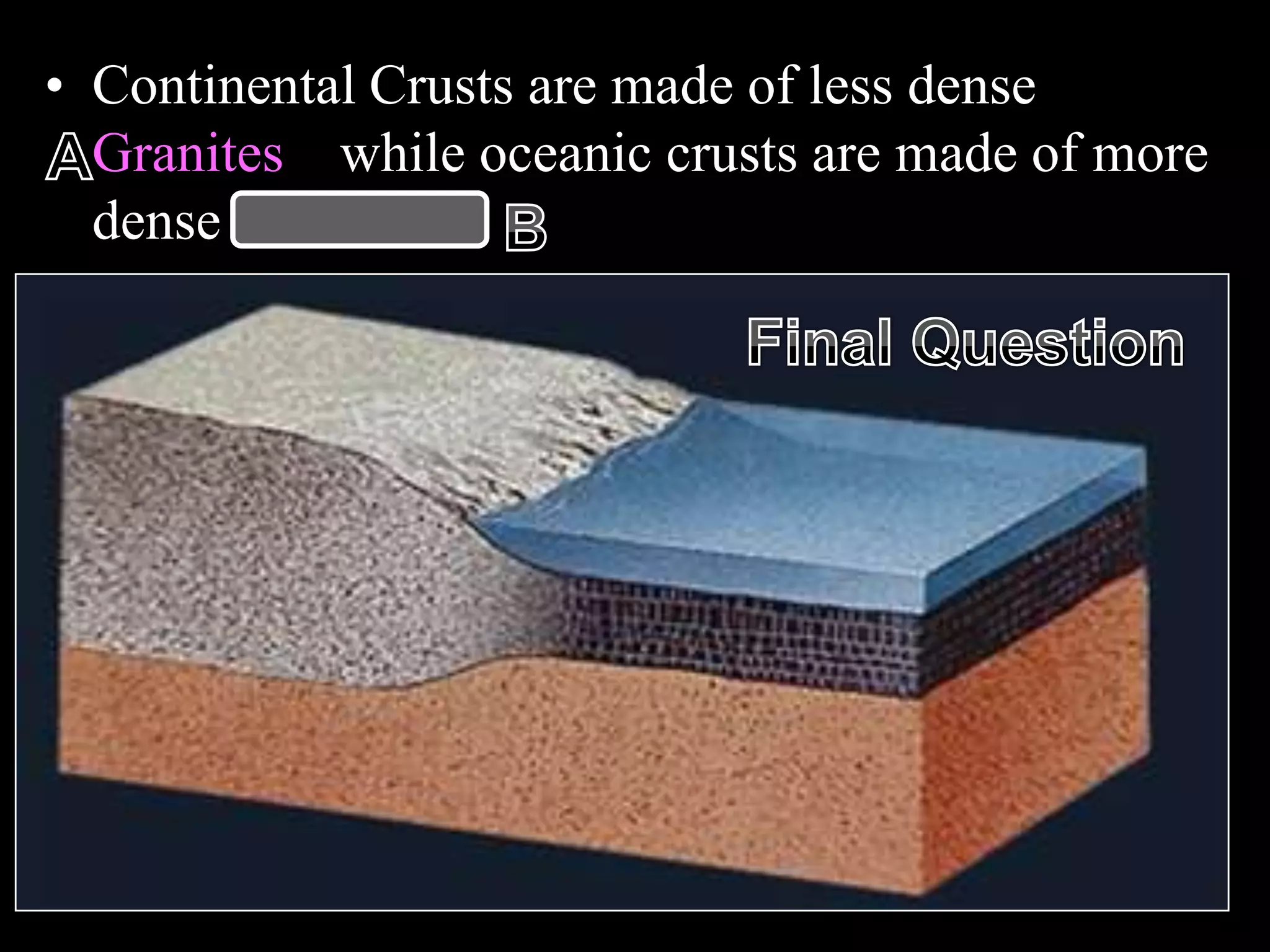
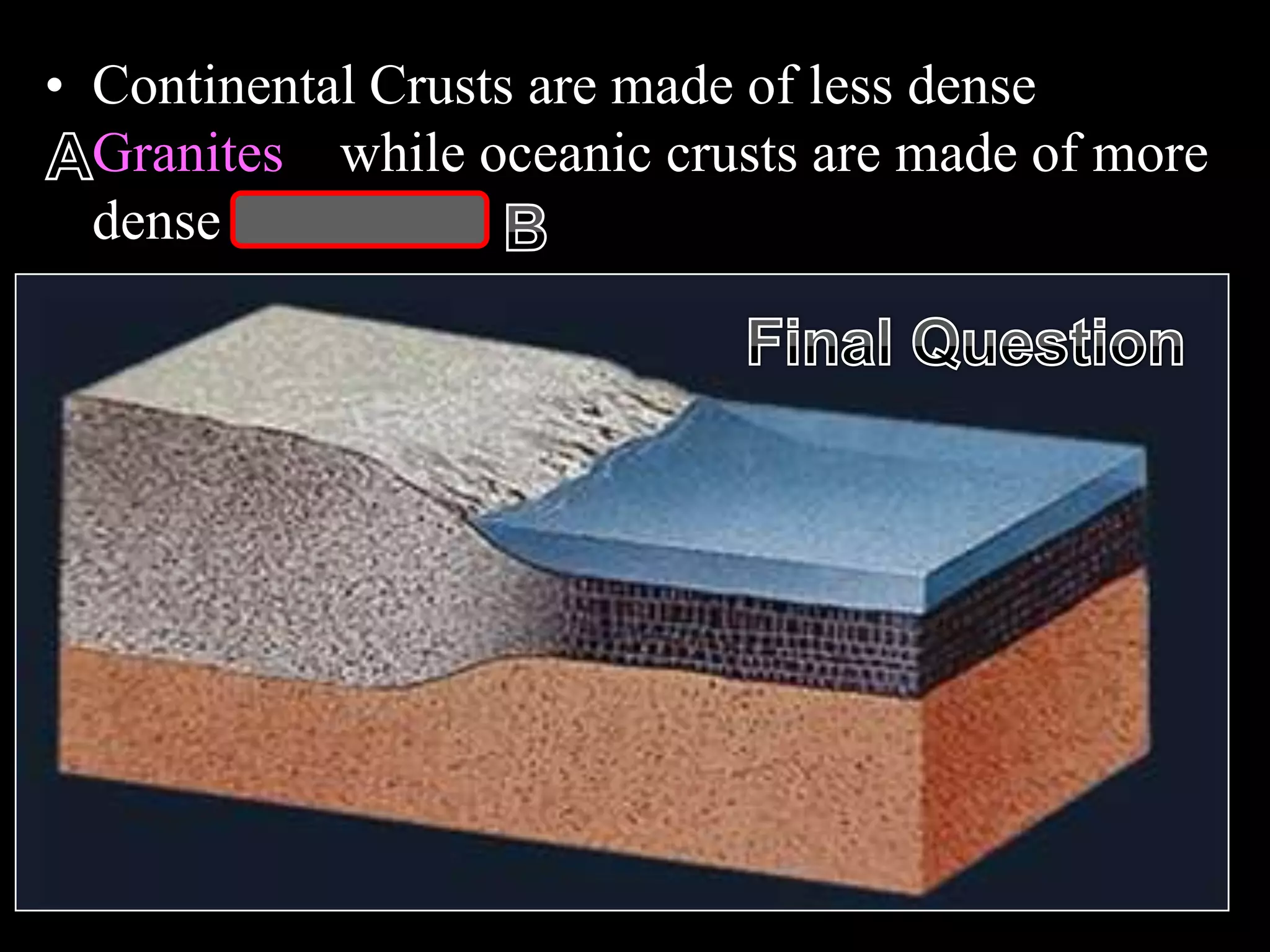
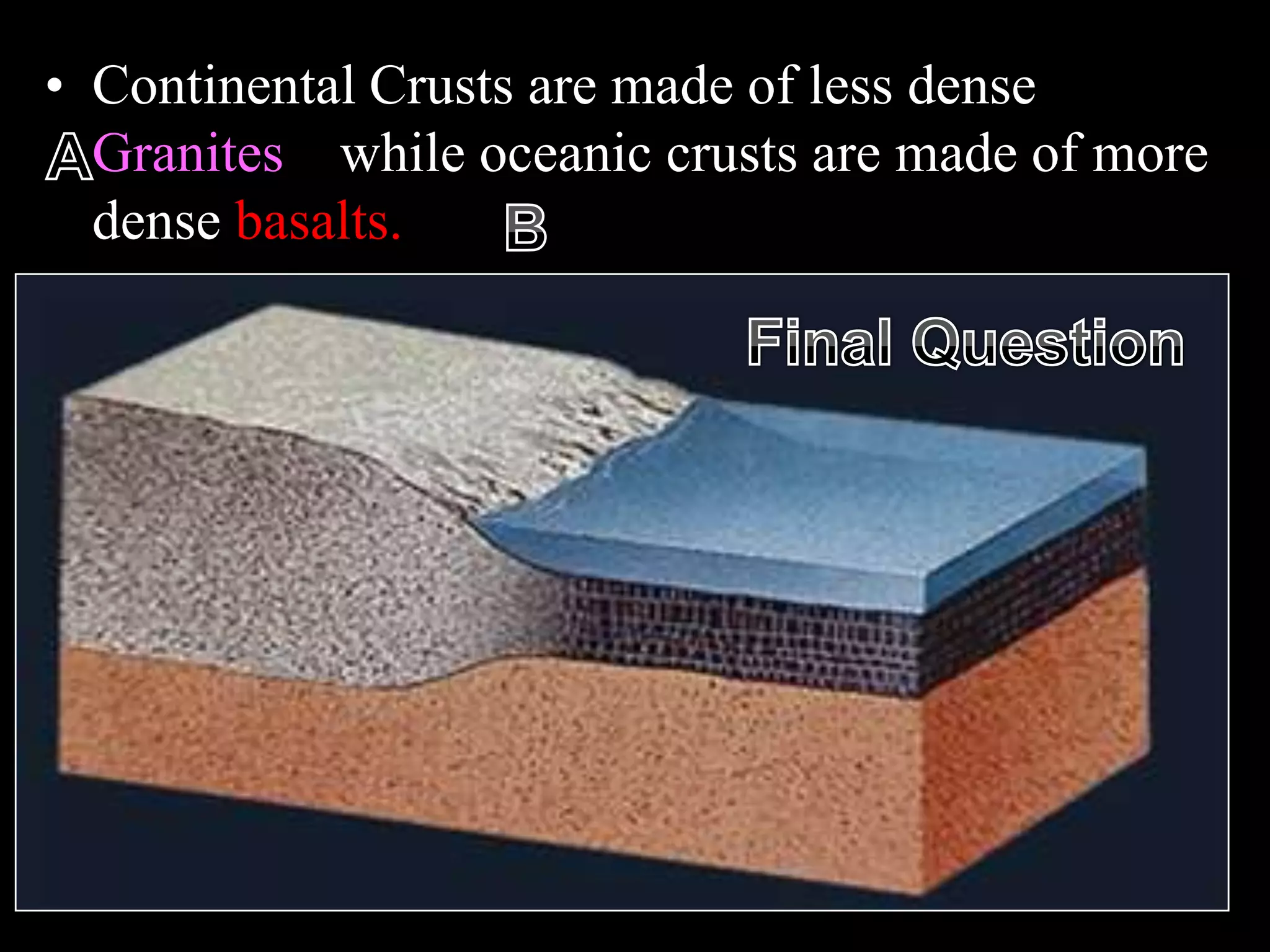
• Continental Crusts are made of less dense
Granites while oceanic crusts are made of more
dense basalts.
Answer Key
MOVING
AROUND
LAYERS OF
EVIDENCE
TERRARIFIC A LOT ON
YOUR PLATE
-BONUS-
NAME THE
PLACE AND
CONTINENT
1 6 11 16 *21
2 7 12 17 *22
3 8 13 18 *23
4 9 14 19 *24
5 10 15 20 *25
Copyright © 2010 Ryan P. Murphy
Dynamic Earth Review Game
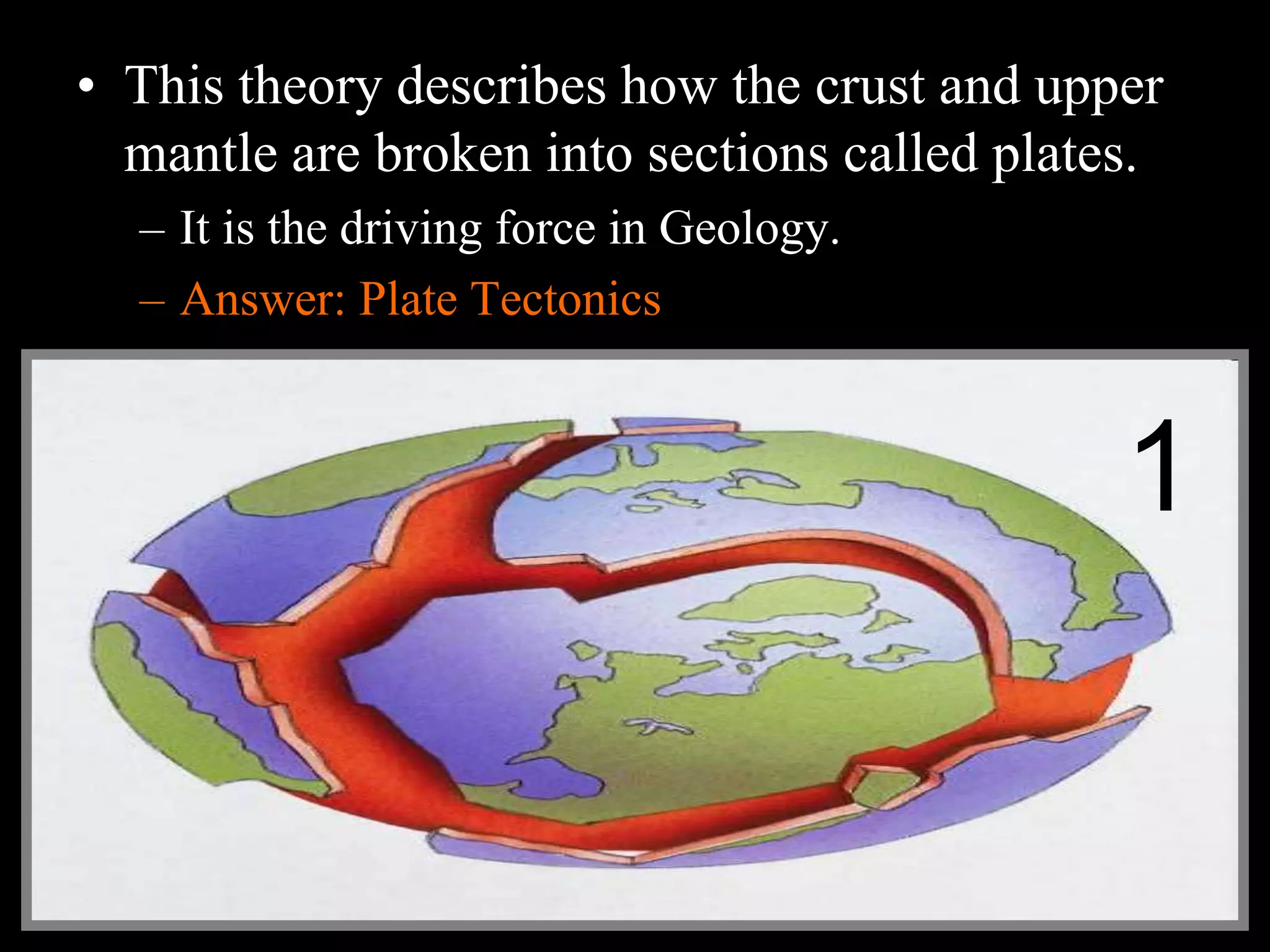
• This theory describes how the crust and upper
mantle are broken into sections called plates.
– It is the driving force in Geology.
1
• This theory describes how the crust and upper
mantle are broken into sections called plates.
– It is the driving force in Geology.
– Answer: Plate Tectonics
1
• This is the theory that describes how the
continents are gradually moving across the
earth.
2
• This is the theory that describes how the
continents are gradually moving across the
earth. Answer: Continental Drift
2
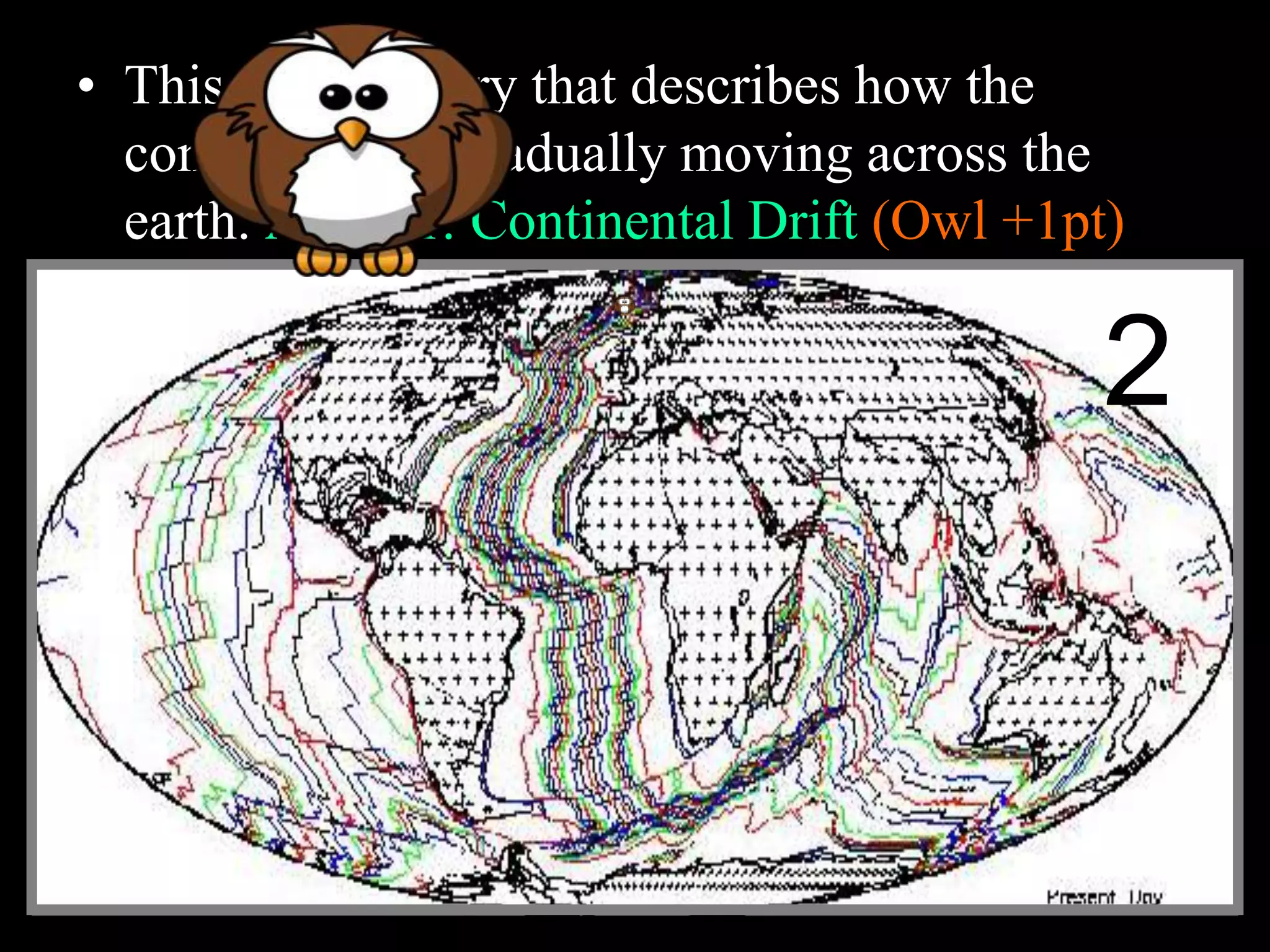
• This is the theory that describes how the
continents are gradually moving across the
earth. Answer: Continental Drift (Owl +1pt)
2
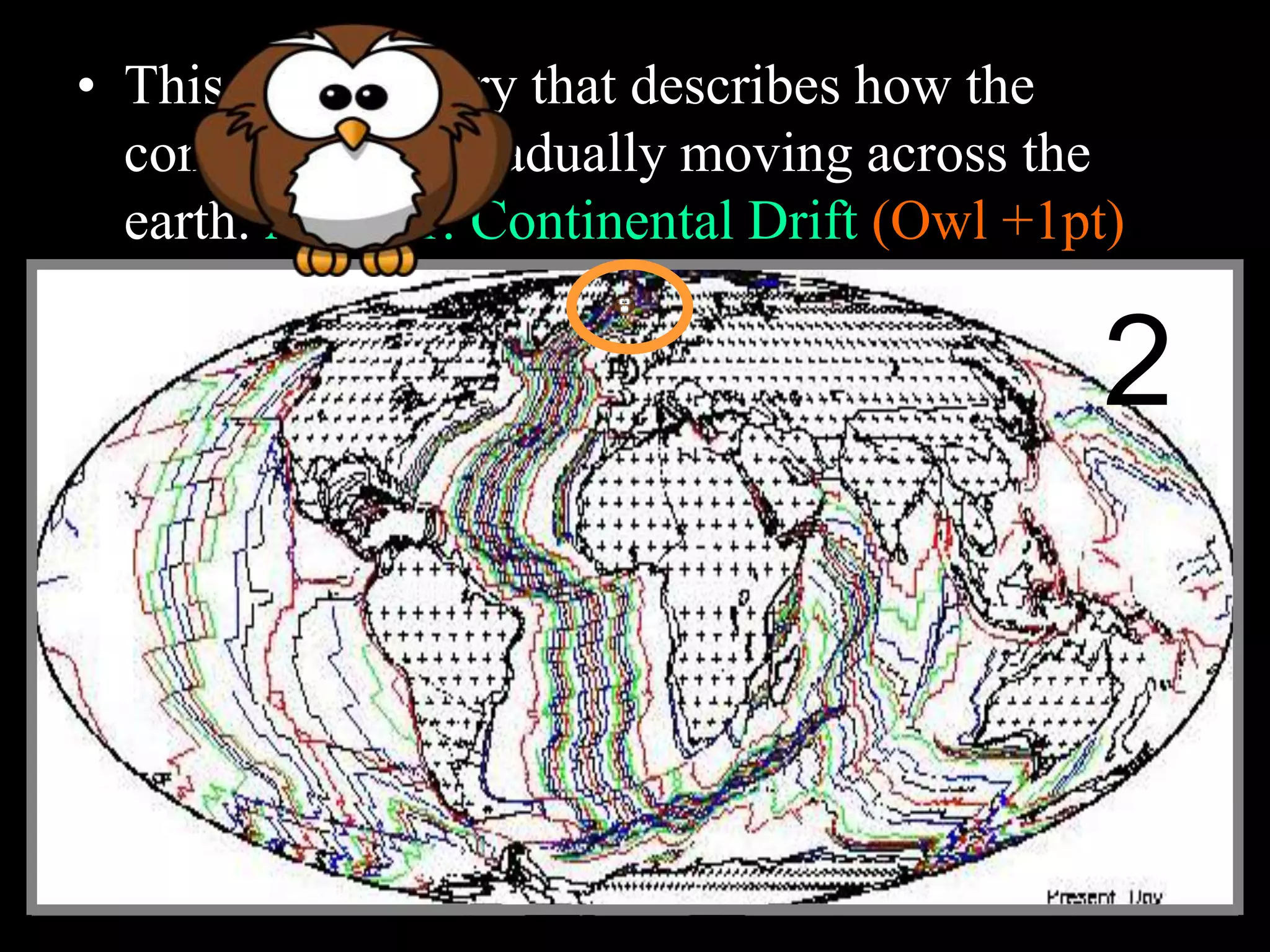
• This is the theory that describes how the
continents are gradually moving across the
earth. Answer: Continental Drift (Owl +1pt)
2
This scientist was the first to propose that the
continents were once together?
3
This scientist was the first to propose that the
continents were once together?
Alfred Wegener
3
Name the Supercontinent below?
4
Name the Supercontinent below?
4
Before the Supercontinent PANGEA, name
the two prior supercontinents circled below?
Before the Supercontinent PANGEA, name
the two prior supercontinents circled below?
Before the Supercontinent PANGEA, name
the two prior supercontinents circled below?
Before the Supercontinent PANGEA, name
the two prior supercontinents circled below?
Before the Supercontinent PANGEA, name
the two prior supercontinents circled below?
MOVING
AROUND
LAYERS OF
EVIDENCE
TERRARIFIC A LOT ON
YOUR PLATE
-BONUS-
NAME THE
PLACE AND
CONTINENT
1 6 11 16 *21
2 7 12 17 *22
3 8 13 18 *23
4 9 14 19 *24
5 10 15 20 *25
Copyright © 2010 Ryan P. Murphy
Dynamic Earth Review Game
• Which is not an evidence of continental drift?
A.) The Shapes Match.
B.) Same fossils found on different continents.
C.) Different rock structures on different continents.
D.) Fossils of Trees and Animals in Antarctica.
E.) Magnetic layers in sea floor spreading.
6
• Which is not an evidence of continental drift?
A.) The Shapes Match.
B.) Same fossils found on different continents.
C.) Different rock structures on different continents.
D.) Fossils of Trees and Animals in Antarctica.
E.) Magnetic layers in sea floor spreading.
6
• Which is not an evidence of continental drift?
A.) The Shapes Match.
B.) Same fossils found on different continents.
C.) Different rock structures on different continents.
D.) Fossils of Trees and Animals in Antarctica.
E.) Magnetic layers in sea floor spreading.
6
• Which is not an evidence of continental drift?
A.) The Shapes Match.
B.) Same fossils found on different continents.
C.) Different rock structures on different continents.
D.) Fossils of Trees and Animals in Antarctica.
E.) Magnetic layers in sea floor spreading.
6
• Which is not an evidence of continental drift?
A.) The Shapes Match.
B.) Same fossils found on different continents.
C.) Different rock structures on different continents.
D.) Fossils of Trees and Animals in Antarctica.
E.) Magnetic layers in sea floor spreading.
6
• Which is not an evidence of continental drift?
A.) The Shapes Match.
B.) Same fossils found on different continents.
C.) Different rock structures on different continents.
D.) Fossils of Trees and Animals in Antarctica.
E.) Magnetic layers in sea floor spreading.
6
• Which is not an evidence of continental drift?
A.) The Shapes Match. and the answer is…
B.) Same fossils found on different continents.
C.) Different rock structures on different continents.
D.) Fossils of Trees and Animals in Antarctica.
E.) Magnetic layers in sea floor spreading.
6
• Which is not an evidence of continental drift?
A.) The Shapes Match. and the answer is…
B.) Same fossils found on different continents.
C.) Different rock structures on different continents.
D.) Fossils of Trees and Animals in Antarctica.
E.) Magnetic layers in sea floor spreading.
6
• Which is not an evidence of continental drift?
A.) The Shapes Match. and the answer is…
B.) Same fossils found on different continents.
C.) Different rock structures on different continents.
D.) Fossils of Trees and Animals in Antarctica.
E.) Magnetic layers in sea floor spreading.
6
• Which is not an evidence of continental drift?
A.) The Shapes Match. and the answer is…
B.) Same fossils found on different continents.
C.) Same rock structures on different continents.
D.) Fossils of Trees and Animals in Antarctica.
E.) Magnetic layers in sea floor spreading.
6
• One way scientist can learn about the interior of
the earth is by studying these two waves?
7
• One way scientist can learn about the interior of
the earth is by studying these two waves?
7
• One way scientist can learn about the interior of
the earth is by studying these two waves?
7
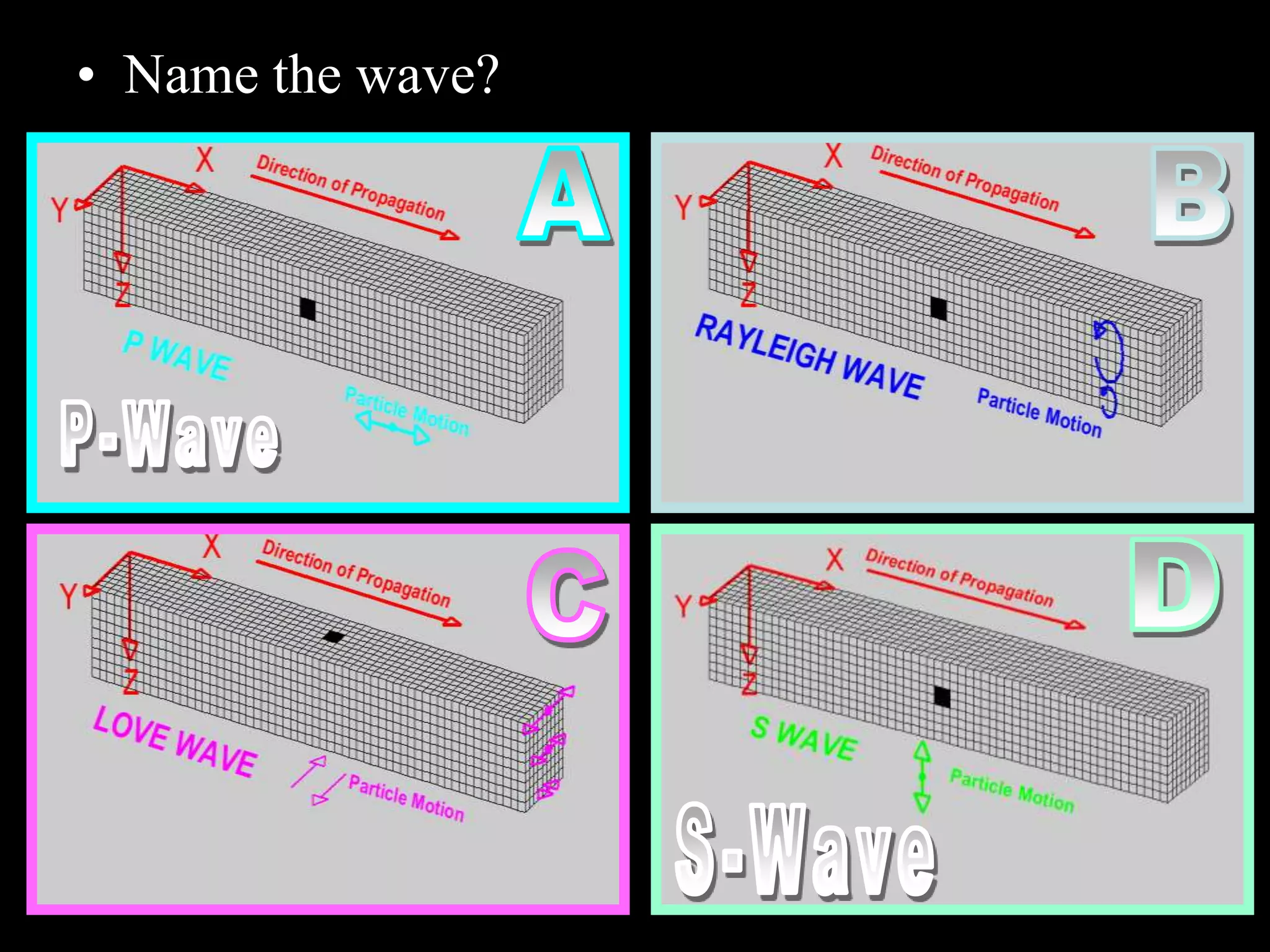
• Name the wave?
• Name the wave?
• Name the wave?
• Name the wave?
• Name the wave?
• Name the wave?
• Name the wave?
• Name the wave?
• Name the wave?
• Name the wave?
• Name the wave?
• Name the wave?
• Name the wave?
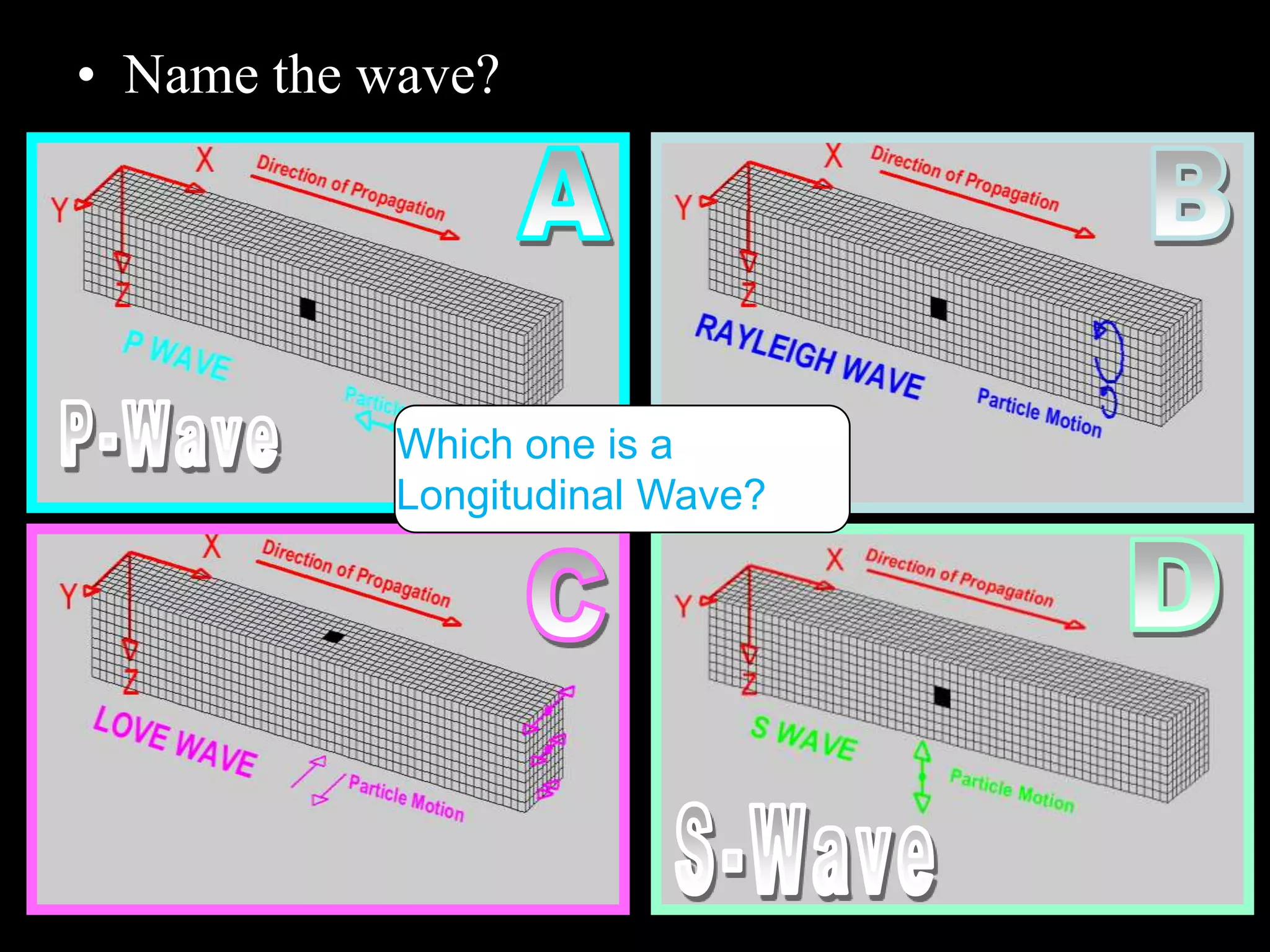
Which one is a
Longitudinal Wave?
• Name the wave?
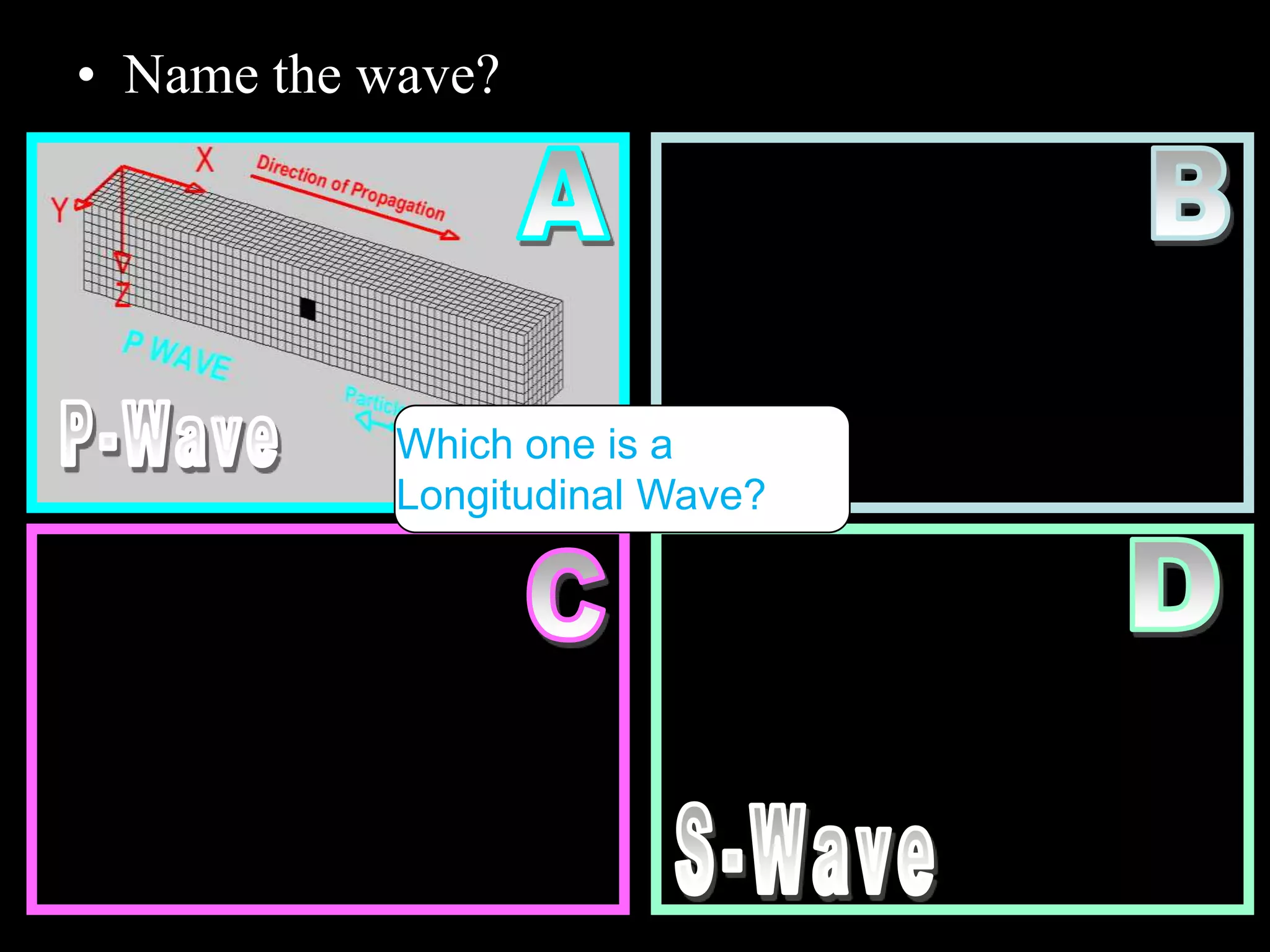
Which one is a
Longitudinal Wave?
• Name the wave?
Which one is a
Longitudinal Wave?
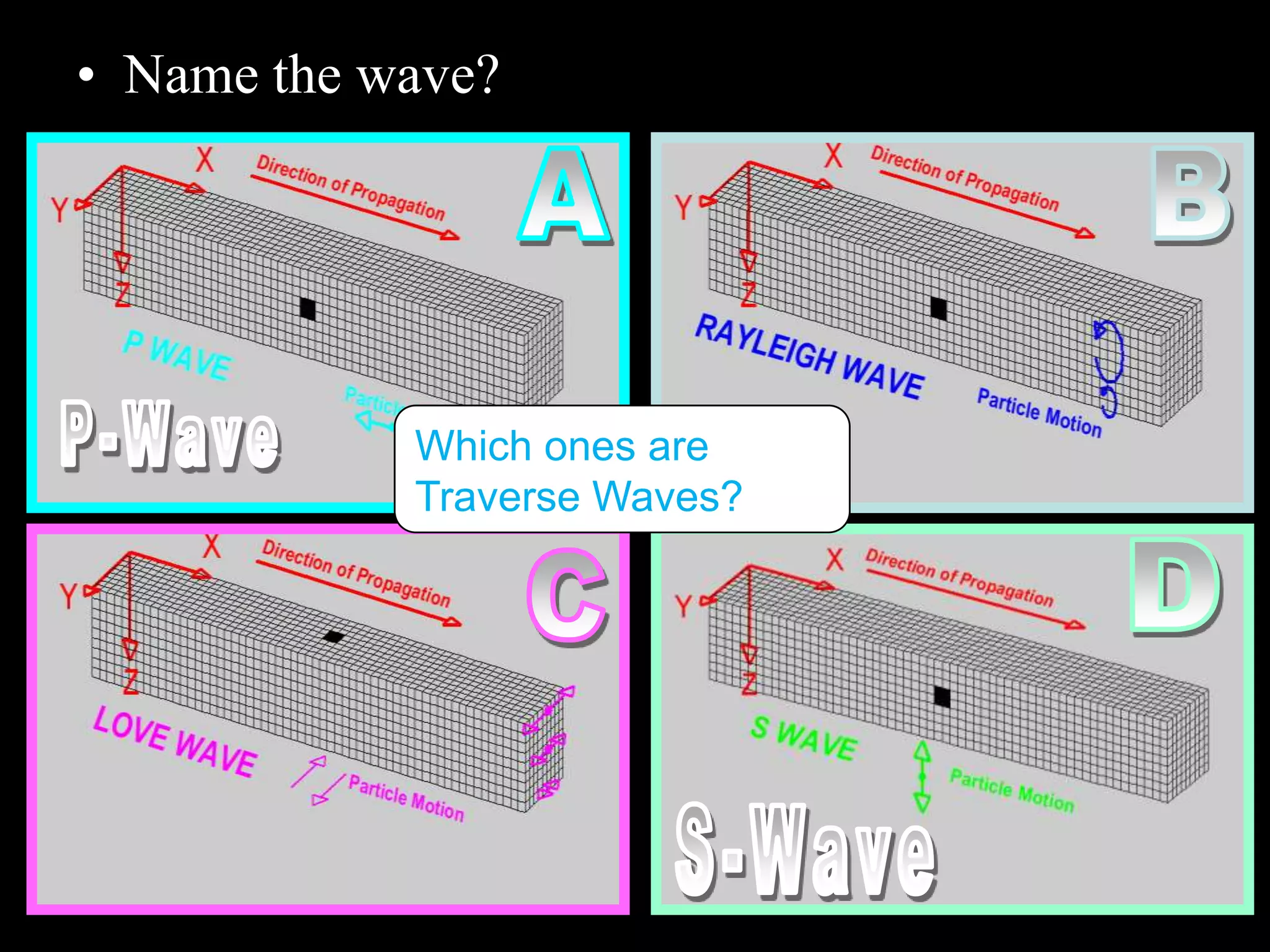
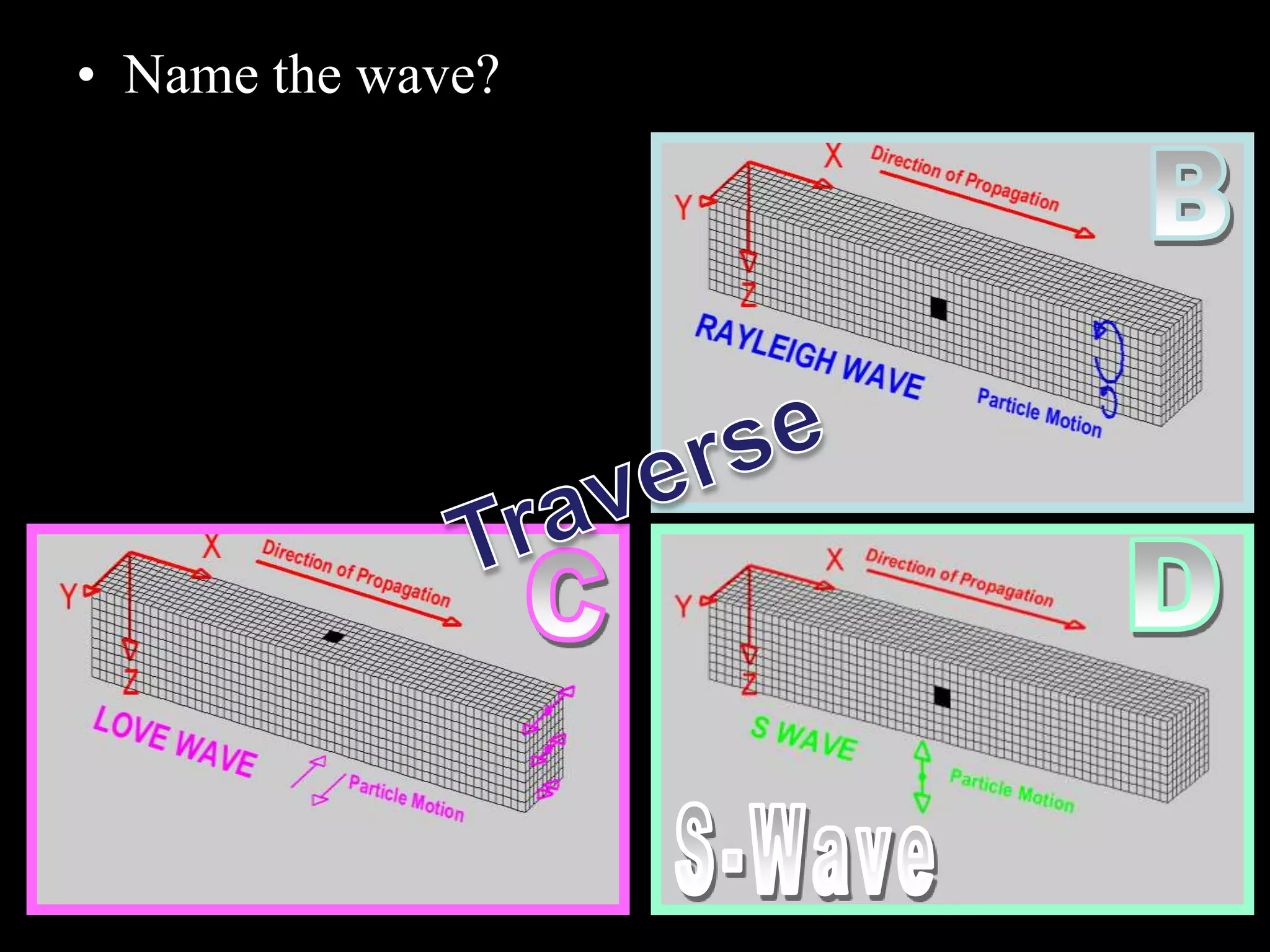
• Name the wave?
Which ones are
Traverse Waves?
• Name the wave?
This formed when gravity pulled the
heaviest elements toward the middle of
the Earth?
9
This formed when gravity pulled the
heaviest elements toward the middle of
the Earth?
9
• Name A, B, and C.
Copyright © 2010 Ryan P. Murphy
A
B
C
10
• Name A, B, and C.
Copyright © 2010 Ryan P. Murphy
A
B
C
10
• Name A, B, and C.
Copyright © 2010 Ryan P. Murphy
B
C
10
• Name A, B, and C.
Copyright © 2010 Ryan P. Murphy
B
C
10
• Name A, B, and C.
Copyright © 2010 Ryan P. Murphy
C
10
• Name A, B, and C.
Copyright © 2010 Ryan P. Murphy
C
10
• Name A, B, and C.
Copyright © 2010 Ryan P. Murphy
10
MOVING
AROUND
LAYERS OF
EVIDENCE
TERRARIFIC A LOT ON
YOUR PLATE
-BONUS-
NAME THE
PLACE AND
CONTINENT
1 6 11 16 *21
2 7 12 17 *22
3 8 13 18 *23
4 9 14 19 *24
5 10 15 20 *25
Copyright © 2010 Ryan P. Murphy
Dynamic Earth Review Game
The Inner Core is made mostly of these two
elements?
11
The Inner Core is made mostly of these two
elements?
11
The Mantle is made of these chemical
elements?
12
The Mantle is made of these chemical
elements?
12A.) Solid Iron and Nickel
The Mantle is made of these chemical
elements?
12A.) Solid Iron and Nickel
B.) Liquid Iron and Nickel
The Mantle is made of these chemical
elements?
12A.) Solid Iron and Nickel
B.) Liquid Iron and Nickel
C.) Magnesium Silicates, Iron, and Calcium
The Mantle is made of these chemical
elements?
12A.) Solid Iron and Nickel
B.) Liquid Iron and Nickel
C.) Magnesium Silicates, Iron, and Calcium
D.) Lead, Fluorine, and Potassium
The Mantle is made of these chemical
elements?
12A.) Solid Iron and Nickel
B.) Liquid Iron and Nickel
C.) Magnesium Silicates, Iron, and Calcium
D.) Lead, Fluorine, and Potassium
E.) Nobody knows
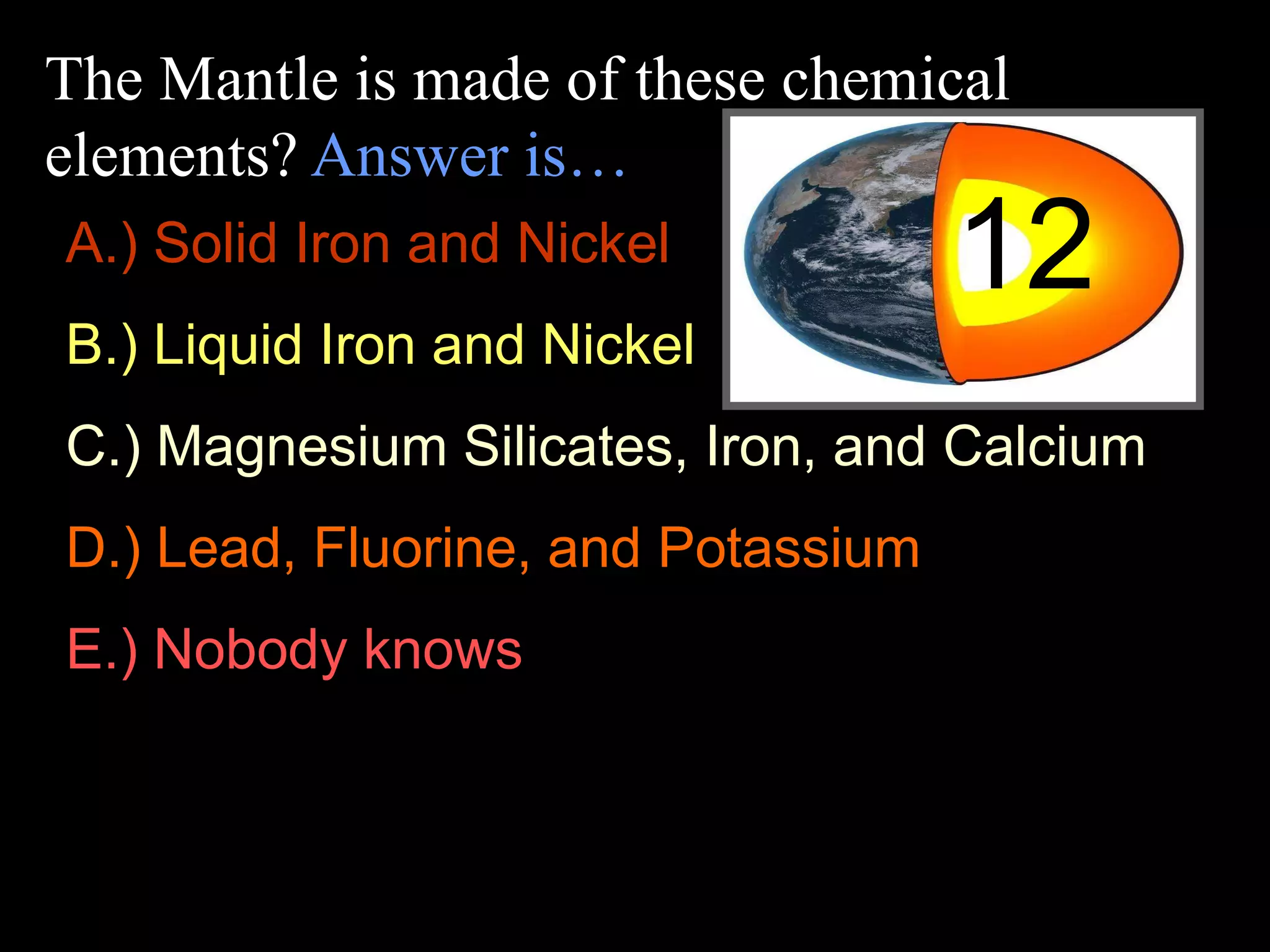
The Mantle is made of these chemical
elements? Answer is…
12A.) Solid Iron and Nickel
B.) Liquid Iron and Nickel
C.) Magnesium Silicates, Iron, and Calcium
D.) Lead, Fluorine, and Potassium
E.) Nobody knows
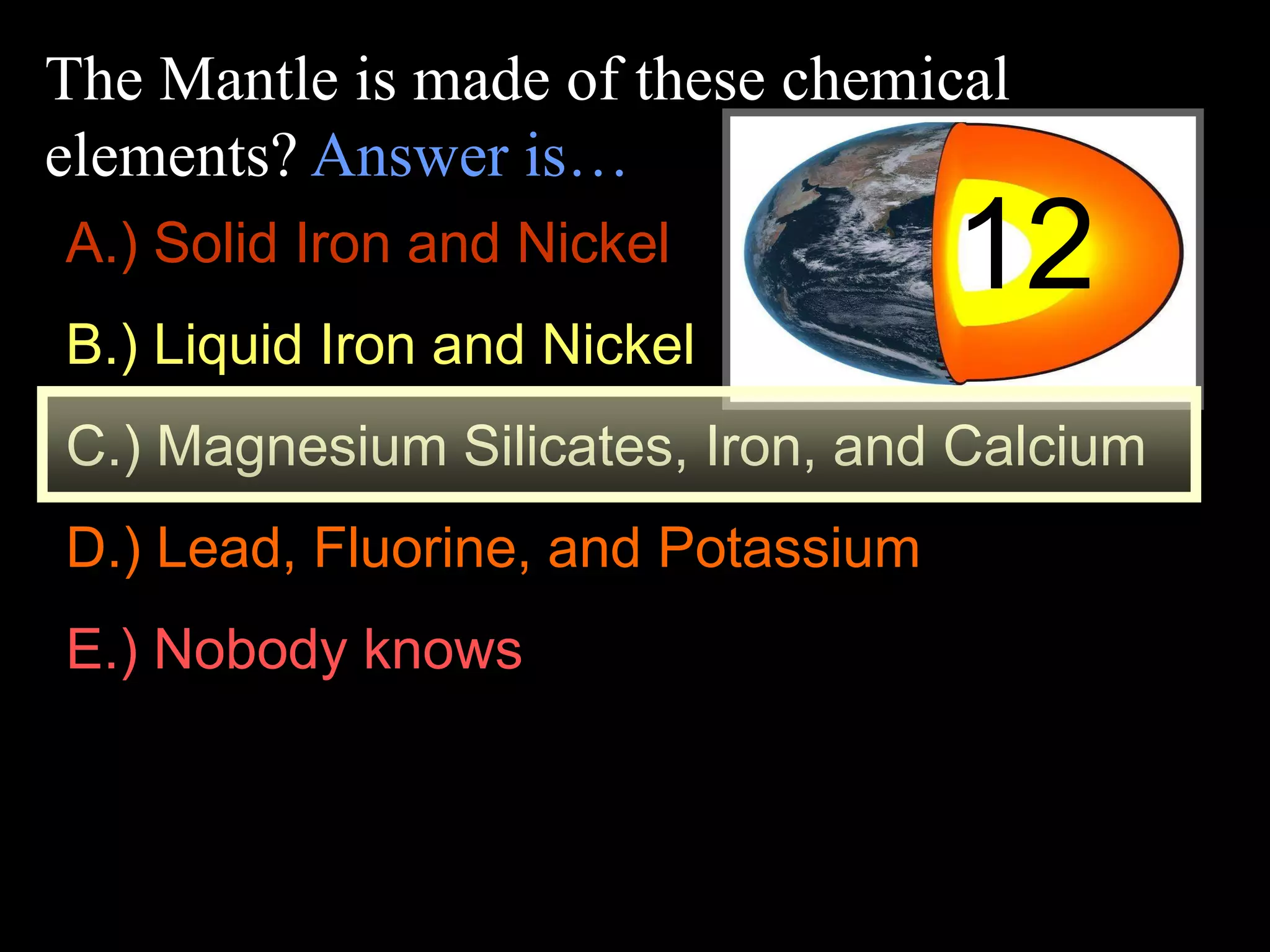
The Mantle is made of these chemical
elements? Answer is…
12A.) Solid Iron and Nickel
B.) Liquid Iron and Nickel
C.) Magnesium Silicates, Iron, and Calcium
D.) Lead, Fluorine, and Potassium
E.) Nobody knows
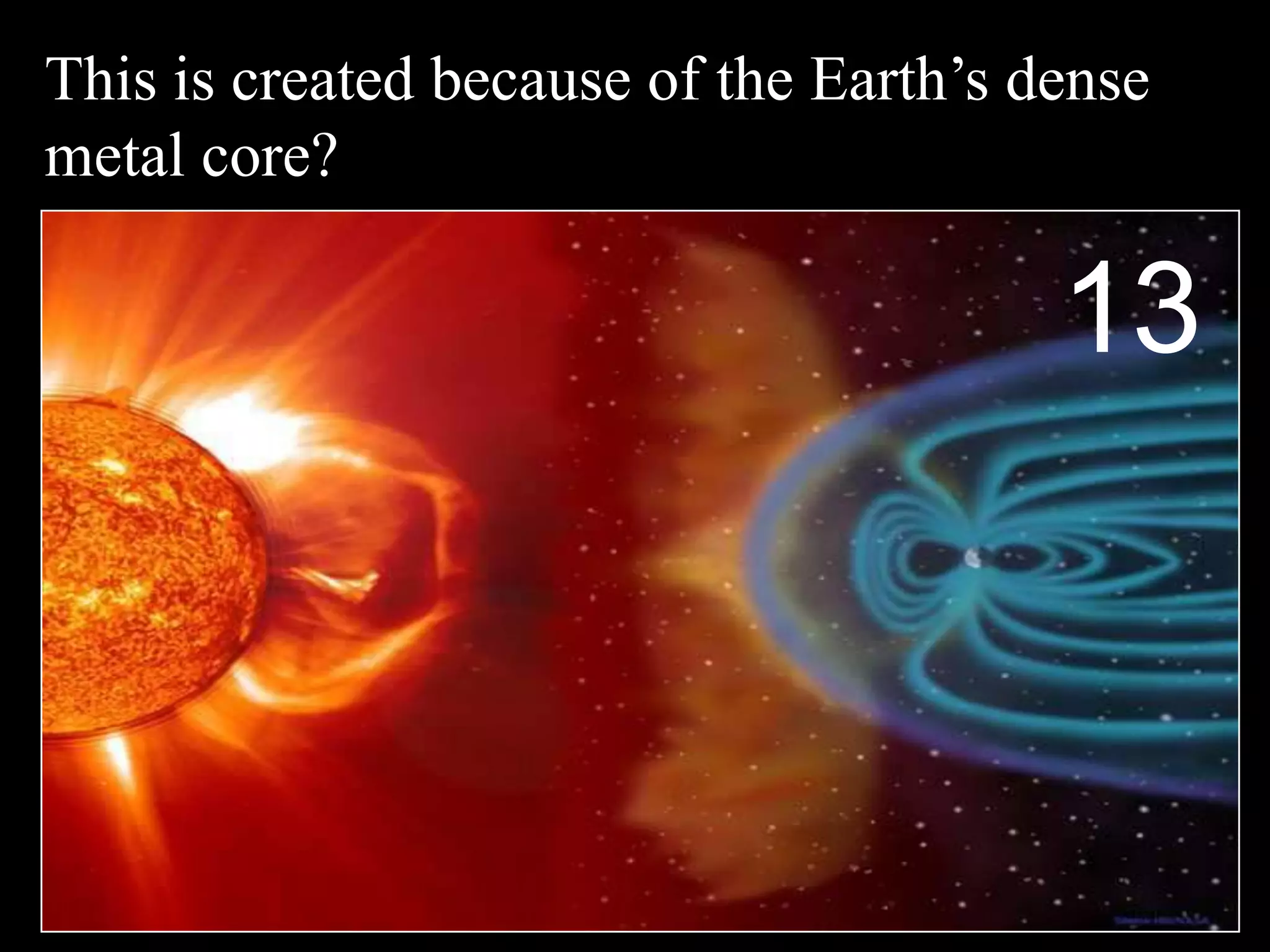
This is created because of the Earth’s dense
metal core?
13
This is created because of the Earth’s dense
metal core?
13
• Please name A, B, and C?
• Convection
• Conduction
• Radiation
Copyright © 2010 Ryan P. Murphy
A
B
C
A
B
C
14
• Please name A, B, and C?
• Convection
• Conduction
• Radiation
Copyright © 2010 Ryan P. Murphy
A
B
C
A
B
C
14
• Please name A, B, and C?
• Convection
• Conduction
• Radiation
Copyright © 2010 Ryan P. Murphy
B
C
A
B
C
14
• Please name A, B, and C?
• Convection
• Conduction
• Radiation
Copyright © 2010 Ryan P. Murphy
B
C
A
B
C
14
• Please name A, B, and C?
• Convection
• Conduction
• Radiation
Copyright © 2010 Ryan P. Murphy
C
A
B
C
14
• Please name A, B, and C?
• Convection
• Conduction
• Radiation
Copyright © 2010 Ryan P. Murphy
C
A
B
C
14
• Please name A, B, and C?
• Convection
• Conduction
• Radiation
Copyright © 2010 Ryan P. Murphy
A
B
C
14
• Which colored arrows are incorrect based on
the convection current patterns and plate
movements below?
Copyright © 2010 Ryan P. Murphy
15
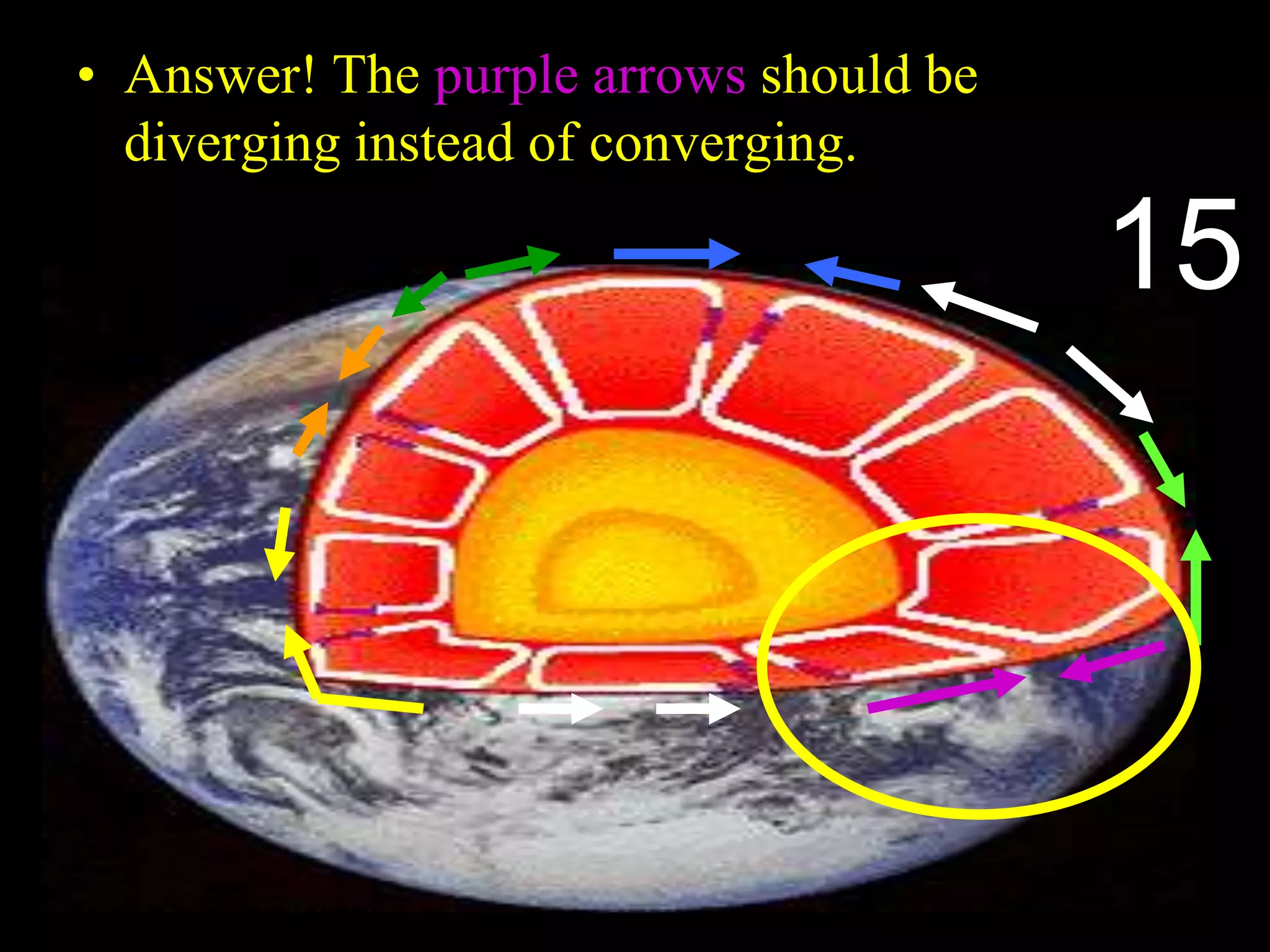
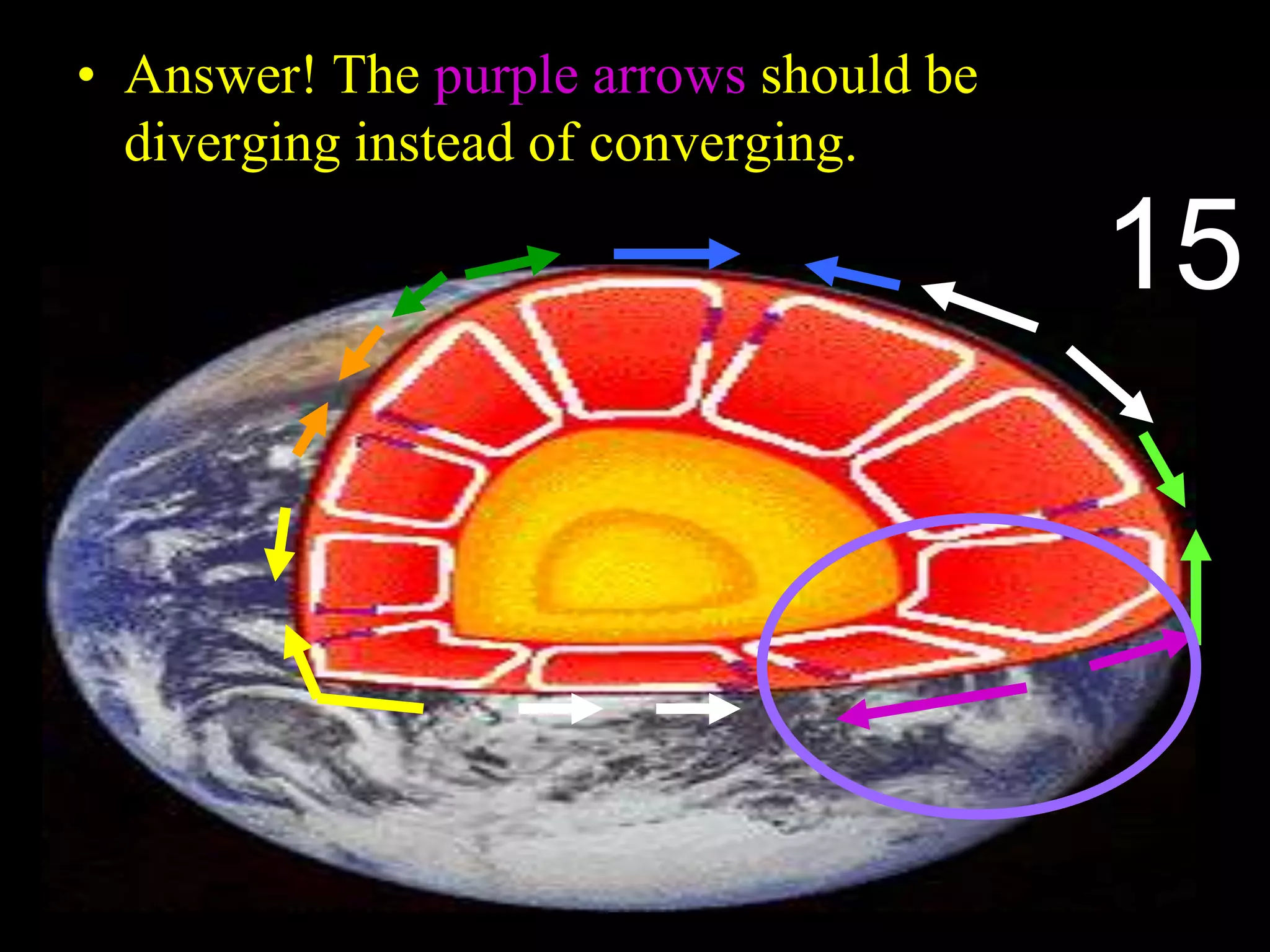
• Answer! The purple arrows should be
diverging instead of converging.
Copyright © 2010 Ryan P. Murphy
15
• Answer! The purple arrows should be
diverging instead of converging.
Copyright © 2010 Ryan P. Murphy
15
MOVING
AROUND
LAYERS OF
EVIDENCE
TERRARIFIC A LOT ON
YOUR PLATE
-BONUS-
NAME THE
PLACE AND
CONTINENT
1 6 11 16 *21
2 7 12 17 *22
3 8 13 18 *23
4 9 14 19 *24
5 10 15 20 *25
Copyright © 2010 Ryan P. Murphy
Dynamic Earth Review Game
• What type of plate boundary is shown below.
16
• What type of plate boundary is shown below.
– A.) Subduction Zone
16
• What type of plate boundary is shown below.
– A.) Subduction Zone
– B.) Divergent Ocean Boundary
16
• What type of plate boundary is shown below.
– A.) Subduction Zone
– B.) Divergent Ocean Boundary
– C.) Convergent Continental Boundary16
• What type of plate boundary is shown below.
– A.) Subduction Zone
– B.) Divergent Ocean Boundary
– C.) Convergent Continental Boundary
– D.) Divergent Continental Boundary
16
• What type of plate boundary is shown below.
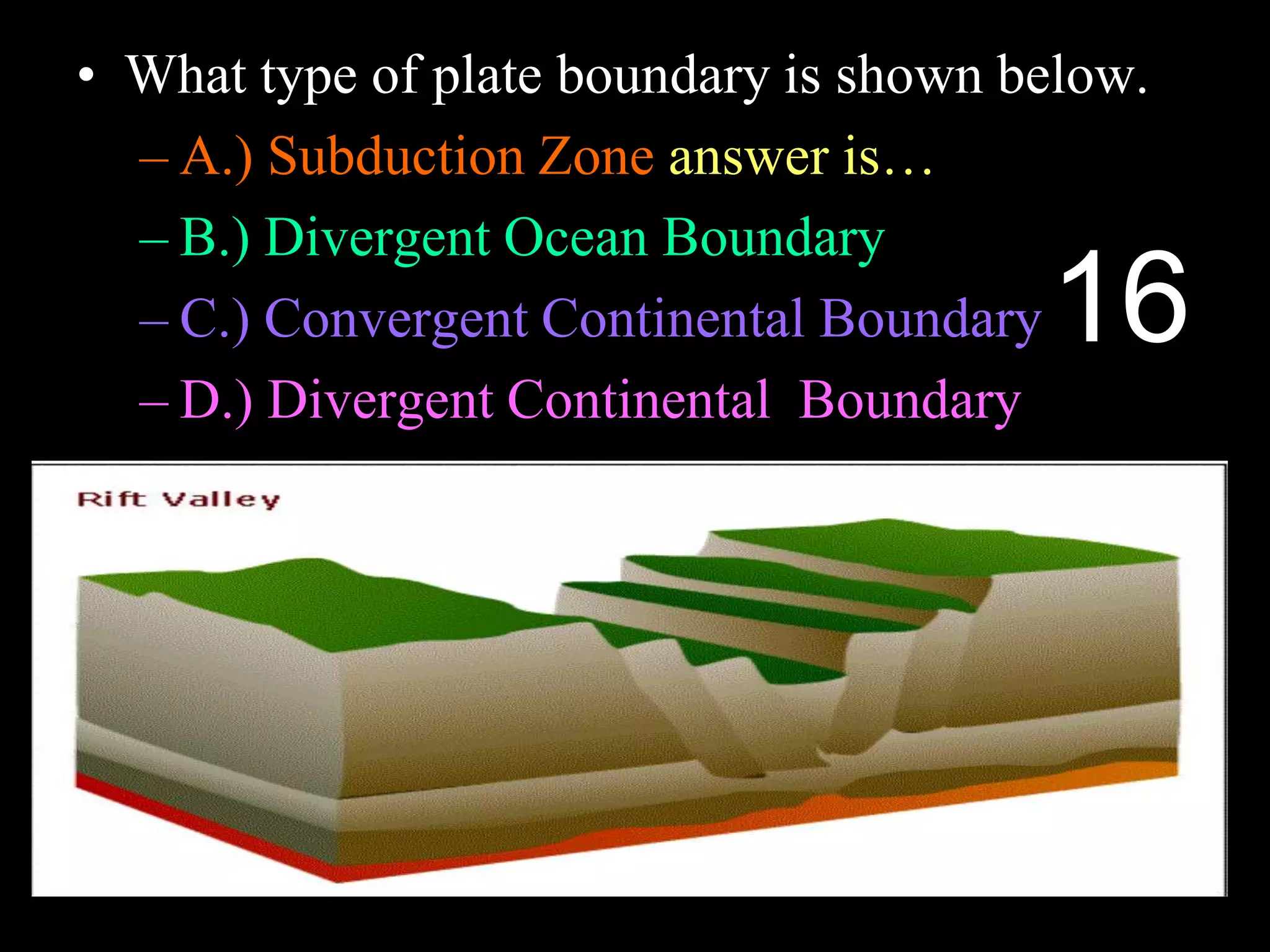
– A.) Subduction Zone answer is…
– B.) Divergent Ocean Boundary
– C.) Convergent Continental Boundary
– D.) Divergent Continental Boundary
16
• What type of plate boundary is shown below.
– A.) Subduction Zone answer is…
– B.) Divergent Ocean Boundary
– C.) Convergent Continental Boundary
– D.) Divergent Continental Boundary
16
Please name A, B, C, D, E in the picture below.
17
A
B
C
CE
D= Type of Zone
Please name A, B, C, D, E in the picture below.
17
A
B
C
CE
D= Type of Zone
Please name A, B, C, D, E in the picture below.
17
A
B
C
CE
D= Type of Zone
Continental Crust
Please name A, B, C, D, E in the picture below.
17
A
B
C
CE
D= Type of Zone
Continental Crust
Please name A, B, C, D, E in the picture below.
17
A
B
C
CE
D= Type of Zone
Continental Crust
Ocean Crust
Please name A, B, C, D, E in the picture below.
17
A
B
C
CE
D= Type of Zone
Continental Crust
Ocean Crust
Please name A, B, C, D, E in the picture below.
17
A
B
C
CE
D= Type of Zone
Continental Crust
Ocean Crust Lithosphere
Please name A, B, C, D, E in the picture below.
17
A
B
C
E
D= Type of Zone
Continental Crust
Ocean Crust
Lithosphere
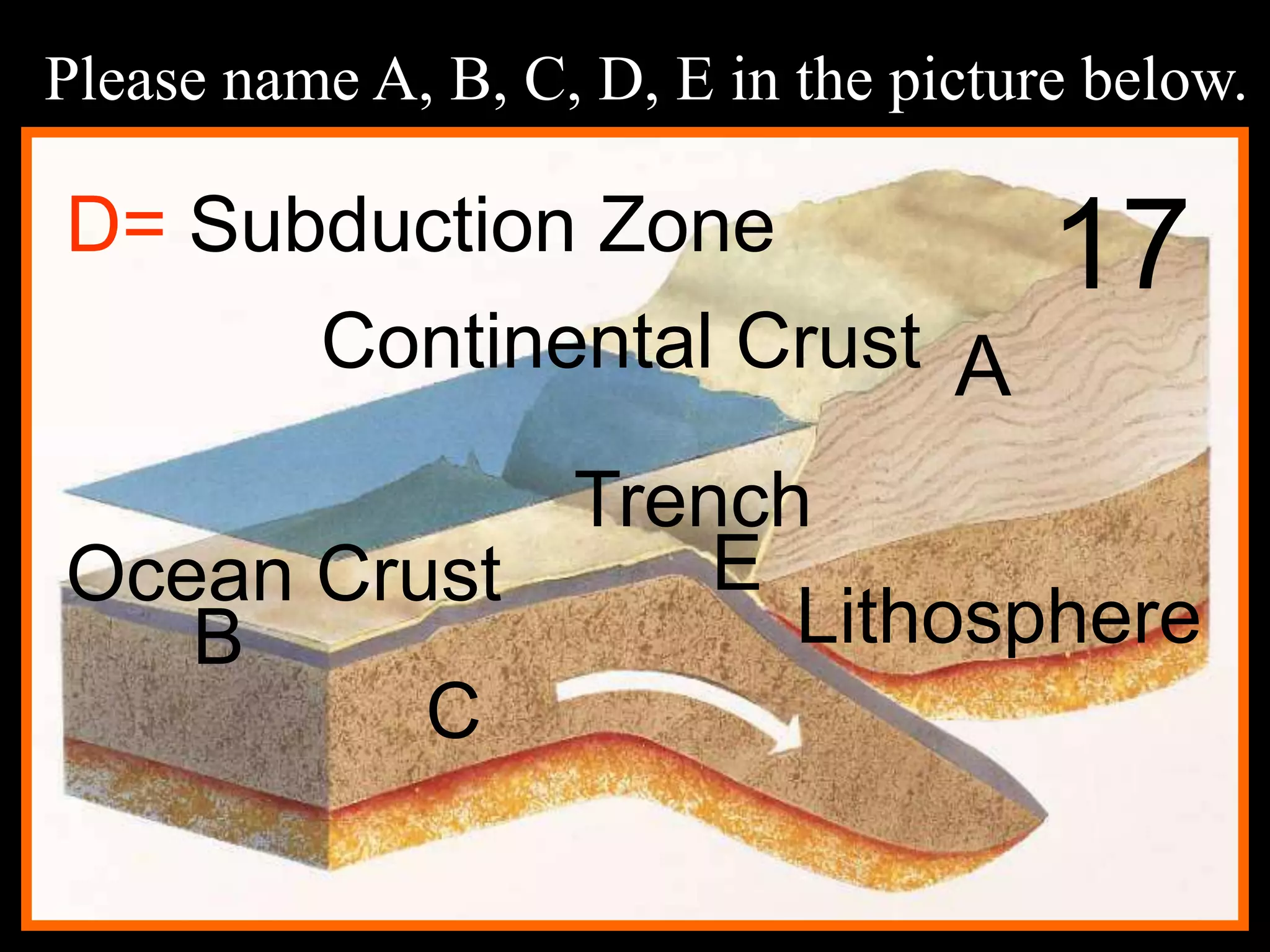
Please name A, B, C, D, E in the picture below.
17
A
B
C
E
D= Subduction Zone
Continental Crust
Ocean Crust
Lithosphere
Please name A, B, C, D, E in the picture below.
17
A
B
C
E
D= Subduction Zone
Continental Crust
Ocean Crust
Lithosphere
Please name A, B, C, D, E in the picture below.
17
A
B
C
E
D= Subduction Zone
Continental Crust
Ocean Crust
Lithosphere
Trench
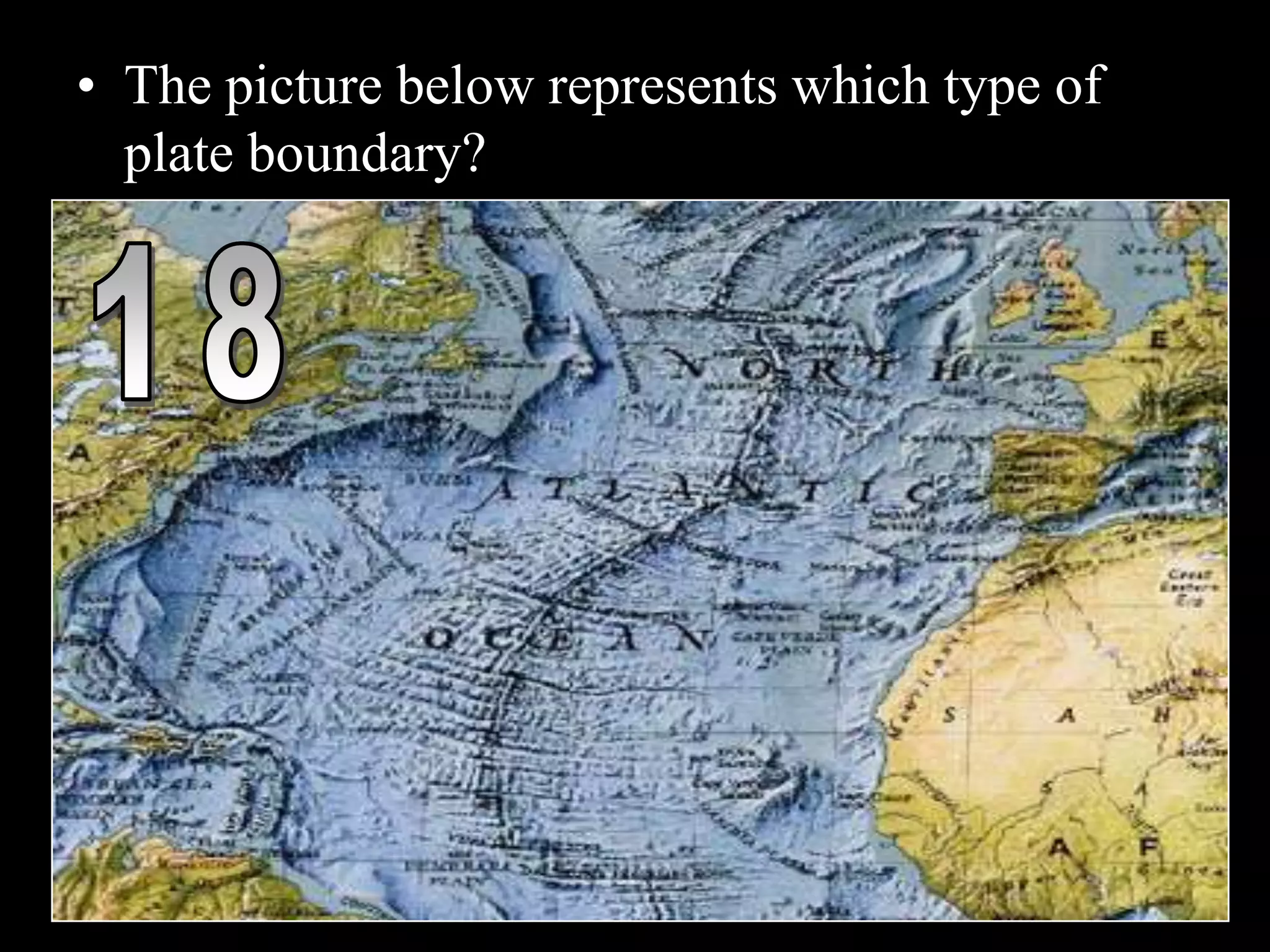
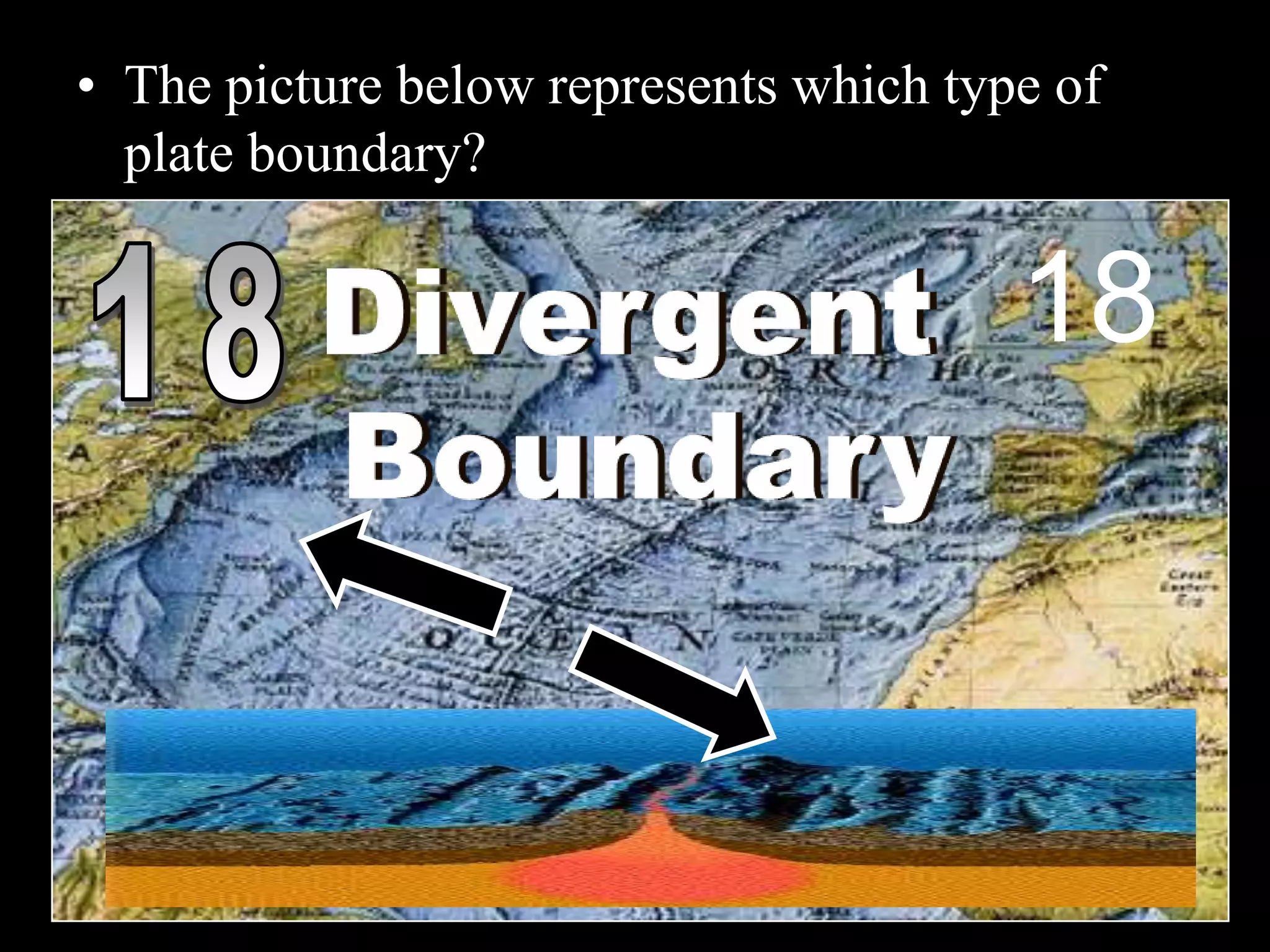
• The picture below represents which type of
plate boundary?
• The picture below represents which type of
plate boundary?
18
• What is the general name for this geologically
active area that circles the Pacific Ocean?
19
• What is the general name for this geologically
active area that circles the Pacific Ocean?
19
• This is the name for a group of volcanic
islands formed from ocean crust convergence.
20
• This is the name for a group of volcanic
islands formed from ocean crust convergence.
20
MOVING
AROUND
LAYERS OF
EVIDENCE
TERRARIFIC A LOT ON
YOUR PLATE
-BONUS-
NAME THE
PLACE AND
CONTINENT
1 6 11 16 *21
2 7 12 17 *22
3 8 13 18 *23
4 9 14 19 *24
5 10 15 20 *25
Copyright © 2010 Ryan P. Murphy
Dynamic Earth Review Game
*21
*21
*21
*22
*22
*22
*23
*23
*23
*24
*24
*24
*25
*25
*25
MOVING
AROUND
LAYERS OF
EVIDENCE
TERRARIFIC A LOT ON
YOUR PLATE
-BONUS-
NAME THE
PLACE AND
CONTINENT
1 6 11 16 *21
2 7 12 17 *22
3 8 13 18 *23
4 9 14 19 *24
5 10 15 20 *25
Copyright © 2010 Ryan P. Murphy
Dynamic Earth Review Game
FINAL QUESTION:
“You may wager up
to 5pts for this final
question.”
• Continental Crusts are made of less dense
Granites while oceanic crusts are made of more
dense basalts.
• Continental Crusts are made of less dense
Granites while oceanic crusts are made of more
dense basalts.
• Continental Crusts are made of less dense
Granites while oceanic crusts are made of more
dense basalts.
• Continental Crusts are made of less dense
Granites while oceanic crusts are made of more
dense basalts.
• Continental Crusts are made of less dense
Granites while oceanic crusts are made of more
dense basalts.
Questions 1-20 = 5pts Each
Final Category (Bonus) = 1pt Each
Final Questions = 5 pt wager
Find the Owl =
Secretly write “Owl” in the correct box
worth 1pt.
http://sciencepowerpoint.com/Website Link:
• This part of the PowerPoint roadmap is just one small part of
my Geology Topics Unit. This unit includes…
• A six part 6,000 Slide PowerPoint Presentation / unit roadmap
full of activities, review questions, games, video links,
flashcards, materials list, and much more.
• A 18 bundled homework package, modified version, 19 pages
of unit notes, 6 PowerPoint Review Games of 100+ slides
each, videos, rubrics, and much more that all chronologically
follow the unit slideshow.
• This is a fantastic unit for any Earth Science Class.
• http://sciencepowerpoint.com/Geology_Unit.html
Areas of Focus within The Geology Topics Unit:
-Areas of Focus within The Geology Topics Unit: Plate Tectonics, Evidence for
Plate Tectonics, Pangea, Energy Waves, Layers of the Earth, Heat
Transfer, Types of Crust, Plate Boundaries, Hot Spots, Volcanoes, Positives and
Negatives of Volcanoes, Types of Volcanoes, Parts of a Volcano, Magma, Types
of Lava, Viscosity, Earthquakes, Faults, Folds, Seismograph, Richter
Scale, Seismograph, Tsunami’s, Rocks, Minerals, Crystals, Uses of
Minerals, Types of Crystals, Physical Properties of Minerals, Rock
Cycle, Common Igneous Rocks, Common Sedimentary Rocks, Common
Metamorphic Rocks., Age of the Earth, Uniformitarianism, Principle of
Superposition, Earth History, Time Units, Timeline of Events, Basic
Evolution, Mass Extinction Events, Dinosaurs, Early Mammals, and more.
Full Unit can be found at…
http://sciencepowerpoint.com/Geology_Unit.html
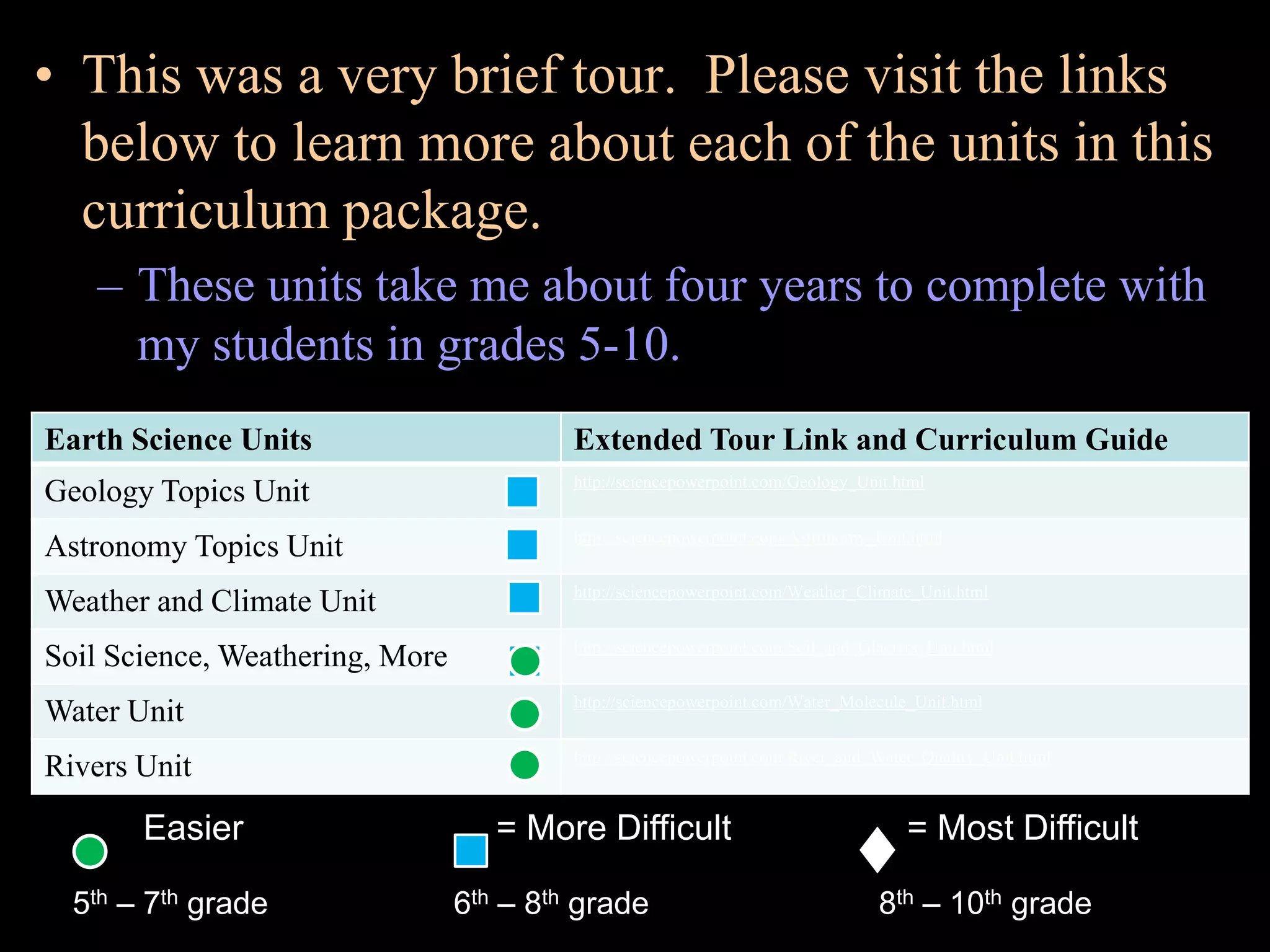
• This was a very brief tour. Please visit the links
below to learn more about each of the units in this
curriculum package.
– These units take me about four years to complete with
my students in grades 5-10.
Earth Science Units Extended Tour Link and Curriculum Guide
Geology Topics Unit http://sciencepowerpoint.com/Geology_Unit.html
Astronomy Topics Unit http://sciencepowerpoint.com/Astronomy_Unit.html
Weather and Climate Unit http://sciencepowerpoint.com/Weather_Climate_Unit.html
Soil Science, Weathering, More http://sciencepowerpoint.com/Soil_and_Glaciers_Unit.html
Water Unit http://sciencepowerpoint.com/Water_Molecule_Unit.html
Rivers Unit http://sciencepowerpoint.com/River_and_Water_Quality_Unit.html
= Easier = More Difficult = Most Difficult
5th – 7th grade 6th – 8th grade 8th – 10th grade
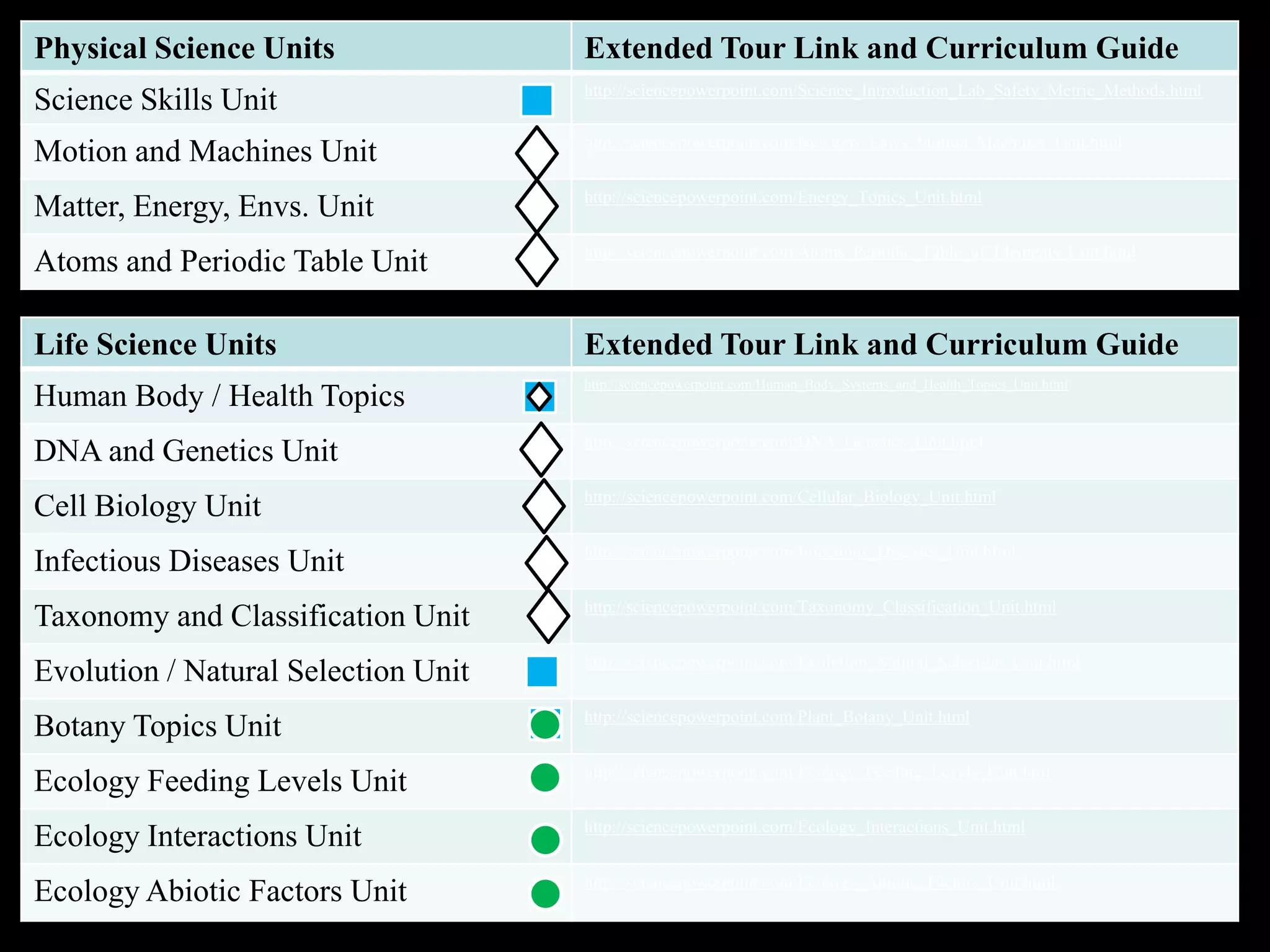
Physical Science Units Extended Tour Link and Curriculum Guide
Science Skills Unit http://sciencepowerpoint.com/Science_Introduction_Lab_Safety_Metric_Methods.html
Motion and Machines Unit http://sciencepowerpoint.com/Newtons_Laws_Motion_Machines_Unit.html
Matter, Energy, Envs. Unit http://sciencepowerpoint.com/Energy_Topics_Unit.html
Atoms and Periodic Table Unit http://sciencepowerpoint.com/Atoms_Periodic_Table_of_Elements_Unit.html
Life Science Units Extended Tour Link and Curriculum Guide
Human Body / Health Topics
http://sciencepowerpoint.com/Human_Body_Systems_and_Health_Topics_Unit.html
DNA and Genetics Unit http://sciencepowerpoint.com/DNA_Genetics_Unit.html
Cell Biology Unit http://sciencepowerpoint.com/Cellular_Biology_Unit.html
Infectious Diseases Unit http://sciencepowerpoint.com/Infectious_Diseases_Unit.html
Taxonomy and Classification Unit http://sciencepowerpoint.com/Taxonomy_Classification_Unit.html
Evolution / Natural Selection Unit http://sciencepowerpoint.com/Evolution_Natural_Selection_Unit.html
Botany Topics Unit http://sciencepowerpoint.com/Plant_Botany_Unit.html
Ecology Feeding Levels Unit http://sciencepowerpoint.com/Ecology_Feeding_Levels_Unit.htm
Ecology Interactions Unit http://sciencepowerpoint.com/Ecology_Interactions_Unit.html
Ecology Abiotic Factors Unit http://sciencepowerpoint.com/Ecology_Abiotic_Factors_Unit.html
• More Units Available at…
Earth Science: The Soil Science and Glaciers Unit, The Geology Topics
Unit, The Astronomy Topics Unit, The Weather and Climate Unit, and The
Rivers and Water Quality Unit, The Water Molecule Unit.
Physical Science: The Laws of Motion and Machines Unit, The Atoms
and Periodic Table Unit, The Energy and the Environment Unit, and
Science Skills Unit.
Life Science: The Diseases and Cells Unit, The DNA and Genetics Unit,
The Life Topics Unit, The Plant Unit, The Taxonomy and Classification
Unit, Ecology: Feeding Levels Unit, Ecology: Interactions Unit, Ecology:
Abiotic Factors, The Evolution and Natural Selection Unit and The Human
Body Systems and Health Topics Unit
Copyright © 2010 Ryan P. Murphy
• The entire four year curriculum can be found at...
http://sciencepowerpoint.com/ Please feel free to
contact me with any questions you may have. Thank
you for your interest in this curriculum.
Sincerely,
Ryan Murphy M.Ed
www.sciencepowerpoint@gmail.com
http://sciencepowerpoint.com/Website Link:

Dynamic Earth PowerPoint Quiz Game, Geology Topics Lesson PowerPoint

  • 1.
    • Name A,B, and C. Copyright © 2010 Ryan P. Murphy A B C 10
  • 2.
    MOVING AROUND LAYERS OF EVIDENCE TERRARIFIC ALOT ON YOUR PLATE -BONUS- NAME THE PLACE AND CONTINENT 1 6 11 16 *21 2 7 12 17 *22 3 8 13 18 *23 4 9 14 19 *24 5 10 15 20 *25 Copyright © 2010 Ryan P. Murphy Dynamic Earth Review Game
  • 3.
    • How toplay… – Don’t play like Jeo_ _ _ _ y. – Class should be divided into several small groups. – Groups should use science journal (red slide notes), homework, and other available materials to assist you. – Groups can communicate quietly with each other but no sharing answers between groups. • Practice quietly communicating right now? • Practice Communication Question: • Your group gets to order one pizza and you can have two toppings. What does your group want?
  • 4.
    Questions 1-20 =5pts Each Final Category (Bonus) = 1pt Each Final Questions = 5 pt wager If you wager 5 on the last question and get it wrong you lose 5 pts. Wager 5 and get it right you get 5 pts. Find the Owl = Secretly write “Owl” in the correct box worth 1pt. “I’ll be about this big.”
  • 5.
    • Is yourname on the review sheet?
  • 6.
    • Is yourname on the review sheet?
  • 7.
  • 8.
    MOVING AROUND LAYERS OF EVIDENCE TERRARIFIC ALOT ON YOUR PLATE -BONUS- NAME THE PLACE AND CONTINENT 1 6 11 16 *21 2 7 12 17 *22 3 8 13 18 *23 4 9 14 19 *24 5 10 15 20 *25 Copyright © 2010 Ryan P. Murphy Dynamic Earth Review Game
  • 9.
    MOVING AROUND LAYERS OF EVIDENCE TERRARIFIC ALOT ON YOUR PLATE -BONUS- NAME THE PLACE AND CONTINENT 1 6 11 16 *21 2 7 12 17 *22 3 8 13 18 *23 4 9 14 19 *24 5 10 15 20 *25 Copyright © 2010 Ryan P. Murphy Dynamic Earth Review Game
  • 10.
    • This theorydescribes how the crust and upper mantle are broken into sections called plates. – It is the driving force in Geology. 1
  • 11.
    • This isthe theory that describes how the continents are gradually moving across the earth. 2
  • 12.
    This scientist wasthe first to propose that the continents were once together? 3
  • 13.
  • 14.
    Before the SupercontinentP_ _ _ _ _, name the two prior supercontinents circled below?
  • 15.
    MOVING AROUND LAYERS OF EVIDENCE TERRARIFIC ALOT ON YOUR PLATE -BONUS- NAME THE PLACE AND CONTINENT 1 6 11 16 *21 2 7 12 17 *22 3 8 13 18 *23 4 9 14 19 *24 5 10 15 20 *25 Copyright © 2010 Ryan P. Murphy Dynamic Earth Review Game
  • 16.
    • Which isnot an evidence of continental drift? A.) The Shapes Match. B.) Same fossils found on different continents. C.) Different rock structures on different continents. D.) Fossils of Trees and Animals in Antarctica. E.) Magnetic layers in sea floor spreading. 6
  • 17.
    • Which isnot an evidence of continental drift? A.) The Shapes Match. B.) Same fossils found on different continents. C.) Different rock structures on different continents. D.) Fossils of Trees and Animals in Antarctica. E.) Magnetic layers in sea floor spreading. 6
  • 18.
    • Which isnot an evidence of continental drift? A.) The Shapes Match. B.) Same fossils found on different continents. C.) Different rock structures on different continents. D.) Fossils of Trees and Animals in Antarctica. E.) Magnetic layers in sea floor spreading. 6
  • 19.
    • Which isnot an evidence of continental drift? A.) The Shapes Match. B.) Same fossils found on different continents. C.) Different rock structures on different continents. D.) Fossils of Trees and Animals in Antarctica. E.) Magnetic layers in sea floor spreading. 6
  • 20.
    • Which isnot an evidence of continental drift? A.) The Shapes Match. B.) Same fossils found on different continents. C.) Different rock structures on different continents. D.) Fossils of Trees and Animals in Antarctica. E.) Magnetic layers in sea floor spreading. 6
  • 21.
    • Which isnot an evidence of continental drift? A.) The Shapes Match. B.) Same fossils found on different continents. C.) Different rock structures on different continents. D.) Fossils of Trees and Animals in Antarctica. E.) Magnetic layers in sea floor spreading. 6
  • 22.
    • One wayscientist can learn about the interior of the earth is by studying these two waves? 7
  • 23.
  • 24.
  • 25.
  • 26.
  • 27.
    This formed whengravity pulled the heaviest elements toward the middle of the Earth? 9
  • 28.
    • Name A,B, and C. Copyright © 2010 Ryan P. Murphy A B C 10
  • 29.
    MOVING AROUND LAYERS OF EVIDENCE TERRARIFIC ALOT ON YOUR PLATE -BONUS- NAME THE PLACE AND CONTINENT 1 6 11 16 *21 2 7 12 17 *22 3 8 13 18 *23 4 9 14 19 *24 5 10 15 20 *25 Copyright © 2010 Ryan P. Murphy Dynamic Earth Review Game
  • 30.
    The Inner Coreis made mostly of these two elements? 11
  • 31.
    The Mantle ismade of these chemical elements? 12
  • 32.
    The Mantle ismade of these chemical elements? 12A.) Solid Iron and Nickel
  • 33.
    The Mantle ismade of these chemical elements? 12A.) Solid Iron and Nickel B.) Liquid Iron and Nickel
  • 34.
    The Mantle ismade of these chemical elements? 12A.) Solid Iron and Nickel B.) Liquid Iron and Nickel C.) Magnesium Silicates, Iron, and Calcium
  • 35.
    The Mantle ismade of these chemical elements? 12A.) Solid Iron and Nickel B.) Liquid Iron and Nickel C.) Magnesium Silicates, Iron, and Calcium D.) Lead, Fluorine, and Potassium
  • 36.
    The Mantle ismade of these chemical elements? 12A.) Solid Iron and Nickel B.) Liquid Iron and Nickel C.) Magnesium Silicates, Iron, and Calcium D.) Lead, Fluorine, and Potassium E.) Nobody knows
  • 37.
    This is createdbecause of the Earth’s dense spinning metal cores? 13
  • 38.
    • Please nameA, B, and C? • Convection • Conduction • Radiation Copyright © 2010 Ryan P. Murphy A B C A B C 14
  • 39.
    • Which coloredarrows are incorrect based on the convection current patterns and plate movements below? Copyright © 2010 Ryan P. Murphy 15
  • 40.
    MOVING AROUND LAYERS OF EVIDENCE TERRARIFIC ALOT ON YOUR PLATE -BONUS- NAME THE PLACE AND CONTINENT 1 6 11 16 *21 2 7 12 17 *22 3 8 13 18 *23 4 9 14 19 *24 5 10 15 20 *25 Copyright © 2010 Ryan P. Murphy Dynamic Earth Review Game
  • 41.
    • What typeof plate boundary is shown below. 16
  • 42.
    • What typeof plate boundary is shown below. – A.) Subduction Zone 16
  • 43.
    • What typeof plate boundary is shown below. – A.) Subduction Zone – B.) Divergent Ocean Boundary 16
  • 44.
    • What typeof plate boundary is shown below. – A.) Subduction Zone – B.) Divergent Ocean Boundary – C.) Convergent Continental Boundary16
  • 45.
    • What typeof plate boundary is shown below. – A.) Subduction Zone – B.) Divergent Ocean Boundary – C.) Convergent Continental Boundary – D.) Divergent Continental Boundary 16
  • 46.
    Please name A,B, C, D, E in the picture below. 17 A B C CE D= Type of Zone
  • 47.
    • The picturebelow represents which type of plate boundary?
  • 48.
    • What isthe general name for this geologically active area that circles the Pacific Ocean? 19
  • 49.
    • This isthe name for a group of volcanic islands formed from ocean crust convergence. 20
  • 50.
    MOVING AROUND LAYERS OF EVIDENCE TERRARIFIC ALOT ON YOUR PLATE -BONUS- NAME THE PLACE AND CONTINENT 1 6 11 16 *21 2 7 12 17 *22 3 8 13 18 *23 4 9 14 19 *24 5 10 15 20 *25 Copyright © 2010 Ryan P. Murphy Dynamic Earth Review Game
  • 51.
  • 52.
  • 53.
  • 54.
  • 55.
  • 56.
    MOVING AROUND LAYERS OF EVIDENCE TERRARIFIC ALOT ON YOUR PLATE -BONUS- NAME THE PLACE AND CONTINENT 1 6 11 16 *21 2 7 12 17 *22 3 8 13 18 *23 4 9 14 19 *24 5 10 15 20 *25 Copyright © 2010 Ryan P. Murphy Dynamic Earth Review Game FINAL QUESTION:
  • 57.
    “You may wagerup to 5pts for this final question.”
  • 58.
    • Continental Crustsare made of less dense Granites while oceanic crusts are made of more dense basalts.
  • 59.
  • 60.
    MOVING AROUND LAYERS OF EVIDENCE TERRARIFIC ALOT ON YOUR PLATE -BONUS- NAME THE PLACE AND CONTINENT 1 6 11 16 *21 2 7 12 17 *22 3 8 13 18 *23 4 9 14 19 *24 5 10 15 20 *25 Copyright © 2010 Ryan P. Murphy Dynamic Earth Review Game
  • 61.
    • This theorydescribes how the crust and upper mantle are broken into sections called plates. – It is the driving force in Geology. 1
  • 62.
    • This theorydescribes how the crust and upper mantle are broken into sections called plates. – It is the driving force in Geology. – Answer: Plate Tectonics 1
  • 63.
    • This isthe theory that describes how the continents are gradually moving across the earth. 2
  • 64.
    • This isthe theory that describes how the continents are gradually moving across the earth. Answer: Continental Drift 2
  • 65.
    • This isthe theory that describes how the continents are gradually moving across the earth. Answer: Continental Drift (Owl +1pt) 2
  • 66.
    • This isthe theory that describes how the continents are gradually moving across the earth. Answer: Continental Drift (Owl +1pt) 2
  • 67.
    This scientist wasthe first to propose that the continents were once together? 3
  • 68.
    This scientist wasthe first to propose that the continents were once together? Alfred Wegener 3
  • 69.
  • 70.
  • 71.
    Before the SupercontinentPANGEA, name the two prior supercontinents circled below?
  • 72.
    Before the SupercontinentPANGEA, name the two prior supercontinents circled below?
  • 73.
    Before the SupercontinentPANGEA, name the two prior supercontinents circled below?
  • 74.
    Before the SupercontinentPANGEA, name the two prior supercontinents circled below?
  • 75.
    Before the SupercontinentPANGEA, name the two prior supercontinents circled below?
  • 76.
    MOVING AROUND LAYERS OF EVIDENCE TERRARIFIC ALOT ON YOUR PLATE -BONUS- NAME THE PLACE AND CONTINENT 1 6 11 16 *21 2 7 12 17 *22 3 8 13 18 *23 4 9 14 19 *24 5 10 15 20 *25 Copyright © 2010 Ryan P. Murphy Dynamic Earth Review Game
  • 77.
    • Which isnot an evidence of continental drift? A.) The Shapes Match. B.) Same fossils found on different continents. C.) Different rock structures on different continents. D.) Fossils of Trees and Animals in Antarctica. E.) Magnetic layers in sea floor spreading. 6
  • 78.
    • Which isnot an evidence of continental drift? A.) The Shapes Match. B.) Same fossils found on different continents. C.) Different rock structures on different continents. D.) Fossils of Trees and Animals in Antarctica. E.) Magnetic layers in sea floor spreading. 6
  • 79.
    • Which isnot an evidence of continental drift? A.) The Shapes Match. B.) Same fossils found on different continents. C.) Different rock structures on different continents. D.) Fossils of Trees and Animals in Antarctica. E.) Magnetic layers in sea floor spreading. 6
  • 80.
    • Which isnot an evidence of continental drift? A.) The Shapes Match. B.) Same fossils found on different continents. C.) Different rock structures on different continents. D.) Fossils of Trees and Animals in Antarctica. E.) Magnetic layers in sea floor spreading. 6
  • 81.
    • Which isnot an evidence of continental drift? A.) The Shapes Match. B.) Same fossils found on different continents. C.) Different rock structures on different continents. D.) Fossils of Trees and Animals in Antarctica. E.) Magnetic layers in sea floor spreading. 6
  • 82.
    • Which isnot an evidence of continental drift? A.) The Shapes Match. B.) Same fossils found on different continents. C.) Different rock structures on different continents. D.) Fossils of Trees and Animals in Antarctica. E.) Magnetic layers in sea floor spreading. 6
  • 83.
    • Which isnot an evidence of continental drift? A.) The Shapes Match. and the answer is… B.) Same fossils found on different continents. C.) Different rock structures on different continents. D.) Fossils of Trees and Animals in Antarctica. E.) Magnetic layers in sea floor spreading. 6
  • 84.
    • Which isnot an evidence of continental drift? A.) The Shapes Match. and the answer is… B.) Same fossils found on different continents. C.) Different rock structures on different continents. D.) Fossils of Trees and Animals in Antarctica. E.) Magnetic layers in sea floor spreading. 6
  • 85.
    • Which isnot an evidence of continental drift? A.) The Shapes Match. and the answer is… B.) Same fossils found on different continents. C.) Different rock structures on different continents. D.) Fossils of Trees and Animals in Antarctica. E.) Magnetic layers in sea floor spreading. 6
  • 86.
    • Which isnot an evidence of continental drift? A.) The Shapes Match. and the answer is… B.) Same fossils found on different continents. C.) Same rock structures on different continents. D.) Fossils of Trees and Animals in Antarctica. E.) Magnetic layers in sea floor spreading. 6
  • 87.
    • One wayscientist can learn about the interior of the earth is by studying these two waves? 7
  • 88.
    • One wayscientist can learn about the interior of the earth is by studying these two waves? 7
  • 89.
    • One wayscientist can learn about the interior of the earth is by studying these two waves? 7
  • 90.
  • 91.
  • 92.
  • 93.
  • 94.
  • 95.
  • 96.
  • 97.
  • 98.
  • 99.
  • 100.
  • 101.
  • 102.
    • Name thewave? Which one is a Longitudinal Wave?
  • 103.
    • Name thewave? Which one is a Longitudinal Wave?
  • 104.
    • Name thewave? Which one is a Longitudinal Wave?
  • 105.
    • Name thewave? Which ones are Traverse Waves?
  • 106.
  • 107.
    This formed whengravity pulled the heaviest elements toward the middle of the Earth? 9
  • 108.
    This formed whengravity pulled the heaviest elements toward the middle of the Earth? 9
  • 109.
    • Name A,B, and C. Copyright © 2010 Ryan P. Murphy A B C 10
  • 110.
    • Name A,B, and C. Copyright © 2010 Ryan P. Murphy A B C 10
  • 111.
    • Name A,B, and C. Copyright © 2010 Ryan P. Murphy B C 10
  • 112.
    • Name A,B, and C. Copyright © 2010 Ryan P. Murphy B C 10
  • 113.
    • Name A,B, and C. Copyright © 2010 Ryan P. Murphy C 10
  • 114.
    • Name A,B, and C. Copyright © 2010 Ryan P. Murphy C 10
  • 115.
    • Name A,B, and C. Copyright © 2010 Ryan P. Murphy 10
  • 116.
    MOVING AROUND LAYERS OF EVIDENCE TERRARIFIC ALOT ON YOUR PLATE -BONUS- NAME THE PLACE AND CONTINENT 1 6 11 16 *21 2 7 12 17 *22 3 8 13 18 *23 4 9 14 19 *24 5 10 15 20 *25 Copyright © 2010 Ryan P. Murphy Dynamic Earth Review Game
  • 117.
    The Inner Coreis made mostly of these two elements? 11
  • 118.
    The Inner Coreis made mostly of these two elements? 11
  • 119.
    The Mantle ismade of these chemical elements? 12
  • 120.
    The Mantle ismade of these chemical elements? 12A.) Solid Iron and Nickel
  • 121.
    The Mantle ismade of these chemical elements? 12A.) Solid Iron and Nickel B.) Liquid Iron and Nickel
  • 122.
    The Mantle ismade of these chemical elements? 12A.) Solid Iron and Nickel B.) Liquid Iron and Nickel C.) Magnesium Silicates, Iron, and Calcium
  • 123.
    The Mantle ismade of these chemical elements? 12A.) Solid Iron and Nickel B.) Liquid Iron and Nickel C.) Magnesium Silicates, Iron, and Calcium D.) Lead, Fluorine, and Potassium
  • 124.
    The Mantle ismade of these chemical elements? 12A.) Solid Iron and Nickel B.) Liquid Iron and Nickel C.) Magnesium Silicates, Iron, and Calcium D.) Lead, Fluorine, and Potassium E.) Nobody knows
  • 125.
    The Mantle ismade of these chemical elements? Answer is… 12A.) Solid Iron and Nickel B.) Liquid Iron and Nickel C.) Magnesium Silicates, Iron, and Calcium D.) Lead, Fluorine, and Potassium E.) Nobody knows
  • 126.
    The Mantle ismade of these chemical elements? Answer is… 12A.) Solid Iron and Nickel B.) Liquid Iron and Nickel C.) Magnesium Silicates, Iron, and Calcium D.) Lead, Fluorine, and Potassium E.) Nobody knows
  • 127.
    This is createdbecause of the Earth’s dense metal core? 13
  • 128.
    This is createdbecause of the Earth’s dense metal core? 13
  • 129.
    • Please nameA, B, and C? • Convection • Conduction • Radiation Copyright © 2010 Ryan P. Murphy A B C A B C 14
  • 130.
    • Please nameA, B, and C? • Convection • Conduction • Radiation Copyright © 2010 Ryan P. Murphy A B C A B C 14
  • 131.
    • Please nameA, B, and C? • Convection • Conduction • Radiation Copyright © 2010 Ryan P. Murphy B C A B C 14
  • 132.
    • Please nameA, B, and C? • Convection • Conduction • Radiation Copyright © 2010 Ryan P. Murphy B C A B C 14
  • 133.
    • Please nameA, B, and C? • Convection • Conduction • Radiation Copyright © 2010 Ryan P. Murphy C A B C 14
  • 134.
    • Please nameA, B, and C? • Convection • Conduction • Radiation Copyright © 2010 Ryan P. Murphy C A B C 14
  • 135.
    • Please nameA, B, and C? • Convection • Conduction • Radiation Copyright © 2010 Ryan P. Murphy A B C 14
  • 136.
    • Which coloredarrows are incorrect based on the convection current patterns and plate movements below? Copyright © 2010 Ryan P. Murphy 15
  • 137.
    • Answer! Thepurple arrows should be diverging instead of converging. Copyright © 2010 Ryan P. Murphy 15
  • 138.
    • Answer! Thepurple arrows should be diverging instead of converging. Copyright © 2010 Ryan P. Murphy 15
  • 139.
    MOVING AROUND LAYERS OF EVIDENCE TERRARIFIC ALOT ON YOUR PLATE -BONUS- NAME THE PLACE AND CONTINENT 1 6 11 16 *21 2 7 12 17 *22 3 8 13 18 *23 4 9 14 19 *24 5 10 15 20 *25 Copyright © 2010 Ryan P. Murphy Dynamic Earth Review Game
  • 140.
    • What typeof plate boundary is shown below. 16
  • 141.
    • What typeof plate boundary is shown below. – A.) Subduction Zone 16
  • 142.
    • What typeof plate boundary is shown below. – A.) Subduction Zone – B.) Divergent Ocean Boundary 16
  • 143.
    • What typeof plate boundary is shown below. – A.) Subduction Zone – B.) Divergent Ocean Boundary – C.) Convergent Continental Boundary16
  • 144.
    • What typeof plate boundary is shown below. – A.) Subduction Zone – B.) Divergent Ocean Boundary – C.) Convergent Continental Boundary – D.) Divergent Continental Boundary 16
  • 145.
    • What typeof plate boundary is shown below. – A.) Subduction Zone answer is… – B.) Divergent Ocean Boundary – C.) Convergent Continental Boundary – D.) Divergent Continental Boundary 16
  • 146.
    • What typeof plate boundary is shown below. – A.) Subduction Zone answer is… – B.) Divergent Ocean Boundary – C.) Convergent Continental Boundary – D.) Divergent Continental Boundary 16
  • 147.
    Please name A,B, C, D, E in the picture below. 17 A B C CE D= Type of Zone
  • 148.
    Please name A,B, C, D, E in the picture below. 17 A B C CE D= Type of Zone
  • 149.
    Please name A,B, C, D, E in the picture below. 17 A B C CE D= Type of Zone Continental Crust
  • 150.
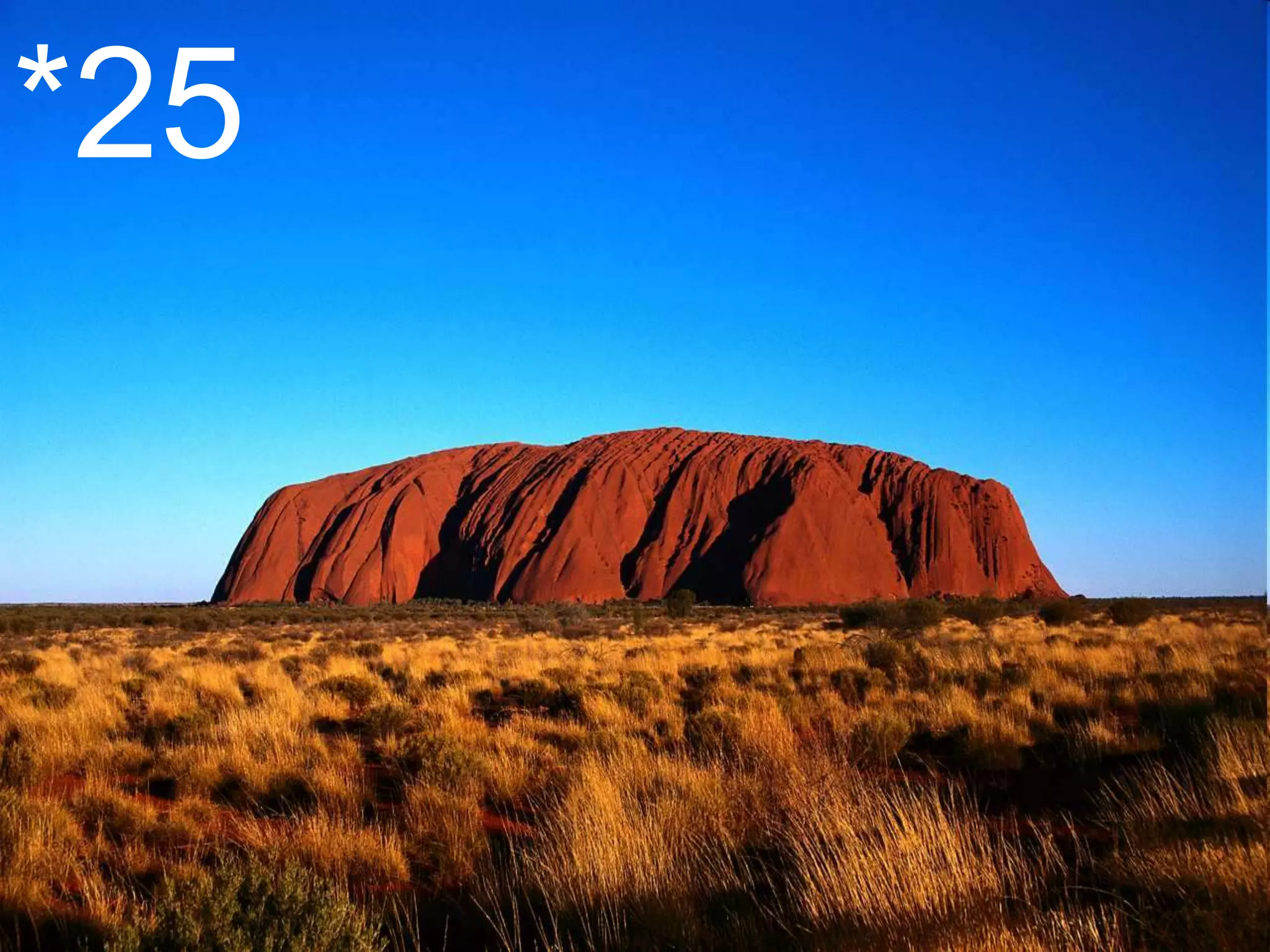
    Please name A,B, C, D, E in the picture below. 17 A B C CE D= Type of Zone Continental Crust
  • 151.
    Please name A,B, C, D, E in the picture below. 17 A B C CE D= Type of Zone Continental Crust Ocean Crust
  • 152.
    Please name A,B, C, D, E in the picture below. 17 A B C CE D= Type of Zone Continental Crust Ocean Crust
  • 153.
    Please name A,B, C, D, E in the picture below. 17 A B C CE D= Type of Zone Continental Crust Ocean Crust Lithosphere
  • 154.
    Please name A,B, C, D, E in the picture below. 17 A B C E D= Type of Zone Continental Crust Ocean Crust Lithosphere
  • 155.
    Please name A,B, C, D, E in the picture below. 17 A B C E D= Subduction Zone Continental Crust Ocean Crust Lithosphere
  • 156.
    Please name A,B, C, D, E in the picture below. 17 A B C E D= Subduction Zone Continental Crust Ocean Crust Lithosphere
  • 157.
    Please name A,B, C, D, E in the picture below. 17 A B C E D= Subduction Zone Continental Crust Ocean Crust Lithosphere Trench
  • 158.
    • The picturebelow represents which type of plate boundary?
  • 159.
    • The picturebelow represents which type of plate boundary? 18
  • 160.
    • What isthe general name for this geologically active area that circles the Pacific Ocean? 19
  • 161.
    • What isthe general name for this geologically active area that circles the Pacific Ocean? 19
  • 162.
    • This isthe name for a group of volcanic islands formed from ocean crust convergence. 20
  • 163.
    • This isthe name for a group of volcanic islands formed from ocean crust convergence. 20
  • 164.
    MOVING AROUND LAYERS OF EVIDENCE TERRARIFIC ALOT ON YOUR PLATE -BONUS- NAME THE PLACE AND CONTINENT 1 6 11 16 *21 2 7 12 17 *22 3 8 13 18 *23 4 9 14 19 *24 5 10 15 20 *25 Copyright © 2010 Ryan P. Murphy Dynamic Earth Review Game
  • 165.
  • 166.
  • 167.
  • 168.
  • 169.
  • 170.
  • 171.
  • 172.
  • 173.
  • 174.
  • 175.
  • 176.
  • 177.
  • 178.
  • 179.
  • 180.
    MOVING AROUND LAYERS OF EVIDENCE TERRARIFIC ALOT ON YOUR PLATE -BONUS- NAME THE PLACE AND CONTINENT 1 6 11 16 *21 2 7 12 17 *22 3 8 13 18 *23 4 9 14 19 *24 5 10 15 20 *25 Copyright © 2010 Ryan P. Murphy Dynamic Earth Review Game FINAL QUESTION:
  • 181.
    “You may wagerup to 5pts for this final question.”
  • 182.
    • Continental Crustsare made of less dense Granites while oceanic crusts are made of more dense basalts.
  • 183.
    • Continental Crustsare made of less dense Granites while oceanic crusts are made of more dense basalts.
  • 184.
    • Continental Crustsare made of less dense Granites while oceanic crusts are made of more dense basalts.
  • 185.
    • Continental Crustsare made of less dense Granites while oceanic crusts are made of more dense basalts.
  • 186.
    • Continental Crustsare made of less dense Granites while oceanic crusts are made of more dense basalts.
  • 187.
    Questions 1-20 =5pts Each Final Category (Bonus) = 1pt Each Final Questions = 5 pt wager Find the Owl = Secretly write “Owl” in the correct box worth 1pt.
  • 188.
  • 189.
    • This partof the PowerPoint roadmap is just one small part of my Geology Topics Unit. This unit includes… • A six part 6,000 Slide PowerPoint Presentation / unit roadmap full of activities, review questions, games, video links, flashcards, materials list, and much more. • A 18 bundled homework package, modified version, 19 pages of unit notes, 6 PowerPoint Review Games of 100+ slides each, videos, rubrics, and much more that all chronologically follow the unit slideshow. • This is a fantastic unit for any Earth Science Class. • http://sciencepowerpoint.com/Geology_Unit.html
  • 191.
    Areas of Focuswithin The Geology Topics Unit: -Areas of Focus within The Geology Topics Unit: Plate Tectonics, Evidence for Plate Tectonics, Pangea, Energy Waves, Layers of the Earth, Heat Transfer, Types of Crust, Plate Boundaries, Hot Spots, Volcanoes, Positives and Negatives of Volcanoes, Types of Volcanoes, Parts of a Volcano, Magma, Types of Lava, Viscosity, Earthquakes, Faults, Folds, Seismograph, Richter Scale, Seismograph, Tsunami’s, Rocks, Minerals, Crystals, Uses of Minerals, Types of Crystals, Physical Properties of Minerals, Rock Cycle, Common Igneous Rocks, Common Sedimentary Rocks, Common Metamorphic Rocks., Age of the Earth, Uniformitarianism, Principle of Superposition, Earth History, Time Units, Timeline of Events, Basic Evolution, Mass Extinction Events, Dinosaurs, Early Mammals, and more. Full Unit can be found at… http://sciencepowerpoint.com/Geology_Unit.html
  • 198.
    • This wasa very brief tour. Please visit the links below to learn more about each of the units in this curriculum package. – These units take me about four years to complete with my students in grades 5-10. Earth Science Units Extended Tour Link and Curriculum Guide Geology Topics Unit http://sciencepowerpoint.com/Geology_Unit.html Astronomy Topics Unit http://sciencepowerpoint.com/Astronomy_Unit.html Weather and Climate Unit http://sciencepowerpoint.com/Weather_Climate_Unit.html Soil Science, Weathering, More http://sciencepowerpoint.com/Soil_and_Glaciers_Unit.html Water Unit http://sciencepowerpoint.com/Water_Molecule_Unit.html Rivers Unit http://sciencepowerpoint.com/River_and_Water_Quality_Unit.html = Easier = More Difficult = Most Difficult 5th – 7th grade 6th – 8th grade 8th – 10th grade
  • 199.
    Physical Science UnitsExtended Tour Link and Curriculum Guide Science Skills Unit http://sciencepowerpoint.com/Science_Introduction_Lab_Safety_Metric_Methods.html Motion and Machines Unit http://sciencepowerpoint.com/Newtons_Laws_Motion_Machines_Unit.html Matter, Energy, Envs. Unit http://sciencepowerpoint.com/Energy_Topics_Unit.html Atoms and Periodic Table Unit http://sciencepowerpoint.com/Atoms_Periodic_Table_of_Elements_Unit.html Life Science Units Extended Tour Link and Curriculum Guide Human Body / Health Topics http://sciencepowerpoint.com/Human_Body_Systems_and_Health_Topics_Unit.html DNA and Genetics Unit http://sciencepowerpoint.com/DNA_Genetics_Unit.html Cell Biology Unit http://sciencepowerpoint.com/Cellular_Biology_Unit.html Infectious Diseases Unit http://sciencepowerpoint.com/Infectious_Diseases_Unit.html Taxonomy and Classification Unit http://sciencepowerpoint.com/Taxonomy_Classification_Unit.html Evolution / Natural Selection Unit http://sciencepowerpoint.com/Evolution_Natural_Selection_Unit.html Botany Topics Unit http://sciencepowerpoint.com/Plant_Botany_Unit.html Ecology Feeding Levels Unit http://sciencepowerpoint.com/Ecology_Feeding_Levels_Unit.htm Ecology Interactions Unit http://sciencepowerpoint.com/Ecology_Interactions_Unit.html Ecology Abiotic Factors Unit http://sciencepowerpoint.com/Ecology_Abiotic_Factors_Unit.html
  • 200.
    • More UnitsAvailable at… Earth Science: The Soil Science and Glaciers Unit, The Geology Topics Unit, The Astronomy Topics Unit, The Weather and Climate Unit, and The Rivers and Water Quality Unit, The Water Molecule Unit. Physical Science: The Laws of Motion and Machines Unit, The Atoms and Periodic Table Unit, The Energy and the Environment Unit, and Science Skills Unit. Life Science: The Diseases and Cells Unit, The DNA and Genetics Unit, The Life Topics Unit, The Plant Unit, The Taxonomy and Classification Unit, Ecology: Feeding Levels Unit, Ecology: Interactions Unit, Ecology: Abiotic Factors, The Evolution and Natural Selection Unit and The Human Body Systems and Health Topics Unit Copyright © 2010 Ryan P. Murphy
  • 201.
    • The entirefour year curriculum can be found at... http://sciencepowerpoint.com/ Please feel free to contact me with any questions you may have. Thank you for your interest in this curriculum. Sincerely, Ryan Murphy M.Ed www.sciencepowerpoint@gmail.com
  • 202.