GOOD DAY
GRADE 10
PLATE
TECTONICS
PLATE
TECTONICS
• The theory that the Earth’s outermost layer
is fragmented into a dozen or more large
and small plates that move relative to one
another as they ride on top of hotter, more
mobile material.
PLATE TECTONIC
• The Earth’s crust is divided into 12 major plates
which are moved in various directions.
• This plate motion causes them to collide, pull
apart, or scrape against each other.
• Each type of interaction causes a characteristic
set of Earth structures or “tectonic” features.
• The word, tectonic, refers to the deformation of
the crust as a consequence of plate interaction.
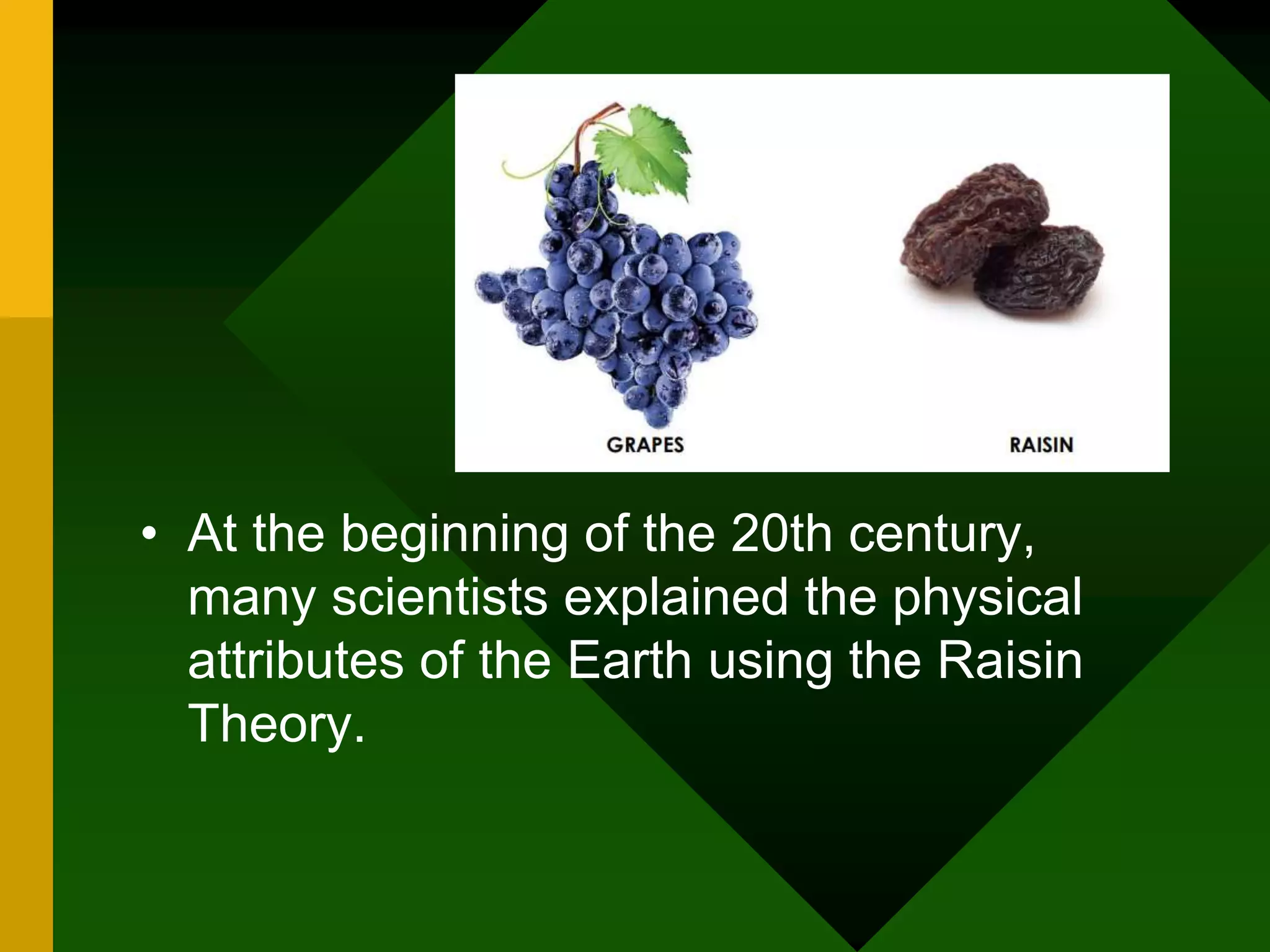
• At the beginning of the 20th century,
many scientists explained the physical
attributes of the Earth using the Raisin
Theory.
WHAT IS THE RAISIN
THEORY?
• known as the "Geosynclinical
Theory" or "Geosyncline
Hypothesis",
• According to this principle, the
level of the Earth’s crust is
determined by its density; lighter
material rises, forming continents,
mountains, and plateaus, and
heavier material sinks, forming
basins and ocean floors.
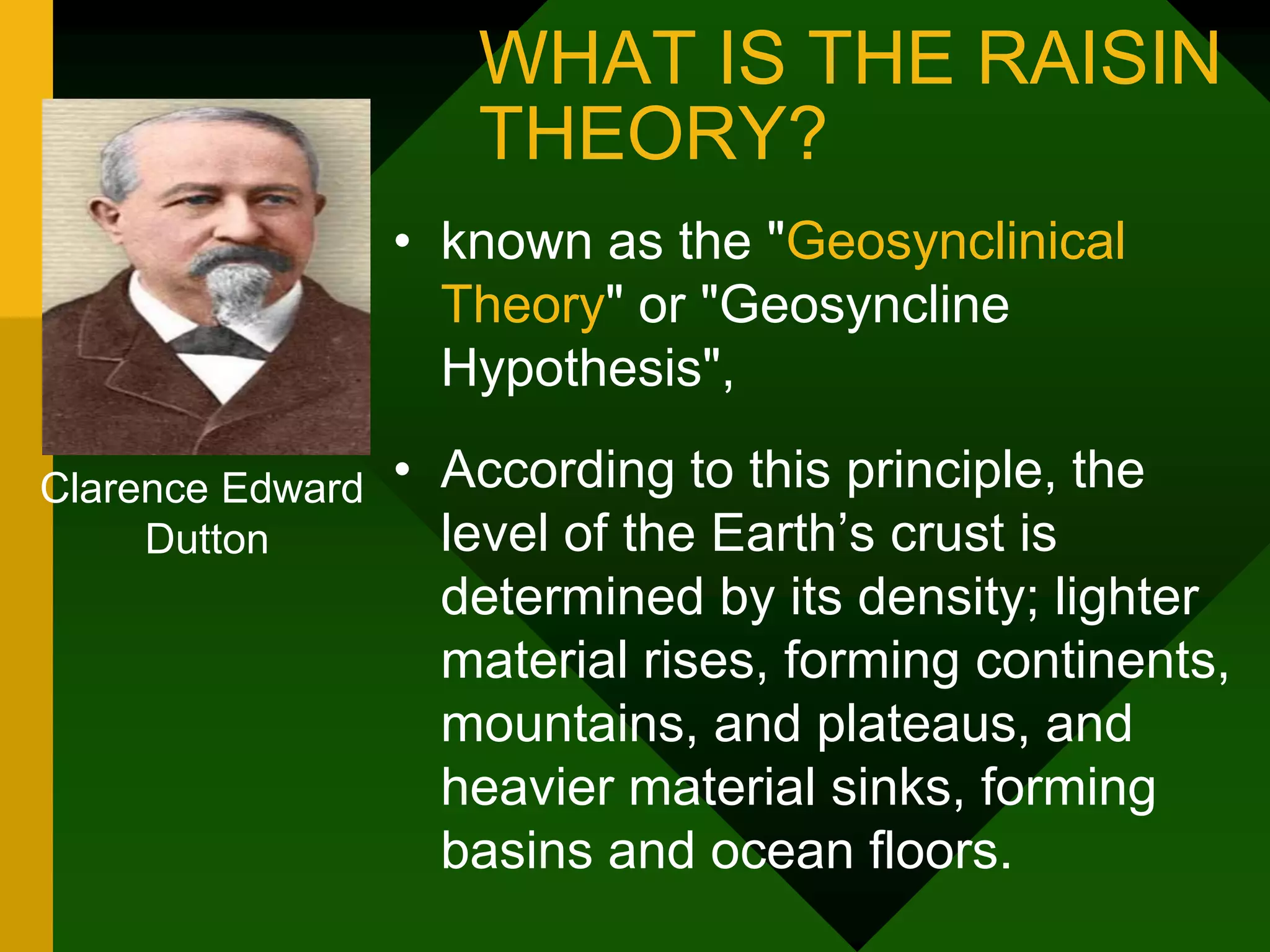
Clarence Edward
Dutton
TECTONIC is a term derived from
the Greek word " tekton" which
means " carpenter" or " builder".
• TECTONIC PLATES - (also called a
lithospheric plate) is a massive, irregularly
shaped slab of solid rock, generally composed
of both continental and oceanic lithosphere.
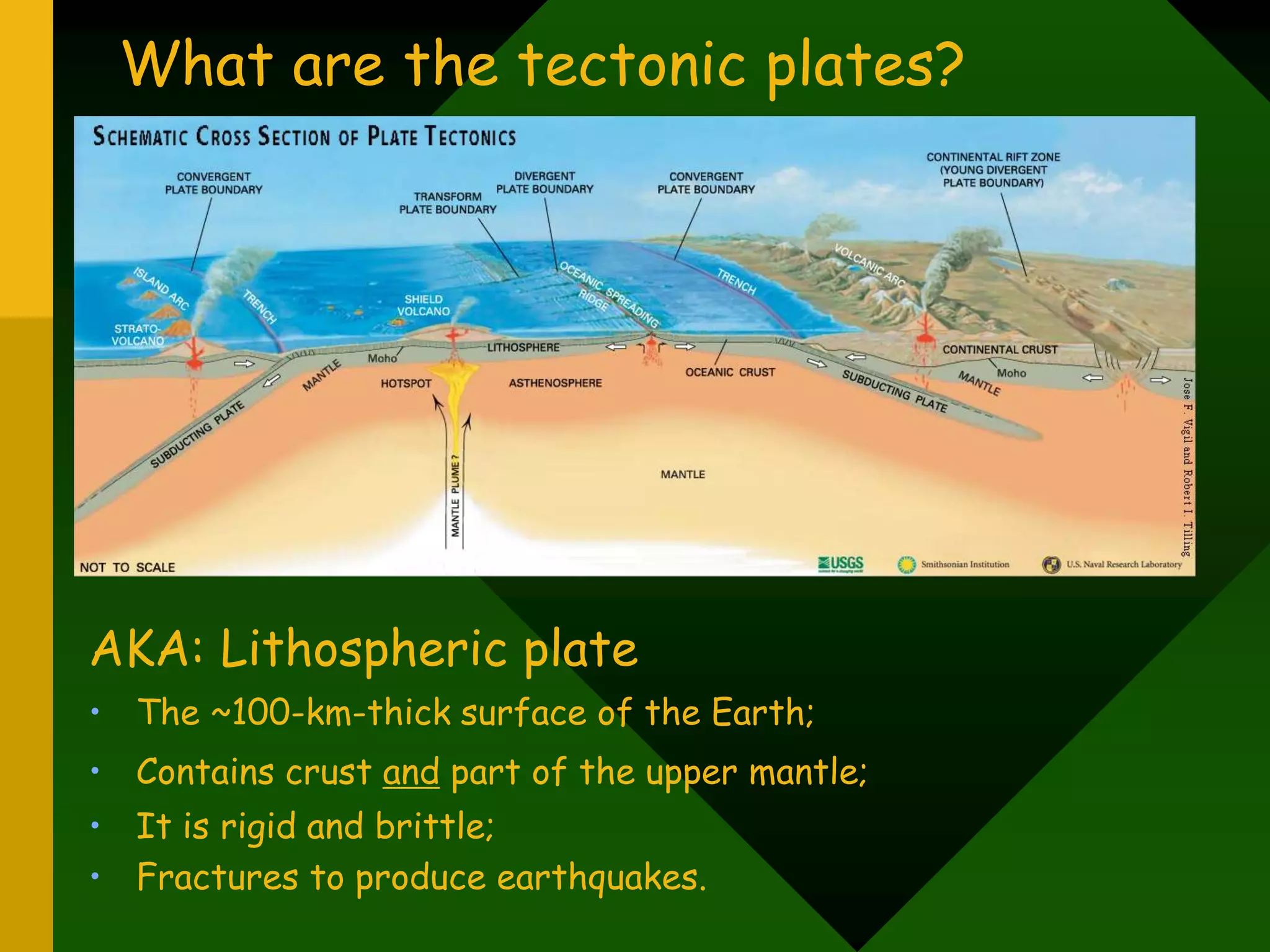
What are the tectonic plates?
AKA: Lithospheric plate
• The ~100-km-thick surface of the Earth;
• Contains crust and part of the upper mantle;
• It is rigid and brittle;
• Fractures to produce earthquakes.
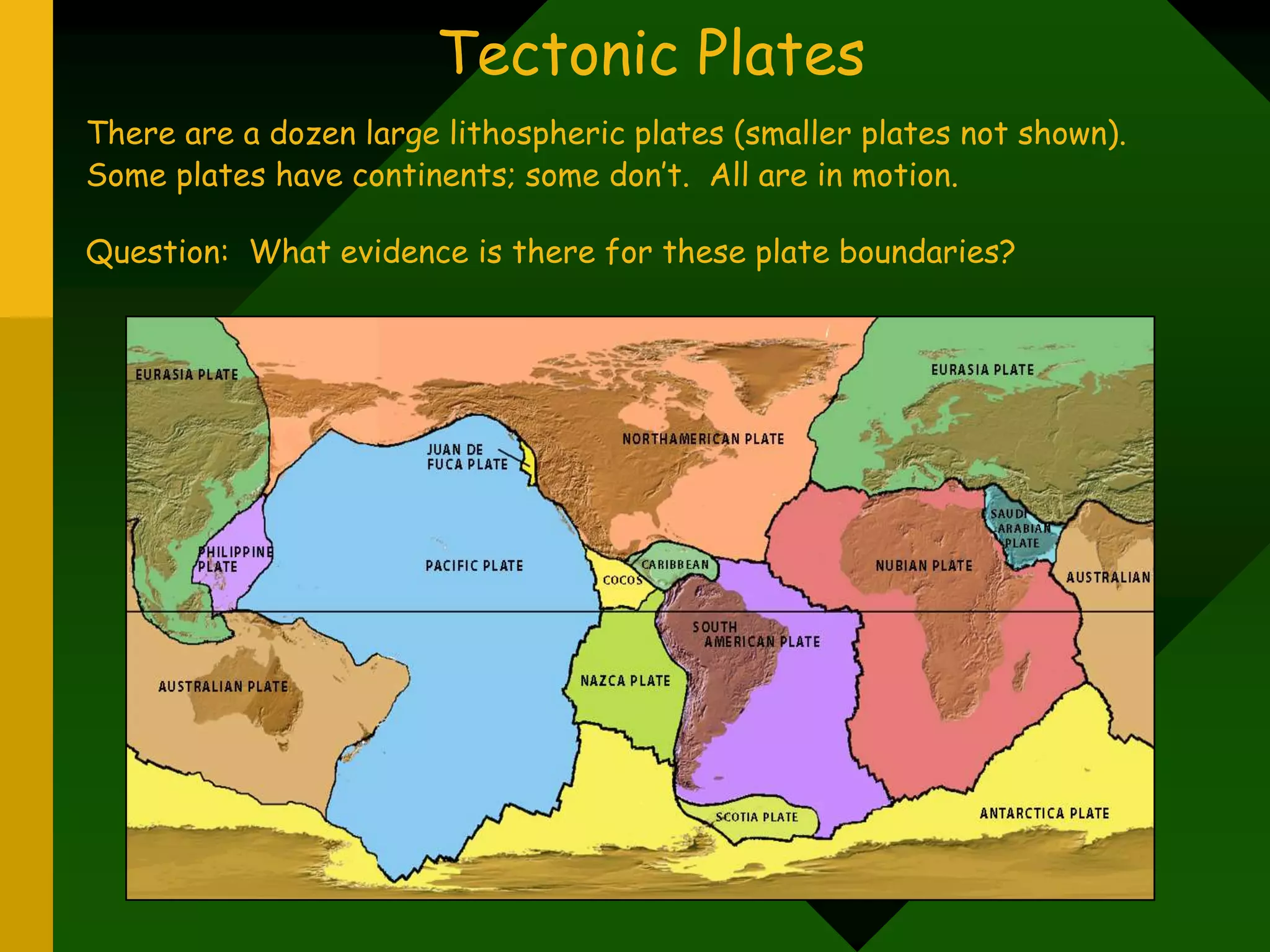
There are a dozen large lithospheric plates (smaller plates not shown).
Some plates have continents; some don’t. All are in motion.
Question: What evidence is there for these plate boundaries?
Tectonic Plates
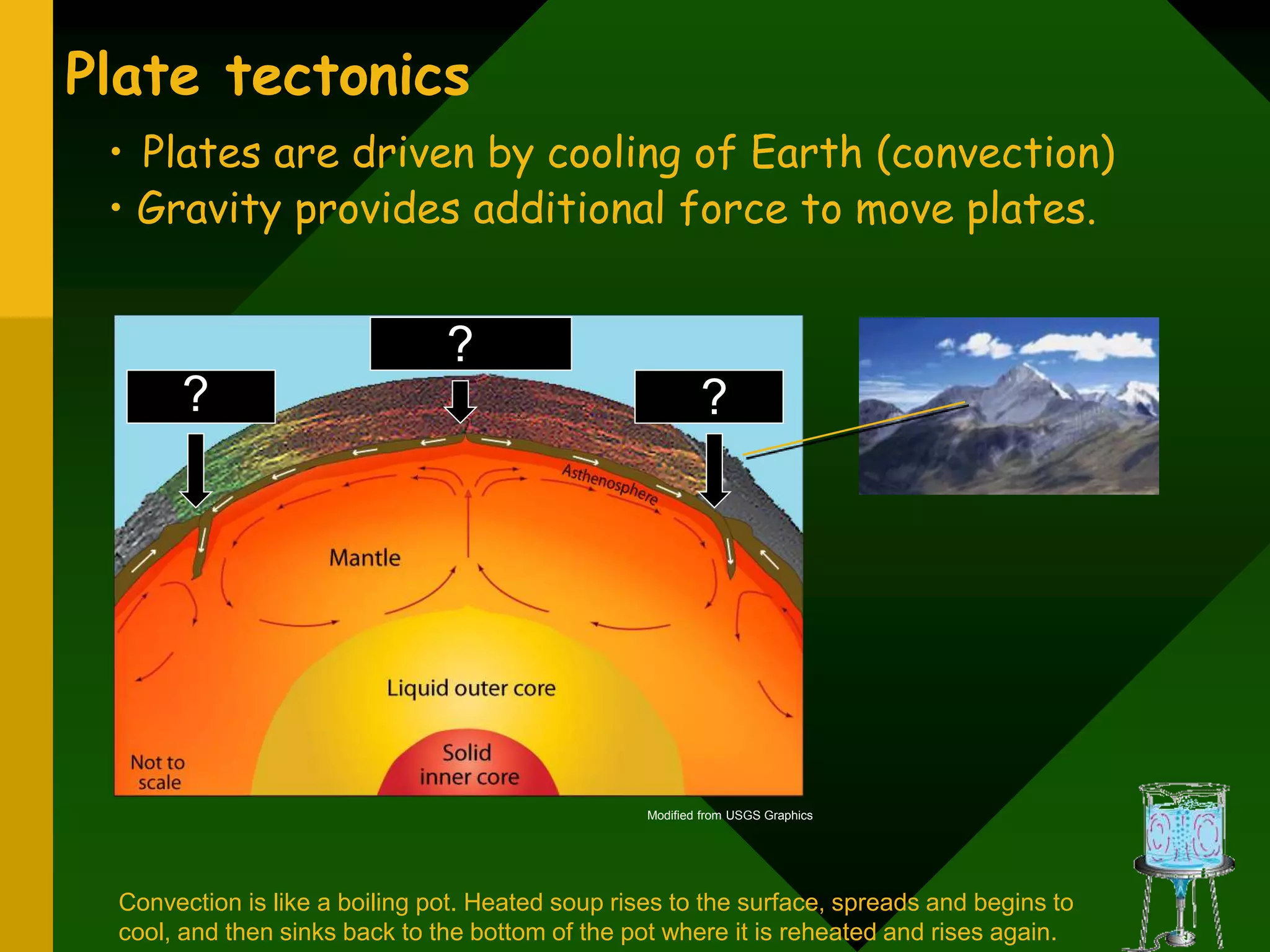
Convection is like a boiling pot. Heated soup rises to the surface, spreads and begins to
cool, and then sinks back to the bottom of the pot where it is reheated and rises again.
Plate tectonics
• Plates are driven by cooling of Earth (convection)
• Gravity provides additional force to move plates.
Modified from USGS Graphics
?
?
?
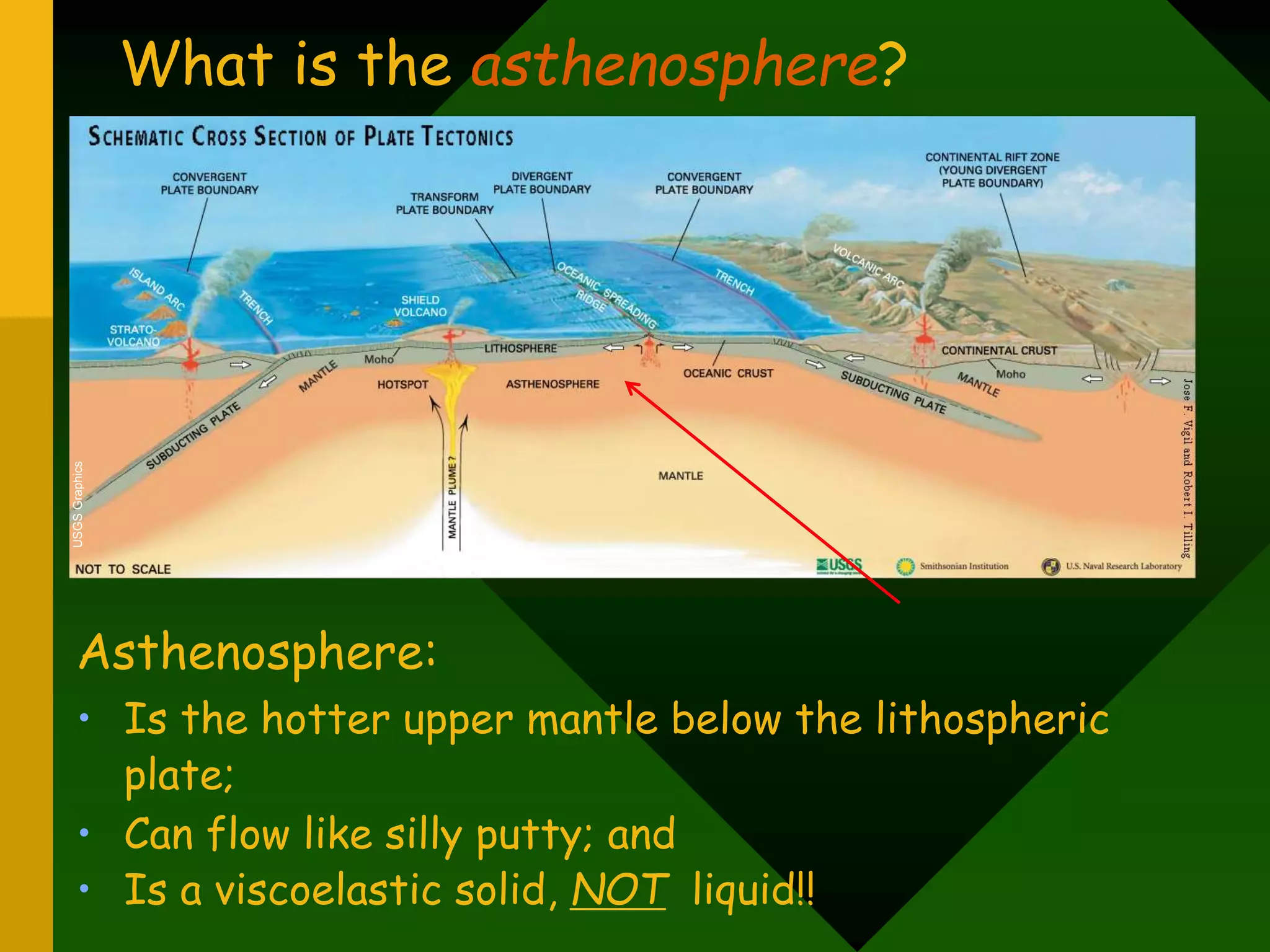
What is the asthenosphere?
Asthenosphere:
• Is the hotter upper mantle below the lithospheric
plate;
• Can flow like silly putty; and
• Is a viscoelastic solid, NOT liquid!!
USGS
Graphics
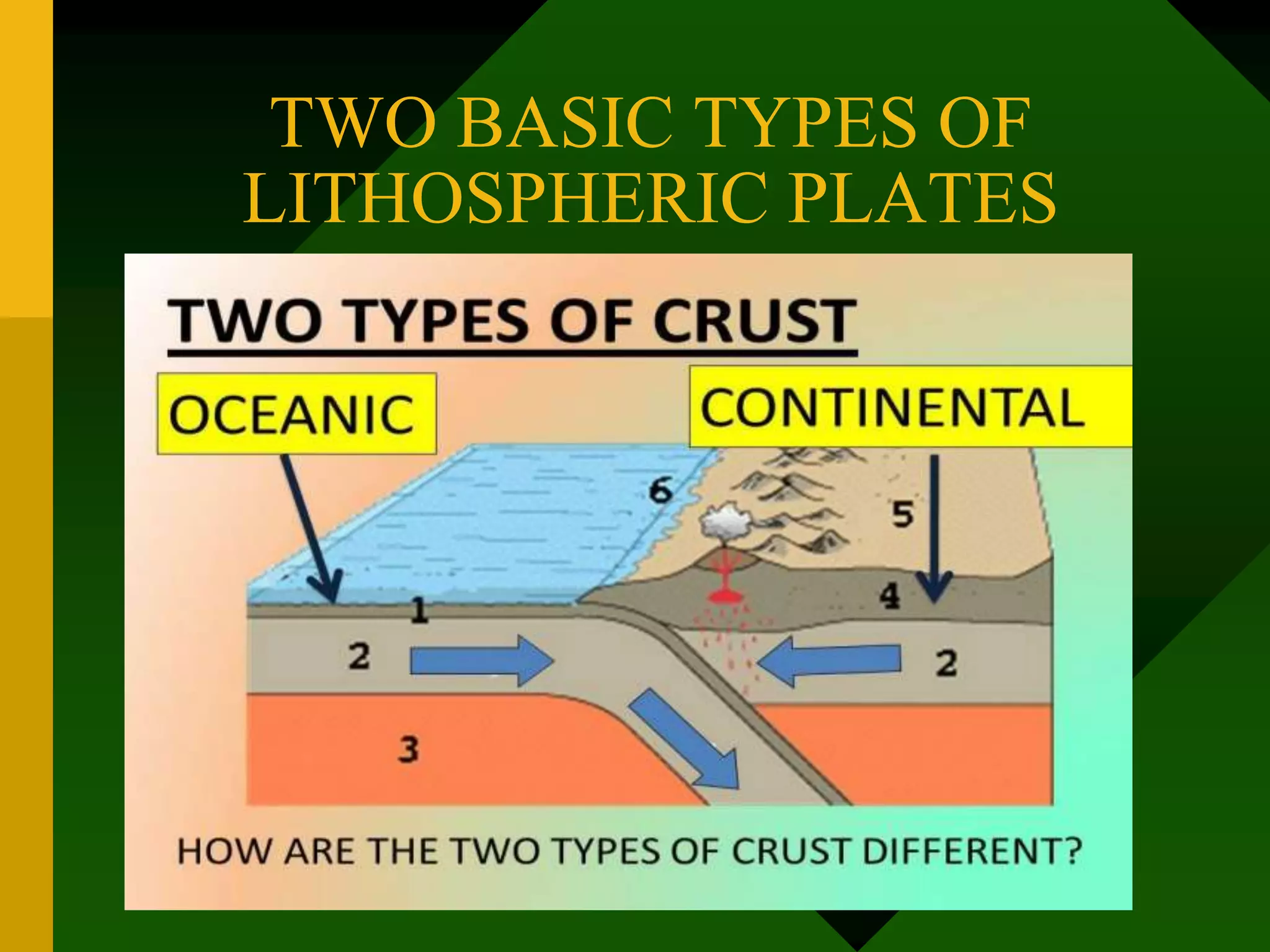
TWO BASIC TYPES OF
LITHOSPHERIC PLATES
CONTINENTAL
CRUST/LITHOSPHERIC
• Older than oceanic crust ( 4 billion years old)
• the solid ground where you stand upon
• lighter than oceanic crust as it is composed of
lower density materials such as granitic rock.
• Are formed through a volcanic eruption
• 10 to 70 km thick
• Basement rock is the thick foundation of
ancient, and oldest, metamorphic and igneous
rock that forms the crust of continents, often in
the form of granite.
• Platform - a younger layer of continental crust
which are made of sedimentary rocks
• Cratons - can be described as shields, in which
the basement rock crops out at the surface, and
platforms, in which the basement is overlaid by
sediments and sedimentary rock.
OCEANIC CRUST/
LITHOSPHERIC
• made up of heavier basalt and gabbro rocks
• younger than continental crust ( 200 million
years old)
• 7km thick
• formed by magma, it has a limited life span
because when it encounters continental crust, it is
pushed underneath.
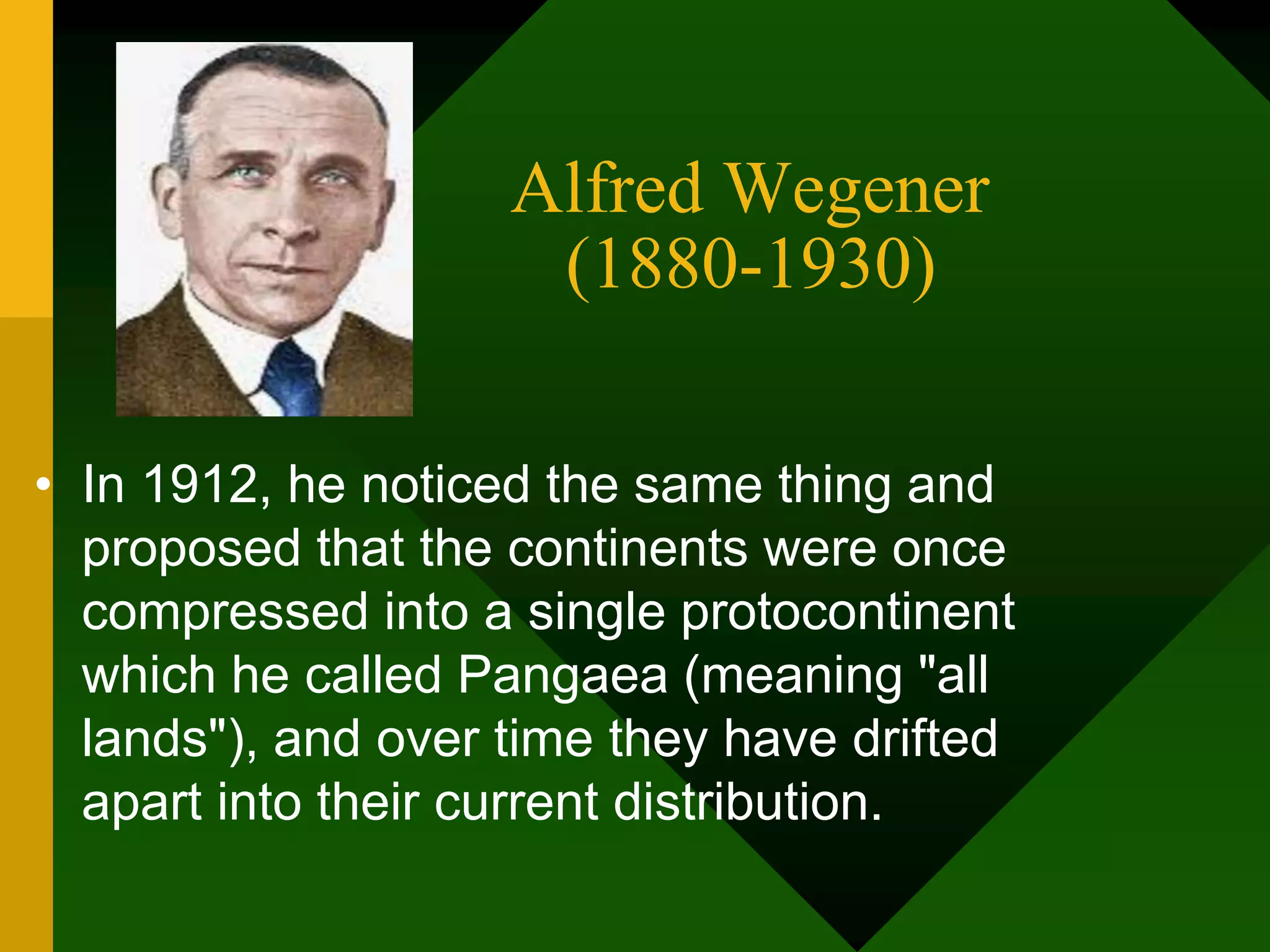
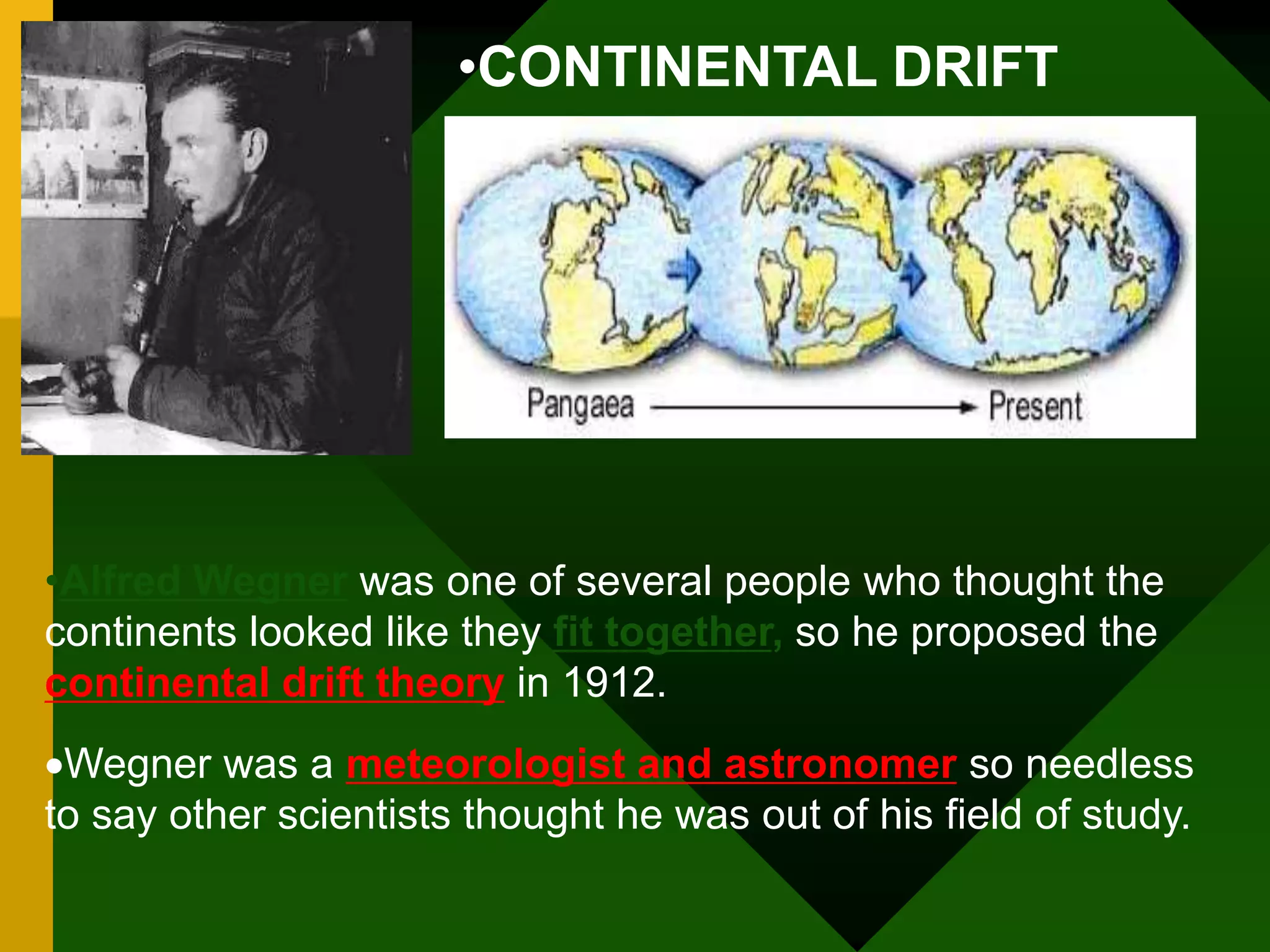
Alfred Wegener
(1880-1930)
• In 1912, he noticed the same thing and
proposed that the continents were once
compressed into a single protocontinent
which he called Pangaea (meaning "all
lands"), and over time they have drifted
apart into their current distribution.
How fast are the plates moving?
Plates move 1-10 centimeters per year (≈ rate of fingernail growth).
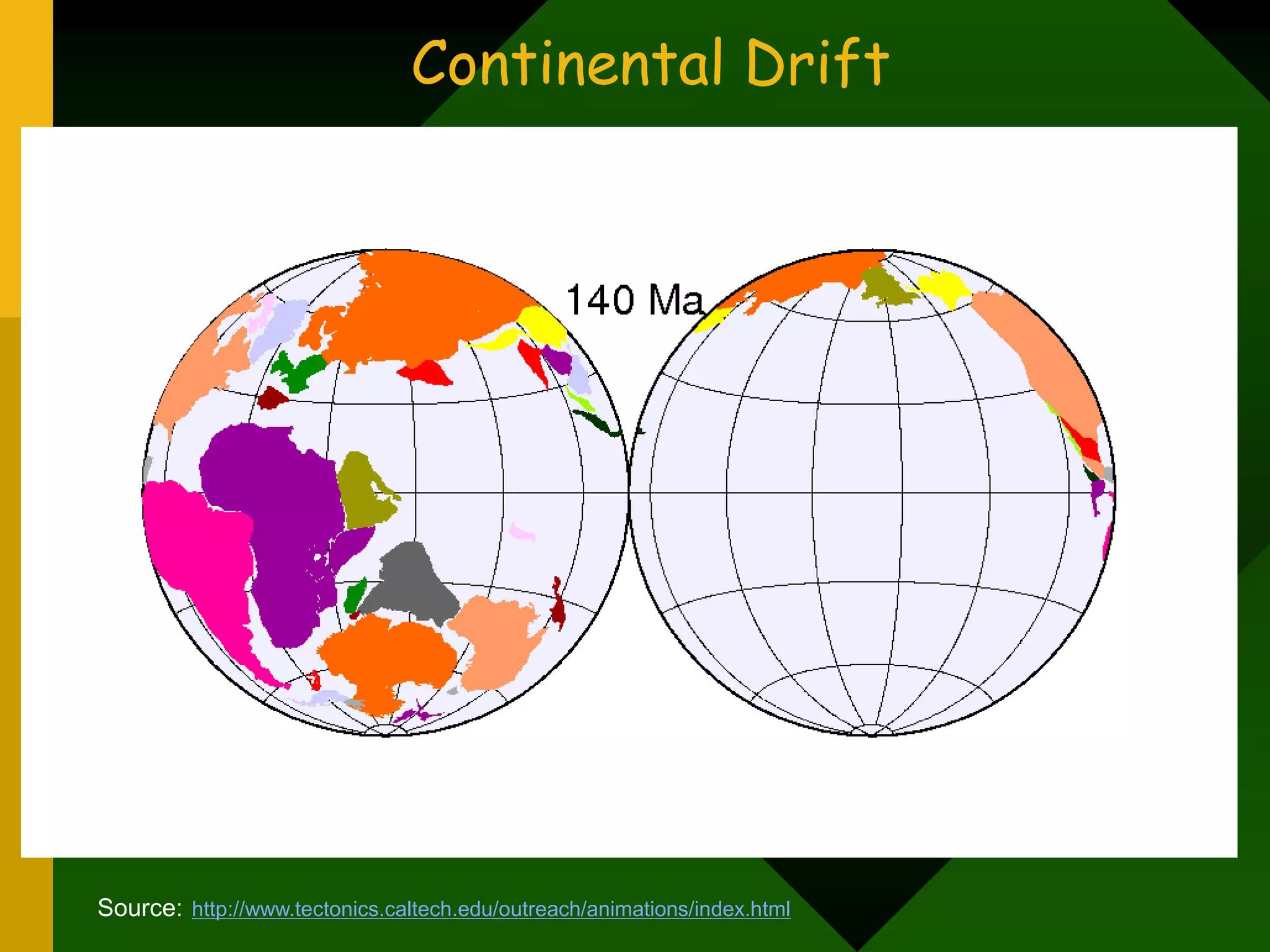
Continental Drift
Source: http://www.tectonics.caltech.edu/outreach/animations/index.html
•CONTINENTAL DRIFT
•Alfred Wegner was one of several people who thought the
continents looked like they fit together, so he proposed the
continental drift theory in 1912.
Wegner was a meteorologist and astronomer so needless
to say other scientists thought he was out of his field of study.
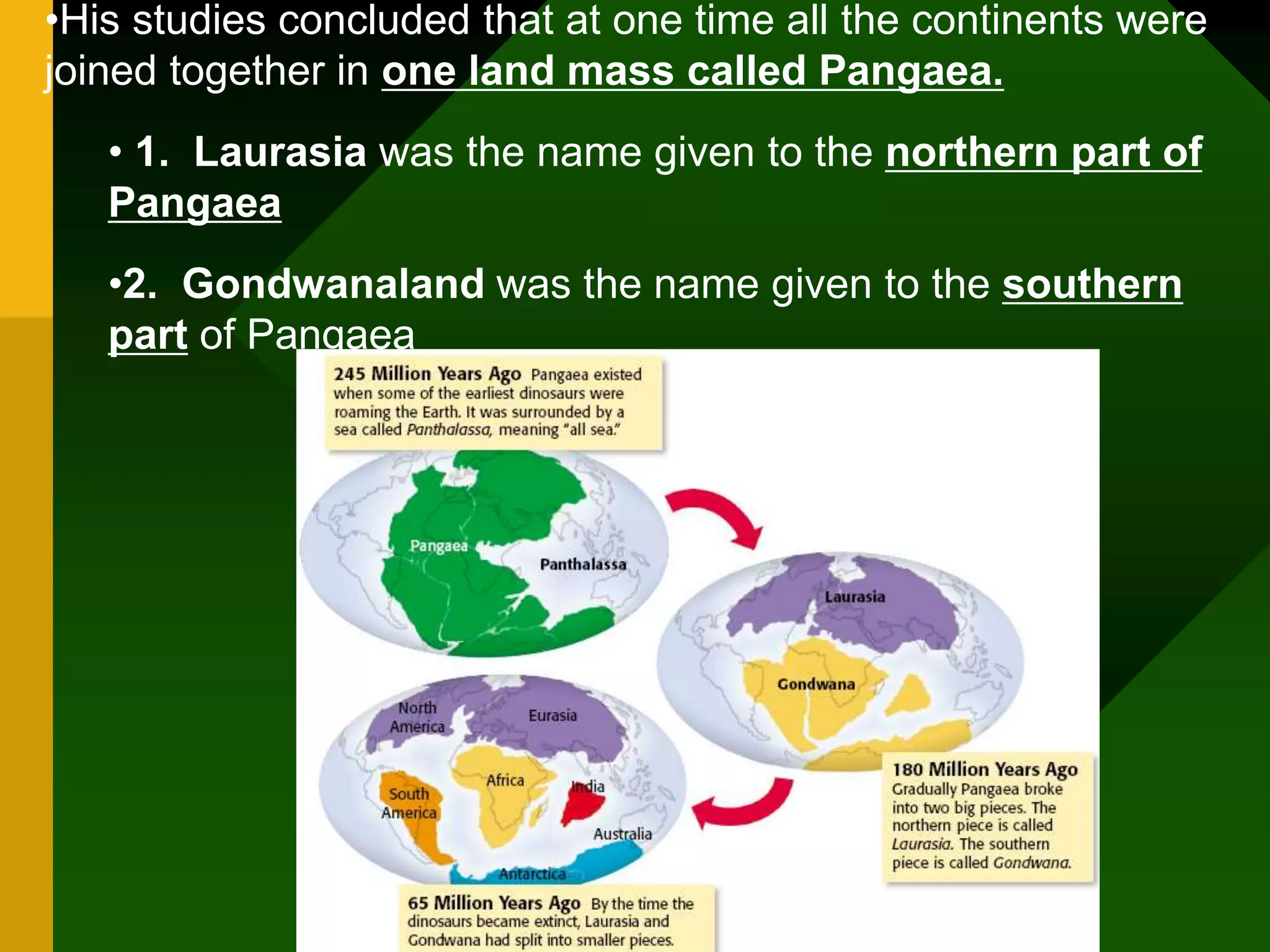
•His studies concluded that at one time all the continents were
joined together in one land mass called Pangaea.
• 1. Laurasia was the name given to the northern part of
Pangaea
•2. Gondwanaland was the name given to the southern
part of Pangaea
Scientists thought this
theory was outrageous
because even though
Wegner had evidence of
one large land mass, he
didn’t have the answers to
what force (engine)
“floated the plates”. He
was laughed at and did not
live to see his theory
accepted.
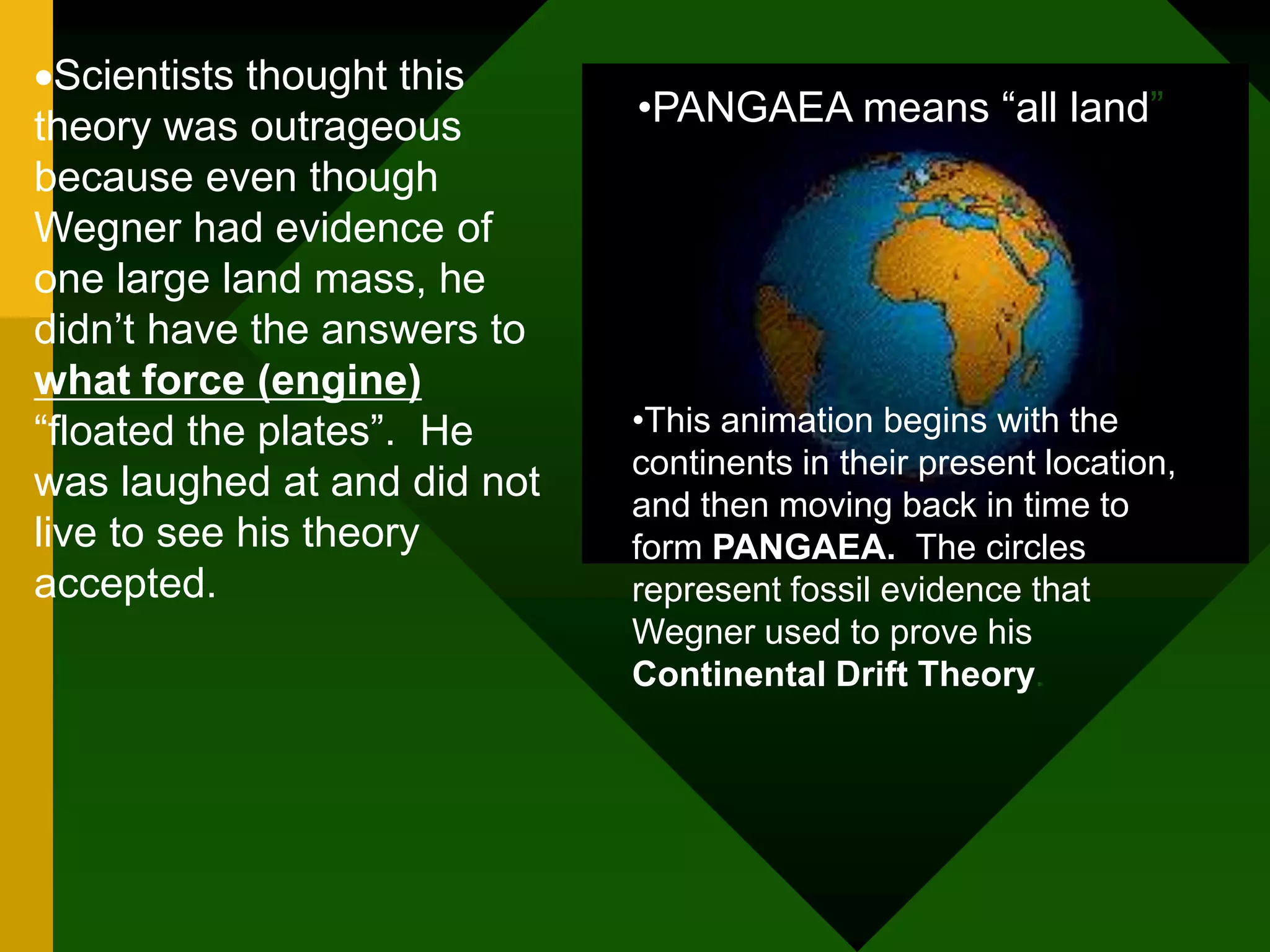
•This animation begins with the
continents in their present location,
and then moving back in time to
form PANGAEA. The circles
represent fossil evidence that
Wegner used to prove his
Continental Drift Theory.
•PANGAEA means “all land”
• WHERE’S THE EVIDENCE
• Wegner had 5 pieces of evidence to prove his continental
drift theory:
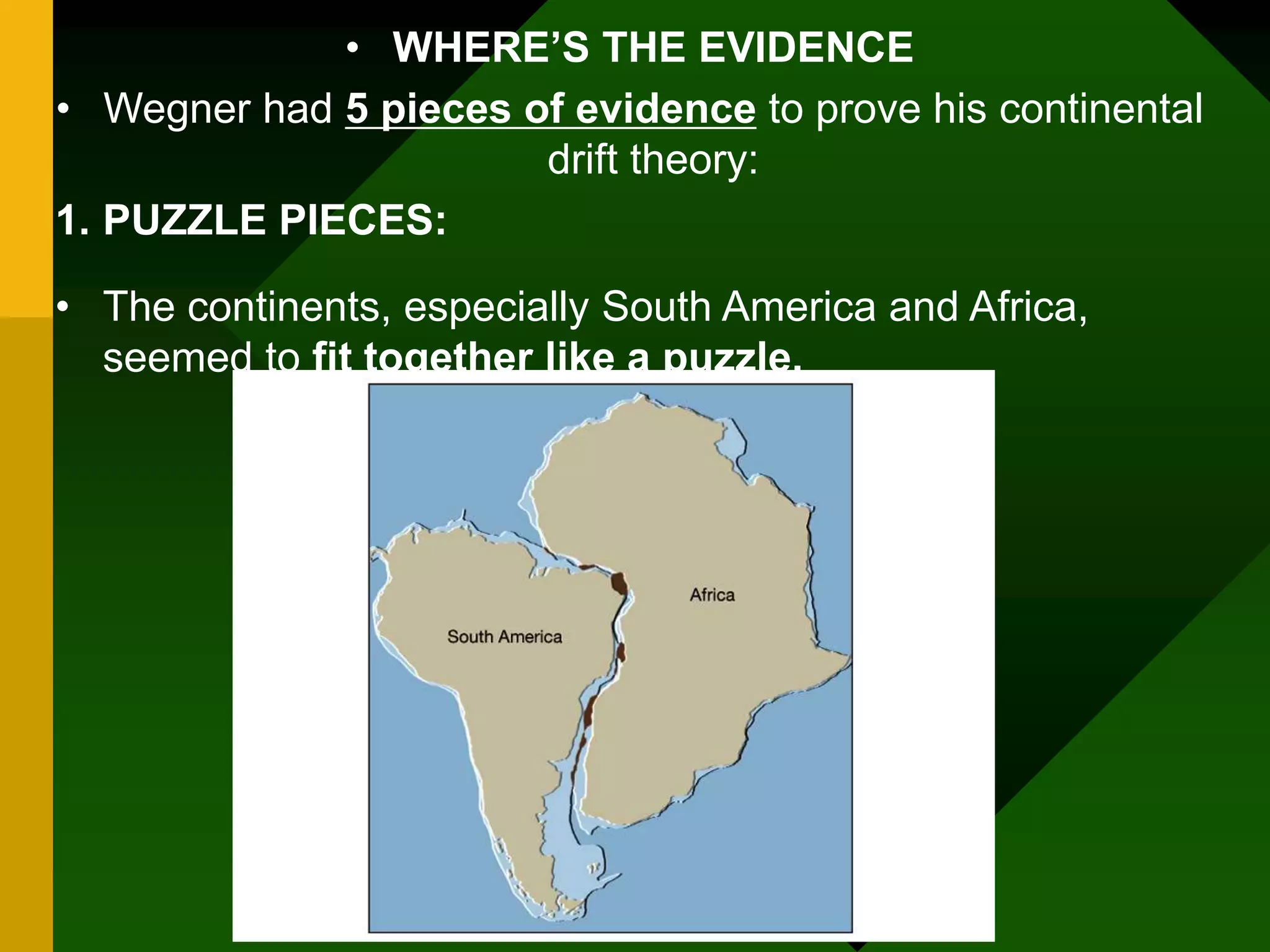
1. PUZZLE PIECES:
• The continents, especially South America and Africa,
seemed to fit together like a puzzle.
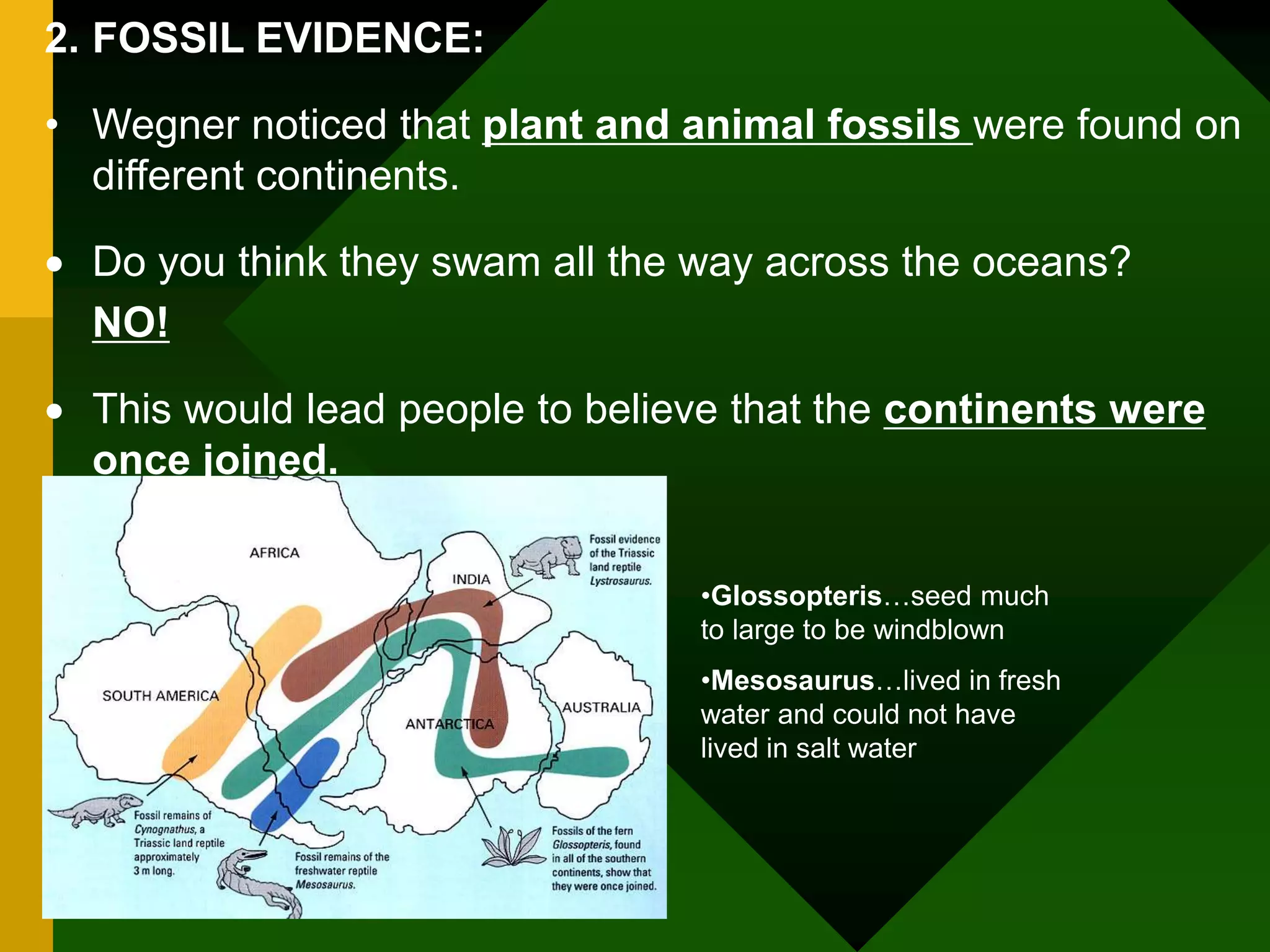
2. FOSSIL EVIDENCE:
• Wegner noticed that plant and animal fossils were found on
different continents.
 Do you think they swam all the way across the oceans?
NO!
 This would lead people to believe that the continents were
once joined.
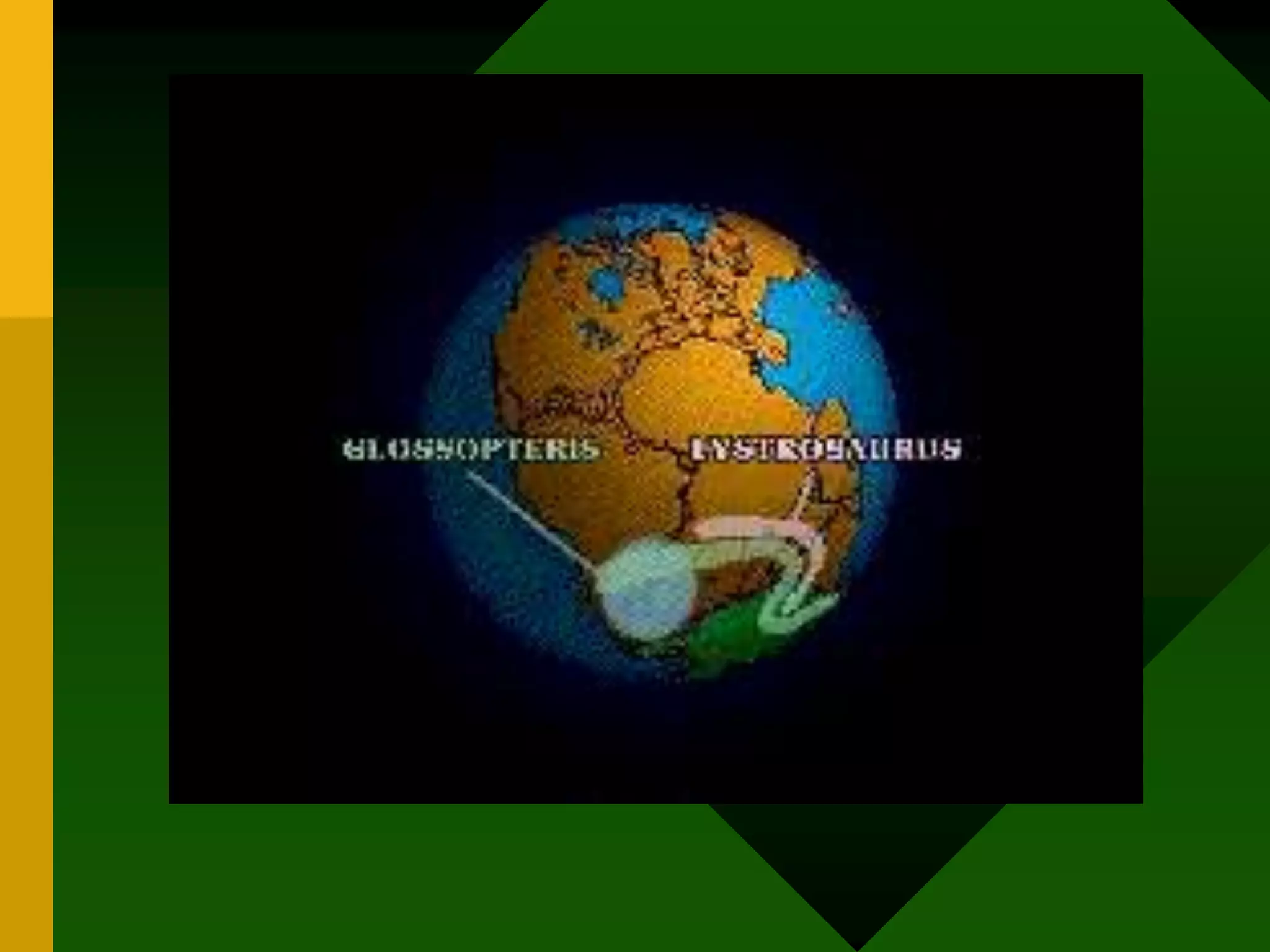
•Glossopteris…seed much
to large to be windblown
•Mesosaurus…lived in fresh
water and could not have
lived in salt water
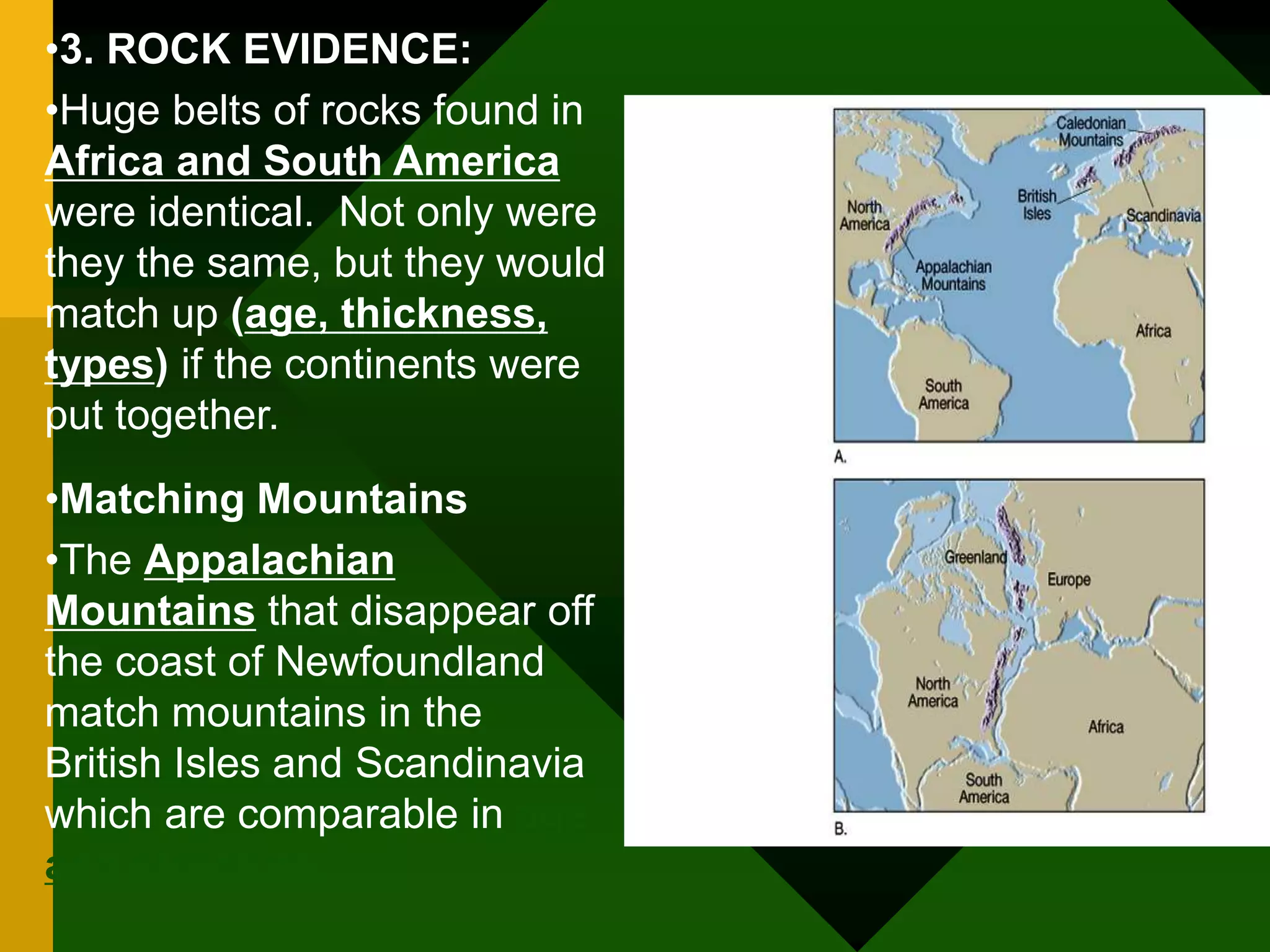
•3. ROCK EVIDENCE:
•Huge belts of rocks found in
Africa and South America
were identical. Not only were
they the same, but they would
match up (age, thickness,
types) if the continents were
put together.
•Matching Mountains
•The Appalachian
Mountains that disappear off
the coast of Newfoundland
match mountains in the
British Isles and Scandinavia
which are comparable in age
and structure.
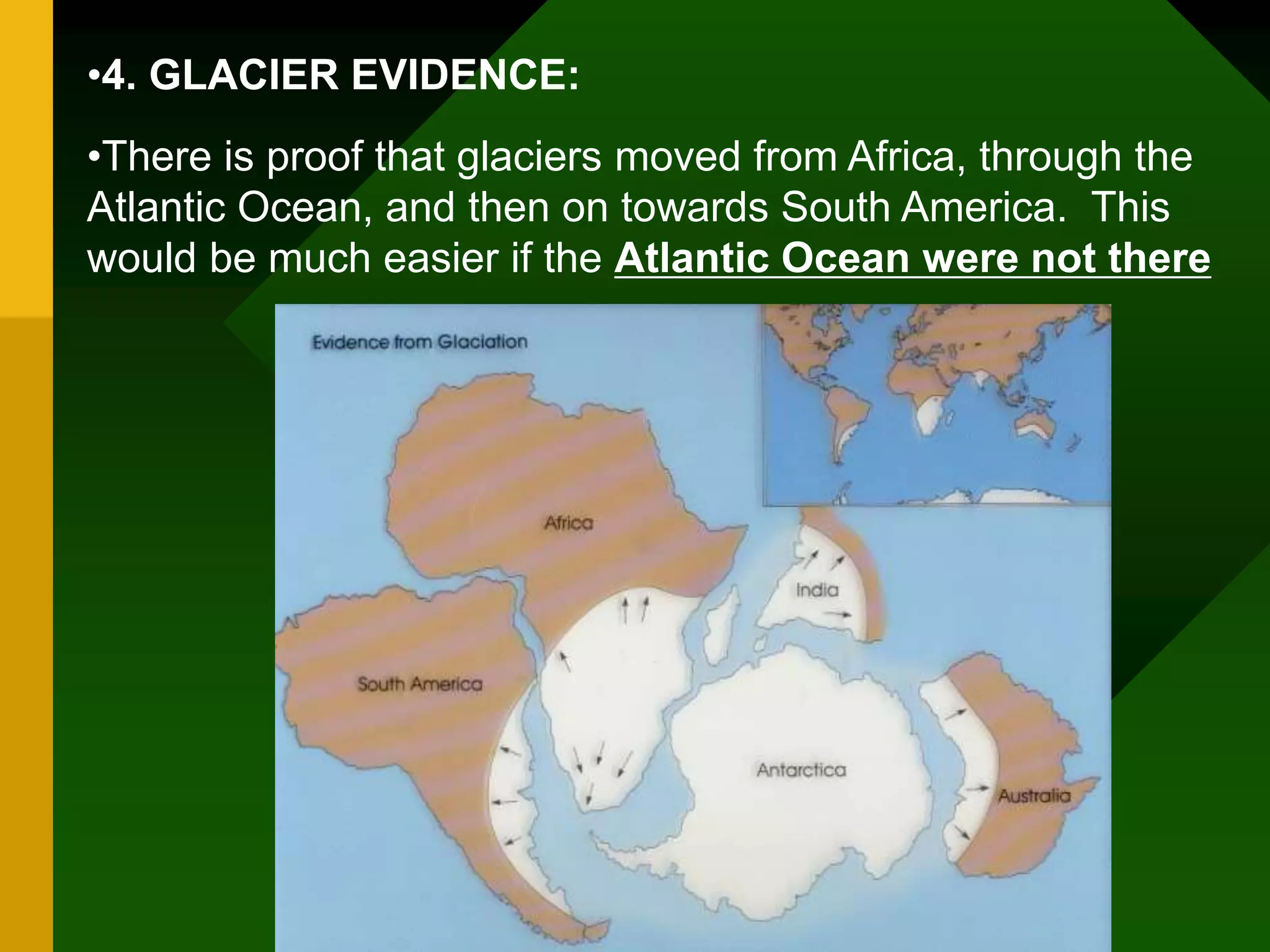
•4. GLACIER EVIDENCE:
•There is proof that glaciers moved from Africa, through the
Atlantic Ocean, and then on towards South America. This
would be much easier if the Atlantic Ocean were not there
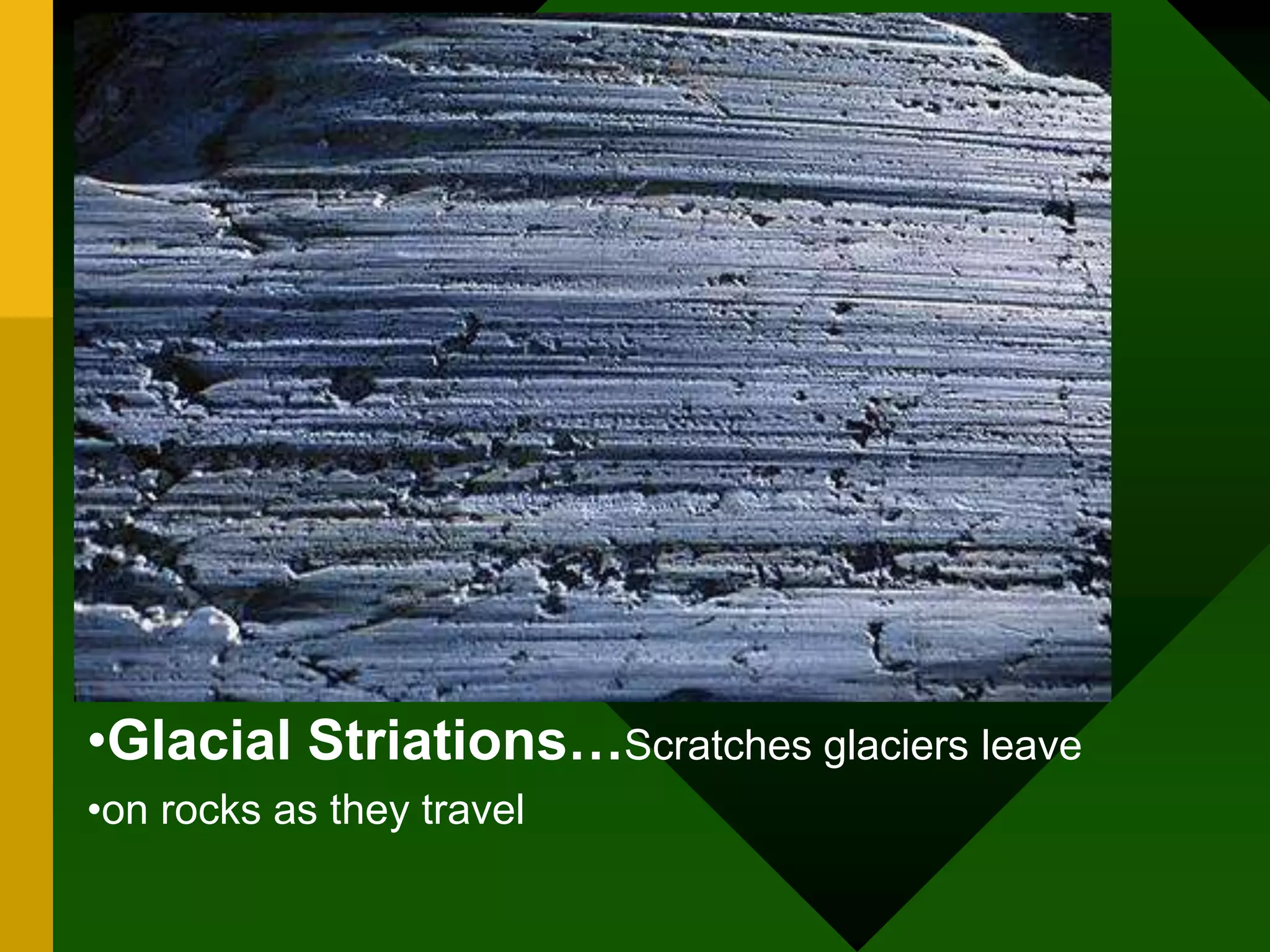
•Glacial Striations…Scratches glaciers leave
•on rocks as they travel
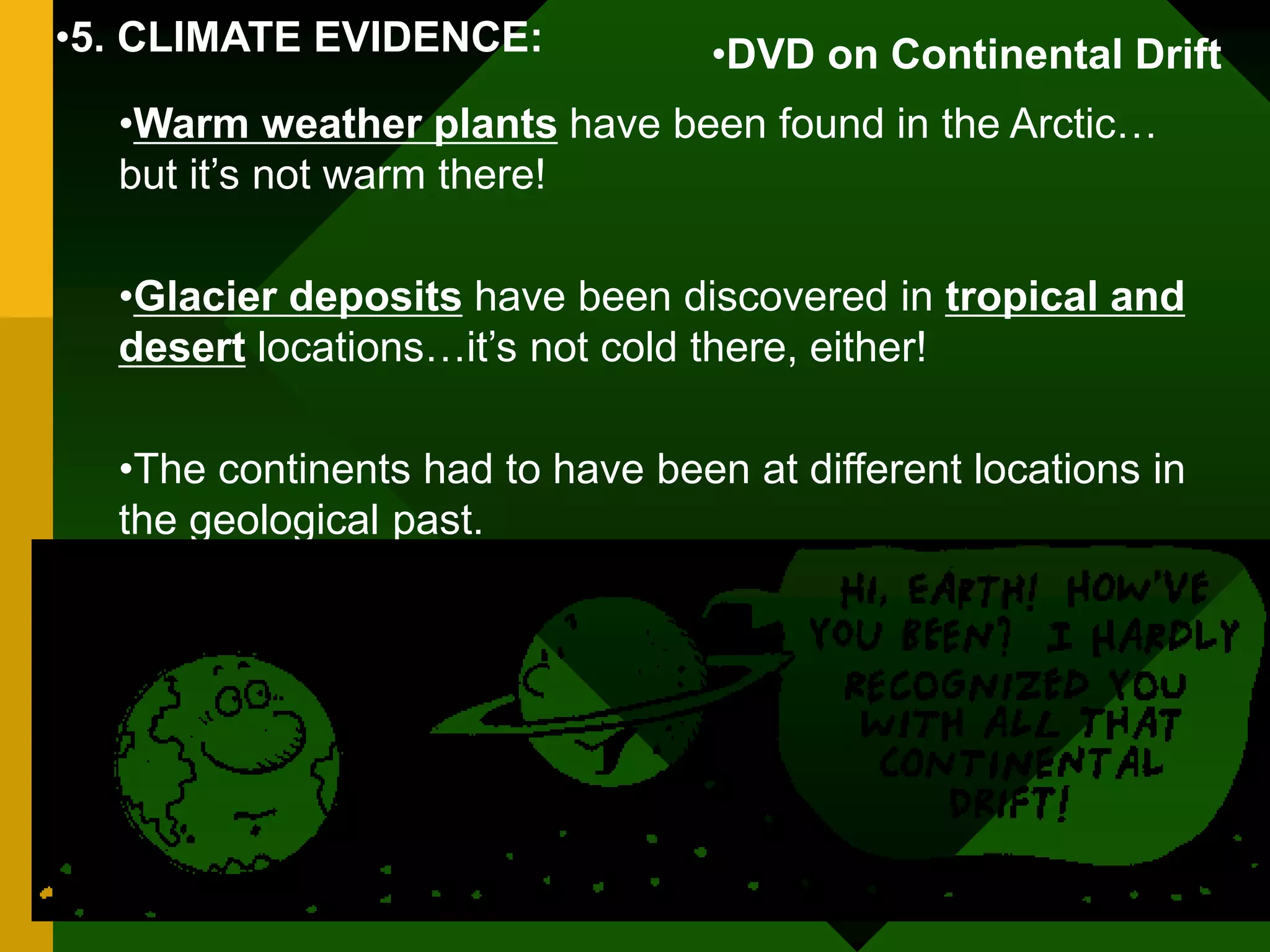
•5. CLIMATE EVIDENCE:
•Warm weather plants have been found in the Arctic…
but it’s not warm there!
•Glacier deposits have been discovered in tropical and
desert locations…it’s not cold there, either!
•The continents had to have been at different locations in
the geological past.
•DVD on Continental Drift
15 Major Tectonic Plates
PRIMARY PLATES
• African Plate
• Eurasian Plate
• Indo - Australian Plate
• North American Plate
• Pacific Plate
• South American Plate
• Nazca Plate
SECONDARY PLATES •
Arabian Plate
• Caribbean Plate
• Cocos Plate
• Indian Plate
• Juan de Duca Plate
• Philippine Sea Plate
• Scotia Plate
• Nazca Plate
https://forms.gle/pjkfdxcgBsLFxX5B6

Earth&PlateTectonics_Butler_ERBmod.ppt

  • 1.
  • 2.
  • 4.
    PLATE TECTONICS • The theorythat the Earth’s outermost layer is fragmented into a dozen or more large and small plates that move relative to one another as they ride on top of hotter, more mobile material.
  • 5.
    PLATE TECTONIC • TheEarth’s crust is divided into 12 major plates which are moved in various directions. • This plate motion causes them to collide, pull apart, or scrape against each other. • Each type of interaction causes a characteristic set of Earth structures or “tectonic” features. • The word, tectonic, refers to the deformation of the crust as a consequence of plate interaction.
  • 6.
    • At thebeginning of the 20th century, many scientists explained the physical attributes of the Earth using the Raisin Theory.
  • 7.
    WHAT IS THERAISIN THEORY? • known as the "Geosynclinical Theory" or "Geosyncline Hypothesis", • According to this principle, the level of the Earth’s crust is determined by its density; lighter material rises, forming continents, mountains, and plateaus, and heavier material sinks, forming basins and ocean floors. Clarence Edward Dutton
  • 9.
    TECTONIC is aterm derived from the Greek word " tekton" which means " carpenter" or " builder". • TECTONIC PLATES - (also called a lithospheric plate) is a massive, irregularly shaped slab of solid rock, generally composed of both continental and oceanic lithosphere.
  • 10.
    What are thetectonic plates? AKA: Lithospheric plate • The ~100-km-thick surface of the Earth; • Contains crust and part of the upper mantle; • It is rigid and brittle; • Fractures to produce earthquakes.
  • 11.
    There are adozen large lithospheric plates (smaller plates not shown). Some plates have continents; some don’t. All are in motion. Question: What evidence is there for these plate boundaries? Tectonic Plates
  • 12.
    Convection is likea boiling pot. Heated soup rises to the surface, spreads and begins to cool, and then sinks back to the bottom of the pot where it is reheated and rises again. Plate tectonics • Plates are driven by cooling of Earth (convection) • Gravity provides additional force to move plates. Modified from USGS Graphics ? ? ?
  • 13.
    What is theasthenosphere? Asthenosphere: • Is the hotter upper mantle below the lithospheric plate; • Can flow like silly putty; and • Is a viscoelastic solid, NOT liquid!! USGS Graphics
  • 14.
    TWO BASIC TYPESOF LITHOSPHERIC PLATES
  • 15.
    CONTINENTAL CRUST/LITHOSPHERIC • Older thanoceanic crust ( 4 billion years old) • the solid ground where you stand upon • lighter than oceanic crust as it is composed of lower density materials such as granitic rock. • Are formed through a volcanic eruption • 10 to 70 km thick
  • 16.
    • Basement rockis the thick foundation of ancient, and oldest, metamorphic and igneous rock that forms the crust of continents, often in the form of granite. • Platform - a younger layer of continental crust which are made of sedimentary rocks • Cratons - can be described as shields, in which the basement rock crops out at the surface, and platforms, in which the basement is overlaid by sediments and sedimentary rock.
  • 17.
    OCEANIC CRUST/ LITHOSPHERIC • madeup of heavier basalt and gabbro rocks • younger than continental crust ( 200 million years old) • 7km thick • formed by magma, it has a limited life span because when it encounters continental crust, it is pushed underneath.
  • 18.
    Alfred Wegener (1880-1930) • In1912, he noticed the same thing and proposed that the continents were once compressed into a single protocontinent which he called Pangaea (meaning "all lands"), and over time they have drifted apart into their current distribution.
  • 19.
    How fast arethe plates moving? Plates move 1-10 centimeters per year (≈ rate of fingernail growth). Continental Drift Source: http://www.tectonics.caltech.edu/outreach/animations/index.html
  • 20.
    •CONTINENTAL DRIFT •Alfred Wegnerwas one of several people who thought the continents looked like they fit together, so he proposed the continental drift theory in 1912. Wegner was a meteorologist and astronomer so needless to say other scientists thought he was out of his field of study.
  • 22.
    •His studies concludedthat at one time all the continents were joined together in one land mass called Pangaea. • 1. Laurasia was the name given to the northern part of Pangaea •2. Gondwanaland was the name given to the southern part of Pangaea
  • 23.
    Scientists thought this theorywas outrageous because even though Wegner had evidence of one large land mass, he didn’t have the answers to what force (engine) “floated the plates”. He was laughed at and did not live to see his theory accepted. •This animation begins with the continents in their present location, and then moving back in time to form PANGAEA. The circles represent fossil evidence that Wegner used to prove his Continental Drift Theory. •PANGAEA means “all land”
  • 24.
    • WHERE’S THEEVIDENCE • Wegner had 5 pieces of evidence to prove his continental drift theory: 1. PUZZLE PIECES: • The continents, especially South America and Africa, seemed to fit together like a puzzle.
  • 25.
    2. FOSSIL EVIDENCE: •Wegner noticed that plant and animal fossils were found on different continents.  Do you think they swam all the way across the oceans? NO!  This would lead people to believe that the continents were once joined. •Glossopteris…seed much to large to be windblown •Mesosaurus…lived in fresh water and could not have lived in salt water
  • 27.
    •3. ROCK EVIDENCE: •Hugebelts of rocks found in Africa and South America were identical. Not only were they the same, but they would match up (age, thickness, types) if the continents were put together. •Matching Mountains •The Appalachian Mountains that disappear off the coast of Newfoundland match mountains in the British Isles and Scandinavia which are comparable in age and structure.
  • 28.
    •4. GLACIER EVIDENCE: •Thereis proof that glaciers moved from Africa, through the Atlantic Ocean, and then on towards South America. This would be much easier if the Atlantic Ocean were not there
  • 29.
    •Glacial Striations…Scratches glaciersleave •on rocks as they travel
  • 30.
    •5. CLIMATE EVIDENCE: •Warmweather plants have been found in the Arctic… but it’s not warm there! •Glacier deposits have been discovered in tropical and desert locations…it’s not cold there, either! •The continents had to have been at different locations in the geological past. •DVD on Continental Drift
  • 31.
    15 Major TectonicPlates PRIMARY PLATES • African Plate • Eurasian Plate • Indo - Australian Plate • North American Plate • Pacific Plate • South American Plate • Nazca Plate SECONDARY PLATES • Arabian Plate • Caribbean Plate • Cocos Plate • Indian Plate • Juan de Duca Plate • Philippine Sea Plate • Scotia Plate • Nazca Plate
  • 32.