Downloaded 30 times
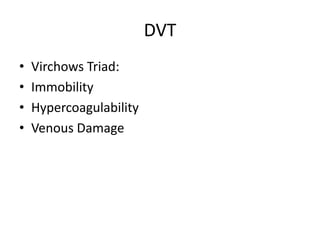
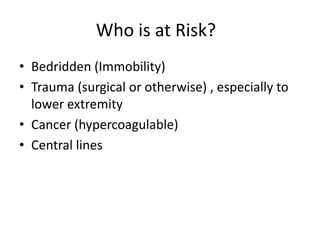
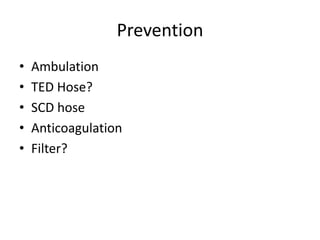
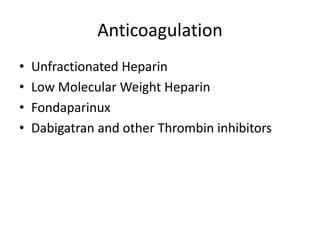
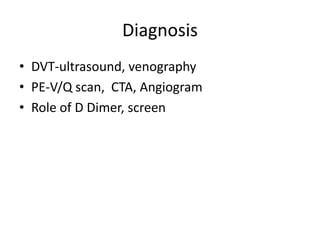
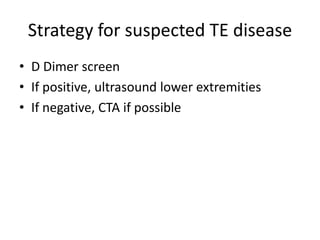
Thromboembolic disease refers to pulmonary embolism and deep vein thrombosis, which are often related. Pulmonary embolism occurs when a blood clot breaks off and travels to the lungs, while deep vein thrombosis is a blood clot that forms in the deep veins, usually of the legs. The risks of thromboembolic disease include immobility, hypercoagulability, trauma, cancer, and central line placement. Prevention focuses on ambulation, compression stockings or devices, and anticoagulation medications, while diagnosis involves tests like ultrasound, CT, and D-dimer. Treatment is primarily long-term anticoagulation to prevent further clots.


![DVT_and_PE_Prophylaxis[1].pptxkjjjjjjjjjjj](https://cdn.slidesharecdn.com/ss_thumbnails/dvtandpeprophylaxis1-250909165357-1dee648d-thumbnail.jpg?width=640&height=640&fit=bounds)
![DVT_and_PE_Prophylaxis[1].pptx jakakajja](https://cdn.slidesharecdn.com/ss_thumbnails/dvtandpeprophylaxis1-250909163807-8b42ad0c-thumbnail.jpg?width=640&height=640&fit=bounds)


