Journal club cases 
1.Congenital Defect in the Pericardium 
2.Aspirated Foreign Body 
3.Wormian Bones 
4.Retroperitoneal Fibrosis
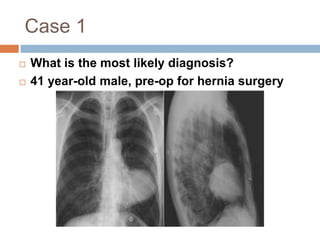
Case 1 
 What is the most likely diagnosis? 
 41 year-old male, pre-op for hernia surgery
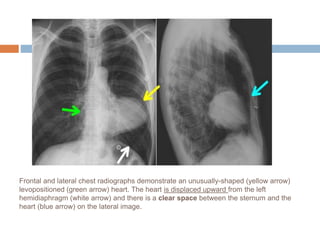
Frontal and lateral chest radiographs demonstrate an unusually-shaped (yellow arrow) 
levopositioned (green arrow) heart. The heart is displaced upward from the left 
hemidiaphragm (white arrow) and there is a clear space between the sternum and the 
heart (blue arrow) on the lateral image.
Congenital Defect in the Pericardium 
 Rare absence of a part or all of the pericardium 
 Due to failure of pericardial development 
secondary to premature atrophy of the left duct 
of Cuvier (cardinal vein) which then fails to 
nourish the left pleuropericardial membrane 
 Male:female ratio of 3:1 
 May be detected at any age but most commonly 
in low 20’s
Location 
 Foraminal defect on left side 35% 
 Complete absence of left side 35% 
levoposition of heart 
 Diaphragmatic surface 17% 
 Total bilateral absence 9% 
 Right sided 4%
Clinical findings 
 Mostly asymptomatic 
 May have: 
 Tachycardia 
 Palpitations 
 Right bundle block 
 Positional discomfort lying on left side 
 Chest pain
Imaging Findings 
 Focal bulge in area of main pulmonary artery 
or left atrium in partial defects 
 In complete form, heart rotates up and to the 
left 
 Lung may interpose between heart and left 
hemidiaphragm 
 Increased distance between sternum and 
heart 2° absence of sternopericardial ligament
 Lung may interpose between aorta and main 
pulmonary artery on axial CT scans 
 Levoposition of heart
Treatment 
 Asymptomatic, complete absence of the 
pericardium and very small defects present no 
danger to the patient and require no intervention 
 Symptomatic foraminal defect may require 
surgery because of herniation and strangulation 
of left atrial appendage or herniation of LA/LV 
 Surgery can be enlargement of the defect to prevent 
strangulation or closure of the defect
Complications and associations 
Associated congenital anomalies occur in about 
30 per cent of the reported cases 
 Bronchogenic cysts 
 ASD, VSD, PDA, Tetralogy of Fallot, Mitral 
stenosis 
 Diaphragmatic hernia 
 Pulmonary sequestration
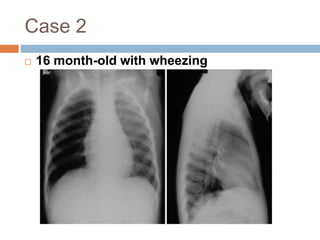
Case 2 
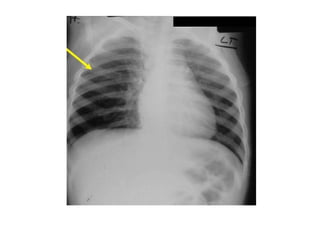
 16 month-old with wheezing
Aspirated Foreign Body 
 Children between 1-3 are most at risk 
 Up until age 15, both right and left main 
bronchi arise at about the same angle from the 
trachea so that objects may be aspirated into 
either side 
 Afterwards, the right main bronchus arises in a 
less acute, more straight path than the left
 The most frequently aspirated foreign bodies 
are food (especially nuts), teeth, dental 
devices and medical instruments 
 Some nuts, such as peanuts, have an oil that 
leads to inflammation and edema making them 
more difficult to expel
Clinical Findings 
Many go undiscovered delaying diagnosis 
 Cough 
 Wheeze 
 Stridor 
 Dyspnea 
 Cyanosis 
 Asphyxia if the object obstructs the trachea or 
larynx
Imaging Findings 
 A normal chest radiograph does not exclude 
an aspirated foreign body 
 Children will more often display signs of air-trapping 
while adults will more often show 
atelectasis 
 80% of aspirated foreign bodies will be non-opaque 
on conventional radiography
 Hyperinflation of one lung or lobe may occur 
(obstructive emphysema) 
 Lobar or segmental atelectasis 
 Mediastinal shift 
 Pneumomediastinum 
 CT may demonstrate the foreign body or better 
show the narrowing of the bronchus
Differential Diagnosis 
 Asthma 
 In an adult, a large pulmonary embolus may 
appear to cause increased lucency of one 
hemithorax 
 Swyer-James syndrome 
 Lack of soft tissue on one side, such as from a 
mastectomy or Poland Syndrome
complications 
 Mediastinitis or tracheoesophageal fistulas 
 Air trapping leading 
 Obstructive emphysema 
 Atelectasis 
 Post-obstructive pneumonia 
 Abscess 
 Bronchiectasis
Treatment 
 Bronchoscopic removal
Case 3 
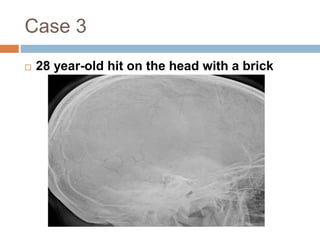
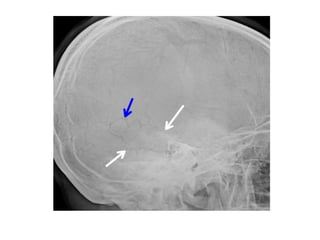
 28 year-old hit on the head with a brick
Wormian Bones 
 Accessory bones within a suture of the skull 
 Most often the lambdoid suture 
 Usually a normal variant occurring in as many 
as 80% of Asian population 
 Males more frequently affected than females 
 Pathological only when greater than 10 in 
number or large
 A larger, single, centrally located intrasutural 
bone at the junction of the lambdoid suture 
and sagittal suture is called the os inca
Diseases Associated With Wormian Bones 
 Cleidocranial Dysplasia 
 Pyknodysostosis 
 Osteogenesis Imperfecta 
 Hypothyroidism 
 Hypophosphatasia 
 Acro-osteolysis 
 Down Syndrome
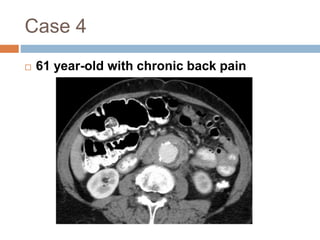
Case 4 
 61 year-old with chronic back pain
Retroperitoneal Fibrosis 
 Relatively uncommon 
 More common in males than in females 
 Predominantly patients aged 40-60 years 
 In almost 70% of patients, no cause is found
Primary or Idiopathic Retroperitoneal Fibrosis 
(RPF) 
 May be an autoimmune response. 
 Primary biliary cirrhosis 
 Fibrosing mediastinitis 
 Glomerulonephritis 
 Panhypopituitarism
 Rheumatoid arthritis 
 Ankylosing spondylitis 
 Polyarteritis nodosa 
 Systemic lupus erythematosus (SLE) 
 Hashimoto thyroiditis
Secondary Retroperitoneal Fibrosis 
 Has been found associated with certain drugs, 
such as 
 Methylsergicide 
 Beta-adrenergic blockers
 Desmoplastic response to malignancy 
 Lymphoma 
 Carcinoid 
 Retroperitoneal metastases (breast, lung, 
thyroid, GI tract, GU organs)
 Retroperitoneal fluid collection as in trauma, 
surgery or infection 
 Aneurysm of the aorta or iliac arteries 
(desmoplastic response) 
 Radiation therapy
Clinical findings 
 Most common presentation is flank, back, 
scrotal or lower abdominal pain 
 Fever 
 Weight loss 
 Nausea and vomiting 
 Symptoms relating to renal impairment and 
hypertension are common clinical features
Imaging Findings 
US 
Hypoechoic homogeneous mass 
On CT scans 
 Rind of soft tissue around aorta and inferior 
vena cava between level of kidney and sacrum 
 Spreads to involve the ureters, causing 
varying degrees of obstruction. 
 Fat plane between the mass and the psoas 
muscle may be obliterated
 MRI 
Low to medium homogeneous signal intensity 
Heterogeneous high signal intensity on T2 
(inflammatory stage) 
Low signal intensity on T2 (dense fibrotic 
stage)
Prognosis 
 Satisfactory if renal impairment is not too 
severe
THANK YOU

Journal club cases

  • 1.
    Journal club cases 1.Congenital Defect in the Pericardium 2.Aspirated Foreign Body 3.Wormian Bones 4.Retroperitoneal Fibrosis
  • 2.
    Case 1 What is the most likely diagnosis?  41 year-old male, pre-op for hernia surgery
  • 3.
    Frontal and lateralchest radiographs demonstrate an unusually-shaped (yellow arrow) levopositioned (green arrow) heart. The heart is displaced upward from the left hemidiaphragm (white arrow) and there is a clear space between the sternum and the heart (blue arrow) on the lateral image.
  • 4.
    Congenital Defect inthe Pericardium  Rare absence of a part or all of the pericardium  Due to failure of pericardial development secondary to premature atrophy of the left duct of Cuvier (cardinal vein) which then fails to nourish the left pleuropericardial membrane  Male:female ratio of 3:1  May be detected at any age but most commonly in low 20’s
  • 5.
    Location  Foraminaldefect on left side 35%  Complete absence of left side 35% levoposition of heart  Diaphragmatic surface 17%  Total bilateral absence 9%  Right sided 4%
  • 6.
    Clinical findings Mostly asymptomatic  May have:  Tachycardia  Palpitations  Right bundle block  Positional discomfort lying on left side  Chest pain
  • 7.
    Imaging Findings Focal bulge in area of main pulmonary artery or left atrium in partial defects  In complete form, heart rotates up and to the left  Lung may interpose between heart and left hemidiaphragm  Increased distance between sternum and heart 2° absence of sternopericardial ligament
  • 8.
     Lung mayinterpose between aorta and main pulmonary artery on axial CT scans  Levoposition of heart
  • 9.
    Treatment  Asymptomatic,complete absence of the pericardium and very small defects present no danger to the patient and require no intervention  Symptomatic foraminal defect may require surgery because of herniation and strangulation of left atrial appendage or herniation of LA/LV  Surgery can be enlargement of the defect to prevent strangulation or closure of the defect
  • 10.
    Complications and associations Associated congenital anomalies occur in about 30 per cent of the reported cases  Bronchogenic cysts  ASD, VSD, PDA, Tetralogy of Fallot, Mitral stenosis  Diaphragmatic hernia  Pulmonary sequestration
  • 11.
    Case 2 16 month-old with wheezing
  • 13.
    Aspirated Foreign Body  Children between 1-3 are most at risk  Up until age 15, both right and left main bronchi arise at about the same angle from the trachea so that objects may be aspirated into either side  Afterwards, the right main bronchus arises in a less acute, more straight path than the left
  • 14.
     The mostfrequently aspirated foreign bodies are food (especially nuts), teeth, dental devices and medical instruments  Some nuts, such as peanuts, have an oil that leads to inflammation and edema making them more difficult to expel
  • 15.
    Clinical Findings Manygo undiscovered delaying diagnosis  Cough  Wheeze  Stridor  Dyspnea  Cyanosis  Asphyxia if the object obstructs the trachea or larynx
  • 16.
    Imaging Findings A normal chest radiograph does not exclude an aspirated foreign body  Children will more often display signs of air-trapping while adults will more often show atelectasis  80% of aspirated foreign bodies will be non-opaque on conventional radiography
  • 17.
     Hyperinflation ofone lung or lobe may occur (obstructive emphysema)  Lobar or segmental atelectasis  Mediastinal shift  Pneumomediastinum  CT may demonstrate the foreign body or better show the narrowing of the bronchus
  • 18.
    Differential Diagnosis Asthma  In an adult, a large pulmonary embolus may appear to cause increased lucency of one hemithorax  Swyer-James syndrome  Lack of soft tissue on one side, such as from a mastectomy or Poland Syndrome
  • 19.
    complications  Mediastinitisor tracheoesophageal fistulas  Air trapping leading  Obstructive emphysema  Atelectasis  Post-obstructive pneumonia  Abscess  Bronchiectasis
  • 20.
  • 21.
    Case 3 28 year-old hit on the head with a brick
  • 23.
    Wormian Bones Accessory bones within a suture of the skull  Most often the lambdoid suture  Usually a normal variant occurring in as many as 80% of Asian population  Males more frequently affected than females  Pathological only when greater than 10 in number or large
  • 24.
     A larger,single, centrally located intrasutural bone at the junction of the lambdoid suture and sagittal suture is called the os inca
  • 25.
    Diseases Associated WithWormian Bones  Cleidocranial Dysplasia  Pyknodysostosis  Osteogenesis Imperfecta  Hypothyroidism  Hypophosphatasia  Acro-osteolysis  Down Syndrome
  • 26.
    Case 4 61 year-old with chronic back pain
  • 27.
    Retroperitoneal Fibrosis Relatively uncommon  More common in males than in females  Predominantly patients aged 40-60 years  In almost 70% of patients, no cause is found
  • 28.
    Primary or IdiopathicRetroperitoneal Fibrosis (RPF)  May be an autoimmune response.  Primary biliary cirrhosis  Fibrosing mediastinitis  Glomerulonephritis  Panhypopituitarism
  • 29.
     Rheumatoid arthritis  Ankylosing spondylitis  Polyarteritis nodosa  Systemic lupus erythematosus (SLE)  Hashimoto thyroiditis
  • 30.
    Secondary Retroperitoneal Fibrosis  Has been found associated with certain drugs, such as  Methylsergicide  Beta-adrenergic blockers
  • 31.
     Desmoplastic responseto malignancy  Lymphoma  Carcinoid  Retroperitoneal metastases (breast, lung, thyroid, GI tract, GU organs)
  • 32.
     Retroperitoneal fluidcollection as in trauma, surgery or infection  Aneurysm of the aorta or iliac arteries (desmoplastic response)  Radiation therapy
  • 33.
    Clinical findings Most common presentation is flank, back, scrotal or lower abdominal pain  Fever  Weight loss  Nausea and vomiting  Symptoms relating to renal impairment and hypertension are common clinical features
  • 34.
    Imaging Findings US Hypoechoic homogeneous mass On CT scans  Rind of soft tissue around aorta and inferior vena cava between level of kidney and sacrum  Spreads to involve the ureters, causing varying degrees of obstruction.  Fat plane between the mass and the psoas muscle may be obliterated
  • 35.
     MRI Lowto medium homogeneous signal intensity Heterogeneous high signal intensity on T2 (inflammatory stage) Low signal intensity on T2 (dense fibrotic stage)
  • 36.
    Prognosis  Satisfactoryif renal impairment is not too severe
  • 37.