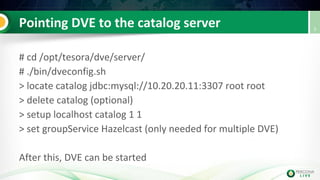
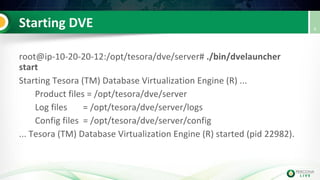
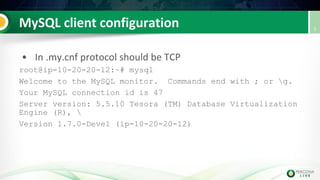
root@ip-10-20-20-12:~# mysql
Welcome to the MySQL monitor. Commands end with ; or g.
Your MySQL connection id is 47
Server version: 5.5.10 Tesora (TM) Database Virtualization
Engine (R), 
Version 1.7.0-Devel (ip-10-20-20-12)
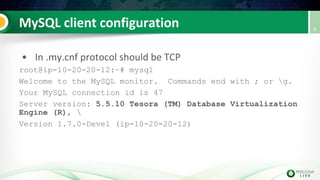
root@ip-10-20-20-12:~# mysql
Welcome to the MySQL monitor. Commands end with ; or g.
Your MySQL connection id is 47
Server version: 5.5.10 Tesora (TM) Database Virtualization
Engine (R), 
Version 1.7.0-Devel (ip-10-20-20-12)
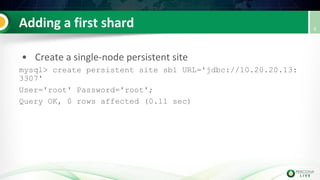
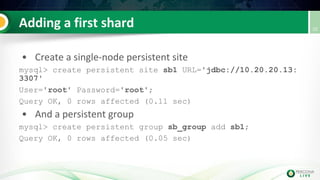
mysql> create persistent site sb1 URL='jdbc://10.20.20.13:
3307'
User='root' Password='root';
Query OK, 0 rows affected (0.11 sec)
mysql> create persistent site sb1 URL='jdbc://10.20.20.13:
3307'
User='root' Password='root';
Query OK, 0 rows affected (0.11 sec)
mysql> create persistent group sb_group add sb1;
Query OK, 0 rows affected (0.05 sec)
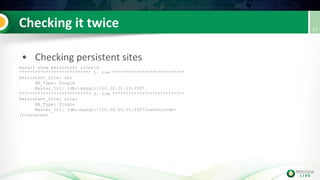
mysql> show persistent sitesG
*************************** 1. row ***************************
Persistent_Site: sb1
HA_Type: Single
Master_Url: jdbc:mysql://10.20.20.13:3307
*************************** 2. row ***************************
Persistent_Site: site1
HA_Type: Single
Master_Url: jdbc:mysql://10.20.20.11:3307?useUnicode=
(truncated)
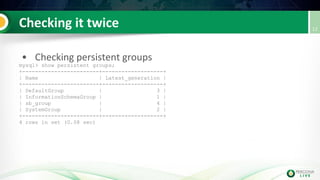
mysql> show persistent groups;
+------------------------+-------------------+
| Name | Latest_generation |
+------------------------+-------------------+
| DefaultGroup | 3 |
| InformationSchemaGroup | 1 |
| sb_group | 4 |
| SystemGroup | 2 |
+------------------------+-------------------+
4 rows in set (0.08 sec)
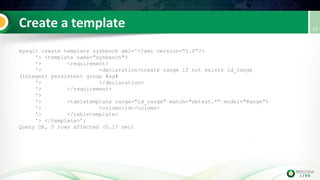
mysql> create template sysbench xml='<?xml version="1.0"?>
'> <template name="sysbench">
'> <requirement>
'> <declaration>create range if not exists id_range
(integer) persistent group #sg#
'> </declaration>
'> </requirement>
'>
'> <tabletemplate range="id_range" match="sbtest.*" model="Range">
'> <column>id</column>
'> </tabletemplate>
'> </template>';
Query OK, 0 rows affected (0.17 sec)
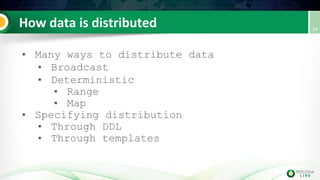
• Many ways to distribute data
• Broadcast
• Deterministic
• Range
• Map
• Specifying distribution
• Through DDL
• Through templates
• You can add sites to a group
• Data will still be distributed
• How?
• Broadcast tables [trivial]
• Distributed tables [hard]
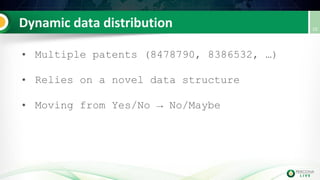
• Multiple patents (8478790, 8386532, …)
• Relies on a novel data structure
• Moving from Yes/No → No/Maybe
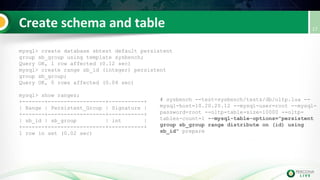
mysql> create database sbtest default persistent
group sb_group using template sysbench;
Query OK, 1 row affected (0.12 sec)
mysql> create range sb_id (integer) persistent
group sb_group;
Query OK, 0 rows affected (0.04 sec)
mysql> show ranges;
+-------+------------------+-----------+
| Range | Persistent_Group | Signature |
+-------+------------------+-----------+
| sb_id | sb_group | int |
+-------+------------------+-----------+
1 row in set (0.02 sec)
# sysbench --test=sysbench/tests/db/oltp.lua --
mysql-host=10.20.20.12 --mysql-user=root --mysql-
password=root --oltp-table-size=10000 --oltp-
tables-count=1 --mysql-table-options="persistent
group sb_group range distribute on (id) using
sb_id" prepare
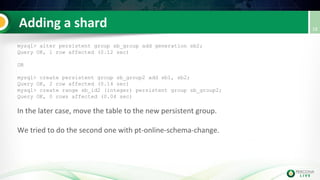
mysql> alter persistent group sb_group add generation sb2;
Query OK, 1 row affected (0.12 sec)
OR
mysql> create persistent group sb_group2 add sb1, sb2;
Query OK, 2 row affected (0.14 sec)
mysql> create range sb_id2 (integer) persistent group sb_group2;
Query OK, 0 rows affected (0.04 sec)
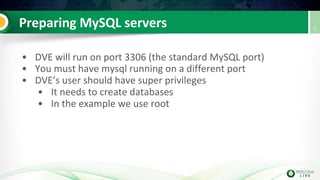
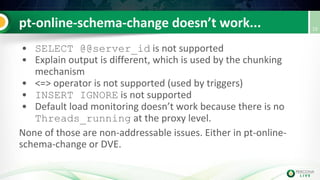
SELECT @@server_id
INSERT IGNORE
Threads_running
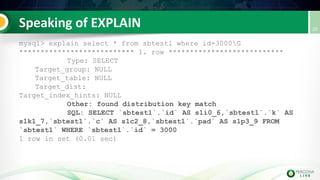
mysql> explain select * from sbtest1 where id=3000G
*************************** 1. row ***************************
Type: SELECT
Target_group: NULL
Target_table: NULL
Target_dist:
Target_index_hints: NULL
Other: found distribution key match
SQL: SELECT `sbtest1`.`id` AS s1i0_6,`sbtest1`.`k` AS
s1k1_7,`sbtest1`.`c` AS s1c2_8,`sbtest1`.`pad` AS s1p3_9 FROM
`sbtest1` WHERE `sbtest1`.`id` = 3000
1 row in set (0.01 sec)
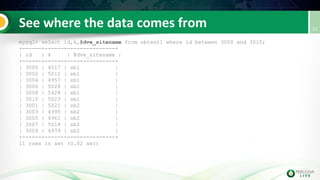
mysql> select id,k,@dve_sitename from sbtest1 where id between 3000 and 3010;
+------+------+---------------+
| id | k | @dve_sitename |
+------+------+---------------+
| 3000 | 4517 | sb1 |
| 3002 | 5011 | sb1 |
| 3004 | 4957 | sb1 |
| 3006 | 5028 | sb1 |
| 3008 | 5428 | sb1 |
| 3010 | 5023 | sb1 |
| 3001 | 5021 | sb2 |
| 3003 | 4995 | sb2 |
| 3005 | 4961 | sb2 |
| 3007 | 5014 | sb2 |
| 3009 | 4979 | sb2 |
+------+------+---------------+
11 rows in set (0.02 sec)
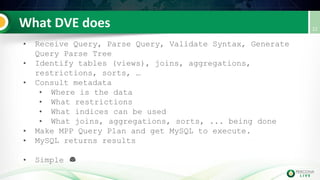
• Receive Query, Parse Query, Validate Syntax, Generate
Query Parse Tree
• Identify tables (views), joins, aggregations,
restrictions, sorts, …
• Consult metadata
• Where is the data
• What restrictions
• What indices can be used
• What joins, aggregations, sorts, ... being done
• Make MPP Query Plan and get MySQL to execute.
• MySQL returns results
• Simple
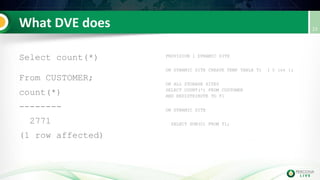
Select count(*)
From CUSTOMER;
count(*)
--------
2771
(1 row affected)
PROVISION 1 DYNAMIC SITE
ON DYNAMIC SITE CREATE TEMP TABLE T1 ( C int );
ON ALL STORAGE SITES
SELECT COUNT(*) FROM CUSTOMER
AND REDISTRIBUTE TO T1
ON DYNAMIC SITE
SELECT SUM(C) FROM T1;
• Transparent sharding, parallel query execution
• Complex queries including cross site joins, aggregations, sorts, …
• Full support for views
• Referential Integrity (constraints)
• Elasticity
• Fully Open Source
Percona Live 4/15/15: Transparent sharding database virtualization engine (DVE)

Percona Live 4/15/15: Transparent sharding database virtualization engine (DVE)

  • 5.
    root@ip-10-20-20-12:~# mysql Welcome tothe MySQL monitor. Commands end with ; or g. Your MySQL connection id is 47 Server version: 5.5.10 Tesora (TM) Database Virtualization Engine (R), Version 1.7.0-Devel (ip-10-20-20-12)
  • 6.
    root@ip-10-20-20-12:~# mysql Welcome tothe MySQL monitor. Commands end with ; or g. Your MySQL connection id is 47 Server version: 5.5.10 Tesora (TM) Database Virtualization Engine (R), Version 1.7.0-Devel (ip-10-20-20-12)
  • 9.
    mysql> create persistentsite sb1 URL='jdbc://10.20.20.13: 3307' User='root' Password='root'; Query OK, 0 rows affected (0.11 sec)
  • 10.
    mysql> create persistentsite sb1 URL='jdbc://10.20.20.13: 3307' User='root' Password='root'; Query OK, 0 rows affected (0.11 sec) mysql> create persistent group sb_group add sb1; Query OK, 0 rows affected (0.05 sec)
  • 11.
    mysql> show persistentsitesG *************************** 1. row *************************** Persistent_Site: sb1 HA_Type: Single Master_Url: jdbc:mysql://10.20.20.13:3307 *************************** 2. row *************************** Persistent_Site: site1 HA_Type: Single Master_Url: jdbc:mysql://10.20.20.11:3307?useUnicode= (truncated)
  • 12.
    mysql> show persistentgroups; +------------------------+-------------------+ | Name | Latest_generation | +------------------------+-------------------+ | DefaultGroup | 3 | | InformationSchemaGroup | 1 | | sb_group | 4 | | SystemGroup | 2 | +------------------------+-------------------+ 4 rows in set (0.08 sec)
  • 13.
    mysql> create templatesysbench xml='<?xml version="1.0"?> '> <template name="sysbench"> '> <requirement> '> <declaration>create range if not exists id_range (integer) persistent group #sg# '> </declaration> '> </requirement> '> '> <tabletemplate range="id_range" match="sbtest.*" model="Range"> '> <column>id</column> '> </tabletemplate> '> </template>'; Query OK, 0 rows affected (0.17 sec)
  • 14.
    • Many waysto distribute data • Broadcast • Deterministic • Range • Map • Specifying distribution • Through DDL • Through templates
  • 15.
    • You canadd sites to a group • Data will still be distributed • How? • Broadcast tables [trivial] • Distributed tables [hard]
  • 16.
    • Multiple patents(8478790, 8386532, …) • Relies on a novel data structure • Moving from Yes/No → No/Maybe
  • 17.
    mysql> create databasesbtest default persistent group sb_group using template sysbench; Query OK, 1 row affected (0.12 sec) mysql> create range sb_id (integer) persistent group sb_group; Query OK, 0 rows affected (0.04 sec) mysql> show ranges; +-------+------------------+-----------+ | Range | Persistent_Group | Signature | +-------+------------------+-----------+ | sb_id | sb_group | int | +-------+------------------+-----------+ 1 row in set (0.02 sec) # sysbench --test=sysbench/tests/db/oltp.lua -- mysql-host=10.20.20.12 --mysql-user=root --mysql- password=root --oltp-table-size=10000 --oltp- tables-count=1 --mysql-table-options="persistent group sb_group range distribute on (id) using sb_id" prepare
  • 18.
    mysql> alter persistentgroup sb_group add generation sb2; Query OK, 1 row affected (0.12 sec) OR mysql> create persistent group sb_group2 add sb1, sb2; Query OK, 2 row affected (0.14 sec) mysql> create range sb_id2 (integer) persistent group sb_group2; Query OK, 0 rows affected (0.04 sec)
  • 19.
  • 20.
    mysql> explain select* from sbtest1 where id=3000G *************************** 1. row *************************** Type: SELECT Target_group: NULL Target_table: NULL Target_dist: Target_index_hints: NULL Other: found distribution key match SQL: SELECT `sbtest1`.`id` AS s1i0_6,`sbtest1`.`k` AS s1k1_7,`sbtest1`.`c` AS s1c2_8,`sbtest1`.`pad` AS s1p3_9 FROM `sbtest1` WHERE `sbtest1`.`id` = 3000 1 row in set (0.01 sec)
  • 21.
    mysql> select id,k,@dve_sitenamefrom sbtest1 where id between 3000 and 3010; +------+------+---------------+ | id | k | @dve_sitename | +------+------+---------------+ | 3000 | 4517 | sb1 | | 3002 | 5011 | sb1 | | 3004 | 4957 | sb1 | | 3006 | 5028 | sb1 | | 3008 | 5428 | sb1 | | 3010 | 5023 | sb1 | | 3001 | 5021 | sb2 | | 3003 | 4995 | sb2 | | 3005 | 4961 | sb2 | | 3007 | 5014 | sb2 | | 3009 | 4979 | sb2 | +------+------+---------------+ 11 rows in set (0.02 sec)
  • 22.
    • Receive Query,Parse Query, Validate Syntax, Generate Query Parse Tree • Identify tables (views), joins, aggregations, restrictions, sorts, … • Consult metadata • Where is the data • What restrictions • What indices can be used • What joins, aggregations, sorts, ... being done • Make MPP Query Plan and get MySQL to execute. • MySQL returns results • Simple
  • 23.
    Select count(*) From CUSTOMER; count(*) -------- 2771 (1row affected) PROVISION 1 DYNAMIC SITE ON DYNAMIC SITE CREATE TEMP TABLE T1 ( C int ); ON ALL STORAGE SITES SELECT COUNT(*) FROM CUSTOMER AND REDISTRIBUTE TO T1 ON DYNAMIC SITE SELECT SUM(C) FROM T1;
  • 25.
    • Transparent sharding,parallel query execution • Complex queries including cross site joins, aggregations, sorts, … • Full support for views • Referential Integrity (constraints) • Elasticity • Fully Open Source