So Your OpenStack Cloud
is Built...Now What’s
Next?
Walter Bentley
Cloud Solutions Architect – Private Cloud
2
@ d j s t a y f l y p r o
Walter Bentley
Senior Technical Marketing Engineer, RPC
Twitter: @djstayflypro
LinkedIn: http://goo.gl/r2p21i
GitHub: wbentley15
Blog: hitchnyc.com
• Over 17 years of IT experience
• New Yexan (a New Yorker living in Texas)
• Cloud Advocate (hybrid is my favorite)
• Author & Knowledge sharer
• OpenStack believer
• Motorcyclist & DJ (literally…no lie)
• Always about living life now!
3
@ d j s t a y f l y p r o
Talking Points
• Review some common cloud decisions and day-to-day operator tasks
• Learn why OpenStack and automation work great together
• Review some automation considerations before getting started
• Step thru how to automate various tasks with OpenStack
• Benefits of adopting an ‘Administration DevOps’ state of mind and next steps
4
@ d j s t a y f l y p r o
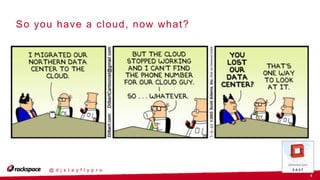
So you have a cloud, now what?
Why not create some roles and
playbooks to automate all those
pre-configurations
5
@ d j s t a y f l y p r o
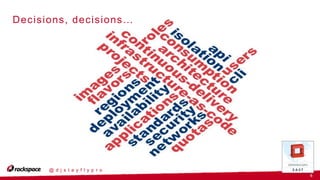
Decisions, decisions…
6
@ d j s t a y f l y p r o
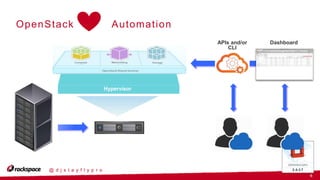
OpenStack Automation
APIs and/or
CLI
Dashboard
Hypervisor
7
@ d j s t a y f l y p r o
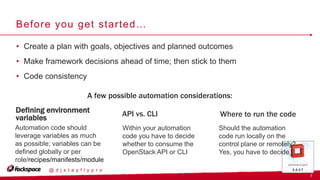
Before you get started…
A few possible automation considerations:
• Create a plan with goals, objectives and planned outcomes
• Make framework decisions ahead of time; then stick to them
• Code consistency
Defining environment
variables API vs. CLI Where to run the code
Should the automation
code run locally on the
control plane or remotely?
Yes, you have to decide
Within your automation
code you have to decide
whether to consume the
OpenStack API or CLI
Automation code should
leverage variables as much
as possible; variables can be
defined globally or per
role/recipes/manifests/module
s
Image FPO
8
D e m o : Tu r n A p p l i c a t i o n
S t a c k s i n t o C o d e
w i t h H e a t
8
9
@ d j s t a y f l y p r o
OpenStack Scenario #1
As a cloud operator,
you want to empower the QA team with the ability to stand up their own
test environments…
• What would be your approach for doing this with OpenStack? Provide QA with a
project and say good luck?
• Is there more you could do for them? How could you make this a single ‘push
button’ solution?
Image FPO
10
D e m o : A u t o m a t e c l o u d
a d m i n i s t r a t i o n t a s k s
w i t h A n s i b l e
10
11
@ d j s t a y f l y p r o
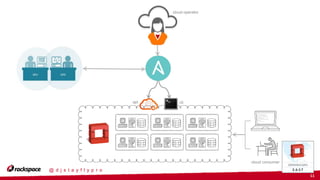
cloud operator
cloud consumer
api cli
12
@ d j s t a y f l y p r o
OpenStack Scenario #2
As a cloud operator,
what if you were tasked with creating 50 users and projects…
• How long would it take you using Horizon? Using the CLI?
• Keep in mind you have password standards to meet, given a tight timeline and will
need to avoid mistakes/typos.
• What if you need to now adjust the quotas for all 50 projects next?
Image FPO
13
D e m o : D e t e r m i n e y o u r
c l o u d s h e a l t h i n o n e
c o m m a n d
13
14
@ d j s t a y f l y p r o
OpenStack Scenario #3
As a cloud operator,
what if you were tasked with providing real-time health status reports of
your cloud
• Could you easily do this? What would be your approach?
• Would connecting to each controller node be the best use of time?
• What if your environment has over 1,000 compute nodes?
Image FPO
15
‘ A D M I N I S T R AT I O N D E VO P S ’ S TAT E O F M I N D
15
16
@ d j s t a y f l y p r o
Cloud Lifecycle
DISCOVER/
ASSESS
Compute
Memory
Storage
Segregation
Goals
Objectives
Outcomes
ARCHITECT
Network
Redundancy
Sizing/Scaling
Strategy
IMPLEMENT SUPPORT
Monitor
Troubleshoot
Escalation/
Tickets
SECURITY
CAPACITY PLANNING
17
@ d j s t a y f l y p r o
‘Administration DevOps’ Concepts and Principles
Automate everything – do it once and run it hundreds of times
Influence application design; cloudy applications should:
 easily scale horizontally
 be designed to consume disposable computing
resources
 be designed in a share nothing approach (stateless)
 be built in an DevOps model
 be built to expect failures
18
Q&A Session
Twitter: @djstayflypro
Email: walter.bentley@rackspace.com
O N E FA N AT I C A L P L A C E | S A N A N T O N I O , T X 7 8 2 1 8
U S S A L E S : 1 - 8 0 0 - 9 61 - 2 8 8 8 | U S S U P P O R T: 1 - 8 0 0 - 9 61 - 4 4 5 4 | W W W. R AC K S PAC E . C O M
© RACKSPACE LTD. | RACKSPACE® AND FANATICAL SUPPORT® ARE SERVICE MARKS OF RACKSPACE US, INC. REGISTERED IN THE UNITED S TATES AND OTHER COUNTRIES. |
WWW.RACKSPACE.COM
Thank you
Twitter: @djstayflypro
Email: walter.bentley@rackspace.com

So Your OpenStack Cloud is Built...Now What?

  • 1.
    So Your OpenStackCloud is Built...Now What’s Next? Walter Bentley Cloud Solutions Architect – Private Cloud
  • 2.
    2 @ d js t a y f l y p r o Walter Bentley Senior Technical Marketing Engineer, RPC Twitter: @djstayflypro LinkedIn: http://goo.gl/r2p21i GitHub: wbentley15 Blog: hitchnyc.com • Over 17 years of IT experience • New Yexan (a New Yorker living in Texas) • Cloud Advocate (hybrid is my favorite) • Author & Knowledge sharer • OpenStack believer • Motorcyclist & DJ (literally…no lie) • Always about living life now!
  • 3.
    3 @ d js t a y f l y p r o Talking Points • Review some common cloud decisions and day-to-day operator tasks • Learn why OpenStack and automation work great together • Review some automation considerations before getting started • Step thru how to automate various tasks with OpenStack • Benefits of adopting an ‘Administration DevOps’ state of mind and next steps
  • 4.
    4 @ d js t a y f l y p r o So you have a cloud, now what? Why not create some roles and playbooks to automate all those pre-configurations
  • 5.
    5 @ d js t a y f l y p r o Decisions, decisions…
  • 6.
    6 @ d js t a y f l y p r o OpenStack Automation APIs and/or CLI Dashboard Hypervisor
  • 7.
    7 @ d js t a y f l y p r o Before you get started… A few possible automation considerations: • Create a plan with goals, objectives and planned outcomes • Make framework decisions ahead of time; then stick to them • Code consistency Defining environment variables API vs. CLI Where to run the code Should the automation code run locally on the control plane or remotely? Yes, you have to decide Within your automation code you have to decide whether to consume the OpenStack API or CLI Automation code should leverage variables as much as possible; variables can be defined globally or per role/recipes/manifests/module s
  • 8.
    Image FPO 8 D em o : Tu r n A p p l i c a t i o n S t a c k s i n t o C o d e w i t h H e a t 8
  • 9.
    9 @ d js t a y f l y p r o OpenStack Scenario #1 As a cloud operator, you want to empower the QA team with the ability to stand up their own test environments… • What would be your approach for doing this with OpenStack? Provide QA with a project and say good luck? • Is there more you could do for them? How could you make this a single ‘push button’ solution?
  • 10.
    Image FPO 10 D em o : A u t o m a t e c l o u d a d m i n i s t r a t i o n t a s k s w i t h A n s i b l e 10
  • 11.
    11 @ d js t a y f l y p r o cloud operator cloud consumer api cli
  • 12.
    12 @ d js t a y f l y p r o OpenStack Scenario #2 As a cloud operator, what if you were tasked with creating 50 users and projects… • How long would it take you using Horizon? Using the CLI? • Keep in mind you have password standards to meet, given a tight timeline and will need to avoid mistakes/typos. • What if you need to now adjust the quotas for all 50 projects next?
  • 13.
    Image FPO 13 D em o : D e t e r m i n e y o u r c l o u d s h e a l t h i n o n e c o m m a n d 13
  • 14.
    14 @ d js t a y f l y p r o OpenStack Scenario #3 As a cloud operator, what if you were tasked with providing real-time health status reports of your cloud • Could you easily do this? What would be your approach? • Would connecting to each controller node be the best use of time? • What if your environment has over 1,000 compute nodes?
  • 15.
    Image FPO 15 ‘ AD M I N I S T R AT I O N D E VO P S ’ S TAT E O F M I N D 15
  • 16.
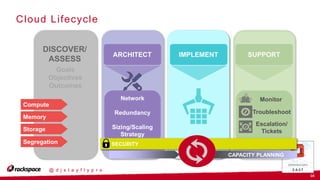
    16 @ d js t a y f l y p r o Cloud Lifecycle DISCOVER/ ASSESS Compute Memory Storage Segregation Goals Objectives Outcomes ARCHITECT Network Redundancy Sizing/Scaling Strategy IMPLEMENT SUPPORT Monitor Troubleshoot Escalation/ Tickets SECURITY CAPACITY PLANNING
  • 17.
    17 @ d js t a y f l y p r o ‘Administration DevOps’ Concepts and Principles Automate everything – do it once and run it hundreds of times Influence application design; cloudy applications should:  easily scale horizontally  be designed to consume disposable computing resources  be designed in a share nothing approach (stateless)  be built in an DevOps model  be built to expect failures
  • 18.
  • 19.
    O N EFA N AT I C A L P L A C E | S A N A N T O N I O , T X 7 8 2 1 8 U S S A L E S : 1 - 8 0 0 - 9 61 - 2 8 8 8 | U S S U P P O R T: 1 - 8 0 0 - 9 61 - 4 4 5 4 | W W W. R AC K S PAC E . C O M © RACKSPACE LTD. | RACKSPACE® AND FANATICAL SUPPORT® ARE SERVICE MARKS OF RACKSPACE US, INC. REGISTERED IN THE UNITED S TATES AND OTHER COUNTRIES. | WWW.RACKSPACE.COM Thank you Twitter: @djstayflypro Email: walter.bentley@rackspace.com

Editor's Notes

  • #5 Key Message: After conquering the struggle to get to the cloud, now that you have it…many now are not sure the best way to introduce/use it within the company
  • #6 Key Message: Yes, there are a million decisions to make now: infrastructure-as-code continuous-delivery Availability Applications Consumption Deployment Isolation Architecture standards Projects Security Networks Regions Flavors Quotas Images Roles Users API CLI
  • #7 Key Message: This is where OpenStack provided value, a means of adding an orchestration layer on top of the many hypervisors in your DC. Provides efficiency of hardware and the ability to distribute your workloads based on demand. Should be familiar with the OpenStack API and CLI, not just rely on Horizon
  • #8 Key Message: Framework decisions ahead of time Solid framework drives code consistency, which in turn allows for easy adoption Do you know how to consume the API? Have you tried the CLI?
  • #17 Key Message: Highlight the automation considerations you should be aware of before you get started