Dave Stokes
Community Manager
MySQL
December 04, 2019
New MySQL Features & A Peek at 2020
Subtitle
1
Safe harbor statement
The following is intended to outline our general product direction. It is intended for information
purposes only, and may not be incorporated into any contract. It is not a commitment to deliver
any material, code, or functionality, and should not be relied upon in making purchasing
decisions.
The development, release, timing, and pricing of any features or functionality described for
Oracle’s products may change and remains at the sole discretion of Oracle Corporation.
2
Me?
 Started using MySQL when it first was available
 Used in many projects -> Open Source used to low $
 Joined MySQL AB as PHP Programmer in Certification
Team
 MySQL AB -> Sun Microsystems -> Oracle
 Calpont & InfiniDB
 MySQL Community Team
3
First topic
Program agenda
1
2
3
4
5
Second topic
Third topic
Fourth topic
Fifth topic
4
Please ask questions!
Let us make this interactive!!
What do you want to see from MySQL in 2020?
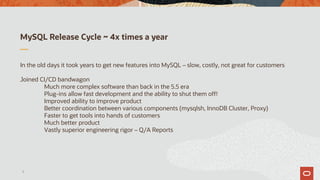
MySQL Release Cycle ~ 4x times a year
In the old days it took years to get new features into MySQL – slow, costly, not great for customers
Joined CI/CD bandwagon
Much more complex software than back in the 5.5 era
Plug-ins allow fast development and the ability to shut them off!
Improved ability to improve product
Better coordination between various components (mysqlsh, InnoDB Cluster, Proxy)
Faster to get tools into hands of customers
Much better product
Vastly superior engineering rigor – Q/A Reports
5
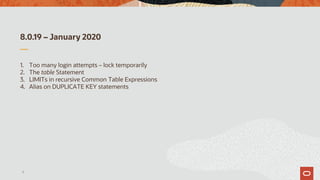
8.0.19 – January 2020
1. Too many login attempts – lock temporarily
2. The table Statement
3. LIMITs in recursive Common Table Expressions
4. Alias on DUPLICATE KEY statements
6
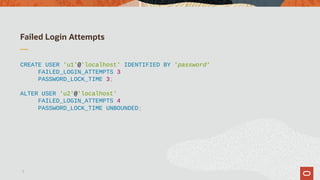
Failed Login Attempts
CREATE USER 'u1'@'localhost' IDENTIFIED BY 'password‘
FAILED_LOGIN_ATTEMPTS 3
PASSWORD_LOCK_TIME 3;
ALTER USER 'u2'@'localhost'
FAILED_LOGIN_ATTEMPTS 4
PASSWORD_LOCK_TIME UNBOUNDED;
7
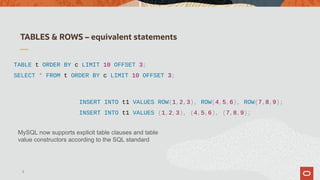
TABLES & ROWS – equivalent statements
TABLE t ORDER BY c LIMIT 10 OFFSET 3;
SELECT * FROM t ORDER BY c LIMIT 10 OFFSET 3;
INSERT INTO t1 VALUES ROW(1,2,3), ROW(4,5,6), ROW(7,8,9);
INSERT INTO t1 VALUES (1,2,3), (4,5,6), (7,8,9);
8
MySQL now supports explicit table clauses and table
value constructors according to the SQL standard
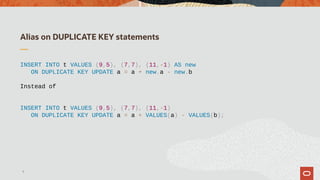
Alias on DUPLICATE KEY statements
INSERT INTO t VALUES (9,5), (7,7), (11,-1) AS new
ON DUPLICATE KEY UPDATE a = a + new.a - new.b
Instead of
INSERT INTO t VALUES (9,5), (7,7), (11,-1)
ON DUPLICATE KEY UPDATE a = a + VALUES(a) - VALUES(b);
9
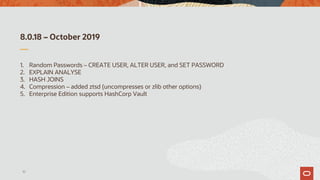
8.0.18 – October 2019
1. Random Passwords – CREATE USER, ALTER USER, and SET PASSWORD
2. EXPLAIN ANALYSE
3. HASH JOINS
4. Compression – added ztsd (uncompresses or zlib other options)
5. Enterprise Edition supports HashCorp Vault
10
Random Password
https://elephantdolphin.blogspot.com/2019/10/mysql-random-
password-generation.html
SQL > create user 'Foo'@'%' IDENTIFIED BY RANDOM PASSWORD;
+------+------+----------------------+
| user | host | generated password |
+------+------+----------------------+
| Foo | % | Ld]5/Fkn[Kk29/g/M;>n |
+------+------+----------------------+
1 row in set (0.0090 sec)
11
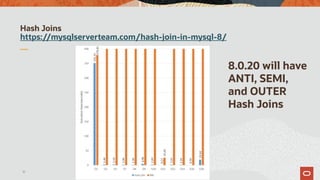
Hash Joins
https://mysqlserverteam.com/hash-join-in-mysql-8/
12
8.0.20 will have
ANTI, SEMI,
and OUTER
Hash Joins
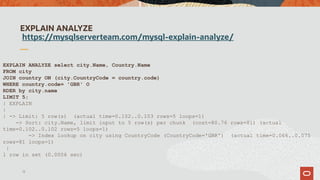
EXPLAIN ANALYZE
https://mysqlserverteam.com/mysql-explain-analyze/
EXPLAIN ANALYZE select city.Name, Country.Name
FROM city
JOIN country ON (city.CountryCode = country.code)
WHERE country.code= 'GBR' O
RDER by city.name
LIMIT 5;
| EXPLAIN
|
| -> Limit: 5 row(s) (actual time=0.102..0.103 rows=5 loops=1)
-> Sort: city.Name, limit input to 5 row(s) per chunk (cost=80.76 rows=81) (actual
time=0.102..0.102 rows=5 loops=1)
-> Index lookup on city using CountryCode (CountryCode='GBR') (actual time=0.066..0.075
rows=81 loops=1)
|
1 row in set (0.0006 sec)
13
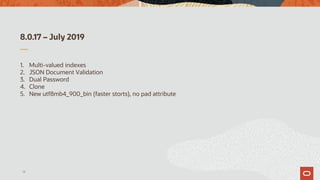
8.0.17 – July 2019
1. Multi-valued indexes
2. JSON Document Validation
3. Dual Password
4. Clone
5. New utf8mb4_900_bin (faster storts), no pad attribute
14
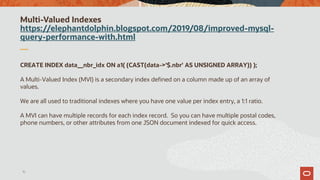
Multi-Valued Indexes
https://elephantdolphin.blogspot.com/2019/08/improved-mysql-
query-performance-with.html
CREATE INDEX data__nbr_idx ON a1( (CAST(data->'$.nbr' AS UNSIGNED ARRAY)) );
A Multi-Valued Index (MVI) is a secondary index defined on a column made up of an array of
values.
We are all used to traditional indexes where you have one value per index entry, a 1:1 ratio.
A MVI can have multiple records for each index record. So you can have multiple postal codes,
phone numbers, or other attributes from one JSON document indexed for quick access.
15
JSON Document Validation
https://elephantdolphin.blogspot.com/2019/07/json-schema-
validation-with-mysql-8017.html
CREATE TABLE `testx` (
`col` JSON,
CONSTRAINT `myage_inRange`
CHECK (JSON_SCHEMA_VALID('{"type": "object",
"properties": {
"myage": {
"type" : "number",
"minimum": 28,
"maximum": 99
}
},"required": ["myage"]
}', `col`) = 1)
);
mysql> insert into testx values('{"myage":27}');
ERROR 3819 (HY000): Check constraint 'myage_inRange' is violated.
mysql> insert into testx values('{"myage":97}');
Query OK, 1 row affected (0.02 sec)
16
You can now check for
required keys, value
types, and range check
values in your JSON
documents!
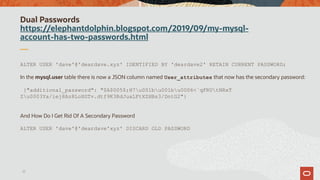
Dual Passwords
https://elephantdolphin.blogspot.com/2019/09/my-mysql-
account-has-two-passwords.html
ALTER USER 'dave'@'deardave.xyz' IDENTIFIED BY 'deardave2' RETAIN CURRENT PASSWORD;
In the mysql.user table there is now a JSON column named User_attributes that now has the secondary password:
{"additional_password": "$A$005$;H7u001bu001bu0006<`qFRUtNRxT
Zu0003Ya/iej8Az8LoXGTv.dtf9K3RdJuaLFtXZHBs3/DntG2"}
And How Do I Get Rid Of A Secondary Password
ALTER USER 'dave'@'deardave'xyz' DISCARD OLD PASSWORD
17
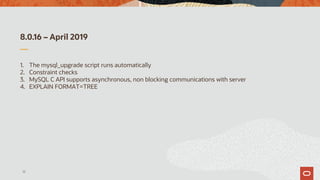
8.0.16 – April 2019
1. The mysql_upgrade script runs automatically
2. Constraint checks
3. MySQL C API supports asynchronous, non blocking communications with server
4. EXPLAIN FORMAT=TREE
18
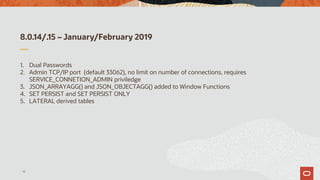
8.0.14/.15 – January/February 2019
1. Dual Passwords
2. Admin TCP/IP port (default 33062), no limit on number of connections, requires
SERVICE_CONNETION_ADMIN priviledge
3. JSON_ARRAYAGG() and JSON_OBJECTAGG() added to Window Functions
4. SET PERSIST and SET PERSIST ONLY
5. LATERAL derived tables
19
8.0.11 – till now
1. Data Dictionary
2. Histograms
3. Resource Groups
4. CATS
5. Better JSON support
6. UTF8MB4
7. Improved InnoDB Cluster
8. Improved X DevAPI / MySQL as NoSQL
9. New temporary table engine
10. Better performance
20
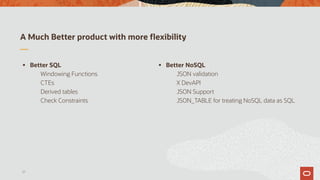
A Much Better product with more flexibility
 Better SQL
Windowing Functions
CTEs
Derived tables
Check Constraints
 Better NoSQL
JSON validation
X DevAPI
JSON Support
JSON_TABLE for treating NoSQL data as SQL
21
22
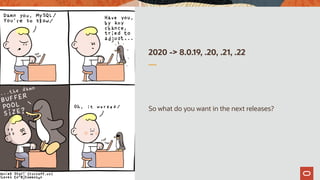
2020 -> 8.0.19, .20, .21, .22
So what do you want in the next releases?
23
Dave’s very unofficial private ideas of what you will see in the next
releases of MySQL in 2020 not blessed or endorsed by Oracle,
MySQL, or anybody else but me.
1. Enterprise Edition will be doing a lot more with security (and customers are paying for it).
2. Much more improvements in:
1. JSON Support
2. GIS
3. More functionality in InnoDB cluster following consistency levels in latest releases, clone plug-in
4. Big improvements in X DevAPI
5. More features in the new shell
6. Still a few mutexes to eliminate, better performance
7. More emphasis on Kuberneties-ish deployments despite not being a great database environment
8. DBAs are going to be harder to find, but scope of job will widen
9. Bad data architecture will start to be seen as a problem: Digital Data Landfill
10. ?
24
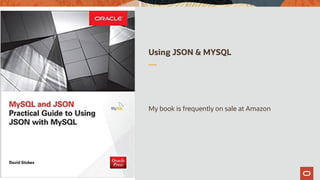
Using JSON & MYSQL
My book is frequently on sale at Amazon
25
Thank you
Dave Stokes
MySQL Community Manager
MySQL
David.Stokes @ Oracle.com
26

MySQL New Features -- Sunshine PHP 2020 Presentation

  • 1.
    Dave Stokes Community Manager MySQL December04, 2019 New MySQL Features & A Peek at 2020 Subtitle 1
  • 2.
    Safe harbor statement Thefollowing is intended to outline our general product direction. It is intended for information purposes only, and may not be incorporated into any contract. It is not a commitment to deliver any material, code, or functionality, and should not be relied upon in making purchasing decisions. The development, release, timing, and pricing of any features or functionality described for Oracle’s products may change and remains at the sole discretion of Oracle Corporation. 2
  • 3.
    Me?  Started usingMySQL when it first was available  Used in many projects -> Open Source used to low $  Joined MySQL AB as PHP Programmer in Certification Team  MySQL AB -> Sun Microsystems -> Oracle  Calpont & InfiniDB  MySQL Community Team 3
  • 4.
    First topic Program agenda 1 2 3 4 5 Secondtopic Third topic Fourth topic Fifth topic 4 Please ask questions! Let us make this interactive!! What do you want to see from MySQL in 2020?
  • 5.
    MySQL Release Cycle~ 4x times a year In the old days it took years to get new features into MySQL – slow, costly, not great for customers Joined CI/CD bandwagon Much more complex software than back in the 5.5 era Plug-ins allow fast development and the ability to shut them off! Improved ability to improve product Better coordination between various components (mysqlsh, InnoDB Cluster, Proxy) Faster to get tools into hands of customers Much better product Vastly superior engineering rigor – Q/A Reports 5
  • 6.
    8.0.19 – January2020 1. Too many login attempts – lock temporarily 2. The table Statement 3. LIMITs in recursive Common Table Expressions 4. Alias on DUPLICATE KEY statements 6
  • 7.
    Failed Login Attempts CREATEUSER 'u1'@'localhost' IDENTIFIED BY 'password‘ FAILED_LOGIN_ATTEMPTS 3 PASSWORD_LOCK_TIME 3; ALTER USER 'u2'@'localhost' FAILED_LOGIN_ATTEMPTS 4 PASSWORD_LOCK_TIME UNBOUNDED; 7
  • 8.
    TABLES & ROWS– equivalent statements TABLE t ORDER BY c LIMIT 10 OFFSET 3; SELECT * FROM t ORDER BY c LIMIT 10 OFFSET 3; INSERT INTO t1 VALUES ROW(1,2,3), ROW(4,5,6), ROW(7,8,9); INSERT INTO t1 VALUES (1,2,3), (4,5,6), (7,8,9); 8 MySQL now supports explicit table clauses and table value constructors according to the SQL standard
  • 9.
    Alias on DUPLICATEKEY statements INSERT INTO t VALUES (9,5), (7,7), (11,-1) AS new ON DUPLICATE KEY UPDATE a = a + new.a - new.b Instead of INSERT INTO t VALUES (9,5), (7,7), (11,-1) ON DUPLICATE KEY UPDATE a = a + VALUES(a) - VALUES(b); 9
  • 10.
    8.0.18 – October2019 1. Random Passwords – CREATE USER, ALTER USER, and SET PASSWORD 2. EXPLAIN ANALYSE 3. HASH JOINS 4. Compression – added ztsd (uncompresses or zlib other options) 5. Enterprise Edition supports HashCorp Vault 10
  • 11.
    Random Password https://elephantdolphin.blogspot.com/2019/10/mysql-random- password-generation.html SQL >create user 'Foo'@'%' IDENTIFIED BY RANDOM PASSWORD; +------+------+----------------------+ | user | host | generated password | +------+------+----------------------+ | Foo | % | Ld]5/Fkn[Kk29/g/M;>n | +------+------+----------------------+ 1 row in set (0.0090 sec) 11
  • 12.
  • 13.
    EXPLAIN ANALYZE https://mysqlserverteam.com/mysql-explain-analyze/ EXPLAIN ANALYZEselect city.Name, Country.Name FROM city JOIN country ON (city.CountryCode = country.code) WHERE country.code= 'GBR' O RDER by city.name LIMIT 5; | EXPLAIN | | -> Limit: 5 row(s) (actual time=0.102..0.103 rows=5 loops=1) -> Sort: city.Name, limit input to 5 row(s) per chunk (cost=80.76 rows=81) (actual time=0.102..0.102 rows=5 loops=1) -> Index lookup on city using CountryCode (CountryCode='GBR') (actual time=0.066..0.075 rows=81 loops=1) | 1 row in set (0.0006 sec) 13
  • 14.
    8.0.17 – July2019 1. Multi-valued indexes 2. JSON Document Validation 3. Dual Password 4. Clone 5. New utf8mb4_900_bin (faster storts), no pad attribute 14
  • 15.
    Multi-Valued Indexes https://elephantdolphin.blogspot.com/2019/08/improved-mysql- query-performance-with.html CREATE INDEXdata__nbr_idx ON a1( (CAST(data->'$.nbr' AS UNSIGNED ARRAY)) ); A Multi-Valued Index (MVI) is a secondary index defined on a column made up of an array of values. We are all used to traditional indexes where you have one value per index entry, a 1:1 ratio. A MVI can have multiple records for each index record. So you can have multiple postal codes, phone numbers, or other attributes from one JSON document indexed for quick access. 15
  • 16.
    JSON Document Validation https://elephantdolphin.blogspot.com/2019/07/json-schema- validation-with-mysql-8017.html CREATETABLE `testx` ( `col` JSON, CONSTRAINT `myage_inRange` CHECK (JSON_SCHEMA_VALID('{"type": "object", "properties": { "myage": { "type" : "number", "minimum": 28, "maximum": 99 } },"required": ["myage"] }', `col`) = 1) ); mysql> insert into testx values('{"myage":27}'); ERROR 3819 (HY000): Check constraint 'myage_inRange' is violated. mysql> insert into testx values('{"myage":97}'); Query OK, 1 row affected (0.02 sec) 16 You can now check for required keys, value types, and range check values in your JSON documents!
  • 17.
    Dual Passwords https://elephantdolphin.blogspot.com/2019/09/my-mysql- account-has-two-passwords.html ALTER USER'dave'@'deardave.xyz' IDENTIFIED BY 'deardave2' RETAIN CURRENT PASSWORD; In the mysql.user table there is now a JSON column named User_attributes that now has the secondary password: {"additional_password": "$A$005$;H7u001bu001bu0006<`qFRUtNRxT Zu0003Ya/iej8Az8LoXGTv.dtf9K3RdJuaLFtXZHBs3/DntG2"} And How Do I Get Rid Of A Secondary Password ALTER USER 'dave'@'deardave'xyz' DISCARD OLD PASSWORD 17
  • 18.
    8.0.16 – April2019 1. The mysql_upgrade script runs automatically 2. Constraint checks 3. MySQL C API supports asynchronous, non blocking communications with server 4. EXPLAIN FORMAT=TREE 18
  • 19.
    8.0.14/.15 – January/February2019 1. Dual Passwords 2. Admin TCP/IP port (default 33062), no limit on number of connections, requires SERVICE_CONNETION_ADMIN priviledge 3. JSON_ARRAYAGG() and JSON_OBJECTAGG() added to Window Functions 4. SET PERSIST and SET PERSIST ONLY 5. LATERAL derived tables 19
  • 20.
    8.0.11 – tillnow 1. Data Dictionary 2. Histograms 3. Resource Groups 4. CATS 5. Better JSON support 6. UTF8MB4 7. Improved InnoDB Cluster 8. Improved X DevAPI / MySQL as NoSQL 9. New temporary table engine 10. Better performance 20
  • 21.
    A Much Betterproduct with more flexibility  Better SQL Windowing Functions CTEs Derived tables Check Constraints  Better NoSQL JSON validation X DevAPI JSON Support JSON_TABLE for treating NoSQL data as SQL 21
  • 22.
  • 23.
    2020 -> 8.0.19,.20, .21, .22 So what do you want in the next releases? 23
  • 24.
    Dave’s very unofficialprivate ideas of what you will see in the next releases of MySQL in 2020 not blessed or endorsed by Oracle, MySQL, or anybody else but me. 1. Enterprise Edition will be doing a lot more with security (and customers are paying for it). 2. Much more improvements in: 1. JSON Support 2. GIS 3. More functionality in InnoDB cluster following consistency levels in latest releases, clone plug-in 4. Big improvements in X DevAPI 5. More features in the new shell 6. Still a few mutexes to eliminate, better performance 7. More emphasis on Kuberneties-ish deployments despite not being a great database environment 8. DBAs are going to be harder to find, but scope of job will widen 9. Bad data architecture will start to be seen as a problem: Digital Data Landfill 10. ? 24
  • 25.
    Using JSON &MYSQL My book is frequently on sale at Amazon 25
  • 26.
    Thank you Dave Stokes MySQLCommunity Manager MySQL David.Stokes @ Oracle.com 26