PREPARED BY:
MOUSOM SINGHA
B.E MINING ENGINEERING
IIEST SHIBPUR
MAY, 2016
Study of Dumper Cycle Time
Katamati Iron Ore Mine
Objective and Targets
 Objective: To optimize dumper cycle time
 Targets:
 To observe and collect data sample
 To analyse current level of dumper efficiency
 To identify means for improving cycle time
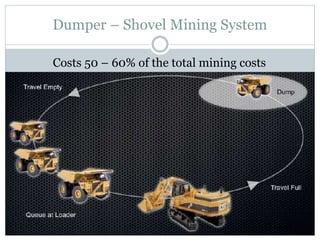
Dumper – Shovel Mining System
Costs 50 – 60% of the total mining costs
Standard Time Definition
Factors affecting Dumper efficiency
 Truck-shovel match and allocation;
 Shift operating schedules;
 Haul road design and ramp gradients ;
 Haul road rolling resistance ;
 Cycle Time.
Cycle Time Study
 The following factors were considered for the study:
 Waiting at the face
 Positioning
 Loading
 Travel(loaded); from face to dump
 Waiting at the dump
 Unloading
 Travel(empty); from dump to face
 Waiting at weigh bridge
 Weighing time
Cycle Time Study
 The following data were also collected, though not
directly related to dumper cycle:
 Weight of load in dumper
 Maximum and minimum speeds of dumpers
Cycle Time Study
 It has been observed that two different kinds of ore
based on their composition were mined
simultaneously at the Katamati mine.
 The two different ores were dumped at two different
dump sites, namely, the Wet plant facility and the
DCMP dump.
 Hence, the cycle time study has been conducted
separately for the two different dump sites.
For Wet Plant Dump
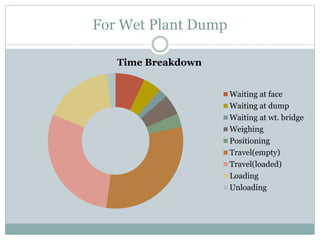
 Average total waiting time: 4.13 minutes
 Average positioning time: 1 minute
 Average loading time: 5.07 minutes
 Travel time (loaded): 8.92 minutes
 Travel time(empty): 9.35 minutes
For Wet Plant Dump
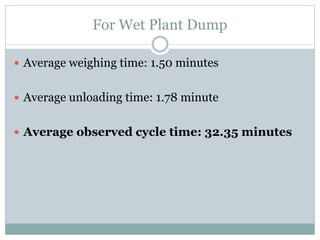
 Average weighing time: 1.50 minutes
 Average unloading time: 1.78 minute
 Average observed cycle time: 32.35 minutes
For Wet Plant Dump
Time Breakdown
Waiting at face
Waiting at dump
Waiting at wt. bridge
Weighing
Positioning
Travel(empty)
Travel(loaded)
Loading
Unloading
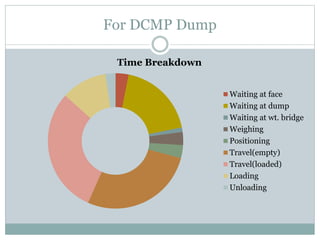
For DCMP Dump
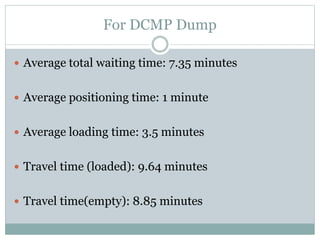
 Average total waiting time: 7.35 minutes
 Average positioning time: 1 minute
 Average loading time: 3.5 minutes
 Travel time (loaded): 9.64 minutes
 Travel time(empty): 8.85 minutes
For DCMP Dump
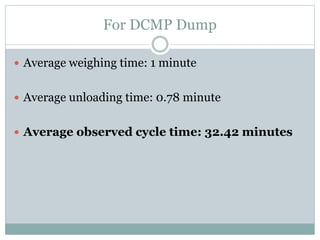
 Average weighing time: 1 minute
 Average unloading time: 0.78 minute
 Average observed cycle time: 32.42 minutes
For DCMP Dump
Time Breakdown
Waiting at face
Waiting at dump
Waiting at wt. bridge
Weighing
Positioning
Travel(empty)
Travel(loaded)
Loading
Unloading
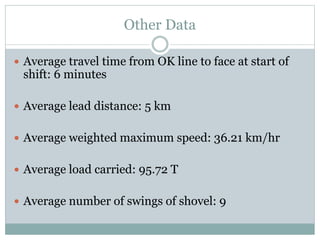
Other Data
 Average travel time from OK line to face at start of
shift: 6 minutes
 Average lead distance: 5 km
 Average weighted maximum speed: 36.21 km/hr
 Average load carried: 95.72 T
 Average number of swings of shovel: 9
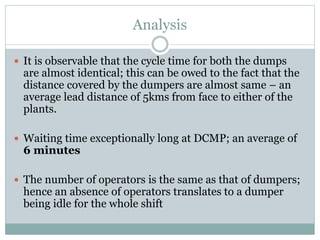
Analysis
 It is observable that the cycle time for both the dumps
are almost identical; this can be owed to the fact that the
distance covered by the dumpers are almost same – an
average lead distance of 5kms from face to either of the
plants.
 Waiting time exceptionally long at DCMP; an average of
6 minutes
 The number of operators is the same as that of dumpers;
hence an absence of operators translates to a dumper
being idle for the whole shift
Analysis
 In one shift, shovel servicing was not completed
during the preceding 1 hour of break time and 3
dumpers had to wait in queue for 10 minutes for the
servicing
 Even though the maximum speed allowed is 30
km/hr, the rule is often broken. This behaviour is
more pronounced as the shift progresses. This can be
attributed to fatigue of operators and consequent
disregard of rules.
Analysis
 In some cases, there is a dilemma of safety versus
pressure of production. In a certain case, a dumper
overtook a water-sprinkling truck even though over-
taking is banned on the haul roads.
 The DCMP breaks down often. In some cases,
dumpers wait for a few minutes before they are
finally instructed to dump near the DCMP and move
along. This wait time can be reduced if DCMP
informs the dumpers on time.
Recommendations
 More operators should be employed in a shift, even as
standby. Often, an absence of a single operator leads to a
dumper being idle for the whole shift further resulting
loss in production.
 Starting time for shifts should be aimed towards a
staggered format. This means that shifts for different
operators should start at different times so that
“bunching” effect is avoided whereby a total of about 1
hour of idle time is experienced at the start and end of
the shift. Similarly time is lost during the break time.
Recommendations
 Swarm-based truck-shovel dispatch system¹ or
efficient Fleet Management Systems(FMS) like
TALPAC, CAT FPC etc. should be installed.
¹Bissiri Y., Dunbar S., Hall A., Swarm –Based Truck-Shovel Dispatching System
in Open Pit Mine Operations, Department of Mining and Mineral Process
Engineering, University of British Columbia, Vancouver, Canada
Recommendations
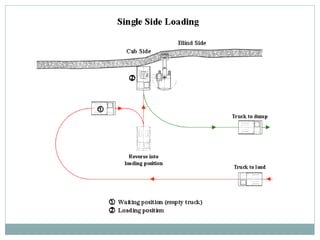
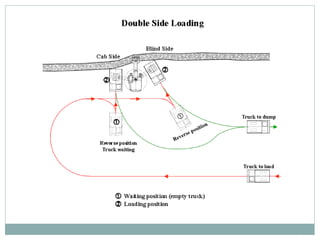
 Both side loading should be aimed. A sample
schematic is given for example in the following
slides:
Recommendations
 All dumpers should be fitted with equipment
checking the speed to prevent going above 30 km/hr,
instead of only 1 dumper as is the case presently.
However, since all observed dumpers cross this limit,
further safety studies should be carried out to
consider the possibility of raising this limit
marginally, if regulations permit.
Thank you

Dumper Cycle Study

  • 1.
    PREPARED BY: MOUSOM SINGHA B.EMINING ENGINEERING IIEST SHIBPUR MAY, 2016 Study of Dumper Cycle Time Katamati Iron Ore Mine
  • 2.
    Objective and Targets Objective: To optimize dumper cycle time  Targets:  To observe and collect data sample  To analyse current level of dumper efficiency  To identify means for improving cycle time
  • 3.
    Dumper – ShovelMining System Costs 50 – 60% of the total mining costs
  • 4.
  • 5.
    Factors affecting Dumperefficiency  Truck-shovel match and allocation;  Shift operating schedules;  Haul road design and ramp gradients ;  Haul road rolling resistance ;  Cycle Time.
  • 6.
    Cycle Time Study The following factors were considered for the study:  Waiting at the face  Positioning  Loading  Travel(loaded); from face to dump  Waiting at the dump  Unloading  Travel(empty); from dump to face  Waiting at weigh bridge  Weighing time
  • 7.
    Cycle Time Study The following data were also collected, though not directly related to dumper cycle:  Weight of load in dumper  Maximum and minimum speeds of dumpers
  • 8.
    Cycle Time Study It has been observed that two different kinds of ore based on their composition were mined simultaneously at the Katamati mine.  The two different ores were dumped at two different dump sites, namely, the Wet plant facility and the DCMP dump.  Hence, the cycle time study has been conducted separately for the two different dump sites.
  • 9.
    For Wet PlantDump  Average total waiting time: 4.13 minutes  Average positioning time: 1 minute  Average loading time: 5.07 minutes  Travel time (loaded): 8.92 minutes  Travel time(empty): 9.35 minutes
  • 10.
    For Wet PlantDump  Average weighing time: 1.50 minutes  Average unloading time: 1.78 minute  Average observed cycle time: 32.35 minutes
  • 11.
    For Wet PlantDump Time Breakdown Waiting at face Waiting at dump Waiting at wt. bridge Weighing Positioning Travel(empty) Travel(loaded) Loading Unloading
  • 12.
    For DCMP Dump Average total waiting time: 7.35 minutes  Average positioning time: 1 minute  Average loading time: 3.5 minutes  Travel time (loaded): 9.64 minutes  Travel time(empty): 8.85 minutes
  • 13.
    For DCMP Dump Average weighing time: 1 minute  Average unloading time: 0.78 minute  Average observed cycle time: 32.42 minutes
  • 14.
    For DCMP Dump TimeBreakdown Waiting at face Waiting at dump Waiting at wt. bridge Weighing Positioning Travel(empty) Travel(loaded) Loading Unloading
  • 15.
    Other Data  Averagetravel time from OK line to face at start of shift: 6 minutes  Average lead distance: 5 km  Average weighted maximum speed: 36.21 km/hr  Average load carried: 95.72 T  Average number of swings of shovel: 9
  • 16.
    Analysis  It isobservable that the cycle time for both the dumps are almost identical; this can be owed to the fact that the distance covered by the dumpers are almost same – an average lead distance of 5kms from face to either of the plants.  Waiting time exceptionally long at DCMP; an average of 6 minutes  The number of operators is the same as that of dumpers; hence an absence of operators translates to a dumper being idle for the whole shift
  • 17.
    Analysis  In oneshift, shovel servicing was not completed during the preceding 1 hour of break time and 3 dumpers had to wait in queue for 10 minutes for the servicing  Even though the maximum speed allowed is 30 km/hr, the rule is often broken. This behaviour is more pronounced as the shift progresses. This can be attributed to fatigue of operators and consequent disregard of rules.
  • 18.
    Analysis  In somecases, there is a dilemma of safety versus pressure of production. In a certain case, a dumper overtook a water-sprinkling truck even though over- taking is banned on the haul roads.  The DCMP breaks down often. In some cases, dumpers wait for a few minutes before they are finally instructed to dump near the DCMP and move along. This wait time can be reduced if DCMP informs the dumpers on time.
  • 19.
    Recommendations  More operatorsshould be employed in a shift, even as standby. Often, an absence of a single operator leads to a dumper being idle for the whole shift further resulting loss in production.  Starting time for shifts should be aimed towards a staggered format. This means that shifts for different operators should start at different times so that “bunching” effect is avoided whereby a total of about 1 hour of idle time is experienced at the start and end of the shift. Similarly time is lost during the break time.
  • 20.
    Recommendations  Swarm-based truck-shoveldispatch system¹ or efficient Fleet Management Systems(FMS) like TALPAC, CAT FPC etc. should be installed. ¹Bissiri Y., Dunbar S., Hall A., Swarm –Based Truck-Shovel Dispatching System in Open Pit Mine Operations, Department of Mining and Mineral Process Engineering, University of British Columbia, Vancouver, Canada
  • 21.
    Recommendations  Both sideloading should be aimed. A sample schematic is given for example in the following slides:
  • 24.
    Recommendations  All dumpersshould be fitted with equipment checking the speed to prevent going above 30 km/hr, instead of only 1 dumper as is the case presently. However, since all observed dumpers cross this limit, further safety studies should be carried out to consider the possibility of raising this limit marginally, if regulations permit.
  • 25.