FHIR Profiles, Extensions
ValueSets, Conformance &
(Manyslidesadaptedfrompresentationby
EwoutKramer)
DavidHay
ProductStrategist
FMGco-chair
www.fhirblog.com
Page 2 • Copyright © 2012 Orion Health™ group of companies • All rights reserved
The need for Profiles
• Many different contexts in healthcare, but a single set of
Resources
– A desire to keep the resources manageable
• Need to be able to:
– Describe restrictions based on use and context
– Support elements not in the core resource
• Allow for these usage statements to:
– Authored in a structured manner
– Published in a repository
– Discoverable at Design and Run-time
– Used as the basis for validation, code, report and UI generation.
2
Page 3 • Copyright © 2012 Orion Health™ group of companies • All rights reserved
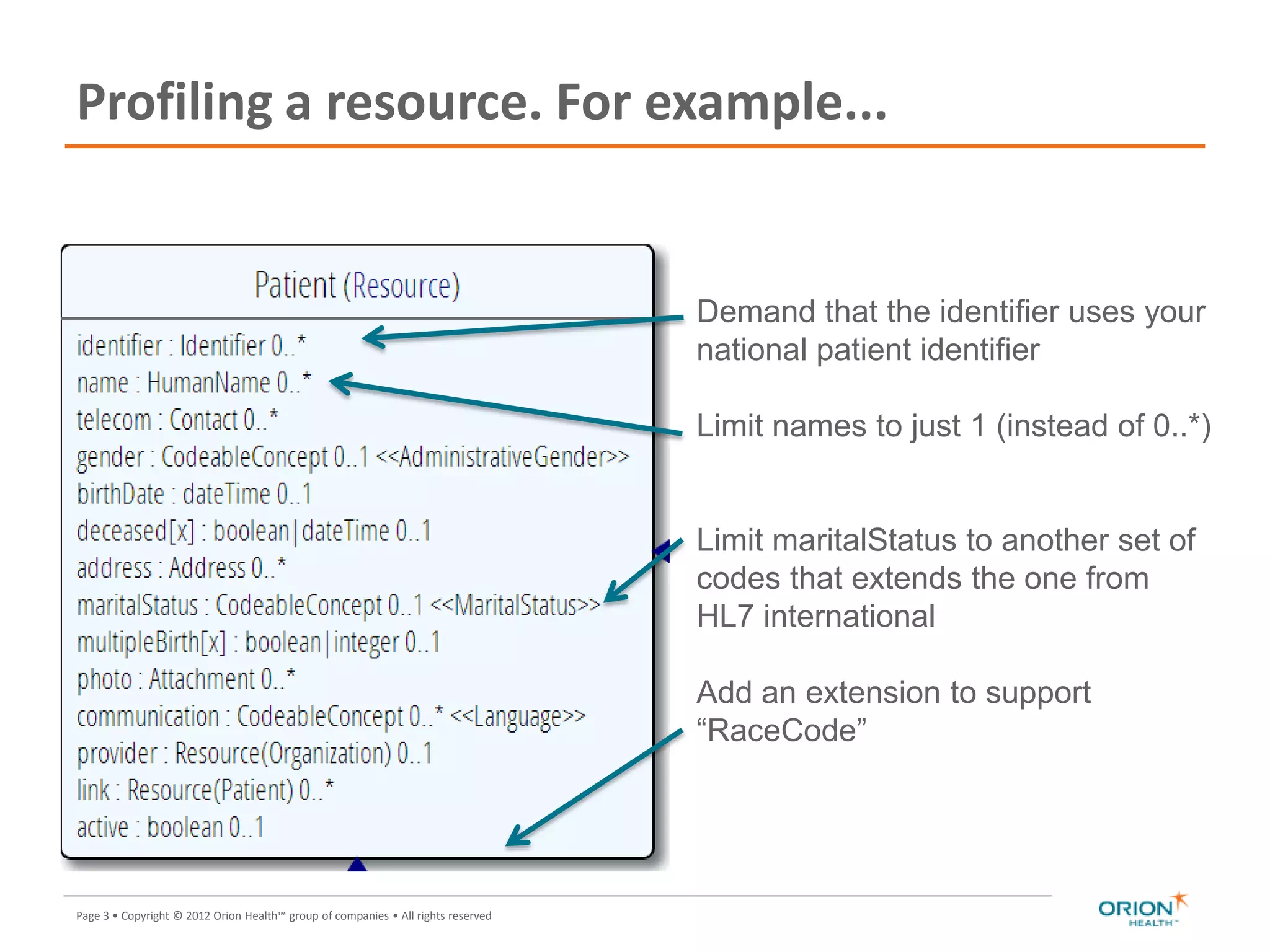
Profiling a resource. For example...
3
Demand that the identifier uses your
national patient identifier
Limit names to just 1 (instead of 0..*)
Limit maritalStatus to another set of
codes that extends the one from
HL7 international
Add an extension to support
“RaceCode”
Note: hardly any
mandatory
elements in the
Page 4 • Copyright © 2012 Orion Health™ group of companies • All rights reserved
Capabilities of Profiles
• Descriptive
– Information about the Profile (what, why, who)
• Extending a resource
– Adding new properties
– Same capabilities as existing ones
• Constraining a resource
– Specifying datatypes for an element
– Modifying datatypes (eg translations)
– Defining terminology bindings
– Specifying multiplicity (eg make an element required)
– Further refining repeating values (‘Slicing’)
• Example of Composition.section (Document)
– Cannot specify default values for resource instances
• Everything explicit in an instance
Page 5 • Copyright © 2012 Orion Health™ group of companies • All rights reserved
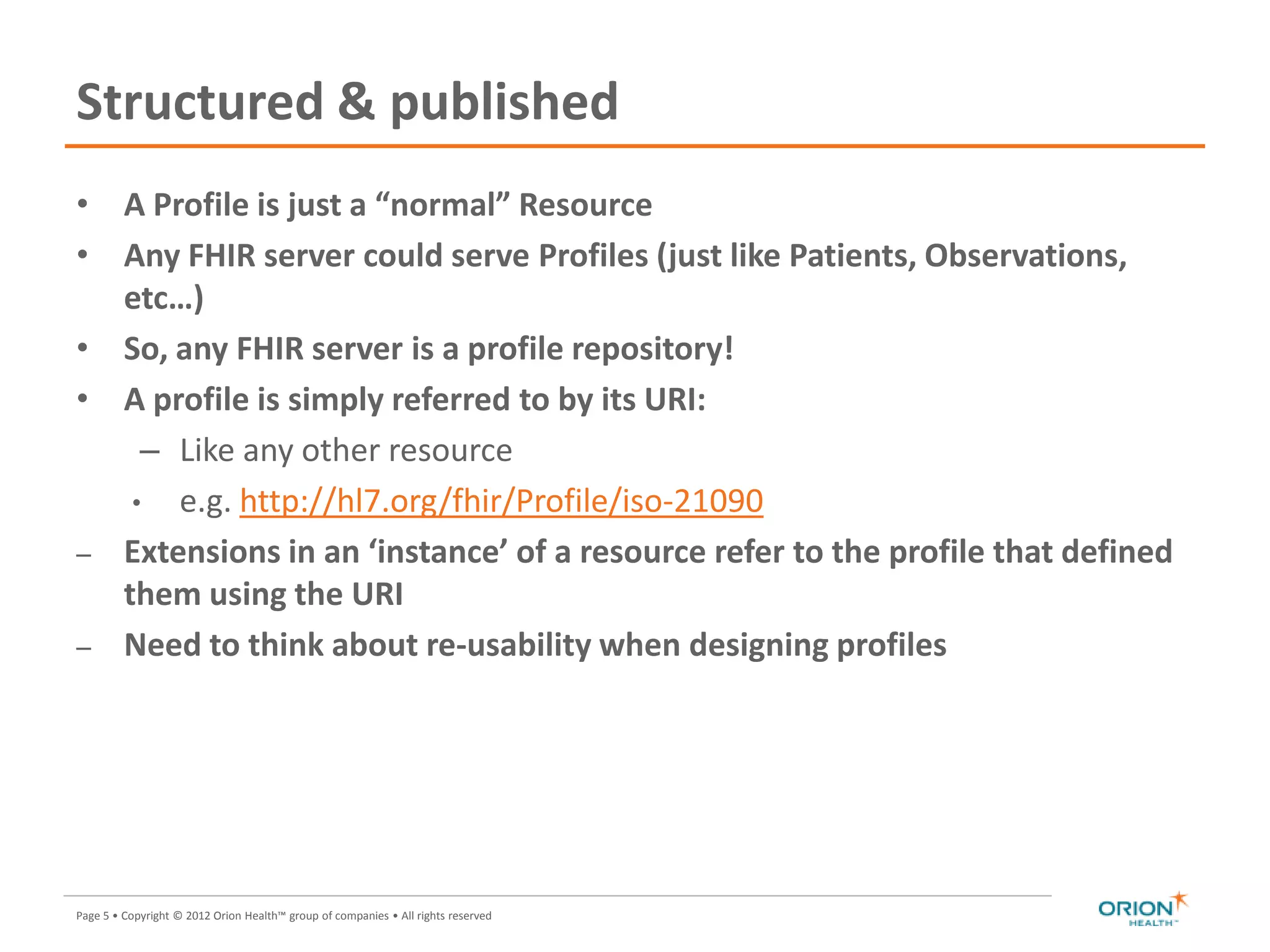
Structured & published
• A Profile is just a “normal” Resource
• Any FHIR server could serve Profiles (just like Patients, Observations,
etc…)
• So, any FHIR server is a profile repository!
• A profile is simply referred to by its URI:
– Like any other resource
• e.g. http://hl7.org/fhir/Profile/iso-21090
– Extensions in an ‘instance’ of a resource refer to the profile that defined
them using the URI
– Need to think about re-usability when designing profiles
5
Page 6 • Copyright © 2012 Orion Health™ group of companies • All rights reserved
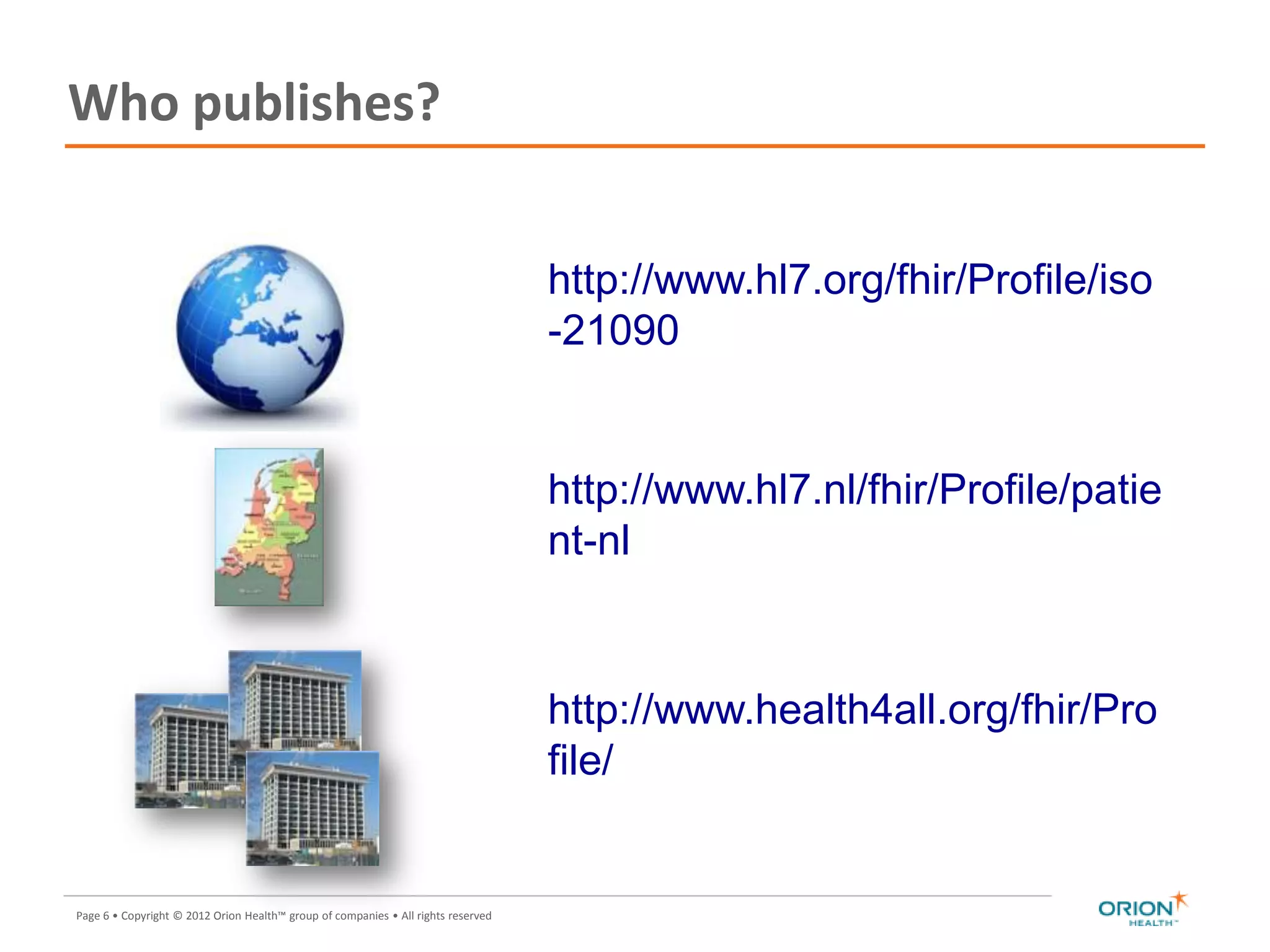
Who publishes?
http://www.hl7.org/fhir/Profile/iso
-21090
http://www.hl7.nl/fhir/Profile/patie
nt-nl
http://www.health4all.org/fhir/Pro
file/
Page 7 • Copyright © 2012 Orion Health™ group of companies • All rights reserved
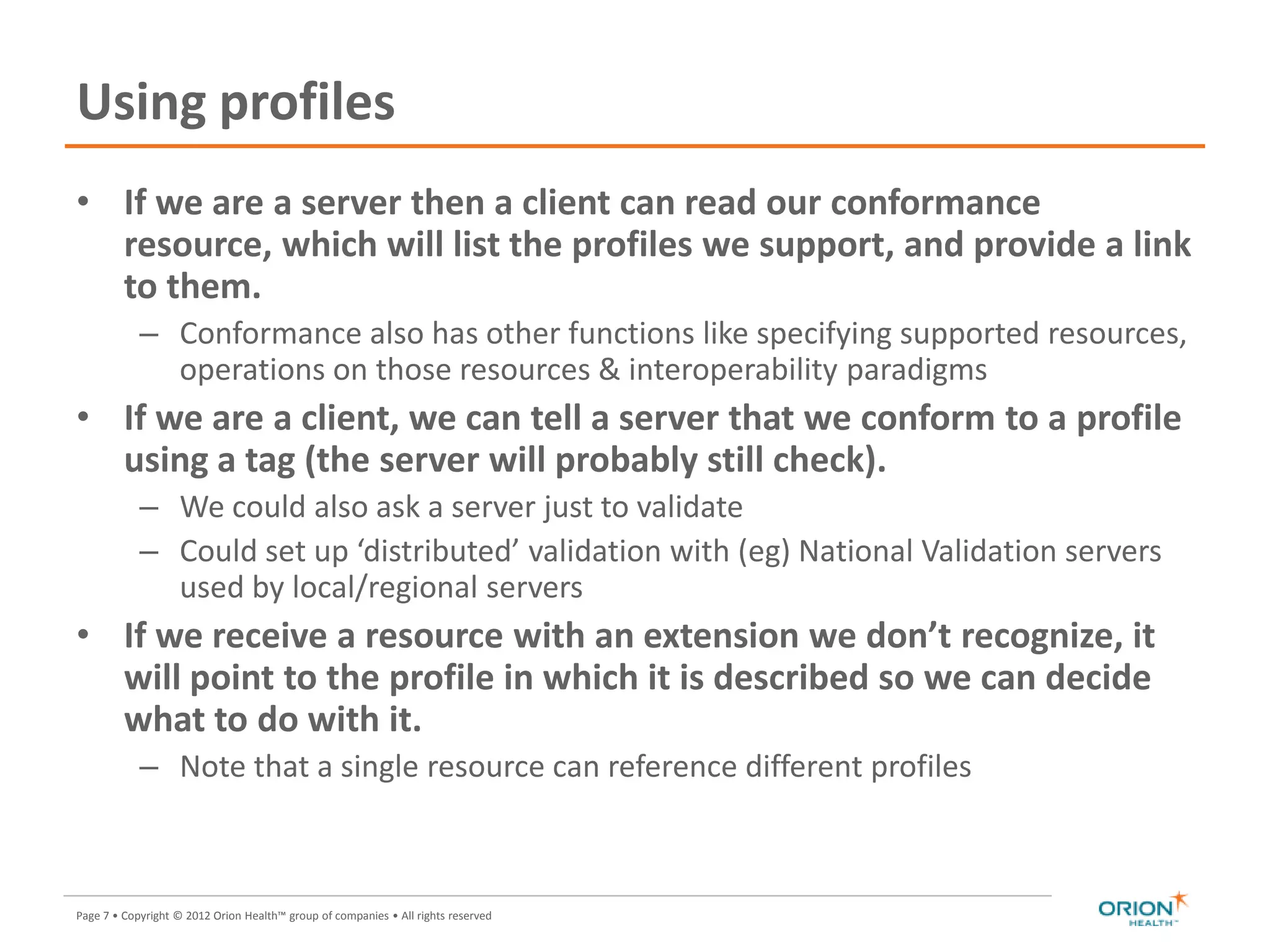
Using profiles
• If we are a server then a client can read our conformance
resource, which will list the profiles we support, and provide a link
to them.
– Conformance also has other functions like specifying supported resources,
operations on those resources & interoperability paradigms
• If we are a client, we can tell a server that we conform to a profile
using a tag (the server will probably still check).
– We could also ask a server just to validate
– Could set up ‘distributed’ validation with (eg) National Validation servers
used by local/regional servers
• If we receive a resource with an extension we don’t recognize, it
will point to the profile in which it is described so we can decide
what to do with it.
– Note that a single resource can reference different profiles
7
Page 8 • Copyright © 2012 Orion Health™ group of companies • All rights reserved
Tags
• Contain metadata about resources
• Used for different purposes:
– Compliance to Profile
– Security – e.g. sensitivity of resource
– Indicate Document/Message
– User defined
• Transported in different ways:
– REST – as an HTTP header
– In a bundle (document, message, transaction) - in the feed.category
element
Page 9 • Copyright © 2012 Orion Health™ group of companies • All rights reserved
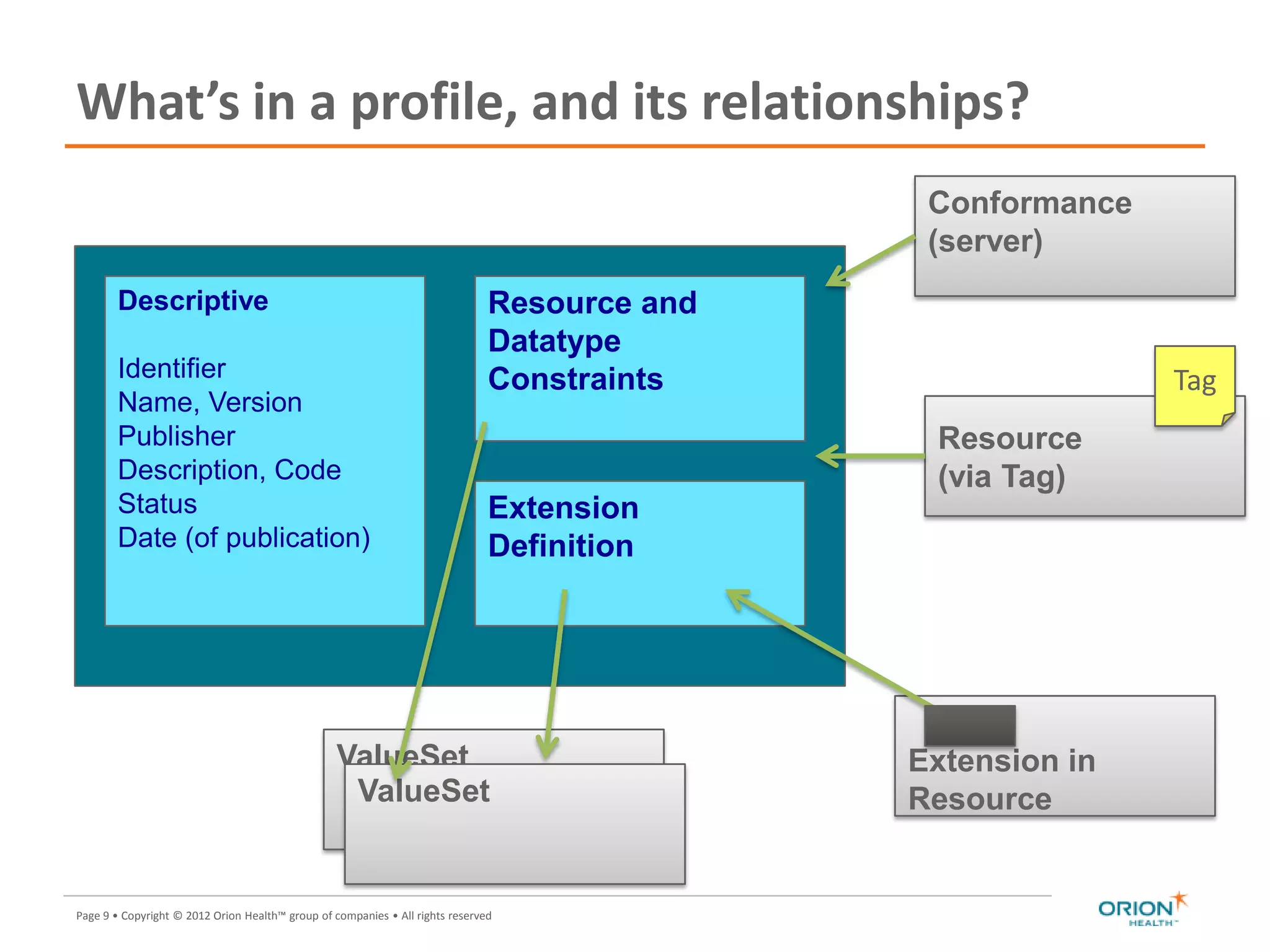
What’s in a profile, and its relationships?
9
Descriptive
Identifier
Name, Version
Publisher
Description, Code
Status
Date (of publication)
Resource and
Datatype
Constraints
Extension
Definition
Conformance
(server)
Resource
(via Tag)
ValueSet
ValueSet
Extension in
Resource
Tag
Page 10 • Copyright © 2012 Orion Health™ group of companies • All rights reserved
Scale / design
• Make a profile with just extensions
• Make a profile with just 1 resource + extensions on that
resource
• Make a profile with all (say national) resources + extensions.
10
Page 11 • Copyright © 2012 Orion Health™ group of companies • All rights reserved
Profile Descriptive information
• To describe the purpose of the Profile
• To help with location
• Details
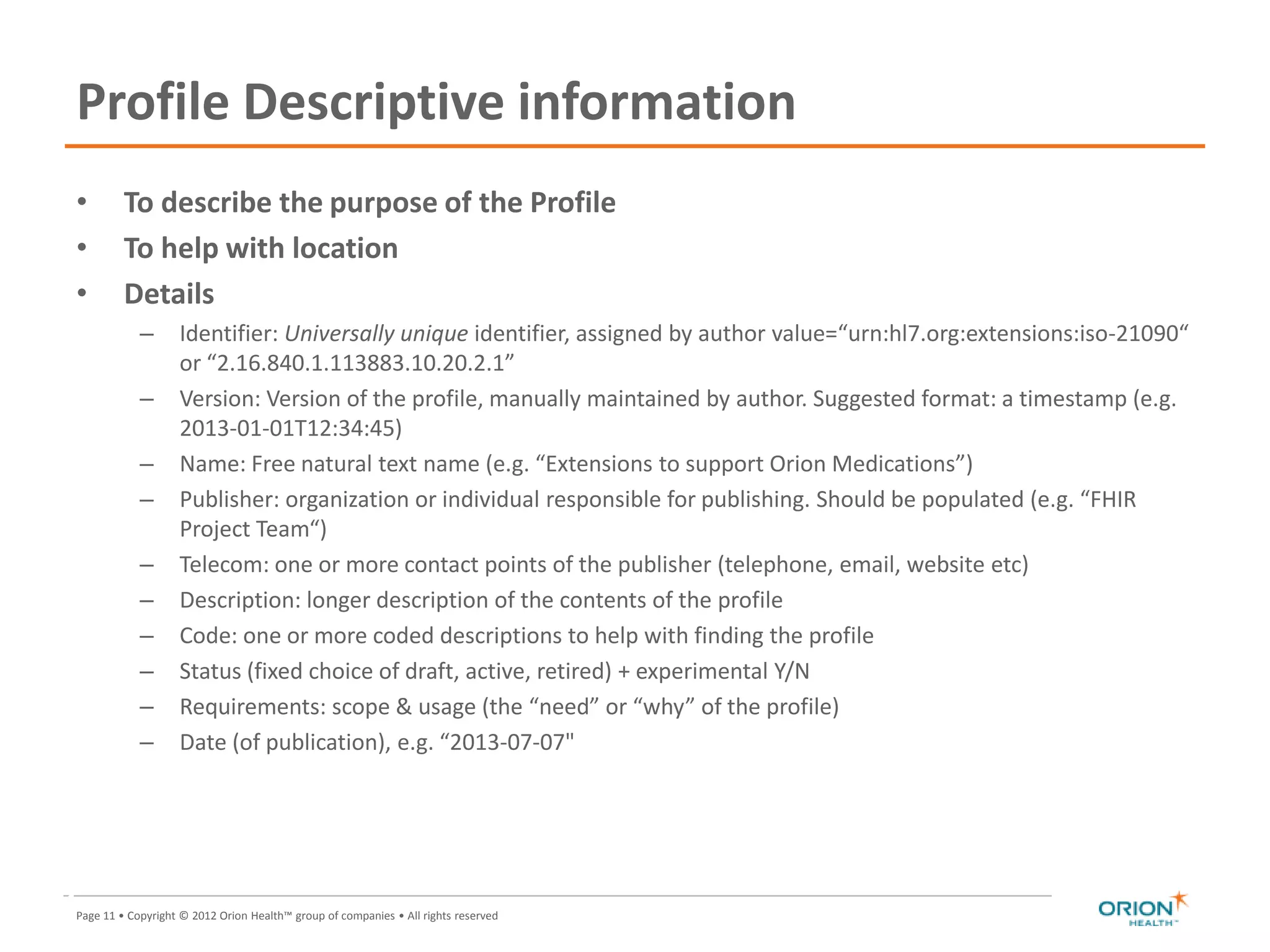
– Identifier: Universally unique identifier, assigned by author value=“urn:hl7.org:extensions:iso-21090“
or “2.16.840.1.113883.10.20.2.1”
– Version: Version of the profile, manually maintained by author. Suggested format: a timestamp (e.g.
2013-01-01T12:34:45)
– Name: Free natural text name (e.g. “Extensions to support Orion Medications”)
– Publisher: organization or individual responsible for publishing. Should be populated (e.g. “FHIR
Project Team“)
– Telecom: one or more contact points of the publisher (telephone, email, website etc)
– Description: longer description of the contents of the profile
– Code: one or more coded descriptions to help with finding the profile
– Status (fixed choice of draft, active, retired) + experimental Y/N
– Requirements: scope & usage (the “need” or “why” of the profile)
– Date (of publication), e.g. “2013-07-07"
11
Page 12 • Copyright © 2012 Orion Health™ group of companies • All rights reserved
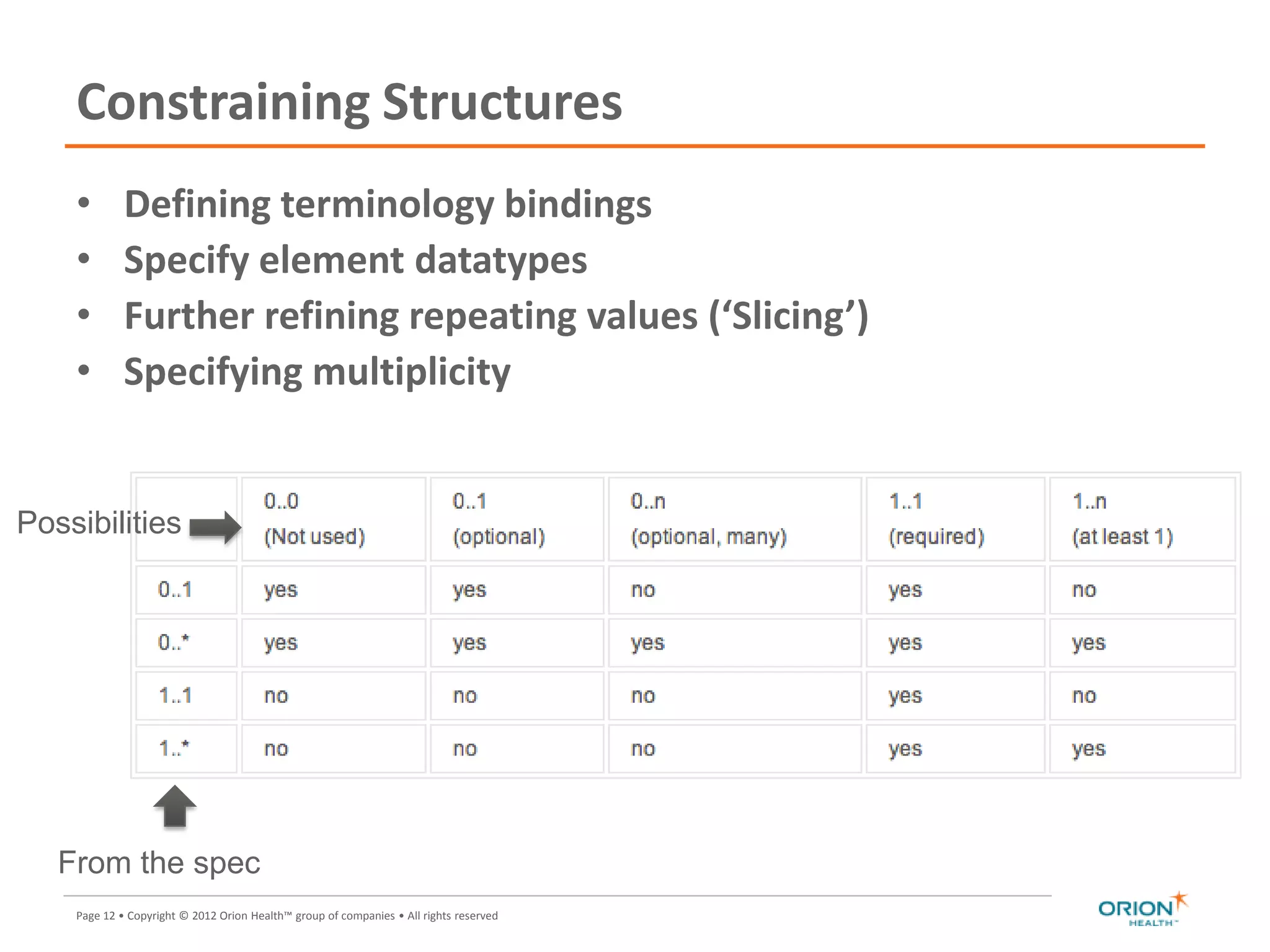
Constraining Structures
• Defining terminology bindings
• Specify element datatypes
• Further refining repeating values (‘Slicing’)
• Specifying multiplicity
From the spec
Possibilities
Page 13 • Copyright © 2012 Orion Health™ group of companies • All rights reserved
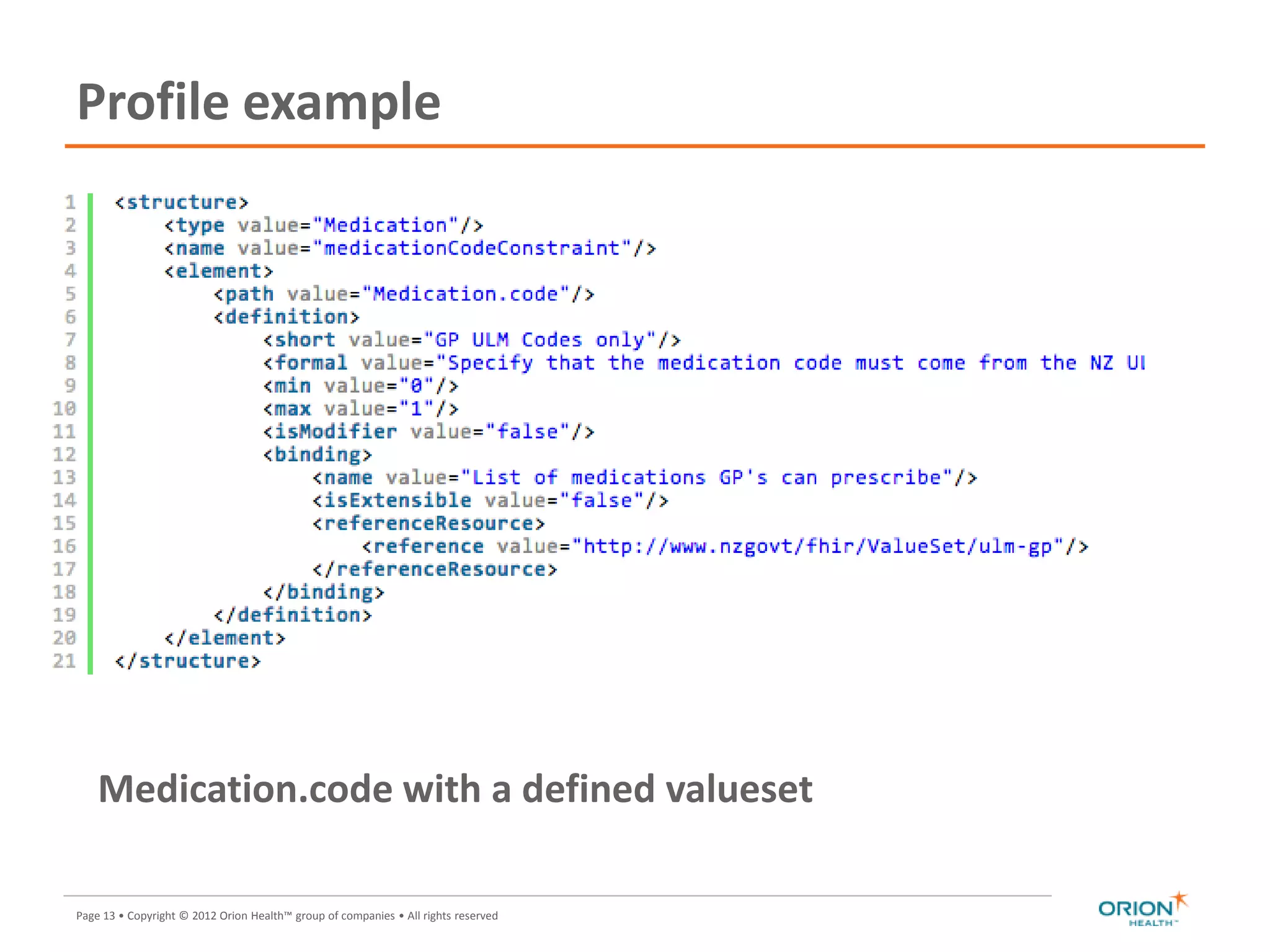
Profile example
Medication.code with a defined valueset
Page 14 • Copyright © 2012 Orion Health™ group of companies • All rights reserved
Profile Example
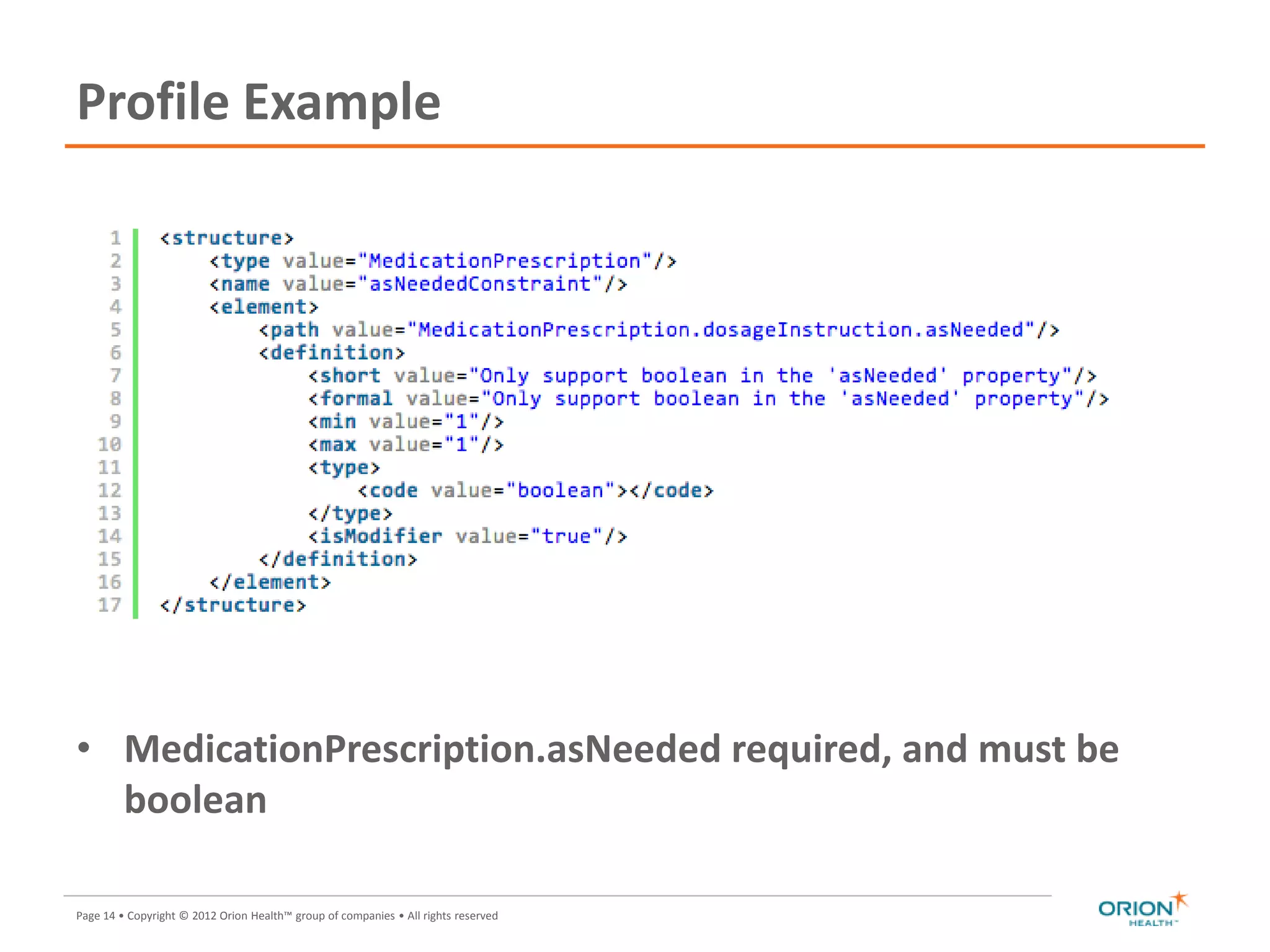
• MedicationPrescription.asNeeded required, and must be
boolean
Page 15 • Copyright © 2012 Orion Health™ group of companies • All rights reserved
Slicing
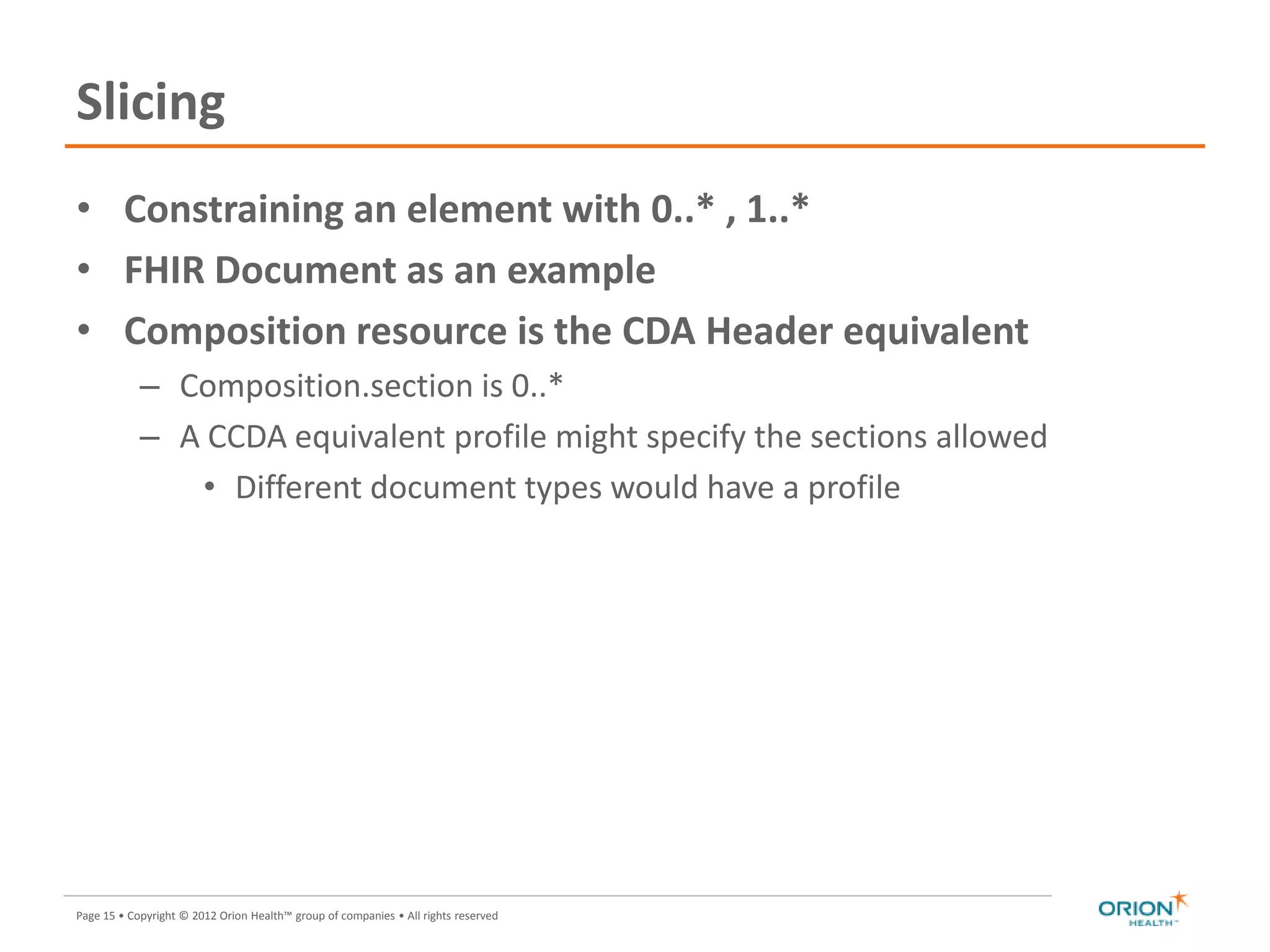
• Constraining an element with 0..* , 1..*
• FHIR Document as an example
• Composition resource is the CDA Header equivalent
– Composition.section is 0..*
– A CCDA equivalent profile might specify the sections allowed
• Different document types would have a profile
Page 16 • Copyright © 2012 Orion Health™ group of companies • All rights reserved
Extensions
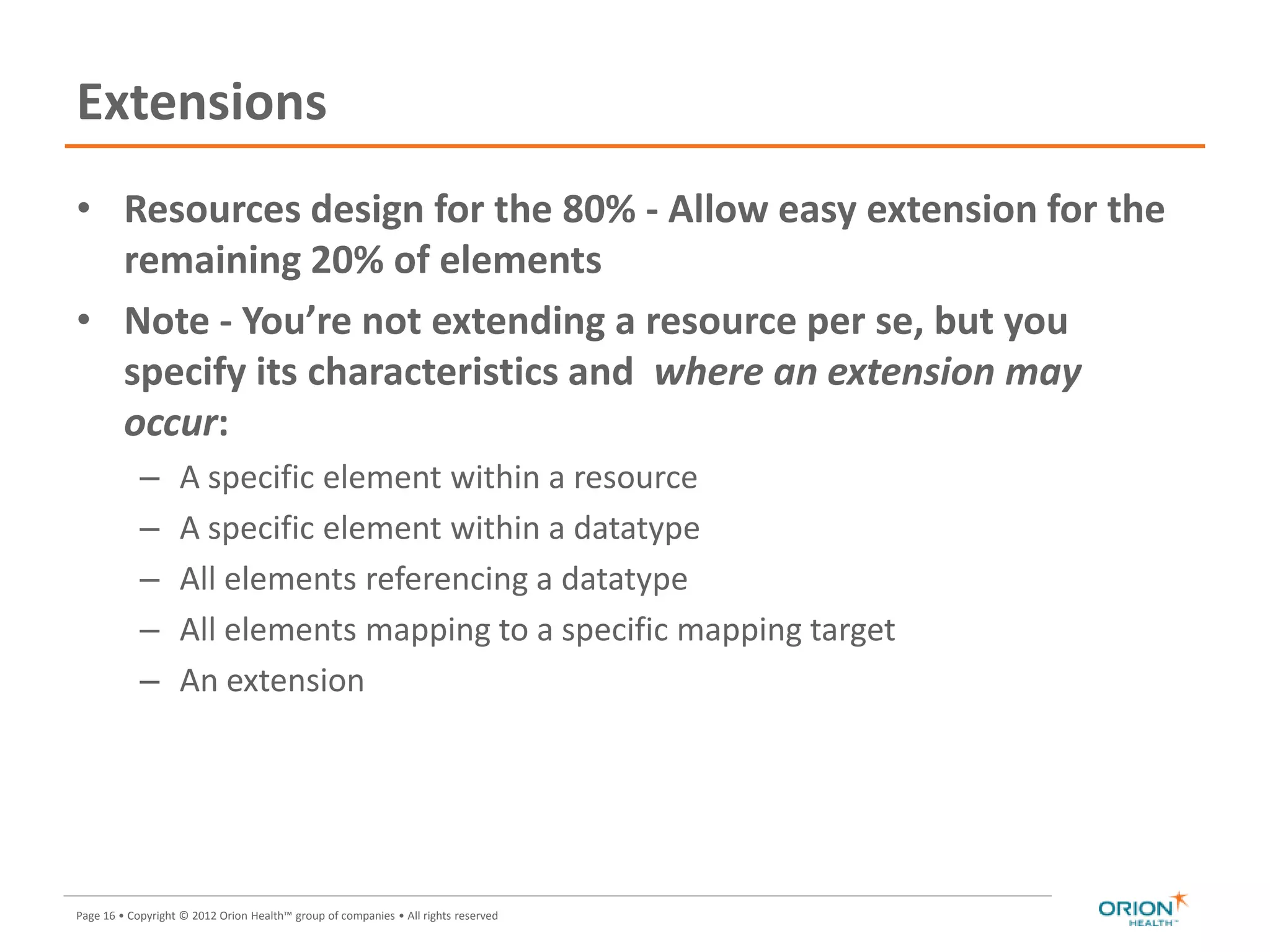
• Resources design for the 80% - Allow easy extension for the
remaining 20% of elements
• Note - You’re not extending a resource per se, but you
specify its characteristics and where an extension may
occur:
– A specific element within a resource
– A specific element within a datatype
– All elements referencing a datatype
– All elements mapping to a specific mapping target
– An extension
Page 17 • Copyright © 2012 Orion Health™ group of companies • All rights reserved
Extension definition
17
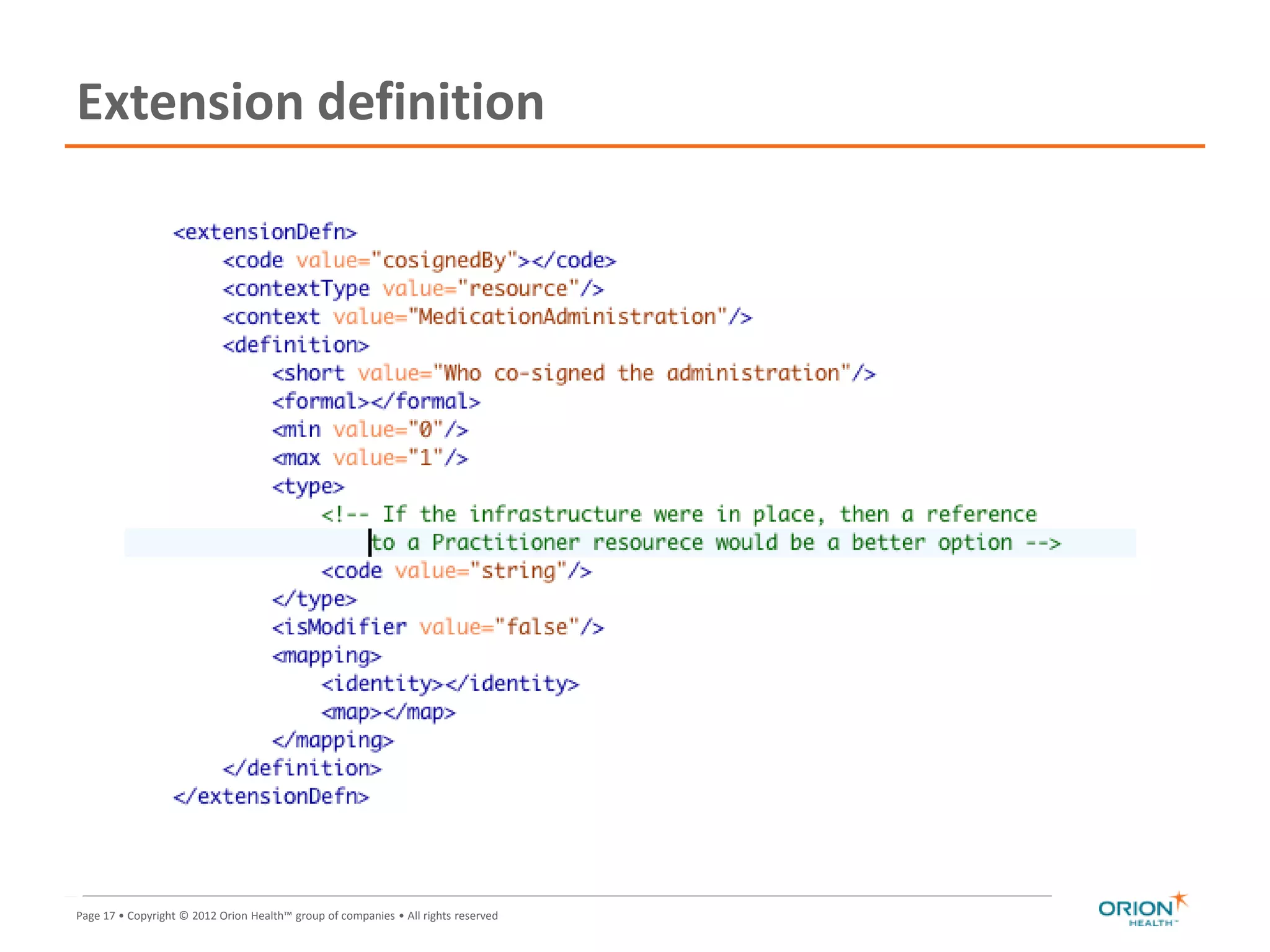
Note: multiple
contexts!
Page 18 • Copyright © 2012 Orion Health™ group of companies • All rights reserved
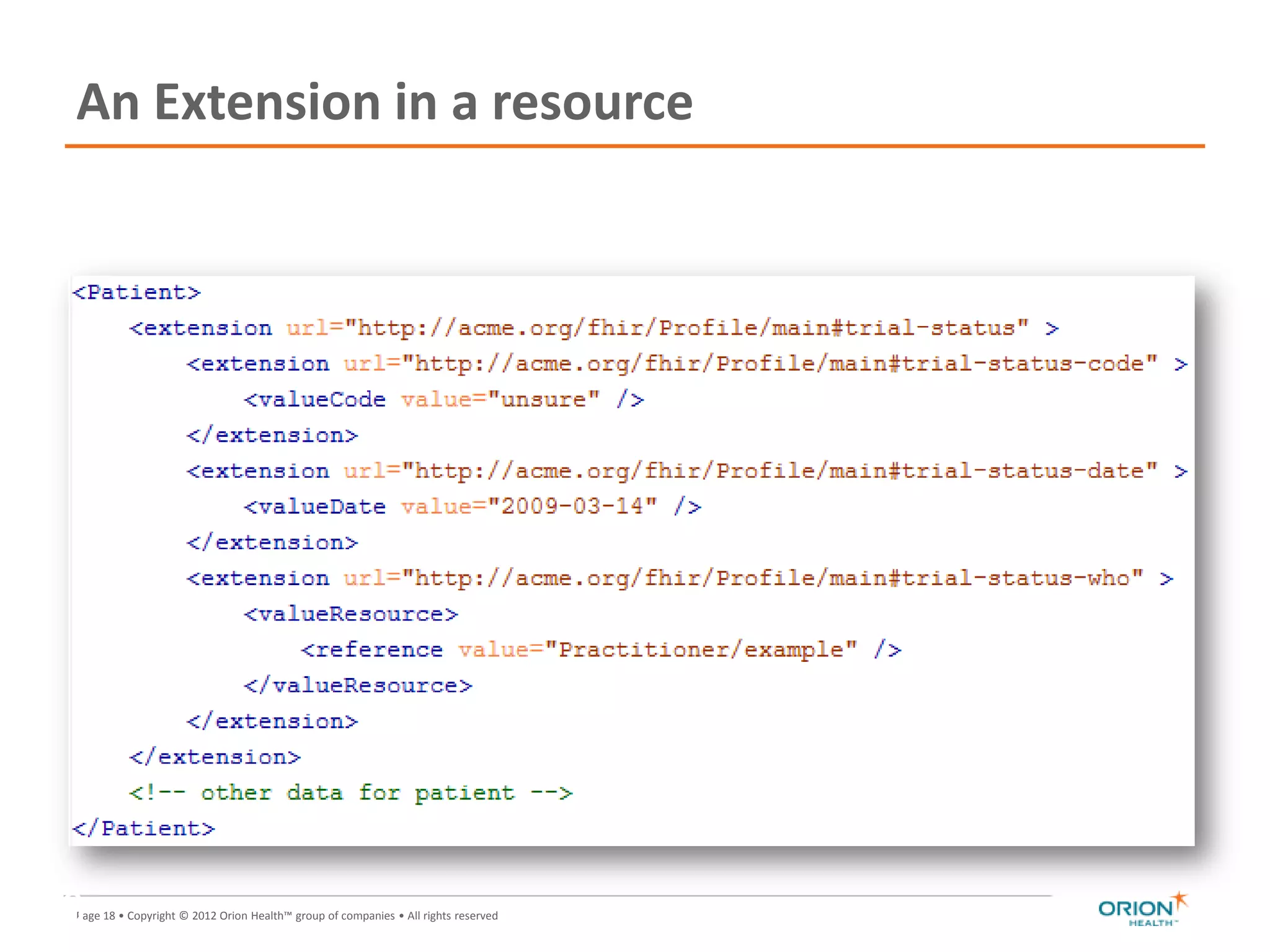
An Extension in a resource
18
Page 19 • Copyright © 2012 Orion Health™ group of companies • All rights reserved
The need for Governance
• Profiles & extensions allow a user to customize their use of
FHIR
• With great power...
Page 20 • Copyright © 2012 Orion Health™ group of companies • All rights reserved
Appendix
Associated Resources
Page 21 • Copyright © 2012 Orion Health™ group of companies • All rights reserved
ValueSets
• A “true” FHIR ValueSet resource (may be version specific)
• A general reference to some web content that defines a set
of codes. (e.g. mime types).
• A textual description of the possible codes
21
Page 22 • Copyright © 2012 Orion Health™ group of companies • All rights reserved
Conformance resource
• Allows a server to indicate:
– Metadata about the server
– The resources they support
– The paradigms they support
• REST, messaging, services
– The queries against those resources
– Specific (custom) queries
– The profiles it supports
• Is a normal resource
– Supports discoverability (think UDDI for SOAP)

FHIR Profiles

  • 1.
    FHIR Profiles, Extensions ValueSets,Conformance & (Manyslidesadaptedfrompresentationby EwoutKramer) DavidHay ProductStrategist FMGco-chair www.fhirblog.com
  • 2.
    Page 2 •Copyright © 2012 Orion Health™ group of companies • All rights reserved The need for Profiles • Many different contexts in healthcare, but a single set of Resources – A desire to keep the resources manageable • Need to be able to: – Describe restrictions based on use and context – Support elements not in the core resource • Allow for these usage statements to: – Authored in a structured manner – Published in a repository – Discoverable at Design and Run-time – Used as the basis for validation, code, report and UI generation. 2
  • 3.
    Page 3 •Copyright © 2012 Orion Health™ group of companies • All rights reserved Profiling a resource. For example... 3 Demand that the identifier uses your national patient identifier Limit names to just 1 (instead of 0..*) Limit maritalStatus to another set of codes that extends the one from HL7 international Add an extension to support “RaceCode” Note: hardly any mandatory elements in the
  • 4.
    Page 4 •Copyright © 2012 Orion Health™ group of companies • All rights reserved Capabilities of Profiles • Descriptive – Information about the Profile (what, why, who) • Extending a resource – Adding new properties – Same capabilities as existing ones • Constraining a resource – Specifying datatypes for an element – Modifying datatypes (eg translations) – Defining terminology bindings – Specifying multiplicity (eg make an element required) – Further refining repeating values (‘Slicing’) • Example of Composition.section (Document) – Cannot specify default values for resource instances • Everything explicit in an instance
  • 5.
    Page 5 •Copyright © 2012 Orion Health™ group of companies • All rights reserved Structured & published • A Profile is just a “normal” Resource • Any FHIR server could serve Profiles (just like Patients, Observations, etc…) • So, any FHIR server is a profile repository! • A profile is simply referred to by its URI: – Like any other resource • e.g. http://hl7.org/fhir/Profile/iso-21090 – Extensions in an ‘instance’ of a resource refer to the profile that defined them using the URI – Need to think about re-usability when designing profiles 5
  • 6.
    Page 6 •Copyright © 2012 Orion Health™ group of companies • All rights reserved Who publishes? http://www.hl7.org/fhir/Profile/iso -21090 http://www.hl7.nl/fhir/Profile/patie nt-nl http://www.health4all.org/fhir/Pro file/
  • 7.
    Page 7 •Copyright © 2012 Orion Health™ group of companies • All rights reserved Using profiles • If we are a server then a client can read our conformance resource, which will list the profiles we support, and provide a link to them. – Conformance also has other functions like specifying supported resources, operations on those resources & interoperability paradigms • If we are a client, we can tell a server that we conform to a profile using a tag (the server will probably still check). – We could also ask a server just to validate – Could set up ‘distributed’ validation with (eg) National Validation servers used by local/regional servers • If we receive a resource with an extension we don’t recognize, it will point to the profile in which it is described so we can decide what to do with it. – Note that a single resource can reference different profiles 7
  • 8.
    Page 8 •Copyright © 2012 Orion Health™ group of companies • All rights reserved Tags • Contain metadata about resources • Used for different purposes: – Compliance to Profile – Security – e.g. sensitivity of resource – Indicate Document/Message – User defined • Transported in different ways: – REST – as an HTTP header – In a bundle (document, message, transaction) - in the feed.category element
  • 9.
    Page 9 •Copyright © 2012 Orion Health™ group of companies • All rights reserved What’s in a profile, and its relationships? 9 Descriptive Identifier Name, Version Publisher Description, Code Status Date (of publication) Resource and Datatype Constraints Extension Definition Conformance (server) Resource (via Tag) ValueSet ValueSet Extension in Resource Tag
  • 10.
    Page 10 •Copyright © 2012 Orion Health™ group of companies • All rights reserved Scale / design • Make a profile with just extensions • Make a profile with just 1 resource + extensions on that resource • Make a profile with all (say national) resources + extensions. 10
  • 11.
    Page 11 •Copyright © 2012 Orion Health™ group of companies • All rights reserved Profile Descriptive information • To describe the purpose of the Profile • To help with location • Details – Identifier: Universally unique identifier, assigned by author value=“urn:hl7.org:extensions:iso-21090“ or “2.16.840.1.113883.10.20.2.1” – Version: Version of the profile, manually maintained by author. Suggested format: a timestamp (e.g. 2013-01-01T12:34:45) – Name: Free natural text name (e.g. “Extensions to support Orion Medications”) – Publisher: organization or individual responsible for publishing. Should be populated (e.g. “FHIR Project Team“) – Telecom: one or more contact points of the publisher (telephone, email, website etc) – Description: longer description of the contents of the profile – Code: one or more coded descriptions to help with finding the profile – Status (fixed choice of draft, active, retired) + experimental Y/N – Requirements: scope & usage (the “need” or “why” of the profile) – Date (of publication), e.g. “2013-07-07" 11
  • 12.
    Page 12 •Copyright © 2012 Orion Health™ group of companies • All rights reserved Constraining Structures • Defining terminology bindings • Specify element datatypes • Further refining repeating values (‘Slicing’) • Specifying multiplicity From the spec Possibilities
  • 13.
    Page 13 •Copyright © 2012 Orion Health™ group of companies • All rights reserved Profile example Medication.code with a defined valueset
  • 14.
    Page 14 •Copyright © 2012 Orion Health™ group of companies • All rights reserved Profile Example • MedicationPrescription.asNeeded required, and must be boolean
  • 15.
    Page 15 •Copyright © 2012 Orion Health™ group of companies • All rights reserved Slicing • Constraining an element with 0..* , 1..* • FHIR Document as an example • Composition resource is the CDA Header equivalent – Composition.section is 0..* – A CCDA equivalent profile might specify the sections allowed • Different document types would have a profile
  • 16.
    Page 16 •Copyright © 2012 Orion Health™ group of companies • All rights reserved Extensions • Resources design for the 80% - Allow easy extension for the remaining 20% of elements • Note - You’re not extending a resource per se, but you specify its characteristics and where an extension may occur: – A specific element within a resource – A specific element within a datatype – All elements referencing a datatype – All elements mapping to a specific mapping target – An extension
  • 17.
    Page 17 •Copyright © 2012 Orion Health™ group of companies • All rights reserved Extension definition 17 Note: multiple contexts!
  • 18.
    Page 18 •Copyright © 2012 Orion Health™ group of companies • All rights reserved An Extension in a resource 18
  • 19.
    Page 19 •Copyright © 2012 Orion Health™ group of companies • All rights reserved The need for Governance • Profiles & extensions allow a user to customize their use of FHIR • With great power...
  • 20.
    Page 20 •Copyright © 2012 Orion Health™ group of companies • All rights reserved Appendix Associated Resources
  • 21.
    Page 21 •Copyright © 2012 Orion Health™ group of companies • All rights reserved ValueSets • A “true” FHIR ValueSet resource (may be version specific) • A general reference to some web content that defines a set of codes. (e.g. mime types). • A textual description of the possible codes 21
  • 22.
    Page 22 •Copyright © 2012 Orion Health™ group of companies • All rights reserved Conformance resource • Allows a server to indicate: – Metadata about the server – The resources they support – The paradigms they support • REST, messaging, services – The queries against those resources – Specific (custom) queries – The profiles it supports • Is a normal resource – Supports discoverability (think UDDI for SOAP)

Editor's Notes

  • #7 “Drive-by” or “bottom-up” operability: “Communicate first, standardize later”First, business partners. Then, collaborations, communities. Maybe, finally,nation-wideIt’s a naturalprocessthatpeoplewill want to make itwork first, thenonlycoordinatewhattheyreallyneedto, andthenrealizetheycanbroadentheir approach to a community.“Support”, of course top-down shouldstillbepossible! Maybe even a combi in the long-term