Semantics and Syntax of Dublin Core
Usage in Open Archives Initiative Data
Providers of Cultural Heritage Materials

Arwen Hutt, University of Tennessee
Jenn Riley, Indiana University
OAI-PMH

 Open Archives Initiative Protocol for Metadata Har
 Originally developed for sharing metadata

about e-prints
 Two players



Data providers
Service providers

 Requires unqualified Dublin Core be exposed

for all resources, but supplemental metadata
formats are allowed
Dublin Core [Unqualified]
 Simple, flexible metadata format
 15 elements



All repeatable
None required

 “Core” across all knowledge domains
“Cultural heritage” defined
 The intellectual creative and material output

of society
 Libraries, museums and archives generally
considered cultural heritage institutions
 Often primary source materials
 Tend to be older analog digitized for network
access
Significant variability in OAI metadata
 Ward: found that only a small number of DC

elements were used in the majority of OAI
records
 Liu: Arc service provider studied controlled
vocabulary usage in DC subject, type, format,
language, and date fields
 NSDL: found errors missing data, incorrect
data, confusing data, insufficient data
 UIUC: date, coverage, format, and type
vocabulary varies significantly
Goals of the study
 Focus on cultural heritage community
 Examined 3 DC fields: date, creator,

contributor



Semantic content
Syntactic form

 Results could inform community best

practices
 One step towards improving the overall
quality of OAI metadata
Harvesting statistics
 Successfully harvested metadata from 35

data providers
 750,945 total records harvested
 5% sample* from each data provider taken
for analysis (37,564 records)

* Minimum of 1 record per provider, values rounded up to the nearest whole number
Processing steps
 Date, creator, contributor elements extracted

into “silos”
 Repeated values grouped, keeping
connections between elements and the
records in which they appeared
 Certain characteristics tracked about each
element
 Example
Characteristics recorded for all
elements
 The presence of multiple discrete values in a

single element
<creator>Hutt, Arwen; Riley, Jenn</creator>

 The presence of pseudo-qualifiers within the

value that refined the meaning of the element
<creator>Berlin, Irving
[composer]</creator>

 Whether the value was appropriate within the

specified element based on DC rules and
usage guidelines
<date>Las Vegas, Nevada</date>
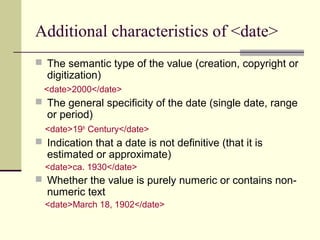
Additional characteristics of <date>
 The semantic type of the value (creation, copyright or

digitization)

<date>2000</date>

 The general specificity of the date (single date, range

or period)

<date>19th Century</date>

 Indication that a date is not definitive (that it is

estimated or approximate)

<date>ca. 1930</date>

 Whether the value is purely numeric or contains non-

numeric text

<date>March 18, 1902</date>
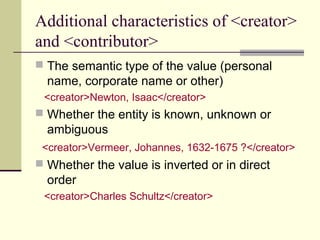
Additional characteristics of <creator>
and <contributor>
 The semantic type of the value (personal

name, corporate name or other)
<creator>Newton, Isaac</creator>

 Whether the entity is known, unknown or

ambiguous
<creator>Vermeer, Johannes, 1632-1675 ?</creator>

 Whether the value is inverted or in direct

order
<creator>Charles Schultz</creator>
Strategies for categorization
 Automatic

Iteratively developed
 Pattern matching
 Identification of commonly occurring values


 Manual


Where feasible

 Not perfect!
Findings for <date>
 Values largely appropriate for element
 Few “pseudo-qualifiers”
 Different events represented
 Values mostly numeric
 Many dates not expressible in W3CDTF
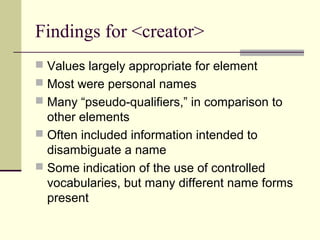
Findings for <creator>
 Values largely appropriate for element
 Most were personal names
 Many “pseudo-qualifiers,” in comparison to

other elements
 Often included information intended to
disambiguate a name
 Some indication of the use of controlled
vocabularies, but many different name forms
present
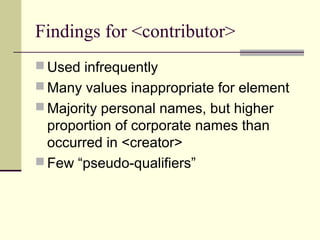
Findings for <contributor>
 Used infrequently
 Many values inappropriate for element
 Majority personal names, but higher

proportion of corporate names than
occurred in <creator>
 Few “pseudo-qualifiers”
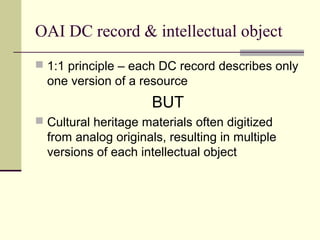
OAI DC record & intellectual object
 1:1 principle – each DC record describes only

one version of a resource

BUT
 Cultural heritage materials often digitized

from analog originals, resulting in multiple
versions of each intellectual object
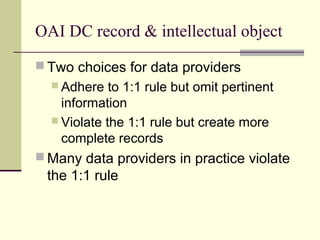
OAI DC record & intellectual object
 Two choices for data providers
 Adhere

to 1:1 rule but omit pertinent
information
 Violate the 1:1 rule but create more
complete records
 Many data providers in practice violate

the 1:1 rule
OAI DC record & aggregated search
environment
 Extraction of records from original

collection context
 Aggregation with records from other
collections
Moving towards better metadata –
some possibilities
 Remove the OAI requirement for simple

Dublin Core (or “the Nuclear Option”)
 Develop best practice documentation for
cultural heritage materials that deviate from
current DC best practice
 Combination of data provider education and
service provider normalization
 Improved communication between data and
service providers
 Encourage use of other metadata formats
supplementing simple DC
Some other relevant initiatives
 Digital Library Federation and NSDL OAI and

Shareable Metadata Best Practices Working
Group

Development of general OAI best practices
 Development of strategies for communication
with vendors


 DLF Aquifer Metadata Working Group
 Development of profile for DLF institutions
(strong focus on cultural heritage)
 Recommendations for specific metadata
elements
Plans for extension of this research
 Primary analysis of the subject, coverage and

publisher elements
 Analyze temporal information across date,
subject and coverage elements
 Analyze geographic information across
subject and coverage elements
 Analyze name information across creator,
contributor and publisher elements
These presentation slides:
http://www.dlib.indiana.edu/~jenlrile/presentations/jcdl2005/jcdl2005.ppt

Arwen Hutt
Metadata Librarian
University of Tennessee
Digital Library Center

Jenn Riley
Metadata Librarian
Indiana University Digital
Library Program

ahutt@utk.edu

jenlrile@indiana.edu

Semantics and Syntax of Dublin Core Usage in Open Archives Initiative Data Providers of Cultural Heritage Materials

  • 1.
    Semantics and Syntaxof Dublin Core Usage in Open Archives Initiative Data Providers of Cultural Heritage Materials Arwen Hutt, University of Tennessee Jenn Riley, Indiana University
  • 2.
    OAI-PMH  Open ArchivesInitiative Protocol for Metadata Har  Originally developed for sharing metadata about e-prints  Two players   Data providers Service providers  Requires unqualified Dublin Core be exposed for all resources, but supplemental metadata formats are allowed
  • 3.
    Dublin Core [Unqualified] Simple, flexible metadata format  15 elements   All repeatable None required  “Core” across all knowledge domains
  • 4.
    “Cultural heritage” defined The intellectual creative and material output of society  Libraries, museums and archives generally considered cultural heritage institutions  Often primary source materials  Tend to be older analog digitized for network access
  • 5.
    Significant variability inOAI metadata  Ward: found that only a small number of DC elements were used in the majority of OAI records  Liu: Arc service provider studied controlled vocabulary usage in DC subject, type, format, language, and date fields  NSDL: found errors missing data, incorrect data, confusing data, insufficient data  UIUC: date, coverage, format, and type vocabulary varies significantly
  • 6.
    Goals of thestudy  Focus on cultural heritage community  Examined 3 DC fields: date, creator, contributor   Semantic content Syntactic form  Results could inform community best practices  One step towards improving the overall quality of OAI metadata
  • 7.
    Harvesting statistics  Successfullyharvested metadata from 35 data providers  750,945 total records harvested  5% sample* from each data provider taken for analysis (37,564 records) * Minimum of 1 record per provider, values rounded up to the nearest whole number
  • 8.
    Processing steps  Date,creator, contributor elements extracted into “silos”  Repeated values grouped, keeping connections between elements and the records in which they appeared  Certain characteristics tracked about each element  Example
  • 9.
    Characteristics recorded forall elements  The presence of multiple discrete values in a single element <creator>Hutt, Arwen; Riley, Jenn</creator>  The presence of pseudo-qualifiers within the value that refined the meaning of the element <creator>Berlin, Irving [composer]</creator>  Whether the value was appropriate within the specified element based on DC rules and usage guidelines <date>Las Vegas, Nevada</date>
  • 10.
    Additional characteristics of<date>  The semantic type of the value (creation, copyright or digitization) <date>2000</date>  The general specificity of the date (single date, range or period) <date>19th Century</date>  Indication that a date is not definitive (that it is estimated or approximate) <date>ca. 1930</date>  Whether the value is purely numeric or contains non- numeric text <date>March 18, 1902</date>
  • 11.
    Additional characteristics of<creator> and <contributor>  The semantic type of the value (personal name, corporate name or other) <creator>Newton, Isaac</creator>  Whether the entity is known, unknown or ambiguous <creator>Vermeer, Johannes, 1632-1675 ?</creator>  Whether the value is inverted or in direct order <creator>Charles Schultz</creator>
  • 12.
    Strategies for categorization Automatic Iteratively developed  Pattern matching  Identification of commonly occurring values   Manual  Where feasible  Not perfect!
  • 13.
    Findings for <date> Values largely appropriate for element  Few “pseudo-qualifiers”  Different events represented  Values mostly numeric  Many dates not expressible in W3CDTF
  • 14.
    Findings for <creator> Values largely appropriate for element  Most were personal names  Many “pseudo-qualifiers,” in comparison to other elements  Often included information intended to disambiguate a name  Some indication of the use of controlled vocabularies, but many different name forms present
  • 15.
    Findings for <contributor> Used infrequently  Many values inappropriate for element  Majority personal names, but higher proportion of corporate names than occurred in <creator>  Few “pseudo-qualifiers”
  • 16.
    OAI DC record& intellectual object  1:1 principle – each DC record describes only one version of a resource BUT  Cultural heritage materials often digitized from analog originals, resulting in multiple versions of each intellectual object
  • 17.
    OAI DC record& intellectual object  Two choices for data providers  Adhere to 1:1 rule but omit pertinent information  Violate the 1:1 rule but create more complete records  Many data providers in practice violate the 1:1 rule
  • 18.
    OAI DC record& aggregated search environment  Extraction of records from original collection context  Aggregation with records from other collections
  • 19.
    Moving towards bettermetadata – some possibilities  Remove the OAI requirement for simple Dublin Core (or “the Nuclear Option”)  Develop best practice documentation for cultural heritage materials that deviate from current DC best practice  Combination of data provider education and service provider normalization  Improved communication between data and service providers  Encourage use of other metadata formats supplementing simple DC
  • 20.
    Some other relevantinitiatives  Digital Library Federation and NSDL OAI and Shareable Metadata Best Practices Working Group Development of general OAI best practices  Development of strategies for communication with vendors   DLF Aquifer Metadata Working Group  Development of profile for DLF institutions (strong focus on cultural heritage)  Recommendations for specific metadata elements
  • 21.
    Plans for extensionof this research  Primary analysis of the subject, coverage and publisher elements  Analyze temporal information across date, subject and coverage elements  Analyze geographic information across subject and coverage elements  Analyze name information across creator, contributor and publisher elements
  • 22.
    These presentation slides: http://www.dlib.indiana.edu/~jenlrile/presentations/jcdl2005/jcdl2005.ppt ArwenHutt Metadata Librarian University of Tennessee Digital Library Center Jenn Riley Metadata Librarian Indiana University Digital Library Program ahutt@utk.edu jenlrile@indiana.edu

Editor's Notes

  • #3 Our study was performed on metadata shared by OAI-PMH. OAI is protocol for sharing metadata, not content. Data providers “expose” metadata for service providers to come get. Service providers make use of that metadata in some way. Currently, by far the most common service provided is cross-repository searching. Our study focused on data providers of cultural heritage materials.
  • #4 Explain the difference b/n qualified and simple dc Example of 1:1 principle – mona lisa painting, leonardo painted many years ago– digital image created by jenn riley 2000
  • #6 All the research in this area talks about the variability problem Quickly!
  • #7 What we work with Better chance of finding patterns within a general community Semantic content – the meaning of the content of a metadata element Syntactic form – the structure or format of the value
  • #9 Processing performed with perl and xslt scripts Show sample Grouping Link back to original record Attributes – some attributes are used all silos but there are some that are specific to the different elements [We picked characteristics to record based on our experience as OAI data providers and on reports in the OAI literature]
  • #11 Date specificity – ming dynasty, 1980’s, 1900-1910, etc.
  • #13 Perl scripts Not perfect Too many records to manually check each one Certain characteristics require subjective judgements
  • #14 Digitization and creation most prevalent, but a few copyright also. 3 to 1 numeric to textual W3CDTF – profile of ISO 8601 recommended by Dublin Core as a best practice for date encoding but 17% of dates cannot be represented by it. we’re seeing a need for better support for variations on date values
  • #19 Extraction – on the horse example, Roosevelt Aggregation – Administrative metadata is rarely useful in an aggregated environment. - System hacks like to make all years of a date range searchable typing in every year in the range.