DYNAMIC SYCHRONOUS TRANSFER MODE
PRESENTED BY
 GOVIND BIYANI(125328)
 MANOJIT LAHA(125316)
 RAJ KUMAR SETH(125331)
 AYAN GUCHHAIT(125301)
CONTENTS
 INTRODUCTION
 DEFINITION
 BASICS OF DTM
 PRINCIPLES OF DTM
 ADVANTAGES
 APPLICATION
 CONCLUSION
INTRODUCTION
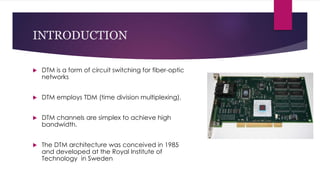
 DTM is a form of circuit switching for fiber-optic
networks
 DTM employs TDM (time division multiplexing).
 DTM channels are simplex to achieve high
bandwidth.
 The DTM architecture was conceived in 1985
and developed at the Royal Institute of
Technology in Sweden
WHAT IS DTM ?
 DTM is a broadband network
architecture .
 DTM is based on circuit switching
augmented with dynamic
reallocation of time slots.
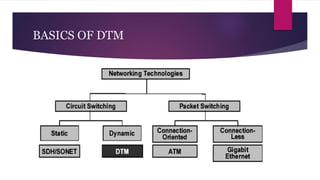
BASICS OF DTM
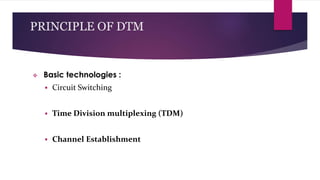
PRINCIPLE OF DTM
 Basic technologies :
 Circuit Switching
 Time Division multiplexing (TDM)
 Channel Establishment
CIRCUIT SWITCHING
 Network resources are reserved all the
way from sender to receiver before the
start of the transfer
 Control signalling and payload data
transfers are separated
 Traditional voice telephone service is an
example of circuit switching.
TIME DIVISION MULTIPLEXING
 Signals are operate in same
frequency in different time slot.
 It’s a base band transmission.
 In synchronous TDM time slot are pre
assigned.
DTM multiplexing format
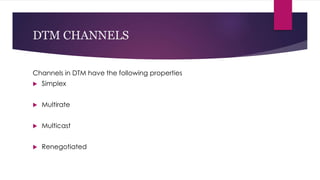
DTM CHANNELS
Channels in DTM have the following properties
 Simplex
 Multirate
 Multicast
 Renegotiated
ADVANTAGE
 Increases the use of fiber's transmission
capacity.
 Provides support for real-time broadband
traffic & multicasting.
 Dynamically allocates the distribution of
resources to the network nodes
APPLICATION
 Real-time traffic & multicasting
required in videos
 Transmission of integrated data,
both audio & video.
 Enterprise Access and Private
Data Networking
CONCLUSION
 DTM aims to reduce network complexity
 DTM provides full access to available bandwidth.
 DTM provides a guaranteed quality of service (QoS) for streaming
video services.
DTM

DTM

  • 1.
    DYNAMIC SYCHRONOUS TRANSFERMODE PRESENTED BY  GOVIND BIYANI(125328)  MANOJIT LAHA(125316)  RAJ KUMAR SETH(125331)  AYAN GUCHHAIT(125301)
  • 2.
    CONTENTS  INTRODUCTION  DEFINITION BASICS OF DTM  PRINCIPLES OF DTM  ADVANTAGES  APPLICATION  CONCLUSION
  • 3.
    INTRODUCTION  DTM isa form of circuit switching for fiber-optic networks  DTM employs TDM (time division multiplexing).  DTM channels are simplex to achieve high bandwidth.  The DTM architecture was conceived in 1985 and developed at the Royal Institute of Technology in Sweden
  • 4.
    WHAT IS DTM?  DTM is a broadband network architecture .  DTM is based on circuit switching augmented with dynamic reallocation of time slots.
  • 5.
  • 6.
    PRINCIPLE OF DTM Basic technologies :  Circuit Switching  Time Division multiplexing (TDM)  Channel Establishment
  • 7.
    CIRCUIT SWITCHING  Networkresources are reserved all the way from sender to receiver before the start of the transfer  Control signalling and payload data transfers are separated  Traditional voice telephone service is an example of circuit switching.
  • 8.
    TIME DIVISION MULTIPLEXING Signals are operate in same frequency in different time slot.  It’s a base band transmission.  In synchronous TDM time slot are pre assigned.
  • 9.
  • 10.
    DTM CHANNELS Channels inDTM have the following properties  Simplex  Multirate  Multicast  Renegotiated
  • 11.
    ADVANTAGE  Increases theuse of fiber's transmission capacity.  Provides support for real-time broadband traffic & multicasting.  Dynamically allocates the distribution of resources to the network nodes
  • 12.
    APPLICATION  Real-time traffic& multicasting required in videos  Transmission of integrated data, both audio & video.  Enterprise Access and Private Data Networking
  • 13.
    CONCLUSION  DTM aimsto reduce network complexity  DTM provides full access to available bandwidth.  DTM provides a guaranteed quality of service (QoS) for streaming video services.