 INTRODUCTION
 WHY DTM?
 BASICS: CIRCUIT SWITCHING v/s PACKET
SWITCHING
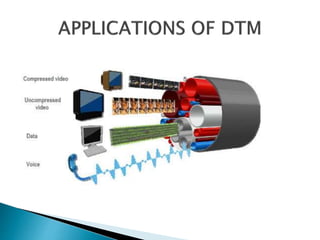
 DTM APPLICATIONS
 FUTURE OF DTM
 REFERENCES
 DYNAMIC SYNCHRONOUS TRANSFER MODE
(DTM).
 An exciting networking technology.
 Made to provide high speed networking with
top quality transmission and ability to adapt
the bandwidth to traffic variations quickly.
 Transmission capacity of optical fibers is
growing faster than processing capacity of
computers.
 DTM is designed to increase the use of fibers
transmission capacity and to provide support
for real-time broadband traffic and
multicasting.
 CIRCUIT SWITCHING :
 In circuit-switched networks, network
 resources are reserved all the way from
sender before start of the transfer,thereby
creating a circuit.
 For eg. Traditional telephone services.
 Packet switching:
 Data is divided into packets.
 Each contains address, size, sequence.
 The packets are sent through the network.
 Packet switched networks are based either on
connectionless or connection oriented
technology.
 Transmission of data such as audio and video
both in real time.
 High speed communication.
 Increases the use of fibre transmission
capacity.
 Provide support to real time broadband.
 Dense wavelength division multiplexing
equipments today carry only few
wavelengths, 40 to 100 wavelengths carried
on one single fiber will be possible in near
future.
 DTM aims to reduce network complexity to
provide full access to available bandwidth.
 The International Engineering Consortium
 http://www.iec.org/cgi-
bin/acrobat.pl?filecode=37
 Telecom Standards
 http://www.etsi.org/frameset/home.htm?/tec
hnicalactiv/DTM/dtm.htm
 European Telecommunications Standards
Institute
 http://webapp.etsi.org/action%5CMV/MV200
21220/es_20180304v010101m.pdf
Dynamic synchronous transfer mode

Dynamic synchronous transfer mode

  • 2.
     INTRODUCTION  WHYDTM?  BASICS: CIRCUIT SWITCHING v/s PACKET SWITCHING  DTM APPLICATIONS  FUTURE OF DTM  REFERENCES
  • 4.
     DYNAMIC SYNCHRONOUSTRANSFER MODE (DTM).  An exciting networking technology.  Made to provide high speed networking with top quality transmission and ability to adapt the bandwidth to traffic variations quickly.
  • 5.
     Transmission capacityof optical fibers is growing faster than processing capacity of computers.  DTM is designed to increase the use of fibers transmission capacity and to provide support for real-time broadband traffic and multicasting.
  • 7.
     CIRCUIT SWITCHING:  In circuit-switched networks, network  resources are reserved all the way from sender before start of the transfer,thereby creating a circuit.  For eg. Traditional telephone services.
  • 8.
     Packet switching: Data is divided into packets.  Each contains address, size, sequence.  The packets are sent through the network.  Packet switched networks are based either on connectionless or connection oriented technology.
  • 10.
     Transmission ofdata such as audio and video both in real time.  High speed communication.  Increases the use of fibre transmission capacity.  Provide support to real time broadband.
  • 11.
     Dense wavelengthdivision multiplexing equipments today carry only few wavelengths, 40 to 100 wavelengths carried on one single fiber will be possible in near future.  DTM aims to reduce network complexity to provide full access to available bandwidth.
  • 12.
     The InternationalEngineering Consortium  http://www.iec.org/cgi- bin/acrobat.pl?filecode=37  Telecom Standards  http://www.etsi.org/frameset/home.htm?/tec hnicalactiv/DTM/dtm.htm  European Telecommunications Standards Institute  http://webapp.etsi.org/action%5CMV/MV200 21220/es_20180304v010101m.pdf