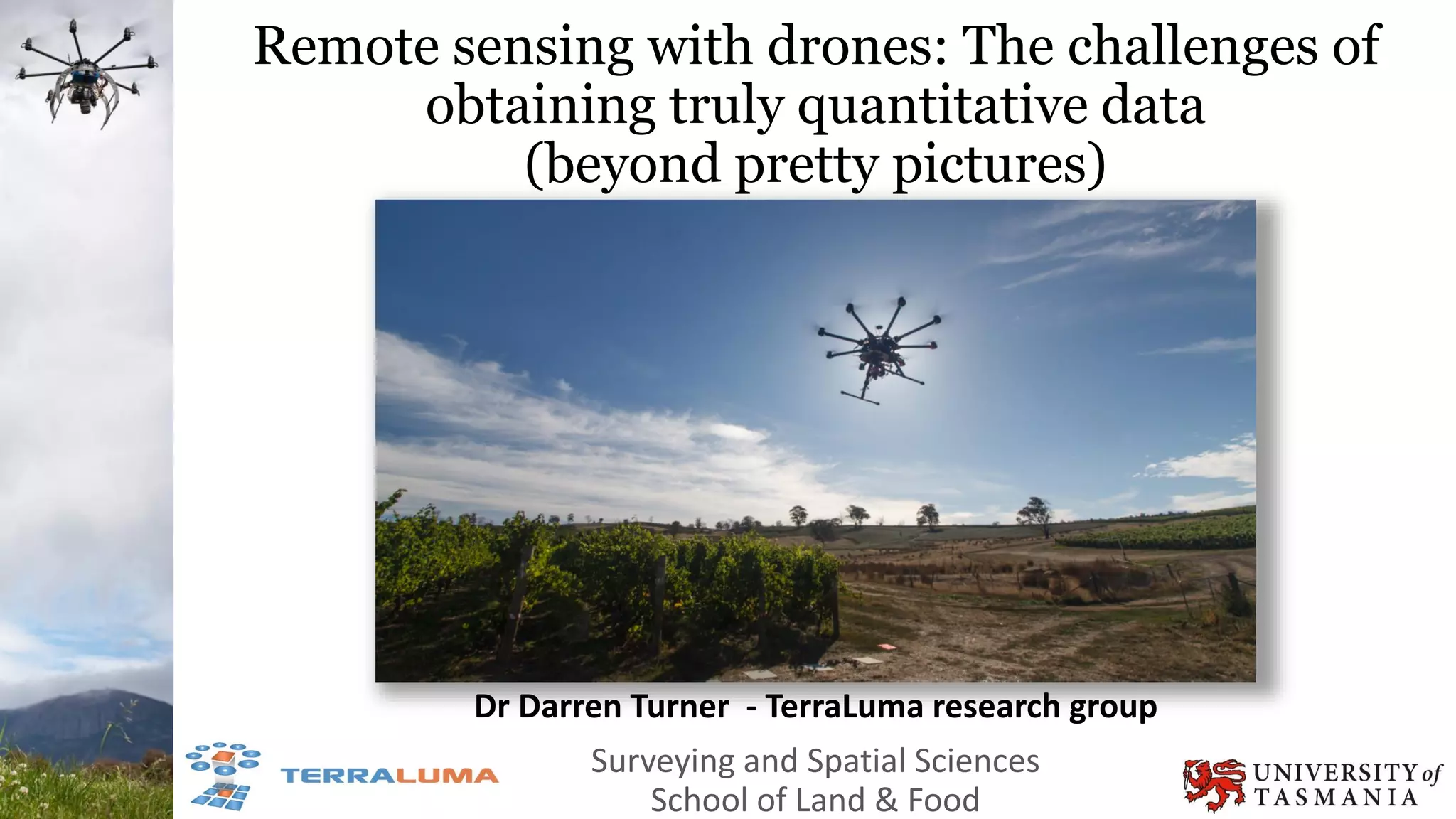
Dr Darren Turner - TerraLuma research group
Surveying and Spatial Sciences
School of Land & Food
Remote sensing with drones: The challenges of
obtaining truly quantitative data
(beyond pretty pictures)
TerraLuma
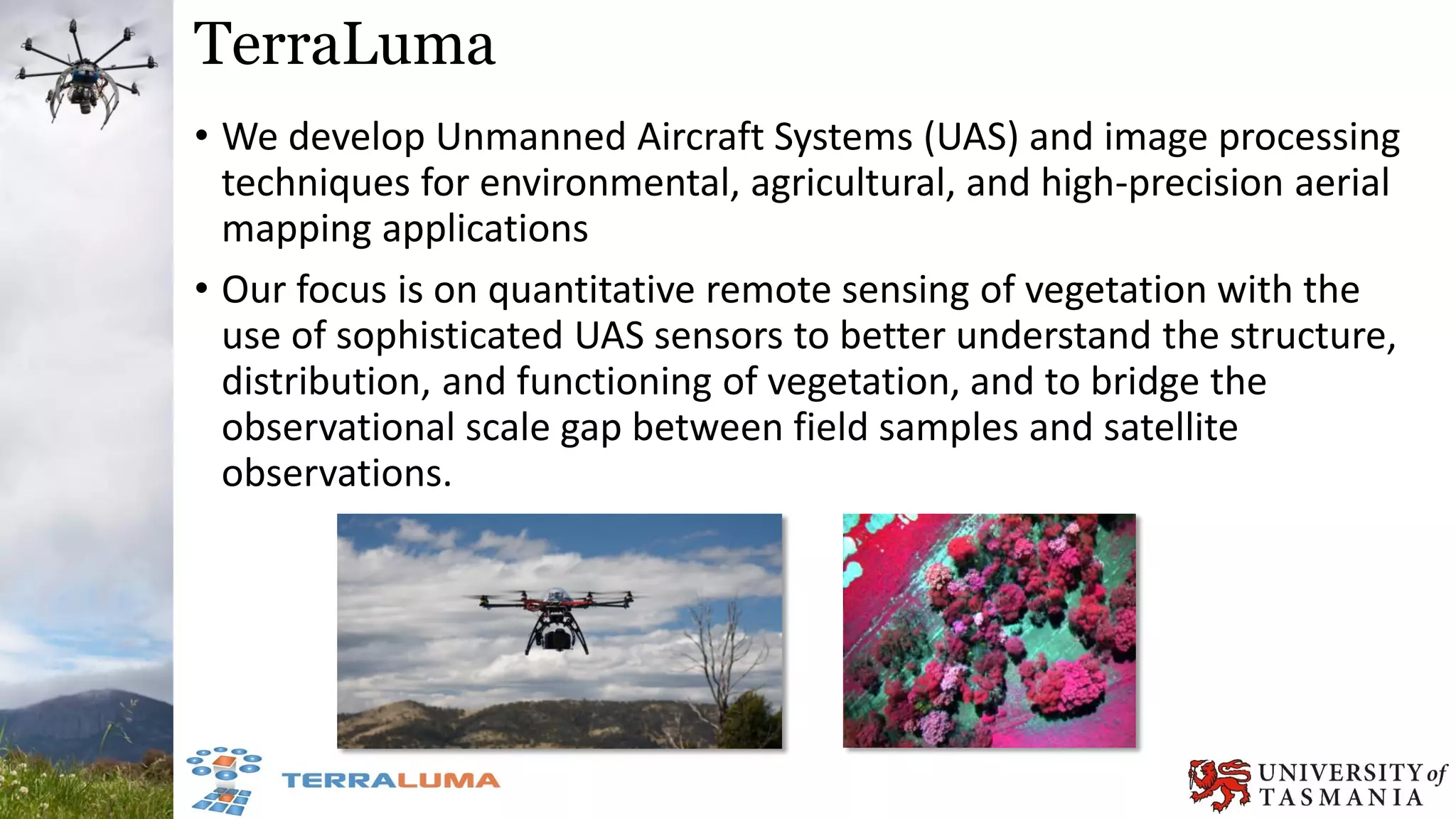
• We develop Unmanned Aircraft Systems (UAS) and image processing
techniques for environmental, agricultural, and high-precision aerial
mapping applications
• Our focus is on quantitative remote sensing of vegetation with the
use of sophisticated UAS sensors to better understand the structure,
distribution, and functioning of vegetation, and to bridge the
observational scale gap between field samples and satellite
observations.
Problems with satellite &
airborne remote sensing
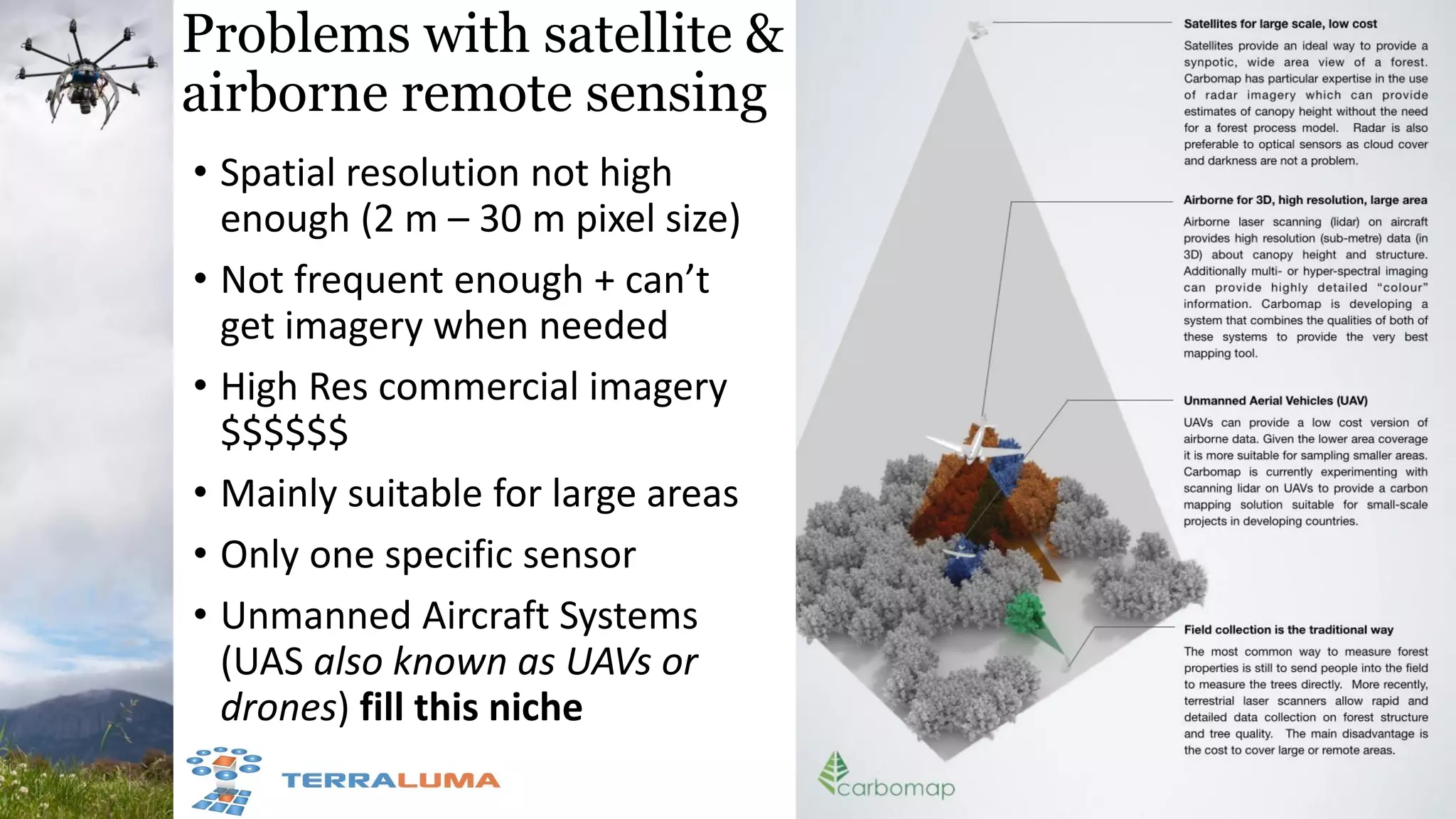
• Spatial resolution not high
enough (2 m – 30 m pixel size)
• Not frequent enough + can’t
get imagery when needed
• High Res commercial imagery
$$$$$$
• Mainly suitable for large areas
• Only one specific sensor
• Unmanned Aircraft Systems
(UAS also known as UAVs or
drones) fill this niche
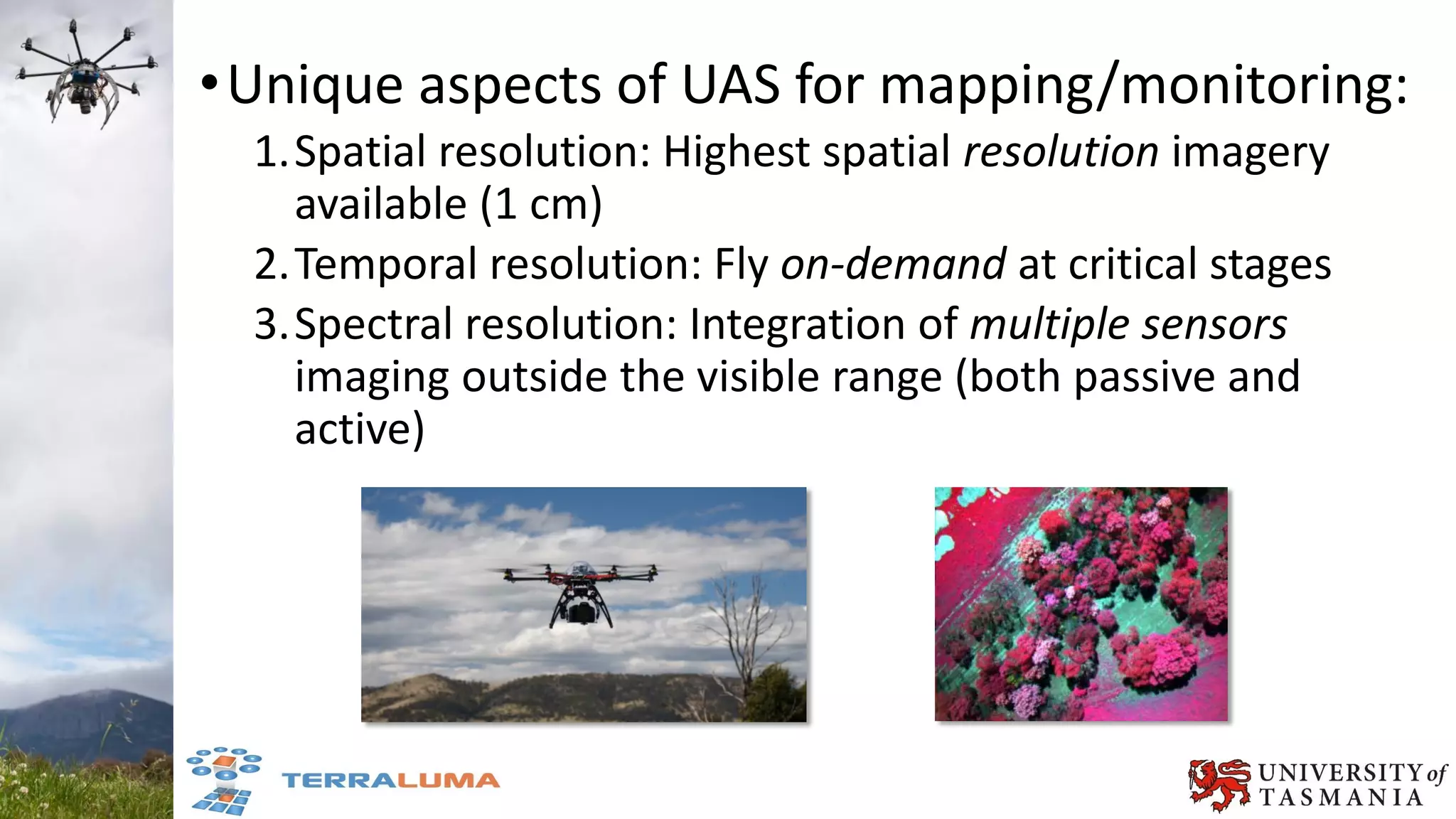
•Unique aspects of UAS for mapping/monitoring:
1.Spatial resolution: Highest spatial resolution imagery
available (1 cm)
2.Temporal resolution: Fly on-demand at critical stages
3.Spectral resolution: Integration of multiple sensors
imaging outside the visible range (both passive and
active)
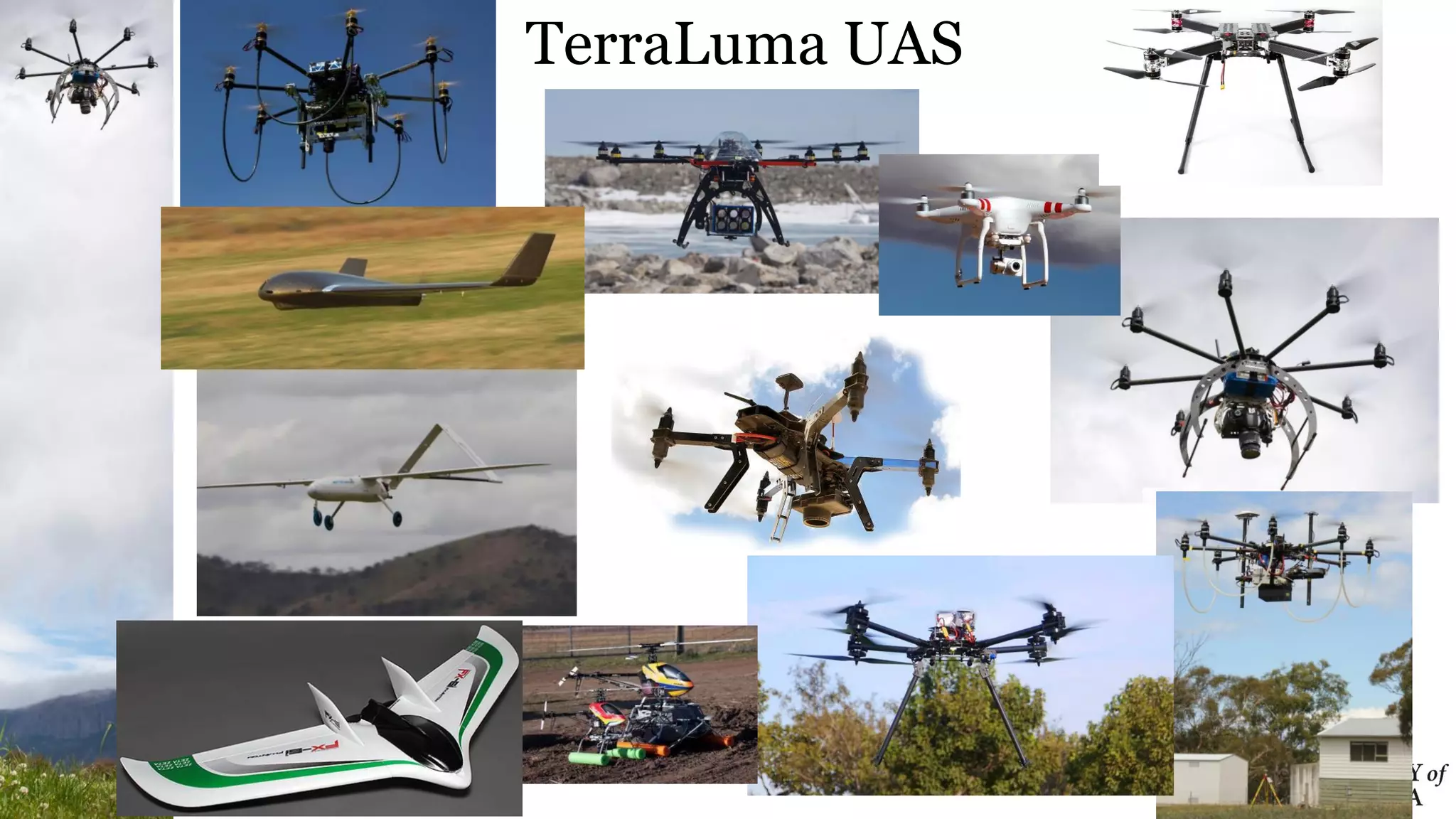
TerraLuma UAS
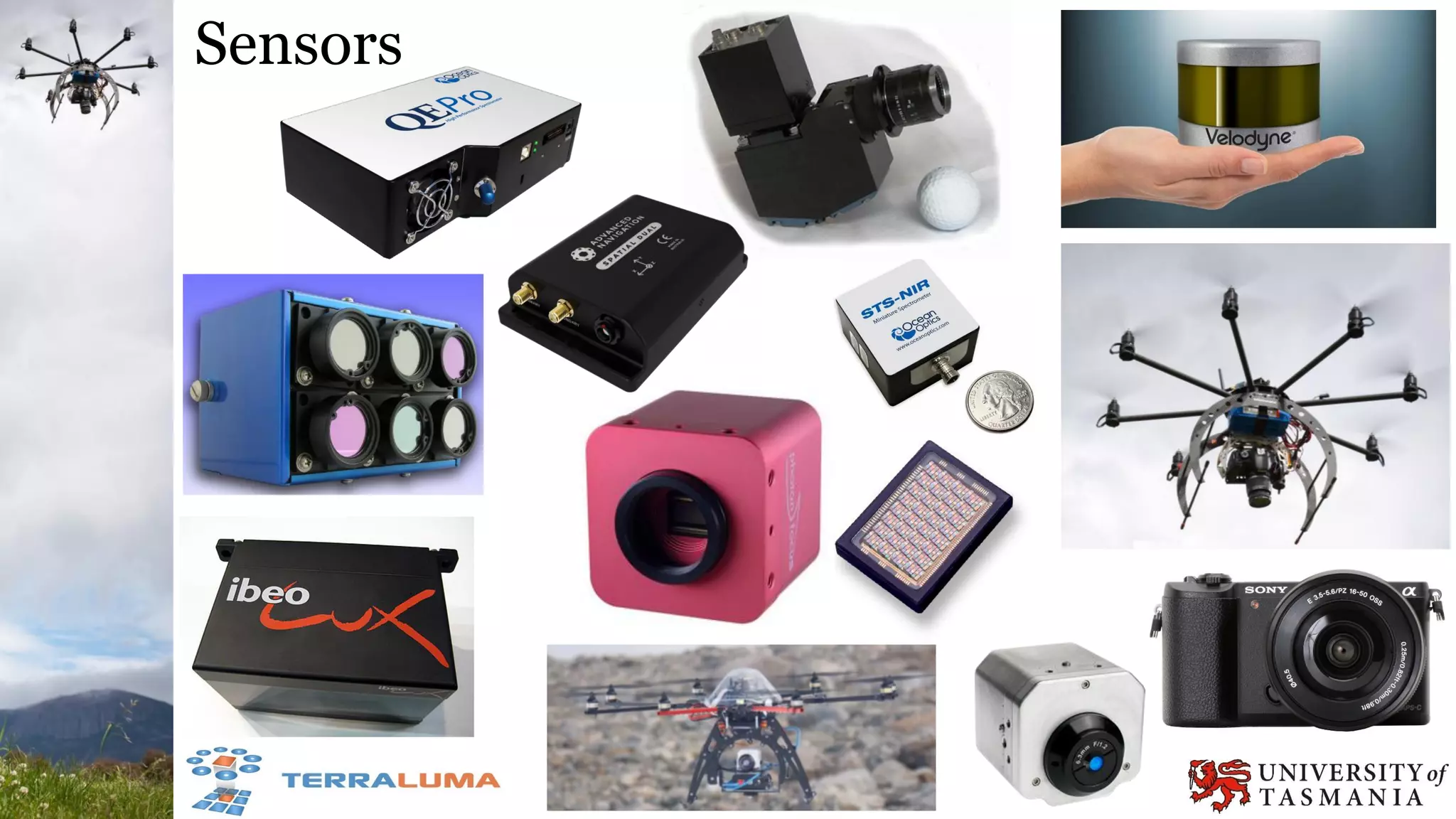
Sensors
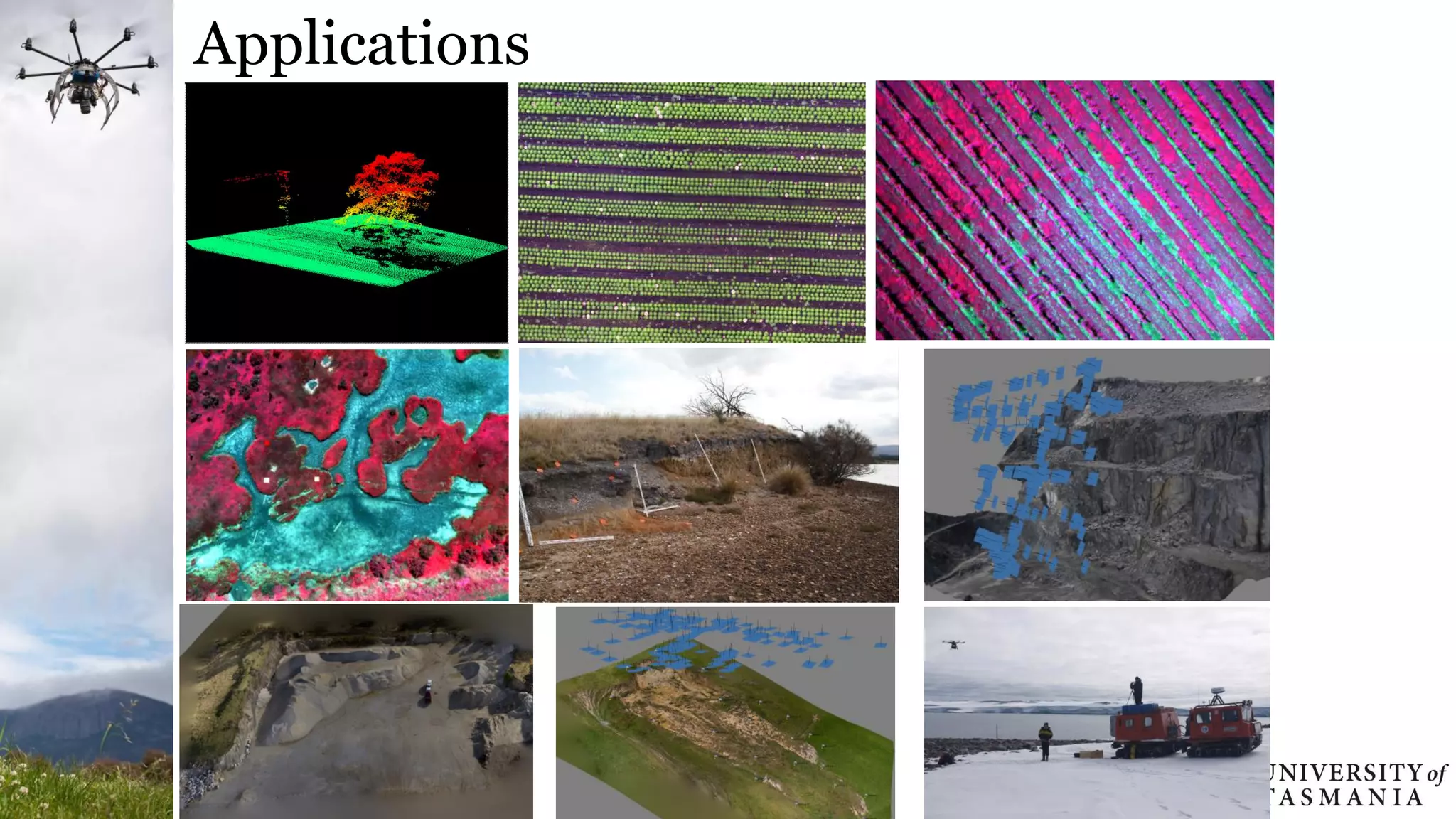
Applications
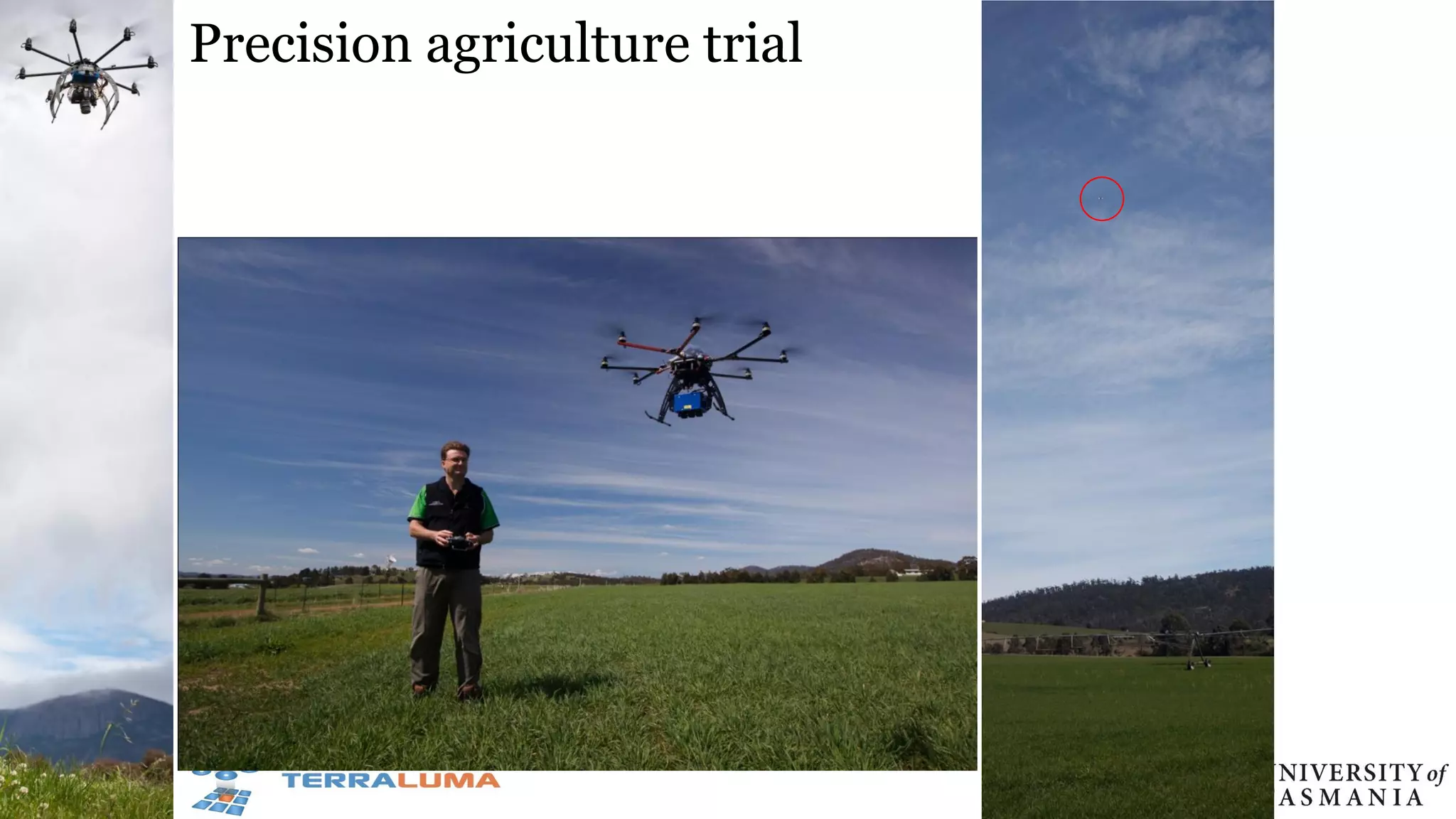
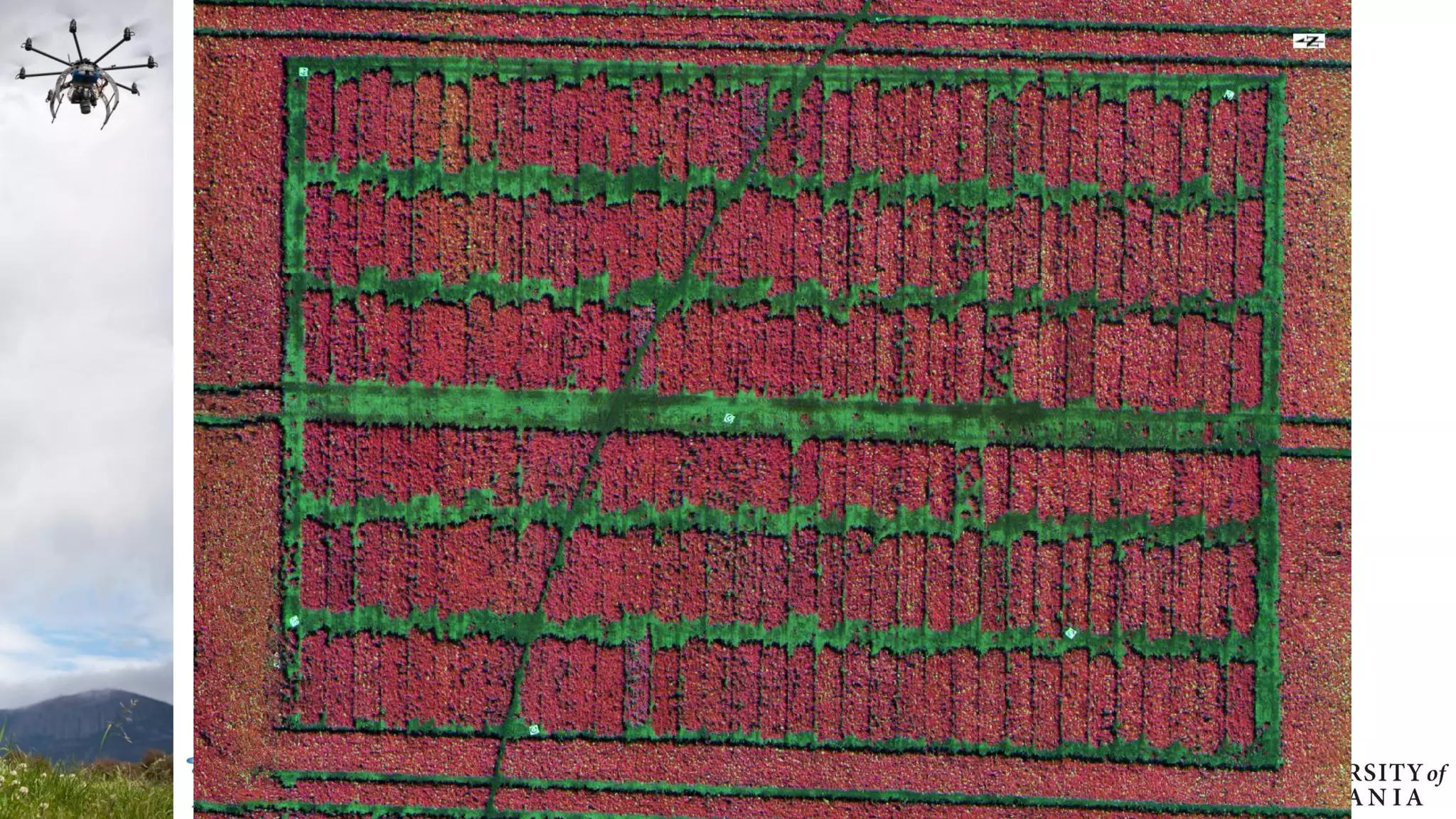
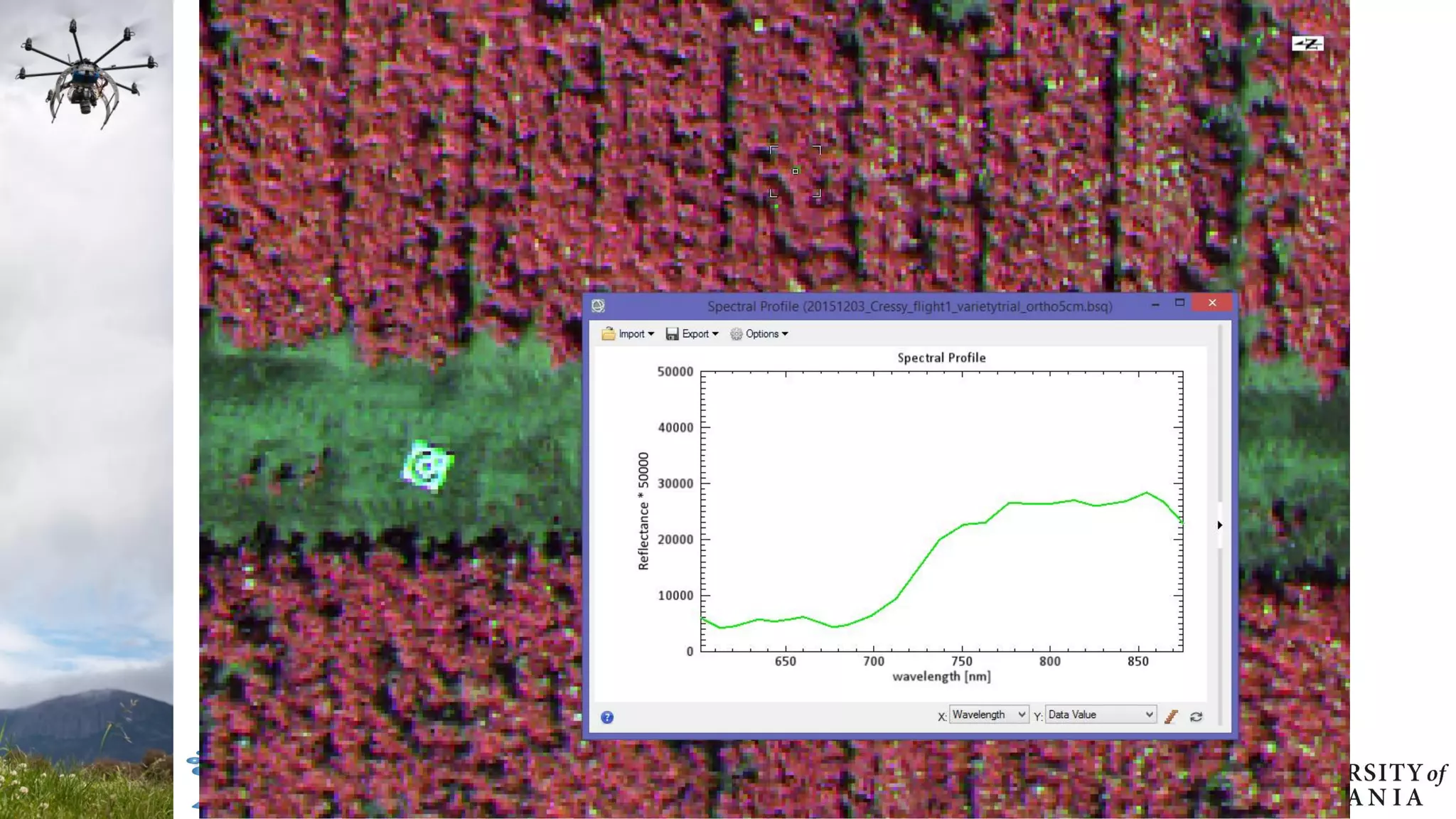
Precision agriculture trial
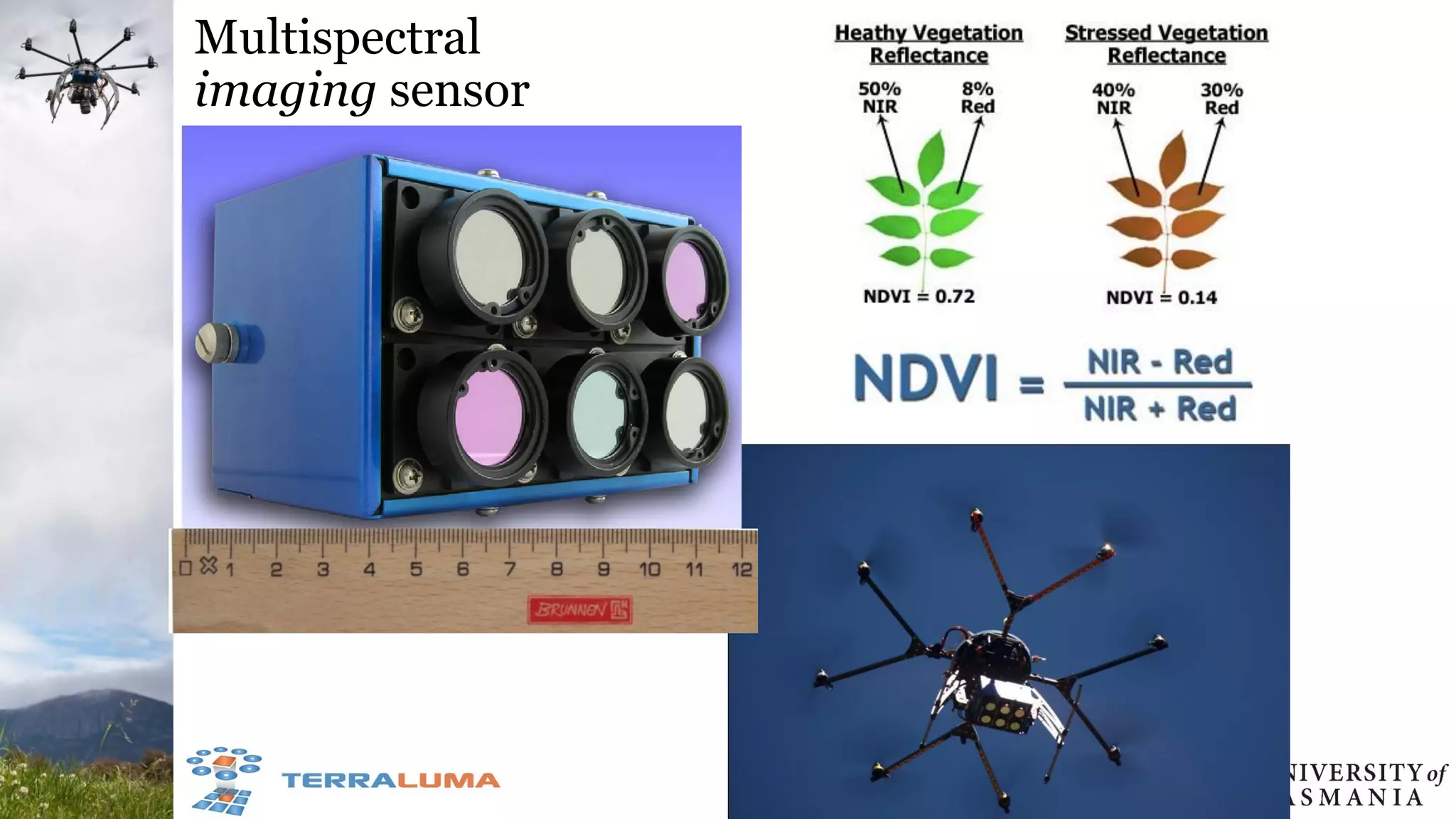
Multispectral
imaging sensor
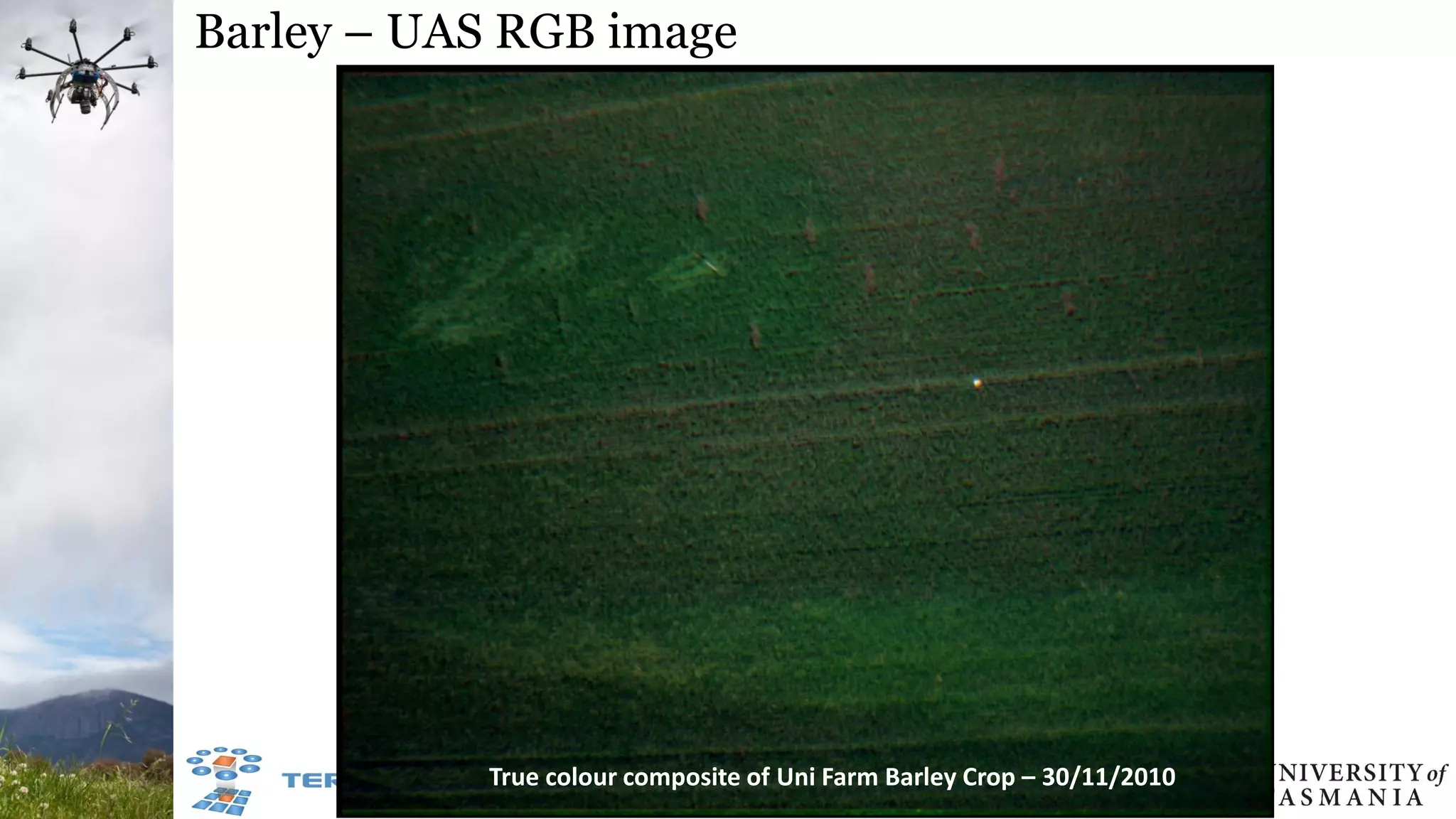
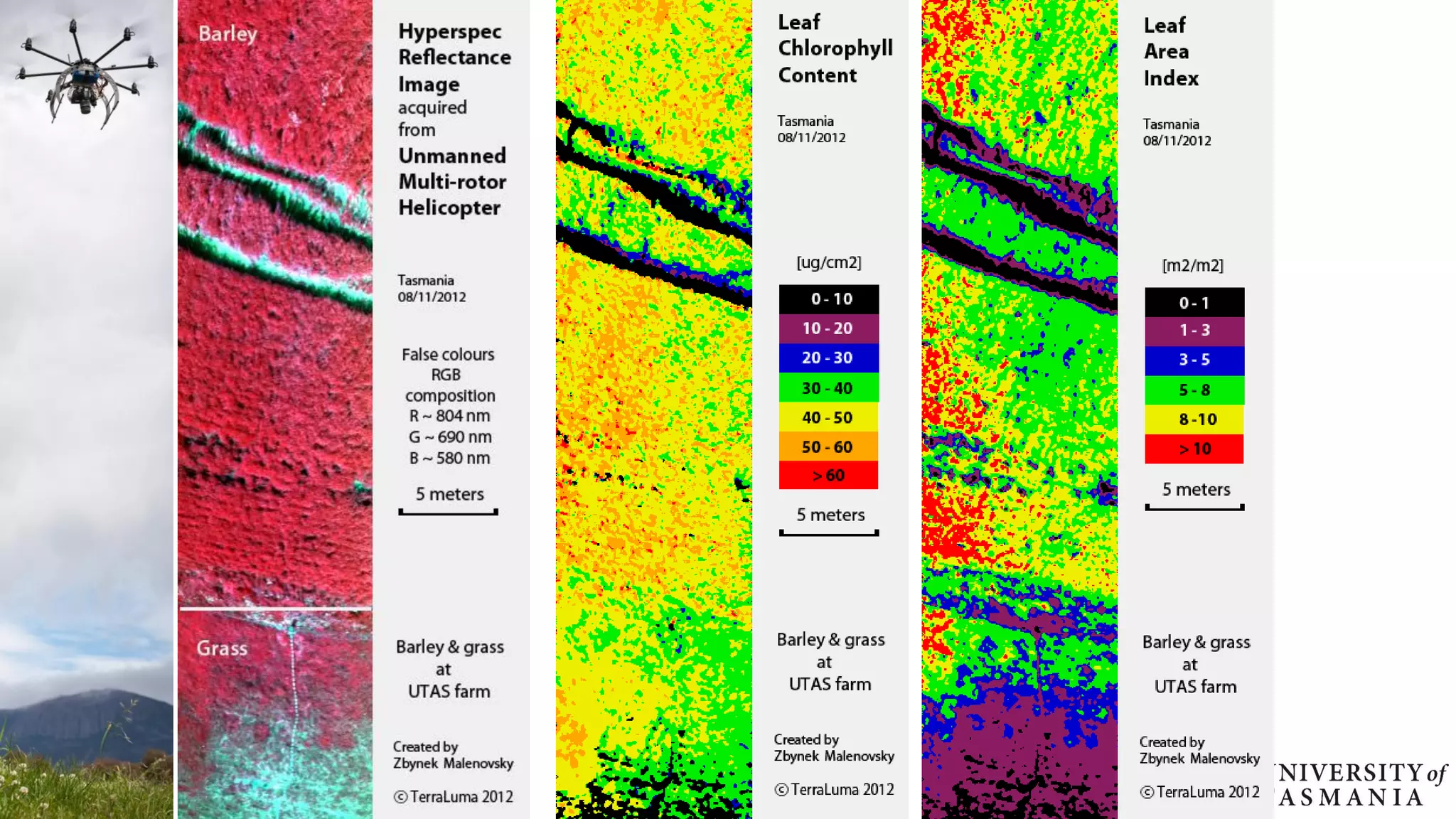
Barley – UAS RGB image
True colour composite of Uni Farm Barley Crop – 30/11/2010
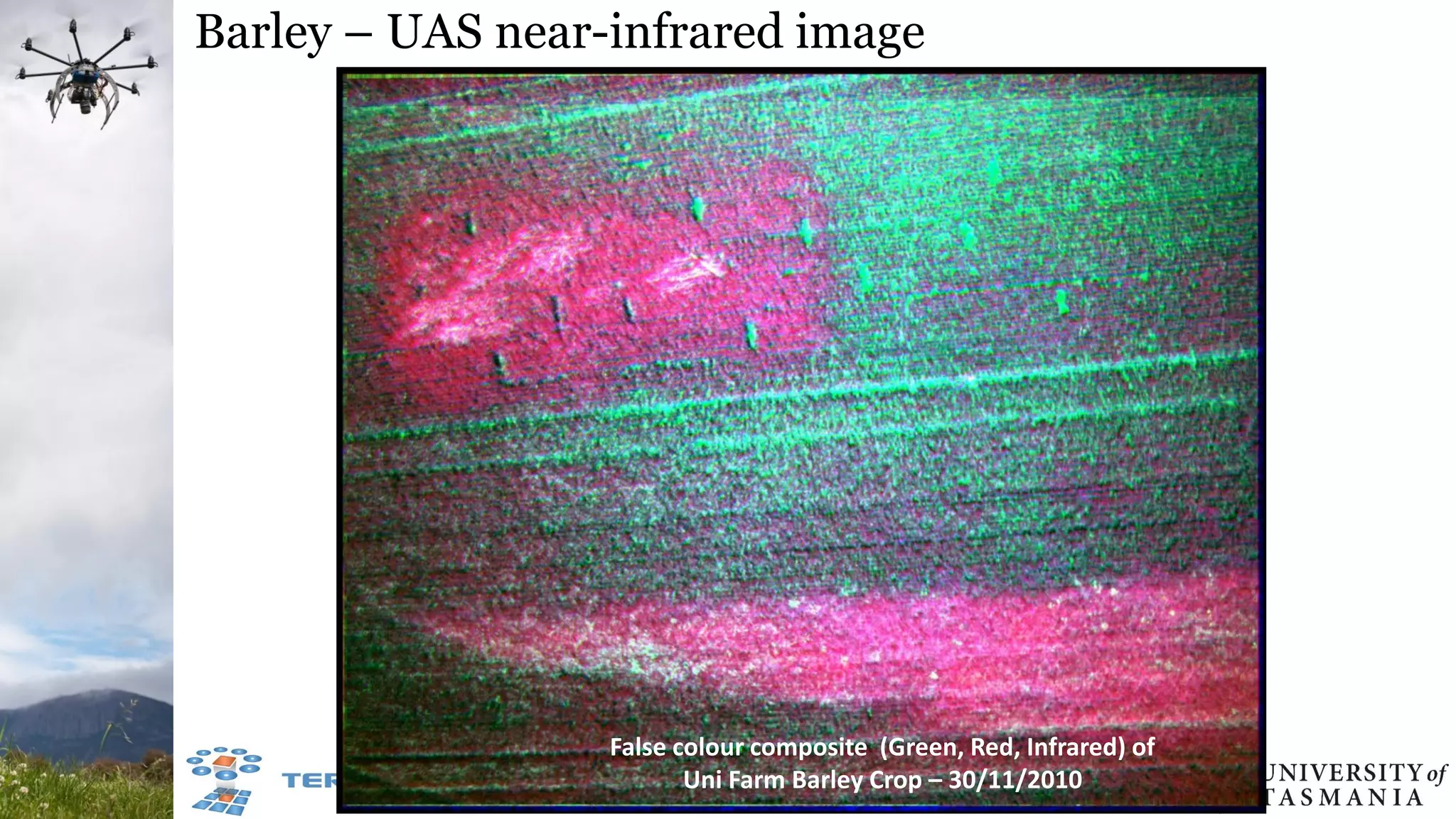
Barley – UAS near-infrared image
False colour composite (Green, Red, Infrared) of
Uni Farm Barley Crop – 30/11/2010
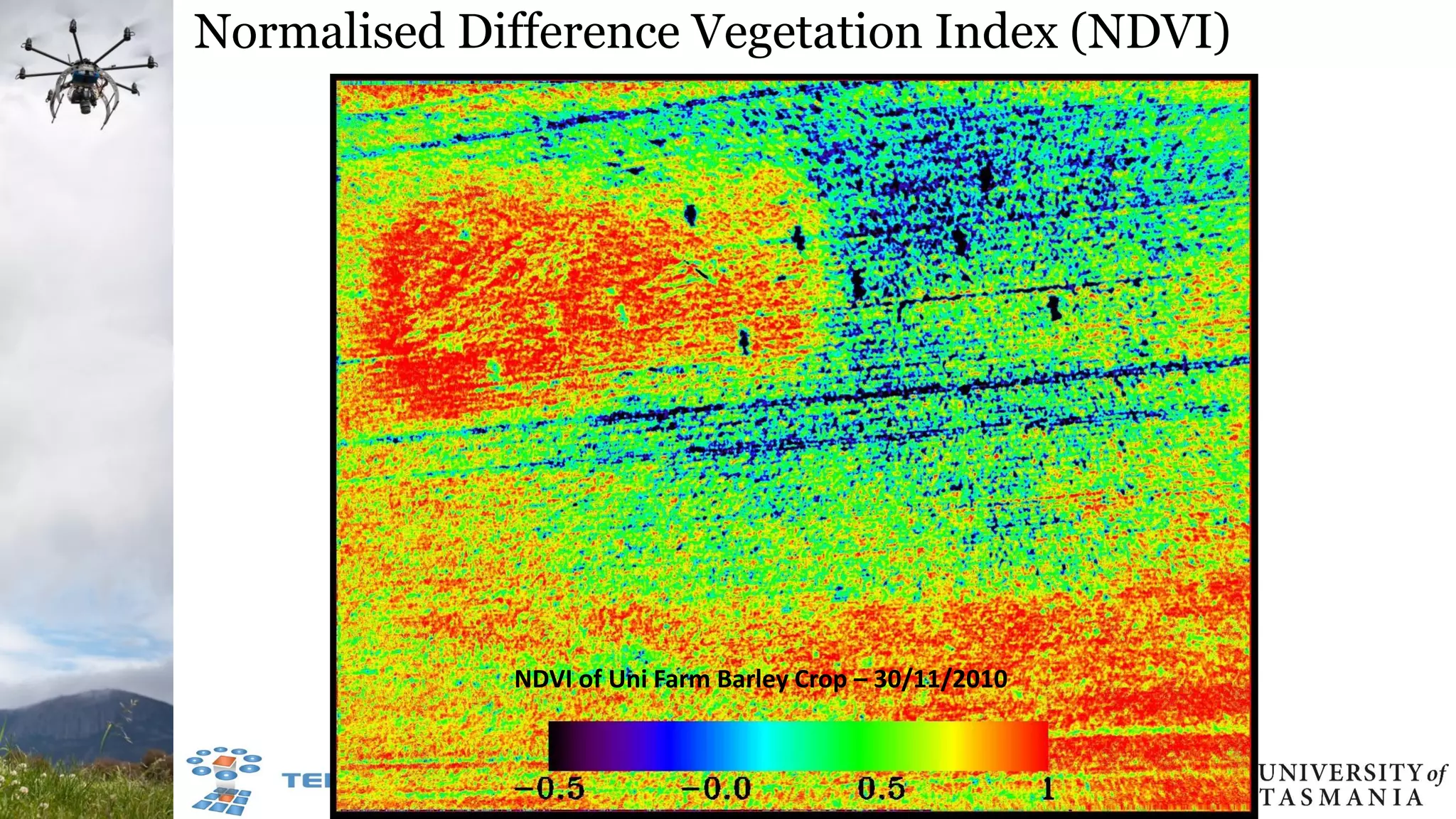
Normalised Difference Vegetation Index (NDVI)
NDVI of Uni Farm Barley Crop – 30/11/2010
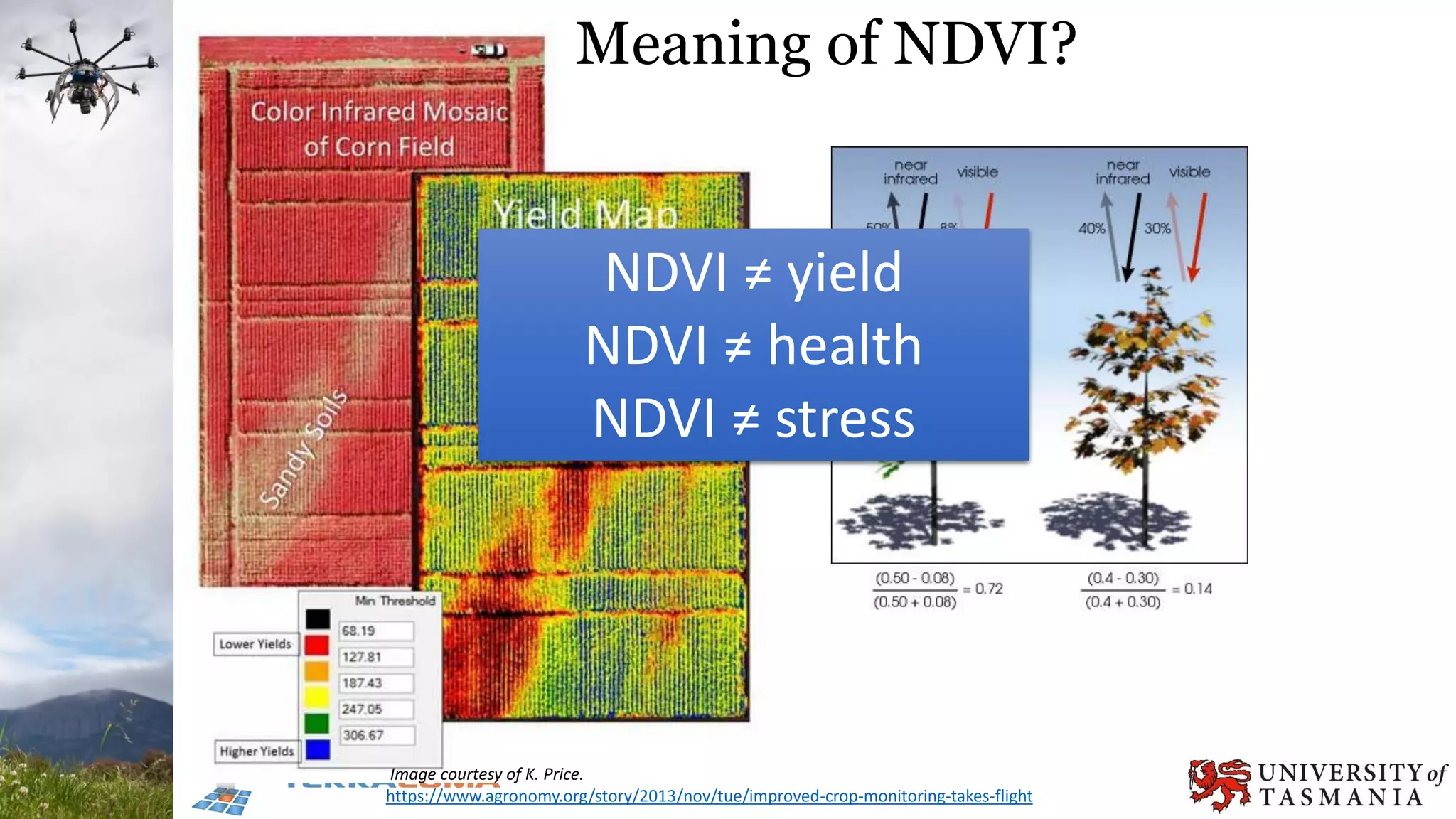
Image courtesy of K. Price.
https://www.agronomy.org/story/2013/nov/tue/improved-crop-monitoring-takes-flight
NDVI ≠ yield
NDVI ≠ health
NDVI ≠ stress
Meaning of NDVI?
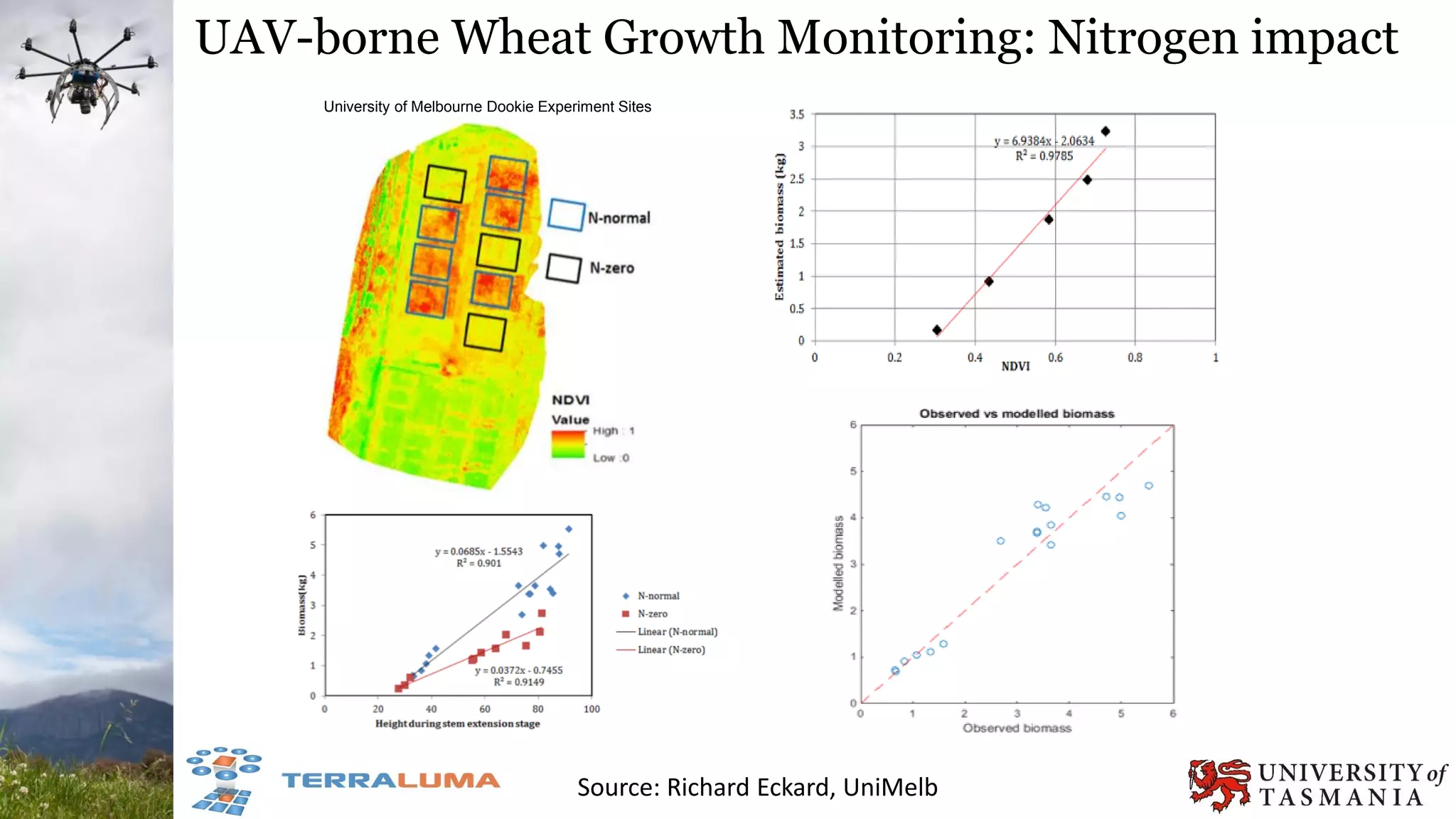
University of Melbourne Dookie Experiment Sites
UAV-borne Wheat Growth Monitoring: Nitrogen impact
Source: Richard Eckard, UniMelb
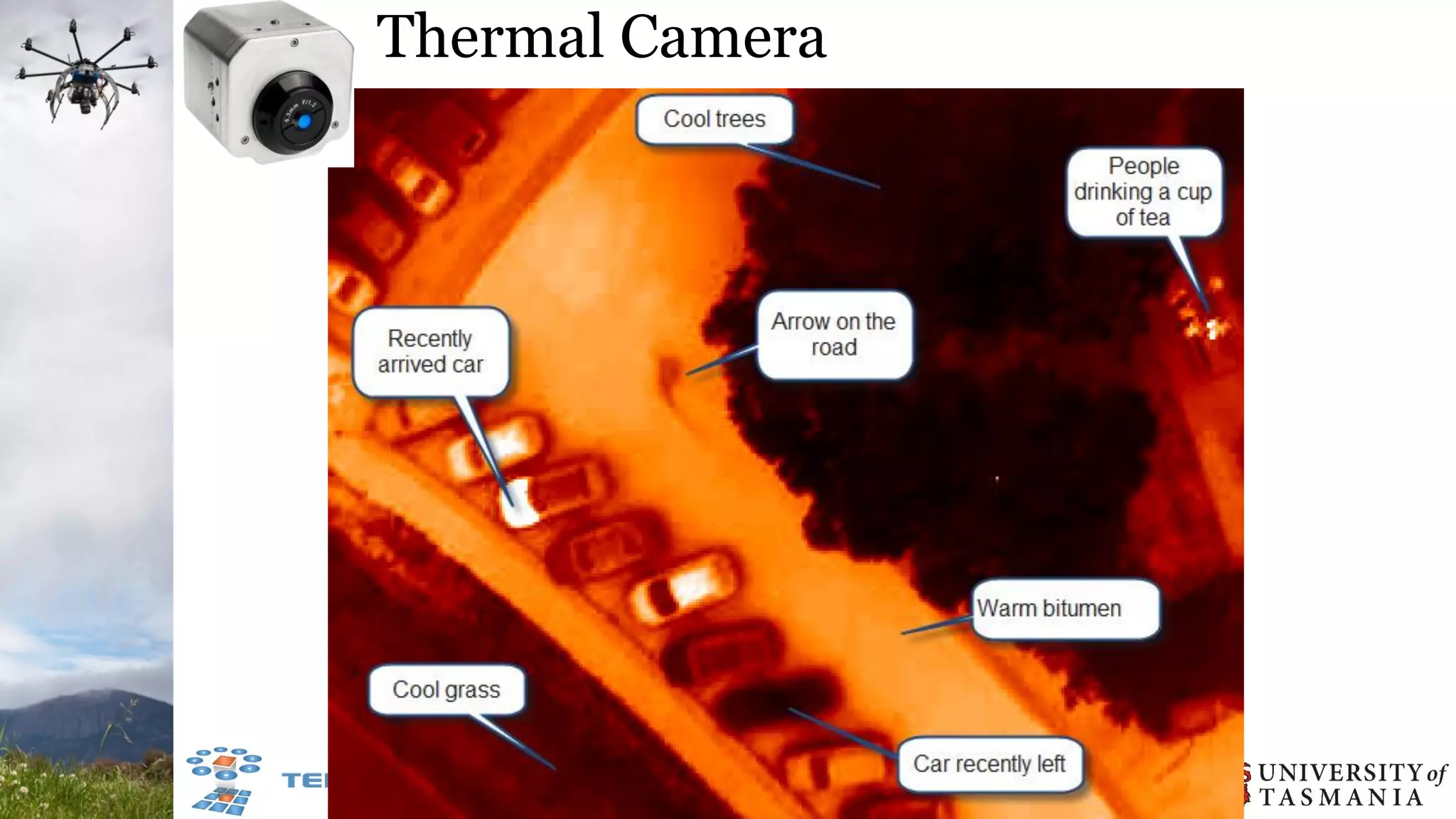
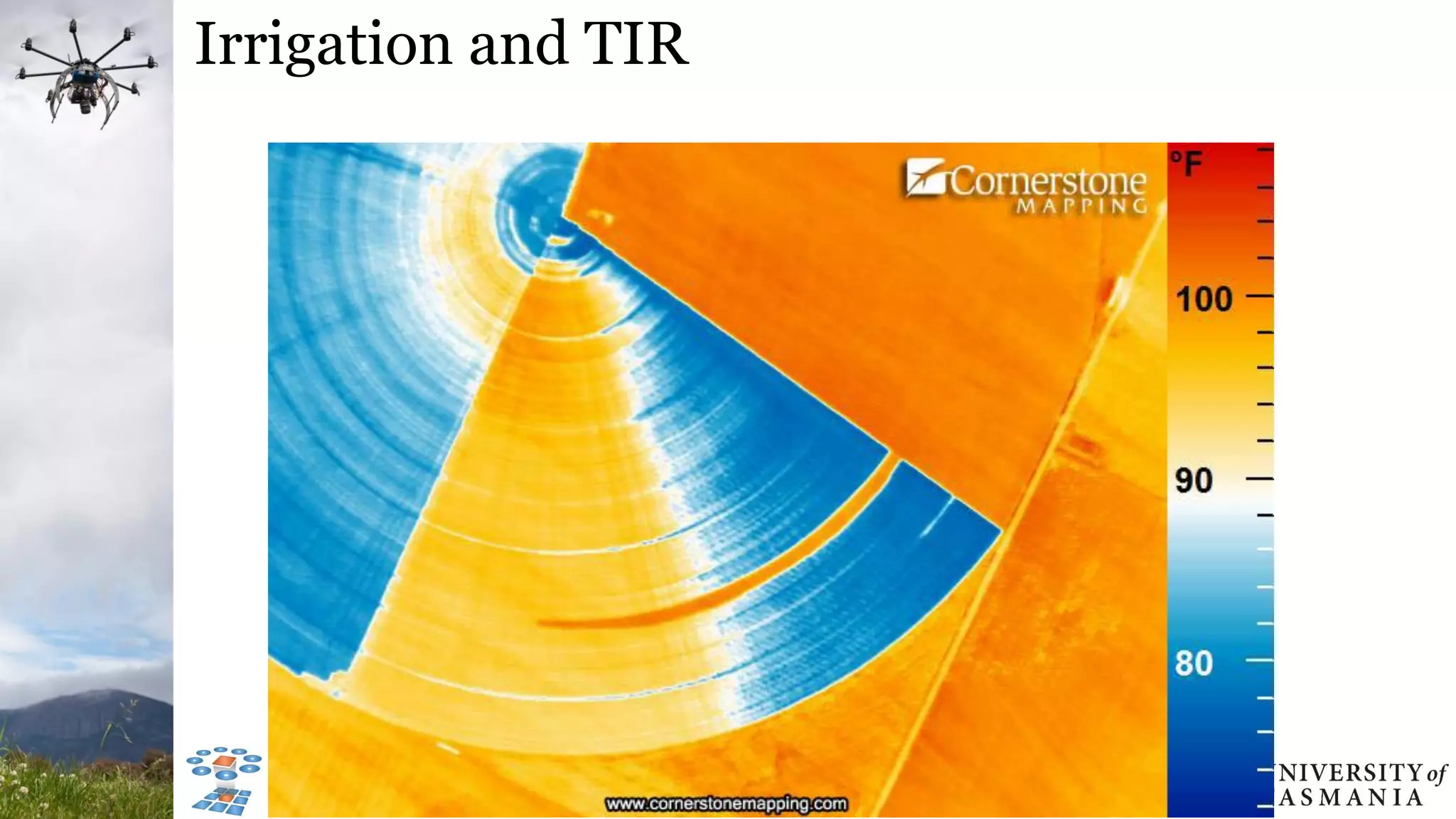
Thermal Camera
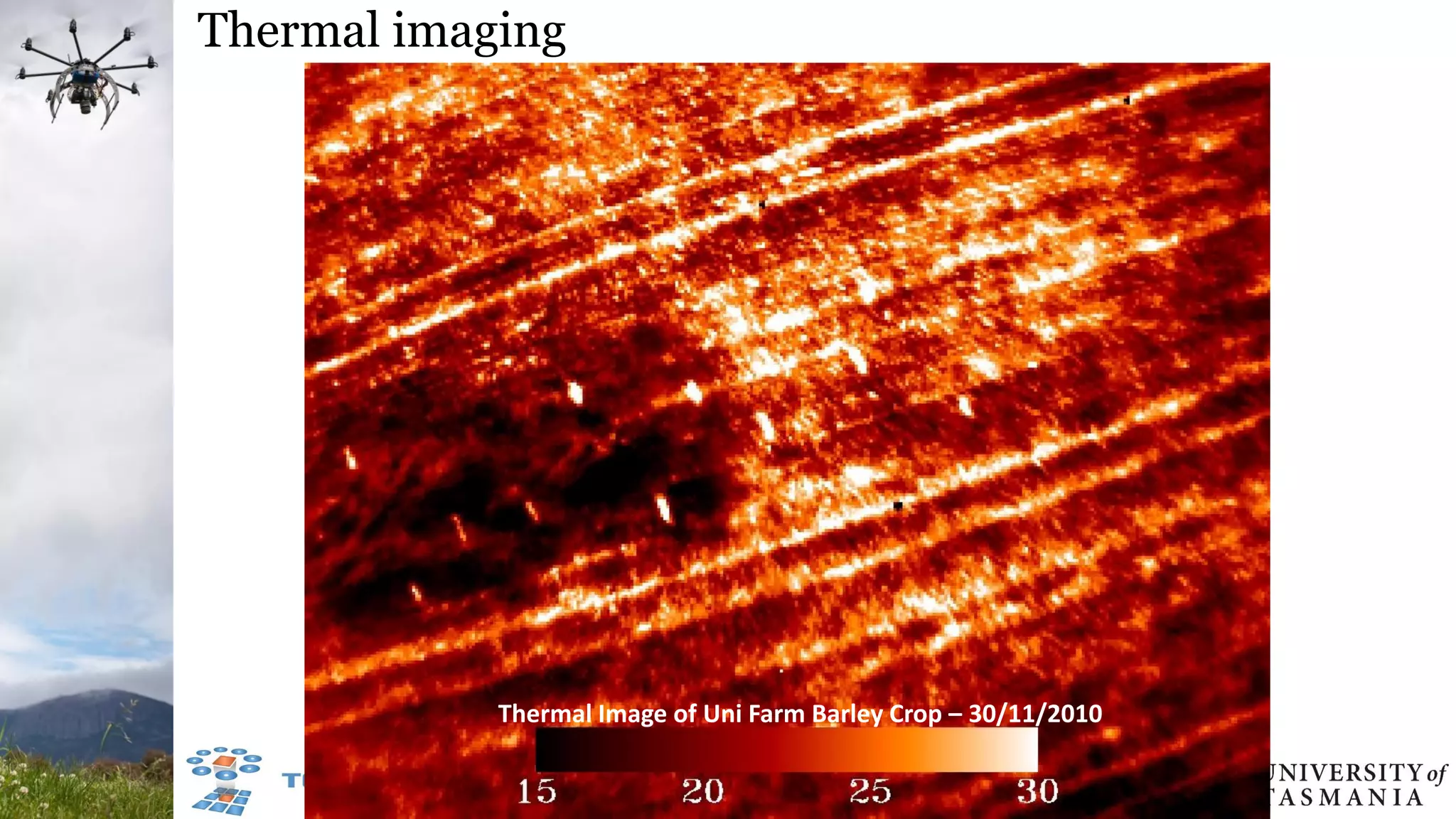
Thermal imaging
Thermal Image of Uni Farm Barley Crop – 30/11/2010
Irrigation and TIR
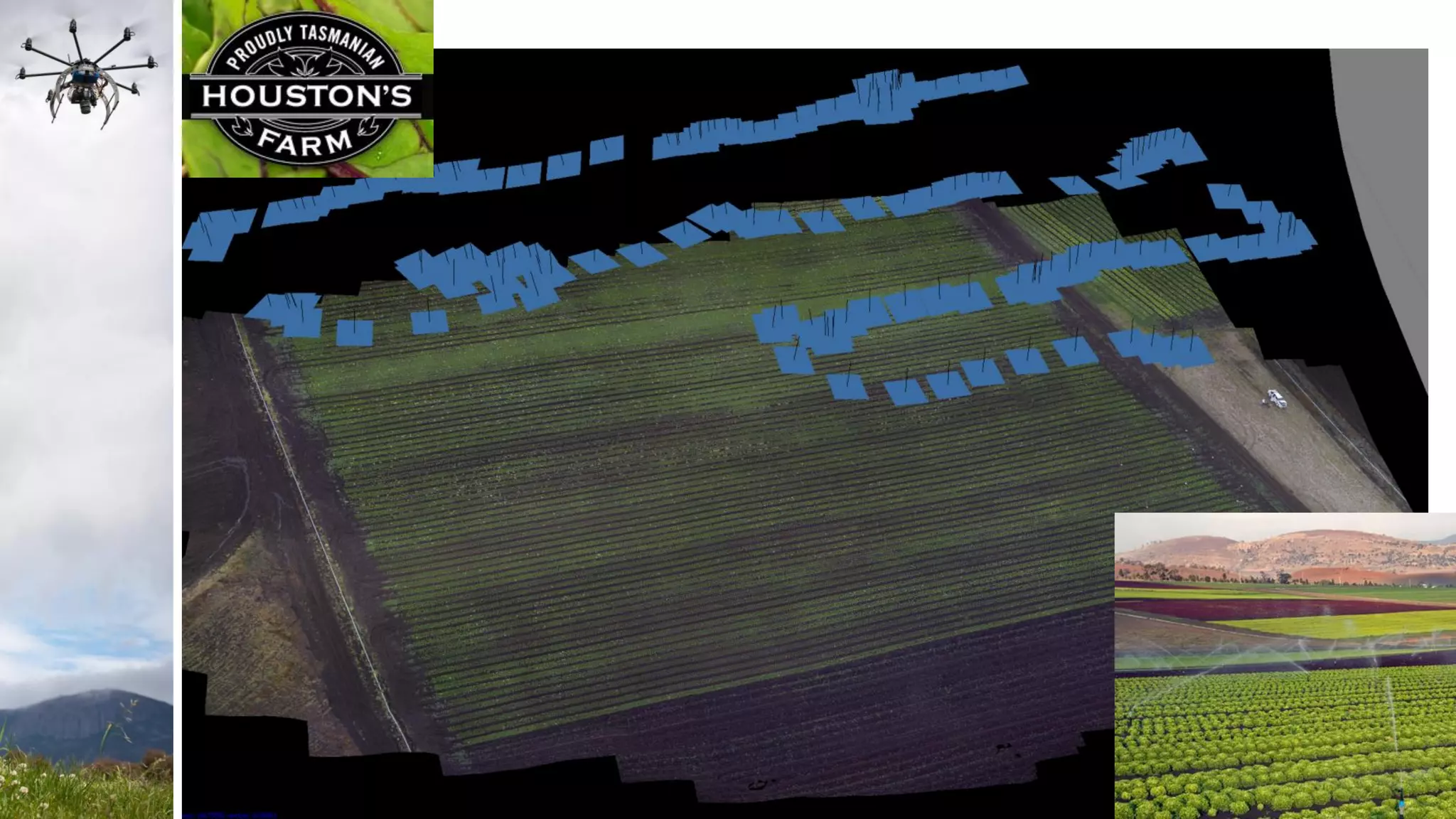
Houston’s Farm
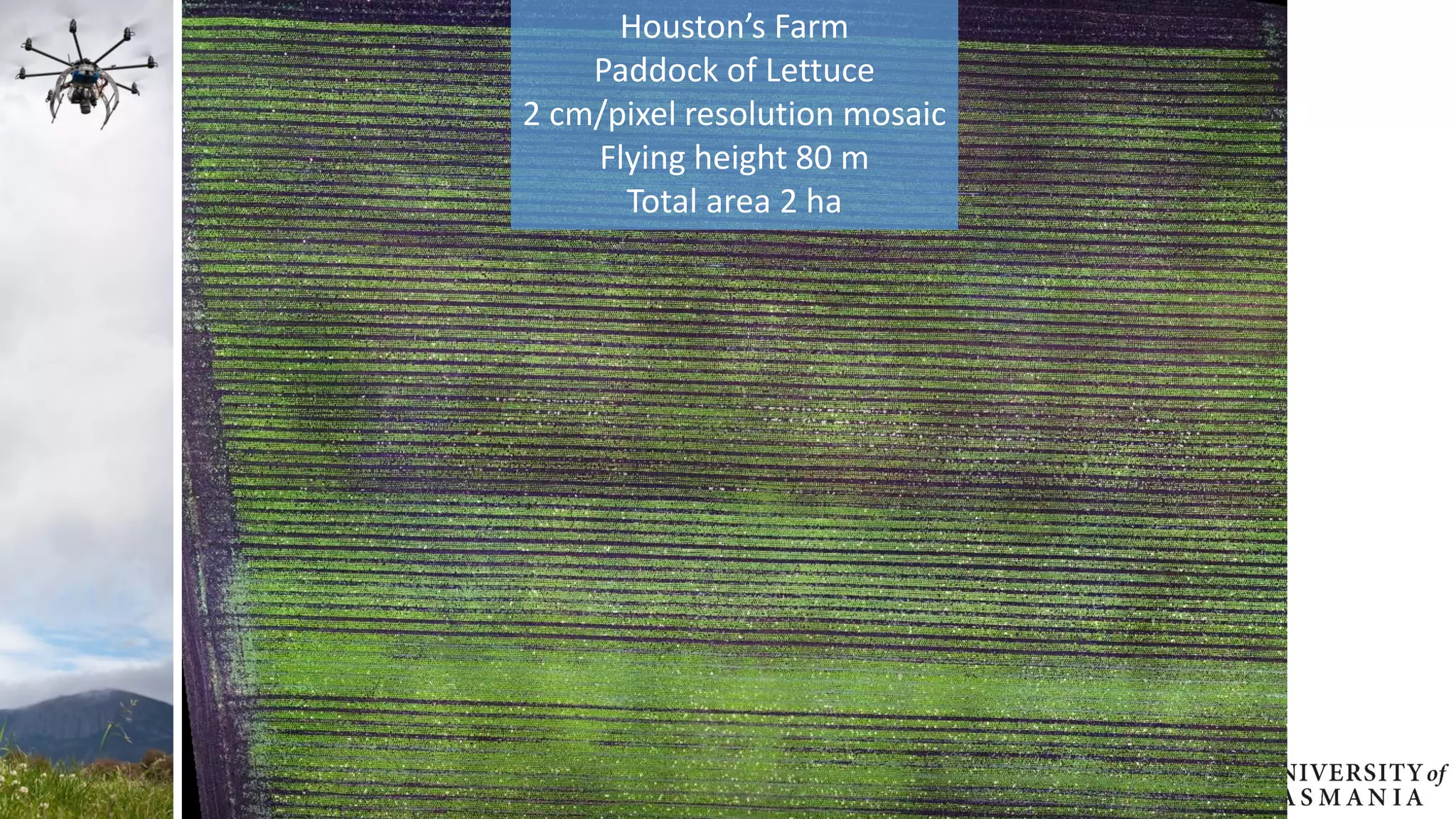
Paddock of Lettuce
2 cm/pixel resolution mosaic
Flying height 80 m
Total area 2 ha
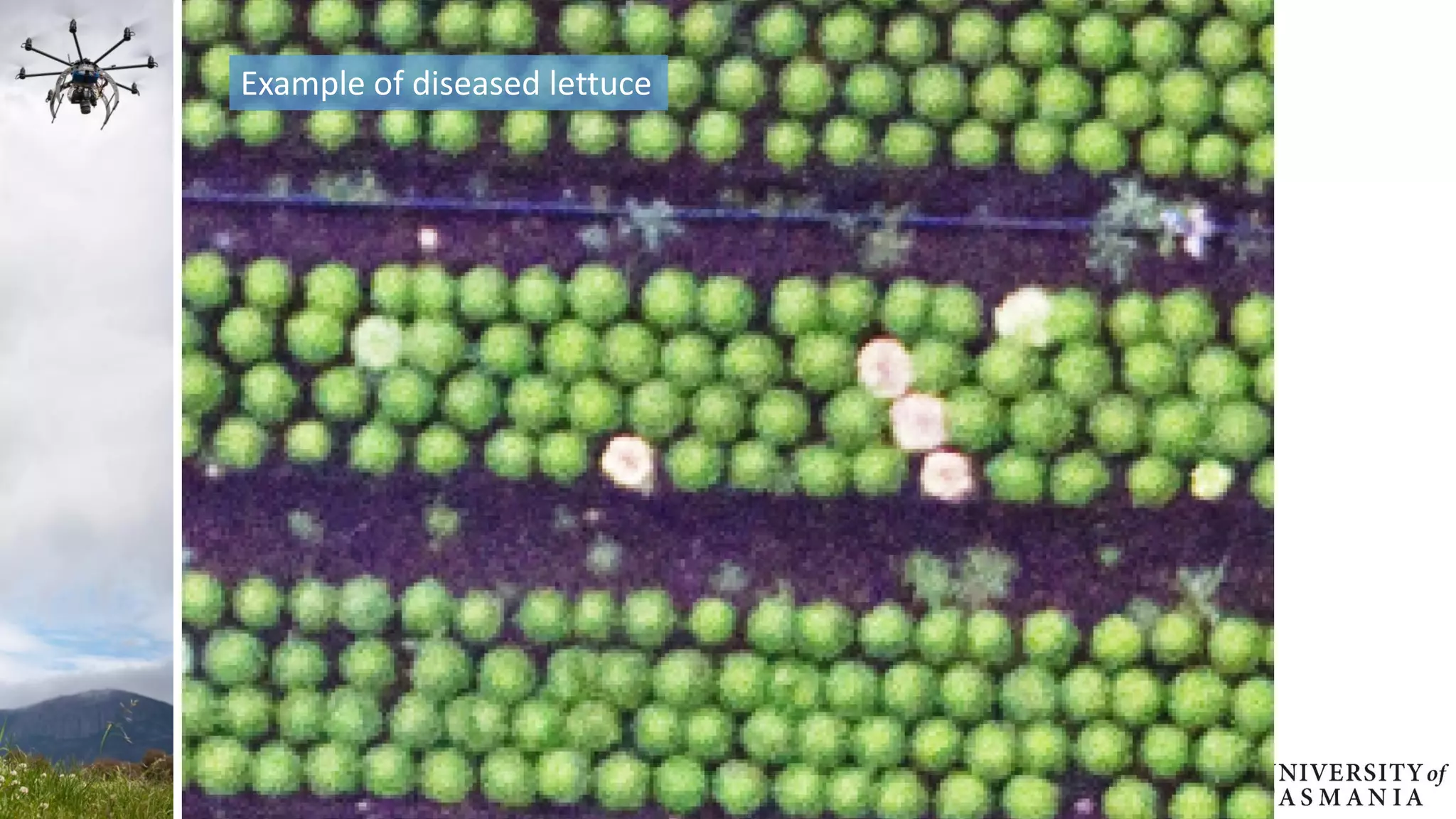
Example of diseased lettuce
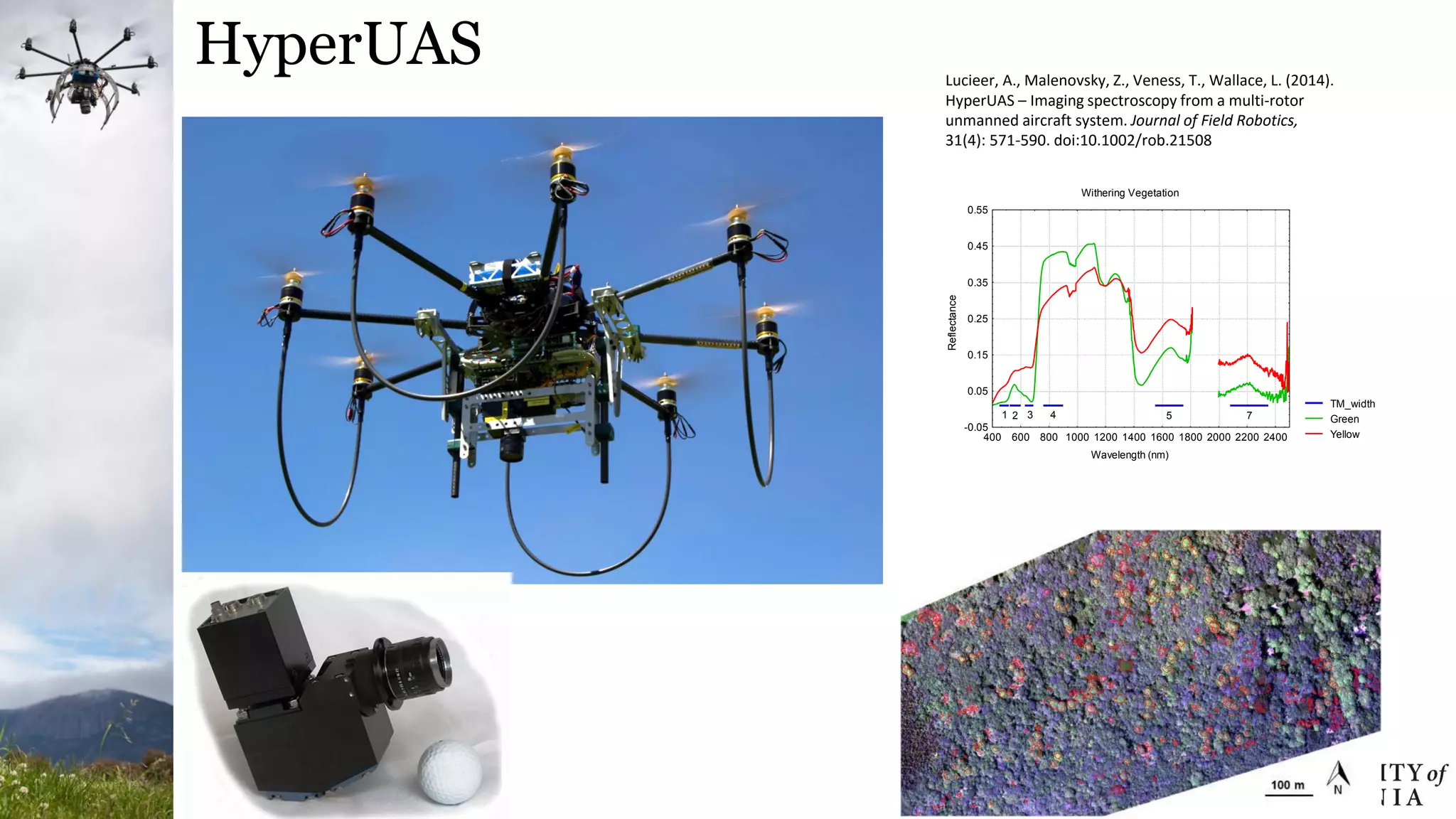
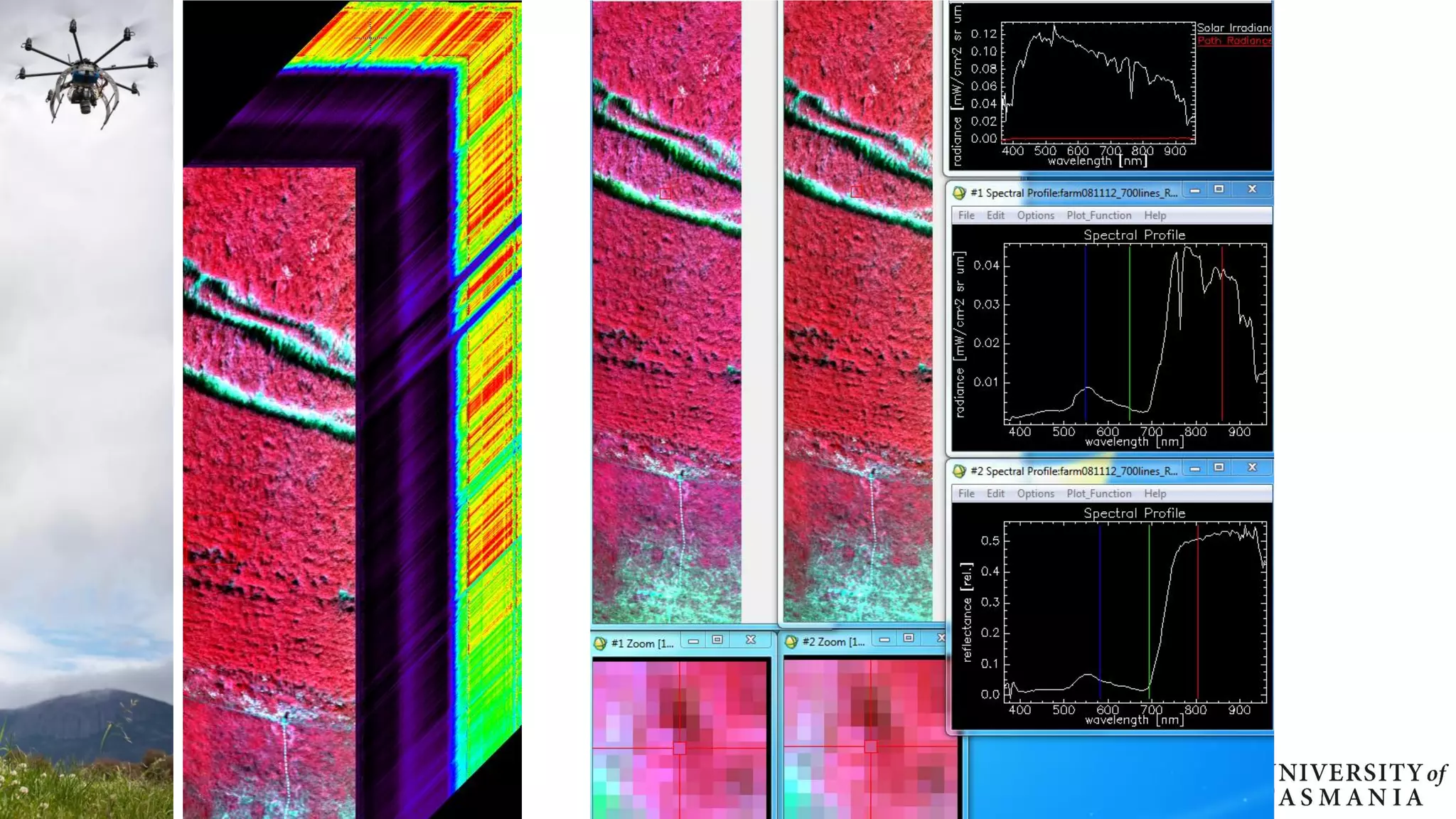
HyperUAS Lucieer, A., Malenovsky, Z., Veness, T., Wallace, L. (2014).
HyperUAS – Imaging spectroscopy from a multi-rotor
unmanned aircraft system. Journal of Field Robotics,
31(4): 571-590. doi:10.1002/rob.21508
TM_width
Green
Yellow
Withering Vegetation
Wavelength (nm)
Reflectance
-0.05
0.05
0.15
0.25
0.35
0.45
0.55
400 600 800 1000 1200 1400 1600 1800 2000 2200 2400
41 32 5 7
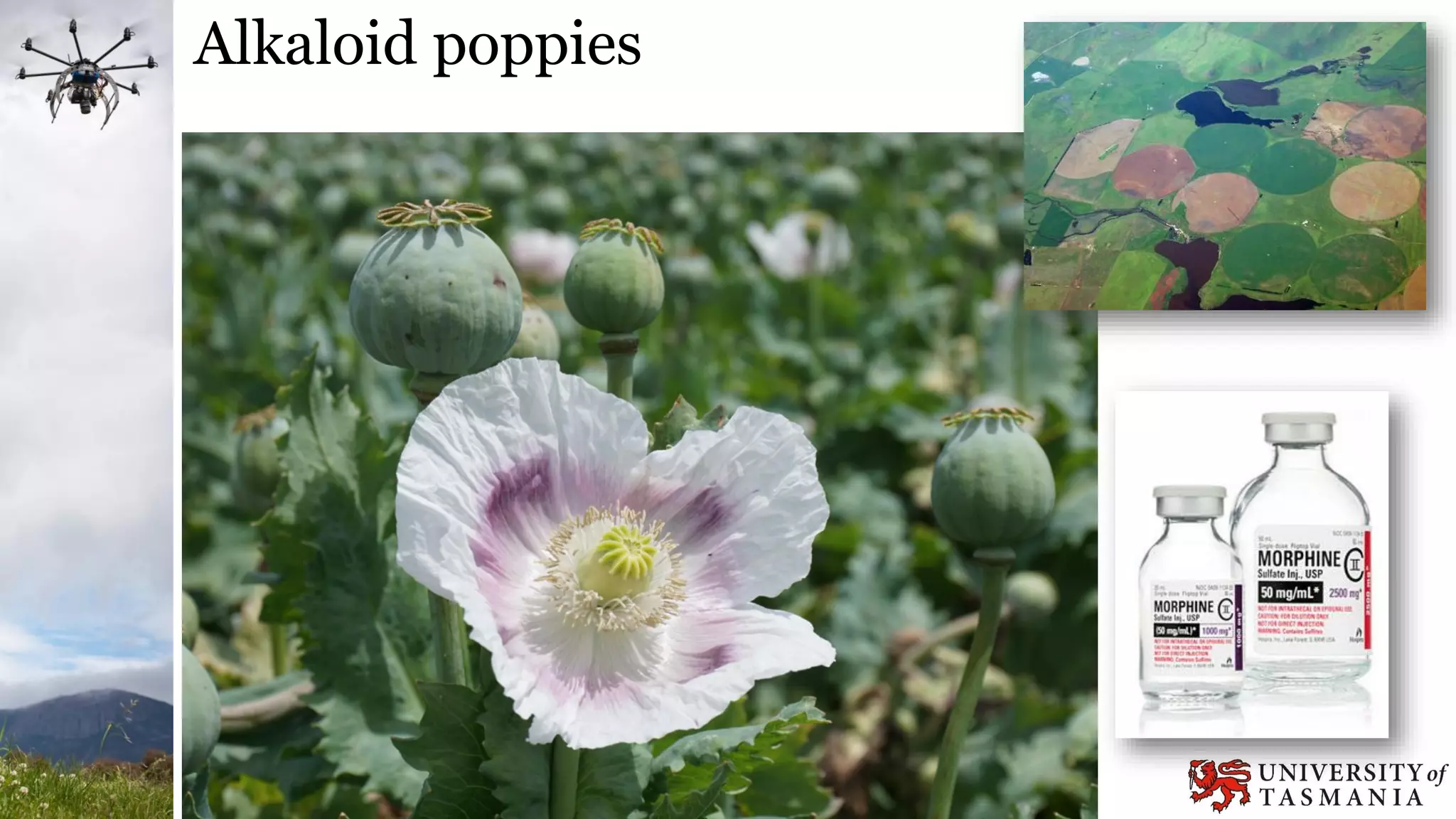
Alkaloid poppies
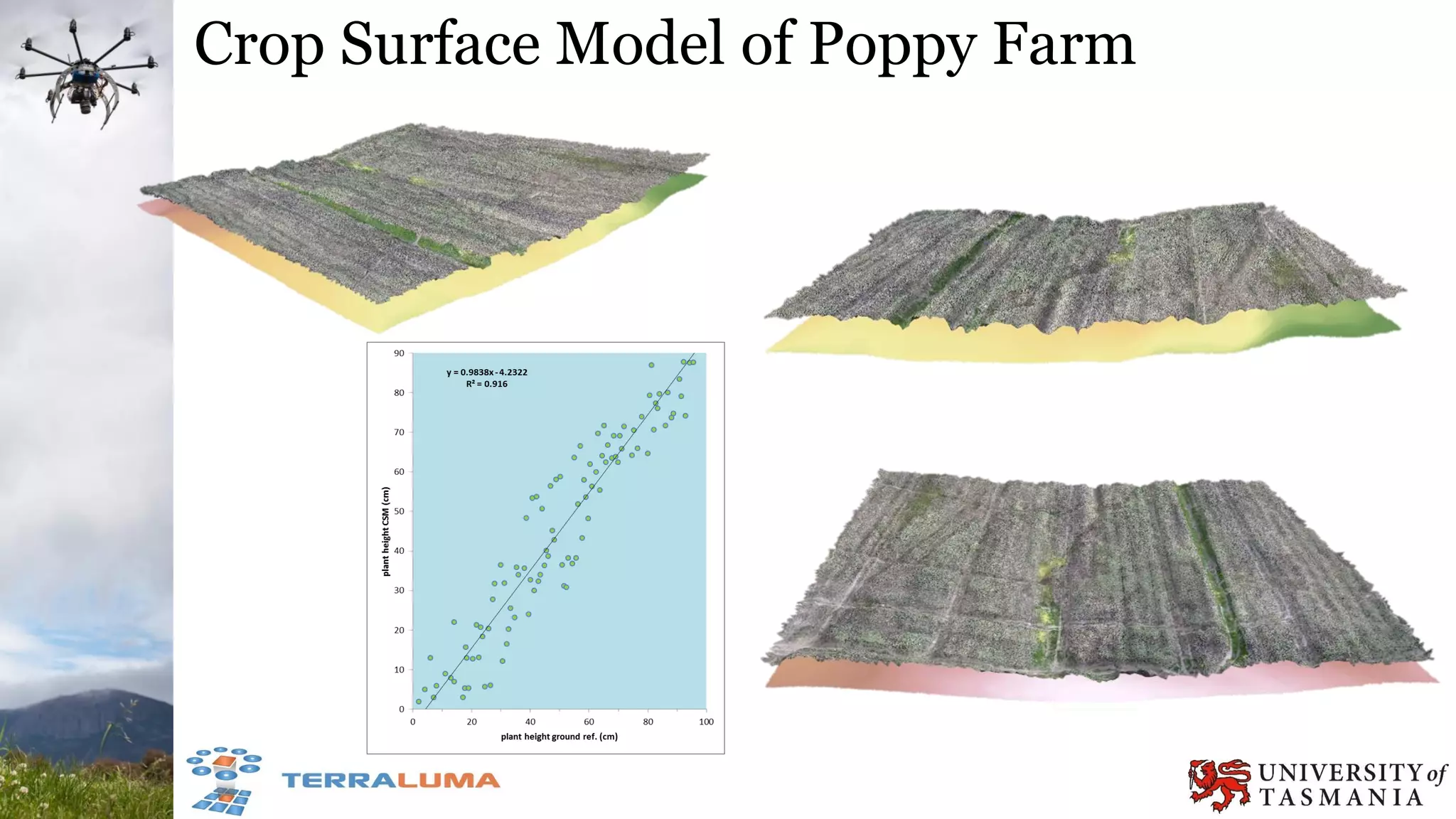
Crop Surface Model of Poppy Farm
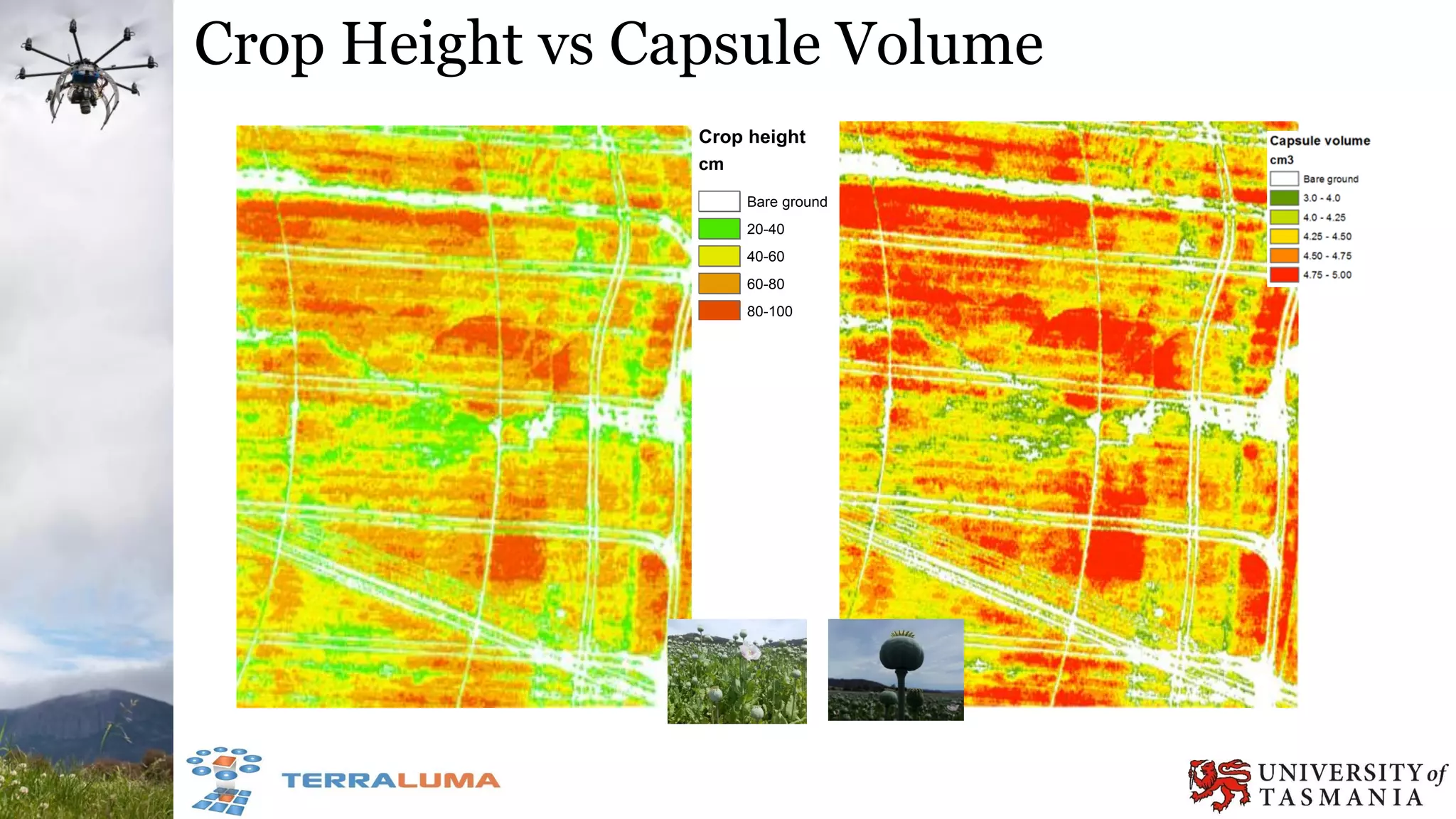
Crop Height vs Capsule Volume
Crop height
cm
20-40
40-60
60-80
80-100
Bare ground
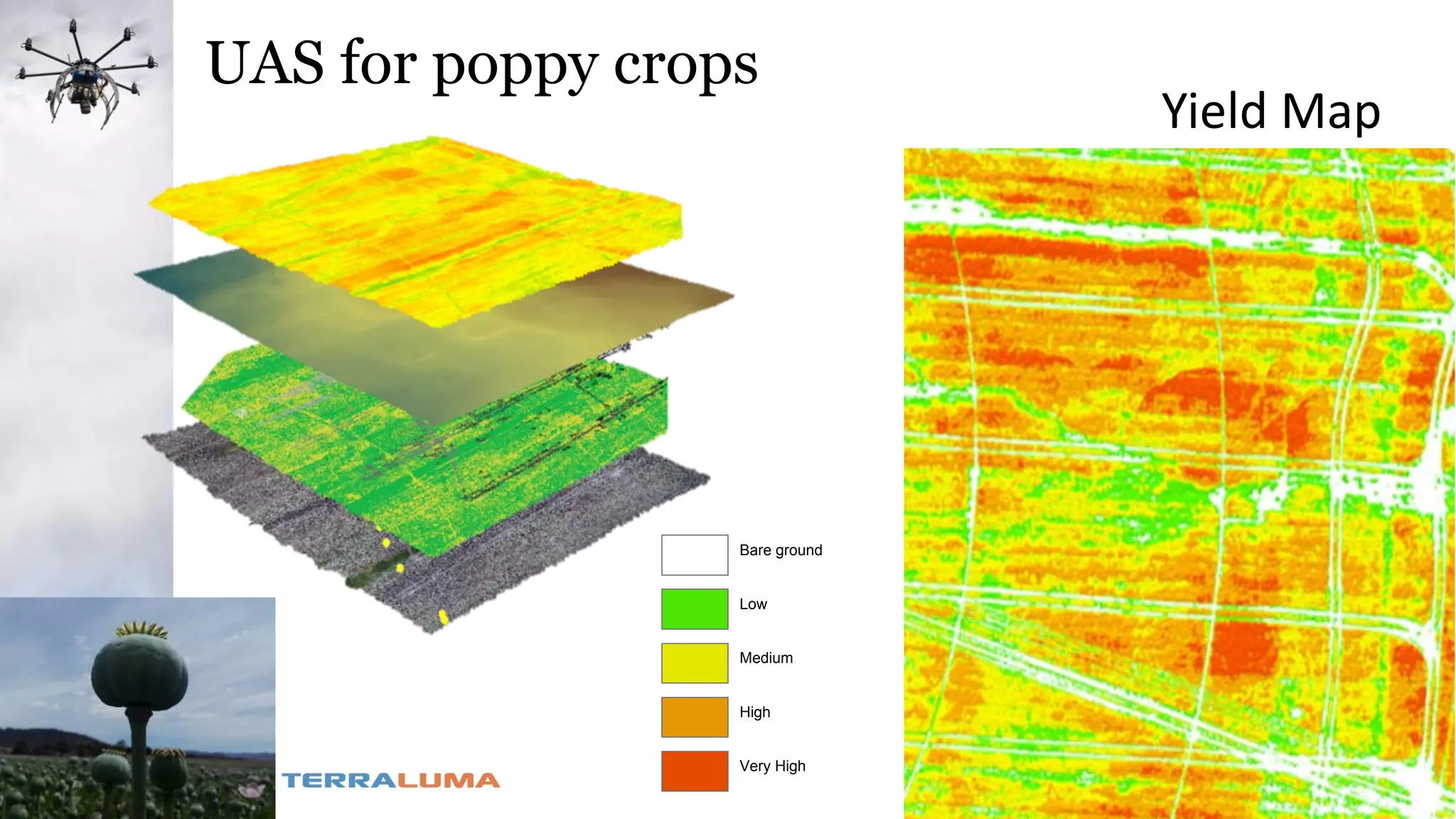
UAS for poppy crops
Low
Medium
High
Very High
Bare ground
Yield Map
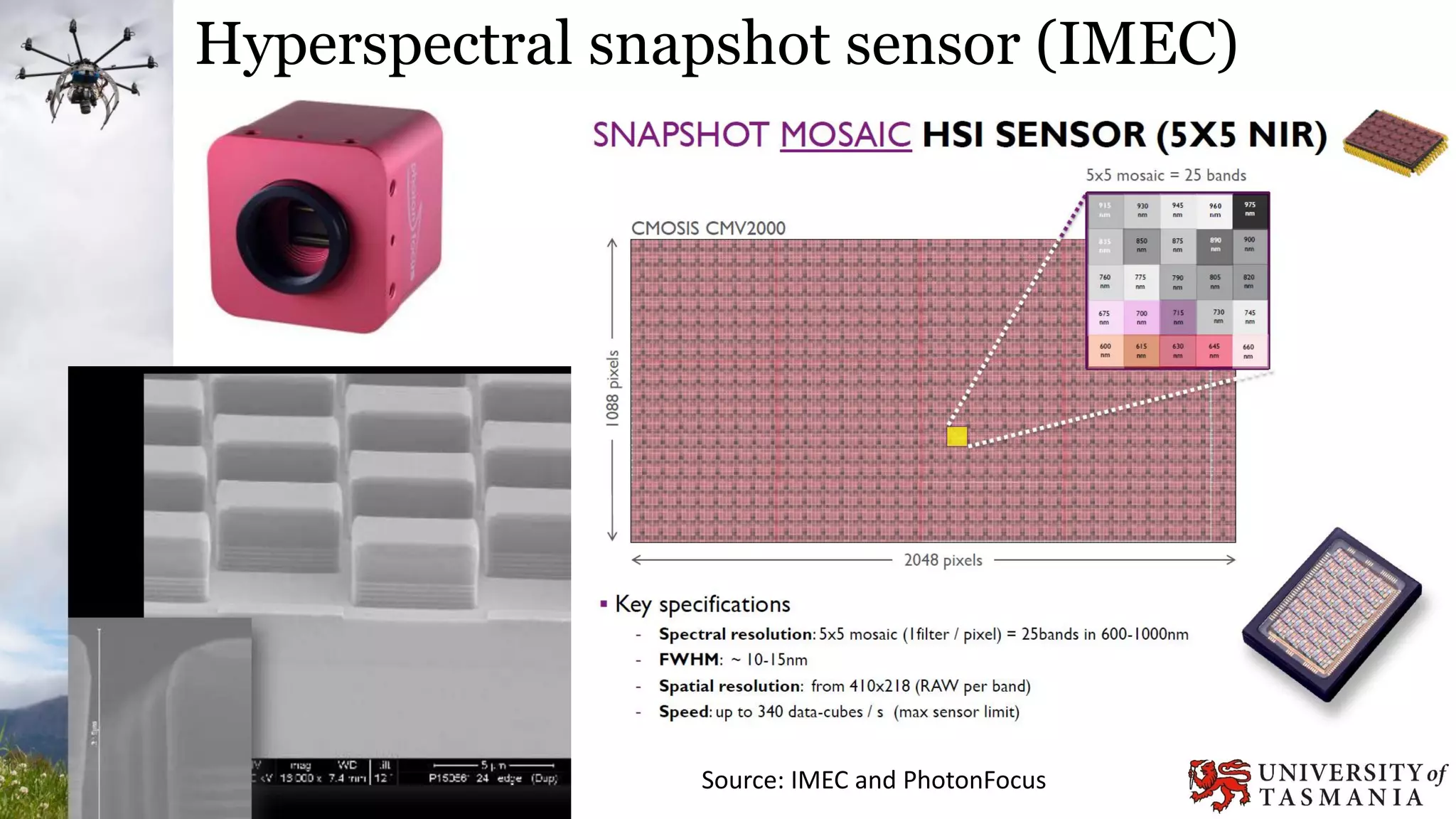
Hyperspectral snapshot sensor (IMEC)
Source: IMEC and PhotonFocus
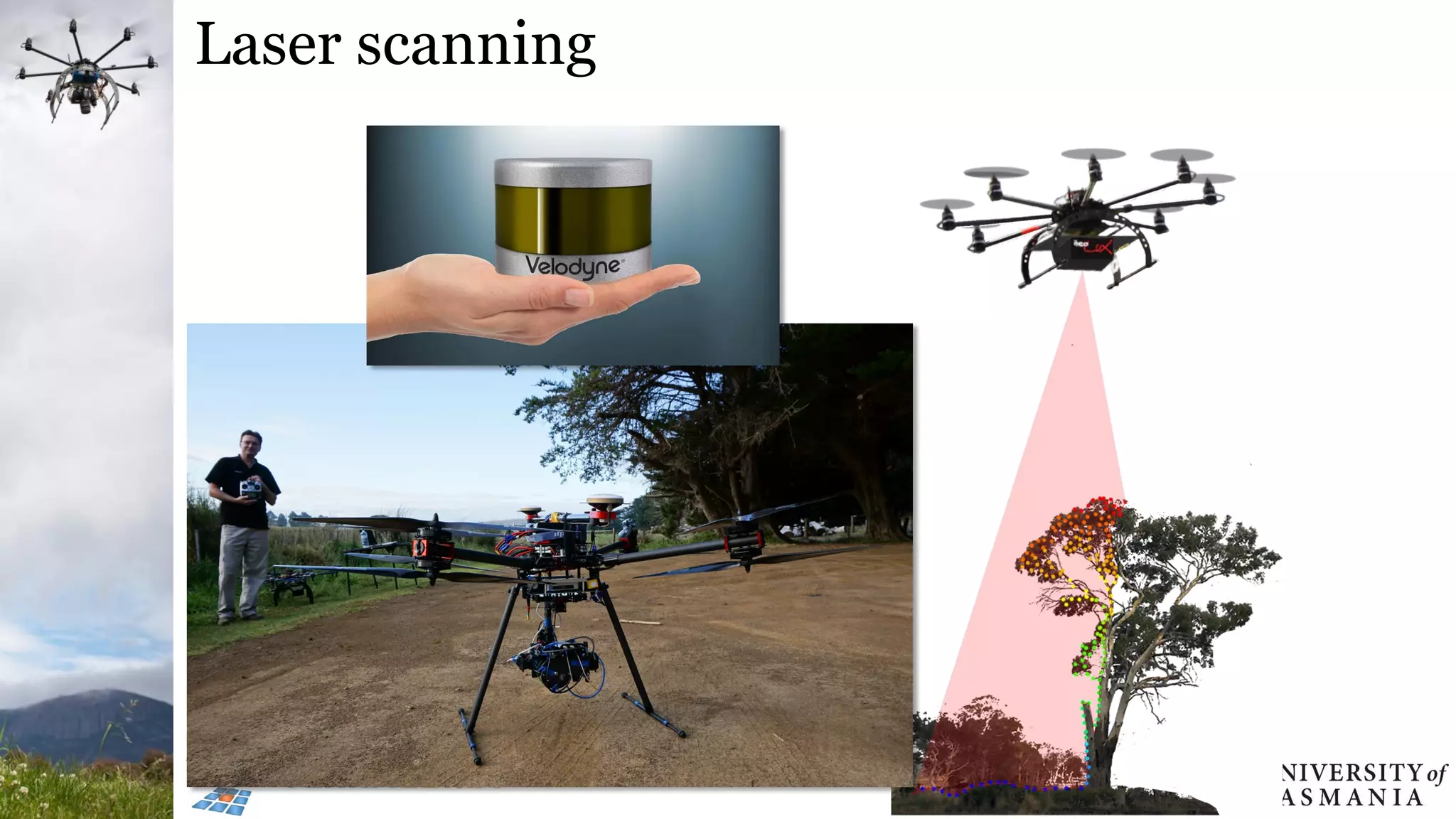
Laser scanning
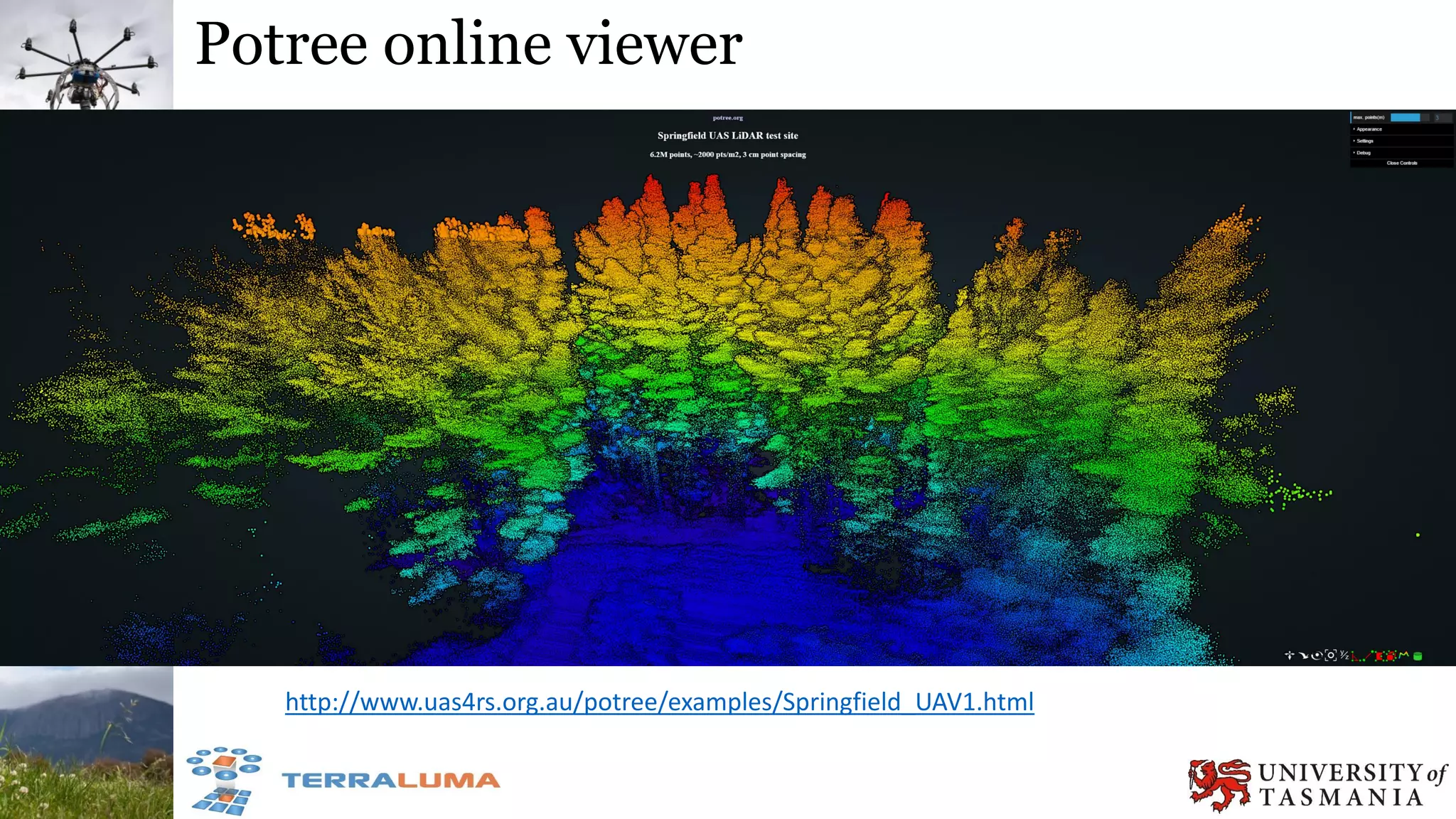
Potree online viewer
http://www.uas4rs.org.au/potree/examples/Springfield_UAV1.html
Conclusions
• UAS are an effective tool to capture high-resolution
imagery
• UAS imagery can be used for wide range of applications
• Research required to overcome hurdles and generate
“demonstrator studies”
• Calibration is critical
• The future of UAS remote sensing is exciting!
The following slides are courtesy of
Professor Stuart Phinn (UQ)
They were presented at the
UAS4RS conference
24th-25th May 2017
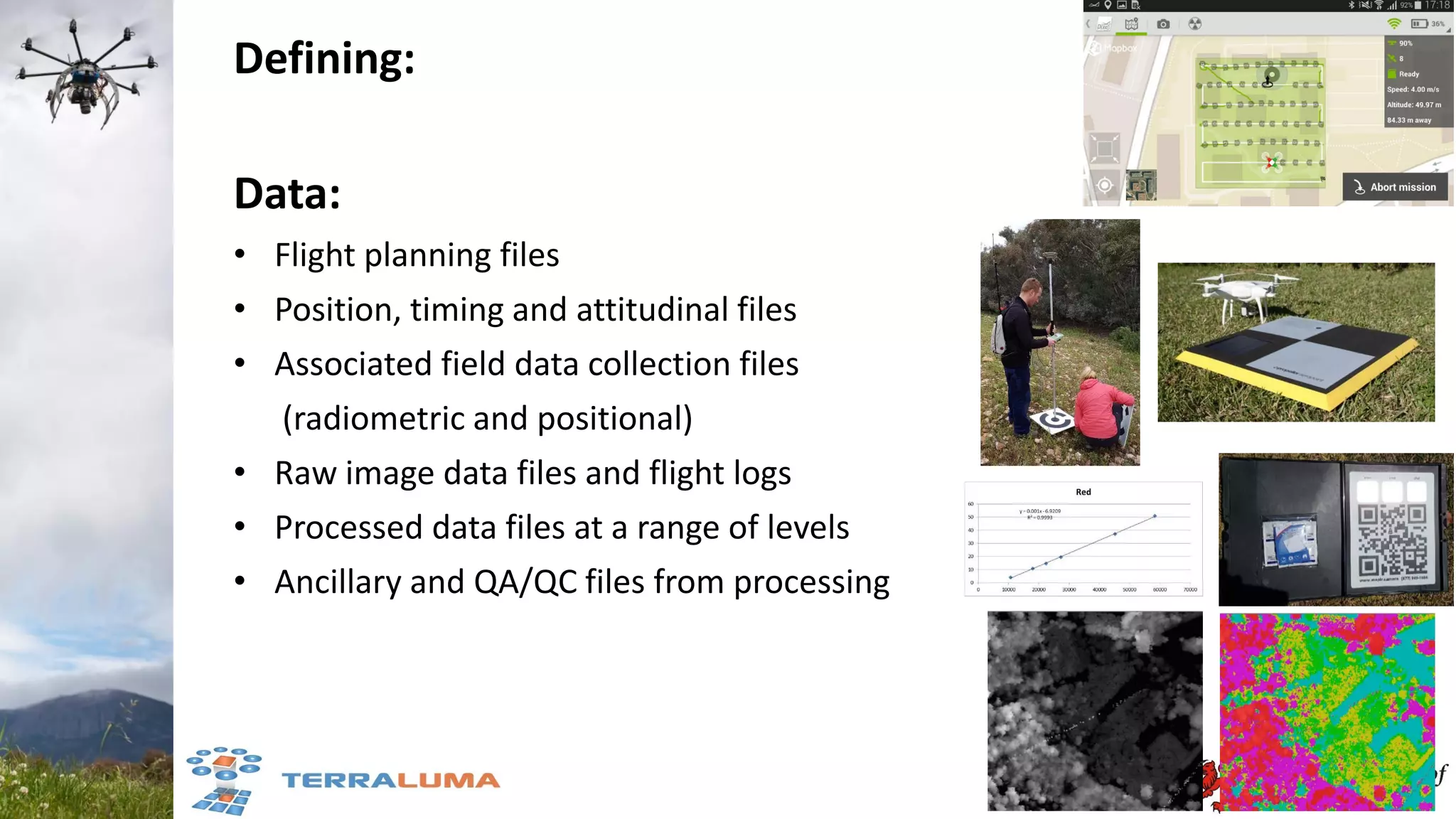
Defining:
Data:
• Flight planning files
• Position, timing and attitudinal files
• Associated field data collection files
(radiometric and positional)
• Raw image data files and flight logs
• Processed data files at a range of levels
• Ancillary and QA/QC files from processing
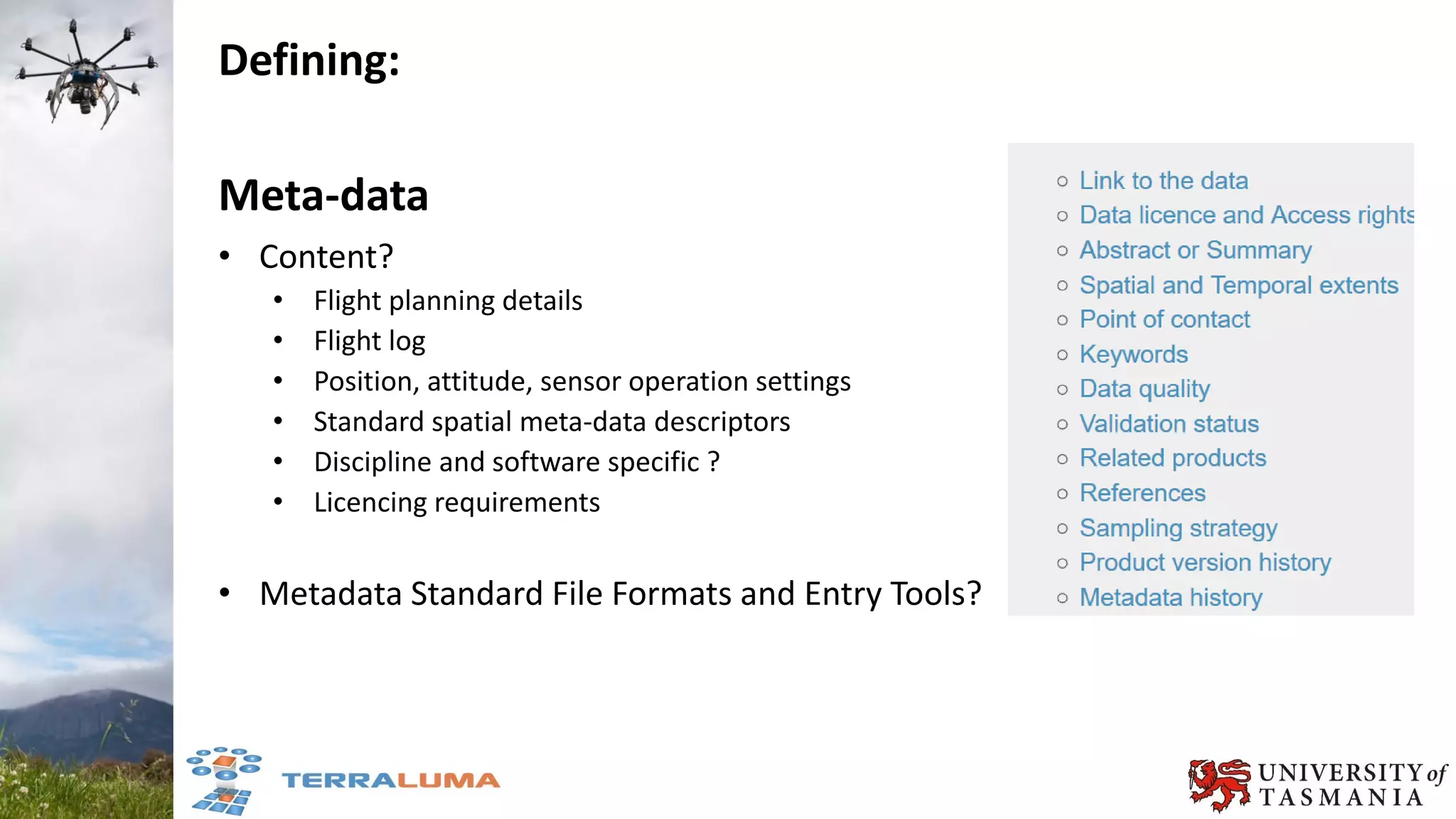
Defining:
Meta-data
• Content?
• Flight planning details
• Flight log
• Position, attitude, sensor operation settings
• Standard spatial meta-data descriptors
• Discipline and software specific ?
• Licencing requirements
• Metadata Standard File Formats and Entry Tools?
Defining:
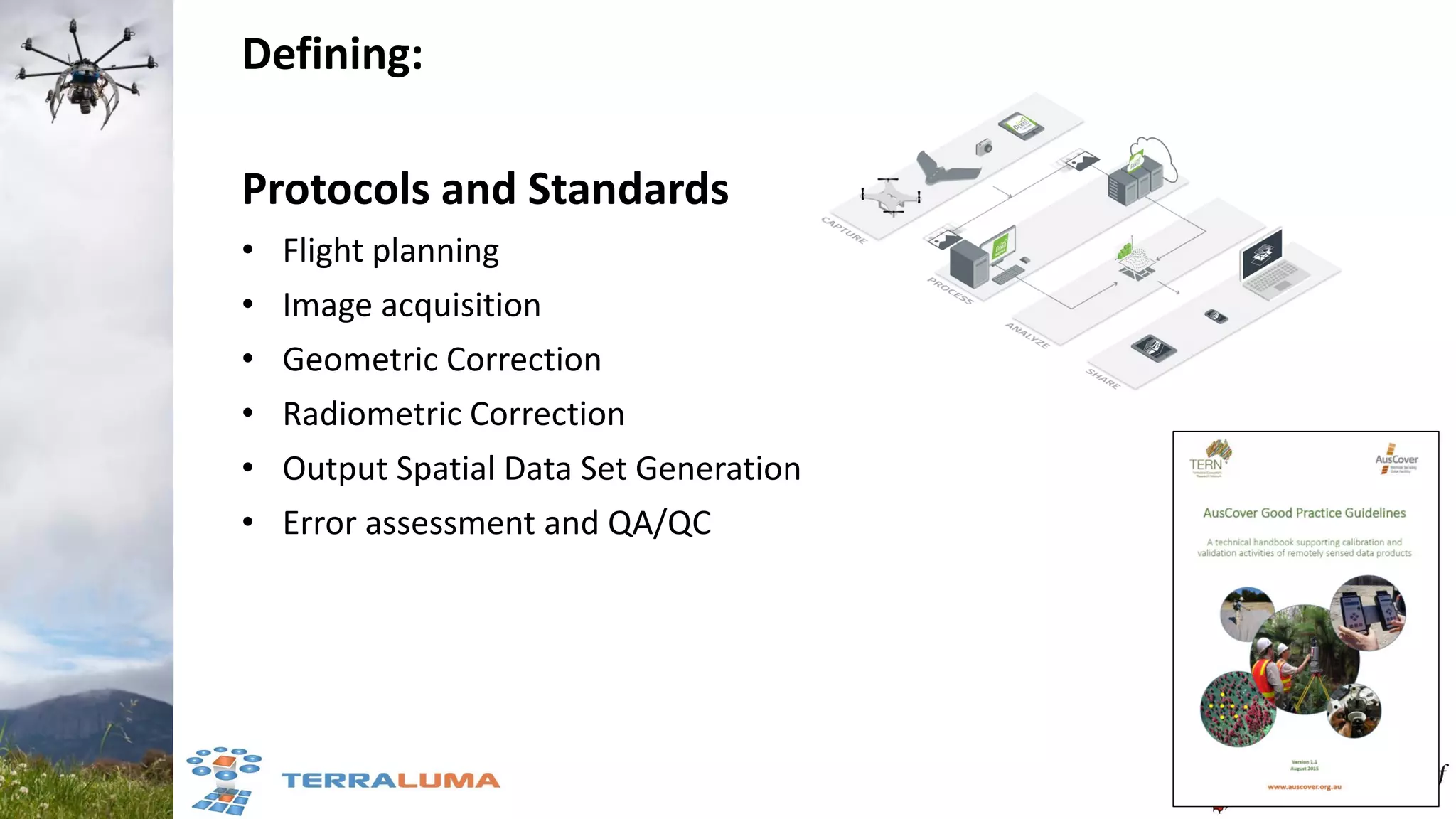
Protocols and Standards
• Flight planning
• Image acquisition
• Geometric Correction
• Radiometric Correction
• Output Spatial Data Set Generation
• Error assessment and QA/QC
• Purposes of data publishing:
• Requirement of funding or institution
• Security, and return from investment
• Enable discovery and re-use
• Stages of data publishing:
• Collection
• Verification and Quality Assurance + Checking
• Storage format
• Metadata selection and generation
• Select and assign licence
• Assign unique and citable identifier
• Select suitable Publisher-Portal
• Publish….
Defining:
Publishing
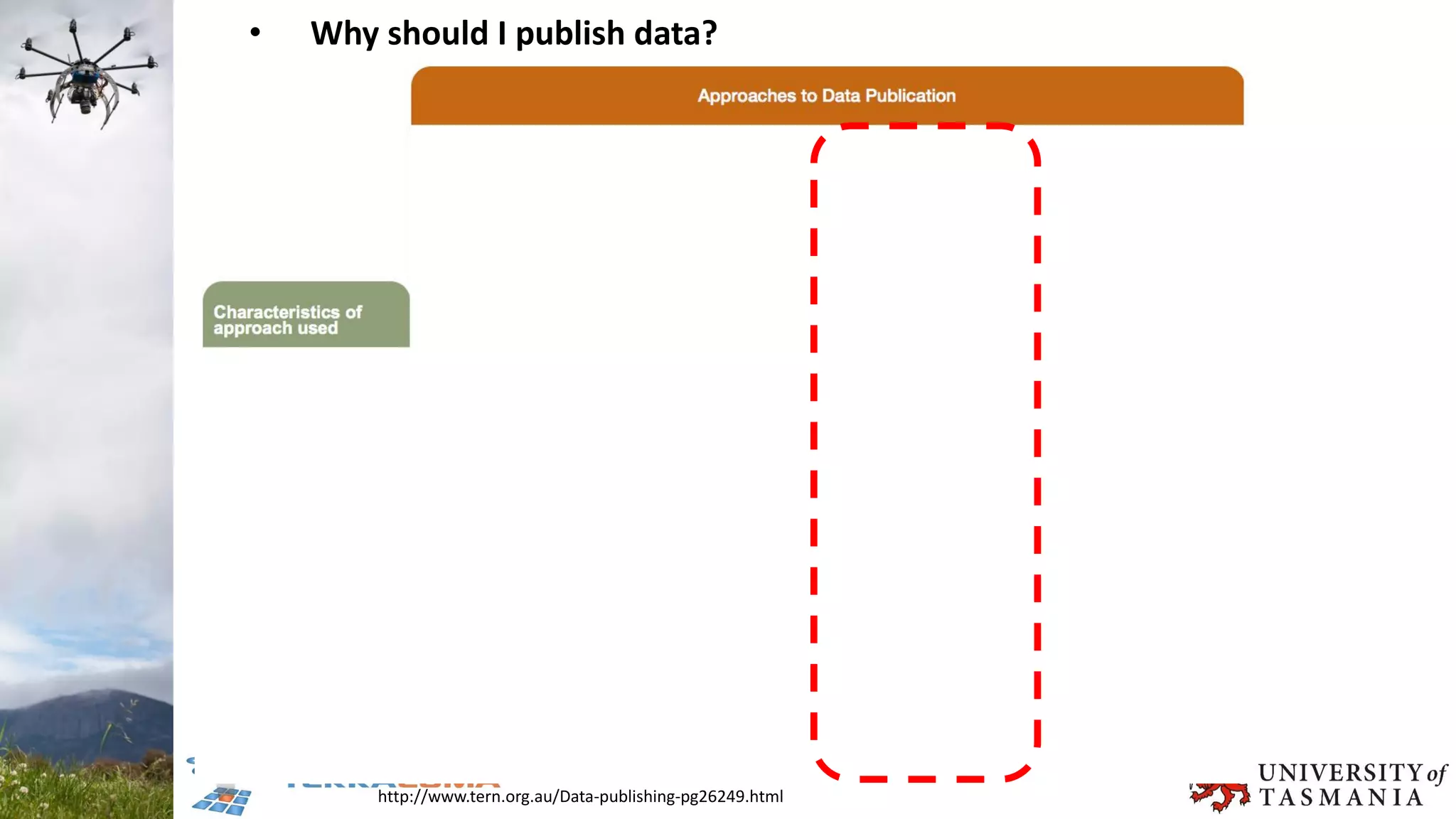
• Why should I publish data?
http://www.tern.org.au/Data-publishing-pg26249.html
How?
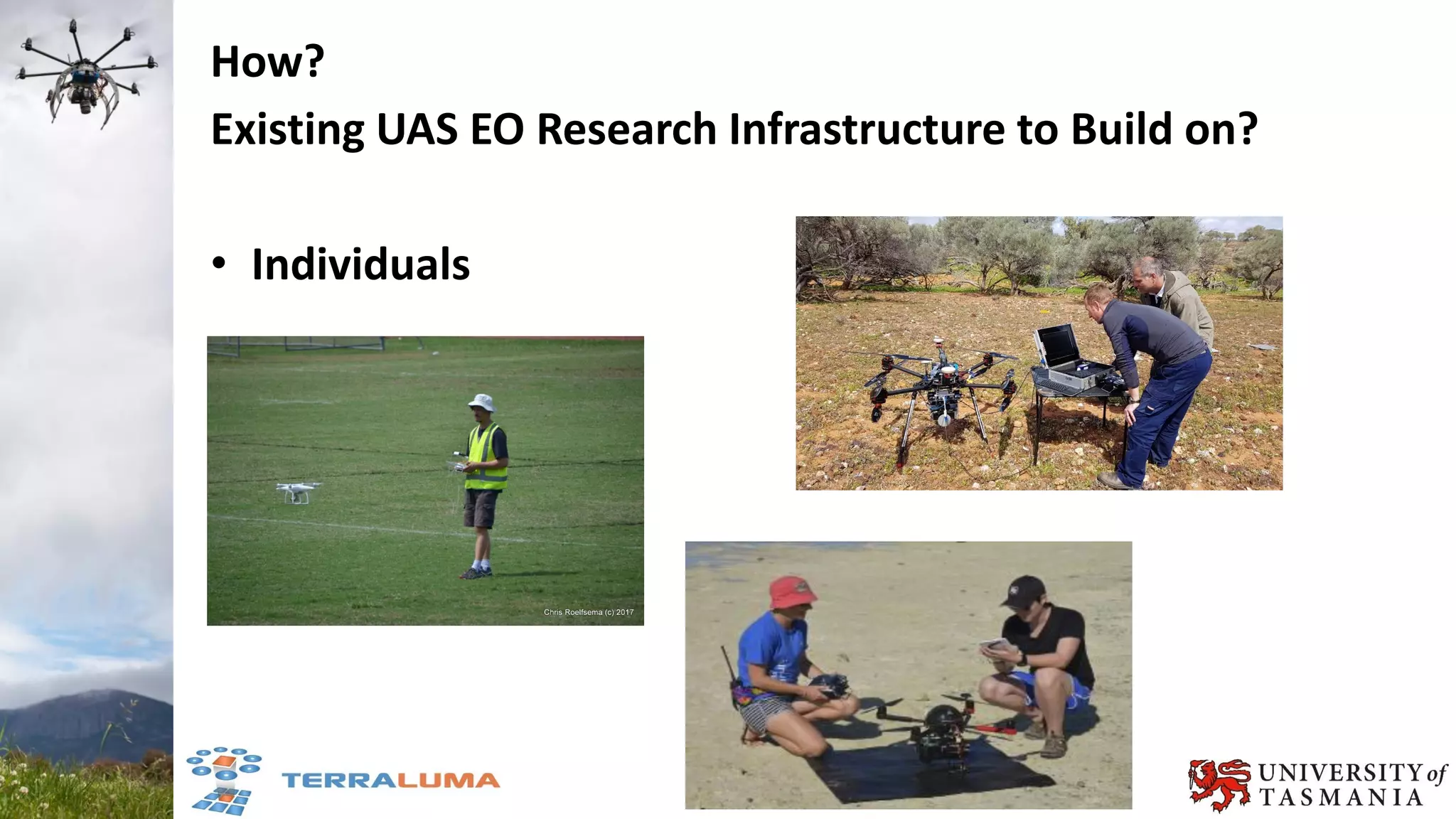
Existing UAS EO Research Infrastructure to Build on?
• Individuals
How?
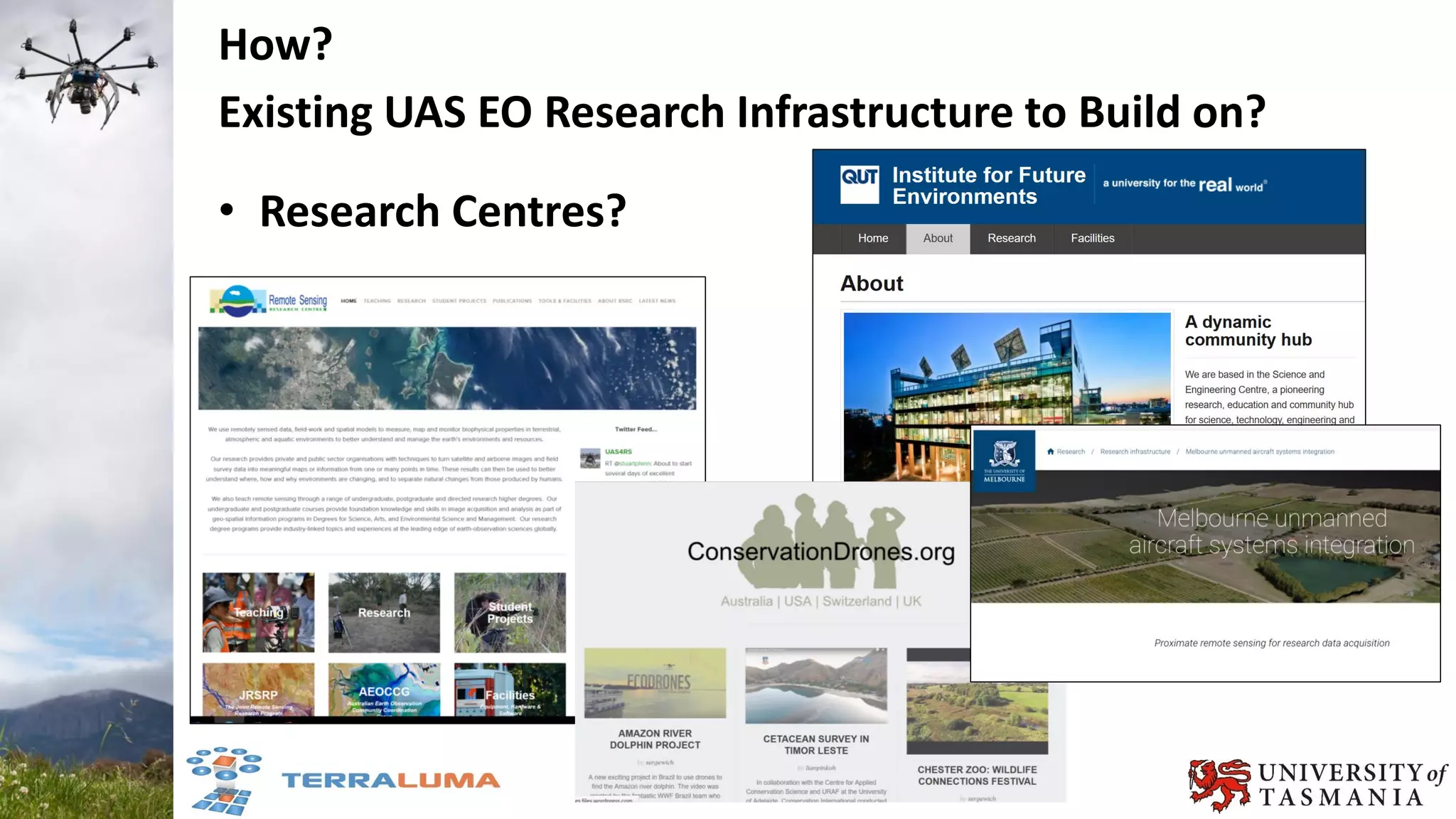
Existing UAS EO Research Infrastructure to Build on?
• Research Centres?
How:
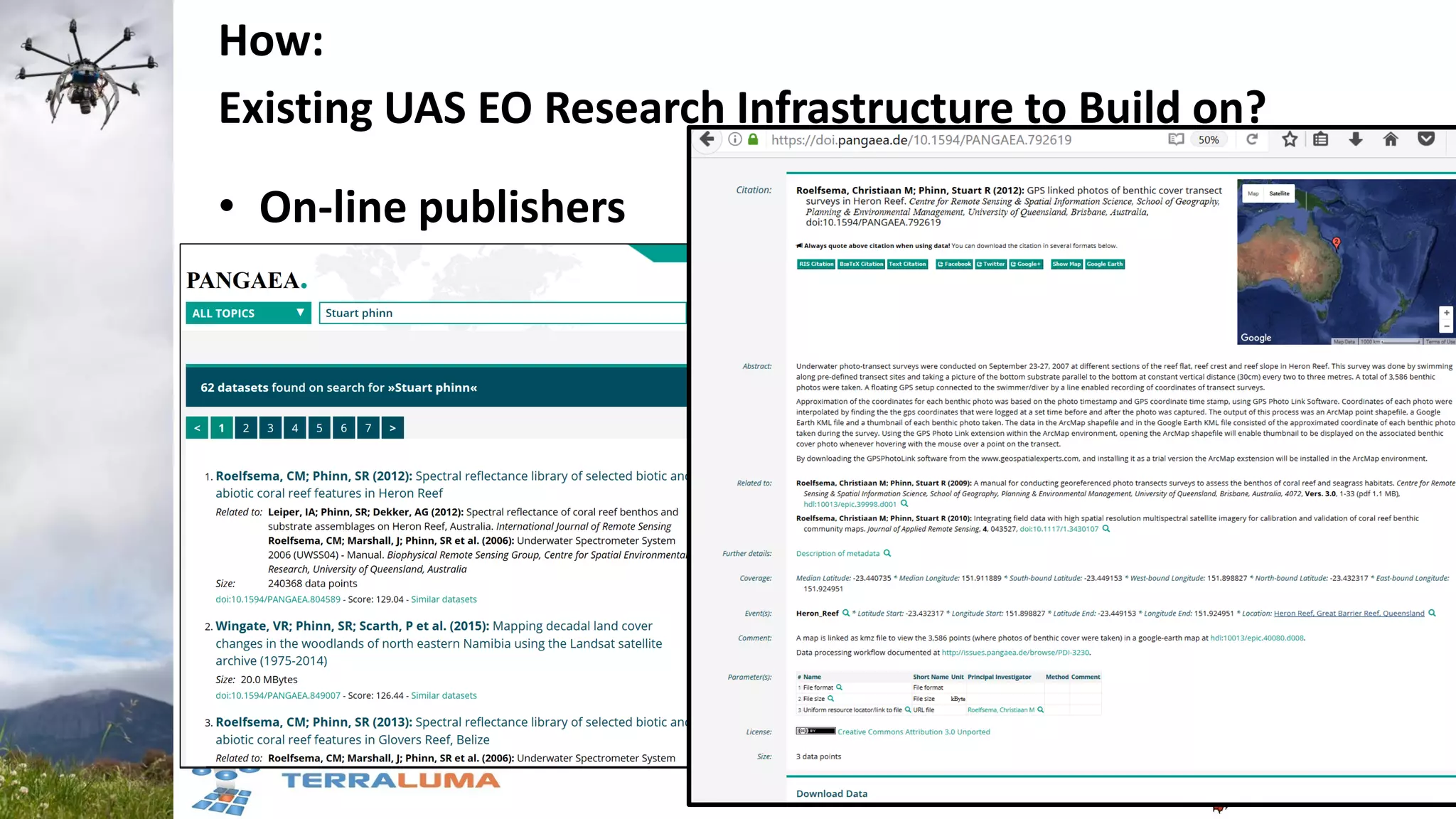
Existing UAS EO Research Infrastructure to Build on?
• On-line publishers
How:
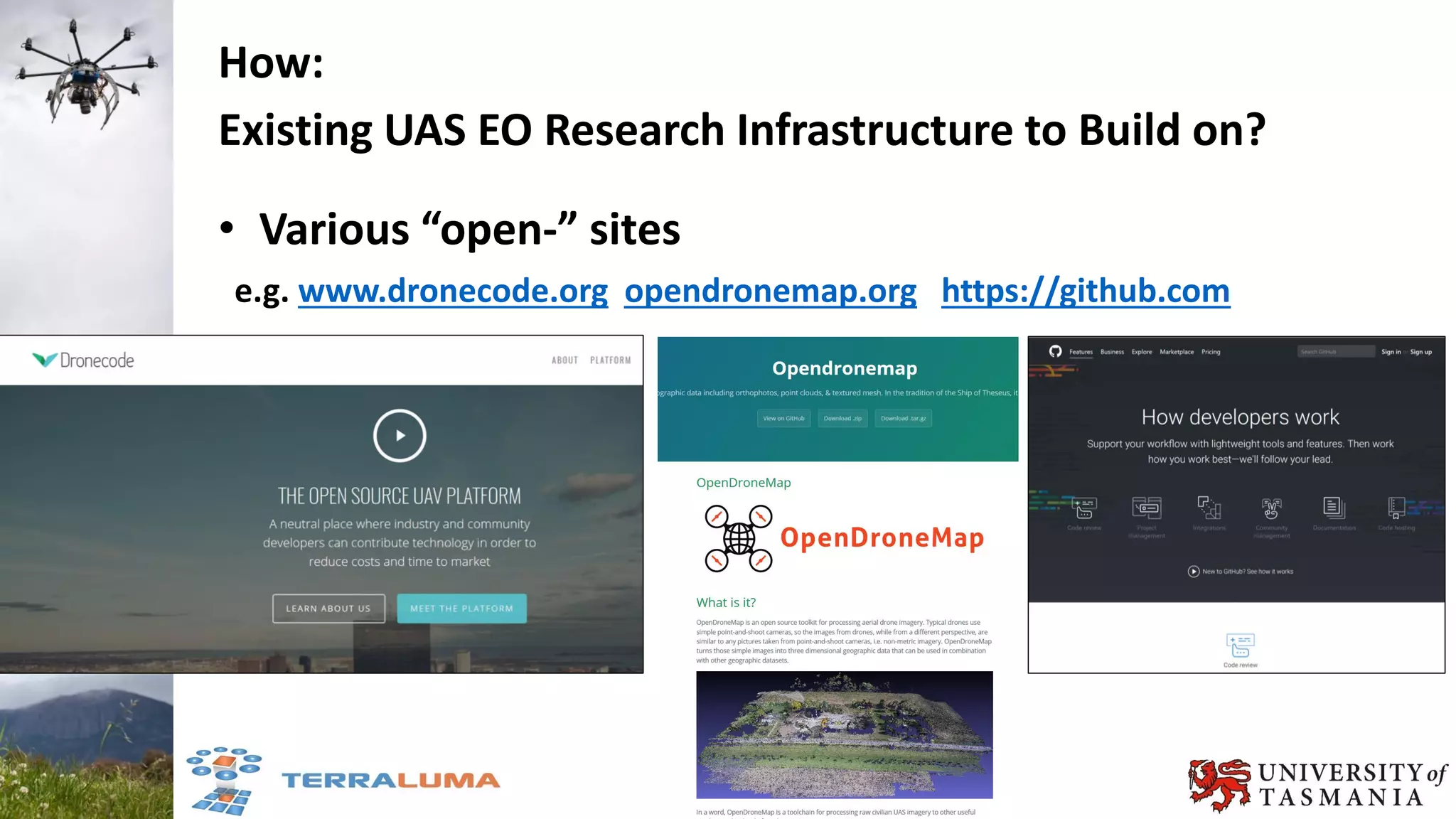
Existing UAS EO Research Infrastructure to Build on?
• Various “open-” sites
e.g. www.dronecode.org opendronemap.org https://github.com
How:
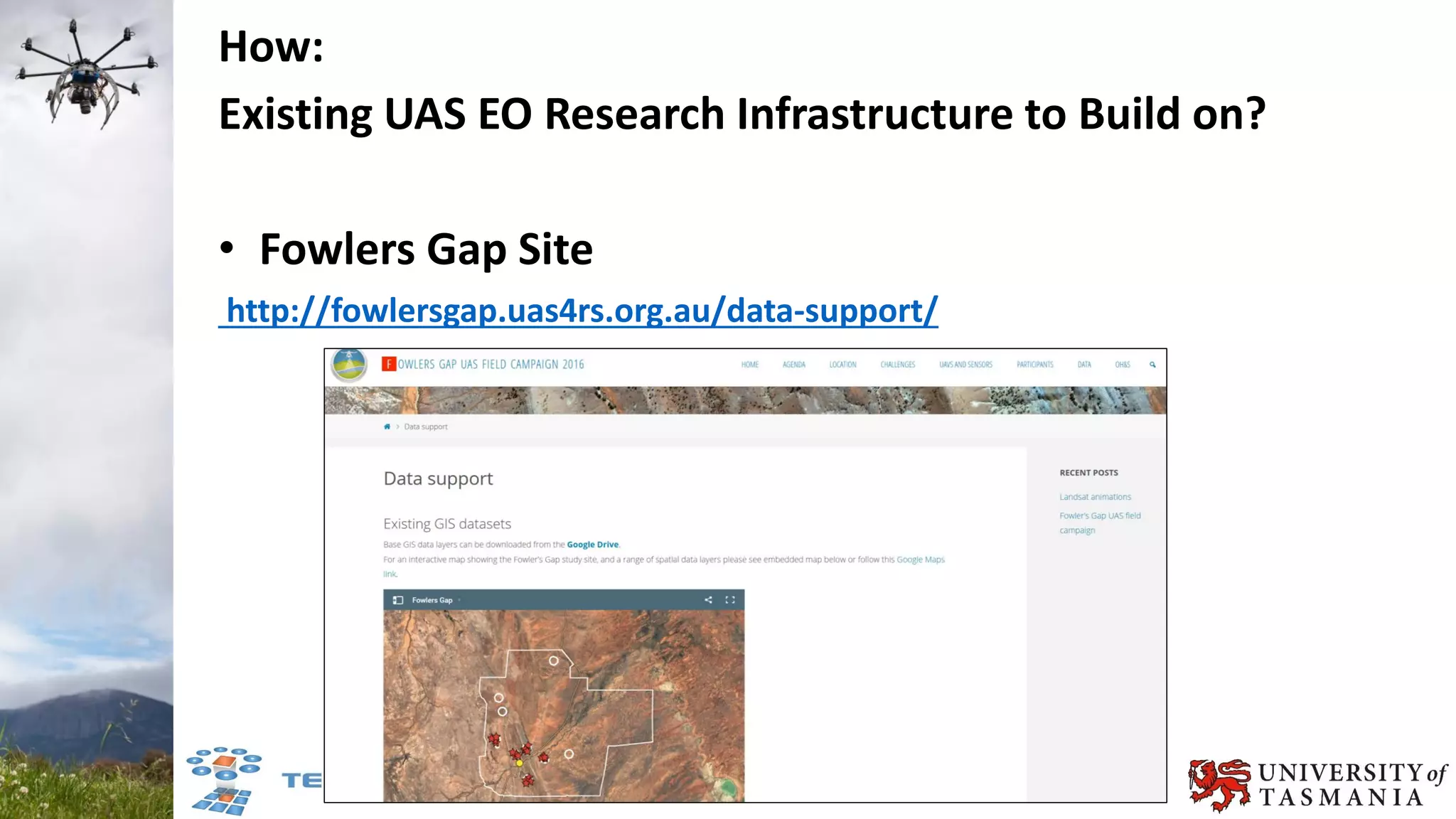
Existing UAS EO Research Infrastructure to Build on?
• Fowlers Gap Site
http://fowlersgap.uas4rs.org.au/data-support/
How:
Existing UAS EO Research Infrastructure to Build on?
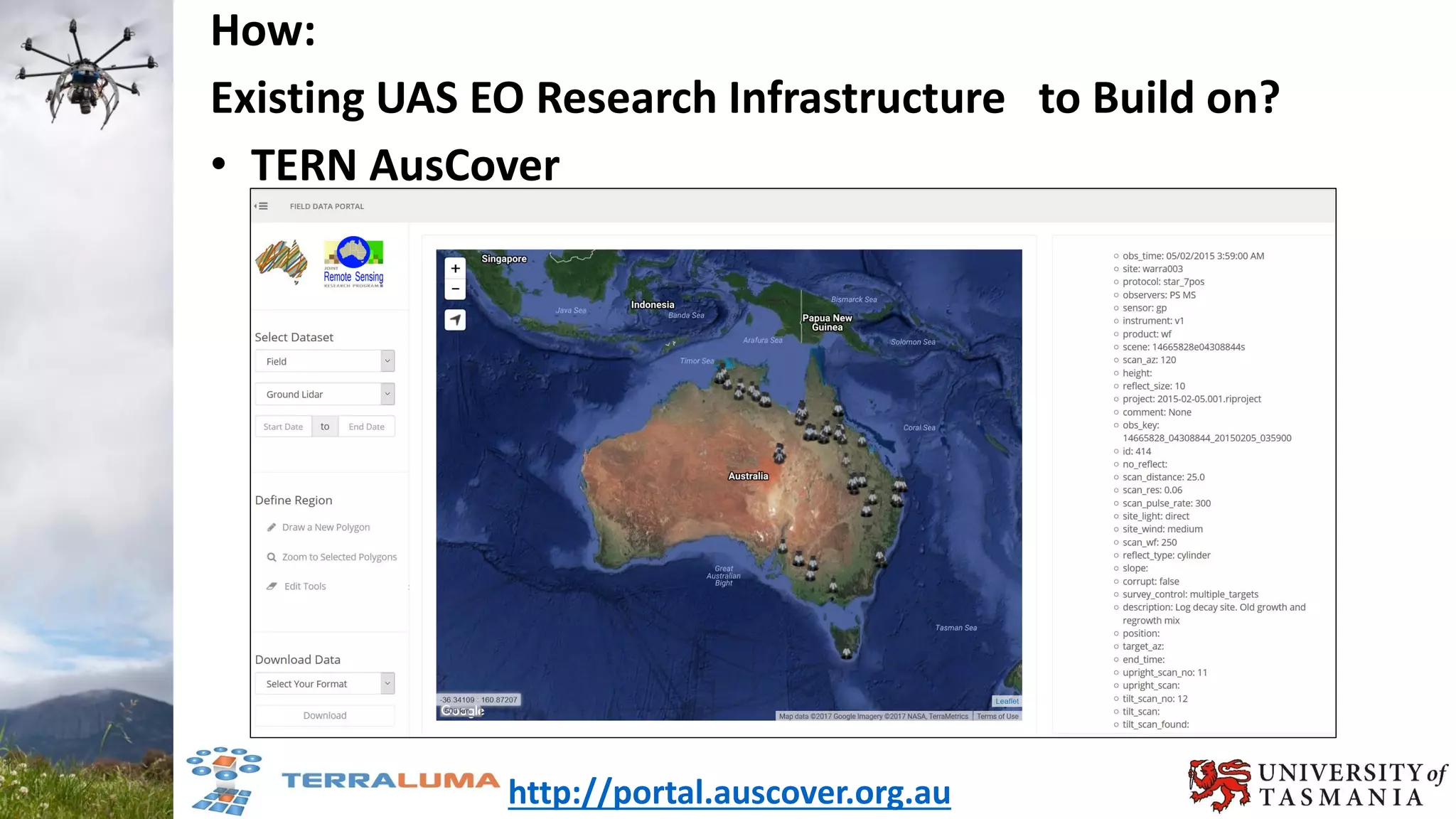
• TERN AusCover
http://portal.auscover.org.au
How:
Existing UAS EO Research Infrastructure to Build on?
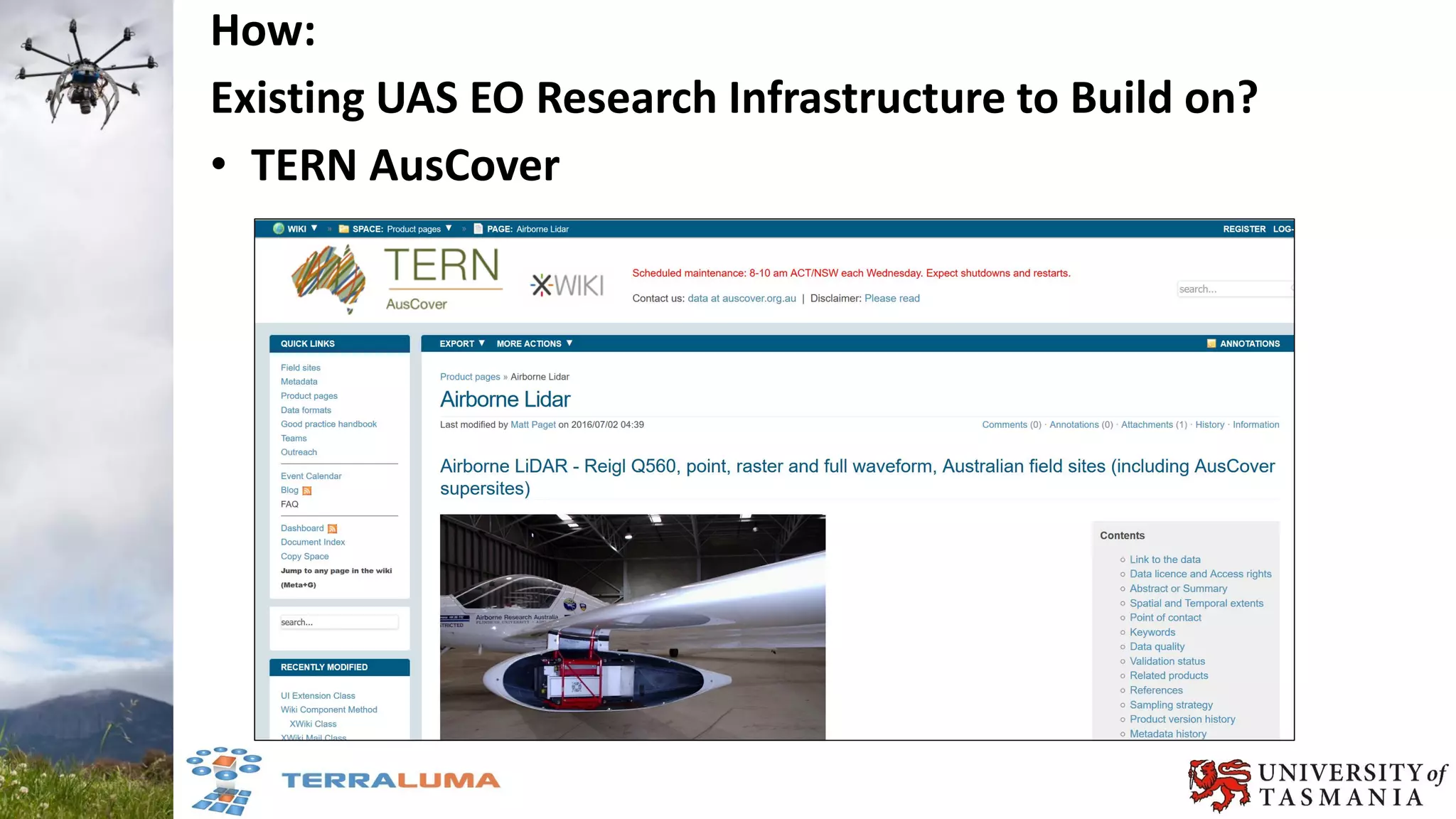
• TERN AusCover
???
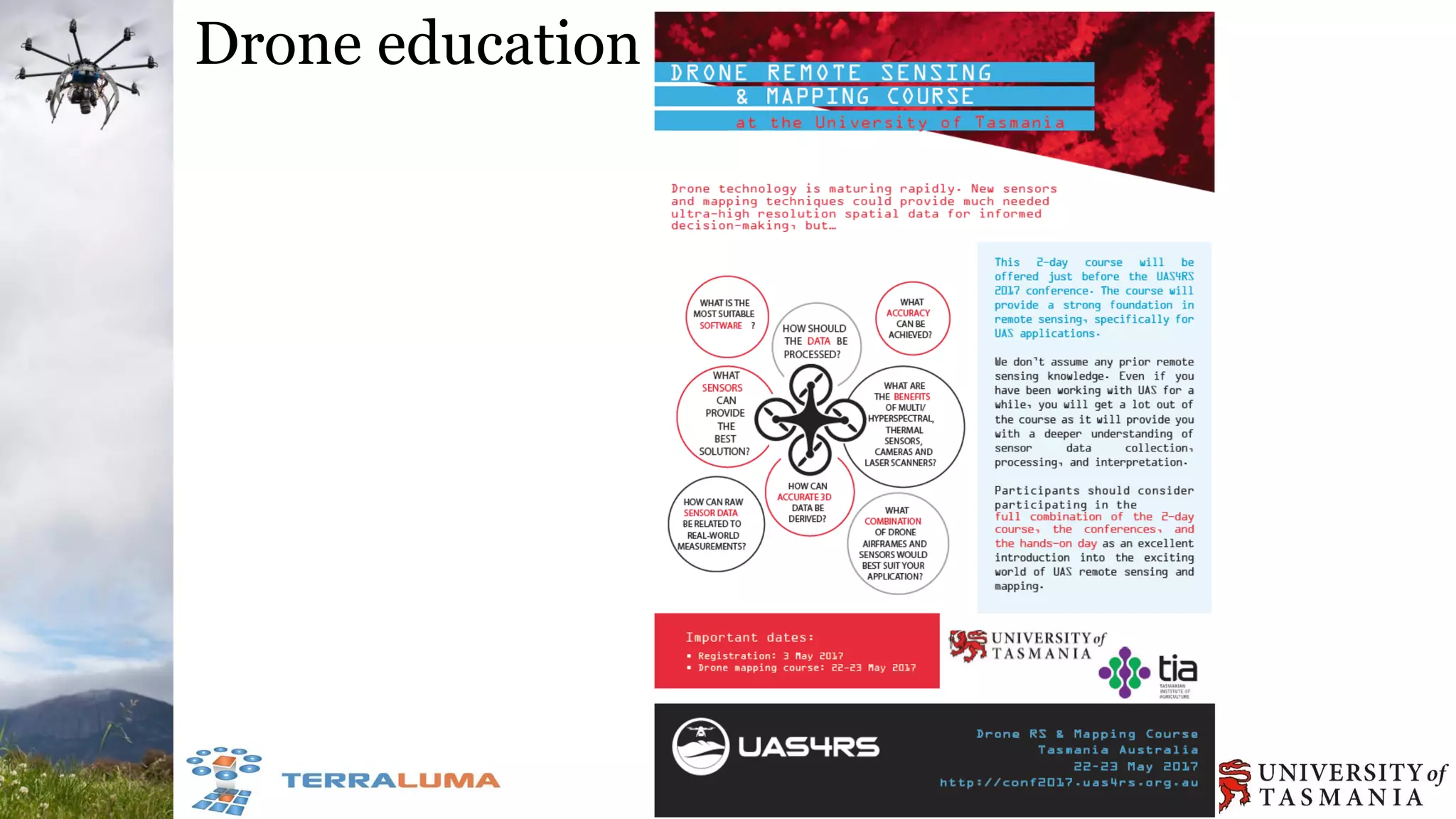
Drone education
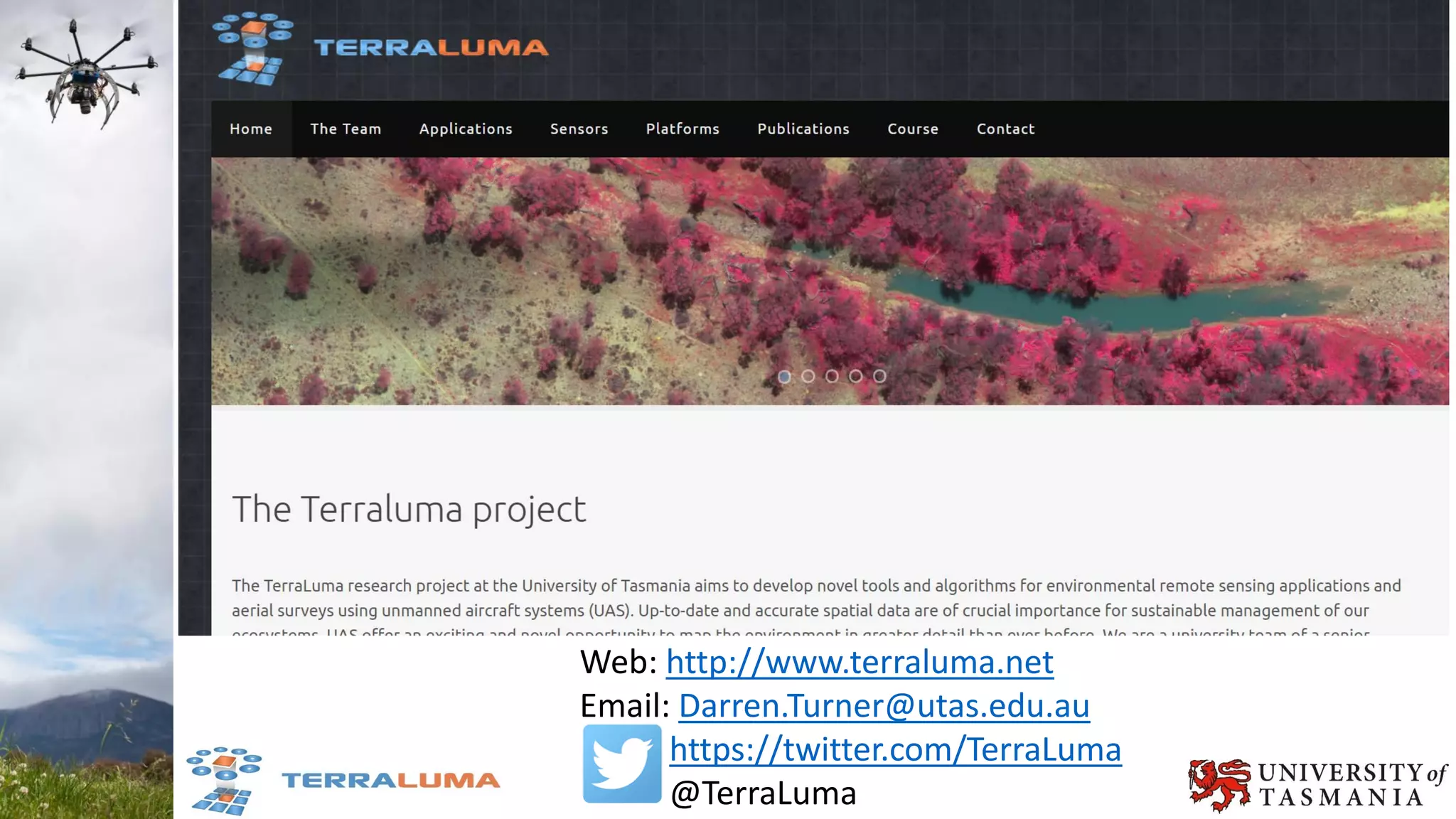
Web: http://www.terraluma.net
Email: Darren.Turner@utas.edu.au
https://twitter.com/TerraLuma
@TerraLuma

Remote sensing with drones: The challenges of obtaining truly quantitative data (beyond pretty pictures)

  • 1.
    Dr Darren Turner- TerraLuma research group Surveying and Spatial Sciences School of Land & Food Remote sensing with drones: The challenges of obtaining truly quantitative data (beyond pretty pictures)
  • 2.
    TerraLuma • We developUnmanned Aircraft Systems (UAS) and image processing techniques for environmental, agricultural, and high-precision aerial mapping applications • Our focus is on quantitative remote sensing of vegetation with the use of sophisticated UAS sensors to better understand the structure, distribution, and functioning of vegetation, and to bridge the observational scale gap between field samples and satellite observations.
  • 3.
    Problems with satellite& airborne remote sensing • Spatial resolution not high enough (2 m – 30 m pixel size) • Not frequent enough + can’t get imagery when needed • High Res commercial imagery $$$$$$ • Mainly suitable for large areas • Only one specific sensor • Unmanned Aircraft Systems (UAS also known as UAVs or drones) fill this niche
  • 4.
    •Unique aspects ofUAS for mapping/monitoring: 1.Spatial resolution: Highest spatial resolution imagery available (1 cm) 2.Temporal resolution: Fly on-demand at critical stages 3.Spectral resolution: Integration of multiple sensors imaging outside the visible range (both passive and active)
  • 5.
  • 6.
  • 7.
  • 8.
  • 9.
  • 10.
    Barley – UASRGB image True colour composite of Uni Farm Barley Crop – 30/11/2010
  • 11.
    Barley – UASnear-infrared image False colour composite (Green, Red, Infrared) of Uni Farm Barley Crop – 30/11/2010
  • 12.
    Normalised Difference VegetationIndex (NDVI) NDVI of Uni Farm Barley Crop – 30/11/2010
  • 13.
    Image courtesy ofK. Price. https://www.agronomy.org/story/2013/nov/tue/improved-crop-monitoring-takes-flight NDVI ≠ yield NDVI ≠ health NDVI ≠ stress Meaning of NDVI?
  • 14.
    University of MelbourneDookie Experiment Sites UAV-borne Wheat Growth Monitoring: Nitrogen impact Source: Richard Eckard, UniMelb
  • 15.
  • 16.
    Thermal imaging Thermal Imageof Uni Farm Barley Crop – 30/11/2010
  • 17.
  • 19.
    Houston’s Farm Paddock ofLettuce 2 cm/pixel resolution mosaic Flying height 80 m Total area 2 ha
  • 20.
  • 21.
    HyperUAS Lucieer, A.,Malenovsky, Z., Veness, T., Wallace, L. (2014). HyperUAS – Imaging spectroscopy from a multi-rotor unmanned aircraft system. Journal of Field Robotics, 31(4): 571-590. doi:10.1002/rob.21508 TM_width Green Yellow Withering Vegetation Wavelength (nm) Reflectance -0.05 0.05 0.15 0.25 0.35 0.45 0.55 400 600 800 1000 1200 1400 1600 1800 2000 2200 2400 41 32 5 7
  • 24.
  • 27.
    Crop Surface Modelof Poppy Farm
  • 28.
    Crop Height vsCapsule Volume Crop height cm 20-40 40-60 60-80 80-100 Bare ground
  • 29.
    UAS for poppycrops Low Medium High Very High Bare ground Yield Map
  • 31.
    Hyperspectral snapshot sensor(IMEC) Source: IMEC and PhotonFocus
  • 35.
  • 36.
  • 37.
    Conclusions • UAS arean effective tool to capture high-resolution imagery • UAS imagery can be used for wide range of applications • Research required to overcome hurdles and generate “demonstrator studies” • Calibration is critical • The future of UAS remote sensing is exciting!
  • 38.
    The following slidesare courtesy of Professor Stuart Phinn (UQ) They were presented at the UAS4RS conference 24th-25th May 2017
  • 39.
    Defining: Data: • Flight planningfiles • Position, timing and attitudinal files • Associated field data collection files (radiometric and positional) • Raw image data files and flight logs • Processed data files at a range of levels • Ancillary and QA/QC files from processing
  • 40.
    Defining: Meta-data • Content? • Flightplanning details • Flight log • Position, attitude, sensor operation settings • Standard spatial meta-data descriptors • Discipline and software specific ? • Licencing requirements • Metadata Standard File Formats and Entry Tools?
  • 41.
    Defining: Protocols and Standards •Flight planning • Image acquisition • Geometric Correction • Radiometric Correction • Output Spatial Data Set Generation • Error assessment and QA/QC
  • 42.
    • Purposes ofdata publishing: • Requirement of funding or institution • Security, and return from investment • Enable discovery and re-use • Stages of data publishing: • Collection • Verification and Quality Assurance + Checking • Storage format • Metadata selection and generation • Select and assign licence • Assign unique and citable identifier • Select suitable Publisher-Portal • Publish…. Defining: Publishing
  • 43.
    • Why shouldI publish data? http://www.tern.org.au/Data-publishing-pg26249.html
  • 44.
    How? Existing UAS EOResearch Infrastructure to Build on? • Individuals
  • 45.
    How? Existing UAS EOResearch Infrastructure to Build on? • Research Centres?
  • 46.
    How: Existing UAS EOResearch Infrastructure to Build on? • On-line publishers
  • 47.
    How: Existing UAS EOResearch Infrastructure to Build on? • Various “open-” sites e.g. www.dronecode.org opendronemap.org https://github.com
  • 48.
    How: Existing UAS EOResearch Infrastructure to Build on? • Fowlers Gap Site http://fowlersgap.uas4rs.org.au/data-support/
  • 49.
    How: Existing UAS EOResearch Infrastructure to Build on? • TERN AusCover http://portal.auscover.org.au
  • 50.
    How: Existing UAS EOResearch Infrastructure to Build on? • TERN AusCover
  • 51.
  • 52.
  • 53.