Construction
Experts in process design and material
processing for over 60 years.
Rotary Dryer
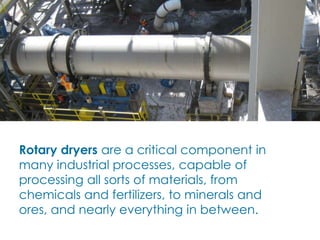
Rotary dryers are a critical component in
many industrial processes, capable of
processing all sorts of materials, from
chemicals and fertilizers, to minerals and
ores, and nearly everything in between.
While rotary dryers should be customized to
yield optimal processing conditions, the basis
of a rotary dryer is often somewhat standard.
While rotary dryers should be customized to
yield optimal processing conditions, the basis
of a rotary dryer is often somewhat standard.
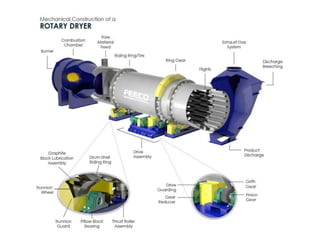
The following information offers an explanation
on some of the standard components of a
rotary dryer, as well as available
customizations. Some information may be
specific to FEECO rotary dryers.
Standard
Components
Dryer Shell
The shell of the dryer can be made from a
variety of materials, including:
Dryer Shell
The shell of the dryer can be made from a
variety of materials, including:
- Carbon Steel
Dryer Shell
The shell of the dryer can be made from a
variety of materials, including:
- Carbon Steel
- Stainless Steel
Dryer Shell
The shell of the dryer can be made from a
variety of materials, including:
- Carbon Steel
- Stainless Steel
- Hastelloy
Dryer Shell
The shell of the dryer can be made from a
variety of materials, including:
- Carbon Steel
- Stainless Steel
- Hastelloy
- Inconel
Dryer Shell
The shell of the dryer can be made from a
variety of materials, including:
- Carbon Steel
- Stainless Steel
- Hastelloy
- Inconel
- And other Alloys
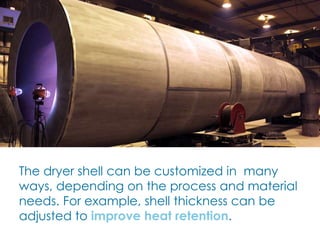
The dryer shell can be customized in many
ways, depending on the process and material
needs. For example, shell thickness can be
adjusted to improve heat retention.
A properly constructed shell is of the utmost
importance. The shell must run true and
concentric in order to maintain process
efficiency and be reliable for years to come.
A properly constructed shell is of the utmost
importance. The shell must run true and
concentric in order to maintain process
efficiency and be reliable for years to come.
A poorly manufactured shell will promote wear
on all components, reducing efficiency, and
often resulting in premature failure.
The Combustion Chamber
The combustion chamber is where the
actual combustion reaction occurs. From
here, the drying air is directed through the
drum.
The Combustion Chamber
The combustion chamber is where the
actual combustion reaction occurs. From
here, the drying air is directed through the
drum.
A variety of combustion chambers are
available, with various customizations
available as well.
Burner
The burner determines the output of
BTU’s/Watts.
Burner
The burner determines the output of
BTU’s/Watts.
Burners can be designed to
accommodate a variety of fuel sources,
such as:
Burner
The burner determines the output of
BTU’s/Watts.
Burners can be designed to
accommodate a variety of fuel sources,
such as:
- Natural Gas
Burner
The burner determines the output of
BTU’s/Watts.
Burners can be designed to
accommodate a variety of fuel sources,
such as:
- Natural Gas
- Propane
Burner
The burner determines the output of
BTU’s/Watts.
Burners can be designed to
accommodate a variety of fuel sources,
such as:
- Natural Gas
- Propane
- Diesel
Burner
The burner determines the output of
BTU’s/Watts.
Burners can be designed to
accommodate a variety of fuel sources,
such as:
- Natural Gas
- Propane
- Diesel
- And more…
Raw Material Feed
Also called the feed chute, this is where
raw material feedstock is fed into the
dryer. This is typically carried out using a
feed chute or screw.
Raw Material Feed
Also called the feed chute, this is where
raw material feedstock is fed into the
dryer. This is typically carried out using a
feed chute or screw.
Feed chutes must be designed to be
robust, resistant to wear, and to reduce
the potential for material build-up.
Air Seal
The seal connects the discharge
breeching to the rotating drum in order to
keep air and material from prematurely
exiting the drum.
Air Seal
The seal connects the discharge
breeching to the rotating drum in order to
keep air and material from prematurely
exiting the drum.
A variety of seal types are available.
Drive Assembly
The drive assembly is what causes the
drum to rotate. Various options are
available depending on the horsepower
and size of the drum. Options include:
Drive Assembly
The drive assembly is what causes the
drum to rotate. Various options are
available depending on the horsepower
and size of the drum. Options include:
- Chain and Sprocket
Drive Assembly
The drive assembly is what causes the
drum to rotate. Various options are
available depending on the horsepower
and size of the drum. Options include:
- Chain and Sprocket
- Gear and Pinion
Drive Assembly
The drive assembly is what causes the
drum to rotate. Various options are
available depending on the horsepower
and size of the drum. Options include:
- Chain and Sprocket
- Gear and Pinion
- Friction Drive
Drive Assembly
The drive assembly is what causes the
drum to rotate. Various options are
available depending on the horsepower
and size of the drum. Options include:
- Chain and Sprocket
- Gear and Pinion
- Friction Drive
- Direct Drive
Riding Ring
The riding ring is part of the support
structure for the drum and provides a
place for pressure to be absorbed.
Thrust Rollers
Thrust rollers push up on the riding ring to
prevent the drum from moving
horizontally, or “drifting.”
Trunnion Wheels
The trunnion wheels serve as the cradle for
the rotating drum, helping to ensure
smooth and concentric rotation.
Trunnion Wheels
The trunnion wheels serve as the cradle for
the rotating drum, helping to ensure
smooth and concentric rotation.
Trunnion wheels also serve as a wear
piece, since they are more cost-effective
to replace than the riding ring itself.
Flights
Flights, also called material lifters,
maximize heat transfer between the
material and the drying air.
Flights
Flights, also called material lifters,
maximize heat transfer between the
material and the drying air.
Flights pick up the material and drop it
through the air stream as the drum
rotates.
Flights
Flights, also called material lifters,
maximize heat transfer between the
material and the drying air.
Flights pick up the material and drop it
through the air stream as the drum
rotates.
Both flight design and pattern are
customizable.
Discharge Breeching
The discharge breeching is where product
exits the dryer, and the exhaust gas
system removes off-gases and small
particulates.
Common Add-ons
Advancing Flights
Advancing flights help to advance material
into the drum.
Advancing Flights
Advancing flights help to advance material
into the drum.
They help to prevent build-up near the inlet.
Knocking Systems
Knocking systems are used to prevent
build-up within the drum.
Knocking Systems
Knocking systems are used to prevent
build-up within the drum.
While a variety of knocking systems are
available, in general, they all work by
dislodging material as the drum rotates.
Conclusion
Rotary dryers are a robust, reliable industrial
drying system.
Conclusion
Rotary dryers are a robust, reliable industrial
drying system.
They offer a highly customizable solution for
drying bulk solids.
Conclusion
Rotary dryers are a robust, reliable industrial
drying system.
They offer a highly customizable solution for
drying bulk solids.
While standard rotary dryers are available, a
custom solution will offer the best results.
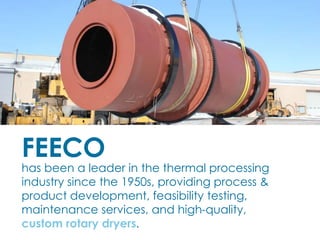
has been a leader in the thermal processing
industry since the 1950s, providing process &
product development, feasibility testing,
maintenance services, and high-quality,
custom rotary dryers.
FEECO
Want to learn more?
Download our
Rotary Dryer Handbook
The Rotary Dryer Handbook
Rotary Dryer Sizing & Design
Processing Challenges
Service & Maintenance
And more…
Download Now

Rotary Dryer Construction

  • 1.
    Construction Experts in processdesign and material processing for over 60 years. Rotary Dryer
  • 2.
    Rotary dryers area critical component in many industrial processes, capable of processing all sorts of materials, from chemicals and fertilizers, to minerals and ores, and nearly everything in between.
  • 3.
    While rotary dryersshould be customized to yield optimal processing conditions, the basis of a rotary dryer is often somewhat standard.
  • 4.
    While rotary dryersshould be customized to yield optimal processing conditions, the basis of a rotary dryer is often somewhat standard. The following information offers an explanation on some of the standard components of a rotary dryer, as well as available customizations. Some information may be specific to FEECO rotary dryers.
  • 5.
  • 7.
    Dryer Shell The shellof the dryer can be made from a variety of materials, including:
  • 8.
    Dryer Shell The shellof the dryer can be made from a variety of materials, including: - Carbon Steel
  • 9.
    Dryer Shell The shellof the dryer can be made from a variety of materials, including: - Carbon Steel - Stainless Steel
  • 10.
    Dryer Shell The shellof the dryer can be made from a variety of materials, including: - Carbon Steel - Stainless Steel - Hastelloy
  • 11.
    Dryer Shell The shellof the dryer can be made from a variety of materials, including: - Carbon Steel - Stainless Steel - Hastelloy - Inconel
  • 12.
    Dryer Shell The shellof the dryer can be made from a variety of materials, including: - Carbon Steel - Stainless Steel - Hastelloy - Inconel - And other Alloys
  • 13.
    The dryer shellcan be customized in many ways, depending on the process and material needs. For example, shell thickness can be adjusted to improve heat retention.
  • 14.
    A properly constructedshell is of the utmost importance. The shell must run true and concentric in order to maintain process efficiency and be reliable for years to come.
  • 15.
    A properly constructedshell is of the utmost importance. The shell must run true and concentric in order to maintain process efficiency and be reliable for years to come. A poorly manufactured shell will promote wear on all components, reducing efficiency, and often resulting in premature failure.
  • 16.
    The Combustion Chamber Thecombustion chamber is where the actual combustion reaction occurs. From here, the drying air is directed through the drum.
  • 17.
    The Combustion Chamber Thecombustion chamber is where the actual combustion reaction occurs. From here, the drying air is directed through the drum. A variety of combustion chambers are available, with various customizations available as well.
  • 18.
    Burner The burner determinesthe output of BTU’s/Watts.
  • 19.
    Burner The burner determinesthe output of BTU’s/Watts. Burners can be designed to accommodate a variety of fuel sources, such as:
  • 20.
    Burner The burner determinesthe output of BTU’s/Watts. Burners can be designed to accommodate a variety of fuel sources, such as: - Natural Gas
  • 21.
    Burner The burner determinesthe output of BTU’s/Watts. Burners can be designed to accommodate a variety of fuel sources, such as: - Natural Gas - Propane
  • 22.
    Burner The burner determinesthe output of BTU’s/Watts. Burners can be designed to accommodate a variety of fuel sources, such as: - Natural Gas - Propane - Diesel
  • 23.
    Burner The burner determinesthe output of BTU’s/Watts. Burners can be designed to accommodate a variety of fuel sources, such as: - Natural Gas - Propane - Diesel - And more…
  • 24.
    Raw Material Feed Alsocalled the feed chute, this is where raw material feedstock is fed into the dryer. This is typically carried out using a feed chute or screw.
  • 25.
    Raw Material Feed Alsocalled the feed chute, this is where raw material feedstock is fed into the dryer. This is typically carried out using a feed chute or screw. Feed chutes must be designed to be robust, resistant to wear, and to reduce the potential for material build-up.
  • 26.
    Air Seal The sealconnects the discharge breeching to the rotating drum in order to keep air and material from prematurely exiting the drum.
  • 27.
    Air Seal The sealconnects the discharge breeching to the rotating drum in order to keep air and material from prematurely exiting the drum. A variety of seal types are available.
  • 28.
    Drive Assembly The driveassembly is what causes the drum to rotate. Various options are available depending on the horsepower and size of the drum. Options include:
  • 29.
    Drive Assembly The driveassembly is what causes the drum to rotate. Various options are available depending on the horsepower and size of the drum. Options include: - Chain and Sprocket
  • 30.
    Drive Assembly The driveassembly is what causes the drum to rotate. Various options are available depending on the horsepower and size of the drum. Options include: - Chain and Sprocket - Gear and Pinion
  • 31.
    Drive Assembly The driveassembly is what causes the drum to rotate. Various options are available depending on the horsepower and size of the drum. Options include: - Chain and Sprocket - Gear and Pinion - Friction Drive
  • 32.
    Drive Assembly The driveassembly is what causes the drum to rotate. Various options are available depending on the horsepower and size of the drum. Options include: - Chain and Sprocket - Gear and Pinion - Friction Drive - Direct Drive
  • 33.
    Riding Ring The ridingring is part of the support structure for the drum and provides a place for pressure to be absorbed.
  • 34.
    Thrust Rollers Thrust rollerspush up on the riding ring to prevent the drum from moving horizontally, or “drifting.”
  • 35.
    Trunnion Wheels The trunnionwheels serve as the cradle for the rotating drum, helping to ensure smooth and concentric rotation.
  • 36.
    Trunnion Wheels The trunnionwheels serve as the cradle for the rotating drum, helping to ensure smooth and concentric rotation. Trunnion wheels also serve as a wear piece, since they are more cost-effective to replace than the riding ring itself.
  • 37.
    Flights Flights, also calledmaterial lifters, maximize heat transfer between the material and the drying air.
  • 38.
    Flights Flights, also calledmaterial lifters, maximize heat transfer between the material and the drying air. Flights pick up the material and drop it through the air stream as the drum rotates.
  • 39.
    Flights Flights, also calledmaterial lifters, maximize heat transfer between the material and the drying air. Flights pick up the material and drop it through the air stream as the drum rotates. Both flight design and pattern are customizable.
  • 40.
    Discharge Breeching The dischargebreeching is where product exits the dryer, and the exhaust gas system removes off-gases and small particulates.
  • 41.
  • 42.
    Advancing Flights Advancing flightshelp to advance material into the drum.
  • 43.
    Advancing Flights Advancing flightshelp to advance material into the drum. They help to prevent build-up near the inlet.
  • 44.
    Knocking Systems Knocking systemsare used to prevent build-up within the drum.
  • 45.
    Knocking Systems Knocking systemsare used to prevent build-up within the drum. While a variety of knocking systems are available, in general, they all work by dislodging material as the drum rotates.
  • 46.
    Conclusion Rotary dryers area robust, reliable industrial drying system.
  • 47.
    Conclusion Rotary dryers area robust, reliable industrial drying system. They offer a highly customizable solution for drying bulk solids.
  • 48.
    Conclusion Rotary dryers area robust, reliable industrial drying system. They offer a highly customizable solution for drying bulk solids. While standard rotary dryers are available, a custom solution will offer the best results.
  • 49.
    has been aleader in the thermal processing industry since the 1950s, providing process & product development, feasibility testing, maintenance services, and high-quality, custom rotary dryers. FEECO
  • 50.
    Want to learnmore? Download our Rotary Dryer Handbook The Rotary Dryer Handbook Rotary Dryer Sizing & Design Processing Challenges Service & Maintenance And more… Download Now