Introduction
• Pharmacist- prime source of information
• Past- drugs were few, low potency, less inquiries and
all queries answered by referring pharmacopoeias and
other reference books.
• No longer possible for todays situation
Need to alter traditional system
1. Number of drug increased, more potent and
selective, newer formulations, difficult to make
rational choice of drug.
2. Literature relating to drugs has expanded.
Need to communicate information to all medical staff,
hospitals and the consumers.
Definition:
• Drug information is ‘an any objective, documented data or
knowledge involving the pharmacological, toxicological and
therapeutic use of drugs’
• It includes,
 Chemical name, structure, properties, identification, therapeutic
indication, mechanism of action, metabolism, excretion, side
effect, adverse drug reaction, contraindications, interaction,
incompatibilities, cost, advantages, sign, systems, treatments,
clinical efficacy, comparative data, clinical data, rational use….
 Includes gathering, reviewing, evaluating, indexing,
organizing, storing, summarizing and distribution information
of drug.
In accordance with above points need to establish
drug information centers
organized drug information sources
full time staff with properly trained persons
Need and Scope in India
• India one of the largest market in world.
• More than 1 lakh drug formulations, generic and
combination of drugs are available
• Difficult to maintain the data for physicians,
medical staff, and other drug authorities
• Patients consult mostly with physicians or
surgeons in multiple drug therapy so its difficult to
maintain rational use of drugs in each diseases. At
this point DI specialist can prove helpful
• Total number of drugs are restricted, it will be easy
for physician to prescribe. WHO made list of
essential drugs to cover 95 % diseases of common
man. Pharmacist at DIC will provide excellent
source for current information.
• Substandard drugs are sold in market, physician get confused,
unable to differentiate, faulty product reporting programme may
be undertaken by information specialist.
• India have very few reliable sources of up to date information
on medications. There is need for information.
• The output of drug industry can be monitored on monthly basis
and new products entering into the market could be evaluated at
such centers.
• Several consumers groups i.e. Consumers guidance society
have started demanding on information on drugs. Medication
error can be minimized by proper information.
• Drug information center enables the clinical health professional
to make quicker, more rational decision. It act as bridge in the
communication network between the wealth of information
available and the active health professionals.
• Todays. India needs several information centers across the
country which can link up their services to provide fast, up to
date drug information to the community. The usefulness and the
needs for such centers is only just being realized.
Objectives:
The main objective of the DIC is to provide factual,
unbiased drug information as a part of an effort to
improve patient care. A drug information center can
realized various other objectives-
1. To promote the safe, effective and economic use of
medical products in patient
2. To achieve the rational use of drugs in hospitals by
well defined policies
3. To provide the specialized information on drug
therapeutics to meet the drug information needs of
the clinicians and other health care professionals.
4. To improve patient care by conducting drug
utilization review
5.To decrease ADR by proper pointing at them in
advance
6. To help PTC committee in rational selection of drug
formulary
7.To establish the discipline of clinical pharmacy as a
specialized professional
8.To conduct training and educational programme.
Functions:
• 3 major functions
1. Service- answer questions, supporting PTC committee
and preparing newsletters
2. Education- teaching pharmacy students drug information
skill, training courses for health care professionals
3. Research- participation in clinical trial, conducting drug
utilization review for physician, literature search for
academicians.
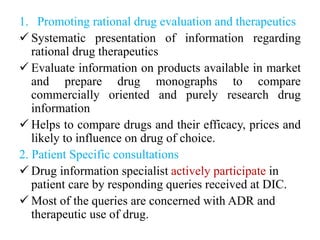
1. Promoting rational drug evaluation and therapeutics
 Systematic presentation of information regarding
rational drug therapeutics
 Evaluate information on products available in market
and prepare drug monographs to compare
commercially oriented and purely research drug
information
 Helps to compare drugs and their efficacy, prices and
likely to influence on drug of choice.
2. Patient Specific consultations
 Drug information specialist actively participate in
patient care by responding queries received at DIC.
 Most of the queries are concerned with ADR and
therapeutic use of drug.
3. ADR Reporting
 1.5 to 35% of patients admitted are due to ADR
 Analyst play an imp role by following up such
patients and by filling form needed
4. Drug interaction monitoring
 Reason- multiple drug therapy
 DIC suggest way to detect interactions and determine
their clinical use.
5. Drug utilization review
 Helps to know pattern of drug used in hospitals
 Helps to project hospital budget
 Identify inappropriate use of drug
6. Pharmacy and Therapeutics Committee related
functions
7. Investigational drug information
 Participate in clinical investigation to establish safety
and efficacy of new drugs
 Assist in preparation of protocols, applications and
literature reports on investigational drugs.
8. Publication of newsletter
 Publish news letters, news bulletins or periodic
reports for current updates
9. Teaching and Educational activities
10. Consumer awareness programme and community
pharmacy based activities
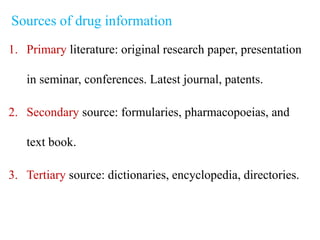
Sources of drug information
1. Primary literature: original research paper, presentation
in seminar, conferences. Latest journal, patents.
2. Secondary source: formularies, pharmacopoeias, and
text book.
3. Tertiary source: dictionaries, encyclopedia, directories.
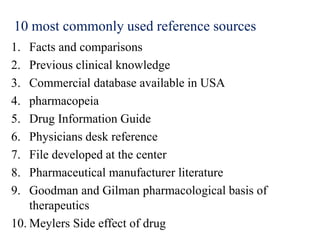
10 most commonly used reference sources
1. Facts and comparisons
2. Previous clinical knowledge
3. Commercial database available in USA
4. pharmacopeia
5. Drug Information Guide
6. Physicians desk reference
7. File developed at the center
8. Pharmaceutical manufacturer literature
9. Goodman and Gilman pharmacological basis of
therapeutics
10. Meylers Side effect of drug
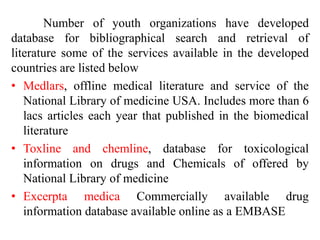
Number of youth organizations have developed
database for bibliographical search and retrieval of
literature some of the services available in the developed
countries are listed below
• Medlars, offline medical literature and service of the
National Library of medicine USA. Includes more than 6
lacs articles each year that published in the biomedical
literature
• Toxline and chemline, database for toxicological
information on drugs and Chemicals of offered by
National Library of medicine
• Excerpta medica Commercially available drug
information database available online as a EMBASE
• International Pharmaceutical abstracts both in printed and
computerized form by American Society of hospital
pharmacist
• Drug information full text contain complete text of
evaluative monographs from the American hospital
formulary service
• Pharmaceutical information and news service offered by
Pharmaceutical Society of Great Britain
• Pharmaceutical news index important source of
information on market trade
• World patent index
• Medicom, family of medical information database is
offered by traditional system to provide Health Care
professional up-to-date information on a drug interaction
clinical laboratory test
Organization of drug information center
• The first DIC was established at the University of
Medical Centre in a North America in 1962.
• In India the Pharmacology departments of some
teaching medical hospitals like GS Medical College
and Hospital grant Medical College, J J Medical
College in Mumbai have established drug information
center in 1968 and 1974 respectively
• Initially a drug information Centre may be created as
an integral part of Pharmacy department in a room
with a few chairs, filing cabinet, telephone, computer
and Xerox machine In addition some basic reference
sources
A sample guideline to equipment staff and budget
requirements for drug information Centre is given
below
Recommendations for equipment's
• Basic office equipment
• Photocopier
• Reader
• Telephones computer modem attachment
• Computer system
• Typewriters calculators
• Audio video ads like slide projector video cassette
recorder
Budgeting of drug information center:
The areas of expense which should be considered for drug
information you need are as follows
• Staff salary and wages
• Principal pharmacist
• Basic grade pharmacist
• Trainees
• Administrative officers
Other Expenditures
• Technical literature, Printing and stationery
• Office equipment's, Computer Services
• Equipment maintenance cost, Travel expenses
• Telephone cost, Training expenses
• Printing a Bulletin of stock distribution
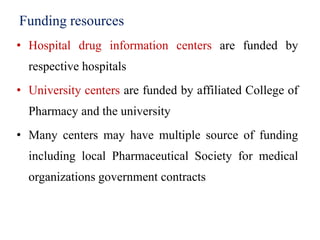
Funding resources
• Hospital drug information centers are funded by
respective hospitals
• University centers are funded by affiliated College of
Pharmacy and the university
• Many centers may have multiple source of funding
including local Pharmaceutical Society for medical
organizations government contracts
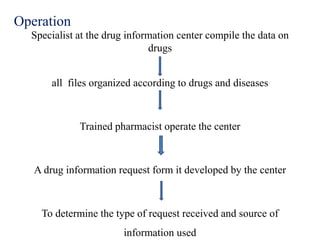
Operation
Specialist at the drug information center compile the data on
drugs
all files organized according to drugs and diseases
Trained pharmacist operate the center
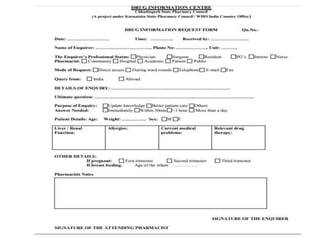
A drug information request form it developed by the center
To determine the type of request received and source of
information used
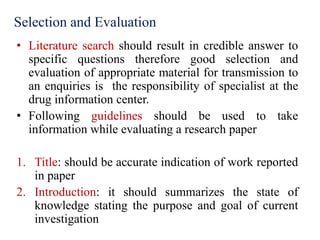
Selection and Evaluation
• Literature search should result in credible answer to
specific questions therefore good selection and
evaluation of appropriate material for transmission to
an enquiries is the responsibility of specialist at the
drug information center.
• Following guidelines should be used to take
information while evaluating a research paper
1. Title: should be accurate indication of work reported
in paper
2. Introduction: it should summarizes the state of
knowledge stating the purpose and goal of current
investigation
3. Objectives: well defined, clear
4. Experimental methods: accurate description of all
materials and procedures used in investigation
5. Results: including tables graphs
6. Discussion: results are discussed in perspective to
Current Knowledge and significant contribution
8. Bibliography: include complete list of authors
publications and references cited in the text
Communication:
• The pharmacist must be able to device select and
utilize the most effective techniques for
communicating his findings
• Best on a queries he should be able to decide what is to
be answered and how, when and why.
• Telephonic conversations, periodic Bulletin, radio and
other media may be used for communicating drug
information
THANK YOU

DRUG INFORMATION SYSTEM.pptx

  • 2.
    Introduction • Pharmacist- primesource of information • Past- drugs were few, low potency, less inquiries and all queries answered by referring pharmacopoeias and other reference books. • No longer possible for todays situation Need to alter traditional system 1. Number of drug increased, more potent and selective, newer formulations, difficult to make rational choice of drug. 2. Literature relating to drugs has expanded. Need to communicate information to all medical staff, hospitals and the consumers.
  • 3.
    Definition: • Drug informationis ‘an any objective, documented data or knowledge involving the pharmacological, toxicological and therapeutic use of drugs’ • It includes,  Chemical name, structure, properties, identification, therapeutic indication, mechanism of action, metabolism, excretion, side effect, adverse drug reaction, contraindications, interaction, incompatibilities, cost, advantages, sign, systems, treatments, clinical efficacy, comparative data, clinical data, rational use….  Includes gathering, reviewing, evaluating, indexing, organizing, storing, summarizing and distribution information of drug. In accordance with above points need to establish drug information centers organized drug information sources full time staff with properly trained persons
  • 4.
    Need and Scopein India • India one of the largest market in world. • More than 1 lakh drug formulations, generic and combination of drugs are available • Difficult to maintain the data for physicians, medical staff, and other drug authorities • Patients consult mostly with physicians or surgeons in multiple drug therapy so its difficult to maintain rational use of drugs in each diseases. At this point DI specialist can prove helpful • Total number of drugs are restricted, it will be easy for physician to prescribe. WHO made list of essential drugs to cover 95 % diseases of common man. Pharmacist at DIC will provide excellent source for current information.
  • 5.
    • Substandard drugsare sold in market, physician get confused, unable to differentiate, faulty product reporting programme may be undertaken by information specialist. • India have very few reliable sources of up to date information on medications. There is need for information. • The output of drug industry can be monitored on monthly basis and new products entering into the market could be evaluated at such centers. • Several consumers groups i.e. Consumers guidance society have started demanding on information on drugs. Medication error can be minimized by proper information. • Drug information center enables the clinical health professional to make quicker, more rational decision. It act as bridge in the communication network between the wealth of information available and the active health professionals. • Todays. India needs several information centers across the country which can link up their services to provide fast, up to date drug information to the community. The usefulness and the needs for such centers is only just being realized.
  • 6.
    Objectives: The main objectiveof the DIC is to provide factual, unbiased drug information as a part of an effort to improve patient care. A drug information center can realized various other objectives- 1. To promote the safe, effective and economic use of medical products in patient 2. To achieve the rational use of drugs in hospitals by well defined policies 3. To provide the specialized information on drug therapeutics to meet the drug information needs of the clinicians and other health care professionals. 4. To improve patient care by conducting drug utilization review
  • 7.
    5.To decrease ADRby proper pointing at them in advance 6. To help PTC committee in rational selection of drug formulary 7.To establish the discipline of clinical pharmacy as a specialized professional 8.To conduct training and educational programme.
  • 8.
    Functions: • 3 majorfunctions 1. Service- answer questions, supporting PTC committee and preparing newsletters 2. Education- teaching pharmacy students drug information skill, training courses for health care professionals 3. Research- participation in clinical trial, conducting drug utilization review for physician, literature search for academicians.
  • 9.
    1. Promoting rationaldrug evaluation and therapeutics  Systematic presentation of information regarding rational drug therapeutics  Evaluate information on products available in market and prepare drug monographs to compare commercially oriented and purely research drug information  Helps to compare drugs and their efficacy, prices and likely to influence on drug of choice. 2. Patient Specific consultations  Drug information specialist actively participate in patient care by responding queries received at DIC.  Most of the queries are concerned with ADR and therapeutic use of drug.
  • 10.
    3. ADR Reporting 1.5 to 35% of patients admitted are due to ADR  Analyst play an imp role by following up such patients and by filling form needed 4. Drug interaction monitoring  Reason- multiple drug therapy  DIC suggest way to detect interactions and determine their clinical use. 5. Drug utilization review  Helps to know pattern of drug used in hospitals  Helps to project hospital budget  Identify inappropriate use of drug
  • 11.
    6. Pharmacy andTherapeutics Committee related functions 7. Investigational drug information  Participate in clinical investigation to establish safety and efficacy of new drugs  Assist in preparation of protocols, applications and literature reports on investigational drugs. 8. Publication of newsletter  Publish news letters, news bulletins or periodic reports for current updates 9. Teaching and Educational activities 10. Consumer awareness programme and community pharmacy based activities
  • 12.
    Sources of druginformation 1. Primary literature: original research paper, presentation in seminar, conferences. Latest journal, patents. 2. Secondary source: formularies, pharmacopoeias, and text book. 3. Tertiary source: dictionaries, encyclopedia, directories.
  • 13.
    10 most commonlyused reference sources 1. Facts and comparisons 2. Previous clinical knowledge 3. Commercial database available in USA 4. pharmacopeia 5. Drug Information Guide 6. Physicians desk reference 7. File developed at the center 8. Pharmaceutical manufacturer literature 9. Goodman and Gilman pharmacological basis of therapeutics 10. Meylers Side effect of drug
  • 14.
    Number of youthorganizations have developed database for bibliographical search and retrieval of literature some of the services available in the developed countries are listed below • Medlars, offline medical literature and service of the National Library of medicine USA. Includes more than 6 lacs articles each year that published in the biomedical literature • Toxline and chemline, database for toxicological information on drugs and Chemicals of offered by National Library of medicine • Excerpta medica Commercially available drug information database available online as a EMBASE
  • 15.
    • International Pharmaceuticalabstracts both in printed and computerized form by American Society of hospital pharmacist • Drug information full text contain complete text of evaluative monographs from the American hospital formulary service • Pharmaceutical information and news service offered by Pharmaceutical Society of Great Britain • Pharmaceutical news index important source of information on market trade • World patent index • Medicom, family of medical information database is offered by traditional system to provide Health Care professional up-to-date information on a drug interaction clinical laboratory test
  • 16.
    Organization of druginformation center • The first DIC was established at the University of Medical Centre in a North America in 1962. • In India the Pharmacology departments of some teaching medical hospitals like GS Medical College and Hospital grant Medical College, J J Medical College in Mumbai have established drug information center in 1968 and 1974 respectively • Initially a drug information Centre may be created as an integral part of Pharmacy department in a room with a few chairs, filing cabinet, telephone, computer and Xerox machine In addition some basic reference sources
  • 17.
    A sample guidelineto equipment staff and budget requirements for drug information Centre is given below Recommendations for equipment's • Basic office equipment • Photocopier • Reader • Telephones computer modem attachment • Computer system • Typewriters calculators • Audio video ads like slide projector video cassette recorder
  • 18.
    Budgeting of druginformation center: The areas of expense which should be considered for drug information you need are as follows • Staff salary and wages • Principal pharmacist • Basic grade pharmacist • Trainees • Administrative officers Other Expenditures • Technical literature, Printing and stationery • Office equipment's, Computer Services • Equipment maintenance cost, Travel expenses • Telephone cost, Training expenses • Printing a Bulletin of stock distribution
  • 19.
    Funding resources • Hospitaldrug information centers are funded by respective hospitals • University centers are funded by affiliated College of Pharmacy and the university • Many centers may have multiple source of funding including local Pharmaceutical Society for medical organizations government contracts
  • 20.
    Operation Specialist at thedrug information center compile the data on drugs all files organized according to drugs and diseases Trained pharmacist operate the center A drug information request form it developed by the center To determine the type of request received and source of information used
  • 22.
    Selection and Evaluation •Literature search should result in credible answer to specific questions therefore good selection and evaluation of appropriate material for transmission to an enquiries is the responsibility of specialist at the drug information center. • Following guidelines should be used to take information while evaluating a research paper 1. Title: should be accurate indication of work reported in paper 2. Introduction: it should summarizes the state of knowledge stating the purpose and goal of current investigation
  • 23.
    3. Objectives: welldefined, clear 4. Experimental methods: accurate description of all materials and procedures used in investigation 5. Results: including tables graphs 6. Discussion: results are discussed in perspective to Current Knowledge and significant contribution 8. Bibliography: include complete list of authors publications and references cited in the text
  • 24.
    Communication: • The pharmacistmust be able to device select and utilize the most effective techniques for communicating his findings • Best on a queries he should be able to decide what is to be answered and how, when and why. • Telephonic conversations, periodic Bulletin, radio and other media may be used for communicating drug information
  • 25.