

PREPARED BY:
JANINE V. SAMELO
BSCHEM4
WHAT IS NANOTECHNOLOGY?

• Nanotechnology is the engineering of functional systems
at the molecular scale.

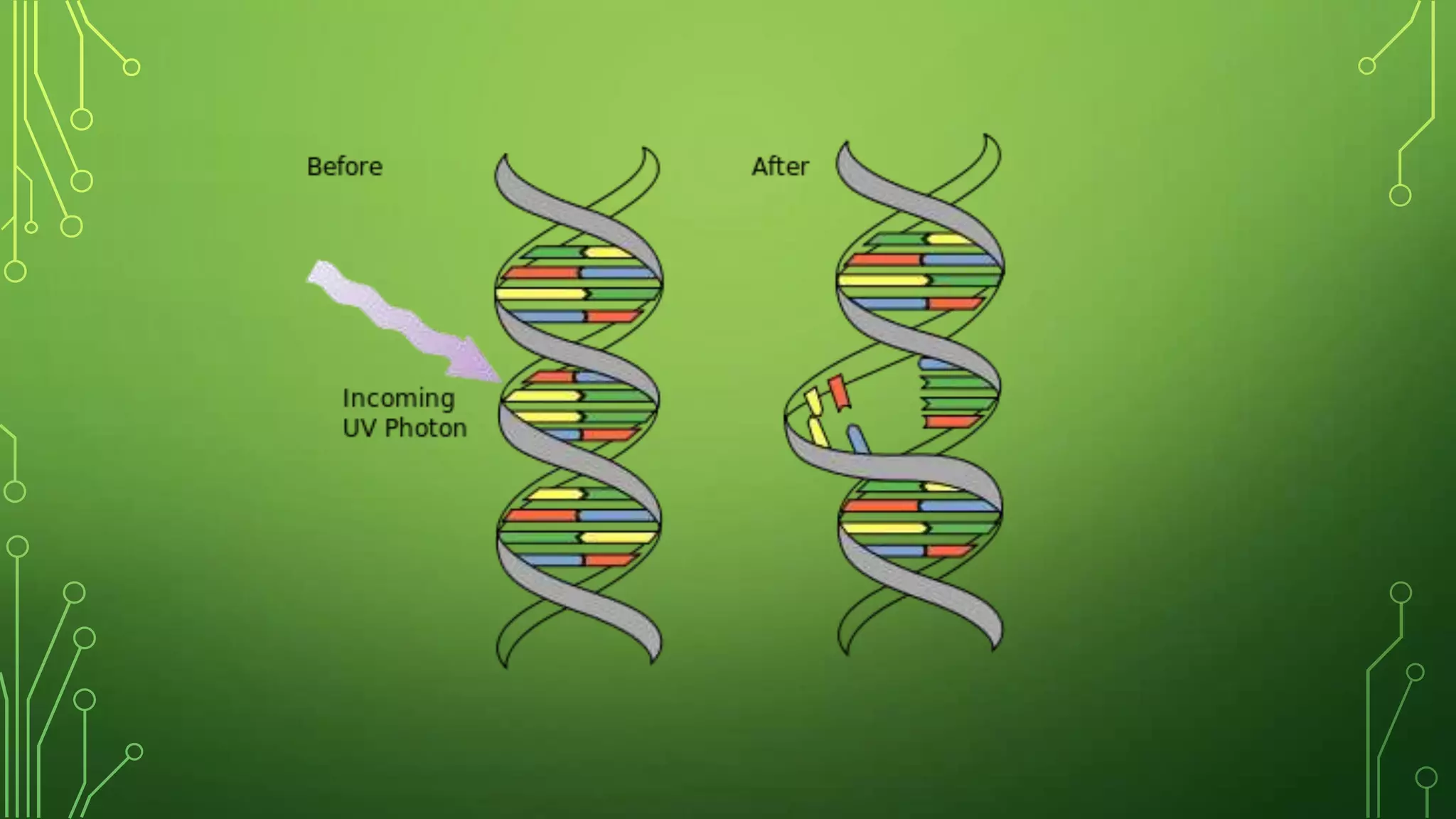
• Nanotechnology is the science of manipulating atoms and
molecules in the nanoscale - 80,000 times smaller than
the width of a human hair.
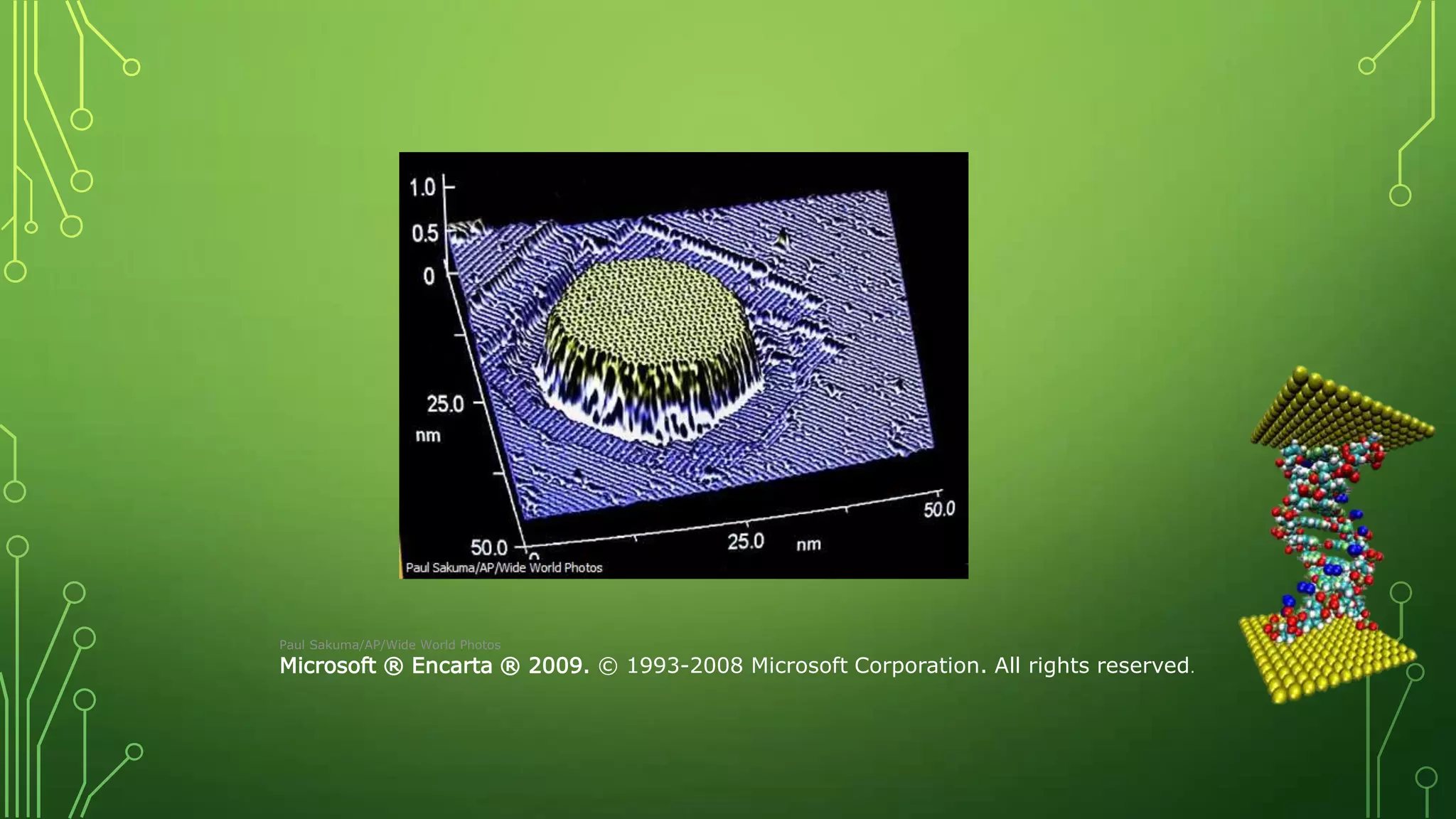
Paul Sakuma/AP/Wide World Photos

Microsoft ® Encarta ® 2009. © 1993-2008 Microsoft Corporation. All rights reserved.
BENEFITS AND APPLICATIONS

• Everyday materials, processes and food
• Electronics and Information Technology
• Sustainable energy
• Environmental remediation
• Medical and Health
• Transportation
NANOTECH IN EVERYDAY MATERIALS AND
PROCESSES
NANOTECH IN COSMETICS
1. Mineral-based cosmetic ingredients with nano-sized
dimensions

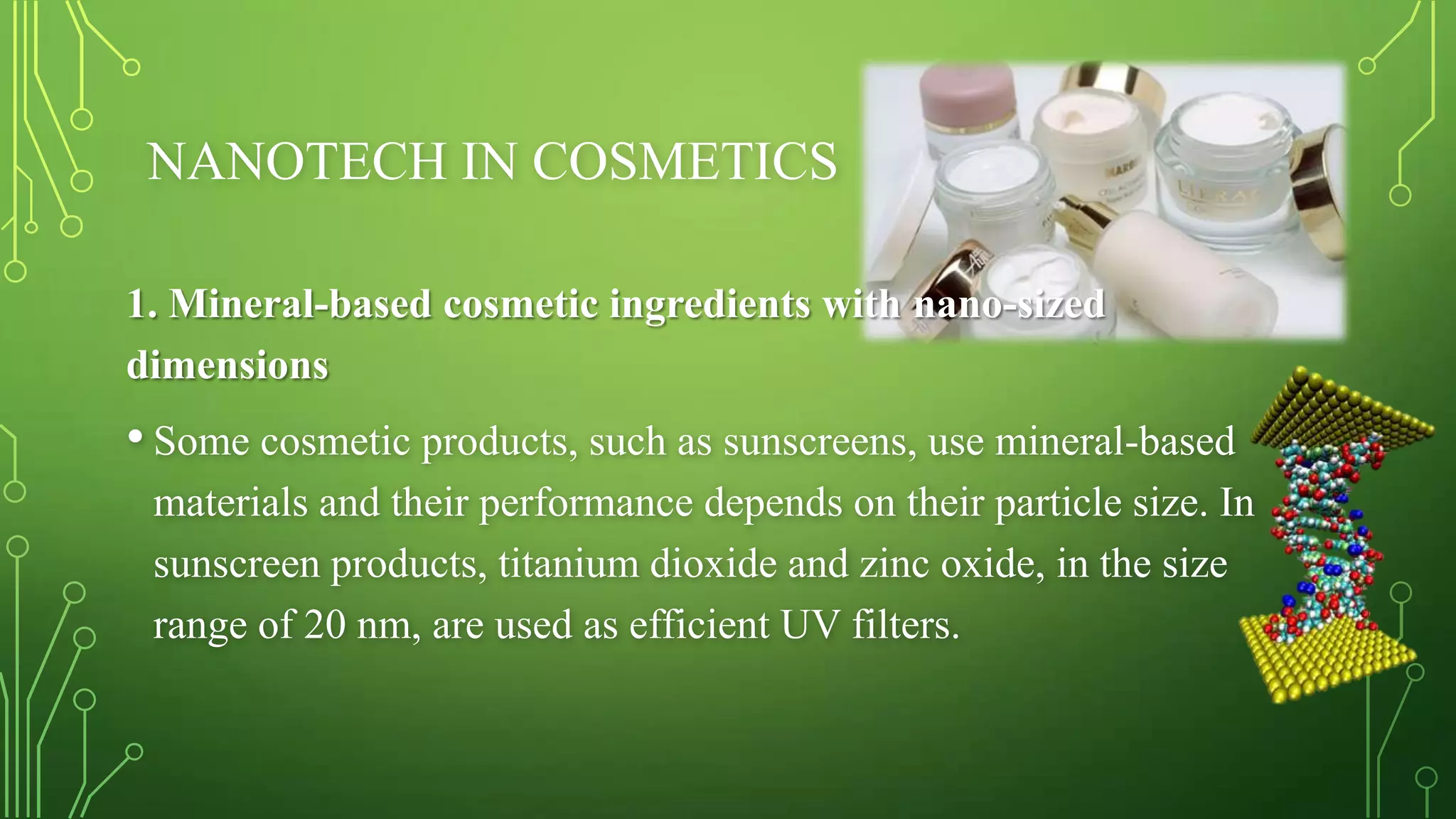
• Some cosmetic products, such as sunscreens, use mineral-based
materials and their performance depends on their particle size. In
sunscreen products, titanium dioxide and zinc oxide, in the size
range of 20 nm, are used as efficient UV filters.
NANOTECH IN COSMETICS
2. Nanocapsules

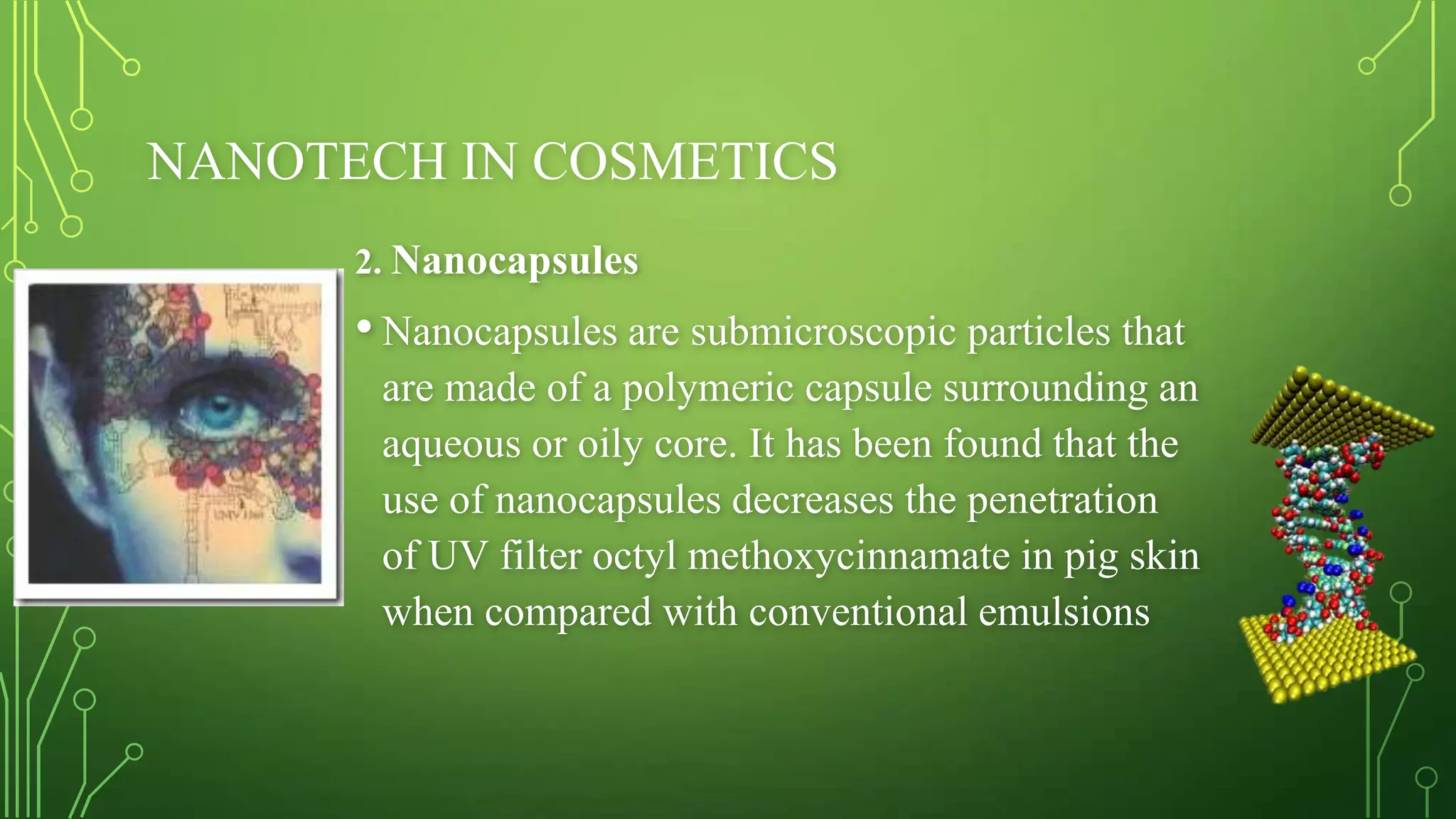
• Nanocapsules are submicroscopic particles that
are made of a polymeric capsule surrounding an
aqueous or oily core. It has been found that the
use of nanocapsules decreases the penetration
of UV filter octyl methoxycinnamate in pig skin
when compared with conventional emulsions
NANOTECH IN COSMETICS
3.

Nanosilver and Nanogold

• antibacterial properties of nanosilver in a range of applications.
• underarm deodorants with claims that the silver in the product will
provide up to 24-hour antibacterial protection.

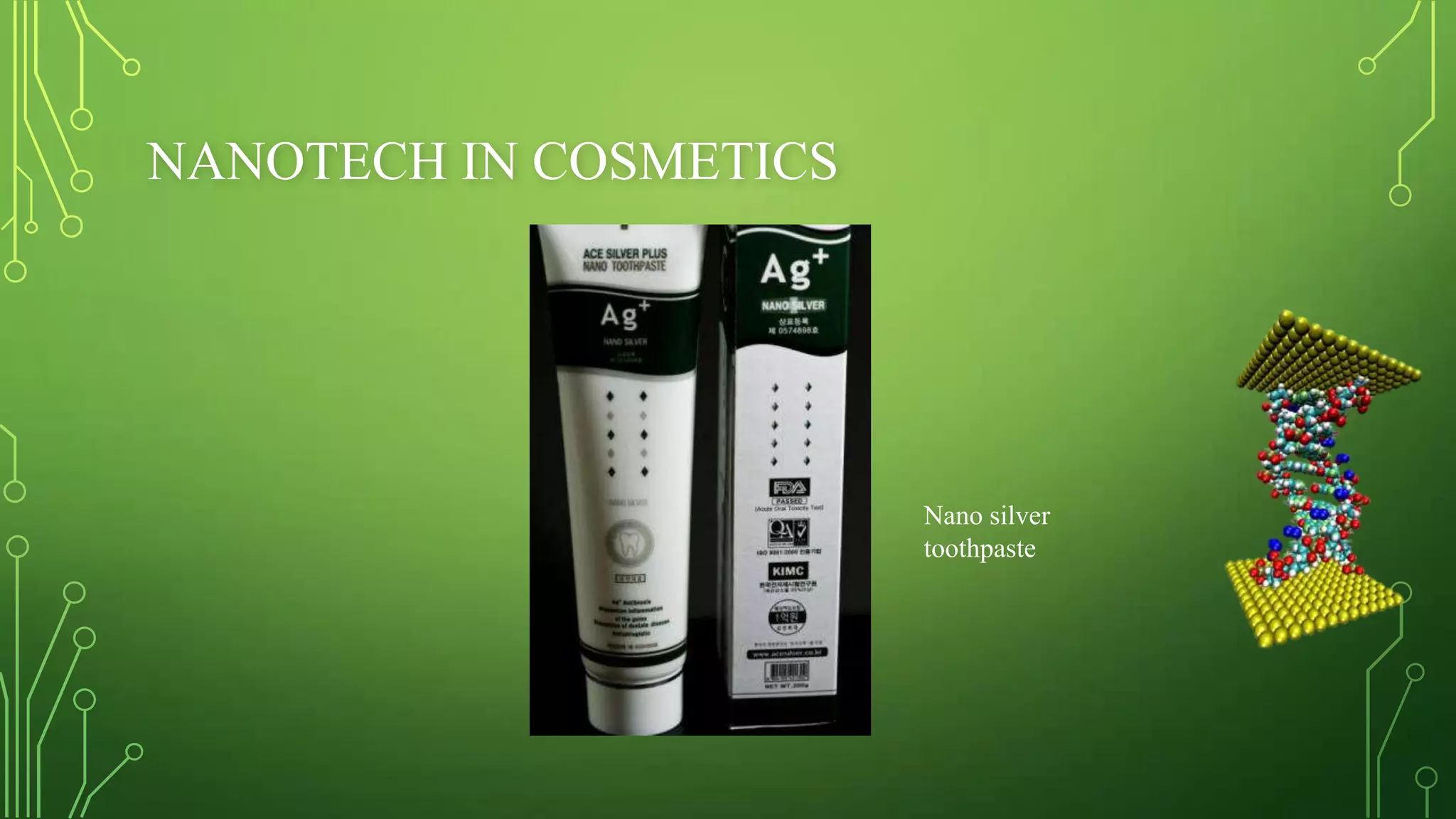
• Nano-sized gold is used in disinfecting the bacteria in the mouth
and has also been added to toothpaste.
NANOTECH IN COSMETICS

Nano silver
toothpaste
NANOTECH IN COSMETICS
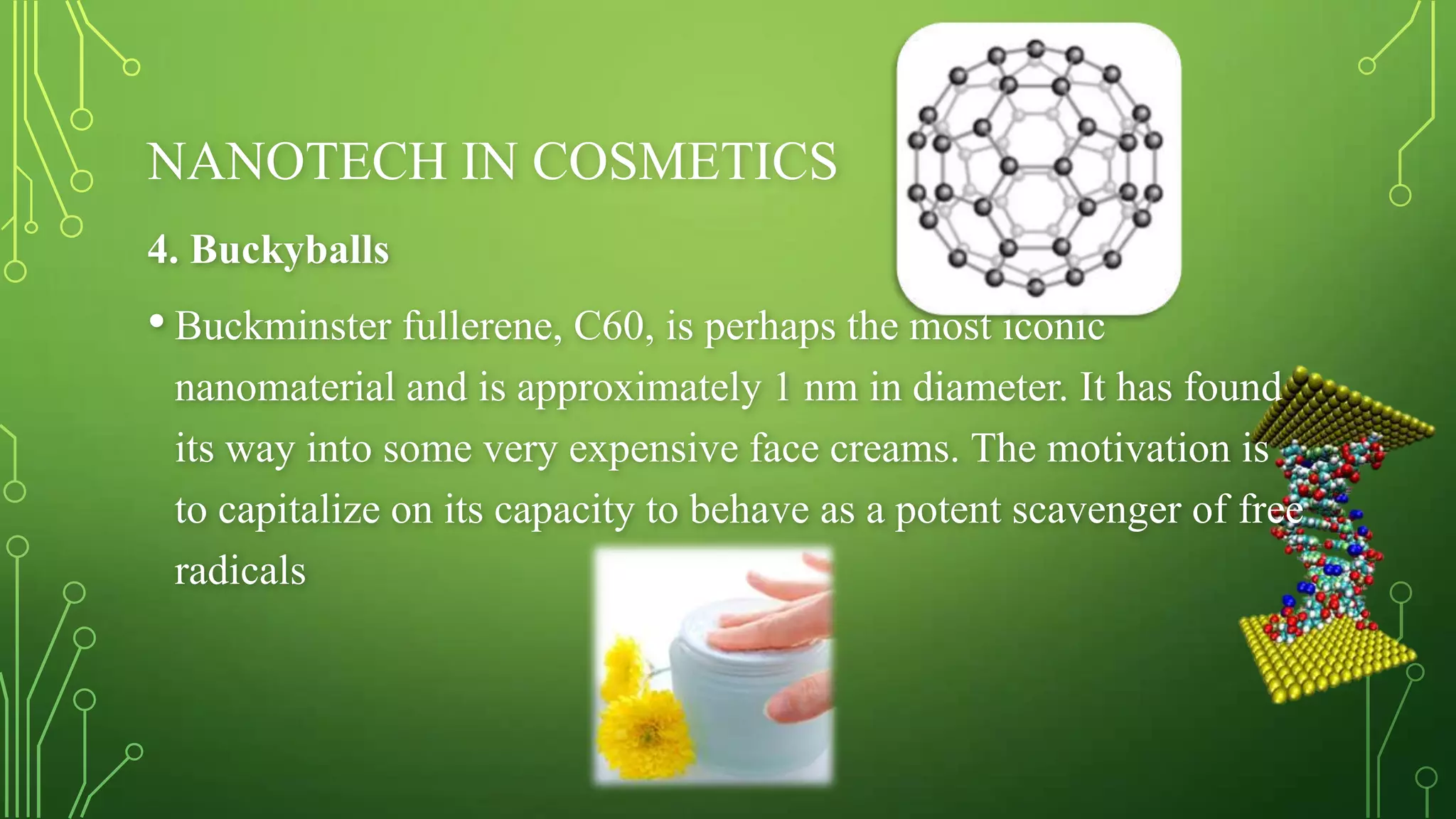
4. Buckyballs

• Buckminster fullerene, C60, is perhaps the most iconic
nanomaterial and is approximately 1 nm in diameter. It has found
its way into some very expensive face creams. The motivation is
to capitalize on its capacity to behave as a potent scavenger of free
radicals
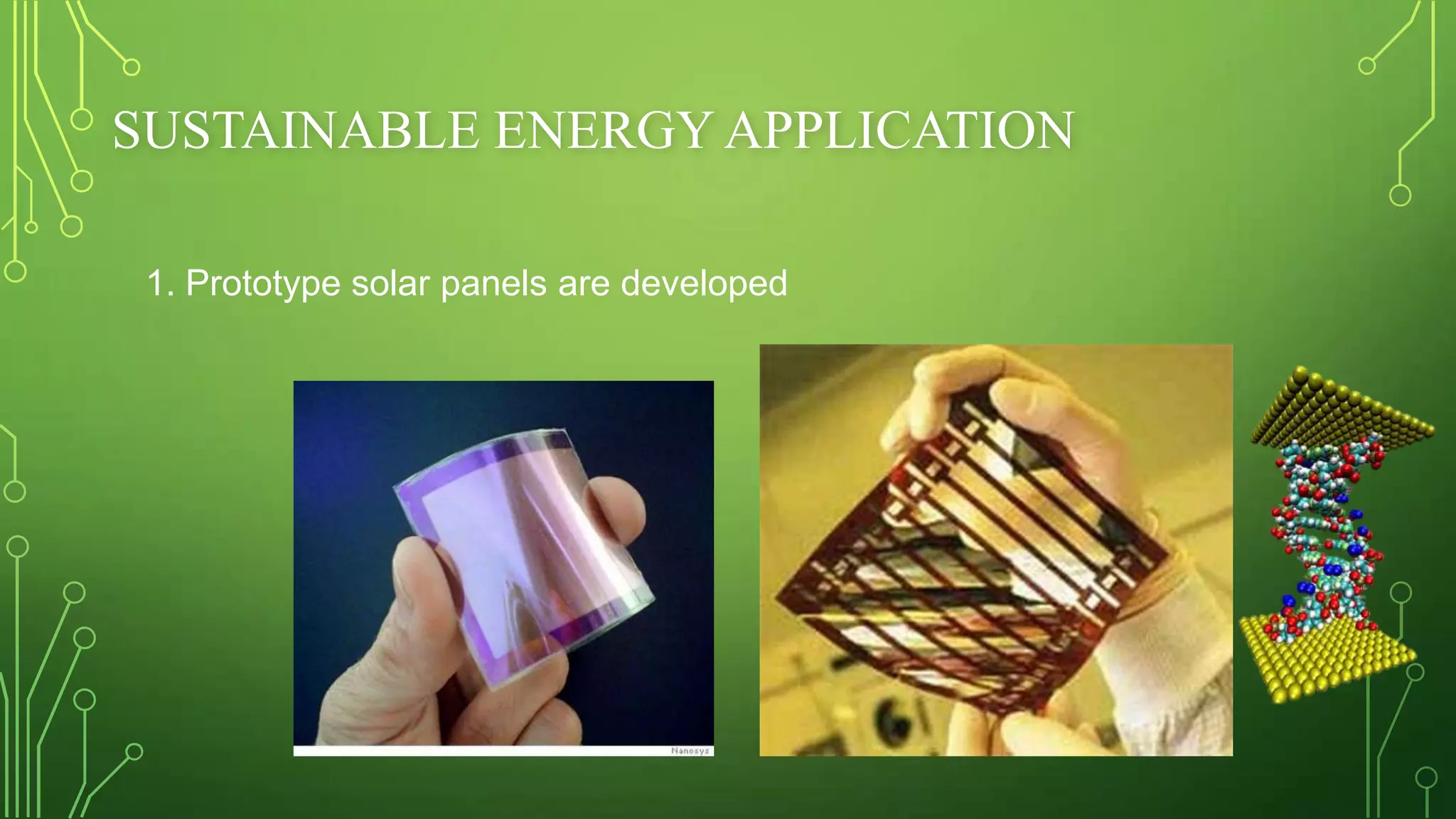
SUSTAINABLE ENERGY APPLICATION
1. Prototype solar panels are developed
ENVIRONMENTAL REMEDIATION
APPLICATIONS
1. detect and clean up environmental contaminants.
-Coatings

-Sprayers
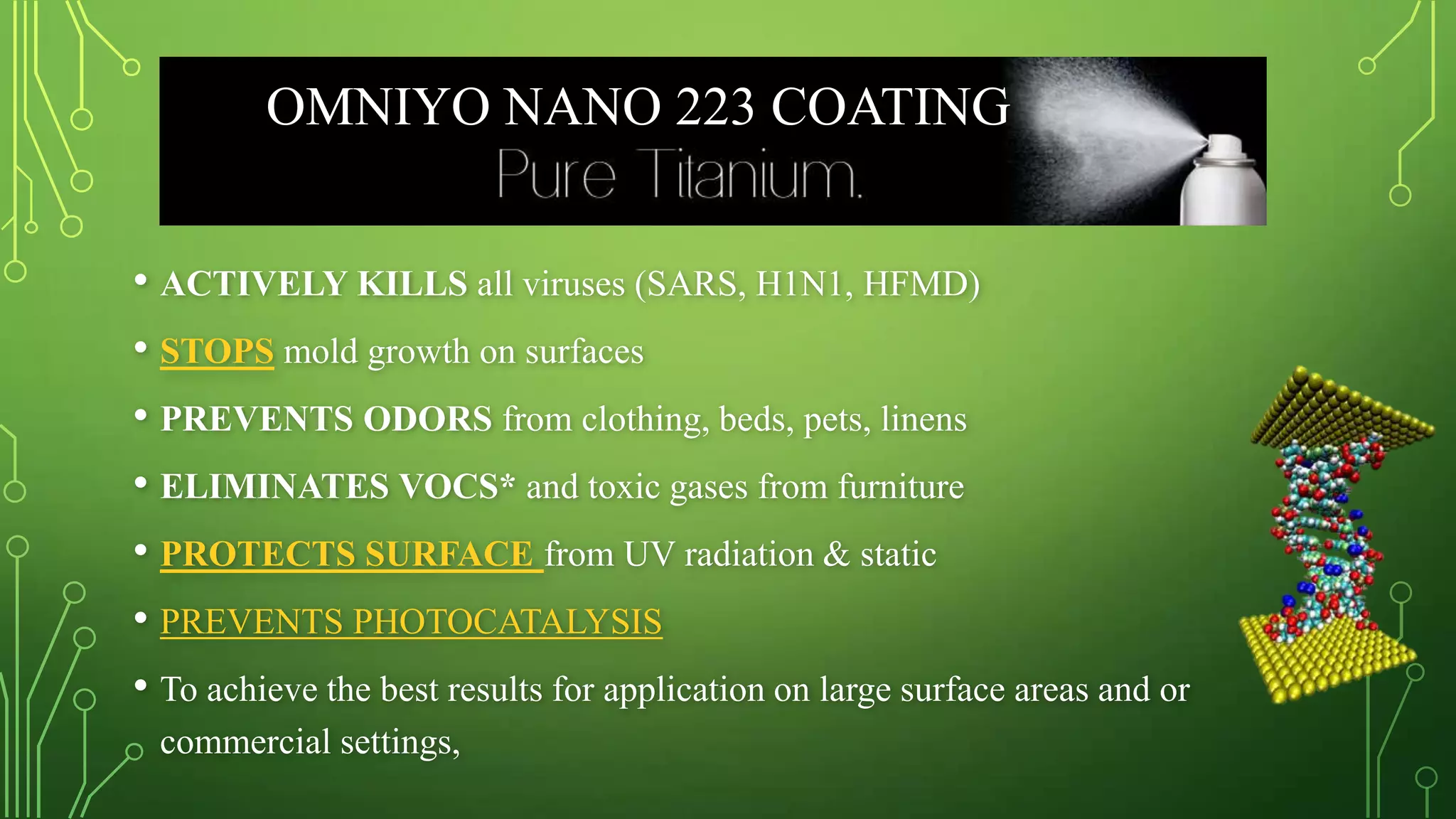
OMNIYO NANO 223 COATING
• ACTIVELY KILLS all viruses (SARS, H1N1, HFMD)
• STOPS mold growth on surfaces
• PREVENTS ODORS from clothing, beds, pets, linens
• ELIMINATES VOCS* and toxic gases from furniture
• PROTECTS SURFACE from UV radiation & static
• PREVENTS PHOTOCATALYSIS
• To achieve the best results for application on large surface areas and or
commercial settings,
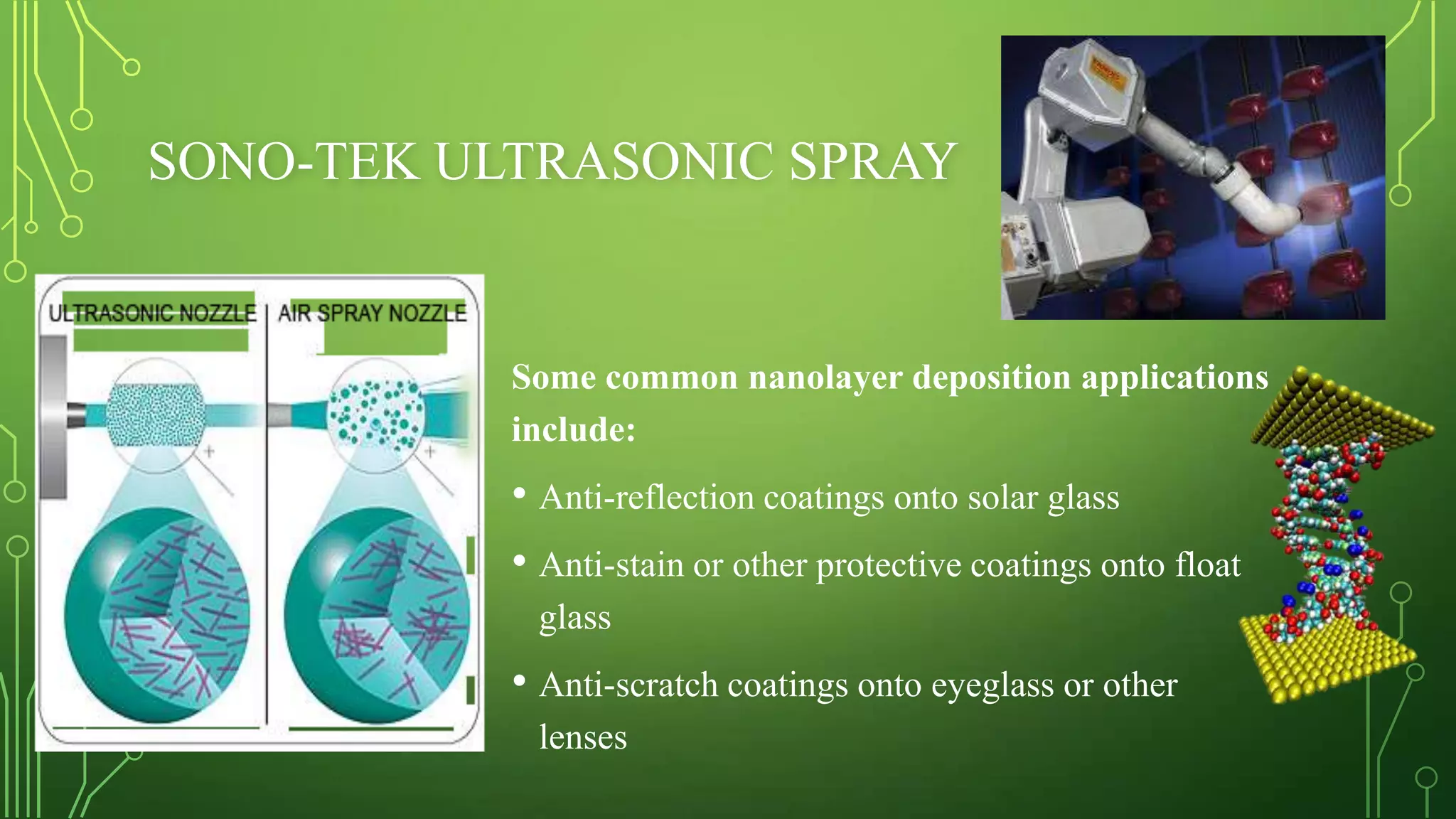
SONO-TEK ULTRASONIC SPRAY

Some common nanolayer deposition applications
include:

• Anti-reflection coatings onto solar glass
• Anti-stain or other protective coatings onto float
glass

• Anti-scratch coatings onto eyeglass or other
lenses
ENVIRONMENTAL REMEDIATION
APPLICATIONS
2. Nanotechnology could help meet the need for affordable, clean

drinking water through rapid, low-cost detection of impurities in
and filtration and purification of water.
ENVIRONMENTAL REMEDIATION
APPLICATIONS
3. Nanoparticles are used to clean industrial water
pollutants in ground water through chemical reactions that
render them harmless, at much lower cost than methods
that require pumping the water out of the ground for
treatment.
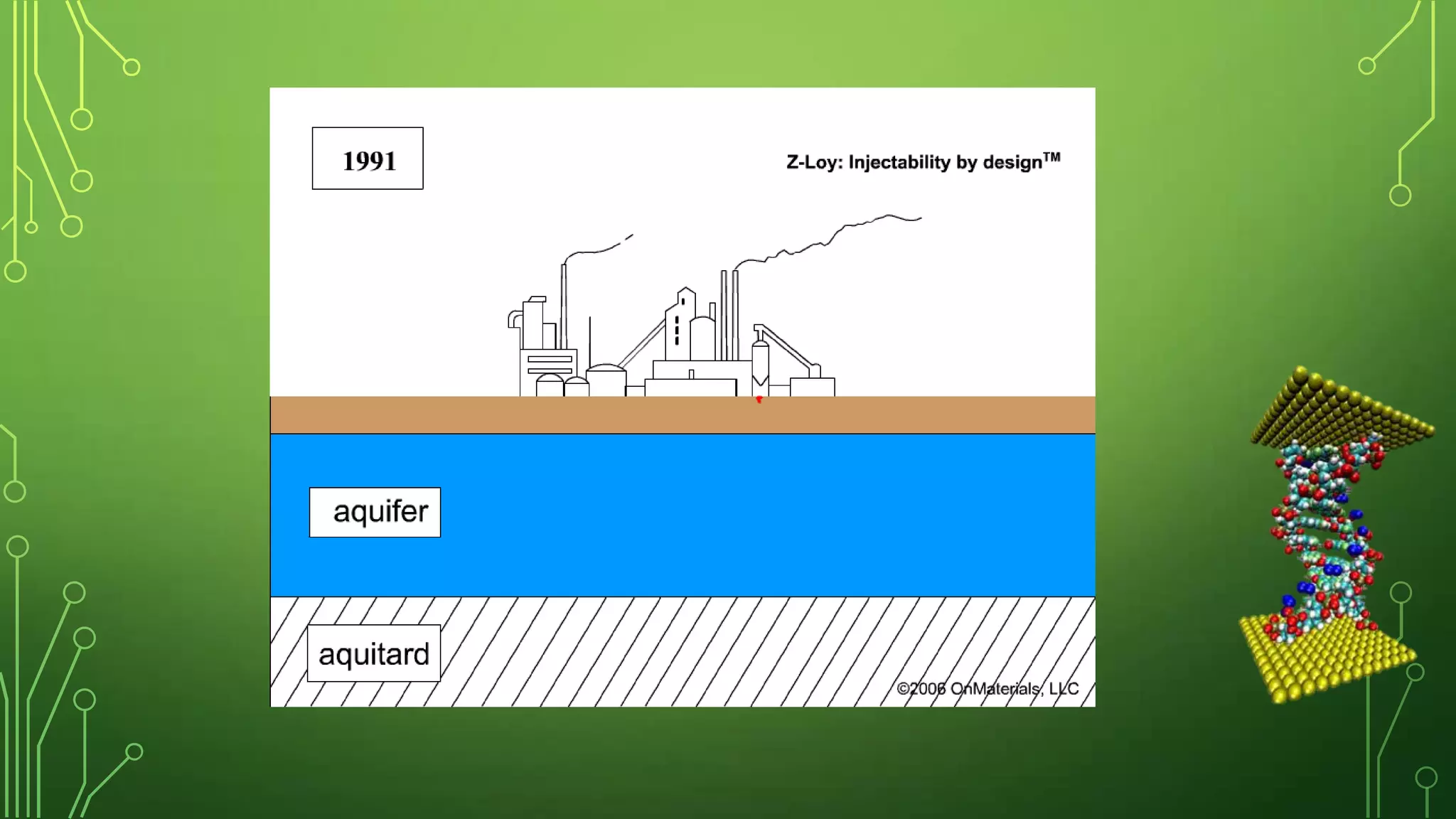
Z-LOYTM
• engineered zero valent metal powder suspensions (zero-valent
iron [aka zvi, nZVI], copper, magnesium, zinc, and others). In situ
remediation with Z-LoyTM injected into the subsurface, facilitates
the elimination of toxic substances, including:

• Halogenated solvents, including TCA, TCE and PCE
• Halogenated aromatics including PCB and pesticides
• Metallic substances including chromates and arsenates
CONCLUSION
• Nanotechnology is an innovative science that includes the design,
characterization, production and application of structures, devices and
systems by controlling shape and size at the nanometer scale. This
widespread use of nanoscale materials is due to the fact they obtain
newer properties which differ from the large-scale particles. These
altered properties include color, transparency, solubility and chemical
reactivity, making the nanomaterials attractive to the food, Electronics
and Information Technology, Sustainable energy, Environmental
remediation, Medical and Health, Transportation, cosmetics, and
personal care industries
REFERENCES
• http://crnano.org/whatis.htm
• http://www.crnano.org/dangers.htm
• http://scienceinsociety.northwestern.edu/content/articles/2012/nanotechnolog
y-and-science-beauty

• http://www.beautymagonline.com/sample-pages/1190-nanotechnology-2
• http://www.sono-tek.com/nanotechnology-overview
REFERENCES
• http://www.niehs.nih.gov/health/topics/agents/sya-nano/
• http://www.omniyo.co/
• http://www.omniyo.co/biofilms.php
• http://www.omniyo.co/commercial-applications.php
• http://www.nano.gov/you/nanotechnology-benefits
• http://www.ncbi.nlm.nih.gov/pmc/articles/PMC3425166/
Biotechnology in Product Development

Biotechnology in Product Development

  • 1.
    PREPARED BY: JANINE V.SAMELO BSCHEM4
  • 2.
    WHAT IS NANOTECHNOLOGY? •Nanotechnology is the engineering of functional systems at the molecular scale. • Nanotechnology is the science of manipulating atoms and molecules in the nanoscale - 80,000 times smaller than the width of a human hair.
  • 3.
    Paul Sakuma/AP/Wide WorldPhotos Microsoft ® Encarta ® 2009. © 1993-2008 Microsoft Corporation. All rights reserved.
  • 4.
    BENEFITS AND APPLICATIONS •Everyday materials, processes and food • Electronics and Information Technology • Sustainable energy • Environmental remediation • Medical and Health • Transportation
  • 5.
    NANOTECH IN EVERYDAYMATERIALS AND PROCESSES
  • 6.
    NANOTECH IN COSMETICS 1.Mineral-based cosmetic ingredients with nano-sized dimensions • Some cosmetic products, such as sunscreens, use mineral-based materials and their performance depends on their particle size. In sunscreen products, titanium dioxide and zinc oxide, in the size range of 20 nm, are used as efficient UV filters.
  • 7.
    NANOTECH IN COSMETICS 2.Nanocapsules • Nanocapsules are submicroscopic particles that are made of a polymeric capsule surrounding an aqueous or oily core. It has been found that the use of nanocapsules decreases the penetration of UV filter octyl methoxycinnamate in pig skin when compared with conventional emulsions
  • 9.
    NANOTECH IN COSMETICS 3. Nanosilverand Nanogold • antibacterial properties of nanosilver in a range of applications. • underarm deodorants with claims that the silver in the product will provide up to 24-hour antibacterial protection. • Nano-sized gold is used in disinfecting the bacteria in the mouth and has also been added to toothpaste.
  • 10.
    NANOTECH IN COSMETICS Nanosilver toothpaste
  • 11.
    NANOTECH IN COSMETICS 4.Buckyballs • Buckminster fullerene, C60, is perhaps the most iconic nanomaterial and is approximately 1 nm in diameter. It has found its way into some very expensive face creams. The motivation is to capitalize on its capacity to behave as a potent scavenger of free radicals
  • 12.
    SUSTAINABLE ENERGY APPLICATION 1.Prototype solar panels are developed
  • 13.
    ENVIRONMENTAL REMEDIATION APPLICATIONS 1. detectand clean up environmental contaminants. -Coatings -Sprayers
  • 14.
    OMNIYO NANO 223COATING • ACTIVELY KILLS all viruses (SARS, H1N1, HFMD) • STOPS mold growth on surfaces • PREVENTS ODORS from clothing, beds, pets, linens • ELIMINATES VOCS* and toxic gases from furniture • PROTECTS SURFACE from UV radiation & static • PREVENTS PHOTOCATALYSIS • To achieve the best results for application on large surface areas and or commercial settings,
  • 15.
    SONO-TEK ULTRASONIC SPRAY Somecommon nanolayer deposition applications include: • Anti-reflection coatings onto solar glass • Anti-stain or other protective coatings onto float glass • Anti-scratch coatings onto eyeglass or other lenses
  • 16.
    ENVIRONMENTAL REMEDIATION APPLICATIONS 2. Nanotechnologycould help meet the need for affordable, clean drinking water through rapid, low-cost detection of impurities in and filtration and purification of water.
  • 17.
    ENVIRONMENTAL REMEDIATION APPLICATIONS 3. Nanoparticlesare used to clean industrial water pollutants in ground water through chemical reactions that render them harmless, at much lower cost than methods that require pumping the water out of the ground for treatment.
  • 18.
    Z-LOYTM • engineered zerovalent metal powder suspensions (zero-valent iron [aka zvi, nZVI], copper, magnesium, zinc, and others). In situ remediation with Z-LoyTM injected into the subsurface, facilitates the elimination of toxic substances, including: • Halogenated solvents, including TCA, TCE and PCE • Halogenated aromatics including PCB and pesticides • Metallic substances including chromates and arsenates
  • 20.
    CONCLUSION • Nanotechnology isan innovative science that includes the design, characterization, production and application of structures, devices and systems by controlling shape and size at the nanometer scale. This widespread use of nanoscale materials is due to the fact they obtain newer properties which differ from the large-scale particles. These altered properties include color, transparency, solubility and chemical reactivity, making the nanomaterials attractive to the food, Electronics and Information Technology, Sustainable energy, Environmental remediation, Medical and Health, Transportation, cosmetics, and personal care industries
  • 21.
    REFERENCES • http://crnano.org/whatis.htm • http://www.crnano.org/dangers.htm •http://scienceinsociety.northwestern.edu/content/articles/2012/nanotechnolog y-and-science-beauty • http://www.beautymagonline.com/sample-pages/1190-nanotechnology-2 • http://www.sono-tek.com/nanotechnology-overview
  • 22.
    REFERENCES • http://www.niehs.nih.gov/health/topics/agents/sya-nano/ • http://www.omniyo.co/ •http://www.omniyo.co/biofilms.php • http://www.omniyo.co/commercial-applications.php • http://www.nano.gov/you/nanotechnology-benefits • http://www.ncbi.nlm.nih.gov/pmc/articles/PMC3425166/

Editor's Notes

  • #3 Nanotechnology is sometimes referred to as a general-purpose technology. That's because in its advanced form it will have significant impact on almost all industries and all areas of society. It will offer better built, longer lasting, cleaner, safer, and smarter products for the home, for communications, for medicine, for transportation, for agriculture, and for industry in general.
  • #4 A germanium crystal only 1 nanometer (nm) wide is seen in this computer-generated image
  • #6 baseball bats, tennis rackets, motorcycle helmets, automobile bumpers, luggage, and power tool housings can make them simultaneously lightweight, stiff, durable, and resilient, degreasers, coatings, films and eye glassesComputers, microchips, TV cell phonesSolar panels, Less pollutantsQuantum dots are semiconducting nanocrystals that can enhance biological imaging for medical diagnosticsNanoscale sensors and devices may provide cost-effective continuous structural monitoring of the condition and performance of bridges, tunnels, rails, parking structures, and pavements over time.
  • #7 Their main advantage is that they provide broad UV-protection and do not cause cutaneous adverse health effects.
  • #13 Nanostructured solar cells already are cheaper to manufacture and easier to install, since they can use print-like manufacturing processes and can be made in flexible rolls rather than discrete panels. Newer research suggests that future solar converters might even be “paintable.”
  • #16 The increase in surface area due to its reduced size may produce an exponential effect leading up to 100x in efficacyOmniyoNano 223 is able to function under the widest range of light sources, actively eliminating all bacteria, viruses, molds and air pollutants.
  • #17 How OmniyoNano 223 Helps, Omniyo Nano 223 has the benefit of UV protection of up to 90%. Being able to absorb and scatter UV rays, it protects all surfaces from damage caused by UV light.
  • #18 Since TiO2 is a catalyst, by definition, the OmniyoNano TiO2 coating can neither be used up nor worn out. Therefore, it has the unique ability to sustain the photo-oxidation process once applied.
  • #20 researchers have discovered unexpected magnetic interactions between ultrasmall specks of rust, which can help remove arsenic or carbon tetrachloride from water they are developing nanostructured filters that can remove virus cells from water; and they are investigating a deionization method using nano-sized fiber electrodes to reduce the cost and energy requirements of removing salts from water.