International Research Journal of Engineering and Technology (IRJET) e-ISSN: 2395-0056
Volume: 09 Issue: 06 | June 2022 www.irjet.net p-ISSN: 2395-0072
© 2022, IRJET | Impact Factor value: 7.529 | ISO 9001:2008 Certified Journal | Page 744
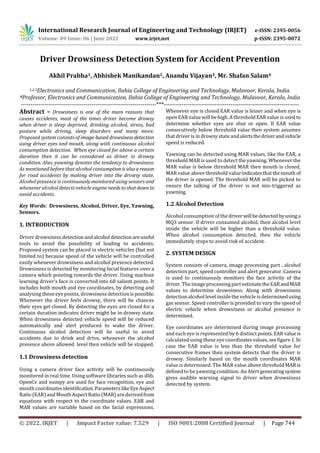
Driver Drowsiness Detection System for Accident Prevention
Akhil Prabha1, Abhishek Manikandan2, Anandu Vijayan3, Mr. Shafan Salam4
1,2,3Electronics and Communication, Ilahia College of Engineering and Technology, Mulavoor, Kerala, India.
4Professor, Electronics and Communication, Ilahia College of Engineering and Technology, Mulavoor, Kerala, India
---------------------------------------------------------------------***---------------------------------------------------------------------
Abstract – Drowsiness is one of the main reasons that
causes accidents, most of the times driver become drowsy
when driver is sleep deprived, drinking alcohol, stress, bad
posture while driving, sleep disorders and many more.
Proposed system consists of image-based drowsinessdetection
using driver eyes and mouth, along with continuous alcohol
consumption detection. When eye closed for above a certain
duration then it can be considered as driver in drowsy
condition. Also, yawning denotes the tendency to drowsiness.
As mentioned before that alcohol consumption isalsoareason
for road accidents by making driver into the drowsy state.
Alcohol presence is continuously monitored using sensors and
whenever alcohol detects vehicle engine needstoshutdownto
avoid accidents.
Key Words: Drowsiness, Alcohol, Driver, Eye, Yawning,
Sensors.
1. INTRODUCTION
Driver drowsiness detection andalcohol detectionareuseful
tools to avoid the possibility of leading to accidents.
Proposed system can be placed in electric vehicles (but not
limited to) because speed of the vehicle will be controlled
easily whenever drowsiness and alcohol presence detected.
Drowsiness is detected by monitoring facial features over a
camera which pointing towards the driver. Using machine
learning driver’s face is converted into 68 salient points. It
includes both mouth and eye coordinates, by detecting and
analysing these eye points, drowsiness detection ispossible.
Whenever the driver feels drowsy, there will be chances
their eyes get closed. By detecting the eyes are closed for a
certain duration indicates driver might be in drowsy state.
When drowsiness detected vehicle speed will be reduced
automatically and alert produced to wake the driver.
Continuous alcohol detection will be useful to avoid
accidents due to drink and drive, whenever the alcohol
presence above allowed level then vehicle will be stopped.
1.1 Drowsiness detection
Using a camera driver face activity will be continuously
monitored in real time. Using software libraries such as dlib,
OpenCv and numpy are used for face recognition, eye and
mouthcoordinates identification.ParameterslikeEyeAspect
Ratio (EAR)and Mouth Aspect Ratio (MAR) are derivedfrom
equations with respect to the coordinate values. EAR and
MAR values are variable based on the facial expressions.
Whenever eye is closed EAR value is lesser and when eye is
open EAR value will be high.A threshold EAR value is usedto
determine whether eyes are shut or open. If EAR value
consecutively below threshold value then system assumes
that driver is in drowsy stateandalertsthedriverandvehicle
speed is reduced.
Yawning can be detected using MAR values, like the EAR, a
threshold MAR is used to detect the yawning. Whenever the
MAR value is below threshold MAR then mouth is closed,
MAR value above threshold valueindicatesthatthemouth of
the driver is opened. The threshold MAR will be picked to
ensure the talking of the driver is not mis-triggered as
yawning.
1.2 Alcohol Detection
Alcohol consumption of thedriverwill bedetectedbyusinga
MQ3 sensor. If driver consumed alcohol, then alcohol level
inside the vehicle will be higher than a threshold value.
When alcohol consumption detected, then the vehicle
immediately stops to avoid risk of accident.
2. SYSTEM DESIGN
System consists of camera, image processing part , alcohol
detection part, speed controller and alert generator. Camera
is used to continuously monitors the face activity of the
driver. The image processingpart estimatetheEARandMAR
values to determine drowsiness. Along with drowsiness
detection alcohol level insidethe vehicle is determinedusing
gas sensor. Speed controller is provided to vary the speed of
electric vehicle when drowsiness or alcohol presence is
determined.
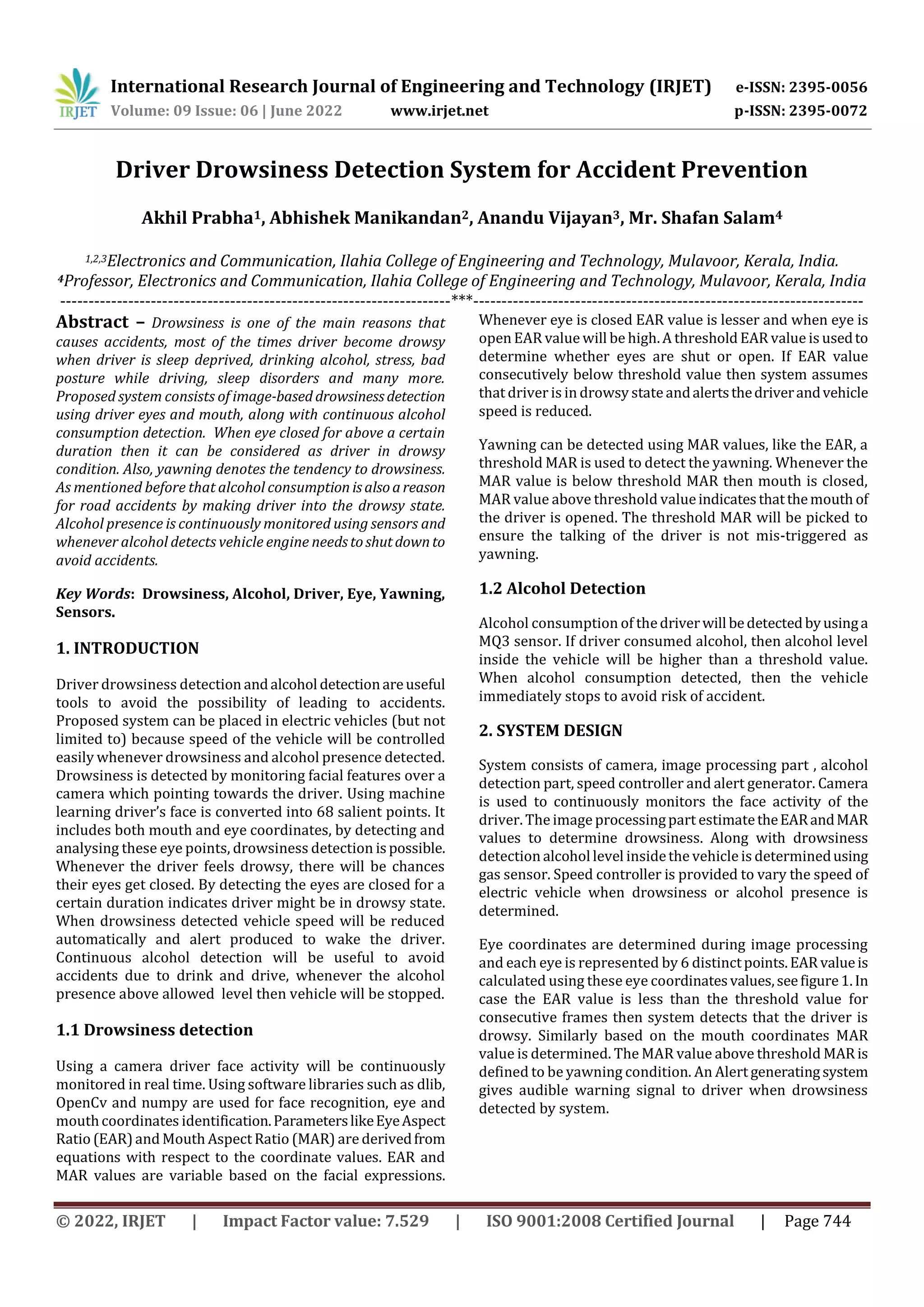
Eye coordinates are determined during image processing
and each eye is represented by 6 distinctpoints.EARvalueis
calculated using these eye coordinatesvalues,seefigure1.In
case the EAR value is less than the threshold value for
consecutive frames then system detects that the driver is
drowsy. Similarly based on the mouth coordinates MAR
value is determined. The MAR value above threshold MARis
defined to be yawning condition. An Alert generatingsystem
gives audible warning signal to driver when drowsiness
detected by system.
International Research Journal of Engineering and Technology (IRJET) e-ISSN: 2395-0056
Volume: 09 Issue: 06 | June 2022 www.irjet.net p-ISSN: 2395-0072
© 2022, IRJET | Impact Factor value: 7.529 | ISO 9001:2008 Certified Journal | Page 745
Fig -1: Eye Coordinates
EAR value is determined by,
EAR = ( P2− P6 ) + ( P3−P5 ) / 2 *( P1−P4 )
Fig -2: Mouth coordinates
Also Mouth Aspect Ratio (MAR) is determined by,
MAR= (|| P2-P8 ||+|| P3-P7 ||+|| P4 - P6 || ) / 2 ( ||P1-P5|| )
2.1 Existing System
System captures real time feed of the driver while driving
and using Haar cascade algorithm face can be recognized.
From the outline of face, eye and mouth will be detected.
Each frame of the camera feed is used to measure EAR .With
optimized algorithm eye shut due to sleepiness is detected.
All other unintentional events like blinking of eye will notbe
considered by the system as drowsiness event. In other
words, it is assumed to be driver is in drowsy condition, so
false detection will be avoided. After detecting drowsy state
of driver alert signal is passed from the signal to alert the
driver.
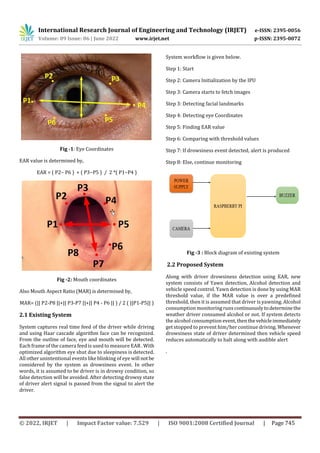
System workflow is given below.
Step 1: Start
Step 2: Camera Initialization by the IPU
Step 3: Camera starts to fetch images
Step 3: Detecting facial landmarks
Step 4: Detecting eye Coordinates
Step 5: Finding EAR value
Step 6: Comparing with threshold values
Step 7: If drowsiness event detected, alert is produced
Step 8: Else, continue monitoring
Fig -3 : Block diagram of existing system
2.2 Proposed System
Along with driver drowsiness detection using EAR, new
system consists of Yawn detection, Alcohol detection and
vehicle speed control. Yawn detection is done by using MAR
threshold value, if the MAR value is over a predefined
threshold, then it is assumed that driver is yawning. Alcohol
consumption monitoringrunscontinuouslytodeterminethe
weather driver consumed alcohol or not. If system detects
the alcohol consumption event, thenthevehicleimmediately
get stopped to prevent him/her continue driving. Whenever
drowsiness state of driver determined then vehicle speed
reduces automatically to halt along with audible alert
.
International Research Journal of Engineering and Technology (IRJET) e-ISSN: 2395-0056
Volume: 09 Issue: 06 | June 2022 www.irjet.net p-ISSN: 2395-0072
© 2022, IRJET | Impact Factor value: 7.529 | ISO 9001:2008 Certified Journal | Page 746
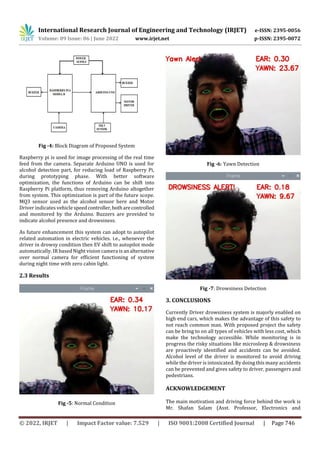
Fig -4: Block Diagram of Proposed System
Raspberry pi is used for image processing of the real time
feed from the camera. Separate Arduino UNO is used for
alcohol detection part, for reducing load of Raspberry Pi,
during prototyping phase. With better software
optimization, the functions of Arduino can be shift into
Raspberry Pi platform, thus removing Arduino altogether
from system. This optimization is part of the future scope.
MQ3 sensor used as the alcohol sensor here and Motor
Driver indicates vehicle speedcontroller,botharecontrolled
and monitored by the Arduino. Buzzers are provided to
indicate alcohol presence and drowsiness.
As future enhancement this system can adopt to autopilot
related automation in electric vehicles. i.e., whenever the
driver in drowsy condition then EV shift to autopilot mode
automatically. IR based Night vision camera is analternative
over normal camera for efficient functioning of system
during night time with zero cabin light.
2.3 Results
Fig -5: Normal Condition
Fig -6: Yawn Detection
Fig -7: Drowsiness Detection
3. CONCLUSIONS
Currently Driver drowsiness system is majorly enabled on
high end cars, which makes the advantage of this safety to
not reach common man. With proposed project the safety
can be bring to on all types of vehicles with less cost, which
make the technology accessible. While monitoring is in
progress the risky situations like microsleep & drowsiness
are proactively identified and accidents can be avoided.
Alcohol level of the driver is monitored to avoid driving
while the driver is intoxicated. By doing this many accidents
can be prevented and gives safety to driver, passengers and
pedestrians.
ACKNOWLEDGEMENT
The main motivation and driving force behind the work is
Mr. Shafan Salam (Asst. Professor, Electronics and
International Research Journal of Engineering and Technology (IRJET) e-ISSN: 2395-0056
Volume: 09 Issue: 06 | June 2022 www.irjet.net p-ISSN: 2395-0072
© 2022, IRJET | Impact Factor value: 7.529 | ISO 9001:2008 Certified Journal | Page 747
Communication Engineering, Ilahia College of Engineering
and Technology, Muvattupuzha, Kerala). I am unboundedly
grateful for his valuable corrections and guidance that
helped improving this work.
REFERENCES
[1] Eye Detection Using Morphological and Color Image
Processing Tanmay Rajpathaka, Ratnesh Kumar and Eric
Schwartzb
[2] A Robust Algorithm for Eye Detection on Grey Intensity
Face without Spectacles- JCS&T Vol. 5 No. 3
[3] Froba Kebbuck: Audio- and Video-Based Biometric
Person Authentication,3rdInternational Conference,AVBPA
2001, Halmstad, Sweden, June 2001.Proceedings, Springer.
ISBN 3- 540- 42216-1.
[4] Driver Drowsiness Detection using Eye-Closeness
Detection (2016 12th International Conference on Signal-
Image Technology & Internet-Based Systems)

Driver Drowsiness Detection System for Accident Prevention

  • 1.
    International Research Journalof Engineering and Technology (IRJET) e-ISSN: 2395-0056 Volume: 09 Issue: 06 | June 2022 www.irjet.net p-ISSN: 2395-0072 © 2022, IRJET | Impact Factor value: 7.529 | ISO 9001:2008 Certified Journal | Page 744 Driver Drowsiness Detection System for Accident Prevention Akhil Prabha1, Abhishek Manikandan2, Anandu Vijayan3, Mr. Shafan Salam4 1,2,3Electronics and Communication, Ilahia College of Engineering and Technology, Mulavoor, Kerala, India. 4Professor, Electronics and Communication, Ilahia College of Engineering and Technology, Mulavoor, Kerala, India ---------------------------------------------------------------------***--------------------------------------------------------------------- Abstract – Drowsiness is one of the main reasons that causes accidents, most of the times driver become drowsy when driver is sleep deprived, drinking alcohol, stress, bad posture while driving, sleep disorders and many more. Proposed system consists of image-based drowsinessdetection using driver eyes and mouth, along with continuous alcohol consumption detection. When eye closed for above a certain duration then it can be considered as driver in drowsy condition. Also, yawning denotes the tendency to drowsiness. As mentioned before that alcohol consumption isalsoareason for road accidents by making driver into the drowsy state. Alcohol presence is continuously monitored using sensors and whenever alcohol detects vehicle engine needstoshutdownto avoid accidents. Key Words: Drowsiness, Alcohol, Driver, Eye, Yawning, Sensors. 1. INTRODUCTION Driver drowsiness detection andalcohol detectionareuseful tools to avoid the possibility of leading to accidents. Proposed system can be placed in electric vehicles (but not limited to) because speed of the vehicle will be controlled easily whenever drowsiness and alcohol presence detected. Drowsiness is detected by monitoring facial features over a camera which pointing towards the driver. Using machine learning driver’s face is converted into 68 salient points. It includes both mouth and eye coordinates, by detecting and analysing these eye points, drowsiness detection ispossible. Whenever the driver feels drowsy, there will be chances their eyes get closed. By detecting the eyes are closed for a certain duration indicates driver might be in drowsy state. When drowsiness detected vehicle speed will be reduced automatically and alert produced to wake the driver. Continuous alcohol detection will be useful to avoid accidents due to drink and drive, whenever the alcohol presence above allowed level then vehicle will be stopped. 1.1 Drowsiness detection Using a camera driver face activity will be continuously monitored in real time. Using software libraries such as dlib, OpenCv and numpy are used for face recognition, eye and mouthcoordinates identification.ParameterslikeEyeAspect Ratio (EAR)and Mouth Aspect Ratio (MAR) are derivedfrom equations with respect to the coordinate values. EAR and MAR values are variable based on the facial expressions. Whenever eye is closed EAR value is lesser and when eye is open EAR value will be high.A threshold EAR value is usedto determine whether eyes are shut or open. If EAR value consecutively below threshold value then system assumes that driver is in drowsy stateandalertsthedriverandvehicle speed is reduced. Yawning can be detected using MAR values, like the EAR, a threshold MAR is used to detect the yawning. Whenever the MAR value is below threshold MAR then mouth is closed, MAR value above threshold valueindicatesthatthemouth of the driver is opened. The threshold MAR will be picked to ensure the talking of the driver is not mis-triggered as yawning. 1.2 Alcohol Detection Alcohol consumption of thedriverwill bedetectedbyusinga MQ3 sensor. If driver consumed alcohol, then alcohol level inside the vehicle will be higher than a threshold value. When alcohol consumption detected, then the vehicle immediately stops to avoid risk of accident. 2. SYSTEM DESIGN System consists of camera, image processing part , alcohol detection part, speed controller and alert generator. Camera is used to continuously monitors the face activity of the driver. The image processingpart estimatetheEARandMAR values to determine drowsiness. Along with drowsiness detection alcohol level insidethe vehicle is determinedusing gas sensor. Speed controller is provided to vary the speed of electric vehicle when drowsiness or alcohol presence is determined. Eye coordinates are determined during image processing and each eye is represented by 6 distinctpoints.EARvalueis calculated using these eye coordinatesvalues,seefigure1.In case the EAR value is less than the threshold value for consecutive frames then system detects that the driver is drowsy. Similarly based on the mouth coordinates MAR value is determined. The MAR value above threshold MARis defined to be yawning condition. An Alert generatingsystem gives audible warning signal to driver when drowsiness detected by system.
  • 2.
    International Research Journalof Engineering and Technology (IRJET) e-ISSN: 2395-0056 Volume: 09 Issue: 06 | June 2022 www.irjet.net p-ISSN: 2395-0072 © 2022, IRJET | Impact Factor value: 7.529 | ISO 9001:2008 Certified Journal | Page 745 Fig -1: Eye Coordinates EAR value is determined by, EAR = ( P2− P6 ) + ( P3−P5 ) / 2 *( P1−P4 ) Fig -2: Mouth coordinates Also Mouth Aspect Ratio (MAR) is determined by, MAR= (|| P2-P8 ||+|| P3-P7 ||+|| P4 - P6 || ) / 2 ( ||P1-P5|| ) 2.1 Existing System System captures real time feed of the driver while driving and using Haar cascade algorithm face can be recognized. From the outline of face, eye and mouth will be detected. Each frame of the camera feed is used to measure EAR .With optimized algorithm eye shut due to sleepiness is detected. All other unintentional events like blinking of eye will notbe considered by the system as drowsiness event. In other words, it is assumed to be driver is in drowsy condition, so false detection will be avoided. After detecting drowsy state of driver alert signal is passed from the signal to alert the driver. System workflow is given below. Step 1: Start Step 2: Camera Initialization by the IPU Step 3: Camera starts to fetch images Step 3: Detecting facial landmarks Step 4: Detecting eye Coordinates Step 5: Finding EAR value Step 6: Comparing with threshold values Step 7: If drowsiness event detected, alert is produced Step 8: Else, continue monitoring Fig -3 : Block diagram of existing system 2.2 Proposed System Along with driver drowsiness detection using EAR, new system consists of Yawn detection, Alcohol detection and vehicle speed control. Yawn detection is done by using MAR threshold value, if the MAR value is over a predefined threshold, then it is assumed that driver is yawning. Alcohol consumption monitoringrunscontinuouslytodeterminethe weather driver consumed alcohol or not. If system detects the alcohol consumption event, thenthevehicleimmediately get stopped to prevent him/her continue driving. Whenever drowsiness state of driver determined then vehicle speed reduces automatically to halt along with audible alert .
  • 3.
    International Research Journalof Engineering and Technology (IRJET) e-ISSN: 2395-0056 Volume: 09 Issue: 06 | June 2022 www.irjet.net p-ISSN: 2395-0072 © 2022, IRJET | Impact Factor value: 7.529 | ISO 9001:2008 Certified Journal | Page 746 Fig -4: Block Diagram of Proposed System Raspberry pi is used for image processing of the real time feed from the camera. Separate Arduino UNO is used for alcohol detection part, for reducing load of Raspberry Pi, during prototyping phase. With better software optimization, the functions of Arduino can be shift into Raspberry Pi platform, thus removing Arduino altogether from system. This optimization is part of the future scope. MQ3 sensor used as the alcohol sensor here and Motor Driver indicates vehicle speedcontroller,botharecontrolled and monitored by the Arduino. Buzzers are provided to indicate alcohol presence and drowsiness. As future enhancement this system can adopt to autopilot related automation in electric vehicles. i.e., whenever the driver in drowsy condition then EV shift to autopilot mode automatically. IR based Night vision camera is analternative over normal camera for efficient functioning of system during night time with zero cabin light. 2.3 Results Fig -5: Normal Condition Fig -6: Yawn Detection Fig -7: Drowsiness Detection 3. CONCLUSIONS Currently Driver drowsiness system is majorly enabled on high end cars, which makes the advantage of this safety to not reach common man. With proposed project the safety can be bring to on all types of vehicles with less cost, which make the technology accessible. While monitoring is in progress the risky situations like microsleep & drowsiness are proactively identified and accidents can be avoided. Alcohol level of the driver is monitored to avoid driving while the driver is intoxicated. By doing this many accidents can be prevented and gives safety to driver, passengers and pedestrians. ACKNOWLEDGEMENT The main motivation and driving force behind the work is Mr. Shafan Salam (Asst. Professor, Electronics and
  • 4.
    International Research Journalof Engineering and Technology (IRJET) e-ISSN: 2395-0056 Volume: 09 Issue: 06 | June 2022 www.irjet.net p-ISSN: 2395-0072 © 2022, IRJET | Impact Factor value: 7.529 | ISO 9001:2008 Certified Journal | Page 747 Communication Engineering, Ilahia College of Engineering and Technology, Muvattupuzha, Kerala). I am unboundedly grateful for his valuable corrections and guidance that helped improving this work. REFERENCES [1] Eye Detection Using Morphological and Color Image Processing Tanmay Rajpathaka, Ratnesh Kumar and Eric Schwartzb [2] A Robust Algorithm for Eye Detection on Grey Intensity Face without Spectacles- JCS&T Vol. 5 No. 3 [3] Froba Kebbuck: Audio- and Video-Based Biometric Person Authentication,3rdInternational Conference,AVBPA 2001, Halmstad, Sweden, June 2001.Proceedings, Springer. ISBN 3- 540- 42216-1. [4] Driver Drowsiness Detection using Eye-Closeness Detection (2016 12th International Conference on Signal- Image Technology & Internet-Based Systems)