Drill String & BHA Design
Presented by: M.Taher
Supervisor: Mr. Modesty
Drill String Components
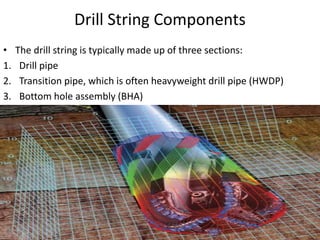
• The drill string is typically made up of three sections:
1. Drill pipe
2. Transition pipe, which is often heavyweight drill pipe (HWDP)
3. Bottom hole assembly (BHA)
Drill String Design
• To plan a wellbore trajectory that will limit
drillstring wear and damages.
• The use of larger stronger drillstring components in
smaller hole sizes prevent the accumulation of
fatigue, improve hydraulics and control deviation.
• The selection of a drillstring design that is resistant
to wear and damages is equally important.
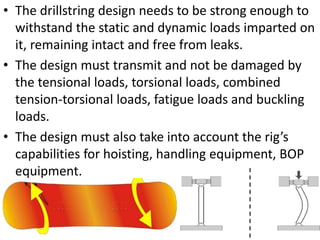
• The drillstring design needs to be strong enough to
withstand the static and dynamic loads imparted on
it, remaining intact and free from leaks.
• The design must transmit and not be damaged by
the tensional loads, torsional loads, combined
tension-torsional loads, fatigue loads and buckling
loads.
• The design must also take into account the rig’s
capabilities for hoisting, handling equipment, BOP
equipment.
• It needs to be able to support optimum hydraulics
for pressure losses, annular velocities and flow
regimes while staying within the limits imposed by
the rig surface equipment and wellbore trajectory
limits.
• Designs must also account for near vertical, high
angle and horizontal wells to prevent buckling. Plus,
tools and practices need to be identified to prevent
casing wear and minimize levels of torque and drag.
Functions of Drill String
• A drill string on a drilling rig is a column, or string,
of drill pipe that transmits drilling fluid (via the mud
pumps) and torque (via the kelly drive or top drive)
to the drill bit.
• The drill string is hollow so that drilling fluid can be
pumped down through it and circulated back up the
annulus.
Drill String Joints
• Most components in a drill string are manufactured
in 31 foot.
• Each 31 foot component is referred to as a joint.
• Typically 2, 3 or 4 joints are joined together to
make a stand.
• Modern onshore rigs are capable of handling ~90 ft
stands (often referred to as a triple).
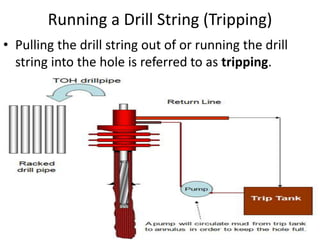
Running a Drill String (Tripping)
• Pulling the drill string out of or running the drill
string into the hole is referred to as tripping.
BHA Design
(Bottom Hole Assembly)
• The BHA design must be able to deliver the required
directional performance and supply the required
range of formation and drilling measurements for
each size of hole.
• The method of driving the bit, either rotary mode,
motor, turbine or rotary steerable, needs to be
selected based on the needs of the application, the
well objectives and drilling environment.
• The BHA design needs to be matched to the bit and
hole enlargement tools to ensure the forces being
generated are in balance.
• All the down hole equipment must be able to meet
the demands of the drilling conditions such as:
 Pressure
 Temperature
 Dogleg severity
 Mass flow rate, abrasive formations and drilling
vibration.
(BHA) Components
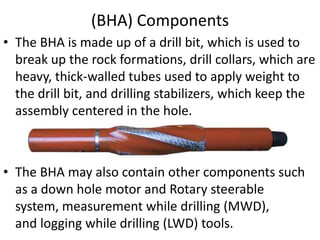
• The BHA is made up of a drill bit, which is used to
break up the rock formations, drill collars, which are
heavy, thick-walled tubes used to apply weight to
the drill bit, and drilling stabilizers, which keep the
assembly centered in the hole.
• The BHA may also contain other components such
as a down hole motor and Rotary steerable
system, measurement while drilling (MWD),
and logging while drilling (LWD) tools.
Functions of BHA
 In addition to add WOB,
1. Prevent dogleg & key seat.
2. Produce a smooth borehole & full size hole.
3. Improve bit performance.
4. Minimize drilling problems (differential pressure)
5. Minimize harmful vibration
6. Reduce production problems
Drill String Failure Mechanism
17%
4%
13%
66%
Overload
Corrosion
Other
Fatigue
World Deepest Drill String
• The world’s deepest drill is about to get taller, tall enough to dig
into Earth's mantle.
• Already, the Chikyu research vessel is capable of fetching samples
at depths of 23,000 feet (7010.40 m) below the seabed, two to
four times that of any other drill.
• In 2007, off the coast of Japan, it became the first mission to study
subduction zones, the area between tectonic plates that is the
birthplace of many earthquakes.
• Scientists will tack on at least an extra mile of drill and attempt the
most ambitious mission ever: piercing the Earth’s mantle. There,
scientists expect to find the same conditions as those in the early
Earth, and perhaps the same life-forms that thrived then.
Drill String Subs
• Subs are shorter components of the drill string,
averaging only 4 feet in length.
• Most subs are used as an adapter between two
different connection types in the same drill string.
• Often times the connection on drill pipe will differ
from that of the bottom hole assembly (drill collars
and heavy-weight) and a crossover sub must be used
to adapt the two different connections.
• Another common type of sub is a bit sub. A bit sub
is a sub that is used just above the bit and serves as
a crossover between the drill collar connections and
the bit connection, and it also houses the float
valve.
• The float valve is basically a one way fluid valve that
allows drilling fluids to pass out of the drill string
and into the bit, but does not allow those fluids to
back-flow into the drill string.
Crossover sub
• It’s used to connect lower drill tools and upper drill
tools while the lower connections is not matched
with the upper connections.
• It acts as connecting and change-over, deliver
torque function in different types of drill tools.
• All connections are phosphated or coppered
coating to minimize galling on initial make-up and
drilling operation.
Mud Motors
• Positive displacement Motors (PDM)
• PDM provide excellent steerability for deflecting or
straighten the well cores.
• In addition it allows us to increase the bit rpm
without increasing the drill string rotation and to
drill on less WOB, which can result in higher
penetration rate comparing to drill with a rotating
Kelly.
• Also, it reduce drill pipe and casing wear.
Drill String & BHA Design
• This video shows the components of the drill string
and the BHA.
• This video will be as a conclusion of the whole
presentation.
• If there is any question, please do ask.
• Last thing to remember always: SAFTY First.
References
• http://www.popsci.com/technology/article/2010-03/deepest-drill
• http://208.88.130.69/October-2003-Advances-in-fatigue-design-Curvature-
index-theory.html
• http://drillpipesupply.com/subs
• http://owetech.en.alibaba.com/product/292191881-
200144679/Crossover_Sub.html
• http://www.dhoiltools.com/crossoversubs.html
• http://www.squidoo.com/directional-drill-pipe
• http://drillingclub.proboards.com/index.cgi
• http://www.drillingformulas.com/what-is-a-trip-tank/

Drill String & Bottom Hole Assembly Design

  • 1.
    Drill String &BHA Design Presented by: M.Taher Supervisor: Mr. Modesty
  • 2.
    Drill String Components •The drill string is typically made up of three sections: 1. Drill pipe 2. Transition pipe, which is often heavyweight drill pipe (HWDP) 3. Bottom hole assembly (BHA)
  • 3.
    Drill String Design •To plan a wellbore trajectory that will limit drillstring wear and damages. • The use of larger stronger drillstring components in smaller hole sizes prevent the accumulation of fatigue, improve hydraulics and control deviation. • The selection of a drillstring design that is resistant to wear and damages is equally important.
  • 4.
    • The drillstringdesign needs to be strong enough to withstand the static and dynamic loads imparted on it, remaining intact and free from leaks. • The design must transmit and not be damaged by the tensional loads, torsional loads, combined tension-torsional loads, fatigue loads and buckling loads. • The design must also take into account the rig’s capabilities for hoisting, handling equipment, BOP equipment.
  • 5.
    • It needsto be able to support optimum hydraulics for pressure losses, annular velocities and flow regimes while staying within the limits imposed by the rig surface equipment and wellbore trajectory limits. • Designs must also account for near vertical, high angle and horizontal wells to prevent buckling. Plus, tools and practices need to be identified to prevent casing wear and minimize levels of torque and drag.
  • 6.
    Functions of DrillString • A drill string on a drilling rig is a column, or string, of drill pipe that transmits drilling fluid (via the mud pumps) and torque (via the kelly drive or top drive) to the drill bit. • The drill string is hollow so that drilling fluid can be pumped down through it and circulated back up the annulus.
  • 7.
    Drill String Joints •Most components in a drill string are manufactured in 31 foot. • Each 31 foot component is referred to as a joint. • Typically 2, 3 or 4 joints are joined together to make a stand. • Modern onshore rigs are capable of handling ~90 ft stands (often referred to as a triple).
  • 8.
    Running a DrillString (Tripping) • Pulling the drill string out of or running the drill string into the hole is referred to as tripping.
  • 9.
    BHA Design (Bottom HoleAssembly) • The BHA design must be able to deliver the required directional performance and supply the required range of formation and drilling measurements for each size of hole. • The method of driving the bit, either rotary mode, motor, turbine or rotary steerable, needs to be selected based on the needs of the application, the well objectives and drilling environment.
  • 10.
    • The BHAdesign needs to be matched to the bit and hole enlargement tools to ensure the forces being generated are in balance. • All the down hole equipment must be able to meet the demands of the drilling conditions such as:  Pressure  Temperature  Dogleg severity  Mass flow rate, abrasive formations and drilling vibration.
  • 11.
    (BHA) Components • TheBHA is made up of a drill bit, which is used to break up the rock formations, drill collars, which are heavy, thick-walled tubes used to apply weight to the drill bit, and drilling stabilizers, which keep the assembly centered in the hole. • The BHA may also contain other components such as a down hole motor and Rotary steerable system, measurement while drilling (MWD), and logging while drilling (LWD) tools.
  • 12.
    Functions of BHA In addition to add WOB, 1. Prevent dogleg & key seat. 2. Produce a smooth borehole & full size hole. 3. Improve bit performance. 4. Minimize drilling problems (differential pressure) 5. Minimize harmful vibration 6. Reduce production problems
  • 13.
    Drill String FailureMechanism 17% 4% 13% 66% Overload Corrosion Other Fatigue
  • 14.
    World Deepest DrillString • The world’s deepest drill is about to get taller, tall enough to dig into Earth's mantle. • Already, the Chikyu research vessel is capable of fetching samples at depths of 23,000 feet (7010.40 m) below the seabed, two to four times that of any other drill. • In 2007, off the coast of Japan, it became the first mission to study subduction zones, the area between tectonic plates that is the birthplace of many earthquakes. • Scientists will tack on at least an extra mile of drill and attempt the most ambitious mission ever: piercing the Earth’s mantle. There, scientists expect to find the same conditions as those in the early Earth, and perhaps the same life-forms that thrived then.
  • 16.
    Drill String Subs •Subs are shorter components of the drill string, averaging only 4 feet in length. • Most subs are used as an adapter between two different connection types in the same drill string. • Often times the connection on drill pipe will differ from that of the bottom hole assembly (drill collars and heavy-weight) and a crossover sub must be used to adapt the two different connections.
  • 17.
    • Another commontype of sub is a bit sub. A bit sub is a sub that is used just above the bit and serves as a crossover between the drill collar connections and the bit connection, and it also houses the float valve. • The float valve is basically a one way fluid valve that allows drilling fluids to pass out of the drill string and into the bit, but does not allow those fluids to back-flow into the drill string.
  • 18.
    Crossover sub • It’sused to connect lower drill tools and upper drill tools while the lower connections is not matched with the upper connections. • It acts as connecting and change-over, deliver torque function in different types of drill tools. • All connections are phosphated or coppered coating to minimize galling on initial make-up and drilling operation.
  • 19.
    Mud Motors • Positivedisplacement Motors (PDM) • PDM provide excellent steerability for deflecting or straighten the well cores. • In addition it allows us to increase the bit rpm without increasing the drill string rotation and to drill on less WOB, which can result in higher penetration rate comparing to drill with a rotating Kelly. • Also, it reduce drill pipe and casing wear.
  • 20.
    Drill String &BHA Design • This video shows the components of the drill string and the BHA. • This video will be as a conclusion of the whole presentation. • If there is any question, please do ask. • Last thing to remember always: SAFTY First.
  • 21.
    References • http://www.popsci.com/technology/article/2010-03/deepest-drill • http://208.88.130.69/October-2003-Advances-in-fatigue-design-Curvature- index-theory.html •http://drillpipesupply.com/subs • http://owetech.en.alibaba.com/product/292191881- 200144679/Crossover_Sub.html • http://www.dhoiltools.com/crossoversubs.html • http://www.squidoo.com/directional-drill-pipe • http://drillingclub.proboards.com/index.cgi • http://www.drillingformulas.com/what-is-a-trip-tank/