Drafting a Summary Composition I—J. Santoy
Goal —Reader will understand essay by reading summary. Identify all key points/ideas Identify author as creator/originator of ideas Identify all key sections of essay
How Did We Get Here? Read essay Annotated for key ideas Identified Stages of thought notes  Composed short section summaries  Identified author’s thesis sentence
How will I begin? Introduction Body Conclusion
Introduction Who is the author? What is the complete title? Identify topic 1-2 sentence summary of entire essay
Body How does author begin? Which stages of thought could I combine in my summary? How does the author end? How do I remind reader that these ideas are not mine? Author Tags
Conclusion How does the author end? What major idea/question/problem does he leave the reader with?
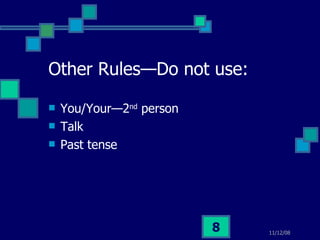
Other Rules—Do not use: You/Your—2 nd  person Talk Past tense
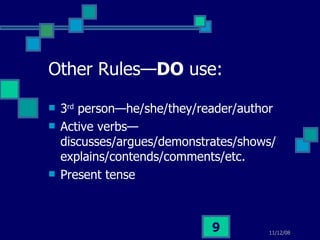
Other Rules— DO  use: 3 rd  person—he/she/they/reader/author Active verbs—discusses/argues/demonstrates/shows/ explains/contends/comments/etc. Present tense
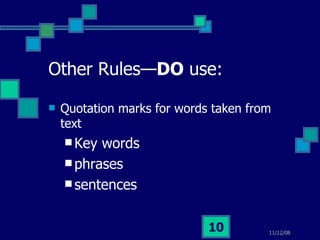
Other Rules— DO  use: Quotation marks for words taken from text Key words phrases sentences
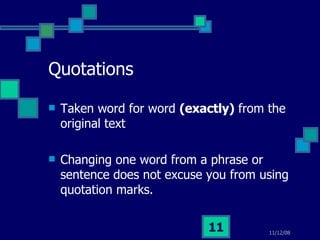
Quotations Taken word for word  (exactly)  from the original text Changing one word from a phrase or sentence does not excuse you from using quotation marks.
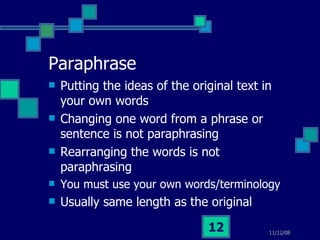
Paraphrase Putting the ideas of the original text in your own words Changing one word from a phrase or sentence is not paraphrasing Rearranging the words is not paraphrasing You must use your own words/terminology Usually same length as the original
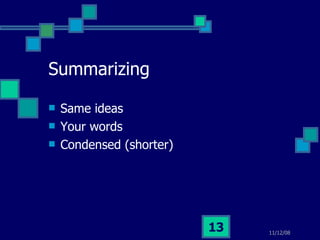
Summarizing Same ideas Your words Condensed (shorter)

Drafting A Summary

  • 1.
    Drafting a SummaryComposition I—J. Santoy
  • 2.
    Goal —Reader willunderstand essay by reading summary. Identify all key points/ideas Identify author as creator/originator of ideas Identify all key sections of essay
  • 3.
    How Did WeGet Here? Read essay Annotated for key ideas Identified Stages of thought notes Composed short section summaries Identified author’s thesis sentence
  • 4.
    How will Ibegin? Introduction Body Conclusion
  • 5.
    Introduction Who isthe author? What is the complete title? Identify topic 1-2 sentence summary of entire essay
  • 6.
    Body How doesauthor begin? Which stages of thought could I combine in my summary? How does the author end? How do I remind reader that these ideas are not mine? Author Tags
  • 7.
    Conclusion How doesthe author end? What major idea/question/problem does he leave the reader with?
  • 8.
    Other Rules—Do notuse: You/Your—2 nd person Talk Past tense
  • 9.
    Other Rules— DO use: 3 rd person—he/she/they/reader/author Active verbs—discusses/argues/demonstrates/shows/ explains/contends/comments/etc. Present tense
  • 10.
    Other Rules— DO use: Quotation marks for words taken from text Key words phrases sentences
  • 11.
    Quotations Taken wordfor word (exactly) from the original text Changing one word from a phrase or sentence does not excuse you from using quotation marks.
  • 12.
    Paraphrase Putting theideas of the original text in your own words Changing one word from a phrase or sentence is not paraphrasing Rearranging the words is not paraphrasing You must use your own words/terminology Usually same length as the original
  • 13.
    Summarizing Same ideasYour words Condensed (shorter)