 to discuss the good and bad points of something
to express your views on a particular subject
1. Giving reasons
2. Making suggestions
3. Giving recommendations
DISCURSIVEWRITING
(forandagainst)
ORGANIZATION
You have only 120-180 words in which to write your answer, so you will
need 4 paragraphs:
An introduction which sets the subject of discussion
Two paragraphs in which you give your ideas
A conclusion which in some way “summarises” what you’ve said or
restates your main feeling, opinion, etc.
First and last paragraphs
Both are very important
The first paragraph should give a good first impression (or even a
surprising one) and make the reader want to go on.
The last paragraph should leave the reader with a clear idea of what
your conclusions are. It should feel as if you have tied all the ends
togehter neatly, not just stopped because you’ve written enough.
• Use a word or phrase at the beginning to tell the reader this is the end.
• Summarize the main points.
• Relate back to the original question.
STYLE
An essay that asks for your ideas fairly neutral neither too formal
nor too informal
SO
• Don’t use conversational language, eg. direct speech.
• Use connecting words and phrases to link your ideas
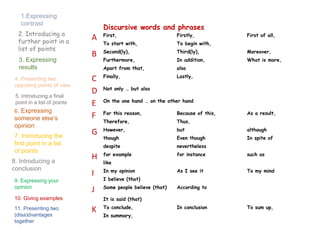
Discursive words and phrases
A First, Firstly, First of all,
To start with, To begin with,
B Second(ly), Third(ly), Moreover,
Furthermore, In addition, What is more,
Apart from that, also
C Finally, Lastly,
D Not only … but also
E On the one hand … on the other hand
F For this reason, Because of this, As a result,
Therefore, Thus,
G However, but although
though Even though In spite of
despite nevertheless
H for example for instance such as
like
I In my opinion As I see it To my mind
I believe (that)
J Some people believe (that) According to
It is said (that)
K To conclude, In conclusion To sum up,
In summary,
1.Expressing
contrast
2. Introducing a
further point in a
list of points
3. Expressing
results
4. Presenting two
opposing points of view
5. Introducing a final
point in a list of points
6. Expressing
someone else’s
opinion
7. Introducing the
first point in a list
of points
8. Introducing a
conclusion
9. Expressing your
opinion
10. Giving examples
11. Presenting two
(disa)dvantages
together
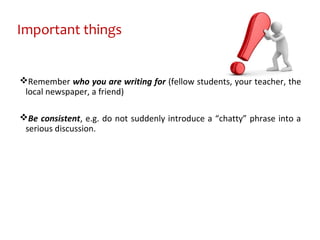
Important things
Remember who you are writing for (fellow students, your teacher, the
local newspaper, a friend)
Be consistent, e.g. do not suddenly introduce a “chatty” phrase into a
serious discussion.
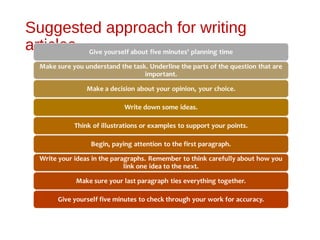
Suggested approach for writing
articles
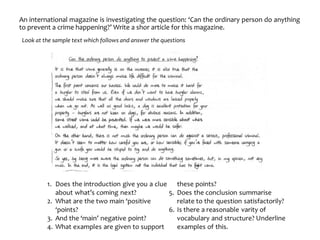
An international magazine is investigating the question: ‘Can the ordinary person do anything
to prevent a crime happening?’ Write a shor article for this magazine.
Look at the sample text which follows and answer the questions
BibliographyBibliography
Evans, Virgina and Dooley, Jenny (1999).
Reading and Writing. Targets 3. Student’s
Book. Swansea: Express Publishing.72-75.
 Mann, Malcom and Taylore_Knowles,
Steve (2006). Skills for First Certificate.
Writing. Oxford: Macmillan. 72-75.
BibliographyBibliography
Evans, Virgina and Dooley, Jenny (1999).
Reading and Writing. Targets 3. Student’s
Book. Swansea: Express Publishing.72-75.
 Mann, Malcom and Taylore_Knowles,
Steve (2006). Skills for First Certificate.
Writing. Oxford: Macmillan. 72-75.

Discursive writing 1

  • 1.
     to discussthe good and bad points of something to express your views on a particular subject 1. Giving reasons 2. Making suggestions 3. Giving recommendations DISCURSIVEWRITING (forandagainst)
  • 2.
    ORGANIZATION You have only120-180 words in which to write your answer, so you will need 4 paragraphs: An introduction which sets the subject of discussion Two paragraphs in which you give your ideas A conclusion which in some way “summarises” what you’ve said or restates your main feeling, opinion, etc.
  • 3.
    First and lastparagraphs Both are very important The first paragraph should give a good first impression (or even a surprising one) and make the reader want to go on. The last paragraph should leave the reader with a clear idea of what your conclusions are. It should feel as if you have tied all the ends togehter neatly, not just stopped because you’ve written enough. • Use a word or phrase at the beginning to tell the reader this is the end. • Summarize the main points. • Relate back to the original question.
  • 4.
    STYLE An essay thatasks for your ideas fairly neutral neither too formal nor too informal SO • Don’t use conversational language, eg. direct speech. • Use connecting words and phrases to link your ideas
  • 5.
    Discursive words andphrases A First, Firstly, First of all, To start with, To begin with, B Second(ly), Third(ly), Moreover, Furthermore, In addition, What is more, Apart from that, also C Finally, Lastly, D Not only … but also E On the one hand … on the other hand F For this reason, Because of this, As a result, Therefore, Thus, G However, but although though Even though In spite of despite nevertheless H for example for instance such as like I In my opinion As I see it To my mind I believe (that) J Some people believe (that) According to It is said (that) K To conclude, In conclusion To sum up, In summary, 1.Expressing contrast 2. Introducing a further point in a list of points 3. Expressing results 4. Presenting two opposing points of view 5. Introducing a final point in a list of points 6. Expressing someone else’s opinion 7. Introducing the first point in a list of points 8. Introducing a conclusion 9. Expressing your opinion 10. Giving examples 11. Presenting two (disa)dvantages together
  • 6.
    Important things Remember whoyou are writing for (fellow students, your teacher, the local newspaper, a friend) Be consistent, e.g. do not suddenly introduce a “chatty” phrase into a serious discussion.
  • 7.
    Suggested approach forwriting articles
  • 8.
    An international magazineis investigating the question: ‘Can the ordinary person do anything to prevent a crime happening?’ Write a shor article for this magazine. Look at the sample text which follows and answer the questions
  • 9.
    BibliographyBibliography Evans, Virgina andDooley, Jenny (1999). Reading and Writing. Targets 3. Student’s Book. Swansea: Express Publishing.72-75.  Mann, Malcom and Taylore_Knowles, Steve (2006). Skills for First Certificate. Writing. Oxford: Macmillan. 72-75.
  • 10.
    BibliographyBibliography Evans, Virgina andDooley, Jenny (1999). Reading and Writing. Targets 3. Student’s Book. Swansea: Express Publishing.72-75.  Mann, Malcom and Taylore_Knowles, Steve (2006). Skills for First Certificate. Writing. Oxford: Macmillan. 72-75.