Guidelines for Writing a Critique
Step 1Read.Read.Read.Re-read.Read again.
Step 1 1/2While you read, take notesUnderline thingsCircle words.Do you notice any patterns?Do you notice anything about the author’s tone?Is it funny? Angry? Serious?
Step 2Gather your ammunitionFind out where the work was published – does that help you figure out the author’s purpose and audience?What are the author’s obvious strategies in making his or her point?Are they successful?
Step 3Go DeeperLook at underlying assumptions, both yours and the writer’sLook for places where the author has left gaps – are these deliberate?  Do they need to be filled?Does the author play on your emotions?  How?  Is he or she using any images or ideas that play on some abstract, for example patriotism?
Step 4OrganizeArrange paragraphs based on clusters you find in your readingAFTER organizing, you should see a clear thesis beginning to emerge
Your Essay should includeA general introduction, in which you state your thesisA brief (BRIEF) (that means SHORT) (like ONE paragraph!) summarySomething about the purpose and audience, as you see itSomething about the author’s strategies, as you detect themWhether they are successful or notAnalysis of critical elements, like underlying values, rhetorical appeals.Comments on what worked, what didn’tYour personal response to the issue (also pretty short)Overall conclusion
How many paragraphs was that?More than five, you betcha.And forget the 3-part thesis.  It won’t work.
Step 5WriteWriteRevise.
General Guidelines
Organize by rhetorical point, not by summaryAllow your organization to develop naturally out of what you have found in your reading and note-taking.
Use the Present Tense
Refer to the author by his or her last nameLewis argues, Atwood writes, James demonstrates…
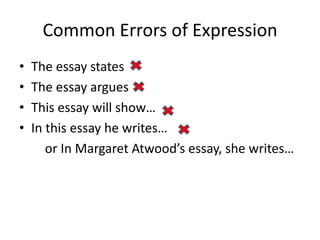
Common Errors of ExpressionThe essay statesThe essay argues This essay will show…In this essay he writes…        or In Margaret Atwood’s essay, she writes…
Oh, and it’s an ESSAYNot a story.

Guidelines For Writing A Critique

  • 1.
  • 2.
  • 3.
    Step 1 1/2Whileyou read, take notesUnderline thingsCircle words.Do you notice any patterns?Do you notice anything about the author’s tone?Is it funny? Angry? Serious?
  • 4.
    Step 2Gather yourammunitionFind out where the work was published – does that help you figure out the author’s purpose and audience?What are the author’s obvious strategies in making his or her point?Are they successful?
  • 5.
    Step 3Go DeeperLookat underlying assumptions, both yours and the writer’sLook for places where the author has left gaps – are these deliberate? Do they need to be filled?Does the author play on your emotions? How? Is he or she using any images or ideas that play on some abstract, for example patriotism?
  • 6.
    Step 4OrganizeArrange paragraphsbased on clusters you find in your readingAFTER organizing, you should see a clear thesis beginning to emerge
  • 7.
    Your Essay shouldincludeA general introduction, in which you state your thesisA brief (BRIEF) (that means SHORT) (like ONE paragraph!) summarySomething about the purpose and audience, as you see itSomething about the author’s strategies, as you detect themWhether they are successful or notAnalysis of critical elements, like underlying values, rhetorical appeals.Comments on what worked, what didn’tYour personal response to the issue (also pretty short)Overall conclusion
  • 8.
    How many paragraphswas that?More than five, you betcha.And forget the 3-part thesis. It won’t work.
  • 9.
  • 10.
  • 11.
    Organize by rhetoricalpoint, not by summaryAllow your organization to develop naturally out of what you have found in your reading and note-taking.
  • 12.
  • 13.
    Refer to theauthor by his or her last nameLewis argues, Atwood writes, James demonstrates…
  • 14.
    Common Errors ofExpressionThe essay statesThe essay argues This essay will show…In this essay he writes… or In Margaret Atwood’s essay, she writes…
  • 15.
    Oh, and it’san ESSAYNot a story.