



PNEUMONIA TREATMENT
PROTOCOL
BY SEHAM MOUSTAFA
FETOUH
BCPS , MSc of clinical pharmacy , Pharm D
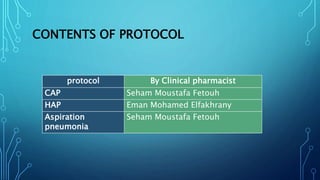
CONTENTS OF PROTOCOL
protocol By Clinical pharmacist
CAP Seham Moustafa Fetouh
HAP Eman Mohamed Elfakhrany
Aspiration
pneumonia
Seham Moustafa Fetouh
COMMUNITY ACQUIRED
PNEUMONIA
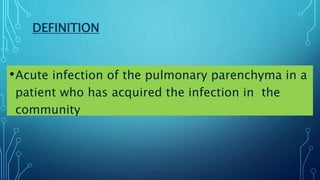
DEFINITION
•Acute infection of the pulmonary parenchyma in a
patient who has acquired the infection in the
community
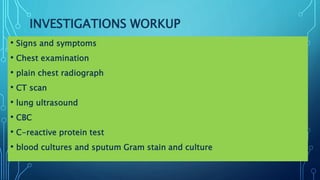
INVESTIGATIONS WORKUP
• Signs and symptoms
• Chest examination
• plain chest radiograph
• CT scan
• lung ultrasound
• CBC
• C-reactive protein test
• blood cultures and sputum Gram stain and culture
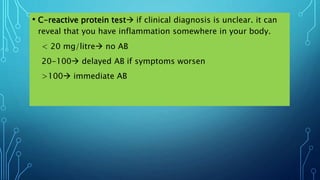
• C-reactive protein test if clinical diagnosis is unclear. it can
reveal that you have inflammation somewhere in your body.
< 20 mg/litre no AB
20-100 delayed AB if symptoms worsen
>100 immediate AB
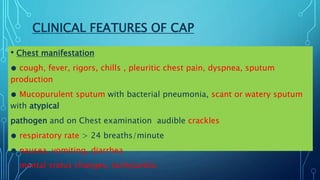
CLINICAL FEATURES OF CAP
• Chest manifestation
● cough, fever, rigors, chills , pleuritic chest pain, dyspnea, sputum
production
● Mucopurulent sputum with bacterial pneumonia, scant or watery sputum
with atypical
pathogen and on Chest examination audible crackles
● respiratory rate > 24 breaths/minute
● nausea, vomiting, diarrhea
● mental status changes, tachycardia
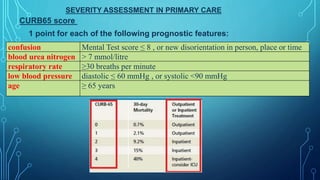
SEVERITY ASSESSMENT IN PRIMARY CARE
confusion Mental Test score ≤ 8 , or new disorientation in person, place or time
blood urea nitrogen > 7 mmol/litre
respiratory rate ≥30 breaths per minute
low blood pressure diastolic ≤ 60 mmHg , or systolic <90 mmHg
age ≥ 65 years
1 point for each of the following prognostic features:
CURB65 score
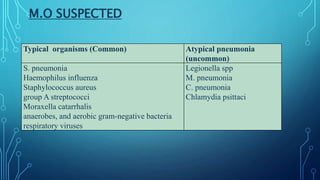
M.O SUSPECTED
Atypical pneumonia
(uncommon)
Typical organisms (Common)
Legionella spp
M. pneumonia
C. pneumonia
Chlamydia psittaci
S. pneumonia
Haemophilus influenza
Staphylococcus aureus
group A streptococci
Moraxella catarrhalis
anaerobes, and aerobic gram-negative bacteria
respiratory viruses
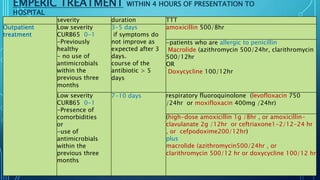
EMPERIC TREATMENT WITHIN 4 HOURS OF PRESENTATION TO
HOSPITAL
severity duration TTT
Outpatient
treatment
Low severity
CURB65 0-1
-Previously
healthy
- no use of
antimicrobials
within the
previous three
months
3-5 days
if symptoms do
not improve as
expected after 3
days.
course of the
antibiotic > 5
days
amoxicillin 500/8hr
-patients who are allergic to penicillin
Macrolide (azithromycin 500/24hr, clarithromycin
500/12hr
OR
Doxycycline 100/12hr
Low severity
CURB65 0-1
-Presence of
comorbidities
or
-use of
antimicrobials
within the
previous three
months
7-10 days respiratory fluoroquinolone (levofloxacin 750
/24hr or moxifloxacin 400mg /24hr)
(high-dose amoxicillin 1g /8hr , or amoxicillin-
clavulanate 2g /12hr or ceftriaxone1-2/12-24 hr
, or cefpodoxime200/12hr)
plus
macrolide (azithromycin500/24hr , or
clarithromycin 500/12 hr or doxycycline 100/12 hr
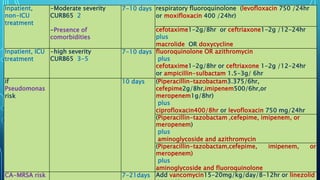
Inpatient,
non-ICU
treatment
-Moderate severity
CURB65 2
-Presence of
comorbidities
7-10 days respiratory fluoroquinolone (levofloxacin 750 /24hr
or moxifloxacin 400 /24hr)
cefotaxime1-2g/8hr or ceftriaxone1-2g /12-24hr
plus
macrolide OR doxycycline
Inpatient, ICU
treatment
-high severity
CURB65 3-5
7-10 days fluoroquinolone OR azithromycin
plus
cefotaxime1-2g/8hr or ceftriaxone 1-2g /12-24hr
or ampicillin-sulbactam 1.5-3g/ 6hr
if
Pseudomonas
risk
10 days (Piperacillin-tazobactam3.375/6hr,
cefepime2g/8hr,imipenem500/6hr,or
meropenem1g/8hr)
plus
ciprofloxacin400/8hr or levofloxacin 750 mg/24hr
(Piperacillin-tazobactam ,cefepime, imipenem, or
meropenem)
plus
aminoglycoside and azithromycin
(Piperacillin-tazobactam,cefepime, imipenem, or
meropenem)
plus
aminoglycoside and fluoroquinolone
CA-MRSA risk 7-21days Add vancomycin15-20mg/kg/day/8-12hr or linezolid
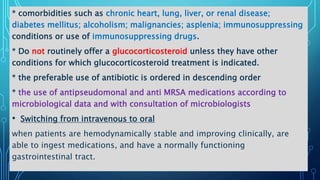
* comorbidities such as chronic heart, lung, liver, or renal disease;
diabetes mellitus; alcoholism; malignancies; asplenia; immunosuppressing
conditions or use of immunosuppressing drugs.
* Do not routinely offer a glucocorticosteroid unless they have other
conditions for which glucocorticosteroid treatment is indicated.
* the preferable use of antibiotic is ordered in descending order
* the use of antipseudomonal and anti MRSA medications according to
microbiological data and with consultation of microbiologists
• Switching from intravenous to oral
when patients are hemodynamically stable and improving clinically, are
able to ingest medications, and have a normally functioning
gastrointestinal tract.
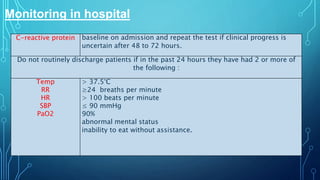
Monitoring in hospital
C-reactive protein baseline on admission and repeat the test if clinical progress is
uncertain after 48 to 72 hours.
Do not routinely discharge patients if in the past 24 hours they have had 2 or more of
the following :
Temp
RR
HR
SBP
PaO2
> 37.5°C
≥24 breaths per minute
> 100 beats per minute
≤ 90 mmHg
90%
abnormal mental status
inability to eat without assistance.
HOSPITAL ACQUIRED PNEUMONIA
DEFINITION
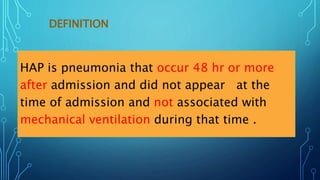
HAP is pneumonia that occur 48 hr or more
after admission and did not appear at the
time of admission and not associated with
mechanical ventilation during that time .
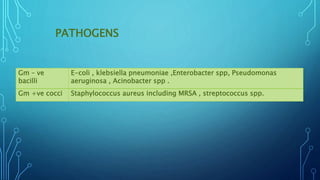
PATHOGENS
Gm – ve
bacilli
E-coli , klebsiella pneumoniae ,Enterobacter spp, Pseudomonas
aeruginosa , Acinobacter spp .
Gm +ve cocci Staphylococcus aureus including MRSA , streptococcus spp.
Emperic Treatment
IF Not of high risk of mortality* Using one of the following:
Levofloxacin 750 mg /24hr
Cefepim 2 g /8hr
piperacillin –tazobactam 4.5 g/6hr
if suspected MRSA: add
vancomycin 15mg /kg / 8-12 hr.
(consider loading dose 25-30 mg
/kg x 1 for severe illness )
IF high risk of mortality* Using one of the following:
Levofloxacin 750 mg /24hr
Ciprofloxacin 400 mg /8hr
Amikacin 15-20 mg/kg /24hr
Gentamycin 5-7 mg /kg /24hr
PLUS
Using one of the following:
Cefepim 2 g /8hr
Ceftazidim 2g /8hr
Imipenem 500mg /6hr
Meropenem 1g /8hr
piperacillin –tazobactam 4.5 g/6hr
if suspected MRSA: add
vancomycin 15mg /kg / 8-12 hrs.
(consider loading dose 25-30 mg
/kg x 1 for severe illness )
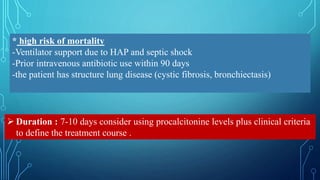
* high risk of mortality
-Ventilator support due to HAP and septic shock
-Prior intravenous antibiotic use within 90 days
-the patient has structure lung disease (cystic fibrosis, bronchiectasis)
 Duration : 7-10 days consider using procalcitonine levels plus clinical criteria
to define the treatment course .
ASPIRATION PNEUMONIA
DEFINITION
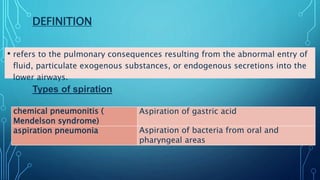
• refers to the pulmonary consequences resulting from the abnormal entry of
fluid, particulate exogenous substances, or endogenous secretions into the
lower airways.
Aspiration of gastric acidchemical pneumonitis (
Mendelson syndrome)
Aspiration of bacteria from oral and
pharyngeal areas
aspiration pneumonia
Types of spiration
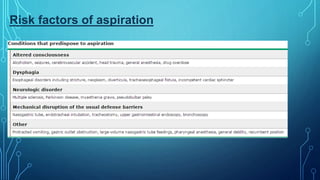
Risk factors of aspiration
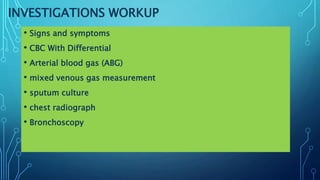
INVESTIGATIONS WORKUP
• Signs and symptoms
• CBC With Differential
• Arterial blood gas (ABG)
• mixed venous gas measurement
• sputum culture
• chest radiograph
• Bronchoscopy
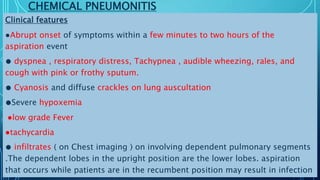
CHEMICAL PNEUMONITIS
Clinical features
●Abrupt onset of symptoms within a few minutes to two hours of the
aspiration event
● dyspnea , respiratory distress, Tachypnea , audible wheezing, rales, and
cough with pink or frothy sputum.
● Cyanosis and diffuse crackles on lung auscultation
●Severe hypoxemia
●low grade Fever
●tachycardia
● infiltrates ( on Chest imaging ) on involving dependent pulmonary segments
.The dependent lobes in the upright position are the lower lobes. aspiration
that occurs while patients are in the recumbent position may result in infection
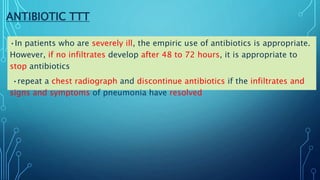
ANTIBIOTIC TTT
•In patients who are severely ill, the empiric use of antibiotics is appropriate.
However, if no infiltrates develop after 48 to 72 hours, it is appropriate to
stop antibiotics
•repeat a chest radiograph and discontinue antibiotics if the infiltrates and
signs and symptoms of pneumonia have resolved
BACTERIAL INFECTION
Chest manifestation
● Cough with purulent sputum ,Shortness of breath, dyspnea on exertion
● Pleuritic chest pain
● Putrid expectoration (a clue to anaerobic bacterial pneumonia)
● Fever or chills
● Malaise, myalgias
● Rigors may be present of absent
●complication untreated aspiration pneumonia  bronchopleural fistula 
Lung abscess, necrotizing pneumonia, or empyema.
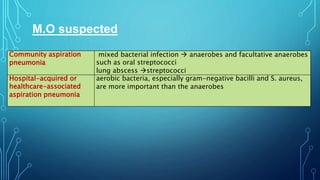
M.O suspected
Community aspiration
pneumonia
mixed bacterial infection  anaerobes and facultative anaerobes
such as oral streptococci
lung abscess streptococci
Hospital-acquired or
healthcare-associated
aspiration pneumonia
aerobic bacteria, especially gram-negative bacilli and S. aureus,
are more important than the anaerobes
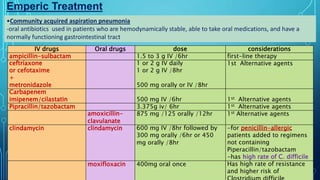
Emperic Treatment
IV drugs Oral drugs dose considerations
ampicillin-sulbactam 1.5 to 3 g IV /6hr first-line therapy
ceftriaxone
or cefotaxime
+
metronidazole
1 or 2 g IV daily
1 or 2 g IV /8hr
500 mg orally or IV /8hr
1st Alternative agents
Carbapenem
imipenem/cilastatin 500 mg IV /6hr 1st Alternative agents
Pipracillin/tazobactam 3.375g iv/ 6hr 1st Alternative agents
amoxicillin-
clavulanate
875 mg /125 orally /12hr 1st Alternative agents
clindamycin clindamycin 600 mg IV /8hr followed by
300 mg orally /6hr or 450
mg orally /8hr
-for penicillin-allergic
patients added to regimens
not containing
Piperacillin/tazobactam
-has high rate of C. difficile
moxifloxacin 400mg oral once Has high rate of resistance
and higher risk of
•Community acquired aspiration pneumonia
-oral antibiotics used in patients who are hemodynamically stable, able to take oral medications, and have a
normally functioning gastrointestinal tract
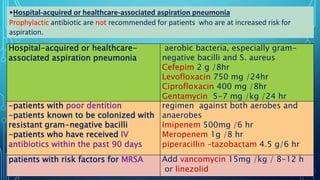
Hospital-acquired or healthcare-
associated aspiration pneumonia
aerobic bacteria, especially gram-
negative bacilli and S. aureus
Cefepim 2 g /8hr
Levofloxacin 750 mg /24hr
Ciprofloxacin 400 mg /8hr
Gentamycin 5-7 mg /kg /24 hr
-patients with poor dentition
-patients known to be colonized with
resistant gram-negative bacilli
-patients who have received IV
antibiotics within the past 90 days
regimen against both aerobes and
anaerobes
Imipenem 500mg /6 hr
Meropenem 1g /8 hr
piperacillin –tazobactam 4.5 g/6 hr
patients with risk factors for MRSA Add vancomycin 15mg /kg / 8-12 h
or linezolid
•Hospital-acquired or healthcare-associated aspiration pneumonia
Prophylactic antibiotic are not recommended for patients who are at increased risk for
aspiration.
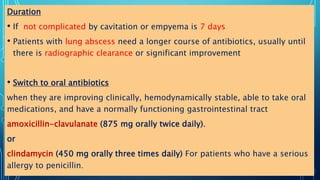
Duration
• If not complicated by cavitation or empyema is 7 days
• Patients with lung abscess need a longer course of antibiotics, usually until
there is radiographic clearance or significant improvement
• Switch to oral antibiotics
when they are improving clinically, hemodynamically stable, able to take oral
medications, and have a normally functioning gastrointestinal tract
amoxicillin-clavulanate (875 mg orally twice daily).
or
clindamycin (450 mg orally three times daily) For patients who have a serious
allergy to penicillin.
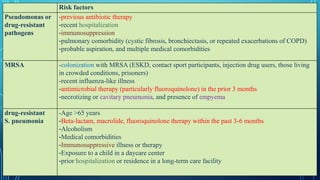
Risk factors
-previous antibiotic therapy
-recent hospitalization
-immunosuppression
-pulmonary comorbidity (cystic fibrosis, bronchiectasis, or repeated exacerbations of COPD)
-probable aspiration, and multiple medical comorbidities
Pseudomonas or
drug-resistant
pathogens
-colonization with MRSA (ESKD, contact sport participants, injection drug users, those living
in crowded conditions, prisoners)
-recent influenza-like illness
-antimicrobial therapy (particularly fluoroquinolone) in the prior 3 months
-necrotizing or cavitary pneumonia, and presence of empyema
MRSA
-Age >65 years
-Beta-lactam, macrolide, fluoroquinolone therapy within the past 3-6 months
-Alcoholism
-Medical comorbidities
-Immunosuppressive illness or therapy
-Exposure to a child in a daycare center
-prior hospitalization or residence in a long-term care facility
drug-resistant
S. pneumonia
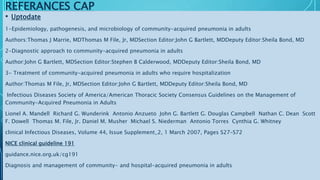
REFERANCES CAP
• Uptodate
1-Epidemiology, pathogenesis, and microbiology of community-acquired pneumonia in adults
Authors:Thomas J Marrie, MDThomas M File, Jr, MDSection Editor:John G Bartlett, MDDeputy Editor:Sheila Bond, MD
2-Diagnostic approach to community-acquired pneumonia in adults
Author:John G Bartlett, MDSection Editor:Stephen B Calderwood, MDDeputy Editor:Sheila Bond, MD
3- Treatment of community-acquired pneumonia in adults who require hospitalization
Author:Thomas M File, Jr, MDSection Editor:John G Bartlett, MDDeputy Editor:Sheila Bond, MD
Infectious Diseases Society of America/American Thoracic Society Consensus Guidelines on the Management of
Community-Acquired Pneumonia in Adults
Lionel A. Mandell Richard G. Wunderink Antonio Anzueto John G. Bartlett G. Douglas Campbell Nathan C. Dean Scott
F. Dowell Thomas M. File, Jr. Daniel M. Musher Michael S. Niederman Antonio Torres Cynthia G. Whitney
clinical Infectious Diseases, Volume 44, Issue Supplement_2, 1 March 2007, Pages S27–S72
NICE clinical guideline 191
guidance.nice.org.uk/cg191
Diagnosis and management of community- and hospital-acquired pneumonia in adults
REFERANCES HAP
• Andre C. Kalil, Mark L. Metersky, Michael Klompas , et al .
Management of Adults With Hospital-acquired and Ventilator-
associated Pneumonia: 2016 Clinical Practice Guidelines by the
Infectious Diseases Society of America and the American
Thoracic Society.
REFERENCES ASPIRATION
-Uptodate
Aspiration pneumonia in adults
Author:John G Bartlett, MDSection Editor:Daniel J Sexton, MDDeputy Editor:Sheila Bond, M
-http://emedicine.medscape.com/article/296198-overview#a9
-Infectious Diseases Society of America/American Thoracic Society Consensus Guidelines on the
Management of Community-Acquired Pneumonia in Adults
Lionel A. Mandell Richard G. Wunderink Antonio Anzueto John G. Bartlett G. Douglas Campbell Nathan
C. Dean Scott F. Dowell Thomas M. File, Jr. Daniel M. Musher Michael S. Niederman Antonio Torres
Cynthia G. Whitney
Clinical Infectious Diseases, Volume 44, Issue Supplement_2, 1 March 2007, Pages S27–S72
-Antibiotic Guidelines johns hopkins 2015-2016 Sara E. Cosgrove, M.D., M.S.
Director, Antimicrobial Stewardship Program, Edina Avdic, Pharm.D., M.B.A, ID Pharmacist
Associate Director, Antimicrobial Stewardship Program
-Sanford guide antimicrobial therapy electronic application
Dr seham   pneumonia treatment protocol

Dr seham pneumonia treatment protocol

  • 1.
    PNEUMONIA TREATMENT PROTOCOL BY SEHAMMOUSTAFA FETOUH BCPS , MSc of clinical pharmacy , Pharm D
  • 2.
    CONTENTS OF PROTOCOL protocolBy Clinical pharmacist CAP Seham Moustafa Fetouh HAP Eman Mohamed Elfakhrany Aspiration pneumonia Seham Moustafa Fetouh
  • 3.
  • 4.
    DEFINITION •Acute infection ofthe pulmonary parenchyma in a patient who has acquired the infection in the community
  • 5.
    INVESTIGATIONS WORKUP • Signsand symptoms • Chest examination • plain chest radiograph • CT scan • lung ultrasound • CBC • C-reactive protein test • blood cultures and sputum Gram stain and culture
  • 6.
    • C-reactive proteintest if clinical diagnosis is unclear. it can reveal that you have inflammation somewhere in your body. < 20 mg/litre no AB 20-100 delayed AB if symptoms worsen >100 immediate AB
  • 7.
    CLINICAL FEATURES OFCAP • Chest manifestation ● cough, fever, rigors, chills , pleuritic chest pain, dyspnea, sputum production ● Mucopurulent sputum with bacterial pneumonia, scant or watery sputum with atypical pathogen and on Chest examination audible crackles ● respiratory rate > 24 breaths/minute ● nausea, vomiting, diarrhea ● mental status changes, tachycardia
  • 8.
    SEVERITY ASSESSMENT INPRIMARY CARE confusion Mental Test score ≤ 8 , or new disorientation in person, place or time blood urea nitrogen > 7 mmol/litre respiratory rate ≥30 breaths per minute low blood pressure diastolic ≤ 60 mmHg , or systolic <90 mmHg age ≥ 65 years 1 point for each of the following prognostic features: CURB65 score
  • 9.
    M.O SUSPECTED Atypical pneumonia (uncommon) Typicalorganisms (Common) Legionella spp M. pneumonia C. pneumonia Chlamydia psittaci S. pneumonia Haemophilus influenza Staphylococcus aureus group A streptococci Moraxella catarrhalis anaerobes, and aerobic gram-negative bacteria respiratory viruses
  • 10.
    EMPERIC TREATMENT WITHIN4 HOURS OF PRESENTATION TO HOSPITAL severity duration TTT Outpatient treatment Low severity CURB65 0-1 -Previously healthy - no use of antimicrobials within the previous three months 3-5 days if symptoms do not improve as expected after 3 days. course of the antibiotic > 5 days amoxicillin 500/8hr -patients who are allergic to penicillin Macrolide (azithromycin 500/24hr, clarithromycin 500/12hr OR Doxycycline 100/12hr Low severity CURB65 0-1 -Presence of comorbidities or -use of antimicrobials within the previous three months 7-10 days respiratory fluoroquinolone (levofloxacin 750 /24hr or moxifloxacin 400mg /24hr) (high-dose amoxicillin 1g /8hr , or amoxicillin- clavulanate 2g /12hr or ceftriaxone1-2/12-24 hr , or cefpodoxime200/12hr) plus macrolide (azithromycin500/24hr , or clarithromycin 500/12 hr or doxycycline 100/12 hr
  • 11.
    Inpatient, non-ICU treatment -Moderate severity CURB65 2 -Presenceof comorbidities 7-10 days respiratory fluoroquinolone (levofloxacin 750 /24hr or moxifloxacin 400 /24hr) cefotaxime1-2g/8hr or ceftriaxone1-2g /12-24hr plus macrolide OR doxycycline Inpatient, ICU treatment -high severity CURB65 3-5 7-10 days fluoroquinolone OR azithromycin plus cefotaxime1-2g/8hr or ceftriaxone 1-2g /12-24hr or ampicillin-sulbactam 1.5-3g/ 6hr if Pseudomonas risk 10 days (Piperacillin-tazobactam3.375/6hr, cefepime2g/8hr,imipenem500/6hr,or meropenem1g/8hr) plus ciprofloxacin400/8hr or levofloxacin 750 mg/24hr (Piperacillin-tazobactam ,cefepime, imipenem, or meropenem) plus aminoglycoside and azithromycin (Piperacillin-tazobactam,cefepime, imipenem, or meropenem) plus aminoglycoside and fluoroquinolone CA-MRSA risk 7-21days Add vancomycin15-20mg/kg/day/8-12hr or linezolid
  • 12.
    * comorbidities suchas chronic heart, lung, liver, or renal disease; diabetes mellitus; alcoholism; malignancies; asplenia; immunosuppressing conditions or use of immunosuppressing drugs. * Do not routinely offer a glucocorticosteroid unless they have other conditions for which glucocorticosteroid treatment is indicated. * the preferable use of antibiotic is ordered in descending order * the use of antipseudomonal and anti MRSA medications according to microbiological data and with consultation of microbiologists • Switching from intravenous to oral when patients are hemodynamically stable and improving clinically, are able to ingest medications, and have a normally functioning gastrointestinal tract.
  • 13.
    Monitoring in hospital C-reactiveprotein baseline on admission and repeat the test if clinical progress is uncertain after 48 to 72 hours. Do not routinely discharge patients if in the past 24 hours they have had 2 or more of the following : Temp RR HR SBP PaO2 > 37.5°C ≥24 breaths per minute > 100 beats per minute ≤ 90 mmHg 90% abnormal mental status inability to eat without assistance.
  • 14.
  • 15.
    DEFINITION HAP is pneumoniathat occur 48 hr or more after admission and did not appear at the time of admission and not associated with mechanical ventilation during that time .
  • 16.
    PATHOGENS Gm – ve bacilli E-coli, klebsiella pneumoniae ,Enterobacter spp, Pseudomonas aeruginosa , Acinobacter spp . Gm +ve cocci Staphylococcus aureus including MRSA , streptococcus spp.
  • 17.
    Emperic Treatment IF Notof high risk of mortality* Using one of the following: Levofloxacin 750 mg /24hr Cefepim 2 g /8hr piperacillin –tazobactam 4.5 g/6hr if suspected MRSA: add vancomycin 15mg /kg / 8-12 hr. (consider loading dose 25-30 mg /kg x 1 for severe illness ) IF high risk of mortality* Using one of the following: Levofloxacin 750 mg /24hr Ciprofloxacin 400 mg /8hr Amikacin 15-20 mg/kg /24hr Gentamycin 5-7 mg /kg /24hr PLUS Using one of the following: Cefepim 2 g /8hr Ceftazidim 2g /8hr Imipenem 500mg /6hr Meropenem 1g /8hr piperacillin –tazobactam 4.5 g/6hr if suspected MRSA: add vancomycin 15mg /kg / 8-12 hrs. (consider loading dose 25-30 mg /kg x 1 for severe illness )
  • 18.
    * high riskof mortality -Ventilator support due to HAP and septic shock -Prior intravenous antibiotic use within 90 days -the patient has structure lung disease (cystic fibrosis, bronchiectasis)  Duration : 7-10 days consider using procalcitonine levels plus clinical criteria to define the treatment course .
  • 19.
  • 20.
    DEFINITION • refers tothe pulmonary consequences resulting from the abnormal entry of fluid, particulate exogenous substances, or endogenous secretions into the lower airways. Aspiration of gastric acidchemical pneumonitis ( Mendelson syndrome) Aspiration of bacteria from oral and pharyngeal areas aspiration pneumonia Types of spiration
  • 21.
    Risk factors ofaspiration
  • 22.
    INVESTIGATIONS WORKUP • Signsand symptoms • CBC With Differential • Arterial blood gas (ABG) • mixed venous gas measurement • sputum culture • chest radiograph • Bronchoscopy
  • 23.
    CHEMICAL PNEUMONITIS Clinical features ●Abruptonset of symptoms within a few minutes to two hours of the aspiration event ● dyspnea , respiratory distress, Tachypnea , audible wheezing, rales, and cough with pink or frothy sputum. ● Cyanosis and diffuse crackles on lung auscultation ●Severe hypoxemia ●low grade Fever ●tachycardia ● infiltrates ( on Chest imaging ) on involving dependent pulmonary segments .The dependent lobes in the upright position are the lower lobes. aspiration that occurs while patients are in the recumbent position may result in infection
  • 24.
    ANTIBIOTIC TTT •In patientswho are severely ill, the empiric use of antibiotics is appropriate. However, if no infiltrates develop after 48 to 72 hours, it is appropriate to stop antibiotics •repeat a chest radiograph and discontinue antibiotics if the infiltrates and signs and symptoms of pneumonia have resolved
  • 25.
    BACTERIAL INFECTION Chest manifestation ●Cough with purulent sputum ,Shortness of breath, dyspnea on exertion ● Pleuritic chest pain ● Putrid expectoration (a clue to anaerobic bacterial pneumonia) ● Fever or chills ● Malaise, myalgias ● Rigors may be present of absent ●complication untreated aspiration pneumonia  bronchopleural fistula  Lung abscess, necrotizing pneumonia, or empyema.
  • 26.
    M.O suspected Community aspiration pneumonia mixedbacterial infection  anaerobes and facultative anaerobes such as oral streptococci lung abscess streptococci Hospital-acquired or healthcare-associated aspiration pneumonia aerobic bacteria, especially gram-negative bacilli and S. aureus, are more important than the anaerobes
  • 27.
    Emperic Treatment IV drugsOral drugs dose considerations ampicillin-sulbactam 1.5 to 3 g IV /6hr first-line therapy ceftriaxone or cefotaxime + metronidazole 1 or 2 g IV daily 1 or 2 g IV /8hr 500 mg orally or IV /8hr 1st Alternative agents Carbapenem imipenem/cilastatin 500 mg IV /6hr 1st Alternative agents Pipracillin/tazobactam 3.375g iv/ 6hr 1st Alternative agents amoxicillin- clavulanate 875 mg /125 orally /12hr 1st Alternative agents clindamycin clindamycin 600 mg IV /8hr followed by 300 mg orally /6hr or 450 mg orally /8hr -for penicillin-allergic patients added to regimens not containing Piperacillin/tazobactam -has high rate of C. difficile moxifloxacin 400mg oral once Has high rate of resistance and higher risk of •Community acquired aspiration pneumonia -oral antibiotics used in patients who are hemodynamically stable, able to take oral medications, and have a normally functioning gastrointestinal tract
  • 28.
    Hospital-acquired or healthcare- associatedaspiration pneumonia aerobic bacteria, especially gram- negative bacilli and S. aureus Cefepim 2 g /8hr Levofloxacin 750 mg /24hr Ciprofloxacin 400 mg /8hr Gentamycin 5-7 mg /kg /24 hr -patients with poor dentition -patients known to be colonized with resistant gram-negative bacilli -patients who have received IV antibiotics within the past 90 days regimen against both aerobes and anaerobes Imipenem 500mg /6 hr Meropenem 1g /8 hr piperacillin –tazobactam 4.5 g/6 hr patients with risk factors for MRSA Add vancomycin 15mg /kg / 8-12 h or linezolid •Hospital-acquired or healthcare-associated aspiration pneumonia Prophylactic antibiotic are not recommended for patients who are at increased risk for aspiration.
  • 29.
    Duration • If notcomplicated by cavitation or empyema is 7 days • Patients with lung abscess need a longer course of antibiotics, usually until there is radiographic clearance or significant improvement • Switch to oral antibiotics when they are improving clinically, hemodynamically stable, able to take oral medications, and have a normally functioning gastrointestinal tract amoxicillin-clavulanate (875 mg orally twice daily). or clindamycin (450 mg orally three times daily) For patients who have a serious allergy to penicillin.
  • 30.
    Risk factors -previous antibiotictherapy -recent hospitalization -immunosuppression -pulmonary comorbidity (cystic fibrosis, bronchiectasis, or repeated exacerbations of COPD) -probable aspiration, and multiple medical comorbidities Pseudomonas or drug-resistant pathogens -colonization with MRSA (ESKD, contact sport participants, injection drug users, those living in crowded conditions, prisoners) -recent influenza-like illness -antimicrobial therapy (particularly fluoroquinolone) in the prior 3 months -necrotizing or cavitary pneumonia, and presence of empyema MRSA -Age >65 years -Beta-lactam, macrolide, fluoroquinolone therapy within the past 3-6 months -Alcoholism -Medical comorbidities -Immunosuppressive illness or therapy -Exposure to a child in a daycare center -prior hospitalization or residence in a long-term care facility drug-resistant S. pneumonia
  • 31.
    REFERANCES CAP • Uptodate 1-Epidemiology,pathogenesis, and microbiology of community-acquired pneumonia in adults Authors:Thomas J Marrie, MDThomas M File, Jr, MDSection Editor:John G Bartlett, MDDeputy Editor:Sheila Bond, MD 2-Diagnostic approach to community-acquired pneumonia in adults Author:John G Bartlett, MDSection Editor:Stephen B Calderwood, MDDeputy Editor:Sheila Bond, MD 3- Treatment of community-acquired pneumonia in adults who require hospitalization Author:Thomas M File, Jr, MDSection Editor:John G Bartlett, MDDeputy Editor:Sheila Bond, MD Infectious Diseases Society of America/American Thoracic Society Consensus Guidelines on the Management of Community-Acquired Pneumonia in Adults Lionel A. Mandell Richard G. Wunderink Antonio Anzueto John G. Bartlett G. Douglas Campbell Nathan C. Dean Scott F. Dowell Thomas M. File, Jr. Daniel M. Musher Michael S. Niederman Antonio Torres Cynthia G. Whitney clinical Infectious Diseases, Volume 44, Issue Supplement_2, 1 March 2007, Pages S27–S72 NICE clinical guideline 191 guidance.nice.org.uk/cg191 Diagnosis and management of community- and hospital-acquired pneumonia in adults
  • 32.
    REFERANCES HAP • AndreC. Kalil, Mark L. Metersky, Michael Klompas , et al . Management of Adults With Hospital-acquired and Ventilator- associated Pneumonia: 2016 Clinical Practice Guidelines by the Infectious Diseases Society of America and the American Thoracic Society.
  • 33.
    REFERENCES ASPIRATION -Uptodate Aspiration pneumoniain adults Author:John G Bartlett, MDSection Editor:Daniel J Sexton, MDDeputy Editor:Sheila Bond, M -http://emedicine.medscape.com/article/296198-overview#a9 -Infectious Diseases Society of America/American Thoracic Society Consensus Guidelines on the Management of Community-Acquired Pneumonia in Adults Lionel A. Mandell Richard G. Wunderink Antonio Anzueto John G. Bartlett G. Douglas Campbell Nathan C. Dean Scott F. Dowell Thomas M. File, Jr. Daniel M. Musher Michael S. Niederman Antonio Torres Cynthia G. Whitney Clinical Infectious Diseases, Volume 44, Issue Supplement_2, 1 March 2007, Pages S27–S72 -Antibiotic Guidelines johns hopkins 2015-2016 Sara E. Cosgrove, M.D., M.S. Director, Antimicrobial Stewardship Program, Edina Avdic, Pharm.D., M.B.A, ID Pharmacist Associate Director, Antimicrobial Stewardship Program -Sanford guide antimicrobial therapy electronic application