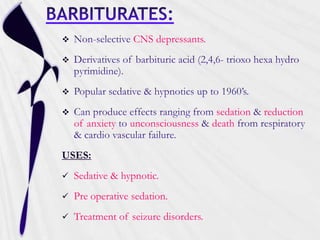
 CNS depressants.


 sedation reduction
of anxiety unconsciousness death
USES:
 Sedative & hypnotic.
 Pre operative sedation.
 Treatment of seizure disorders.

 Bind to GABA receptors



Prolong the opening of chloride channel
Inhibiting excitable cells of the CNS










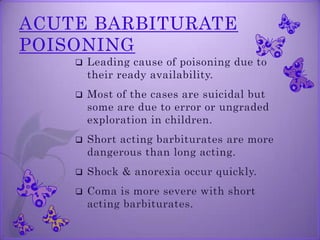
ACUTE BARBITURATE
POISONING
 Leading cause of poisoning due to
their ready availability.
 Most of the cases are suicidal but
some are due to error or ungraded
exploration in children.
 Short acting barbiturates are more
dangerous than long acting.
 Shock & anorexia occur quickly.
 Coma is more severe with short
acting barbiturates.
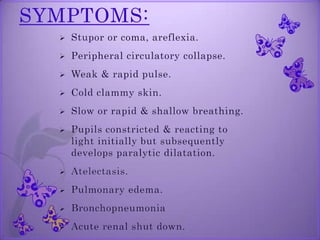
SYMPTOMS:
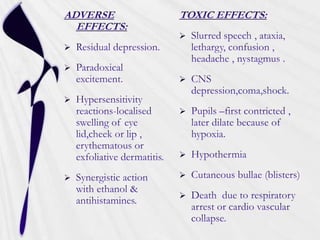
 Stupor or coma, areflexia.
 Peripheral circulatory collapse.
 Weak & rapid pulse.
 Cold clammy skin.
 Slow or rapid & shallow breathing.
 Pupils constricted & reacting to
light initially but subsequently
develops paralytic dilatation.
 Atelectasis.
 Pulmonary edema.
 Bronchopneumonia
 Acute renal shut down.
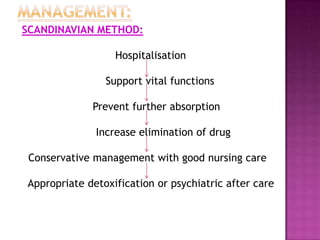
SCANDINAVIAN METHOD:
Hospitalisation
Support vital functions
Prevent further absorption
Increase elimination of drug
Conservative management with good nursing care
Appropriate detoxification or psychiatric after care
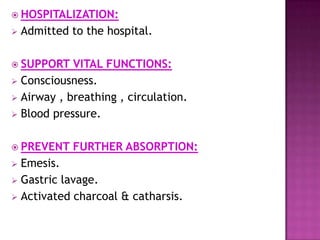
 HOSPITALIZATION:
 Admitted to the hospital.
 SUPPORT VITAL FUNCTIONS:
 Consciousness.
 Airway , breathing , circulation.
 Blood pressure.
 PREVENT FURTHER ABSORPTION:
 Emesis.
 Gastric lavage.
 Activated charcoal & catharsis.
 INCREASE ELIMINATION OF DRUG:
 Forced diuresis.
 Alkalinization of urine.
 Prophylactic antibiotic.
 Peritoneal dialysis.
 Hemodialysis.
 Hemoperfusion.
 OTHER MEASURES:
 Psychiatric after care.
Pharmacology by H.P.Rang and M. M.
Dale, 5th edition, page no:523.
Principles of Clinical Toxicology by
Thomas. A. Gossel , 2nd edition , page
no:290-293.
Textbook of Forensic Medicine and
Toxicology by V.V. Pillay , 14th edition,
page no:472-473.
Essentials of Medical Pharmacology by
K.D.Tripathi , 6th edition, page no:390-392.
Pharmacology and Pharmacotherapeutics
by R.S. Sathoskar, 19th edition, page no:114-
115.
BENZODIAZEPINES



USES:





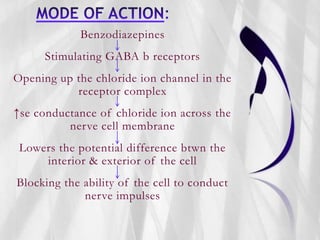
Benzodiazepines
Stimulating GABA b receptors
Opening up the chloride ion channel in the
receptor complex
↑se conductance of chloride ion across the
nerve cell membrane
Lowers the potential difference btwn the
interior & exterior of the cell
Blocking the ability of the cell to conduct
nerve impulses
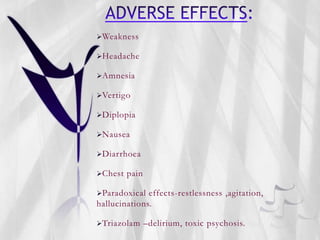
Weakness
Headache
Amnesia
Vertigo
Diplopia
Nausea
Diarrhoea
Chest pain
Paradoxical effects-restlessness ,agitation,
hallucinations.
Triazolam –delirium, toxic psychosis.
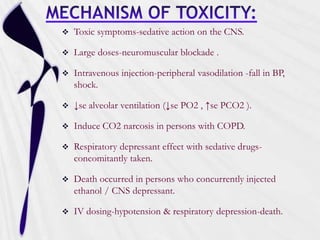
 Toxic symptoms-sedative action on the CNS.
 Large doses-neuromuscular blockade .
 Intravenous injection-peripheral vasodilation -fall in BP,
shock.
 ↓se alveolar ventilation (↓se PO2 , ↑se PCO2 ).
 Induce CO2 narcosis in persons with COPD.
 Respiratory depressant effect with sedative drugs-
concomitantly taken.
 Death occurred in persons who concurrently injected
ethanol / CNS depressant.
 IV dosing-hypotension & respiratory depression-death.
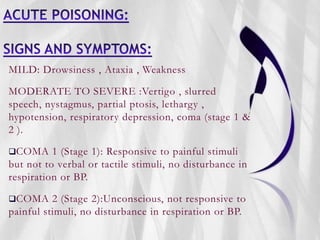
MILD: Drowsiness , Ataxia , Weakness
MODERATE TO SEVERE :Vertigo , slurred
speech, nystagmus, partial ptosis, lethargy ,
hypotension, respiratory depression, coma (stage 1 &
2 ).
COMA 1 (Stage 1): Responsive to painful stimuli
but not to verbal or tactile stimuli, no disturbance in
respiration or BP.
COMA 2 (Stage 2):Unconscious, not responsive to
painful stimuli, no disturbance in respiration or BP.
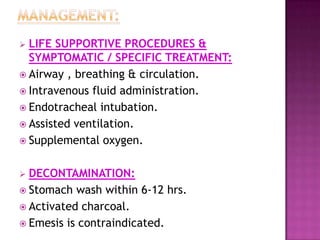
 LIFE SUPPORTIVE PROCEDURES &
SYMPTOMATIC / SPECIFIC TREATMENT:
 Airway , breathing & circulation.
 Intravenous fluid administration.
 Endotracheal intubation.
 Assisted ventilation.
 Supplemental oxygen.
 DECONTAMINATION:
 Stomach wash within 6-12 hrs.
 Activated charcoal.
 Emesis is contraindicated.
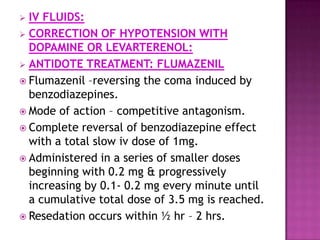
 IV FLUIDS:
 CORRECTION OF HYPOTENSION WITH
DOPAMINE OR LEVARTERENOL:
 ANTIDOTE TREATMENT: FLUMAZENIL
 Flumazenil –reversing the coma induced by
benzodiazepines.
 Mode of action – competitive antagonism.
 Complete reversal of benzodiazepine effect
with a total slow iv dose of 1mg.
 Administered in a series of smaller doses
beginning with 0.2 mg & progressively
increasing by 0.1- 0.2 mg every minute until
a cumulative total dose of 3.5 mg is reached.
 Resedation occurs within ½ hr – 2 hrs.
TEXT BOOK OF FORENSIC MEDICINE AND TOXICOLOGY
BY V.V PILLAY , 14TH EDITION, PAGE NO:470-471.
PRINCIPLES OF CLINICAL TOXICOLOGY BY THOMAS . A
. GOSSEL , 2ND EDITION, PAGE NO:285-288.
PHARMACOLOGY BY H.P. RANG AND M.M. DALE , 5TH
EDITION,PAGE NO:522.
ESSENTIALS OF MEDICAL PHARMACOLOGY BY K.D.
TRIPATHI, 6TH EDITION, PAGE NO:389.
WWW. GOOGLE.COM.
Barbiturates and benzodiazepines acute poisoning

Barbiturates and benzodiazepines acute poisoning

  • 2.
     CNS depressants.   sedation reduction of anxiety unconsciousness death USES:  Sedative & hypnotic.  Pre operative sedation.  Treatment of seizure disorders.
  • 3.
      Bind toGABA receptors    Prolong the opening of chloride channel Inhibiting excitable cells of the CNS
  • 5.
  • 6.
    ACUTE BARBITURATE POISONING  Leadingcause of poisoning due to their ready availability.  Most of the cases are suicidal but some are due to error or ungraded exploration in children.  Short acting barbiturates are more dangerous than long acting.  Shock & anorexia occur quickly.  Coma is more severe with short acting barbiturates.
  • 7.
    SYMPTOMS:  Stupor orcoma, areflexia.  Peripheral circulatory collapse.  Weak & rapid pulse.  Cold clammy skin.  Slow or rapid & shallow breathing.  Pupils constricted & reacting to light initially but subsequently develops paralytic dilatation.  Atelectasis.  Pulmonary edema.  Bronchopneumonia  Acute renal shut down.
  • 8.
    SCANDINAVIAN METHOD: Hospitalisation Support vitalfunctions Prevent further absorption Increase elimination of drug Conservative management with good nursing care Appropriate detoxification or psychiatric after care
  • 9.
     HOSPITALIZATION:  Admittedto the hospital.  SUPPORT VITAL FUNCTIONS:  Consciousness.  Airway , breathing , circulation.  Blood pressure.  PREVENT FURTHER ABSORPTION:  Emesis.  Gastric lavage.  Activated charcoal & catharsis.
  • 10.
     INCREASE ELIMINATIONOF DRUG:  Forced diuresis.  Alkalinization of urine.  Prophylactic antibiotic.  Peritoneal dialysis.  Hemodialysis.  Hemoperfusion.  OTHER MEASURES:  Psychiatric after care.
  • 11.
    Pharmacology by H.P.Rangand M. M. Dale, 5th edition, page no:523. Principles of Clinical Toxicology by Thomas. A. Gossel , 2nd edition , page no:290-293. Textbook of Forensic Medicine and Toxicology by V.V. Pillay , 14th edition, page no:472-473. Essentials of Medical Pharmacology by K.D.Tripathi , 6th edition, page no:390-392. Pharmacology and Pharmacotherapeutics by R.S. Sathoskar, 19th edition, page no:114- 115.
  • 12.
  • 15.
    Benzodiazepines Stimulating GABA breceptors Opening up the chloride ion channel in the receptor complex ↑se conductance of chloride ion across the nerve cell membrane Lowers the potential difference btwn the interior & exterior of the cell Blocking the ability of the cell to conduct nerve impulses
  • 16.
  • 17.
     Toxic symptoms-sedativeaction on the CNS.  Large doses-neuromuscular blockade .  Intravenous injection-peripheral vasodilation -fall in BP, shock.  ↓se alveolar ventilation (↓se PO2 , ↑se PCO2 ).  Induce CO2 narcosis in persons with COPD.  Respiratory depressant effect with sedative drugs- concomitantly taken.  Death occurred in persons who concurrently injected ethanol / CNS depressant.  IV dosing-hypotension & respiratory depression-death.
  • 18.
    MILD: Drowsiness ,Ataxia , Weakness MODERATE TO SEVERE :Vertigo , slurred speech, nystagmus, partial ptosis, lethargy , hypotension, respiratory depression, coma (stage 1 & 2 ). COMA 1 (Stage 1): Responsive to painful stimuli but not to verbal or tactile stimuli, no disturbance in respiration or BP. COMA 2 (Stage 2):Unconscious, not responsive to painful stimuli, no disturbance in respiration or BP.
  • 19.
     LIFE SUPPORTIVEPROCEDURES & SYMPTOMATIC / SPECIFIC TREATMENT:  Airway , breathing & circulation.  Intravenous fluid administration.  Endotracheal intubation.  Assisted ventilation.  Supplemental oxygen.  DECONTAMINATION:  Stomach wash within 6-12 hrs.  Activated charcoal.  Emesis is contraindicated.
  • 20.
     IV FLUIDS: CORRECTION OF HYPOTENSION WITH DOPAMINE OR LEVARTERENOL:  ANTIDOTE TREATMENT: FLUMAZENIL  Flumazenil –reversing the coma induced by benzodiazepines.  Mode of action – competitive antagonism.  Complete reversal of benzodiazepine effect with a total slow iv dose of 1mg.  Administered in a series of smaller doses beginning with 0.2 mg & progressively increasing by 0.1- 0.2 mg every minute until a cumulative total dose of 3.5 mg is reached.  Resedation occurs within ½ hr – 2 hrs.
  • 21.
    TEXT BOOK OFFORENSIC MEDICINE AND TOXICOLOGY BY V.V PILLAY , 14TH EDITION, PAGE NO:470-471. PRINCIPLES OF CLINICAL TOXICOLOGY BY THOMAS . A . GOSSEL , 2ND EDITION, PAGE NO:285-288. PHARMACOLOGY BY H.P. RANG AND M.M. DALE , 5TH EDITION,PAGE NO:522. ESSENTIALS OF MEDICAL PHARMACOLOGY BY K.D. TRIPATHI, 6TH EDITION, PAGE NO:389. WWW. GOOGLE.COM.