Hormonal method
• Injectables
At the end of the learning session, the
student should be able to:
1. state the type of injectable method.
2. explain the mechanism and action of
injectable method.
3. explain the advantages and disadvantages
of injectable method
4. explain the management of client on
injectable method
i. Depot Medroxy Progesterone Acetate
(DMPA)
- Contain 150 mg / vial
- Given by intramuscular injection at 3
monthly or 12/52
- It also known as Depo, Depo-Provera,
Megestron and Petogen.
ii. Norethisterone Enanthate (NET-EN)
- Contain 200 mg / vial
- Given by intramuscular injection at 2
monthly or 8/52
- It also known as Noristerat and Syngestal.
• Each contains a progestin like the natural hormone
progesterone in a woman’s body. Do not contain
estrogen, and can be used throughout breastfeeding
and by women who cannot use methods with
estrogen.
 Its main mechanism of action is to suppress
ovulation.
• It also makes the endometrium unsuitable for
implantation if fertilisation occurs.
• It also increases the viscosity of cervical
mucus, making the mucus less easily
penetrable to sperm.
• Reduce sperm transport in upper genital
tract (fallopian tubes)
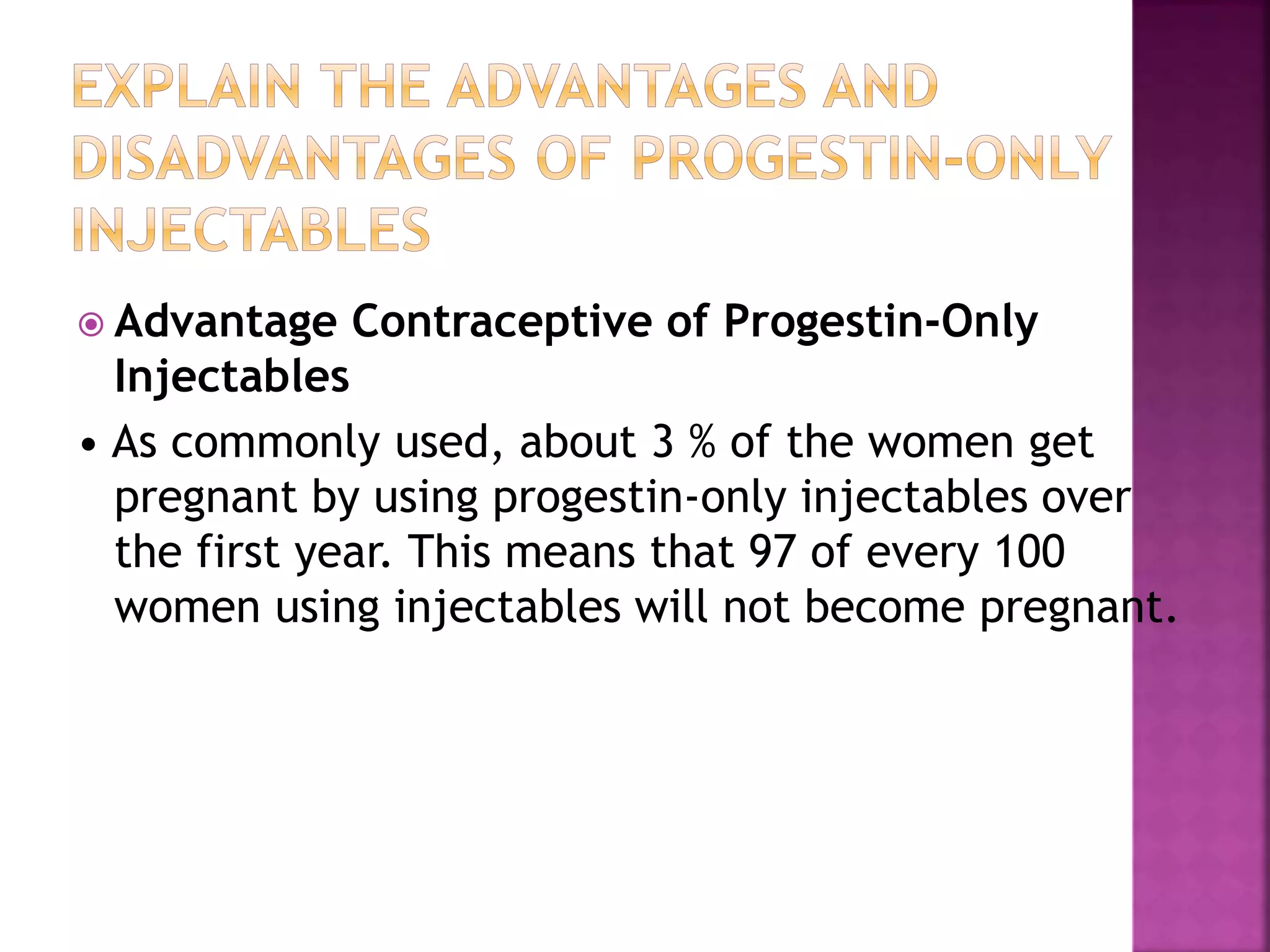
 Advantage Contraceptive of Progestin-Only
Injectables
• As commonly used, about 3 % of the women get
pregnant by using progestin-only injectables over
the first year. This means that 97 of every 100
women using injectables will not become pregnant.
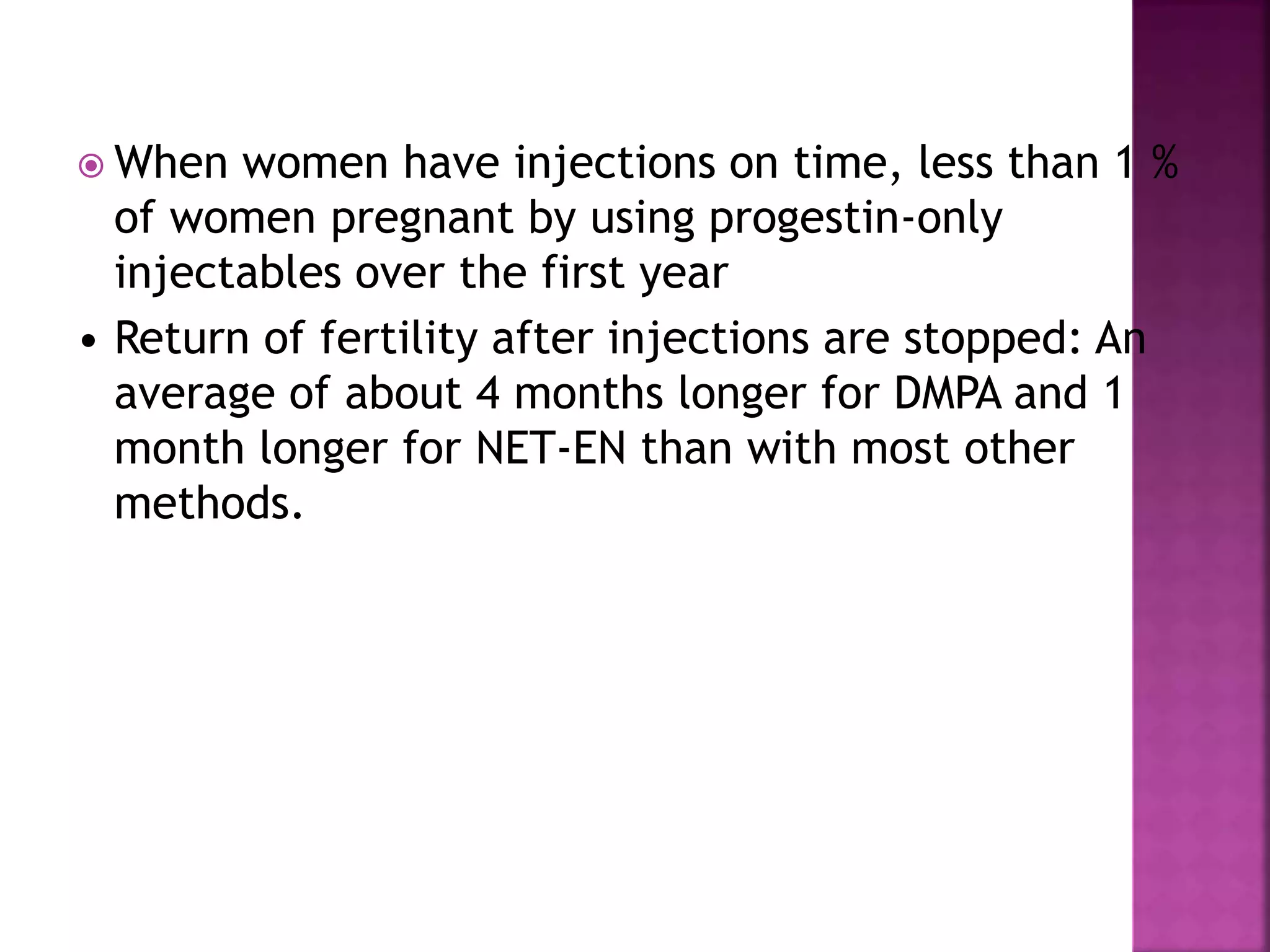
 When women have injections on time, less than 1 %
of women pregnant by using progestin-only
injectables over the first year
• Return of fertility after injections are stopped: An
average of about 4 months longer for DMPA and 1
month longer for NET-EN than with most other
methods.
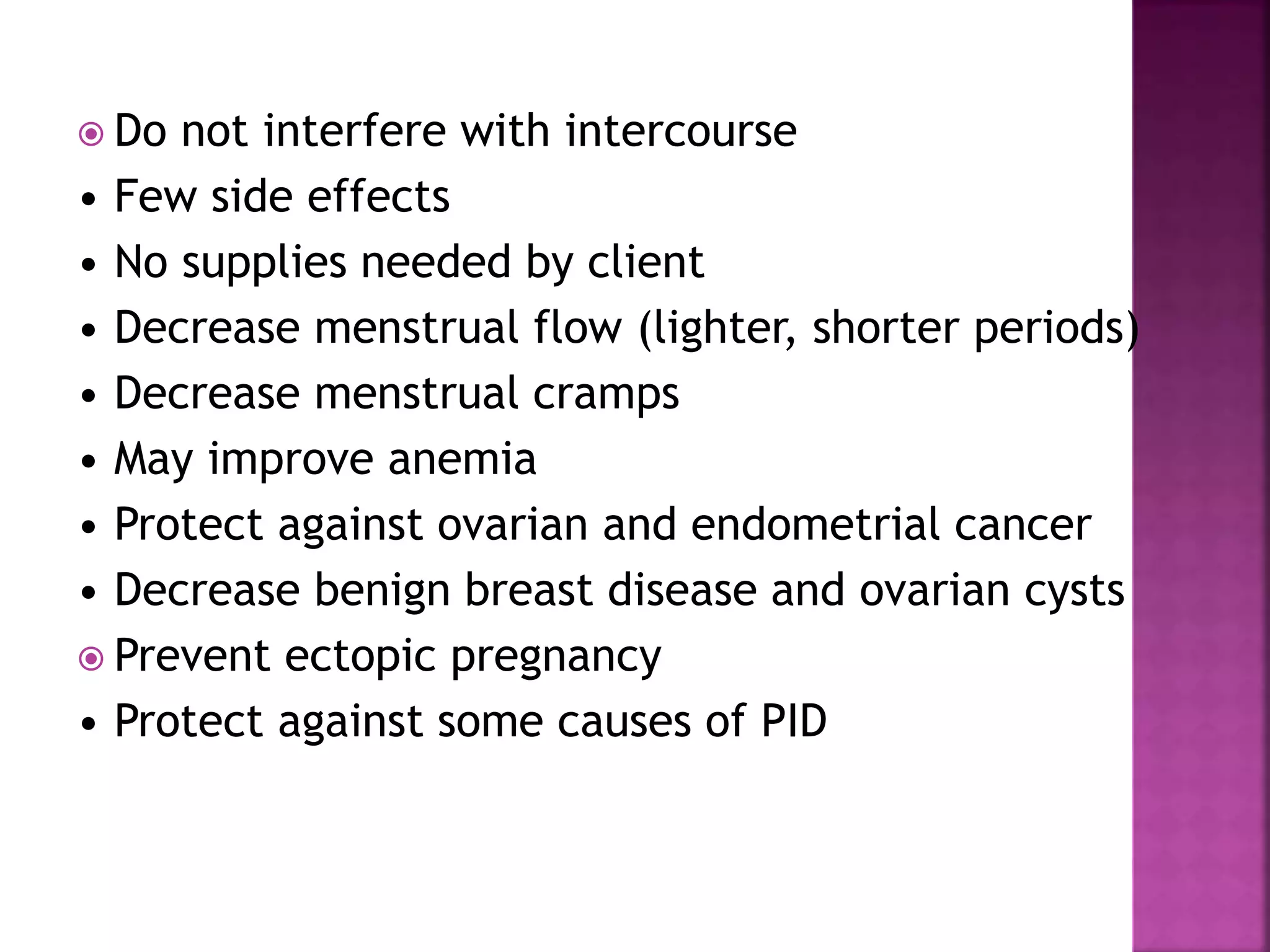
 Do not interfere with intercourse
• Few side effects
• No supplies needed by client
• Decrease menstrual flow (lighter, shorter periods)
• Decrease menstrual cramps
• May improve anemia
• Protect against ovarian and endometrial cancer
• Decrease benign breast disease and ovarian cysts
 Prevent ectopic pregnancy
• Protect against some causes of PID
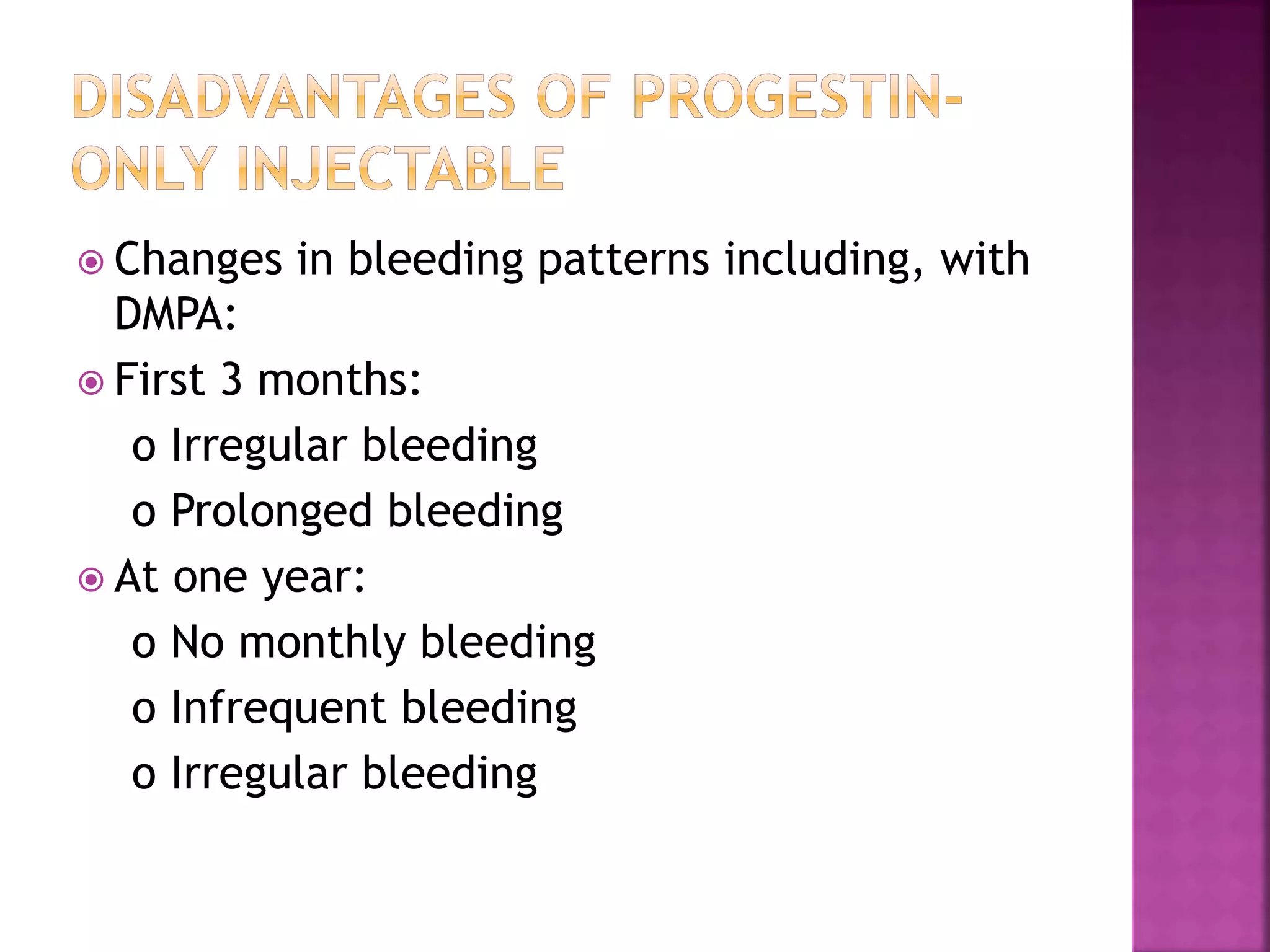
 Changes in bleeding patterns including, with
DMPA:
 First 3 months:
o Irregular bleeding
o Prolonged bleeding
 At one year:
o No monthly bleeding
o Infrequent bleeding
o Irregular bleeding
 Irregular or unpredictable bleeding or spotting
• Possible hair loss. Weight gain, especially right after
pregnancy
• It may delay your chances of getting pregnant after
the injection is stopped. It can take between six
and eighteen months for menstruation and
ovulation to return consistently. This does not mean
that you are protected from pregnancy during this
time. Use alternate protection as condoms.
 Does not protect against sexually transmitted
diseases
 When to Start
1.Having menstrual cycles or switching from a
non hormonal method
 Any time of the month
• If she is starting within 7 days after the start
of her monthly bleeding, no need for a
backup method.
 If it is more than 7 days after the start of her
monthly bleeding, she can start injectables any
time it is reasonably certain she is not pregnant.
 She will need a backup method for the first 7 days
after the injection.
• If she is switching from an IUD, she can start
injectables immediately
2. Switching from a hormonal method
• Immediately, if she has been using the hormonal
method consistently and correctly or if it is
otherwise reasonably certain she is not pregnant.
 No need to wait for her next monthly bleeding. No
need for a backup method.
• If she is switching from another injectable, she can
have the new injectable when the repeat injection
would have been given. No need for a backup
method.
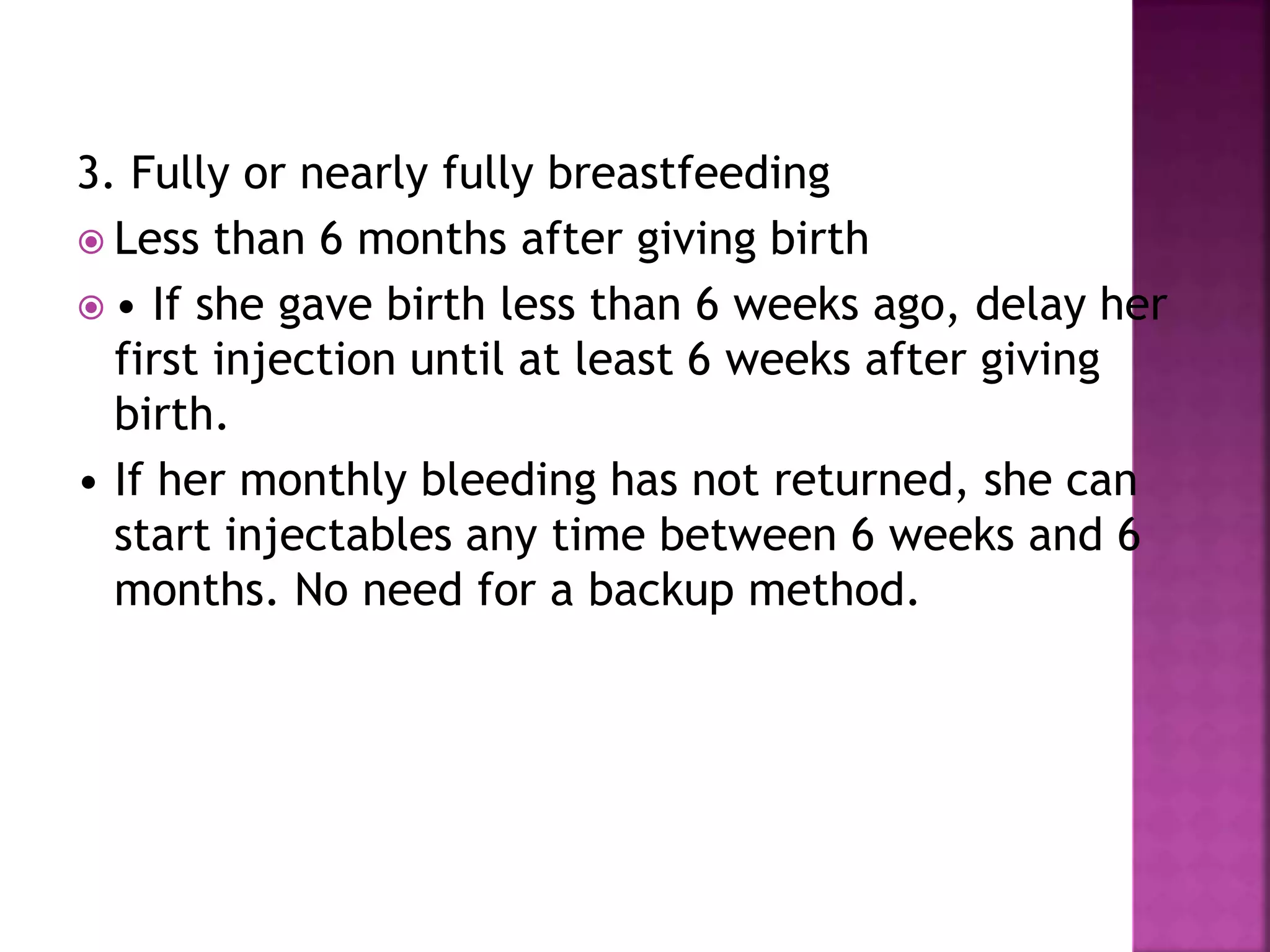
3. Fully or nearly fully breastfeeding
 Less than 6 months after giving birth
 • If she gave birth less than 6 weeks ago, delay her
first injection until at least 6 weeks after giving
birth.
• If her monthly bleeding has not returned, she can
start injectables any time between 6 weeks and 6
months. No need for a backup method.
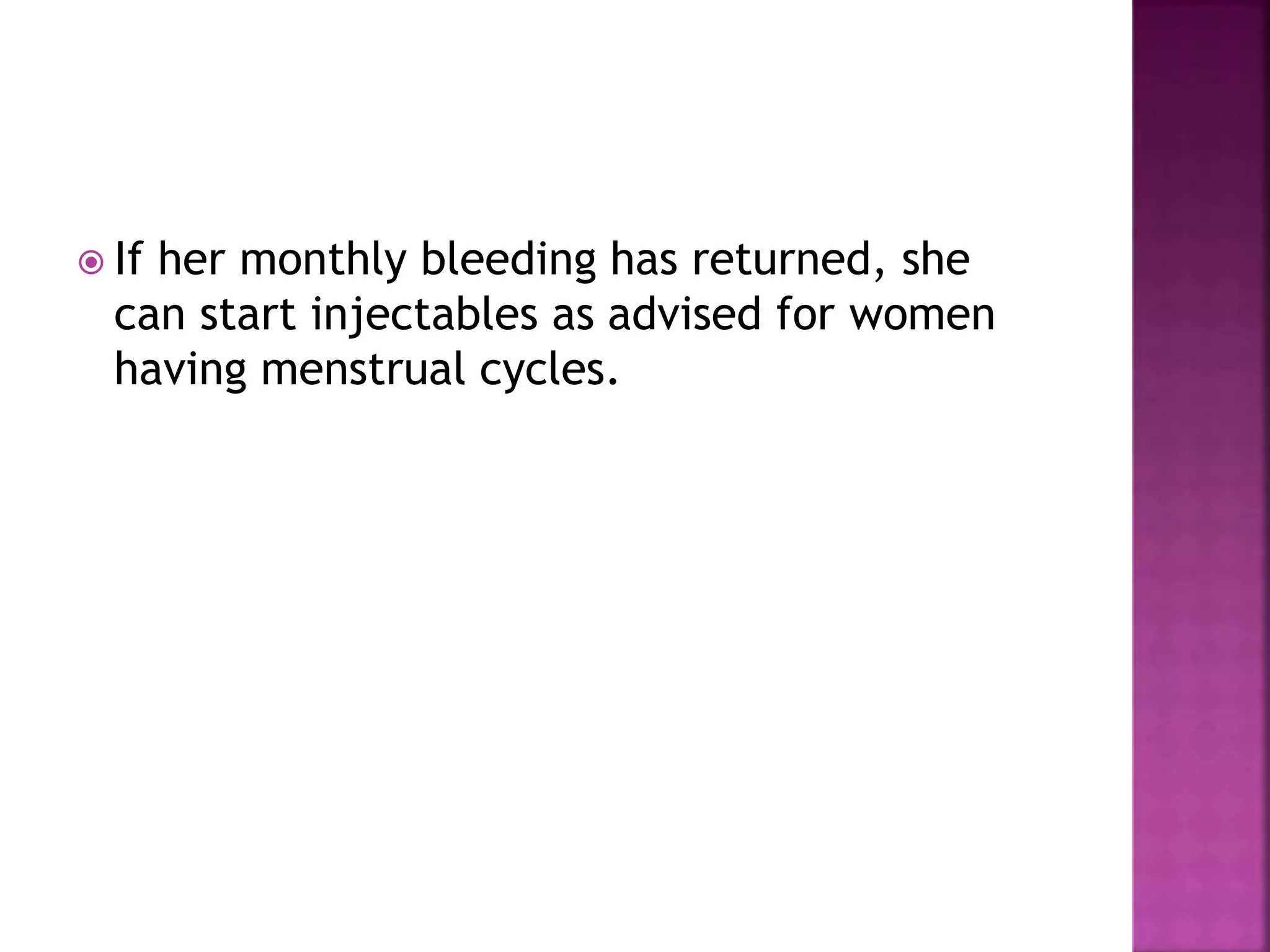
 If her monthly bleeding has returned, she
can start injectables as advised for women
having menstrual cycles.
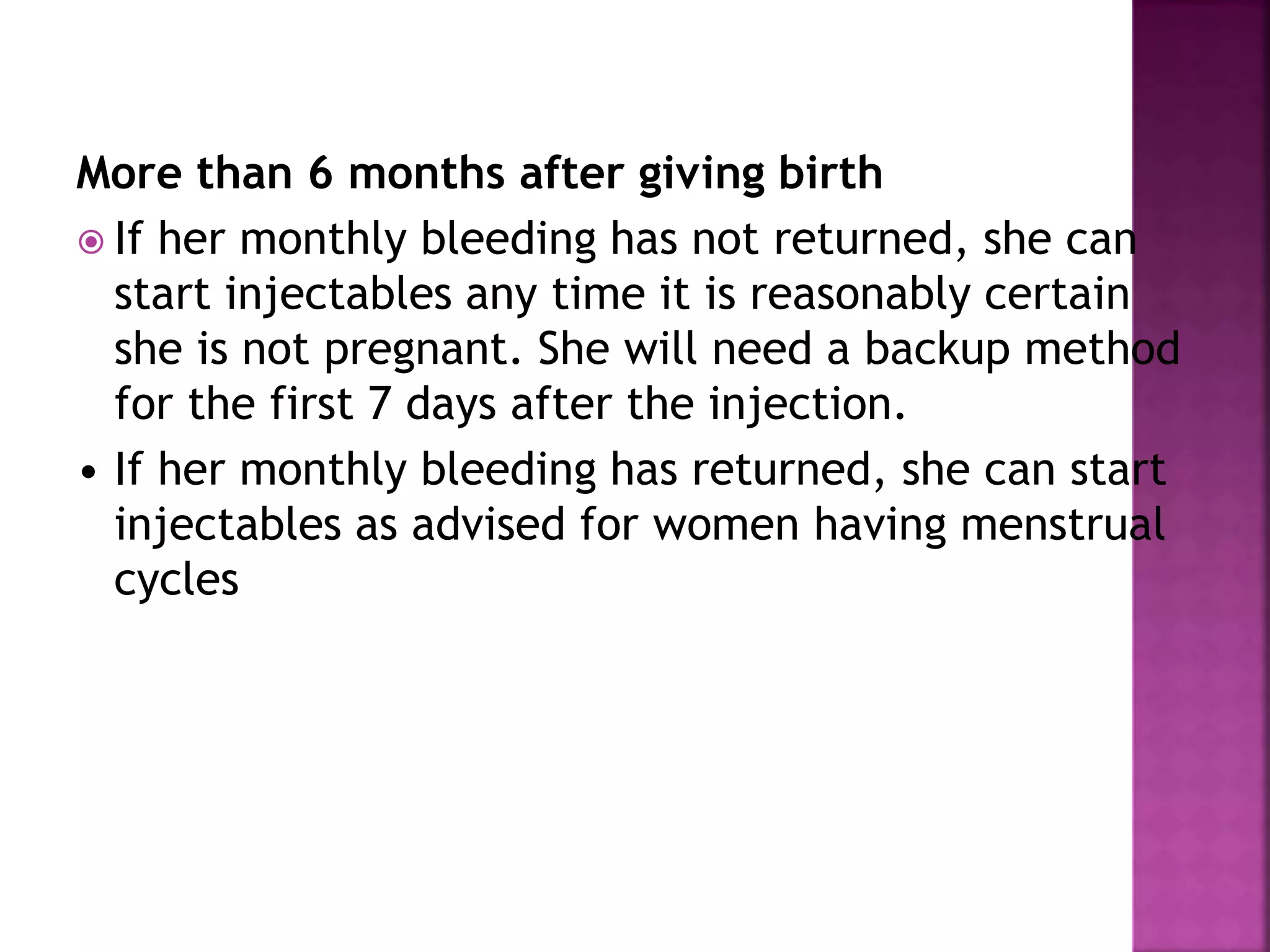
More than 6 months after giving birth
 If her monthly bleeding has not returned, she can
start injectables any time it is reasonably certain
she is not pregnant. She will need a backup method
for the first 7 days after the injection.
• If her monthly bleeding has returned, she can start
injectables as advised for women having menstrual
cycles
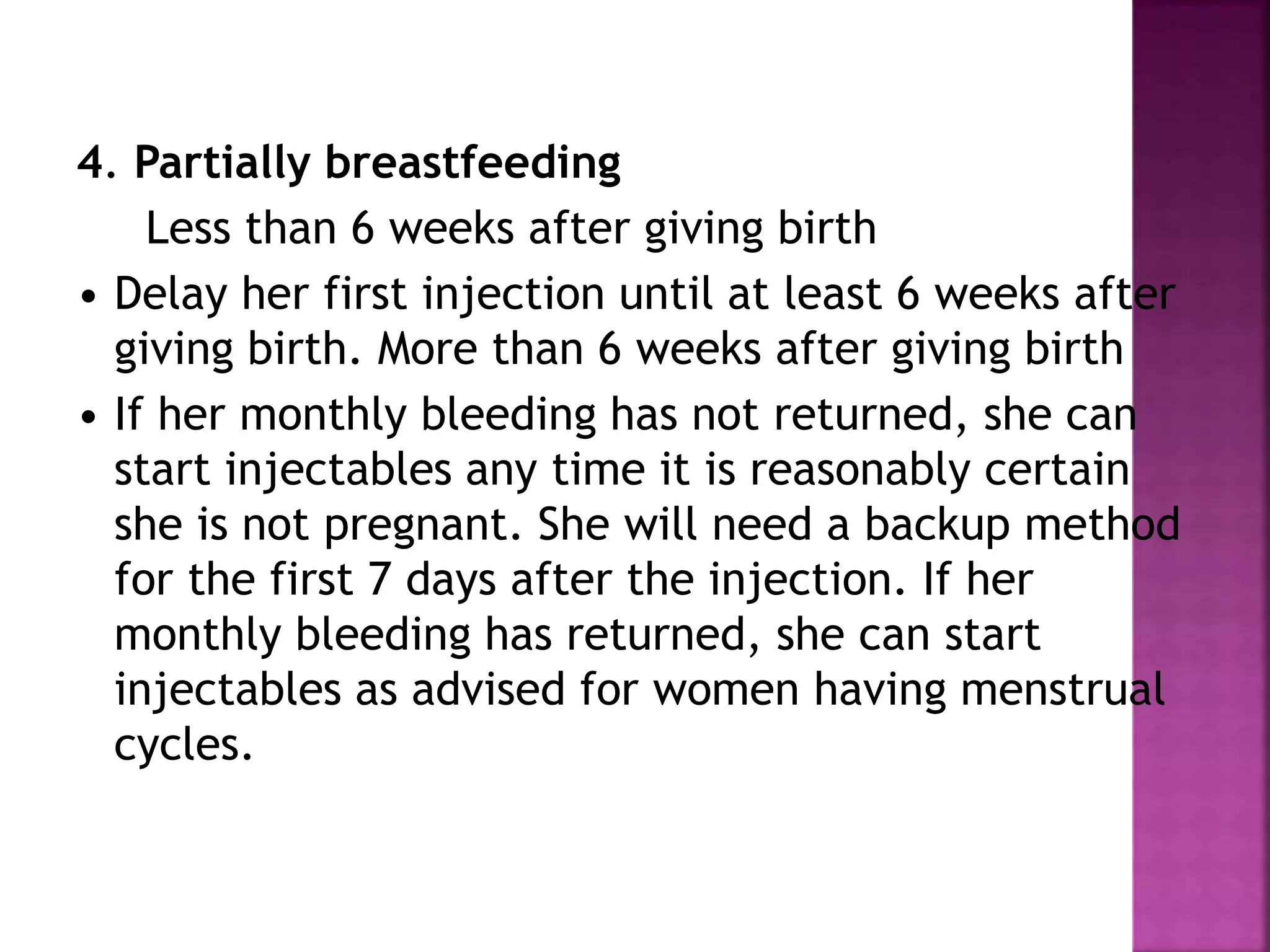
4. Partially breastfeeding
Less than 6 weeks after giving birth
• Delay her first injection until at least 6 weeks after
giving birth. More than 6 weeks after giving birth
• If her monthly bleeding has not returned, she can
start injectables any time it is reasonably certain
she is not pregnant. She will need a backup method
for the first 7 days after the injection. If her
monthly bleeding has returned, she can start
injectables as advised for women having menstrual
cycles.
5. Not breastfeeding
 Less than 4 weeks after giving birth
• She can start injectables at any time. No need for a
backup method.
More than 4 weeks after giving birth
 If her monthly bleeding has not returned, she can
start injectables any time it is reasonably certain
she is not pregnant. She will need a backup method
for the first 7 days after the injection. If her
monthly bleeding has returned, she can start
injectables as advised for women having menstrual
cycles
7. No monthly bleeding (not related to childbirth or
breastfeeding)
• She can start injectables any time it is reasonably
certain she is not pregnant. She will need a backup
method for the first 7 days after the injection
8. After miscarriage or abortion
• Immediately. If she is starting within 7 days after
miscarriage or abortion, no need for a backup
method.
• If it is more than 7 days after miscarriage or
abortion, she can start injectables any time it is
reasonably certain she is not pregnant. She will
need a backup method for the first 7 days after the
injection.
9. After taking emergency contraceptive pills
(ECPs)
• She can start injectables on the same day as the
ECPs, or if preferred, within 7 days after the start
of her monthly bleeding. She will need a backup
method for the first 7 days after the injection. She
should return if she has signs or symptoms of
pregnancy other than not having monthly bleeding.
1. Describe the most common side effects
• For the first several months, irregular
bleeding, prolonged bleeding, frequent
bleeding. Later, no monthly bleeding.
• Weight gain (about 1–2 kg per year),
headaches, dizziness, and possibly other side
effects.
2. Explain about these side effects
• Side effects are not signs of illness.
• Common, but some women do not have
them.
• The client can come back for help if side
effects bother her.
1. Obtain one dose of injectable, needle, and
syringe
• DMPA: 150 mg or NET-EN: 200 mg
• If possible, use single-dose vials. Check
expiration date. Check that the vial is not
leaking.
• DMPA: A 2 ml syringe and a 21–23 gauge
intramuscular needle. NETEN: A 2 or 5 ml
syringe and a 19-gauge intramuscular needle.
A narrower needle (21–23 gauge) also can be
used.
2. Wash hands
3. Prepare vial
• DMPA: Gently shake the vial.
• NET-EN: Shaking the vial is not necessary
• No need to wipe top of vial with antiseptic.
• If vial is cold, warm to skin temperature before
giving the injection.
4. Fill syringe
• Pierce top of vial with sterile needle and fill syringe
with proper dose.
5. Inject formula
• Insert sterile needle deep into the deltoid muscle,
or the gluteal muscle
• Inject the contents of the syringe. Do not massage
injection site.
6. Dispose of disposable syringes and needles
safely
• Do not recap, bend, or break needles before
disposal.
• Place in a puncture-proof sharps container
• Tell her not to massage the injection site.
 Agree on a date for her next injection in 3
months (12 weeks) for DMPA, or in 2 months
(8 weeks) for NET-EN.
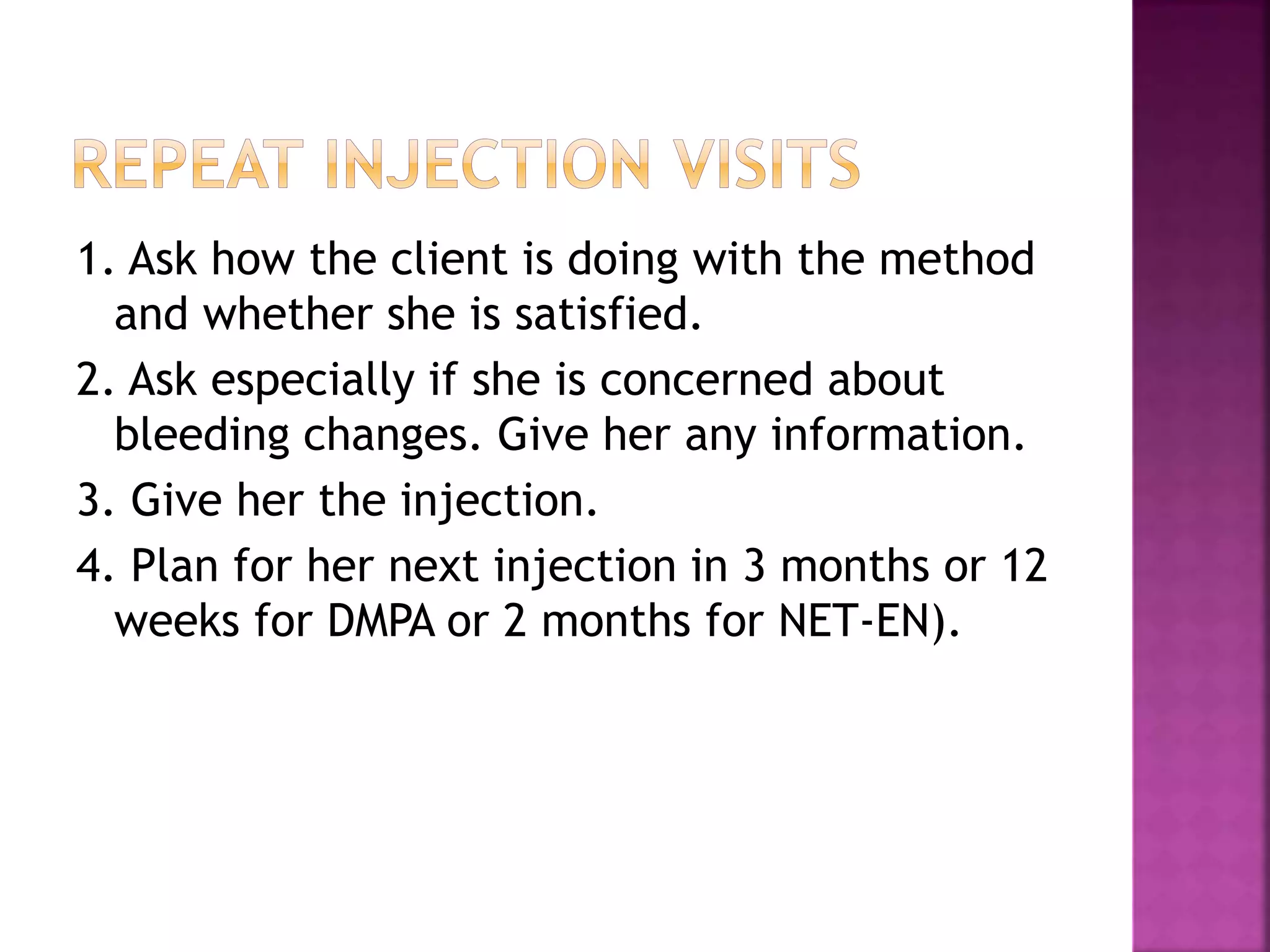
1. Ask how the client is doing with the method
and whether she is satisfied.
2. Ask especially if she is concerned about
bleeding changes. Give her any information.
3. Give her the injection.
4. Plan for her next injection in 3 months or 12
weeks for DMPA or 2 months for NET-EN).
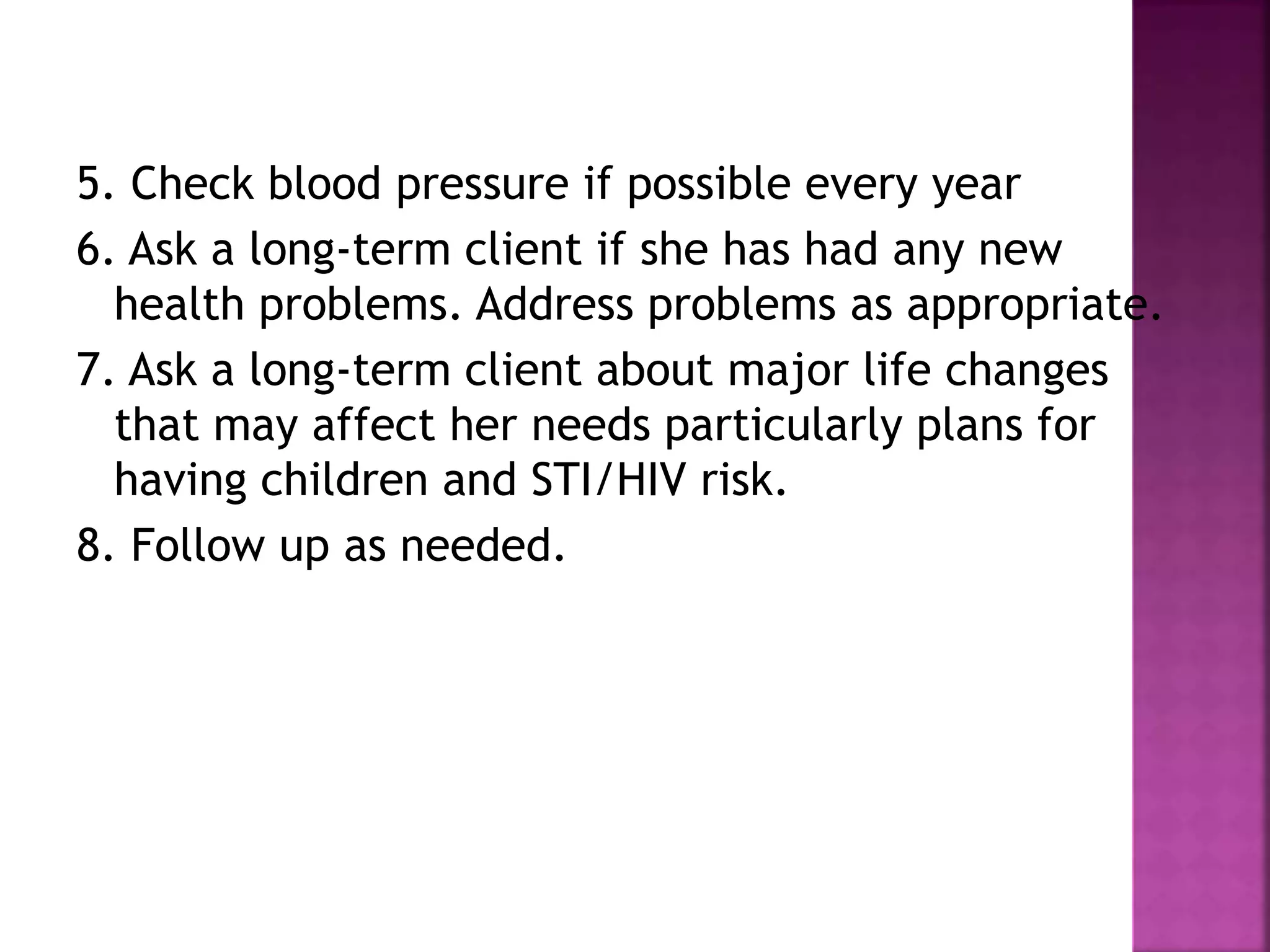
5. Check blood pressure if possible every year
6. Ask a long-term client if she has had any new
health problems. Address problems as appropriate.
7. Ask a long-term client about major life changes
that may affect her needs particularly plans for
having children and STI/HIV risk.
8. Follow up as needed.
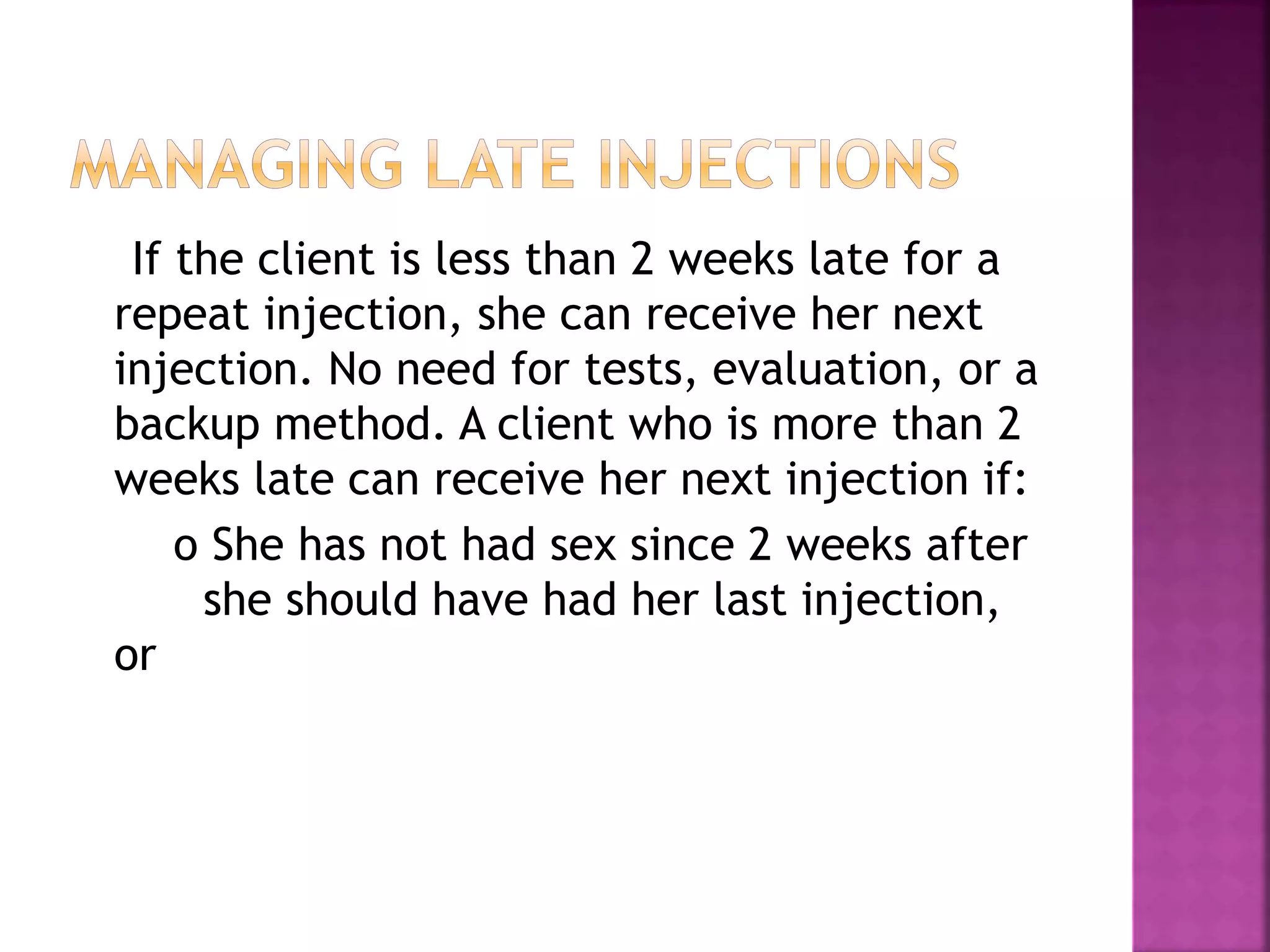
If the client is less than 2 weeks late for a
repeat injection, she can receive her next
injection. No need for tests, evaluation, or a
backup method. A client who is more than 2
weeks late can receive her next injection if:
o She has not had sex since 2 weeks after
she should have had her last injection,
or
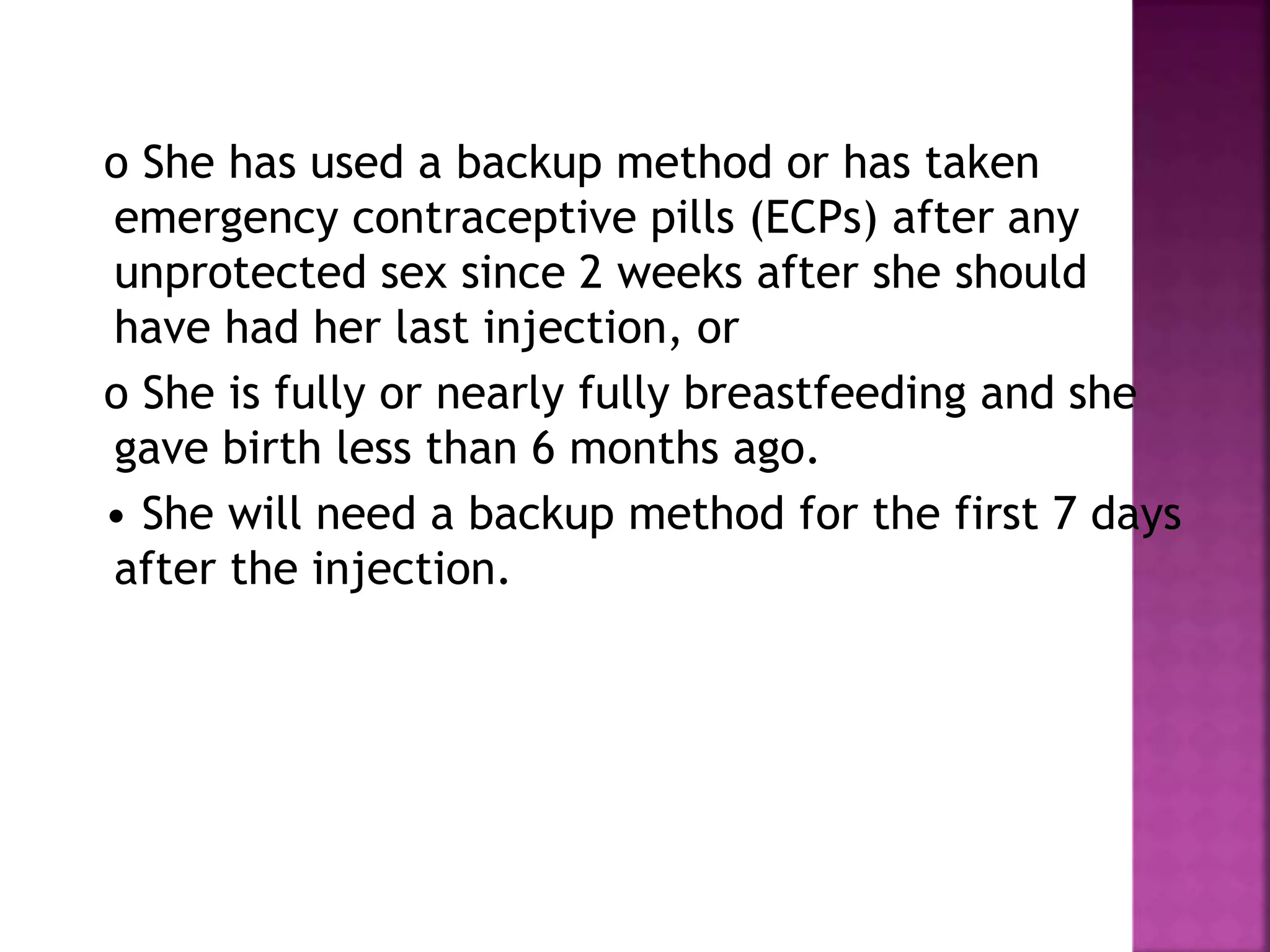
o She has used a backup method or has taken
emergency contraceptive pills (ECPs) after any
unprotected sex since 2 weeks after she should
have had her last injection, or
o She is fully or nearly fully breastfeeding and she
gave birth less than 6 months ago.
• She will need a backup method for the first 7 days
after the injection.
FAMILY PLANNING - injectables.ppt

FAMILY PLANNING - injectables.ppt

  • 1.
  • 2.
    At the endof the learning session, the student should be able to: 1. state the type of injectable method. 2. explain the mechanism and action of injectable method. 3. explain the advantages and disadvantages of injectable method 4. explain the management of client on injectable method
  • 3.
    i. Depot MedroxyProgesterone Acetate (DMPA) - Contain 150 mg / vial - Given by intramuscular injection at 3 monthly or 12/52 - It also known as Depo, Depo-Provera, Megestron and Petogen.
  • 4.
    ii. Norethisterone Enanthate(NET-EN) - Contain 200 mg / vial - Given by intramuscular injection at 2 monthly or 8/52 - It also known as Noristerat and Syngestal. • Each contains a progestin like the natural hormone progesterone in a woman’s body. Do not contain estrogen, and can be used throughout breastfeeding and by women who cannot use methods with estrogen.
  • 5.
     Its mainmechanism of action is to suppress ovulation. • It also makes the endometrium unsuitable for implantation if fertilisation occurs. • It also increases the viscosity of cervical mucus, making the mucus less easily penetrable to sperm. • Reduce sperm transport in upper genital tract (fallopian tubes)
  • 6.
     Advantage Contraceptiveof Progestin-Only Injectables • As commonly used, about 3 % of the women get pregnant by using progestin-only injectables over the first year. This means that 97 of every 100 women using injectables will not become pregnant.
  • 7.
     When womenhave injections on time, less than 1 % of women pregnant by using progestin-only injectables over the first year • Return of fertility after injections are stopped: An average of about 4 months longer for DMPA and 1 month longer for NET-EN than with most other methods.
  • 8.
     Do notinterfere with intercourse • Few side effects • No supplies needed by client • Decrease menstrual flow (lighter, shorter periods) • Decrease menstrual cramps • May improve anemia • Protect against ovarian and endometrial cancer • Decrease benign breast disease and ovarian cysts  Prevent ectopic pregnancy • Protect against some causes of PID
  • 9.
     Changes inbleeding patterns including, with DMPA:  First 3 months: o Irregular bleeding o Prolonged bleeding  At one year: o No monthly bleeding o Infrequent bleeding o Irregular bleeding
  • 10.
     Irregular orunpredictable bleeding or spotting • Possible hair loss. Weight gain, especially right after pregnancy • It may delay your chances of getting pregnant after the injection is stopped. It can take between six and eighteen months for menstruation and ovulation to return consistently. This does not mean that you are protected from pregnancy during this time. Use alternate protection as condoms.  Does not protect against sexually transmitted diseases
  • 11.
     When toStart 1.Having menstrual cycles or switching from a non hormonal method  Any time of the month • If she is starting within 7 days after the start of her monthly bleeding, no need for a backup method.
  • 12.
     If itis more than 7 days after the start of her monthly bleeding, she can start injectables any time it is reasonably certain she is not pregnant.  She will need a backup method for the first 7 days after the injection. • If she is switching from an IUD, she can start injectables immediately
  • 13.
    2. Switching froma hormonal method • Immediately, if she has been using the hormonal method consistently and correctly or if it is otherwise reasonably certain she is not pregnant.  No need to wait for her next monthly bleeding. No need for a backup method. • If she is switching from another injectable, she can have the new injectable when the repeat injection would have been given. No need for a backup method.
  • 14.
    3. Fully ornearly fully breastfeeding  Less than 6 months after giving birth  • If she gave birth less than 6 weeks ago, delay her first injection until at least 6 weeks after giving birth. • If her monthly bleeding has not returned, she can start injectables any time between 6 weeks and 6 months. No need for a backup method.
  • 15.
     If hermonthly bleeding has returned, she can start injectables as advised for women having menstrual cycles.
  • 16.
    More than 6months after giving birth  If her monthly bleeding has not returned, she can start injectables any time it is reasonably certain she is not pregnant. She will need a backup method for the first 7 days after the injection. • If her monthly bleeding has returned, she can start injectables as advised for women having menstrual cycles
  • 17.
    4. Partially breastfeeding Lessthan 6 weeks after giving birth • Delay her first injection until at least 6 weeks after giving birth. More than 6 weeks after giving birth • If her monthly bleeding has not returned, she can start injectables any time it is reasonably certain she is not pregnant. She will need a backup method for the first 7 days after the injection. If her monthly bleeding has returned, she can start injectables as advised for women having menstrual cycles.
  • 18.
    5. Not breastfeeding Less than 4 weeks after giving birth • She can start injectables at any time. No need for a backup method. More than 4 weeks after giving birth  If her monthly bleeding has not returned, she can start injectables any time it is reasonably certain she is not pregnant. She will need a backup method for the first 7 days after the injection. If her monthly bleeding has returned, she can start injectables as advised for women having menstrual cycles
  • 19.
    7. No monthlybleeding (not related to childbirth or breastfeeding) • She can start injectables any time it is reasonably certain she is not pregnant. She will need a backup method for the first 7 days after the injection
  • 20.
    8. After miscarriageor abortion • Immediately. If she is starting within 7 days after miscarriage or abortion, no need for a backup method. • If it is more than 7 days after miscarriage or abortion, she can start injectables any time it is reasonably certain she is not pregnant. She will need a backup method for the first 7 days after the injection.
  • 21.
    9. After takingemergency contraceptive pills (ECPs) • She can start injectables on the same day as the ECPs, or if preferred, within 7 days after the start of her monthly bleeding. She will need a backup method for the first 7 days after the injection. She should return if she has signs or symptoms of pregnancy other than not having monthly bleeding.
  • 22.
    1. Describe themost common side effects • For the first several months, irregular bleeding, prolonged bleeding, frequent bleeding. Later, no monthly bleeding. • Weight gain (about 1–2 kg per year), headaches, dizziness, and possibly other side effects.
  • 23.
    2. Explain aboutthese side effects • Side effects are not signs of illness. • Common, but some women do not have them. • The client can come back for help if side effects bother her.
  • 24.
    1. Obtain onedose of injectable, needle, and syringe • DMPA: 150 mg or NET-EN: 200 mg • If possible, use single-dose vials. Check expiration date. Check that the vial is not leaking. • DMPA: A 2 ml syringe and a 21–23 gauge intramuscular needle. NETEN: A 2 or 5 ml syringe and a 19-gauge intramuscular needle. A narrower needle (21–23 gauge) also can be used.
  • 25.
    2. Wash hands 3.Prepare vial • DMPA: Gently shake the vial. • NET-EN: Shaking the vial is not necessary • No need to wipe top of vial with antiseptic. • If vial is cold, warm to skin temperature before giving the injection.
  • 26.
    4. Fill syringe •Pierce top of vial with sterile needle and fill syringe with proper dose. 5. Inject formula • Insert sterile needle deep into the deltoid muscle, or the gluteal muscle • Inject the contents of the syringe. Do not massage injection site.
  • 27.
    6. Dispose ofdisposable syringes and needles safely • Do not recap, bend, or break needles before disposal. • Place in a puncture-proof sharps container
  • 28.
    • Tell hernot to massage the injection site.
  • 29.
     Agree ona date for her next injection in 3 months (12 weeks) for DMPA, or in 2 months (8 weeks) for NET-EN.
  • 30.
    1. Ask howthe client is doing with the method and whether she is satisfied. 2. Ask especially if she is concerned about bleeding changes. Give her any information. 3. Give her the injection. 4. Plan for her next injection in 3 months or 12 weeks for DMPA or 2 months for NET-EN).
  • 31.
    5. Check bloodpressure if possible every year 6. Ask a long-term client if she has had any new health problems. Address problems as appropriate. 7. Ask a long-term client about major life changes that may affect her needs particularly plans for having children and STI/HIV risk. 8. Follow up as needed.
  • 32.
    If the clientis less than 2 weeks late for a repeat injection, she can receive her next injection. No need for tests, evaluation, or a backup method. A client who is more than 2 weeks late can receive her next injection if: o She has not had sex since 2 weeks after she should have had her last injection, or
  • 33.
    o She hasused a backup method or has taken emergency contraceptive pills (ECPs) after any unprotected sex since 2 weeks after she should have had her last injection, or o She is fully or nearly fully breastfeeding and she gave birth less than 6 months ago. • She will need a backup method for the first 7 days after the injection.