PLYR & DPLYR
Mathew Hall
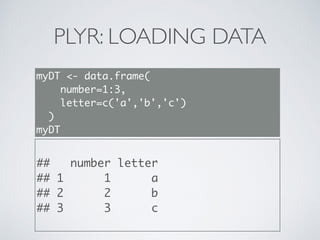
PLYR: LOADING DATA
myDT <- data.frame(
number=1:3,
letter=c('a','b','c')
)
myDT
## number letter
## 1 1 a
## 2 2 b
## 3 3 c
PLYR: LOADING DATA
D <-
read.csv("TB_burden_countries_2014-11-16.csv")
head(names(D))
## [1] "country" "iso2" "iso3" "iso_numeric" "g_whoregion"
## [6] "year"
PLYR: FILTERING
mean(D[D$country=='Afghanistan','e_prev_100k'])
## [1] 376.4
PLYR: FILTERING
with(D, mean(e_prev_100k[country=='Afghanistan']))
## [1] 376.4
PLYR: SELECTING COLUMNS
head(D[,c('e_prev_100k','e_prev_100k_lo',
'e_prev_100k_hi')])
## e_prev_100k e_prev_100k_lo e_prev_100k_hi
## 1 306 156 506
## 2 343 178 562
## 3 371 189 614
## 4 392 194 657
## 5 410 198 697
## 6 424 199 733
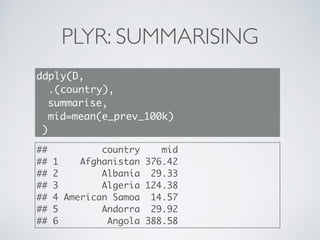
PLYR: SUMMARISING
ddply(D,
.(country),
summarise,
mid=mean(e_prev_100k)
)
## country mid
## 1 Afghanistan 376.42
## 2 Albania 29.33
## 3 Algeria 124.38
## 4 American Samoa 14.57
## 5 Andorra 29.92
## 6 Angola 388.58
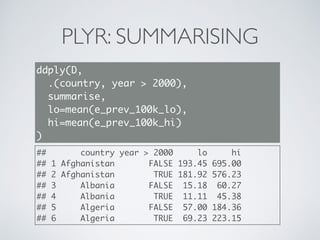
PLYR: SUMMARISING
ddply(D,
.(country, year > 2000),
summarise,
lo=mean(e_prev_100k_lo),
hi=mean(e_prev_100k_hi)
)
## country year > 2000 lo hi
## 1 Afghanistan FALSE 193.45 695.00
## 2 Afghanistan TRUE 181.92 576.23
## 3 Albania FALSE 15.18 60.27
## 4 Albania TRUE 11.11 45.38
## 5 Algeria FALSE 57.00 184.36
## 6 Algeria TRUE 69.23 223.15
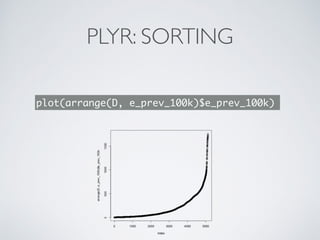
PLYR: SORTING
plot(arrange(D, e_prev_100k)$e_prev_100k)
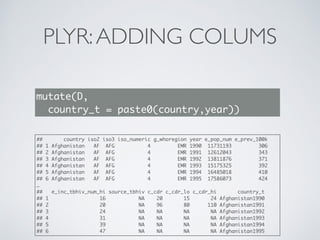
PLYR:ADDING COLUMS
mutate(D,
country_t = paste0(country,year))
## country iso2 iso3 iso_numeric g_whoregion year e_pop_num e_prev_100k
## 1 Afghanistan AF AFG 4 EMR 1990 11731193 306
## 2 Afghanistan AF AFG 4 EMR 1991 12612043 343
## 3 Afghanistan AF AFG 4 EMR 1992 13811876 371
## 4 Afghanistan AF AFG 4 EMR 1993 15175325 392
## 5 Afghanistan AF AFG 4 EMR 1994 16485018 410
## 6 Afghanistan AF AFG 4 EMR 1995 17586073 424
…
## e_inc_tbhiv_num_hi source_tbhiv c_cdr c_cdr_lo c_cdr_hi country_t
## 1 16 NA 20 15 24 Afghanistan1990
## 2 20 NA 96 80 110 Afghanistan1991
## 3 24 NA NA NA NA Afghanistan1992
## 4 31 NA NA NA NA Afghanistan1993
## 5 39 NA NA NA NA Afghanistan1994
## 6 47 NA NA NA NA Afghanistan1995
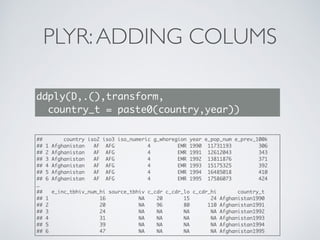
PLYR:ADDING COLUMS
ddply(D,.(),transform,
country_t = paste0(country,year))
## country iso2 iso3 iso_numeric g_whoregion year e_pop_num e_prev_100k
## 1 Afghanistan AF AFG 4 EMR 1990 11731193 306
## 2 Afghanistan AF AFG 4 EMR 1991 12612043 343
## 3 Afghanistan AF AFG 4 EMR 1992 13811876 371
## 4 Afghanistan AF AFG 4 EMR 1993 15175325 392
## 5 Afghanistan AF AFG 4 EMR 1994 16485018 410
## 6 Afghanistan AF AFG 4 EMR 1995 17586073 424
…
## e_inc_tbhiv_num_hi source_tbhiv c_cdr c_cdr_lo c_cdr_hi country_t
## 1 16 NA 20 15 24 Afghanistan1990
## 2 20 NA 96 80 110 Afghanistan1991
## 3 24 NA NA NA NA Afghanistan1992
## 4 31 NA NA NA NA Afghanistan1993
## 5 39 NA NA NA NA Afghanistan1994
## 6 47 NA NA NA NA Afghanistan1995
DPLYR
split
apply
combine
summarise
mutate
Take a data frame, compute summaries,
produce a new data frame
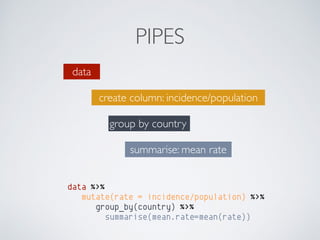
PIPES
data
group by country
create column: incidence/population
summarise: mean rate
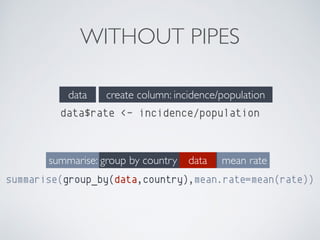
WITHOUT PIPES
data
group by country
create column: incidence/population
data
data$rate <- incidence/population
summarise(group_by(data,country),mean.rate=mean(rate))
summarise: mean rate
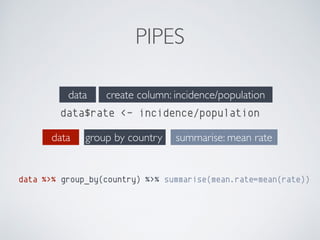
PIPES
data
group by country
create column: incidence/population
data
data$rate <- incidence/population
data %>% group_by(country) %>% summarise(mean.rate=mean(rate))
summarise: mean rate
PIPES
group by country
create column: incidence/population
data
data %>%
mutate(rate = incidence/population) %>%
group_by(country) %>%
summarise(mean.rate=mean(rate))
PIPES
@romain_francois
DPLYR: LOAD
D <-
read.csv("TB_burden_countries_2014-11-16.csv")
D <- tbl_df(D)
DPLYR: LOAD
D <-
read.csv("TB_burden_countries_2014-11-16.csv")
D <- tbl_df(D)
DPLYR: SELECTING
D %>%
select(e_prev_100k,e_prev_100k_lo,e_prev_100k_hi)
## Source: local data frame [5,120 x 3]
##
## e_prev_100k e_prev_100k_lo e_prev_100k_hi
## 1 306 156 506
## 2 343 178 562
## 3 371 189 614
## 4 392 194 657
## 5 410 198 697
## 6 424 199 733
## 7 438 202 764
## 8 448 203 788
## 9 454 204 800
## 10 446 203 782
## .. ... ... ...
DPLYR: FILTER & SUMMARISE
D %>%
filter(country == 'Afghanistan') %>%
summarise(
mid=mean(e_prev_100k),
lo=mean(e_prev_100k_lo),
hi=mean(e_prev_100k_hi)
)
## Source: local data frame [1 x 3]
##
## mid lo hi
## 1 376.4 187.2 630.7
DPLYR: FILTER & SUMMARISE
D %>%
group_by(country) %>%
summarise(mid=mean(e_prev_100k))
## Source: local data frame [219 x 2]
##
## country mid
## 1 Afghanistan 376.417
## 2 Albania 29.333
## 3 Algeria 124.375
## 4 American Samoa 14.567
## 5 Andorra 29.921
## 6 Angola 388.583
## 7 Anguilla 52.417
## 8 Antigua and Barbuda 8.725
## 9 Argentina 55.500
## 10 Armenia 76.875
## .. ... ...
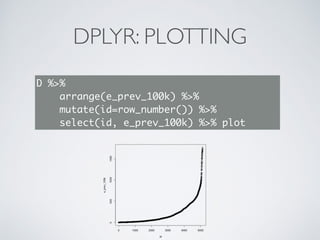
DPLYR: PLOTTING
D %>%
arrange(e_prev_100k) %>%
mutate(id=row_number()) %>%
select(id, e_prev_100k) %>% plot
DPLYR:ADDING COLUMNS
D %>%
mutate(country_t = paste0(country,year)) %>%
select(country_t)
## Source: local data frame [5,120 x 1]
##
## country_t
## 1 Afghanistan1990
## 2 Afghanistan1991
## 3 Afghanistan1992
## 4 Afghanistan1993
## 5 Afghanistan1994
## 6 Afghanistan1995
## 7 Afghanistan1996
## 8 Afghanistan1997
## 9 Afghanistan1998
## 10 Afghanistan1999
## .. ...
DPLYR: DATABASES
data <- data.frame(x=1:200000000,
y=runif(4), z=runif(50))
format(object.size(data), units="GB")
## [1] "3.7 Gb"
DPLYR: DATABASES
src <- src_sqlite(“data.sqlite")
data <- tbl(src, "data")
DPLYR: DATABASES
data %>%
summarise(mean(x), max(y), mean(z))
## Source: sqlite 3.7.17 [data.sqlite]
## From: <derived table> [?? x 3]
##
## mean(x) max(y) mean(z)
## 1 1e+08 0.9008 0.4501
## .. ... ... ...
DPLYR: DATABASES
data %>%
summarise(mean(x), max(y), mean(z))
## Source: sqlite 3.7.17 [data.sqlite]
## From: <derived table> [?? x 3]
##
## mean(x) max(y) mean(z)
## 1 1e+08 0.9008 0.4501
## .. ... ... ...
Use data as if it were local data.frame
Processing done in the database
DPLYR
• Similar to data.table & sqldf
• (Almost) transparently use a DB for speed
• Works with pipes
• Lazy
POSTSCRIPT: PLYR
• Most functions provided by dplyr, except:
• **ply, nicer than sapply, tapply, etc.
PLYR: SUMMARISING
library(plyr)
E <- D[with(D, country=='Afghanistan'),]
ddply(E, .(country), summarise,
mid=mean(e_prev_100k),
lo=mean(e_prev_100k_lo),
hi=mean(e_prev_100k_hi) )
## country mid lo hi
## 1 Afghanistan 376.4 187.2 630.7
return data frame
PLYR: SUMMARISING
library(plyr)
E <- D[with(D, country=='Afghanistan'),]
ddply(E, .(country), summarise,
mid=mean(e_prev_100k),
lo=mean(e_prev_100k_lo),
hi=mean(e_prev_100k_hi) )
take data frame
return data frame
PLYR: SUMMARISING
library(plyr)
E <- D[with(D, country=='Afghanistan'),]
ddply(E, .(country), summarise,
mid=mean(e_prev_100k),
lo=mean(e_prev_100k_lo),
hi=mean(e_prev_100k_hi) )
take data frame
grouping columnsinput
return data frame
PLYR: SUMMARISING
library(plyr)
E <- D[with(D, country=='Afghanistan'),]
ddply(E, .(country), summarise,
mid=mean(e_prev_100k),
lo=mean(e_prev_100k_lo),
hi=mean(e_prev_100k_hi) )
take data frame
grouping columnsinput
new columns
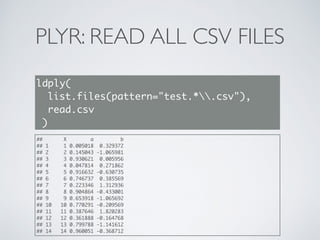
PLYR: READ ALL CSV FILES
ldply(
list.files(pattern="test.*.csv"),
read.csv
)
## X a b
## 1 1 0.005018 0.329372
## 2 2 0.145043 -1.065981
## 3 3 0.930621 0.005956
## 4 4 0.047814 0.271862
## 5 5 0.916632 -0.630735
## 6 6 0.746737 0.385569
## 7 7 0.223346 1.312936
## 8 8 0.904864 -0.433001
## 9 9 0.653918 -1.065692
## 10 10 0.770291 -0.209569
## 11 11 0.387646 1.820283
## 12 12 0.361888 -0.164768
## 13 13 0.799788 -1.141612
## 14 14 0.960051 -0.368712
PLYR: PLOT EACH GROUP
d_ply(
long,
.(Sensor),
function(df){
pdf(paste0(df$Sensor[1],".pdf"));
plot(df$value);
dev.off()
})
RESOURCES
• dplyr vignettes: http://cran.r-project.org/web/packages/dplyr/vignettes
• plyr: StackOverflow, google

Dplyr and Plyr

  • 1.
  • 2.
    PLYR: LOADING DATA myDT<- data.frame( number=1:3, letter=c('a','b','c') ) myDT ## number letter ## 1 1 a ## 2 2 b ## 3 3 c
  • 3.
    PLYR: LOADING DATA D<- read.csv("TB_burden_countries_2014-11-16.csv") head(names(D)) ## [1] "country" "iso2" "iso3" "iso_numeric" "g_whoregion" ## [6] "year"
  • 4.
  • 5.
  • 6.
    PLYR: SELECTING COLUMNS head(D[,c('e_prev_100k','e_prev_100k_lo', 'e_prev_100k_hi')]) ##e_prev_100k e_prev_100k_lo e_prev_100k_hi ## 1 306 156 506 ## 2 343 178 562 ## 3 371 189 614 ## 4 392 194 657 ## 5 410 198 697 ## 6 424 199 733
  • 7.
    PLYR: SUMMARISING ddply(D, .(country), summarise, mid=mean(e_prev_100k) ) ## countrymid ## 1 Afghanistan 376.42 ## 2 Albania 29.33 ## 3 Algeria 124.38 ## 4 American Samoa 14.57 ## 5 Andorra 29.92 ## 6 Angola 388.58
  • 8.
    PLYR: SUMMARISING ddply(D, .(country, year> 2000), summarise, lo=mean(e_prev_100k_lo), hi=mean(e_prev_100k_hi) ) ## country year > 2000 lo hi ## 1 Afghanistan FALSE 193.45 695.00 ## 2 Afghanistan TRUE 181.92 576.23 ## 3 Albania FALSE 15.18 60.27 ## 4 Albania TRUE 11.11 45.38 ## 5 Algeria FALSE 57.00 184.36 ## 6 Algeria TRUE 69.23 223.15
  • 9.
  • 10.
    PLYR:ADDING COLUMS mutate(D, country_t =paste0(country,year)) ## country iso2 iso3 iso_numeric g_whoregion year e_pop_num e_prev_100k ## 1 Afghanistan AF AFG 4 EMR 1990 11731193 306 ## 2 Afghanistan AF AFG 4 EMR 1991 12612043 343 ## 3 Afghanistan AF AFG 4 EMR 1992 13811876 371 ## 4 Afghanistan AF AFG 4 EMR 1993 15175325 392 ## 5 Afghanistan AF AFG 4 EMR 1994 16485018 410 ## 6 Afghanistan AF AFG 4 EMR 1995 17586073 424 … ## e_inc_tbhiv_num_hi source_tbhiv c_cdr c_cdr_lo c_cdr_hi country_t ## 1 16 NA 20 15 24 Afghanistan1990 ## 2 20 NA 96 80 110 Afghanistan1991 ## 3 24 NA NA NA NA Afghanistan1992 ## 4 31 NA NA NA NA Afghanistan1993 ## 5 39 NA NA NA NA Afghanistan1994 ## 6 47 NA NA NA NA Afghanistan1995
  • 11.
    PLYR:ADDING COLUMS ddply(D,.(),transform, country_t =paste0(country,year)) ## country iso2 iso3 iso_numeric g_whoregion year e_pop_num e_prev_100k ## 1 Afghanistan AF AFG 4 EMR 1990 11731193 306 ## 2 Afghanistan AF AFG 4 EMR 1991 12612043 343 ## 3 Afghanistan AF AFG 4 EMR 1992 13811876 371 ## 4 Afghanistan AF AFG 4 EMR 1993 15175325 392 ## 5 Afghanistan AF AFG 4 EMR 1994 16485018 410 ## 6 Afghanistan AF AFG 4 EMR 1995 17586073 424 … ## e_inc_tbhiv_num_hi source_tbhiv c_cdr c_cdr_lo c_cdr_hi country_t ## 1 16 NA 20 15 24 Afghanistan1990 ## 2 20 NA 96 80 110 Afghanistan1991 ## 3 24 NA NA NA NA Afghanistan1992 ## 4 31 NA NA NA NA Afghanistan1993 ## 5 39 NA NA NA NA Afghanistan1994 ## 6 47 NA NA NA NA Afghanistan1995
  • 12.
    DPLYR split apply combine summarise mutate Take a dataframe, compute summaries, produce a new data frame
  • 13.
    PIPES data group by country createcolumn: incidence/population summarise: mean rate
  • 14.
    summarise: mean rate WITHOUTPIPES data group by country create column: incidence/population data data$rate <- incidence/population summarise(group_by(data,country),mean.rate=mean(rate))
  • 15.
    summarise: mean rate PIPES data groupby country create column: incidence/population data data$rate <- incidence/population data %>% group_by(country) %>% summarise(mean.rate=mean(rate))
  • 16.
    summarise: mean rate PIPES groupby country create column: incidence/population data data %>% mutate(rate = incidence/population) %>% group_by(country) %>% summarise(mean.rate=mean(rate))
  • 17.
  • 18.
  • 19.
  • 20.
    DPLYR: SELECTING D %>% select(e_prev_100k,e_prev_100k_lo,e_prev_100k_hi) ##Source: local data frame [5,120 x 3] ## ## e_prev_100k e_prev_100k_lo e_prev_100k_hi ## 1 306 156 506 ## 2 343 178 562 ## 3 371 189 614 ## 4 392 194 657 ## 5 410 198 697 ## 6 424 199 733 ## 7 438 202 764 ## 8 448 203 788 ## 9 454 204 800 ## 10 446 203 782 ## .. ... ... ...
  • 21.
    DPLYR: FILTER &SUMMARISE D %>% filter(country == 'Afghanistan') %>% summarise( mid=mean(e_prev_100k), lo=mean(e_prev_100k_lo), hi=mean(e_prev_100k_hi) ) ## Source: local data frame [1 x 3] ## ## mid lo hi ## 1 376.4 187.2 630.7
  • 22.
    DPLYR: FILTER &SUMMARISE D %>% group_by(country) %>% summarise(mid=mean(e_prev_100k)) ## Source: local data frame [219 x 2] ## ## country mid ## 1 Afghanistan 376.417 ## 2 Albania 29.333 ## 3 Algeria 124.375 ## 4 American Samoa 14.567 ## 5 Andorra 29.921 ## 6 Angola 388.583 ## 7 Anguilla 52.417 ## 8 Antigua and Barbuda 8.725 ## 9 Argentina 55.500 ## 10 Armenia 76.875 ## .. ... ...
  • 23.
    DPLYR: PLOTTING D %>% arrange(e_prev_100k)%>% mutate(id=row_number()) %>% select(id, e_prev_100k) %>% plot
  • 24.
    DPLYR:ADDING COLUMNS D %>% mutate(country_t= paste0(country,year)) %>% select(country_t) ## Source: local data frame [5,120 x 1] ## ## country_t ## 1 Afghanistan1990 ## 2 Afghanistan1991 ## 3 Afghanistan1992 ## 4 Afghanistan1993 ## 5 Afghanistan1994 ## 6 Afghanistan1995 ## 7 Afghanistan1996 ## 8 Afghanistan1997 ## 9 Afghanistan1998 ## 10 Afghanistan1999 ## .. ...
  • 25.
    DPLYR: DATABASES data <-data.frame(x=1:200000000, y=runif(4), z=runif(50)) format(object.size(data), units="GB") ## [1] "3.7 Gb"
  • 26.
    DPLYR: DATABASES src <-src_sqlite(“data.sqlite") data <- tbl(src, "data")
  • 27.
    DPLYR: DATABASES data %>% summarise(mean(x),max(y), mean(z)) ## Source: sqlite 3.7.17 [data.sqlite] ## From: <derived table> [?? x 3] ## ## mean(x) max(y) mean(z) ## 1 1e+08 0.9008 0.4501 ## .. ... ... ...
  • 28.
    DPLYR: DATABASES data %>% summarise(mean(x),max(y), mean(z)) ## Source: sqlite 3.7.17 [data.sqlite] ## From: <derived table> [?? x 3] ## ## mean(x) max(y) mean(z) ## 1 1e+08 0.9008 0.4501 ## .. ... ... ... Use data as if it were local data.frame Processing done in the database
  • 29.
    DPLYR • Similar todata.table & sqldf • (Almost) transparently use a DB for speed • Works with pipes • Lazy
  • 30.
    POSTSCRIPT: PLYR • Mostfunctions provided by dplyr, except: • **ply, nicer than sapply, tapply, etc.
  • 31.
    PLYR: SUMMARISING library(plyr) E <-D[with(D, country=='Afghanistan'),] ddply(E, .(country), summarise, mid=mean(e_prev_100k), lo=mean(e_prev_100k_lo), hi=mean(e_prev_100k_hi) ) ## country mid lo hi ## 1 Afghanistan 376.4 187.2 630.7
  • 32.
    return data frame PLYR:SUMMARISING library(plyr) E <- D[with(D, country=='Afghanistan'),] ddply(E, .(country), summarise, mid=mean(e_prev_100k), lo=mean(e_prev_100k_lo), hi=mean(e_prev_100k_hi) ) take data frame
  • 33.
    return data frame PLYR:SUMMARISING library(plyr) E <- D[with(D, country=='Afghanistan'),] ddply(E, .(country), summarise, mid=mean(e_prev_100k), lo=mean(e_prev_100k_lo), hi=mean(e_prev_100k_hi) ) take data frame grouping columnsinput
  • 34.
    return data frame PLYR:SUMMARISING library(plyr) E <- D[with(D, country=='Afghanistan'),] ddply(E, .(country), summarise, mid=mean(e_prev_100k), lo=mean(e_prev_100k_lo), hi=mean(e_prev_100k_hi) ) take data frame grouping columnsinput new columns
  • 35.
    PLYR: READ ALLCSV FILES ldply( list.files(pattern="test.*.csv"), read.csv ) ## X a b ## 1 1 0.005018 0.329372 ## 2 2 0.145043 -1.065981 ## 3 3 0.930621 0.005956 ## 4 4 0.047814 0.271862 ## 5 5 0.916632 -0.630735 ## 6 6 0.746737 0.385569 ## 7 7 0.223346 1.312936 ## 8 8 0.904864 -0.433001 ## 9 9 0.653918 -1.065692 ## 10 10 0.770291 -0.209569 ## 11 11 0.387646 1.820283 ## 12 12 0.361888 -0.164768 ## 13 13 0.799788 -1.141612 ## 14 14 0.960051 -0.368712
  • 36.
    PLYR: PLOT EACHGROUP d_ply( long, .(Sensor), function(df){ pdf(paste0(df$Sensor[1],".pdf")); plot(df$value); dev.off() })
  • 37.
    RESOURCES • dplyr vignettes:http://cran.r-project.org/web/packages/dplyr/vignettes • plyr: StackOverflow, google