Downstream Processing
Lasina.J
General Steps in Downstream
Purification
Downstream processing
• The various stages of processing that occur
after the completion of the fermentation or
bioconversion stage, including separation,
purification, and packaging of the product.
Stages in Downstream
Processing
 Removal of Insolubles
 Product Isolation
 Product Purification
 Product Polishing
 A few product recovery methods may be
considered to combine two or more stages.
For example, expanded bed adsorption
accomplishes removal of insolubles and product
isolation in a single step. Affinity chromatography
often isolates and purifies in a single step.
Removal of Insolubles
• Separation of cells, cell debris or other particulate
matter
• Typical operations to achieve this:
1) Filtration
2) Centrifugation
3) Sedimentation
4) Flocculation a process where a solute comes out
of solution in the form of floc or flakes.
5) Gravity settling
Filtration
• A mechanical operation used for the
separation of solids from fluids (liquids or
gases) by interposing a medium to porous
membrane through which the fluid can pass,
but the solids in the fluid are retained.
Filtration
• The solid particles deposited on the filter form
a layer, which is known as filter cake.
• All the solid particles from the feed are
stopped by the cake ,and the cake grows at
the rate at which particles are bought to its
surface.
• All of the fluid goes through the cake and filter
medium.
Liquid filtrate
Cell mass
Continuous Rotary filter
Knife
Hollow spokes
Filter
Perforate
d drum
Continuous Rotary Vacuum filter
• It is one of the most commonly used type of
filter in fermentation.
• The drum is pre coated prior to filtration.
• A small agent of coagulating is added to the
broth before it is pumped into the filter.
• The drum rotates under vacuum and a thin
layer of cells sticks to the drum.
• The thickness of the layer increases in the
section designed for forming the cake.
Points to be considered while selecting
the filter medium:
• Ability to build the solid.
• Minimum resistance to flow the filtrate.
• Resistance to chemical attack.
• Minimum cost.
• Long life
Centrifugation
• Centrifugation is used to separate particles of 100 – 0.1
micrometer from liquid by gravitational forces.
• It depends on particles size,density difference between
the cells and the broth and broth viscosity.
• Use of the centrifugal force for the separation of
mixtures
• More-dense components migrate away from the axis of
the centrifuge
• Less-dense components migrate towards the axis.
• Types of centrifuges used are Tubular bowl
centrifuge,multichamber centrifuge,disc bowl
centrifuge etc.
Sedimentation
• It is apllicable only for large particles greater
than 100 micrometer flocs.
• It is a slow process and takes ~3 hours.
• It is used in process like activated sludge
effluent treatment.
• It’s a free settling process depends only on
gravity.
• Particles settling is a high particle density
suspension(hindered settling).
Flocculation
• Process where a solute comes out of solution in
the form of flocs or flakes.
• Particles finer than 0.1 µm in water remain
continuously in motion due to electrostatic
charge which causes them to repel each other
• Once their electrostatic charge is neutralized (use
of coagulant) the finer particles start to collide
and combine together .
• These larger and heavier particles are called flocs.
Product Isolation
• Removal of those components whose properties
vary markedly from that of the desired product.
• Water is the chief impurity
a) Isolation steps are designed to remove it
(i.e.dialysis)
b) Reducing the volume
c) Concentrating the product.
d) Liquid –liquid extraction, adsorption,
ultrafiltration, and precipitation are some of the
unit operations involved.
Liquid -Liquid extraction
• It is a separation process that takes the advantage of
the relative solubilities of solute in immiscible solvents.
• Solute is dissolved more readily and becomes more
concentrated in the solvent in which it has a higher
solubility.
• A partial separation occurs when a number of solutes
have different relative solubilities in the two solvents
used.
• Solvent should be non toxic, selective, inexpensive and
immiscible with broth and should have a high
distribution coefficent for the product.
Adsorption
• is a surface phenomenon
• It is the binding of molecules to the surface and
different from absorption.
• The binding to the surface is weak and reversible.
• Compounds containing chromogenic group are
usually strongly adsorbed on activated carbon.
• Common adsorbent used are activated
carbon,silica gel,alumina becoz they present
enormous surface areas per unit weight.
Ultrafiltration
UF is basically a pressure-driven separation
process.
The operating pressure is usually between 0.1
and 1 MPa.
Ultrafiltration
• UF is governed by a screening principle and
dependent on particle size.
• UF membranes have a pore size between 1
nm and 100 nm (10 and 2000 Å), thus
allowing retention of compounds with a
molecular weight of 300 to 500 000 Dalton.
• Typically, the process is suitable for retaining
biomolecules, bacteria, viruses, polymers,
colloidal particles and sugar molecules.
Ultrafiltration
Precipitation
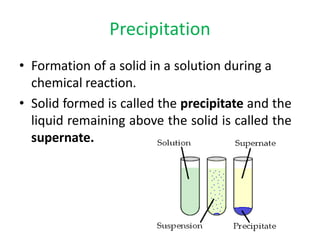
• Formation of a solid in a solution during a
chemical reaction.
• Solid formed is called the precipitate and the
liquid remaining above the solid is called the
supernate.
Precipitation
• Salts such as ammonium & sodium sulphate
are used for proteins to precipitate.
• Organic solvents methanol used to precipitate
dextrans.
• Chilled ethanol and acetone used for protein
precipitation.
• Non ionic polymer such as polyethylene glycol
used in precipitation.
Product Purification
• Done to separate those contaminants that
resemble the product very closely in physical and
chemical properties.
• Expensive to carry out
• Require sensitive and sophisticated equipment
• Significant fraction of the entire downstream
processing expenditure.
• Examples of operations include affinity, size
exclusion, reversed phase
chromatography,crystallization and fractional
precipitation.
Chromatography
• Separation of mixtures
• Passing a mixture dissolved in a "mobile
phase" through a stationary phase, which
separates the analyte to be measured from
other molecules in the mixture and allows it
to be isolated.
Ion Exchange Chromatography
• Used charged stationary
phase to separate
charged compounds
• Resin that carries
charged functional
groups which interact
with oppositely charged
groups of thecompound
to be retained.
• FPLC
Definition: Ion
• Ion is an atom or molecule which has lost or
gained one or more valence electrons, giving it a
positive or negative electrical charge.
• Anions are negatively charged ions, formed when
an atom gains electrons in a reaction. Anions are
negatively charged because there are more
electrons associated with them than there are
protons in their nuclei.
• Cations are positively charged ions, formed when
an atom loses electrons in a reaction, forming an
'electron hole'.
Affinity chromatography
• Affinity chromatography separates the protein of
interest on the basis of a reversible interaction
between it and its antibody coupled to a
chromatography bead (here labeled antigen) .
• With high selectivity, high resolution, and high
capacity for the protein of interest, purification
levels in the order of several thousand-fold are
achievable.
• The protein of interest is collected in a purified,
concentrated form. Biological interactions
between the antigen and the protein of interest
can result from electrostatic interactions, van der
Waals' forces and/or hydrogen bonding. Toelute
the protein of interest from the affinity beads, the
interaction can be reversed by changing the pH or
ionic strength.
• The concentrating effect enables large volumes to
be processed. The protein of interest can be
purified from high levels of contaminating
substances.
• Making antibodies to the protein of interest is
expensive, so affinity chromatography is the least
economical choice for production
chromatography.
Size exclusion chromatography
• Gel permeation/filtration
• chromatography (GPC)
• Separates molecules
• according to their size
• Low resolution"polishing"
• Tertiary/Quaternary structure(native)
Reversed phase chromatography
Reversed-phase chromatography is an elution
procedure used
in liquid
chromatography in
which the mobile
phase is significantly
more polar than the stationary phase.
Definitions: Polarity
• The dipole-dipole intermolecular forces
between the slightly positively-charged end of
one molecule to the negative end of another
or the same molecule.
• Molecular polarity is dependent on the
difference in electronegativity between atoms
in a compound and the asymmetry of the
compound's structure.
Liquid Chromatography
• Mobile phase is a liquid.
• Carried out either in a column or a plane.
• HPLC
• In the HPLC technique, the sample is forced
through a column that is packed with
irregularly or spherically shaped particles or a
porous monolithic layer (stationary phase) by
a liquid (mobile phase) at high pressure.
HPLC Configuration
Crystallization
• process of formation of solid crystals
precipitating from a solution, melt or more
rarely deposited directly from a gas.
• chemical solid-liquid separation technique, in
which mass transfer of a solute from the liquid
solution to a pure solid crystalline phase
occurs.
Product Polishing
• End with packaging of the product in a form that is
• stable, easily transportable and convenient.
• Crystallization
• Desiccation
• Lyophilization
• Spray drying
• May include:
• Sterilization of the product
• Remove or deactivate trace contaminants which might
compromise product safety viruses or depyrogenation
lyophilization
• freezing the material
• reducing the surrounding pressure and adding
enough heat to allow the frozen water in the
material to sublime directly from the solid
phase to gas.
Thank - You

Downstramprocessing ppt

  • 1.
  • 2.
    General Steps inDownstream Purification
  • 3.
    Downstream processing • Thevarious stages of processing that occur after the completion of the fermentation or bioconversion stage, including separation, purification, and packaging of the product.
  • 4.
    Stages in Downstream Processing Removal of Insolubles  Product Isolation  Product Purification  Product Polishing  A few product recovery methods may be considered to combine two or more stages. For example, expanded bed adsorption accomplishes removal of insolubles and product isolation in a single step. Affinity chromatography often isolates and purifies in a single step.
  • 5.
    Removal of Insolubles •Separation of cells, cell debris or other particulate matter • Typical operations to achieve this: 1) Filtration 2) Centrifugation 3) Sedimentation 4) Flocculation a process where a solute comes out of solution in the form of floc or flakes. 5) Gravity settling
  • 6.
    Filtration • A mechanicaloperation used for the separation of solids from fluids (liquids or gases) by interposing a medium to porous membrane through which the fluid can pass, but the solids in the fluid are retained.
  • 7.
    Filtration • The solidparticles deposited on the filter form a layer, which is known as filter cake. • All the solid particles from the feed are stopped by the cake ,and the cake grows at the rate at which particles are bought to its surface. • All of the fluid goes through the cake and filter medium.
  • 8.
    Liquid filtrate Cell mass ContinuousRotary filter Knife Hollow spokes Filter Perforate d drum
  • 9.
    Continuous Rotary Vacuumfilter • It is one of the most commonly used type of filter in fermentation. • The drum is pre coated prior to filtration. • A small agent of coagulating is added to the broth before it is pumped into the filter. • The drum rotates under vacuum and a thin layer of cells sticks to the drum. • The thickness of the layer increases in the section designed for forming the cake.
  • 10.
    Points to beconsidered while selecting the filter medium: • Ability to build the solid. • Minimum resistance to flow the filtrate. • Resistance to chemical attack. • Minimum cost. • Long life
  • 11.
    Centrifugation • Centrifugation isused to separate particles of 100 – 0.1 micrometer from liquid by gravitational forces. • It depends on particles size,density difference between the cells and the broth and broth viscosity. • Use of the centrifugal force for the separation of mixtures • More-dense components migrate away from the axis of the centrifuge • Less-dense components migrate towards the axis. • Types of centrifuges used are Tubular bowl centrifuge,multichamber centrifuge,disc bowl centrifuge etc.
  • 12.
    Sedimentation • It isapllicable only for large particles greater than 100 micrometer flocs. • It is a slow process and takes ~3 hours. • It is used in process like activated sludge effluent treatment. • It’s a free settling process depends only on gravity. • Particles settling is a high particle density suspension(hindered settling).
  • 13.
    Flocculation • Process wherea solute comes out of solution in the form of flocs or flakes. • Particles finer than 0.1 µm in water remain continuously in motion due to electrostatic charge which causes them to repel each other • Once their electrostatic charge is neutralized (use of coagulant) the finer particles start to collide and combine together . • These larger and heavier particles are called flocs.
  • 14.
    Product Isolation • Removalof those components whose properties vary markedly from that of the desired product. • Water is the chief impurity a) Isolation steps are designed to remove it (i.e.dialysis) b) Reducing the volume c) Concentrating the product. d) Liquid –liquid extraction, adsorption, ultrafiltration, and precipitation are some of the unit operations involved.
  • 15.
    Liquid -Liquid extraction •It is a separation process that takes the advantage of the relative solubilities of solute in immiscible solvents. • Solute is dissolved more readily and becomes more concentrated in the solvent in which it has a higher solubility. • A partial separation occurs when a number of solutes have different relative solubilities in the two solvents used. • Solvent should be non toxic, selective, inexpensive and immiscible with broth and should have a high distribution coefficent for the product.
  • 16.
    Adsorption • is asurface phenomenon • It is the binding of molecules to the surface and different from absorption. • The binding to the surface is weak and reversible. • Compounds containing chromogenic group are usually strongly adsorbed on activated carbon. • Common adsorbent used are activated carbon,silica gel,alumina becoz they present enormous surface areas per unit weight.
  • 17.
    Ultrafiltration UF is basicallya pressure-driven separation process. The operating pressure is usually between 0.1 and 1 MPa.
  • 18.
    Ultrafiltration • UF isgoverned by a screening principle and dependent on particle size. • UF membranes have a pore size between 1 nm and 100 nm (10 and 2000 Å), thus allowing retention of compounds with a molecular weight of 300 to 500 000 Dalton. • Typically, the process is suitable for retaining biomolecules, bacteria, viruses, polymers, colloidal particles and sugar molecules.
  • 19.
  • 20.
    Precipitation • Formation ofa solid in a solution during a chemical reaction. • Solid formed is called the precipitate and the liquid remaining above the solid is called the supernate.
  • 21.
    Precipitation • Salts suchas ammonium & sodium sulphate are used for proteins to precipitate. • Organic solvents methanol used to precipitate dextrans. • Chilled ethanol and acetone used for protein precipitation. • Non ionic polymer such as polyethylene glycol used in precipitation.
  • 22.
    Product Purification • Doneto separate those contaminants that resemble the product very closely in physical and chemical properties. • Expensive to carry out • Require sensitive and sophisticated equipment • Significant fraction of the entire downstream processing expenditure. • Examples of operations include affinity, size exclusion, reversed phase chromatography,crystallization and fractional precipitation.
  • 23.
    Chromatography • Separation ofmixtures • Passing a mixture dissolved in a "mobile phase" through a stationary phase, which separates the analyte to be measured from other molecules in the mixture and allows it to be isolated.
  • 24.
    Ion Exchange Chromatography •Used charged stationary phase to separate charged compounds • Resin that carries charged functional groups which interact with oppositely charged groups of thecompound to be retained. • FPLC
  • 25.
    Definition: Ion • Ionis an atom or molecule which has lost or gained one or more valence electrons, giving it a positive or negative electrical charge. • Anions are negatively charged ions, formed when an atom gains electrons in a reaction. Anions are negatively charged because there are more electrons associated with them than there are protons in their nuclei. • Cations are positively charged ions, formed when an atom loses electrons in a reaction, forming an 'electron hole'.
  • 26.
    Affinity chromatography • Affinitychromatography separates the protein of interest on the basis of a reversible interaction between it and its antibody coupled to a chromatography bead (here labeled antigen) . • With high selectivity, high resolution, and high capacity for the protein of interest, purification levels in the order of several thousand-fold are achievable. • The protein of interest is collected in a purified, concentrated form. Biological interactions between the antigen and the protein of interest can result from electrostatic interactions, van der Waals' forces and/or hydrogen bonding. Toelute the protein of interest from the affinity beads, the interaction can be reversed by changing the pH or ionic strength. • The concentrating effect enables large volumes to be processed. The protein of interest can be purified from high levels of contaminating substances. • Making antibodies to the protein of interest is expensive, so affinity chromatography is the least economical choice for production chromatography.
  • 27.
    Size exclusion chromatography •Gel permeation/filtration • chromatography (GPC) • Separates molecules • according to their size • Low resolution"polishing" • Tertiary/Quaternary structure(native)
  • 28.
    Reversed phase chromatography Reversed-phasechromatography is an elution procedure used in liquid chromatography in which the mobile phase is significantly more polar than the stationary phase.
  • 29.
    Definitions: Polarity • Thedipole-dipole intermolecular forces between the slightly positively-charged end of one molecule to the negative end of another or the same molecule. • Molecular polarity is dependent on the difference in electronegativity between atoms in a compound and the asymmetry of the compound's structure.
  • 30.
    Liquid Chromatography • Mobilephase is a liquid. • Carried out either in a column or a plane. • HPLC • In the HPLC technique, the sample is forced through a column that is packed with irregularly or spherically shaped particles or a porous monolithic layer (stationary phase) by a liquid (mobile phase) at high pressure.
  • 31.
  • 32.
    Crystallization • process offormation of solid crystals precipitating from a solution, melt or more rarely deposited directly from a gas. • chemical solid-liquid separation technique, in which mass transfer of a solute from the liquid solution to a pure solid crystalline phase occurs.
  • 33.
    Product Polishing • Endwith packaging of the product in a form that is • stable, easily transportable and convenient. • Crystallization • Desiccation • Lyophilization • Spray drying • May include: • Sterilization of the product • Remove or deactivate trace contaminants which might compromise product safety viruses or depyrogenation
  • 34.
    lyophilization • freezing thematerial • reducing the surrounding pressure and adding enough heat to allow the frozen water in the material to sublime directly from the solid phase to gas.
  • 35.