DOW FIRE AND
EXPLOSION HAZARD
AND ITS CASE STUDY
BY:
GAURAV SINGH RAJPUT
@gauravkrsrajput
WHAT IS DOW FIRE AND
EXPLOSION INDEX?
 The hazard classification guide developed by Dow
Chemical Company.
 Published by the American Institute of Chemical
Engineering, Dow (1994).
 It gives a method of evaluating the potential risk
from process, and assessing the potential loss.
OBJECTIVES OF DOW F&EI
Quantify:
The expected damage of potential fire & explosion
incidents in realistic terms
Identify:
Equipment that would likely contribute to the
creation or escalation of an incident
Communicate:
The fire & explosion potential to design teams and
plant personnel
 It is tailored for storage, handling and processing of
explosive and flammable material in chemical
process industry. It uses systematic approach based
on rating form.
 Suitable to be used at an early stage of a project and
for auditing existing plant.
 Final rating number (i.e. F&EI) provided a relative
ranking of hazard.
 It is also used for estimating damage radius (using
Dow correlation) and estimate dollar losses in the
event of accident (using consequences analysis form).
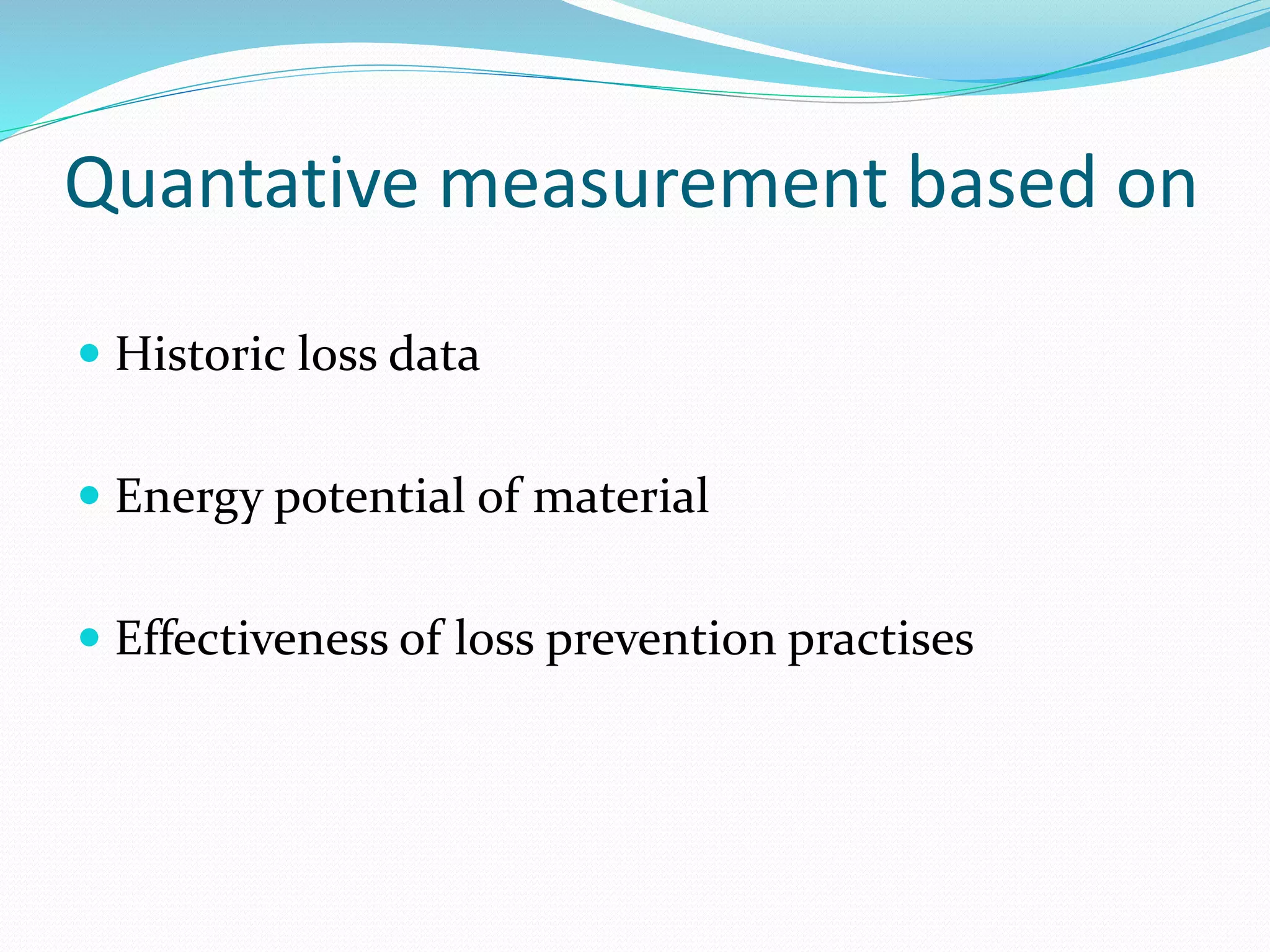
Quantative measurement based on
 Historic loss data
 Energy potential of material
 Effectiveness of loss prevention practises
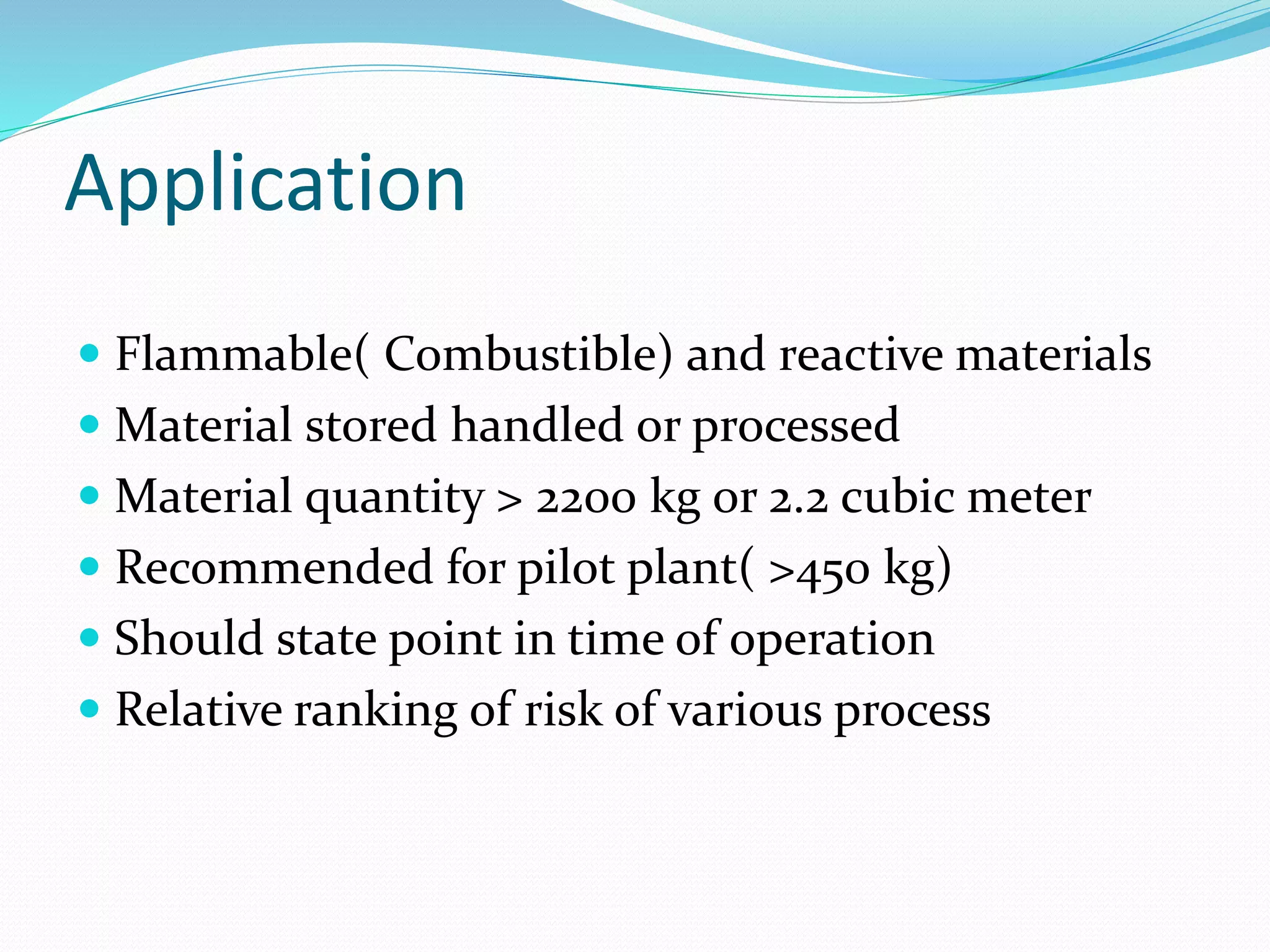
Application
 Flammable( Combustible) and reactive materials
 Material stored handled or processed
 Material quantity > 2200 kg or 2.2 cubic meter
 Recommended for pilot plant( >450 kg)
 Should state point in time of operation
 Relative ranking of risk of various process
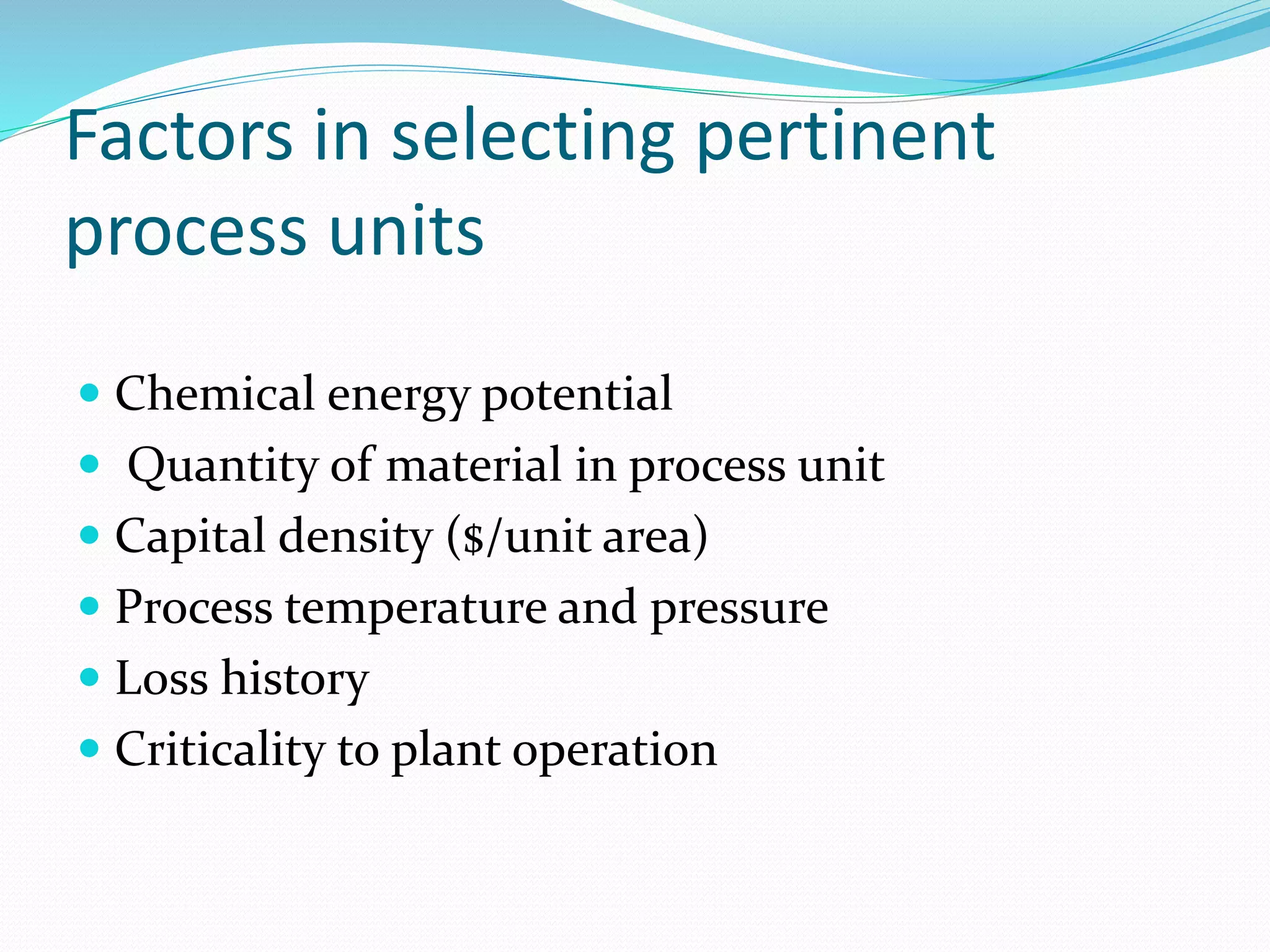
Factors in selecting pertinent
process units
 Chemical energy potential
 Quantity of material in process unit
 Capital density ($/unit area)
 Process temperature and pressure
 Loss history
 Criticality to plant operation
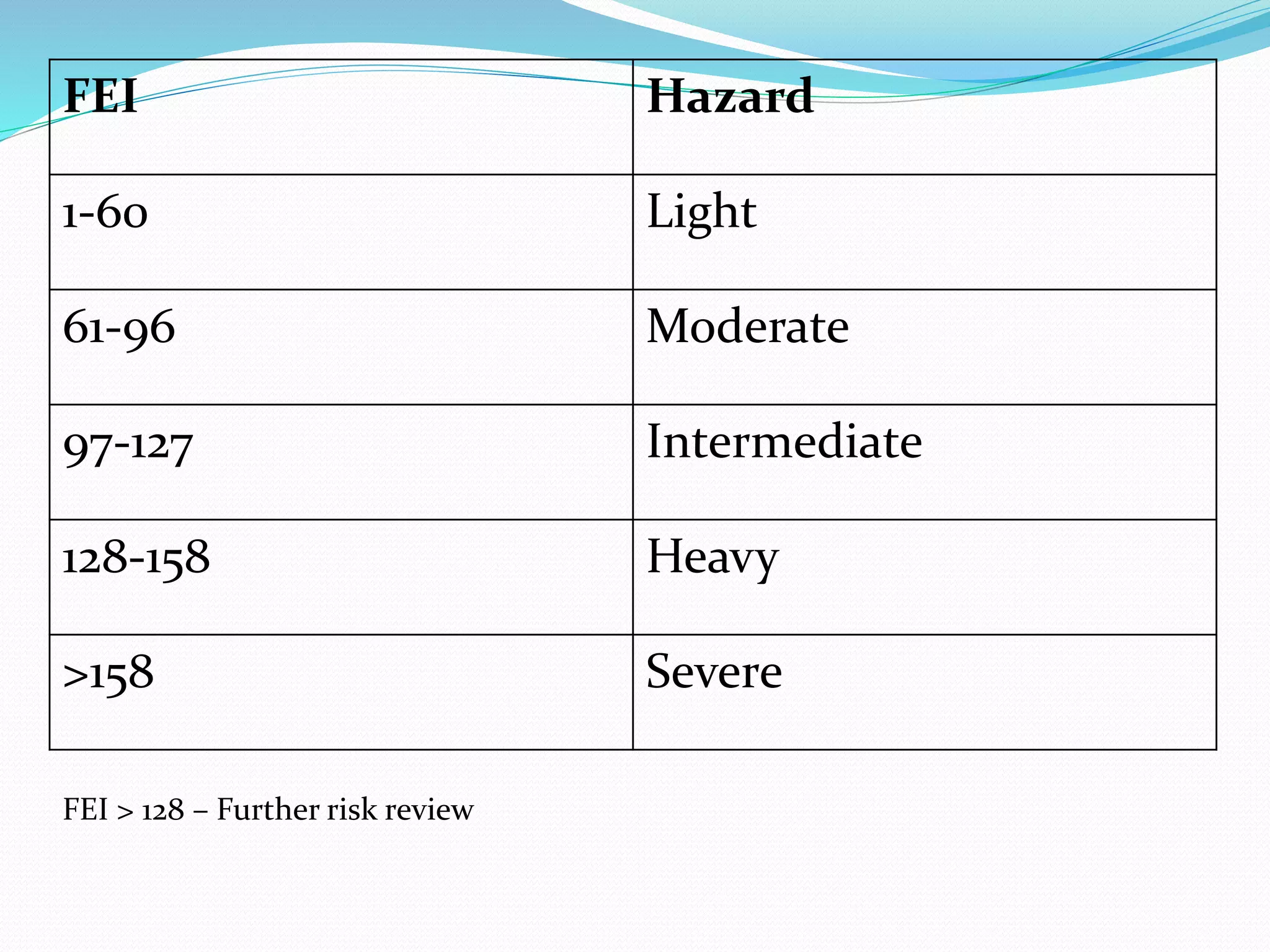
FEI Hazard
1-60 Light
61-96 Moderate
97-127 Intermediate
128-158 Heavy
>158 Severe
FEI > 128 – Further risk review
Procedure
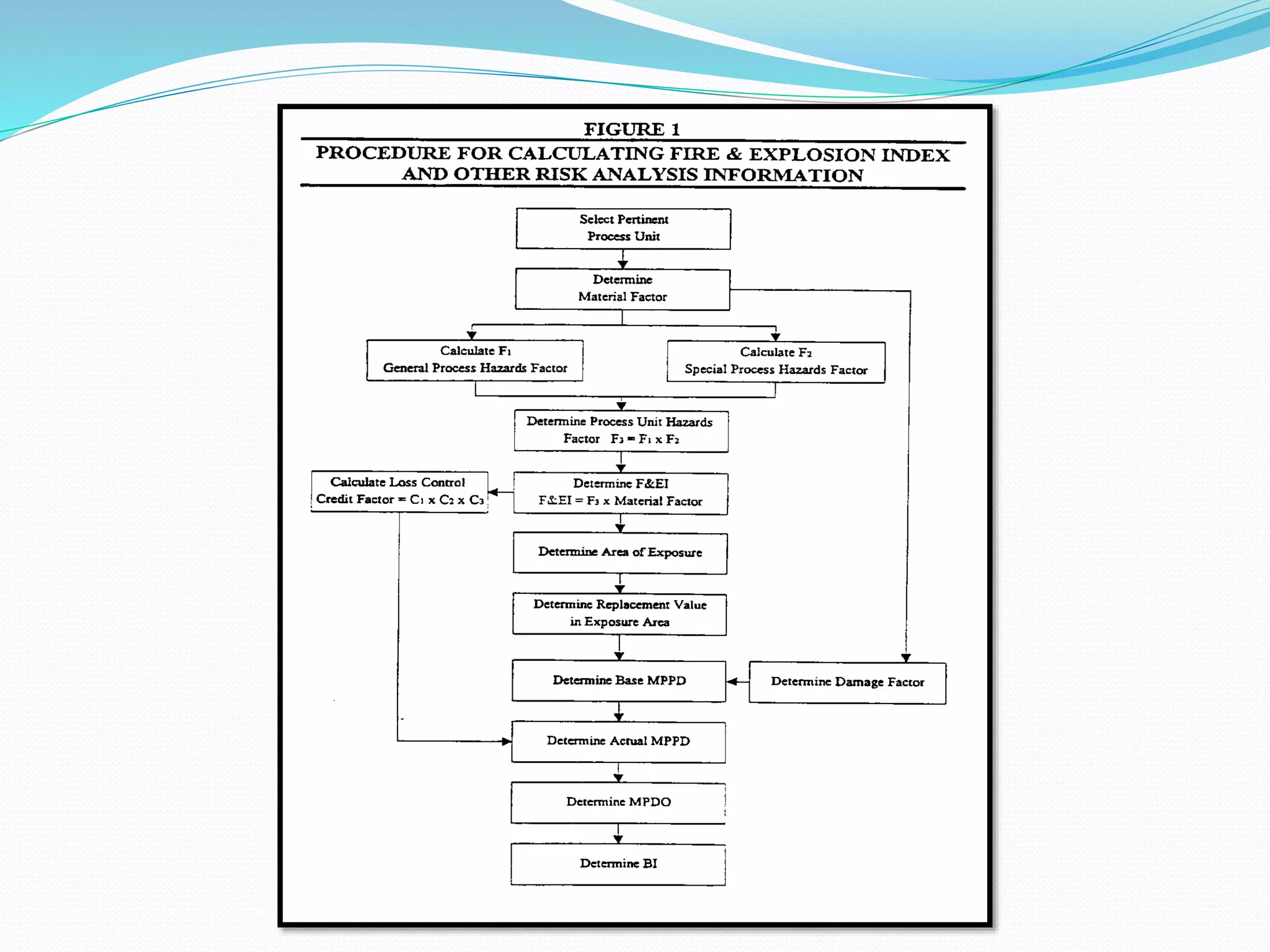
To develop the DOW FEI study, the following
documents are required:
-An accurate plot plan.
- A process flow sheet.
-Data sheets of the main process units.
-A fire & Explosion Index Hazard classification guide.
-A complete Fire & Explosion Index form.
-Replacement cost data for the installed process
equipment under study.
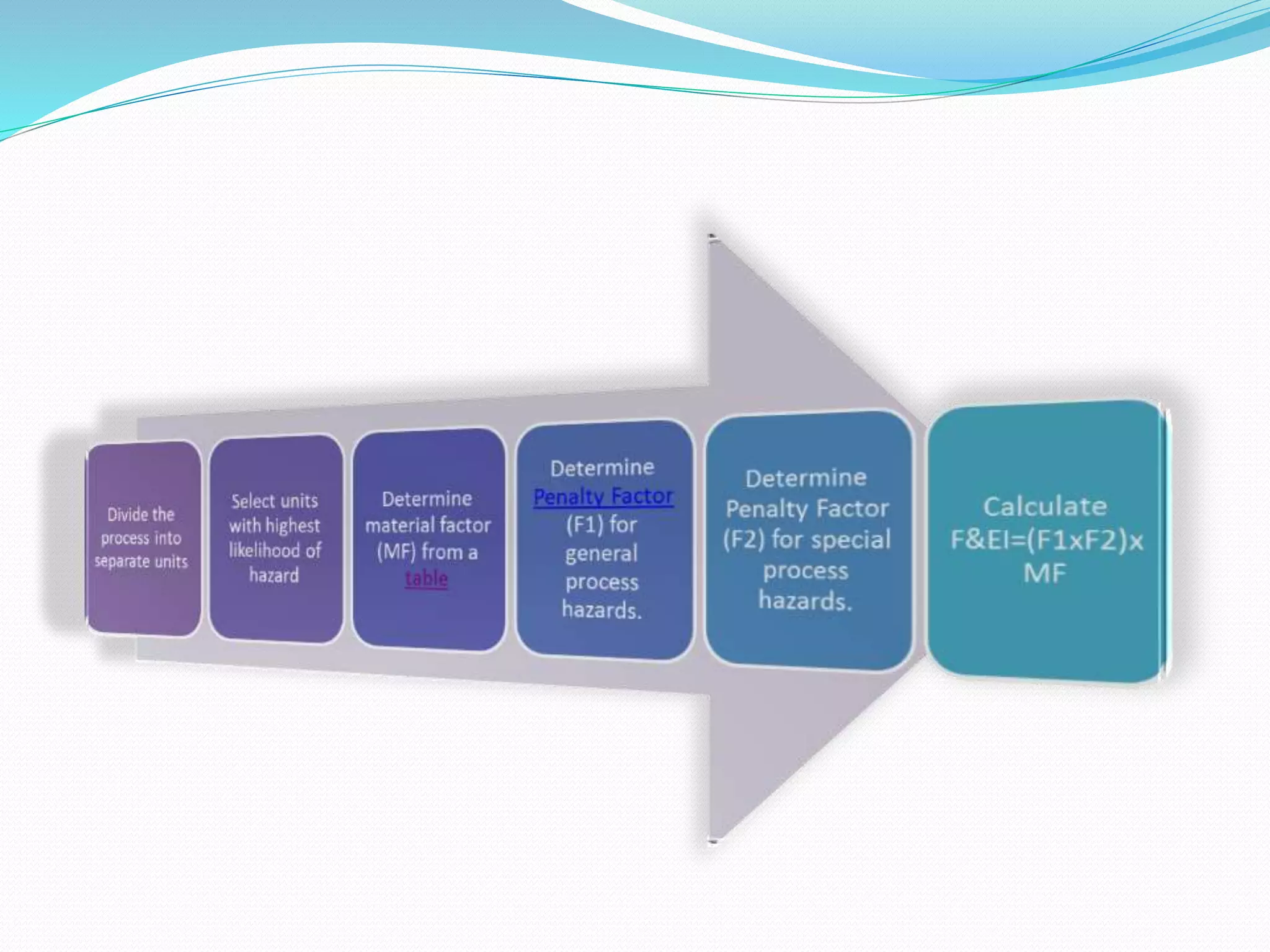
1. The first step of the study, is the identification of
the critical process unit.
Only those items, or units, with a critical role
inside the process should be studied, and to
simplify the identification of those units.
- Storage tank
- Process stem storage tank
- Reactor feed tank
- Reactors
- Recovery vessels
- others
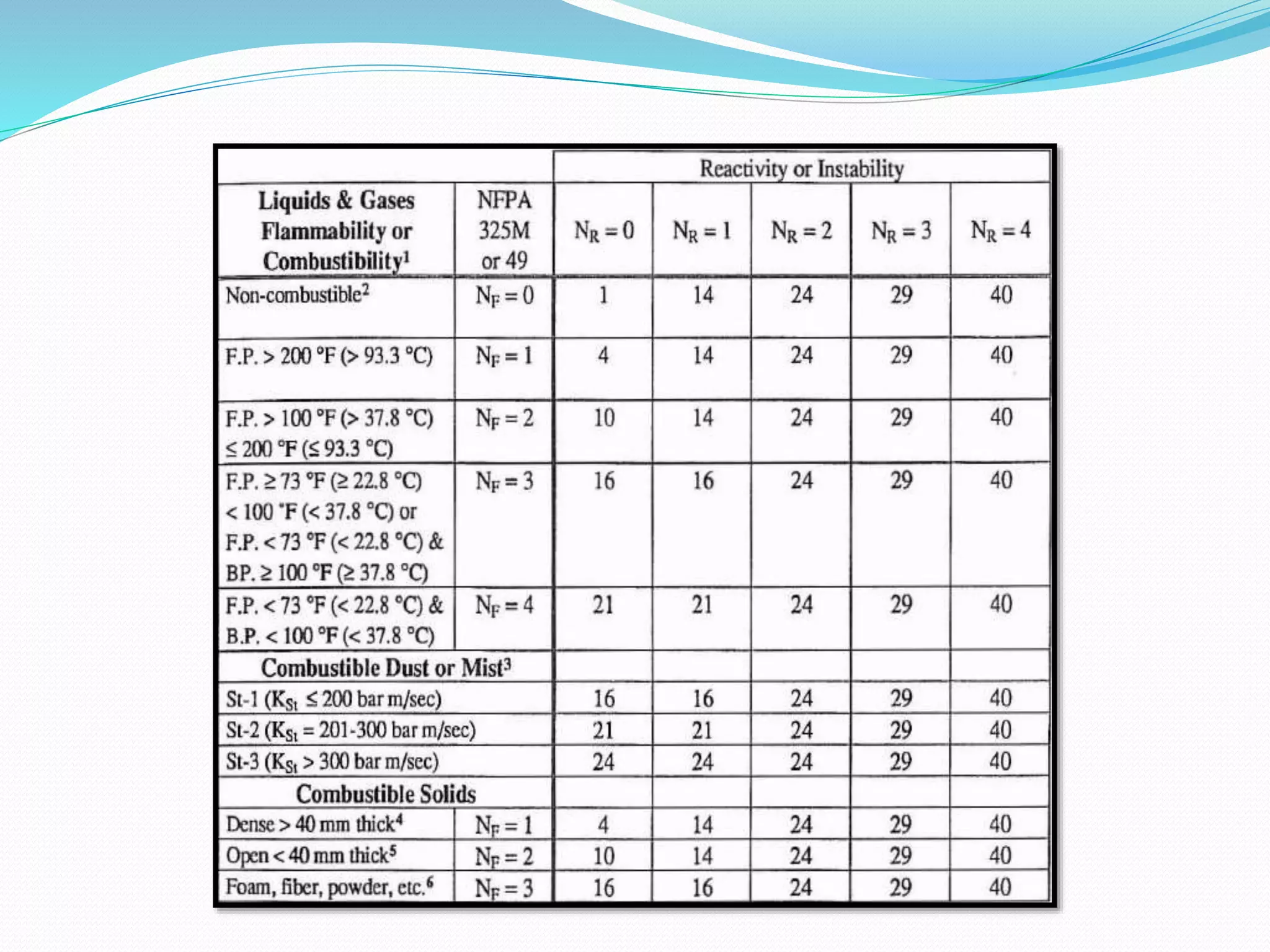
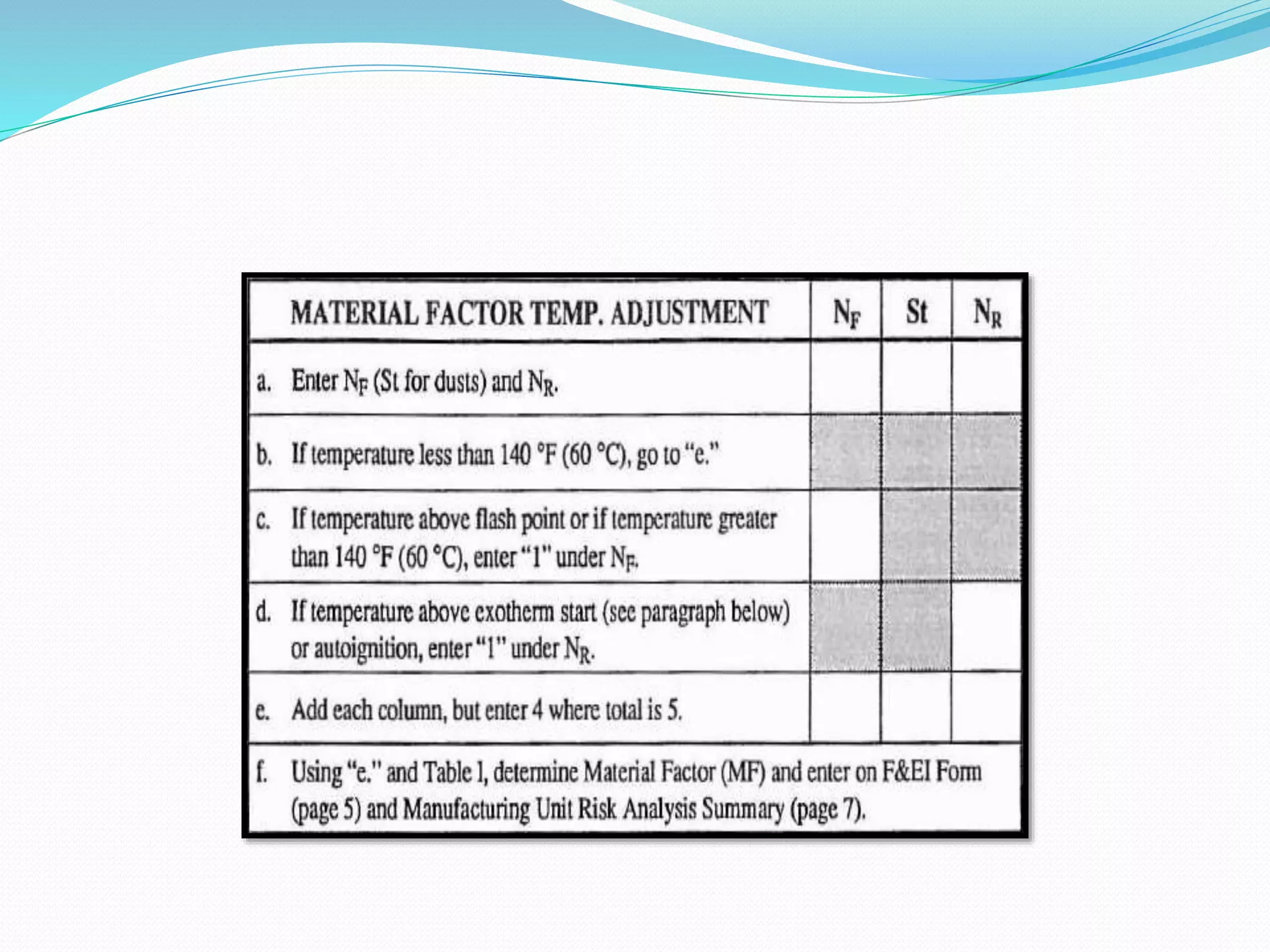
2. Calculation of The Material Factor:
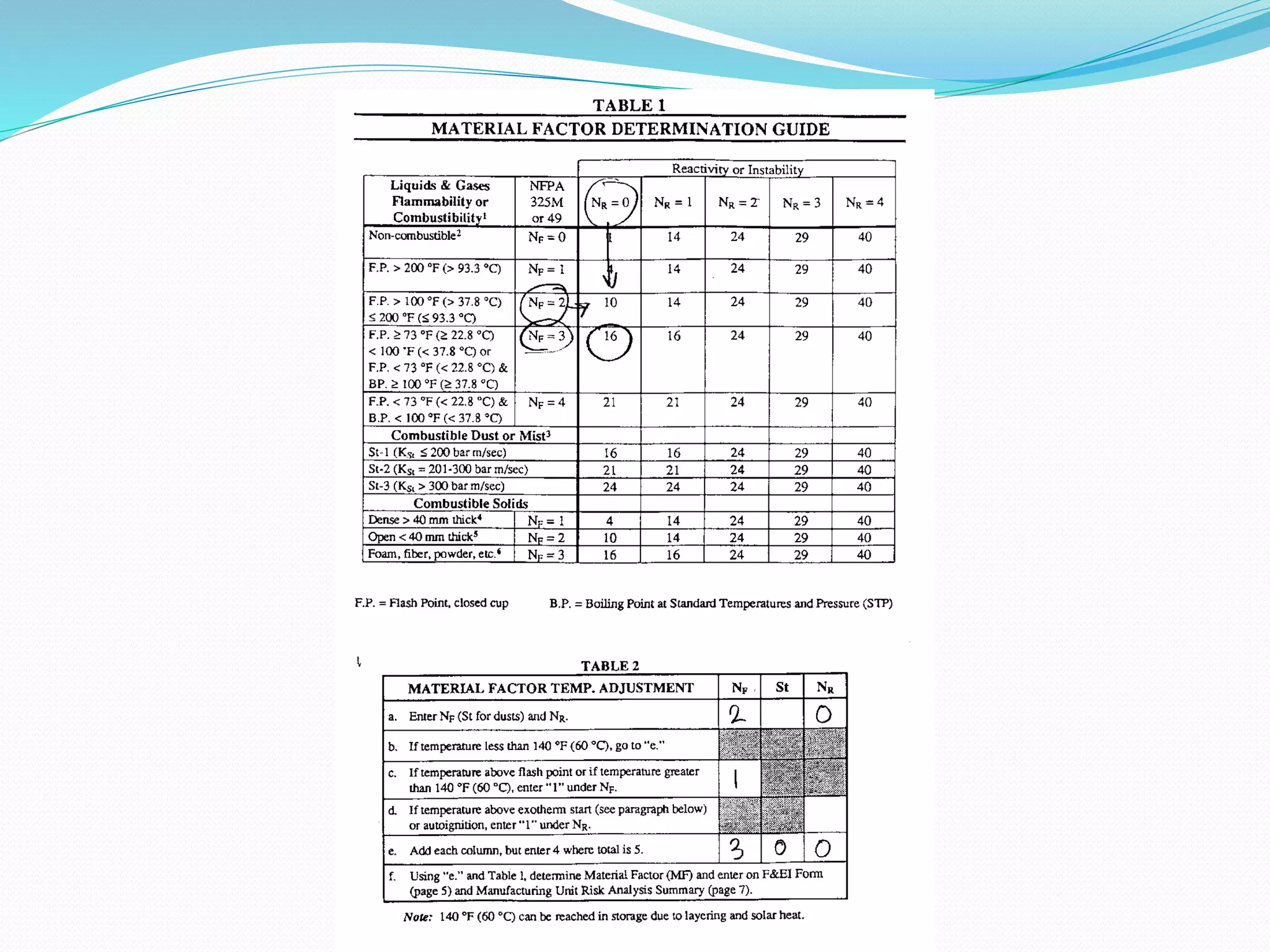
The Material Factor, it is the first parameter of the FEI
calculation. The MF is the measure of the intrinsic
potential energy released by the combustion,
explosion or chemical reaction of the substances.
Those parameters are NFPA rating expressing the
flammability and reactivity of the substance
respectively.
The MF for the particular material in the process unit
is to be obtain from table 1.
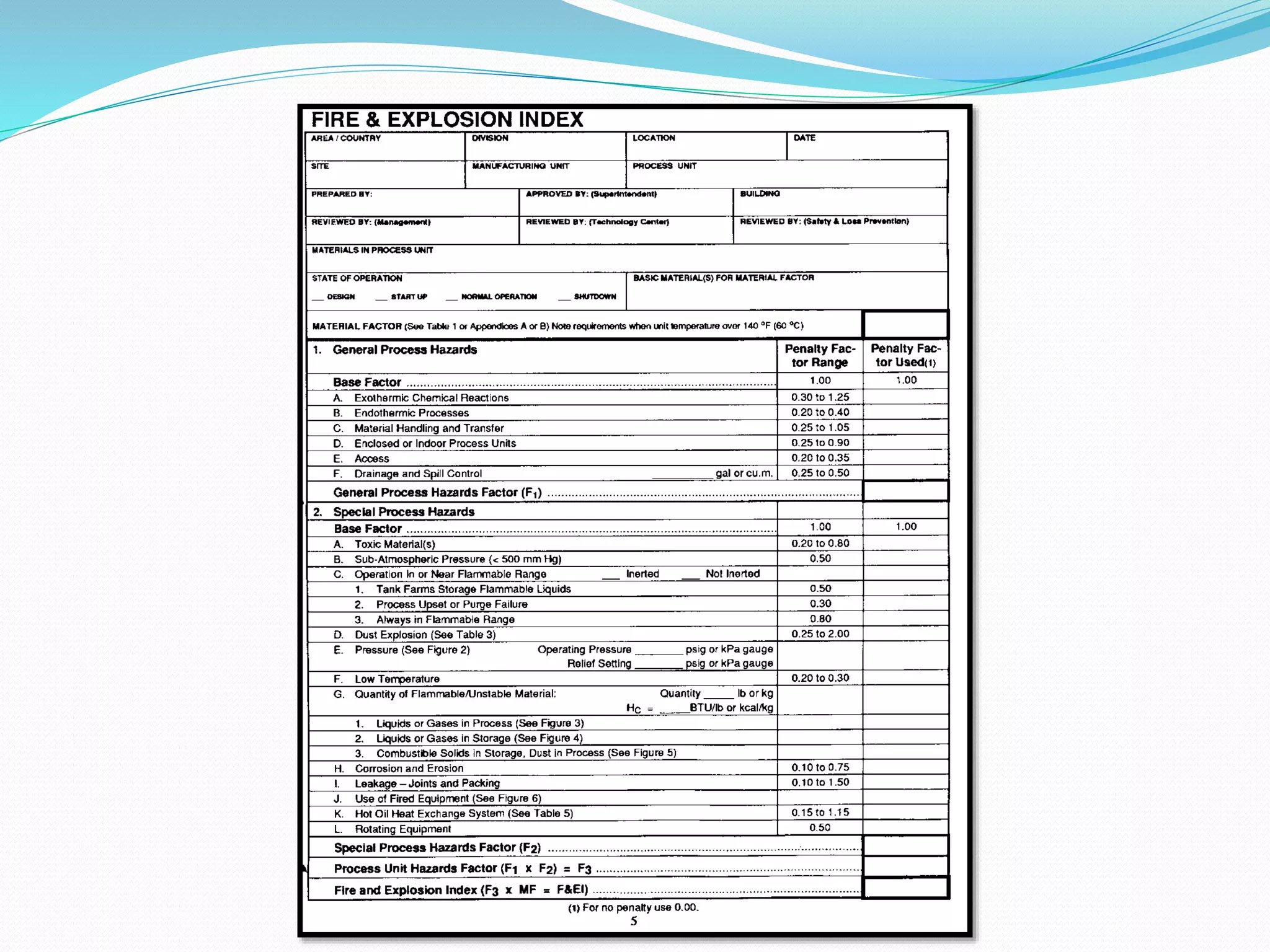
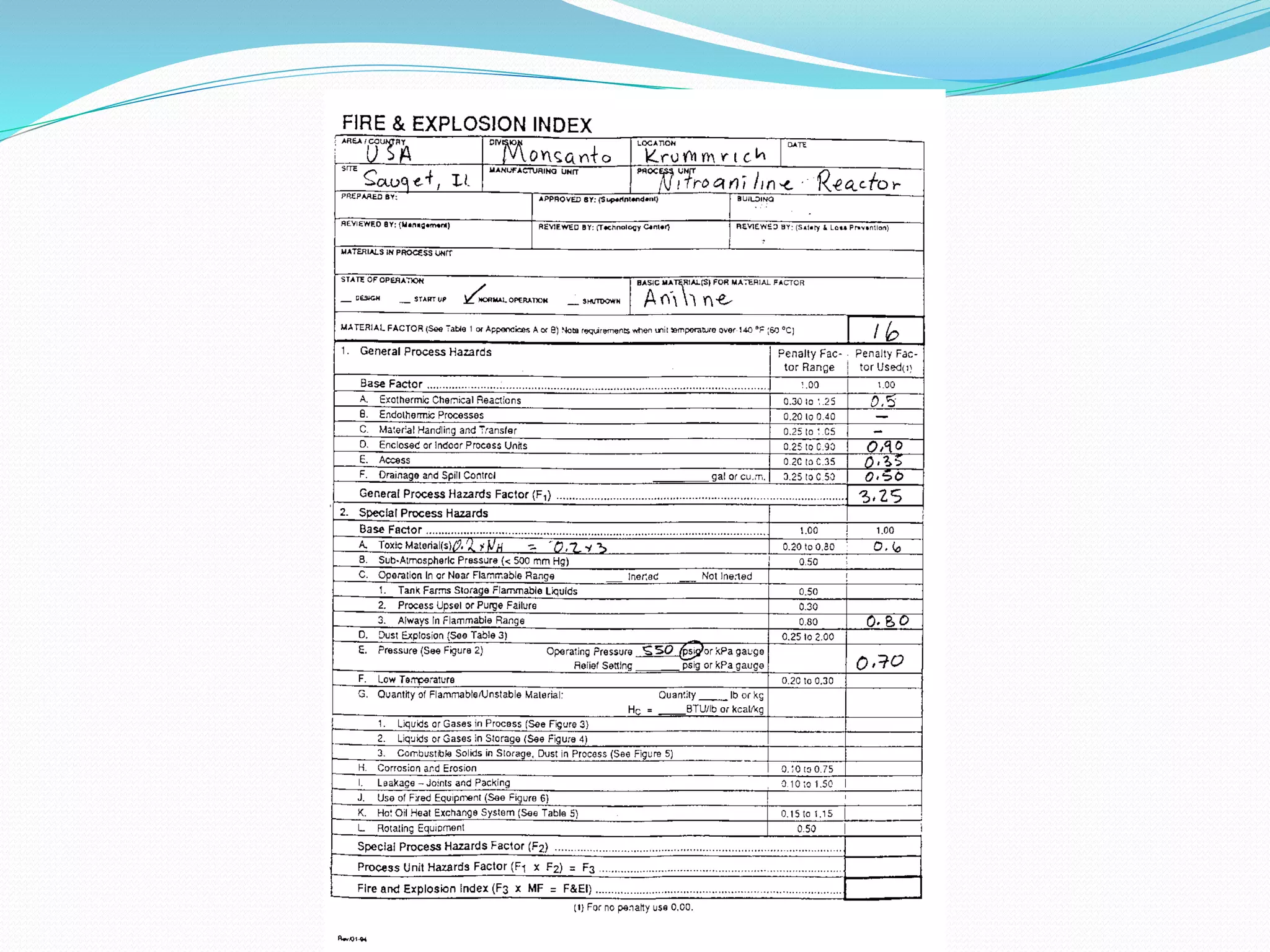
3. General Process Hazards Factor (F1):
The general Process Hazard Factors are six different
elements, playing a primary role in the hazardous
scenario like explosions of fires.
- Material Handling and Transfer
- Process Units
- Access to the area
- Drainage and Spill Control
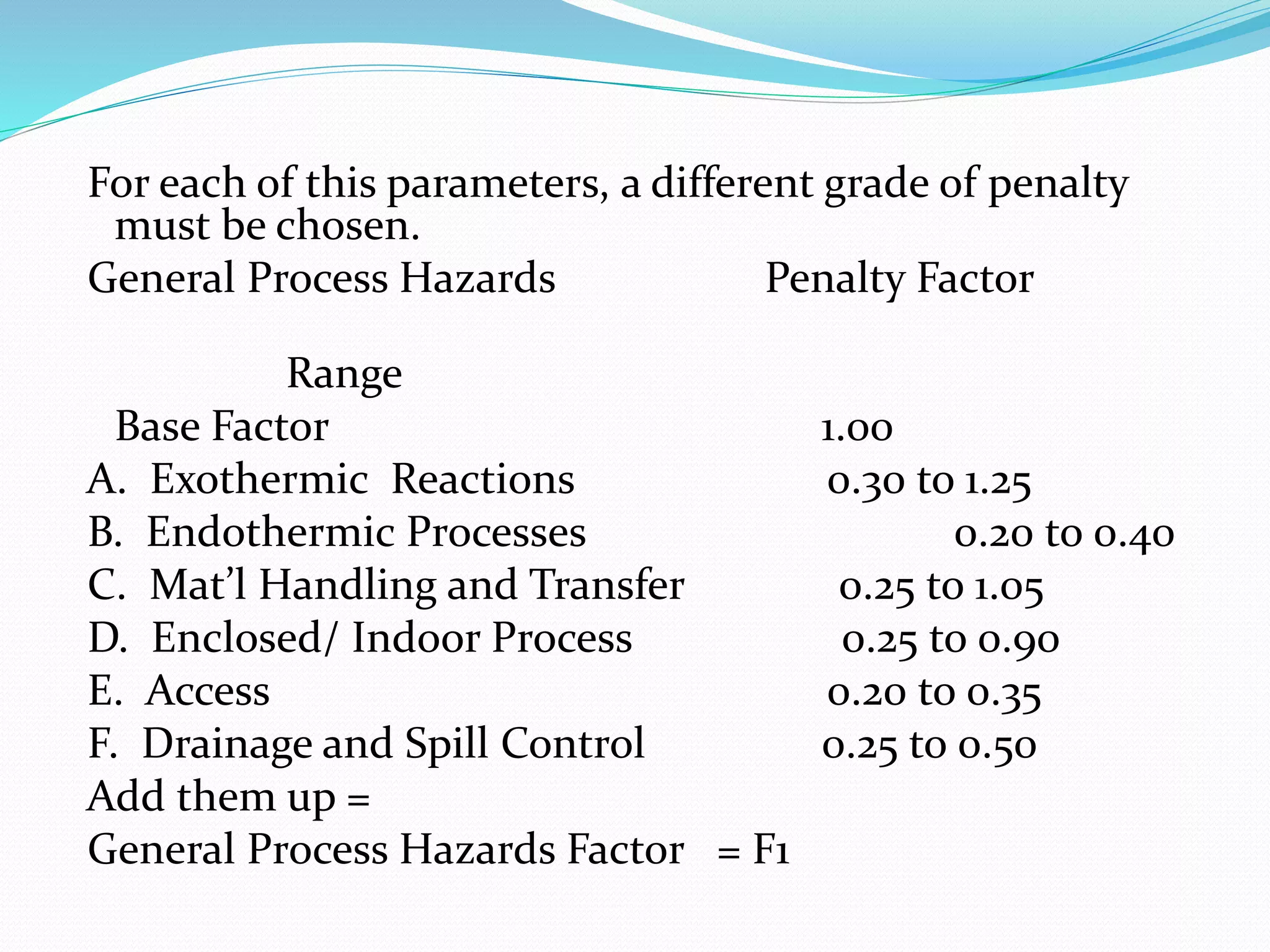
For each of this parameters, a different grade of penalty
must be chosen.
General Process Hazards Penalty Factor
Range
Base Factor 1.00
A. Exothermic Reactions 0.30 to 1.25
B. Endothermic Processes 0.20 to 0.40
C. Mat’l Handling and Transfer 0.25 to 1.05
D. Enclosed/ Indoor Process 0.25 to 0.90
E. Access 0.20 to 0.35
F. Drainage and Spill Control 0.25 to 0.50
Add them up =
General Process Hazards Factor = F1
4. Special Process Hazards Factor (F2):
The special process hazard are factors that contribute
primarily to the probability of a loss incident. There
are twelve factors:
- Toxic Materials
- Sub Atmospheric Pressure (Under 500 mmHg)
- Operation IN or NEAR Flammable Range
- Toxic Materials
- Sub Atmospheric Pressure (Under 500 mmHg)
- Operation IN or NEAR Flammable Range
- Dust Explosion
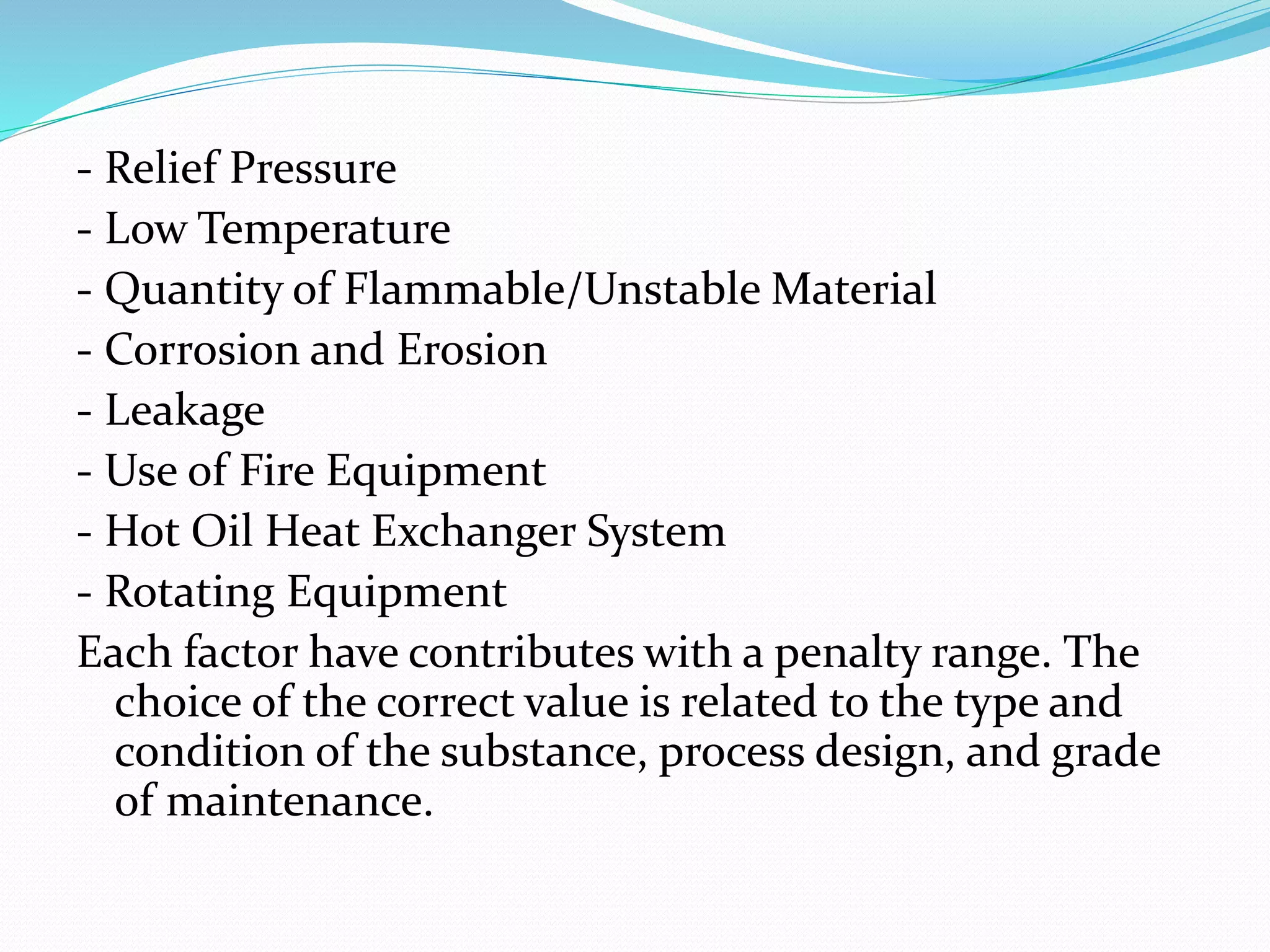
- Relief Pressure
- Relief Pressure
- Low Temperature
- Quantity of Flammable/Unstable Material
- Corrosion and Erosion
- Leakage
- Use of Fire Equipment
- Hot Oil Heat Exchanger System
- Rotating Equipment
Each factor have contributes with a penalty range. The
choice of the correct value is related to the type and
condition of the substance, process design, and grade
of maintenance.
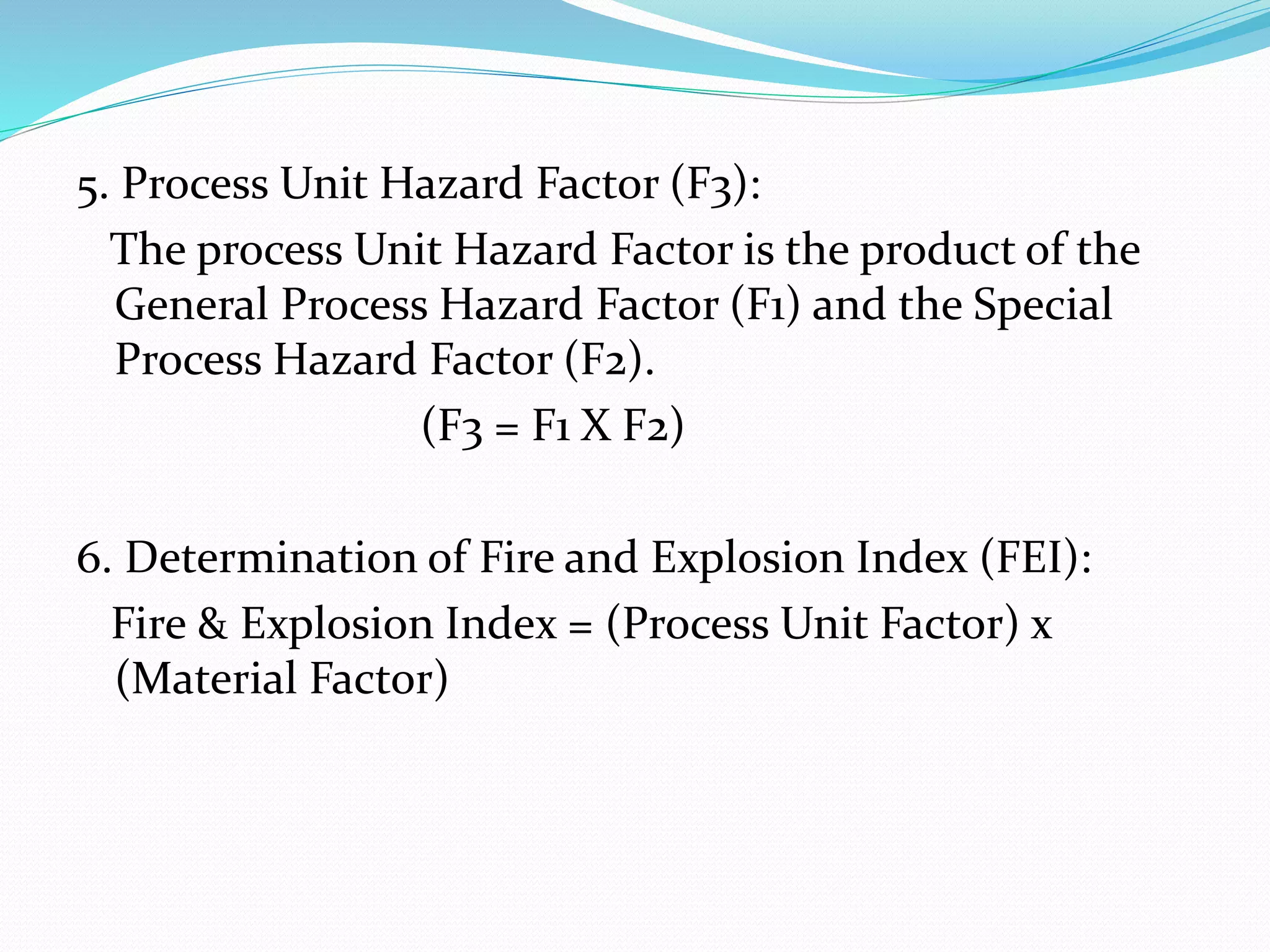
5. Process Unit Hazard Factor (F3):
The process Unit Hazard Factor is the product of the
General Process Hazard Factor (F1) and the Special
Process Hazard Factor (F2).
(F3 = F1 X F2)
6. Determination of Fire and Explosion Index (FEI):
Fire & Explosion Index = (Process Unit Factor) x
(Material Factor)
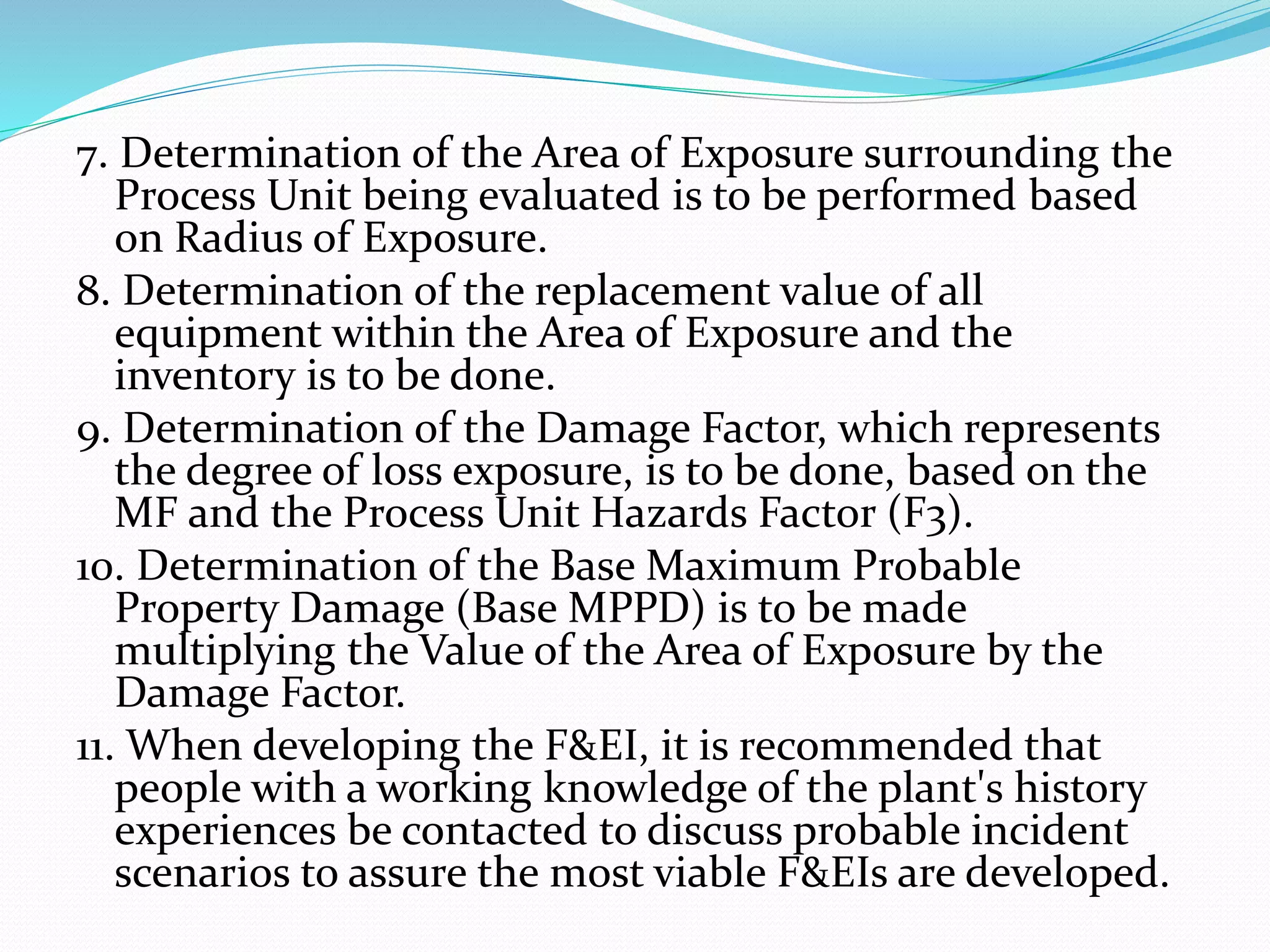
7. Determination of the Area of Exposure surrounding the
Process Unit being evaluated is to be performed based
on Radius of Exposure.
8. Determination of the replacement value of all
equipment within the Area of Exposure and the
inventory is to be done.
9. Determination of the Damage Factor, which represents
the degree of loss exposure, is to be done, based on the
MF and the Process Unit Hazards Factor (F3).
10. Determination of the Base Maximum Probable
Property Damage (Base MPPD) is to be made
multiplying the Value of the Area of Exposure by the
Damage Factor.
11. When developing the F&EI, it is recommended that
people with a working knowledge of the plant's history
experiences be contacted to discuss probable incident
scenarios to assure the most viable F&EIs are developed.
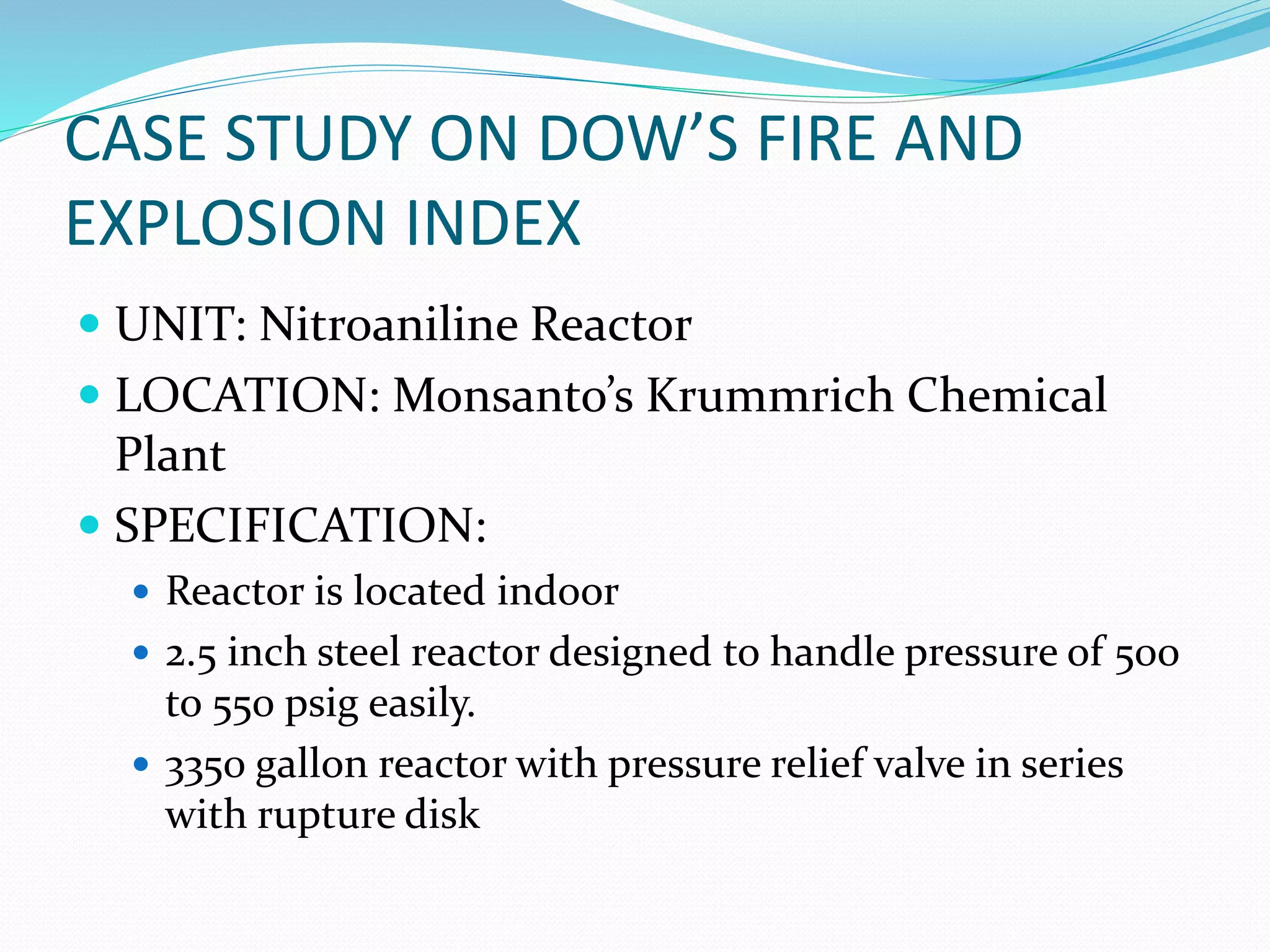
CASE STUDY ON DOW’S FIRE AND
EXPLOSION INDEX
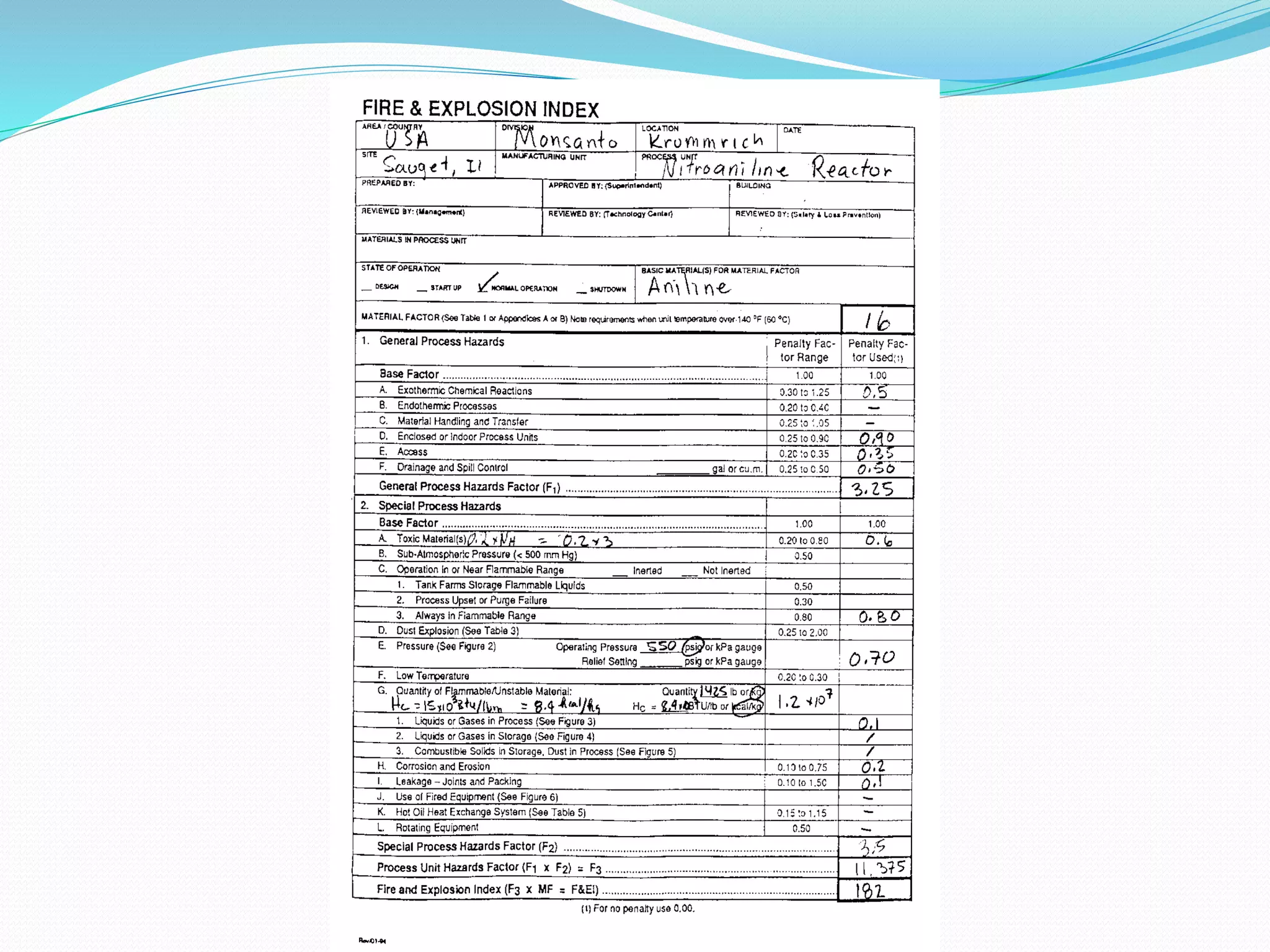
 UNIT: Nitroaniline Reactor
 LOCATION: Monsanto’s Krummrich Chemical
Plant
 SPECIFICATION:
 Reactor is located indoor
 2.5 inch steel reactor designed to handle pressure of 500
to 550 psig easily.
 3350 gallon reactor with pressure relief valve in series
with rupture disk
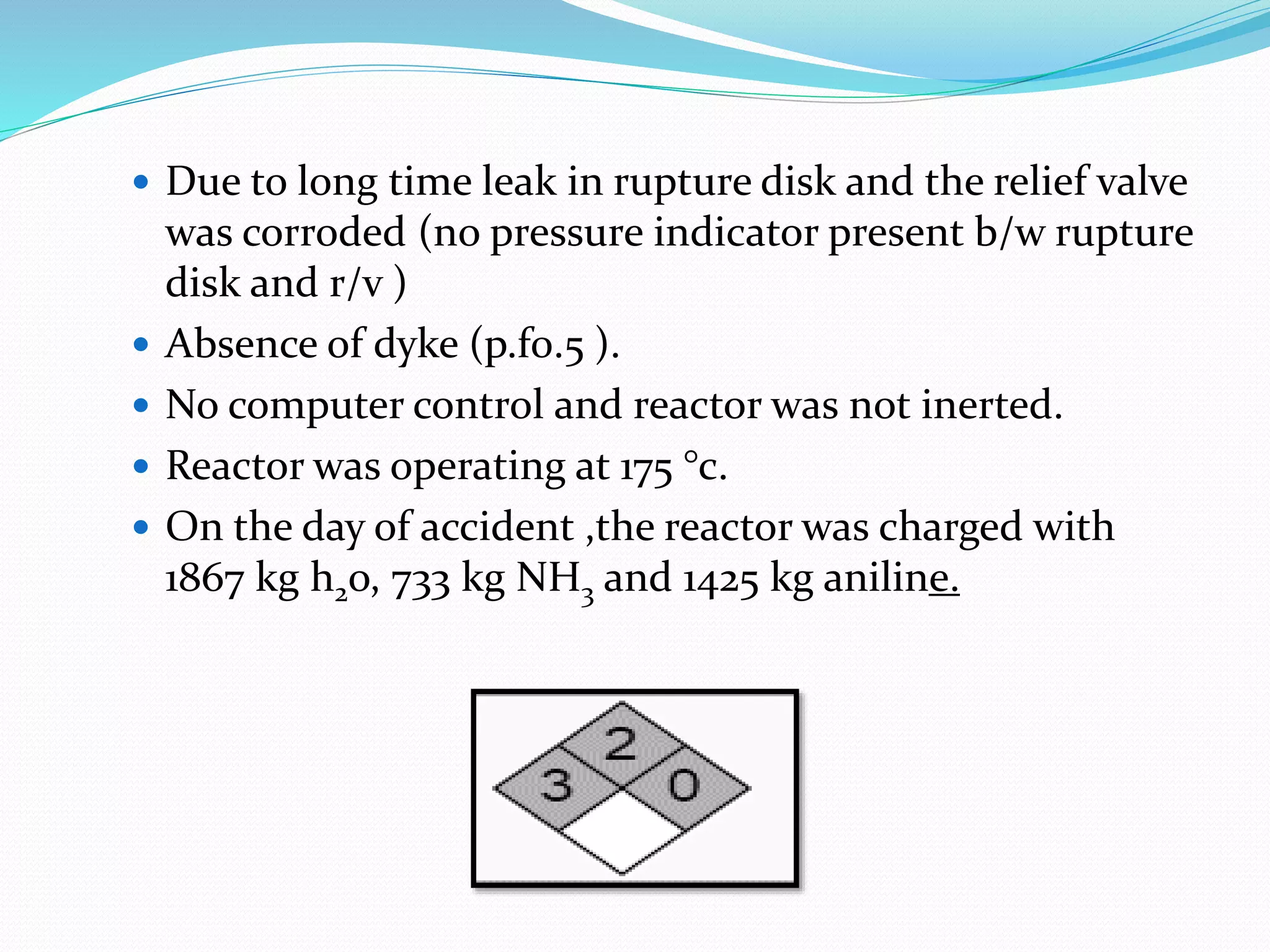
 Due to long time leak in rupture disk and the relief valve
was corroded (no pressure indicator present b/w rupture
disk and r/v )
 Absence of dyke (p.f0.5 ).
 No computer control and reactor was not inerted.
 Reactor was operating at 175 °c.
 On the day of accident ,the reactor was charged with
1867 kg h2o, 733 kg NH3 and 1425 kg aniline.
Nitroanline Synthesis Reaction
THANK YOU….!
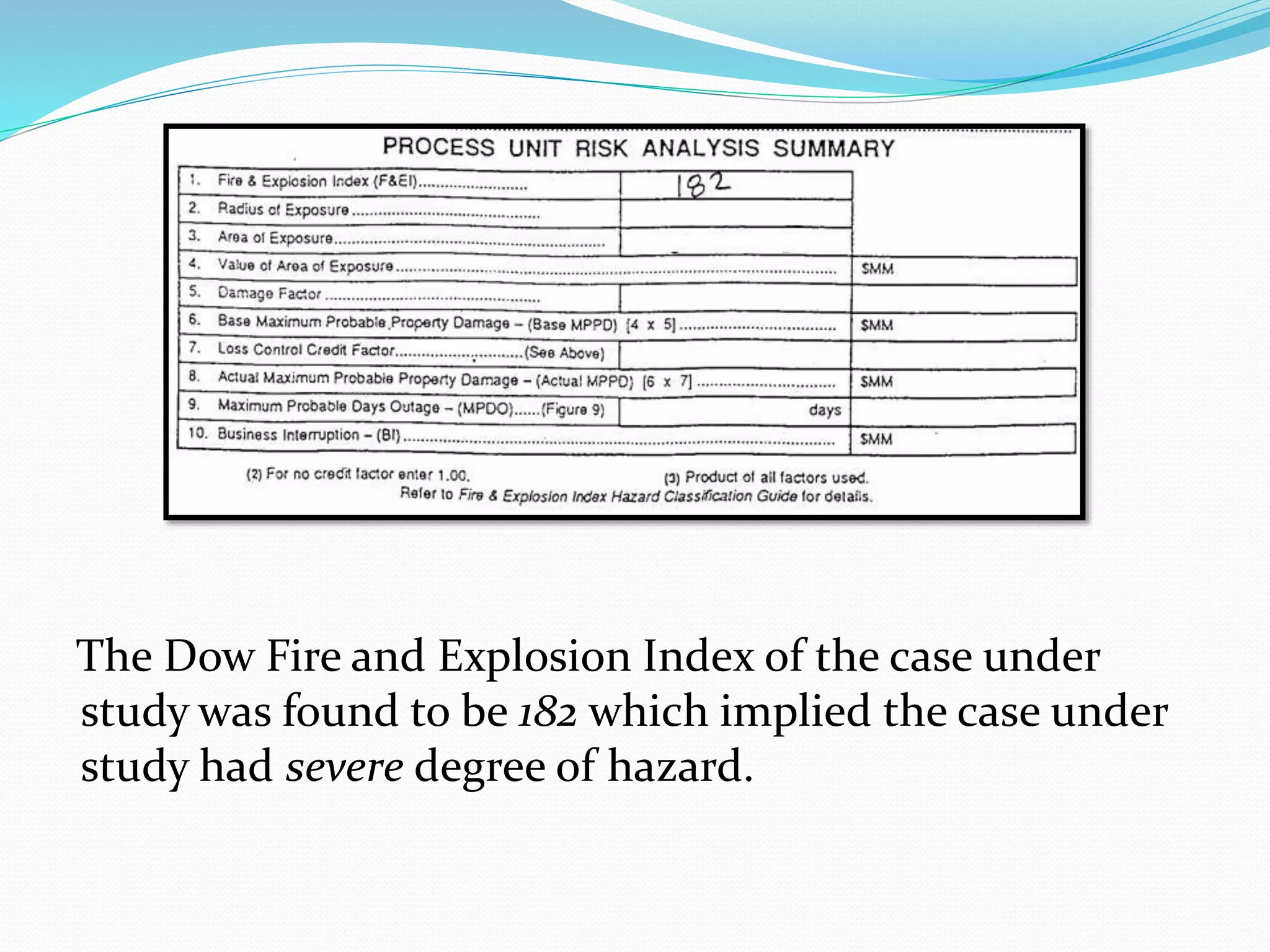
The Dow Fire and Explosion Index of the case under
study was found to be 182 which implied the case under
study had severe degree of hazard.

DOW Fire And Explosion Hazard And Its Case Study I Gaurav Singh Rajput

  • 1.
    DOW FIRE AND EXPLOSIONHAZARD AND ITS CASE STUDY BY: GAURAV SINGH RAJPUT @gauravkrsrajput
  • 2.
    WHAT IS DOWFIRE AND EXPLOSION INDEX?  The hazard classification guide developed by Dow Chemical Company.  Published by the American Institute of Chemical Engineering, Dow (1994).  It gives a method of evaluating the potential risk from process, and assessing the potential loss.
  • 3.
    OBJECTIVES OF DOWF&EI Quantify: The expected damage of potential fire & explosion incidents in realistic terms Identify: Equipment that would likely contribute to the creation or escalation of an incident Communicate: The fire & explosion potential to design teams and plant personnel
  • 4.
     It istailored for storage, handling and processing of explosive and flammable material in chemical process industry. It uses systematic approach based on rating form.  Suitable to be used at an early stage of a project and for auditing existing plant.  Final rating number (i.e. F&EI) provided a relative ranking of hazard.  It is also used for estimating damage radius (using Dow correlation) and estimate dollar losses in the event of accident (using consequences analysis form).
  • 5.
    Quantative measurement basedon  Historic loss data  Energy potential of material  Effectiveness of loss prevention practises
  • 6.
    Application  Flammable( Combustible)and reactive materials  Material stored handled or processed  Material quantity > 2200 kg or 2.2 cubic meter  Recommended for pilot plant( >450 kg)  Should state point in time of operation  Relative ranking of risk of various process
  • 7.
    Factors in selectingpertinent process units  Chemical energy potential  Quantity of material in process unit  Capital density ($/unit area)  Process temperature and pressure  Loss history  Criticality to plant operation
  • 8.
    FEI Hazard 1-60 Light 61-96Moderate 97-127 Intermediate 128-158 Heavy >158 Severe FEI > 128 – Further risk review
  • 9.
    Procedure To develop theDOW FEI study, the following documents are required: -An accurate plot plan. - A process flow sheet. -Data sheets of the main process units. -A fire & Explosion Index Hazard classification guide. -A complete Fire & Explosion Index form. -Replacement cost data for the installed process equipment under study.
  • 10.
    1. The firststep of the study, is the identification of the critical process unit. Only those items, or units, with a critical role inside the process should be studied, and to simplify the identification of those units. - Storage tank - Process stem storage tank - Reactor feed tank - Reactors - Recovery vessels - others
  • 11.
    2. Calculation ofThe Material Factor: The Material Factor, it is the first parameter of the FEI calculation. The MF is the measure of the intrinsic potential energy released by the combustion, explosion or chemical reaction of the substances. Those parameters are NFPA rating expressing the flammability and reactivity of the substance respectively. The MF for the particular material in the process unit is to be obtain from table 1.
  • 14.
    3. General ProcessHazards Factor (F1): The general Process Hazard Factors are six different elements, playing a primary role in the hazardous scenario like explosions of fires. - Material Handling and Transfer - Process Units - Access to the area - Drainage and Spill Control
  • 15.
    For each ofthis parameters, a different grade of penalty must be chosen. General Process Hazards Penalty Factor Range Base Factor 1.00 A. Exothermic Reactions 0.30 to 1.25 B. Endothermic Processes 0.20 to 0.40 C. Mat’l Handling and Transfer 0.25 to 1.05 D. Enclosed/ Indoor Process 0.25 to 0.90 E. Access 0.20 to 0.35 F. Drainage and Spill Control 0.25 to 0.50 Add them up = General Process Hazards Factor = F1
  • 16.
    4. Special ProcessHazards Factor (F2): The special process hazard are factors that contribute primarily to the probability of a loss incident. There are twelve factors: - Toxic Materials - Sub Atmospheric Pressure (Under 500 mmHg) - Operation IN or NEAR Flammable Range - Toxic Materials - Sub Atmospheric Pressure (Under 500 mmHg) - Operation IN or NEAR Flammable Range - Dust Explosion - Relief Pressure
  • 17.
    - Relief Pressure -Low Temperature - Quantity of Flammable/Unstable Material - Corrosion and Erosion - Leakage - Use of Fire Equipment - Hot Oil Heat Exchanger System - Rotating Equipment Each factor have contributes with a penalty range. The choice of the correct value is related to the type and condition of the substance, process design, and grade of maintenance.
  • 18.
    5. Process UnitHazard Factor (F3): The process Unit Hazard Factor is the product of the General Process Hazard Factor (F1) and the Special Process Hazard Factor (F2). (F3 = F1 X F2) 6. Determination of Fire and Explosion Index (FEI): Fire & Explosion Index = (Process Unit Factor) x (Material Factor)
  • 20.
    7. Determination ofthe Area of Exposure surrounding the Process Unit being evaluated is to be performed based on Radius of Exposure. 8. Determination of the replacement value of all equipment within the Area of Exposure and the inventory is to be done. 9. Determination of the Damage Factor, which represents the degree of loss exposure, is to be done, based on the MF and the Process Unit Hazards Factor (F3). 10. Determination of the Base Maximum Probable Property Damage (Base MPPD) is to be made multiplying the Value of the Area of Exposure by the Damage Factor. 11. When developing the F&EI, it is recommended that people with a working knowledge of the plant's history experiences be contacted to discuss probable incident scenarios to assure the most viable F&EIs are developed.
  • 23.
    CASE STUDY ONDOW’S FIRE AND EXPLOSION INDEX  UNIT: Nitroaniline Reactor  LOCATION: Monsanto’s Krummrich Chemical Plant  SPECIFICATION:  Reactor is located indoor  2.5 inch steel reactor designed to handle pressure of 500 to 550 psig easily.  3350 gallon reactor with pressure relief valve in series with rupture disk
  • 24.
     Due tolong time leak in rupture disk and the relief valve was corroded (no pressure indicator present b/w rupture disk and r/v )  Absence of dyke (p.f0.5 ).  No computer control and reactor was not inerted.  Reactor was operating at 175 °c.  On the day of accident ,the reactor was charged with 1867 kg h2o, 733 kg NH3 and 1425 kg aniline.
  • 25.
  • 29.
  • 30.
    The Dow Fireand Explosion Index of the case under study was found to be 182 which implied the case under study had severe degree of hazard.