DOSIMETERS
BY
DR VISHAL MEHROTRA
PERSONAL MONITORING:
• Refers to measurement of amount of radiations
reaching the body of an operator through
personal monitoring device.
• Exposure monitoring of personnel is required
whenever radiation workers are likely to risk
receiving 10% or more of annual occupational
effective dose limit of 50mSv (5rem) in any single
year.
• In keeping with ALARA concept , most health care
facilities issues dosimetry devices when personnel
might receive about 1% of the annual
occupational effective dose limit in any month.
• Exposure monitoring is accomplished through the
wearing of personnel dosimeters.
Purpose of Personnel Dosimeter
• The personnel dosimeter provides an indication
of the working habits and working conditions of
diagnostic imaging personnel.
• It determines occupational exposure by detecting
and measuring the quantity of ionizing radiation
to which the dosimeter has been exposed over a
period of time.
Placement of Personnel Dosimeter
During Routine Radiographic Procedures:
• A personnel monitoring device records only the
exposure received in the area where it is worn.
When a protective apron is worn
• Fluoroscopy and special radiographic procedures
produce the highest occupational radiation
exposure for diagnostic imaging personnel .
• When a protective lead apron is used during such
procedures, the dosimeter should be worn
outside the apron at collar level on the anterior
surface of the body because unprotected head,
neck and lenses of eye receive 10 to 20 times
more exposure than the protected body trunk.
As a second monitor when a protective apron is
worn
• During special radiographic procedures, some
health care facilities may prefer to have diagnostic
imaging personnel wear to separate monitoring
devices.
• The first or primary dosimeter is to be worn
outside the protective apparel at collar level to
monitor the approximate equivalent dose to the
thyroid gland and eyes.
• The second dosimeter should be worn beneath a
wrap around –style lead apron at waist level.
As a monitor for embryo - fetus
• In addition to primary dosimeter worn at collar
level, pregnant diagnostic imaging personnel
should be issued a second monitoring device to
record the radiation dose to the abdomen during
gestation.
• This monitor will provide an estimate of the
equivalent dose to the embryo- fetus.
Personnel dosimeters characteristics
• A personnel dosimeter should be light weight and
easy to carry.
• It should be made of materials durable enough to
tolerate normal daily use.
• It must be able to detect and record both small
and large exposures in a consistent and reliable
manner.
• Outside influences such as very warm weather,
humidity and mechanical shock should not affect
performance of the instrument.
Types of personnel dosimeters
• Frick dosimeter
• Film Badges
• Optically stimulated luminescent
dosimeters
• Pocket ionization chambers
• Thermoluminescent dosimeters.
• Extremity dosimeters (TLD ring badges)
Frick dosimeter
• It is the dosimeter which was used earlier.
• It is based on principle of chemical effects.
Principle
There is oxidation of ferrous to ferric ions on exposure
to radiation.
It has been widely used in radiobiology.
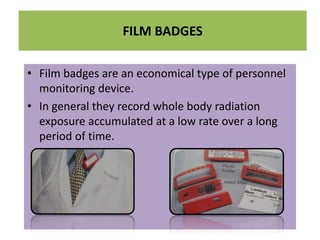
FILM BADGES
• Film badges are an economical type of personnel
monitoring device.
• In general they record whole body radiation
exposure accumulated at a low rate over a long
period of time.
• Film badges contain a film which helps to
determine the radiation exposure when
processed, based on the degree of darkening.
• Specially designed devices in which a small piece
of radiosensitive film similar to dental
radiographic film is sandwiched between the
metal filters inside a plastic holder.
• The film badge is composed of 3 parts:
• A durable light weight plastic film holder
• An assortment of metal filters
• A film packet
• The film holder should be made of a plastic
material of a low atomic number to filter low
energy X radiation, gamma radiation and beta
radiation.
• Inside the plastic holder are metal filters of
aluminum or copper that are secured in a
permanent position. These filters allow the
measurement of the approximate energy of the
radiation reaching the dosimeter.
• Penetrating radiations cast a faint shadow of
filters on the processed dosimetry film where as
soft radiations cast a more pronounced image of
the filters.
• Thus the radiation dose can be evaluated as deep
or shallow.
• The filter image may also be used to determine
whether the exposure was the result of excessive
amounts of scattered radiation or a single
exposure.
Radiation dosimetry film inside the film badge
• The radiation dosimetry film contained in the
radiographic film packet is similar to the dental
film.
• This film is sensitive to dose ranging from as low
as 0.1mSv(10mrem) to as high as 5000mSv
(500rem) .
• Doses less than 0.1mSv are not usually detected
and will be reported as minimal on a personnel
monitoring report.
• The outside of the film packet forms a light free
envelope for dosimetry film.
• Inside the envelope, a sheet of lead foil backs the
film to absorb scatter radiation coming from
behind the dosimeter.
• Radiation interacting with the film in the badge
causes the film to darken once it is developed.
• After processing , the density or degree of
blackening, of the image of the filters recorded on
the dosimeter film is proportional to the amount
of radiation received and the energy of radiation.
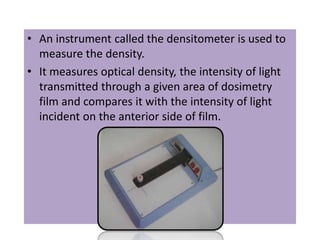
• An instrument called the densitometer is used to
measure the density.
• It measures optical density, the intensity of light
transmitted through a given area of dosimetry
film and compares it with the intensity of light
incident on the anterior side of film.
Advantages :
• They are inexpensive, easy to handle.
• Provides a permanent record of dose received.
• May be checked and re assessed at a later date.
• Can measure the type and energy of radiation
encountered.
• Mechanical integrity.
Disadvantages
• Cannot be worn for longer period.
• No immediate indication of exposure – all
information is retrospective.
• Processing is required which may lead to errors
• Prone to filter loss
Optically stimulated luminescence dosimeter
• The OSL dosimeter provides the best features of
traditional film and TLD.
• The OSL dosimeter contains an aluminium oxide
detector (thin layer).
• When the dosimeter is read out, OSL occurs when
the dosimeter is struck by laser light at selected
frequencies.
• When such laser light is incident upon the sensing
material, it becomes luminescent in proportion to
the amount of radiation exposure received.
• Energy Discrimination
• Three different filters are incorporated in to the
detector packet of the OSL dosimeter.
• The filters are respectively made of aluminium ,
tin & copper .
• Each filter blocks a portion of radiation sensitive
aluminum oxide OSL, causing a different degree
of attenuation for any radiation striking the badge
depending on its energy.
• The Al filter offers the least absorption, where as
Cu filter attenuates the most.
In diagnostic imaging the increased sensitivity
of the OSL dosimeter makes it ideal for
monitoring employees working in low radiation
environments & for pregnant workers.
Pocket ionization chambers
The pocket ionization chamber (pocket dosimeter)
is the most sensitive type of personnel dosimeter.
• These are small devices measuring about 2 cm in
diameter and 10cm by length & externally
resembles an ordinary fountain pen.
• It contains a thimble ionization chamber that
measures radiation exposure.
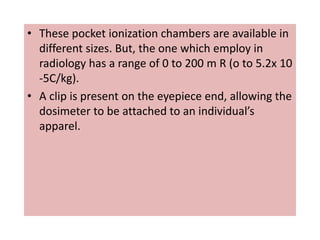
• These pocket ionization chambers are available in
different sizes. But, the one which employ in
radiology has a range of 0 to 200 m R (o to 5.2x 10
-5C/kg).
• A clip is present on the eyepiece end, allowing the
dosimeter to be attached to an individual’s
apparel.
• Types
• Two types of pocket ionization chambers exist:
The self reading type: which contains a built in
electrometer (a device that measures electrical
charge).
Non self reading type: which requires a special
accessory electrometer to read the device.
Components
• The pocket ionization chamber contains two
electrodes, one positively charged ( the central
electrode) and one negatively charged (the outer
electrode).
• A quartz fiber may form part of the positive
electrode and also function as the indicator on
the transparent reading scale.
• When the charged electrodes in the device are
exposed to gamma or X radiation, the air
surrounding the central electrode becomes
ionized and discharges the mechanism in direct
proportion to the amount of radiation to which it
has been exposed
Special charging unit
• A special charging unit is required for pocket
ionization chambers.
• Each dosimeter must be charged to
predetermined voltage before use so that quartz
fiber indicator shows a zero reading.
Advantages
• The most accurate method of measuring the
radiation dose.
• Direct read out gives immediate information.
• They are compact ,easy to carry and convenient
to use.
• Reasonably accurate and sensitive, they are ideal
monitoring devices for procedures of relatively
short duration.
Disadvantages
• Fairly expensive costing $ 150 or more per unit.
• They are fragile and can be easily damaged
• They give no permanent record of exposure
• They doesn’t indicate the type or energy of the
radiation
• Personal ionization monitors are not very
sensitive to low energy radiation
Thermoluminescent dosimeters (TLD)
• They are used for personal monitoring of whole body
or extremities as well as for measuring skin dose.
• This light free device contains radiosensitive
crystalline lithium fluoride as powder or small chip
app. 3mm square &1mm thick , which functions as
the sensing material of the TLD.
• Thermoluminescent dosimeters are based on the
principle 0f the ability of certain crystals to absorb
X ray photons and generate visible light.
• Ionizing radiation causes the lithium flouride
crystals in TLD to undergo changes in some of
their physical properties.
• When irradiated, some of the electrons in
crystalline lattice structure of LiF molecule
absorbs energy and are excited to higher energy
levels. The presence of impurities in the crystal
causes electrons to become trapped within these
bands.
• When the LiF crystals are passed through special
heating process, these trapped electrons receive
enough energy to rise above their present
locations in to a region called conduction band,
from here the electrons can return to their
original state with the emission of energy in the
form of visible light.
The energy emitted is equal to the difference between the
electron binding energy of the two orbital levels.
• A device called a TLD analyzer measures the
amount of ionizing radiation to which a TLD badge
has been exposed by first heating the crystals to
free the trapped, highly energized electrons and
then reading the amount of light emitted by
crystals (which is proportional to the TLD badge
exposure).
Advantages
• Lithium fluoride is reusable.
• More sensitive and accurate than film badges.
• Can measure exposures as low as 5 mR.
• No loss of information following exposure to
excessive heat and humidity.
• Read out measurement are easily automated and
rapidly produced.
• Suitable for wide variety of dose measurements
• TLD may be worn up to 3 months.
Disadvantages
• Relatively expensive.
• Read out is destructive, giving no permanent
record, results cannot be checked or reassessed.
• Only initial information is provided on the type
and energy of the radiation.
• The necessity of using calibrated dosimeters with
TLDs .
Extremity dosimeter
• It is recommended that an
extremity dosimeter, or TLD ring
badge, be worn by an imaging
professional as a second monitor
when performing radiographic
procedures that require the hands
to be near the primary X-ray beam.
• This monitor measures the
approximate equivalent dose to the
hands of the wearer of the
dosimeter.
DOSIMETERS.pptx

DOSIMETERS.pptx

  • 1.
  • 2.
    PERSONAL MONITORING: • Refersto measurement of amount of radiations reaching the body of an operator through personal monitoring device. • Exposure monitoring of personnel is required whenever radiation workers are likely to risk receiving 10% or more of annual occupational effective dose limit of 50mSv (5rem) in any single year.
  • 3.
    • In keepingwith ALARA concept , most health care facilities issues dosimetry devices when personnel might receive about 1% of the annual occupational effective dose limit in any month. • Exposure monitoring is accomplished through the wearing of personnel dosimeters.
  • 4.
    Purpose of PersonnelDosimeter • The personnel dosimeter provides an indication of the working habits and working conditions of diagnostic imaging personnel. • It determines occupational exposure by detecting and measuring the quantity of ionizing radiation to which the dosimeter has been exposed over a period of time.
  • 5.
    Placement of PersonnelDosimeter During Routine Radiographic Procedures: • A personnel monitoring device records only the exposure received in the area where it is worn.
  • 6.
    When a protectiveapron is worn • Fluoroscopy and special radiographic procedures produce the highest occupational radiation exposure for diagnostic imaging personnel . • When a protective lead apron is used during such procedures, the dosimeter should be worn outside the apron at collar level on the anterior surface of the body because unprotected head, neck and lenses of eye receive 10 to 20 times more exposure than the protected body trunk.
  • 7.
    As a secondmonitor when a protective apron is worn • During special radiographic procedures, some health care facilities may prefer to have diagnostic imaging personnel wear to separate monitoring devices. • The first or primary dosimeter is to be worn outside the protective apparel at collar level to monitor the approximate equivalent dose to the thyroid gland and eyes. • The second dosimeter should be worn beneath a wrap around –style lead apron at waist level.
  • 8.
    As a monitorfor embryo - fetus • In addition to primary dosimeter worn at collar level, pregnant diagnostic imaging personnel should be issued a second monitoring device to record the radiation dose to the abdomen during gestation. • This monitor will provide an estimate of the equivalent dose to the embryo- fetus.
  • 9.
    Personnel dosimeters characteristics •A personnel dosimeter should be light weight and easy to carry. • It should be made of materials durable enough to tolerate normal daily use. • It must be able to detect and record both small and large exposures in a consistent and reliable manner. • Outside influences such as very warm weather, humidity and mechanical shock should not affect performance of the instrument.
  • 10.
    Types of personneldosimeters • Frick dosimeter • Film Badges • Optically stimulated luminescent dosimeters • Pocket ionization chambers • Thermoluminescent dosimeters. • Extremity dosimeters (TLD ring badges)
  • 11.
    Frick dosimeter • Itis the dosimeter which was used earlier. • It is based on principle of chemical effects. Principle There is oxidation of ferrous to ferric ions on exposure to radiation. It has been widely used in radiobiology.
  • 12.
    FILM BADGES • Filmbadges are an economical type of personnel monitoring device. • In general they record whole body radiation exposure accumulated at a low rate over a long period of time.
  • 13.
    • Film badgescontain a film which helps to determine the radiation exposure when processed, based on the degree of darkening. • Specially designed devices in which a small piece of radiosensitive film similar to dental radiographic film is sandwiched between the metal filters inside a plastic holder.
  • 14.
    • The filmbadge is composed of 3 parts: • A durable light weight plastic film holder • An assortment of metal filters • A film packet
  • 15.
    • The filmholder should be made of a plastic material of a low atomic number to filter low energy X radiation, gamma radiation and beta radiation. • Inside the plastic holder are metal filters of aluminum or copper that are secured in a permanent position. These filters allow the measurement of the approximate energy of the radiation reaching the dosimeter.
  • 16.
    • Penetrating radiationscast a faint shadow of filters on the processed dosimetry film where as soft radiations cast a more pronounced image of the filters. • Thus the radiation dose can be evaluated as deep or shallow. • The filter image may also be used to determine whether the exposure was the result of excessive amounts of scattered radiation or a single exposure.
  • 17.
    Radiation dosimetry filminside the film badge • The radiation dosimetry film contained in the radiographic film packet is similar to the dental film. • This film is sensitive to dose ranging from as low as 0.1mSv(10mrem) to as high as 5000mSv (500rem) . • Doses less than 0.1mSv are not usually detected and will be reported as minimal on a personnel monitoring report.
  • 18.
    • The outsideof the film packet forms a light free envelope for dosimetry film. • Inside the envelope, a sheet of lead foil backs the film to absorb scatter radiation coming from behind the dosimeter. • Radiation interacting with the film in the badge causes the film to darken once it is developed. • After processing , the density or degree of blackening, of the image of the filters recorded on the dosimeter film is proportional to the amount of radiation received and the energy of radiation.
  • 19.
    • An instrumentcalled the densitometer is used to measure the density. • It measures optical density, the intensity of light transmitted through a given area of dosimetry film and compares it with the intensity of light incident on the anterior side of film.
  • 20.
    Advantages : • Theyare inexpensive, easy to handle. • Provides a permanent record of dose received. • May be checked and re assessed at a later date. • Can measure the type and energy of radiation encountered. • Mechanical integrity.
  • 21.
    Disadvantages • Cannot beworn for longer period. • No immediate indication of exposure – all information is retrospective. • Processing is required which may lead to errors • Prone to filter loss
  • 22.
    Optically stimulated luminescencedosimeter • The OSL dosimeter provides the best features of traditional film and TLD. • The OSL dosimeter contains an aluminium oxide detector (thin layer). • When the dosimeter is read out, OSL occurs when the dosimeter is struck by laser light at selected frequencies. • When such laser light is incident upon the sensing material, it becomes luminescent in proportion to the amount of radiation exposure received.
  • 24.
    • Energy Discrimination •Three different filters are incorporated in to the detector packet of the OSL dosimeter. • The filters are respectively made of aluminium , tin & copper . • Each filter blocks a portion of radiation sensitive aluminum oxide OSL, causing a different degree of attenuation for any radiation striking the badge depending on its energy. • The Al filter offers the least absorption, where as Cu filter attenuates the most.
  • 25.
    In diagnostic imagingthe increased sensitivity of the OSL dosimeter makes it ideal for monitoring employees working in low radiation environments & for pregnant workers.
  • 26.
    Pocket ionization chambers Thepocket ionization chamber (pocket dosimeter) is the most sensitive type of personnel dosimeter. • These are small devices measuring about 2 cm in diameter and 10cm by length & externally resembles an ordinary fountain pen. • It contains a thimble ionization chamber that measures radiation exposure.
  • 27.
    • These pocketionization chambers are available in different sizes. But, the one which employ in radiology has a range of 0 to 200 m R (o to 5.2x 10 -5C/kg). • A clip is present on the eyepiece end, allowing the dosimeter to be attached to an individual’s apparel.
  • 28.
    • Types • Twotypes of pocket ionization chambers exist: The self reading type: which contains a built in electrometer (a device that measures electrical charge). Non self reading type: which requires a special accessory electrometer to read the device.
  • 29.
    Components • The pocketionization chamber contains two electrodes, one positively charged ( the central electrode) and one negatively charged (the outer electrode). • A quartz fiber may form part of the positive electrode and also function as the indicator on the transparent reading scale.
  • 30.
    • When thecharged electrodes in the device are exposed to gamma or X radiation, the air surrounding the central electrode becomes ionized and discharges the mechanism in direct proportion to the amount of radiation to which it has been exposed
  • 31.
    Special charging unit •A special charging unit is required for pocket ionization chambers. • Each dosimeter must be charged to predetermined voltage before use so that quartz fiber indicator shows a zero reading.
  • 32.
    Advantages • The mostaccurate method of measuring the radiation dose. • Direct read out gives immediate information. • They are compact ,easy to carry and convenient to use. • Reasonably accurate and sensitive, they are ideal monitoring devices for procedures of relatively short duration.
  • 33.
    Disadvantages • Fairly expensivecosting $ 150 or more per unit. • They are fragile and can be easily damaged • They give no permanent record of exposure • They doesn’t indicate the type or energy of the radiation • Personal ionization monitors are not very sensitive to low energy radiation
  • 34.
    Thermoluminescent dosimeters (TLD) •They are used for personal monitoring of whole body or extremities as well as for measuring skin dose. • This light free device contains radiosensitive crystalline lithium fluoride as powder or small chip app. 3mm square &1mm thick , which functions as the sensing material of the TLD.
  • 35.
    • Thermoluminescent dosimetersare based on the principle 0f the ability of certain crystals to absorb X ray photons and generate visible light. • Ionizing radiation causes the lithium flouride crystals in TLD to undergo changes in some of their physical properties. • When irradiated, some of the electrons in crystalline lattice structure of LiF molecule absorbs energy and are excited to higher energy levels. The presence of impurities in the crystal causes electrons to become trapped within these bands.
  • 36.
    • When theLiF crystals are passed through special heating process, these trapped electrons receive enough energy to rise above their present locations in to a region called conduction band, from here the electrons can return to their original state with the emission of energy in the form of visible light. The energy emitted is equal to the difference between the electron binding energy of the two orbital levels.
  • 37.
    • A devicecalled a TLD analyzer measures the amount of ionizing radiation to which a TLD badge has been exposed by first heating the crystals to free the trapped, highly energized electrons and then reading the amount of light emitted by crystals (which is proportional to the TLD badge exposure).
  • 38.
    Advantages • Lithium fluorideis reusable. • More sensitive and accurate than film badges. • Can measure exposures as low as 5 mR. • No loss of information following exposure to excessive heat and humidity. • Read out measurement are easily automated and rapidly produced. • Suitable for wide variety of dose measurements • TLD may be worn up to 3 months.
  • 39.
    Disadvantages • Relatively expensive. •Read out is destructive, giving no permanent record, results cannot be checked or reassessed. • Only initial information is provided on the type and energy of the radiation. • The necessity of using calibrated dosimeters with TLDs .
  • 40.
    Extremity dosimeter • Itis recommended that an extremity dosimeter, or TLD ring badge, be worn by an imaging professional as a second monitor when performing radiographic procedures that require the hands to be near the primary X-ray beam. • This monitor measures the approximate equivalent dose to the hands of the wearer of the dosimeter.