Downloaded 132 times


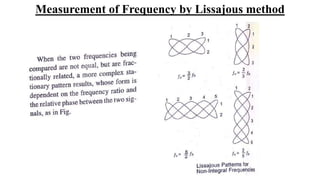


The document describes the Lissajous method for measuring frequency and phase using an oscilloscope. The Lissajous pattern results from applying sine waves simultaneously to the oscilloscope's horizontal and vertical deflection plates. If one frequency is an integral multiple of the other, the pattern will be stationary. The procedure involves setting up the oscilloscope, connecting signal sources, and noting how the pattern changes as the frequency or phase relationship between the signals is varied. Stationary patterns indicate integral frequency ratios, and phase shifts cause cyclic changes to the pattern.


