RIVERS
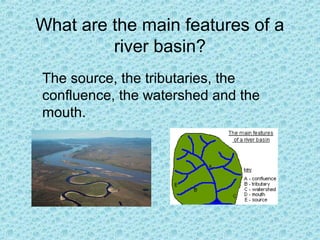
What are the main features of a
river basin?
The source, the tributaries, the
confluence, the watershed and the
mouth.
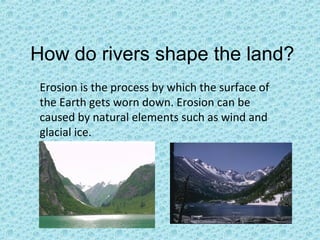
How do rivers shape the land?
Erosion is the process by which the surface of
the Earth gets worn down. Erosion can be
caused by natural elements such as wind and
glacial ice.
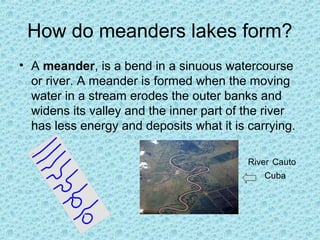
How do meanders lakes form?
• A meander, is a bend in a sinuous watercourse
or river. A meander is formed when the moving
water in a stream erodes the outer banks and
widens its valley and the inner part of the river
has less energy and deposits what it is carrying.
River Cauto
Cuba
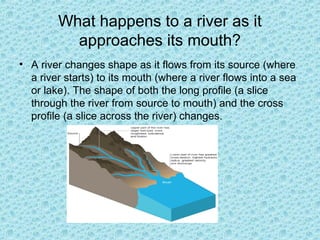
What happens to a river as it
approaches its mouth?
• A river changes shape as it flows from its source (where
a river starts) to its mouth (where a river flows into a sea
or lake). The shape of both the long profile (a slice
through the river from source to mouth) and the cross
profile (a slice across the river) changes.
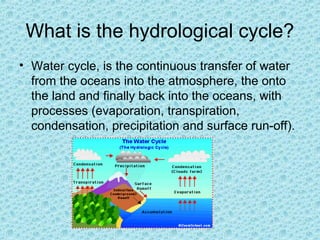
What is the hydrological cycle?
• Water cycle, is the continuous transfer of water
from the oceans into the atmosphere, the onto
the land and finally back into the oceans, with
processes (evaporation, transpiration,
condensation, precipitation and surface run-off).
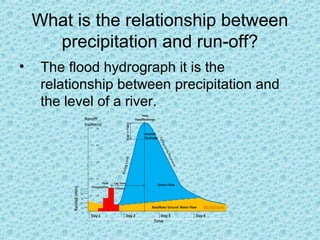
What is the relationship between
precipitation and run-off?
•

The flood hydrograph it is the
relationship between precipitation and
the level of a river.
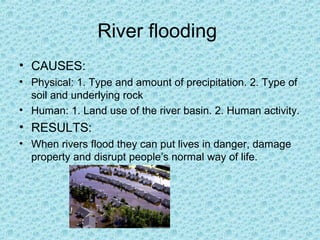
River flooding
• CAUSES:
• Physical: 1. Type and amount of precipitation. 2. Type of
soil and underlying rock
• Human: 1. Land use of the river basin. 2. Human activity.

• RESULTS:
• When rivers flood they can put lives in danger, damage
property and disrupt people’s normal way of life.
COASTS
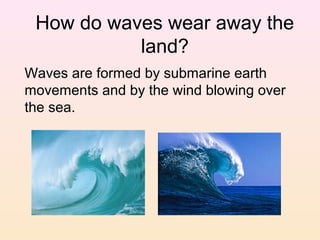
How do waves wear away the
land?
Waves are formed by submarine earth
movements and by the wind blowing over
the sea.
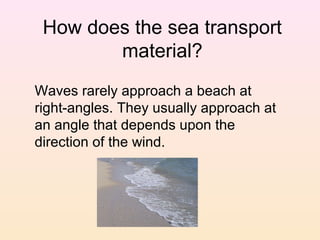
How does the sea transport
material?
Waves rarely approach a beach at
right-angles. They usually approach at
an angle that depends upon the
direction of the wind.
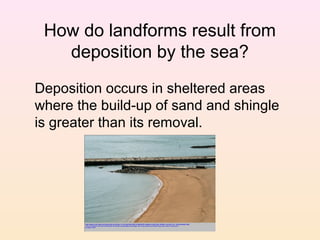
How do landforms result from
deposition by the sea?
Deposition occurs in sheltered areas
where the build-up of sand and shingle
is greater than its removal.
What are the causes, effects and
human responses to cliff erosion?

• Causes to cliff erosion.
•

•

If resistant rock, waves erode at their
base causing them to become unstable
and to collapse.
If less resistant rock, rain can wash loose
material down to the cliff base. It can be
rapidly removed by waves.
Effects to cliff erosion
•

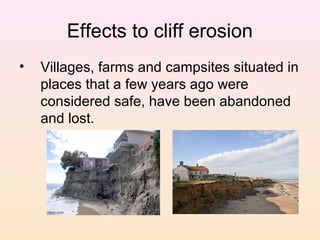
Villages, farms and campsites situated in
places that a few years ago were
considered safe, have been abandoned
and lost.
Human responses
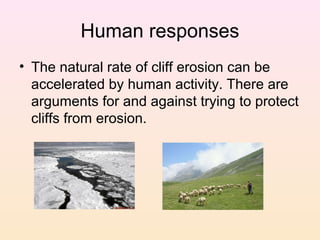
• The natural rate of cliff erosion can be
accelerated by human activity. There are
arguments for and against trying to protect
cliffs from erosion.
Coastal flooding in Britain
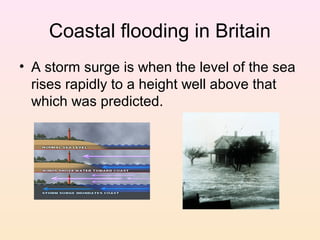
• A storm surge is when the level of the sea
rises rapidly to a height well above that
which was predicted.
GLACIATION
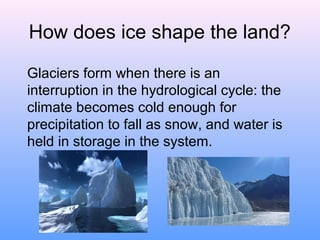
How does ice shape the land?
Glaciers form when there is an
interruption in the hydrological cycle: the
climate becomes cold enough for
precipitation to fall as snow, and water is
held in storage in the system.
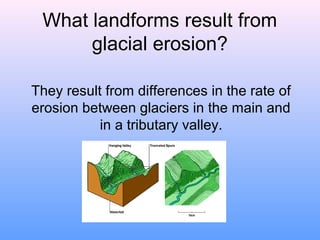
What landforms result from
glacial erosion?
They result from differences in the rate of
erosion between glaciers in the main and
in a tributary valley.
What landforms result from
glacial deposition?
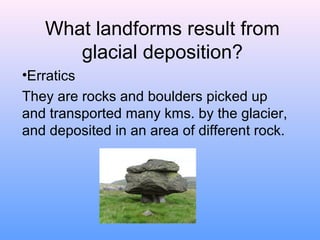
•Erratics
They are rocks and boulders picked up
and transported many kms. by the glacier,
and deposited in an area of different rock.
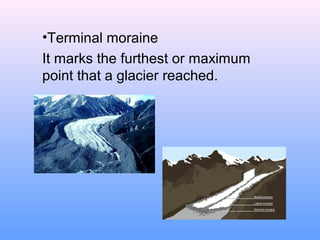
•Terminal moraine
It marks the furthest or maximum
point that a glacier reached.
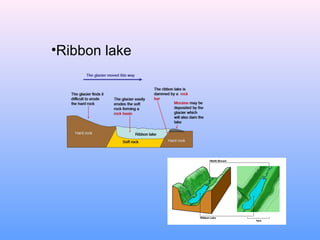
•Ribbon lake
Rocks and
landscapes
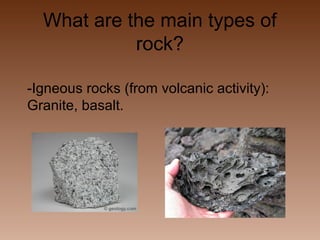
What are the main types of
rock?
-Igneous rocks (from volcanic activity):
Granite, basalt.
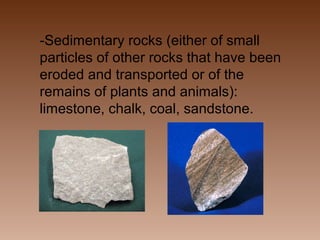
-Sedimentary rocks (either of small
particles of other rocks that have been
eroded and transported or of the
remains of plants and animals):
limestone, chalk, coal, sandstone.
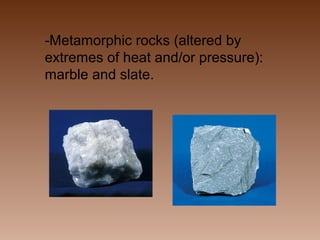
-Metamorphic rocks (altered by
extremes of heat and/or pressure):
marble and slate.
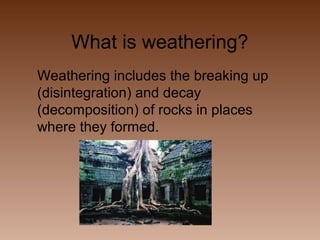
What is weathering?
Weathering includes the breaking up
(disintegration) and decay
(decomposition) of rocks in places
where they formed.
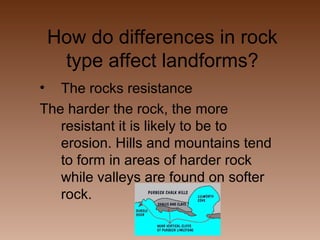
How do differences in rock
type affect landforms?
•

The rocks resistance
The harder the rock, the more
resistant it is likely to be to
erosion. Hills and mountains tend
to form in areas of harder rock
while valleys are found on softer
rock.
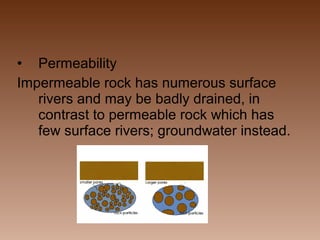
• Permeability
Impermeable rock has numerous surface
rivers and may be badly drained, in
contrast to permeable rock which has
few surface rivers; groundwater instead.
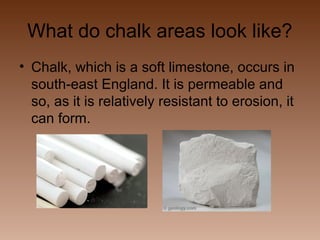
What do chalk areas look like?
• Chalk, which is a soft limestone, occurs in
south-east England. It is permeable and
so, as it is relatively resistant to erosion, it
can form.
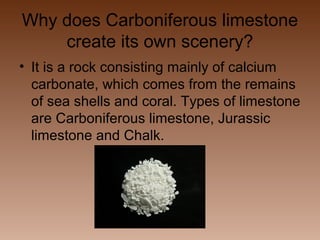
Why does Carboniferous limestone
create its own scenery?
• It is a rock consisting mainly of calcium
carbonate, which comes from the remains
of sea shells and coral. Types of limestone
are Carboniferous limestone, Jurassic
limestone and Chalk.
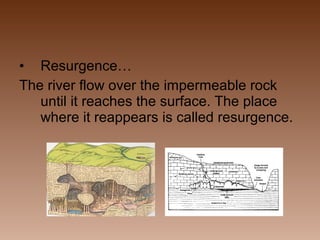
• Resurgence…
The river flow over the impermeable rock
until it reaches the surface. The place
where it reappears is called resurgence.
What are the effects of quarrying in
National Parks?
•

Quarrying…
It is when rocks are taken straight from the
Earth’s surface –unlike mining where
workers have to operate underground.
Plate tectonics
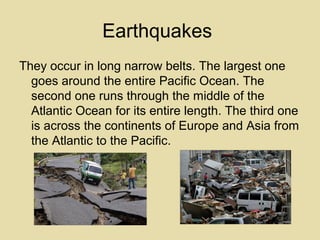
Earthquakes
They occur in long narrow belts. The largest one
goes around the entire Pacific Ocean. The
second one runs through the middle of the
Atlantic Ocean for its entire length. The third one
is across the continents of Europe and Asia from
the Atlantic to the Pacific.
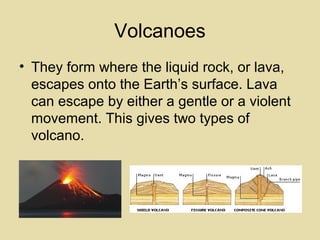
Volcanoes
• They form where the liquid rock, or lava,
escapes onto the Earth’s surface. Lava
can escape by either a gentle or a violent
movement. This gives two types of
volcano.
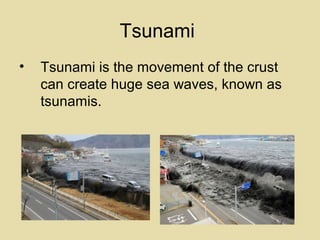
Tsunami
•

Tsunami is the movement of the crust
can create huge sea waves, known as
tsunamis.
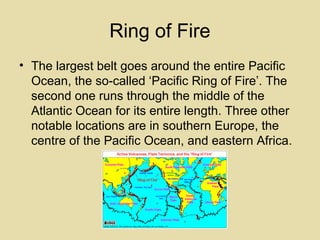
Ring of Fire
• The largest belt goes around the entire Pacific
Ocean, the so-called ‘Pacific Ring of Fire’. The
second one runs through the middle of the
Atlantic Ocean for its entire length. Three other
notable locations are in southern Europe, the
centre of the Pacific Ocean, and eastern Africa.
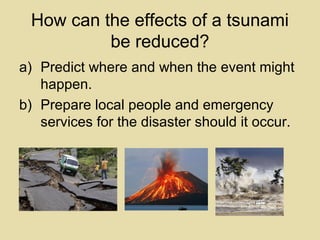
How can the effects of a tsunami
be reduced?
a) Predict where and when the event might
happen.
b) Prepare local people and emergency
services for the disaster should it occur.
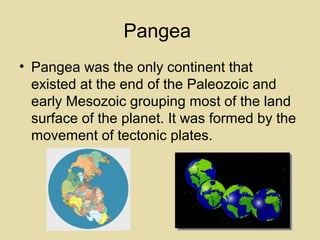
Pangea
• Pangea was the only continent that
existed at the end of the Paleozoic and
early Mesozoic grouping most of the land
surface of the planet. It was formed by the
movement of tectonic plates.
Britain´s
weather and
climate
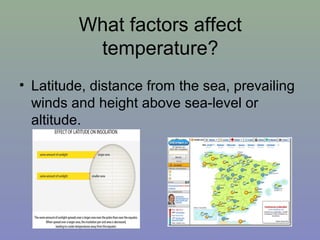
What factors affect
temperature?
• Latitude, distance from the sea, prevailing
winds and height above sea-level or
altitude.
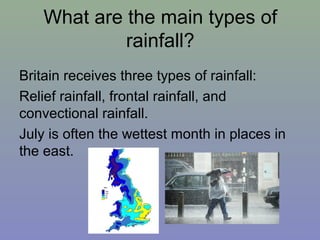
What are the main types of
rainfall?
Britain receives three types of rainfall:
Relief rainfall, frontal rainfall, and
convectional rainfall.
July is often the wettest month in places in
the east.
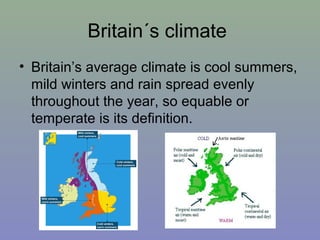
Britain´s climate
• Britain’s average climate is cool summers,
mild winters and rain spread evenly
throughout the year, so equable or
temperate is its definition.
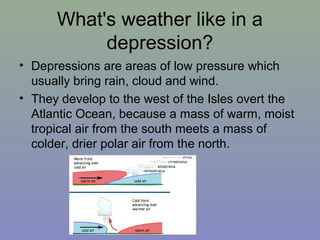
What's weather like in a
depression?
• Depressions are areas of low pressure which
usually bring rain, cloud and wind.
• They develop to the west of the Isles overt the
Atlantic Ocean, because a mass of warm, moist
tropical air from the south meets a mass of
colder, drier polar air from the north.
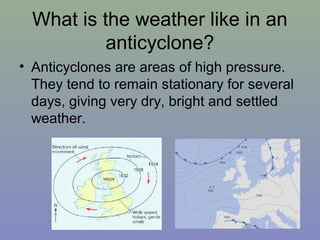
What is the weather like in an
anticyclone?
• Anticyclones are areas of high pressure.
They tend to remain stationary for several
days, giving very dry, bright and settled
weather.
What are the
world's main
climates?
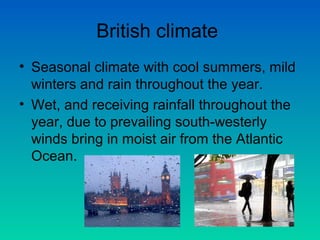
British climate
• Seasonal climate with cool summers, mild
winters and rain throughout the year.
• Wet, and receiving rainfall throughout the
year, due to prevailing south-westerly
winds bring in moist air from the Atlantic
Ocean.
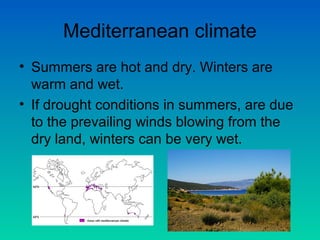
Mediterranean climate
• Summers are hot and dry. Winters are
warm and wet.
• If drought conditions in summers, are due
to the prevailing winds blowing from the
dry land, winters can be very wet.
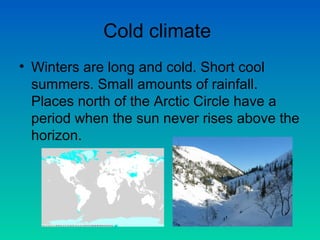
Cold climate
• Winters are long and cold. Short cool
summers. Small amounts of rainfall.
Places north of the Arctic Circle have a
period when the sun never rises above the
horizon.
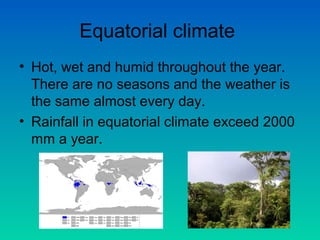
Equatorial climate
• Hot, wet and humid throughout the year.
There are no seasons and the weather is
the same almost every day.
• Rainfall in equatorial climate exceed 2000
mm a year.
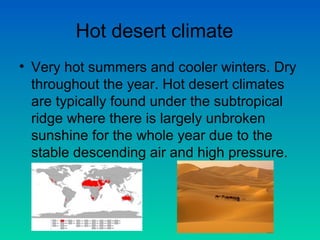
Hot desert climate
• Very hot summers and cooler winters. Dry
throughout the year. Hot desert climates
are typically found under the subtropical
ridge where there is largely unbroken
sunshine for the whole year due to the
stable descending air and high pressure.
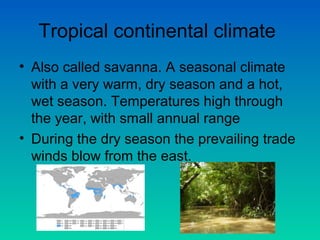
Tropical continental climate
• Also called savanna. A seasonal climate
with a very warm, dry season and a hot,
wet season. Temperatures high through
the year, with small annual range
• During the dry season the prevailing trade
winds blow from the east.
THE GREENHOUSE EFFECT
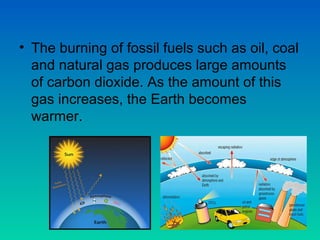
• The Earth is surrounded by a layer of
gases, including carbon dioxide. This
keeps the Earth warm by preventing the
escape of heat that would normally be lost
from the atmosphere. The gases act
rather like the glass in a greenhouse. They
let heat in but prevent most of it from
getting out.
• The burning of fossil fuels such as oil, coal
and natural gas produces large amounts
of carbon dioxide. As the amount of this
gas increases, the Earth becomes
warmer.
•By:
•José Antonio
Donado

Donaoooo4b2

  • 1.
  • 2.
    What are themain features of a river basin? The source, the tributaries, the confluence, the watershed and the mouth.
  • 3.
    How do riversshape the land? Erosion is the process by which the surface of the Earth gets worn down. Erosion can be caused by natural elements such as wind and glacial ice.
  • 4.
    How do meanderslakes form? • A meander, is a bend in a sinuous watercourse or river. A meander is formed when the moving water in a stream erodes the outer banks and widens its valley and the inner part of the river has less energy and deposits what it is carrying. River Cauto Cuba
  • 5.
    What happens toa river as it approaches its mouth? • A river changes shape as it flows from its source (where a river starts) to its mouth (where a river flows into a sea or lake). The shape of both the long profile (a slice through the river from source to mouth) and the cross profile (a slice across the river) changes.
  • 6.
    What is thehydrological cycle? • Water cycle, is the continuous transfer of water from the oceans into the atmosphere, the onto the land and finally back into the oceans, with processes (evaporation, transpiration, condensation, precipitation and surface run-off).
  • 7.
    What is therelationship between precipitation and run-off? • The flood hydrograph it is the relationship between precipitation and the level of a river.
  • 8.
    River flooding • CAUSES: •Physical: 1. Type and amount of precipitation. 2. Type of soil and underlying rock • Human: 1. Land use of the river basin. 2. Human activity. • RESULTS: • When rivers flood they can put lives in danger, damage property and disrupt people’s normal way of life.
  • 9.
  • 10.
    How do waveswear away the land? Waves are formed by submarine earth movements and by the wind blowing over the sea.
  • 11.
    How does thesea transport material? Waves rarely approach a beach at right-angles. They usually approach at an angle that depends upon the direction of the wind.
  • 12.
    How do landformsresult from deposition by the sea? Deposition occurs in sheltered areas where the build-up of sand and shingle is greater than its removal.
  • 13.
    What are thecauses, effects and human responses to cliff erosion? • Causes to cliff erosion. • • If resistant rock, waves erode at their base causing them to become unstable and to collapse. If less resistant rock, rain can wash loose material down to the cliff base. It can be rapidly removed by waves.
  • 14.
    Effects to clifferosion • Villages, farms and campsites situated in places that a few years ago were considered safe, have been abandoned and lost.
  • 15.
    Human responses • Thenatural rate of cliff erosion can be accelerated by human activity. There are arguments for and against trying to protect cliffs from erosion.
  • 16.
    Coastal flooding inBritain • A storm surge is when the level of the sea rises rapidly to a height well above that which was predicted.
  • 17.
  • 18.
    How does iceshape the land? Glaciers form when there is an interruption in the hydrological cycle: the climate becomes cold enough for precipitation to fall as snow, and water is held in storage in the system.
  • 19.
    What landforms resultfrom glacial erosion? They result from differences in the rate of erosion between glaciers in the main and in a tributary valley.
  • 20.
    What landforms resultfrom glacial deposition? •Erratics They are rocks and boulders picked up and transported many kms. by the glacier, and deposited in an area of different rock.
  • 21.
    •Terminal moraine It marksthe furthest or maximum point that a glacier reached.
  • 22.
  • 23.
  • 24.
    What are themain types of rock? -Igneous rocks (from volcanic activity): Granite, basalt.
  • 25.
    -Sedimentary rocks (eitherof small particles of other rocks that have been eroded and transported or of the remains of plants and animals): limestone, chalk, coal, sandstone.
  • 26.
    -Metamorphic rocks (alteredby extremes of heat and/or pressure): marble and slate.
  • 27.
    What is weathering? Weatheringincludes the breaking up (disintegration) and decay (decomposition) of rocks in places where they formed.
  • 28.
    How do differencesin rock type affect landforms? • The rocks resistance The harder the rock, the more resistant it is likely to be to erosion. Hills and mountains tend to form in areas of harder rock while valleys are found on softer rock.
  • 29.
    • Permeability Impermeable rockhas numerous surface rivers and may be badly drained, in contrast to permeable rock which has few surface rivers; groundwater instead.
  • 30.
    What do chalkareas look like? • Chalk, which is a soft limestone, occurs in south-east England. It is permeable and so, as it is relatively resistant to erosion, it can form.
  • 31.
    Why does Carboniferouslimestone create its own scenery? • It is a rock consisting mainly of calcium carbonate, which comes from the remains of sea shells and coral. Types of limestone are Carboniferous limestone, Jurassic limestone and Chalk.
  • 32.
    • Resurgence… The riverflow over the impermeable rock until it reaches the surface. The place where it reappears is called resurgence.
  • 33.
    What are theeffects of quarrying in National Parks? • Quarrying… It is when rocks are taken straight from the Earth’s surface –unlike mining where workers have to operate underground.
  • 34.
  • 35.
    Earthquakes They occur inlong narrow belts. The largest one goes around the entire Pacific Ocean. The second one runs through the middle of the Atlantic Ocean for its entire length. The third one is across the continents of Europe and Asia from the Atlantic to the Pacific.
  • 36.
    Volcanoes • They formwhere the liquid rock, or lava, escapes onto the Earth’s surface. Lava can escape by either a gentle or a violent movement. This gives two types of volcano.
  • 37.
    Tsunami • Tsunami is themovement of the crust can create huge sea waves, known as tsunamis.
  • 38.
    Ring of Fire •The largest belt goes around the entire Pacific Ocean, the so-called ‘Pacific Ring of Fire’. The second one runs through the middle of the Atlantic Ocean for its entire length. Three other notable locations are in southern Europe, the centre of the Pacific Ocean, and eastern Africa.
  • 39.
    How can theeffects of a tsunami be reduced? a) Predict where and when the event might happen. b) Prepare local people and emergency services for the disaster should it occur.
  • 40.
    Pangea • Pangea wasthe only continent that existed at the end of the Paleozoic and early Mesozoic grouping most of the land surface of the planet. It was formed by the movement of tectonic plates.
  • 41.
  • 42.
    What factors affect temperature? •Latitude, distance from the sea, prevailing winds and height above sea-level or altitude.
  • 43.
    What are themain types of rainfall? Britain receives three types of rainfall: Relief rainfall, frontal rainfall, and convectional rainfall. July is often the wettest month in places in the east.
  • 44.
    Britain´s climate • Britain’saverage climate is cool summers, mild winters and rain spread evenly throughout the year, so equable or temperate is its definition.
  • 45.
    What's weather likein a depression? • Depressions are areas of low pressure which usually bring rain, cloud and wind. • They develop to the west of the Isles overt the Atlantic Ocean, because a mass of warm, moist tropical air from the south meets a mass of colder, drier polar air from the north.
  • 46.
    What is theweather like in an anticyclone? • Anticyclones are areas of high pressure. They tend to remain stationary for several days, giving very dry, bright and settled weather.
  • 47.
    What are the world'smain climates?
  • 48.
    British climate • Seasonalclimate with cool summers, mild winters and rain throughout the year. • Wet, and receiving rainfall throughout the year, due to prevailing south-westerly winds bring in moist air from the Atlantic Ocean.
  • 49.
    Mediterranean climate • Summersare hot and dry. Winters are warm and wet. • If drought conditions in summers, are due to the prevailing winds blowing from the dry land, winters can be very wet.
  • 50.
    Cold climate • Wintersare long and cold. Short cool summers. Small amounts of rainfall. Places north of the Arctic Circle have a period when the sun never rises above the horizon.
  • 51.
    Equatorial climate • Hot,wet and humid throughout the year. There are no seasons and the weather is the same almost every day. • Rainfall in equatorial climate exceed 2000 mm a year.
  • 52.
    Hot desert climate •Very hot summers and cooler winters. Dry throughout the year. Hot desert climates are typically found under the subtropical ridge where there is largely unbroken sunshine for the whole year due to the stable descending air and high pressure.
  • 53.
    Tropical continental climate •Also called savanna. A seasonal climate with a very warm, dry season and a hot, wet season. Temperatures high through the year, with small annual range • During the dry season the prevailing trade winds blow from the east.
  • 54.
    THE GREENHOUSE EFFECT •The Earth is surrounded by a layer of gases, including carbon dioxide. This keeps the Earth warm by preventing the escape of heat that would normally be lost from the atmosphere. The gases act rather like the glass in a greenhouse. They let heat in but prevent most of it from getting out.
  • 55.
    • The burningof fossil fuels such as oil, coal and natural gas produces large amounts of carbon dioxide. As the amount of this gas increases, the Earth becomes warmer.
  • 56.