ßkeÀej
O³eeve
EVOLUTION, MEANING, DEFINITION,
OBJECTIVES AND MISCONCEPTIONS
Ghantali Mitra Mandal
Yoga Diploma Course
Anand Sahasrabuddhe
B Sc (Hons), Yoga Teachers diploma Ghantali Mitra
Mandal, (Recog. By Govt. of Maharashtra), Adv. P. G
Dip in Yoga Science (Kavi Kulaguru Kalidas University,
Nagpur), M. A. in Yoga Science (Kavi Kulaguru Kalidas
University, Nagpur).
EVOLUTION OF YOGA
The development of yoga can be traced back to
over 5,000 years ago, but some researchers think
that yoga may be up to 10,000 years old. Yoga’s
long rich history can be divided into four main
periods of innovation, practice and development.
EVOLUTION OF YOGA
1. Pre-Classical
• Pre-vedic period (Before 3000 BC)
• Vedic period (3000 BC to 800 BC)
• Upanishadic period (800 BC to 250 BC)
2. Classical period (184 BC to 148 BC)
3. Post classical period (800 AD to 1700 AD)
4. Modern period (From 1863 AD onwards)
Pre-vedic period (Before 3000 BC)
We find depictions of yoga postures in the
recent excavations at Harappa and
Mohenjodaro. This indicates that yoga may have
been practiced as early as 5000 years ago. Or
10000 years ago.
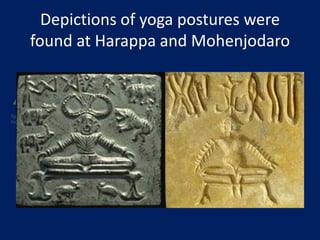
Depictions of yoga postures were
found at Harappa and Mohenjodaro
Anumber of seals and fossil remains of Indus Saraswati valley civilization with Yotic motives and
figures performing yoga indicate the presence of Yoga in India.The Number of seals and fossil remains of
Indus Saraswati valley
Vedic period (3000 BC to 800 BC)
During the vedic period, yoga was practiced ritually, to
develop concentration. The rituals practiced during this
period are quite differing from the present practices of
yoga. The rituals of the vedic period are close to the
definition of yoga: union of the individual self with the
supreme self.
We find references of Yoga in Vedic literature in a
scattered manner in all Vedas.
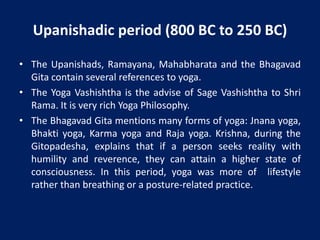
Upanishadic period (800 BC to 250 BC)
• The Upanishads, Ramayana, Mahabharata and the Bhagavad
Gita contain several references to yoga.
• The Yoga Vashishtha is the advise of Sage Vashishtha to Shri
Rama. It is very rich Yoga Philosophy.
• The Bhagavad Gita mentions many forms of yoga: Jnana yoga,
Bhakti yoga, Karma yoga and Raja yoga. Krishna, during the
Gitopadesha, explains that if a person seeks reality with
humility and reverence, they can attain a higher state of
consciousness. In this period, yoga was more of lifestyle
rather than breathing or a posture-related practice.
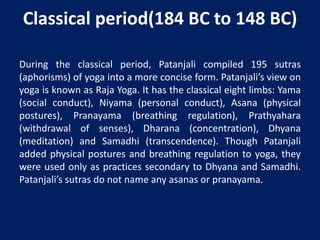
Classical period(184 BC to 148 BC)
During the classical period, Patanjali compiled 195 sutras
(aphorisms) of yoga into a more concise form. Patanjali’s view on
yoga is known as Raja Yoga. It has the classical eight limbs: Yama
(social conduct), Niyama (personal conduct), Asana (physical
postures), Pranayama (breathing regulation), Prathyahara
(withdrawal of senses), Dharana (concentration), Dhyana
(meditation) and Samadhi (transcendence). Though Patanjali
added physical postures and breathing regulation to yoga, they
were used only as practices secondary to Dhyana and Samadhi.
Patanjali’s sutras do not name any asanas or pranayama.
Post classical period (800 AD to 1700 AD)
During this age, followers of Patanjali yoga gave yoga a
new outlook by giving greater importance to the
asanas, kriyas and pranayama, for cleansing of the body
and mind. The purification of body and mind
helped practitioners reach higher levels of practice, like
Samadhi. This form of yoga is called hatha yoga. The
authentic books of Hatha Yoga namely Hatha Pradipika
and Gheranda Samhita developed in this period
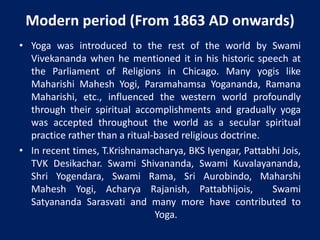
Modern period (From 1863 AD onwards)
• Yoga was introduced to the rest of the world by Swami
Vivekananda when he mentioned it in his historic speech at
the Parliament of Religions in Chicago. Many yogis like
Maharishi Mahesh Yogi, Paramahamsa Yogananda, Ramana
Maharishi, etc., influenced the western world profoundly
through their spiritual accomplishments and gradually yoga
was accepted throughout the world as a secular spiritual
practice rather than a ritual-based religious doctrine.
• In recent times, T.Krishnamacharya, BKS Iyengar, Pattabhi Jois,
TVK Desikachar. Swami Shivananda, Swami Kuvalayananda,
Shri Yogendara, Swami Rama, Sri Aurobindo, Maharshi
Mahesh Yogi, Acharya Rajanish, Pattabhijois, Swami
Satyananda Sarasvati and many more have contributed to
Yoga.
YOGA MEANING
• Yoga word originated from Sanskrit.
• Dhatu yuja means to join.
• Joining of Atman with Paramatman.
• Joining Soul with super soul.
• Joining Individual consciousness with super
consciousness.
• Joining Body with Mind.
• Joining Mind with Atman.
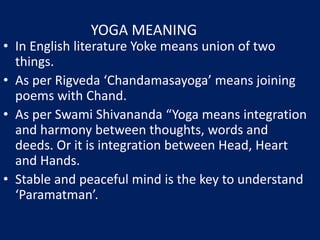
YOGA MEANING
• In English literature Yoke means union of two
things.
• As per Rigveda ‘Chandamasayoga’ means joining
poems with Chand.
• As per Swami Shivananda “Yoga means integration
and harmony between thoughts, words and
deeds. Or it is integration between Head, Heart
and Hands.
• Stable and peaceful mind is the key to understand
‘Paramatman’.
YOGA TYPES
• Bhakti Yoga
• Raja Yoga
• Laya Yoga
• Karma Yoga
• Hatha Yoga
• Mantra Yoga
Yoga indicates stable state of mind and the first
word indicates the method or path to achieve it.
Benefits of stable Mind
By achieving stable state of mind
• The Rishis were trying to solve difficult riddles
of universe.
• Present times Scientists are trying to solve
materialistic problems of day to day life.
• Common man like we all can keep away
‘psycho somatic diseases’.
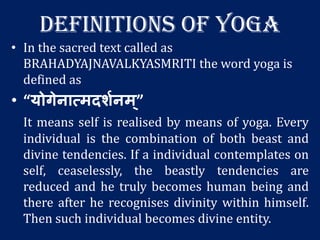
DEFINITIONS OF YOGA
• In the sacred text called as
BRAHADYAJNAVALKYASMRITI the word yoga is
defined as
• “योगेनात्मदर्शनम्”
It means self is realised by means of yoga. Every
individual is the combination of both beast and
divine tendencies. If a individual contemplates on
self, ceaselessly, the beastly tendencies are
reduced and he truly becomes human being and
there after he recognises divinity within himself.
Then such individual becomes divine entity.
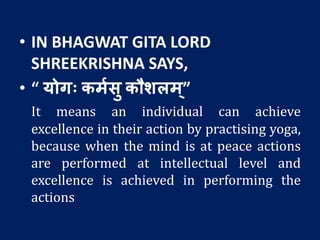
• IN BHAGWAT GITA LORD
SHREEKRISHNA SAYS,
• “ योगः कमशसु कौर्लम ्”
It means an individual can achieve
excellence in their action by practising yoga,
because when the mind is at peace actions
are performed at intellectual level and
excellence is achieved in performing the
actions
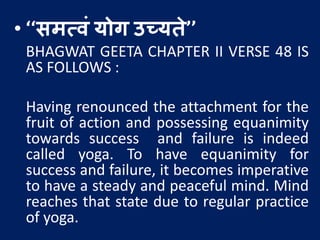
• ‘‘समत्वं योग उच्यते’’
BHAGWAT GEETA CHAPTER II VERSE 48 IS
AS FOLLOWS :
Having renounced the attachment for the
fruit of action and possessing equanimity
towards success and failure is indeed
called yoga. To have equanimity for
success and failure, it becomes imperative
to have a steady and peaceful mind. Mind
reaches that state due to regular practice
of yoga.
• ‘‘योगो भवतत दुःखहा ’’
THE BHAGAVATGITA OFFERS
ANOTHER DEFINITION OF YOGA
IN CHAPTER VI, VERSE 17. IT SAY
YOGO BHAVATI DUHKHAHAH -
YOGA DESTROYS MISERY.
• ‘‘योगश्चितवृश्त्ततनरोध’’
• THE VERY SECOND APHORISM FROM THE
PATANJALA YOGASUTRAS IS
YOGASCITTAVRTTINIRODHOH – IT MEANS
THAT YOGA IS THE CESSATION OF
MODIFICATION OF MIND.
• CITTA IS THE MANIFESTATION OF MIND,
EGO AND INTELLECT. VRTII IS THE
NATURAL RESPONSE WHEN MIND COMES
INTO CONTACT WITH OBJECT. VRTIIS ARE
THUS WAVES IN THE MIND. ANGER,
SORROW AND HAPPINESS ARE ALSO
MENTAL MODIFICATIONS. CESSATION OF
THIS MODIFICATION OF MIND IS YOGA.
• ‘‘संसारोत्तरणेयुक्तीयोगर्ब्देन कथ्यते’’
SAMSAROTTARANEYUKTIRYOGASABDENA
KATHYATE - The technique that enables one
to overcome the difficulties of the worldly
life is called yoga. This is very brief, apt and
easy to comprehend definition of yoga. The
yogavasistha asserts that yoga is the best
tool to pacify mind.
• ‘‘मनः प्रर्मन उपायः इतत योग’’
• It says MANAHPRASAMANNOPAYAH ITI YOGAH.
• In the VYASABHASYA, the commentary by Vyasa
on the PATANJALA YOGASUTRAS, Yoga has been
defined as
“योगः समाधी:”
YOGAH SAMADHIHI, Yoga means absorption: in
the statement referred to above first word yoga
denotes
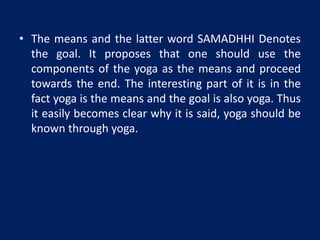
• The means and the latter word SAMADHHI Denotes
the goal. It proposes that one should use the
components of the yoga as the means and proceed
towards the end. The interesting part of it is in the
fact yoga is the means and the goal is also yoga. Thus
it easily becomes clear why it is said, yoga should be
known through yoga.
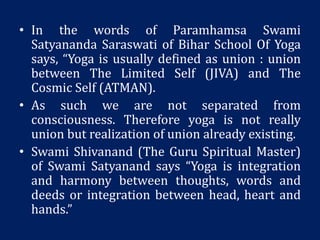
• In the words of Paramhamsa Swami
Satyananda Saraswati of Bihar School Of Yoga
says, “Yoga is usually defined as union : union
between The Limited Self (JIVA) and The
Cosmic Self (ATMAN).
• As such we are not separated from
consciousness. Therefore yoga is not really
union but realization of union already existing.
• Swami Shivanand (The Guru Spiritual Master)
of Swami Satyanand says “Yoga is integration
and harmony between thoughts, words and
deeds or integration between head, heart and
hands.”
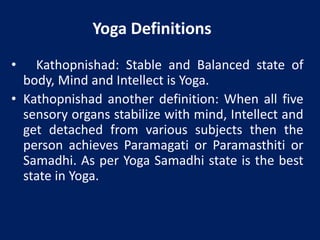
Yoga Definitions
• Kathopnishad: Stable and Balanced state of
body, Mind and Intellect is Yoga.
• Kathopnishad another definition: When all five
sensory organs stabilize with mind, Intellect and
get detached from various subjects then the
person achieves Paramagati or Paramasthiti or
Samadhi. As per Yoga Samadhi state is the best
state in Yoga.
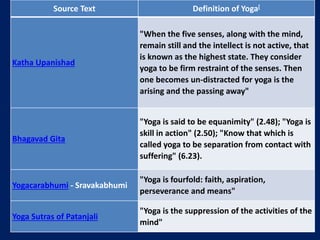
Source Text Definition of Yoga[
Katha Upanishad
"When the five senses, along with the mind,
remain still and the intellect is not active, that
is known as the highest state. They consider
yoga to be firm restraint of the senses. Then
one becomes un-distracted for yoga is the
arising and the passing away"
Bhagavad Gita
"Yoga is said to be equanimity" (2.48); "Yoga is
skill in action" (2.50); "Know that which is
called yoga to be separation from contact with
suffering" (6.23).
Yogacarabhumi - Sravakabhumi
"Yoga is fourfold: faith, aspiration,
perseverance and means"
Yoga Sutras of Patanjali
"Yoga is the suppression of the activities of the
mind"
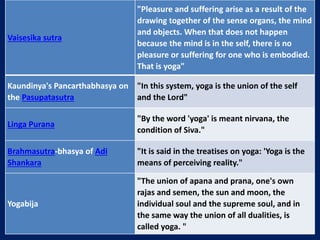
Vaisesika sutra
"Pleasure and suffering arise as a result of the
drawing together of the sense organs, the mind
and objects. When that does not happen
because the mind is in the self, there is no
pleasure or suffering for one who is embodied.
That is yoga"
Kaundinya's Pancarthabhasya on
the Pasupatasutra
"In this system, yoga is the union of the self
and the Lord"
Linga Purana
"By the word 'yoga' is meant nirvana, the
condition of Siva."
Brahmasutra-bhasya of Adi
Shankara
"It is said in the treatises on yoga: 'Yoga is the
means of perceiving reality."
Yogabija
"The union of apana and prana, one's own
rajas and semen, the sun and moon, the
individual soul and the supreme soul, and in
the same way the union of all dualities, is
called yoga. "
AIMS & OBJECTIVE OF YOGA
• The ultimate aim of yoga is self realization i.e.
Moksha, Kaivalya or Nirvana. This is state, free
from miseries and sufferings of life.
• Yoga offers the goal of life and means to reach
it.
• Though the final goal of yoga is Samadhi, the
immediate aims and the objectives of yoga are
to keep the person, practitioner physically fit,
mentally stable and emotionally quiet.
• The knowledge that we obtain of the material
and visible objects is called as physics while
the knowledge gained through Yogasadhana
about our pure nature and realization of power
of self is metaphysic or spiritual knowledge.
MISCONCEPTIONS OF YOGA
• There are many misconceptions about yoga. Due
to lack of information, erroneous notions,
incorrect comprehension of the subject matter,
prejudices, intellectual incapability, and difference
of opinion
1. Yoga is meant only for a selected few person to
be practice in forest, in solitude after renouncing
the worldly life and wearing the saffron robes of
a monk.
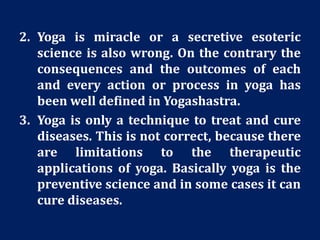
2. Yoga is miracle or a secretive esoteric
science is also wrong. On the contrary the
consequences and the outcomes of each
and every action or process in yoga has
been well defined in Yogashastra.
3. Yoga is only a technique to treat and cure
diseases. This is not correct, because there
are limitations to the therapeutic
applications of yoga. Basically yoga is the
preventive science and in some cases it can
cure diseases.
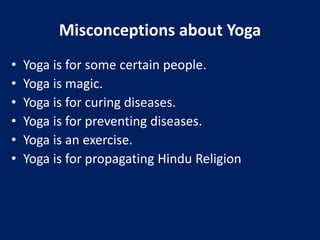
Misconceptions about Yoga
• Yoga is for some certain people.
• Yoga is magic.
• Yoga is for curing diseases.
• Yoga is for preventing diseases.
• Yoga is an exercise.
• Yoga is for propagating Hindu Religion
Yoga Evolutiion Meaning Definition Objectives Misconceptions - Anand Sahasrabuddhe