PRINCIPLES 
AND 
METHODS 
OF 
YOGA THERAPY 
STUDY MATERIALS 
COMPILED AND EDITED 
BY 
YOGACHARYA 
Dr ANANDA BALAYOGI BHAVANANI 
M.B.B.S, A.D.Y, D.S.M, D.P.C, P.G.D.F.H, P.G.D.Y, F.I.A.Y 
CHAIRMAN 
INTERNATIONAL CENTRE FOR YOGA EDUCATION AND 
RESEARCH AND YOGANJALI NATYALAYAM 
PUDUCHERRY, SOUTH INDIA 
www.rishiculture.org 
www.icyer.com
CONTENTS 
1. Yoga therapy-A Complete System of Health 1 
2. Important Concepts Of Yoga Therapy 4 
3. Therapeutical Benefits Of Hatha Yoga 12 
4. Integrated Approach To Yoga Therapy 14 
5. Origin, Scope & Practical Application of Yoga Therapy 16 
6. Yoga And Positive Health 28 
7. Yoga And Stress 30 
8. Yoga And Modern Medicine 41 
9. Tirumoolar On Health & Disease (Thirumandiram) 45 
10. Thiruvalluvar On The Art Of Healing (Tirukkural) 46 
11. Therapeutic Potential Of Pranayama 47 
12. Yoga & Medicine By Dr. Steven Brena 51 
13. Yoga And Yoga Therapy By Dr. Georg Feuerstein 53 
14. Swarodaya Vigjnan 56 
15. Shivasvarodaya 59 
16. Lifestyle Modification In Health And Disease 60 
17. Basics Of Indian Psychotherapy 63 
18. Basic Concepts Of Ayurvedic Physiology 70 
19. Ayurveda And Asana By Mark Halpern 78 
20. Notes On A Few Important Medical Conditions 
a. Hypertension /High Blood Pressure 83 
b. Anemia 85 
c. Rheumatoid Arthritis 88 
* Notes on Yoga Therapy –Compiled and Edited by Dr Ananda Balayogi Bhavanani *
d. Piles / Hemorrhoids 90 
e. Epilepsy/ Fits/ Seizures 91 
f. Back Pain 94 
g. Obesity 96 
h. Peptic Ulcer 97 
i. Pregnancy 99 
j. Diabetes Mellitus 102 
k. Degenerative Neck Disease 106 
l. Attention Deficit Hyperactivity Disorder 109 
m. Bronchial Asthma 112 
21. Yoga For Menopause 114 
22. Health Hazards Of Smoking 115 
23. Important Yogic Concepts Related To Yoga Therapy 117 
24. Lifestyle Modifications For Hypertension 120 
25. Various Yoga Therapy Schedules 
a. Diabetes 124 
b. Hypertension 125 
c. Pre Syncope / Syncope 125 
d. Bronchial Asthma 126 
e. Obesity 127 
f. Backache 128 
g. Nasal Allergies And Breathing Problems 130 
h. Yoga Practices For Women 131 
i. Simplified Stress Reduction Programme 134 
* Notes on Yoga Therapy –Compiled and Edited by Dr Ananda Balayogi Bhavanani *
* Notes for Yoga Therapy –Compiled and Edited by Dr Ananda Balayogi Bhavanani * 
1 
YOGA THERAPY: 
A COMPLETE SYSTEM OF 
PREVENTIVE, CURATIVE AND PROMOTIVE HEALTH 
By Dr Georg Feuerstein, Ph.D 
(Excerpted from The Yoga Perspective on Pain, Mental Health, and 
Euthanasia. Yoga Studies. Newsletter of YREC/IAYT.Jan-Apr 2002) 
Traditionally, Yoga was not intended for the imbalanced or sick individual but for 
the normal person interested in, and capable of, pursuing what Abraham Maslow 
called B-values. Yoga is not physical or psychological therapy—even though it 
contains a therapeutic element—but a tradition of psycho-spiritual growth leading 
to inner peace and freedom. Today, however, in Western countries, Yoga is almost 
universally pursued as a discipline for fitness and health and has proven to be 
highly effective as such. 
While Yoga’s comprehensive methodology includes many techniques that serve 
the popular goals of enhancing or restoring fitness and health, its real potency lies 
in the domain of psychospiritual maturation, notably at the higher levels of self-transcendence 
and self-transformation through profound meditation. As a 
psychospiritual discipline, which also involves a therapeutic component, Yoga can 
offer an unusually comprehensive and practical perspective on this acute problem 
in medical care. The yogic perspective is inclusive of the moral and spiritual 
aspects of human life but also of the practical issues of pain, suffering, illness, and 
death. 
To begin with, Yoga philosophy acknowledges the stark reality that life itself is 
terminal (anitya). Whatever our state of health may be, we all are destined to die 
within a rather limited frame of time: eighty, a hundred, or perhaps, at some point 
in the future, two hundred years. For most of us, life will always be too short. 
Yoga acknowledges another undeniable fact: that life is filled with suffering 
(duhkha)—an insight with which other spiritual traditions fully concur. See, for 
instance, the Biblical wisdom of John 16:33: “In this life you will have trouble.” 
Even if we were to never experience sickness or bodily injury, we would still be 
exposed to all kinds of experiences that would cause us distress (i.e., suffering), 
notably interpersonal difficulties, sickness and injury of family members and 
friends, and not least loss of a loved one. 
The question is whether there is ever a moment when suffering becomes so 
overwhelming that we are justified in taking our own or someone else’s life in 
order to end suffering. First of all, we need to appreciate that Yoga makes a 
distinction between pain (pîthâ) and suffering (duhkha). The former is a physical 
reaction, the latter a psychological response. Yogins have clearly demonstrated 
that they can experience pain without adding to it the subjective element of 
suffering. A good example is Sri Ramana Maharishi (1879-1950), an enlightened 
master who awoke at the age of sixteen. Toward the end of his life as a sage, 
Ramana suffered from rheumatism in his legs, back, and shoulders and then also 
was diagnosed with a sarcoma near his left elbow. First he refused to be operated 
on, preferring to allow Nature to take its course. At the urgent pleading of his 
disciples, however, he finally succumbed to several operations, which all proved 
useless, and, if anything, merely exacerbated his physical pain. All the while, 
however, Ramana remained in a state of great calmness, which was palpable to 
the numerous visitors who day after day came to his hermitage to sit in his 
presence. When asked about his pain, he observed: “They take this body for 
Bhagavan and attribute suffering to him. What a pity!” To another devotee he 
said: “Where is pain if there is no mind?” 
Ramana died with utmost dignity in front of numerous devotees. Just before he 
passed away, a group started to chant, and Ramana opened his eyes. “He gave a 
brief smile of indescribable tenderness,” wrote Osborne. “From the outer edges of 
his eyes tears of bliss rolled down. One more deep breath, and no more. There
was no struggle, no spasm, no other sign of death: only that the next breath did 
not come.” 
Yoga adepts, who are not yet enlightened but have mastered the art of 
concentration, have also demonstrated extraordinary control over the mind and 
nervous system, including the sensation of pain. The control of pain is absolutely 
necessary in the performance of the various practices of tapas, or austerity. One 
such practice is the Tibetan Buddhist technique of tumo, which requires the yogin 
to sit naked in ice and snow for several hours and dry a wet blanket with his own 
body heat. For the ordinary person, this feat, which has been captured on film, 
would soon turn into a very painful and presumably lethal experience. 
For an adept of the stature of Ramana Maharishi, who in his enlightenment 
transcended both pain and pleasure, there is no need to specifically control the 
nervous system and the sensation of pain. This sage allowed every experience to 
arise, without seeking to prevent or interfere with it. The body undoubtedly 
experienced pain, but Ramana was not suffering. He was blissfully present as pure 
Consciousness. This is one of the characteristics of sahaja-samâdhi, or “natural 
ecstasy,” a state of utter spontaneity in which, to an outside observer, immanence 
and transcendence occur simultaneously. For the enlightened being, however, no 
such dualism exists. 
Short of enlightenment, we inevitably react to the sensation of pain by seeking to 
withdraw from its objective cause: We quickly pull back our hand from a hot stove 
and rush to apply ice, aloe, or some analgesic ointment to the damaged skin to 
reduce the burning sensations. But if we are observant, we will find that we also 
pull back inwardly as if we were trying to shut out the pain. 
In the case of AIDS, cancer, and similar diseases, this mental withdrawal becomes 
more pronounced as the symptoms increase with the progression of the disease. 
Increasing doses of painkillers are necessary to control the pain, but these can 
have unwanted side effects, including a disabling drowsiness. Terminal patients 
thus find themselves torn between wanting to be fully present as aware human 
beings and yet finding the pain too intolerable. 
Yoga offers several techniques for reducing pain, including deep relaxation, 
conscious breathing, visualization, and meditation. Hypnosis also has long been 
used successfully in dealing with pain. In 1995, a National Institutes of Health 
(NIH) panel endorsed hypnosis as an effective method for alleviating the chronic 
pain associated with cancer, irritable bowel syndrome, inflammatory conditions of 
the mouth, and tension headaches. While Yoga is not identical with hypnosis, 
some of the mental and neurophysiological factors utilized in Yoga and hypnosis 
are similar or the same. 
Also, instruction in the basic principles of Yoga philosophy, notably the idea of a 
witnessing consciousness that survives death, can prove supportive in a 
thanatological program. In particular, it can provide the patient with a suitably 
broad context for understanding life, sickness, and death and thereby help dispel 
much unnecessary fear. This is not a matter of indoctrinating the patient, but of 
giving him or her a last-minute opportunity to ponder the Big Questions (Who am 
I? Whence do I come? Whither do I go? What must I do?). As psychiatrist Viktor 
Frankl put it: 
* Notes for Yoga Therapy –Compiled and Edited by Dr Ananda Balayogi Bhavanani * 
2 
Ultimately, man should not ask what the meaning of his life is, 
but rather must recognize that it is he who is asked. In a 
word, each man is questioned by life; and he can only answer 
to life by answering for his own life; to life he can only 
respond by being responsible. 
To offer terminal patients more social interaction, as proposed by Dr. Lavery, may 
well reduce the likelihood of their having suicidal thoughts, but it will not 
necessarily lessen their pain, discomfort, distress, and fear. Moreover, from a 
yogic perspective conventional social interaction serves as a distraction, because it 
does not allow the patient to focus on the actual situation and properly prepare for 
a conscious death. If social interaction were used to assist this preparatory 
process, it would become a constructive affair. 
From a yogic perspective, suicide, physician-assisted suicide, and euthanasia are 
not favored options. It is true, however, that some yogic schools permit terminally
ill Yoga adepts to fast to death, but these adepts are assumed to have an 
advanced ability for concentration and meditation, allowing them to exit the body 
consciously—that is, in full control of the inner process of dying. For all others, 
suicide of any kind is generally considered to be inauspicious, as it creates a 
mental trauma that is not deleted by the shedding of the physical body. Yoga, 
after all, operates with the notion that the individual survives the death of the 
material frame and continues in an after-death state until there is rebirth. 
For those who are not able to induce their own deep meditation state in the final 
hour, there is the possibility of guided meditation or co-meditation, which has 
been practiced with good results for the dying patient. In this respect, the work of 
Richard Boerstler can be recommended. 
All of Yoga can be regarded as a dress rehearsal for the moment of death. 
Through the steady cultivation of spiritual attitudes and mental concentration, the 
yogin and Yogini endeavors to prepare for this all-important transition. Central to 
all Yoga is the conviction that we become what our mind tends to dwell on, and 
what our mind, through long habituation, is likely to dwell on in the final phase of 
physical dissolution is the same things that have preoccupied us in life. Only when 
we have the presence and power to deeply contemplate the source of our 
existence itself—whatever name we may give to this source—will our exit from life 
and subsequent post-mortem state prove to be a spiritual opening free from 
dread. 
To be able to approach dying with such awareness and dignity, we must first live 
consciously and with dignity. While it is clearly beneficial to set foot on the yogic 
path early in life, it is never too late to begin. If some of Yoga’s wisdom and 
psychotechnology could be made available to those who are suffering pain and 
distress, especially the terminally ill, they would find deeper meaning and renewed 
hope, as well as relief via Yoga’s time-tested psychophysical techniques. 
* Notes for Yoga Therapy –Compiled and Edited by Dr Ananda Balayogi Bhavanani * 
3
* Notes for Yoga Therapy –Compiled and Edited by Dr Ananda Balayogi Bhavanani * 
4 
IMPORTANT CONCEPTS OF YOGA THERAPY 
By Yogacharya Dr Ananda Balayogi Bhavanani, 
(Excerpted from “A Primer of Yoga Theory”) 
SOME DEFINITIONS OF YOGA RELATED TO YOGA THERAPY 
• Science and art of mastering the mind—Swami Gitananda Giri 
• A state of mastery over the senses and mind (Kathopanishad) 
• Equanimity of mind (Samatvam Yogaha uchyate) -Yogeshwar Krishna in 
Bhagavad Gita 
• A skillful and subtle process to calm down the mind (Yoga Vashistha) 
• Dis-association from the union with pain (Dukka samYoga viYogam Yoga 
sangnitam) - Yogeshwar Krishna in Bhagavad Gita 
• “Yoga is said to be the oneness of breath, mind, and senses, and the 
abandonment of all states of existence.”—Maitri Upanishad 
• “Yoga is said to be the unity of exhalation and inhalation and of blood and 
semen, as well as the union of sun and moon and of the individual psyche 
with the transcendental Self.” — Yoga Shikha Upanishad. 
• Mother of all science—Swami Gitananda Giri 
• The path of moderation—Swami Gitananda Giri 
• Four (five) fold awareness. —Swami Gitananda Giri 
o Awareness of body 
o Awareness of emotions 
o Awareness of mind 
o Awareness of awareness itself 
o Awareness of how unaware we are! 
CARDINAL PRINCIPLES OF YOGA THERAPY 
• Relax the body 
• Slow down the breath 
• Calm the mind 
THE YOGIC STRUCTURAL SYSTEMS 
The Sapta Dhatus (Seven substances that make up the human body) 
1. Rasa (Chyle), 
2. Rakta (Blood), 
3. Maamsa (Flesh), 
4. Medas (Fat), 
5. Asthi (Bone), 
6. Majjaa (Marrow), 
7. Sukra (Semen) 
The Tri Doshas (The Three Humors) 
1. Vata - Wind 
2. Pitta - Bile 
3. Kapha or Kleshma - Phlegm
Pujya Swamiji Gitananda Giri Guru Maharaj has described the Nava Dhushyas or 
nine factors that are the physical structural systems of the human body. He has 
also described the Dwadasha Kramas or the twelve systems of man that also 
takes into account the non physical aspects of the human functioning. 
The Nava Dhushyas (Nine Physical Structural Systems) are: 
Asthi - Bone Tissue 
Maamsa - Muscle Tissue 
Nadis - Channels of Nerve Energy 
Rasa-Rakta - Circulation and Blood Components 
Indriyas - Vital Organs 
Granthis - Endocrine Glands 
Meda - Adipose Tissue 
Majjaa - Bone Marrow 
Soma - Hormones including the higher Ojas, Tejas and Sukra 
The Dwadasha Kramas include in addition to the Nau Dhushyas, the non-physical 
components of: 
Prana - the cosmic catalyst associated with emotions. This includes the sub units 
of Prana Vayus (nerve currents), Prana Nadis (channels of Pranic flow), Prana 
Vahaka (nerve impulses), and Prana Vahana (nerve fluids), Prana Vana (psychic 
vortexes associated with the Chakras), Prana Granthis (nodes of Prana) and Prana 
Bindus (foci of higher mental energy). 
Manas - subconscious, conscious and superconscious mind including the Buddhi 
(intellect), Bindu (foci of consciousness), Loka (planes of consciousness), Mandala 
(etheric mental and energy patterns and fields) 
Chakra - etheric energy nature associated with the nerves and glands of the 
physical body. It is also related to the psyche and Ahamkara. it also includes the 
psychic nature associated with the higher self or Atman 
* Notes for Yoga Therapy –Compiled and Edited by Dr Ananda Balayogi Bhavanani * 
5 
Pancha Koshas (The Five Sheaths) 
• Annamaya Kosha - Physical Sheath 
• Pranamaya Kosha - Energy Sheath 
• Manomaya Kosha - Mind Sheath 
• Vignanamaya Kosha - Sheath of Intellect 
• Anandamaya Kosha - Sheath of Eternal Bliss 
Correlation of the Pancha Koshas with the three Sharira 
• Sthula Sharira - Annamaya Kosha 
• Sukshma Sharira - Pranamaya, Manomaya and Vignanamaya Koshas 
• Karana Sharira - Anandamaya Kosha 
SOME PHYSIOLOGICAL BENEFITS OF YOGA 
• Stable autonomic nervous system equilibrium, with a tendency toward 
parasympathetic nervous system dominance rather than the usual stress-induced 
sympathetic nervous system dominance 
• Pulse rate decreases 
• Respiratory rate decreases 
• Blood pressure decreases 
• Galvanic Skin Response (GSR) increases
• EEG - alpha waves increase. theta, delta, and beta waves also increase 
* Notes for Yoga Therapy –Compiled and Edited by Dr Ananda Balayogi Bhavanani * 
6 
during various stages of meditation 
• EMG activity decreases 
• Cardiovascular efficiency increases 
• Respiratory efficiency increases, Respiratory amplitude and smoothness 
increase, tidal volume increases, vital capacity increases, breath-holding 
time increases 
• Gastrointestinal function normalizes 
• Endocrine function normalizes 
• Excretory functions improve 
• Musculoskeletal flexibility and joint range of motion increase 
• Posture improves 
• Strength and resiliency increase 
• Endurance increases 
• Energy level increases 
• Weight normalizes 
• Sleep improves 
• Immunity increases 
• Pain decreases 
SOME PSYCHOLOGICAL BENEFITS OF YOGA 
• Somatic and kinesthetic awareness increase 
• Mood improves and subjective well-being increases 
• Self-acceptance and self-actualization increase 
• Social adjustment increases 
• Anxiety and depression decrease 
• Hostility decreases 
• Psychomotor functions improve: 
o Grip strength increases 
o Dexterity and fine skills improve 
o Eye-hand coordination improves 
o Choice reaction time improves 
o Steadiness improves 
o Depth perception improves 
o Balance improves 
o Integrated functioning of body parts improves 
• Cognitive function improves: 
o Attention improves 
o Concentration improves 
o Memory improves 
o Learning efficiency improves 
o Symbol coding improves 
o Depth perception improves 
o Flicker fusion frequency improves
SOME BIOCHEMICAL EFFECTS OF YOGA 
The biochemical profile improves, indicating an anti-stress and antioxidant effect, 
important in the prevention of degenerative diseases. 
• Glucose decreases 
• Sodium decreases 
• Total cholesterol decreases 
• Triglycerides decrease 
• HDL cholesterol increases 
• LDL cholesterol decreases 
• VLDL cholesterol decreases 
• Cholinesterase increases 
• Catecholamines decrease 
• ATPase increases 
• Hematocrit increases 
• Hemoglobin increases 
• Lymphocyte count increases 
• Total white blood cell count decreases 
• Thyroxin increases 
• Vitamin C increases 
• Total serum protein increases 
SOME COMPONENT ASPECTS OF AN INTEGRATED APPROACH TO YOGA 
THERAPY 
When working with Yoga therapy it is vital that we take into consideration all of 
the following aspects that will be part of the integrated approach to the problem. 
These aspects are: Diet, Environment, Lifestyle, Bodywork, Breath work and the 
Thought Process. 
The need of the modern age is to have an integrated approach towards therapy 
and to utilize Yoga therapy with coordination and collaboration with other systems 
of medicine such as Allopathy, Ayurveda, Siddha and Naturopathy. Physiotherapy 
and Chiropractic practices may be used with the Yoga if needed. Advice on diet 
and life style is very important. 
CLASSIFICATION OF DISEASES ACCORDING TO THE YOGA VASHISHTA 
The Nirvana Prakarana of the Laghu Yoga Vashishta describes the origin and 
destruction of mental and bodily diseases. Sage Vashishta teaches Lord Rama that 
there are two major classifications of disease. Those that are caused by the mind 
are primary (Adhija, the psychosomatic, stress disorders) while those that afflict 
the body directly are secondary (Anadhija, infectious disease, accidents etc). The 
primary disease has two sub divisions. These are the Samanya (ordinary physical 
diseases) and the Sara (the essential disorder of rebirth). Samanya diseases are 
the ones that affect man physically and may be destroyed by the correction of the 
mind-body disharmony. However only Atma Jnana can destroy the Sara or 
essential disorder of rebirth. 
WHAT IMBALANCES CAN THE PRACTICE OF ASANAS HELP TO CORRECT? 
Asanas can help correct the structural imbalances and restore balance. They are 
also useful in improving muscle strength and endurance, increasing movement 
and flexibility of joints, skeletal alignment and neuro-muscular coordination 
* Notes for Yoga Therapy –Compiled and Edited by Dr Ananda Balayogi Bhavanani * 
7
SOME THERAPEUTIC INTERVENTIONS AT DIFFERENT LEVELS WITH 
RESPECT TO THE PANCHA KOSHAS 
• Annamaya Kosha interventions: Jattis (Shitileekarana Vyayama), Kriyas 
* Notes for Yoga Therapy –Compiled and Edited by Dr Ananda Balayogi Bhavanani * 
8 
(structured movements), Asanas and dietary modifications and control. 
• Pranamaya Kosha interventions: Shat Karmas, Pranayamas, 
Prananusandhana, breath awareness, breath-movement coordination and 
the energizing and balancing of the Pranic energy. Jnana Yoga techniques 
such as Anuloma Viloma etc. 
• Manomaya Kosha interventions: Trataka, Concentration (Dharana), 
mediation (Dhyana) and Japa. Jnana Yoga practices such as Yoga Nidraa 
etc. 
• Vignanamaya Kosha interventions: Analysis (Swadhyaya), lectures and 
spiritually uplifting exchange (Satsangha) and experience (Anubhava) 
• Anandamaya Kosha interventions: Learning to implement the principles of 
Karma Yoga (Yoga is skilled action without expectation) and following the 
principle of action in relaxation to bring about joy in all the activities. A 
realization that we live in a blissful universe and that all life is joy is to be 
brought about in this intervention through use of Bhakti Yoga, Karma Yoga 
and elements as such as Bhajans, counseling and Satsanghas. 
SOME OF THE THERAPEUTIC MODALITIES OF YOGA THERAPY 
1. Physical therapies: Asanas, Kriyas, Mudras and Bandhas gently stretch and 
strengthen muscles, improve mobility, flexibility, respiration, circulation, 
digestion and elimination, and promote a general sense of health and well 
being. 
2. Emotional therapies: Swadyaya, Pranayama, Pratyahara, Dharana, Dhyana and 
Bhajans can calm and centre the mind, helping to relieve stress and mental 
fatigue and bring about emotional balance. 
3. Development of proper psychological attitudes: By encouraging us to step back 
and look objectively at our habitual patterns of behaviour and thoughts, Yoga 
can help us to cope better with situations that put our bodies and minds under 
strain. Development of the following qualities are also emphasized in order to 
become mentally balanced humane beings: Vairagya (detached, dispassionate 
attitude), Chitta Prasadann (acceptance of the Divine Will), Maitri (friendliness 
towards the happy), Karuna (compassion for the suffering), Mudita 
(cheerfulness towards the virtuous) and Upekshanam (indifference and 
avoidance of the evil) etc. 
4. Mental therapies: Relaxation and visualization practices, Trataka, Pranayama, 
Pratyahara, Dharana as well as Dhyana. Relaxation is a central element in Yoga 
therapy as relaxation is the body’s way of recharging its cells and helps to ease 
physical, emotional and mental tensions. 
5. Spiritual therapies: Swadyaya, Satsangha, Bhajans sessions and Yogic 
counseling are important aspects of Yogic therapy that are often neglected in 
favour of the physical therapies alone. 
6. Preventive therapies: Yoga has numerous preventive benefits especially when 
it is started early in childhood. It helps in the prevention of accidents by 
increasing awareness as well as agility. Improved immunity helps I preventing 
infectious and contagious diseases. The added benefit of starting early is that 
the person knows the technique so that they can do it if needed at a later 
stage in life. Yoga also offers rehabilitative therapies for most musculoskeletal 
conditions as well as in recovery for debilitating illnesses. The practice of Yoga 
also goes a long way towards prevention of disability and improving quality of 
life in numerous chronic conditions. 
7. Pain relief therapies: Yoga is a useful addition to the pain relief therapies as it 
increases pain tolerance and provides an improved quality of life. It can be 
safely said that Yoga helps us endure conditions that it may not be able to 
cure.
SOME OF THE LIMITATIONS OF YOGA THERAPY 
Though Yoga and Yoga therapy are very useful in bringing about a state of total 
health it is not a miracle cure for all problems. It needs a lot of discrimination on 
the part of both the therapist as well as the patient. It may not be useful in 
emergency conditions and there is a strong need to consult a qualified medical 
doctor where in doubt. Each patient is different and so the therapy has to be 
molded to suit the individual needs rather than relying on a specific therapy plan 
for patients suffering the same medical condition. A very true problem is that 
there is a different approach of the different schools of Yoga to the same 
condition. It is better to follow any one system that one is conversant with, rather 
then trying to mix systems in a “Yogic Cocktail’. One must also be vigilant as there 
is a strong presence of numerous quacks pretending to be Yoga therapists and 
this leads to a bad name for Yoga therapy as well as Yoga in general. Premier 
institutions and governing bodies must take necessary action to weed out these 
unscrupulous operators that are in Yoga only for the money. 
* Notes for Yoga Therapy –Compiled and Edited by Dr Ananda Balayogi Bhavanani * 
9 
SOME DISORDERS AND DISEASES AMIABLE TO YOGA THERAPY 
• Psychosomatic and stress disorders 
Bronchial asthma 
Diabetes mellitus 
Hypertension 
Irritable bowel syndrome 
Gastro intestinal ulcer diseases 
Atherosclerosis 
Seizure disorder (epilepsy) 
Headache 
• Physical disorders 
Heart disease 
Lung disease 
Mental retardation 
• Psychiatric disorders 
Anxiety disorders, 
Obsessive-compulsive disorder 
Depression 
Substance abuse 
• Musculo-skeletal disorders 
Lumbago 
Spondylosis 
Sciatica 
Carpel tunnel syndrome 
• Metabolic disorders 
Thyroid and other endocrine disorders 
Obesity 
Metabolic syndrome 
• Infective and communicable diseases
WHAT ASPECTS OF YOGA THERAPY CAN HELP CORRECT FUNCTIONAL AND 
PSYCHOLOGICAL IMBALANCES? 
Yogic diet, Pranayama as well as mind control techniques are especially useful in 
correcting functional and psychological imbalances. 
HOW CAN YOGA HELP CONTROL AND PREVENT INFECTIVE AND 
COMMUNICABLE DISEASES? 
Yoga can help control and prevent infective and communicable diseases through 
improving the individual immunity and resistance, improved hygiene through the 
practice of Yamas and Niyamas as well as the cleansing practices and the 
disciplined cultivation of good habits and avoidance of wrong habits that lead to 
impaired immunity. 
YOGIC TWELVE POINT SYSTEM OF DIAGNOSIS AND HEALTH EVALUATION 
According to Yogamaharishi Dr Swami Gitananda Giri, Yoga Chikitsa requires a 
twelve-point approach in which different aspects of the human nature are taken 
into consideration in making the final diagnosis. 
1. Trigunas - Manifestations of the Three Basic Qualities 
2. Tri Doshas - Manifestations of the Three Humors 
3. Tri Vasanas - Psychological Background 
4. Prana - Manifestations of the Prana Vayus 
5. Abhyasa - Personal Discipline 
6. Jiva karma - Life Style 
7. Chetana - Quality of Thoughts 
8. Vacha - Quality of Speech 
9. Aahara - Diet and Food Habits 
10. Viparita Buddhi - Presence of Destructive or Bad Habits 
11. Jiva Vrittis - Body Rates of the Individual 
12. Sankalpa - Ideals of the Individual 
FOUR FOLD CONCEPT OF RELAXATION IN GITANANDA YOGA 
The Gitananda Yoga system views the need for relaxation and its solution in four 
ways: 
1. Letting Down: This letting down is to deal with one’s barriers to the 
needed advice and help, to let down one’s prejudices and preconceived 
ideas and notions about people, things and ideas, to let down all of the false 
notions and materialistic idolatry that we have built up in modern living and 
in particular, to let down from the “God of Tension” which is virtually deified 
in “civilized” society. To break away from the superstitions of our social and 
religious beliefs is not easy to do. These beliefs may be needed to support a 
healthy psyche. Therefore, it is necessary that you find out the truth, 
stripped of all false belief, about your own nature and the nature of the 
Supreme. Leave off all fears and anxieties and gain a positive attitude 
towards yourself and others. Cultivate the desire for right action when 
action is called for. 
2. Giving Up: One has to want to give up the stresses and strains that beset 
them. This does not mean surrender or a defeat, as popularly suggested by 
the English term “to give up”. This giving up is to throw off any weakness 
that tends to build up to tension, and to give off or let off those foolish 
* Notes for Yoga Therapy –Compiled and Edited by Dr Ananda Balayogi Bhavanani * 
10
tensions that at times turn us into a smoking volcano. Giving up here is a 
positive, evolutionary process. 
3. Giving In: To give in, in the Yoga concept of relaxation, is to “given in” to 
the dictates of the Inner Mind, the Higher Consciousness. Again, this is a 
positive process and is not the giving in of surrender. There is no negation 
or abdication of positive actions or ideas. One has to take up an Inner Life 
study to understand what it really means in words to give in to the Inner 
Self. In the beginning, it is an intellectual process, highly exciting and 
satisfying, but it must move beyond the intellectual, ecstatic state to even a 
more positive, a more transcendental state. 
4. Giving Over: The giving over of the control of the Higher Mind to the 
Higher Self is the highest and last stage of Four – Fold Relaxation. This is 
where the highest attainments of the relaxation are achieved, where one 
can merge into beautiful super-conscious higher states of which you are 
aware, but no words can describe. Giving over represents the peak of 
fulfillment. 
DIFFERENT STRESS MANAGEMENT PROGRAMMES DEVELOPED BY sVYASA, 
BANGALORE 
* Notes for Yoga Therapy –Compiled and Edited by Dr Ananda Balayogi Bhavanani * 
11 
IRT - Instant Relaxation Technique (Stretch and relax in Shavasana) 
QRT - Quick Relaxation Technique 
(Observation of abdominal muscle movement, Synchronization with 
breathing and finally breathing with feeling) 
DRT - Deep Relaxation Technique 
(Part by part relaxation with Akara, Ukara and Makara chanting) 
SMET - Self-Management of Excessive Tension 
(Alternate stimulation and relaxation combination)
* Notes for Yoga Therapy –Compiled and Edited by Dr Ananda Balayogi Bhavanani * 
12 
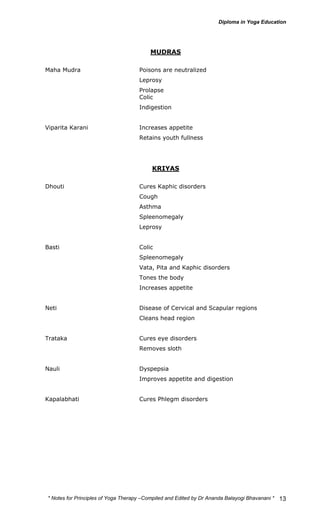
THERAPEUTICAL BENEFITS OF HATHA YOGA 
ACCORDING TO YOGI SWATMARAMA 
ASANAS 
Paschima Tana Stimulates the gastric fire 
Reduces Obesity 
Cures all diseases 
Mayurasana Cures disorders of Phlegm, bile and wind 
Increases Appetite 
Improves Digestion 
Bhadrasana Removes fatigue 
PRANAYAMAS 
“Proper practice eradicates all diseases but improper practice generates 
disease” 
Surya Bhedana Purifies the sinuses 
Vata disorders 
Removes worms 
Ujjayi Disorders of phlegm 
Disorders of the Dhatus (humors) 
Sitkari No hunger, thirst, sleep or lassitude 
Sheetali Colic 
Spleenomegaly 
Fever 
Bile disorders 
Hunger and thirst alleviated 
Poisons are neutralized 
Bhastrika Cures disorders of Phlegm, bile and gas 
Increases the gastric fire
* Notes for Yoga Therapy –Compiled and Edited by Dr Ananda Balayogi Bhavanani * 
13 
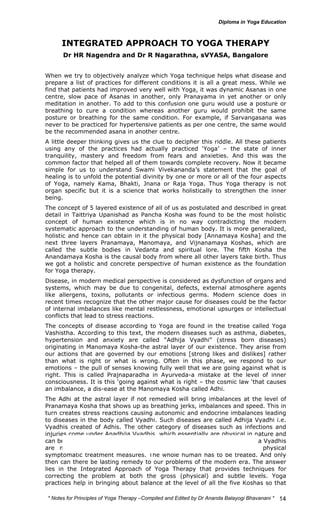
MUDRAS 
Maha Mudra Poisons are neutralized 
Leprosy 
Prolapse 
Colic 
Indigestion 
Viparita Karani Increases appetite 
Retains youth fullness 
KRIYAS 
Dhouti Cures Kaphic disorders 
Cough 
Asthma 
Spleenomegaly 
Leprosy 
Basti Colic 
Spleenomegaly 
Vata, Pita and Kaphic disorders 
Tones the body 
Increases appetite 
Neti Disease of Cervical and Scapular regions 
Cleans head region 
Trataka Cures eye disorders 
Removes sloth 
Nauli Dyspepsia 
Improves appetite and digestion 
Kapalabhati Cures Phlegm disorders
* Notes for Yoga Therapy –Compiled and Edited by Dr Ananda Balayogi Bhavanani * 
14 
INTEGRATED APPROACH TO YOGA THERAPY 
Dr HR Nagendra and Dr R Nagarathna, sVYASA, Bangalore 
When we try to objectively analyze which Yoga technique helps what disease and 
prepare a list of practices for different conditions it is all a great mess. While we 
find that patients had improved very well with Yoga, it was dynamic Asanas in one 
centre, slow pace of Asanas in another, only Pranayama in yet another or only 
meditation in another. To add to this confusion one guru would use a posture or 
breathing to cure a condition whereas another guru would prohibit the same 
posture or breathing for the same condition. For example, if Sarvangasana was 
never to be practiced for hypertensive patients as per one centre, the same would 
be the recommended asana in another centre. 
A little deeper thinking gives us the clue to decipher this riddle. All these patients 
using any of the practices had actually practiced ‘Yoga’ – the state of inner 
tranquility, mastery and freedom from fears and anxieties. And this was the 
common factor that helped all of them towards complete recovery. Now it became 
simple for us to understand Swami Vivekananda’s statement that the goal of 
healing is to unfold the potential divinity by one or more or all of the four aspects 
of Yoga, namely Kama, Bhakti, Jnana or Raja Yoga. Thus Yoga therapy is not 
organ specific but it is a science that works holistically to strengthen the inner 
being. 
The concept of 5 layered existence of all of us as postulated and described in great 
detail in Taittriya Upanishad as Pancha Kosha was found to be the most holistic 
concept of human existence which is in no way contradicting the modern 
systematic approach to the understanding of human body. It is more generalized, 
holistic and hence can obtain in it the physical body [Annamaya Kosha] and the 
next three layers Pranamaya, Manomaya, and Vijnanamaya Koshas, which are 
called the subtle bodies in Vedanta and spiritual lore. The fifth Kosha the 
Anandamaya Kosha is the causal body from where all other layers take birth. Thus 
we got a holistic and concrete perspective of human existence as the foundation 
for Yoga therapy. 
Disease, in modern medical perspective is considered as dysfunction of organs and 
systems, which may be due to congenital, defects, external atmosphere agents 
like allergens, toxins, pollutants or infectious germs. Modern science does in 
recent times recognize that the other major cause for diseases could be the factor 
of internal imbalances like mental restlessness, emotional upsurges or intellectual 
conflicts that lead to stress reactions. 
The concepts of disease according to Yoga are found in the treatise called Yoga 
Vashistha. According to this text, the modern diseases such as asthma, diabetes, 
hypertension and anxiety are called “Adhija Vyadhi” (stress born diseases) 
originating in Manomaya Kosha-the astral layer of our existence. They arise from 
our actions that are governed by our emotions [strong likes and dislikes] rather 
than what is right or what is wrong. Often in this phase, we respond to our 
emotions – the pull of senses knowing fully well that we are going against what is 
right. This is called Prajnaparadha in Ayurveda-a mistake at the level of inner 
consciousness. It is this ‘going against what is right – the cosmic law ‘that causes 
an imbalance, a dis-ease at the Manomaya Kosha called Adhi. 
The Adhi at the astral layer if not remedied will bring imbalances at the level of 
Pranamaya Kosha that shows up as breathing jerks, imbalances and speed. This in 
turn creates stress reactions causing autonomic and endocrine imbalances leading 
to diseases in the body called Vyadhi. Such diseases are called Adhija Vyadhi i.e. 
Vyadhis created of Adhis. The other category of diseases such as infections and 
injuries come under Anadhija Vyadhis, which essentially are physical in nature and 
can be tackled by the modern medical system effectively. Since the Adhija Vyadhis 
are multi dimensional, we need to tackle them not merely with physical 
symptomatic treatment measures. The whole human has to be treated. And only 
then can there be lasting remedy to our problems of the modern era. The answer 
lies in the Integrated Approach of Yoga Therapy that provides techniques for 
correcting the problem at both the gross (physical) and subtle levels. Yoga 
practices help in bringing about balance at the level of all the five Koshas so that
complete health can be restored. The practices at Annamaya Kosha include 
Yogasanas, Shitileekarana Vyayama [Jattis or loosening practices], Yoga diet and 
Yoga Kriyas, at Pranamaya Kosha – breathing practices, breathing Kriyas and 
Pranayama. At the Manomaya Kosha, the practices are meditation, devotional 
sessions and happy assembly, where-as lectures, counseling and Satsangha 
correct the notions about one’s life ambitions and goals that form the basic 
conceptual root for the life style of the individual. Karma Yoga and tuning to 
nature are the practices that help one to get established in Anandamaya Kosha 
bringing bliss in our lives. 
The ideal way to plan your daily Yoga practices is, 45 minutes of physical practices 
followed by Shavasana in the morning, Pranayama and meditation for 45 minutes 
in the evening. Daily practice is mandatory. Physical practices have to be 
performed only in empty stomach or 4 hours after a major meal or 2 hours after a 
small meal. Do not practice complicated Yogasanas when you are very tired or 
during menstruation. Simple Yogasanas, Meditation and Naadaanusaandhana can 
be practiced even during menstruation in women. 
* Notes for Yoga Therapy –Compiled and Edited by Dr Ananda Balayogi Bhavanani * 
15
* Notes for Yoga Therapy –Compiled and Edited by Dr Ananda Balayogi Bhavanani * 
16 
YOGA CHIKITSA – YOGA THERAPY 
ORIGIN, SCOPE AND PRACTICAL APPLICATION 
By Yogamaharishi Dr. Swami Gitananda Giri Guru Maharaj 
Founder, Ananda Ashram, ICYER, Puducherry 
Yoga Chikitsa is virtually as old as Yoga itself, indeed, the “return of mind that 
feels separated from the Universe in which it exists” represents the first Yoga 
therapy. Yoga Chikitsa could be termed “man’s first attempt at unitive 
understanding of mind-emotions-physical distress and is the oldest wholistic 
concept and therapy in the world. Western therapists are now approaching Unitive 
Understanding (Yoga) and wholistic therapies (Yoga Chikitsa) with “Yoga like 
practices.” Many of these Western practices are being absorbed into Indian 
therapies because our own Indian Therapists are not aware of the scope of Yoga 
Ch8ikitsa and quickly take up these modern and often less practical but m ore 
costly therapies. Yoga is the loser when this happens, as all Western therapies are 
directed to the Western hedonistic concepts and vulgar materialistic ends or goals, 
rather than the spiritual concepts to be achieved through Yoga. 
In this presentation I am trying to open up a wider view of Yoga and its 
application as a therapy by introducing some fifty-two sections of Yoga treatment 
that are acceptable within the overall concept of the Yoga Darshana, By expanding 
some of the sub-headings, I could have elaborated on the fifty-two major sections 
presented so that a total of 108 major and minor applications of Yoga Therapy and 
treatment are considered. Many of the present divisions or sections contain one or 
more distinct therapies but for sake of brevity, only 52 sections are considered. 
Many interested in Yoga Chikitsa will belabor or disagree with many of the general 
sections I have described. Others will state that there is no classical authority for 
Yoga Chikitsa, while still others will elaborate how difficult it is to use such an 
ancient science in practical application as a modern therapy. Indeed, it is difficult 
for three reasons: firstly, there is little information available to the seeking Yoga 
therapist on Yoga Chikitsa itself. Secondly, many therapists wishing to use Yoga 
Chikitsa are nor personally involved in Yoga, and therefore, miss the real scope for 
Yoga Chikitsa in dealing with the problems of modern man. Finally, the patient of 
Yoga Chikitsa is a distinct problem. He wants to be healthy instantly…have an 
instant cure. That has been promised to him by popular, aggressive and all too 
misleading pharmaceutical advertisements, and the bias of modern physicians 
East and West to anything as “offbeat” as Yoga Chikitsa. Yet, there is no other 
hope for real cure of the diseases of man except with the wholistic method 
employed in Yoga Chikitsa. 
Modern medical science enumerates some nearly 4,000 diseases and disorders of 
the body and mind in modern medicine and psychology. Yoga views this vast 
proliferation of diseases as a natural outcome of the stress and strain created by 
desire fostered by modern propaganda and the abuse of the body condoned on all 
sides even by religion, science and philosophy. Add to this the synthetic “junk 
food” diet of modern society and you have the possibility of endless disorders 
developing…even the extinction of man by his own ignorance and misdeeds. Yoga, 
a wholistic, unified concept of Oneness, is termed in Sanskrit “Adwaitam” or non-dual 
in nature. It suggests happiness, harmony and ease. Dis-ease is created 
when duality or “Dwaitam” arises in the human mind. This false concept of duality 
has produced all of the conflicts of human mind and the vast list of human 
disorders afflicting man. Duality-disease-is the primary cause of man’s downfall. 
Adwaita Vedanta, Yoga, and other wholistic concepts return man to his pristine, 
whole nature. Anything other than a Yoga concept leads only to human disorders. 
All diseases, maladies, tensions, are manifestations of divisions of what should be 
man’s complete nature, the Atman or Self. This Self is “Ease”. A loss of “Ease” 
creates “Dis-ease”. Duality is the first insanity, the first disease, the unreasonable 
thought that “I am different from the whole…. I am unique. I am me.” The ego is 
a manifestation of disease. Only a distorted ego could feel alone, suffer from “the 
lonely disease”, in a Universe, a Cosmos totally filled with the Self. It is of some 
interest to note that one of the oldest words for man in an Indian language is
“Insana”. Man is “insane”. A return to sanity, “going sane,” is the subject of real 
Yoga Sadhana and Yoga Abyasa. Yoga Chikitsa is one of the methods to help 
insane man back to the path of sanity. A healthy man or woman is known by the 
term-Yogi. 
Because man has failed to maintain a unified view of himself in respect to Ultimate 
Reality, a harmonious blend of his personality in relationship to his hidden 
universality, he is anything but a Yogi. He can be described as a Rogi suffering 
from Roga, disease; a Bhogi, a seeker of Bhoga, hedonistic pleasure, and if he 
survives this role as either or both he can be considered little more than an “old 
Phogi” in his latter years. Good health, the absence of disease, involves a 
universal philosophy of life, an appropriate Unified Style of Living, and where 
necessary, proper, wholistic treatment for disorders which may arise as the result 
of past Karma. Indeed, it may be necessary to understand the role that one’s 
personal Karma plays in the onset of human disorders and the ultimate alleviation 
or cure of these disorders. 
Modern science has failed to meet the demands of the needy of the world, 
whatever that need may be. Indeed, there is every evidence that man is much 
more ill than at any time in the past and this is especially true with chronic 
disorders, which have plagued us with crippling, refractory conditions that seem to 
defy the wisdom of science and modern discoveries. Perhaps it is time to look to 
the East, especially India, who already has proved to the world to be the mother 
of religions and philosophies and re-discovers the use of our Vedic Sciences of 
Ayurveda and Yoga Chikitsa. Ayurveda once employed Yoga-like technique as a 
part of its method of treatment. Yoga Chikitsa has drawn heavily from the science 
of Ayurveda. Ayuryoga, a coined term, would indicate a re-blending of the two, 
into Ayur Chikitsa of Yoga Chikitsa. In recent times, Ayurveda has been 
recognized by the World Health Organization as a practical medical system and 
Yoga Chikitsa has recently been accepted by the Government of India, Ministry of 
Health, as an indigenous Medical System. Together these two ancient Indian 
Sciences could alter the course of human suffering and more so, human evolution. 
While man suffers in mind and body, he distorts the Universe in which he lives 
through his view. Happy, healthy man would create a heaven here on earth. 
Fragmentary knowledge of this vast system of medicine exists throughout various 
parts of India and many Yoga Experts already employ some form of Yoga Chikitsa 
in their Yoga centres. It will be necessary to gather existing information and 
knowledge together, or under a number of classifications for analysis and 
evaluation and certain diagnostic and treatment methods adopted. Treatment of 
physical, emotional and mental disorders should be kept within Yogic parameters. 
It is not wise to employ non-Yogic concepts or methods in Yoga Chikitsa. Existing 
centres, which include some well-established Ashrams, should be prevailed upon 
to sponsor Yoga Therapy courses of a degree and non-degree category. During the 
period of training, the Yoga Therapist or Yoga Physician should undergo strict Yoga 
discipline for greater understanding of basic Yoga concepts and precepts. Courses 
in Yoga Chikitsa should be broad-based and admit all categories of therapists 
regardless of caste, colour, or financial condition. The main criteria should be that 
the candidate has a deep desire for spiritual unfoldment along the path of Yoga 
and to serve suffering humanity through the science of Yoga Chikitsa. 
Diploma graduates should be employed by Ashrams, Yoga Centres and Centres 
that could make use of a Yoga Therapy specialist. Ample funds should be made 
available to institutions training therapists on a professional basis. Yoga Chikitsa 
centres should be independent of and free from a-Yogic influences, a-Yogic 
environment, and any a-Yogic manipulations from any source religious, political, 
or personal. Yoga Chikitsa training should be encouraged in India’s widely 
advertised “barefoot doctor” medical system. Thereby, any of the objections made 
by concerned scientific groups would be overcome by the employment of Yoga 
Chikitsa on a National basis and to ensure that we bring about a vast change on 
the Indian scene. The slogan “Health for All by the Year 2,000” was an empty 
slogan, a mockery of possibility, an intellectual absurdity became Yoga Chikitsa 
was not part to play in the scheme of things. 
The need for an indigenous, wholistic therapy in India alone would justify that 
Yoga Chikitsa be developed and taught in special institutions, Ashrams and Yoga 
Centres. That wholistic therapy is now popular in Western countries and 
* Notes for Yoga Therapy –Compiled and Edited by Dr Ananda Balayogi Bhavanani * 
17
particularly, North America is an extra impetus for those interested in Yoga 
Chikitsa to make valuable contacts with the West. The Government of India should 
be interested in allotting funds for Yoga centres already in existence for study and 
training in Yoga Chikitsa, but there need be no delay while awaiting Government 
sponsorship and assistance. 
There are a number of Ashrams and Yoga Institutions in India now employing 
some form of Yoga Chikitsa and others investigating Yoga phenomena on a 
scientific basis for application as therapy. Most of the scientific research in India 
today is on the use of Hatha Yoga Asanas, Pranayama, and some form of 
meditation for the alleviation of distress conditions. Scientific appraisal has shown 
the wonderful possibilities of the practical application of many Yoga techniques as 
Yoga Therapy. Excellent facilities exist for study, therapy training, research in 
Yoga Chikitsa, and practical application of techniques at Yoga Chikitsa Clinics 
helping many patients back to health and happiness through the practical 
application of Yoga training and Yoga therapy. Ananda Ashram, the headquarters 
of Yoga Jivana Satsangha (International) has been conducting Yoga training 
courses and courses in Yoga Therapy since 1968 onwards. Most of the therapies 
that follow are taught in our Six-Month International Yoga Sadhana Course at 
Ananda Ashram, ICYER, Puducherry. 
1. YOGA ANATOMY 
While Western medical anatomy deals with the concept of only one physical body, 
Yoga Chikitsa involves a study and consideration, if only conceptual, of the Pancha 
Kosha, Five Bodies of Man. Yoga Chikitsa must be deeply concerned with the study 
and knowledge of the psychic Chakras, Prana Nadis and Bindus, as well as an 
application of Yoga Chikitsa that takes in the consideration of many concepts not 
found in Western terminology. The study of Yoga Anatomy would borrow heavily 
from terms and concepts used in Ayurveda, Siddha Vaidya, Samkhya and Yoga. 
2. YOGA PHYSIOLOGY 
In Yoga Chikitsa, a wider knowledge of the physiology or function of the Five 
Bodies would be a necessary study and application of the workings of the various 
Koshas in harmony or symbiosis. Knowledge of the Trigunic nature, Vasanas, and 
Doshas, would be a necessity and most important, the effect of the various Pranas 
and the shutdown of body organs when one or more of the major or minor Pranas 
are not functioning. Yoga anatomy and physiology should be a compulsory study 
for anyone practising Yoga Chikitsa professionally. 
3. YOGA PHILOSOPHY 
Yoga has a wholistic, universal concept of life and a very positive outlook on the 
spiritual evolution of man. Many consider Yoga Darshana to be more than a 
philosophy, rather an insight into the true nature of man and his relationship with 
the Universe. This relationship is important as the basic concept for Yoga Chikitsa. 
Real healing is likely to take place on a permanent basic only if the patient has a 
Yogic view. 
4. YOGA PSYCHOLOGY 
Where Yoga philosophy leaves off, its practical application begins…this practical 
application can be termed “Yoga psychology”. A psychological view of the use of 
Yoga Therapy is valuable to aid the student or patient to understand difficult 
practices or those which are difficult to understand in the beginning of therapy. 
Yoga psychology or Jnana Yoga can be equated with Vedanta for those taking up 
the psychological view of Yoga Chikitsa alone. It should be accepted that the Yoga 
concept of psychology or Vedanta be used in Yoga Chikitsa, and Western 
psychology and its terms should be scrupulously avoided. Western concepts do 
not in any way agree with the aim, goal or achievement according to Yoga 
psychology. 
* Notes for Yoga Therapy –Compiled and Edited by Dr Ananda Balayogi Bhavanani * 
18
5. YOGA ASANAS: ISOMETRIC STATIC POSTURES 
All classical Asanas of Hatha Yoga have some therapeutic value even when used 
alone, and even practised as a prevention of body disorders. Some of the Hatha 
Asanas can be slightly altered so that they can be used as remedial Asanas for the 
alleviation of some common physical disorders. Special consideration should be 
given to that group of practices best demonstrating Yoga Chikitsa ideals and goals 
that fall under the category of “Hathaats”, “Hathenas”, and “Hastikams”. It is 
possible that some Asana- like positions could be specially developed by Yoga 
Chikitsa experts to broaden the field of treatment through body postures. 
6. YOGA KRIYAS: ISOTONIC MOVEMENTS 
Yoga describes a Kriya as an activity where body movement, circulation of blood, 
circulation of nerve energy, or higher forms of energy conceived in Yoga Chikitsa, 
is manifestly demonstrated to take place. In this concept the term Kriya is 
associated only with activity done in classical Yoga Asana positions. The cleansing 
Kriyas belong under their own separate category and heading. 
7. YOGA MUDRAS 
In Hatha Yoga, a Mudra is a special body position forcing activity of the 
involuntary muscular system to create reflexogenic feedback to associated glands, 
particularly the endocrine glandular system. The study of Mudras is as extensive 
as the study of any section or phase of Yoga itself, yet, with most Yoga teachers 
and therapists, is a subject rarely introduced to students or patients, but possibly 
the key to the most spectacular form of treatment available in Yoga Chikitsa. 
8. PRANAYAMA 
There are at least 130 Pranayamas found in ancient and modern writings. Many of 
these breath-controls represent Yoga Chikitsa at its best, while some classical 
Pranayamas ca be altered slightly to be used as a form of remedial breath 
correction routine. Breath-related disorders particularly respond to basic 
Pranayama training. The use of Kumbhakas and Bandhas should be restricted to 
the training of Yoga students. Rarely are these two aspects of Pranayama of any 
great value in Prana Chikitsa, but do represent practices associated with piercing 
through the Trigranthis, psychic knots, which could be considered a part of higher 
Yoga Therapy under certain circumstances. 
9. ADHI PRANAYAMA 
Some Pranayamas of a higher nature can be used to induce deep relaxation and 
meditation. There is clinical evidence that healing takes place during “breath 
awareness relaxation”, and the resultant stress reduction suggests some 
Pranayamas have a special role to play in the correction of certain emotional / 
mental / psychic problems. Such Pranayamas should be taught only by a Yoga 
Therapy expert. 
10. VYAYAMA: YOGA STYLE EXERCISE 
Yoga Asanas, Kriyas and Mudras should in no way be considered in the same 
category as exercise or gymnastics. But, there is a group of legitimate body 
movements in the system called Vyayama where certain “thrusts, swings and 
sways” called Jattas and Jattis could form a group of excellent remedial exercises, 
and particularly where the patient is already familiar with such body-style 
movements. Many modern Yoga teachers are exponents of Vyayama, rather than 
Asana Yoga. 
11. REMEDIAL DIETARY REGIMES 
Yoga advocates a pure vegetarian diet made up of raw fruits, vegetables, and 
nuts, along with cooked grains, seeds, pods, pulses, roots and leafy vegetables. 
* Notes for Yoga Therapy –Compiled and Edited by Dr Ananda Balayogi Bhavanani * 
19
Some Yogis use milk, butter, ghee, cheese, and yogurt. Eggs, animal flesh, fowl 
and fish are not recommended in Yoga Aahara. Large quantities of roughage must 
be maintained in a healthy Yoga diet, avoiding refined grains and sterile sugar. 
Mitaahaara is a restricted diet and usually used for cleansing purposes, affording 
the body an opportunity to recuperate from over-eating or allergic reaction to 
foods ingested. Many digestive complaints can be eliminated by Mitaahaara alone. 
Yoga Chikitsa owes a great debt to modern research into the value of food stuffs 
and the application of knowledge of modern nutrition to a modern Yoga diet, In 
many cases on the Indian scene, there is not enough nutrients in the generally 
poor diet, so some knowledge of those foods found commonly n nature that value. 
Malnutrition can be overcome by a “meager diet” and the judicial use of Asanas, 
Kriyas, Mudras and Pranayama which have been shown to increase the absorption 
of food nutrients into the human system. 
12. ANAAHAARA - FASTING 
Scientifically – controlled Anaahaara, fasting from food, is a highly recommended 
way to give a physiological rest to the body. In Yoga Chikitsa, fasting can from a 
valuable core of practices to bring about radical cures of refractory conditions. 
Anaahaara is considered a physical Tapas along with Mauna or keeping silence. A 
thorough knowledge of how to prepare for a fast, conducting the fast, and 
breaking the fast must be known for this excellent Chikitsa. Anaahaara is usually 
done on water alone augmented by many sessions of Pranayama daily. Some 
“pseudo-fasts” call for the use of fruit, or vegetable juices alone during the fast, 
such as the “Grape Cure” for cancer. 
13. MAUNA - SILENCE 
Mauna can be termed “fasting from speech” and is as potent as fasting from food 
as a curative technique. It is sometimes recommended to be used along with 
physiological fasting and can be undertaken as a “serenity therapy” while still 
involved with public contacts or practised when withdrawing from society for a full 
nature-cure-rest. 
14. RELAXATION THERAPY 
Yoga has its own “Nishpanda” Kriyas to deal with tension, stress and anxiety, 
particularly, of a physical and neurological nature. Hatha Yoga Asanas like Shava 
Asana, the Corpse. Posture, and Hatha Kriyas, like Kaya Kriya, and Mudras like 
Maha Bhedana Mudra, are specially created to deal with physical tension. Many 
Hatha Yoga Relaxation techniques are relatively unknown, even to popular Yoga 
teachers, and this field need to be explored for the good of students and patients 
alike. 
15. JNANA YOGA THERAPY 
Jnana Yoga Therapy has recently developed into one of the major schools of 
emotional, mental tension-relieving, psychological therapies. Concepts from Raja 
Yoga are also included under Jnana Yoga Therapy. In counseling, the acceptance 
of Yama, moral restraints, and Niyamas, ethical observances, is the basis of the 
ideal needed to overcome anxiety and stress. Along with some specially developed 
“Kriyas”, a new anxiety stress therapy is available to Yoga Chikitsakas. 
16. YOGA THERAPEUTICS 
There are some 104 Mala Shoddhana Karmas, Deha Karmas, Kramas, and Kriyas 
in the Yoga Therapeutic System, which also includes the traditional Shat Karmas, 
the Six Cleansers of Hatha Yoga. These therapeutics are mostly concerned with 
decongestion and the elimination of toxins. Some of the practices are : douches, 
poultices, packs, water cleansers, and massage therapy. Shanka Prakshalana, a 
complete cleaning of the alimentary canal including one aspect of liver drainage, 
and the Laghu Prakshali, gravity enema, must be included in this group of 
* Notes for Yoga Therapy –Compiled and Edited by Dr Ananda Balayogi Bhavanani * 
20
techniques. A thorough knowledge of Yoga Therapeutics must be part of the 
training of a Yoga Chikitsak. These practices represent the most natural form of 
treatment in the Yoga Chikitsa System. 
17. WATER BATHS AND DOUCHES 
There is a whole section of Yoga Chikitsa where water baths cm oil baths or baths 
using herbal extracts or packs is in vogue. Water, oil, and herbal preparations are 
also used in douches, poultices, and body packs. Classical texts describe some 
twenty-four Snaas or baths with various healing effects and some 108 Netis or 
Douches to clean the nine body openings and some 54 Lepas or Upanahas, packs 
and poultices. Many of these therapies are drawn from Ayurveda, Siddha Vaidya, 
and from Kerala Ayurveda. 
18. SOLAR, LUNAR AND AIR BATHS 
Yoga Chikitsa advises the use of many types of Snaas including natural baths : 
judicial use of sun bath, lunar ray bath, and exposure to the air. Glands 
particularly respond to this form of treatment. Modern Yoga therapists have also 
taken to the use of Ultra Violet lamps, heat lamps, cosmic ray and other artificial 
ray treatment, where sun, moon, and fresh moving air are not available. Sea bath 
treatment could also fall within this category. 
19. MASSAGE AND FRICTION TREATMENT 
Anga Mardanam, Yoga Massage, falls into a number of categories which include 
dry massage, the use of various oils and herbal preparations, even oil and herbal 
baths, both before and after massage. There is a special “Yoga massage” where 
the Nadis, Bindu and Chakras, are dealt with in the treatment. The forms of 
massage include friction, percussion, pressure, pinch and squeeze techniques. 
20. SPINAL MANIPULATION 
Yoga Chikitsa is the origin of Danda-Hasta Vyaapaara, a type of Eastern 
Chiropractics which includes the manipulation of the spinal column and other 
skeletal groups as well as muscle and sinew treatment. The extended, whole body 
postural manipulation is termed Hastha Vyaapaara, although the feet may be used 
in the treatment, and therefore termed Pada Vyaapaara. Bone Setting is a 
separated technique in Yoga Chikitsa. 
21. POSTURAL MANIPULATION 
Deha Vyaapaara is the system is Yoga Chikitsa equivalent to Western Osteopathy. 
This system is also sometimes called Hastha Bhyam or Hastha Vyaapaara. It 
includes the setting of bones and joints, muscular extension and flexion, spinal 
traction, which includes methods of dealing with neck and lower back disorders, 
limb traction, and replacing prolapsed internal organs. 
22. BODY REBUILDING 
This science includes Kayakarshanam or an entire body rebuilding programme by 
external and internal treatment in conjunction with remedial Asanas, Kriyas and 
Mudras and Mala Shoddhana Karmas. 
23. YOGA HYGIENE 
Yoga has a special system of hygiene, Aarogyavidya, to deal with the teeth 
(Danta); skin (Twach); hair (Kesha); and nails (Nakha). There is a special hygiene 
for the eyes, ears, nose and throat that may also be included under this general 
heading. 
* Notes for Yoga Therapy –Compiled and Edited by Dr Ananda Balayogi Bhavanani * 
21
24. YOGA HEALTH REGIME 
Yoga, as well as Yoga Chikitsa, recommends Aarogya Pathyam, a particular “life 
style,” the by-product being “sane living”. There are specific rules for Yoga health 
and happiness. 
25. YOGA SANITATION AND TOILETRY 
There is a specific training to be imparted about Aarogyakaram, the Yoga concept 
of hygiene and toilet training. The use of various herbal solutions in sanitation, like 
the use of evergreen needles and charcoal for sterilizing as well as the use of 
Sambrani, dhoop or incense and other disinfectants. 
26. YOGA DIAGNOSTICS - ROGALAKSHANAM 
There are a number of ways by which stress and disease in the body can be 
diagnosed. These include : 
* Notes for Yoga Therapy –Compiled and Edited by Dr Ananda Balayogi Bhavanani * 
22 
1. Pulse reading 
2. Dermography, reading of the changes in the skin 
3. Iridology, the reading of the iris of the eye 
4. Observation of symptoms relative to Kapha, Pitta, and Vata 
5. Analysis of 
a. Lakshana (traits), 
b. Vasana (pre-disposition) 
c. Dosha (humours) 
d. Klesha (obstructions) and 
e. Ritti (manner) 
6. Sputum, sweat, urine and faeces analysis. 
27. YOGA PREVENTION 
This section of Pratirogyam or Nirodhakam would include the proper use of 
1. Healthy balanced diet 
2. Proper sleep 
3. Rest and relaxation; 
4. Healthy recreation 
5. Constructive hobbies 
6. This section could also deal with education to prevent impairment of the 
senses such as misuse of the eyes, ears, nose and throat 
7. Training to retain good memory 
8. May also include technique in maintaining glandular health and the 
resultant sexual potency. 
28. YOGA REJUVENATION 
Kaya Kalpa is he Hindu system of cellular rejuvenation and Yoga Chikitsa employs 
a special combination of Asanas, Kriyas and Mudras, fasting, and urine therapy to 
achieve this end. 
29. AUTO-URINE THERAPY 
Amaroli Chikitsa or Shiva Amrit Chikitsa is the use of one’s own urine for internal 
or external treatment. The use of urine packs on external wounds and cancerous 
sores has been shown to produce spectacular cures.
30. YOGA SEX THERAPY 
Yoga has a unique approach to sexual control through Brahmacharya Mudras and 
the control of fertility cycles and Yoga family planning by the adjustment of Ojas 
and Tejas (hormones and enzymes) through the use of the Shat Mudras, which 
are sometimes called Oli Mudras. 
31. FERTILITY CONTROL 
Phaladatwa and Saphalatwa are two phases of human fertility control that could 
be considered as a part of Yoga Chikitsa. It has been scientifically shown that the 
use of the Oli Mudras can control female ovulation and the production of sperm in 
the male. 
Oli Mudras or Shat Mudras are : Vajroli Part I and Part II ; Sahajoli Part I and II ; 
and Amaroli, Part I and Part II. These Mudras should not be confused with Vajra 
Karmas from the cleansing system of Hatha Yoga sometimes known by the same 
names. 
32. YOGA FAMILY PLANNING 
It would be an ideal situation if the world could be introduced to the Yoga concept 
of Family Planning. Truly spiritualized families would be the result. Yoga Family 
Planning involves keeping to special observances according to Cosmic Rhythms, 
body cycles (bio-rhythms) and spiritual festivals. A number of India’s leading Yoga 
teachers and their Ashrams teach some system of Yoga Family Planning. This is a 
field in which much research could be done for the benefit of Mother India and the 
world. 
33. HERBS, MINERALS AND STONE THERAPY 
Yoga has borrowed heavily from Ayurveda and South Indian Siddha Vaidya and 
even Unnani, the Muslim system of medical alchemy. In the preparation and use 
of herbs (Aushadhi), metals (Dhatu or Loha) ; stones, both precious and semi-precious 
(Ratna, Shila and Shilajit). Basmas or fired powdered compounds and 
stones. Sometimes this same material is used as Dhoop (incense) for insufflations 
through the nostrils. Seeds (Bijas); fruit stones (Ashthi) and green or dried pods 
(Bijakosha) are used both in medicine, and like and Rudraksha and Tulsi seeds are 
strung on Malas and worn around the neck. 
34. ACUPRESSURE 
The Yoga System of Bindu Manvaahanam or Manvanharanam is the oldest system 
of Acupressure in the world and has been much borrowed by Chinese and 
Japanese modern system. The Yoga system is far superior in every way to modern 
systems. 
35. ACUPUNCTURE 
The Chinese, Japanese and Koreans have borrowed heavily from the Indian 
system of Bindu Prerana or Pratodan Bindu or Acupuncture. In the classical Vedic 
and Ayurvedic system, only four points of the body were invaded by sharpened 
instruments or specially prepared needles. 
36. YOGA HEALING 
There are a number of systems within Yoga Chikitsa which lead to either physical 
healing, Pinda Upashama, or psychic healing, Andha Upashama. Yoga healing is 
also known as Yoga Kushalam and includes water healing (Jalam); magnetic or 
Pranic healing (Prana); Mantric healing (Mantra) and psychic healing 
(Adhyatmikam.) So called “spiritual healing” would involve the use of Prana, 
Mantra and Adhyatmika techniques. A separate section of Chikitsa is used for 
exorcism, the relief of psychic possession. 
* Notes for Yoga Therapy –Compiled and Edited by Dr Ananda Balayogi Bhavanani * 
23
37. RELIEF OF PSYCHIC POSSESSION 
Psychic possession is an admitted phenomenon in Hindu culture. An entire science 
involving Mantra, Yantra, and Tantra has been evolved to deal with 
Bhutapasaaranam or mental disturbances associated with this phenomenon. 
Native medicine of India has evolved a number of techniques known as Duri 
Kriyas which may be scientifically employed in Yoga Chikitsa. Care must be seen 
that ignorant superstitions do not enter into this otherwise valuable science. 
38. MANTRA YOGA 
The Yoga of Sound Vibration is the use of archaic Sanskrit Runes and Dhoons in 
some sections of Yoga healing : to ward of psychic phenomenon, for exorcism, or 
for purely speeding up the vibration of cells to the healing vibration level. 
39. YANTRIC BIO-RHYTHMS 
Yantra is the study of an archaic Vedic-based science and its application of Rita 
Yuga (Cosmic Rhythms), Dharma Yuga (Solar Bio-Rhythms) and Karma (Personal 
Reactive Bio-Rhythms). There is a section in Yantra which helps to understand the 
construction of consciousness and this section may be taken as a separate study 
in Yoga Psychological Therapy. 
40. YAGNA AND YATRA THERAPY 
The Vedic concept is that Yagna and Homa Puja and other forms of ceremony 
have a curative value and that Yatra or holy pilgrimage has a beneficial effect. 
Many people conduct religious ceremonies and go on a pilgrimage for a return of 
health or other boons. 
41. YOGA COUNSELING 
The Yoga system of psychological counseling, Upadesham, is literally on a Guru / 
Chela basis. There are three ways in which counseling is done: 
1. Direct counseling where instructions are given on a personal level. This system 
is used both in Jnana Yoga and Raja Yoga where the teacher points out certain 
defects in the Karma and the way by which this can individually be rectified. 
2. Indirect counseling, such as that afforded by Satsangha, the company of the 
wise and where a person hears certain stories with a moral and ethical base 
and is able to apply this to his own circumstances. 
3. The study of the Shastras or the scriptures which would include UPANISHADS, 
BHAGAVAD GITA etc. These offer ways by which one can alter one’s 
psychological circumstances by right thinking and right living. 
42. BHAKTI YOGA 
There is a distinct role to be played in health and well being by the use of 
devotional faith, worship and meditation which would include religious study, 
Bhajana and Kirthana singing and the use of an Istha Mantra or a personal Mantra 
given by the Guru. 
43. ASTROLOGICAL MEDICINE 
There is a distinct system of astrological diagnosis and treatment termed Astro- 
Medicine Nakshtra Vidya, deduced from the time and place of one’s birth and 
calculating the movement of celestial bodies and changing times and seasons. This 
can be a separate study within Vedic medicine, but it is a valuable tool in Yoga 
Chikitsa. Some Gurus use palmistry, phrenology, numerology, and other psychic 
sciences for medical diagnosis and treatment. 
* Notes for Yoga Therapy –Compiled and Edited by Dr Ananda Balayogi Bhavanani * 
24
44. YOGA DARSHANA CHIKITSA 
A study of the Vedas, Vedanta, Tantra, Jnana, and Raja Yoga suggests that certain 
conclusions which are diagnostic can evolve out of these Insights. There are 
definite, distinct treatments associated with various schools of Hindu thought, 
especially Jnana Yoga-the Yoga of Wisdom, Raja Yoga-the Royal Yoga of mind-over- 
body control, and adaptable therapies from Veda, Vedanta, and the Tantric 
system. These systems are much preferred to treat sensitive, orthodox Hindus 
and it can be easily seen that Raja Yoga concepts and therapy is readily accepted 
by youth of all countries suffering from emotional and psych9ological problems. 
Both Jnana Yoga and Raja Yoga Therapy is based on Yama-morality and Niyama-ethics, 
as well as the broader application of Ashtanga Yoga. These techniques are 
preferred to crude, ego-centric system of Western psycho-analysis and psycho-therapy. 
45. YOGA THERAPY 
It is possible to “pick and choose” from the 52 broader headings that fall under 
Yoga Chikitsa, producing a systematic, workable therapy for many physical, 
emotional, and mental conditions. Any form of Yoga Chikitsa should at least 
embody the Hatha Yoga system of Asanas, Kriyas and Mudras, Mala Shoddhana 
Karmas, and Jnana Yoga and Raja Yoga counseling. Any deficiency in this limited 
system can be counteracted by the inclusion of any other Yoga or Yoga-like 
techniques. 
46. MAUNA AND ANTHARA MAUNA 
Mauna is taking to silence, not speaking, a Yoga Tapas, while Anthara Mauna is a 
meditative-like technique allowing one to enter into a state of deep profound 
“inner silence”. Both are termed “serenity therapies” and are of independent value 
to modern man suffering from disturbed senses and chaotic mind. It is possible to 
make these two into separate and distinct therapies where required. 
47. EENT THERAPY 
The Yoga Kriyas and Mala Shoddhana Karmas offer a special therapy for the cure 
of eye, ear, nose and throat conditions. Special eye drills are used in a separate 
therapy with scientifically proved results. Yoga Therapy could be modified to deal 
with almost any condition afflicting man, but it should be noted that “prevention is 
better than cure”. In the field of EENT Kriyas prevention should be advocated 
before congestive conditions result. The Yoga Therapy system of eye exercises 
may be considered a separate system of therapy. It is the most comprehensive 
approach ever devised for the correction of problems of sight and perhaps the 
best known in the West of all forms of Yoga Chikitsa. 
48. YOGA EYE THERAPY 
It is estimated that 90 per cent of all eye problems are psychological in origin or 
from simple misuse of the eyes. The eyes respond very well to the Yoga system of 
eye therapy which involves decongestion of the eyes an eve sockets, a retraining 
of the muscles associated with the eyes, and remedial eye drills. Yoga Eye 
Therapy is one system where it can be easily shown how psychological tension 
affects the eyes and its use could be one of the greatest contributions of Yoga 
Chikitsa in modern times. 
49. YOGA GLANDULAR THERAPY 
Yoga offers the only complete system of endocrine glandular therapy, Adhimasam 
Chikitsa, on a non-drug basis n the world today. Also called Granthi Chikitsa, Yoga 
Glandular Therapy offers some answers that modern Western Science is searching 
for in its pursuit of the studies of endocrinology and endocrine therapy. The 
human glandular system is distinctly affected by Mudras in particular. Glandular 
* Notes for Yoga Therapy –Compiled and Edited by Dr Ananda Balayogi Bhavanani * 
25
Therapy may also hold the secret of the cure of distressing conditions like 
leukemia and other forms of cancer. 
50. BONE SETTING 
Yoga Chikitsa and the Hindu system of medicine offer a most spectacular method 
by which the skeletal structure can be set and reset and even fractured bones knit 
together in healing, taking a very short time for the healing to take place. Known 
as Trudithashisamdha Kriya, this system is in vogue amongst many South Indian 
Hatha Yoga specialists as well as “Barefoot Doctors” of folk medicine. 
51. ANXIETY AND STRESS THERAPY 
Yoga Abhya Sadhana Chikitsa has a particular application for the reduction of 
anxiety and stress. This system employs various techniques from a number of 
Schools of Yoga like : Asanas, Kriyas, Mudras, Pranayama, Relaxation Techniques, 
evolved within Jnana Yoga Therapy and Raja Yoga Therapy. Two distinct system 
have evolved. The first one deals with tension-relaxation or Spandha-Nishpandha 
Kriyas that belong to the physical therapy of Yoga Chikitsa, while a second aspect 
termed Chintaa Chikitsa deals with psychological anxiety and stress. The 
psychological therapy field is also known as Manastaapa Chikitsa and employs 
Jnana Yoga and Raja Yoga therapy as well as the broader use of Dharana 
(concentration) and Dhyana (meditation). Some therapists employ Pratyahara 
(sense withdrawal0 as a special technique. Other therapists even advocate 
“pseudo arousal” of Kundalini Shakti as a therapy. At least one therapist argues 
that Samadhi Therapy is a possibility. It is generally accepted that Kundalini 
Shakti should not be aroused except by those in total Yogic health, and that 
Samadhi or Cosmic Consciousness demands all other systems to be in perfect 
harmony. Terms like Kundalini Therapy and Samadhi Therapy should be 
discouraged on the basis of Yoga spiritual concepts alone. There are other 
legitimate techniques which can be used to obtain therapeutic results without the 
misuse of Adhyatma Yoga. 
52. GENERAL YOGA REMEDIAL THERAPY 
Yoga Chikitsa as a modern therapy should embody many or all of the fifty-two 
sections detailed although it is possible that a therapist may specialize in one or 
more limited types of therapy at the expense of the others. A Yoga Therapist may 
employ techniques from other systems of Alternative Medicine only when required. 
But, if the term Yoga Chikitsa is used, it demands that Yoga be the major 
consideration. Yoga is the most complete system of Naturopathy anywhere in the 
world today. This ancient system is so modern that it qualifies as the only really 
“wholistic medicine” and therapy in vogue in the modern world. Yoga concepts 
must be taught to students an patients and those being treated must be 
introduced to the practice of Hatha Yoga Asanas. Kriyas, Mudras, and Pranayama. 
Yoga Therapy without the support of Yoga practices would be a contradiction of 
Yoga. 
* Notes for Yoga Therapy –Compiled and Edited by Dr Ananda Balayogi Bhavanani * 
26 
A SPECIAL NOTE 
As Yoga Therapy is a complete system within itself it need not draw from any 
other source. Yoga Chikitsa requires little or no equipment, paraphernalia or 
gadgets, whereas the popular Alternative Medical System require very expensive 
equipment and lead to costly charges for students and patients alike. Yoga 
Therapy can be evolved on a broad-based system with little expense or outlay on 
the part of the therapies which are popularly included in Alternative Medical 
Systems are being included as Yoga Therapy by some therapists. In some cases 
these practices could be used to advantage, but with others, they actually detract 
from Yoga Chikitsa and their use should be otherwise discouraged. Yoga will 
always be the loser in the mind of the patient when modern, popular, attractive 
therapies are offered as an alternative to Yoga Chikitsa.
Ayurveda, Siddha Vaidya, and other Hindu medical concepts are usually quite 
compatible with Yoga Chikitsa. Some Alternative Systems that may be included 
with caution are: Naturopathy, Napropathy, Homeopathy, Unnani Therapy (Use of 
Vitamins, Minerals, Protein Tablets etc). Sporting Exercises, Body Building 
(Bullworker, Weight Lifting), Eurythemics, Aerobic Dancing, Hypnosis (It should be 
noted that Yoga is de-hypnosis), and may other alternative medical therapies. 
* Notes for Yoga Therapy –Compiled and Edited by Dr Ananda Balayogi Bhavanani * 
27 
SUMMARY 
Yoga Chikitsa is a remedial medical science as old as the concept of Yoga itself. 
There is only one disease duality. Its cure is a return to Universal Oneness. 
However abstract this Dwaita-adwaita concept may be, it must be the basis of 
Yoga Therapy as well as Yoga itself. Yoga Chikitsa should not be separated from 
the mainstream of Yoga proper or it will suffer the fate of most divided sciences. 
Yoga Chikitsa without Yoga is an absurd anomaly. 
Yoga Therapists must be deeply involved in a Yogic way of life themselves and be 
a very fine example of morality and ethics as taught in Ashtanga Yoga or Raja 
Yoga. As Yoga Chikitsa is considered a modern alternative medical system, it must 
truly offer an alternative life style to that of modern hedonistic medicine. If Yoga 
Chikitsa is used only within the materialistic medical systems of today, it will fail. 
At a recent world Conference of Alternative Medical Systems, it was most obvious 
that the participants involved were not following an alternative life style but were 
involved in most materialistic fashion with their “fad” and their personal conduct 
was certainly no indication that the therapist had adopted an Alternative Life 
Style, Rather, the misuse of drugs, alcohol, tobacco and sexual vices were no 
ample display. If Yoga therapy is introduced into such a scene, it will suffer a fate 
that will lower the prestige of Yoga and the aims in general of Yogic Life. 
The first and most important Yoga in Yoga Chikitsa must be the Union of the 
therapist and his own Yoga Sadhana with the greater concept of Yoga as Universal 
Oneness. This is likely to produce the most important quality of a Yoga Therapist, 
that is, his ability to heal. Yoga Chikitsa is not just a group of techniques to be 
taught to and employed by anyone. The basic requirement of a Yoga Chikitsak is 
that some quality of healing is already present in his life and being. The final stage 
of Yoga Chikitsa is the Union of therapist and patient. This will require a Yogic 
view to be aware of the fact that healing comes from within the patient and is only 
educed by the therapy and the therapist. Truly, Yoga Chikitsa could become the 
must sought after system of healing in modern times. 
Much time will have to be spent with each patient or subject and the patient must 
receive basic Yoga concepts and Yoga training from the therapist in what should 
be a teacher-pupil relationship, rather than a healer-patient relationship. The Yoga 
Therapist must encourage his patient to take to a Yogic-life-style so that the 
healing gained is permanent and not transitory one. At least 52 separate sections 
of treatment are outlined in this presentation. Perhaps even more headings or 
sections could be devised.
* Notes for Yoga Therapy –Compiled and Edited by Dr Ananda Balayogi Bhavanani * 
28 
YOGA AND POSITIVE HEALTH 
(Courtesy Kaivalyadhama, Lonavla, Maharasthra) 
Yoga can be defined as Samadhi as well as Samgathi. When defined as Samadhi, 
it means the Integration of Personality and as ‘Samgathi’ it means ‘Harmony’. 
Harmony in this sense refers to the ‘Joy of Positive Health’. Joy of positive 
course depends upon the supreme harmony between all bodily and mental 
functions. 
The musical instrument veena gives exquisite heavenly music only when its 
strings are attuned adequately and played upon harmoniously. So too, real health 
(the positive health) consists in a balanced dynamic adjustment of forces that are 
opposing each other inside and outside the human body. 
There is a hidden harmony or attunement between the things or forces that are at 
variance. This existence of the hidden harmony is usually not recognized or 
strengthened in ordinary life. Yoga tries to find harmony in things that are at 
variance and helps to cultivate harmonious relationship and attunement to the 
highest level possible at every stage of human existence. 
Positive health does not mean a mere freedom from disease. In addition, a 
jubilant and energetic way of living and feeling that is the peak state of well being 
at all levels – physical, mental, emotional, social and spiritual. 
One of the aims of Yoga is to encourage positive hygiene and health. Its eye is on 
the development of the inner natural powers of the body and mind. In doing so, 
Yoga gives special attention to various eliminative processes and reconditions of 
the inherent powers of adaptation and adjustment of body and mind. Thus, the 
development of positive powers of adaptation and adjustment inherent in the 
internal environment of man helps him enjoy the positive health and not just the 
freedom from diseases. 
Yoga lays greater stress on this aspect of positive health. This is known by the 
technical term ‘Nadi Shuddhi’ in Yoga, which means purification of all channels of 
communication. Eradication of ‘Malas’ (any factor that disturbs the balanced 
working of the body and mind) or ‘Mala-Shuddhi’ refers to the same process. 
According to Swami Kuvalayananda, Yoga helps cultivation of positive 
health through three integral steps: 
1. Cultivation of correct psychological attitudes; 
2. Reconditioning of the neuro-muscular and neuro-glandular system – 
in fact, the whole body – to enable it to withstand greater stresses 
and strains, and 
3. Laying great emphasis on appropriate diet conducive to such a peak 
state of health, and encouraging the natural processes of 
elimination through various processes of Nadi-Shuddhi or Mala – 
Shuddhi. 
These constitute the three general measures of positive health according to Yoga. 
Positive health and feeling of well being both have their levels and degrees 
thought these couldn’t be defined today in exact term. Kriya-Yoga is meant to 
raise this level of health and feeling of well being to the highest degree possible. 
Training in Kriya Yoga makes a person to undergo a way of life and re-organizes 
his psychosomatic personality. This is to develop within him a capacity to 
withstand a considerably wide range of environmental variations. In Kriya Yoga, 
due consideration in given to the environmental influence, both external and 
internal, on the physical as well as mental processes. The attempt here is to 
cultivate a strong immunity. Such a fortification of body and mind is considered 
highly essential to bring about a balanced behaviour and stable personality. 
The word Kriya Yoga signifies a preparatory stage as a whole, which envisages a 
complete reconditioning of both, body and mind so as. 
1. To immensely widen the range of their adaptability, and 
2. To raise the threshold of their re-activity.
The internal systems of man have to be trained to cope with the new situations 
and circumstances. Man has to be so trained as to be able to cultivate his own 
powers of adaptation and adjustment. Training the organs once again, directly or 
indirectly and re-establishing a proper coordination and harmony between the 
various parts can bring about efficiency of organs and cooperation between them. 
ROLE OF PURIFICATORY PROCESS IN YOGA 
A healthy mind and healthy body are considered as essential pre-requisites to the 
higher practices of Yoga. To ensure the health of the body and mind, Yoga has 
laid down certain positive hygienic methods, both of mental as well as physical 
hygiene. These constitute what is known as Kriya Yoga. Every Yoga aspirant must 
have attained true health of body and mind first before he starts the higher 
practices of Yoga proper. Unless he does this, he is warned, he is likely to meet 
with great many pitfalls in his training and may even become a physical or mental 
wreck. Many cases have been reported owing the rash undertaking of the higher 
practices of Yoga without preparing their body and mind for the advanced 
practices of Yoga. 
The word Kriya has almost similar meaning and significant as Karma, with special 
technical meaning according to Yoga. It means the purificatory and re-conditioning 
process in Yoga. Karma Yoga in Gita seems to signify the same. Here 
the word Karma is action can contribute to a purification of mind. In Ayurveda 
too, the word karma is used in this same technical sense; it means ‘Shodhana 
Karma or cleaning process as can be seen from the Ayurvedic Pancha-Karma- 
Chikitsa. 
In Yoga too, Kriya and Karma are used specifically for its various cleansing 
processes, that is, special lavages with water, air etc., Kriya Yoga as such signifies 
a preparatory stages as laid in Yoga for a reconditioning of mind and body. 
All the practices of Yoga aim at purification. And Asana in one of Yogic practices 
forming the basis for almost all other Yogic practices and plays an important role 
in every kind of Yoga-Sadhana. 
The Tantric text Rudrayamala tells that ‘Asana contributes towards the purification 
of the human body’. Another Yoga text gives the benefit of certain Asanas as ‘Nadi 
Shuddhi’ i.e., the purification of Nadis in the body. Padmasana is prescribed for 
the practice of Pranayama, specially the ‘Purificatory Pranayama’. Further, 
Patanjali has prescribed Ashtanga Yoga for the purpose of systematic elimination 
of impurities, i.e., Asuddhi – Kshaya. 
Hatha Yoga prescribes certain special lavages etc. with water, air etc., however, 
some Hatha Yogins are against the practice of such procedures. For they insist 
that the practice of Pranayama in itself will bring about purification of the Nadis in 
the body. 
The purificatory procedures, Asanas, Pranayamas etc. form the preliminary aspect 
of Yoga to bring about a harmonious working of body and mind. However, Dhyana 
or meditation is the most important technique of Yoga in the whole curriculum. 
Dhyana when practiced properly can prove to be a great tranquilizer. 
The concept of homeostasis introduced by Walter B. Cannon has come to be 
applied to psychological stability as well as physiological steadiness. It is the 
maintenance of steady or balanced states in the organism by co-ordinate 
physiological processes. Yoga helps to restore the homeostasis and helps one to 
cope successfully the stress of modern life. Adoption of Yoga can help man to 
overcome the abnormal tension of the hectic life of the present-day world. Yoga 
systematically eliminates the disease causing elements, fortifies the mechanism of 
immunity to fight and overcome disease, the reconditioning of the psycho-physiological 
mechanism affords positive health, abundance of energy and 
engender a jubilant and energetic sense of well-being and harmonious 
relationships at various levels of individual’s life. 
* Notes for Yoga Therapy –Compiled and Edited by Dr Ananda Balayogi Bhavanani * 
29
* Notes for Yoga Therapy –Compiled and Edited by Dr Ananda Balayogi Bhavanani * 
30 
YOGA AND STRESS 
By Yogacharya Dr ANANDA BALAYOGI BHAVANANI 
M.B.B.S, A.D.Y, D.S.M, D.P.C, P.G.D.F.H, P.G.D.Y, F.I.A.Y 
Chairman: International Centre for Yoga Education and Research at 
Ananda Ashram, Pondicherry, South India 
Modern man faces stress everywhere and caught in its claws in a vicious spiral 
knows not how to extradite himself. His life has become a 'rat-race' and his body, 
emotions and mind are all jangled by the physiological and psychological 
responses of his ‘self’ to the stress he faces in his life at every stage of existence. 
None are spared the whirlpool-like pull of this web. From tiny tots facing 
innumerable 'tests', in school, corporate businessmen struggling to balance their 
accounts at work, farmers toiling for their daily bread, soldiers guarding the 
frontiers, news-reporters breaking themselves in order to make their 'dead-line's 
- none is spared this whirlpool of stress and no one knows how to escape. 
The words tension, pressure and stress are virtually synonymous terms that are 
used to describe the huge expenditure of nerve energy that modern conditions or 
situations of life demand from all of us. This can easily be seen when a busy 
doctor, lawyer, businessman or politician has to meet a large number of persons, 
face differing problems and find out immediate solutions. The human body is 
made to operate without a break, with the result that our nervous system is 
perpetually under high tension and our muscular system becomes habitually 
tense. All of this then ultimately leads to mental, emotional and physical fatigue. 
One of the most common statements heard nowadays is “I am too tired to even 
think”! 
Stress is the natural ability that the human system has developed over millennia 
in order to withstand strain. The ability to withstand stress differs from one 
individual to another. Every individual has a threshold of stress up to which, they 
can bear stress and cope with the demands of their external environment. Type of 
personality, individual temperament and emotional stability determine this stress 
threshold. When external stress exceeds the threshold of the individual, then they 
succumb to overstress. In such a scenario, the body and mind of that person try 
to reduce, avoid or withdraw from that stress-creating situation. However, if the 
excessive stress persists and/ or increases, the body and mind suffer. This in turn 
leads to physical maladies and mental pathologies. Insomnia, asthma, coronary 
troubles, hypertensions, cancer, sexual inadequacies, diabetes, mental 
breakdown, neurotic behaviour are only a few of the numerous disorders that 
result from excessive stress. 
Caught in this situation, people try to seek release from such overstress by 
resorting to handy remedies such as sleeping pills, alcohol, smoking, absenteeism, 
and emotional withdrawal. None of these are answers to the problem and to the 
contrary start to create more stress and problems for such a person. 
Recent research has supported the importance of the role of stress or rather 
‘distress’ in premature aging and the etiology of disease. It is postulated that 
frequent stressful experiences lead to the failure of the homeostatic, self-regulating 
mechanisms of the organism leading to disease, premature aging and 
early or sudden death. Stress has also been shown to weaken the immune system 
and make us more vulnerable to infection and other such health related problems. 
We must realise that it is our attitude to things that happen to us and even 
towards stress itself that causes a major part of the problem. Relaxation and 
exercise can form part of stress management but rarely are they the whole 
answer as they do not deal with what causes us to become tense in the first place. 
We need to find out where the problem lies-whether in our attitude or behaviour 
or a combination of both and then develop the skills to overcome it. For example if 
you always give in to others you will end up feeling like a doormat. If you practice 
relaxation you may end up as a relaxed doormat rather than a tense one but 
everybody will continue to walk over you. And now as you are not showing signs 
of stress or tension, they will walk over you with an easier conscience. Thus we 
must learn to analyze what is causing the stress and develop the necessary skills
to combat it. Great motivation, commitment and practice are required to do this to 
the level necessary. 
Yoga is a spiritual science for the integrated and holistic development of our 
physical, mental as well as moral-spiritual aspects. The philosophy of Yoga is 
practical and definitely applicable in our day-to-day living. Yoga has been 
documented to produce desirable physiological changes and recent advances in 
the field of research have shown that it also has sound scientific basis. The Yogic 
concept of health and disease enables us to understand that the cause of physical 
disorders stems from the seed in the mind and beyond. Adi is the cause and 
Vyadhi only the effect in the Yogic scheme of things. By paying careful attention 
to personal history, one can nearly always trace the origins of psychosomatic 
disease back to patterns of emotional pressures. 
From the Yogic viewpoint of disease it can be seen that psychosomatic diseases 
appear to progress through four distinct phases: 
1. Psychic Phase: This phase is marked by mild but persistent psychological 
and behavioral symptoms of stress, such as irritability, disturbed sleep and 
other minor symptoms. 
2. Psychosomatic Phase: If the stress continues there is an increase in 
symptoms, along with the beginnings of generalized physiological 
symptoms such as occasional hypertension and tremors. 
3. Somatic Phase: This phase is marked by increased function of the organs, 
particularly the target, or involved organ. At this stage one begins to 
identify the beginnings of a disease state. 
4. Organic Phase: This phase is marked by the full involvement of a so-called 
disease state, with physiological changes such as an ulcerated stomach or 
chronic hypertension, becoming manifest in their totality. 
Often, however, the early stages of the disease process are overlooked and the 
final stage is seen as an entity unto itself, having little relationship to one’s living 
habits and patterns. This is because modern medicine only looks at the human 
being as being the physical being and neglects the effects of the Pancha Kosha 
and Tri Sharira on health and disease. 
There are many examples of psychosomatic diseases, which are directly related to 
stress. They include common colds, ulcers, headaches, back pains, chest pains, 
spastic colons, constipation and diarrhea. The list is almost endless. We don’t 
know why one organ system is affected by stress and not another. Certainly, 
genetic factors, diet and conditioned learning are all involved, but the key lies in 
one’s mental structures. In other words, what is increasingly clear is that stress is 
at the root of all psychosomatic disease regardless of the organ system involved. 
The art and science of Yoga has infinite possibilities for providing answers to most 
problems of modern man. However modern man misunderstands this science of 
Yoga and wants it to be his miracle pill. A pill that he takes only once, and wants 
all his problems to vanish into thin air! Yoga is a wholistic science and must be 
learnt and practiced with such a view in mind. The dedicated practice of Yoga as a 
way of life is no doubt a panacea for problems related to stress and stress-induced 
disorders. 
WHAT IS STRESS? 
Stress may be defined as the “RESPONSE PATTERN OF AN ORGANISM TO 
PREPARE ITSELF FOR FIGHT OR FLIGHT”. 
The fight or flight response relieves the effects of stress and thus is a normal 
phenomenon termed 'eustress'. However, modern man has no means to 'fight or 
flight' the real or imagined stress and ends up in "distress" which then leads to 
psycho-somatic disorders of various kinds. 
To quote an example from Pujya Swamiji Gitananda Giri 
"If you were face to face with a saber-toothed tiger in prehistoric times you either 
fought it, fled the scene, or ended up in its tummy! This led to the relief of the 
stress. Now days we have the same 'stress response' but are not facing only 
* Notes for Yoga Therapy –Compiled and Edited by Dr Ananda Balayogi Bhavanani * 
31
'saber-toothed' tigers and have no where to run, no means to fight and thus no 
mechanism to relieve the stress. 
This leads to 'distress' which is imbalance of the system and thus anti the Yogic 
principle of 'Samatvam' (equal mindedness in all situations) and 'Stitha Prajna' 
(the person who has developed Samatvam). 
In the words of the eminent Indian scientist Dr. W. Selvamurthy, 
“STRESS IS AN ALTERED STATE OF BODY AND MIND FROM NORMAL 
HOMEOSTATIC CONDITIONS THAT IS CAUSED DUE TO EXTRINSIC OR 
INTRINSIC FACTORS” 
This disturbance is due to unusual burden on the organism leading to a state of 
tension and pressure which threatens to damage and impair the functioning 
capacity of the organism. He also stressed the point that all stress is not bad. 
Stress has both a positive as well as the negative dimension. The positive 
dimension of stress brings out creativity and the best in us by goal setting and 
improved performance via the optimal arousal of body and mind. On the other 
hand, the negative dimension of stress through exaggerated arousal of the body 
and mind leads to, decreased performance and ill health. It is like a parabola 
curve, which initially leads to betterment of performance but later when more and 
more stress occurs, performance suffers drastically. (see fig.) 
AROUSAL CURVE 
* Notes for Yoga Therapy –Compiled and Edited by Dr Ananda Balayogi Bhavanani * 
32 
STRESS 
PERFORMANCE 
PEAK 
POINT 
SOURCES OF STRESS: 
We are affected by stress from all directions. It may be from the work place, the 
home, family members or from within the person themselves. The sources of 
stress can be classified as those due to the external environment and those due to 
the internal environment of the person themselves. 
EXTERNAL ENVIRONMENT 
1. Physical environment 
a. Climatic changes 
b. Natural disasters 
C. Man-made disasters 
2. Family environment 
a. Stress at home: cruel husband, nagging wives, ill-behaved children 
3. Work environment 
a. Stressful job situations such as defense personnel, anesthesiologists. 
b. Exploitation 
c. Laziness and underachievement. 
4. Societal environment
a. Fast life & over-activity. 
a. Negative social behaviour & wrong actions 
b. Disharmony in the society 
5. Conflict between intellect & emotions 
a. Lack of harmony between thought, word and deed 
6. Sudden / severe / cumulative changes 
INTERNAL ENVIRONMENT 
1. Life events 
a. Death of a close friend or family member 
b. Birth of a new family member 
c. Wedding 
d. Divorce 
e. Misunderstanding in the family 
2. Loss of an expected promotion 
3. Biological factors 
a. Capacity of the system to withstand and combat stress 
b. Stress threshold of the person 
c. Type of personality 
4. Psychological factors 
a. Unbalanced outer development. No parallel inner development. 
b. Overindulgence & immorality 
c. Negative emotions such as anger, hate, jealousy, ego, grief, self- doubt 
d. Over-ambition, inflated goals & greed 
e. Too much desire, excessive attachment 
5. Physiological states 
a. Pregnancy 
b. Post partum 
c. Puberty 
6. Pathological states 
a. Disorders and diseases that decrease the ability to combat stress 
7. Pharmacological factors 
a. Some drugs decrease the ability to combat stress 
8. Becoming a millionaire overnight 
STRESS RESPONSE: 
* Notes for Yoga Therapy –Compiled and Edited by Dr Ananda Balayogi Bhavanani * 
33 
PHYSICAL CAUSES STRESS 
PSYCHOLOGICAL CAUSES STRESS 
REACTION 
EMOTIONAL CAUSES 
Prof Hans Selye’s model of stress reaction in the body, known as the General 
Adaptation Syndrome (GAS) has three phases:
1) Alarm Reaction, 
2) Resistance, 
3) Exhaustion. 
• ALARM REACTION: This is the immediate effect of stress on the body. In 
* Notes for Yoga Therapy –Compiled and Edited by Dr Ananda Balayogi Bhavanani * 
34 
THOUGHTS HYPOTHALAMUS 
ÇÇÇÇÇÇSYMPATHETIC DISCHARGE 
ÇBLOOD 
ÇÇSWEATING 
PRESSURE 
ÇBASAL 
METABOLIC 
RATE 
ÇBLOOD 
SUGAR 
ÇMUSCLE 
TONE 
ÇMENTAL 
ACTIVITY 
ÇHEART 
RATE 
PERCEPTION OF STRESS STRESS 
EMOTIONS 
EVENTS 
this the person responds to the perceived or real stress with either ‘fight or 
flight’. Stress hormones such as adrenaline, nor adrenaline, cortisol, 
glucagon and aldosterone secreted and various physiological changes occur 
in the body to prepare us to respond to the stress. 
• RESISTANCE: In this phase the body seems to return to normal but if the 
stress persists, the resources of the body get depleted. Externally the 
problem is not visible and we end up thinking that all is well with our 
system. 
• EXHAUSTION: Chronic stress places a constant load on these Neuro-endocrine 
adaptive mechanisms leading to distortion in the homeostatic 
mechanism, thus weakening the response of the organism to environmental 
challenges which in turn leads to ill health and disease. The disorders that 
we associate with stress start to manifest in this phase. 
MANIFESTATION OF STRESS IN THE PANCHA KOSHA 
NARA: PSYCHIC DISASSOCIATION 
Yoga conceives man as a multi-bodied, multi-dimensioned 
mind, a universal being, rather than 
simply body, mind and spirit. The limiting concepts 
of man as Eka Kosha, one body, has led to all of 
the limitations of Western science whether that 
science be medical or philosophical. 
Perhaps the saddest thing that has happened to 
man in his belief in the new religion called 
“science” is that he has failed to recognize the 
psychic aspects of man. It is true that antiquated 
religions put more emphasis on “saving the soul” of 
man than upon his material evolution. With the rise 
of science and its antagonism towards organized 
religion, it has been natural that a science put 
more emphasis on the material aspect of life. 
Because of this, unfortunate people needing medical treatment often suffer from 
the side effects of drugs used in the treatment of their disorders and a whole new 
range of medical disorders has been produced by indiscriminate use of drugs, and
medical treatment. Until medical science recognizes the spiritual side of man and 
the needs in these spheres, the treatment of disease will only create new 
disorders. These new disorders will be horrors in comparison with those conditions 
known in the past, with no known or foreseeable treatment for these maladies. 
Science must recognize clearly that “man cannot live by bread alone” nor can he 
be treated by drugs alone. 
Man has at least five bodies, Pancha Kosha. The physical body is called Annamaya 
Kosha, the body or sheath (Kosha) compounded (Maya) of cells (Anna). 
Pranayama Kosha is the body or sheath made out of Prana, the vital forces of 
nature harmonized into the physical body by the life pumping action of the breath 
(Prana). This body or sheath is also known as the life-force body, the emotional 
body or the vital body. Manomaya Kosha is made up of the lower memory mind of 
Chitta and the conscious mind, Manas. Vignanamaya Kosha is the body permeated 
by the super-conscious mind of the Buddhi and the Ahamkara, the self-ideating 
principle of the higher mind. Anandamaya Kosha is the body of bliss, Anandam, 
and is the cosmic body or the cosmic egg. 
When the cosmic egg, Anandamaya Kosha, is perfectly centered by the lower 
bodies, then Samatvam, or equilibrium is said to exist. For the physical body, it 
represents homeostasis, or organic equilibrium. It represents Samabhava, mental 
equipoise, for the mind with all senses balanced and under control of the Buddhi, 
the higher spiritual intellect. 
When the Annamaya Kosha is mal-aligned 
with the other four bodies, 
physical disassociation or disease 
appears. The body loses its normal 
tendency for a uniform and beneficial 
physiological stability within and 
between its various parts. Psychic 
disorders may also be present but of a 
minor nature, such as being late for 
appointments or engagements, or 
constantly bumping into or 
“accidentally” hitting others. Watch a 
crowded street and see those with 
“NARA” attempting to waltz ‘around” 
unsuspecting victims. If you have ever 
met a person with “NARA” yourself, you 
know the tremendous embarrassment 
caused to both when you know that you 
must collide . . . and “do”. This will also 
answer so many questions about 
accidents that just seem to happen and 
cannot be avoided. A bicycle will swerve 
and hit the pedestrian. The cyclist 
claims there was “nothing he could do”. A car swerves out of traffic and a terrible 
accident takes place. Ships collide at sea, and aircraft run into each other 
thousands of feet in the air. 
One notes the predisposition of certain people to accidents, so much so that they 
are called “accident-prone”. Others seem to have such a “bad run of luck” and ill 
fortune that they extract our pity. Some are chronically ill or emotional 
hypochondriacs. Minor accidents may escape the notice of all but a careful 
observer. 
Some people are continually ill or emotional hypochondriacs. Minor accidents may 
escape the notice of all but a careful observer. Some people are continually 
banging their heads on kitchen cupboards, shelves or car doors. Still others slam 
their fingers in doors and drawers of all types. Many bang their fingers when doing 
minor carpentry work. 
The “stumble-foot” is well known for “falling-up” as well as “falling down” stairs, or 
tripping while simply walking along the road or sidewalk. 
* Notes for Yoga Therapy –Compiled and Edited by Dr Ananda Balayogi Bhavanani * 
35
If physical aberrations alone were the only manifestation of Nara, we might be 
able to deal with the situation in a purely physical way. Emotional and mental 
aberrations are even more widespread. Some signs of emotional Nara are 
constant disappointments in people and events, when events do not come up to 
our expectations or we are not able to fully 
participate because we are tired, run-down, 
or whatever the Nara. An Angel with Nara 
would be unhappy in heaven. “Nara” people 
are habitually late, missing the good things 
of life. I know of a groom who missed his 
wedding, and the girl he still loves today 
married another man because she wanted 
the security of punctuality. I know of dozens 
of people who have missed jobs they are well 
qualified for by not applying on time. One 
case of heightened Nara was of a man who 
was chronically out of work because he was 
over-qualified for most jobs. After years of 
waiting his chance, a letter of appointment 
came in the mail. When he reported for duty, 
he discovered that he was late for the job as 
the letter had been held up in the mail. Even 
our postal service can have Nara. 
What is the source of these strange conditions? A mal-alignment of the Pancha 
Kosha, the five bodies of man, is the answer. When you walk through a doorway, 
the psychic body aligns with the size of the opening. Your physical body should 
core the psychic body. If it is out of line to either side you will strike the door jam. 
If the physical body is either higher or lower than the psychic body, the head or 
feet will be constantly injured. Similar psychological and psychic events of a 
negative nature will be present in the life of the person suffering from this mal-alignment. 
The condition is called “Nara”. Other symptoms of Nara are a chronic 
upset stomach, constant headache, constipation, or the radical opposite, a watery 
discharge from the bowel. The correction of this condition is easily brought about 
by the mastery of simple Pranayamas like Vibhagha Pranayama and Mahat Yoga 
Pranayama or more complicated Kriyas like the Anuloma-Viloma, Polarity Breath. 
Can you imagine the spiritual state of most of us if Nara is a common state of man 
and woman . . . and it is! If the physical body is inharmonious with the higher 
bodies, accident and physical illness are present. If the vital body is out of line, all 
sorts of emotional and psychic distortions are to be seen. Mental states occur 
when the lower mind body is out of line with its lower counterparts. If all three 
lower bodies and the cosmic sheath, then untold tragedies occur. We may be far 
out of line in our spiritual drives. No doubt Nara has accounted for the proliferation 
of religions as well as weird cults. If the life of a Yogi is like “an arrow sent straight 
to its goal” then a state of total well being must be accomplished. Otherwise, our 
efforts will go astray. 
Yoga is the practice we will call the “arrow” of the mind. The “bow” is the effort we 
put out. Balance is our aim. Yoga is our goal. 
In Yoga Chikitsa (Yoga therapy) it is stressed that there is a basic Adhi-Vyadhi or 
psychosomatic basic for physical and psychological afflictions, but it is also readily 
admitted that there is a somato-psychic range of disorders caused by flesh eating, 
tobacco, drugs and alcohol. 
Any of the four lower bodies may be out of harmony with the highest of the 
Pancha Kosha, the Anandamaya Kosha. The cosmic body is never out of line with 
its cosmic counterpart. The Anandamaya Kosha is like a Bindu within the Maha 
Bindu, a point within the cosmic point. 
The physical body and the vital body may be harmonized, but be out of line with 
the higher bodies of the mind. When this happens, neurotic and psychotic 
tendencies develop. The lower mind may be in harmony with the lower bodies, but 
out of line with higher bodies. A hatred of higher spiritual things and mental 
disorders associated with persecution of one-self and others will develop. 
* Notes for Yoga Therapy –Compiled and Edited by Dr Ananda Balayogi Bhavanani * 
36
Only perfect alignment that is Yoga represents well being whether the higher 
forces of the seven streams of consciousness, flow unhindered into the planes of 
human consciousness. 
Stress or rather "distress" manifests not only in our physical body 
but also in the other Koshas (sheaths or bodies of man) in various 
ways. 
SUICIDE 
OVEREATING 
* Notes for Yoga Therapy –Compiled and Edited by Dr Ananda Balayogi Bhavanani * 
37 
ANNAMAYA KOSHA 
• Neuro - endocrine imbalances. e.g. Diabetes Mellitus, Peptic Ulcer, Irritable 
bowel syndrome, Essential Hypertension, Coronary Artery Disease, 
Obstructive lung diseases (Asthma)and tension headaches. 
PRANAMAYA KOSHA 
• Emotional disturbances. e.g. road rage, mood fluctuations 
• Breathing difficulties. e.g. Bronchial Asthma, COPD 
• Energy imbalances. e.g. Lethargy and the feeling of being "down in the 
dumps." 
MANOMAYA KOSHA 
• Mental problems and various psychiatric disorders e.g depression, 
schizophrenia, hysteria, bulimia, mania, anxiety neuroses. 
• Decreased quality of life 
• Increased amount of worries 
RESULTANT EFFECTS OF CHRONIC STRESS 
UNNATURAL LIFE STYLE 
HUMAN ORGANISM 
VICTIM OF VARIOUS 
PSYCHOSOMATIC DISORDERS 
ÈIMMUNE 
RESPONSE 
ÇSURCEPTIBILITY 
TO INFECTION 
ÈRESPONSE OF THE 
BODY TO COMBAT 
GROWTH OF MALIGNANT 
TUMORS 
STRESS EVERY WHERE 
ÇSTRESS 
HEADACHES 
SLEEP DISTURBANCES 
DEPRESSION 
OBESITY 
DIABETES MELLITUS 
HYPERTENSION 
ANGINA PECTORIS 
BRONCHIAL ASTHMA 
PEPTIC ULCERATION 
INFLAMATORY BOWEL DISEASE 
IMPOTENCY 
TRIGGERS EPILEPTIC SEIZUES
ROLE OF YOGA IN PREVENTING AND MANAGING STRESS 
Yoga is a wholistic science of life, which deals with physical, mental, emotional and 
spiritual health. Various aspects of Yoga help in the prevention and management 
of stress. 
1. YOGIC CONCEPTS: 
Various Yogic concepts have guided man towards shaping his life and the 
interpersonal relationships in his social life. 
a. Vasudeiva Kudumbakam - The whole world is one family. This is an 
excellent concept which helps one to understand that division on the basis of 
class, creed, religion and geographical distribution are all 'man made' 
obstructions towards oneness. One can then look upon all as his own and can 
bond with everyone irrespective of any barrier. 
b. Pancha Kosha - The concept of our five sheaths or bodies helps us to 
understand how all our actions, emotions and even thoughts can influence our 
surroundings and that "No man is an island". The concept of “Nara” or psychic 
disassociation helps us to be aware of why things happen to us and others in 
our daily life. 
c. Chaturvidha Purusharthas - The four legitimate goals of life tell us how we 
can set legitimate goals in this life and work towards attaining them in the right 
way, following our dharma to attain Artha (material prosperity), Kama 
(emotional prosperity) and finally the attainment to the real goal of our life, 
Moksha (spiritual prosperity). 
d. Chatur Ashramas - This concept of the four different stages in life, helps us 
to know how, what and when to perform the various activities in our life. 
Brahmacharya is the period from birth till 27 years and is the period for 
study, conserving the creative impulse and channeling it towards elevating 
spiritual pursuits. Grahasta is the period of responsibility, spanning the period 
from 27 - 54 years in which we learn to care about others in the family and the 
social network, fulfilling our dharma towards both the young and the old. 
Vanaprastha or retirement is the period after 54 years when one's life can be 
played over again and again in the mind with a sense of fulfillment and 
satisfaction having not to worry about anything at all. Sanyasa is the period of 
life when after performing our duties to the best of our ability for 81 years and 
after having attained perfection in life we renounce everything for the divine. 
e. Pancha Klesha: Avidya (ignorance), Asmita (ego), Raaga (attraction), 
Dwesha (repulsion) and Abinivesha (urge to live at any cost) are the five 
Kleshas or mental afflictions with which we are born into this human life. 
Through Yoga we can understand how these control our life and see their 
effects on our behaviour. These 'Kleshas' hinder our personal and social life 
and must be destroyed through the practice of Patanjali's Kriya Yoga, which 
consists of Tapas, Swadyaya and Ishwar Pranidhana (Atman Prasadhanam). 
f. Nishkama Karma: Selfless action and the performance of our duty 
without any motive, are qualities extolled by the Bhagavad Gita which is one of 
the main Yogic texts. Performing one's duty for the sake of the duty itself and 
not with any other motive helps us to develop detachment (Vairagya) which is 
a quality vital for a good life. 
g. Karmasu Koushalam: 'Skill in action' is Yoga says Yogeshwar Krishna in the 
Bhagavad Gita. 'To do our best and leave the rest' is how Pujya Swamiji 
Gitananda Giri Guru Maharaj used to describe the best way of life. Even if we 
don't practice the other aspects of Yoga, we can be 'living' Yoga, by performing 
all our duties skill fully and to the best of our ability. A great artist, doctor, 
worker, singer or sportsman can be a Yogi by performing doing their duty to 
perfection and without care for the rewards of the action, even if they do not 
practice any asana, Pranayama etc. 
h. Samatvam: 'Yoga is equanimity ' says the Bhagavad Gita. Development of a 
complete personality who is neither affected by praise nor blame through 
* Notes for Yoga Therapy –Compiled and Edited by Dr Ananda Balayogi Bhavanani * 
38
development of Vairagya (detachment) leads to the state of "Stitha Prajna" or 
"Sama Bhava". This is a state of mind which is equally predisposed to all that 
happens, be it good or bad. Such a human is a boon to society and a pleasure 
to live and work with. 
i. Vairagya: The concept of Vairagya (detachment) when understood and 
cultivated makes us dispassionate to the Dwandhwa (the pairs of opposites) 
such as praise-blame, hot-cold or pleasant-unpleasant. 
j. Yoga as a “way of life”: The regular practice of Yoga as a 'way of Life' helps 
to reduce the levels of physical, mental and emotional stress. This Yogic ‘way 
of life’ lays emphasis on right thought, right action, right reaction and right 
attitude. 
2. HATHA YOGA AND JNANA YOGA 
Yogic Asanas, Pranayamas and Jnana Yoga Kriyas, work on the various Koshas of 
our body and clear up all the subconscious 'quirks' in our brain from the billions of 
years of evolution from animal to the human state. An understanding of these 
'quirks' helps us to understand our reaction to various situations and helps to 
prevent our 'stress response' to them. 'Stress Relievers' from Hatha Yoga and 
Jnana Yoga are of immense benefit in relieving the pent up emotions and the 
reaction to the stressful situation. 
3. YAMA AND NIYAMA 
The Pancha Yama and Pancha Niyama provide a strong moral and ethical 
foundation for our personal and social life. They guide our attitudes with regard to 
the right and wrong in our life and in relation to our self, our family unit and the 
entire social system. These changes in our attitude and behaviour will go a long 
way in helping to prevent the very causes of stress in our life. 
* Notes for Yoga Therapy –Compiled and Edited by Dr Ananda Balayogi Bhavanani * 
39 
Pancha Yama : 
Ahimsa - Non - Violence 
Satya - Truthfulness 
Asteya - Non-Stealing 
Brahmacharya - Proper Channeling of the Creative Impulse 
Aparigraha - Non – Coveted-Ness 
These are the "DO NOT’S" in a Yoga Sadhaka’s life. Do not kill, do not be 
untruthful, do not steal, do not waste your god given creativity and do not covet 
that which does not belong to you. These guide us to say a big "NO" to our lower 
self and the lower impulses of violence etc. When we apply these to our life we 
can definitely have better personal and social relationships as social beings. 
Pancha Niyama 
Soucha - cleanliness 
Santhosha - contentment 
Tapas - discipline 
Swadyaya - study of one’s-self 
Ishwar Pranidhana - reverential gratitude towards the Divine Self 
(Atman Prasadhanam) 
The Pancha Niyamas guide us with "DO’S" - do be clean, do be contented, 
do be disciplined, do self - study (introspection) and do be thankful to the 
divine for all of his blessings. They help us to say a big "YES" to our higher self 
and the higher impulses. Definitely a person with such qualities is a God-send to 
humanity. 
Even when we are unable to live the Yama and Niyama completely, even 
the attempt by us to do so will bear fruit and make each one of us a better person
and help us to be of value to those around us and a valuable person to live with 
in our family and society. These are values which need to be introduced to the 
youth in order to make them aware and conscious of these wonderful concepts of 
daily living which are qualities to be imbibed with joy and not learnt with fear or 
compulsion. The parents can by example show their children the importance of 
these qualities and when the children see the good examples of their parents 
living there principles they will surely follow suit sooner than later. 
4. IMPORTANCE OF THE RIGHT ATTITUDE 
"To have the will to change that which can be changed, the strength to accept that 
which can not he changed, and the wisdom to know the difference" is the attitude 
which needs to the cultivated. An attitude of letting go the worries, the problems 
and a greater understanding of our mental process helps to create a harmony in 
our body, mind whose disharmony is the main cause of 'Aadi – Vyadhi’ or the 
psychosomatic disorders. 
5. PRANAYAMA 
The practice of Pranayama helps to regulate our emotions and stabilize the mind, 
which is said to be as restless as a ‘drunken monkey bitten by a scorpion’. Animals 
that breathe slowly are seen to be of less excitable nature than those who breathe 
rapidly and a similar observation holds true for humans. Even when we get angry, 
we can experience that our breathing becomes rapid and it is slower when we are 
cool and relaxed. Thus the slow, rhythmic and controlled breathing in Pranayamas 
leads to the emotional control seen in many Yoga Sadhakas. 
6. PRATYAHARA 
Pratyahara Kriyas help to distance our self from the sensory objects, attraction to 
whom is said to be the initial step in the causation of stress in man. Here, we 
withdraw our self from the senses and then are not affected by them. We realize 
how false the senses are in reality, and then do not get either attracted to them 
nor feel any revulsion towards them. 
7. DHARANA AND DHYANA 
Dharana and Dhyana, help to focus our mind on the right ideals and pursue our 
goals in a spirit of "Nishkama karma" (selfless action) and "Karmasu Koushalam" 
(skillful actions). Development of clarity of thought appears when we are a 'Stitha 
Prajna' (person of mental balance) and have 'Sama Bhava’ (equal reaction to the 
opposites). Proper sleep patterns and a subjective feeling of wellness are 
produced by Yoga and this in turn leads to better human relationships, proper 
attitudes, increased production at work and the greater good for the individual, 
family, nation and ultimately for the whole of humanity. 
8. BHAKTI YOGA 
Bhakti Yoga, enables us to realise the greatness of the Divine and understand our 
puniness as compared to the power of the Divine or nature. We realize that we are 
but 'puppets on a string' following his commands on the stage of the world and 
then perform our activities with the intention of them being an offering to the 
divine and gratefully receive HIS blessings. 
9. NADA YOGA AND MANTRA YOGA 
Music and the chanting of Mantras with devotion helps to elevate the mind into a 
higher plane where the individual transcends their problems and can look at 
things in the right perspective. A detached view of our life can help us to see our 
self in the true reality. The divine manifests in various ways and the loss of our 
individual ego enable us to see the divine Self that is there within us and also 
within all beings. 
* Notes for Yoga Therapy –Compiled and Edited by Dr Ananda Balayogi Bhavanani * 
40
* Notes for Yoga Therapy –Compiled and Edited by Dr Ananda Balayogi Bhavanani * 
41 
YOGA AND MODERN MEDICINE 
Dialogue: Dr. Uma Krishnaswamy talks to T. K. V. Desikachar 
The achievements of modern medicine are spectacular to say the least. From 
organ transplants at the macro-level to genetic engineering at the micro-level, 
there can be no doubt whatsoever, that the edifice of modern medicine in its 
totality is one of the stupendous achievements of the collective scientific temper of 
mankind, perhaps best exemplified by putting a man on the moon. 
Yet, as patients at the receiving end, we know all too well that this system of 
healing is far from perfect and that there are large hiatuses in addressing many 
common ailments: Arthritis, ischemic heart disease and cancer, to mention but a 
few. While there is every possibility that ongoing research may well provide 
solutions for such problems in the future, what does one do in the interim period? 
We are aware that many of the existing problems of modern medicine stem from a 
largely reductionist philosophy which has been relentlessly driving it in the past. A 
single defect at a molecular level cannot be overcome by a single external 
solution, however intellectually seductive such an idea may be. 
Nor is it always sensible to seek external solutions, in lieu of solutions lying within 
the inner world of the human being. The truth that the human body is a 
powerhouse of healing is only now being recognised within the perspective of 
modern science and means are being explored to tap these hidden resources. 
Nor indeed can one rely solely on chemical or physical solutions to tackle the soma 
while disregarding the psyche. There is a growing realisation within the bastion of 
orthodox medical research of the indivisibility of the three dimensions of the 
syncytium of life, physical - emotional - spiritual, set in the fourth dimension of 
time. 
The merit of these viewpoints has been gathering weight and momentum slowly 
within the modern medical establishment and its research wing. This internal 
process of intellectual refinement can be seen externally in the progressive 
"greening" of modern medicine and surgery and the increasing dialogue between 
it and other systems of healing. 
These dialogues tend to be amicable or abrasive, useful or unproductive 
depending not merely on the intellectual basis of the systems of healing in 
question, but largely on the intellectual and emotional flexibility, humility and 
honesty of those engaged in the dialogue. 
The perception of many systems of healing as disparate or antagonistic is sadly an 
artifact of the intellectual arrogance of the respective practitioners. If these baser 
instincts and emotions are set aside, one automatically realises that a system of 
healing is greater than the practitioner of that system and that each system has a 
framework that is worthy of respect if not reverence. 
Where there is reverence, there is a zeal to find resonance in thought and action. 
The rule here is simple: accept the individual and his current modality of 
treatment as an inseparable whole. And offer only that which will help and heal 
this whole, composite entity. The corollary to this is that if one cannot afford such 
a solution it is essential to admit one's inability honestly at the earliest 
opportunity. 
Commercial concerns tend to often blunt ethics in such circumstances and all too 
often there is a temptation to use base tactics to wean the patient to one's 
preferred system of healing. Needless to say, it is a moral imperative to refer the 
patient to another practitioner of superior merit or to another "complementary" 
system of healing. 
Having found a resonance of thought in a "complementary" system of healing, 
how does one translate mere thinking to a practice? The fundamental rule that 
governs all such composite solutions is that "one size" cannot fit all. Here lies the 
difficulty, for individualisation in approach cannot exist unless there is complete 
and true empathy between the "healer" and the patient.
To elaborate: a Yoga teacher is no doctor. He does not understand in medical 
terms what a "Spondylolisthesis" is or what "Bronchial Asthma" is. But he is 
sensitive and cognizant of the impact of these diagnostic labels on his student, 
both in body and mind: "low back pain" or "breathlessness", "irritability" from 
chronic and unrelieved pain or "depression" from an inability to play games! 
In this process of understanding and cooperation therefore one may say 
categorically that the human factor is paramount in creating syncretism and hence 
an eventual synergy in the combined solutions. It is of interest that one such 
consistently synergistic therapeutic modality has been the combination of modern 
medicine with Yoga. 
This is particularly intriguing because Yoga is not a mere system of physical 
healing, but a way to mental clarity and a path to the higher self. What is the 
secret of this unexpectedly amicable and cordial relationship between Yoga and 
modern medicine? 
While it is patently obvious that there is no identify of thought and deed between 
these two systems, there is yet an inexplicable congruence when the systems 
impact on an individual patient transcending the human factor of the doctor on the 
one hand and the Yoga teacher on the other. 
Where is the common ground for these apparently diverse systems of knowledge? 
How do they find a resonance of thought and action? How are these solutions 
being applied to a specific illness or combination of illnesses in an uniquely 
individual patient in practice? What are the pitfalls? What are the unexpected 
bonuses of such an approach? And what of the human equations which lie behind 
such approaches? 
The first, and apparently the most difficult question in fact is the only one that can 
be answered with ease: the common ground enjoyed by all systems of healing 
however diverse, is their intense compassion for and desire to help and heal the 
sick. 
Like raindrops finding their way ultimately to the same ocean, through many 
geographically distinct and distant rivers, all systems of healing are united in their 
common goal. 
These issues are addressed and an attempt made to answer some of the questions 
raised above in the following dialogue between the eminent Yoga teacher T.K.V. 
Desikachar and myself. 
T.K.V. Desikachar: Some doctors like you send your patients to us, though we 
have not been trained in the field of health and sickness. The patients too come to 
us and report back to you. So, I am sure you are not washing your hands off your 
patients! How is it that you are so confident about us, who are not technically 
competent in your field? 
Dr. Uma Krishnaswamy: Despite the fact that modern medicine has made such 
enormous strides as far as management of illness is concerned, there are certain 
areas where we are unable to proceed beyond a particular point. Consequently we 
as practitioners of medicine and as impartial scientists honestly acknowledge that 
there are limitations to our system of healing. 
We acknowledge the fact that we can go thus far and no further. On account of 
this, we tend to be always on the look out to see how else we can help the 
patient. This may be in conjunction with what we have done or what we hope to 
do with the patient or it may take the patient completely away from our hands. 
Either way it does not matter, as long as the patient benefits. Among the various 
alternative systems of healing, I feel comfortable with Yoga, because it is a 
system of healing which concentrates on physical movement very deeply. 
Of course one is not blind to the fact that this concentration on the body is 
towards a spiritual end - but, that is a different dimension altogether. As Yoga 
teachers you know more about the physicalities of the body and its requirements 
for health than most other systems of healing. For example, you know which 
particular asana or posture can relax a muscle or which can help joint mobility. 
* Notes for Yoga Therapy –Compiled and Edited by Dr Ananda Balayogi Bhavanani * 
42
From my point of view, these are all very well defined and very precise areas of 
anatomy and physiology that you understand instinctively, by habit, by practice, 
by study or by tradition! You may not view anatomy or physiology the way we do. 
But I see that you are working on human anatomy and physiology, albeit in a 
different manner. This gives me confidence that Yoga has the potential to help 
some of my patients. 
TKVD: But the patients that you send to us do not merely have physical 
problems. They may have other dimensions to their illness. Why do you think 
Yoga can help such individuals? 
UKS: The canvas keeps on enlarging. On the one hand we may actually be able to 
see the physical deficit and send the patient to you for help. On the other hand we 
have those patients where there are no physical problems to see. They may have 
emotional problems or stress related problems that are now so common. I find 
that Yoga is not just compartmentalised to Asanas or gymnastics of the body, but 
goes beyond all this to the cultivation of mental clarity. 
The techniques that you use to obtain that mental clarity are very useful in that 
they concomitantly reduce stress. Yoga produces a tremendous impact as far as 
stress related illnesses are concerned - whether it is a tension headche, or angina 
precipitated by the "Monday morning" businessman's stress! I see in my clinical 
practice that when an individual takes up Yoga, his stress management becomes 
that much better. This is the other dimension of help that I seek from Yoga for my 
patients. 
TKVD: I get the impression that you prefer Yoga over other systems of healing. Is 
this true? 
UKS: It would be incorrect to say that I prefer Yoga, over other systems. I think I 
am equally receptive to all systems of healing. There are some illnesses where I 
may prefer to send the patient to an Ayurvedic physician. There are some illnesses 
where I think the patient may benefit from the Unani or Siddha traditions or even 
a combination of systems! But it seems as if Yoga offers answers for many of the 
problems that I commonly face in my clinical work. 
TKVD: Many years ago my father said that Yoga is a simple system that does not 
require any equipment. One only requires some floor space! It is an inexpensive 
system of healing. Why is it then that the people who seek help from Yoga or 
practise Yoga are usually financially and intellectually of a higher strata than the 
majority of the Indians? 
UKS: I think there are two very interesting socio cultural aspects to account for 
this state of affairs. Yoga is viewed as an esoteric and abstruse system of 
philosophy by contemporary society. So it is only the western-educated 
intelligentsia of modern society that read the Yoga Sutras of Patanjali. 
On the other hand, the traditional or orthodox scholars by and large do not 
appreciate the physicality of Yoga. They are concerned (and rightly so) that Yoga 
will be translated into a fashionable and shallow physical culture by the non-traditionalists, 
as in many Western countries. That Yoga uses the body as a mere 
means to a lofty spiritual end gets forgotten in such situations. 
Moreover, there is a narrow sectarian sense of rivalry between the various schools 
of philosophy. Why study or uphold the merits of Yoga darsana while there is a 
compelling sense of duty to foster one's own traditional school of philosophy? Why 
fritter away one's lifetime on anything less than the study of Vedanta darsana? 
Such attitudes continue to condition society to a very large extent. Until 
revolutionary teachers such as your father, Sri T. Krishnamacharya, came onto the 
scene and pointed out that Yoga is a practical science that can help an individual 
in distress, many were unaware of the healing dimensions of Yoga. 
When this truth was endorsed by the spiritual luminaries of our day, such as the 
Paramacharya of Kanchipuram and J. Krishnamurti, it served as a catalyst to the 
process of public awakening. But this awakening unfortunately is only amongst the 
urban intelligentsia. 
In the rural areas, traditional scholars are familiar with the Yoga Sutras, but if you 
ask them whether they practise Asanas, they will pooh-pooh it. The uneducated 
people in the rural areas on the other hand often have not even heard of Yoga, or 
* Notes for Yoga Therapy –Compiled and Edited by Dr Ananda Balayogi Bhavanani * 
43
they may perceive it as a gymnastic exercise that allows one to stand on one's 
head! Thus there is a dichotomy in our society, of thought and of practice. 
There are so many systems of healing in our country. You are very fond of 
pointing out that though they are different, the basis for all systems of healing is 
the desire to help the sick by the use of whatever technique is available to one. 
For instance, you will not condemn Ayurveda or Siddha because you know that the 
Ayurvedic or Siddha physician wants to help the patient, just as you do. 
TKVD: Even at the philosophical level, the concern has always been to find a 
solution to cure the suffering of an individual. If you look at Sankhya darsana or 
Yoga darsana, there is a basic tenet that human suffering must be reduced. 
I feel that if something helps someone, then it is right for that person. But 
because it works for one individual, it does not mean that it will work for 
everyone. This is why we have to be very careful. Anything that helps must be 
accepted. The consideration is the person and not the system. The whole objective 
should be to remove the suffering of the person and nothing else. I sometimes 
send people to astrologers - if it helps, then why not? 
UKS: Mani, mantram, ausadham (lucky gems, spells and medicine) - anything can 
help! From a very traditional standpoint of Yoga, how is health viewed? 
TKVD: Instead of health, I shall talk about sickness. The first chapter of the Yoga 
Sutra of Patanjali says that there are obstacles in the path of both spiritual and 
personal quest. The most important obstacle is vyadhi or illness. Vyadhi is an 
imbalance of the human system. 
Sickness produces emotional disturbance, loss of confidence and loss of energy 
through a lack of prana or vital energy to function with. There are also certain 
manifestations at the physical level such as pain. The saint Nathamuni says that 
irrespective of whether you are a king or a monk, you cannot pursue your goal if 
you are sick. In order to reduce these obstacles, many suggestions are proposed 
by Patanjali. 
UKS: Certain systems insist on an extremely rigid diet pattern, which is not 
feasible in today's world. Even if a person is well intentioned and wants to stick to 
the diet, he or she may not be able to, because of the pressures of daily life. How 
does Yoga view diet? 
TKVD: The discipline of food is defined as mita hita aharam, That is, one should 
partake moderately of wholesome food. If I introduce something harmful into the 
body, then the system will not function well. We must ensure that our food does 
not add to the problems already present in the system. 
Jihva chapalyam (fickleness of the palate) is one of the most powerful chapalyams 
of ficklenesses. I insist on a dietary regime only if it is absolutely essential. For 
example, if a foreigner comes to India, I ask him to be careful about drinking 
water. 
A lady from Italy was not able to eat due to to emotional trauma. In this case I 
tempted her appetite with chicken soup, because, she was used to it! Food must 
nourish the person. Hence I would say that diet restriction should be minimum. 
Once there is dietary discipline, there is very little that we have to do! 
UKS: Very true! Would the same rule apply to any lifestyle changes also? 
TKVD: I saw a lady from Austria who smoked to cope with emotional stress. She 
worried that I would ask her to stop smoking. I told her that I would not stop her 
from smoking. If my insistence of lifestyle change becomes an obstacle for the 
person to pursue Yoga, then it will not work. It is like getting the camel into the 
tent. The first thing is to get the animal in! The lady in question stopped smoking 
on her own when she started meditation. I have seen people with the drug or 
drinking habit stop on their own after they practice Yoga for a while. This is what 
Yoga does for them. 
UKS: I had noticed that when some people undertake a discipline such as Yoga, 
they start looking at themselves critically. In other words, they want to set right 
what is wrong by self help. Why does this happen? Is it because they focus on 
their body and are more aware of it and its needs? 
* Notes for Yoga Therapy –Compiled and Edited by Dr Ananda Balayogi Bhavanani * 
44
TKVD: Yoga initiates svadhyaya or self study or observation. There are people 
who are not even aware of the fact that they cannot raise their arms above their 
head. When we asked them to do so, they found that they could not do it. This 
triggers a situation where they begin to look at themselves, and sometimes they 
become too critical about themselves. The teacher has to be very careful. If the 
teacher is too strict, the student becomes a fanatic or a hypochondriac. This is 
another sickness! 
UKS: What you are advocating therefore is moderation in all things. As the divine 
author of the Bhagavad Gita puts it: "To him whose food and recreation are 
moderate, whose exertion in actions is moderate, whose sleep and waking are 
moderate, to him accrues Yoga, which is destructive of pain." 
* Notes for Yoga Therapy –Compiled and Edited by Dr Ananda Balayogi Bhavanani * 
45 
TIRUMOOLAR ON HEALTH & DISEASE 
(THIRUMANDIRAM) 
655: Diseases Appear When Dhananjaya does not function 
Boils, itches and leprosy, Anemia, and like diseases that swellings show Paralysis, 
hunchback, arthritis and diseases of eye that bulging show all appear When 
Dhananjaya in disorder functions. 
656: Importance of Kurma Vayu for Eye 
When Dhananjaya malfunctions the eye gets diseases like cataract and glaucoma 
But Kurma is goodly to the eye; If Kurma permeates not the eye, it receives light 
none. 
725: Why I Preserve Body 
Time was when I despised the body; But then I saw the God within And the body, 
I realised, is the Lord's temple And so I began preserving it With care infinite. 
726: Purification of Internal Organs of Body 
Churn the intestines in Shuddhi practice, your bowels become clean; then control 
the breath in the heart's region and make it pervade the Nadis entire; they who 
can do this will gain a body that no fire can burn. 
727: Effect of Practising Yoga at Dawn, Noon and Dusk 
As body wax-like suppleness attains, practicing yoga in dusk the phlegm leaves; 
at noon leaves the wind that is treacherous; at dawn practised, the bile leaves; 
thus all poison from body expelled and you shall know no greying, nor wrinkling. 
728: Yoga Leads to Imperishable Body 
Three the coils of serpent Kundalini Ten the Vayus that agitate the body; Twelve 
finger-length the Prana breath; When the two bags of spiration Are tight 
controlled, and you sit in meditation unwavering The body perishes not ever. 
791: Breath Rhythm for Glowing Health 
If on Fridays, Mondays and Wednesdays Breathing dominates in nostril left, the 
body will no harm know and it will in health glow; Thus did Lord Nandi tell us, In 
manner delectable. 
1933: How Food Builds Body, Blood and Mind 
The food you partake in divisions three go to the body, the mind and the excreta; 
the parts that to the body and the mind go Verily become the blood, first.
* Notes for Yoga Therapy –Compiled and Edited by Dr Ananda Balayogi Bhavanani * 
46 
THIRUVALLUVAR ON THE ART OF HEALING 
(TIRUKKURAL) 
CHAPTER 95 -- MEDICINE 
KURAL 941 
Disease is but deficiency or excess of three life forces, 
defined by writers of scientific texts as air, fire and water. 
KURAL 942 
The body requires no medicine if you eat 
only after the food you have already eaten is digested. 
KURAL 943 
Once digestion is complete, eat with moderation; 
that is the way to prolong the life of the body. 
KURAL 944 
Assured the last meal has digested and sensing a keen appetite, 
savor only foods that are fully agreeable. 
KURAL 945 
Life remains unharmed when one eats with restraint, 
refraining from foods that have proven disagreeable. 
KURAL 946 
The pleasures of health abide in the man who eats moderately. 
The pains of disease dwell with him who eats excessively. 
KURAL 947 
The thoughtless glutton who gorges himself beyond the limits 
of his digestive fires will be consumed by limitless ills. 
KURAL 948 
Diagnose the illness, trace its cause, 
seek the appropriate remedy and apply it skillfully. 
KURAL 949 
An accomplished doctor prescribes a remedy after considering 
the patient's nature, the disease's nature and the time of year. 
KURAL 950 
Medicine consists of a patient, a physician, a prescription 
and a nurse--each of these having four parts.
* Notes for Yoga Therapy –Compiled and Edited by Dr Ananda Balayogi Bhavanani * 
47 
THERAPEUTIC POTENTIAL OF PRANAYAMA 
By Yoga Vibhushan, Yoga Bishmacharya, Yogacharya 
Dr. ANANDA BALAYOGI BHAVANANI 
CHAIRMAN: INTERNATIONAL CENTRE FOR YOGA EDUCATION AND 
RESEARCH, & YOGANJALI NATYALAYAM, Pondicherry, South India 
What is Pranayama? 
• The fourth Anga of Patanjali’s Ashtanga Yoga 
• Regulation of inhalation and exhalation 
• Science of controlled, conscious expansion (Ayama) of Prana, the vital life 
force 
• Practice Yama-Niyama and try to master Asana before Pranayama 
• A link between the body-emotions and mind 
An Integral Component of Yoga Therapy 
• Acts at Pranamaya Kosha level 
• Mono therapy / Combination 
Pranayama as a therapy 
Advantages 
• Can be done by most patients 
• Not too taxing 
• Can be taught in shorter time 
• Can be used with other practices 
• Can be integrated into the daily life 
• Doesn’t require any special equipment 
• Space not a constraint 
• Cost effective 
Drawbacks 
• Needs : 
• Comprehension 
• Regularity 
• Discipline 
• Dedication 
• Determination 
• Lack of qualified teachers 
• Not a magic pill 
Mental benefits of Pranayama (Patanjala Yoga Sutra) 
• Tatah kshiyate prakashah aavaranam 
-Thereby the covering of light disappears. 
• Dharanasu cha yogyataa manasah 
Fitness of the mind is developed for higher practices
* Notes for Yoga Therapy –Compiled and Edited by Dr Ananda Balayogi Bhavanani * 
48 
Physical benefits of Pranayama (Hatha Pradipika) 
• Disturbed breath leads to a disturbed mind, hence, cultivate a steady and 
quiet breath in order to control the mind and prolong the life”. 
• Quietness of the nerves and concentration depend solely on the steady, 
smooth and rhythmic sound of the inhalation and exhalation 
• Slender and lustrous body, increased gastric fire and excellent health 
• Surya Bhedana purifies sinuses, cures Vata disorders and removes worms 
• Ujjayi cures disorders of phlegm and Dhatus 
• Sitkari: no hunger, thirst, sleep or lassitude 
• Sheetali relieves colic, spleenomegaly, fever & bile disorders. Hunger and 
thirst are alleviated & poisons neutralized 
• Bhastrika cures phlegm, bile and gas disorders & helps increase gastric fire 
• He also warns us that, though Pranayama can cure all diseases, it may 
cause a multitude of problems if performed wrongly 
Slow & Rhythmic Pranayamas 
• Hypertension 
• Diabetes mellitus 
• Bronchial Asthma 
• Musculo Skeletal disorders 
• Anxiety neurosis 
• Insomnia 
• Irritable bowel syndrome 
• Coronary Artery disease 
• Epilepsy 
Fast Pranayamas (Kapalabhati, Bhastrika) - activation 
• Bronchial asthma 
• Hypothyroidism 
• Depression 
• Lethargy 
• Chronic fatigue syndrome 
• Obesity 
Chandra Pranayama / Chandra Bhedana 
• Hypertension 
• Diabetes mellitus 
• Coronary artery disease 
• Anxiety 
• Insomnia 
• Epilepsy 
• Hyperthyroidism 
Surya Pranayama / Surya Bhedana 
• Depression 
• Asthma 
Anti Stress 
Relaxative 
Sukha, Savitri, 
Anuloma Viloma, 
Nadi Shuddhi, 
Ujjayi 
Relaxation 
Activation
* Notes for Yoga Therapy –Compiled and Edited by Dr Ananda Balayogi Bhavanani * 
49 
• Excessive sleepiness 
• Hypothyroidism 
• Obesity 
• Syncope 
Cleansing breaths 
• Anu Nasika – E N T disorders 
• Mukh Bhastrika 
- Learning disorders 
- Attention disorders 
- Mental retardation 
- Diabetes mellitus 
• Kukkriya Pranayama 
- Abdominal disorders 
- Throat disorders 
Cooling Pranayama (Sheetali, Sitkari, Sadanta) 
• Hot flushes of menopause 
• Thyrotoxicosis 
• Ulcer disorders 
• Appetite disorders 
• Pitta conditions 
• Heat exhaustion 
Nada Pranayamas (Brahmari / Pranava) 
• Eye disorders 
• ENT disorders 
• Stress disorders 
• Chronic headache 
• Neck disorders 
• Anxiety disorders 
• Depression 
Vibhagha Pranayama- Sectional breathing 
• Adam Pranayama- abdominal and lower limb disorders 
• Madhyam Pranayama- Chest and upper limb disorders 
• Adhyam Pranayama- head and neck disorders 
• Mahat Yoga Pranayama- whole body 
Vibrational breath therapy 
• Savitri Pranayama 
• Pranava Pranayama 
• Chakra Awareness
* Notes for Yoga Therapy –Compiled and Edited by Dr Ananda Balayogi Bhavanani * 
50 
Pranayama while walking –cardio respiratory exercise 
• Savitri Pranayama 
• Nadi Shuddhi 
• Sukha Pranayama 
Pranayama and breath awareness with movement 
• Bhujangini Mudra 
• Nasarga Mukha Bhastrika with Jathis 
• Vyagraha Pranayama 
• Pawan Mukta Kriya 
SOME COMMON PRANAYAMAS 
• Vibhagha Pranayama 
– Adham, Madhyam, Adhyam and Mahat Yoga Pranayama 
• Pranava Pranayama 
• Savitri Pranayama 
• Chandra Pranayama 
• Chandra Bhedana Pranayama 
• Sheetali Pranayama 
• Sitkari Pranayama 
• Sadanta Pranayama 
• Kapalabhati 
• Bhastrika Pranayama 
– Nasarga / Nasarga Mukha / Mukh Bhastrika 
• Surya Pranayama 
• Surya Bhedana Pranayama 
• Ujjayi Pranayama 
• Nadi Shuddhi 
Conclusion 
• Pranayama has immense therapeutic potential 
• Right diet - right attitude are important 
• Of vital importance in Yoga Sadhana 
• The best and only way to really control the mind is by regular, dedicated 
and determined practice of Pranayama with awareness, consciousness 
and purity of thought, word and deed 
• Pranayama practise can only be possible if the field has been prepared 
by sincere practice of Yama, Niyama and Asana that are necessary 
preludes to Pranayama Sadhana
* Notes for Yoga Therapy –Compiled and Edited by Dr Ananda Balayogi Bhavanani * 
51 
YOGA & MEDICINE 
By Dr. Steven Brena (1972) 
The chapter titles are as follows: 
Part One: 
Some Biological Functions in Humans: The Yoga Point of View 
1. The integral man: A view of our nervous system 
2. The mind-power: Consciousness and super consciousness 
3. Energy and foods: A view of our nutrition 
4. Energy and muscular activity: The Asanas 
5. Energy and oxygen consumption: A view of our respiration 
Part Two: 
Some Common Human Problems: From the Perspective of Yoga 
Philosophy 
6. Sex-energy: The sexual problem in the light of Yoga 
7. Diseases and Yoga: A look at our disharmonies 
8. What pain is: A look at human suffering 
9. Yoga concepts applied to contemporary medicine: Some promising attempts 
10. Drugs, hypnosis and Yoga 
Chapter one concludes with a diagram with the following caption: 
On the physical level, human functioning can be compared to a computer, with 
three different kinds of "inputs" and "outputs." One set connects man with the 
outer environment (the somatic man); a second set of "input-output" connects 
man with his inner environment (the cells and the tissues of his body--the 
vegetative man); a third set provides the hormonal functioning. The vegetative 
and the hormonal systems sustain the vital and sexual functions, interacting upon 
conscious and unconscious information received by all networks, through intricate 
and numerous feedback mechanisms. The three systems are connected through 
one common channel: the cerebrospinal axis. 
After a long, general introduction, the titles of the subsections of chapter two, 
which pertain to Yoga, are: subjective light, moral elevation, intellectual 
illumination, sense of immortality, loss of the sense of sin, feeling of awakening, 
the transfiguration, post experience behavior. 
In the Diseases and Yoga chapter, Dr. Brena classifies disorders into the 
following categories: 
1. Inflammatory diseases, 
2. Degenerative diseases, 
3. Metabolic diseases, 
4. Endocrine diseases, 
5. Positive diseases 
("can include all the diseases from inflammation, where there is a reaction 
of positive defense of the organism to eliminate the inflammatory agent and 
overcome the disease"), and 
6. Negative diseases
("diseases with a negative polarity are all the forms of degeneration of the tissues, 
some metabolic diseases, as well as many hormone diseases, characterized by a 
defect of function or by an immoderate hyperactivity). A disharmonious mind-power 
may explain both the prevalence of the negative energy in the body and 
the poor ability of the patient to attain recovery consciously. In the mature Yogi, a 
negative disease is less likely, since in him yama and niyama have already worked 
the necessary purifications of the body and of the mind. In any case, once the 
control of the vital energy is acquired, it is possible to magnetize the Chakra, on 
which the function of the sick organ depends, and send a wave of vitalizing 
positive energy to it." 
He concludes the chapter entitled "Yoga Concepts Applied to Contemporary 
Medicine" as follows: 
"I submit that Yoga is probably the most effective way to deal with various 
psychosomatic disabilities along the same, time-honored, lines of treatment that 
contemporary medicine has just rediscovered and tested. The Asanas are 
probably the best tool to disrupt any learned patterns of wrong muscular 
efforts. Pranayama and Pratyahara are extremely efficient techniques to divert 
the individual's attention from the objects of the outer environment, to 
increase every person's energy potentials and 'interiorize' them, to achieve 
control of one's inner functioning. Moreover, in restoring human unity, the 
Yoga discipline is always increasing awareness and understanding of ourselves, 
adjusting our emotions, expanding our intellect, and enabling us not only to 
function better in any given situation, but to perform as spiritual beings with 
universal values." 
* Notes for Yoga Therapy –Compiled and Edited by Dr Ananda Balayogi Bhavanani * 
52
* Notes for Yoga Therapy –Compiled and Edited by Dr Ananda Balayogi Bhavanani * 
53 
YOGA AND YOGA THERAPY 
By Dr. Georg Feuerstein 
Yoga is one of India’s oldest and most comprehensive soteriological traditions, 
which has developed a vast arsenal of physical and mental techniques geared to 
gain control over the nervous system in order to achieve, at will, conscious and 
supraconscious states of transcendence. In order to appreciate the unique 
contribution of Yoga to our understanding of the human condition, this age-old 
tradition is best viewed from the kind of broad perspective of the human potential 
that characterizes transpersonal psychology and psychosomatic medicine. Yoga 
therapy is of modern coinage and represents a first effort to integrate traditional 
yogic concepts and techniques with Western medical and psychological knowledge. 
Whereas traditional Yoga is primarily concerned with personal transcendence on 
the part of a "normal" or healthy individual, Yoga therapy aims at the holistic 
treatment of various kinds of psychological or somatic dysfunctions ranging from 
back problems to emotional distress. Both approaches, however, share an 
understanding of the human being as an integrated body-mind system, which can 
function optimally only when there is a state of dynamic balance. 
Yoga Past and Present 
The beginnings of Yoga can be seen in India’s oldest sacred corpus, the Rig-Veda, 
which was compiled prior to 2000 B.C.E. In this hymnody, composed in archaic 
Sanskrit, inspired sages expressed their deepest thoughts and intuitions about 
human life. Yoga achieved its classical form under Patanjali, the compiler of the 
Yoga-Sûtra, who is assigned to the period from 200 B.C.E. to 200 C.E. He outlined 
the eight "limbs" of the yogic path: (1) moral discipline (yama), (2) self-restraint 
(niyama), posture (âsana), breath control (prânâyâma), sensory inhibition 
(pratyâhâra), concentration (dhâranâ), meditation (dhyâna), and ecstasy 
(samâdhi). These are intended to lead the practitioner (called yogin if male and 
yoginî if female) to total transcendence, or liberation. Yogic teachings are also 
present in Buddhism and Jainism, though in the West the term Yoga is most 
commonly associated with Hinduism. 
In contrast to Patanjali’s Classical Yoga, the many schools of Post-Classical Yoga 
are nondualistic. That is, they pursue their soteriological program on the basis of 
the recognition that "All is One." Thus their via negativa leans toward a more life-positive 
orientation, which is founded in the understanding that if everything is an 
interconnected and interdependent Whole, there is no need for escape or denial of 
body, mind, and world. 
This orientation achieved its peak in Hatha-Yoga ("Forceful Yoga"). This type of 
Yoga specializes in exploring the body’s potential for the transformative processes 
of yogic consciousness technology. Understandably, it is this orientation that holds 
the greatest appeal for contemporary Western students, especially those 
concerned with the integration of body and mind. 
Hatha-Yoga has always had a close relationship with India’s native naturopathic 
system called Âyur-Veda ("Life Science"), which is profoundly holistic and for this 
reason has become fashionable in the West in recent years. A similar osmosis has 
occurred between Hatha-Yoga and the Siddha naturopathic system of South India, 
which, however, is as yet little known in Western countries. 
The psychosomatic approach of Hatha-Yoga includes many physical purification 
techniques and a large number of postures that exercise the body in various ways. 
The last-mentioned feature has been mainly responsible for the great popularity of 
Hatha-Yoga outside India. Today an estimated six million Americans are practicing 
postures and other Hatha-Yoga techniques on a more or less regular basis to help 
restore or maintain their fitness and/or health. 
In the West, there are several significant contemporary approaches to Hatha- 
Yoga, which are based on traditional teachings to varying degrees and also utilize 
the therapeutic potential of Yoga. The most traditional orientation, which goes by 
the name of ViniYoga, is found in the school of T. Krishnamacharya (1888-1989)
and his son T. K. V. Desikachar. It has produced a number of Western Viniyoga 
teachers, including Gary Kraftsow in Hawaii, who recently authored a significant 
book on Yoga therapy. 
Another well-known system, which has produced over a thousand teachers around 
the world, is that of B. K. S. Iyengar, a son-in-law and student of T. 
Krishnamacharya. More than any other teacher, Iyengar has developed Hatha- 
Yoga for therapeutic purposes and in this context has pioneered the use of props 
such as wood blocks, benches, bolsters, and straps. 
A third widely used approach containing therapeutic elements is Kripalu Yoga, as 
developed by Yogi Amrit Desai and the Kripalu Center for Yoga and Health in 
Massachusetts. 
A modified form of Kripalu Yoga is taught at Phoenix Rising Therapy under Michael 
Lee, M.A., also in Massachusetts. 
In California, Joseph LePage, Ph.D., is using Yoga therapy specifically for stress 
reduction under the aegis of Integrative Yoga Therapy. 
More recently, Dean Ornish, M.D., a student of Swami Satchidananda of the 
Integral Yoga Society, has included Yoga therapy for stress management in his 
program for patients suffering from various types of heart disease. Patients are 
expected to commit to one hour of Yoga a day for the period of one year, in 
addition to adhering to a low-fat vegetarian diet, regular exercise, and utilizing 
group support. Currently the Ornish Program is used at eight hospitals and since 
its inception in 1985 has involved hundreds of patients. 
Medical and Psychological Research on Yoga 
In the course of its several thousand years of existence, Yoga has accumulated a 
huge store of experiential data, some of which is contained in the extensive native 
literature written in Sanskrit and various vernacular languages. Much of the 
information, however, is still passed on from teacher to disciple by word of mouth, 
and therefore to learn the subtleties of yogic technology one is obliged to undergo 
a traditional pupilage even today. 
Ever since classical Greece, Westerners have been intrigued by the extraordinary 
physical and mental abilities of Yoga practitioners. There are numerous anecdotes 
about Yogins being able to stop their pulse and heart beat, to experience no pain 
when cut or burned, to suffer no injury when ingesting lethal doses of poison, to 
be buried underground for several days in an airtight box, and not least to remain 
transfixed in concentration for hours and even days. 
Some of these feats have been tested and fully or partially verified in medical 
laboratories. One of the better known contemporary yogins capable of 
extraordinary somatic and psychological responses was the late Swami Rama 
(1925-1996), founder of the Himalayan International Institute in Pennsylvania. In 
1970 he was tested at the Menninger Foundation in Topeka, Kansas, and among 
other yogic skills demonstrated extensive control over his brain waves. While few 
Yoga practitioners actually attain this level of mastery, in principle everyone is 
held to be capable of it. Swami Rama’s expertise and humanitarianism attracted 
many physicians and psychologists, which, in 1989, led to the creation of one of 
India’s best equipped hospitals with 500 beds and a plan for 2,000 more. This 
hospital, which is meant to be expanded into a medical city, uses Yoga therapy as 
a complement to conventional medicine. 
The earliest medical studies of Yoga were conducted at the Yoga Institute in 
Santacruz, Bombay. The Institute was founded in 1918 by Shri Yogendra as a 
research and educational organization and today is directed by his son Jayadeva 
Yogendra, Ph.D., who is also the editor of the quarterly magazine Yoga and Total 
Health, now in its forty-second year of publication. Another well-known Indian 
Yoga research institution is Kaivalyadhama in Lonavla, which was founded in 1924 
by Swami Kuvalayananda, who also launched Yoga-Mimamsa journal. 
Over the years, numerous medical studies have been carried out that typically 
bear out the modest-to-moderate claims made by Yoga authorities. These range 
from Yoga’s beneficial effect on physical flexibility, muscle tone, and stamina to 
poor eyesight, obesity, indigestion, back pain, hypertension, various respiratory 
* Notes for Yoga Therapy –Compiled and Edited by Dr Ananda Balayogi Bhavanani * 
54
diseases, sinusitis, arthritis, diabetes (I and II), as well as anxiety, nervousness, 
attention deficit, and memory loss. 
In the 1970s, the immense popularity of Transcendental Meditation (TM) 
introduced to the West by Maharishi Mahesh Yogi led to many studies of this and 
other forms of meditation. Again, the benefits of regular meditation for physical 
and mental health have clearly been demonstrated in experiments. The Yoga 
Research and Education Center in California is currently creating a data base of 
medical and scientific studies on Yoga, which, when completed, will be made 
accessible to Yoga teachers and investigators. Some aspects of Yoga—notably 
meditation—have been fairly thoroughly (and repeatedly) investigated, while 
others are in need of systematic study. In particular, illness-specific and 
longitudinal studies are needed to explore the effects of regular Yoga practice on a 
person’s psychosomatic well-being. 
Discussion 
As an emerging field, Yoga therapy is still in the process of defining itself both 
relative to the medical and psychological profession and the Indic Yoga tradition. 
Throughout its long history, Yoga’s proven vitality has always been integrally 
connected with the traditional initiatory structure and oral transmission of yogic 
teachings. In the West, a new approach to Yoga is evolving, which tends to 
downplay these two traditional elements but which has introduced a battery of 
new concepts and practices stemming from medicine and psychology. While this 
direction is necessary and inevitable, it also exposes Yoga to reductionism, which 
must be avoided. Specifically, to the extent that Yoga therapy understands itself 
as little more than physical therapy or breath therapy it will have failed in 
preserving the holistic paradigm of original Yoga. The challenge confronting Yoga 
therapists is to remain true to the holistic (psychosomatic and spiritual) content of 
traditional Yoga while simultaneously serving clients who are suffering from 
physical and emotional dysfunctions and who may not be prepared to hear that 
their problems have a spiritual component. To express it differently, Yoga 
therapists will have to become highly skillful in navigating the potentially 
hazardous waters between therapy and religion—a challenge they share, for 
instance, with some psychotherapists. 
Yoga has been part of the American cultural kaleidoscope for the past hundred 
years and is undoubtedly here to stay. Yoga teacher training in the United States 
is becoming ever more professionalized through the efforts of organizations like 
the International Association of Yoga Therapists in Mill Valley, California, and 
International Yoga Studies in Phoenix, Arizona. Training specific to Yoga therapy is 
also increasingly subjected to higher professional standards, which will serve both 
Yoga therapists and their clients. The first fruits of these various efforts can be 
seen in the recent interest by health insurance companies in admitting Yoga and 
Yoga therapy into their programs. The future for Yoga and Yoga therapy looks 
bright. 
* Notes for Yoga Therapy –Compiled and Edited by Dr Ananda Balayogi Bhavanani * 
55
* Notes for Yoga Therapy –Compiled and Edited by Dr Ananda Balayogi Bhavanani * 
56 
SWARODAYA VIGJNAN 
A Scientific Analysis of the Nasal Cycle & its Applications 
By 
Yogacharya Dr. ANANDA BALAYOGI BHAVANANI 
Yoga is the evolutionary process of integration (yuj = union). In the Bhagavad 
Gita, Lord Krishna says “Samatvam Yoga uchyate”(Yoga is equanimity). The Yogic 
concept of Loma Viloma (balancing the dwandwas / opposites) encompasses the 
wide variety of processes in our body, emotions and mind and thus brings about 
this equanimity of the mind. Yoga and Tantra emphasize the balance between the 
two halves of the body in terms of Loma and Viloma. The right side of the body is 
considered to be of masculine nature, endowed with warm, golden, positive, 
pranic energy and represented by the pingala nadi (energy channel on the right of 
the sushumna). The left side of the body is considered feminine and endowed with 
cool, silvery, negative, apanic energy and represented by the ida nadi (energy 
channel on the left of the sushumna). The sushumna nadi is the energy channel 
that runs down the middle of the central canal of the spinal cord. (Note: All these 
energy channels are in the pranamaya kosha though they have correlating 
structures in the physical body). The Yogin attempts to understand, harness and 
bring about a balance between the energies of the two halves of the body. The 
best practical example of this concept is found in the study of the nasal cycle. 
The nasal cycle is an ultradian rhythm of nasal congestion and decongestion with a 
quasi-periodicity of 60 to 240 minutes. Keyser made the first formal description 
and the use of the term nasal cycle in 1895. However the concept of the nasal 
cycle and an understanding of its role in our life had existed for long before that in 
Indian thought. The Vedic science of understanding the function of the nasal cycle 
was known as Swarodaya Vigjnan (swara = sonorous sound produced by the 
airflow through the nostrils in the nasal cycle, udaya = functioning state, and 
vigjnan = knowledge). The Shivaswarodaya, an ancient treatise in Sanskrit 
literature advises the Yogi to undertake quieter, passive activities (soumya karya) 
when the left nostril flow is dominant (ida / chandra swara), to engage in 
challenging and exertional activities (roudra karya) when right nostril is dominant 
(pingala / surya swara) and to relax or meditate when the bilateral nasal flow is 
operational (sushumna swara) as it was considered to be unsuitable for 
performance of worldly activities. Ida swara (left nostril dominance) was described 
as feminine, Shakti and moon-like (chandra) while the pingala swara (right nostril 
dominance) was described as masculine, Shiva and sun-like (surya). Similarly the 
traditional Indian description of Ardhanarishwara consists of Shakti (the female 
element) being depicted on the left and Shiva (the male element) on the right side 
of the body. Such a notion of left-right, female-male duality was common in 
oriental traditional medicine as also in western alchemy. The nasal cycle has been 
demonstrated not only in man but also in rat, rabbit and domestic pig. 
TRADITIONAL VIEWS ON SWARA YOGA 
A. Rhythmicity of the swara 
Textbooks of swara Yoga (Charandas, 1954; Kannan, 1967; Gautam, 1975) 
describe a definite pattern of breathing in a healthy person on each day of 
the month at sunrise. It is said that on days 1,2,3,7,8,9,13,14,15 of the 
bright fortnight (the two weeks after full moon), the breath is to flow 
predominantly in the left nostril at sunrise and on days 4,5,6,10,11,12 it is 
to flow in the right nostril at sunrise. Similarly, on days 
1,2,3,7,8,9,13,14,15 of the dark fortnight (the two weeks after the new 
moon), the breath is to flow predominantly in the right nostril at sunrise 
and on days 4,5,6,10,11,12 it is to flow in the left nostril at sunrise. In 
modern man it is difficult to have these natural patterns due to the 
haphazard life styles but in preliminary studies conducted on students 
attending six months Yoga Training at ICYER, Yogamaharishi Dr. Swami 
Gitananda Giri had reported a definite relationship between the lunar phase 
and the swara pattern.
* Notes for Yoga Therapy –Compiled and Edited by Dr Ananda Balayogi Bhavanani * 
57 
B. Activities prescribed in various swaras 
1. Activities prescribed in lunar Swara 
Initiation of new projects, intake of hot liquids, studies and learning, 
traveling, dancing, singing, weddings and other auspicious ceremonies 
are prescribed to be performed when in the lunar (left nostril dominant) 
swara. 
2. Activities prescribed in solar swara 
Strenuous activities such as sporting activities, creative writing, 
commencing of battle, intake of food, sleep and extension of business 
are prescribed activities to be performed when in the solar (right nostril 
dominant) swara. 
3. Activities prescribed in sushumna swara 
During the time that both nostrils are functioning equally, it is prohibited 
to perform any worldly activities and the activities advised are 
Yogabhyasa, mediation, puja and other such spiritual and relaxing 
activities. 
4. Interesting observations on swara Yoga 
Some interesting observations that are made in relation to swara Yoga are; 
• Major meals should be partaken in the solar swara. 
• Bathing should be performed in the solar swara and there is danger of 
catching cold if done in the lunar swara. 
• Articles of hot potency should be taken in the lunar swara as also liquids. 
• Articles of cold potency should be taken in solar swara. 
• One should go to sleep in the solar swara. 
• If male partner has solar swara and female partner has lunar swara 
during coitus, then the child conceived will be male. The converse would 
beget a female child (This interesting observation would be worth being 
studied scientifically). 
• If a person has headache, cold, hypertension, acidity or asthmatic 
attack, the change of his swara pattern artificially to the opposite swara 
may benefit and give relief within an hour. (Again this is worth being 
studied scientifically, as it would be of use in immediate symptomatic 
benefit for patients found true.) 
• Indulgence in coitus during flow of same swara of both partners will not 
result in pregnancy. (Worth scientific investigation as it would be a very 
effective family planning method is found to be true.) 
MECHANISM OF NASAL CYCLE 
Various mechanisms were postulated for the occurrence of the nasal cycle and a 
great amount of research work has been done in this field. The teleological 
explanation indicates that as one nostril was active in its air-conditioning function, 
the other nostril rested. It has been seen that the use of Yoga Danda (T-shaped 
wooden implement used by the Yogis to regulate differential breathing patterns), 
pressure of a crutch in the axilla, pressure on the thorax while sitting and also the 
act of lying down on the side all affect the pattern of nasal dominance. All these 
maneuvers cause decreased airflow in the ipsilateral (same side) nostril and 
increased airflow in the contra lateral (opposite side) nostril. The pattern takes a 
minute to start to change, equalizes in both nostrils by about the 4th minute and 
reaches the peak in 17 minutes with application of a crutch and 11 minutes by 
lateral recumbence. Congestion of the mucosa of one nostril leads to the contra 
lateral nostril becoming dominant and vice versa. The nasal cycle is dependent 
upon the tonic activity of the limbic autonomic nervous system, the levels of 
circulating catecolamines and other neuro-hormones. Vinod Deshmukh showed 
that nasal congestion correlates with low sympathetic-high parasympathetic 
activity whereas decongestion is directly related to high sympathetic-low 
parasympathetic activity mode. Virendra Singh showed that compression of the
hemi thorax from any surface lateral, anterior, posterior or superior could lead to 
congestion of the ipsilateral nostril with simultaneous decongestion of the opposite 
nostril. Keuning has demonstrated that anaesthetizing the nose or the larynx does 
not influence the nasal cycle but that the nasal cycle is absent after cervical 
sympathetic denervation and laryngectomy. Mitti Mohan and Eccles showed that 
airflow in the patent and congested nostrils caused reflex congestion of the patent 
nostril. Eccles also proposed that the hypothalamus was the centre for the 
sympathetic effects on the nasal mucosa and the nasal cycle. 
EFFECTS OF NASAL CYCLE AND FORCED UNINOSTRIL BREATHING 
Wernitz and others reported selective hemispheric stimulation by unilateral forced 
breathing. They showed that forced breathing through one nostril produces a 
relative increase in the EEG amplitude in the contra lateral hemisphere. Block et al 
demonstrated that unilateral breathing affects males ipsilaterally on both spatial 
and verbal tasks. Their spatial performance is better during right nostril breathing 
and verbal performance is better during left nostril breathing. In females it affects 
performance contra laterally but only in spatial tasks and their spatial performance 
is better during left nostril breathing. However in a study on 108 school children, 
K.V Naveen and others found that Yogic breathing through a particular nostril 
increases spatial rather than verbal scores without lateralized effects. 
Mitti Mohan tested the nostril dominance with reference to the bilateral volar GSR 
(galvanic skin resistance) that is an indicator of sympathetic activity. He found 
that sympathetic activity was lower in ida swara, (left nostril breathing) followed 
by pingala swara (right nostril breathing) and was the maximum in the sushumna 
swara (bilateral nostril breathing). 
Backon has shown that right nostril breathing significantly increases blood glucose 
levels, whereas left nostril breathing lowers it. Shirley Telles et all have shown 
that right nostril breathing can significantly increase the metabolism measured by 
the increased baseline oxygen consumption with one month of practice several 
times a day. They have also shown that breathing through the left nostril 
exclusively, repeated 4 times a day produced a significant increase in the baseline 
GSR suggestive of reduced sympathetic activity to the palmer sweat glands. 
L.Rai et al found that induced left nostril breathing produced decreased systolic, 
diastolic and mean blood pressures. They suggested that the left nostril breathing 
could be used as a prophylactic means to combat rises in blood pressure 
associated with everyday stress and strain of life. They also found that induced 
right nostril breathing caused correction of blood pressure to normal levels, 
increase heart rate, increase skin conductance and increased body temperature. 
CONCLUSION 
The science of swara that is of recent interest to scientists all over the world, had 
been analysed extensively by Indian Yogis of lore. Though they lacked the physical 
equipment available to modern science, these Yogis through their dedicated 
practice (abhyasa), inner vision (antar drishti) and self-analysis (swadyaya) had 
made an extensive number of observations on this concept. Recent scientific 
studies have helped us to have a better, methodical understanding of these 
concepts. They have thrown light on the potential health benefits of forced 
uninostril breathing in various medical conditions. Further research is required to 
prove the efficacy of these techniques in clinical conditions such as hypertension, 
low blood pressure, autonomic dysfunction and diabetes. The interesting 
observation that changing the nasal dominance pattern to the opposite side may 
relieve conditions such as acute asthma, acidity and headache, requires further 
studies before such techniques can be advocated for clinical trials and patient 
care. 
The theory that conception doesn’t occur when both partners are in same swara if 
found true, will be a welcome addition to the contraceptive armory especially in 
situations where other methods such as oral contraception are contraindicated. In 
conclusion, it can be said that the swara Yoga concept is a highly interesting field 
for further research and it may have wonderful scope in the field of patient care 
and in improving our understanding of how to live in harmony with nature. 
* Notes for Yoga Therapy –Compiled and Edited by Dr Ananda Balayogi Bhavanani * 
58
DIVINATION OF DISEASES AND THEIR AVERSION. 
* Notes for Yoga Therapy –Compiled and Edited by Dr Ananda Balayogi Bhavanani * 
59 
(Shivasvarodaya-Ram Kumar Rai) 
When the Svaras in the nostrils do not adhere to their fixed timings and days then 
the body develops diseases. In case a disease had developed due to erroneous 
functioning of the Svaras, then a correction of that functioning can cure that 
disease. In this connection some possible diseases and methods of their aversion 
or cure are as follows: 
Fever – When feverishness is felt then one should stop the Svara, which is flowing 
at the moment, and keep it stopped till full recovery. Lying on the same side of 
which the Svara is flowing will stop that Svara. Soft cotton can also be placed in 
the nostril, which is required to be stopped. 
Headache – When headache is felt, one should lie down straight on his back and 
stretch both his hands sideways along the body (assume Shavasana). In this 
posture he should then request someone to tightly tie separate strings around the 
elbows (joint of the fore and upper arms) of both hands. This would soon relieve 
the Headache, after which the strings should be untied. 
In case it is migraine or one-sided Headache then the hand only of that side 
whose head is aching, should be tied in the aforesaid manner. It is not necessary 
to tie both hands in this condition. If however, the same ache again recurs the 
next day and the same Svara is also flowing which was flowing on the first day, 
then in addition to tying the elbow of the respective hand the Svara of that side 
should also be stopped. 
Indigestion – Persons suffering from Indigestion should develop the habit of taking 
their food during the reign of Right Svara. This will gradually relieve the existing 
indigestion and develop a healthy appetite and digestion. Lying down on the left 
side for about 15 to 20 minutes after meals also facilitates the process. 
There is another way also for getting rid of chronic Indigestion. One should sit 
daily for 10 to 15 minutes in Padmasana and concentrate his sight on his navel. 
This would cure the disease even within a week. 
Other Pains – If there is a pain in the chest, back, waist or stomach then one 
should immediately stop the Svara that is flowing at the moment. This will give 
relief from pain. 
Asthma – When there is attack of Asthma and suffocation begins then one should 
immediately stop the Svara flowing at the moment. As a measure of permanent 
cure he should then try to keep the flowing Svara changing from one to another 
for a month. The greater is the effort in alternating the flow of the Svaras; the 
better would be the cure from the malady.
* Notes for Yoga Therapy –Compiled and Edited by Dr Ananda Balayogi Bhavanani * 
60 
LIFESTYLE MODIFICATION IN HEALTH AND 
DISEASE 
By Prof Dr. MADANMOHAN, MD, FIAY, PGDY 
Director-Professor & Head, Physiology, JIPMER, Pondicherry 
INTRODUCTION 
• Good health – a priceless possession 
• Ill health & disease – a curse 
• Holistic health i) body ii) mind iii) soul 
• Improve your health / heal yourself physically, emotionally and spiritually 
• Unhealthy lifestyle is a major underlying factor for i) disease ii) disability iii) 
death. 
• Adopt a healthy lifestyle for 
• Health promotion 
• Prevention & cure of disease 
LIFESTYLE IS: 
• The way we live our day-to-day lives with the object of acquiring & 
maintaining healthy body & mind 
• The way we think, emote & behave, act & interact, rest & relax, eat & 
drink 
• Daily discipline, a dynamic process 
CHOICES / ACTIONS TO BE TAKEN TO IMPROVE: 
• Physical health & physiological Functions 
• Mental health & sense of well being 
• Life span 
• Quality of life 
CHOICE IS YOURS. RESOLVE NOW: 
• If healthy – to stay fit 
• If unwell – to restore health 
ADVANTAGES OF LIFESTYLE MODIFICATION 
• Natural, effective & safe 
• Complementary to “modern” medicine 
• Inexpensive 
LIFESTYLE DISORDERS: THE INDIAN SCENARIO 
Addicted to: 
i) Physical inactivity 
ii) Junk food 
iii) Television 
….. Indiscipline
* Notes for Yoga Therapy –Compiled and Edited by Dr Ananda Balayogi Bhavanani * 
61 
HENCE LIFESTYLE DISORDERS ARE COMMON: 
• DM, HT, CAD, Ca, backache, low energy level 
• High death rates among 30-50 yr group. 
• Lifestyle modification should be the first step for 
• primary prevention 
• secondary prevention 
COMPONENTS OF LIFESTYLE MODIFICATION 
• Healthy food & drink 
• Regular physical exercise 
• Rest & relaxation 
• Healthy emotional relationships 
• Preventive measures 
• Management of stress 
• Periodical check-up 
• Self-examination 
• External & internal cleanliness & purity 
HEALTHY FOOD AND DRINK 
• Food is the most neglected medicine 
• Nutritious, well balanced 
• Low in: Fat, salt, sugar, hot spices 
• High in: Fiber, antioxidants 
• Adequate quantity of clean water 
• Emphasis on: Vegetarian, fresh vegetables & fruits, whole grains & pulses, 
sprouts, low-fat dairy produce 
• Avoid: 
o Unhealthy / junk food 
o Chronic over dosage of vitamins & minerals 
o High-risk diet: Obesity, constipation, HT, CAD, DM, cancers, 
premature aging 
o Even a single meal rich in fat & cholesterol release of TXA2 coronary 
spasm & tendency to clot 
REGULAR PHYSICAL EXERCISE 
• Physical activity / inactivity: Important role in health / disease 
• Benefits of exercise: 
• Decreases flab 
• Increases energy level 
• Prevents & cures many diseases 
• Exercise 30 min daily / 15 min BD, 
• 4-5 d / week, moderate intensity 
• For depression, stress & anxiety: Outdoor activity that you enjoy 
• For osteoporosis: Resistance / high impact training
* Notes for Yoga Therapy –Compiled and Edited by Dr Ananda Balayogi Bhavanani * 
62 
ADVANTAGES OF YOGA 
• Holistic 
• Preventive, promotive, curative 
• Science, philosophy, art 
• Body, mind, soul 
• Desirable +ve “side effects” 
• Harmless 
• Simultaneous improvement in health & other diseases 
• Relief from stress 
REST & RELAXATION 
• Sleep well 
• Siesta 
• Hobbies 
• Massage 
• Nature 
• Meditation 
HEALTHY EMOTIONAL RELATIONSHIPS 
• Promote positive thoughts, emotions & behavior 
• Get rid of negativity 
• Warm smile, caring touch, show concern 
• Selfless service 
• Group support 
PREVENTIVE MEASURES 
Avoid: 
• Self / irrational medication 
• Tobacco products 
• Alcohol 
• Sedentary lifestyle 
• Reckless lifestyle: Immoderate partying , Risky behavior 
PERIODIC CHECK-UP 
• Consult your family physician regularly 
• Monitor: Wt, BP, blood sugar, blood cholesterol & triglycerides, ECG, PEFR 
• Especially if family h/o HT, CAD, DM 
SELF-EXAMINATION 
• Skin, teeth, mouth, throat, breasts, testes
* Notes for Yoga Therapy –Compiled and Edited by Dr Ananda Balayogi Bhavanani * 
63 
BASICS OF INDIAN PSYCHOTHERAPY 
By Dr. Rakesh Giri - Ph.D. 
Department of Yoga, Gurukul Kangri University, Haridwar 
Every scientific discipline has its specific protocols, procedures, and methodologies 
that are considered essential in order to arrive at valid knowledge. These 
approaches are based on well-established presumptions about reality and about 
knowledge that, within each field, are rarely made explicit and even more rarely 
questioned. It is hard to challenge these fundamental premises because so much 
of the discipline is built on them. Almost everything the discipline has achieved is 
contingent on their inviolability. And yet, if we want to consider introducing 
traditional Indian psychology within modern academic psychology we must 
examine the presumptions underlying both systems with great care. If we fail to 
appreciate the enormous differences between the two systems and the intricate 
manner in which they are related to each other, we are likely to miss out on the 
very essence of what Indian psychology could contribute to the world and 
especially to psychology as an academic science. 
It is true that both academic psychology and Indian psychology are extremely 
complex fields of human activity. They cover long periods of time and consist of 
many disparate sub-streams and widely differing schools of thought. Within 
Western psychology, for example, the differences between psychoanalysis, 
cognitive behaviourism, and the various humanist schools seem to outweigh by far 
their commonalities. Within the Indian tradition also, there are significant 
differences between the psychological systems inherent in Vedanta, Samkhya, and 
Buddhism, to name just a few. So it is clear that one must be wary of undue 
generalizations. But still, there are some definite and highly significant differences 
between the centres of gravity of both systems. It is even possible, and this is 
perhaps more interesting, to discover an overriding historical development that 
encompasses both systems and that could give a hint as to where the future may 
be leading us. 
THE FOUNDATIONS OF ACADEMIC AND INDIAN PSYCHOLOGY 
For a good part of the twentieth century, academic psychology was fully under the 
sway of behaviourism, and it based itself on an exclusively materialist worldview: 
consciousness, and all that depends on it, was virtually banned from psychological 
inquiry. The most extreme forms of behaviourism have luckily been discarded and 
at present consciousness is a respected and high profile subject of scientific 
discourse. Thoughts, beliefs, and feelings are again a legitimate focus for 
psychological research. But the behaviourist influence is not gone. Academic 
psychology is still commonly defined as the science of behaviour and, if not in 
theory, at least in practice, it still regards human beings primarily as separate, 
physical entities, living in a physical world. Social influences, for example, are 
acknowledged, but it is taken for granted that such influences are transmitted by 
physical gestures and expressions. If use is made of self-reports, there is a 
tendency to take the reports, not the experience, as the raw data. Individual 
experiences are distrusted and one relies instead on standardized reports of 
groups of individuals that need to differ ‘significantly’ from those of other groups. 
In short, traditional academic psychology relies primarily on a physicalist view of 
reality. For many of those working in the field, all this may seem too obvious to be 
worth mentioning, but actually, it is not that obvious at all. The original 
assignment of psychology, its svadharma one could say, is to be the science of the 
soul, the science of our inner being, the science of consciousness. To develop such 
an inner science is certainly not easy, but to coolly redefine psychology as the 
science of behaviour is a kind of coup d’etat for which there is no good excuse. As 
I hope to show, Indian psychology has followed a more fruitful path by 
concentrating its efforts on the development of solid and extremely well worked-out 
procedures to improve the quality and reliability of subjective knowledge. It 
has been helped in this endeavour by the fact that it could build on a for this 
purpose much more suitable basic philosophy.
During the long history of the Indian civilization there have been, no doubt, 
materialist or agnostic schools, but the vast majority of Indian thinkers takes 
consciousness, rather than matter as the basis of reality. Across the spectrum of 
the various schools, the nature of the ultimate reality is described as 
Sachchidananda, an indissoluble unity of absolute existence, consciousness, and 
joy. It is out of this absolute consciousness, existence, and joy that the physical 
world comes into manifestation as just one type of world among many others. Sri 
Aurobindo describes this as a process of exclusive concentration, comparable to 
that of a man fully engrossed in his work: he forgets the surrounding; he forgets 
who he is; for all outer appearances, he becomes the work in which he is involved. 
Through a similar process, the Absolute One condenses itself into the multitude of 
lesser forms of consciousness that we know, for example, as the mentality of 
humankind or the apparent nascence of matter. 
[1]A central aspect of the Indian system is thus that it recognizes as 
consciousness not only the human mind, which is the only form of consciousness 
that traditional science recognizes, but an extensive hierarchy of different types of 
consciousness ranging right from the super-consciousness of Brahman to the 
apparent unconsciousness of matter. In this vast scheme, the ordinary human 
mind is seen as not more than an intermediary term. 
It is possible to build logically coherent philosophies on both physical and spiritual 
premises and the most exclusive forms of these two opposite viewpoints show an 
interesting symmetry. If the material viewpoint is carried to its extreme, 
consciousness is seen as not more than a causally ineffective epiphenomenon of 
material processes. If one looks at the world from exactly the opposite side, from 
the standpoint of the exclusively spiritual mayavadin schools of Indian thought, 
the physical manifestation appears as an illusion imposed on the pure 
consciousness of the Absolute. 
But the symmetry is not complete. There is a considerable, qualitative difference 
between those theories that start from matter and those that start from 
consciousness. The materialist and reductionist schemes have, no doubt, proven 
to be powerful within their range, but they tend to have an impoverishing effect 
when used beyond it. As Sri Aurobindo says, the significance of the lotus, is not 
found in the mud, but in its heavenly archetype above. 
[2]Materialistic explanations tend to trivialise, distort or even completely miss out 
on inner values, beauty, love, freedom, -- in other words on all those more subtle 
aspects of reality that for most people make up the real meaning and value of life. 
The more integral spiritual frameworks, on the other hand, uplift and enrich 
whatever they touch, because they see behind the surface phenomenon, the 
higher reality on which it is based. If one looks from a physicalist standpoint at a 
sculpture, let’s say one of those marvellous, Chola-period statues one finds in 
Gangakondacholapuram, it is just a piece of granite sculpted by means of purely 
physical processes into the likeness of an idealized male or female figure. It is a 
valid description, no doubt, but only to a point. If there had been only physical 
forces at play, the granite would have remained an in descript rock on a hillside. It 
was the vision of the sculptor, who saw Shiva hidden inside the rock, which made 
the artist chip off all that didn’t belong to him. There is something in us that 
vibrates to the same hidden reality that the sculptor saw, and it is this "secret 
ingredient" which makes us recognize the Chola sculptures as the outstanding 
pieces of art they are. Materialist reductionism is a puritan view; it clears out 
superstition, but in the end it sterilizes and leaves one in a bare, severely 
diminished remnant of reality. The exclusively spiritual views of the mayavadin 
schools have a similar impoverishing effect through their denial of the physical 
reality. But there is a third option. The most ancient Vedanta, as espoused in the 
Vedas, or more recently by Sri Aurobindo, is a vast and comprehensive scheme 
that encompasses both materialism and spirituality. It doesn’t deny the reality or 
value of matter, nor any of the discoveries of physics, it has no difficulty with the 
experiences on which the theistic religions are based, nor with the white purity of 
the most impersonal forms of Buddhism. It encompasses them all in what is easily 
the widest framework devised by humankind so far. The entire scientific enterprise 
fits in fact into just one small niche of the Vedic worldview. What is science after 
all? It is a highly perfected physical mind observing physical nature. 
* Notes for Yoga Therapy –Compiled and Edited by Dr Ananda Balayogi Bhavanani * 
64
But in the Vedic scheme, the physical mind is just one of many different levels 
from which the observing consciousness can look out at the world, and physical 
nature is just one of the many different levels on which Nature can manifest. On 
all these myriad levels of involvement and emancipation, it is the one single 
Consciousness- Existence that splits itself, for the sake of the play, into Self, 
purusha, and Nature, prakriti. According to this view, in matter conscious 
existence is fully engrossed in its own movements. On the human level it is kind of 
half awake, so that we can play with "ideas in our mind" and make mental models 
of physical reality that make enough sense to work. But, and here we touch on the 
very heart of the human problem, at this intermediate level, our budding 
individuation and pseudo freedom are achieved at the cost of a deep alienation: 
we are uprooted from the subconscious unity of physical nature without realizing 
as yet the conscious unity of the higher ranges of consciousness above us. It is 
only in these higher ranges that conscious unity begins to be recovered, till at the 
peaks our individual conscious-existence can merge with what has been called, 
the consciousness the Divine has of itself. The basic philosophical system 
underlying Indian thought is thus a much wider and more comprehensive 
worldview than the scientific one. While it is perfectly possible to study Western 
science and its findings from within the framework of Indian thought, one cannot 
study Indian psychology from within the standard scientific framework without 
loosing out on its very essence. 
INDIAN PSYCHOLOGY AND QUESTIONS OF METHOD 
How is all this high philosophy relevant to down-to-earth psychology? There are 
two reasons to be concerned about basic issues of philosophy; the first relates to 
method, the second to content. Regarding method one may observe that ontology 
and epistemology are closely related. It is one’s basic ontology that determines 
the final touchstone in one’s epistemology and vice versa. In other words, what 
we take f or theultimate reality is inextricably linked to what we accept as proof. 
The common assumption that scientific proof rests in sensorial perception and that 
validity and reliability are determined by physical referents and instruments 
implies that w e aredealing with physical objects. These criteria are thus fine for 
physics, but not for psychology, because they reduce human beings to physical 
bodies, and presume without ground that consciousness, if such a thing can be 
conceded, is dependent on the physical functioning of the brain. History shows 
that if one begins by presuming that only physical things can be reliably known, 
one will tend to focus exclusively on physical factors and after some time one runs 
the risk of thinking that the physical aspect of reality is all there actually is. This is 
at least what has happened in Europ e. 
Copernicus launched his explanatory system as not more than a simplification of 
astrological [3]calculations. Two centuries later, La Place's famous remark to 
Napoleon that he did not need God to explain the movements of the planets, is 
still an honest statement of his mathematical model. But when Daniel C. Dennett 
claims that, "we are just a bunch of neurons" what had started as a clean, 
methodological simplification, has ended as a drastic ontological reduction, which 
would have greatly surprised those who started the scientific revolution in Europe. 
As we have seen, the Indian tradition presumes that consciousness is the primary 
reality, and that we are first and foremost a conscious Self, one with Brahman. If 
we accept this, then the ultimate proof in psychology must rest in subjective 
experience itself, and external, physical measurements can no longer be used as a 
yardstick. After all, in this philosophical framework the material manifestation is 
just one way in which our mind sees the in itself ineffable (anantaguna) reality. 
This means that we have to look for an entirely different solution to the problem of 
reliability. The Indian tradition has approached the problem by focussing on the 
quality, purity, and concentration of the antahkarana, the inner instrument of 
knowledge used by the person who has the experience. Just as Western science 
has developed techniques to make objective measurement more reliable, the 
Indian tradition has developed a plethora of methods to enhance the quality and 
reliability of inner observation. The specific form these methods have taken shows 
a baffling variety, but their essence is quite straightforward and methodologically 
sound. To put it very simply, it rests on a particular combination of concentration 
and detachment, leading to an attentive, one would almost say, "objective" [4], 
* Notes for Yoga Therapy –Compiled and Edited by Dr Ananda Balayogi Bhavanani * 
65
inner silence. I’m convinced that, when we pursue this line of enquiry in the right 
spirit, we will find this approach at least as powerful, effective, and reliable for the 
study of inner, psychological processes, as the standard scientific methods have 
been for the study of physics, chemistry, and biology. 
There are other, equally crucial aspects in which the introduction of the Indian 
ontology would require a profound change in the epistemology and methodology 
of psychology. They have to do with the nature of knowledge and the way 
knowledge is acquired. This is a complex issue, and all I can do here is to mention 
a few of the main issues. A first point is that the modern scientific concept of 
knowledge is not the same as the ancient Indian idea of knowledge. Scientific 
knowledge is something external, it is something you have; Vedic knowledge is 
transformative, it changes who you are. Speaking of the role of knowledge in 
Yoga, Sri Aurobindo writes: 
… the knowledge we have to arrive at is not truth of the intellect; it is not right 
belief, right opinions, right information about oneself and things, -- that is only the 
surface mind's idea of knowledge. To arrive at some mental conception about God 
and ourselves and the world is an object good for the intellect but not large 
enough for the Spirit; it will not make us the conscious sons of Infinity. Ancient 
Indian thought meant by knowledge a consciousness which possesses the highest 
Truth in a direct perception and in self-experience; to become, to be the Highest 
that we know is the sign that we really have the knowledge. 
[5]This is an example of what Sri Aurobindo calls, "knowledge by identity". In our 
surface consciousness, we know by this type of knowledge only ourselves. It is not 
mediated through our sense organs, but it comes into existence directly, simply by 
being ourselves. In our ordinary consciousness, we know in this direct manner 
only the bare fact of our own existence, all other detail we construct by the more 
indirect means of our sensorial mind, intelligence, memory etc. But according to 
the Indian tradition, and anyone who cares to take the trouble can verify this for 
himself, we can deepen this inner type of knowledge till we know ourselves as our 
eternal soul, our higher Self which is one with the Self of the world. If we explore 
this further, we find that this direct knowledge by identity need not remain limited 
to our own individual being; it can be extended to other selves and even to things, 
which we then can know as if from inside. We then realise that ordinary sensorial 
knowledge is only one amongst many other types of knowledge, and that it is not 
always the most reliable. 
Knowledge by identity plays a role in all forms of knowledge, but it shows itself 
most clearly in intuition and revelation. This is no doubt a difficult field to explore 
systematically, but it is clear that if we could make such types of knowledge more 
commonly operational, it would be a fascinating development. Sri Aurobindo 
predicts that in the long run, discoveries in this direction will dwarf those of the 
physical sciences. 
A second point is, that scientific knowledge is entirely explicit. It is exhaustive, in 
the sense that there is nothing more to it than what is explicitly given on the 
surface. Vedic knowledge, on the other hand, often deals with realities that resist 
exhaustive description; it just points at an ineffable reality that can be 
experienced, even realised in one’s own being, but that cannot be exhaustively 
described. In the older Indian texts one can often see how a Rishi uses an image 
or only a name, to evoke in the listener the direct experience of the underlying 
reality. 
An interesting example is the end of the Kena Upanishad where just the 
mentioning of the Eternal as the protector of a blade of grass against the assaults 
by Agni and Vayu is enough to silence the questioning mind and make Indra 
realise the futility of his ego, and the omnipotence of Brahman, the all-pervading 
divine consciousness. 
A third point is the use of the mind. In modern times, science constructs 
knowledge with the help of mental reasoning out of basic data provided by the 
senses. The later Indian systems of thought do basically the same, with as only 
difference that they allow a wider range of inputs, like the text of a scripture, the 
word of the Guru, suprasensual experience, etc. But the Vedas and the 
Upanishads have not been composed like that. The Rishis are clear that they do 
not construct their knowledge but receive it directly through revelation, 
* Notes for Yoga Therapy –Compiled and Edited by Dr Ananda Balayogi Bhavanani * 
66
inspiration, intuition, and intuitive discrimination (dristhi, sruti, smriti, and ketu). 
According to Sri Aurobindo it is quite possible to recover these methods of direct 
knowledge, and then use the reasoning mind, not to arrive at knowledge, as we 
do now, but only to express a knowledge that has already been attained by these 
more direct, and in the end more reliable means. 
He sees this as the way of the future. After a long period in which mind developed 
and intuition got increasingly lost, we may now have reached a stage where we 
can take up again the more direct method of intuition to arrive at knowledge and 
use the newly developed rational mind only for its expression. 
We have already seen that it is not possible to make a meaningful study of Indian 
psychology from within the boundaries of academic psychology as it is presently 
understood. Its present theoretical framework is too small and cannot deal with 
the very essence of what Indian psychology is about. But even from the few short 
observations on the epistemology of Indian psychology that we have made so far, 
it may be clear that studying Indian psychology on its own terms will not be easy. 
It will require a profound and far-reaching change from present practice in almost 
every respect: in methods of teaching, in methods of research, in the definition of 
results. But the most interesting of these changes is certainly that it requires 
psychologists to be yogis. In itself this is nothing new, music teachers need to be 
musicians, physicists need to be mathematicians. But it will involve a difficult – 
but for those who try highly rewarding -- period of transition. 
REINTRODUCING INFINITY INTO PSYCHOLOGY 
The enrichment the Indian ontology offers is not limited to a richer epistemology. 
It equally affects the contents of every aspect of psychology. The most central is, 
of course, what it has to say about the nature of our essential being. Starting from 
a materialist viewpoint we can in principle not get any further than our ego, which 
is no more than a temporary construct required to establish our individuality and 
coordinate our actions. Starting from a consciousness perspective one also 
encounters the ego, and one can see it perhaps even more clearly, but one can 
also discern that there is something else hiding behind and above it. In experience 
we can rise above our ego and identify with the Atman, our real Self, immutable, 
eternal, standing above. We can also go deep within, and find behind the heart 
our antaratman, our chaitya purusha, what Sri Aurobindo calls our psychic being. 
It is this inmost soul that, as a representative of the Self above, is the true centre 
of our psychological being. It is this that is supposed to incarnate in the human 
body to collect from life to life experience and gradually build an increasingly 
deep, spiritualised personality around itself. The deepest, most valuable 
experiences people have of love, faith, gratitude, awe, beauty, all relate to this 
psychic centre. In a materialist framework, experiences related to these inner 
parts of ourselves can only be regarded as freak phenomena that resist 
explanation. But, when seen in the cadre of the gradual development of a 
soulpersonality, the gradual transformation of all the parts of our being under the 
influence of our inmost self, they fall beautifully in place and get their due value. 
Indian psychology introduces likewise in every aspect of psychology an element of 
infinity. Emotions and feelings for example get a whole new depth and beauty 
when seen as different expressions and distortions of an underlying Ananda. 
Motivation completely changes its character if one realizes that the aim of 
existence is not just promulgating one’s genes or having a good time for the 
longest period possible, but the finding of one’s soul and the bringing of one’s 
entire being and all one’s actions under its influence. Even pain and difficulties can 
then be recognized and accepted as uncomfortable, but effective steps in this 
long-term project. In developmental psychology, the enormous differences 
between children right from birth and the different ways they go through the 
stages of development acquire a whole new depth and meaning when seen 
against the backdrop of a vast, ongoing, individual and collective evolution of 
consciousness. 
The element of infinity that Indian psychology introduces in psychology brings 
with it a greater beauty, a deeper meaning, a deeper connectedness. Things 
difficult to research and badly missing in modern times, but very much needed to 
keep our individual and collective life together. 
* Notes for Yoga Therapy –Compiled and Edited by Dr Ananda Balayogi Bhavanani * 
67
THE BIG PICTURE 
The introduction of Indian psychology into the psychology curriculum is not an 
isolated event. It has its political overtones. Rather than shy away from these, I 
would like to make an attempt to place them in a broad historical perspective. At 
the present time, we see two broad cultural streams converging towards a new 
synthesis, which potentially could go far beyond what either of them has 
developed in the past. 
In West-Asia and Europe the confluence of Judaic, Greek, Roman and Arabic 
influences has led over the last two thousand years to the development of the two 
great monotheistic religions, with their strenuous attempts to arrive not only at a 
single truth, but also at a single and exclusive form to express that truth. It 
spawned civilizations with a strong element of uniformity, maintained by a 
powerful, centralized religion, grounded more in doctrinal faith than in direct 
personal experience. Partly in response to this -- during what, interestingly, is 
called the European Enlightenment -- the human urge for independent, individual 
enquiry separated itself from religion, and we see the birth of a science that is 
progressive, rational, and decentralized. But, as the result of a kind of power-sharing 
arrangement in its early days, Western science focuses almost exclusively 
on the material, objective aspect of reality. The approach of science and its 
technical and economical applications proves to be extremely effective in dealing 
with physical nature, and as science gradually takes over more and more aspects 
of public life, Western society becomes increasingly rational, democratic, and 
materialist. 
In India we see in the remote past the deep and vast spirituality of the Vedas and 
early Upanishads. In this early period, mental reasoning in the modern sense does 
not seem to play a significant role and knowledge is based on a well-trained 
intuitive insight, confirmed in experience. Where individual experiences differ, they 
are not pitted against each other as in later times, but acknowledged as 
complementary aspects of one continuous reality. But with the coming up of the 
rational and divisive mind, more and more value is given to logical analysis and 
the linguistic exegesis of established texts. As a result we see conflicting schools 
of thought built on experiences that themselves are complementary rather than 
exclusive: Buddhism, the six Darshanas, Shankara, -- each school asserts its 
separate viewpoints and refutes those of the others. Simultaneously the social 
fabric splits up into myriads of separate strands, casts, clans, sects, philosophical 
schools, that each stick tenaciously to their separate forms and ideologies. But 
still, in the midst of all this, both Indian religion and science stay close to 
experiential spirituality. The scientific spirit of enquiry links itself not to an external 
technology focused on the manipulation of the outer physical manifestation, but to 
Yoga, an inner technology focused on changing one’s internal, psychological 
reality. As a result the society stays rooted in spirituality and in a sometimes 
manifest, sometimes more tenuous awareness of the Oneness that underlies the 
variety on the surface. Indian philosophy and the multitude of decentralized 
religions remain subservient to direct personal experience. An irreverent folk 
tradition honors the wise illiterate woman above the learned pandit. This trend 
finds its culmination in Ramakrishna, who, lacking any kind of formal education 
and almost totally ignorant of Sanskrit, is still widely acclaimed as the greatest 
sage of the 19th century. The towering quality of his realization marks according 
to Sri Aurobindo the transition from a period dominated by the rational, divisive 
and externalizing mind, to a new period, once more grounded in direct, intuitive 
experience. In this new period the now highly developed mind will only be a 
passive instrument to express the inherently harmonious Truth found deep within 
ourselves. 
In the synthesis of these two broad streams of civilization, India has her own 
unique contribution to make. The core of this contribution must be her deep 
spiritual knowledge, and more specifically, her ability to let this spirituality 
penetrate all aspects of life. Among the sciences it must thus be specifically in 
psychology that India has to make her greatest contribution, and here we mean 
obviously not behaviorist psychology, but psychology in its original sense, 
psychology as the science of the soul, the science of consciousness. For no other 
culture has such a treasure house of practical psychological and spiritual 
knowledge as its heritage. 
* Notes for Yoga Therapy –Compiled and Edited by Dr Ananda Balayogi Bhavanani * 
68
India is still in the process of recovering from 800 years of foreign rule [6], and 
one can see the introduction of Indian psychology in the framework of this 
national resurgence, but if one does so exclusively, one misses out on the larger 
historical events that are taking place at the moment. There can be no doubt that 
the West is still dominant politically, economically and intellectually, but 
underneath, there is a strong counter stream of cultural and spiritual influence 
from India to the West. Eugene Taylor, who wrote an excellent book [7] on the 
history of spirituality in the USA, argues on the basis of existing trends that Indian 
psychology is bound to have an increasing influence on the world culture, 
especially as a new epistemology. 
CONCLUSION 
It would be a great tragedy if in India Indian Psychology would be introduced as 
something that is only of interest to India, or worse, as something that belongs to 
the past. Indian psychology definitely belongs to the future and is of utmost 
relevance for the whole of humanity. It is needed, not as a minor, ethnic addition 
in the already overfull marketplace of trivial information, but as a vital link 
between spirituality and science. There is all reason to believe that it will fulfil this 
role and that in due time it will become the central discipline that will help 
humanity to know itself, to know one another, and to know the Divine. Knowledge 
of the Self and of the Divine is not something that belongs exclusively to religion, 
or that should be left to the new age counterculture. It is the most valuable 
element of human experience and the reality in which we live. If psychology is, as 
I think it is, the science of consciousness, then it should not shirk this assignment 
but take it up with all its rigor and enthusiasm. The Indian tradition has provided 
all the methodological tools that are required. 
The core of Indian psychology is its spiritual understanding, the rigorous methods 
that it has developed to make self-observation reliable, powerful, and capable of 
covering the entire range of consciousness open to our being. Its real value will 
show itself when this spiritual knowledge is used not only for individual liberation, 
as it has done in the past, but also for a comprehensive, collective transformation 
of life, which is the promise of the future. This is the long-term project, for which 
we are now preparing the first steps. 
* Notes for Yoga Therapy –Compiled and Edited by Dr Ananda Balayogi Bhavanani * 
69
* Notes for Yoga Therapy –Compiled and Edited by Dr Ananda Balayogi Bhavanani * 
70 
BASIC CONCEPTS OF 
AYURVEDIC PHYSIOLOGY 
THE TRIDOSHAS 
Ayurveda is an ancient science of medicine in India. It literally means, `The 
science of life. It is the world’s oldest health care system. It is one of ancient 
India’s greatest gift to the world. It is a science of health based on universal 
principles and profound insights into the connection between the body and mind 
and the laws of nature that structures all activities in life, it is heartening to see 
that this ancient Indian wisdom is again regaining its importance and becoming 
increasingly popular all over the world. 
According to Ayurveda there are three substances or biological humors in the 
human body that governs all life processes of growth and decay. In Ayurveda 
these biological humors are known as Doshas. Dosha means that which darkens, 
spoils, causes things to decay or a fault. When out of balance, the Doshas are 
causative forces in the disease process. Doshas are invisible. They govern the 
physical processes in the body without being quite physical themselves. They lie in 
the gap between energy and matter and are the connecting link between them. It 
is at this level that thought turns into matter. They are three in number. The 
Doshas are Vata, Pitta and Kapha. 
The composition of the Doshas 
The Doshas are composed from five great elements. These five great elements are 
Space, Air, Fire, Water and Earth. These elements are not exactly what is known 
to us as space, air, fire, water and earth. These are subtle forces whose 
combination gives rise to what is known to us. A more detailed understanding of 
these five elements will be given later. By mixing different pairs of the five 
elements, one arrives at the three Doshas (Fig-4) 
Vata --- is composed of space and air 
Pitta --- is composed of fire and water 
Kapha --- is composed of earth and water. 
The functions of the Doshas 
Vata 
This is the energy responsible for all movement in the physical body. Although it is 
the air principle it is not the air of the external environment but subtle energy that 
governs biological movement. It controls breathing, movement of muscles, 
movement of food through the digestive tract, and nerve impulses to and from the 
brain. Its etymological meaning is, ‘that which moves things`. It also governs our 
sensory and mental balance and orientation and promotes mental adaptability and 
comprehension. 
Pitta 
This means, `that which digest things`. It is the principle of fire, the energy of 
metabolism. It is responsible for all chemical and metabolic transformations in the 
body. It regulates digestion, absorption, assimilation and body temperature. It 
also governs our mental digestion, our capacity to perceive reality and understand 
things as they are. 
Kapha 
This means, `that which holds things together`. It provides substance and gives 
support and provides the structural principle of our bodily tissues. It promotes
anabolism, the creation and growth of new cells and also cell repair. It lubricates 
our joints, moisturizes the skin, helps to heal wounds and maintains immunity. 
Kapha provides strength, vigor and stability. It also provides our emotional 
support in life and governs such traits as love, compassion, patience and 
forgiveness. 
* Notes for Yoga Therapy –Compiled and Edited by Dr Ananda Balayogi Bhavanani * 
71 
Seat of the Doshas 
Vata - colon 
Pitta - small intestine 
Kapha - chest 
Doshas and the Gunas 
Students of Ayurveda frequently ask whether there is a relationship between the 
three doshas and the three gunas. There is no direct correspondence. The gunas 
are the subtlest principles in all forms of energies. Every form of energy physical 
or mental will have the gunas in a particular ratio. The doshas are grosser 
energies that makes up the physical body. So each dosha will have all the three 
gunas in some proportion. Vata is approximately 75% rajas, 20%sattwa and 5% 
tamas. Pitta is 50% or a bit more sattwa, 45% rajas and 5% tamas. Kapha is 75% 
tamas 15% sattwa and very little rajas. This is just an approximation not a fixed 
rule. The proportions can vary. Also it can be understood in this way. Sattwa is 
present in vata as clarity, creativity and lightness; in pitta as knowledge, 
understanding; in kapha as love, compassion and forgiveness. Rajas is present is 
vata as hyperactivity, nervousness, fear, anxiety and ungroundedness; in pitta as 
aggressiveness, competitiveness, power and prestige; in kapha as attachment, 
greed and possessiveness. Tamas is present in vata as confusion, indecisiveness, 
sadness and grief; in pitta as anger, hatred, envy and jealousy; in kapha as 
depression and deep confusion. 
The Doshas and their qualities 
VATA 
The vata individuals have light, flexible bodies. They have light muscles and little 
fat. They tend to be slim or underweight. They may be too tall or too short. They 
sometimes appear under developed with flat chests and less strength and 
stamina. Their bodies need sweet, sour and salty tastes. Constipation is the most 
common ailment. Vatas walk quickly, eat quickly and always in a rush. Vatas are 
drawn to a lot of sexual activity but excess sex is one cause of aggravated vata. 
Vatas have clarity of mind, mental flexibility and creativity, good imagination and 
come up with new ideas. 
PITTA 
The pitta body type is medium height and build. They seldom loose or gain much 
weight. They are stronger physically than vata. They often experience early 
graying or loss of hair, tending to be bald. Moles and freckles are common in pitta 
skin. Normal body temperature is slightly higher and hands and feet are usually 
sweaty. They perspire quite a lot. Pittas have strong appetite and good digestion. 
KAPHA 
They are blessed with a strong, healthy well developed body. They have strong 
muscles and heavy bones. They gain weight easily and cannot take it off easily. 
They have slow digestion. Their skin is soft, smooth and lustrous. Kaphas have 
sweet tooth and love candies, cookies and chocolate. Vigorous exercise is good for 
them but they prefer to sit, eat and do nothing. They are slow in everything, slow 
to eat, decide or act. They have a sweet loving disposition, caring and forgiving.
DHATUS 
This is usually translated as ‘body tissue’. The real meaning of dhatus are those 
substances and structures which are retained by the body and always rejuvenated 
or replenished. They are natural part of the body’s constitution and give the body 
its physical strength, structural integrity and function. There are seven dhatus 
which compose the retainable structures and substances of the body. 
• Rasa: The nutrient fluid or plasma that forms the basis for blood 
• Rakta: Blood that governs oxygenation of all tissues and organs. 
• Mamsa: Muscle tissue that protects the vital organs, performs movement 
* Notes for Yoga Therapy –Compiled and Edited by Dr Ananda Balayogi Bhavanani * 
72 
of joints. 
• Meda (fat): Maintains the lubrication of the tissues and serves as insulating 
material to protect body heat. 
• Asthi:Bones and cartilage that gives support to the body’s structure. 
• Majja:Bone marrow that fills up the bony spaces and nerve tissues carries 
motor and sensory impulses and facilitates communication among body 
cells and organs. 
• Shukra:The reproductive tissue of sperm and ovum. 
The Dhatus are listed in the above manner because they develop in the body in a 
fixed sequential manner one from the other. Each succeeding dhatu is a metabolic 
refinement of the previous dhatu and gets nourished by it. Rasa is the first dhatu 
to be formed and is the metabolic end product of the digestive processes. The 
metabolic processes that work on rasa dhatu then produce rakta. The next dhatu 
to develop is mamsa which gives rise to meda. From meda comes asthi and from 
asthi arises majja. Shukra is the last dhatu to be created and is the most refined. 
Mala 
The malas are those substances which the body eliminates in the process of 
creating and maintaining the dhatus. They are feces, urine, sweat, mucus, tears, 
saliva, menses and carbondioxide. The action of the doshas separates the waste 
material from the dhatus at each stage of metabolism and then discharges them 
from the body. 
Ama 
When the doshas are aggravated because of poor diet, unhealthy lifestyle, 
negative emotions they first affect agni the body’s biological fire that governs 
digestion and assimilation. When agni becomes weakened or disturbed food is not 
properly digested. The undigested, unabsorbed food particles accumulate in the 
gastro-intestinal tract and turn into a toxic, sticky substance called ama. This ama 
clogs the intestines, overflows through other bodily channels such as blood vessels 
and cause diseases. The presence of ama can be felt as fatigue or a feeling of 
heaviness. It may induce constipation, indigestion, gas, bad breath, stiffness in 
the body or mental confusion. 
Seasons 
Ayurveda classifies seasons according to their predominant dosha. The windy, 
cool, dry weather of autumn is largely vata; followed by dark, heavy, damp, 
cloudy kapha qualities of winter. Early spring is kapha but as late spring arrives 
the increased, warmth, light and brightness express pitta qualities which 
manifests fully in summer.
* Notes for Yoga Therapy –Compiled and Edited by Dr Ananda Balayogi Bhavanani * 
73 
YOGA EXERCISES FOR THE THREE DOSHAS 
Kaphas: 
With their stronger, heavier physiques can and should do the most strenuous 
exercises. They are the most reluctant exercisers, preferring to do little or 
nothing. They must exercise strongly otherwise they will put on weight and feel 
emotionally heavy and dull. Jogging, cycling, tennis aerobics are great for kaphas. 
The important seat of Kapha is the chest. Yoga exercises that stretch the 
pulmonary cavity and increase circulation in the chest are good. Beneficial 
postures are sun salutation 12 cycles done quickly, viparita karani mudra, 
shoulder stand, plow , locust, bridge, peacock, camel, fish, cobra, bow and circle 
postures. Bhastrika pranayama is good for Kaphas. 
Pittas: 
They should exercise a moderate amount. Pitta has its seat in the solar plexus and 
the intestines. All exercises that stretch .the chest and the abdomen are good. 
Fish, camel, locust, bow, circle and surya namaskara done slowly. Avoid 
headstand, shoulder stand and plow and all inverted postures. Shitali pranayama 
is good for Pittas. 
Vatas: 
They require the gentlest exercises. Vata people are fast moving and they are 
attracted to active sports but quieter exercises are better for them. Sun salutation 
12 cycles, done very slowly. All exercises that stretch the pelvic area is good. All 
forward bends, back bends, spinal twists, plow, camel, locust, cat stretch, leg 
lifts. Ujjayi or Nadi Shodhana pranayama is good for Vatas. 
PHYSICAL CONSTITUTION (PRAKRITI) 
A knowledge of our body-mind constitution is the key to find balance, healing and 
perfect health. Our constitution is formed from the doshas. At the time of 
conception each person’s combination of vata, pitta and kapha is determined by 
the combination present in the parents. The unique combination at conception is 
called ‘Prakriti’. This prakriti do not change during a person’s life time. At the time 
of birth our constitution is made up of these doshas in a particular ratio. That ratio 
is more or less a fixed mold in which our constitution is shaped. That mold is fixed 
and does not change through out life. This mold differs from person to person and 
gives each personality his own inherent characteristics. Nature’s purpose is to 
create variety, these different molds provides the variety. Each variety has its own 
beauty and charm and serve a good purpose in nature’s plans. Although the mold 
remains fixed, the doshas that constitutes it are always in a state of flux, i.e. 
constantly changing. Sometimes they get aggravated and sometimes depleted. 
Our thoughts, emotions and activities constantly affect the doshas. Finding the 
right balance in life means to keep the doshas as close to the mold as possible 
neither allowing them to be aggravated nor depleted, and making the best use of 
the inherent qualities of the doshas. 
People generally think that balancing the doshas means, having equal amounts of 
vata, pitta and kapha. This is wrong. One cannot change the ratio of the doshas 
with which one is born. That ratio is our prakriti our nature. We cannot push our 
doshas into a ratio that is better than the one we are born with. By trying to do so 
we only distance ourselves from our nature. This ratio is the ideal balance for the 
three doshas during the whole of one’s life. Everything that we do, see, feel, taste 
or smell affects the doshas and changes the ratio. After the change the doshas 
must fall back to the normal ideal balance. If this returning to the balance point is 
not achieved for a prolonged period then a state called vikriti is created. This 
means we have deviated from our nature or prakriti. This deviation will sooner o
later manifest as a disease. Knowledge of our body-mind constitution or prakriti 
will help us to ensure that this deviation is kept to its minimum. 
PANCHAKARMA 
Panchakarma is derived from two Sanskrit words ‘Pancha’ means five and ‘Krma’ 
means actions. These actions are specialized techniques for purification and 
rejuvenation of the body. According to Ayurveda the body normally uses three 
routes to eliminate ama, i.e. toxic substances and waste products --- the mouth / 
nose, anus / urethra and pores of the skin. The three doshas act as the vehicle to 
carry ama either upward, downward or out through the periphery. Panchakarma’s 
curative and rejuvenative power lies in its ability to utilize and stimulate the 
natural movement of the doshas to eliminate ama. Panchakarma takes advantage 
of the naturally occurring cycles of the doshas migration and utilizes the active 
phases of each dosha to draw dosha specific ama out of the dhatus and eliminate 
it from the body. It is here that Panchakarma differs from every other form of 
treatment including all other modes of detoxification and purification. The 
uniqueness of Panchakarma is that it takes into consideration the 
psychophysiology of the patient. It is an excellent ‘shodhana chikitsa’ or 
purification therapy. It is designed to draw ama out of the dhatus, return it to the 
digestive tract and from there expel it from the body. 
Before a patient is administered the Panchakarma treatment his body is prepared 
by important preliminary practices such as Snehana (internal oleation or internal 
snehana followed by external oleation in the form of oil massage), Swedana 
(After massaging oil all over the body the individual is then given a steam bath 
which further loosens the toxins and increase their movement towards the GI 
tract) and Shirodhara (dripping warm oil in a steady stream on the foreheadto 
quieten the mind and the senses that then allows the body’s natural healing 
mechanism to release stress from the nervous system). 
1. VAMANA 
This is the process of therapeutic vomiting, for the purpose of expelling excess 
kapha and kaphic ama from the kapha zone or upper part of the body. Special 
herbs such as yashti madhu (licorice) and madan phal (Randia Dymotorum) 
stimulate the action of Agni (fire) and Vayu (air) elements. They are hot, strong 
and penetrating. Their action permeates the fine channels in the kapha zone and 
stirs up and liquefies the ama. Just as fire always move upward, the heating 
action of these herbs create an upward motion which lifts ama out of the kapha’s 
seat in the stomach. It is administered for the kapha-related disorders. These 
include all lung problems, bronchial asthma, allergies, chronic colds, rhinitis, 
diabetes mellitus (Prameha), arteriosclerosis, arthritis and skin diseases like 
eczema, psoriasis and leukoderma. It is also beneficial for some viral disorders 
like herpes zoster. 
2. NASYA 
It is the process of therapeutic cleansing of the tissues and organs of the head and 
neck. It introduces medicated oils and powders into the nose. It removes ama 
from the nose, larynx, pharynx, mouth, sinuses, eyes and ears. Ayurveda 
describes the nose as the doorway to the brain. It cleanses and opens the 
channels of the head, which improve oxygenation, and flow of pure prana that has 
a highly beneficial influence on brain functioning. It is used to alleviate dry nasal 
passages, sinus congestion, common cold, chronic sinusitis and allergies. It 
relieves headaches, migraine, and epilepsy and has a positive effect on 
degenerative diseases of the brain and mental retardation. Traditionally nasya 
uses two different substances, medicated powders and medicated oils for the 
following three purposes: 
• To promote secretions that dislodge and carry toxins out of the body, these 
* Notes for Yoga Therapy –Compiled and Edited by Dr Ananda Balayogi Bhavanani * 
74 
are called shodhana nasya. 
• To create palliative or soothing effect called shamana nasya.
• To provide nourishment to the tissues called bruhana nasya. Bruhana 
means nutritive, it is more nourishing than cleansing. It improves sensory 
functioning and attention deficit disorders and helps with degenerative brain 
conditions like Alzheirner’s, epilepsy and mental retardation. 
3. VIRECHANA 
It is the process of therapeutic purging that cleanses the colon, small intestine, 
kidneys and associated pitta-dominant organs e.g. liver, spleen and gall bladder. 
It works in a downward direction to eliminate pitta related ama and excess pitta in 
the form of acidic secretions. Virechana is a natural, herb induced purging 
process, which automatically ceases once the ama is cleaned. Virechana is a 
controlled process that gathers ama from many locations in the body, 
concentrates it in the small intestine and then discharges it. It is good for the 
treatment of pitta related disorders like hyperacidity, colitis, hemorrhoids, chronic 
headaches, diabetes, allergies, skin disorders like acne, dermatitis, psoriasis, 
eczema, leprosy and leucoderma. People with dominant pitta, who have a 
tendency towards frequent bowel movements with loose stools, receive mild 
laxatives. Kaphic patients with slow bowels and heavy, sticky stools are given a 
stronger laxative. Those with vata dominant conditions have a tendency towards 
dry, hard stools and constipation are usually treated with castor oil. 
4. BASTI 
Basti therapy is the most powerful of the five main procedures of panchakarma. 
Basti is the introduction of medicated liquids into the colon through the rectum. 
While it directly affects the colon it is not a localized or symptomatic treatment. 
The colon is seldom addressed for its own sake. It is utilized for its vital link with 
all the other organs and tissues. Basti therefore has a wide ranging influence in 
the body, affecting the doshas and the dhatus. The colon like the roots of a tree 
performs the job of providing nourishment to all other organs and tissues of the 
body. The colon is the main organ of’ absorption of nutrients after digestion and 
the main receptacle for waste elimination. It is also the main seat of vata dosha. 
The word basti is frequently translated into the English language as enema. Basti 
however differs completely from enemas or colonics in its intent, administration 
and effect. Enemas treat localized symptoms of constipation by promoting 
evacuation. They clean feces that have collected in the rectum and sigmoid 
colon. Colonics clear accumulated fecal matter from the entire colon through 
repeated flushing with water. 
However when basti is administered in conjunction with panchakarma’s pre-procedure, 
it cleans far more than just the colon. It helps purify toxins from all 
over the body. Vata, with its excitable nature and drying tendency must be 
nourished and pacified. Basti introduces medicated, oily substances into the colon 
to be retained and absorbed by the belly. It treats the entire length of the colon 
from the ileocecal valve to the anus and eliminates not only fecal matter but also 
ama and toxins from all the dhatus. In addition it restores healthy function to the 
colon and through the colon nurtures and rebuilds the tissues and organs. 
Basti therapy is the most effective treatment for disorders arising from abnormal 
vata. This includes chronic constipation, low back pain, sciatica, rheumatism, gout, 
arthritis and various neuromuscular disorders like paraplegia, hemiplegia, 
poliomyelitis, alzeimer’s disease, parkinson’s disease and dystrophy and atrophy 
of the nerves and muscles. It benefits epilepsy, mental retardation and sensory 
malfunction. Vata governs and has its secondary seat in the bones. Therefore, 
basti helps in the disorders of the bone tissue such as osteoporosis. 
5. RAKTAMOKSHANA 
It is the process of therapeutically withdrawing blood from certain parts of the 
body to provide a rapid and sometimes dramatic reduction of symptoms in certain 
acute disorders. It is used to remove pitta-related ama from the blood. 
* Notes for Yoga Therapy –Compiled and Edited by Dr Ananda Balayogi Bhavanani * 
75
THE DOSHAS AS CONSTITUTIONAL FACTORS 
The Doshas create three different primary types of individual constitutions or mind-body 
types. No type is necessarily better or worse than the others. Each has its benefits as well 
as its weaknesses. Kapha types posses the strongest build but can lack in motivation and 
adaptation to use it properly. Vata types have the weakest build but the greatest capacity 
for change and adaptation to protect it. Pitta types have moderate physical strength but 
greater mental and emotional force. 
Below is included a simple test to determine the Doshas in your own nature. No person is 
of one type only, so expect some combination of traits. The predominant trait will 
determine your type. 
AYURVEDIC CONSTITUTION CHART 
* Notes for Yoga Therapy –Compiled and Edited by Dr Ananda Balayogi Bhavanani * 
76 
VATA (AIR) PITTA (FIRE) KAPHA (WATER) 
Height: tall or very short medium usually short but can be tall & large 
Frame: thin, bony good muscles moderate, developed large, well formed 
Weight: low, hard to hold weight moderate heavy, hard to lose weight 
Skin Lustre: dull or dusky ruddy, lustrous white or pale 
Eyes: small, nervous piercing, easily Inflamed large, white 
Hair: dry, thin thin, only thick, only, wavy, lustrous 
Teeth: crooked, poorly formed moderate, bleeding gums large, well formed 
Nails: rough, brittle soft, pink soft, white 
Joints: stiff, crack easily loose firm, large 
Circulation: poor, variable good moderate 
Appetite: variable, nervous high excessive moderate but constant 
Thirst: low, scanty high moderate 
Sweating: scanty profuse but not enduring low to start but profuse 
Stool: hard or dry soft, loose normal 
Urination: scanty profuse, yellow moderate, clear 
Sensitivities: cold, dryness, Wind heat, sunlight fire cold, damp 
Immune low, variable moderate high 
Function sensitive to heat 
Disease pain, inflammation fever, oedema congestion 
Tendency 
Disease Type nervous blood, liver mucous, lungs 
Activity: high, restless moderate low, moves slowly 
Endurance poor, easily exhausted moderate but focused high 
Sleep: poor, disturbed variable excess 
Dreams: frequent, colourful moderate, romantic infrequent, disturbed 
Memory: quick but absent-minded sharp, clear slow but steady 
Speech: fast, frequent sharp, cutting slow, melodious 
Temperament: nervous, changeable motivated content, conservative 
Positive adaptability courage love 
Emotions: 
Negative fear anger attachment 
Emotions: 
Faith: variable, erratic strong, steady, slow to 
determined change 
TOTAL VATA_______ PITTA_______ KAPHA_______
MENTAL CONSTITUTION ACCORDING TO THE THREE GUNAS 
Ayurveda and Yoga use the three Gunas for determining individual mental or spiritual nature. Generally 
one Guna predominates in our nature. However, we all have spiritual or Sattvic moments, Rajasic or 
disturbed periods, and Tamasic or dull times which may be shorter or longer depending upon our 
nature. We also have Sattvic, Rajasic or Tamasic phases of life which may last for months or even 
years. 
The Gunas show our mental and spiritual state through which we can measure our propensity for 
psychological problems. The following test is a good index of these qualities and how they work within 
our life and character. The answers on the left indicate Sattva, in the middle Rajas, and on the right 
Tamas. Please fill out this form carefully and honestly. After answering the questionnaire for yourself, 
you should have someone who knows you well, like your husband, wife or close friend, fill it out for you 
also. Note the difference between how you view yourself and how others see you. 
For most of us, our answers will generally fall in the middle or Rajasic area, which is the main spiritual 
state in our active and outgoing culture today. We will have various psychological problems but can 
usually deal with them. A Sattvic nature shows a spiritual disposition with few psychological issues. A 
highly Sattvic nature is rare at any time and shows a saint or a sage. A Tamasic person has a danger of 
severe psychological problems but would be unlikely to fill out such a chart or even read such a book. 
The areas in ourselves that we fan improve from Tamas to rajas or from rajas to Sattva will aid in our 
peace of mind and spiritual growth. We should do all we can to make such changes. 
MENTAL CONSTITUTION CHART 
* Notes for Yoga Therapy –Compiled and Edited by Dr Ananda Balayogi Bhavanani * 
77 
Diet: Vegetarian Some Meat Heavy Meat Diet 
Drugs, Alcohol Never Occasionally Frequently 
& Stimulants 
Sensory Impressions Calm, Pure Mixed Disturbed 
Need for Sleep Little Moderate High 
Sexual Activity Low Moderate High 
Control of Senses Good Moderate Weak 
Speech Calm and Peaceful Agitated Dull 
Cleanliness High Moderate Low 
Work Selfless For Personal Goals Lazy 
Anger Rarely Sometimes Frequently 
Fear Rarely Sometimes Frequently 
Desire Little Some Much 
Pride Modest Some Ego Vain 
Depression Never Sometimes Frequently 
Love Universal Personal Lacking in Love 
Violent Behavior Never Sometimes Frequently 
Attachment to Money Little Some A lot 
Contentment Usually Partly Never 
Forgiveness Forgives easily With effort Long term grudges 
Concentration Good Moderate Poor 
Memory Good Moderate Poor 
Will Power Strong Variable Weak 
Truthfulness Always Most of the Time Rarely 
Honesty Always Most of the Time Rarely 
Peace of Mind Generally Partly Rarely 
Creativity High Moderate Low 
Spiritual Study Daily Occasionally Never 
Mantra, Prayer Daily Occasionally Never 
Meditation Daily Occasionally Never 
Service Much Some None 
TOTAL SATTVA______ RAJAS_______ TAMAS_______
* Notes for Yoga Therapy –Compiled and Edited by Dr Ananda Balayogi Bhavanani * 
78 
AYURVEDA AND ASANA 
By Mark Halpern 
Founder-Director: California College of Ayurveda, Grass Valley, USA 
According to Ayurveda, different people require very different Yoga practices. As a 
Yoga teacher and doctor practicing Ayurvedic medicine, I've experienced firsthand 
how Ayurveda—in addition to the dietary and lifestyle advice that it is best known 
for—can shed light on the practice of Yoga. Take the case of the 31-year-old 
woman who came to me complaining of nervousness and chronic neck pain. She 
had been practicing Yoga for six years and still could not understand why she was 
still experiencing these difficulties. Our work with Ayurveda helped this women 
understand how the Asanas she had been practicing had aggravated the subtle 
energies of her body. She also learned new Asanas that were more in harmony 
with her unique energetic balance. With this new knowledge, she was able to 
modify her practice and eliminate her neck pain and nervousness, bringing greater 
well-being to her body and mind. 
Sister Symptoms 
Yoga and Ayurveda are two paths intertwined in such a close relationship that it is 
hard to imagine traveling down one of these paths without knowledge of the 
other. Ayurveda, which means "knowledge of life," is the ancient art and science 
of keeping the body and mind balanced and healthy. Yoga is the ancient art and 
science of preparing the body and mind for the eventual liberation and 
enlightenment of the soul. 
Like Hatha Yoga, Ayurveda teaches how to keep the physical body healthy, and 
how this health relates to our spiritual journey. Both Yoga and Ayurveda spring 
from the ancient Sanskrit texts called the Vedas. According to Vedic scholar David 
Frawley, "Yoga is the practical side of the Vedic teachings, while Ayurveda is the 
healing side." In practice, both paths overlap. 
In fact, Ayurveda and Yoga are so closely related that some people argue that 
Patanjali, the first codifier of Yoga, and Caraka, the first codifier of Ayurveda, may 
have in fact been one and the same person. Philosophically, both Yoga and 
Ayurveda are rooted in Samkhya, one of six schools of classical Indian thought. 
The foundation of this philosophy can be described as follows: 
1. There exists a fundamental state of pure being that is beyond intellectual 
understanding and which all life consciously strives for. This is the state of 
enlightenment or self-liberation. 
2. Suffering is a part of our lives because of our attachment to our ego or self-identity 
(Ahamkara). 
3. The path toward ending suffering is the path of dissolving or transcending 
the ego. In doing so, all fear, anger, and attachment are eradicated. 
4. To achieve this goal, we must live a purely ethical life. (Ethical guidelines 
are listed as the Yamas and Niyamas in the Yoga Sutra of Patanjali.) 
5. Any disturbance within the mind or body interferes with this path. Ayurveda 
is the science of keeping the biological forces in balance so that the mind 
and body may be healthy. 
Fundamentals of Ayurveda 
According to Ayurveda, the universal life force manifests as three different 
energies, or doshas, known as Vata, pitta, and kapha. We are all made up of a 
unique combination of these three forces. This unique combination, determined at 
the moment of conception, is our constitution, or prakruti. The three doshas 
constantly fluctuate according to our environment, which includes our diet, the 
seasons, the climate, our age, and many more factors. The current state of these 
three doshas most commonly defines our imbalance, or vikruti. Since we all have 
a unique constitution and unique imbalances, each person's path toward health
will be unique. In addition, what will keep each of us healthy is also unique. 
Understanding our prakruti and vikruti offers each of us the potential to make 
correct choices. 
The three doshas are generally described in terms of the five elements: earth, air, 
fire, water, and ether (the subtle energy that connects all things). Vata is said to 
be made up of air and ether. Likened to the wind, it is said to be light, drying, 
cooling, and capable of movement. Pitta is said to be made up of fire and water. 
Considered to be mostly fire, it is hot, light, and neither too dry nor too moist; it 
does not move on its own, but it can be easily moved by the wind (Vata). Kapha is 
said to be made up of water and earth, which combine like mud. Kapha is heavy, 
moist, cool, and stable. 
The three doshas fluctuate constantly. As they move out of balance, they affect 
particular areas of our bodies in characteristic ways. When Vata is out of balance— 
typically in excess—we are prone to diseases of the large intestines, like 
constipation and gas, along with diseases of the nervous system, immune system, 
and joints. When pitta is in excess, we are prone to diseases of the small 
intestines, like diarrhea, along with diseases of the liver, spleen, thyroid, blood, 
skin, and eyes. When kapha is in excess, we are prone to diseases of the stomach 
and lungs, most notably mucous conditions, along with diseases of water 
metabolism, such as swelling. 
When working with the doshas, remember these basic principles: Like increases 
like, and opposites balance each other. In other words, foods, weather, and 
situations that have similar characteristics as the doshas will increase them; those 
that have opposite characteristics will decrease them. Knowing this, you can 
adjust your Yoga practice, diet, and other environmental factors to affect these 
forces in ways that create greater balance and harmony. (For example, Vata 
types—who are dry, light, and airy—should avoid foods with similar qualities, like 
popcorn, and consume foods with opposite qualities, like warm milk). 
The Three Gunas 
Another fundamental Ayurvedic principle is the idea of the three Gunas, or 
qualities of nature. The three Gunas—sattva, rajas, and tamas—are used to 
describe emotional and spiritual characteristics. 
That which is sattvic is light, clear, and stable. Sattva is the state of being, which 
comes from purity of mind, and leads to an awareness of our connectedness to 
God, a state in which we manifest our most virtuous qualities. 
That which is rajasic is active, agitated, or turbulent. Rajas arises when we are 
distracted from our truest essence, and manifests emotions such as fear, worry, 
anger, jealously, attachment, and depression. 
That which is tamasic is heavy, dull, dark, and inert. Tamasic actions include 
violent or vindictive behavior, along with self-destructive behaviors such as 
addiction, depression, and suicide. 
All movement or activity is by nature rajasic (agitating) and heating to the body. 
Yet some movements are more agitating and others less so. Generally speaking, 
the slower the movement, the less rajasic and the less agitating to the body and 
mind. The faster the movement, the more rajasic and the more heating it will be. 
Any movement practiced with great awareness becomes more sattvic. Movements 
done with distraction or less attentiveness are more rajasic. Thus, one way to 
enhance our experience of Yoga is to practice slowly and with awareness. 
No movement can be purely sattvic. The inherent nature of movement is rajasic, 
as rajas is the principal of energy, and movement requires energy. Hence our 
sattvic qualities are most nurtured in meditation and in the stillness of holding a 
pose, where we can find pure awareness. 
The rajasic nature of movement does not necessarily make it bad for us. Rajas 
serves the useful purpose of stimulating our bodies and minds. We could not 
function in our world without a part of us being rajasic. 
* Notes for Yoga Therapy –Compiled and Edited by Dr Ananda Balayogi Bhavanani * 
79
What Sort of Yoga is Right for You? 
When determining the kind of Yoga practice that is right for you, the most 
important factor is your vikruti, or imbalance. Your vikruti is, in fact, the single 
most important determinant of your entire regime. Once you have corrected your 
imbalance, you can stay in good health by choosing a Yoga practice that balances 
your constitution, or prakruti. (It's sometimes hard for the layperson to distinguish 
between characteristics that are inborn, or constitutional, and those that result 
from an imbalance. For best results, consult a trained Ayurvedic physician.) 
People of Vata constitution or imbalance are most supported by a Yoga practice 
that is calming, quieting, and yet warming. People of pitta nature or imbalance are 
most supported by a Yoga practice that is calming, quieting, and cooling. And 
people of kapha nature or imbalance are most supported by a Yoga practice that is 
stimulating and warming. Each individual has different needs. To practice in a way 
that does not support you is to invite greater imbalance. 
ASANAS FOR VATA 
The Asanas, which are most suitable for balancing vata, are those that are calming 
and grounding by nature. They will counter the tendency for those with a vata 
imbalance to be "spacey," agitated, or nervous. These Asanas will help allay fear, 
worry, and anxiety and also improve vata physical imbalances such as 
constipation, lower back pain, and joint pains. The lower abdomen, pelvis, and 
large intestine are the main residence of vata in the body, so many of these 
Asanas compress the lower abdomen or cause the lower abdomen to become taut. 
In addition, Asanas that strengthen the lower back help alleviate vata. 
In general, most Yoga Asanas are good for balancing vata, since most Asanas are 
calming to the mind. There are, however, some that are particularly good and 
some that should certainly be avoided. 
Uttanasana (Standing Forward Bend) is an exceptional asana for vatas. Stand 
with your feet about shoulder-width apart. The arms may be raised over the head 
as you reach to the sky, or you may wish to bend the elbows, clasping the 
opposing arms just above the elbow and letting your forearms rest on or just 
above the crown of your head. Keeping your back straight, slowly bend forward 
from the hips as you exhale. Bend as far forward as you comfortably can. Your 
hands may remain crossed, touch the floor in front of your feet, or, if you are very 
flexible, be clasped just behind your heels. For the less flexible, the hands may be 
placed on blocks which rest on the floor. Let gravity assist the lengthening of your 
spine. All standing Asanas tend to be grounding if awareness is placed on the feet, 
honoring the connection between your body and the Earth. Note that this asana 
can put quite a strain on an injured lower back, so care should be used. If the 
lower back is simply tight, a condition related to aggravated vata, this is an 
excellent asana. The seated version of this asana, Paschimottanasana (Seated 
Forward Bend), will have similar value and may be easier if your back is sore. 
Balasana (Child's Pose) is another excellent asana for compressing the pelvis 
and the vata region. Sit upright with your knees flexed and placed underneath 
your buttocks. Keeping your arms to your side, bend forward from the hips until 
your head is resting on the floor in front of you. If you do not have the flexibility 
to place your head on the ground, place a folded blanket or a pillow on the floor in 
front of you for your head to rest upon. Compression Asanas are excellent for 
constipation and for chronic gas. 
Supta Virasana (Reclining Hero Pose) is another good asana for vata. Kneel 
with your knees together and your buttocks resting on your heels. Move the legs 
out to the side of the pelvis so that the buttocks slide down in between both legs. 
Place the hands on the soles of the feet and lean back onto the elbows. This may 
be enough extension for many people. If you are flexible enough, gradually lower 
your back down to the floor. Your hands may lie by your side or be stretched 
above the head to lengthen the spine. While this stretch does not compress the 
pelvis, it creates a mild extension of the lower abdominal muscles and lower back. 
This action increases the pressure in the pelvis, again alleviating vata. According 
to Ayurvedic doctor Vasant Lad, this asana is particularly useful as a part of 
treatment for vata-type asthma conditions. 
* Notes for Yoga Therapy –Compiled and Edited by Dr Ananda Balayogi Bhavanani * 
80
Dhanurasana (Bow Pose) also extends the lower back and places pressure on 
the pelvis. Lie on your stomach with your arms at your sides. Lift the head, 
shoulders, and chest off of the mat and bend both knees. Reach back and take 
hold of the ankles. Let your legs draw your chest farther into the air so that your 
body weight rests on the pelvic region. This is essential for the maximum relief of 
vata 
Virasana (Hero Pose), Siddhasana (Easy Pose), and Padmasana (Lotus 
Pose) are very calming poses which sedate vata's agitated nature. These 
meditative poses are excellent for calming the nervous system, which aids in the 
healing of anxiety, nervousness, sciatica, and muscle spasm. The most calming 
pose of all is, of course, the supine Savasana (Corpse Pose). 
People of vata nature should avoid Asanas shat are overly stimulating to the 
nervous system, such as repetitive Sun Salutations, and those that place 
excessive pressure on sensitive joints in the body. The cervicothoracic junction— 
the bony region where the neck meets the shoulders—is one of these areas. Here, 
large vertebrae stick out like "sore thumbs." People of vata nature and imbalance 
tend to have weaker bones, less fatty padding, looser ligaments, and more 
susceptibility to pain. For these reasons, Salamba Sarvangasana 
(Shoulderstand) and Halasana (Plow Pose) should be avoided or modified by 
placing a blanket under the shoulders for extra padding. This also decreases the 
extreme flexion the neck is placed in. Even so, people of vata nature or imbalance 
should not hold these poses for very long, or they will risk injury. 
ASANAS FOR PITTA 
The best Asanas for pitta are those that are calming and not overly heating. 
People of pitta nature or imbalance tend to be more assertive and intense. 
Calming poses help sedate their intensity and ease the emotions of anger and 
resentment that they are prone to. By alleviating pitta, these Asanas are good as 
part of the treatment for conditions such as ulcers and hyperacidity, liver disease, 
and acne. Asanas that help balance pitta are those that place pressure on the 
naval and solar plexus region, in the small intestine where pitta resides. These 
Asanas directly affect the liver and spleen and help regulate the strength of the 
digestive fire. 
Ustrasana (Camel Pose) is very beneficial for pittas. Kneel with the buttocks 
lifted as though you were standing on your knees. Place your palms on your 
buttocks. Move your thighs and pelvis forward as you extend the lower back, 
bringing your hands to your heels. Gently extend your neck. Remember to 
breathe. This asana opens up the abdomen, solar plexus, and chest, allowing for 
freer movement of energy through these regions. 
Bhujangasana (Cobra Pose) and Dhanurasana (Bow Pose) are also excellent 
solar plexus extension poses for pitta. These Asanas can play a role in the 
treatment of ulcers and hepatitis. To perform Cobra Pose, lie face down with your 
feet together and ankles extended. Bend the elbows and place your hands flat on 
the floor by your lower ribs. (Less flexible people may choose to place the palms 
on the floor at shoulder level.) Upon inhalation, extend the elbows and raise the 
head, chest, and abdomen off the floor while keeping the pelvic bones on the 
floor. The head may be held in a neutral position or in extension. 
Headstand should be avoided for people of pitta imbalance or constitution. 
Headstands heat the body, and much of this heat accumulates in the head and the 
eyes. The eyes are controlled mainly by pitta. For this reason, Headstands can 
help cause or worsen diseases of the eyes. If a person of pitta constitution with no 
serious imbalance chooses to do Headstands, then the Headstand should be held 
for a very short period. 
ASANAS FOR KAPHA 
To balance the heavy, slow, cold, and sedated nature of kapha, practice Asanas 
that are more stimulating and heating. Asanas best suited to individuals of kapha 
nature or imbalances are those that open up the chest. The stomach and chest are 
the areas where kapha accumulates. In the chest, kapha takes on the form of 
* Notes for Yoga Therapy –Compiled and Edited by Dr Ananda Balayogi Bhavanani * 
81
mucous. These Asanas are excellent for the prevention and treatment of 
congestive conditions like bronchitis and pneumonia as well as constrictive 
conditions such as asthma and emphysema. 
Ushtrasana (Camel Pose) and Setu Bandha (Bridge Pose) are useful Asanas 
for kapha. To perform Setu Bandha, lie flat on your back with your arms to your 
sides, with palms facing down toward the floor. Using your elbows and forearms, 
raise your pelvis off the mat as you keep your shoulders and feet grounded. Try to 
stay on the tops of your shoulders and increase the height of the pelvis by 
extending evenly through both legs. 
As a gentle alternative to this posture, lie on your back in extension over a bolster 
and a pillow. Both of these variations do an excellent job of opening the chest, 
allowing for greater circulation of energy through this region. These Asanas also 
affect the flow of energy through the heart chakra, aiding the development of 
compassion and unconditional love. 
For those of kapha nature and imbalance, the calming and sedating effect of most 
Asanas needs to be balanced by other Asanas that are more stimulating and 
heating. People of kapha nature are the best suited to handle strengthening 
poses, as their joints and muscles tend to be strong and stable. Increasing 
flexibility is extremely important for those of kapha nature, as kaphas tend to 
become overly stiff or rigid. 
Suryanamaskar (Sun Salutation) is a very good aerobic exercise for kapha and 
helps in the treatment of obesity and depression, two common kapha conditions. 
The Sun Salutation is the ideal asana for kapha, as it is very active, creates heat, 
and opens the chest. 
People of all constitutions can benefit from Sun Salutations during the time of day 
that is dominated by kapha energy (6:00 to 10:00 a.m and p.m.), as long as 
there is not a serious imbalance in pitta or vata. People of kapha nature should do 
many repetitions and perform them with great speed. While in general people of 
vata nature should avoid this asana, performing it very slowly and with great 
awareness will decrease its vata-aggravating tendencies. Pitta types should do 
limited repetitions, as this series is very heating. 
Few Asanas are harmful to kapha, as kaphas benefit from all forms of stretching 
and movement. Two weak areas of the body for kapha individuals, however, are 
the lungs and the kidneys. Asanas that place excessive pressure on the lower 
abdomen, such as Dhanurasana (Bow Pose), can aggravate the kidneys if held 
for too long. 
Other Factors 
In some ways the prescription I have just given is overly simplistic. In developing 
a healthy Yoga practice, you must take into consideration not only your 
constitution and imbalance but also your age, the season, and the time of day you 
are practicing. 
At different times of our lives, different doshas play a greater role. This is a part of 
the natural fluctuation of these forces. From birth through puberty, our bodies and 
minds are more affected by kapha. From puberty until around our retirement 
years, the influence of pitta increases. The later years, post retirement, are most 
dominated by vata. 
During each of these periods, we must pay attention to the effect our age has on 
us and modify our practice appropriately. When we are very young, our bodies can 
better tolerate the more aerobic styles of Yoga. As we age, we need to practice 
more calming Asanas. 
The seasons also affect a healthy practice. The season of cold dampness increases 
kapha. The season of warm weather increases pitta. The season of cool dryness 
increases vata, as does the windy season. (In different parts of the country these 
take place at different times, so placing the names of traditional seasons upon 
them can be misleading.) During the kapha season, a practice that is more 
stimulating and warming is better. In the pitta season, a practice that is cooling is 
best. In the vata season, a calming practice supports greater health. 
* Notes for Yoga Therapy –Compiled and Edited by Dr Ananda Balayogi Bhavanani * 
82
Finally, the time of day we practice will affect the balance of the doshas. Kapha 
naturally increases between 6:00 and 10:00 a.m and p.m, when we are moving 
slowly. Pitta naturally increases between 10:00 and 2:00 a.m. and p.m., when the 
digestive fire is at its height and, in the daytime, the sun is at its peak. Vata 
naturally increases between 2:00 and 6:00 a.m. and p.m., during the transition 
between night and day. 
Most people practice Yoga in the early morning, when the world is calm. Before 
6:00, during the time of vata, a very quiet and gentle practice is recommended. 
After 6:00, during the time of kapha, a more stimulating practice is appropriate. 
Remember, though, that when designing a Yoga practice for yourself, your overall 
vikruti, or imbalance, is more important than the influence of the season, your 
age, or the time of day. These should be seen as the factors that modify your 
practice but not the factors that create it. When you are in near perfect balance, 
you can create a program based almost entirely on your constitution, the seasons, 
and the time of day. 
In Ayurveda, balancing the effects of the doshas is only half of the formula for 
creating health and well being. The other half is developing a more sattvic lifestyle 
and learning to express our sattvic nature: that aspect of ourselves that, through 
an awareness of our connectedness to Spirit, allows us to express our highest or 
most virtuous qualities. 
Yoga, practiced in harmony with each person's unique nature, is part of the 
Ayurvedic path toward balancing the doshas and enhancing sattva. Through this 
path each of us can reach our full potential. 
* Notes for Yoga Therapy –Compiled and Edited by Dr Ananda Balayogi Bhavanani * 
83 
. 
NOTES ON A FEW IMPORTANT MEDICAL 
CONDITIONS THAT MAY BENEFIT FROM YOGA 
BASED THERAPY 
HYPERTENSION /HIGH BLOOD PRESSURE 
High blood pressure (hypertension) is often called the silent killer because you can 
have it for years without knowing it. High blood pressure or hypertension means 
high pressure (tension) in the arteries. The arteries are the vessels that carry 
blood from the pumping heart to all of the tissues and organs of the body. 
Blood pressure is typically recorded as the systolic pressure (as the heart beats) 
over the diastolic pressure (as the heart relaxes between beats). A consistent 
blood pressure reading of 140/90 mm Hg or higher is considered high blood 
pressure, another term for hypertension. 
WHAT ARE THE CAUSES OF HYPERTENSION? 
It's not always possible to determine why blood pressure reaches higher levels in 
some people. Causes may include narrowing of the arteries or due to the heart 
beating faster or more forcefully than it should. High blood pressure might also be 
caused by another factor such as: 
• Tablets: birth control pills, cold remedies, decongestants, pain relievers. 
• Kidney diseases. 
• Adrenal diseases. 
• Thyroid diseases. 
• Abnormal blood vessels. 
• Pre-eclampsia, a significant increase in blood pressure during the last 3 
months of pregnancy.
* Notes for Yoga Therapy –Compiled and Edited by Dr Ananda Balayogi Bhavanani * 
84 
• Use of illegal drugs such as cocaine and amphetamines. 
RISK FACTORS: 
The major risk factors are: 
• Age-Blood pressure increases as age increases. 
• Race-High blood pressure is more common in blacks than in whites. 
• Sex- In young adulthood and early middle age, men have high blood 
pressure more often than women. 
• Genetics- High blood pressure tends to run in families. 
WHAT ARE THE SYMPTOMS OF HYPERTENSION? 
Most people with high blood pressure have no signs or symptoms headaches, 
dizziness or nosebleeds are common warning signs of high blood pressure. Other 
conditions that can lead to uncontrolled high blood pressure cause the following 
symptoms: Excessive perspiration , Muscle cramps , Weakness , Frequent 
urination, Rapid or irregular heartbeat (palpitations) 
HOW CAN WE DIAGNOSE HYPERTENSION? 
The blood pressure usually is measured with a small, portable instrument called a 
blood pressure instrument (sphygmomanometer) (Sphygmo in Greek means 
pulse, and a manometer measures pressure.). The blood pressure instrument 
basically consists of an air pump, a pressure gauge, and a rubber cuff. The 
instrument registers the blood pressure in units called millimeters of mercury (mm 
Hg). The cuff is placed around the upper arm and inflated to a pressure that 
blocks the flow of blood in the main artery (brachial artery) that travels through 
the arm. Then, the pressure of the cuff on the arm and artery is gradually 
released. As the pressure decreases, the health practitioner listens with a 
stethoscope over the artery at the front of the elbow. The pressure at which the 
practitioner first hears a pulsation over the artery is the systolic pressure. As the 
cuff pressure decreases further, the pressure at which the pulsation finally stops is 
the diastolic pressure. 
HOW CAN HYPERTENSION BE TREATED? 
Goal of treatment is to maintain blood pressure below 140/90 and lower for people 
with other conditions, such as diabetes and kidney disease. 
Adopting healthy lifestyle habits is an effective first step in both preventing and 
controlling high blood pressure. 
The major types of medication first chosen to control high blood pressure include: 
• Diuretics: These medications act on kidneys to help the body eliminate 
sodium and water, reducing blood volume. 
• Beta-blockers: These medications block the effects of certain adrenaline-related 
chemicals, causing your heart to beat more slowly and less 
forcefully. 
• Angiotensin-converting enzyme (ACE) inhibitors: These medications help 
relax blood vessels by blocking the formation of a naturally occurring 
chemical that narrows blood vessels. 
• Calcium antagonists: Calcium antagonists also known as calcium channel 
blockers. These medications help relax the muscles of blood vessels. 
PREVENTION 
• Healthy diet: Research has shown that following a healthy eating plan can 
both reduce the risk of developing high blood pressure and lower an already 
elevated blood pressure. Study shows that hypertension was reduced by an
eating plan that emphasizes fruits, vegetables, and low-fat dairy foods. The 
diet should include whole grains, poultry, fish, and nuts and has reduced 
amounts of fats, red meats, sweets, and sugared beverages. 
• Reduce Salt and Sodium in Your Diet: A key to healthy eating is choosing 
foods containing less salt and sodium. The current recommendation is to 
consume less than 2.4 grams. This equals to 6 grams or about 1 teaspoon 
of table salt a day. 
• Reduce your weight: Being overweight increases blood pressure and is also 
* Notes for Yoga Therapy –Compiled and Edited by Dr Ananda Balayogi Bhavanani * 
85 
a risk factor for heart disease. 
• Exercise: Being physically active is one of the most important steps you can 
take to prevent or control high blood pressure. It also helps reduce your 
risk of heart disease. 
• Quit Smoking: Smoking injures blood vessel walls and speeds up the 
process of hardening of the arteries. 
• Limit alcohol and caffeine: Even if you're healthy, alcohol and caffeine can 
raise your blood pressure to an unhealthy level. Reducing your consumption 
of alcohol can reduce your blood pressure. 
• Control stress: The effects of stress are usually only temporary. But if you 
experience stress regularly, it can produce increases in blood pressure that 
can ¡Ö over time ¡Ö damage your arteries, heart, brain, kidneys and eyes. 
COMPLICATIONS OF HYPERTENSION: 
Stroke: Hypertension is the most important risk factor for stroke. Very high 
pressure can cause a break in a weakened blood vessel, which then bleeds in the 
brain. This can cause a stroke. If a blood clot blocks one of the narrowed arteries, 
it can also cause a stroke. 
Impaired Vision: High blood pressure can eventually cause blood vessels in the 
eye to burst or bleed. Vision may become blurred or otherwise impaired and can 
result in blindness. 
Arteries: As people get older, arteries in the body "harden," especially those in the 
heart, brain, and kidneys. This, in turn, causes the heart and kidneys to work 
harder. 
Kidney Damage: The kidneys act as filters to rid the body of wastes. Over time, 
high blood pressure can narrow and thicken the blood vessels of the kidneys. The 
kidneys filter less fluid, and waste builds up in the blood. The kidneys may fail 
altogether. 
Heart Attack: High blood pressure is a major risk factor for heart attack. The 
arteries bring oxygen-carrying blood to the heart muscle. If the heart cannot get 
enough oxygen, chest pain, also known as "angina," can occur. If the flow of blood 
is blocked, a heart attack results. 
Congestive Heart Failure: High blood pressure is the number one risk factor for 
congestive heart failure (CHF). CHF is a serious condition in which the heart is 
unable to pump enough blood to supply the body's needs. 
ANEMIA 
Anemia refers to a deficiency of red blood cells (RBCs) and/or hemoglobin. This 
results in a reduced ability of blood to transfer oxygen to the tissues, causing 
hypoxia; since all human cells depend on oxygen for survival, varying degrees of 
anemia can have a wide range of clinical consequences. Hemoglobin (the oxygen-carrying 
protein in the red blood cells) has to be present to ensure adequate 
oxygenation of all body tissues and organs. Anemia is the most common disorder 
of the blood.
* Notes for Yoga Therapy –Compiled and Edited by Dr Ananda Balayogi Bhavanani * 
86 
The three main causes of anemia include 
• excessive blood loss (acutely such as a hemorrhage or chronically through 
low-volume loss), 
• excessive blood cell destruction (hemolysis) or 
• deficient red blood cell production (ineffective hematopoiesis). 
These are seen in conditions such as: 
• Increased physiological demand for more red blood cells, eg: increased 
physical activity. 
• In children, during spurts of growth. 
• In women during menstruation, pregnancy, parturition and lactation. 
• Inadequate dietary intake due to poor economic reasons or dietary foods. 
• Decreased absorption due to disorders in the digestive system. 
• Peptic ulcer, piles, hiatus hernia, carcinoma of stomach, carcinoma colon, 
chronic ingestion of a certain type of pain relievers, hookworm infestation. 
There are several kinds of anemia, produced by a variety of underlying causes. 
Anemia can be classified in a variety of ways, based on the morphology of RBCs, 
underlying etiologic mechanisms, and discernible clinical spectra, to mention a 
few. 
In menstruating women, dietary iron deficiency is a common cause of 
deficient red blood cell production. 
SIGNS AND SYMPTOMS 
Anemia goes undetected in many people, and symptoms can be vague. Most 
commonly, people with anemia report a feeling of weakness or fatigue. People 
with more severe anemia sometimes report shortness of breath. Very severe 
anemia prompts the body to compensate by markedly increasing cardiac output, 
leading to palpitations and sweatiness; this process can lead to heart failure in 
elderly people. 
Pallor (pale skin and mucosal linings) is only notable in cases of severe anemia, 
and is therefore not a reliable sign. 
Following severe and prolonged iron deficiency, patients sometimes develop 
difficulty in swallowing, especially solids, in extreme cases also liquids - owing to 
thin membranous web in the lower part of the throat. 
HOW CAN WE DIAGNOSE ANEMIA? 
• Hemoglobin level is decreased 
• Increased or decreased size of the red blood cells 
• Red blood cell count may be normal or decreased. 
• Peripheral blood smear shows pale small cells. 
• Blood iron is reduced or decreased. 
• Total iron binding capacity of blood shows an increase. 
For males, the hemoglobin level that is suggestive of anemia is usually 
less than 13.0 g/dl, and for females, it is less than 12.0 g/dl. 
A reticulocyte count may be ordered either as part of the initial workup or during 
follow-up tests. This is a nearly direct measure of the bone marrow's capacity to 
produce new red blood cells, and is thus the most used method of evaluating the 
problem of production. This can be especially important in cases where both loss 
and a production problem may co-exist. Many physicians use the reticulocyte 
production index – a calculation of the ratio between the level of anemia and the
extent to which the reticulocyte count has risen in response. Even in cases where 
an obvious source of loss exists, this helps evaluate whether the bone marrow will 
be able to compensate for the loss, and at what rate. 
When the cause is not obvious, clinicians use other tests to further distinguish the 
cause for anemia. 
IRON DEFICIENCY ANEMIA 
Iron deficiency anemia is the most common type of anemia overall. IDA is caused 
when the dietary intake or absorption of iron is insufficient. Iron is an essential 
part of hemoglobin, and low iron levels result in decreased incorporation of 
hemoglobin into red blood cells. The principal cause of iron deficiency anemia in 
premenopausal women is blood lost during menses. Studies have shown that iron 
deficiency without anemia causes poor school performance and lower IQ in 
teenage girls. In older patients, iron deficiency anemia is often due to bleeding 
lesions of the gastrointestinal tract; fecal occult blood testing, upper endoscopy 
and lower endoscopy are often performed to identify bleeding lesions, which can 
be malignant. Iron deficiency is the most prevalent deficiency state on a 
worldwide basis. Iron deficiency affects women from different cultures and 
ethnicities. In countries where meat consumption is not common, iron deficiency 
anemia is more prevalent. Iron deficiency is sometimes the cause of abnormal 
fissuring of the angular (corner) sections of the lips (angular cheilitis). 
HOW CAN ANEMIA BE TREATED? 
There are many different treatments for anemia, including increasing dietary 
intake of readily available iron and iron supplementation; the treatment is 
determined by the type of anemia that is diagnosed. If an increase in dietary 
intake is prescribed, then additionally increasing one's intake of Vitamin C may aid 
in the body's ability to absorb iron. In severe cases of anemia, a blood transfusion 
may be necessary. 
* Notes for Yoga Therapy –Compiled and Edited by Dr Ananda Balayogi Bhavanani * 
87 
• Correction of disorder causing Anemia. 
• Correction of iron deficiency - to restore hemoglobin level. 
• To replenish iron stores. 
• Oral iron administration is advised. 
• Total iron binding capacity of blood shows an increase. 
POSSIBLE COMPLICATIONS 
Anemia diminishes the capability of individuals who are affected to perform 
physical labor. This is a result of one's muscles being forced to depend on 
anaerobic metabolism. The lack of iron associated with anemia can cause many 
complications, including hypoxemia, brittle or rigid fingernails, cold intolerance, 
impaired immune function, and possible behavioral disturbances in children. 
Hypoxemia resulting from anemia can worsen the cardio-pulmonary status of 
patients with pre-existing chronic pulmonary disease. Brittle or rigid fingernails 
may be a result of abnormal thinness of nails due to insufficient iron supply. Cold 
intolerance occurs in one in five patients with iron deficiency anemia, and becomes 
visible through numbness and tingling. Impaired immune functioning leading to 
increased likelihood of sickness is another possible complication. 
Finally, chronic anemia may result in behavioral disturbances in children as a 
direct result of impaired neurological development in infants, and reduced 
scholastic performance in children of school age. Behavioral disturbances may 
even surface as an attention deficit disorder. 
ANEMIA DURING PREGNANCY
Anemia often affects females of childbearing age. Because of the subtlety of the 
symptoms, women are often unaware that they have this disorder, as they 
attribute the symptoms to the stresses of their daily lives. Possible problems for 
the fetus include increased risk of growth retardation, prematurity, intrauterine 
death, rupture of the amnion and infection. During pregnancy, women should be 
especially aware of the symptoms of anemia, as an adult female loses an average 
of two milligrams of iron daily. Therefore, she must intake a similar quantity of 
iron in order to make up for this loss. Additionally, a woman loses approximately 
500 milligrams of iron with each pregnancy, compared to a loss of 4-100 
milligrams of iron with each period. Possible consequences for the mother include 
cardiovascular symptoms, reduced physical and mental performance, reduced 
immune function, tiredness, reduced peripartal blood reserves and increased need 
for blood transfusion in the postpartum period. 
WHAT ARE THE DIFFERENT WAYS TO SUPPLEMENT IRON? 
Eating food which is rich in iron and taking iron tablets supplement the lack of iron 
in the body. Also, iron can be given intra muscularly. Iron dextran given intra 
muscularly reaches peak concentration in 24-48 hours. 
Consumption of food rich in iron is essential to prevention of iron deficiency 
anemia; however, the average adult has approximately nine years worth of B12 
stored in the liver, and it would take four to five years of an iron-deficient diet to 
create iron-deficiency anemia from diet alone. Iron-rich foods include red meat; 
green, leafy vegetables; dried beans; dried apricots, prunes, raisins, and other 
dried fruits; almonds; seaweeds; parsley; whole grains; and yams. In extreme 
cases of anemia, researchers recommend consumption of beef liver, lean meat, 
oysters, lamb or chicken, or iron drops/tablets may be introduced. Certain foods 
have been found to interfere with iron absorption in the gastrointestinal tract, and 
these foods should be avoided. They include tea, coffee, wheat bran, rhubarb, 
chocolate, soft drinks, red wine, ice cream, and candy bars (Bauer, 2). With the 
exception of milk and eggs, animal sources of iron provide iron with better 
bioavailability than vegetable sources (Scrimshaw). 
* Notes for Yoga Therapy –Compiled and Edited by Dr Ananda Balayogi Bhavanani * 
88 
RHEUMATOID ARTHRITIS 
Rheumatoid arthritis is a chronic inflammatory disease that causes pain, swelling, 
stiffness and loss of function in the joints .It has several special features that 
make it different from other kinds of arthritis. Being is a systemic disease; hence 
it tends to affect other organs in the body as well. 
WHAT ARE THE CAUSES OF RHEUMATOID ARTHRITIS? 
• The exact cause of Rheumatoid Arthritis is unknown. 
• Rheumatoid arthritis is considered to be a self-immune response to an 
unknown antigen and the antibody formed against rheumatoid arthritis is 
(rheumatoid factor), which is Immunoglobulin M (IgM). 
• The rheumatoid factor (IgM) is found in the blood and synovial fluid present 
in joints of 80% of people with rheumatoid arthritis. 
WHO ARE PRONE TO RHEUMATOID ARTHRITIS? 
• Age - Rheumatoid Arthritis can affect anyone including children (known as 
Juvenile Rheumatoid Arthritis), however it usually occurs between 30 and 
50 years of age. 
• Sex - Women are affected more than men in the ratio of 3:1, and it goes 
into remission when they are pregnant, and symptoms increase after a 
baby is born.
• Tissue Type - Tissue type is another underlying factor, in which people with 
(HLA) Human Leukocyte Antigen DR4 are 7 times more likely to develop 
rheumatoid arthritis than others. The marker is found in white blood cells 
and plays a role in helping the body distinguish between its eron cells & 
foreign invaders. 
Hereditary - Relatives of people with rheumatoid arthritis are more prone to 
develop the disease than others. 
• Infections - People affected with infectious diseases like Diphtheria, Measles 
* Notes for Yoga Therapy –Compiled and Edited by Dr Ananda Balayogi Bhavanani * 
89 
etc. have an increased risk of developing the disease. 
RHEUMATOID ARTHRITIS PROGRESSES IN 3 STAGES:- 
• 1st Stage - Swelling of the synovial lining, causing, pain, warmth stiffness, 
redness and swelling around the joint. 
• 2nd Stage - Rapid division and growth of cells, or pannus, which causes the 
synovium to thicken. 
• 3rd Stage - The inflamed cells release enzymes that might damage, bone & 
cartilage, often causing the involved joint to loose its shape and alignment, 
causing more pain and loss of movement. 
WHAT ARE THE SYMPTOMS OF RHEUMATOID ARTHRITIS? 
Rheumatoid arthritis can start in any joint, but it most commonly begins in the 
smaller joints of the fingers, hands & wrists. Joint involvement is usually 
symmetrical meaning that if a joint hurts on the left hand the same joint will hurt 
on the right hand. 
The symptoms of rheumatoid arthritis can be classified into two categories: 
• Symptoms related to the joints. 
• Symptoms related to other regions of the body. 
SYMPTOMS RELATED TO THE JOINTS 
• Pain - Pain is present both at rest and during movement. The intensity of 
pain is felt more during movement than at rest. The pain is dull natured. 
• Tenderness - Tenderness is present over the affected joints and can be 
caused by a gentle pressure on the affected area by means of touch or 
pressure of clothes that will elicit pain. 
• Swelling - Swelling is present surrounding the joint structure. During early 
stages, the swelling is in fluid nature but as the disease advances it 
becomes thick and the joint appears enlarged. Thickening of the fluid of the 
joint causes joint stiffness, especially, when waking up from bed in the 
morning, also called morning stiffness, the longer the morning stiffness 
lasts the more active the disease. 
• Warmth over the joints - The skin over the affected joint is warm during the 
inflammation period of the joint. 
• Loss of movement - Movement is limited initially because of pain but 
becomes permanent due to erosion of joint surfaces. 
• Muscle wasting - The muscle around the inflamed joint gets wasted because 
of the disease process and lack of movement of the muscle. 
• Deformity - During the inflammation, the joint adapts a position of comfort. 
As the disease advances and irreversible joint changes occur, the deformity 
becomes permanent. 
o Buttonhole deformity - The finger resembles the shape of a 
Buttonhole where the joint of the finger present farther from the nail 
bed is bent and the finger joint nearer to the nail bed is extended.
o Swan-neck deformity - The finger of the affected hand resembles the 
shape of neck of swan, where the joint present far from nail bed is 
extended and the finger joint nearer to the nail bed is bent. 
* Notes for Yoga Therapy –Compiled and Edited by Dr Ananda Balayogi Bhavanani * 
90 
SYMPTOMS INVOLVING OTHER AREAS OF THE BODY 
ƒ General body - General weakness, tiredness, exhaustion, weight loss and 
sometimes low grade fever. 
ƒ Skin - Skin becomes thin, glossy and shiny. 
ƒ Nodules - These can be present anywhere but commonly present over 
elbows. Nodules are round, firm and thick structures, which does not affect 
the joint movement. 
ƒ Vasculitis - Vasculitis is an inflammation of blood vessel but it is fatal if 
Large Blood vessels are involved. 
ƒ Heart - The pericardium layer made up of connective tissue covering the 
outer region of the heart gets inflamed and leads to heart problems. 
ƒ Lungs - Lung complications arise due to marked increase of lung fibrous 
tissue. 
ƒ Eyes - There will be inflammation and wasting of (Lacrimal duct) a tear 
secreting structure. Dry eyes and mouth, red eye are also associated 
symptoms. 
ƒ Spleen - The spleen gets enlarged. 
COMPLICATIONS OF RHEUMATOID ARTHRITIS 
• Septic arthritis - Two or more joints are affected with septic features. This is 
potentially fatal. 
• Osteoporosis - There will be reduction in density of bone and the bone 
becomes fragile. 
PILES / HEMORRHOIDS 
Piles are abnormally enlarged and dilated blood vessels (mainly veins) around the 
rectal passage or anus. Piles are also known as "hemorrhoids". Hemorrhoids occur 
in both men and women most often between the ages of 20 and 50. 
WHAT ARE THE CAUSES OF PILES? 
• It can be hereditary with congenital weakness of the vein walls. 
• In men, due to erect posture there is high pressure in rectal veins. 
• Straining by constipation and over purgation. 
• Dysentery may aggravate latent hemorrhoids. 
• Haemorrhoids are also common among pregnant women. The pressure of 
the foetus in the abdomen, as well as hormonal changes, cause the 
haemorrhoidal vessels to enlarge. 
WHAT ARE THE SYMPTOMS OF PILES ? 
• Hemorrhoids cause itching, burning, swelling or pain. 
• Itching may be present due to swelling and irritation produced by the 
hemorrhoids. 
• Bleeding from the anus is more common with internal than external 
hemorrhoids. It can occur before, during, or after defecation.
• Protrusion of the hemorrhoids from the anus occurs frequently. This usually 
* Notes for Yoga Therapy –Compiled and Edited by Dr Ananda Balayogi Bhavanani * 
91 
occurs after defecation, prolonged standing, or unusual physical exertion. 
• If bleeding is profuse patient may have anemia. 
HOW CAN PILES BE TREATED ? 
• The best treatment of hemorrhoids is prevention. 
• A diet high in fiber and bulk can prevent constipation. 
• Cleaning the peri-anal area with mild, unscented soap and water - available 
as wipes or pads - after each bowel movement can reduce swelling and 
itching. 
• There are numerous creams and suppositories which can help relieve the 
irritation and pain symptoms of relatively minor hemorrhoids, (eg. 
hydrocortisone). 
• If the pain is not too severe, conservative management consisting of stool 
softeners, topical pain relieving creams and Sitz baths (sitting in a tub or 
bathtub of warm water) may suffice. 
• Hemorrhoids that bleed can be treated by various methods, including 
rubber band ligation, injection sclerotherapy, infrared coagulation or 
surgical hemorroidectomy. 
EPILEPSY/ FITS/ SEIZURES 
The term Epilepsy originates from a Greek word epilepsia meaning falling 
sickness. True to the meaning, the patient falls after a change in the electrical 
discharge by the brain cells. Epilepsy is a brain disorder causing repeated seizures 
or fits in the patient. This can happen to anybody without age difference. The 
seizures that occur in young children are called Febrile convulsions. 
WHAT ARE THE CAUSES OF EPILEPSY? 
There are different causes for seizures or fits. These vary from person to person. 
In some people hormone changes during pregnancy or menstruation can cause an 
epileptic attack. Pregnancy, lack of sleep, skipping doses of medicines, use of 
drugs, medications or alcohol, or illness can trigger seizures in a person with a 
previously well-controlled seizure disorder. Sensory stimuli such as lights, sounds 
and touch also can trigger a convulsion. In many cases, no trigger is found for the 
seizures. The amount of stimulation required to cause a seizure is called the 
seizure threshold. Many people with epilepsy are considered to have a low seizure 
threshold. 
FACTORS ATTRIBUTED TO THE CAUSE OF EPILEPSY 
ƒ Abnormalities or injuries, tumor, inflammation or infections of brain called 
meningitis and encephalitis. 
ƒ Family history of epilepsy or seizures 
ƒ Congenital defects and prenatal (near the time of birth) injuries. 
ƒ Complications of Diabetes mellitus 
ƒ Kidney failure 
ƒ Nutritional deficiencies 
ƒ Use or withdrawal of alcohol or drugs 
ƒ Disorders affecting the blood vessels 
ƒ Degenerative disorders (senile dementia Alzheimer type, or similar organic 
brain syndromes).
* Notes for Yoga Therapy –Compiled and Edited by Dr Ananda Balayogi Bhavanani * 
92 
ƒ Acute severe infections in any part of the body. 
ƒ Complications of AIDS or other immune disorders. 
WHAT ARE THE SYMPTOMS OF EPILEPSY? 
Nonspecific symptoms or signs may occur along with the seizures. They include: 
1. Headache. 
2. Changes in mood or energy level. 
3. Dizziness and fainting. 
4. Confusion and memory loss. 
5. An aura is experienced by few patients just before a generalized seizure. 
DIFFERENT TYPES OF EPILEPSY AND THEIR SYMPTOMS. 
PETIT MAL SEIZURES: This type of epilepsy occurs mostly during childhood. It has 
very few or no body movement. During the episode just blinks his eye and 
subsequently looses awareness about his surroundings. 
GRAND MAL SEIZURES (GENERALIZED TONIC-CLONIC SEIZURES): Violent muscle 
contractions affecting the whole body with loss of consciousness and frothing from 
the mouth are the main symptoms. The breathing stops temporarily. Tongue or 
cheek biting is another danger in this type of seizure. 
SINGLE FOCAL SEIZURES: In this type of epilepsy, muscle contractions of a 
specific body part and abnormal sensations occur. Feeling of nausea, sweating, 
skin flushing and dilation of pupils can also occur. 
PARTIAL COMPLEX SEIZURES: Sweating, skin flushing, change in personality or 
emotions are some of the symptoms associated with it. 
FEBRILE CONVULSIONS 
ƒ Seizures or fits in young children are called Febrile Convulsions. 
ƒ Usually this occurs after the child has a high temperature following a fever. 
ƒ This does not cause brain damage or lead to epileptic attack when they 
grow up. 
ƒ This stops by the time the child completes 6 years. Don't panic when your 
child has Febrile Convulsion. Seek immediate medical help. 
HOW CAN WE DIAGNOSE EPILEPSY? 
The diagnosis of epilepsy or seizure disorders involves a history of recurrent 
seizures of any type. A physical examination, including a detailed neuromuscular 
examination, may be normal or may show focal neurologic deficits (localized 
abnormalities of brain functions). 
An electroencephalograph (EEG), a reading of the electrical activity in the brain, 
usually confirms the presence of various types of seizures. It may, in some cases, 
indicate the location of the lesion causing the seizure. 
Tests to determine the cause may include a head CT or a MRI scan. A physical 
examination may be used to rule out other temporary and reversible causes of 
seizures such as a fever, various temporary chemical imbalances, toxemia of 
pregnancy, withdrawal from alcohol or drugs. 
HOW CAN EPILEPSY BE TREATED ? 
The treatment of Epilepsy includes the underlying cause. Avoiding the factors 
triggering an attack is also important. The selection of anti-epileptic medicines 
depends on the type of seizure, the potential side effects and the dosage, which
can be administered. Usually, drugs such as carbamazepine, phenytoin, valproic 
acid are used according to the type of convulsions. 
* Notes for Yoga Therapy –Compiled and Edited by Dr Ananda Balayogi Bhavanani * 
93 
IF YOU SUFFER FROM EPILEPSY 
• Don't forget to take your medicines regularly. 
• Have periodical medical checkups. 
• Keep an identity card with you while traveling. 
• Before taking any new treatment, tell your doctor about your epilepsy. 
WHAT TO DO AFTER AN ATTACK OF EPILEPSY? 
• If a seizure occurs, give suitable emergency first aid immediately. Protect 
the person from injury. Do not attempt to force a hard object like a spoon 
between the teeth, because you can cause more damage than what you are 
trying to prevent! 
Clear the area of furniture or other objects that may cause injury from falls 
during the seizure. 
• Do not attempt to restrain or hold the person down during the seizure. 
• Protect from inhalation of vomit or mucus by turning the person onto the 
side and if possible keep the head down. 
• Turn the person on to his side while he or she sleeps after the seizure is 
over. 
• If the person having seizures turns blue or stops breathing, turn him or her 
to the side to keep the airway or mouth open and prevent the tongue from 
obstructing the airway. 
• Obtain professional medical assistance immediately. 
• If there is any injury due to the fall after a fit, appropriate treatment should 
be given. 
DO'S AND DONT'S FOR THE ONLOOKER 
1. Don't try to stop the fit. 
2. Don't move the patient. 
3. Don't force anything into the mouth during a seizure. 
4. Do allow enough air circulation. 
5. Turn the patient to his/her side to prevent swallowing the vomit. 
6. Note the movements and changes to report to the doctor. 
7. Call the doctor if the convulsion lasts longer. 
KEEP A POSITIVE OUTLOOK 
1. Change the attitude that you are an epileptic and can't lead a normal life. 
You are a normal person who can drive and work. 
2. Take your medicines regularly. 
3. Avoid stress and have good sleep daily. 
FREQUENTLY ASKED QUESTIONS ABOUT EPILEPSY 
If someone has a seizure, does that mean he or she suffers from epilepsy? 
A seizure is a change in behavioral state due to abnormal electrical activity in the 
brain. Given the right set of circumstances (e.g. - blow to the head, intoxication, 
high fever) anyone can experience a seizure. The occurrence of a seizure in the 
presence of some factors leading to physiological disturbance does not mean that 
it will ever happen after the factor has been resolved. When seizures recur without
any obvious cause, then a person may be considered to have epilepsy. This has to 
be further confirmed with an EEG or a CT Scan. 
WHAT IS THE DIFFERENCE BETWEEN SEIZURES AND EPILEPSY? 
Seizures are a symptom of epilepsy. Epilepsy is the underlying tendency of the 
brain to produce sudden bursts of electrical energy that disrupt other brain 
functions. Having a single seizure does not necessarily mean a person has 
epilepsy. High fever, severe head injury, lack of oxygen and a number of other 
factors can affect the brain enough to cause a single seizure. Epilepsy, on the 
other hand, is an underlying condition (or permanent brain damage) that affects 
the delicate systems which govern how electrical energy behaves in the brain, 
making it susceptible to recurring seizures. 
* Notes for Yoga Therapy –Compiled and Edited by Dr Ananda Balayogi Bhavanani * 
94 
IS EPILEPSY CONTAGIOUS? 
No, epilepsy is never contagious. 
WHAT SHOULD BE DONE IF THERE HAS BEEN ONLY A SINGLE SEIZURE? 
When a person has never had a seizure before, the first seizure should be 
informed to a doctor for careful diagnosis to recommend treatment with seizure 
preventing drugs, or to wait and see whether it recurs. Age, family history, and 
possible causes of the seizure are among the factors that are considered. 
BACK PAIN 
Back pain is ranked second to headaches as the most frequent location of pain. 
The most common site for pain is the lower back because it bears the most weight 
and stress from the body. 
It is estimated that up to four out of five people (80%) will experience back pain 
lasting more than a day at some time during their life. Young people are more 
likely to have brief acute episodes of back pain while chronic pain is more 
characteristic of older people. There is little difference in the occurrence in men 
and women. Pregnancy and child care increase women's vulnerability to back 
problems. Studies in the USA indicate that between 40% and 60% of pregnant 
women get back pain. 
CAUSES OF BACK PAIN 
A number of factors contribute to lower back pain, including poor muscle tone, 
excess weight — especially around the middle — and improper or heavy lifting. 
Poor posture and sitting or standing in one position for a long time puts extra 
stress on your back. 
Muscle strains: Strained muscles, tendons or ligaments or inflamed joints may 
cause pain along your spine. 
Osteoarthritis: This degenerative joint condition affects nearly everyone past the 
age of 60 or overloading, injury and aging can slowly deteriorate cartilage, the 
protective tissue that covers the surface of the joints of your vertebrae. 
Osteoporosis: One in three women older than 50 is affected by painful vertebral 
compression fractures due to osteoporosis, a condition that causes a gradual 
weakening of bones. 
SYMPTOMS OF BACK PAIN 
Pain that interferes with sleep. Weakness or numbness in one or both legs or groin 
area- can mean nerve compression by the back.
Problems with bladder or bowel control can also occur due to compression. 
Typically there is a continuous ache in the back that is not relieved by change of 
position, it is worse in the morning. 
The individual is unable to perform normal daily chores or housework. Bending to 
pick up something from the floor can be a painful task. 
* Notes for Yoga Therapy –Compiled and Edited by Dr Ananda Balayogi Bhavanani * 
95 
HOW CAN WE DIAGNOSE BACK PAIN ? 
• Physical examination: Your doctor examines your back to determine where 
the pain is, what degree of movement you have without pain and whether 
you have muscle spasms. X-ray- These images show the alignment of your 
bones, whether you have degenerative joint disease and whether you have 
a tumor. 
Bone scan: You'll receive an injection of a radioactive substance called as 
tracer into a vein. Using a special camera, your doctor may be able to 
detect bone tumors or compression fractures caused by osteoporosis. (MRI) 
or computed tomography (CT) scan. These scans can generate images that 
may reveal herniated disks of the spine or problems with bones, muscles, 
cartilage, ligaments, tendons and blood vessels. 
HOW CAN BACK PAIN BE TREATED ? 
• Medicines-Prescription drugs such as non-steroidal anti-inflammatory drugs 
(NSAID) and muscle relaxants may relieve mild-to-moderate back pain. 
• Physical therapy: This may include applications of heat or cold, or gentle 
massage performed by a physical therapist. Once the pain subsides, your 
therapist can design an exercise program to improve your flexibility, 
strengthen your back and abdominal muscles and improve your posture. 
• Electrical stimulation: Transcutaneous electrical nerve stimulation (TENS) 
may help stop pain by blocking nerve signals from reaching your brain. A 
physical therapist places electrodes on your skin near the area of your pain. 
TENS may relieve pain in your leg due to inflammation or compression of 
nerves in your back. 
• Chiropractic: This treatment involves manipulation and massage of your 
spine and back muscles to relieve mild-to-moderate pain. 
• Acupuncture: An acupuncturist inserts hair-thin needles under your skin. 
The needles usually stay in for 15 to 30 minutes. The insertion causes little 
or no pain. Expect to have several sessions. Research suggests pain relief 
may come from the release of endorphins, your body's natural painkillers. 
DO'S AND DON’TS 
Exercise. Regular aerobic activities that don't strain or jolt your back can increase 
strength and endurance in the muscles of lower back, allowing your muscles to 
function better. These aerobic exercises may include walking, swimming or biking. 
When standing, maintain a neutral pelvic position. 
If you must stand for long periods of time, alternate placing your feet on a low 
footstool to take some of the load off your lower back. When sitting, choose a seat 
with good lower back support or place a pillow or rolled towel in the small of your 
back to maintain its normal curve. Keep your knees and hips level. When lifting, 
let your legs do the work. Move straight up and down. Keep your back straight 
and bend only at the knees. Hold the load close to your body. Avoid lifting and 
twisting simultaneously. 
WHAT ARE THE COMMON CAUSES OF BACK PAIN? 
The most common causes of back pain are those due to muscular pain, disc pain, 
or arthritis. Most muscular pain is due to deconditioning and/or acute strain.
HOW DO DISC INJURIES CAUSE BACK PAIN? 
Disc injuries stimulate nerve fibers on the disc sending a signal of pain to the 
brain. It leaks chemicals which are irritating to the nerves and can cause pain. 
WHAT TYPE OF EXERCISES CAN HELP MY BACK PAIN? 
Strengthening the abdominal and trunk muscles, and the core of your body, is one 
of the first steps towards improving your upright posture and alleviating back 
pain. 
DOES BEING OVERWEIGHT MAKE IT HARDER TO GET RELIEF FROM MY BACK 
PAIN? 
Being overweight places greater stress on the spinal column, and it increases the 
risk of having back pain. 
* Notes for Yoga Therapy –Compiled and Edited by Dr Ananda Balayogi Bhavanani * 
96 
OBESITY 
Obesity may be defined as a condition in which there is an excessive amount of 
body fat. This is one of the most commonest diseases found all over the world. 
CAUSES OF OBESITY 
Age: This is most prevalent in middle age and can occur at any stage of life. 
Socio-economic: In developing countries it is more prevalent in the wealthy 
society, whereas in fully developed countries it is more common in lower-socioeconomic 
groups. 
Heredity: Obesity tends to run in families. A clearer role of genetics helps in 
prevention of obesity on those who are most vulnerable. Eighty percent of the 
offspring of two obese parents become obese. 
Endocrine factors: Abnormal influence or imbalance can be one of the causes of 
obesity. Obesity in women commonly begins at puberty, during pregnancy or at 
menopause. 
Drugs: The use of steroids, oral contraceptives and insulin is commonly followed 
by weight gain. 
WHAT ARE THE SYMPTOMS OF OBESITY? 
• Patient's appearance is sufficient to arrive at a diagnosis in most cases. 
Obesity is determined based on an individual's body mass index ( calculated 
with reference to the person's height and weight). 
• Large body frame. 
• Difficulty in doing daily activities. 
• Lethargy 
• Breathlessness 
HOW CAN WE DIAGNOSE OBESITY ? 
Degree of overweight or obesity should be assessed by measuring height and 
weight of the individual and thereby calculating body mass index (BMI). 
HOW CAN OBESITY BE TREATED ? 
1. Eat a low calorie or carbohydrate diet. 
2. Small frequent meals. 
3. A high fiber and a low fat diet.
4. Regular exercise improves the fitness of obese people and their feeling of 
* Notes for Yoga Therapy –Compiled and Edited by Dr Ananda Balayogi Bhavanani * 
97 
well-being. 
ADVANTAGES OF EXERCISE: 
1. Most obese people are capable of moderate aerobic exercise such as walking, 
swimming, gardening, dancing, provided it does not exceed their cardiovascular 
capacity. 
2. Because of their heavy weight obese people expand more food energy than 
lean people doing exercise of this type. 
3. Regular daily exercise will help in reducing than exercising once in a while. 
There are various appetite suppressing drugs but should be taken only on 
recommendation by the doctor. Surgery also may be an option but usually as a 
last resort, only recommended in case of morbid or gross obesity. 
MECHANICAL DISABILITIES ASSOCIATED WITH OBESITY 
• Flat feet 
• Osteoarthritis of knees, hips, lumbar spine. 
• Abdominal hernia. 
• Varicose veins. 
• Exertional healthlessness. 
• Respiratory infection. 
• Accidents 
A lot of drugs which we use, may give rise to obesity. To mention a few; 
antidepressants, antoepileptics, steroids and antihypertensives. 
DOES OBESITY CAUSE COMPLICATIONS? 
Yes. Obese patients are at a risk of developing Diabetes mellitus, Cardiovascular 
diseases and Hypertension in the long term. 
DOES A LOW CALORIE DIET HELP IN LOSING WEIGHT? 
Yes. Weight reduction can be achieved by reducing food intake and by regular 
exercise. A low calorie diet should constitute a low carbohydrate, high fiber, 
moderate protein and a low fat diet. 
PEPTIC ULCER 
A peptic ulcer is a sore on the lining of the stomach or duodenum. These are the 
parts of the gut where acid bathes the surface. One cause of peptic ulcer is 
bacterial infection by Helicobacter pylori, but some ulcers are also caused by long-term 
use of non steroidal anti-inflammatory agents (NSAIDs), like aspirin and 
ibuprofen. In a few cases, cancerous tumors in the stomach or pancreas can also 
cause ulcers. 
Helicobacter pylori is a Gram negative bacteria that lives in the mucus layer of the 
stomach and is an important factor in the aetiology of active chronic gastritis, 
duodenal ulcer, or gastric ulcer. H. pylori weaken the protective mucous coating of 
the stomach and duodenum, Due to the infection it allows acid to get through the 
sensitive lining beneath. Both the acid and the bacteria irritate the lining and 
cause a sore, or ulcer. 
H. pylori, is believed to be transmitted orally by means of fecal matter through the 
ingestion of contaminated food or water. In addition, it is possible that H. pylori 
could be transmitted from the stomach to the mouth through gastro-esophageal