1
SKIN CANCER
PREVENTION & IDENTIFICATION
Dr.Khomeini SpB
Overview
 This session will provide the participant with a
quick overview of skin cancer, and how it relates
to those who work in the Department of the
Interior.
 We’ll cover what it is, what causes it, how to spot
it early if it occurs, some treatment options, and
what can be done to prevent it.
Please see the “References” slide for more information, and
the excellent sources for much of this presentation
Why is skin cancer important?
 It’s the most common type of cancer in the United
States;
 about 40 to 50 percent of Americans who live to
age 65 will be diagnosed with it, at least once;
 it’s found in more than 1 million Americans each
year;
 it will kill nearly 8,000 people;
 …. and it is largely preventable.
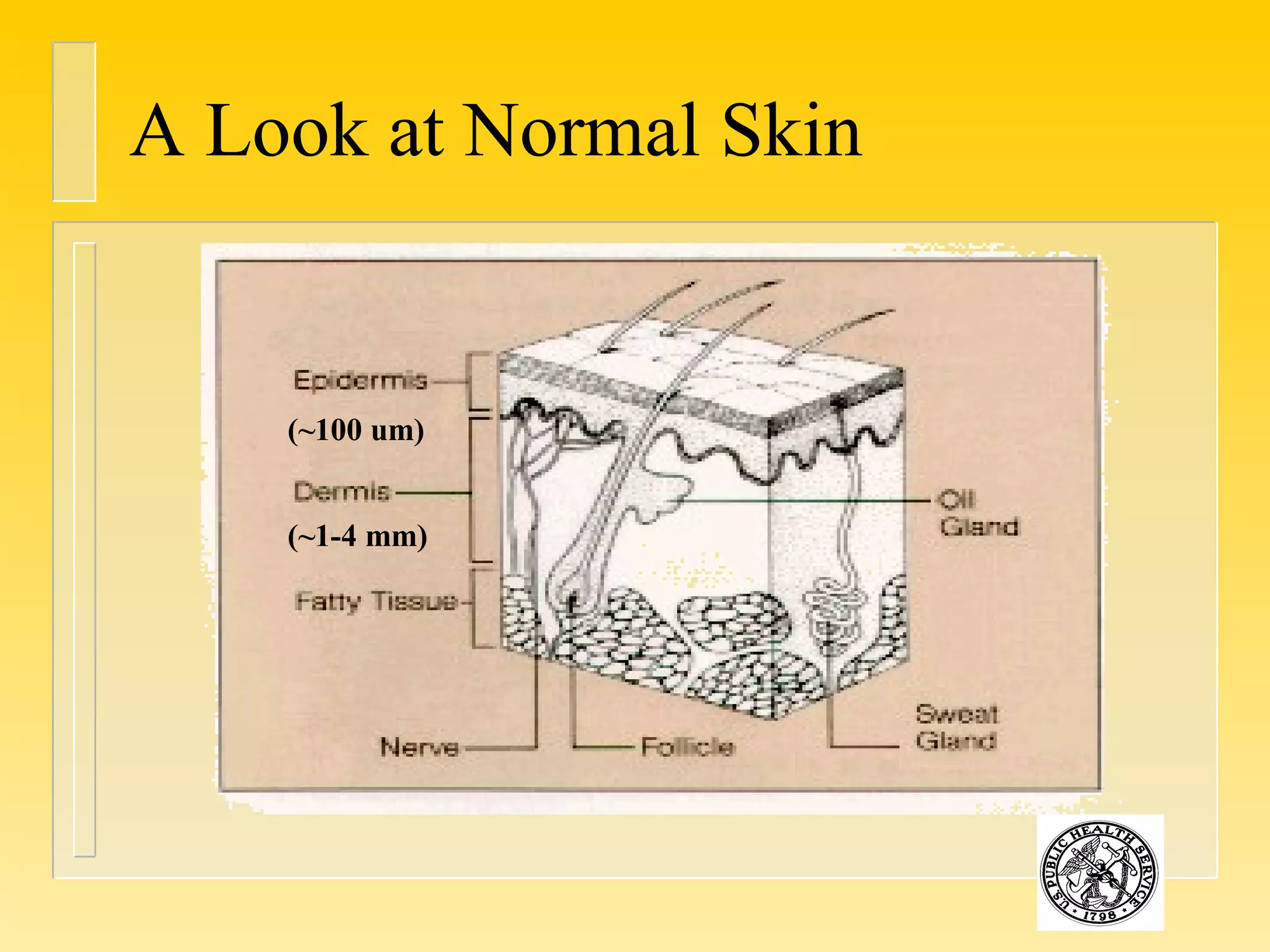
A Look at Normal Skin
(~100 um)
(~1-4 mm)
Federal Occupational Health 5
What Is Skin Cancer?
 An abnormal overgrowth (a tumor) of certain
types of skin cells in the epidermis that began as
normal skin structures.
 A tumor can be either benign (generally localized
and not life-threatening) or malignant (invasive or
spreading, and may be deadly).
 Skin cancer is a malignant tumor, able to invade
surrounding tissues and metastasize (or spread) to
other parts of the body, BUT…..
Is skin cancer deadly?
 … it depends on the type of skin cancer,
and how or if it’s treated, as we’ll discuss in
this session.
What causes skin cancer?

may be the main cause of
skin cancer.
 Artificially-produced UV radiation, such as
from sunlamps and tanning booths, also can
cause skin cancer.
 Predisposition (genetics).
 Chemicals (e.g., trivalent inorganic arsenic).
Ultraviolet radiation
 UVB rays (290-320 nm) are more likely than
UVA rays (400-320 nm) to cause sunburn.
 But, UVA rays pass deeper into the skin.
 UVB radiation is thought to be the cause of
melanoma and other types of skin cancer.
 UVA radiation may cause skin damage that can
lead to skin cancer and cause premature aging of
the skin.
Primary types
Pre-cancerous
-Actinic keratosis
Cancerous
-Basal cell carcinoma
-Squamous cell carcinoma
-Melanoma
-Others (of the specialized structures of the skin)
Actinic keratosis
 A pre-cancerous condition of thick, scaly
patches of sun-damaged skin. Also referred
to as solar or senile keratosis.
Basal Cell Carcinoma
 A type of skin cancer that arises from the basal
cells, small round cells found in the lower part (or
base) of the epidermis, the outer layer of the skin.
Basal Cell Carcinoma
 Basal cell carcinoma accounts for more than
90 percent of all skin cancers in the United
States.
 It is a slow-growing cancer that seldom
spreads to other parts of the body, and
generally is readily treatable.
 May erode into surrounding structures if not
treated.
Basal Cell Carcinoma
Three common presentations:
Small, smooth, pale,
or waxy shiny lump
Firm, red lump A lump that bleeds or
develops a crust
Squamous Cell Carcinoma
 Cancer that begins in squamous cells, which are
thin, flat cells that look like fish scales.
 Squamous cells are found in the tissue that forms
the surface of the skin.
 Also found on other
internal and external
body surfaces.
Squamous Cell Carcinoma
 More than 250,000 new cases of squamous
cell carcinoma diagnosed each year.
 Often develop from sun damaged areas
called solar or actinic keratosis.
 Look similar to basal cell carcinoma, and
even actinic keratosis.
Squamous Cell Carcinoma
 Similar in appearance to actinic keratosis
and basal cell carcinoma.
Melanoma
 A form of skin cancer that arises in melanocytes,
the cells that produce pigment and also are found
in the epidermis.
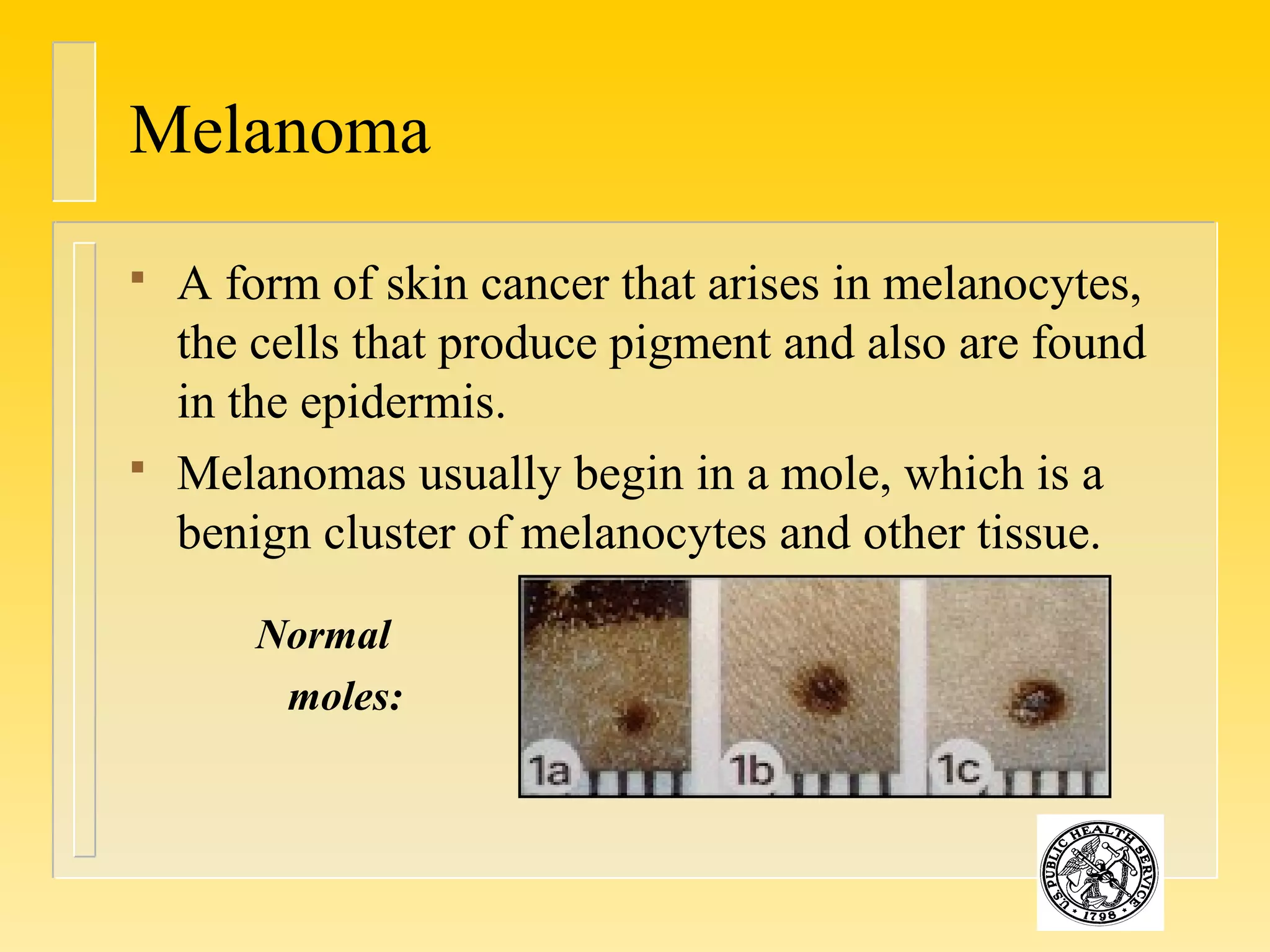
 Melanomas usually begin in a mole, which is a
benign cluster of melanocytes and other tissue.
Normal
moles:
Melanoma
 Melanoma is the deadliest form of skin
cancer, causing more than 75% of all skin
cancer deaths.
 About 53,600 people in the United States
were diagnosed with a melanoma skin.
cancer in 2002, and approximately 7,400
died from the disease.
Melanoma (the A-B-C and Ds)
Asymmetry -- The shape of one half does not match
the other.
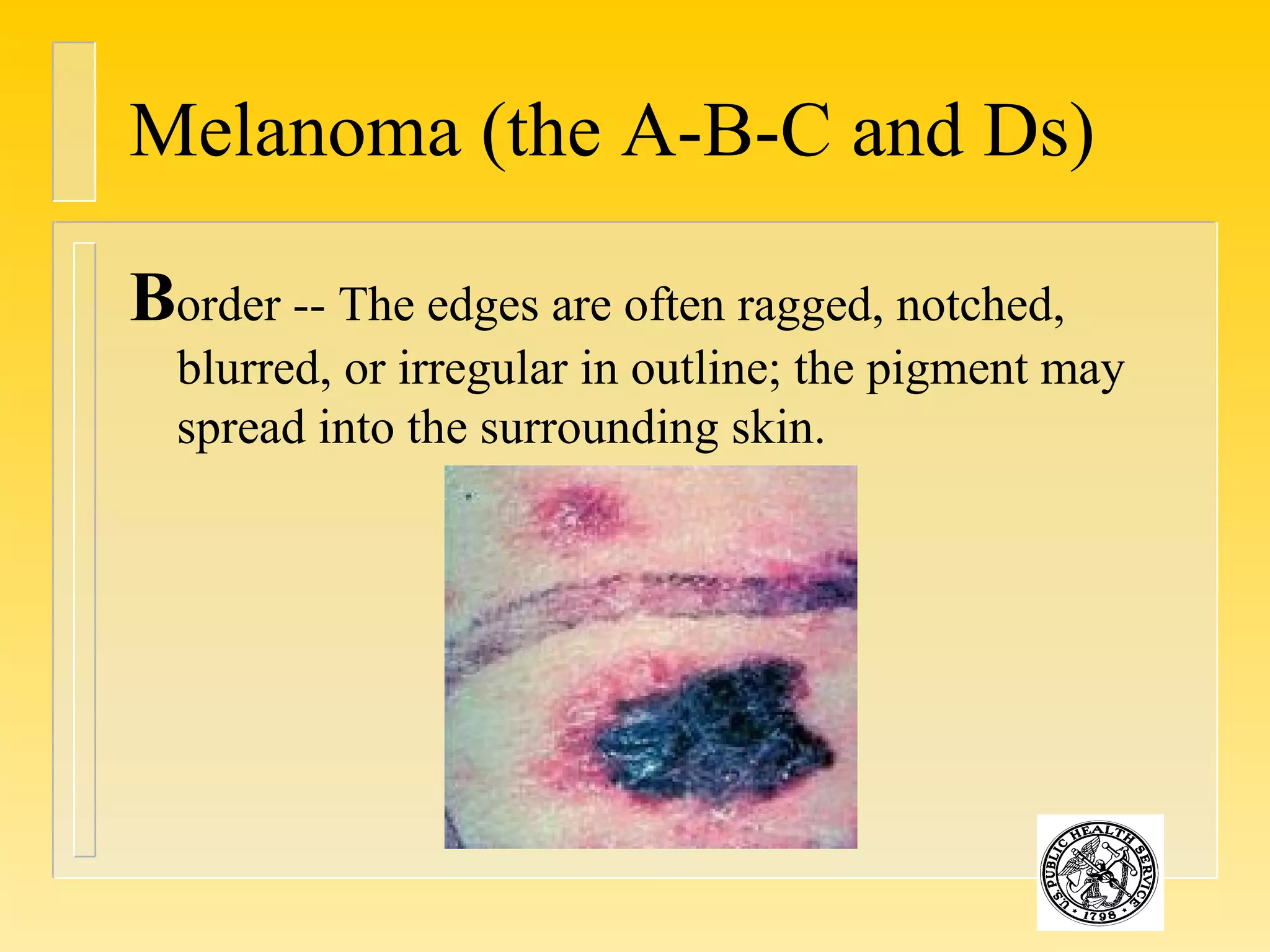
Melanoma (the A-B-C and Ds)
Border -- The edges are often ragged, notched,
blurred, or irregular in outline; the pigment may
spread into the surrounding skin.
Melanoma (the A-B-C and Ds)
Color -- The color is uneven. Shades of black,
brown, and tan may be present. Areas of white,
grey, red, pink, or blue also may be seen.
Melanoma (the A-B-C and Ds)
Diameter -- There is a change in size, usually an
increase. Melanomas are usually larger than the
eraser of a pencil (5 mm or 1/4 inch).
Melanoma
May be found when a pre-existing mole changes:
Early changes
- forming a new black area
- newly formed fine scales
- itching in a mole
More advanced changes
- texture changes (becomes hard or lumpy)
- itch, ooze, or bleed
- usually do not cause pain
Who is at risk for skin cancer?
 Light skin color, hair color, eye color.
 Family history of skin cancer.
 Personal history of skin cancer.
 Certain types and a large number of moles.
 Freckles, which indicate sun sensitivity and sun
damage.
 Chronic exposure to the sun.
 History of sunburns early in life.
Sunburns are common
The Behavior Risk Factor Surveillance
System provided data showing nearly 32%
of all adults in the US report having had a
sunburn in 1999.
More than 57% of adults age 18 to 29
reported having had a sunburn.
Over 40% of children are reported to have
had sunburns over the preceding year.
How is it found?
 Mostly by self examination of the skin
 By observations by family members
 By skin examination during visits to the doctor
To catch it early, you have to LOOK for it!…
and then you have to DO something about it!
How is skin cancer treated?
The physician will:
 Determine what type it is (medical history,
examination, biopsy)
 Determine how localized or extensive it is
 Then treat it….
 surgery (e.g., Moh’s, cryo, laser, curettage, grafts)
 chemotherapy
 radiation
How can it be prevented?
Pick your parents very carefully!
 While genetics isn’t the primary factor, having your
parents keep you from getting sunburns as a child is
important.
 Too late for that? Keep your kids from getting sunburns.
 Too late even for that? (Try to) keep their kids from
getting sunburns.
 And, limit further overexposure and damage to
your own skin.
Why?
Because ongoing, excess UV light is harmful even
for adults:
 Probably leads to more skin cancer, plus….
 Skin damage
 Cataracts and other eye disorders
 Immune system suppression
Skin Damage
 Actinic keratosis
 Hyperplasia (thickening), leathery skin
 Solar degeneration, such as…
– Wrinkles
– Atrophy (thinning skin)
– Pigmented and non-pigmented spots
– Elastin breakdown (sagging skin)
Cataracts and other eye disorders
UV radiation increases the likelihood of:
 Cataracts
 Pterygium (i.e., tissue growth that can block vision)
 Skin cancer around the eyes
 Degeneration of the macula
Immune System Suppression
 Overexposure to UV radiation may
suppress proper functioning of the body's
immune system and the skin's natural
defenses
How to limit sun damage to skin?
 Avoid exposure to the midday sun
(10 a.m. to 2 p.m. standard time, or
11 a.m. to 3 p.m. daylight saving time)
 Wear protective clothing
(sun hats, long sleeves, long pants)
 Apply and renew sunscreens
(those with an SPF of 15 to 30 block most of the
sun's harmful rays)
 Use UVA- and UVB-blocking sunglasses
 Watch the UV Index for your area
What else?
 Don’t try to self diagnose!
 Be sure your physician does a skin examination
when you have a physical.
 See your physician if you find a new mole, or a
sore that doesn’t heal, or a change in the
appearance of any skin feature.

Doi03sem skc skin_cancer.khomeini

  • 1.
    1 SKIN CANCER PREVENTION &IDENTIFICATION Dr.Khomeini SpB
  • 2.
    Overview  This sessionwill provide the participant with a quick overview of skin cancer, and how it relates to those who work in the Department of the Interior.  We’ll cover what it is, what causes it, how to spot it early if it occurs, some treatment options, and what can be done to prevent it. Please see the “References” slide for more information, and the excellent sources for much of this presentation
  • 3.
    Why is skincancer important?  It’s the most common type of cancer in the United States;  about 40 to 50 percent of Americans who live to age 65 will be diagnosed with it, at least once;  it’s found in more than 1 million Americans each year;  it will kill nearly 8,000 people;  …. and it is largely preventable.
  • 4.
    A Look atNormal Skin (~100 um) (~1-4 mm)
  • 5.
    Federal Occupational Health5 What Is Skin Cancer?  An abnormal overgrowth (a tumor) of certain types of skin cells in the epidermis that began as normal skin structures.  A tumor can be either benign (generally localized and not life-threatening) or malignant (invasive or spreading, and may be deadly).  Skin cancer is a malignant tumor, able to invade surrounding tissues and metastasize (or spread) to other parts of the body, BUT…..
  • 6.
    Is skin cancerdeadly?  … it depends on the type of skin cancer, and how or if it’s treated, as we’ll discuss in this session.
  • 7.
    What causes skincancer?  may be the main cause of skin cancer.  Artificially-produced UV radiation, such as from sunlamps and tanning booths, also can cause skin cancer.  Predisposition (genetics).  Chemicals (e.g., trivalent inorganic arsenic).
  • 8.
    Ultraviolet radiation  UVBrays (290-320 nm) are more likely than UVA rays (400-320 nm) to cause sunburn.  But, UVA rays pass deeper into the skin.  UVB radiation is thought to be the cause of melanoma and other types of skin cancer.  UVA radiation may cause skin damage that can lead to skin cancer and cause premature aging of the skin.
  • 9.
    Primary types Pre-cancerous -Actinic keratosis Cancerous -Basalcell carcinoma -Squamous cell carcinoma -Melanoma -Others (of the specialized structures of the skin)
  • 10.
    Actinic keratosis  Apre-cancerous condition of thick, scaly patches of sun-damaged skin. Also referred to as solar or senile keratosis.
  • 11.
    Basal Cell Carcinoma A type of skin cancer that arises from the basal cells, small round cells found in the lower part (or base) of the epidermis, the outer layer of the skin.
  • 12.
    Basal Cell Carcinoma Basal cell carcinoma accounts for more than 90 percent of all skin cancers in the United States.  It is a slow-growing cancer that seldom spreads to other parts of the body, and generally is readily treatable.  May erode into surrounding structures if not treated.
  • 13.
    Basal Cell Carcinoma Threecommon presentations: Small, smooth, pale, or waxy shiny lump Firm, red lump A lump that bleeds or develops a crust
  • 14.
    Squamous Cell Carcinoma Cancer that begins in squamous cells, which are thin, flat cells that look like fish scales.  Squamous cells are found in the tissue that forms the surface of the skin.  Also found on other internal and external body surfaces.
  • 15.
    Squamous Cell Carcinoma More than 250,000 new cases of squamous cell carcinoma diagnosed each year.  Often develop from sun damaged areas called solar or actinic keratosis.  Look similar to basal cell carcinoma, and even actinic keratosis.
  • 16.
    Squamous Cell Carcinoma Similar in appearance to actinic keratosis and basal cell carcinoma.
  • 17.
    Melanoma  A formof skin cancer that arises in melanocytes, the cells that produce pigment and also are found in the epidermis.  Melanomas usually begin in a mole, which is a benign cluster of melanocytes and other tissue. Normal moles:
  • 18.
    Melanoma  Melanoma isthe deadliest form of skin cancer, causing more than 75% of all skin cancer deaths.  About 53,600 people in the United States were diagnosed with a melanoma skin. cancer in 2002, and approximately 7,400 died from the disease.
  • 19.
    Melanoma (the A-B-Cand Ds) Asymmetry -- The shape of one half does not match the other.
  • 20.
    Melanoma (the A-B-Cand Ds) Border -- The edges are often ragged, notched, blurred, or irregular in outline; the pigment may spread into the surrounding skin.
  • 21.
    Melanoma (the A-B-Cand Ds) Color -- The color is uneven. Shades of black, brown, and tan may be present. Areas of white, grey, red, pink, or blue also may be seen.
  • 22.
    Melanoma (the A-B-Cand Ds) Diameter -- There is a change in size, usually an increase. Melanomas are usually larger than the eraser of a pencil (5 mm or 1/4 inch).
  • 23.
    Melanoma May be foundwhen a pre-existing mole changes: Early changes - forming a new black area - newly formed fine scales - itching in a mole More advanced changes - texture changes (becomes hard or lumpy) - itch, ooze, or bleed - usually do not cause pain
  • 24.
    Who is atrisk for skin cancer?  Light skin color, hair color, eye color.  Family history of skin cancer.  Personal history of skin cancer.  Certain types and a large number of moles.  Freckles, which indicate sun sensitivity and sun damage.  Chronic exposure to the sun.  History of sunburns early in life.
  • 25.
    Sunburns are common TheBehavior Risk Factor Surveillance System provided data showing nearly 32% of all adults in the US report having had a sunburn in 1999. More than 57% of adults age 18 to 29 reported having had a sunburn. Over 40% of children are reported to have had sunburns over the preceding year.
  • 26.
    How is itfound?  Mostly by self examination of the skin  By observations by family members  By skin examination during visits to the doctor To catch it early, you have to LOOK for it!… and then you have to DO something about it!
  • 27.
    How is skincancer treated? The physician will:  Determine what type it is (medical history, examination, biopsy)  Determine how localized or extensive it is  Then treat it….  surgery (e.g., Moh’s, cryo, laser, curettage, grafts)  chemotherapy  radiation
  • 28.
    How can itbe prevented? Pick your parents very carefully!  While genetics isn’t the primary factor, having your parents keep you from getting sunburns as a child is important.  Too late for that? Keep your kids from getting sunburns.  Too late even for that? (Try to) keep their kids from getting sunburns.  And, limit further overexposure and damage to your own skin.
  • 29.
    Why? Because ongoing, excessUV light is harmful even for adults:  Probably leads to more skin cancer, plus….  Skin damage  Cataracts and other eye disorders  Immune system suppression
  • 30.
    Skin Damage  Actinickeratosis  Hyperplasia (thickening), leathery skin  Solar degeneration, such as… – Wrinkles – Atrophy (thinning skin) – Pigmented and non-pigmented spots – Elastin breakdown (sagging skin)
  • 31.
    Cataracts and othereye disorders UV radiation increases the likelihood of:  Cataracts  Pterygium (i.e., tissue growth that can block vision)  Skin cancer around the eyes  Degeneration of the macula
  • 32.
    Immune System Suppression Overexposure to UV radiation may suppress proper functioning of the body's immune system and the skin's natural defenses
  • 33.
    How to limitsun damage to skin?  Avoid exposure to the midday sun (10 a.m. to 2 p.m. standard time, or 11 a.m. to 3 p.m. daylight saving time)  Wear protective clothing (sun hats, long sleeves, long pants)  Apply and renew sunscreens (those with an SPF of 15 to 30 block most of the sun's harmful rays)  Use UVA- and UVB-blocking sunglasses  Watch the UV Index for your area
  • 34.
    What else?  Don’ttry to self diagnose!  Be sure your physician does a skin examination when you have a physical.  See your physician if you find a new mole, or a sore that doesn’t heal, or a change in the appearance of any skin feature.