
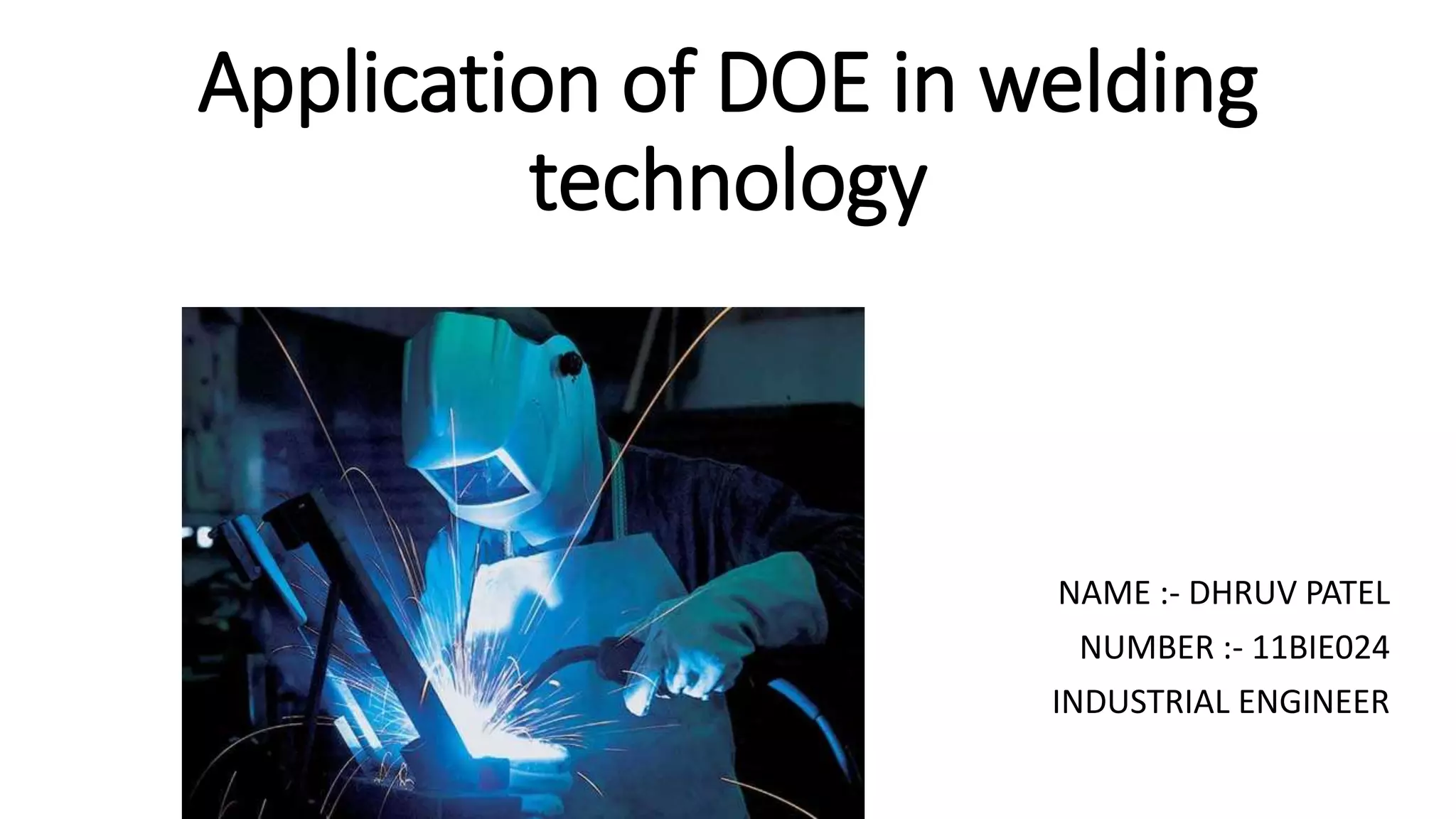

Application of DOE in welding 
technology 
NAME :- DHRUV PATEL 
NUMBER :- 11BIE024 
INDUSTRIAL ENGINEER
Design of Expriment 
• This techniques enables designers to determine simultaneously the 
individual and interactive effects of many effect that could affect the 
output result in any design. 
• DOE is systematic approach to engineering problem solving that 
applies principles and techniques at the data collection stage so as to 
ensure the generation of valid engineering conclusion.
Why industrial engineer have to study the 
DOE? 
• Push quality issue further and further high. 
• Need to focus on quality management. 
• Continously study on process purformance
Exprimentation 
• A test or a series of tests in which purposeful changes are made to 
input variables of a process or system to observe and identify the 
reasons for changes that may be observed in the output response. 
• It is plays an important role in 1) product design 
2) product development 
3) product improvement 
• Complexity :- because k factor and p response then k*p entites are 
there. 
• Experimental error :- when the variability is not expressed by known 
influences then it is experimental error.
Types of DOE methods 
1. Full factorial method 
2. Fraction factorial method 
3. One factor at a time 
4. Taguchi’s experimental design 
5. Six-sigma 
6. Annova 
7. Latin square 
8. screening
Full factorial design 
• Study of two or more factor effect then factorial design are the most 
efficient way of doing this. 
• Widely used in manufacturing company. 
• Full factorial have 22 and 23 factorial design. 23 means 2 is the level 
and 3 is the factor. 
• Using this method we can find… 
1. Main effect 
2. Effect which influence variability 
3. Minimizing the variability 
4. Way to achieve target value
22 factorial design 
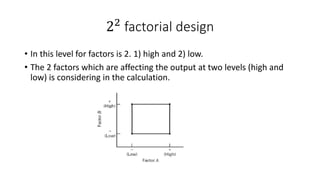
• In this level for factors is 2. 1) high and 2) low. 
• The 2 factors which are affecting the output at two levels (high and 
low) is considering in the calculation.
23 factorial design 
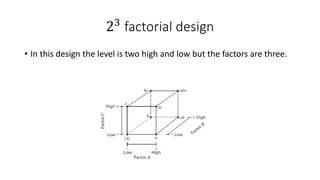
• In this design the level is two high and low but the factors are three.
Fraction factorial design 
• When the factors which are affecting is more than two then we have 
to go for the fraction factorial method. 
• In this design the confounding concept is used. In confounding 
method we know that one factor is confounded by another factor or 
factors. 
• Generally the 27−4 and 24−1 models are used in experiment. 
• Need for fraction factorial :- when the 24 design is there then the 4 
factors are affecting and there is 2 level so there is total 16 replicate 
we have to observe so it is not economic. To reduce the replicates we 
have to apply the fraction factorial. so the no. of replicate is 8 (in this 
case it is half fraction factorial).
Annova 
• Analysis of variances 
• Why we use? :- to test appropriate hypothesis about the treatment 
mean and to estimate the treatment mean. 
• Assumption :- model errors are assumed to be normally and 
independently distributed random variable with mean zero and 
variance σ2. Variance being constant for all level of the factor. 
• This method is based on the calculation of sum of squares, mean 
square and the f-table. 
• If the f-value is fall between the f-table then we have to accept the 
null hypothesis.
Taguchi method 
• Taguchi has found a new method of conducting the design of experiments 
which are based on well defined guidelines. This method uses a special set 
of arrays called orthogonal arrays. These standard arrays stipulates the way 
of conducting the minimal number of experiments which could give the full 
information of all the factors that affect the performance parameter. 
• Objective function :- 1) nominal is best 
2) larger is the best 
3) smaller is the best 
• According to the control factor we have to select the orthogonal array and 
conduct the experiment.
Welding process 
• Welding is a process of permanent joining two materials with suitable 
combination of temperature, pressure and metallurgical conditions. 
• Depending upon the combination of temperature and pressure a 
wide range of welding processes has been developed. 
• Classification of welding processes (based upon source of energy) 
1. Gas welding 
2. Arc welding 
3. Resistance welding 
4. Solid state welding 
5. Radiant energy welding
Types of welding processes 
• Oxyacetylene gas welding 
• Submerged arc welding 
• Sheet metal arc welding 
• Gas tungsten arc welding (TIG) 
• MIG welding 
• Plasma arc welding 
• Spot welding 
• Friction stir welding

Doe techniques

  • 1.
    Application of DOEin welding technology NAME :- DHRUV PATEL NUMBER :- 11BIE024 INDUSTRIAL ENGINEER
  • 2.
    Design of Expriment • This techniques enables designers to determine simultaneously the individual and interactive effects of many effect that could affect the output result in any design. • DOE is systematic approach to engineering problem solving that applies principles and techniques at the data collection stage so as to ensure the generation of valid engineering conclusion.
  • 3.
    Why industrial engineerhave to study the DOE? • Push quality issue further and further high. • Need to focus on quality management. • Continously study on process purformance
  • 4.
    Exprimentation • Atest or a series of tests in which purposeful changes are made to input variables of a process or system to observe and identify the reasons for changes that may be observed in the output response. • It is plays an important role in 1) product design 2) product development 3) product improvement • Complexity :- because k factor and p response then k*p entites are there. • Experimental error :- when the variability is not expressed by known influences then it is experimental error.
  • 5.
    Types of DOEmethods 1. Full factorial method 2. Fraction factorial method 3. One factor at a time 4. Taguchi’s experimental design 5. Six-sigma 6. Annova 7. Latin square 8. screening
  • 6.
    Full factorial design • Study of two or more factor effect then factorial design are the most efficient way of doing this. • Widely used in manufacturing company. • Full factorial have 22 and 23 factorial design. 23 means 2 is the level and 3 is the factor. • Using this method we can find… 1. Main effect 2. Effect which influence variability 3. Minimizing the variability 4. Way to achieve target value
  • 7.
    22 factorial design • In this level for factors is 2. 1) high and 2) low. • The 2 factors which are affecting the output at two levels (high and low) is considering in the calculation.
  • 8.
    23 factorial design • In this design the level is two high and low but the factors are three.
  • 9.
    Fraction factorial design • When the factors which are affecting is more than two then we have to go for the fraction factorial method. • In this design the confounding concept is used. In confounding method we know that one factor is confounded by another factor or factors. • Generally the 27−4 and 24−1 models are used in experiment. • Need for fraction factorial :- when the 24 design is there then the 4 factors are affecting and there is 2 level so there is total 16 replicate we have to observe so it is not economic. To reduce the replicates we have to apply the fraction factorial. so the no. of replicate is 8 (in this case it is half fraction factorial).
  • 10.
    Annova • Analysisof variances • Why we use? :- to test appropriate hypothesis about the treatment mean and to estimate the treatment mean. • Assumption :- model errors are assumed to be normally and independently distributed random variable with mean zero and variance σ2. Variance being constant for all level of the factor. • This method is based on the calculation of sum of squares, mean square and the f-table. • If the f-value is fall between the f-table then we have to accept the null hypothesis.
  • 11.
    Taguchi method •Taguchi has found a new method of conducting the design of experiments which are based on well defined guidelines. This method uses a special set of arrays called orthogonal arrays. These standard arrays stipulates the way of conducting the minimal number of experiments which could give the full information of all the factors that affect the performance parameter. • Objective function :- 1) nominal is best 2) larger is the best 3) smaller is the best • According to the control factor we have to select the orthogonal array and conduct the experiment.
  • 12.
    Welding process •Welding is a process of permanent joining two materials with suitable combination of temperature, pressure and metallurgical conditions. • Depending upon the combination of temperature and pressure a wide range of welding processes has been developed. • Classification of welding processes (based upon source of energy) 1. Gas welding 2. Arc welding 3. Resistance welding 4. Solid state welding 5. Radiant energy welding
  • 13.
    Types of weldingprocesses • Oxyacetylene gas welding • Submerged arc welding • Sheet metal arc welding • Gas tungsten arc welding (TIG) • MIG welding • Plasma arc welding • Spot welding • Friction stir welding