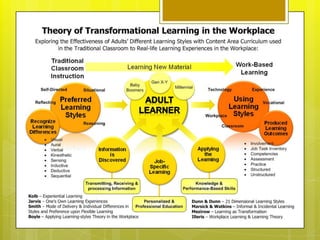
Theory of          Theoretical
Transformational   Framework &
Learning in the    Qualitative
Workplace          Data
                   Larry Weas
                   ETR745x
                   Northern Illinois University
                   Adult & Higher Education
Introduction to project

 Purpose  statement
 Research questions
 Research design
 Participants
 Setting
 Data collection procedures
Purpose Statement
 Compare the differences of adult learning
 styles among three cohort groups (Baby
 Boomers, Generation Xers and the Millennials),
 understand the motivating factors of various
 multi-generational cohorts in the classroom
 and the workplace.
Research Questions
   Why learning styles are important for adult
    learners in the workplace?

   A second question focuses on identifying
    adult learners in the workplace compared to
    traditional classroom learning, and, what are
    some of the critical elements for making that
    learning experience successful with adult
    learners today?
Research Design
 Grounded Theory Approach

     Grounded theory research is mostly done
      through observation, conversation, and
      interview.
     The researcher takes different cases, in
      which the variables interact as a unit to
      produce certain outcomes.
Research Design
Comparative Analysis
  Social units of any size
  Comparative analysis is a general method,
   just as are experimental and statistical
   methods.
  Four stages – Constant Comparison:
      (1) comparing incidents applicable to each
       category
      (2) integrating categories and their properties
      (3) delimiting the theory, and
      (4) writing the theory.
Participants
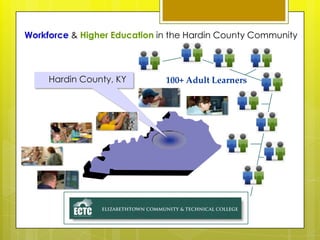
 Over 100+ participants from three multi-
 generational age groups (Baby Boomer,
 Generation X-Y, and the Millennials) in a rural
 community in Hardin County, Kentucky.
 The selected individuals for this study consist of a
 variety of educators, instructors, students,
 employers and employees from the Workforce
 Department. Each of the candidates
 participated in higher education programs at
 the Elizabethtown Community & Technical
 College (ECTC), Elizabethtown, KY.
Setting: Mix &Match of Adult Learners
     Different generations in the classroom and
      workforce
     Different learning characteristics
     Different approaches to learning
     Different ways that the generations prefer to
      learn
     Appropriate learning environment
     Effective teaching strategies
Participants
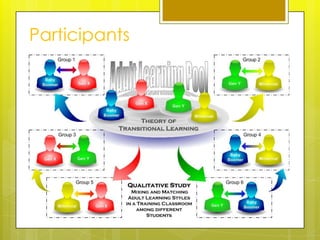
Workforce & Higher Education in the Hardin County Community


     Hardin County, KY        100+ Adult Learners
Data Collection Procedures
  Data  sampled and coded intended to identify
   adults’ different learning styles from three
   samples of multi-generational groups
  Assigned and compared among six sub-
   categories of preferred learning styles. The
   data sampled, coded and, analyzed looked
   at attitudes toward the use of adult learning
   styles in the classroom as well as the
   workplace.
  Memoing the data on the different learning
   styles and expectations, there is the realization
   between adult learning styles and data others
   have concluded in their own interviews.
Major theorists/theories
    Mezirow’s transformational learning

    Kolb's experiential learning

    Jarvis’ potential learning experiences

    Illeris’ Three Dimensions of Learning: cognitive,
     emotional, and social

    Knowles’ andragogy, self-direction in learning and
     adult education and learning

    Smith’s individual differences in learning styles
Key/core concepts

 ‘Productive  Learning’ and ‘Pedagogy of
  Vocational Education’
 Self-directed Learning
 Experiences are a rich resource for learning.
 Awareness of specific learning needs
  generated by real-life events
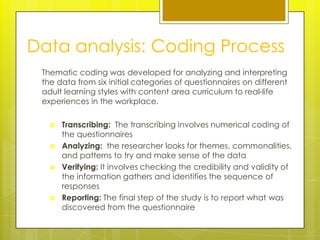
Data analysis: Coding Process
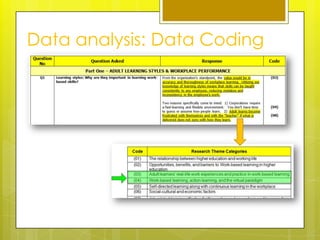
 Thematic coding was developed for analyzing and interpreting
 the data from six initial categories of questionnaires on different
 adult learning styles with content area curriculum to real-life
 experiences in the workplace.

      Transcribing: The transcribing involves numerical coding of
       the questionnaires
      Analyzing: the researcher looks for themes, commonalities,
       and patterns to try and make sense of the data
      Verifying: It involves checking the credibility and validity of
       the information gathers and identifies the sequence of
       responses
      Reporting: The final step of the study is to report what was
       discovered from the questionnaire
Data analysis: Codes
Codes: Coding used for the interviews
 Code                                                                         Research Theme Categories
  (01)   The relationship between higher education and working life
  (02)   Opportunities, benefits, and barriers to Work-based learning in higher education
  (03)   Adult learners’ real-life work experiences and practice in work-based learning
  (04)   Work-based learning, action learning, and the virtual paradigm
  (05)   Self-directed learning along with continuous learning in the workplace
  (06)   Social-cultural and economic factors
  (07)   Job-related training effective for the worker and co-workers and learning from work
  (08)   Challenges and Support for Work-based Learning
  (09)   The use of learning theories in the design of work-based learning
  (10)   Compare and contrast adult learning styles in the classroom to experiences
  (11)   Relevant learning styles for work-related knowledge and skills competencies
  (12)   Rethinking learning styles, expectations, and needs to meet the challenges and shape Corporate America for the 21st Century Workforce
  (13)   Relationship of Learning Styles and Work-based Learning
  (14)   Relationship of Learning in the Classroom and Working Life
  (15)   Continuous and Self-directed Learning in the Workplace
  (16)   Learning Theory vs. Practice
  (17)   Classroom Learning Styles with Work-based Learning
  (18)   Learning Criteria for Work-based Learning in the Workplace
  (19)   Improving Work Performance through Work-based Learning
  (20)   Benefits from Work-based Learning in Higher Education
  (21)   Relevancy of Work-based Learning in the Workplace
  (22)   Implications to Work-based Learning
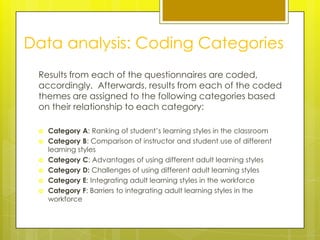
Data analysis: Coding Categories
 Results from each of the questionnaires are coded,
 accordingly. Afterwards, results from each of the coded
 themes are assigned to the following categories based
 on their relationship to each category:

    Category A: Ranking of student’s learning styles in the classroom
    Category B: Comparison of instructor and student use of different
     learning styles
    Category C: Advantages of using different adult learning styles
    Category D: Challenges of using different adult learning styles
    Category E: Integrating adult learning styles in the workforce
    Category F: Barriers to integrating adult learning styles in the
     workforce
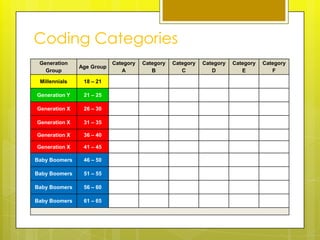
Coding Categories
 Generation                Category   Category   Category   Category   Category   Category
               Age Group
   Group                      A          B          C          D          E          F

 Millennials    18 – 21

Generation Y    21 – 25

Generation X    26 – 30

Generation X    31 – 35

Generation X    36 – 40

Generation X    41 – 45

Baby Boomers    46 – 50

Baby Boomers    51 – 55

Baby Boomers    56 – 60

Baby Boomers    61 – 65
Data analysis: Assertion
“Learners in the workforce are always using their
learning styles in different areas of work. People
want to be able to use their skill set as compared
to classroom learning for some they may consider
it very traditional in learning competency-based
skills. However, in the traditional classroom setting,
adult learners continue to accept a learning
responsibility to learn the subject-matter as it
pertains to their career path.”
Data analysis: Data Coding
Questions & discussion


Thank you!

Doctoral Research Theoretical Framework

  • 1.
    Theory of Theoretical Transformational Framework & Learning in the Qualitative Workplace Data Larry Weas ETR745x Northern Illinois University Adult & Higher Education
  • 2.
    Introduction to project Purpose statement  Research questions  Research design  Participants  Setting  Data collection procedures
  • 3.
    Purpose Statement Comparethe differences of adult learning styles among three cohort groups (Baby Boomers, Generation Xers and the Millennials), understand the motivating factors of various multi-generational cohorts in the classroom and the workplace.
  • 4.
    Research Questions  Why learning styles are important for adult learners in the workplace?  A second question focuses on identifying adult learners in the workplace compared to traditional classroom learning, and, what are some of the critical elements for making that learning experience successful with adult learners today?
  • 5.
    Research Design GroundedTheory Approach  Grounded theory research is mostly done through observation, conversation, and interview.  The researcher takes different cases, in which the variables interact as a unit to produce certain outcomes.
  • 6.
    Research Design Comparative Analysis  Social units of any size  Comparative analysis is a general method, just as are experimental and statistical methods.  Four stages – Constant Comparison:  (1) comparing incidents applicable to each category  (2) integrating categories and their properties  (3) delimiting the theory, and  (4) writing the theory.
  • 7.
    Participants Over 100+participants from three multi- generational age groups (Baby Boomer, Generation X-Y, and the Millennials) in a rural community in Hardin County, Kentucky. The selected individuals for this study consist of a variety of educators, instructors, students, employers and employees from the Workforce Department. Each of the candidates participated in higher education programs at the Elizabethtown Community & Technical College (ECTC), Elizabethtown, KY.
  • 8.
    Setting: Mix &Matchof Adult Learners  Different generations in the classroom and workforce  Different learning characteristics  Different approaches to learning  Different ways that the generations prefer to learn  Appropriate learning environment  Effective teaching strategies
  • 9.
  • 10.
    Workforce & HigherEducation in the Hardin County Community Hardin County, KY 100+ Adult Learners
  • 11.
    Data Collection Procedures  Data sampled and coded intended to identify adults’ different learning styles from three samples of multi-generational groups  Assigned and compared among six sub- categories of preferred learning styles. The data sampled, coded and, analyzed looked at attitudes toward the use of adult learning styles in the classroom as well as the workplace.  Memoing the data on the different learning styles and expectations, there is the realization between adult learning styles and data others have concluded in their own interviews.
  • 12.
    Major theorists/theories  Mezirow’s transformational learning  Kolb's experiential learning  Jarvis’ potential learning experiences  Illeris’ Three Dimensions of Learning: cognitive, emotional, and social  Knowles’ andragogy, self-direction in learning and adult education and learning  Smith’s individual differences in learning styles
  • 13.
    Key/core concepts  ‘Productive Learning’ and ‘Pedagogy of Vocational Education’  Self-directed Learning  Experiences are a rich resource for learning.  Awareness of specific learning needs generated by real-life events
  • 15.
    Data analysis: CodingProcess Thematic coding was developed for analyzing and interpreting the data from six initial categories of questionnaires on different adult learning styles with content area curriculum to real-life experiences in the workplace.  Transcribing: The transcribing involves numerical coding of the questionnaires  Analyzing: the researcher looks for themes, commonalities, and patterns to try and make sense of the data  Verifying: It involves checking the credibility and validity of the information gathers and identifies the sequence of responses  Reporting: The final step of the study is to report what was discovered from the questionnaire
  • 16.
    Data analysis: Codes Codes:Coding used for the interviews Code Research Theme Categories (01) The relationship between higher education and working life (02) Opportunities, benefits, and barriers to Work-based learning in higher education (03) Adult learners’ real-life work experiences and practice in work-based learning (04) Work-based learning, action learning, and the virtual paradigm (05) Self-directed learning along with continuous learning in the workplace (06) Social-cultural and economic factors (07) Job-related training effective for the worker and co-workers and learning from work (08) Challenges and Support for Work-based Learning (09) The use of learning theories in the design of work-based learning (10) Compare and contrast adult learning styles in the classroom to experiences (11) Relevant learning styles for work-related knowledge and skills competencies (12) Rethinking learning styles, expectations, and needs to meet the challenges and shape Corporate America for the 21st Century Workforce (13) Relationship of Learning Styles and Work-based Learning (14) Relationship of Learning in the Classroom and Working Life (15) Continuous and Self-directed Learning in the Workplace (16) Learning Theory vs. Practice (17) Classroom Learning Styles with Work-based Learning (18) Learning Criteria for Work-based Learning in the Workplace (19) Improving Work Performance through Work-based Learning (20) Benefits from Work-based Learning in Higher Education (21) Relevancy of Work-based Learning in the Workplace (22) Implications to Work-based Learning
  • 17.
    Data analysis: CodingCategories Results from each of the questionnaires are coded, accordingly. Afterwards, results from each of the coded themes are assigned to the following categories based on their relationship to each category:  Category A: Ranking of student’s learning styles in the classroom  Category B: Comparison of instructor and student use of different learning styles  Category C: Advantages of using different adult learning styles  Category D: Challenges of using different adult learning styles  Category E: Integrating adult learning styles in the workforce  Category F: Barriers to integrating adult learning styles in the workforce
  • 18.
    Coding Categories Generation Category Category Category Category Category Category Age Group Group A B C D E F Millennials 18 – 21 Generation Y 21 – 25 Generation X 26 – 30 Generation X 31 – 35 Generation X 36 – 40 Generation X 41 – 45 Baby Boomers 46 – 50 Baby Boomers 51 – 55 Baby Boomers 56 – 60 Baby Boomers 61 – 65
  • 19.
    Data analysis: Assertion “Learnersin the workforce are always using their learning styles in different areas of work. People want to be able to use their skill set as compared to classroom learning for some they may consider it very traditional in learning competency-based skills. However, in the traditional classroom setting, adult learners continue to accept a learning responsibility to learn the subject-matter as it pertains to their career path.”
  • 20.
  • 21.