Combating Workplace Ageism
                                       Larry Weas
         Adult & Higher Education, Ed. D. Program
                       Northern Illinois University
Article Introduction

     Combating Workplace Ageism
     Author(s): Reio, T. G., Jr. & Sanders-Reio, J.
     Source: Adult Learning, v11 n1 p10-13 Fall 1999
     Age discrimination in the workplace is widespread
     and often based on stereotypes. Research has
     demonstrated that older workers learn and perform
     well. Adult educators should eliminate ways in which
     educational practices perpetuate ageism, raise
     awareness of it in the workplace, and help older
     workers continue learning.
An Investigation


• An investigation of decision making on training
  scenarios, the researchers gave business students
  in their 20’s an exercise in which they were to
  make decisions about the imaginary employees of
  a fictitious company.
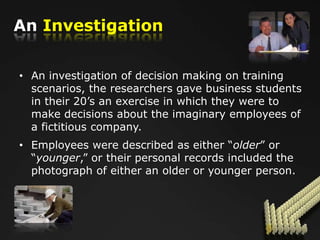
• Employees were described as either “older” or
  “younger,” or their personal records included the
  photograph of either an older or younger person.
Ageism is Widespread

According to a study conducted by the National
Council of Aging, more than 50% of the
employers surveyed believe that older workers
cannot perform as well as younger workers.


                Question: Do you think this is
                because adult learning has become
                technology-based in the workplace?
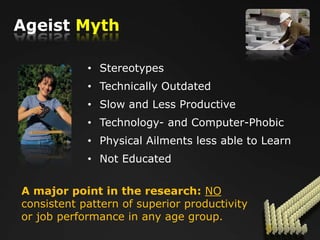
Ageist Myth

            • Stereotypes
            • Technically Outdated
            • Slow and Less Productive
            • Technology- and Computer-Phobic
            • Physical Ailments less able to Learn
            • Not Educated


A major point in the research: NO
consistent pattern of superior productivity
or job performance in any age group.
Adult Workers learn & perform well
    • First: Those who are 45 and older, perform well

    • Second: Adults want to learn new things

    • Third: Older adults are also just as able to learn

    • Fourth: Younger students do better
      when older students are around, at
      least in Higher Education “old dogs”

               • Fifth: Adult workers tend to
                 have many characteristics that
                 are valuable to employers
A Historical Perspective

       “The social realities of race, gender,
       class, ethnicity and religion [have]
       restricted access to opportunities.”

       Stubblefield and Keane (1994)
How Adult Education Serves
to Perpetuate Ageism


 • Adult Education as the engine of change in
   the workplace, with technology as the fuel

 • “Appropriate” basic skills training
What can we do?

 • Modelling more appropriate attitudes
   toward older workers…

 • Appropriate teaching behaviours…

 • Challenge older learners to achieve…

 • Diverse learning environments…
Ageism and the Workplace:
How Bad Is it….
Question: Ageism?

 In support of this article…


            …is Ageism a problem of
            generational
            miscommunication, or even a
            lack of communication
            altogether?
Thank you!


                900


        Over-qualified…

Ageism In the Workplace

  • 1.
    Combating Workplace Ageism Larry Weas Adult & Higher Education, Ed. D. Program Northern Illinois University
  • 2.
    Article Introduction Combating Workplace Ageism Author(s): Reio, T. G., Jr. & Sanders-Reio, J. Source: Adult Learning, v11 n1 p10-13 Fall 1999 Age discrimination in the workplace is widespread and often based on stereotypes. Research has demonstrated that older workers learn and perform well. Adult educators should eliminate ways in which educational practices perpetuate ageism, raise awareness of it in the workplace, and help older workers continue learning.
  • 3.
    An Investigation • Aninvestigation of decision making on training scenarios, the researchers gave business students in their 20’s an exercise in which they were to make decisions about the imaginary employees of a fictitious company. • Employees were described as either “older” or “younger,” or their personal records included the photograph of either an older or younger person.
  • 4.
    Ageism is Widespread Accordingto a study conducted by the National Council of Aging, more than 50% of the employers surveyed believe that older workers cannot perform as well as younger workers. Question: Do you think this is because adult learning has become technology-based in the workplace?
  • 5.
    Ageist Myth • Stereotypes • Technically Outdated • Slow and Less Productive • Technology- and Computer-Phobic • Physical Ailments less able to Learn • Not Educated A major point in the research: NO consistent pattern of superior productivity or job performance in any age group.
  • 6.
    Adult Workers learn& perform well • First: Those who are 45 and older, perform well • Second: Adults want to learn new things • Third: Older adults are also just as able to learn • Fourth: Younger students do better when older students are around, at least in Higher Education “old dogs” • Fifth: Adult workers tend to have many characteristics that are valuable to employers
  • 7.
    A Historical Perspective “The social realities of race, gender, class, ethnicity and religion [have] restricted access to opportunities.” Stubblefield and Keane (1994)
  • 8.
    How Adult EducationServes to Perpetuate Ageism • Adult Education as the engine of change in the workplace, with technology as the fuel • “Appropriate” basic skills training
  • 9.
    What can wedo? • Modelling more appropriate attitudes toward older workers… • Appropriate teaching behaviours… • Challenge older learners to achieve… • Diverse learning environments…
  • 10.
    Ageism and theWorkplace: How Bad Is it….
  • 11.
    Question: Ageism? Insupport of this article… …is Ageism a problem of generational miscommunication, or even a lack of communication altogether?
  • 12.
    Thank you! 900 Over-qualified…