Course: Adult Education (835)
Semester: Autumn, 2019
Assignment No. 1
Q. 1 Discuss the purposes of adult education and how adult Education can contribute to
national development?
Adult Education is a practice in which adults engage in systematic and sustained self–educating
activities in order to gain new forms of knowledge, skills, attitudes, or values. It can mean any
form of learning adults engage in beyond traditional schooling, encompassing basic literacy to
personal fulfillment as a lifelong learner. In particular, adult education reflects a specific
philosophy about learning and teaching based on the assumption that adults can and want to learn,
that they are able and willing to take responsibility for that learning, and that the learning itself
should respond to their needs. Driven by what one needs or wants to learn, the available
opportunities, and the manner in which one learns, adult learning is affected by demographics,
globalization and technology. The learning happens in many ways and in many contexts just as all
adults' lives differ. Adult learning can be in any of the three contexts, i.e.,
 Formal:- Structured learning that typically takes place in an education or training
institution, usually with a set curriculum and carries credentials;
 Non-formal:- Learning that is organized by educational institutions but non credential.
Non-formal learning opportunities may be provided in the workplace and through the
activities of civil society organizations and groups;
 Informal:- Learning that goes on all the time, resulting from daily life activities related to
work, family, community or leisure (e.g. community baking class).
The joy of learning doesn’t come to a screeching halt after we leave school or university; we
continue to pick up new things every single day, whether it’s ascertaining a mind-blowing fact
from a nature documentary or learning how to react to a new situation.
Learning is for life, not just for childhood, and adult education can equip us with the know-how,
skills and confidence to advance our career or make life-changing decisions. With flexible learning
options readily available including online, distance, workplace and local campus sessions, building
on existing knowledge has never been easier as it’s today.
Following is a list of the important benefits of upskilling and continuous learning as an adult:
1. Personal development:- Seeking to learn new skills and develop new ideas is a process of
self-improvement. Learning can not only give us a clearer idea of who we are as a person
Course: Adult Education (835)
Semester: Autumn, 2019
and where our interests really lie, but can also add more dimensions to our character and
help us reach our full potential.
2. Professional development:- Our career constitutes an enormous part of our life, so
professional development is equally important as personal growth. It’s impossible to learn
everything we need to know for our entire working life at the beginning of our career.
Learning new skills can bring an outdated skill set into thest century, help secure us a
promotion and open up new opportunities that might not have been available to us before.
3. Confidence Booster:- Learning is empowering. It gives us the chance to discover things
we’re good at and expand our skills portfolio, thereby boosting our self-esteem and giving
us a sense of pride from our achievements. Learning across our life span can enable us to
make well-informed decisions, give us a better idea of what to do with our life and give
us a sense of fulfilment. The social aspect of learning can also drive our confidence
through the roof!
4. Improves Well-being:- It’s no secret that learning can drastically improve our quality of
life; picking up new skills and developing new talents can widen our interests, give us a
sense of purpose and fulfilment, protect against poor mental health and increase autonomy.
Additionally, learning can add to our resume and make us more appealing to employers,
which could bring economic benefits in the form of additional income.
5. Provides networking opportunities:- Upskilling gives us the opportunity to network and
build relationships in both a professional and personal capacity. For example, enrolling in
a VET qualification will give us contact with experienced consultants in the field and
fellow learners with professional interests in a similar capacity. We might even make some
new friends!
6. Boosts Economic Growth:- Adult education helps in making our economy grow and
develop faster.
7. It enables us to support and respect cultural diversity.
8. It ensures that our children develop a love of learning and take full advantage of education.
Q. 2 Discuss the information-processing model. To what extent this model is effective in
learning?
Faculty members in higher education are involved in many instructional design activities without
formal training in learning theories and the science of instruction. Learning theories provide the
foundation for the selection of instructional strategies and allow for reliable prediction of their
Course: Adult Education (835)
Semester: Autumn, 2019
effectiveness. To achieve effective learning outcomes, the science of instruction and instructional
design models are used to guide the development of instructional design strategies that elicit
appropriate cognitive processes. Here, the major learning theories are discussed and selected
examples of instructional design models are explained. The main objective of this article is to
present the science of learning and instruction as theoretical evidence for the design and delivery
of instructional materials. In addition, this article provides a practical framework for implementing
those theories in the classroom and laboratory.
ALMOST ALL FACULTY MEMBERS who teach in higher education as subject matter experts lack
formal training in the science of instruction and instructional design, even though they routinely
design instructional materials. That is, faculty members are involved in instructional design
activities that mostly lack scientific underpinning and proper documentation (13, 25). In contrast
to subject matter experts, instructional designers are formally trained to use several instructional
design models that have been developed for systematic planning and the development of
instruction. These systematic processes in designing instruction are aimed at increasing
instructional efficiency and facilitating student learning. In that respect, design models translate
the general principles of learning and instruction to provide a procedural framework for developing
instructional materials and creating an environment for successful learning outcomes.
Although there are many different design models available, all of them include the following
essential phases of instructional design: analysis, design, development, implementation, and
evaluation phases. The designer's main task is to perform instructional analysis to determine
instructional goals, develop instructional strategies, and develop and conduct an evaluation to
assess and revise instructional materials. Like instructional designers, faculty members also use
aspects of instructional design. They consider the program objectives to identify their session
objectives, develop learning activities to reach these objectives, and assess learners' progress
toward achieving those objectives. However, faculty activities in planning educational experiences
or designing educational investigation should be guided and supported by the science of learning
and instruction.
The main objectives of this article are to present the theoretical evidence for the design and delivery
of instructional materials and to provide a practical framework for implementing those theories in
the classroom and laboratory. Three sections are included to present the science of learning and
related learning theories, the science of instruction, and a framework for implementation.
Course: Adult Education (835)
Semester: Autumn, 2019
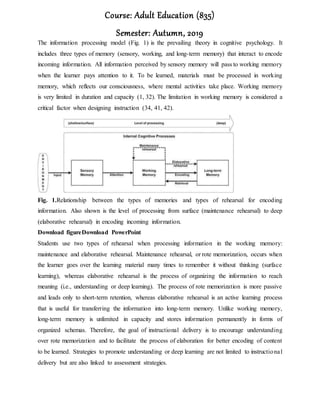
The information processing model (Fig. 1) is the prevailing theory in cognitive psychology. It
includes three types of memory (sensory, working, and long-term memory) that interact to encode
incoming information. All information perceived by sensory memory will pass to working memory
when the learner pays attention to it. To be learned, materials must be processed in working
memory, which reflects our consciousness, where mental activities take place. Working memory
is very limited in duration and capacity (1, 32). The limitation in working memory is considered a
critical factor when designing instruction (34, 41, 42).
Fig. 1.Relationship between the types of memories and types of rehearsal for encoding
information. Also shown is the level of processing from surface (maintenance rehearsal) to deep
(elaborative rehearsal) in encoding incoming information.
Download figureDownload PowerPoint
Students use two types of rehearsal when processing information in the working memory:
maintenance and elaborative rehearsal. Maintenance rehearsal, or rote memorization, occurs when
the learner goes over the learning material many times to remember it without thinking (surface
learning), whereas elaborative rehearsal is the process of organizing the information to reach
meaning (i.e., understanding or deep learning). The process of rote memorization is more passive
and leads only to short-term retention, whereas elaborative rehearsal is an active learning process
that is useful for transferring the information into long-term memory. Unlike working memory,
long-term memory is unlimited in capacity and stores information permanently in forms of
organized schemas. Therefore, the goal of instructional delivery is to encourage understanding
over rote memorization and to facilitate the process of elaboration for better encoding of content
to be learned. Strategies to promote understanding or deep learning are not limited to instructional
delivery but are also linked to assessment strategies.
Course: Adult Education (835)
Semester: Autumn, 2019
Domains of learning.
Gagné (9) identified the five domains of learning that affect the learning process: 1) motor skills, 2)
verbal information, 3) intellectual skills, 4) cognitive strategies, and 5) attitudes. Motor skills
require repetitive practice to master and include such examples as taking a pulse, the introduction
of a nasal tube, and performing dissection in the laboratory. Verbal information refers to the factual
knowledge and principles in the curriculum, and their learning requires organized presentation and
meaningful context. Intellectual skills are the elaboration of basic concepts and rules, the learning
of which is based on prior assimilation of prerequisite skills. The subcategories of intellectual skills
are discrimination (e.g., distinguish between an isometric and isotonic contraction), concrete
concepts (e.g., identify the differences between the cerebrospinal fluid and plasma), defined
concepts (e.g., classifying the different groups of sensory nerve fibers), rule learning (e.g.,
calculating the pulse pressure and mean arterial pressure), and higher order rules (e.g., problem
solving). A simple example to illustrate the difference between verbal information and intellectual
skills is that to recall the definition of creatinine clearance is verbal information; however, using
the Cockcroft-Gault equation to estimate creatinine clearance to assess the function of the kidneys
is an intellectual skill.
Cognitive strategies are internally organized skills that control learning behaviors, remembering,
and thinking, which are learned by practice. Learners develop these strategies by reflecting on their
own experiences or they may be taught effective learning strategies. Attitudes are considered to be
in the affective domain and are not learned by practice. Changing attitudes requires human
modeling with reinforcement and feedback. Attitudes affect a student's motivation to learn. For
example, a student with a positive attitude and interest in physiology will regularly attend
physiology classes.
The main message in recognizing the different domains of learning is that different instructional
concepts require the selection of different instructional strategies and different methods of
assessment. The selection of only one teaching method to deliver all physiology sessions in the
curriculum introduces unnecessary limitations that might negatively affect the learning outcomes.
Learning theories.
Ertmer and Newby (6, 8) nicely explained the importance of linking instructional strategies or
techniques to the theories of human learning. They indicated that learning theories are considered
a source of verifying instructional strategies as well as a foundation for the selection of specific
Course: Adult Education (835)
Semester: Autumn, 2019
strategies. The theories provide information about the relationships among strategies, context, and
learner characteristics for better integration, and, most importantly, learning theories allow for
reliable prediction of the effectiveness of the selected instructional strategies.
Behaviorism, cognitivism, and constructivism are the three primary learning theories (6, 8, 43).
The general characteristics of these theories are shown in Table 1. The three theories differ in how
learning is defined, which subsequently leads to different roles for the learners, and dictates that
different teaching methods and assessment strategies are used.
Q. 3 Discuss the need for planning and organization of adult education and what measures
should a planner take for planning adult education?
In 1984, the issue of adult literacy was highlighted in Illiterate America, a best-selling book by
Jonathan Kozol. The book pointed out that most estimates placed at 20 to 25 the percentage of
Americans reading and writing below the level needed to function in the society. Illiterate America
caused a sensation, and moved government to pay more attention to the issue. The National Adult
Literacy Study (NALS) was ultimately established by the Bush administration, and in 1993
published a report that confirmed the fact that there was a problem with the literacy rate in a
country that had always considered itself nearly 100% literate.
For individuals, lack of basic skills can lead to unemployment or low-paying, dead-end jobs; to
status as permanent political outsiders, with no opportunity to have their voices heard; and to the
possibility of watching their children repeat the cycle. For your local area, low literacy levels can
affect economic development, diminish the effectiveness of local government and citizen
participation, and place a heavy financial and educational burden on the school system. For all
these reasons, many communities support adult literacy programs. This section provides some
information about adult literacy and some guidance about how to plan an adult literacy program.
The next section will help you to actually get your program started in the community.
WHAT IS ADULT LITERACY?
This may seem like a simple question to answer -- adults being able to read and write, right? - but
in fact educators have been puzzling and arguing over it for at least a hundred years. It encompasses
reading and writing, of course, but at what level? A hundred years ago, people were considered
literate if they could write their names, a qualification that would certainly be woefully inadequate
today. And what about math? To be literate, do you have to be able to at least add, subtract,
multiply, and divide, so you can balance your checkbook and figure your gas mileage? Do you
need a certain amount of general knowledge in order to be literate? A lot of educators who use the
Course: Adult Education (835)
Semester: Autumn, 2019
term "cultural literacy" think so. How about people who can't speak or read or write English: are
they literate, if they can read and write in their own language? And do you have an obligation to
help learners understand how to use their literacy?
CO MPO N EN TS O F ADULT LITERACY
As you can see, adult literacy can be looked at in a number of different ways. In planning an adult
literacy program, you have to consider all of them, and decide what your community needs and
what you have the resources to do. The areas that are generally referred to when adult literacy is
discussed are:
 Reading: "Functional literacy" is often defined as the ability to read at a particular grade
level.
 Writing: Written literacy might best be considered to be an individual's capacity to write
what she needs to in clear and reasonably accurate language.
 Math: "Numeracy" or "mathematical literacy" usually refers to the ability to perform the
basic mathematical operations - addition, subtraction, multiplication, division, and
whatever else - normally needed in everyday life.
 English as a Second or Other Language (ESOL): The teaching of English speaking,
listening, reading, and writing skills to those for whom it is not the native language.
 Cultural literacy: Familiarity with the background knowledge that is everywhere in
American culture. This can include everything from the great classics of western literature
to knowing the names of Elvis Presley hits from the '50's.
THE USES O F LITERACY
The uses of literacy also have to be considered in any discussion about the subject. Mark Twain
said that someone who can read and won't is considerably worse off than someone who can't read,
because the latter can be taught to read, while the former is stuck in ignorance. It is the use of a
skill that matters: there may be many athletes with the potential of a Michael Jordan, but only one
of them developed his basketball skill to the point where he was considered the best in the world.
So what do adults want to use literacy skills for? Sondra Stein, of the National Institute for Literacy
(NIFL), conducted a nationwide survey and reported the results in "Equipped for the Future." Adult
learners in literacy programs, asked why they were pursuing literacy skills, gave three equally
important reasons:
Course: Adult Education (835)
Semester: Autumn, 2019
 They wanted to improve their employment situations. Whether that meant gaining more
responsibility on their jobs, becoming more competent at what they did, being promoted,
finding a better job or career, or just being able to work at all, most learners felt that
improving their skills could lead to improving their work life and finances.
 They wanted to be better parents, spouses, and family members. Reading to children or
helping them with homework, keeping better contact with faraway relatives, even writing
love letters to husbands or wives were all cited as reasons for learning to read and write
better.
 They wanted to be better citizens, and to participate in the political life of their
communities. Learners wanted to be able to read about and understand the issues in
political campaigns or local controversies, so they could make their own reasoned
decisions, and wanted to be able to work in their communities to influence or change the
things they cared about.
As you plan an adult literacy program, you need to consider what learners want and need. Their
motivation comes not from what you think they should have, but from what they see as necessary
in their lives. Often, as learners gain competence and confidence, learning itself may become one
of their goals, and that is certainly to be encouraged. But don't lose sight of the fact that their lives
dictate the uses of their newly acquired skills.
Q. 4 Discuss the role of adult education in national development. And why do we need adult
education in Pakistan? Explain.
Education is a vital investment for human and economic development and is influenced by the
environment within which it exists. Changes in technology, labour market patterns and general
global environment, all require policy responses. Traditions, culture and faith all reflect upon the
education system and at the same time are also affected by them. The element of continuity and
change remains perpetual and it is up to the society to determine its pace and direction. We are
living in an inquiring and innovation-oriented society. The demand of twenty first century is
novelty, creativity, and integration of knowledge at global level, research, critical and analytical
thoughts. Rapidly social changes are creating uncertainty and complexity in the society. To
prepare the children and youth to cope with the present situation needs to develop analytical and
critical thinking, skill and attitude that would make them more flexible and innovative to deal
with uncertainty and crises at national and global level.
The greatest need of the hour is to re design curriculum, textbooks, teaching methodology and
children’s literature, formal and non-formal educational systems. It has been demonstrated by
Course: Adult Education (835)
Semester: Autumn, 2019
researcher that active learning (questioning and investigate the nature of topic) develop creativity
and stimulate for learning.
Cultural values of the majority of Pakistanis are derived from Islam. Since an education system
reflects and strengthens social, cultural and moral values, therefore, Pakistan’s educational
interventions have to be based on the core values of religion and faith.
Curriculum plays crucial role in national integration and harmony. Curriculum role as observed in
the National Education Policy (1979) should aim enable the learners to learn knowledge, develop
conceptual and intellectual skills, attitudes, values and aptitudes conductive to the all round
development of their personality and proportionate with the societal, economic and environmental
realities at national and international level.
Whitehead (1962) says “culture is the activity of thought, and receptiveness to beauty and humane
feeling”. A child is a human being in embryo, a man to be and we are responsible to the future for
him. It is considered that a child learns 90 percent of his personality by his nurturing.
It is, perhaps easier to educate a child in beginning than re-educated him when he has already
formed. Therefore, books for children are not simply a source of entertainment rather inculcate
intelligence and values. In Russia, America and Japan children’s literature is considered a great
cultural and educational phenomenon, and creation of books for children is responsibility of the
states. The manifest and latent functions of children’s literature is to transmit knowledge, myth,
mores, values, folkways, legendry personalities, superstitions and beliefs which are integral part
of a culture.
Textbooks are the most widely used as a teaching tool which represent our national culture.
Textbooks reveal our national values, culture, and ideology of a nation. A good text book can be
a “teacher in print”, and sometime even superior to an average teacher. In fact they are influence
towards national integration by sharing common national culture. The selection, organization and
presentation of subject matter in textbooks show philosophy, integrity, values and intellectual
thoughts of a nation.
Questioning methodology is a powerful tool to built analytical and critical skills in pupils. In the
world of knowledge the emphasis has not to be merely mastery to extant the knowledge but on the
acquisitions of capacity to think and analyze facts logically and conclude its own. Teachers must
adopt such teaching methodology by which students must learn how to discard old ideas and
replace them with modify ideas. As Toffler once said “learn how to learn”.
Q. 5 How would you differentiate between traditional literacy and functional literacy?
Explain.
Formally, availability of education for children has increased around the world over the last
decades. However, despite having a successful formal education career, adults can become
functional illiterates. Functional illiteracy means that a person cannot use reading, writing, and
Course: Adult Education (835)
Semester: Autumn, 2019
calculation skills for his/her own and the community’s development. Functional illiteracy has
considerable negative effects not only on personal development, but also in economic and social
terms. Although functional illiteracy has been highly publicized in mass media in the recent years,
there is limited scientific knowledge about the people termed functional illiterates; definition,
assessment, and differential diagnoses with respect to related numerical and linguistic impairments
are rarely studied and controversial. The first goal of our review is to give a comprehensive
overview of the research on functional illiteracy by describing gaps in knowledge within the field
and to outline and address the basic questions concerning who can be considered as functional
illiterates: (1) Do they possess basic skills? (2) In which abilities do they have the largest deficits?
(3) Are numerical and linguistic deficits related? (4) What is the fundamental reason for their
difficulties? (5) Are there main differences between functional illiterates, illiterates, and dyslexics?
We will see that despite partial evidence, there is still much research needed to answer these
questions. Secondly, we emphasize the timeliness for a new and more precise definition that results
in uniform sampling, better diagnosis, conclusion, and intervention. We propose the following
working definition as the result of the review: functional illiteracy is the incapability to understand
complex texts despite adequate schooling, age, language skills, elementary reading skills, and IQ.
These inabilities must also not be fully explained by sensory, domain-general cognitive,
neurological or mental disorders. In sum, we suggest that functional illiteracy must be more
thoroughly understood and assessed from a theoretical, empirical, and diagnostic perspective.
According to the recent literacy rate, 85% of the adult population in the world is literate, and
therefore worldwide about 757 million people are illiterate (UNESCO, 2015). Large-scale
assessments measuring literacy skills indicate that in developing countries, illiteracy is more
prevalent, while in developed countries, functional illiteracy is more prevalent (Bhola, 1995, p.
18). According to the Organization for Economic Co-operation and Development
(OECD), literacy is defined as follows:
“Literacy is defined as the ability to understand, evaluate, use, and engage with written texts to
participate in society, achieve one’s goals, and develop one’s knowledge and potential (OECD,
2013, p. 59).” More detailed, find other institutions, e.g., UNESCO.
Literacy and basic knowledge cannot be clearly separated from each other. Even though the term
“literacy” is a part of basic knowledge, it is a precondition as well as an outcome of basic
knowledge. Literacy may refer to the ability to read and write, but also to application-oriented
Course: Adult Education (835)
Semester: Autumn, 2019
basic knowledge that develops during the whole lifetime, not only during school years (Nickel,
2007).
Formal literacy has increased over the last decades. For instance, while in sub-Saharan Africa there
are still 29.8 million children who do not have access to education, this number represents a one-
quarter decrease from 2000. In contrast, in Europe “only” 0.7 million of children had never
attended school in 2011 (UNESCO, 2013). However, despite improvements in formal literacy,
many people still have problems understanding formal texts. On the one hand, this is a problem
because in today’s society, functioning literacy plays a significant role. It appears in every aspect
of daily life, e.g., opening bank accounts, reading ingredients of food products, understanding
medication or technical instructions, signing contracts, etc. (Cree et al., 2012). On the other hand,
this leads to fewer educational and employment opportunities and hinders living a successful life.
Possessing literacy has many benefits for individuals, families, communities, and nations. The
improvement in literacy levels has beneficial effects on individual (e.g., self-esteem), political
(e.g., democratic values), cultural (e.g., cultural openness), social (e.g., children’s health), and
economic (e.g., individual income) levels (UNESCO, 2006). On the other hand, functioning in a
society without literacy becomes more difficult: those who cannot acquire basic literacy skills have
fewer opportunities in every area of life (Cree et al., 2012).
About (Functional) Illiteracy
So far, we have talked about literacy. However, many people do not achieve literacy because of
inadequate schooling or even despite adequate schooling. On 1949, the United Nations
Educational, Scientific, and Cultural Organization (UNESCO) set the generalized functionality of
literacy. The acquisition of reading and writing was regarded as basic rights: people should be
enabled to become functionally literate in their own culture (Bhola, 1995). A need for a standard
and a workable definition materialized to differentiate between literates and non-literates
(illiterates) and also to distinguish various levels in between. The result of the demand was realized
at the General Conference of the UNESCO in 1978:
“A person is literate who can with understanding both read and write a short simple statement on
his everyday life.
A person is illiterate who cannot with understanding both read and write a short simple statement
on his everyday life.
Course: Adult Education (835)
Semester: Autumn, 2019
A person is functionally literate who can engage in all those activities in which literacy is required
for effective functioning of his group and community and also for enabling him to continue to use
reading, writing, and calculation for his own and the community’s development.
A person is functionally illiterate who cannot engage in all those activities in which literacy is
required for effective functioning of his group and community and also for enabling him to
continue to use reading, writing, and calculation for his own and the community’s development
(UNESCO, 1978, p.183).”
The difference between literate and illiterate people is explicit here: illiterates had never attended
school and are unable to read or write even single words while literates can (Reis and Castro-
Caldas, 1997).
In contrast with literacy and illiteracy, the difference between functional illiteracy, literacy and
illiteracy is not obvious enough. Functionality, which is the essence of the difference between
these terms, was never operationally defined. Recently, the number of functional illiterates in
Europe was estimated to be about 80 million, their proportion is lowest in Sweden with 8% and
highest in Portugal with 40% (e.g., in Eme, 2011; Grotlüschen and Riekmann, 2011a). However,
the frequently referred original International Adult Literacy Survey (IALS) report does not imply
functional illiteracy (OECD and Statistics Canada, 2000). Different definitions and different
diagnostic assessment standards can lead to fundamentally different epidemiological estimations,
so any estimations of functional illiteracy rates may be unreliable.
Go to:
Diagnostics of Functional Illiteracy: Different Approaches
As there is no explicit assessment for functional illiteracy, researchers had to find other techniques
to assess the number of functional illiterates or to identify functional illiterates for experimental
studies.
The UNESCO, the OECD and the IEA (International Association for the Evaluation of
Educational Achievement) measure literacy and other key knowledge skills of children, young
adults, and adults a large-scale, international assessment about strengths and weaknesses in
different countries. Research such as the IALS and the Adult Literacy and Life Skills Survey
(ALL) build on each other (Thorn, 2009; UNESCO, 2009). These kinds of international tests
generally measure literacy and numeracy skills in various ways, including mapping the whole
literacy spectrum and grouping the performance and the abilities into discrete levels. The
Course: Adult Education (835)
Semester: Autumn, 2019
international, supranational and national political actors are first interested in large-scale
assessments, not in individual diagnostics. Against this background, it is understandable (but
nevertheless at least unfortunate) that the diagnostic materials lack test criteria (reliability,
construct validity, criterion validity), which are demanded in standard individual diagnostic tests.
Course: Adult Education (835)
Semester: Autumn, 2019
Assignment No. 2
Q. 1 To what extent do you agree with the training of personnel involved in adult education?
Discuss the effect of not providing any training to them.
A 1981 study of worker safety and health training in the industrial nations begins by quoting the
French writer Victor Hugo: “No cause can succeed without first making education its ally” (Heath
1981). This observation surely still applies to occupational safety and health in the late twentieth
century, and is relevant to organization personnel at all levels.
As the workplace becomes increasingly complex, new demands have arisen for greater
understanding of the causes and means of prevention of accidents, injuries and illnesses.
Government officials, academics, management and labour all have important roles to play in
conducting the research that furthers this understanding. The critical next step is the effective
transmission of this information to workers, supervisors, managers, government inspectors and
safety and health professionals. Although education for occupational physicians and hygienists
differs in many respects from the training of workers on the shop floor, there are also common
principles that apply to all.
National education and training policies and practices will of course vary according to the
economic, political, social, cultural and technological background of the country. In general,
industrially advanced nations have proportionally more specialized occupational safety and health
practitioners at their disposal than do the developing nations, and more sophisticated education
and training programmes are available to these trained workers. More rural and less industrialized
nations tend to rely more on “primary health care workers”, who may be worker representatives
in factories or fields or health personnel in district health centres. Clearly, training needs and
available resources will vary greatly in these situations. However, they all have in common the
need for trained practitioners.
Course: Adult Education (835)
Semester: Autumn, 2019
This article provides an overview of the most significant issues concerning education and training,
including target audiences and their needs, the format and content of effective training and
important current trends in the field.
Target Audiences
In 1981, the Joint ILO/WHO Committee on Occupational Health identified the three levels of
education required in occupational health, safety and ergonomics as (1) awareness, (2) training for
specific needs and (3) specialization. These components are not separate, but rather are part of a
continuum; any person may require information on all three levels. The main target groups for
basic awareness are legislators, policy makers, managers and workers. Within these categories,
many people require additional training in more specific tasks. For example, while all managers
should have a basic understanding of the safety and health problems within their areas of
responsibility and should know where to go for expert assistance, managers with specific
responsibility for safety and health and compliance with regulations may need more intensive
training. Similarly, workers who serve as safety delegates or members of safety and health
committees need more than awareness training alone, as do government administrators involved
in factory inspection and public health functions related to the workplace.
Those doctors, nurses and (especially in rural and developing areas) nonphysician primary health
care workers whose primary training or practice does not include occupational medicine will need
occupational health education in some depth in order to serve workers, for example by being able
to recognize work-related illnesses. Finally, certain professions (for example, engineers, chemists,
architects and designers) whose work has considerable impact on workers’ safety and health need
much more specific education and training in these areas than they traditionally receive.
Specialists require the most intensive education and training, most often of the kind received in
undergraduate and postgraduate programmes of study. Physicians, nurses, occupational hygienists,
safety engineers and, more recently, ergonomists come under this category. With the rapid ongoing
developments in all of these fields, continuing education and on-the-job experience are important
components of the education of these professionals.
It is important to emphasize that increasing specialization in the fields of occupational hygiene and
safety has taken place without a commensurate emphasis on the interdisciplinary aspects of these
endeavours. A nurse or physician who suspects that a patient’s disease is work-related may well
need the assistance of an occupational hygienist to identify the toxic exposure (for example) in the
Course: Adult Education (835)
Semester: Autumn, 2019
workplace that is causing the health problem. Given limited resources, many companies and
governments often employ a safety specialist but not a hygienist, requiring that the safety specialist
address health as well as safety concerns. The interdependence of safety and health issues should
be addressed by offering interdisciplinary training and education to safety and health professionals.
Why Training and Education?
The primary tools needed to achieve the goals of reducing occupational injuries and illnesses and
promoting occupational safety and health have been characterized as the “three E’s”—engineering,
enforcement and education. The three are interdependent and receive varying levels of emphasis
within different national systems. The overall rationale for training and education is to improve
awareness of safety and health hazards, to expand knowledge of the causes of occupational illness
and injury and to promote the implementation of effective preventive measures. The specific
purpose and impetus for training will, however, vary for different target audiences.
Middle and upper level managers
The need for managers who are knowledgeable about the safety and health aspects of the
operations for which they are responsible is more widely acknowledged today than heretofore.
Employers increasingly recognize the considerable direct and indirect costs of serious accidents
and the civil, and in some jurisdictions, criminal liability to which companies and individuals may
be exposed. Although belief in the “careless worker” explanation for accidents and injuries
remains prevalent, there is increasing recognition that “careless management” can be cited for
conditions under its control that contribute to accidents and disease. Finally, firms also realize that
poor safety performance is poor public relations; major disasters like the one in the Union Carbide
plant in Bhopal (India) can offset years of effort to build a good name for a company.
Most managers are trained in economics, business or engineering and receive little or no
instruction during their formal education in occupational health or safety matters. Yet daily
management decisions have a critical impact on employee safety and health, both directly and
indirectly. To remedy this state of affairs, safety and health concerns have begun to be introduced
into management and engineering curricula and into continuing education programmes in many
countries. Further efforts to make safety and health information more widespread is clearly
necessary.
Course: Adult Education (835)
Semester: Autumn, 2019
First-line supervisors
Research has demonstrated the central role played by first-line supervisors in the accident
experience of construction employers (Samelson 1977). Supervisors who are knowledgeable about
the safety and health hazards of their operations, who effectively train their crew members
(especially new employees) and who are held accountable for their crew’s performance hold the
key to improving conditions. They are the critical link between workers and the firm’s safety and
health policies.
Employees
Law, custom and current workplace trends all contribute to the spread of employee education and
training. Increasingly, employee safety and health training is being required by government
regulations. Some apply to general practice, while in others the training requirements are related
to specific industries, occupations or hazards. Although valid evaluation data on the effectiveness
of such training as a countermeasure to work-related injuries and illnesses are surprisingly sparse
(Vojtecky and Berkanovic 1984-85); nevertheless the acceptance of training and education for
improving safety and health performance in many areas of work is becoming widespread in many
countries and companies.
The growth of employee participation programmes, self-directed work teams and shop floor
responsibility for decision-making has affected the way in which safety and health approaches are
taken as well. Education and training are widely used to enhance knowledge and skills at the level
of the line worker, who is now recognized as essential for the effectiveness of these new trends in
work organization. A beneficial action employers can take is to involve employees early on (for
example, in the planning and design stages when new technologies are introduced into a worksite)
to minimize and to anticipate adverse effects on the work environment.
Trade unions have been a moving force both in advocating more and better training for employees
and in developing and delivering curricula and materials to their members. In many countries,
safety committee members, safety delegates and works council representatives have assumed a
growing role in the resolution of hazard problems at the worksite and in inspection and advocacy
as well. Persons holding these positions all require training that is more complete and sophisticated
than that given to an employee performing a particular job.
Course: Adult Education (835)
Semester: Autumn, 2019
Safety and health professionals
The duties of safety and health personnel comprise a broad range of activities that differ widely
from one country to another and even within a single profession. Included in this group are
physicians, nurses, hygienists and safety engineers either engaged in independent practice or
employed by individual worksites, large corporations, government health or labour inspectorates
and academic institutions. The demand for trained professionals in the area of occupational safety
and health has grown rapidly since the 1970s with the proliferation of government laws and
regulations paralleling the growth of corporate safety and health departments and academic
research in this field.
Scope and Objectives of Training and Education
This ILO Encyclopaedia itself presents the multitude of issues and hazards that must be addressed
and the range of personnel required in a comprehensive safety and health programme. Taking the
large view, we can consider the objectives of training and education for safety and health in a
number of ways. In 1981, the Joint ILO/WHO Committee on Occupational Health offered the
following categories of educational objectives which apply in some degree to all of the groups
discussed thus far: (1) cognitive (knowledge), (2) psychomotor (professional skills) and (3)
affective (attitude and values). Another framework describes the “information–education–
training” continuum, roughly corresponding to the “what”, the “why” and the “how” of hazards
and their control. And the “empowerment education” model, to be discussed below, puts great
emphasis on the distinction between training—the teaching of competency-based skills with
predictable behavioural outcomes—and education—the development of independent critical
thinking and decision-making skills leading to effective group action (Wallerstein and Weinger
1992).
Workers need to understand and apply the safety procedures, proper tools and protective
equipment for performing specific tasks as part of their job skills training. They also require
training in how to rectify hazards that they observe and to be familiar with internal company
procedures, in accordance with the safety and health laws and regulations which apply to their area
of work. Similarly, supervisors and managers must be aware of the physical, chemical and
psychosocial hazards present in their workplaces as well as the social, organizational and industrial
relations factors that may be involved in the creation of these hazards and in their correction. Thus,
Course: Adult Education (835)
Semester: Autumn, 2019
gaining knowledge and skills of a technical nature as well as organizational, communication and
problem-solving skills are all necessary objectives in education and training.
In recent years, safety and health education has been influenced by developments in education
theory, particularly theories of adult learning. There are different aspects of these developments,
such as empowerment education, cooperative learning and participative learning. All share the
principle that adults learn best when they are actively involved in problem-solving exercises.
Beyond the transmission of specific bits of knowledge or skills, effective education requires the
development of critical thinking and an understanding of the context of behaviours and ways of
linking what is learned in the classroom to action in the workplace. These principles seem
especially appropriate to workplace safety and health, where the causes of hazardous conditions
and illnesses and injuries are often a combination of environmental and physical factors, human
behaviour and the social context.
In translating these principles into an education programme four categories of objectives must be
included:
Information objectives: the specific knowledge that trainees will acquire. For example, knowledge
of the effects of organic solvents on the skin and on the central nervous system.
Behavioural objectives: the competencies and skills that workers will learn. For example, the
ability to interpret chemical data sheets or to lift a heavy object safely.
Attitude objectives: the beliefs that interfere with safe performance or with response to training
that must be addressed. The belief that accidents are not preventable or that “solvents can’t hurt
me because I’ve worked with them for years and I’m fine” are examples.
Social action objectives: the ability to analyse a specific problem, identify its causes, propose
solutions and plan and take action steps to resolve it. For example, the task of analysing a particular
job where several people have sustained back injuries, and of proposing ergonomic modifications,
requires the social action of changing the organization of work through labour-management
cooperation.
Technological and Demographic Change
Training for awareness and management of specific safety and health hazards obviously depends
on the nature of the workplace. While some hazards remain relatively constant, the changes that
take place in the nature of jobs and technologies require continuous updating of training needs.
Falls from heights, falling objects and noise, for example, have always been and will continue to
Course: Adult Education (835)
Semester: Autumn, 2019
be prominent hazards in the construction industry, but the introduction of many kinds of new
synthetic building materials necessitates additional knowledge and awareness concerning their
potential for adverse health effects. Similarly, unguarded belts, blades and other danger points on
machinery remain common safety hazards but the introduction of industrial robots and other
computer-controlled devices requires training in new types of machinery hazards.
With rapid global economic integration and the mobility of multinational corporations, old and
new occupational hazards frequently exist side-by-side in both highly industrialized and
developing countries. In an industrializing country sophisticated electronics manufacturing
operations may be located next door to a metal foundry that still relies on low technology and the
heavy use of manual labour. Meanwhile, in industrialized countries, garment sweatshops with
miserable safety and health conditions, or lead battery recycling operations (with its threat of lead
toxicity) continue to exist alongside highly automated state-of-the-art industries.
The need for continual updating of information applies as much to workers and managers as it
does to occupational health professionals. Inadequacies in the training even of the latter is
evidenced by the fact that most occupational hygienists educated in the 1970s received scant
training in ergonomics; and even though they received extensive training in air monitoring, it was
applied almost exclusively to industrial worksites. But the single largest technological innovation
affecting millions of workers since that time is the widespread introduction of computer terminals
with visual display units (VDUs). Ergonomic evaluation and intervention to prevent
musculoskeletal and vision problems among VDU users was unheard of in the 1970s; by the mid-
nineties, VDU hazards have become a major concern of occupational hygiene. Similarly, the
application of occupational hygiene principles to indoor air quality problems (to remedy “tight/sick
building syndrome”, for example) has required a great deal of continuing education for hygienists
accustomed only to evaluating factories. Psychosocial factors, also largely unrecognized as
occupational health hazards before the 1980s, play an important role in the treatment of VDU and
indoor air hazards, and of many others as well. All parties investigating such health problems need
education and training in order to understand the complex interactions among environment, the
individual and social organization in these settings.
The changing demographics of the workforce must also be considered in safety and health training.
Women make up an increasing proportion of the workforce in both developed and developing
nations; their health needs in and out of the workplace must be addressed. The concerns of
Course: Adult Education (835)
Semester: Autumn, 2019
immigrant workers raise numerous new training questions, including those to do with language,
although language and literacy issues are certainly not limited to immigrant workers: varying
literacy levels among native-born workers must also be considered in the design and delivery of
training. Older workers are another group whose needs must be studied and incorporated into
education programmes as their numbers increase in the working population of many nations.
Q. 2 Explain the four-step processes in media selection rule and what do you understand by
media classification? Discuss.
You are creating advertising for a new product. To complete this task, you need to go through the
media planning process. Media planning in advertising is the making of decisions to deliver a
message to the target audience.
The Process
Now that you understand what media planning is, it is time to review the process. The process
includes:
 Market analysis
 Establishing the media objective
 Setting the strategy
 Implementation
 Evaluation and follow-up
Let's look at these steps in more detail.
Market Analysis
Performing a market analysis involves determining who your audience is. The audience is the
number and type of people your advertising targets. The audience can be classified according to
age, sex, income, occupation, etc. Performing this analysis will help you to project costs and
determine the right media for your campaign.
Establishing the Media Objective
The media objective is the goal of the media plan. To establish this objective, you must determine
your goal for reach, frequency, circulation, cost, and penetration. Reach is the amount of people
the message is in front of over a period of time. Frequency is the average number of times the
message is in front of those people. Circulation is used for printed advertisements. This is the
Course: Adult Education (835)
Semester: Autumn, 2019
number of prints that are produced and sent out. Cost is broken down into two different sections:
cost per thousand (CPM) and cost per person (CPP). It is important to understand the cost as you
are budgeting. The cost will tell you which form of media is the best option for your
business. Penetration is the number of audience members reached by the advertising. The company
must determine if it wants to take over a market or just reach a certain group prior to setting the
penetration goals and strategies.
Setting the Strategy
Now that you understand who you are marketing to and how much it will cost you, you will need
to make a decision about what type of media you will use. Some options include Internet,
television, radio, newspaper, consumer and business publications, and interactive media platforms.
Which option reaches the largest audience? How often will it reach the audience? Does it fit in
your budget?
Implementation
Now you have a plan. Now it's time to set it in motion. This is when you buy media. Media
buying is the purchasing of the space in the selected media. This involves committing to the media
provider, submitting the ad, and paying the bill. This is the exciting part. You see all your hard
work come together.
Evaluation and Follow-up
After everything is said and done, it is time to see how successful your media plan was. To do so,
you need to follow-up and evaluate the results. Ask yourself, 'Did we meet media objectives? How
successful were the strategies?' The success of this media plan will determine future media plans.
Q. 3 Critically examine different techniques of evaluation and how would you evaluate lesson
inputs? Explain
In a teaching and learning community, the most effective evaluation is that which encourages and
rewards effective teaching practices on the basis of student learning outcomes (Doherty et al.,
2002; Shapiro and Levine, 1999). Assessment of student learning at its best enables students to
identify their own strengths and weaknesses and to determine the kinds of information they need
to correct their learning deficiencies and misconceptions. When such evaluation is properly
employed, students learn that they can engage in self-assessment and continuous improvement of
performance throughout their lives.
Course: Adult Education (835)
Semester: Autumn, 2019
Accordingly, this chapter offers practical guidance to postsecondary faculty and administrators on
ways to institute a system of both evaluation and professional development that can contribute to
significant gains in teaching effectiveness for faculty who teach undergraduates. The chapter
describes how input from students (undergraduates and graduate teaching assistants), colleagues,
and faculty self-evaluation can be used for evaluating individual instructors. It also describes the
advantages and disadvantages of these various approaches.
The technique of outcomes assessment as a means of measuring student learning and the use of
that information to improve teaching are considered first. Additional strategies and methods for
formative evaluation follow. The chapter concludes with a series of suggestions for improving
summative evaluation of faculty. The committee emphasizes that the approaches described in this
chapter are but a sampling of the techniques that appear in the research literature on improving the
evaluation of teaching and student learning. They are
Assessment Is More Than Grades
To many, the word “assessment” simply means the process by which we assign students grades.
Assessment is much more than this, however. Assessment is a mechanism for providing
instructors with data for improving their teaching methods and for guiding and motivating
students to be actively involved in their own learning. As such, assessment provides important
feedback to both instructors and students.
Assessment Is Feedback for Both Instructors and Students
Assessment gives us essential information about what our students are learning and about the
extent to which we are meeting our teaching goals. But the true power of assessment comes in
also using it to give feedback to our students. Improving the quality of learning in our courses
involves not just determining to what extent students have mastered course content at the end of
the course; improving the quality of learning also involves determining to what extent students
are mastering content throughout the course.
One approach to improving student learning is outcome assessment—the process of providing
credible evidence that an instructor’s objectives have been obtained. Outcome assessment enables
faculty to determine what students know and can do as a result of instruction in a course module,
an entire course, or a sequence of courses. This information can be used to indicate to students
how successfully they have mastered the course content they are expected to assimilate. It can also
Course: Adult Education (835)
Semester: Autumn, 2019
be used to provide faculty and academic departments with guidance for improving instruction,
course content, and curricular structure. Moreover, faculty and institutions can use secondary
analysis of individual outcome assessments to demonstrate to prospective students, parents,
college administrators, employers, accreditation bodies, and legislators that a program of study
produces competent graduates (Banta, 2000).
Faculty members, both individually and as colleagues examining their department’s education
programs, have found the following activities helpful when undertaking outcome assessment:
 Developing expected student learning outcomes for an individual course of study,
including laboratory skills.
 Determining the point in a student’s education (e.g., courses, laboratories, and internships)
at which he/she should develop the specified knowledge and skills.
 Incorporating the specified learning outcomes in statements of objectives for the
appropriate courses and experiences.
 Selecting or developing appropriate assessment strategies to test student learning of the
specified knowledge and skills.
 Using the results from assessment to provide formative feedback to individual students and
to improve curriculum and instruction.
 Adjusting expected learning outcomes if appropriate and assessing learning again. Such a
process can lead to continual improvement of curriculum and instruction.
Faculty in STEM are challenged in their teaching by a set of circumstances that most faculty in
other disciplines do not encounter, such as designing laboratory and field components of courses,
incorporating modern technology into courses, or supervising students involved with original
research (see Chapter 2 for additional detail). However, faculty in these disciplines also have an
array of assessment methodologies from which to choose that address particular learning outcomes
(e.g., see Doherty et al., 2002). Student responses in each of the following formats can first be
studied for the information they provide about individual student learning and performance, and
then compared across students and classes for clues about the strengths and weaknesses of
curriculum and instruction:
 Classroom quizzes and exams
 Projects
 Poster presentations of library or laboratory research
Course: Adult Education (835)
Semester: Autumn, 2019
 Cooperative experiences
 Portfolios (collections of work)
 Standardized tests both within and across disciplines
 Student journals
 Questionnaires
 Interviews
 Focus groups
Q. 4 Explain the problems of administrative strategies for adult education
One very critical stage in the development of performance assessments is defining the domain of
knowledge, skills, and abilities that students will be expected to demonstrate. In her remarks, Mari
Pearlman said that in order to have reliable and valid assessments to compare students’ outcomes
across classes, programs, and states, a common domain must be used as the basis for the
assessment. This poses a challenge to the field of adult education because, as several speakers
pointed out, there is no consensus on the content to be assessed. As Ron Pugsley, Office of
Vocational and Adult Education of the Department of Education (DOEd), reminded participants,
Title II of the WIA specifies the core measures that states must use in reporting student progress,
but the content underlying these measures is not operationally defined in the same way by the
states and sometimes not even by all the programs within a state. In many testing programs, there
is a document (called a framework) that provides a detailed outline of the content and skills to be
assessed. But on the national level, no such document exists for adult education, and few states
have defined the universe of content for their adult basic education programs. Hence, the extent to
which specific literacy and numeracy skills are taught in a program can vary greatly depending on
the characteristics of the student population and available staff.
To address this variation in instructional content, the National Institute for Literacy (NIFL) began
the Equipped for the Future (EFF) initiative in 1993. Sondra Stein explained that NIFL used the
results of its survey of 1,500 adults to identify the themes of family, community, work, and lifelong
learning as the main purposes for which adults enroll in adult basic education programs (see Figure
6-1 for the EFF standards). NIFL then specified content standards for each theme and is now in
the process of developing performance assessments aligned with the content standards. Some
states (Maine, Ohio, Oregon, Tennessee, and Washington) have adopted the EFF framework and
are working with NIFL in the assessment development process, while others are in the process of
Course: Adult Education (835)
Semester: Autumn, 2019
developing their own assessments. Although EFF represents an important movement toward
common content for adult basic education programs, not all states have adopted its framework at
this time.
Computer-based assessment could also serve the two purposes, and it has the advantage of
providing rapid feedback to the student. According to Bob Bickerton and Donna Miller-Parker,
use of computer-based assessment in adult basic education has been limited because of
accessibility issues, costs, and training of staff. Henry Braun cautioned that it would be important
to determine the types of learners for whom this modality would be appropriate before initiating
its use for accountability purposes.
One factor that will need to be considered when performance assessments are used for
accountability is the process of calibrating the performance assessments to the scale used for the
NRS. Wendy Yen and Braun emphasized that a true calibration requires that the assessments be
based on the same domains. While the developers of the tests with benchmark scores specified in
the NRS attempted to calibrate their tests to the levels in ABE or ESL (depending on the test),
various workshop presenters said that the calibration process was not technically accurate. Yen
observed that these tests “have different content and have been developed under different criteria.”
She said that these conditions are not sufficient for the more stringent linking procedures such as
equating or calibration. These linking procedures require equivalence of test content and
examination of item and test statistics, among other things. Yen also noted that several National
Research Council (NRC) reports, such as Uncommon Measures: Equivalence and Linkage Among
Educational Tests (1999c) and Embedding Questions: The Pursuit of a Common Measure in
Uncommon Tests (1999a), have addressed the issue of linking results from different assessments.
She observed that linking issues will need to be addressed when performance assessments are used
to measure students’ movement on the NRS levels.
Some of the expenses are one-time costs and some recur with each administration. One-time costs
are those associated with initial implementation of the assessment. Recurring costs are the
expenses for ongoing item or task development, administering the test, and scoring examinees’
responses. As mentioned earlier in this report, the cost for scoring responses to performance
assessments or constructed-response questions is substantially higher than that for scoring
selected-response questions. In addition, costs for the development of these assessments can be
higher. Tasks used on performance assessments are easily memorized and, unlike selected-
Course: Adult Education (835)
Semester: Autumn, 2019
response items, often cannot be reused. Administration costs can also be hefty, given the time,
materials, and resources required to administer performance assessments.
Q. 5 Discuss the characteristics of a good training programme of adult education
When it comes to learning, adults are not over sized children. Maturity brings unique
characteristics that affect how adults are motivated to learn. By appealing to the unique qualities
of adult learners, we can design more effective and motivating online courses. Here’s a list of
generalized characteristics common to many but not all adult learners.
 Autonomy. Adults typically prefer a sense of control and self-direction. They like options
and choice in their learning environment. Even adults who feel anxiety from self-direction
may learn to appreciate this approach if given proper initial support.
 Goal-oriented. Many adults have specific goals they are trying to achieve. They prefer to
partake in learning activities that help them reach their goals.
 Practical. Adults in the workplace prefer practical knowledge and experiences that will
make work easier or provide important skills. In other words, adults need personal
relevance in learning activities.
 Competence and mastery. Adults like to gain competence in workplace skills as it boosts
confidence and improves self-esteem.
 Learning by experience. Many adults prefer to learn by doing rather than listening to
lectures.
 Wealth of Knowledge. In the journey from childhood to adulthood, people accumulate a
unique store of knowledge and experiences. They bring this depth and breadth of
knowledge to the learning situation.
 Purposeful. Workplace training is often part of an initiative that involves change. Adults
want to know the purpose of training and the motivation underlying an organization’s
training initiative.
 Emotional Barriers. Through experience, adults may fear a subject, have anxiety about a
subject or feel anger about forced changes in job responsibilities or policies. These
emotions can interfere with the learning process.
 Results-oriented. Adults are results-oriented. They have specific expectations for what they
will get out of learning activities and will often drop out of voluntary learning if their
expectations aren’t met.
Course: Adult Education (835)
Semester: Autumn, 2019
 Outside responsibilities. Most adult learners have numerous responsibilities and
commitments to family, friends, community and work. Carving out time for learning
affects adult learners.
 Potential physical limitations. Depending on their age and physical condition, adult
learners may acquire psychomotor skills more slowly than younger students and have more
difficulties reading small fonts and seeing small images on the computer screen.
 Big Picture. Adults require the big picture view of what they’re learning. They need to
know how the small parts fit into the larger landscape.
 Responsible for Self. Adult learners often take responsibility for their own success or
failure at learning.
 Need for Community. Many self-directed adult learners prefer a learning community with
whom they can interact and discuss questions and issues.

835-12.docx

  • 1.
    Course: Adult Education(835) Semester: Autumn, 2019 Assignment No. 1 Q. 1 Discuss the purposes of adult education and how adult Education can contribute to national development? Adult Education is a practice in which adults engage in systematic and sustained self–educating activities in order to gain new forms of knowledge, skills, attitudes, or values. It can mean any form of learning adults engage in beyond traditional schooling, encompassing basic literacy to personal fulfillment as a lifelong learner. In particular, adult education reflects a specific philosophy about learning and teaching based on the assumption that adults can and want to learn, that they are able and willing to take responsibility for that learning, and that the learning itself should respond to their needs. Driven by what one needs or wants to learn, the available opportunities, and the manner in which one learns, adult learning is affected by demographics, globalization and technology. The learning happens in many ways and in many contexts just as all adults' lives differ. Adult learning can be in any of the three contexts, i.e.,  Formal:- Structured learning that typically takes place in an education or training institution, usually with a set curriculum and carries credentials;  Non-formal:- Learning that is organized by educational institutions but non credential. Non-formal learning opportunities may be provided in the workplace and through the activities of civil society organizations and groups;  Informal:- Learning that goes on all the time, resulting from daily life activities related to work, family, community or leisure (e.g. community baking class). The joy of learning doesn’t come to a screeching halt after we leave school or university; we continue to pick up new things every single day, whether it’s ascertaining a mind-blowing fact from a nature documentary or learning how to react to a new situation. Learning is for life, not just for childhood, and adult education can equip us with the know-how, skills and confidence to advance our career or make life-changing decisions. With flexible learning options readily available including online, distance, workplace and local campus sessions, building on existing knowledge has never been easier as it’s today. Following is a list of the important benefits of upskilling and continuous learning as an adult: 1. Personal development:- Seeking to learn new skills and develop new ideas is a process of self-improvement. Learning can not only give us a clearer idea of who we are as a person
  • 2.
    Course: Adult Education(835) Semester: Autumn, 2019 and where our interests really lie, but can also add more dimensions to our character and help us reach our full potential. 2. Professional development:- Our career constitutes an enormous part of our life, so professional development is equally important as personal growth. It’s impossible to learn everything we need to know for our entire working life at the beginning of our career. Learning new skills can bring an outdated skill set into thest century, help secure us a promotion and open up new opportunities that might not have been available to us before. 3. Confidence Booster:- Learning is empowering. It gives us the chance to discover things we’re good at and expand our skills portfolio, thereby boosting our self-esteem and giving us a sense of pride from our achievements. Learning across our life span can enable us to make well-informed decisions, give us a better idea of what to do with our life and give us a sense of fulfilment. The social aspect of learning can also drive our confidence through the roof! 4. Improves Well-being:- It’s no secret that learning can drastically improve our quality of life; picking up new skills and developing new talents can widen our interests, give us a sense of purpose and fulfilment, protect against poor mental health and increase autonomy. Additionally, learning can add to our resume and make us more appealing to employers, which could bring economic benefits in the form of additional income. 5. Provides networking opportunities:- Upskilling gives us the opportunity to network and build relationships in both a professional and personal capacity. For example, enrolling in a VET qualification will give us contact with experienced consultants in the field and fellow learners with professional interests in a similar capacity. We might even make some new friends! 6. Boosts Economic Growth:- Adult education helps in making our economy grow and develop faster. 7. It enables us to support and respect cultural diversity. 8. It ensures that our children develop a love of learning and take full advantage of education. Q. 2 Discuss the information-processing model. To what extent this model is effective in learning? Faculty members in higher education are involved in many instructional design activities without formal training in learning theories and the science of instruction. Learning theories provide the foundation for the selection of instructional strategies and allow for reliable prediction of their
  • 3.
    Course: Adult Education(835) Semester: Autumn, 2019 effectiveness. To achieve effective learning outcomes, the science of instruction and instructional design models are used to guide the development of instructional design strategies that elicit appropriate cognitive processes. Here, the major learning theories are discussed and selected examples of instructional design models are explained. The main objective of this article is to present the science of learning and instruction as theoretical evidence for the design and delivery of instructional materials. In addition, this article provides a practical framework for implementing those theories in the classroom and laboratory. ALMOST ALL FACULTY MEMBERS who teach in higher education as subject matter experts lack formal training in the science of instruction and instructional design, even though they routinely design instructional materials. That is, faculty members are involved in instructional design activities that mostly lack scientific underpinning and proper documentation (13, 25). In contrast to subject matter experts, instructional designers are formally trained to use several instructional design models that have been developed for systematic planning and the development of instruction. These systematic processes in designing instruction are aimed at increasing instructional efficiency and facilitating student learning. In that respect, design models translate the general principles of learning and instruction to provide a procedural framework for developing instructional materials and creating an environment for successful learning outcomes. Although there are many different design models available, all of them include the following essential phases of instructional design: analysis, design, development, implementation, and evaluation phases. The designer's main task is to perform instructional analysis to determine instructional goals, develop instructional strategies, and develop and conduct an evaluation to assess and revise instructional materials. Like instructional designers, faculty members also use aspects of instructional design. They consider the program objectives to identify their session objectives, develop learning activities to reach these objectives, and assess learners' progress toward achieving those objectives. However, faculty activities in planning educational experiences or designing educational investigation should be guided and supported by the science of learning and instruction. The main objectives of this article are to present the theoretical evidence for the design and delivery of instructional materials and to provide a practical framework for implementing those theories in the classroom and laboratory. Three sections are included to present the science of learning and related learning theories, the science of instruction, and a framework for implementation.
  • 4.
    Course: Adult Education(835) Semester: Autumn, 2019 The information processing model (Fig. 1) is the prevailing theory in cognitive psychology. It includes three types of memory (sensory, working, and long-term memory) that interact to encode incoming information. All information perceived by sensory memory will pass to working memory when the learner pays attention to it. To be learned, materials must be processed in working memory, which reflects our consciousness, where mental activities take place. Working memory is very limited in duration and capacity (1, 32). The limitation in working memory is considered a critical factor when designing instruction (34, 41, 42). Fig. 1.Relationship between the types of memories and types of rehearsal for encoding information. Also shown is the level of processing from surface (maintenance rehearsal) to deep (elaborative rehearsal) in encoding incoming information. Download figureDownload PowerPoint Students use two types of rehearsal when processing information in the working memory: maintenance and elaborative rehearsal. Maintenance rehearsal, or rote memorization, occurs when the learner goes over the learning material many times to remember it without thinking (surface learning), whereas elaborative rehearsal is the process of organizing the information to reach meaning (i.e., understanding or deep learning). The process of rote memorization is more passive and leads only to short-term retention, whereas elaborative rehearsal is an active learning process that is useful for transferring the information into long-term memory. Unlike working memory, long-term memory is unlimited in capacity and stores information permanently in forms of organized schemas. Therefore, the goal of instructional delivery is to encourage understanding over rote memorization and to facilitate the process of elaboration for better encoding of content to be learned. Strategies to promote understanding or deep learning are not limited to instructional delivery but are also linked to assessment strategies.
  • 5.
    Course: Adult Education(835) Semester: Autumn, 2019 Domains of learning. Gagné (9) identified the five domains of learning that affect the learning process: 1) motor skills, 2) verbal information, 3) intellectual skills, 4) cognitive strategies, and 5) attitudes. Motor skills require repetitive practice to master and include such examples as taking a pulse, the introduction of a nasal tube, and performing dissection in the laboratory. Verbal information refers to the factual knowledge and principles in the curriculum, and their learning requires organized presentation and meaningful context. Intellectual skills are the elaboration of basic concepts and rules, the learning of which is based on prior assimilation of prerequisite skills. The subcategories of intellectual skills are discrimination (e.g., distinguish between an isometric and isotonic contraction), concrete concepts (e.g., identify the differences between the cerebrospinal fluid and plasma), defined concepts (e.g., classifying the different groups of sensory nerve fibers), rule learning (e.g., calculating the pulse pressure and mean arterial pressure), and higher order rules (e.g., problem solving). A simple example to illustrate the difference between verbal information and intellectual skills is that to recall the definition of creatinine clearance is verbal information; however, using the Cockcroft-Gault equation to estimate creatinine clearance to assess the function of the kidneys is an intellectual skill. Cognitive strategies are internally organized skills that control learning behaviors, remembering, and thinking, which are learned by practice. Learners develop these strategies by reflecting on their own experiences or they may be taught effective learning strategies. Attitudes are considered to be in the affective domain and are not learned by practice. Changing attitudes requires human modeling with reinforcement and feedback. Attitudes affect a student's motivation to learn. For example, a student with a positive attitude and interest in physiology will regularly attend physiology classes. The main message in recognizing the different domains of learning is that different instructional concepts require the selection of different instructional strategies and different methods of assessment. The selection of only one teaching method to deliver all physiology sessions in the curriculum introduces unnecessary limitations that might negatively affect the learning outcomes. Learning theories. Ertmer and Newby (6, 8) nicely explained the importance of linking instructional strategies or techniques to the theories of human learning. They indicated that learning theories are considered a source of verifying instructional strategies as well as a foundation for the selection of specific
  • 6.
    Course: Adult Education(835) Semester: Autumn, 2019 strategies. The theories provide information about the relationships among strategies, context, and learner characteristics for better integration, and, most importantly, learning theories allow for reliable prediction of the effectiveness of the selected instructional strategies. Behaviorism, cognitivism, and constructivism are the three primary learning theories (6, 8, 43). The general characteristics of these theories are shown in Table 1. The three theories differ in how learning is defined, which subsequently leads to different roles for the learners, and dictates that different teaching methods and assessment strategies are used. Q. 3 Discuss the need for planning and organization of adult education and what measures should a planner take for planning adult education? In 1984, the issue of adult literacy was highlighted in Illiterate America, a best-selling book by Jonathan Kozol. The book pointed out that most estimates placed at 20 to 25 the percentage of Americans reading and writing below the level needed to function in the society. Illiterate America caused a sensation, and moved government to pay more attention to the issue. The National Adult Literacy Study (NALS) was ultimately established by the Bush administration, and in 1993 published a report that confirmed the fact that there was a problem with the literacy rate in a country that had always considered itself nearly 100% literate. For individuals, lack of basic skills can lead to unemployment or low-paying, dead-end jobs; to status as permanent political outsiders, with no opportunity to have their voices heard; and to the possibility of watching their children repeat the cycle. For your local area, low literacy levels can affect economic development, diminish the effectiveness of local government and citizen participation, and place a heavy financial and educational burden on the school system. For all these reasons, many communities support adult literacy programs. This section provides some information about adult literacy and some guidance about how to plan an adult literacy program. The next section will help you to actually get your program started in the community. WHAT IS ADULT LITERACY? This may seem like a simple question to answer -- adults being able to read and write, right? - but in fact educators have been puzzling and arguing over it for at least a hundred years. It encompasses reading and writing, of course, but at what level? A hundred years ago, people were considered literate if they could write their names, a qualification that would certainly be woefully inadequate today. And what about math? To be literate, do you have to be able to at least add, subtract, multiply, and divide, so you can balance your checkbook and figure your gas mileage? Do you need a certain amount of general knowledge in order to be literate? A lot of educators who use the
  • 7.
    Course: Adult Education(835) Semester: Autumn, 2019 term "cultural literacy" think so. How about people who can't speak or read or write English: are they literate, if they can read and write in their own language? And do you have an obligation to help learners understand how to use their literacy? CO MPO N EN TS O F ADULT LITERACY As you can see, adult literacy can be looked at in a number of different ways. In planning an adult literacy program, you have to consider all of them, and decide what your community needs and what you have the resources to do. The areas that are generally referred to when adult literacy is discussed are:  Reading: "Functional literacy" is often defined as the ability to read at a particular grade level.  Writing: Written literacy might best be considered to be an individual's capacity to write what she needs to in clear and reasonably accurate language.  Math: "Numeracy" or "mathematical literacy" usually refers to the ability to perform the basic mathematical operations - addition, subtraction, multiplication, division, and whatever else - normally needed in everyday life.  English as a Second or Other Language (ESOL): The teaching of English speaking, listening, reading, and writing skills to those for whom it is not the native language.  Cultural literacy: Familiarity with the background knowledge that is everywhere in American culture. This can include everything from the great classics of western literature to knowing the names of Elvis Presley hits from the '50's. THE USES O F LITERACY The uses of literacy also have to be considered in any discussion about the subject. Mark Twain said that someone who can read and won't is considerably worse off than someone who can't read, because the latter can be taught to read, while the former is stuck in ignorance. It is the use of a skill that matters: there may be many athletes with the potential of a Michael Jordan, but only one of them developed his basketball skill to the point where he was considered the best in the world. So what do adults want to use literacy skills for? Sondra Stein, of the National Institute for Literacy (NIFL), conducted a nationwide survey and reported the results in "Equipped for the Future." Adult learners in literacy programs, asked why they were pursuing literacy skills, gave three equally important reasons:
  • 8.
    Course: Adult Education(835) Semester: Autumn, 2019  They wanted to improve their employment situations. Whether that meant gaining more responsibility on their jobs, becoming more competent at what they did, being promoted, finding a better job or career, or just being able to work at all, most learners felt that improving their skills could lead to improving their work life and finances.  They wanted to be better parents, spouses, and family members. Reading to children or helping them with homework, keeping better contact with faraway relatives, even writing love letters to husbands or wives were all cited as reasons for learning to read and write better.  They wanted to be better citizens, and to participate in the political life of their communities. Learners wanted to be able to read about and understand the issues in political campaigns or local controversies, so they could make their own reasoned decisions, and wanted to be able to work in their communities to influence or change the things they cared about. As you plan an adult literacy program, you need to consider what learners want and need. Their motivation comes not from what you think they should have, but from what they see as necessary in their lives. Often, as learners gain competence and confidence, learning itself may become one of their goals, and that is certainly to be encouraged. But don't lose sight of the fact that their lives dictate the uses of their newly acquired skills. Q. 4 Discuss the role of adult education in national development. And why do we need adult education in Pakistan? Explain. Education is a vital investment for human and economic development and is influenced by the environment within which it exists. Changes in technology, labour market patterns and general global environment, all require policy responses. Traditions, culture and faith all reflect upon the education system and at the same time are also affected by them. The element of continuity and change remains perpetual and it is up to the society to determine its pace and direction. We are living in an inquiring and innovation-oriented society. The demand of twenty first century is novelty, creativity, and integration of knowledge at global level, research, critical and analytical thoughts. Rapidly social changes are creating uncertainty and complexity in the society. To prepare the children and youth to cope with the present situation needs to develop analytical and critical thinking, skill and attitude that would make them more flexible and innovative to deal with uncertainty and crises at national and global level. The greatest need of the hour is to re design curriculum, textbooks, teaching methodology and children’s literature, formal and non-formal educational systems. It has been demonstrated by
  • 9.
    Course: Adult Education(835) Semester: Autumn, 2019 researcher that active learning (questioning and investigate the nature of topic) develop creativity and stimulate for learning. Cultural values of the majority of Pakistanis are derived from Islam. Since an education system reflects and strengthens social, cultural and moral values, therefore, Pakistan’s educational interventions have to be based on the core values of religion and faith. Curriculum plays crucial role in national integration and harmony. Curriculum role as observed in the National Education Policy (1979) should aim enable the learners to learn knowledge, develop conceptual and intellectual skills, attitudes, values and aptitudes conductive to the all round development of their personality and proportionate with the societal, economic and environmental realities at national and international level. Whitehead (1962) says “culture is the activity of thought, and receptiveness to beauty and humane feeling”. A child is a human being in embryo, a man to be and we are responsible to the future for him. It is considered that a child learns 90 percent of his personality by his nurturing. It is, perhaps easier to educate a child in beginning than re-educated him when he has already formed. Therefore, books for children are not simply a source of entertainment rather inculcate intelligence and values. In Russia, America and Japan children’s literature is considered a great cultural and educational phenomenon, and creation of books for children is responsibility of the states. The manifest and latent functions of children’s literature is to transmit knowledge, myth, mores, values, folkways, legendry personalities, superstitions and beliefs which are integral part of a culture. Textbooks are the most widely used as a teaching tool which represent our national culture. Textbooks reveal our national values, culture, and ideology of a nation. A good text book can be a “teacher in print”, and sometime even superior to an average teacher. In fact they are influence towards national integration by sharing common national culture. The selection, organization and presentation of subject matter in textbooks show philosophy, integrity, values and intellectual thoughts of a nation. Questioning methodology is a powerful tool to built analytical and critical skills in pupils. In the world of knowledge the emphasis has not to be merely mastery to extant the knowledge but on the acquisitions of capacity to think and analyze facts logically and conclude its own. Teachers must adopt such teaching methodology by which students must learn how to discard old ideas and replace them with modify ideas. As Toffler once said “learn how to learn”. Q. 5 How would you differentiate between traditional literacy and functional literacy? Explain. Formally, availability of education for children has increased around the world over the last decades. However, despite having a successful formal education career, adults can become functional illiterates. Functional illiteracy means that a person cannot use reading, writing, and
  • 10.
    Course: Adult Education(835) Semester: Autumn, 2019 calculation skills for his/her own and the community’s development. Functional illiteracy has considerable negative effects not only on personal development, but also in economic and social terms. Although functional illiteracy has been highly publicized in mass media in the recent years, there is limited scientific knowledge about the people termed functional illiterates; definition, assessment, and differential diagnoses with respect to related numerical and linguistic impairments are rarely studied and controversial. The first goal of our review is to give a comprehensive overview of the research on functional illiteracy by describing gaps in knowledge within the field and to outline and address the basic questions concerning who can be considered as functional illiterates: (1) Do they possess basic skills? (2) In which abilities do they have the largest deficits? (3) Are numerical and linguistic deficits related? (4) What is the fundamental reason for their difficulties? (5) Are there main differences between functional illiterates, illiterates, and dyslexics? We will see that despite partial evidence, there is still much research needed to answer these questions. Secondly, we emphasize the timeliness for a new and more precise definition that results in uniform sampling, better diagnosis, conclusion, and intervention. We propose the following working definition as the result of the review: functional illiteracy is the incapability to understand complex texts despite adequate schooling, age, language skills, elementary reading skills, and IQ. These inabilities must also not be fully explained by sensory, domain-general cognitive, neurological or mental disorders. In sum, we suggest that functional illiteracy must be more thoroughly understood and assessed from a theoretical, empirical, and diagnostic perspective. According to the recent literacy rate, 85% of the adult population in the world is literate, and therefore worldwide about 757 million people are illiterate (UNESCO, 2015). Large-scale assessments measuring literacy skills indicate that in developing countries, illiteracy is more prevalent, while in developed countries, functional illiteracy is more prevalent (Bhola, 1995, p. 18). According to the Organization for Economic Co-operation and Development (OECD), literacy is defined as follows: “Literacy is defined as the ability to understand, evaluate, use, and engage with written texts to participate in society, achieve one’s goals, and develop one’s knowledge and potential (OECD, 2013, p. 59).” More detailed, find other institutions, e.g., UNESCO. Literacy and basic knowledge cannot be clearly separated from each other. Even though the term “literacy” is a part of basic knowledge, it is a precondition as well as an outcome of basic knowledge. Literacy may refer to the ability to read and write, but also to application-oriented
  • 11.
    Course: Adult Education(835) Semester: Autumn, 2019 basic knowledge that develops during the whole lifetime, not only during school years (Nickel, 2007). Formal literacy has increased over the last decades. For instance, while in sub-Saharan Africa there are still 29.8 million children who do not have access to education, this number represents a one- quarter decrease from 2000. In contrast, in Europe “only” 0.7 million of children had never attended school in 2011 (UNESCO, 2013). However, despite improvements in formal literacy, many people still have problems understanding formal texts. On the one hand, this is a problem because in today’s society, functioning literacy plays a significant role. It appears in every aspect of daily life, e.g., opening bank accounts, reading ingredients of food products, understanding medication or technical instructions, signing contracts, etc. (Cree et al., 2012). On the other hand, this leads to fewer educational and employment opportunities and hinders living a successful life. Possessing literacy has many benefits for individuals, families, communities, and nations. The improvement in literacy levels has beneficial effects on individual (e.g., self-esteem), political (e.g., democratic values), cultural (e.g., cultural openness), social (e.g., children’s health), and economic (e.g., individual income) levels (UNESCO, 2006). On the other hand, functioning in a society without literacy becomes more difficult: those who cannot acquire basic literacy skills have fewer opportunities in every area of life (Cree et al., 2012). About (Functional) Illiteracy So far, we have talked about literacy. However, many people do not achieve literacy because of inadequate schooling or even despite adequate schooling. On 1949, the United Nations Educational, Scientific, and Cultural Organization (UNESCO) set the generalized functionality of literacy. The acquisition of reading and writing was regarded as basic rights: people should be enabled to become functionally literate in their own culture (Bhola, 1995). A need for a standard and a workable definition materialized to differentiate between literates and non-literates (illiterates) and also to distinguish various levels in between. The result of the demand was realized at the General Conference of the UNESCO in 1978: “A person is literate who can with understanding both read and write a short simple statement on his everyday life. A person is illiterate who cannot with understanding both read and write a short simple statement on his everyday life.
  • 12.
    Course: Adult Education(835) Semester: Autumn, 2019 A person is functionally literate who can engage in all those activities in which literacy is required for effective functioning of his group and community and also for enabling him to continue to use reading, writing, and calculation for his own and the community’s development. A person is functionally illiterate who cannot engage in all those activities in which literacy is required for effective functioning of his group and community and also for enabling him to continue to use reading, writing, and calculation for his own and the community’s development (UNESCO, 1978, p.183).” The difference between literate and illiterate people is explicit here: illiterates had never attended school and are unable to read or write even single words while literates can (Reis and Castro- Caldas, 1997). In contrast with literacy and illiteracy, the difference between functional illiteracy, literacy and illiteracy is not obvious enough. Functionality, which is the essence of the difference between these terms, was never operationally defined. Recently, the number of functional illiterates in Europe was estimated to be about 80 million, their proportion is lowest in Sweden with 8% and highest in Portugal with 40% (e.g., in Eme, 2011; Grotlüschen and Riekmann, 2011a). However, the frequently referred original International Adult Literacy Survey (IALS) report does not imply functional illiteracy (OECD and Statistics Canada, 2000). Different definitions and different diagnostic assessment standards can lead to fundamentally different epidemiological estimations, so any estimations of functional illiteracy rates may be unreliable. Go to: Diagnostics of Functional Illiteracy: Different Approaches As there is no explicit assessment for functional illiteracy, researchers had to find other techniques to assess the number of functional illiterates or to identify functional illiterates for experimental studies. The UNESCO, the OECD and the IEA (International Association for the Evaluation of Educational Achievement) measure literacy and other key knowledge skills of children, young adults, and adults a large-scale, international assessment about strengths and weaknesses in different countries. Research such as the IALS and the Adult Literacy and Life Skills Survey (ALL) build on each other (Thorn, 2009; UNESCO, 2009). These kinds of international tests generally measure literacy and numeracy skills in various ways, including mapping the whole literacy spectrum and grouping the performance and the abilities into discrete levels. The
  • 13.
    Course: Adult Education(835) Semester: Autumn, 2019 international, supranational and national political actors are first interested in large-scale assessments, not in individual diagnostics. Against this background, it is understandable (but nevertheless at least unfortunate) that the diagnostic materials lack test criteria (reliability, construct validity, criterion validity), which are demanded in standard individual diagnostic tests.
  • 14.
    Course: Adult Education(835) Semester: Autumn, 2019 Assignment No. 2 Q. 1 To what extent do you agree with the training of personnel involved in adult education? Discuss the effect of not providing any training to them. A 1981 study of worker safety and health training in the industrial nations begins by quoting the French writer Victor Hugo: “No cause can succeed without first making education its ally” (Heath 1981). This observation surely still applies to occupational safety and health in the late twentieth century, and is relevant to organization personnel at all levels. As the workplace becomes increasingly complex, new demands have arisen for greater understanding of the causes and means of prevention of accidents, injuries and illnesses. Government officials, academics, management and labour all have important roles to play in conducting the research that furthers this understanding. The critical next step is the effective transmission of this information to workers, supervisors, managers, government inspectors and safety and health professionals. Although education for occupational physicians and hygienists differs in many respects from the training of workers on the shop floor, there are also common principles that apply to all. National education and training policies and practices will of course vary according to the economic, political, social, cultural and technological background of the country. In general, industrially advanced nations have proportionally more specialized occupational safety and health practitioners at their disposal than do the developing nations, and more sophisticated education and training programmes are available to these trained workers. More rural and less industrialized nations tend to rely more on “primary health care workers”, who may be worker representatives in factories or fields or health personnel in district health centres. Clearly, training needs and available resources will vary greatly in these situations. However, they all have in common the need for trained practitioners.
  • 15.
    Course: Adult Education(835) Semester: Autumn, 2019 This article provides an overview of the most significant issues concerning education and training, including target audiences and their needs, the format and content of effective training and important current trends in the field. Target Audiences In 1981, the Joint ILO/WHO Committee on Occupational Health identified the three levels of education required in occupational health, safety and ergonomics as (1) awareness, (2) training for specific needs and (3) specialization. These components are not separate, but rather are part of a continuum; any person may require information on all three levels. The main target groups for basic awareness are legislators, policy makers, managers and workers. Within these categories, many people require additional training in more specific tasks. For example, while all managers should have a basic understanding of the safety and health problems within their areas of responsibility and should know where to go for expert assistance, managers with specific responsibility for safety and health and compliance with regulations may need more intensive training. Similarly, workers who serve as safety delegates or members of safety and health committees need more than awareness training alone, as do government administrators involved in factory inspection and public health functions related to the workplace. Those doctors, nurses and (especially in rural and developing areas) nonphysician primary health care workers whose primary training or practice does not include occupational medicine will need occupational health education in some depth in order to serve workers, for example by being able to recognize work-related illnesses. Finally, certain professions (for example, engineers, chemists, architects and designers) whose work has considerable impact on workers’ safety and health need much more specific education and training in these areas than they traditionally receive. Specialists require the most intensive education and training, most often of the kind received in undergraduate and postgraduate programmes of study. Physicians, nurses, occupational hygienists, safety engineers and, more recently, ergonomists come under this category. With the rapid ongoing developments in all of these fields, continuing education and on-the-job experience are important components of the education of these professionals. It is important to emphasize that increasing specialization in the fields of occupational hygiene and safety has taken place without a commensurate emphasis on the interdisciplinary aspects of these endeavours. A nurse or physician who suspects that a patient’s disease is work-related may well need the assistance of an occupational hygienist to identify the toxic exposure (for example) in the
  • 16.
    Course: Adult Education(835) Semester: Autumn, 2019 workplace that is causing the health problem. Given limited resources, many companies and governments often employ a safety specialist but not a hygienist, requiring that the safety specialist address health as well as safety concerns. The interdependence of safety and health issues should be addressed by offering interdisciplinary training and education to safety and health professionals. Why Training and Education? The primary tools needed to achieve the goals of reducing occupational injuries and illnesses and promoting occupational safety and health have been characterized as the “three E’s”—engineering, enforcement and education. The three are interdependent and receive varying levels of emphasis within different national systems. The overall rationale for training and education is to improve awareness of safety and health hazards, to expand knowledge of the causes of occupational illness and injury and to promote the implementation of effective preventive measures. The specific purpose and impetus for training will, however, vary for different target audiences. Middle and upper level managers The need for managers who are knowledgeable about the safety and health aspects of the operations for which they are responsible is more widely acknowledged today than heretofore. Employers increasingly recognize the considerable direct and indirect costs of serious accidents and the civil, and in some jurisdictions, criminal liability to which companies and individuals may be exposed. Although belief in the “careless worker” explanation for accidents and injuries remains prevalent, there is increasing recognition that “careless management” can be cited for conditions under its control that contribute to accidents and disease. Finally, firms also realize that poor safety performance is poor public relations; major disasters like the one in the Union Carbide plant in Bhopal (India) can offset years of effort to build a good name for a company. Most managers are trained in economics, business or engineering and receive little or no instruction during their formal education in occupational health or safety matters. Yet daily management decisions have a critical impact on employee safety and health, both directly and indirectly. To remedy this state of affairs, safety and health concerns have begun to be introduced into management and engineering curricula and into continuing education programmes in many countries. Further efforts to make safety and health information more widespread is clearly necessary.
  • 17.
    Course: Adult Education(835) Semester: Autumn, 2019 First-line supervisors Research has demonstrated the central role played by first-line supervisors in the accident experience of construction employers (Samelson 1977). Supervisors who are knowledgeable about the safety and health hazards of their operations, who effectively train their crew members (especially new employees) and who are held accountable for their crew’s performance hold the key to improving conditions. They are the critical link between workers and the firm’s safety and health policies. Employees Law, custom and current workplace trends all contribute to the spread of employee education and training. Increasingly, employee safety and health training is being required by government regulations. Some apply to general practice, while in others the training requirements are related to specific industries, occupations or hazards. Although valid evaluation data on the effectiveness of such training as a countermeasure to work-related injuries and illnesses are surprisingly sparse (Vojtecky and Berkanovic 1984-85); nevertheless the acceptance of training and education for improving safety and health performance in many areas of work is becoming widespread in many countries and companies. The growth of employee participation programmes, self-directed work teams and shop floor responsibility for decision-making has affected the way in which safety and health approaches are taken as well. Education and training are widely used to enhance knowledge and skills at the level of the line worker, who is now recognized as essential for the effectiveness of these new trends in work organization. A beneficial action employers can take is to involve employees early on (for example, in the planning and design stages when new technologies are introduced into a worksite) to minimize and to anticipate adverse effects on the work environment. Trade unions have been a moving force both in advocating more and better training for employees and in developing and delivering curricula and materials to their members. In many countries, safety committee members, safety delegates and works council representatives have assumed a growing role in the resolution of hazard problems at the worksite and in inspection and advocacy as well. Persons holding these positions all require training that is more complete and sophisticated than that given to an employee performing a particular job.
  • 18.
    Course: Adult Education(835) Semester: Autumn, 2019 Safety and health professionals The duties of safety and health personnel comprise a broad range of activities that differ widely from one country to another and even within a single profession. Included in this group are physicians, nurses, hygienists and safety engineers either engaged in independent practice or employed by individual worksites, large corporations, government health or labour inspectorates and academic institutions. The demand for trained professionals in the area of occupational safety and health has grown rapidly since the 1970s with the proliferation of government laws and regulations paralleling the growth of corporate safety and health departments and academic research in this field. Scope and Objectives of Training and Education This ILO Encyclopaedia itself presents the multitude of issues and hazards that must be addressed and the range of personnel required in a comprehensive safety and health programme. Taking the large view, we can consider the objectives of training and education for safety and health in a number of ways. In 1981, the Joint ILO/WHO Committee on Occupational Health offered the following categories of educational objectives which apply in some degree to all of the groups discussed thus far: (1) cognitive (knowledge), (2) psychomotor (professional skills) and (3) affective (attitude and values). Another framework describes the “information–education– training” continuum, roughly corresponding to the “what”, the “why” and the “how” of hazards and their control. And the “empowerment education” model, to be discussed below, puts great emphasis on the distinction between training—the teaching of competency-based skills with predictable behavioural outcomes—and education—the development of independent critical thinking and decision-making skills leading to effective group action (Wallerstein and Weinger 1992). Workers need to understand and apply the safety procedures, proper tools and protective equipment for performing specific tasks as part of their job skills training. They also require training in how to rectify hazards that they observe and to be familiar with internal company procedures, in accordance with the safety and health laws and regulations which apply to their area of work. Similarly, supervisors and managers must be aware of the physical, chemical and psychosocial hazards present in their workplaces as well as the social, organizational and industrial relations factors that may be involved in the creation of these hazards and in their correction. Thus,
  • 19.
    Course: Adult Education(835) Semester: Autumn, 2019 gaining knowledge and skills of a technical nature as well as organizational, communication and problem-solving skills are all necessary objectives in education and training. In recent years, safety and health education has been influenced by developments in education theory, particularly theories of adult learning. There are different aspects of these developments, such as empowerment education, cooperative learning and participative learning. All share the principle that adults learn best when they are actively involved in problem-solving exercises. Beyond the transmission of specific bits of knowledge or skills, effective education requires the development of critical thinking and an understanding of the context of behaviours and ways of linking what is learned in the classroom to action in the workplace. These principles seem especially appropriate to workplace safety and health, where the causes of hazardous conditions and illnesses and injuries are often a combination of environmental and physical factors, human behaviour and the social context. In translating these principles into an education programme four categories of objectives must be included: Information objectives: the specific knowledge that trainees will acquire. For example, knowledge of the effects of organic solvents on the skin and on the central nervous system. Behavioural objectives: the competencies and skills that workers will learn. For example, the ability to interpret chemical data sheets or to lift a heavy object safely. Attitude objectives: the beliefs that interfere with safe performance or with response to training that must be addressed. The belief that accidents are not preventable or that “solvents can’t hurt me because I’ve worked with them for years and I’m fine” are examples. Social action objectives: the ability to analyse a specific problem, identify its causes, propose solutions and plan and take action steps to resolve it. For example, the task of analysing a particular job where several people have sustained back injuries, and of proposing ergonomic modifications, requires the social action of changing the organization of work through labour-management cooperation. Technological and Demographic Change Training for awareness and management of specific safety and health hazards obviously depends on the nature of the workplace. While some hazards remain relatively constant, the changes that take place in the nature of jobs and technologies require continuous updating of training needs. Falls from heights, falling objects and noise, for example, have always been and will continue to
  • 20.
    Course: Adult Education(835) Semester: Autumn, 2019 be prominent hazards in the construction industry, but the introduction of many kinds of new synthetic building materials necessitates additional knowledge and awareness concerning their potential for adverse health effects. Similarly, unguarded belts, blades and other danger points on machinery remain common safety hazards but the introduction of industrial robots and other computer-controlled devices requires training in new types of machinery hazards. With rapid global economic integration and the mobility of multinational corporations, old and new occupational hazards frequently exist side-by-side in both highly industrialized and developing countries. In an industrializing country sophisticated electronics manufacturing operations may be located next door to a metal foundry that still relies on low technology and the heavy use of manual labour. Meanwhile, in industrialized countries, garment sweatshops with miserable safety and health conditions, or lead battery recycling operations (with its threat of lead toxicity) continue to exist alongside highly automated state-of-the-art industries. The need for continual updating of information applies as much to workers and managers as it does to occupational health professionals. Inadequacies in the training even of the latter is evidenced by the fact that most occupational hygienists educated in the 1970s received scant training in ergonomics; and even though they received extensive training in air monitoring, it was applied almost exclusively to industrial worksites. But the single largest technological innovation affecting millions of workers since that time is the widespread introduction of computer terminals with visual display units (VDUs). Ergonomic evaluation and intervention to prevent musculoskeletal and vision problems among VDU users was unheard of in the 1970s; by the mid- nineties, VDU hazards have become a major concern of occupational hygiene. Similarly, the application of occupational hygiene principles to indoor air quality problems (to remedy “tight/sick building syndrome”, for example) has required a great deal of continuing education for hygienists accustomed only to evaluating factories. Psychosocial factors, also largely unrecognized as occupational health hazards before the 1980s, play an important role in the treatment of VDU and indoor air hazards, and of many others as well. All parties investigating such health problems need education and training in order to understand the complex interactions among environment, the individual and social organization in these settings. The changing demographics of the workforce must also be considered in safety and health training. Women make up an increasing proportion of the workforce in both developed and developing nations; their health needs in and out of the workplace must be addressed. The concerns of
  • 21.
    Course: Adult Education(835) Semester: Autumn, 2019 immigrant workers raise numerous new training questions, including those to do with language, although language and literacy issues are certainly not limited to immigrant workers: varying literacy levels among native-born workers must also be considered in the design and delivery of training. Older workers are another group whose needs must be studied and incorporated into education programmes as their numbers increase in the working population of many nations. Q. 2 Explain the four-step processes in media selection rule and what do you understand by media classification? Discuss. You are creating advertising for a new product. To complete this task, you need to go through the media planning process. Media planning in advertising is the making of decisions to deliver a message to the target audience. The Process Now that you understand what media planning is, it is time to review the process. The process includes:  Market analysis  Establishing the media objective  Setting the strategy  Implementation  Evaluation and follow-up Let's look at these steps in more detail. Market Analysis Performing a market analysis involves determining who your audience is. The audience is the number and type of people your advertising targets. The audience can be classified according to age, sex, income, occupation, etc. Performing this analysis will help you to project costs and determine the right media for your campaign. Establishing the Media Objective The media objective is the goal of the media plan. To establish this objective, you must determine your goal for reach, frequency, circulation, cost, and penetration. Reach is the amount of people the message is in front of over a period of time. Frequency is the average number of times the message is in front of those people. Circulation is used for printed advertisements. This is the
  • 22.
    Course: Adult Education(835) Semester: Autumn, 2019 number of prints that are produced and sent out. Cost is broken down into two different sections: cost per thousand (CPM) and cost per person (CPP). It is important to understand the cost as you are budgeting. The cost will tell you which form of media is the best option for your business. Penetration is the number of audience members reached by the advertising. The company must determine if it wants to take over a market or just reach a certain group prior to setting the penetration goals and strategies. Setting the Strategy Now that you understand who you are marketing to and how much it will cost you, you will need to make a decision about what type of media you will use. Some options include Internet, television, radio, newspaper, consumer and business publications, and interactive media platforms. Which option reaches the largest audience? How often will it reach the audience? Does it fit in your budget? Implementation Now you have a plan. Now it's time to set it in motion. This is when you buy media. Media buying is the purchasing of the space in the selected media. This involves committing to the media provider, submitting the ad, and paying the bill. This is the exciting part. You see all your hard work come together. Evaluation and Follow-up After everything is said and done, it is time to see how successful your media plan was. To do so, you need to follow-up and evaluate the results. Ask yourself, 'Did we meet media objectives? How successful were the strategies?' The success of this media plan will determine future media plans. Q. 3 Critically examine different techniques of evaluation and how would you evaluate lesson inputs? Explain In a teaching and learning community, the most effective evaluation is that which encourages and rewards effective teaching practices on the basis of student learning outcomes (Doherty et al., 2002; Shapiro and Levine, 1999). Assessment of student learning at its best enables students to identify their own strengths and weaknesses and to determine the kinds of information they need to correct their learning deficiencies and misconceptions. When such evaluation is properly employed, students learn that they can engage in self-assessment and continuous improvement of performance throughout their lives.
  • 23.
    Course: Adult Education(835) Semester: Autumn, 2019 Accordingly, this chapter offers practical guidance to postsecondary faculty and administrators on ways to institute a system of both evaluation and professional development that can contribute to significant gains in teaching effectiveness for faculty who teach undergraduates. The chapter describes how input from students (undergraduates and graduate teaching assistants), colleagues, and faculty self-evaluation can be used for evaluating individual instructors. It also describes the advantages and disadvantages of these various approaches. The technique of outcomes assessment as a means of measuring student learning and the use of that information to improve teaching are considered first. Additional strategies and methods for formative evaluation follow. The chapter concludes with a series of suggestions for improving summative evaluation of faculty. The committee emphasizes that the approaches described in this chapter are but a sampling of the techniques that appear in the research literature on improving the evaluation of teaching and student learning. They are Assessment Is More Than Grades To many, the word “assessment” simply means the process by which we assign students grades. Assessment is much more than this, however. Assessment is a mechanism for providing instructors with data for improving their teaching methods and for guiding and motivating students to be actively involved in their own learning. As such, assessment provides important feedback to both instructors and students. Assessment Is Feedback for Both Instructors and Students Assessment gives us essential information about what our students are learning and about the extent to which we are meeting our teaching goals. But the true power of assessment comes in also using it to give feedback to our students. Improving the quality of learning in our courses involves not just determining to what extent students have mastered course content at the end of the course; improving the quality of learning also involves determining to what extent students are mastering content throughout the course. One approach to improving student learning is outcome assessment—the process of providing credible evidence that an instructor’s objectives have been obtained. Outcome assessment enables faculty to determine what students know and can do as a result of instruction in a course module, an entire course, or a sequence of courses. This information can be used to indicate to students how successfully they have mastered the course content they are expected to assimilate. It can also
  • 24.
    Course: Adult Education(835) Semester: Autumn, 2019 be used to provide faculty and academic departments with guidance for improving instruction, course content, and curricular structure. Moreover, faculty and institutions can use secondary analysis of individual outcome assessments to demonstrate to prospective students, parents, college administrators, employers, accreditation bodies, and legislators that a program of study produces competent graduates (Banta, 2000). Faculty members, both individually and as colleagues examining their department’s education programs, have found the following activities helpful when undertaking outcome assessment:  Developing expected student learning outcomes for an individual course of study, including laboratory skills.  Determining the point in a student’s education (e.g., courses, laboratories, and internships) at which he/she should develop the specified knowledge and skills.  Incorporating the specified learning outcomes in statements of objectives for the appropriate courses and experiences.  Selecting or developing appropriate assessment strategies to test student learning of the specified knowledge and skills.  Using the results from assessment to provide formative feedback to individual students and to improve curriculum and instruction.  Adjusting expected learning outcomes if appropriate and assessing learning again. Such a process can lead to continual improvement of curriculum and instruction. Faculty in STEM are challenged in their teaching by a set of circumstances that most faculty in other disciplines do not encounter, such as designing laboratory and field components of courses, incorporating modern technology into courses, or supervising students involved with original research (see Chapter 2 for additional detail). However, faculty in these disciplines also have an array of assessment methodologies from which to choose that address particular learning outcomes (e.g., see Doherty et al., 2002). Student responses in each of the following formats can first be studied for the information they provide about individual student learning and performance, and then compared across students and classes for clues about the strengths and weaknesses of curriculum and instruction:  Classroom quizzes and exams  Projects  Poster presentations of library or laboratory research
  • 25.
    Course: Adult Education(835) Semester: Autumn, 2019  Cooperative experiences  Portfolios (collections of work)  Standardized tests both within and across disciplines  Student journals  Questionnaires  Interviews  Focus groups Q. 4 Explain the problems of administrative strategies for adult education One very critical stage in the development of performance assessments is defining the domain of knowledge, skills, and abilities that students will be expected to demonstrate. In her remarks, Mari Pearlman said that in order to have reliable and valid assessments to compare students’ outcomes across classes, programs, and states, a common domain must be used as the basis for the assessment. This poses a challenge to the field of adult education because, as several speakers pointed out, there is no consensus on the content to be assessed. As Ron Pugsley, Office of Vocational and Adult Education of the Department of Education (DOEd), reminded participants, Title II of the WIA specifies the core measures that states must use in reporting student progress, but the content underlying these measures is not operationally defined in the same way by the states and sometimes not even by all the programs within a state. In many testing programs, there is a document (called a framework) that provides a detailed outline of the content and skills to be assessed. But on the national level, no such document exists for adult education, and few states have defined the universe of content for their adult basic education programs. Hence, the extent to which specific literacy and numeracy skills are taught in a program can vary greatly depending on the characteristics of the student population and available staff. To address this variation in instructional content, the National Institute for Literacy (NIFL) began the Equipped for the Future (EFF) initiative in 1993. Sondra Stein explained that NIFL used the results of its survey of 1,500 adults to identify the themes of family, community, work, and lifelong learning as the main purposes for which adults enroll in adult basic education programs (see Figure 6-1 for the EFF standards). NIFL then specified content standards for each theme and is now in the process of developing performance assessments aligned with the content standards. Some states (Maine, Ohio, Oregon, Tennessee, and Washington) have adopted the EFF framework and are working with NIFL in the assessment development process, while others are in the process of
  • 26.
    Course: Adult Education(835) Semester: Autumn, 2019 developing their own assessments. Although EFF represents an important movement toward common content for adult basic education programs, not all states have adopted its framework at this time. Computer-based assessment could also serve the two purposes, and it has the advantage of providing rapid feedback to the student. According to Bob Bickerton and Donna Miller-Parker, use of computer-based assessment in adult basic education has been limited because of accessibility issues, costs, and training of staff. Henry Braun cautioned that it would be important to determine the types of learners for whom this modality would be appropriate before initiating its use for accountability purposes. One factor that will need to be considered when performance assessments are used for accountability is the process of calibrating the performance assessments to the scale used for the NRS. Wendy Yen and Braun emphasized that a true calibration requires that the assessments be based on the same domains. While the developers of the tests with benchmark scores specified in the NRS attempted to calibrate their tests to the levels in ABE or ESL (depending on the test), various workshop presenters said that the calibration process was not technically accurate. Yen observed that these tests “have different content and have been developed under different criteria.” She said that these conditions are not sufficient for the more stringent linking procedures such as equating or calibration. These linking procedures require equivalence of test content and examination of item and test statistics, among other things. Yen also noted that several National Research Council (NRC) reports, such as Uncommon Measures: Equivalence and Linkage Among Educational Tests (1999c) and Embedding Questions: The Pursuit of a Common Measure in Uncommon Tests (1999a), have addressed the issue of linking results from different assessments. She observed that linking issues will need to be addressed when performance assessments are used to measure students’ movement on the NRS levels. Some of the expenses are one-time costs and some recur with each administration. One-time costs are those associated with initial implementation of the assessment. Recurring costs are the expenses for ongoing item or task development, administering the test, and scoring examinees’ responses. As mentioned earlier in this report, the cost for scoring responses to performance assessments or constructed-response questions is substantially higher than that for scoring selected-response questions. In addition, costs for the development of these assessments can be higher. Tasks used on performance assessments are easily memorized and, unlike selected-
  • 27.
    Course: Adult Education(835) Semester: Autumn, 2019 response items, often cannot be reused. Administration costs can also be hefty, given the time, materials, and resources required to administer performance assessments. Q. 5 Discuss the characteristics of a good training programme of adult education When it comes to learning, adults are not over sized children. Maturity brings unique characteristics that affect how adults are motivated to learn. By appealing to the unique qualities of adult learners, we can design more effective and motivating online courses. Here’s a list of generalized characteristics common to many but not all adult learners.  Autonomy. Adults typically prefer a sense of control and self-direction. They like options and choice in their learning environment. Even adults who feel anxiety from self-direction may learn to appreciate this approach if given proper initial support.  Goal-oriented. Many adults have specific goals they are trying to achieve. They prefer to partake in learning activities that help them reach their goals.  Practical. Adults in the workplace prefer practical knowledge and experiences that will make work easier or provide important skills. In other words, adults need personal relevance in learning activities.  Competence and mastery. Adults like to gain competence in workplace skills as it boosts confidence and improves self-esteem.  Learning by experience. Many adults prefer to learn by doing rather than listening to lectures.  Wealth of Knowledge. In the journey from childhood to adulthood, people accumulate a unique store of knowledge and experiences. They bring this depth and breadth of knowledge to the learning situation.  Purposeful. Workplace training is often part of an initiative that involves change. Adults want to know the purpose of training and the motivation underlying an organization’s training initiative.  Emotional Barriers. Through experience, adults may fear a subject, have anxiety about a subject or feel anger about forced changes in job responsibilities or policies. These emotions can interfere with the learning process.  Results-oriented. Adults are results-oriented. They have specific expectations for what they will get out of learning activities and will often drop out of voluntary learning if their expectations aren’t met.
  • 28.
    Course: Adult Education(835) Semester: Autumn, 2019  Outside responsibilities. Most adult learners have numerous responsibilities and commitments to family, friends, community and work. Carving out time for learning affects adult learners.  Potential physical limitations. Depending on their age and physical condition, adult learners may acquire psychomotor skills more slowly than younger students and have more difficulties reading small fonts and seeing small images on the computer screen.  Big Picture. Adults require the big picture view of what they’re learning. They need to know how the small parts fit into the larger landscape.  Responsible for Self. Adult learners often take responsibility for their own success or failure at learning.  Need for Community. Many self-directed adult learners prefer a learning community with whom they can interact and discuss questions and issues.