Finding a ProviderAccessibility depends on the state you live in, how far away you are from a clinic, financial situation, and how far along you are in the pregnancy Planned Parenthood- clinics in almost every state; some provide abortions The National Abortion Federation hotline- provides referrals (1-800-772-9100) Search for clinics online- www.gynpages.com Search Yellow Pages- “ Abortion Providers” or “Abortion Services”
4.
What to lookfor when Choosing a Facility: Ask Questions Concerning the Following Issues: Medical Issues (ex: What methods are available?) Financial Issues (ex: What does it cost? Will insurance cover the costs?) State Laws (ex: What are the requirements? Do I need parental consent?) Clinical Procedures (ex: How long will I be at the clinic? How will my privacy be protected?)
5.
What to Expectat the Clinic: Protesters may be present! Providers will be prepared to properly handle any situation, such as escorting the patient into the facility if need be Call ahead to ask about what you might encounter Inside the Clinic: Medical history form will need to be filled out Vital signs will be taken Repeat urine pregnancy test Blood will be drawn to check for anemia and Rh factor Ultrasound may be performed to confirm how far along the pregnancy is Counseling session may take place to discuss the choice of having an abortion
6.
What are theDifferent Methods of Abortion that I can Choose From?
7.
Medication Abortion “MedicalAbortion” Two drugs administered Mifepristone (most common; “abortion pill”) Taken orally Blocks progesterone; causes embryo to detach from uterine lining Misoprostol (taken within 2 days of Mifepristone) Taken orally or inserted vaginally Prostaglandin; causes cervix to soften and uterus to cramp Embryo is expelled in the form of a “heavy period” Method terminates pregnancy within first 9 weeks
8.
(Medication Abortion Continued)Safe; 95-98% Effective Between September 2000 and fall 2004, 350,000 U.S. women used this type of abortion (FDA) Possible side effects: bleeding, nausea, fatigue, cramping, diarrhea, chills Discharge of blood clots is normal Follow-up visit is necessary to ensure completion of abortion
9.
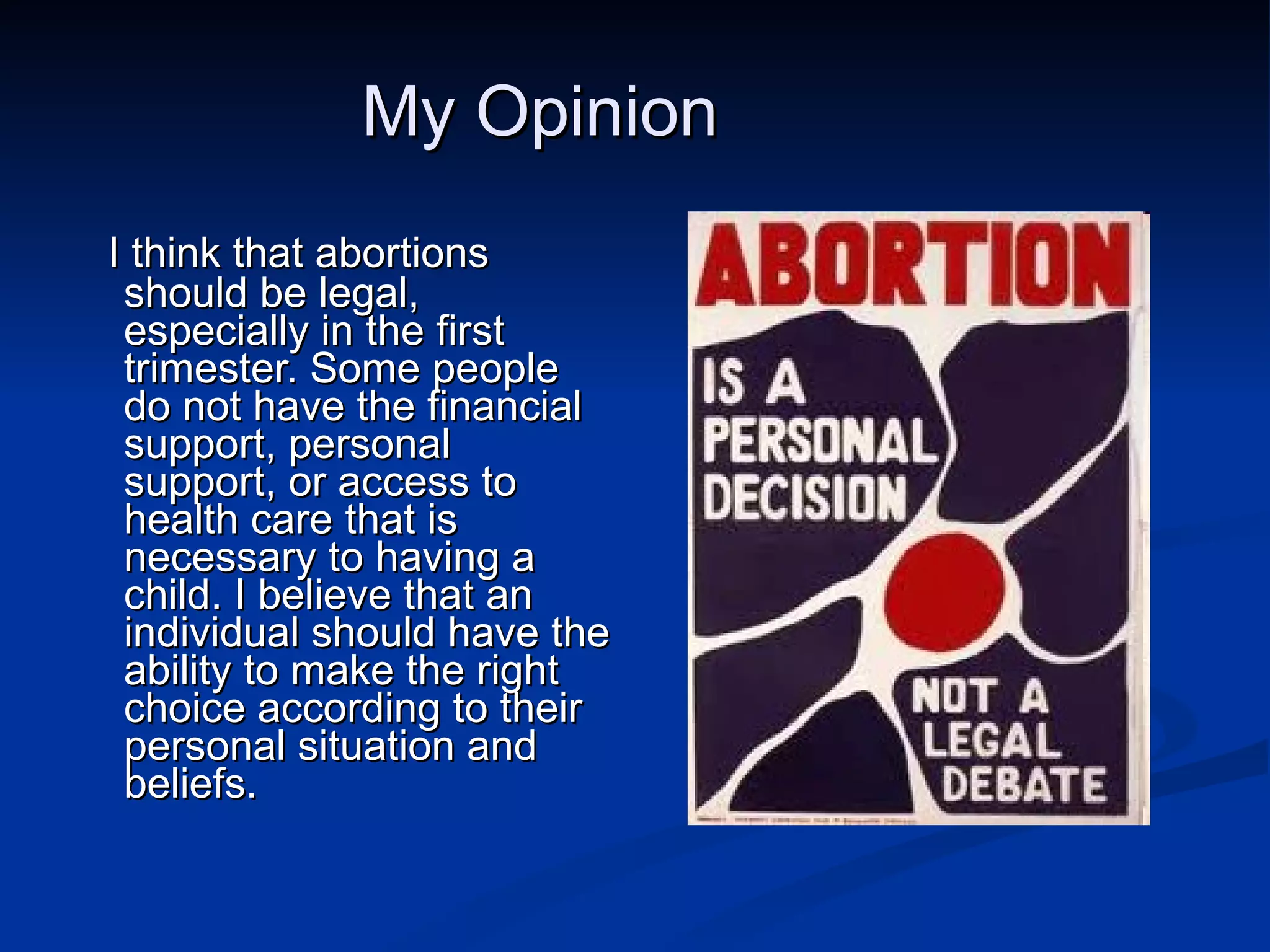
My Opinion Ithink that abortions should be legal, especially in the first trimester. Some people do not have the financial support, personal support, or access to health care that is necessary to having a child. I believe that an individual should have the ability to make the right choice according to their personal situation and beliefs.
10.
Vacuum Aspiration AbortionUterine contents removed by suction (aspiration) Procedure: Pelvic exam performed Speculum inserted into vagina to separate vaginal walls Cervix is washed with antiseptic solution Tenaculum placed on cervix (thin instrument with long handle; lets clinician hold cervix in place) Anesthetic solution injected to numb cervix; cervix is dilated Thin tube (cannula) inserted into uterus through cervix Cannula is connected to source of suction (electric pump or handheld device) Cannula is moved back and forth to draw out pregnancy tissue
11.
(vacuum aspiration continued)Used for most first-trimester abortions Low risk of infection/injury Risk of death is 1 in 160,000 May feel mild to intense cramping from uterus contracting and emptying Cramps should lessen after cannula is removed
12.
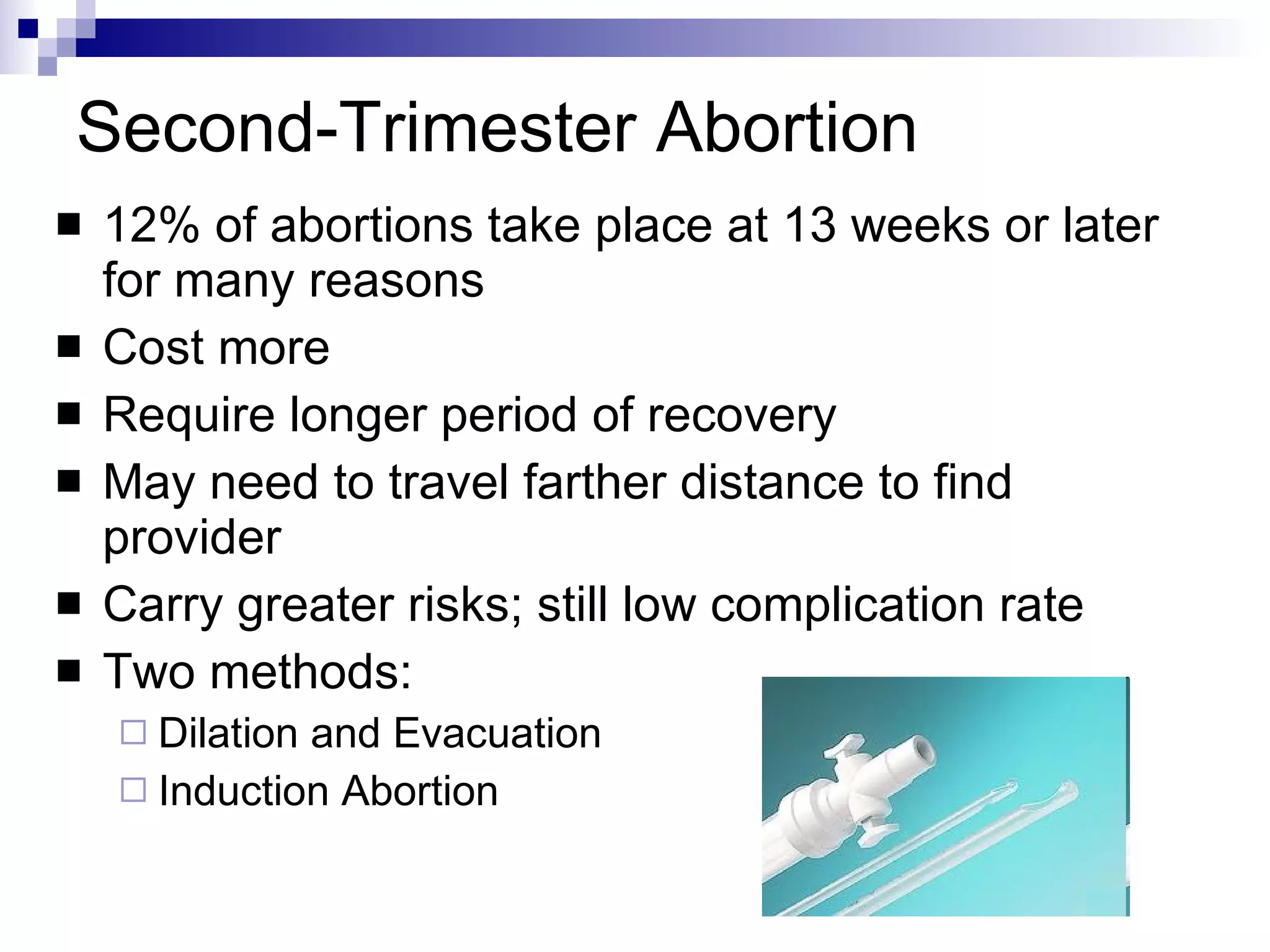
Second-Trimester Abortion 12%of abortions take place at 13 weeks or later for many reasons Cost more Require longer period of recovery May need to travel farther distance to find provider Carry greater risks; still low complication rate Two methods: Dilation and Evacuation Induction Abortion
13.
My Opinion AlthoughI do have reservations, I still believe second-trimester abortions should be allowed because some women do not even realize they are pregnant until this time. However, I do think that there should be a cut-off as to the number of weeks the woman is into the second-trimester.
14.
Dilation and Evacuation(D&E) Most common method of second trimester abortion Removal of fetal and placental tissue with combination of suction and instruments Quicker method Does not require hospitalization Do not have to go through labor (physically and emotionally stressful)
15.
(Dilation and EvacuationContinued) Procedure: Cervix dilated in process similar to vacuum aspiration, but done in advance because pregnancy is farther along Osmotic Dilators (thin rods inserted in cervical opening that absorb moisture and expands, stretching cervix) or Misoprostol is used May be given pain medication or sedatives After dilation, clinician removes fetal and placental tissue using vacuum aspiration, forceps, and a curette (small, spoonlike tool) Strong cramping as uterus is emptied
16.
Induction Abortion Medicationsused to cause uterus to contract and expel pregnancy Each woman’s experience is different Painful contractions can last hours to days May have to have it done in ward where other women are giving birth; bring support system Preparation similar to D&E Plan for overnight hospital stay
17.
(Induction Abortion Continued)Procedure: Medications used to induce labor given in various ways: Prostaglandin suppositories/Misoprostol tablets inserted vaginally every few hours Oxytocin given through IV line Prostaglandins may be injected into arm Saline and Urea may be injected in abdomen into amniotic sac May be given medication afterwards to manage pain
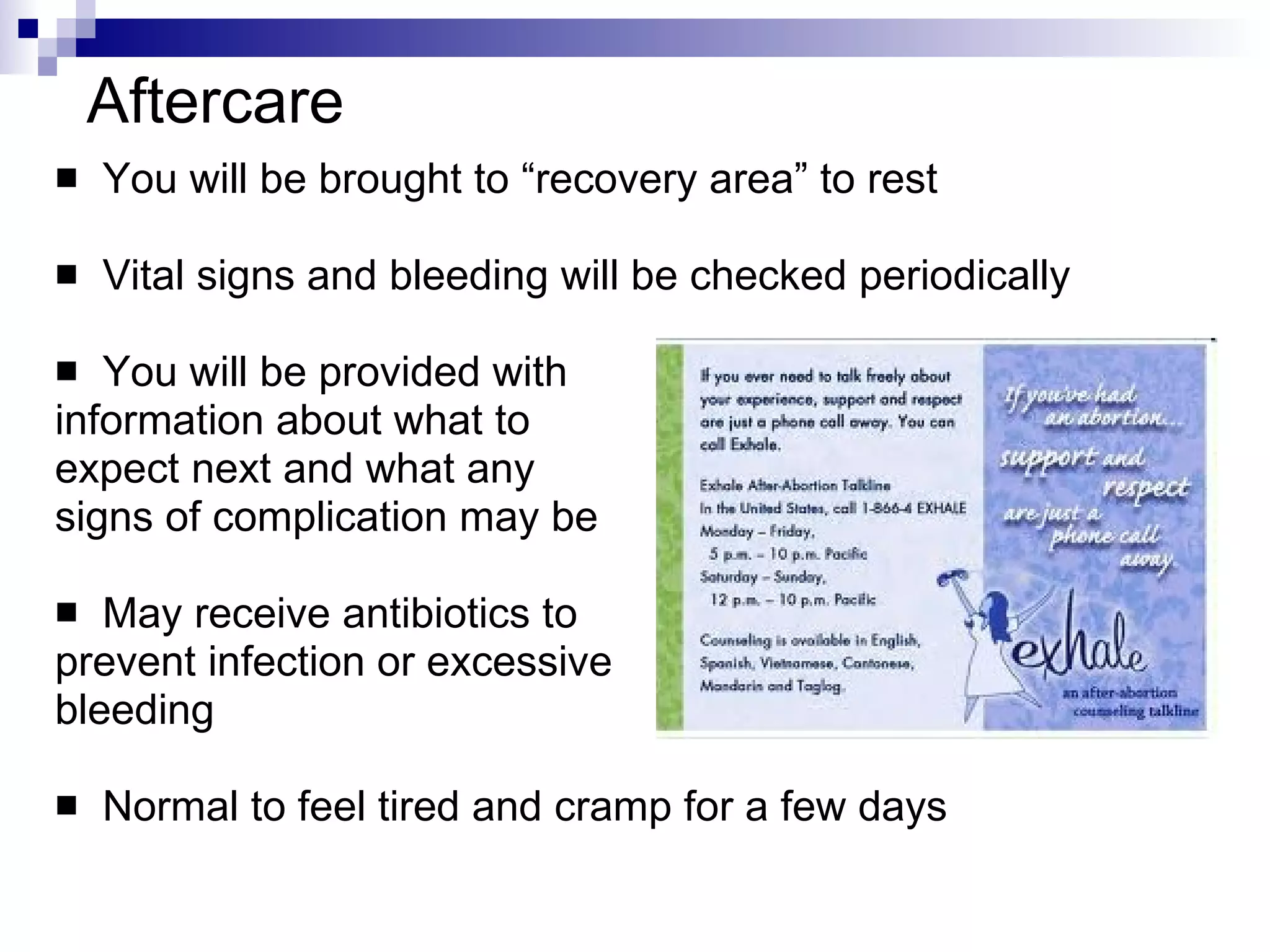
Aftercare You willbe brought to “recovery area” to rest Vital signs and bleeding will be checked periodically You will be provided with information about what to expect next and what any signs of complication may be May receive antibiotics to prevent infection or excessive bleeding Normal to feel tired and cramp for a few days
20.
(Aftercare Continued) Canget pregnant shortly after abortion; use of reliable birth control is important Ask provider about different forms of birth control Follow-up appointment will be made for 2-3 weeks post-abortion Emotions may be a mix of negative feelings and feelings of relief May be told to avoid heavy lifting, exercise, baths, swimming, tampons and vaginal intercourse
21.
The History ofAbortion Practiced legally in U.S. until 1880 Banned at this time unless necessary to save a life Part of backlash to suffrage movement; an effort to control women Way for medical profession to control women’s health care Declining birth rate among whites concerned government about “race suicide” Still widely practiced illegally Economic status, race, and location heavily effected safety of illegal abortion The poor were at the mercy of incompetent doctors or dangerous self abortion methods were used (insertion of coat hangers into the vagina, etc.)
22.
(History of AbortionContinued) Groups formed to help women obtain abortions Jane Collective; Clergy Consultation In the 1960’s following Civil Rights Movement, women began to organize Abortion was major issue in movement Activism led to several states allowing abortion New York was first state to legalize abortions up until the 24 th week of pregnancy Government allowed states to issue individual restrictions
23.
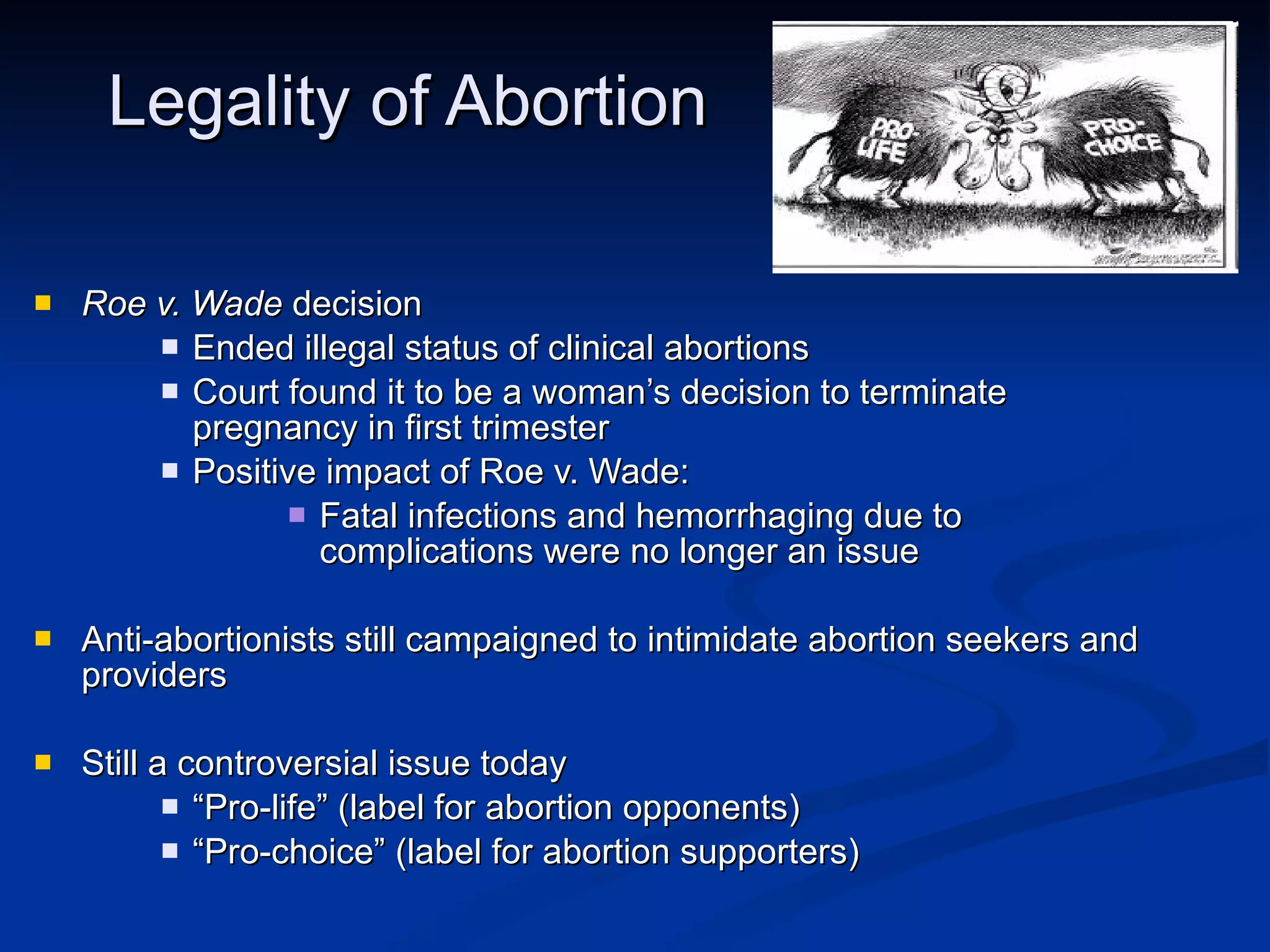
Legality of AbortionRoe v. Wade decision Ended illegal status of clinical abortions Court found it to be a woman’s decision to terminate pregnancy in first trimester Positive impact of Roe v. Wade: Fatal infections and hemorrhaging due to complications were no longer an issue Anti-abortionists still campaigned to intimidate abortion seekers and providers Still a controversial issue today “ Pro-life” (label for abortion opponents) “ Pro-choice” (label for abortion supporters)
24.
Abortion Worldwide About46 million abortions occur yearly; about half are unsafe 95% unsafe abortions occur in developing countries 20 million unsafe abortions performed annually Approximately 13% preventable maternal deaths are due to complications of unsafe abortions 25% world’s population lives in countries where abortion is highly restricted (Latin America, Asia, Africa)
25.
“’ I hadan illegal abortion, which led to infection, and I was close to death. I ended up in a legal hospital with a real doctor who managed to pull me through. Thank god the pregnancy was terminated. All this rubbish about guilt feelings is just that. Ask me if I would do it again knowing the risks- YES- absolutely. Thank heaven it’s legal now, so women don’t have to endure life-threatening situations,’” (Abortion 407) Are you pro-life or pro-choice? What is your reasoning?


![Apporach to lung biopsy [Auto-saved].pptx latest](https://cdn.slidesharecdn.com/ss_thumbnails/apporachtolungbiopsyauto-saved-251211225655-93258539-thumbnail.jpg?width=640&height=640&fit=bounds)
